Tomorrow, Thurs Sept 22, is the beginning of Fall, or Autumn as we called it in the UK and SA. Time to take stock of what’s growing.
Apple production is ending and the Anna, top left, and Ein Shemer, top right, are almost all gone. It has been a good 2.5 months of apple eating since the Pristine became available early July.
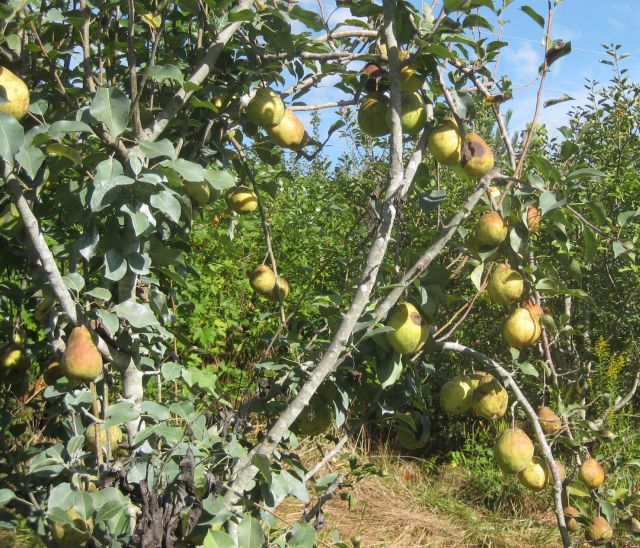
Although the Asian pear is almost done, the other pears are still turning out large, sweet pears and as long as we cut out the bad bits, they are a treat. M. is concerned to see occasional worms emerge from our greens and fruits. She agrees such travelers are never seen in store bought produce and I think she buys in, reluctantly, to my suggestion that if the store bought stuff is so toxicated that the little guys abhor it, why should we big guys be so keen to eat the stuff. It is pleasant indeed to pick breakfast and lunch fresh from the trees and growing beds. And I enjoy eating the fruit with the skin, which I will not do with store bought fruit.
just some of the abundant pears, excise the black spots and it’s delicious
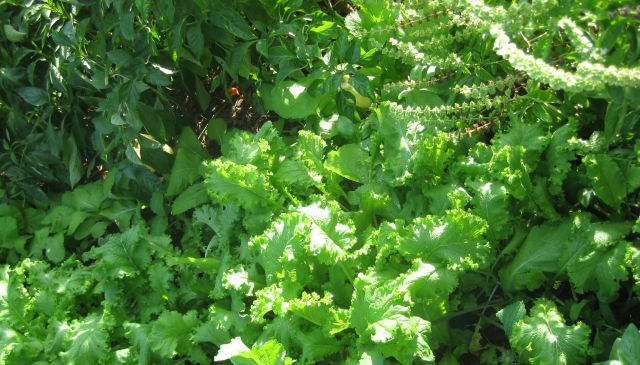
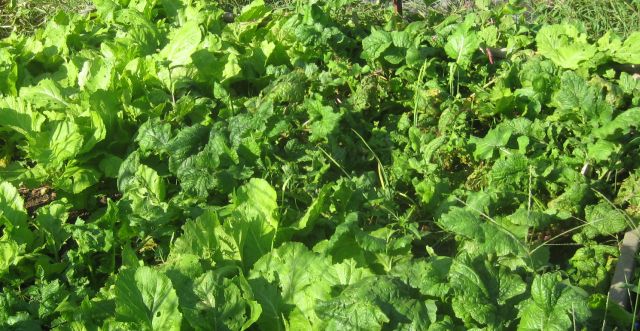
The cooler weather and recent rains have bolstered the greens.
basil top right, sweet peppers top left and lots of mustard greens
And there is little pest or disease pressure.
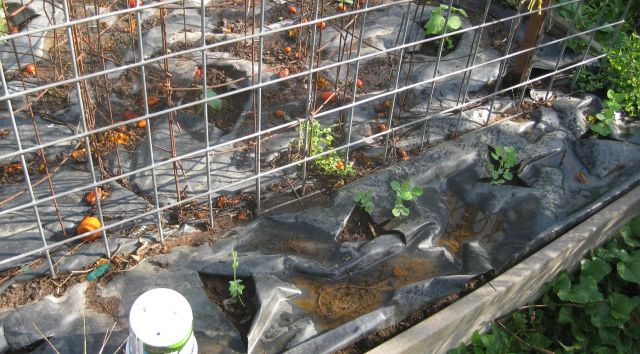
I am having difficulty with rabbit(s) which nail my pea seedlings shortly after they emerge. I am designing an enclosure which I will 3D print which admits sufficient sunlight, rain and air, is well anchored from rabbit nose nudges, and provides adequate protection. In the meantime I keep trying.
these seedlings have not yet been discovered, the yogurt container is one stratagem to dissuade the rabbit
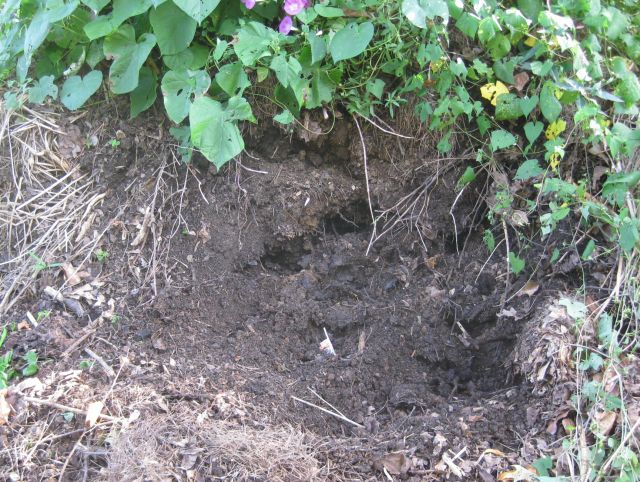
And since my rainwater tanks are well filled and it is cooler, I am transitioning more raised beds from fallow to production. First stop is the compost heap.
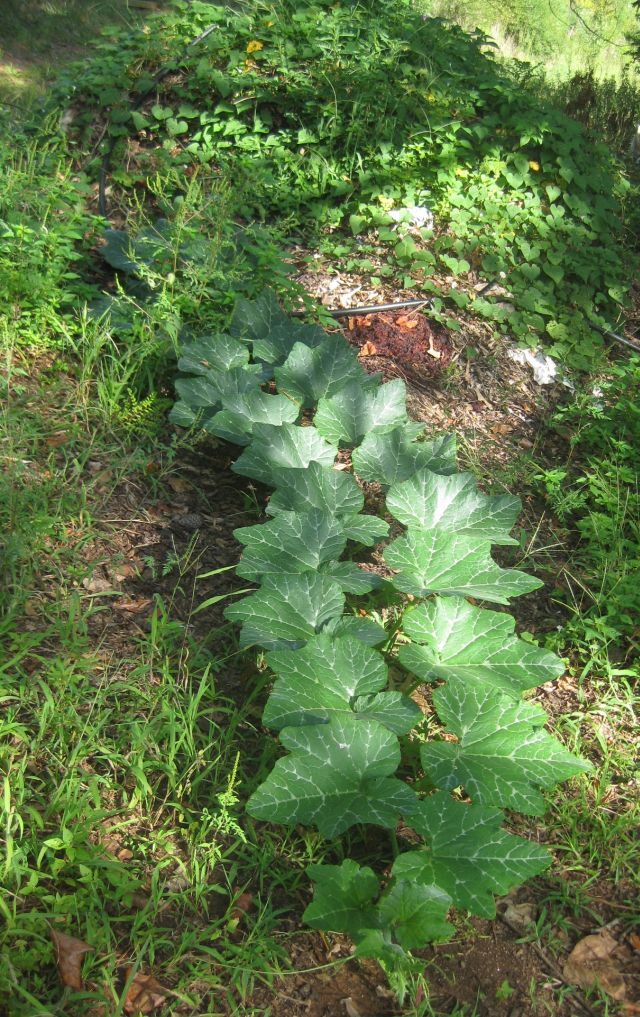
the compost heap should be turned but there is a vigorous butternut vine arrowing from the heap to the sunlit areas and we would like it to finish producing its butternutthe butternut plant self seeded and is vigorous and beneath its leaves is butternut
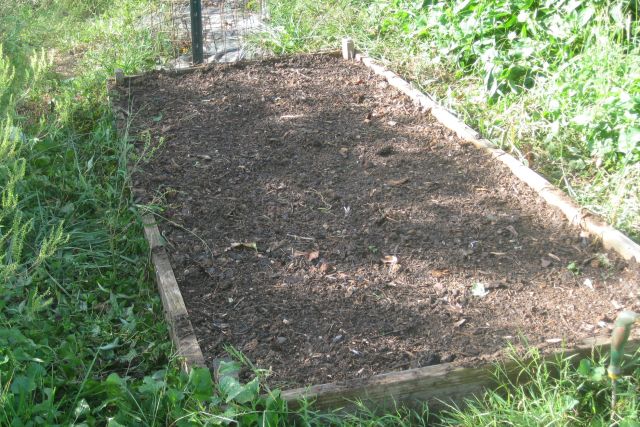
If the lettuce does not survive the rabbit I shall have to enclose the bed or trap the rabbit.
We have been enjoying water melons and cantaloupe though some were picked too early. It is a dicy business judging when to pick – leave it a few days too late and someone else burrows into the sweet flesh.
this one should be ready and I will pick it tomorrow
In my recent post on September 4 I described the installation of a whole house filter, see schematic below.
pipes, fittings and the filter which I installed
Since this was the first time I was using pex, I was concerned there could be a rupture or seepage in the basement during the night when I was not at the house and so I disconnected power to the well pump which is located deep in the ground. The following day when I switched on the power I was surprised that the pump had to run for some time to charge the expansion tank. I thought there could be a leak and, yes the outside faucet was leaking. I repaired the faucet, disconnected the power that evening and the next day no water emerged from the kitchen faucet and again the well pump had to refill the expansion tank. So I visited the other outside faucet which was fine and all the faucets in the house and the washing machine connections and listened to the toilets, and all seemed fine. I gloomily concluded that the check valve in the well was leaking and the water in the expansion tank was leaking back into the well.
My searches on the internet advised that adding a second check valve just before the expansion tank was not a good idea and that I should have the pump pulled and replaced (minimum cost $1,200 if done by contractor) or there could be a leak in the line from the house to the well head or the well head to the pump. But was this really the reason?
I decided to use available instruments to determine the cause. I shut off the water valve at C (the valve at A is always closed) and disconnected the power to the pump and noted the psi pressure reading at E and time of observation. I did not use any water and 50 minutes later was surprised and relieved to see the psi had not budged. So this meant that no water was leaking back to the well. I connected power to the well pump, opened C and allowed pressure to normalize and then closed C and noted pressure at D. Even as I watched, the meter at D slowly rotated to 0. So there was a leak somewhere and my valuable well water was being squandered. Again I visited all the outlets but this time, instead of listening to the toilets I removed the cover of each toilet. And in the last toilet the water was silently overflowing into the overflow tube because the float was not shutting off the fill valve. This will be a quick, easy and inexpensive repair and far, far better than having to deal with a bad well check valve. And with hindsight, the diagnostics to perform were obvious, but isn’t that always the case with hindsight?
serendipity
Common sense is important but a little luck along the way is always welcome. Yesterday at 4.30am, when I was away from the logcabin, my smart phone began chanting I had received a text and it was a “security event zone 2 alarm” at the logcabin which meant something triggered the sensor in the kitchen and my neighbors were being awakened from their slumbers. I quickly shushed the alarm and looked at the cameras and all was well and so I reset the alarm. Zone 2 has been triggered twice in the past 3 months and at the time of one of the triggerings a camera in the kitchen captured a large moth flying in the room. Was it again the moth?
This time the cameras were silent but it could still have been the moth since the camera and and the sensor are in different parts of the room. I decided to open the sensor case to lower its sensitivity and, to my surprise a small spider emerged from inside the cover of the sensor. I now think that this spider was hanging out in the sensor case and it triggered the alarm by crossing the face of the sensor. I removed the spider and some nearby webs. Hopefully this solves the zone 2 alarms. And it was serendipitous, since I was not looking in the sensor case for an inhabitant – but I will take luck anytime.
6 years ago I wanted to receive TV via antenna. We have DSL and I can access Netflix and YouTube etc. but not local stations. I positioned the antenna facing south (Atlanta’s direction) about 20 feet off the ground and connected a cable from the antenna to the cable attached to the previous owner’s dish receiver, and in the winter received a few stations. Since I have digital TV and the signal is digital I do not require a converter box. In the summer reception fell off because the trees grew leaves. I lost interest in the project. Now I have re-engaged.
some technicals
I input my street address at website “antennaweb.org” and it tells me which stations can be accessed and their direction relative to my house. Most are from Atlanta about 40 miles distance. The website “tvfool.com” provides more detailed analysis of nearby channels including the signal strength (Noise Margin decibels– NM(dB)).
I have grappled with but never understood dB (decibels) which is a measurement of the intensity of sound. It is about logarithms, a weak area for me, except that I remember that instead of multiplying two numbers you can take their logs and add them together and the antilog gives the result of multiplication. If the intensity of sound falls by half so the output is (0.5), the input, this is described as a 3 dB fall – the log calculation is 10log 0.5 i.e. take the log of 0.5 and multiply by 10 and the answer is -3.0dB. As the TV signal wends its way through the house to the TV it loses strength – if you wish to power 2 TV’s you use a splitter to split the input into 2 outputs and a consequence is the signal is reduced by half which is 3dB (usually 3.5dB is used in calculations). If 100 ft of RG-6 cable is used and the frequency carried is 700MHz, there is a further loss of 5.6dB, so total loss is 9.1dB (-3.5dB-5.6dB). If you add an amplifier at the antenna end which has a rating of +8dB, then the net loss is 1.1dB. So a nice feature using dB is you simply add up the gains and losses and ensure your signal strength is not too diminished on its way to the TV. You could also use a dB signal meter which is now offered for <$100 (used to be >$500) but not worth the investment for one time use.
I mention that signal loss in the cable is affected by the frequency carried. The impact is significant – for example the attenuation (reduction) to a 50MHz signal on 100ft RG-6 is 1.4dB and for a 900MHz signal is 6.0 dB. A 200ft cable has twice the loss, a 50ft cable half the loss. Which raises the question – what is the frequency of the stations I receive?
There are two bands VHF and UHF. VHF for the 2 stations I receive, has frequency range between 174 and 216 MHz, and the UHF frequency range is between 470 and 890 MHz. Almost all the channels I receive are UHF. So when I design my system I have to ensure it will adequately handle frequencies up to 900 MHz.
back to installation
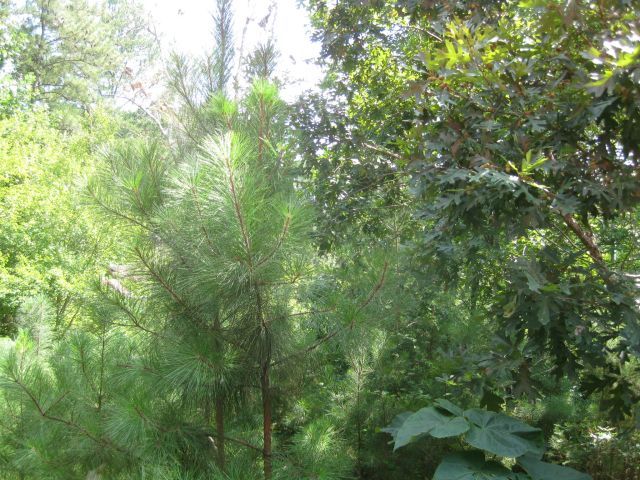
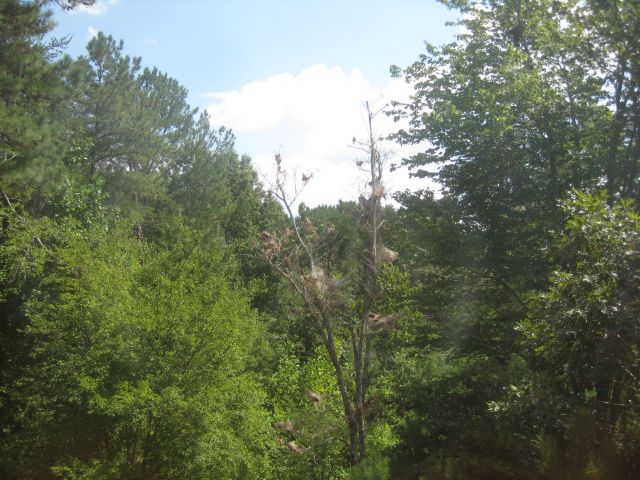
As mentioned, in summer the view of the antenna was blocked by branches and leaves, shown below:
horizontal summer view from old antenna location, 12 ft above ground level
Rather than attach the antenna to the chimney (lightning hazard?) or locate in the attic (signal interference from steel roof?), I moved it to a south facing dormer window.
horizontal summer view 24 ft above ground level
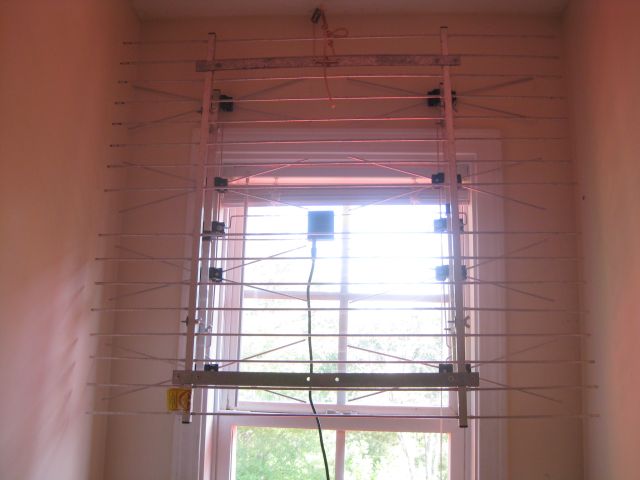
The old antenna was too wide so I snipped off a couple of inches from each side and suspended it from the ceiling.
the width reduced antenna suspended from the ceiling in the dormer window bay
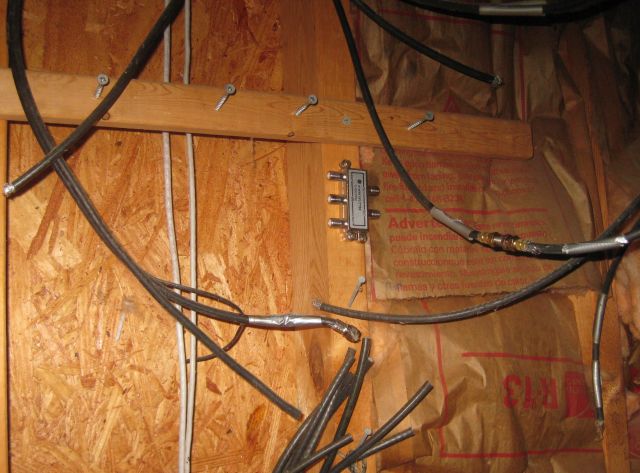
Next step was to connect the antenna to the TV in the living room. I decided to use the existing RG-6 TV cables in the house since every room had been wired for TV and there was a nearby outlet. I connected a battery to the outlet and headed for the basement and located the cable which carried 9 DC volts. I did the same in the living room and then knew which 2 cables to connect.
the connected cables are middle right
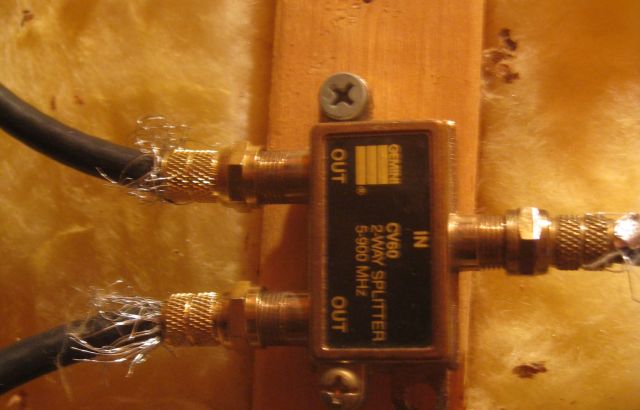
Not knowing better at the time, I used 2 splitters – 1 for connecting upstairs cables and 1 for the basement cables.
a splitter with antenna signal entering on right & 1 output to upstairs room and 1 output to basement
I instructed the TV to scan for digital channels and it found 8. I thought I could do better and decided to eliminate the 2 splitters since I was only using 1 TV in the house, and directly connect the cables together.
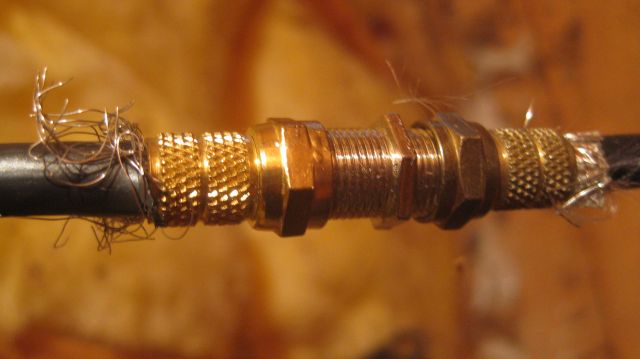
direct connection of the cables
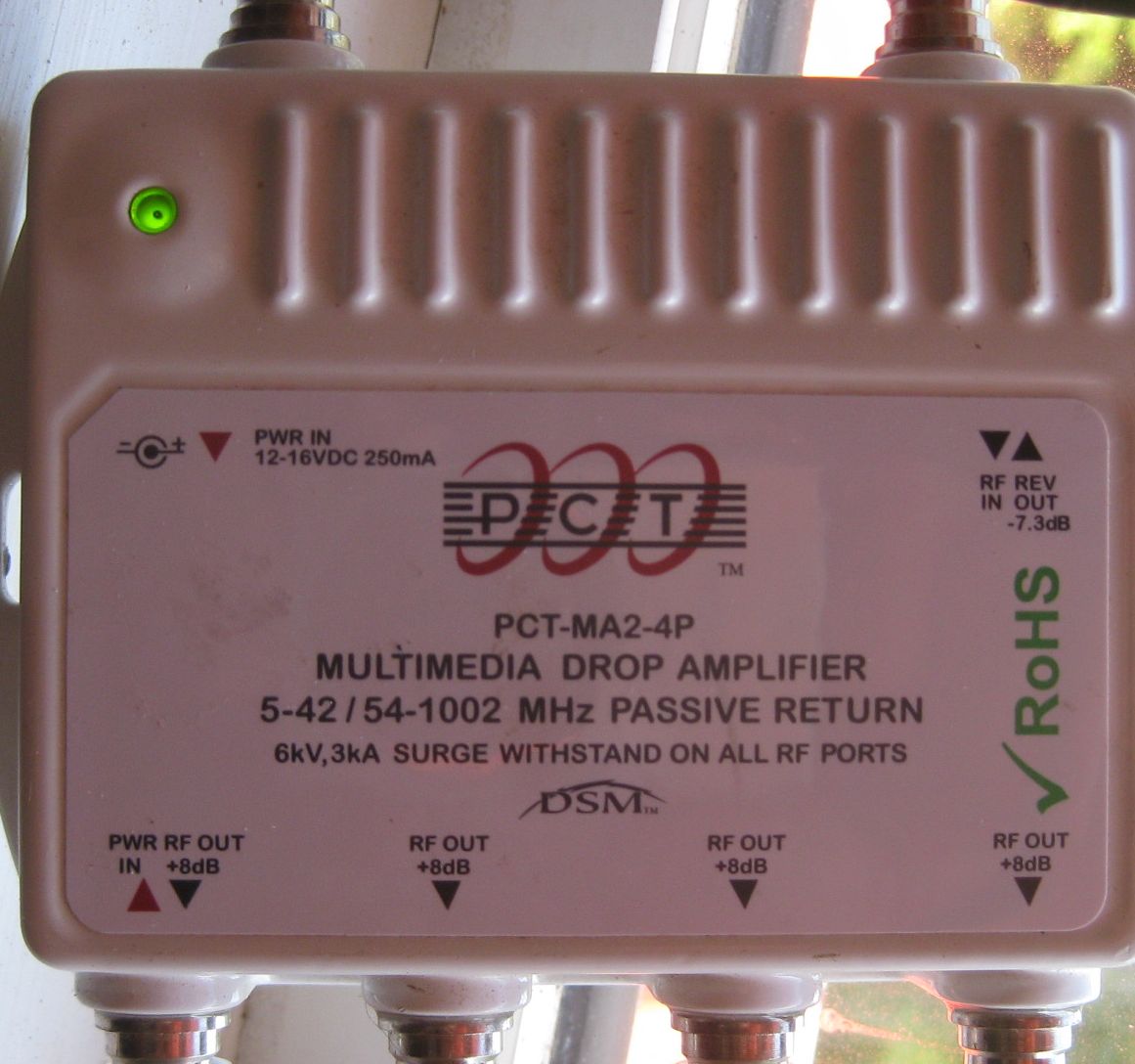
The TV now located 18 channels. I was on a roll. I remembered I had once purchased a signal amplifier so I connected it at the antenna end and the TV was now able to locate 34 digital channels.
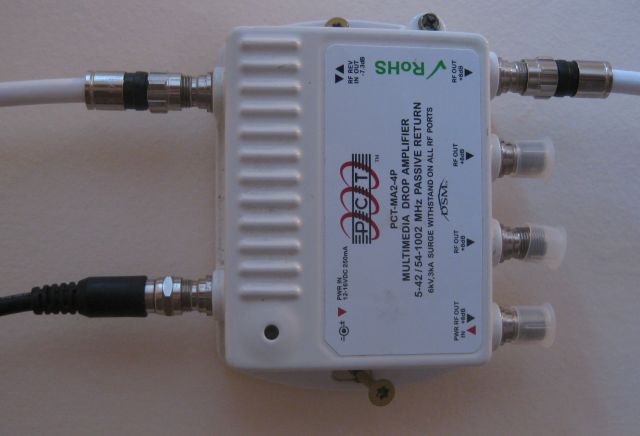
signal amplifier, you can see it enhances the signal by 8dB
Could I do even better? This far I had incurred no cost – the screw on cable connectors, stub RG-59 cable and the signal amplifier were leftovers from previous projects. The screw on cable connector not only looks amateurish but has a practical disadvantage – you twist it clockwise onto the cable and then you twist its rotating cap clockwise onto the male thread of the TV or antenna or connector. And the 2nd twisting motion is opposite to the first and unless you are careful you can loosen the grip on the cable and weaken the connection. So I ordered for for about $20 a package containing a stripping tool to remove the sheathing on the cable, a compression crimping tool which compresses fittings on the cable, and blue locking compression connectors. For good measure I also ordered an additional 50 black connectors for about $10. I also decided to replace the RG-59 stub cables with RG-6 which is a thicker cable with better insulation for higher frequency signals and the 20 ft length of black RG-59 in the living room was conspicuous against the white walls. So I ordered 100 ft of white RG-6 for $16. I had now invested just under $50 and was hoping for better reception.
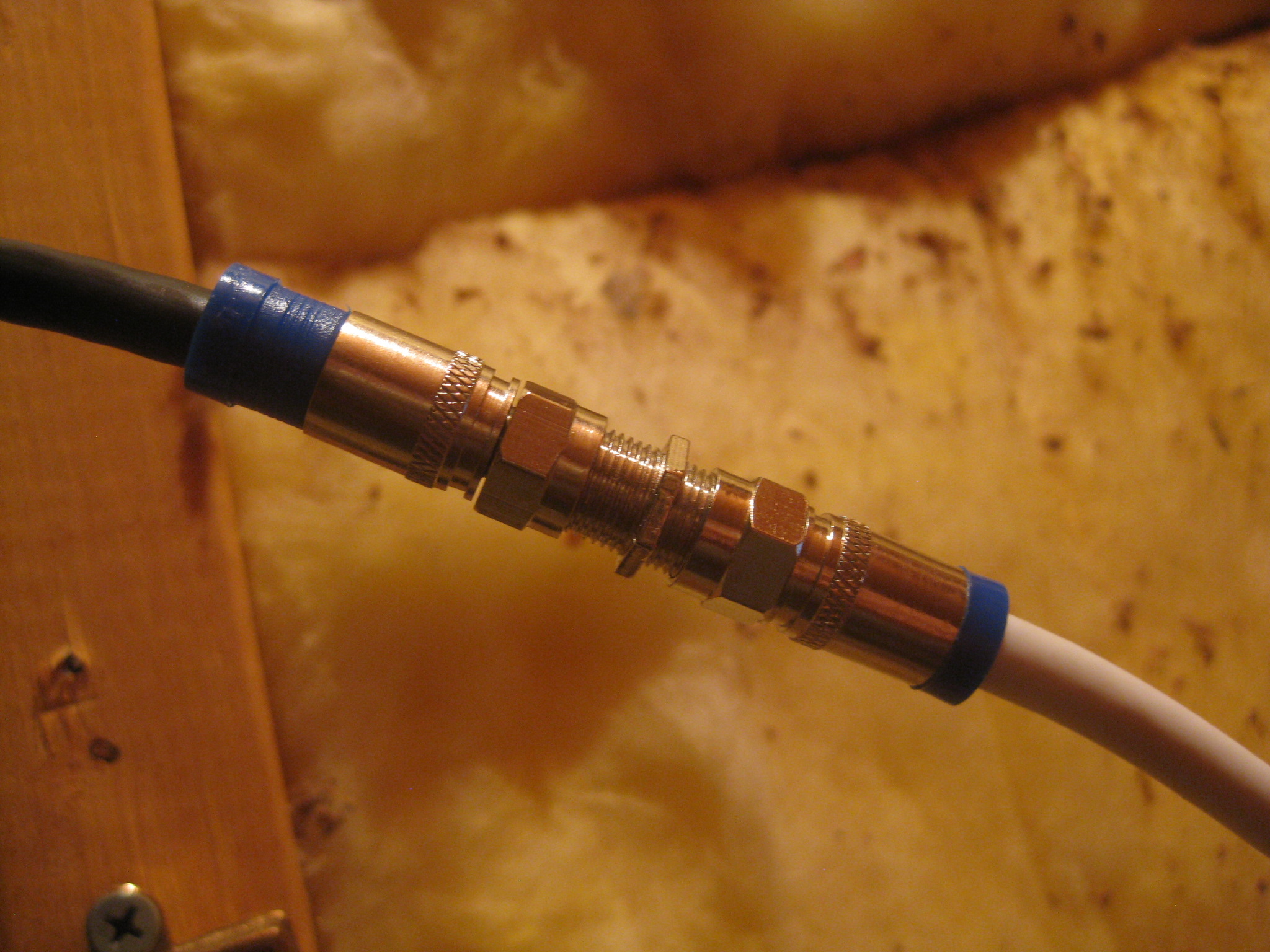
I replaced the 3 stub cables (antenna to amplifier, amplifier to upstairs room cable, living room outlet to TV) with RG-6 cable and the twist on cable connectors with the attractive blue compression connectors. Instead of 34 channels my TV now scanned 14 channels. This was a setback. I remembered the basement connectors were twist on cable and found one was loose and replaced them with blue compression connectors and I now go 18 channels. It seemed one of 3 things could be wrong – the cable was bad, the connectors were bad or my technique was bad. I reexamined all the connections and found one I had forgotten to compress.
my new blue connectors
You can see the connector on the left was not compressed, so I compressed with the compression crimp tool and the TV located 24 channels, 11 less than with the old cable and connectors. I examined the cable and it clearly stated it was RG-6 and I concluded it could not be the problem. Then I examined the blue connectors and found each had a rubber ring inside the threaded female twist cap. The ring probably protects against moisture but it could also block end on end electrical contact. Perhaps this was the problem? So I replaced 9 blue connectors with the new black compression connectors. And…
A few weeks ago M. confronted me in the kitchen with a glass of discolored water. “It’s dirty” she accused. I agreed but suggested if she wanted drinking water she should use the under sink 2 stage filters I installed, which deliver crystal clear water, and not worry about the water from the faucet. She was not appeased and said she would not shower in discolored water nor did she want the dishes or clothing to be washed in the water. We have a deep well I explained so bacteria is not an issue and there was probably a lightning strike which shook up the ground and displaced some sediment.
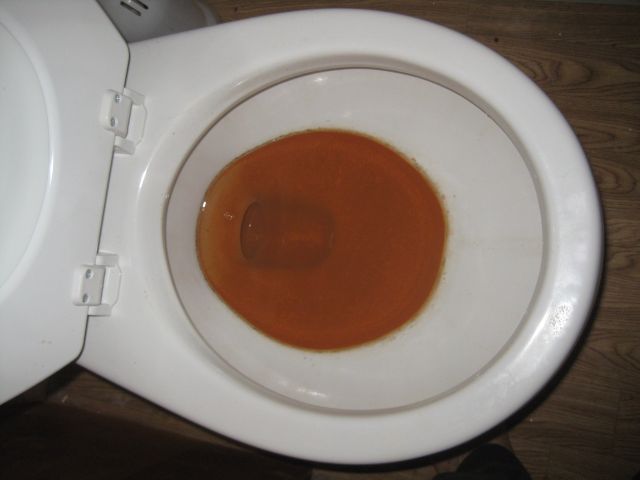
I mentioned this to my neighbor across the road and he said the discoloration was iron in the water and he used a whole house filter and replaced the cartridge every few months. Time for some research, and I found an excellent YouTube video which clarified. Iron in well water which is dissolved or in solution is called ferrous. When exposed to oxygen it precipitates and becomes visible and is called ferric. A sediment filter cannot trap ferrous but will remove ferric. So if you install a single filter where the well water enters the house it will remove ferric but the ferrous will slip by and will precipitate into ferric while sitting in the water heater or the toilet bowl. This solved a puzzle. Our house has an upstairs bathroom which is rarely used. Every few months I flush the upstairs faucets and toilet to ensure there is water in the traps. And the toilet bowl always has red/brown sediment, yet when last flushed a few months previously I had brushed the bowl clean. How did all this sediment get into the bowl? I now conclude the invisible ferrous in the water precipitated into ferric which settled in the bowl.
unappetizing sight – iron sediment precipitated in bowl
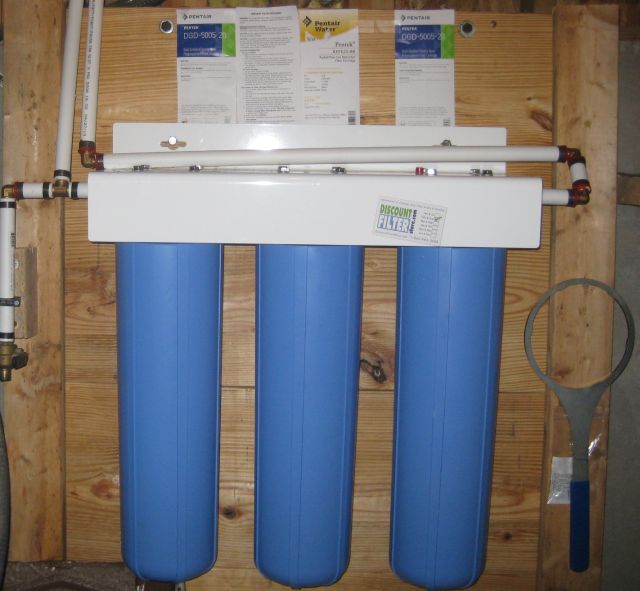
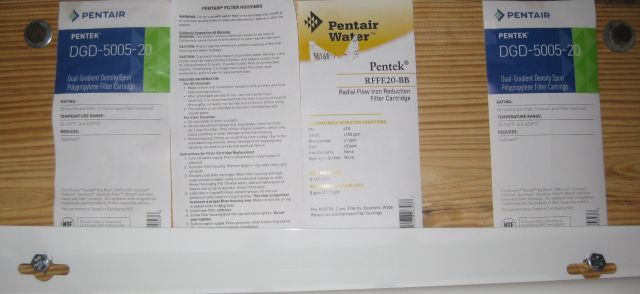
The youtube video recommended 3 filters used in series. The 1st is a sediment filter to trap any sediment and ferric in the well water so it will not clog the 2nd more expensive filter. The 2nd filter (Pentek RFFE-20BB) contains agents (apparently potassium permanganate) which oxidize the water and thereby precipitates the ferrous into ferric. The 3rd filter, like the 1st is a sediment filter which traps the ferric which was produced by the 2nd filter. Pretty neat!
details on the filters – sediment filters on each end and iron filter in middle
Typical filters are 20” in height and enclosed in big blue tubes and therefore called big blue filters. I researched prices and found I could get a better deal (>10% less on a comparable basis) from an independent rather than big A, except for one of the filters which I ordered from big A. A few days later the packages arrived.
Plumbing technicals
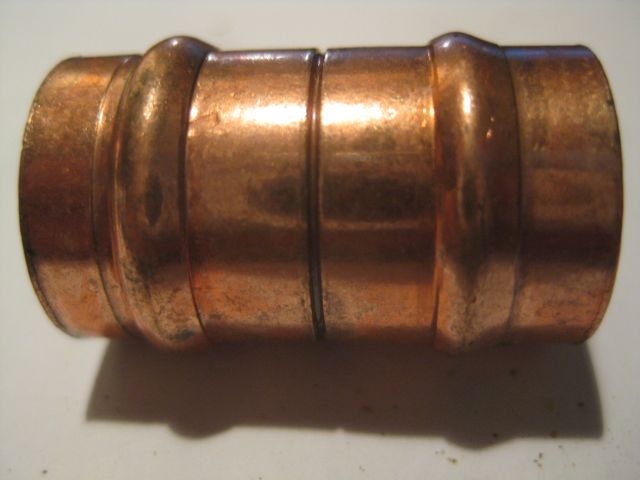
When I lived in London I completely replumbed an old house including installing a gas furnace and 17 radiators and a pump and 3 thermostat controlled motorized valves. I used copper pipe and soldered all the joints except for a few compression fittings. It was much easier to solder a joint in the U.K than in the U.S.A. because, for amateurs like me, there were the wonderful Yorkshire capillary fittings, which had solder rings.
a “yorkshire” fitting
The process was simple – you clean the pipe and the fitting into which it will be inserted, smear both with flux, and then heat with a butane torch until the solder appears at the rim of the fitting where the pipe is inserted. And it always worked and was just as easy for vertical fittings as for horizontal. Here I have often battled establishing capillary action to suck the solder into the joints of larger pipes (1” or greater) and it is frustrating after you have finished soldering to find that one joint leaks. Disassembling the pipes takes time and removing all the water drops also takes time (I used to push bread down the pipes to soak up the moisture and then flush it when all was done). So I was keen to explore alternatives to copper soldered fittings.
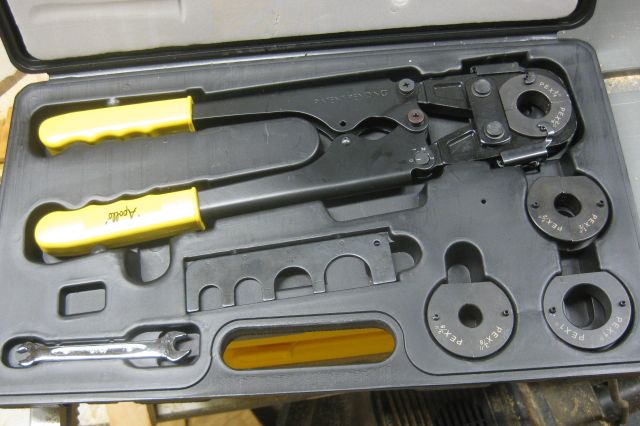
Today there are at least 6 different methods (soldering, compression, glue, pex – cinch, pex – crimp, pex – expander, sharkbite) to connect water pipes and fittings, and there are at least 4 different pipes to choose from – copper, cpvc, pvc and pex. The house has cpvc ¾” pipe and I decided to use pex-crimp and transition with sharkbite. If this all sounds like gobblydegook I will try explain. CPVC is a plastic type pipe, somewhat flexible which is glued into fittings. Unlike PVC, it is good for hot as well as cold water and the glued fittings seem reliable and are cheaper than copper/bronze fittings. But once glued, it is glued and you have to cut the pipe if measurements were off or a change of mind. Sharkbite is expensive but easy to assemble just push the pipe all the way into the fitting and you are done, and it is easy to later separate the pipe from the fitting. And sharkbite is a great way to transition from copper to cpvc or to pex. Pex pipe (a form of polyethylene) is flexible like CPVC. For the pex-crimp method you position (carefully) a copper ring near the end of the pipe, insert a fitting into the pipe, and with both hands position the clamp mouth of a large tool over the ring and (with some effort) close the arms of the tool which crimps the ring tight over the fitting. And then you are done. Pex-crimp is cheaper than sharkbite and a nice feature is you can loose fit and position all the fittings and when you are satisfied then crimp all the rings on the fittings. And after it is crimped you can still rotate the pipe if necessary. And, if you make a mistake (I haven’t yet) you can cut off the ring and re-use the fitting.
my pex crimp ring tool with adapters for 3/8″, 1/2″, 3/4″ and 1″
A disadvantage with pex is the fitting goes into the pex pipe and this reduces the internal diameter of the pipe and impedes water flow more than with copper and cpvc where the pipe goes into the fitting. In London I used a pipe bender for 15mm (0.6″) and 22mm (0.9″) copper pipe which produced wider bends and less water friction than elbow fittings. So now it bugs me to use 0.75” internally restricted pex pipe for the main flow to the house. I considered transitioning to 1” pex but there was less availability and greater cost, so I decided to wait and see.
installation
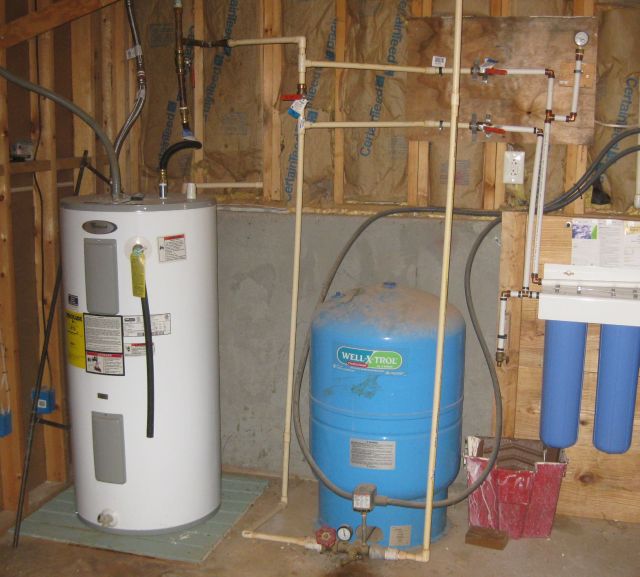
First I had to decide where to mount the 3 stage filter in the basement. It would have been best between the expansion tank and the water heater but there was insufficient space so I reluctantly decided on the right side of the expansion tank. Reluctant because it took the water flow through a number of 90 degree bends.
here is the setup – well water enters blue expansion tank in middle then is diverted to blue filters on right then returns to feed hot water tank and house on left
Next, how to secure to concrete wall. I considered concrete anchor bolts but decided to install a wood wall against the concrete basement wall. I bought a 12ft long, 2” thick, 12” wide (nominal) plank, cut into 4 boards each 3 ft long and stacked them horizontally (see pic above) and held vertically in place by 2×4’s at each end. The top of the top plank rose above the concrete apron wall and I secured it with 7” bolt screws into the base of the vertical wood studs. I screwed the filter housing to the wood wall.
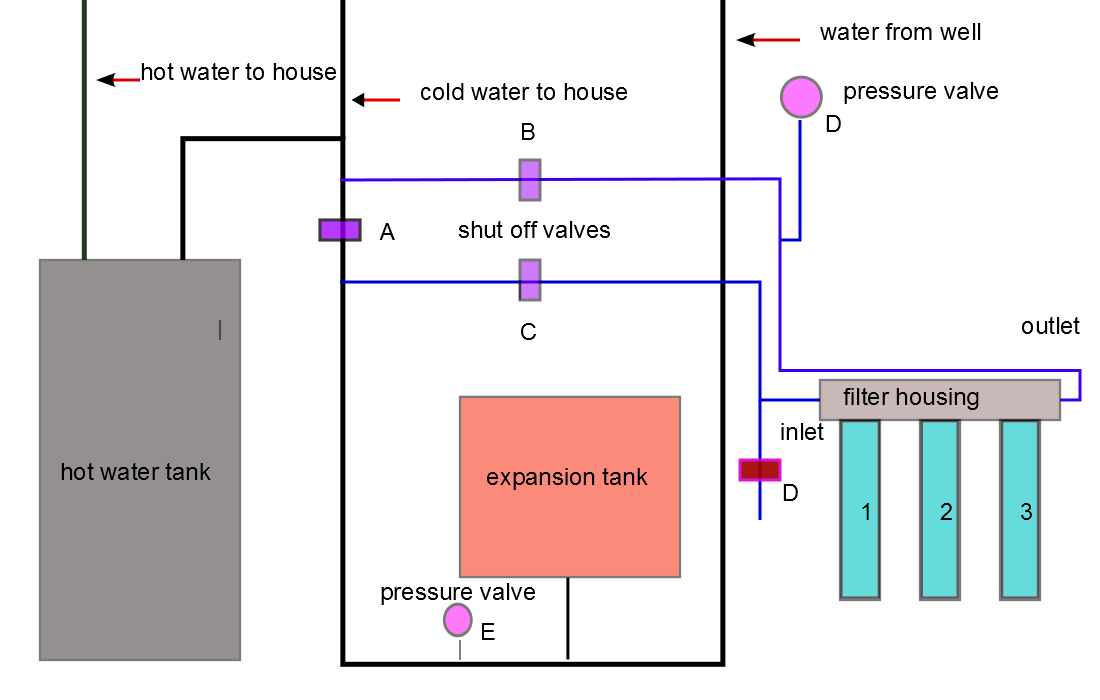
Next for the plumbing. Below is a schematic of the installation:
The blue colored pipe lines are what I installed plus valve A. When valve A is closed, water flows through C to the filters and then returns via B to the original pipe. I can bypass the filters by closing B & C and opening A. I used CPVC all the way to sharkbite valves B & C since I know that glued CPVC will not leak and I am still learning with pex. Pex commences from valves B & C to the filters. I installed a 4th valve at D which allows me to bleed the system (after closing B & C) for removing valves, winterizing the system if I am away, and to inspect the quality of the incoming water. In addition to the existing pressure valve at E I installed another valve at D. As sediment accumulates in the filters there will be a difference between D (higher) and E and when it is greater than say 15 psi, it will be time to change. As previously mentioned filters 1 & 3 are the sediment filters and 2 provides the oxidizing action to precipitate out the ferrous.
Water flow seems fine notwithstanding all the 90 degree turns although I may, one day, replace the line from filter outlet to B with 1″ pex. I bled the water heater and it produced a lot of really brown discolored water which accumulated over the years.
discharging some of the water heater
And now that I have clear water throughout the house I will replace the clogged aerator inserts in the faucet spouts. So far so good.
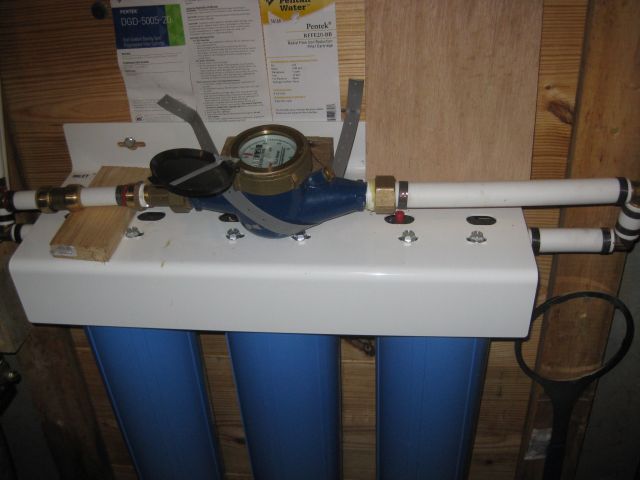
postscript – see my post dated Sept 9 for water loss issue I identified and corrected. Which made me think that I really needed to install a water meter. I happened to have one handy and I used 1″ pex from the filter through 2 90 degree elbows and then returned to 3/4″ pex. See picture below for result.
the new water meter is secured on top of the filter assembly. 1″ pex from filter then 3/4″ pex to house
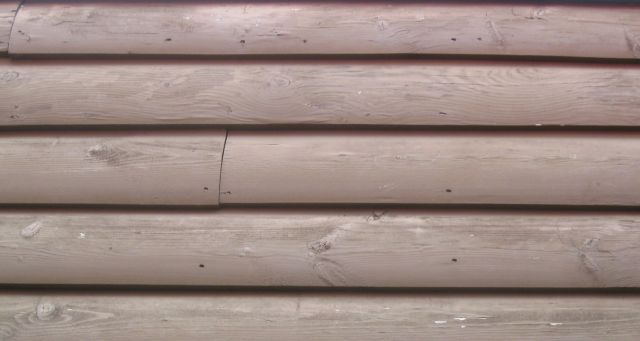
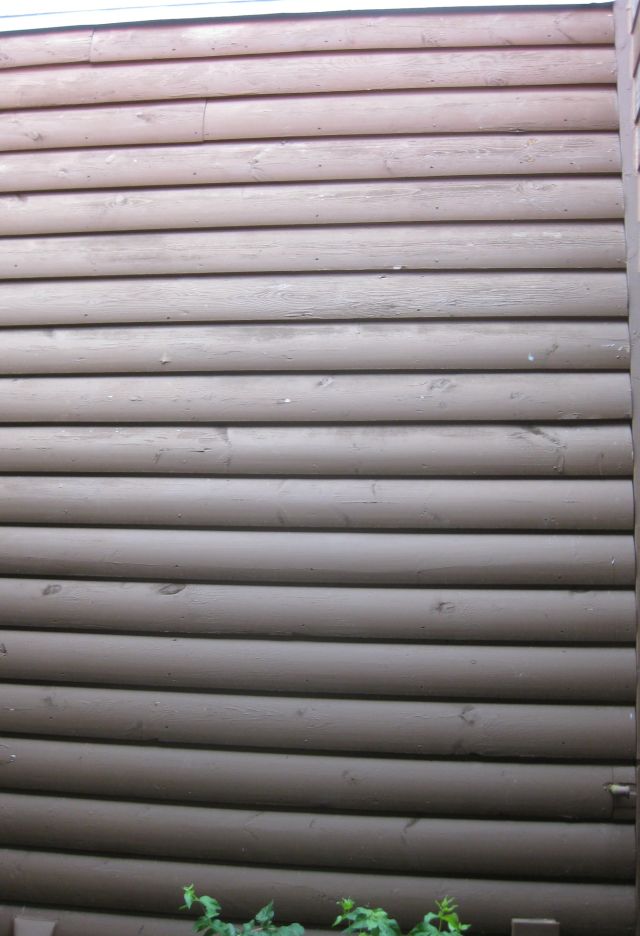
The house on the property has D log wood siding. The “D” describes the shape of the log as seen in cross-section, one side is flat and the other has the shape of a D. The house was built in 2002 and when I purchased it 10 years later the siding was neglected. I engaged a well recommended painting contractor who provided a 5 year guarantee. He recommended, rather than a transparent varnish which would show the wood grain underneath, that we use a block stain which required less annual maintenance. The first day they pressure washed the exterior with a bleach solution – actually sprayed is more accurate since the black mold and loose paint was not disturbed. I took photos showing black mold remaining on the surface and contacted the manager and questioned whether it made sense to paint on top of black mold. With much patience he assured me they were professionals, they had “killed” the mold and it was a good base on which to paint, they knew what they were doing and all would be fine. Each subsequent year paint peeled off and the only comfort was they came back each year and after the obligatory pressure wash/spray ($250) did some scraping and repainted. Aggrievedly they told me they were losing money on each visit. I had little patience. I pointed them to the barn which I had pressure washed and scrubbed before painting and which for 5 years had retained a pristine appearance. They provided imaginative explanations which held them blameless as to why the barn looked good and the house did not. Then the 5 year guarantee ran out and I was on my own.
I try to be self sufficient but scraping and painting from a ladder 3+ stories high does not appeal. And M. provides frequent horror stories from hospital roundings of guys my age who fell off ladders and are now done.
So what to do? I should mention that after the third year, peeling paint was a problem only on the sides facing the summer afternoon sun (west and north). The first two years it was a problem most everywhere because they had not properly prepared the surface before painting. But once they had scraped the loose paint and repainted, it was the sides facing the afternoon sun that deteriorated.
can you spot the difference – the wood top half catches the afternoon sun, the bottom half is largely shadowed by the car port
I remembered in New York I had a similar problem and solved it by applying oil based primer as the foundation on the wood surface and then regular latex paint. Perhaps this would also work in the South?
But who would do a thorough paint job for me? I contacted a local contractor but he didn’t impress and the quoted price for just the chimney and a small area was ridiculous. I spoke to a guy who looked like a painter (skinny, the previous guy was overweight) and he was motivated but did not have insurance. Does my house insurance cover a painter fall? The answer from the broker was confused. I decided if any painting was to be done, the painter had to have adequate insurance. I had my neighbor over who builds log homes and he said wood siding needs annual maintenance and I should go with HardiePlank type siding (allura fiber cement siding) which he could install.
the vexing blunder
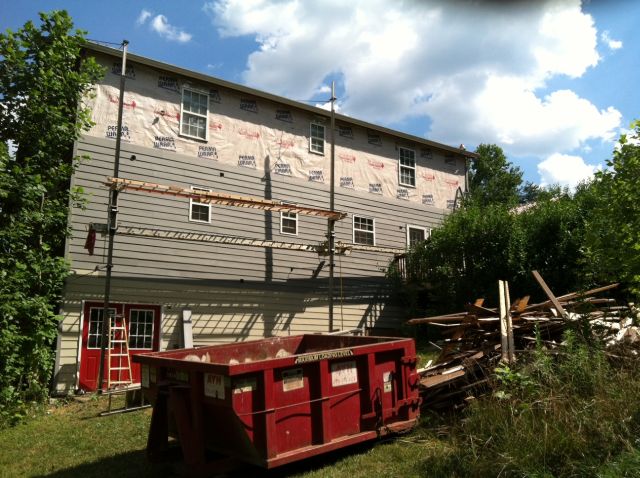
I mulled this over and suggested we leave the D log siding on the lower 2 levels and just do the 3rd level and gables in fiber cement siding. My thought was I could easily maintain the lower 2 levels. He said this would look silly and M. agreed with him, so I gave the go ahead. We agreed on 3 phases – the chimney first, then the long north side and finally the east/west sides. Most of the siding on the south side is covered by roof overhang and is easily accessible and in good condition.
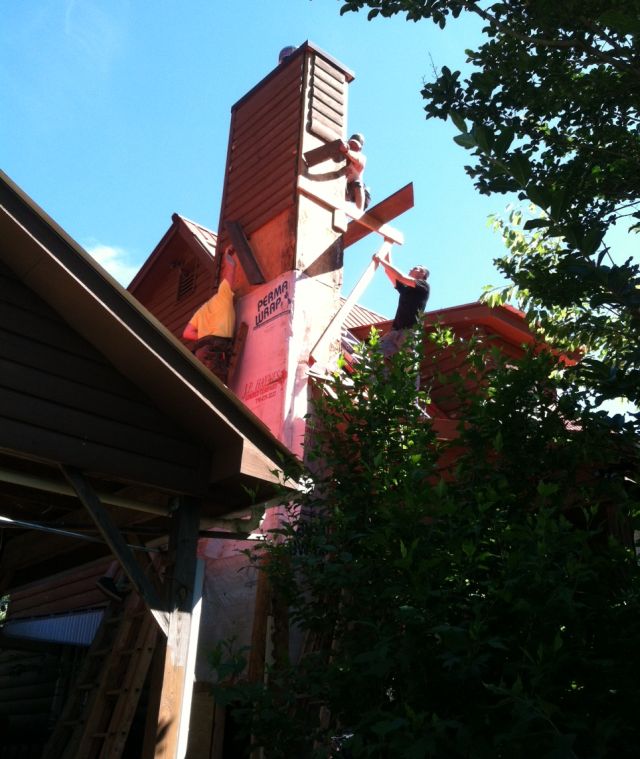
the chimney was intricate and took 2 days, here they are removing the old wood siding
Then came the long side of the house which was also competently done.
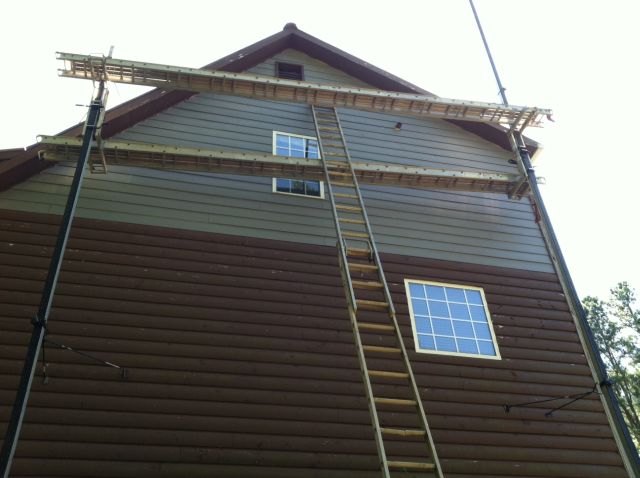
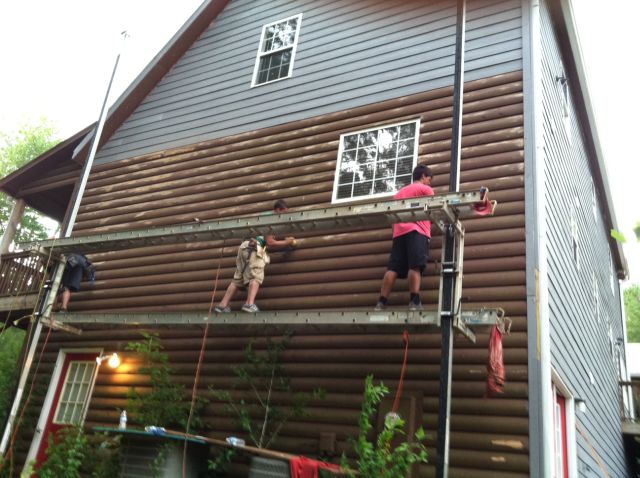
the contractor used pump jack scaffolding – platform is raised by a foot pump operated simultaneously by an individual at each end, and lowered with a hand crank
Weather was in the 90’s and after the north side was done I made an upsetting discovery – the a/c took longer to cool down the house. I went outside and leaned a 5 ft fiber cement siding and a 5ft D log board against the north side of the house facing the sun. Then placed my hand on the sun facing sides – both very hot, then the shadowed sides – the cement board was hot, the D log board only warmish. So the wood board had greater thermal mass and that’s why the house had always been so well insulated in the summer and the winter. I felt sick, my first priority has always been to conserve – energy or rainwater, and now I had unwittingly removed good insulation. I delayed the next phase and pondered what to do. Eventually I decided to have fiber cement board on just the 3rd level and gables of the east and west sides, and leave the wood in place on basement and ground level. And the contractor suggested it would help some if I caulked all the windows and doors which abutted the fiber cement siding (apparently it is accepted practice not to caulk these areas).
the east side is 3 levels plus gables, you can see the paint work on the remaining wood siding has slightly deteriorated
Since the scaffolding would be lowered after the fiber cement siding was installed I suggested extra payment if they would sand and paint the peeling areas. The contractor agreed.
with the scaffolding already in situ, it took little time to power sand the peeling paint areas and repaint and this saved me the chore
Worth mentioning – yes I got proof of adequate insurance coverage, the flashing was also replaced with fiber cement boards and I pre-painted all the siding before it was installed. Finally on the west side I sanded to bare wood all the boards exposed to the setting sun using a 5″Makita disc sander 4,500rpm with #50 and #80 7″ abrasive discs, which produced some circular scarring. I then painted with oil based primer, then latex primer, then 2 coats of acrylic flat paint. Time will tell if this treatment holds up to the fierce Georgian summer afternoon sun.
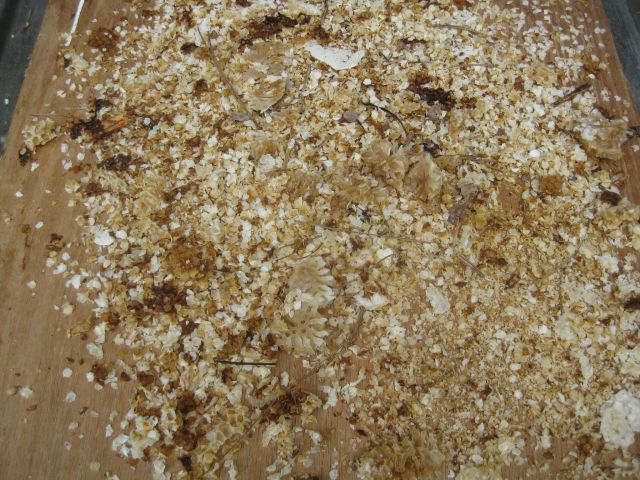
Last week we took about 2.5 gallons of honey from the hive – not a lot since we wish to leave the bees sufficient stores for winter. But enough for our needs for making bread, sweetening our uncooked oatmeal and tea, and a few jars for good friends. Inevitably scraps of wax are left over and what to do with them has been a learning process for me. The first year I placed them in a stainless steel pet bowl outside the hive. Bad idea – the sun heated the bowl, melted the wax and killed bees trying to salvage honey. The next year I added an empty super and placed the bowl in the hive. A few days later when I retrieved the bowl and the super the pissed off bees chased me all the way to the house. The simplest is to put the scraps on a piece of plyw00d near the hive entrance and let the bees take what they wish.
wax scraps cleaned by the bees
And then what to do with the bits of wax?
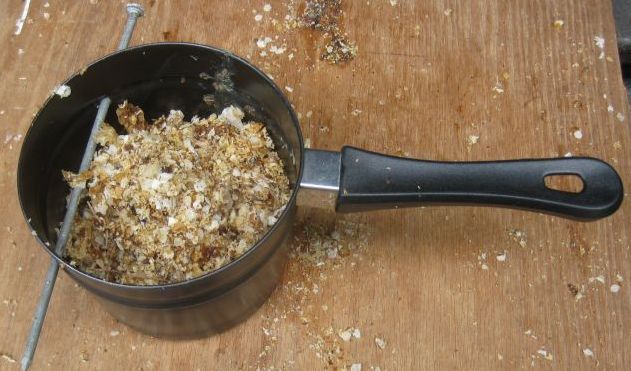
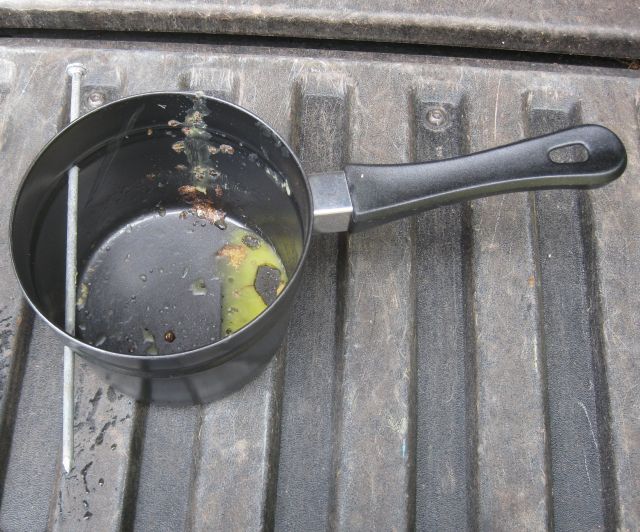
One year I tried gently melting it in a pan over the oven, I turned my back and it all caught aflame. I decided to smarten up and get a double boiler which is a large pot to heat water and a small pot placed inside. But why splurge when we weekly visit the local thrift store. They did not have a double boiler but I found a good large pot ($1) and a smaller pot ($2) which could fit in the larger pot. I solved how to keep the small pot level in the larger pot with the method below.
the pot will only be used for beeswax so driving a nail through the side opposite the handle does not detract from its function
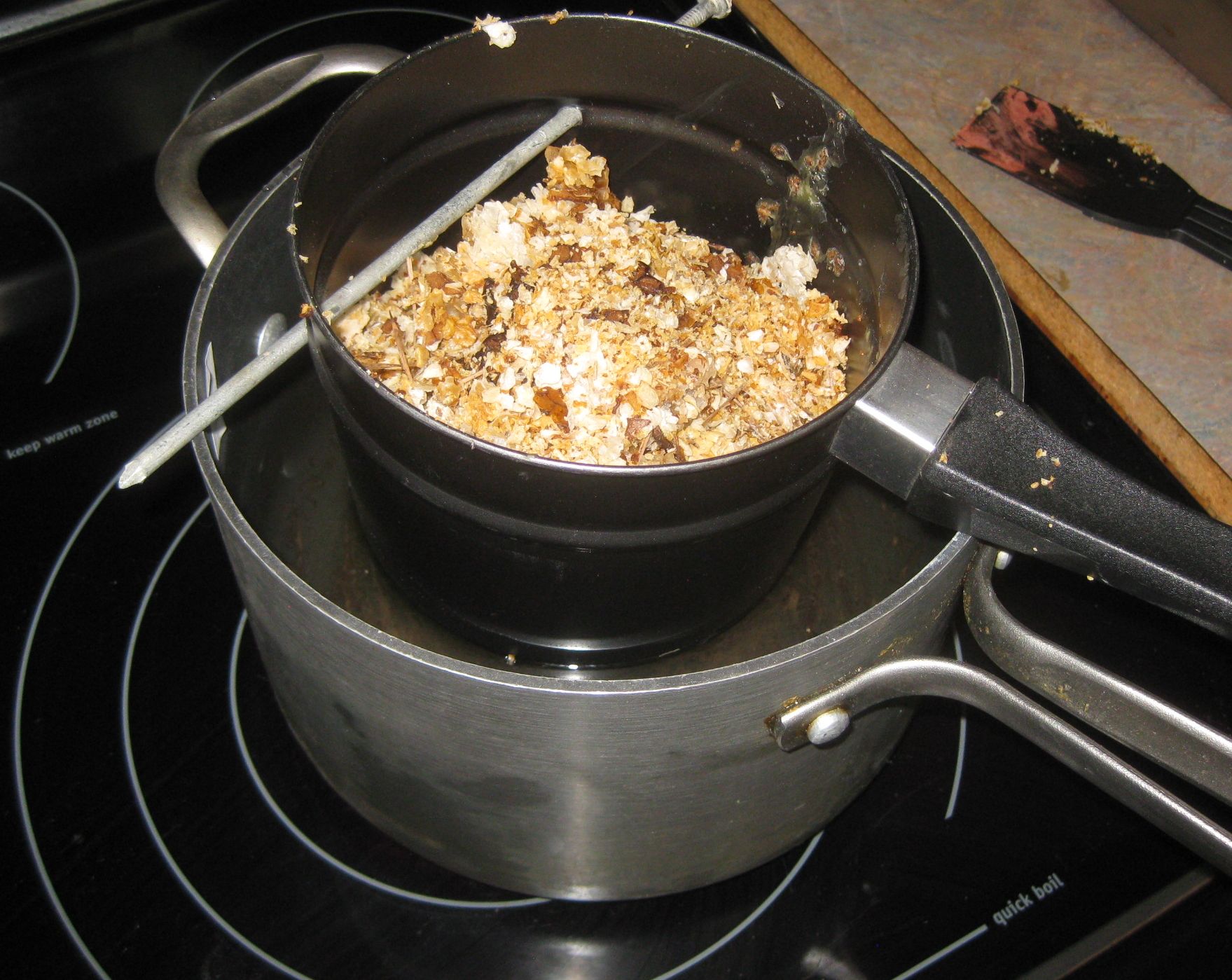
I half filled the big pot with water, inserted the small pot filled with wax scraps, and set the oven to gently boil the water.
once the water reached boil, the wax melted quickly
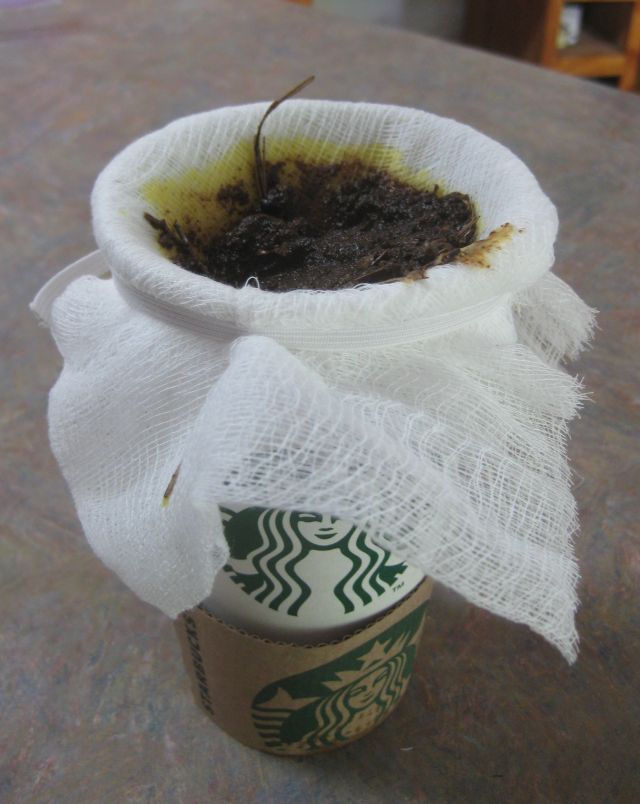
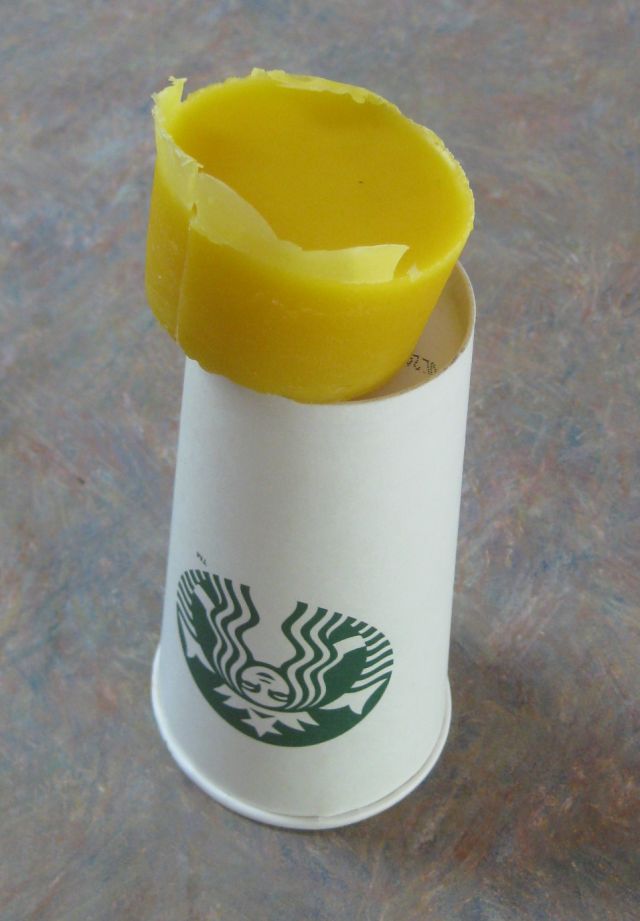
Next I poured the liquid wax through a filter into a mold. Actually it was simpler than it sounds – the filter was cheesecloth folded 4 times secured with an elastic band over a Starbucks coffee cup.
simple setup
The cheesecloth and wax debris I placed in the wood stove for November to start my first fire.
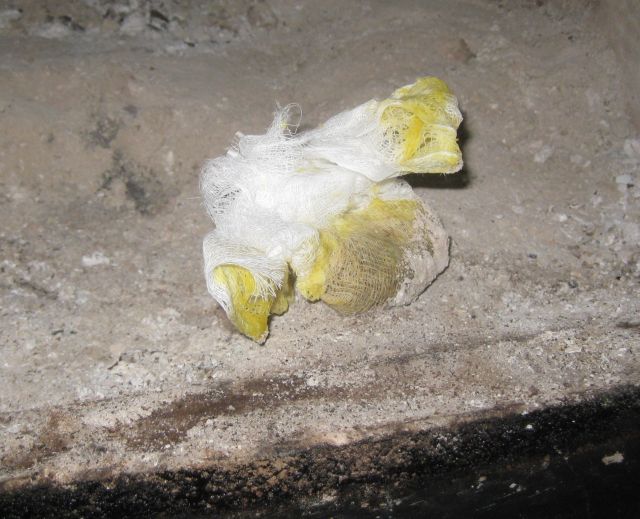
a scrunched bundle of cheesecloth, wax and debris for a fire starter
And the wax I will keep – my father in law used to wax screws before driving into hard wood, I may one day try making Dubbin, a leather preservative used in the UK, South Africa and Canada.
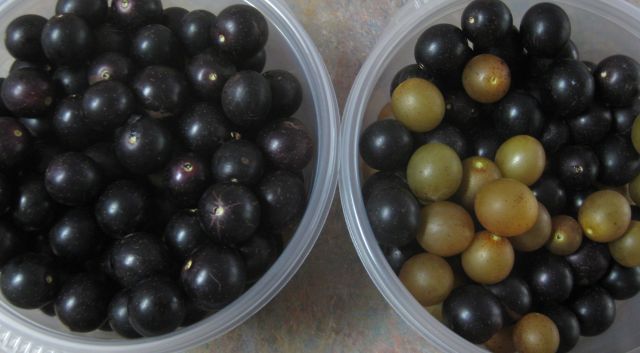
Unlike July which was hot and dry, August has been tempered with rain showers and cloudy days. My property 50 miles north of Atlanta has received a lot of rain while Atlanta very little – could this be the heat island effect? The rain has filled out my muscadine, including the golden scuppernong, shown above and throughout the day they are visited by yellow jackets, wasps and hornets, and me in the earlier morning.
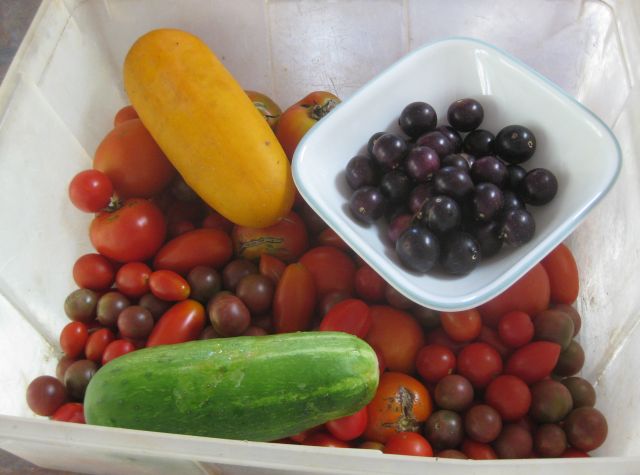
With the exception of the Parks Whopper, most of my tomatoes are done. The Whopper has been an exceptional producer – the first to produce large size tomatoes and the only one still producing, though taste not comparable with the heirlooms.
a day’s collection
My colored sweet peppers and okra are flourishing. Now the cantaloupe and watermelon are ripening, and tasting good. Cucumbers and beans are winding down. After removing the tomato plants I have been seeding the tomato cages with peas – will see how this works out. And planting greens in the raised beds – turnips, mustard, kale and collard, and soon the radishes.
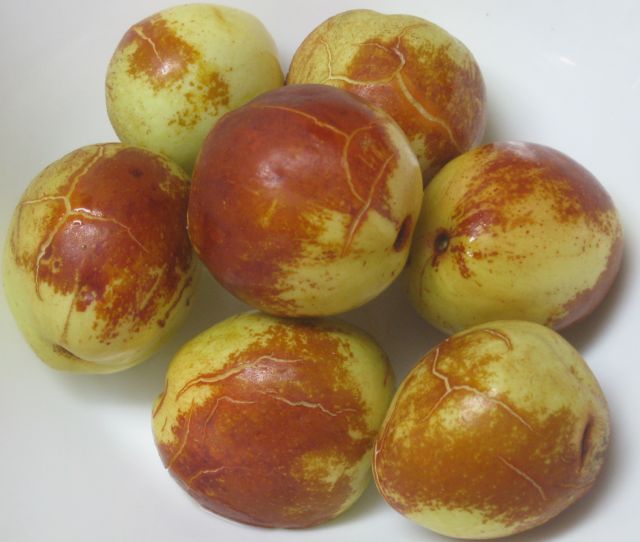
As mentioned in my previous post, lot of pears and muscadine grapes. Some apple varieties still to produce and jujube should be edible in a few weeks although we have begun snacking.
Lang Jujube ripens to a mahogany red color. I planted opposite it a Li Jujube which is not yet fruit bearing.the Kieffer pear (top right) is v. large and sweet. Top left a Giant Korean pear, bottom left a Paduckah apple and bottom right the Anna Apple from Israel with low chill hours requirement
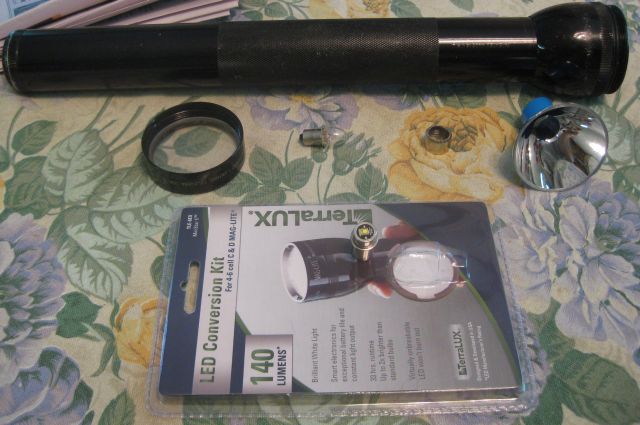
maglite led conversion
With the boxy yellow Eveready LED floating lantern available for <$5, it is difficult to rationalize holding onto the mag-lite flashlights. Except they are so well made and I really did not want to toss my large 4 D cell mag-lite. So I ordered the TerraLux LED conversion kit (140 lumens, $17.48) and it is easy enough to replace the bulb.
a quick replacement of conventional bulb with new LED
Battery life and brightness are greatly increased and I have a handy club, if needed.
Recent good rains have juiced my crops. We thought by now the tomatoes would be done, and some are, but others keep producing. Most everyone complimented the taste of the small tomatoes. We feel the larger tomatoes are less tasty probably from too much rain.
Muscadine season has almost arrived and the black ones above although sweet, will be sweeter still when they roll into my hand and do not have to be tugged. But then there will be many yellow jackets at the smorgasbord and M. developed a nasty reaction when 2 yellow jackets, apparently without provocation, stung her ankle.
And the apples and pears are abundant. In my 7/31 post I criticized the Paduckah apple as a good producer with little taste. Now these apples have fully ripened they really are tasty. I locate fully ripened apples not by feeling for which nudges easily free but by selecting from those that have fallen to the ground. Very few pests this year probably because of my kaolin spraying.
the two bottom apples are Paduckahs, top left is the Matsu (tastes great), 2 on the right are Ein Shemer (not yet ready), Kieffer pear in the middle, and at the top the Giant Korean pear, which needs a few more weeks.
Recent reads
I finished reading 3 interesting books. The Dark Forest by Cixin Liu (tsih-sheen leo) apparently China’s top science fiction writer, is the sequel to The Three-Body Solution. One of my sons read the Mandarin originals, recommended them, gifted them to me, encouraged me persistently, and once I was into it, it was a good read. Another book he recommended The Mandibles by Lionel Shriver, is a dystopian finance drama, very well written and much easier to access. And finally I enjoyed the short stories in The Periodic Table (1984) by Primo Levi – gentle instruction, humor and sadness.
And, a first. My running/walking group has good-naturedly tolerated my digressions on nutrition – that you are what you eat. Yesterday at breakfast after our stint on the river trail, I noticed there were more oatmeal settings (5) than bacon and eggs (4). My comment that this was a first, caused some embarrassment. It seems more folks are correlating health outcomes with what they eat. Good!
With our first (and only) grandchild in San Francisco we visit San Francisco (actually the city of South San Francisco) more frequently and like to lodge in the town of Pacifica which has high cliffs overlooking the ocean.
the cliffs have jogging paths and a natural setting
Our 2 must visits are Florey’s 2nd hand book store and Mike Mooney’s Memorial Gardens.
in remembrance of the victims of September 11
We marvel that Florey’s still survives with all paperbacks priced $1 and all hardcovers $2, and no customers present other than ourselves. But each year it is there and we make requisite purchases, since we are the dinosaur people and though ebooks accompany our trips, paper books are what we are about.
North of SF lies the problem. North of Golden Gate bridge, the redwoods of John Muir Woods and Point Reyes lighthouse is Sonoma County with Bodega Bay, Red Russian River and Sebastopol. Ah, Sebastopol! Each visit inveigles me this is where we belong. Vineyards and Gravenstein apple trees line the approaches, and the local Santa Rosa paper is aptly named“The Press Democrat”.But Sebastopol (population <10k) is on SF radar and real estate prices and rents increase relentlessly. The downtown area is renovated and now boasts The Barlow area, a 12 acres open air market place.
the community market features Meatless Mondays, a trend strongly resisted by meat producers elsewhere
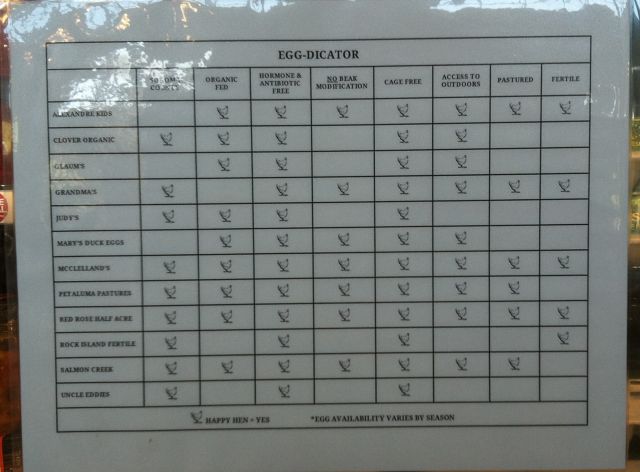
Since the demise of our chickens we monitor egg offerings, vainly trying to replicate the orange yolks our hens produced, and were intrigued by the egg-dicator below.
the checklist includes organic feed; local production; hormone and antibiotic free; no beak modification; access to outdoors; pastured and fertile
It is easy to decry the upmarket symbols such as art studios and gourmet restaurants,and conclude the area is just too elitist. But then you happen on the unexpected such as the Joe Rodota trail next to our old fashioned but very comfortable Sebastopol Inn.
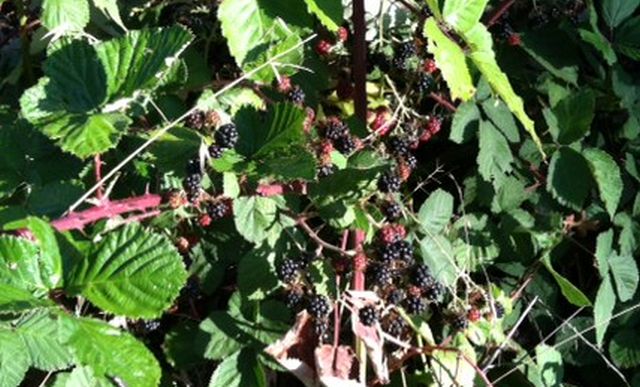
The trail runs to Santa Rosa through marshlands which may flood in the rainy winter season. It was arail track now paved for 3.5 miles. And as you try rationalize that Sebastopol is not for you, you notice the wild blackberries crowding the trail, and they are plump and sweet.
succulent sweet wild blackberries
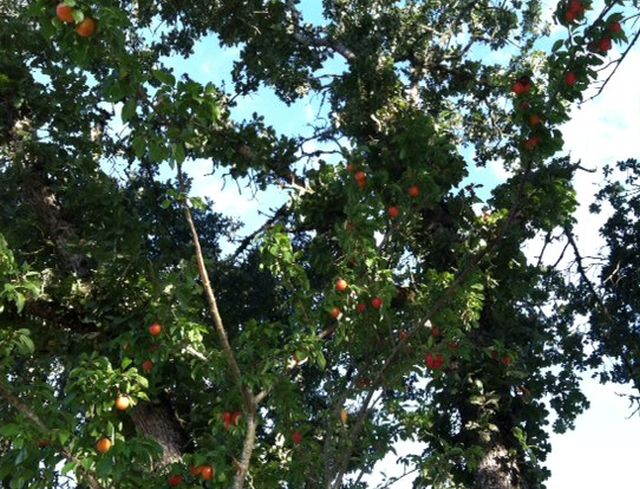
And along the trail are wild sweet cherries and plums.
at times difficult to reach, but worth the effort
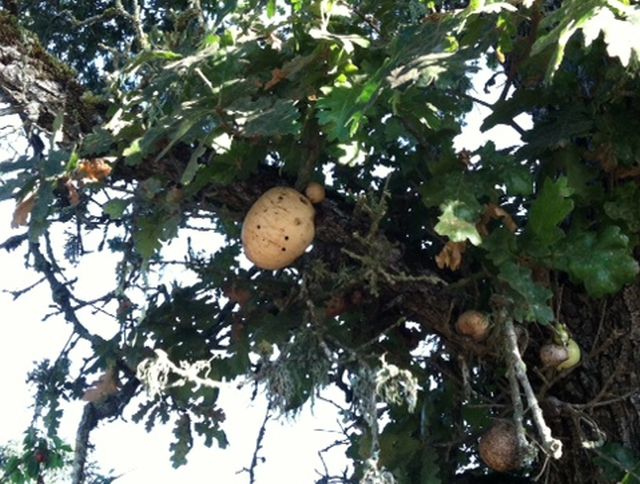
And wild dill and puff balls on the oak trees
puff balls on oak trees
Nature bursts through and gives lie to our civilizing veneer.
There are several commercial organic growers and I would like to have visited one well rated with the permaculture crowd. Their website mentioned public tours for CSA members $10 each or private visits $250 each.I emailed asking if we could join a public tour or make a quick visit for less than $500. Never heard back.I guess viability is a continuing challenge for the small grower and pleasantries fall by the way. However on the way out of Sebastopol we spotted a permaculture training establishment and they were welcoming and encouraged us to walk and look. Their crops were healthy and we marveled the artichokes (Monterey just south of SF is the artichoke Mecca of the world).
notice the dry surroundings, no rain in summer and drip irrigation is a must – unlike Georgia which bursts with green after torrential downpours (when they finally arrive)
So we visited Sebastopol and enjoyed and will include future visits when in SF.Though uprooting from Georgia and moving there – probably not on the cards.
You may well ask – ” I thought this site was about organic growing and permaculture, why so much electronics?” I want some control over my life and surroundings. Perhaps I could work and pay others to maintain the yard; repair my house, car and everything else that fails; administer to my health; and grow my food. But, I like self reliance and making effective inputs to what goes on around me provides satisfaction. Which brings me to the treadmill which failed.
My usual caveat – working with electricity can be dangerous or even deadly, so stay clear if you are not experienced.
Around 2003 I bought a good quality Precor 9.35 treadmill, which M. and B. often used, and then it went on the blink – literally its various lights would blink but nothing happened. Some quick checks brought the conclusion that the circuit board was defective. Previously, when the wall oven and refrigerator failed, I located via the internet, outfits specialized in those circuit boards and sent them the board and received a working board a few days later (cost <$200). And the appliances worked and continue to work.
But wouldn’t it have been great to repair the board myself?
My first venture down this route was fixing the simple board on my scroll saw. It was frustrating, took a long time but I learned techniques along the way and succeeded. The treadmill board is more sophisticated.
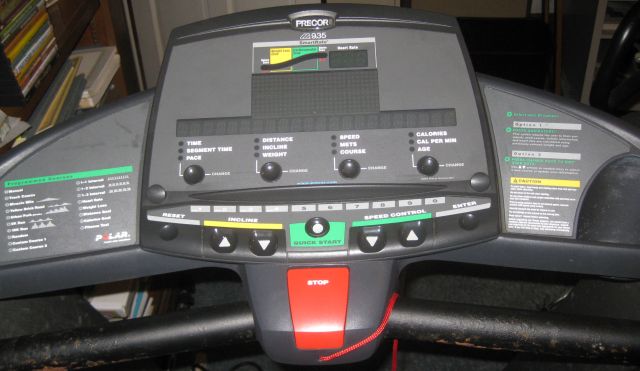
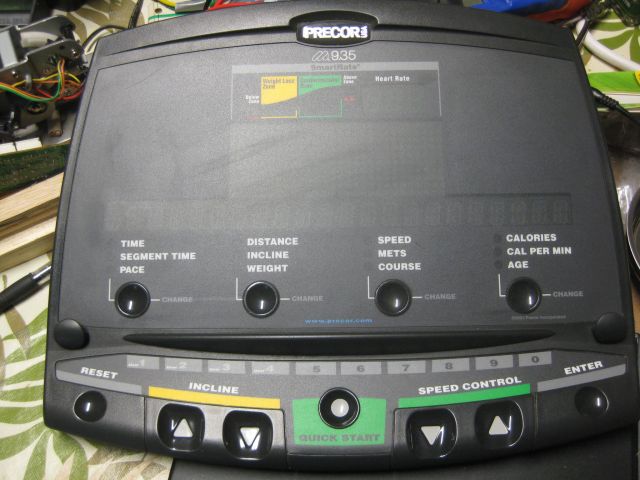
the control panel of the Precor 9.35
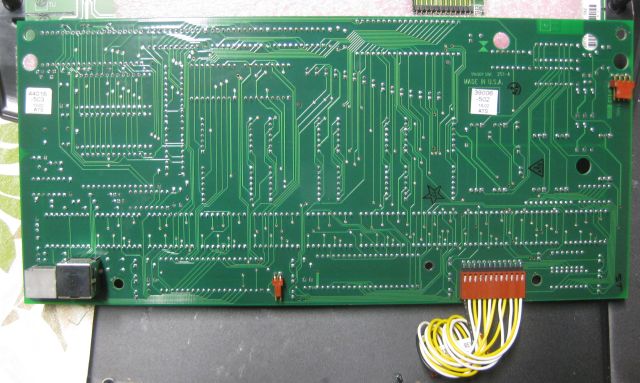
Here is the underside of the circuit board – not much going on.
this view shows some of the traces or connections between the components but not all of them. some are buried in layers of the board
And here is the component side of the board. My starting point is to test the capacitors, cylindrical objects, of which there are 8.
can you spot the capacitors?
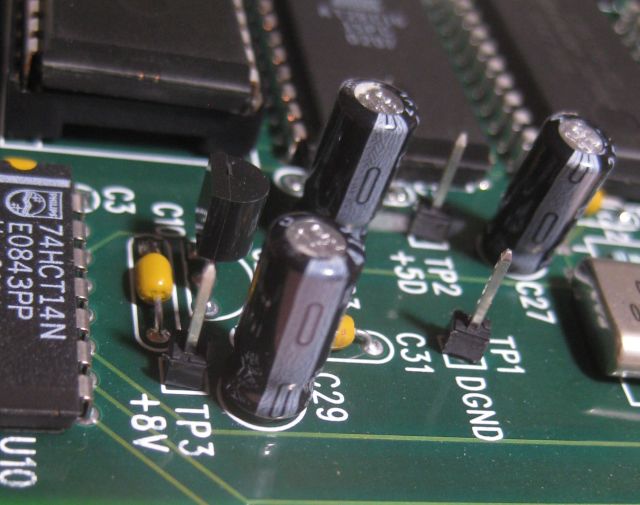
Here is a close up view of 3 capacitors.
all the capacitors have the same value 47uF @ 25v. when replacing polarity must be observed – the light grey band identifies the negative leg
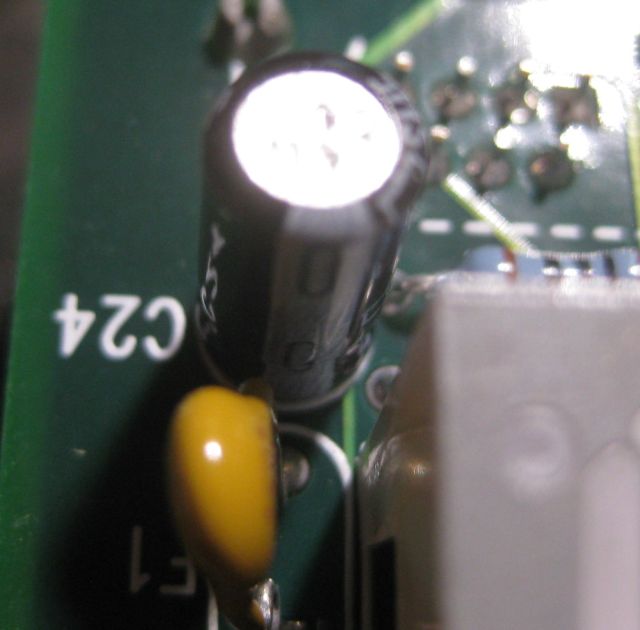
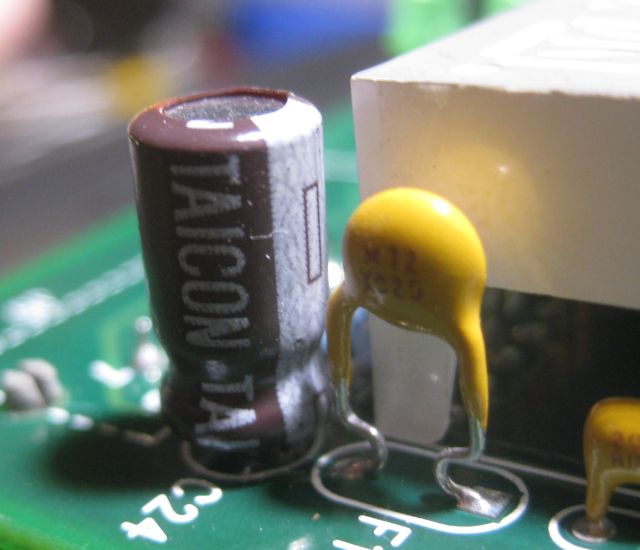
With my ESR meter I established that one capacitor was defective – 7 had an ESR of<0.31 and the defective cap had an ESR of 1. Here is the bad guy.
the photograph was to remind me which side was negative. no indication from its external appearance that it is damaged
Diagnosis was quick. The actual replacement was difficult. Previously, to desolder a component I heated a soldered leg and with my other hand wiggled it free. But this was a multilayered board and it did not wiggle free. I figured lead free solder was used and raised the iron’s temperature. I was concerned too much heat would destroy the board. Touch and go. Eventually I was able to extricate the component but the holes, through which their legs had been inserted, promptly blocked up again with solder. With various diameter wires I was eventually able to clear the holes. Then I soldered a new component (same Farad rating, higher voltage, cost before shipping 15 cents), and it was done.
the new capacitor with polarity observed
But was it fixed? That evening M. tested it and it worked – “significant event” she said!


 I am having difficulty with rabbit(s) which nail my pea seedlings shortly after they emerge. I am designing an enclosure which I will 3D print which admits sufficient sunlight, rain and air, is well anchored from rabbit nose nudges, and provides adequate protection. In the meantime I keep trying.