remediation

This is not about environmental remediation, just correcting a few deficiencies in my nu trac environment.

Bees

When I split the hive a few weeks ago by taking bees and frames from hive 1 and creating a new hive 2, I noticed that hive 1 had no brood and apparently no queen.  In addition to the new queen I purchased for hive 2, I ordered a second queen for hive 1.  The second queen and several attendants arrived in a queen’s cage last Friday from an Alabama beekeeper. After again confirming that hive 1 was queenless, I inserted the queen cage into the hive.

I mentioned in a previous post how observation can be distorted, often by preconceived notions.  Hive 1 prior to introducing the queen was noisy, restless and it even looked as if robbing might be in progress.  Hive 1 has lots of honey and I am waiting for it all to be sealed before I harvest it, so maybe, with the colony demoralized and on the decline, they were being robbed?  Next day the hive seemed very different – no more agitated activity at the hive entrance and no angry responses to the slightest jarring of the hive bodies.  So, I concluded, the caged queen’s pheromones were being spread around the hive and the inhabitants were settling down.  Sunday I opened the hive to see how the bees were responding to the queen cage – they were gathered around it, could be easily brushed away (which indicates they were not attacking and trying to get at the queen) and seemed content.  So this morning, four days after introducing the queen cage, I removed the cork and some of the candy from the hole in the cage.  The bees should now remove the rest of the candy and I hope, in a few days when I reinspect, the queen cage will be empty and the queen will be busy egg laying.  I should mention that the new queen in hive 2 has settled down well and has laid eggs in a tight pattern on both sides of one of the frames.

Fruit orchard

In February 2011 I began a new orchard and installed 12 different 1 year old trees.  This spring I was sure 4 had died but, surprisingly, 2 unexpectedly produced leaves at their bases, so that left 2 victims – a Bing cherry and a Gold Nugett Loquat.

I took my first cuttings last fall and again earlier this year – most did not survive, but the fig cuttings looked strong, so I decided to replace the two dead fruit trees with a couple of cuttings.  I began with the Bing cherry – I thought it would lift easily out of the ground as is common when the roots have rotted, but this cherry was anchored.  I then found that though the  trunk was dead the root trunk was very much alive and well established, so I left alone and hope I will soon be rewarded with shoots.  The loquat lifted easily – just a short dead root trunk.  I enlarged the hole and added some chicken manure and then compost and then installed the small fig cutting.  I will water it frequently and I hope it will survive the transition.  Since the fig cutting is from  a nearby well established fig tree I know it will thrive in this area.
 

observation and analysis

I used to think observation was the key talent.  On trips through the Kruger game reserve in South Africa my siblings and I competed to spot the lion, cheetah, leopard or unusual game first.  On a river boat trip through north Australia we competed to be the first in the launch to spot the saltwater crocs (“salties”) lazing on the banks.  And for such contests a sharp eye was all that was needed.

But in my interactions with nature, observing the discordant object is only the first step.  Understanding why is equally important.

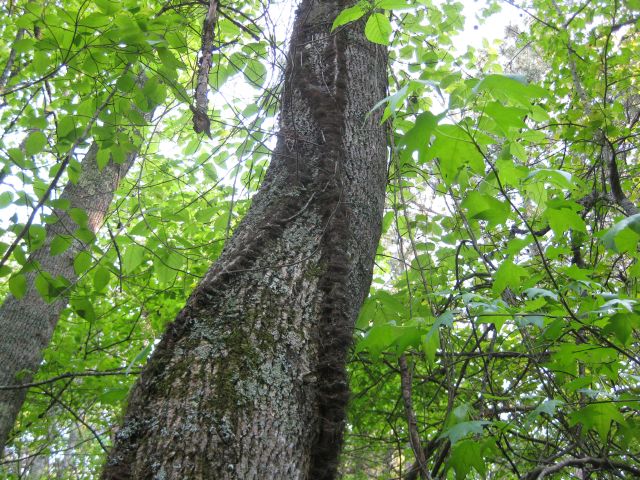
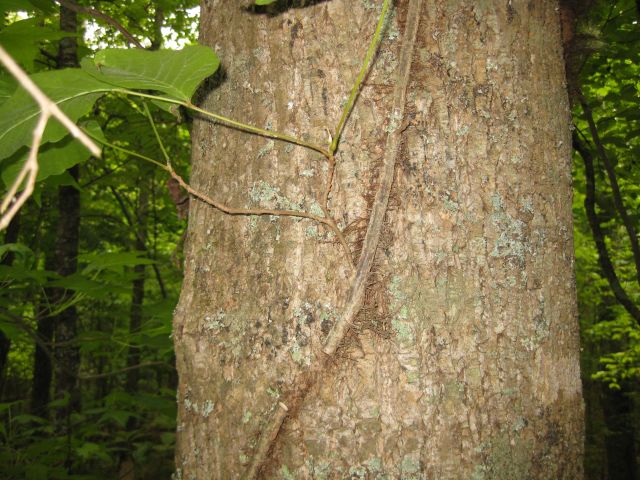
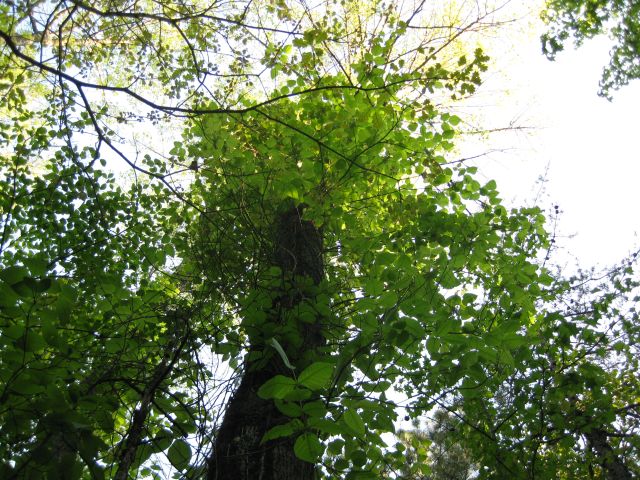
For several years my spring routine has been to spray roundup on the poison ivy alongside my walking paths in the woods.  I believe in live and let live, but my dog is an investigator which requires her to explore scents and droppings off the trail, which are often in the poison ivy patches, and she then transfers the poison to all who contact her.  So I use roundup for this purpose and this purpose alone.  There is a glade alongside the trail where poison ivy thrives, despite repeated attentions from the sprayer.  I observe the poison ivy, I drench and then later in the season spray again and the next year, there it is again, and more spraying.  This year, as I was about to spray, I received a cell call and so lingered at the spot longer than usual and then happened to notice two snake like vines heading up a tree.  Yes, they were poison ivy vines, which explains why, despite my ministrations, the poison  ivy continually resurfaced sponsored by seed from overhead.  Had I reflected on the persistence of the poison ivy I may have thought to look up and not always down.

poison ivy high in a tree
poison ivy vines climbing a tree

Of course, once you know about it, it is a simple matter to identify it elsewhere, as in this other tree, 10 ft away.

a smaller poison ivy vine

But often more is needed than just knowing what to look for.  Analyzing what you are looking at and being aware of the changing environment is a necessary skill.

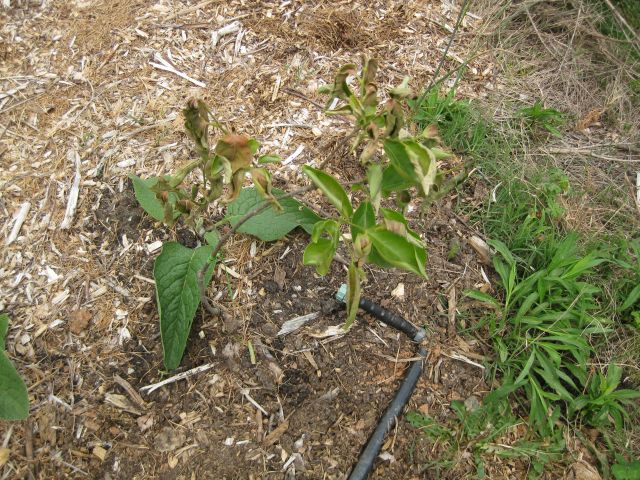
A couple weeks ago as I passed my new orchard I happened to notice that one of the small trees (tanenashi persimmon) was suffering.  Half of its leaves had turned brown.  I remembered that I hadn’t watered this area for a week and, except for the previous day which had been cold, the spring weather had been in the 80’s.  None of the other trees was afflicted but I reasoned this particular tree was probably more susceptible to lack of water, so I promptly irrigated the orchard.  I did notice I had planted Russian comfrey too close to the small tree but reasoned this could not be the cause since comfrey is not allelopathic.  Then a little later that morning, I noticed that my tomato and cucumber seedlings were also afflicted – in their case I had watered every day, except the previous day which was cold.  This seemed unusual hardship for one day’s missed watering.  My mind wandered idly over these facts – perhaps there were root nemitodes attacking the one fruit tree and the tomatoes and cucumbers – such selective treatment seemed unlikely.  Then I noticed, in a separate planting the cucumbers were doing fine and they also had not been watered the previous day because it had been cold.  So why was the one lot ok and the other lot disaster.  Then it dawned on me – the previous day had been cold, but how cold – had there been a freeze?  I happened to meet my neighbor and he said the water in his hose had frozen the previous morning.

Now it made sense – the fig tree and the tomatoes and cucumbers are cold sensitive and had been hammered by the freeze.  And the reason the other cucumber planting was ok was because it is on the crest of a hill with no obstructions below it, so the frost, like water, slid down the hill away from it, which was not the case with the other planting which was on level ground.

frost damaged tanenashi persimmon alongside comfrey

All of this conjecturing and misdiagnosing could have been avoided had I, the previous day, just glanced at my min/max outdoor thermometer, which would have told me how cold it had been and then, with this knowledge I would have understood the changes.  So I need to remove distractions and attune myself better to my surroundings.

Or pursue a more analytical approach as Bill Mollison suggests in “Permaculture – A Designers’ Manual”: first make value-free non interpretative notes about what is seen; then select some observations and prepare a list of speculations; then confirm or deny the speculations by research, asking others, and/or devising more observations to test the hypothesis; then make a final examination of all the information to hand to arrive at a conclusion; and finally decide how to use the knowledge gleaned.  A disciplined approach for me to consider.

wildflower seeding

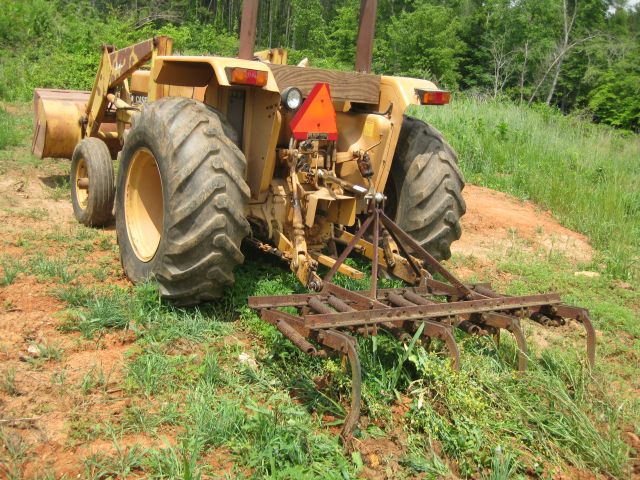
Last fall I collected a large quantity of wildflower seed and stored it in a cloth shopping bag.  Now that I have planted out my tomatoes and with rain in the offing, I decided to sow the seed – cosmos, sunflower, marigold and zinnia.  I was gifted two old cultivators – they are 5 feet wide and connect to the three point hitch at the back of the tractor.  The tines are spring tensioned.  I have a 60hp tractor which typically would pull a larger cultivator and so I had to make some adjustments to fit the cultivator to the tractor.  But the hitch fitted without a hitch, so to speak, and with my tractor in its lowest (slowest) gear I made several passes on contour across the sloping field.  The tines did a great job making furrows in the field and displacing stones.  I then hand sowed my collected seed in the furrows.  I probably should have finished the job dragging large planks with chains, which came with the cultivator, to bury the seeds.  I am hoping we get rain, but not too much, and the rain will settle the seeds in the soil.  Below is a ‘photo of the cultivator.

bees – a swarm trap

Bees swarm to reproduce the colony and a common cause is population density or, according to an Australian beekeeper, dissatisfaction with current living conditions, which can be the same thing.  A primary swarm is when the existing queen leaves with up to 60% of the population and a secondary swarm is when a virgin queen leaves with a large percentage of the bees.  I reckon in my first year of beekeeping my bees swarmed 4 or 5 times.

So one way to prevent swarms is to give them more hive space – more deeps and supers so they don’t feel pressured.  Some beekeepers believe that clippings the wings of the queen will lessen the likelihood of swarming, though this is contested.  First year queens are allegedly less likely to swarm so replacing older queens with young queens may help.  And then there is cutting out the queen cells – before swarming bees ensure that there is a new queen, or a queen on the way, for the hive from which they are departing.  It can take 15 to 17 days for a queen to develop from an egg.  So beekeepers may inspect their frames every 10 days to locate and cut out queen cells.  One beekeeper says he inspects every 7 days.  Before you cut out the queen cells you have to make sure there is still a queen in the colony, for if you cut out the queen cells and the bees have already swarmed then you can end up with a queen less colony which will become weaker and weaker.

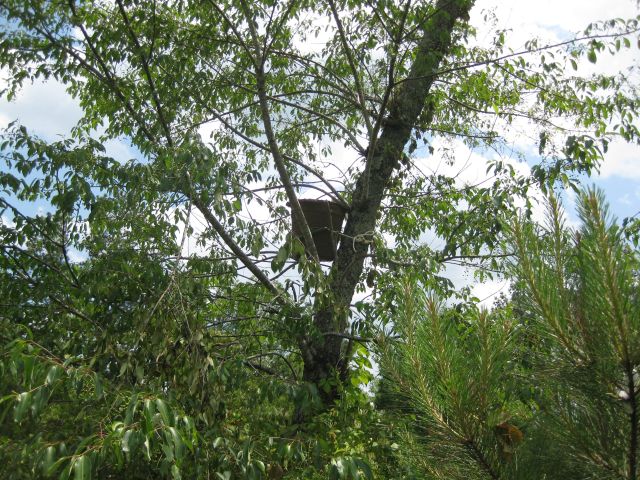
All too much work for me.  So apart from trying to provide optimal living conditions – not too hot or too cold and ample living room, I am a minimalist and keep out of the way.  Until, at a recent beekeeping meeting I learned of swarm traps, and ordered one.  It looks like a hollowed out tree trunk with an access hole at the bottom and a removable lid and came with a swarm lure.  The lure is attached to the lid on the inside of the trap and the trap should be placed 9′ to 12′ above the ground and about 200′ to 250′ from the hive.  I secured the trap to a single standing tree about 180′ from the hive and about 15′ above the ground.   So, with some luck, I may be able to recover my bees if they swarm again.

swarm trap roped to tree beckoning scouts from the next honey bee swarm

tomato planting time

I made a false start about a month ago, when the daily temperatures were in the 80’s, and put out a dozen small tomato plants, most of which succumbed to an unexpected frost.  So I waited a while and in the past week have begun setting out the plants.  I try to rotate to avoid soil borne disease, though the area I have just planted was used for tomatoes for the first time last year.  It is on the top of a small rise along the edge where the ground slopes down, running South to North so it has excellent sun exposure and good drainage.

tomato plants
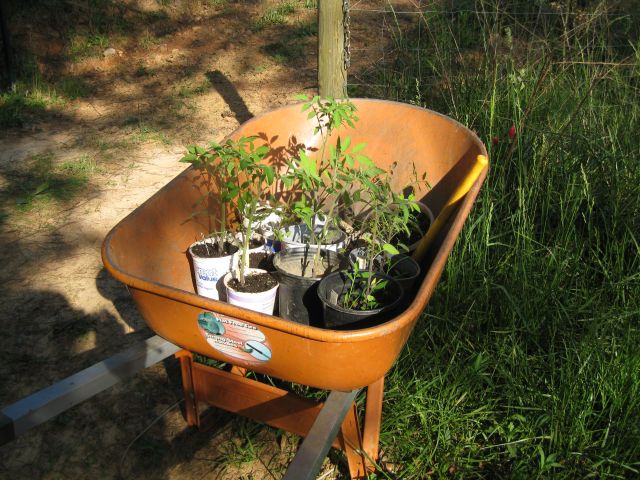
a barrow of tomato plants on their way to planting

compost for tomato plants
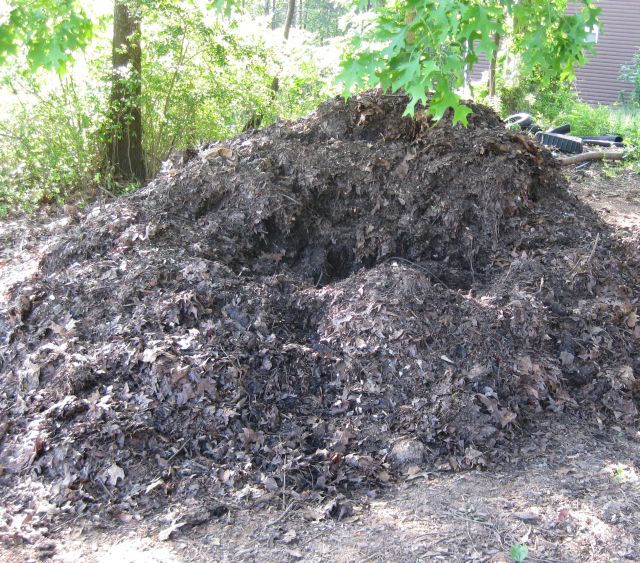
compost heap started last fall, center is done, outside needs turning

The negative to the site is bermuda grass which grows rapaciously through the mulches and grips tenaciously to the ground.  I prepared the tomato planting area by forking and pulling out the bermuda runners and digging in large dollops of my compost.  The compost pile was prepared last fall from leaf bags, surplus vegetation, horse manure and some prior season’s compost for a starter.  The inner core has broken down well, is home to many earth worms, and is a good supplement for my future tomato bed.

tomato cages
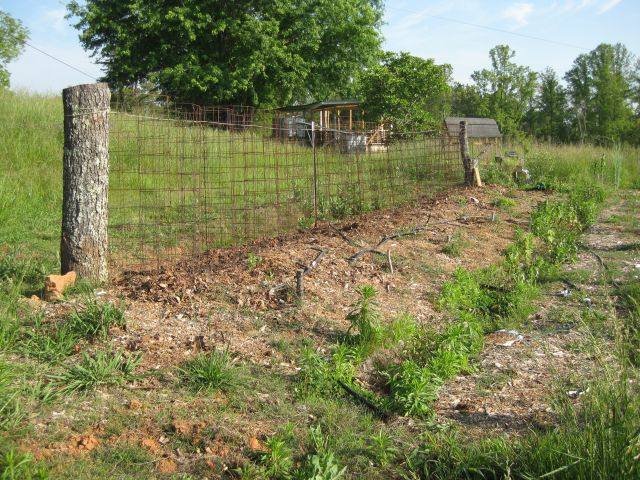
tomato wire cages anchored by cable secured by two cherry tree trunks

tomato plant
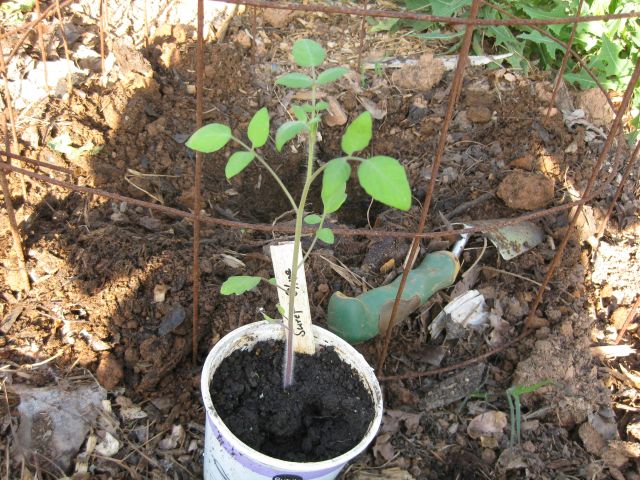
tomato plant in yogurt container awaiting insertion through wire cage into ground

I have two cherry tree trunks on the hill which are the anchors for a cable strung between them. The cable is threaded through 23 tomato cages which I made from metal remesh used for concrete, purchased in rolls 5 ft wide and 150 ft long.  Each cage is 5 ft high, has a 6 ft circumference and the interstices formed by the wire are 6 inch squares.   At the end of each season I store the cages under cover.  I once tried planting the tomato plants first and then placing the wire cages around them but this didn’t work out for me.  So the drill now, after preparing the soil, is to line up the cages threaded with the cable and then dig and place the tomato plants, sliding the hand trowel, and the pots through the 6 inch squares.  Takes some getting used to.

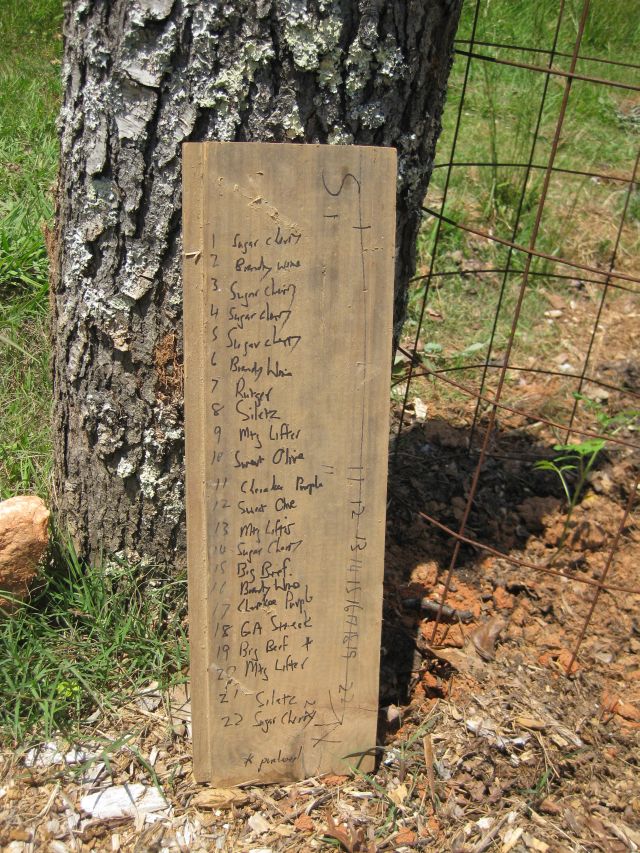
I grew all my tomato plants from seed some of which is 3 or 4 years old (actually of the 23 planted here, two Big Beef were gifted to me by a neighbor).  I have a variety of types and losing some to the frost was not an issue since I grew more than 80 tomato plants and, at the end of the day, will probably plant 50 and give the rest away.  In the past I used plastic markers to identify the tomato plants but these invariably went adrift.  This year I numbered the cages sequentially South to North and have written the cage number and tomato plant name on a board, which will be attached to one of the trunks.

So today I finished planting the 23 tomato plants.  Next steps are to realign my gravity fed irrigation bubblers, then cover the soil between the plants with newspaper to prevent raindrops splashing soil onto the tomato plants and, with aluminum foil wrap, encircle the first 5 inches of the plant’s stem, which also reduces the spread of soil borne problems.  So still some work to do but the plants are out of the greenhouse and can now spread their green wings.

different tomatoes
a listing of the tomato varieties

splitting the bee hive

I acquired my bees in spring 2010 and am now in my third year with the one hive.  I decided it was time for two hives and there are several ways to go about this.  Rather than buy a “package” or “nuc” I wanted to propagate my existing bees.  After all, they have survived two winters, gave me 4.5 gallons honey last year and appear very healthy and have not needed any medications.  So the genetics are good and, what I should have done, as suggested by a commentator, is used a queen cell in the hive to start the second hive.  Instead I waited and waited for a promised queen bee and had given up hope when, 8 days ago I received an email that there was a queen I could pick up that morning.  The seller is a 10 minutes drive and he had provided me with the nuke which started my beekeeping activities so I have confidence that his queen will be well adapted to my locale (actually he buys his queens from an “excellent” source and I trust him).

queen bee
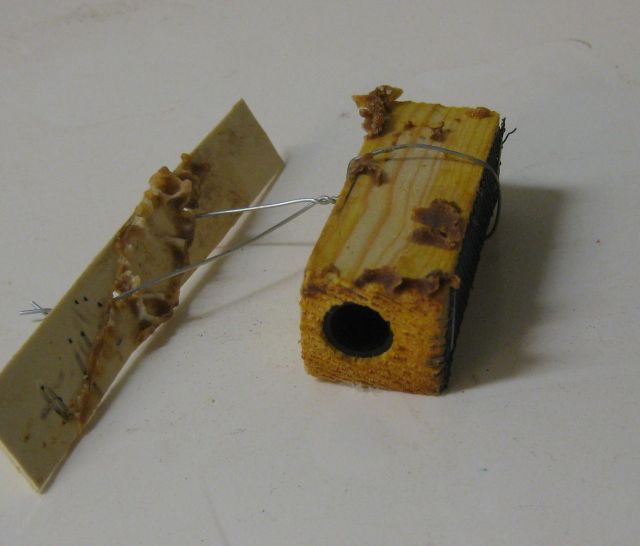
the queen bee cage after the queen was released and wire and plate I fashioned to suspend it between the frames

queen bee
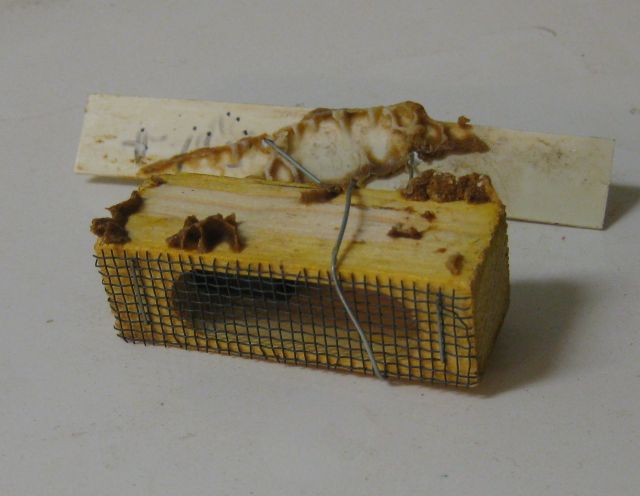
another view of the queen bee cage showing mesh through which the queen is fed prior to her release

So suddenly I had a queen bee and the long wait was over.  The queen is provided in a queen cage which is a little rectangular wood box with mesh along one side and a sealed opening at one of the ends.  I hastened to open my bee hive and, as I had feared it had already swarmed and the queen was gone -I  surmised she was gone since there were no eggs in the cells just sealed brood.  What I mean by this is the queen lays eggs, which after a few days turn into larva and then into a prepupa and then a pupa and then a bee.  After the larva stage the bees seal or cap the cell.  Since I had sealed brood and no eggs or larva it meant the queen had been gone for some days.  There were a number of queen cells on the frames and so I assume, once the bees had ensured there would be a future queen for the colony, a number of them together with the existing queen took off or swarmed to start a new colony elsewhere (and took honey with them to keep them going on this risky undertaking).  If I had been more proactive I could have taken the queen cells out of the hive together with some frames before they swarmed and I could have started a new bee hive and then the bees may not have swarmed because, without the queen cells, there was no ability for the existing hive to propagate itself.  It has been estimated that only 25% of the swarms survive their first year so, quite likely, my former queen and her companions will demise later this year.

I selected 8 frames from the existing bee hive (out of the 16 frames available) choosing 4 with honey and 4 with sealed brood but not with queen cells.  The frames were clustered with bees and the recommended procedure is, while holding the frame above the hive from which it is being removed, to give a sudden down thrust of the frame which sends a lot of the bees off the frame and tumbling onto their hive.  The theory is that field bees (the ones that forage daily for nectar, pollen and water) do not hold tightly to the frame while nurse bees do and so the sudden movement removes the field bees.  So, you may ask, why not have field bees in the new hive?  When bees exit a hive for the first time they study the entrance carefully to memorize its appearance and location for their return after foraging.  However, after this first memorization they don’t bother to do this again since it is wasted effort, they know where their hive is.  So if I had field bees from the main hive in my new hive, when they exited they would have gone food hunting and returned to the old hive.  No gain to the new hive.  Even worse, if they were diligent and noted the location of the new hive, they could have gone to their old hive and told their fellow workers there was lots of honey in a lightly defended hive just 30 ft away.  A suggestion is to place an obstacle at the hive entrance so if you do have field bees when they emerge from the new hive they will see something is radically different and they may decide it worthwhile to take good note and re-memorize the hive appearance and location, and if they do this then they should return to the new hive.

bee hive
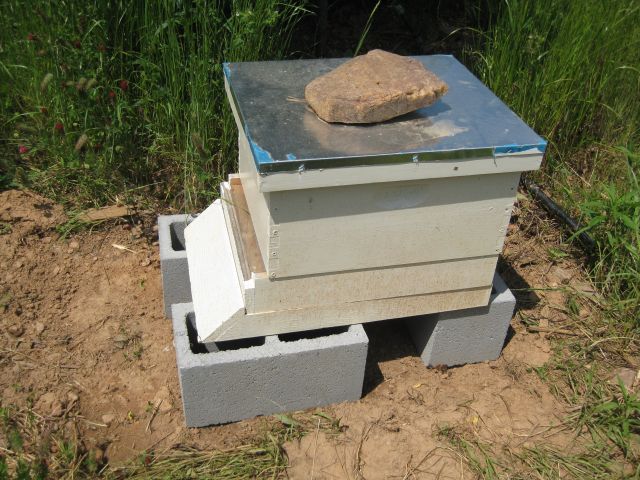
the new bee hive on cinder blocks, not much activity at the entrance

bee hive
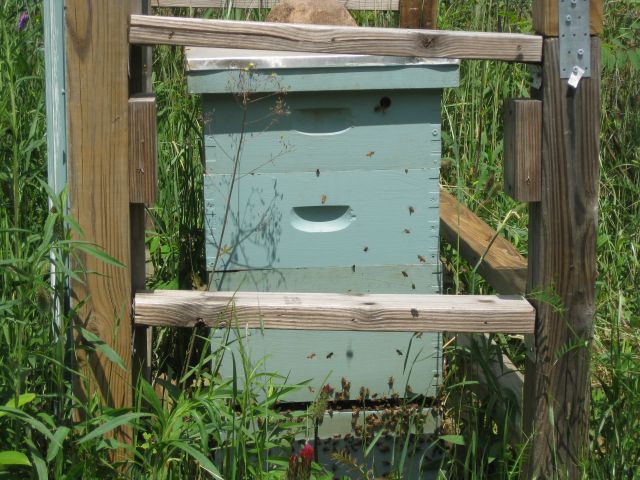
the main bee hive with one deep hive frame and two supers, the top one soon to be harvested

I placed the 8 selected frames in a new hive body on the east side of a small fruit tree, which will protect it from the afternoon sun.  As usual my overactive mind got worrying about what could go wrong.  I rechecked the 8 frames in the bee hive and found a queen cell, which I removed.  Next concern – could one of the queen cells have already hatched and I already have a virgin or mated queen bee on my 8 frames.    Young queens are not as noticeable as developed queens – apparently they have more hair and are fuzzier.  I looked but didn’t notice a threat.  Next concern – if there is no queen in a hive for some time then some of the worker bees assume the role of a queen and begin laying eggs but, because they are not real queens and never mated, their eggs produce drones.  And they so take to their new role they may contend with and kill a real new queen.  Enough with the worrying – I fashioned a wire loop to hold the queen cage in position between the two middle frames in the hive body, wished them all well and closed up the new hive.  I checked a day later to see if the workers were balling the caged queen i.e. clustering aggressively on the screen trying to get at her, or whether they seemed happy.  The hive was peaceful, everyone appeared relaxed and content.  So four days after creating the hive I opened it again and removed the tape which covered the hole entrance to her cage.  And, this morning, some days later I opened the hive again and saw the workers had eaten through the candy which plugged the hole and the cage was empty.  I peered fearfully at the bottom of the hive body hoping I would not see a dead queen body, and I did not.  The bees were really very placid, even  a slight jarring of the hive as I moved the frames did not perturb them.  I was working without gloves and without using smoke and I decided to take a quick look and see if I could spot the queen.  She is bigger than a worker bee but size is not the criterion since the drones are also bigger than the workers.  But the drones have big eyes (all the better to spot the virgin queen when she goes on her mating flight) and squat bodies while the queen has a tapered abdomen.  And then I spotted her and she seemed fine.  So I closed up the hive and will leave it be.  I assume she is a laying queen and when next I open the hive I will check for eggs.  In a few days I will add a super on top of the hive body so the bees will have plenty of room for their honey production – for me to savor and for them to get them through the next winter.

bee hive
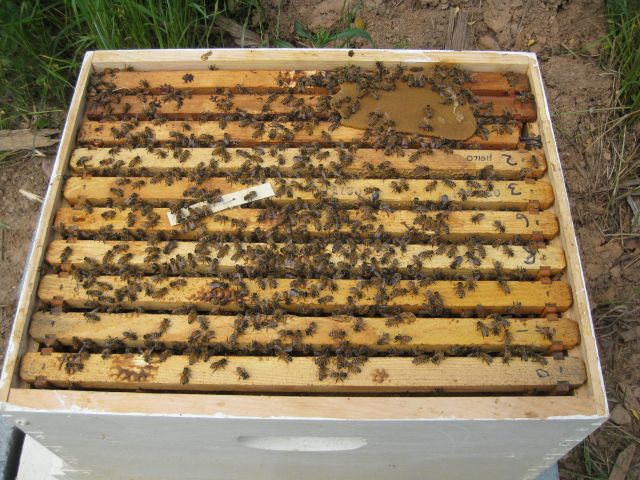
new bee hive and between frames 3 and 6 you can see plastic securing queen cage
queen bee cage
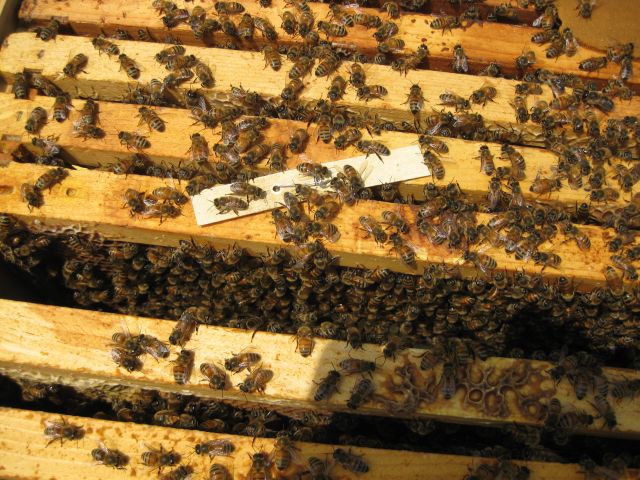
a closer view of the frames in the bee hive, the white plastic strip locates the queen cage


queen bee
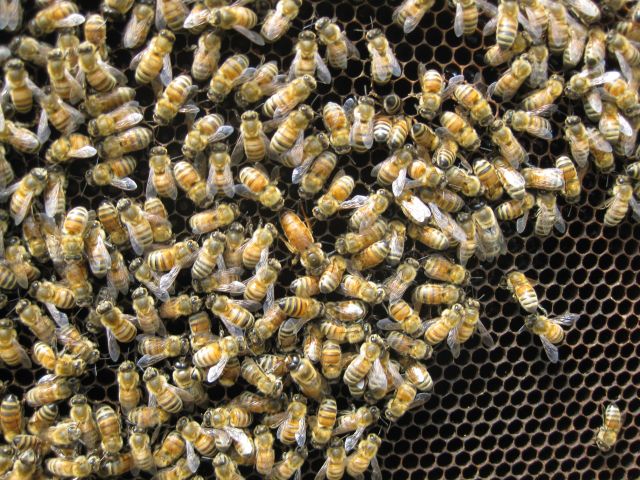
can you spot the queen bee?

rainwater from coop roof

When I built the new coop in October last year I fitted  a gutter which directs rainwater to an adjacent 250 gallon storage tank.  My thought was to (a) collect all rainwater landing on impervious surfaces, and (b) use the water to irrigate a chicken food growing area.  To grow food for the chicken I would have to cordon off a growing area and maintain it with vegetables and irrigation, which involves extra work, so instead I now give them excess vegetables from the vegetable garden.  And the storage tank, which has been full almost since it was installed, now overflows each time it rains.  A waste of water!

With the coop “summerized” with a powered vent fan, insulation and two semi-automatic coop doors, I turned my attention to the rainwater storage tank, which may also be the culprit for the mosquitoes which hang out in that area.  I have a portable electric water pump and it was a simple matter to run a 1″ diameter water pipe from the coop to the barn where two large storage tanks are parked.  For the water to flow as easily as possible, I avoided sharp turns and led the pipe in a gradual sweep and rise from the coop along the ground to a gradual turn to the barn and then, gaining altitude, up to a gutter on the barn which feeds into the rainwater collection system.  I may decide to trench the pipe when the ground is soft after the next decent rainfall.

The exit pipe from the storage tank and the pipe to the barn are fitted with Norwesco fittings, as is the electric water pump.  It is a simple operation to couple the pump to the two pipes, open the tank valve to flow water from the storage tank to prime the pump and then power the pump with electricity already cabled to the coop.  Some 20 minutes later all 250 gallons have been transferred to a large storage tank from which it will be pumped, as needed to irrigate my crops.

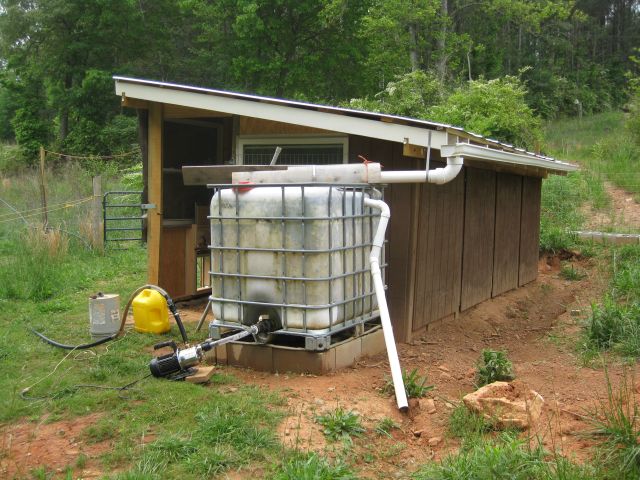
east side of coop showing gutter, downpipe to tank, overflow pipe from tank and exit connection to pump
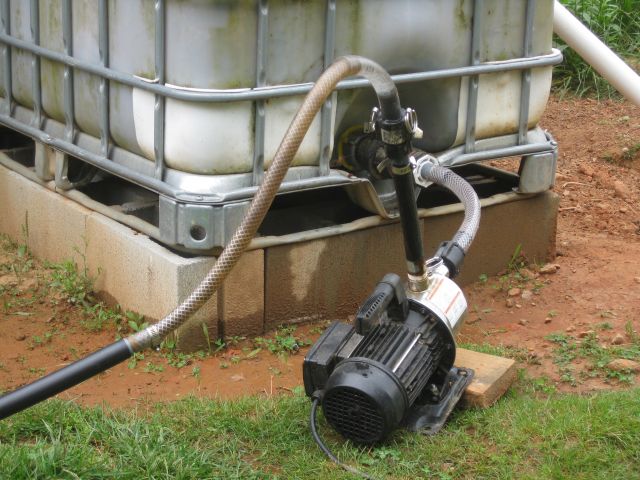
closer up view of conection from storage tank to pump to water pipe to barn
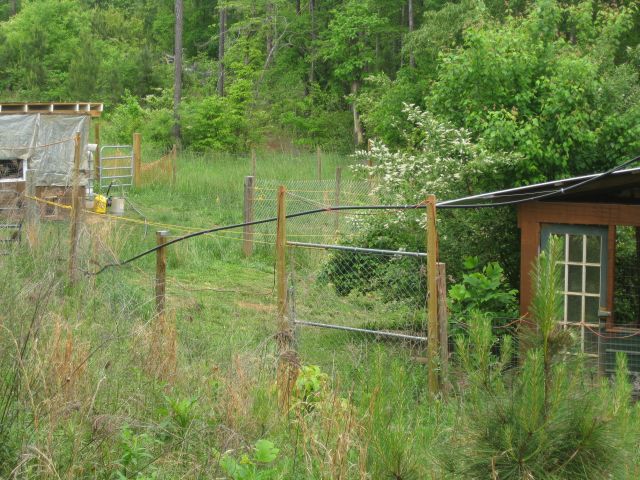
view of the water pipe run from the coop initially on the ground then climbing higher along paddock fence, surmounting gate and ending in gutter


bees – “The Lost World of the Kalahari”

I have been spending time with my bees – recently did my first split (split the one hive into two separate hives) and will soon do the first honey harvest of 2012.  So, with bees on my mind, I want to include some excerpts from an engrossing book written in 1958 in South Africa by Laurens Van Der Post titled “The Lost World of the Kalahari” about the Bushmen.

The Bushmen loved honey and used a special herbal smoke to drug the bees before he dared reach for the honey because “the wild bees of Africa are the most formidable bees I have ever encountered.  They are smaller than most but quick, fearless, and quite unpredictable.  In the village where I was born no hive was allowed by special by-law within four miles of the township because one sleepy summer’s afternoon all the bees had carried out a combined operation against everything that moved in the streets and sun-filled courtyards and paddocks.  I have forgotten the precise extent of the casualty list but I remember there were two little coloured boys, pigs, hens, sheep, goats, dogs and several horses among the dead.”

To locate a hive the Bushman had an ally in a little bird called Die Heuning-wyser, the honey-diviner, who loved honey as much as did the Bushman.  When the bird found a nest it would alert the Bushman who would follow it and after harvesting the honey “he would never fail to reward the bird with honey and, on a point of mutual honour, share with it the royal portion of the harvest: a comb as creamy as the milk of Devon with its own cream made of half-formed grubs.”

And if you did not reward the bird?  Why then, according to a narrator at the camp fire “it will punish you heavily….I once knew a man whose stomach was too big for his eyes- no, not a man of my own people but of the stupid Bapedi – he cheated the bird out of its share and the very next day it called on him again and led him straight to a hole where there was no honey but an angry female puff-adder who bit him on his greedy hand and killed him…..Another bird who had been cheated once led a man into the mouth of a lion….I tell you that bird is too clever for a man to cheat.”

2nd chicken coop door installed

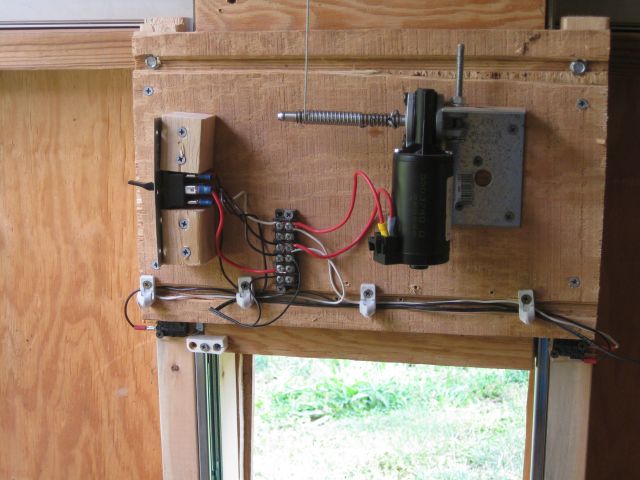
Last week I designed, constructed and installed my first coop door opener – it has operated flawlessly the past week automatically opening the door at about 8am and then late afternoon I reverse the current and close it when I feed the chickens and settle them for the night.

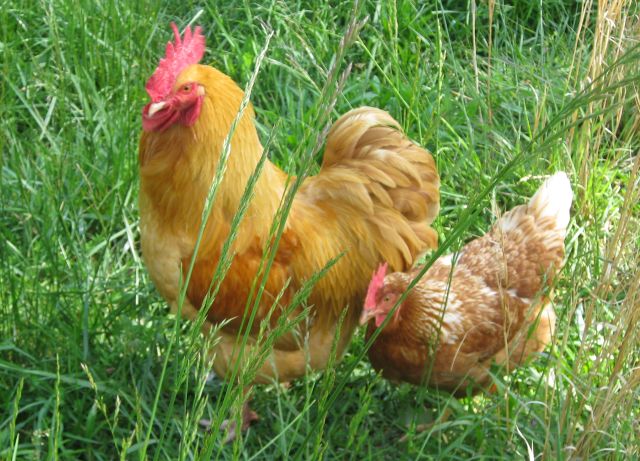
An ongoing issue has been the aggressiveness of the Buff Orpington rooster  to his Buff Orpington sister.  The coop has a partition door and, prior to the advent of the door opener, I would house Lady Macbeth (such a fierce sounding name yet such a timid bird) and the gentle New Jersey Giants and the two Golden Comets on the one side, and the rooster and the other birds on the other.  But since I now arrive later and the door is opened by my new gadget they all have to have access to the exit door, which means no partition.  So the drill the past few evenings was to enforce the partition while Lady Macbeth ate and then, when she had had her fill, I opened the partition door, the rooster charged in and she hopped onto the roost for the night where she was safe from him.  I notice it takes her longer to fill her crop than the other birds and I surmise that, unlike her companions who snack the feed during the day, she probably doesn’t because she does not wish to be cornered by the rooster.  So each evening I wait about 10 minutes while she eats.  Time for a second door.

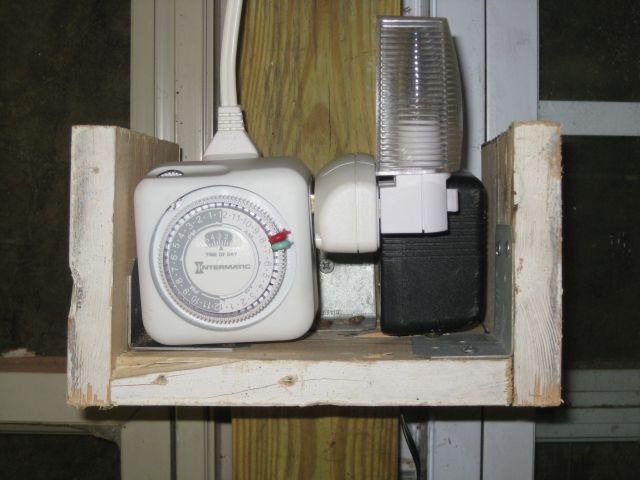
My second door follows the same design as the first with a few refinements.  I acquired a sturdy double pole double throw automotive switch from Radio Shack, which is easier to use than the two separate switches I used on version 1.  I ordered a transformer 10VDC with an advertised 1.5 amps on the internet but it was a puny affair and could not turn the motor and certainly did not deliver 1.5amps, even though the specs  made this claim.  It was cheap and the adage “cheap is costly” applied in this case.  I rummaged and found a 10VDC transformer rated at 0.8amps and it works just fine.  Again I used an inexpensive timer and a night light to remind me at the end of the day   to switch the live circuit to timer circuit.  So tonight Lady Macbeth can sup at her leisure with her 4 docile companions and the rooster can rant and rave to no avail.

Buffy, the rooster, with a Golden Comet


the "summerized" coop (the tarps exclude the light and keep it cool), and the two recently installed coop door openers
simple housing for timer, night lite and transformer
simplified design, one DPDT switch to reverse door direction, contact switches on either side


water conservation – “Heart of Dryness”

I just read Heart of Dryness by James Workman about the plight of the Bushmen in the Kalahari desert when the Botswana government cut off their water supplies and how they adapted and how we can learn from them. I was interested in the book because I am originally from South Africa which abuts Botswana, and also here in Georgia we are engaged in legal water wars with neighboring states.  Workman interlaces the story of the Bushmen with a narrative on the use and abuse of water worldwide and his view that water shortages will result in increased conflicts across the world as the world grows hotter.  He does not believe dams are the solution in arid countries -dry heat and wind result in massive evaporation and build up of sediment reduces storage capacity.  He suggests that artificial aquifer recharge where water is pumped and stored underground is more sensible, akin to the Bushmen burying their water in evaporation proof containers. Some of his findings are counter-intuitive, for example during holidays one Botswana school leaked nine times what it used while in session, due to pressure build up forcing water leaks through cracks.   The 250 page book has 50 pages of notes/bibliography and appears well researched.

His reference to water wastage got me thinking of my own rainwater harvesting system and, since rain was in the forecast, I inspected and found several issues.  Two gutter downpipes were blocked and no water would have been collected from them.  Even more significant – the 4″ pipe which transfers water from my main collection point (the house roof) to my barn storage tanks, had again opened a leak where the 4″ corrugated pipe attaches to the 4″ pvc pipe.

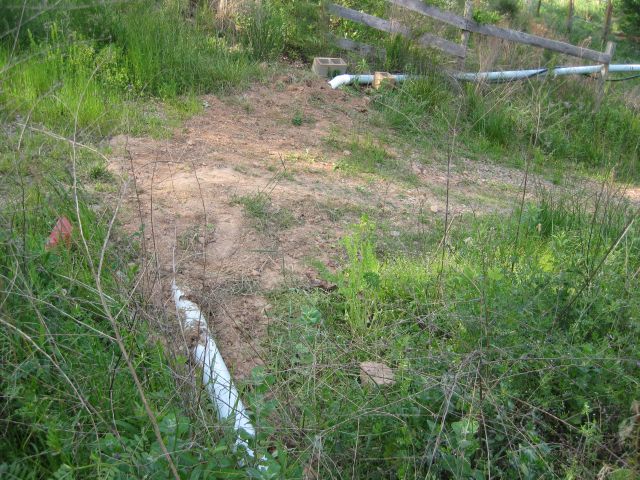
The advantages of corrugated drainage pipe are that it is flexible so it will fit easily in a trench which isn’t straight or which has bends different from the available 90 deg, 45 deg or 22.5 deg fittings.  And it is much cheaper, both the pipe itself and not needing expensive fittings for bends.  Which is why I had used it for a section of the  water run.  Its disadvantages are that it does not make a tight fit when joined with pvc pipe and therefore can leak if there is a small shift in the moorings and, because it is corrugated, debris collects in it and causes blockages.  Now I had to bite the bullet and replace the corrugated pipe with pvc pipe.  I had used 4″ Sch 40 pvc pipe for the exposed overhead run – this is a thicker more expensive pipe.  For the section I was replacing, which runs in a trench, I opted to save money (on the pipe and the fittings) and bought the considerably cheaper DWV pipe.  DWV pipe (drain, waste and vent) is for non pressurized applications and because the pipe will be buried, fully supported by the ground and not sun exposed, this seemed a reasonable choice.  It took some time digging a new trench (the old one was gradually curved and not usable) and aligning the pieces and fittings since the direction change was closer to 80 deg than an easier 90 deg. But now it is done and, with a dry season looming, I hope to be  make every drop count.

newly replaced rainwater pipe