goodbye Red

I inherited Red from departing neighbors.  She had been rescued from a commercial hatchery and came with a snipped beak.  She was the smartest of them all.  In the early days I borrowed her and some of her companions to help prepare the vegetable growing area and she would hover close to my digging implements to examine and gulp down whatever edibles I unearthed – whilst the other chicken stayed as far away from me as possible.  And when she and the others were given to me, it was Red who first identified the presence of a young rooster (Buffy) in my second flock, as I wrote in September 2011:

“she paces the fenceline and he saunters closer
though pretext is food, a purposeful loiter,
he faces and tip toes, his chest full of swagger
she responds just as quickly with unrestrained vigor
and then he departs and she wistfully eyes
the untutored young rooster and if she could,
sighs,
but tomorrow will come and who knows by then
Buffy be back and gladden the hen”

She had been ailing for some time and seemed to recover after I administered some antibiotics and gave her a spa bath with epsom salts.  But the past week was tough and she got weaker and weaker and today she was gone.

What to do with the body?  I remember when I was caring for my neighbors’ chicken while they were away and one died and I buried it.  When I told them they were incredulous so, not understanding their response, I asked if they would have liked me to freeze the body for their later digestion, which provoked a similar response.  So I asked what they did with their  chicken and they said they tossed them into the garbage bag,  which to me is wasteful of recyclable nutrients and somewhat discourteous of a loyal retainer.  In fairness I should mention that my neighbors used to slaughter, process and eat healthy chicken, they drew the line with a chicken dying of unknown causes.

A number of chicken have died over the past 2 years and I have an area where I buried them side by side under biggish stones to deter scavengers.  But I decided today that Red would be better honored if she were buried amongst my fruit trees – perhaps I am thinking of a tradition where a dead fish was buried at the bottom of a hole dug for new fruit trees.
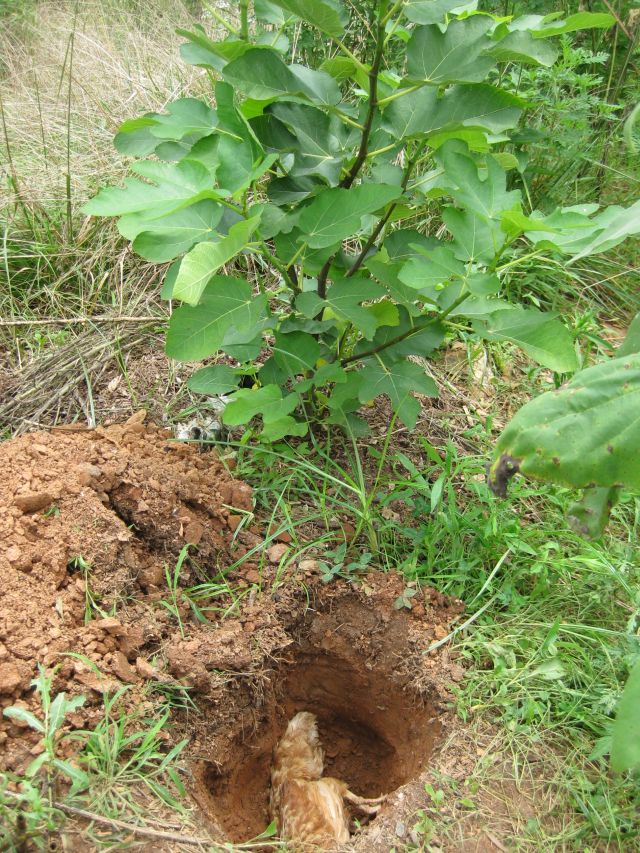
Red about to be buried in a hole alongside a young fig tree

So she has moved on but her remains will contribute to the soil and its inhabitants, the small fig tree and to the fruit it will bear one day.
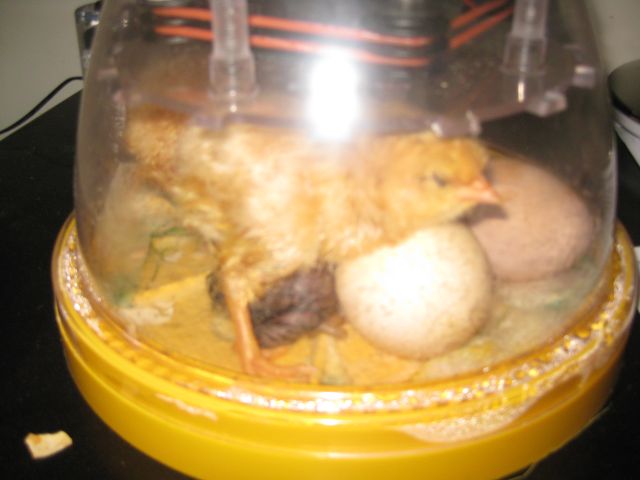
hatched chicks

We have a Buff Orpington rooster and 8 hens, one of which is his sister.  Because most nights I am away from the property I have an automatic coop door opener (design specs elsewhere on this website).  Most nights I lock them in but, when I can’t neighborhood kids earn pocket money doing so.  And when they can’t a neighbor obliges and I will offer, though she doesn’t always accept, a dozen eggs.  She used to keep guinea fowl and she mentioned to me that all the eggs I had given her were fertilized.  My respect for Buffy (the rooster) leaped, not only for his efficacy but also for the way he distributed his favors unerringly.

So as I am a DIY’er I fashioned an incubator <$10 from website instructions and – after 21 days nothing happened.  So with a mother fox and 4 young encamped in the area and being uncertain of my rooster’s life expectancy when a mother fox has to provide, I bit the bullet and purchased a Brinsea 7 egg incubator.  (I am confident Buffy will sacrifice himself for his gals and with his elongated spurs give a good accounting but hope he will not be put to the test).

For incubation success you have to replicate as closely as possible the behavior of a mother hen – how she keeps her eggs warm all the time (except for brief snack and bathroom excursions), how she settles down and rolls them ever so slightly.  Temperature and humidity are critical factors.  The Brinsea has programable options and the default setting seemed designed for chicken (but could easily be adjusted for pheasant, quail, ducks and parrots).  My default settings were 99.5 deg F; 21 day incubation; egg turning every 45 minutes; turning angle 5 seconds duration; and no automatic cooling.  Some explanations – the significance of the 21 day count down is that on the 19th day the incubator will stop turning the eggs.  Automatic cooling is to mimic the cooling which occurs when the mom temporarily leaves the nest.  Since I opened the incubator every few days I thought this was sufficient.  For the last few days of incubation humidity must be high to soften the shell to enable chick emergence, so I checked both water reservoirs were full during this period.

I tried “candling” where you examine the eggs carefully under a bright light and did not learn much.  I did weigh the eggs at the outset and during incubation and noted all the eggs lost weight somewhat in line with recommendations, so I assumed the humidity was ok.

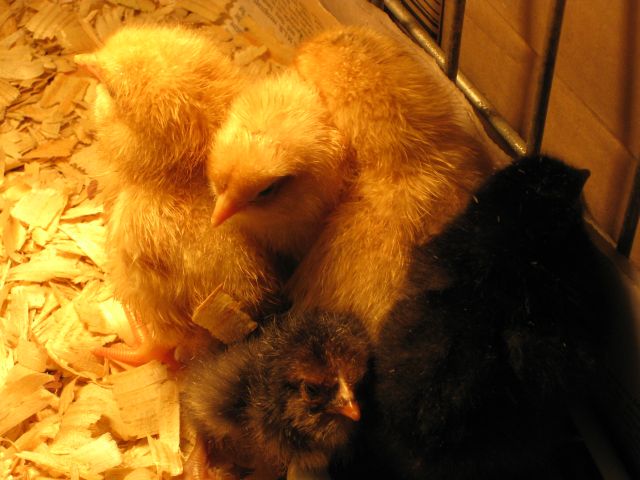
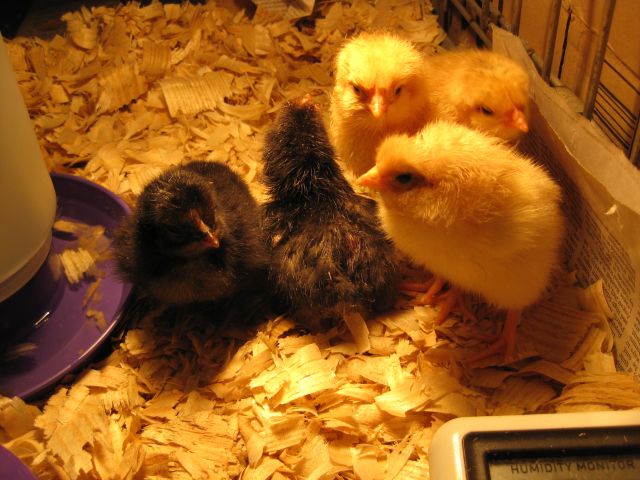
And,  on the 20th and 21st days there was action and 5 chicks emerged from their shells.  In anticipation, I had rigged a heat lamp over a simple brooder box.  I made a quick trip to Sackett’s, the local resource, and purchased an inexpensive plastic gravity fed waterer and feeder and chick feed.  They seem content – not only do they all seem to awake and jump into motion at the same time but, just like the closing of a switch, they all collapse and go to sleep at the same time, piled up on each other.  They all know how to eat but only one so far has figured out how to drink.  More training required there.  As for the remaining two eggs, they may not be viable – I will wait a few days more.

the incubator with the first two chicks emerged

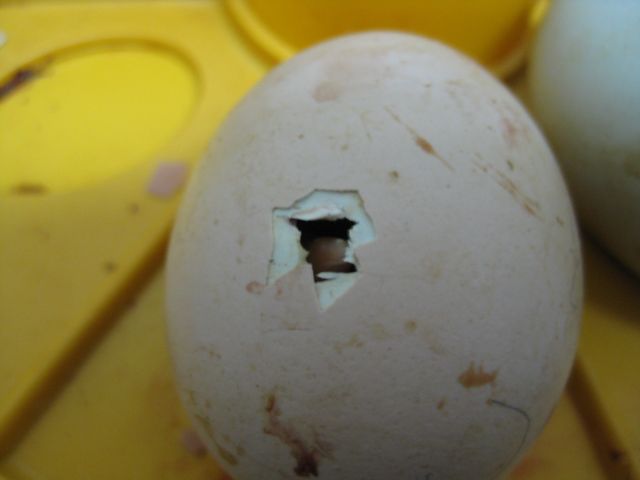
Prior to emerging chicks will make a small hole for breathing and to take a peek at the outside world.

breathing hole and a window to the big world

And what fun it is to snuggle up with siblings, a common dad but different moms.

5 new chicks
5 new chicks

And a final shot of the five (sex still unknown).

5 new chicks
5 new chicks