fungi – growing mushrooms

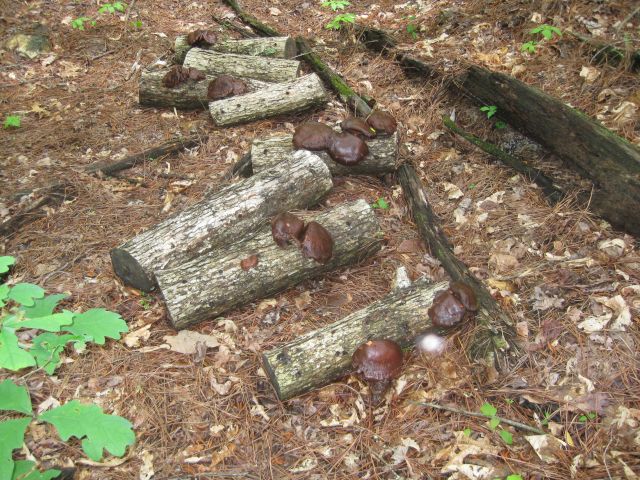
My woodland has so many naturally occurring mushrooms that I am again inspired to grow my own mushrooms. I say again because when I first purchased the woodland it had no access road and I had to cut down a number of trees including oak trees to gain access to the interior where my tractor building now stands. At the time, I cut the trunk of one of the oak trees into 3ft logs and drilled and inserted shiitake mushroom plug spawn and placed the logs in a valley on the north side of a rise where it was mostly sheltered from the sun. With time the logs sprouted mushrooms, especially prolifically after extended rainy periods. Unfortunately I did not visit the site very often and when I did the mushrooms had either been eaten by wild animals or had matured and spoiled. Below is a ‘photo from April 2009 showing some overmatured mushrooms:
mushrooms
over matured shiitake mushrooms -note the edges of the cap have upturned

I kept myself busy with other matters and I only thought of mushrooms again last year when several wild cherry and maple trees had to be taken down. I thought mushroom growing was easy and, without research, decided to purchase several varieties of mushroom on birch dowel sticks (plug spawn) and innoculate the wild cherry logs. Bad idea! As I have now learned, cherry is not a preferred wood for mushrooms. I would have been better off using the maple logs. Apparently fruit trees, and wild cherry belongs to that class, should not be used. I built a mushroom shelter and watered the cherry logs intermittently and, to date, zero.

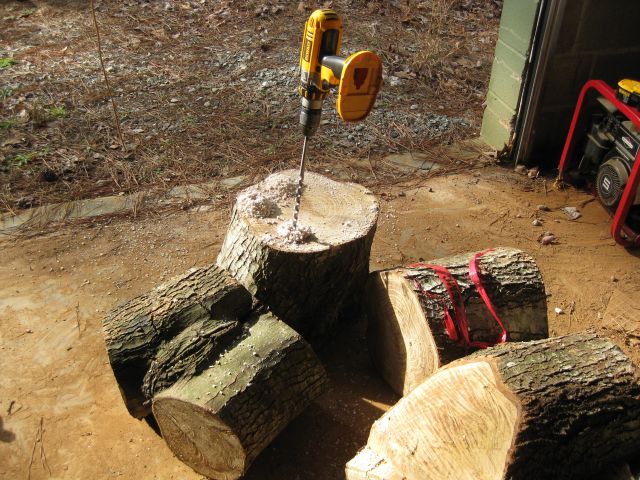
When my neighbor had her sound maple tree cut down (it was threatening the foundation of her house), I decided to get back in the mushroom business and bought grey dove grain oyster spawn. Grain spawn is more difficult to insert into a log than sawdust or plug spawn. Another difficulty – the logs were large in diameter, much more than the 8″ preferred diameter. So I had to make do and drilled vertical holes about a foot long into the face of the logs and filled with the spawn. Not a method I have seen used elsewhere, or recommended.
mushrooms
drilling holes in face of maple log for oyster mushroom spawn

I then sealed the holes with wax – I melted the wax with a blow torch and dripped the molten wax into the holes. I tried to keep things reasonably clean and swabbed tools and materials with hydrogen peroxide – the bottle can be seen on the side of the log.
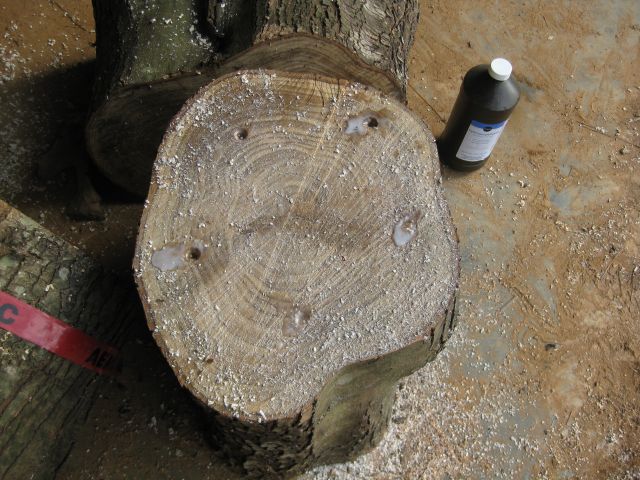
mushrooms
5 vertical holes in face of log sealed with wax

It is interesting how we draw conclusions which are so often wrong. I transferred to the wood shelter 6 of the oak logs from 2008/2009 which had borne shiitake. Four of the logs were light and two were heavy and, I assumed that if the shiitake were to fruit again (seemed unlikely after 4 years of neglect) it would do so on the heavier logs, which had more material remaining. So I placed the 2 heavier logs in the shelter where they enjoyed the same watering routine as the other logs and left the 4 lighter logs under the drip line of the roof. Well – young mushrooms began appearing on the lighter logs and not on the logs in the shelter. Perhaps the logs under the drip line received more water than the logs in the shelter, or the logs were lighter because the mycelium in those logs was more aggressive than the mycelium in the heavier logs. The logs came from the same tree so the wood should not be a factor. Below is a ‘photo of the young shiitake mushrooms now located in the shelter.
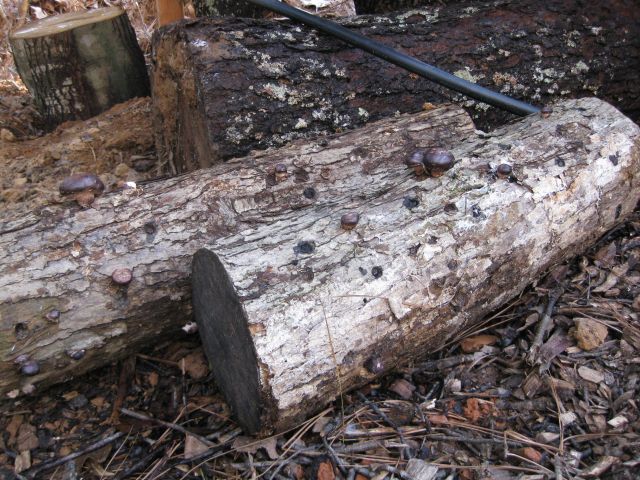
mushrooms
small shiitake mushrooms on logs left outside since 2007

To ensure the logs in the shelter are well watered I rigged a simple spraying system which is gravity fed by rainwater harvested by the tractor building.
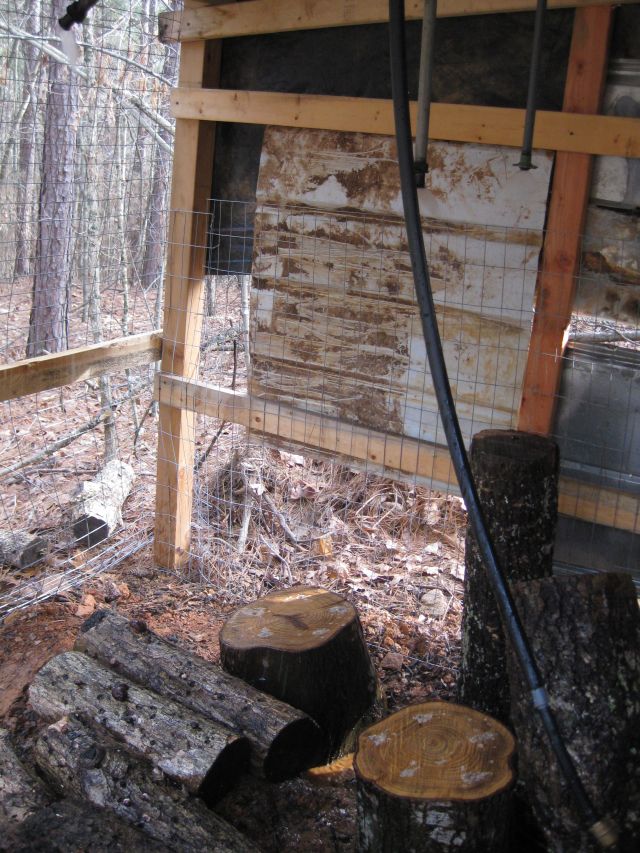
mushrooms
simple gravity fed water spray system for cherry, maple and oak logs

The mushroom shelter is close to the path I use for my woodland walks with Trudy (my canine companion) so I pass it frequently and will be more likely to keep a close eye on mushroom happenings than when the growing took place in the valley which was out of the way. Also, to deter wildlife visitors I have completely enclosed the 8ft by 8ft structure. The 4″ posts are cedar, the 2×4’s are untreated wood, the scraps of metal are just scraps, the black material was used to prevent silt erosion on a construction site, and the fencing material was left overs from a chicken paddock. And the red door, which is not an exterior door and will deteriorate from weather exposure, is a $2 special from the thrift store. Not a particularly attractive construction but should not attract human attention (unless passersby think there is a still in operation) and hopefully will provide food for the table.
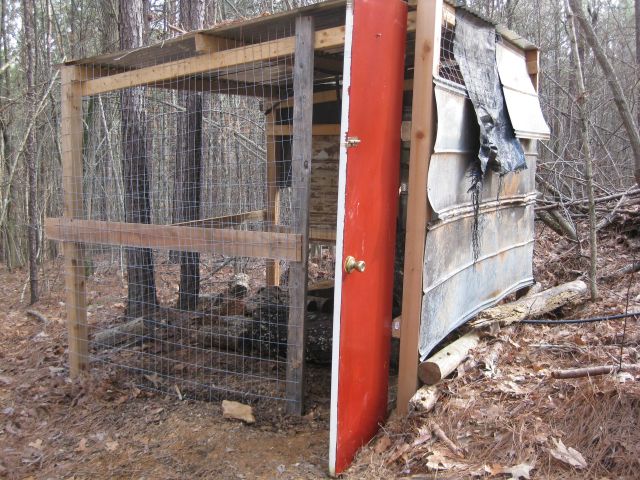
mushrooms
simple mushroom shelter

not always clear sailing

It is good, I suppose, to be reminded occasionally of how fallible we are.

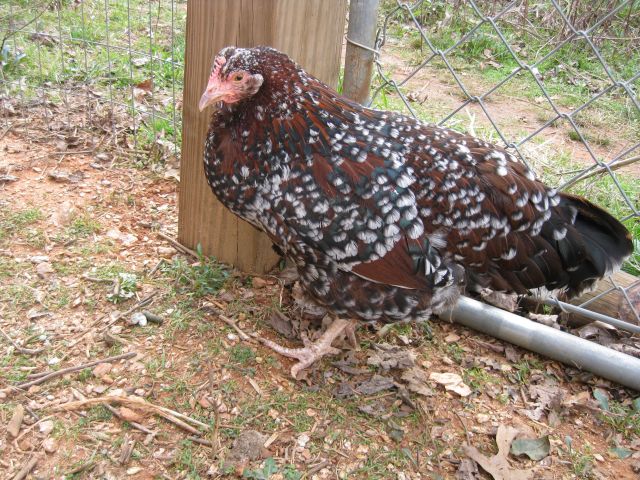
I have, or I should say “had”, a pair of Speckled Sussex hens – acquired with the other 3 different pairs as youngsters and, at the time of writing, less than a year old.  For the past few weeks the Speckled Sussex had been acting out of sorts, not running up to the fence to greet me (in the expectation of handouts) as the others did, and preferring to huddle down next to each other.  I thought this was a temporary malaise, perhaps the shortened daylight hours were depressing them, perhaps they enjoyed their own privacy.  After all they are shorter and more compact than the other taller birds.  Pehaps they were snobs.  I remembered how, when I first brought them and the other 3 pairs of chicken home, they had victimized the two Golden Comets and continuously chased the Comets away from the communal feed tray.  The result was the Comets were ostracized and had to have their own feed tray and keep their own quarters.  This continued until the Comets got bigger, bigger than the Speckled Sussex, and more confident, and then it was no longer a problem.

So all these thoughts went through my mind as I kept an eye of the lonesome pair.  I only realized there was a problem when they wouldn’t move at all when I approached them.  Previously they had always kept their distance from me and rebuked any attempt to pick them up.  Now they wouldn’t move and I was able to easily pick them both up, one in each hand, and carry them to their coop in the evening.  And then it dawned on me that one was weak and sick and the other was loyally staying by its side (I will return to the use of “loyally” later).  The next morning the weak one was clearly exhausted and its one eye was closed.  The farm store manager suggested it had respiratory problems and asked if I heard a “gurgling” in its breathing.  He suggested I dose it with VetRx, which I (and he) thought was an antibiotic.  However, when I examined the package more closely I realized it was not an antibiotic but had natural ingredients to alleviate congestion (I could also have figured this out by reading the label more closely – “based on a formula in use since 1874”).  I administered almost half a cup with a syringe and the hen began breathing much, much better.  However, a few hours later the gurgle returned.  And later that pm it departed – I think it was too weak and I had left intervention until too late.

My initial concern was that the other 13 birds might be affected (in addition to the 8 I purchased as youngsters, I was also gifted 6 older hens by a neighbor).  This does not appear to be the case.  But I have another problem – the remaining Speckled Sussex.  Wikepedia describes “sentience” as “the ability to feel, perceive or be conscious, or to have subjective experiences”.  Are chicken sentient?  Based on my ongoing travails with the remaining Speckled Sussex I answer “definitely”.  As her companion suffered she stopped eating and now her companion is no longer around she has lost all interest in her surroundings and apparently in life itself.  For the past few mornings I have separated her from the others and offered home made whole wheat bread and 4 to 5 worms from the compost heap.  I do not like offering worms on a platter  – they are great workers and it seems unfair, but I feel I let her down and am trying to make amends (and save her).  The worms are irresistible to her and she also enjoys snacking on the bread.  But when I return her to the others she continues to be mournful and will sit alone and make an occasional lament (or so it sounds to me).  There is, of course, the possibility that she is also unwell. I have an antibiotic (Tetracycline) at the ready and I have segregated her from the flock, but since she appears alert, is eating, and is breathing clearly, I am holding off on the antibiotic for now.

I tried to find another Speckled Sussex  and was going to inspect it the next day, when it was sold.  Perhaps this is better since a new hen may have its own problems with the rest of the flock and may not get on all that well anyway with my Speckled Sussex, so buying another one of approximately the same age may be compounding my problems.

lonesome survivor

With the above lesson, or reprimand, taken to heart I now act more quickly on possible problems.  For several weeks one of the Golden Comets made a curious forward backward motion with its neck – not often, but perhaps every five minutes.  Otherwise very active.  On the off chance that there might be some blockage in her crop I dosed her with olive oil using a syringe.  That funny motion seems to have stopped.  But from now on, in addition to observing them, I will also intervene more quickly.  And hopefully, sunny days will return.

it’s off to work we go

So its off to work we go
now the night long roost is done
and the fledgling sun
brings cheer and early crow

we hear the padlock click
the stay bolt undone
we gather at the coop door
and here’s our keeper Rick

he points out the way
a 50 yard jog
across a field and up a hill
its the fruit trees turn today

a 50 yard jog

he is deep into organics
no sprays at all
munchies abounding
for us his soil mechanics

he wants the bad bugs gone
we’re happy to oblige
we eat them all both good and bad
and give our chicken song

we eat them all both good and bad

some say its like a squawk
or shriek to pierce the ears
our cries and clucks and tuck tuck tucks
that is music and our talk

the paddock has a shelter
with water for our thirst
and egg boxes provided
to cushion the ejector

its fenced to show the playground
we could easily fly above
but grass is greener this side
and grubs to be found

we feel with out splayed feet
the bugs beyond our view
a quick back swipe with claw
finds a wriggle for the beak

a quick back swipe with claw

they visit in the night
the possum, fox and coons
and then we’re in our coop home
secure and snuggled tight

there is a local hawk
we used to duck for cover
but now we’re twice its size
and he can only gawk

as we continue at our play
or should I say its work
the scoot and scratch and eat
a day long happy treat.

fungi

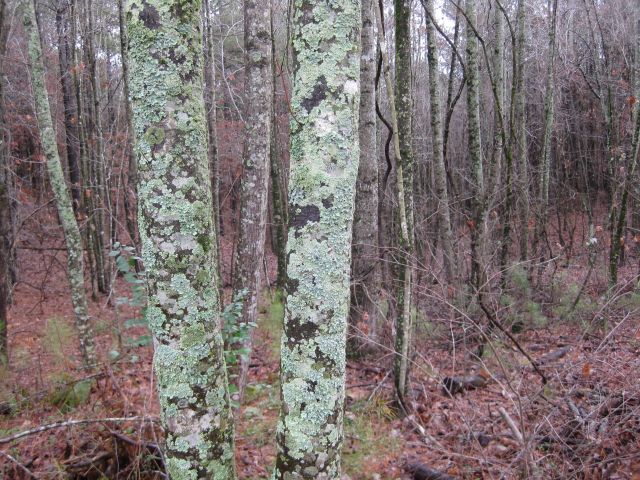
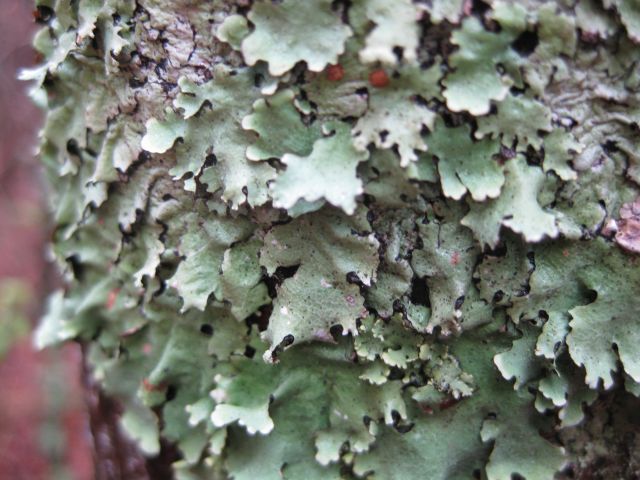
The recent heavy rains and at times warm weather have transformed the appearance of the woodland – the trunks of the trees have assumed a variegated green appearance.

lichen on the trees

On closer examination these are lichen –  a symbiotic alliance between photosynthesizing green alga and fungi.

leaf like lichen


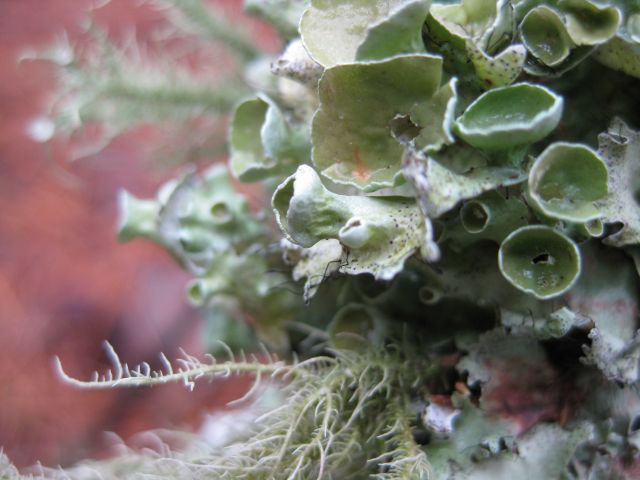
Other growths are more intricate.

unusual trumpet shapes

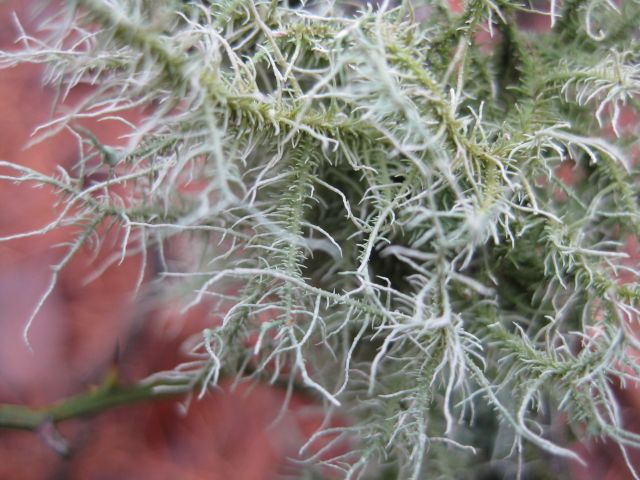
And there are the long reaching arms.

an intricate maze

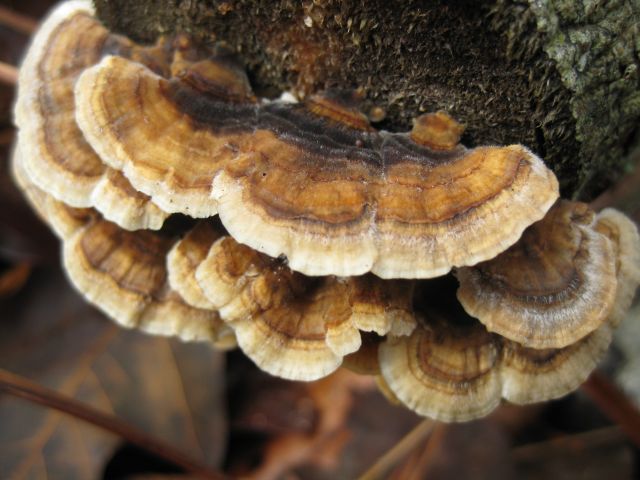
And finally some regular mushroom growths at work decomposing the end of a tree trunk.

regular decomposers


chicken synergies

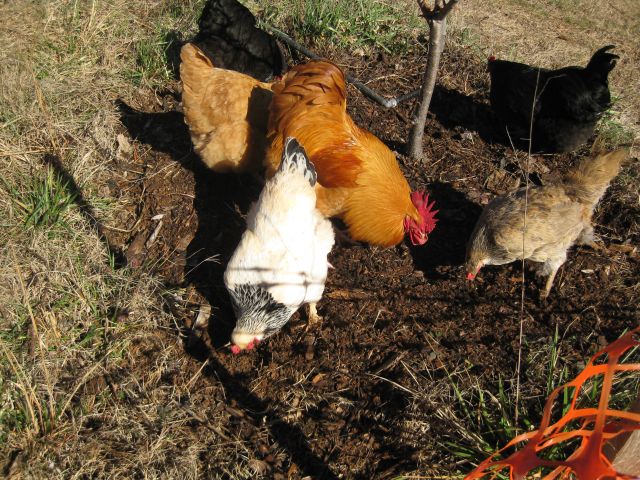
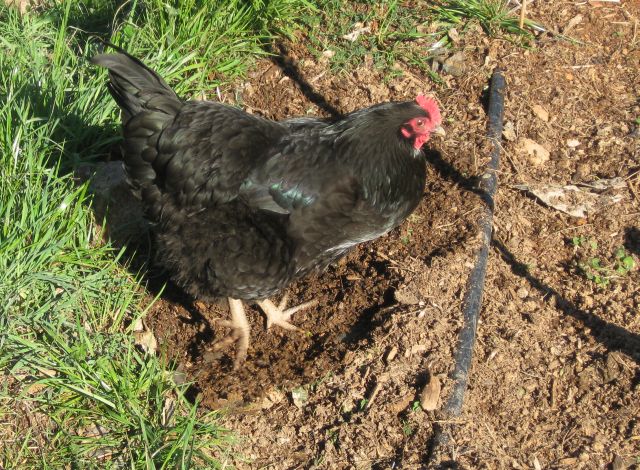
The chicken are still doing well.  Six hens from my former neighbor (4 hybrids, 1 Ameraucana, 1 ISA brown) and 8 youngsters ( 2 Buff Orpingtons (1 of which is a rooster called “Buffy”), 2 Golden Comets, 2 New Jersey Giants and 2 Speckled Sussex).  No casualties, though one of the hybrids walks with a noticeable limp and is now called “Gimpy”.  The two dominant hens are the Ameraucana and the ISA brown, which curiously are also among the smallest.  The two largest hens, the New Jersey Giants, are the most timid and the 2 Speckled Sussex are the most antisocial.  Whenever there is a commotion amongst the hens, Buffy rushes in to settle the dispute.  He also charges out when there is a disturbance or security risk and crows throughout the day.  Notwithstanding shortened daylight hours I am getting 5 to 6 eggs a day.  I have decided against supplementing daylight with artificial lighting on a timer.  The coop I constructed is working well for them – no moisture from outside and inside temperatures have not fallen below 30 F (when the outside has fallen to mid teens).  They seem healthy enough though occasionally there is a soft shelled egg (to my dog’s delight) , so I supplement with yogurt and oyster shells.

I grow organically and my small orchard of 12 apple and assorted fruit trees began bearing fruit last year (actually I also have a 2nd orchard of first year fruit trees some years away from fruit bearing).  With the appearance of fruit there also appeared a variety of bugs, especially on my apple trees.  I know sanitation is important – removing the fallen fruit and wood cuttings because the pests overwinter in the fruit and cuttings.  But how to remove the soil slumberers?

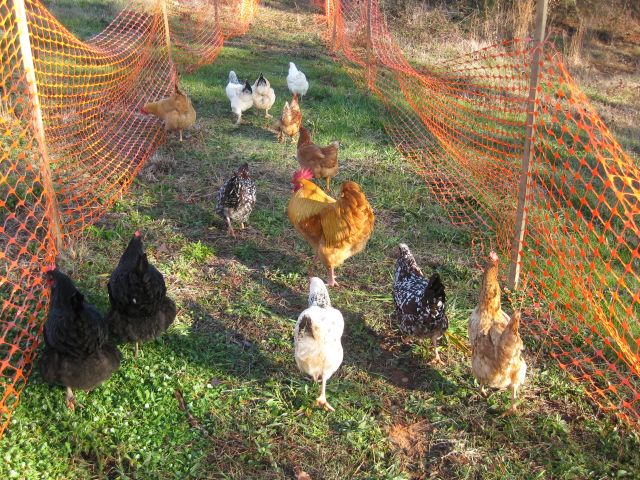
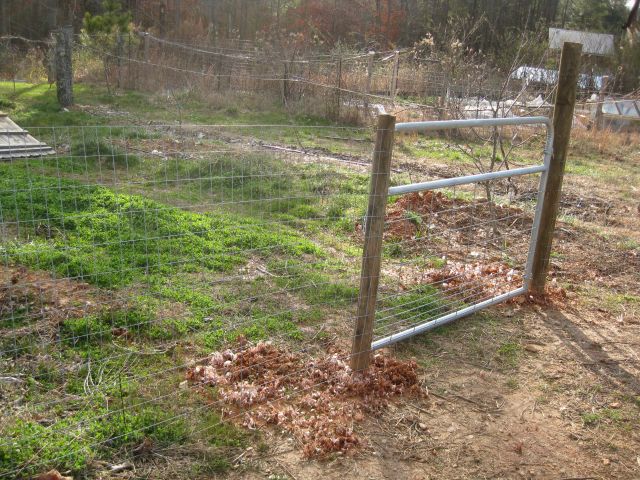
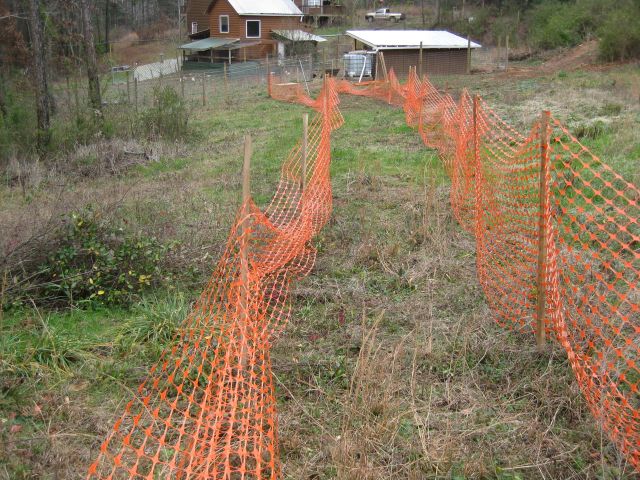
I installed a fence and 2 gates around the orchard and built a chicken day shelter and constructed a passage way to span the 120 ft from the main chicken enclosure to the orchard.  And now my flock are hard at work in the orchard,  removing debris and mulch with vigorous back swipes of their feet and voraciously eating the grubs and other soil dwellers.

a 6 ft galvanized mesh gate installed to the orchard chicken paddock

Fencing is a fairly costly business.  I used welded rather than the more expensive woven wire fences which are necessary for horses and goats, so there is a saving there.  However, the gates cost from $65 to $100 and, if I had welding skills and access to surplus metal, I would make them myself – but I don’t, so I pay – and they should last indefinitely.

The passage way is temporary and I bought the red plastic material and stakes for about $9 per 100 ft from Lowes – marked down from $30.

passage way from main chicken enclosure to orchard paddock

I remedied the problem of the fence slipping down the posts by drilling a hole through each post near the top and tying string through the hole and the top of the fence.

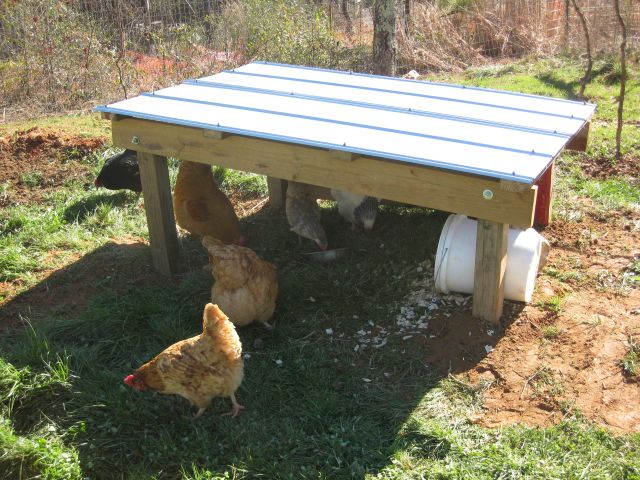
Finally, the day shelter.  I dug 2 ft holes for each of the 4 posts, bolted on 6″ wide planks to the 2 long sides and then 2′ by 4″ purlins and then screwed down galvanized roof sheeting.  The roof sheeting was $20 for a 12ft long 2 ft wide sheet, which I cut in half to fit in my truck and to produce a 6ft by 4ft roof. I will board up the south and west sides to make them feel more secure and sheltered from the sun.  In the shelter I have horizontally placed a 5 gal bucket with straw in the hope the hens will use it for egg laying, and a water container. To alert the flock to the advantages of the shelter I threw in a few handfuls of scratch corn, which immediately got their attention.

chicken day shelter 6 ft by 4 ft, with 5 gal bucket for egg laying

The roof slopes to the west to ensure the rain will run to the west and not over the east entrance.  In addition to reducing orchard pests I expect the flock will enjoy a more varied diet, get more exercise, and consume less of the purchased food I provide.


cold frame building (2)

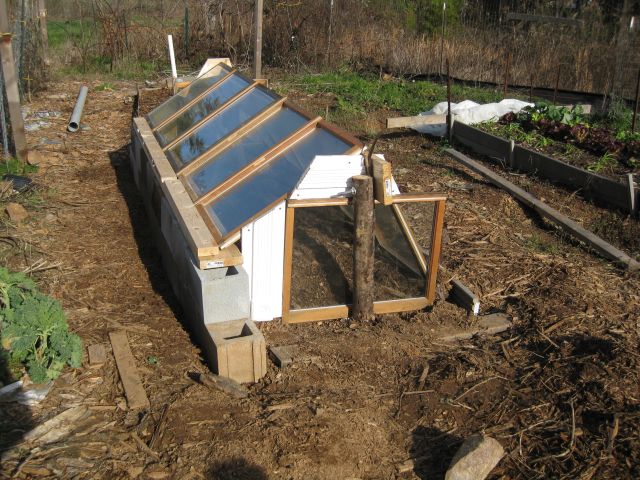
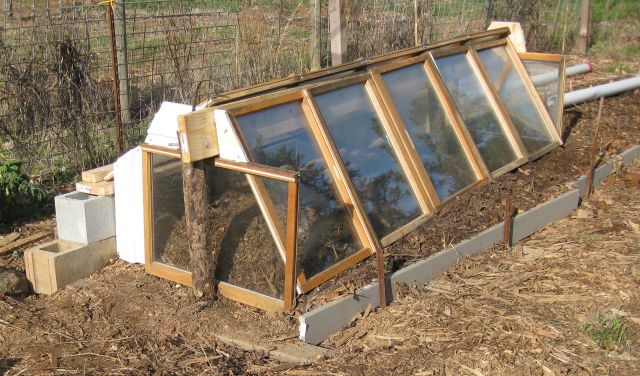
In a previous post I mentioned  building my first cold frame using bargain priced windows from the local thrift, cement blocks and lumber.  The seedlings in this cold frame are growing well and when it is cold (say 18 F outside temperature) the temperature in the cold frame is approximately 10 F higher.  During the day the differential increases.  And it keeps out the frost.  So I am hoping to grow decent sized vegetables.

One cold frame was not enough because I had 10 windows remaining and there is a better site for a cold frame – on top of the hill where it catches early morning sun to late afternoon son.  This location is unfenced and close to a road so there is a possibility of unwelcome attention, therefore my decision to locate the first cold frame in the better protected vegetable growing area.  Nonetheless, the cost of building a cold frame is modest and the full time attention of the sun is a major plus.

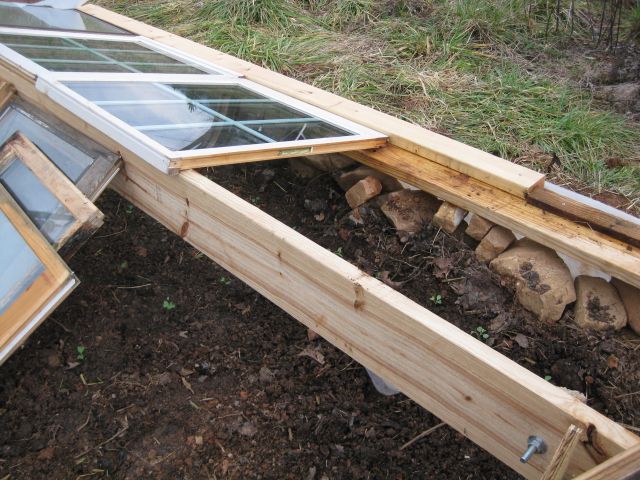
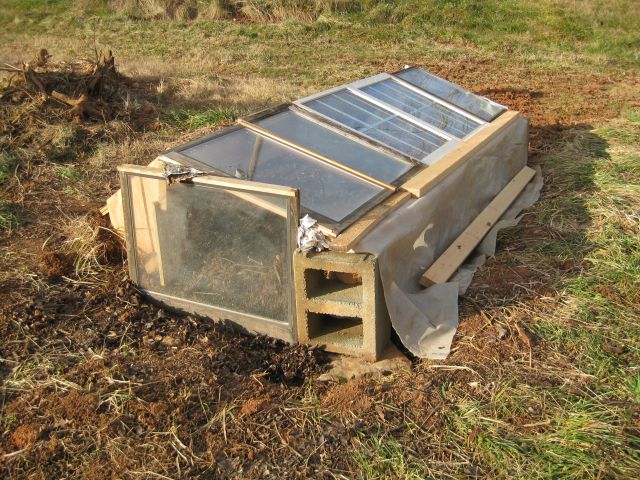
Construction was very similar to the first frame except I dispensed with all but two cement blocks (instead of the 17 used in the first cold frame).  The blocks are located at each end of the cold frame and are spanned by a 10ft by 8″ wide 2″ thick, plank.  In between the two cement block supports I built a stone wall of sorts using the large stones I had uncovered when I dug a contour ditch.  I used a hammer and stone chisel to cut faces on the stones so they would stack.

cold frame
basics of construction of cold frame - windows on top and south facing, stones on north side

The purpose of the stones is to absorb the sun’s heat during the day and release it during the night.  Only the top layer of the stones is visible – there are two (more skilfully arranged) layers below the soil level.  To prevent the warm air exiting through the stones I draped 6 mil plastic sheeting on the outside of the frame.

cold frame
north side of cold frame showing plastic sheeting draped over north stone wall

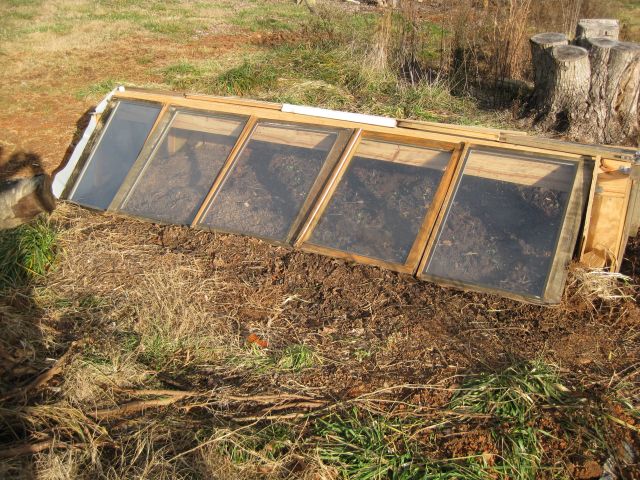
As before, I used the windows from the thrift store to enclose the frame.  The savings from using 15 fewer cement blocks was partially offset by the cost of 3 additional window frames I had to purchase from the thrift store – a different floor manager did the pricing and he wanted $4 per window rather than $1 – such are the vagaries of life.

cold frame
south facing aspect of cold frame, seedlings still to be planted

The gaps and openings I covered with bits of plank or plastic.  I have now introduced some collard and broccoli seedlings and in the next week will add the remaining spinach and other cool season vegetables – and wait and hope that I will get a worthwhile yield.


soil test

Eight years ago when I was working full time and all my growing activities took place in an Atlanta subdivision, I convinced myself I had to buy a soil test kit.  I splurged and bought a LaMotte model STH-4 (sounds like a revved up sports car) which is described as a “professional soil testing outfit”  and, in addition to pH, can test for nitrate nitrogen, phosphorus and potassium.  Needless to say, after a cursory test with meaningless results, I packed the model STH away and it has now resurfaced, in my hour of need when, with temps in the teens (before adjusting for wind chill), I need to do something worthwhile.

LaMotte soil test kit

I decided to take a soil sample from an area where I have done no growing so I will know what the unadjusted soil is like, and from my compost heap.  I know I should be focusing on the condition of the soil in my growing area but I have several months of winter ahead to sample more widely.

The LaMotte instructions for taking soil samples are very detailed – after all, if the sample is not representative of what you are interested in, the results may be skewed.  I took the samples carefully and allowed them to dry out in the green house and then ground them through a metal tea strainer to obtain a powdery sample for the tests.  I followed the procedures carefully.  Basically you fill a measured test tube with an extracting solution, then add the measured soil sample and shake for one minute and filter the soil suspension into a second tube.  The filtrate in the second tube is the general soil extract used for the tests.

For the nitrate nitrogen test you take a measure of the soil extract and add two different nitrate reagents, mix and allow to stand for 5 minutes and compare the color with the nitrate nitrogen color chart.  For potassium (potash) you take a measure of the soil extract, add two potassium reagents (the second reagent causes precipitation if potassium is present) and then you place an empty  calibrated narrow tube on white plexiglass which has a solid black line down the middle.  You slowly add the mixture to the narrow tube until the black line just disappears.  The calibration on the tube tells you how much potassium lbs you have per acre.  Finally, the phosphorus test is like the nitrate nitrogen test – you dissolve two potassium reagents in a measured soil sample and compare the color with the phosphorus color chart.

I performed the tests on my soil sample and the results were – zilch, or insipid if I were to be charitable.  I immediately thought that the chemicals in my soil testing kit had deteriorated.  So, before testing the compost sample, I decided to do an extreme test – I found some chemical fertilizer 13:13:13 (over 10 years old since I don’t use the stuff anymore).  And reran my tests.  And the results were off the wall – or certainly off the LaMotte charts for intensity.  Reassured somewhat, I then ran the tests on my compost sample – and it was interesting.  Mediocre nitrogen but strong potassium and phosphorus.  I will now extend my testing and improve my procedures and hopefully gain useful knowledge of my soil conditions and my growing practices.

I also tested for pH using a Hanna pH meter.  This also takes practice – if the electrode is not properly cleaned (I use an electrode cleaning solution) and properly stored (I use a storage solution) the results can be erratic.  My compost is showing a pH of around 6.5.  More food for thought.

cold frame building

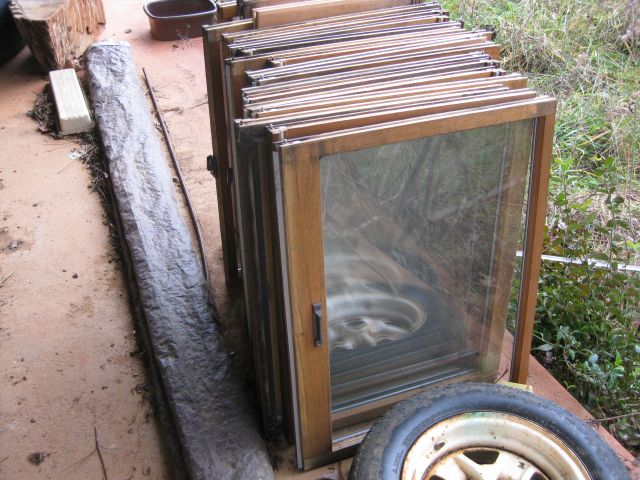
On a recent visit to the thrift store, where there are often solid wood furniture and country painting bargains, I noticed about 50 double insulated small windows each 2 ft wide and  31″ high.  Available for $1 each.  I bought 22.  And have spent a lot of time figuring how to use them effectively in a cold frame.

double insulated, same sized $1 windows from thrift store

My greens are growing very well under an Agripon row cover – it allows air and rain through, protects against frost, keeps the temperature higher inside than out and allows some light through.  However, as with most all solutions, there are negatives.  The cover allows light through, but not all the light and it keeps temperatures higher than ambient temperatures, but not that much higher.  This has worked fine up to now since temperatures have been mild.  Temperatures in January and February will be much lower.  A cold frame using glass windows will let much more light through and will keep temperatures much higher.  Negatives are more labor intensive and costly to construct, does not allow rain to penetrate therefore more supplemental watering required and, on warm days, the temperature will rise too high so I shall have to be watchful to allow ventilation.  An advantage of a cold frame over my greenhouse is the plants will be growing in the ground and their roots will penetrate further than in greenhouse pots.

So having rationalized the need for a cold frame I developed a simple construction plan requiring minimal additional expenditures.

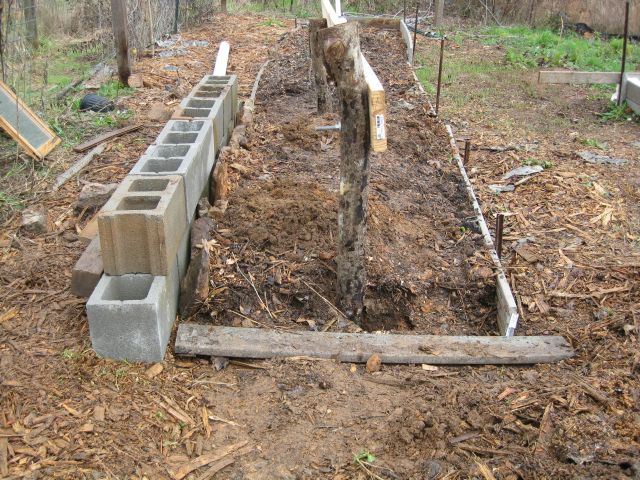
skeleton of cold frame, cement blocks on north side of raised bed, ridgeline down center

I appropriated a section of a newly built raised bed, which has stones on the north side to store heat.  I assembled a two level wall of cement blocks (8″x8″x16″ –  $1.25 each).  9 blocks on the ground and 8 above them (not mortared).  Most of the construction time was ensuring the bottom blocks were level.  I recycled two cherry branches for my uprights to which I bolted a 2″x8″x10ft untreated plank ($5.85) which acts as the ridge on which the windows will rest.

cold frame showing 2nd plank on cement blocks and windows in place

Since cement blocks have cavities, I aligned a second 2″x8″x10ft plank along the top of the second block layer to which I screwed 5 right angle brackets which grip the inside face of the cement blocks to prevent the plank sliding off the blocks.  Additionally I screwed a 2″x4″ plank along the left side of the plank as a step to prevent the windows sliding off the plank.

a view of the south side of the cold frame

On the south side of the cold frame I have the 5 windows with bottom edges resting on the ground and top edge resting on the ridge line.  A total of 12 windows were used, 5 facing up and north, 5 facing south and 1 on each end.  By having the south windows and the end windows resting on the ground this will maximize exposure to the low southern sun (also, unfortunately, accelerate moisture penetration and wood rot).  The areas not enclosed by the windows were filled with sized surplus lumber.  For access and ventilation I remove the south facing windows.  I placed an electronic min/max thermometer in the cold frame and tomorrow, hopefully, I will find there was reasonable heat retention.  The ground should also have warmed up and I will plant out more of my kale, collard, mache, broccoli raab, and turnip greens seedlings.

some winter tasks

Vegetable growing in winter

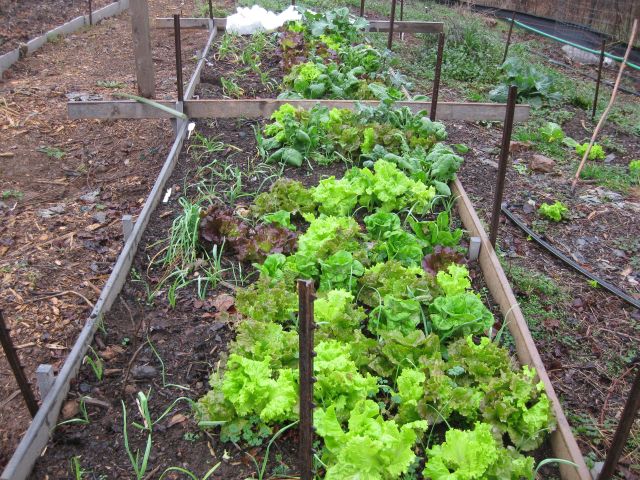
I know it is still early days and we may yet have blizzards and really low temperatures, but I am much encouraged with the growth of my greens (lettuce, spinach, kale, collards) and the protection provided by my row covers, so I have been growing more vegetables for transplanting in a few weeks. I googled winter hardy vegetables and bought Rapini Broccoli Raab seeds and Mache Corn Salad seeds – very reasonably priced and very quick delivery from Hirt’s Gardens.  They germinated in my 3/4″ blocks quickly and are now in the greenhouse in 2″ soil blocks growing well and will be transplanted soon, together with my regulars – I really like kale and have several varieties going.  Below is a snapshot of one of my raised beds – with temps>40 for next several days, I am trying one bed without covers and the other with, and will see if it makes any difference.

Dec 22 raised veg bed, garlic on left, greens on right

Composting

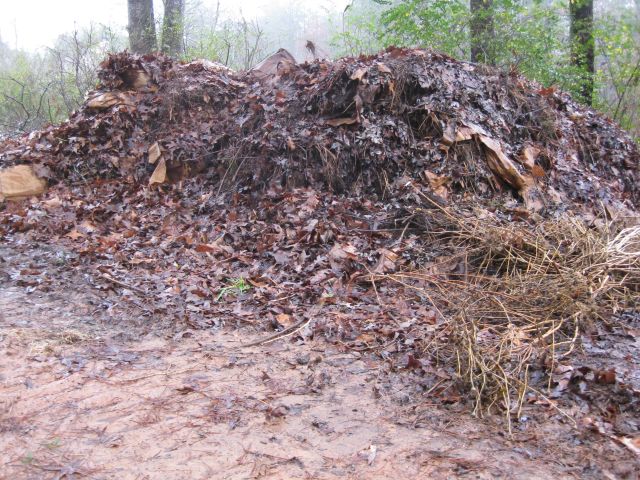
My new heap has more than 60 leaf bags.  It is too much leaf and too little green.  Every other day, when I clean out the coop, I toss the chickens’ contribution on the top and have also contributed some of the horse manure I picked up from the stables.  I have a continuing reservation about the horse manure – don’t know what ‘cides were used to produce the hay or what chems the horses may have received – but I hope the composting process and all my soil workers will break down whatever is  there that shouldn’t be.  The heap is self standing and for turning it, my bobcat is invaluable.  It is breaking down well, evidenced by wisps of steam and diminishing size.

Dec 22 - compost heap


Transplanted muscadines

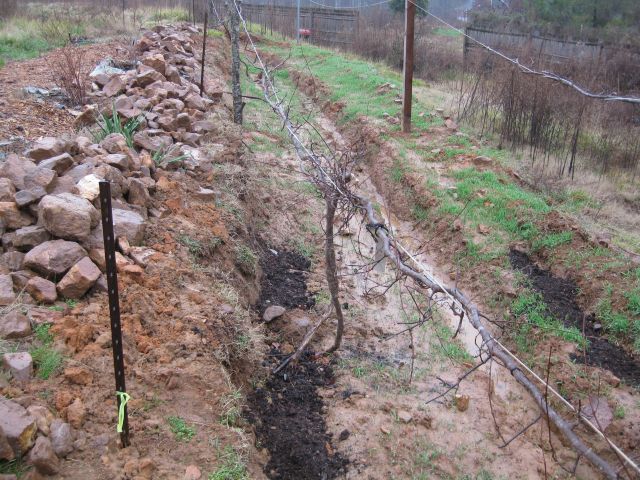
I completed transplanting the muscadines.  I have real concerns about the outcome.  Their roots had extended everywhere and I doubt that I saved even 20% of the roots.  I cut back the vines by 80% and placed the roots in trenches covered with compost (compost is my universal remedy) and spring will tell how well I succeeded.  To stabilize the terrace from wintry rains I seeded with winter rye and it is growing nicely as can be seen below, together with the truncated muscadines.

new muscadine terrace with winter rye, contour ditch and lots of excavated stones

I intend to put the stones to use building stone walls – to be described in a later post.

New raised bed

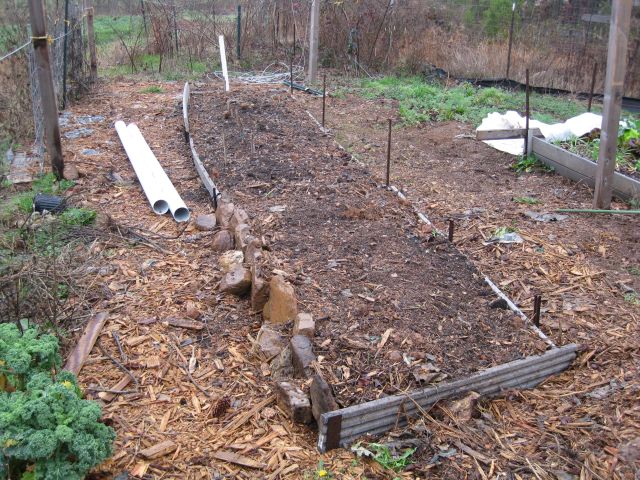
With the muscadines out of the way, I decided to make a third raised bed – this is 4 ft wide and 24 ft long and is awaiting residents.  As an experiment I used a few of the stones as a north border for the bed, the idea being they will act as a heat sink – absorb the heat of the winter son and create a micro climate ( I noticed that my strawberry plants which abut the south side of one of the raised bed i.e. the raised bed side is to the north of it, have produced strawberries in the middle of December!). The two 4″wide 10 ft long pipes will be positioned in the middle and above the bed for the purpose of keeping the winter cover off the vegs.

Dec 22 - new raised veg bed, with heat sink rocks on north border

 Apple tree restoration

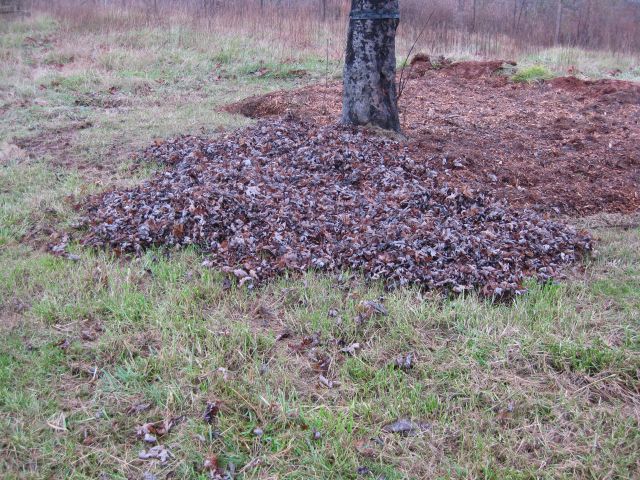
There is a large apple tree on the hill property I recently acquired which did poorly this past year.  One reason, I surmised, is that its roots tapped into a septic system which has been decommissioned and therefore it was deprived of valuable nutrients on which it had become dependent.  Or it could have been the weather, or it may only bear well every other year.  It is surrounded by a vigorous tough grass which competes with its roots for food.  I decided to get rid of the grass.  Imagine a circle with the tree in the center.  I mowed all the grass in the circle.  Then for 50% of the circle I spread horse manure and then wads of newspapers and then covered the lot with a generous load of wood chips.  For the other half I decided on a different approach.  Adjacent trees shed lots of leaves and I gathered these leaves and spread them out on the grass.  Next step will be to add the wood chips.  My reasoning is the leaves will block the light on which grass depends to grow, more effectively than spread newspapers.  And it is quicker to spread the leaves than the paper and the leaves, being more natural than paper will probably contribute better to the health life of the soil.  I am hoping the wood chips will promote growth of fungi which is better for the trees than the grass bacteria.

mulching the apple tree, wood chips on newspaper at rear, leaves in front (in progress)

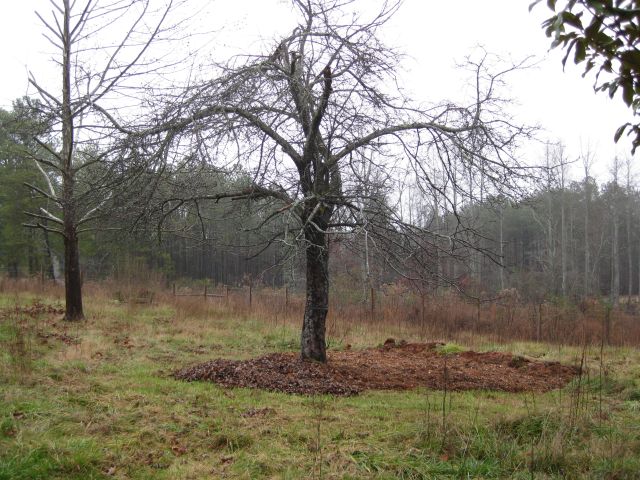
The apple tree itself does not look too impressive right now.  The top half was sheared by a storm and I still have to do more pruning.  Time will tell. By the way the sweet gum behind it fell victim to shearing by the local utility which has a right of way which extends to within a few feet of the trunk of the sweet gum.  So the utility religiously protects its right of way with no favoritism extended.  The one benefit is I received a truck load of wood chips.

Dec 22 - apple tree


Lots of pipes

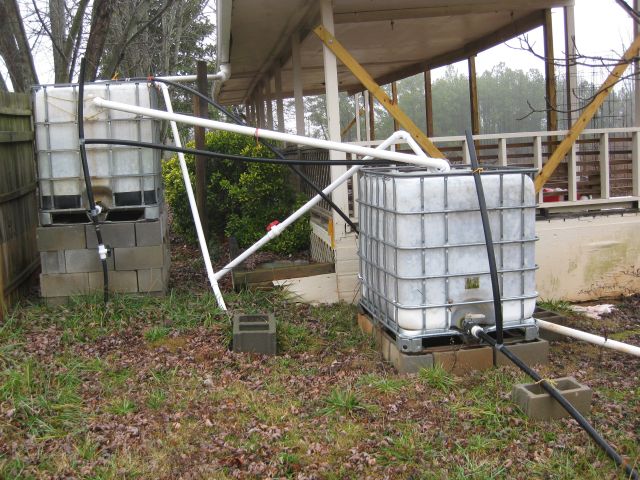
Finally a snapshot of my two gravity feed irrigation tanks. I just added the last and final pipe.  Each of the pipes serves a purpose.

gravity feed irrigation tanks with related necessary pipes

The “Y” brings the rainwater from the storage tanks. If the red valve on the lower limb is open the water goes to the right tank, if closed to the left tank.  The two vertical black pipes are to facilitate bleeding out air bubbles when the valves below them are opened and water runs to the crops.  The left, raised tank, irrigates hill crops, the right tank the crops at the bottom of the hill. You can spot at the top of the left tank the horizontal white pipe bringing rainwater from the roof of the deck and the diagonal black pipe bringing water from a well (only as a last resort and only pumped 3 times this past year).  There are two overflow pipes from the left tank – the lower overflow is if I want the left tank to be half filled before the lower tank is filled, the upper overflow is if I want the left tank to be completely filled before the lower tank is filled.  Finally, the pipe I just added is the overflow from the lower tank – you can see it is directed to the right where the fig tree resides and whichas a berm to capture as much water as possible.

propagation

Winter is a good time to turn my thoughts to propagating plants.  Although I live in the south (Georgia) some days are really miserably cold, windy and rainy.  What better time to learn up on new propagation techniques.

Oaks

Oaks do not transplant easily.  Even young oaks seem to have interminably long tap roots.  And it is difficult to tell a small sapling young oak from a 5 or 10 year old sapling old oak since oaks are content to bide their time in the shade of larger trees until the umbrella is pierced and growth giving light encourages them to get going.  I walked the woodland yesterday looking for acorns and found none though there are many >20 year old white and red oaks.  At first I thought they may not be producing acorns since they are hemmed in on all sides by pines and tulip poplars.  But then I remembered all the oak saplings surrounding these trees and concluded that squirrel or deer had been feasting on the mast (as it is called).  Too late to the party.  However, in Sandy Springs, Atlanta near our suburban home there is a huge oak tree which has littered the sidewalk with thousands of acorns.  I collected 100 this morning and seeded them 25 rows, 4 each, 1″ depth, in a new long raised bed I have built.  I shall water, keep an eye on them and, with some luck in early summer there may be signs of life.

Fruit tree cuttings

I mentioned in an earlier blog that I am new to cuttings and a reader gently nudged me to a better understanding of the mechanics, for which I am thankful.  You have to establish first if you are dealing with hardwood or softwood cuttings.  Hardwood is not necessarily harder than softwood and an example frequently quoted is balsa wood, which is a very light wood but is classified as a hardwood.  The distinction is based on the seed and the seed of hardwoods has a covering, such as fruit or the hard shell of an acorn.  For hardwood cuttings you take the samples in fall or early winter.

My neighbor agreed that I could take cuttings from her many fruit trees, so this morning, with my alcohol sterilized secateurs, I took snips from a number of her trees which include mulberry, cherry, pear and apple.  From these snips I prepared >20 cuttings and rather than using a heated tray and remembering to water and bothering the cuttings with weekly inspections to see if the roots had arrived, I simply prepared a V trench in my outdoor raised bed (which has frost cover protection) and planted them and watered them.  And I will look for buds in the spring.

I know that apple trees should be grafted on appropriate stock but what I want to achieve, rather than a formal orchard, which I already have, is an informal association of fruit trees interspersed with edible or useful perennials.  Since the cuttings are from trees which have thrived in this area, they should be able to take good care of themselves.

Seed germination

My real pursuit has been learning more about seed germination.  Through the comments of MikeH on this website I learned of “Seed Germination Theory and Practice” second edition by Professor Norman Deno (“Deno”) published in 1993 and available for free download. For anyone interested in this topic, this book is great.

Previously I didn’t understand why, although most seed germinated in warm moist conditions, other seed needed cold to germinate and some seed seemed completely indifferent to my efforts.

Deno germinated nearly 2,500 species and the processes he used were relatively simple – he did not use pots and growing media, instead paper towels and polyethylene sandwich bags (thin bags not sealed too tightly so as to maintain aerobic conditions). For some species he used gibberillic acid. He conducted his germination tests at just two temperatures 40 or 70 deg F. Based on the results of his research he developed a number of principles such as all species have mechanisms to delay germination until the seed has been dispersed.  There can be multiple mechanisms such as required sequences of hot and cold temperatures, or cold and hot temperatures, or oscillating temperatures as well as a time clock and/or the need for light or dark etc.

I find interesting why species have particular delay mechanisms and it seems the mechanisms are about ensuring survival of the species. If seed dropped in summer were to germinate in summer, the tender offspring would be killed by winter, hence a programmed requirement that there must be cold (i.e. winter) before the seed can germinate. Apparently for plants growing in swamps or woodland, where having enough light is a bigger problem than having sufficient water, the seeds require light to germinate. Apparently for plants in cold desert areas where moisture is only available in the spring, the seed will germinate at low temperatures in order to be sufficiently developed to benefit from the spring rains. Some species produce quantities of seed coats which are empty and Deno speculates that this is also a survival mechanism – predators which exert themselves to open the seed coats and then find nothing there will lose interest in that particular seed. Some seed require cold then warmth then cold i.e. two winters. The survival mechanism here could be that if all the seed germinated the following year and conditions were bad – drought, fire etc, then the entire species could be destroyed. So requiring two winters appears to double the chances that the species will survive. Fascinating!

I now understand why if you cut a flower before it has seeded, taking care to leave buds on the stalk, the plant will flower again, and if cut, again.  A survival mechanism requires the plant to keep trying to flower so that it will be pollinated and produce seed.  Once it has produced seed it has achieved its mission.  Not to say plants are indifferent to human desires.  Another survival mechanism could be to look beautiful to humans (in addition to the pollinating insects) so that humans will favor them and propagate them.