After several weeks spinning my thoughts, I finally got down to it and built and installed an automatic chicken coop door opener. For the time being it is half automatic – it will open the coop door in the morning (time set for 7.30am) and I will close it in the evening after I have housed and fed the chicken. Cost of components, excluding scrap wood, hardware, and the transformer which was laying around, was less than $50.
I have included full details and photos under the “Self reliance” tab at the top of this website or just click here.
I previously mentioned how I had summerized the coop by adding a powered vent and insulation. The rooster did not like the sound of the vent when it was at full blast and there were no controls to slow it down since its intended location is in the attic of a house where its noise is less obvious. The rooster’s concerns were resolved with the addition of a fan speed switch so, until he is more at ease, I have set it to spin at about half speed, which does not upset him.
The oyster mushroom is one of the easiest to grow. Available free on the internet is a +300 page handbook on oyster mushroom cultivation which has as its central premise that: “Mushroom cultivation has been evaluated as an effective means for poverty alleviation in developing countries due to its possibility of low cost production, high profit and quick return”. A handy insight into mushroom growing around the world.
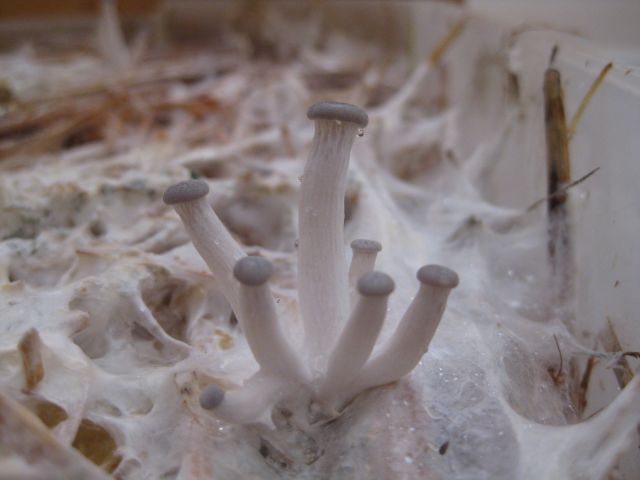
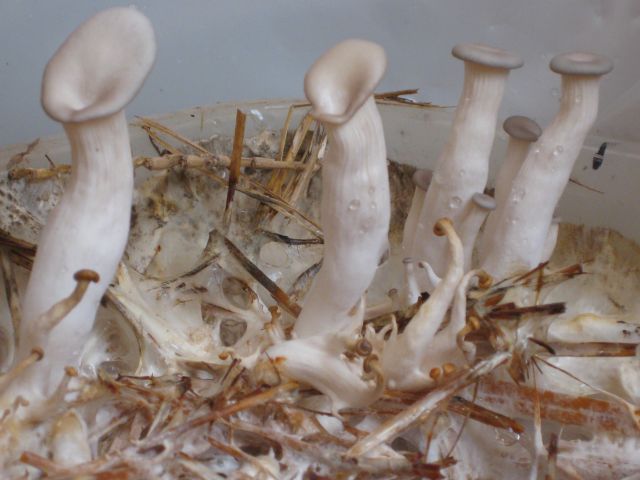
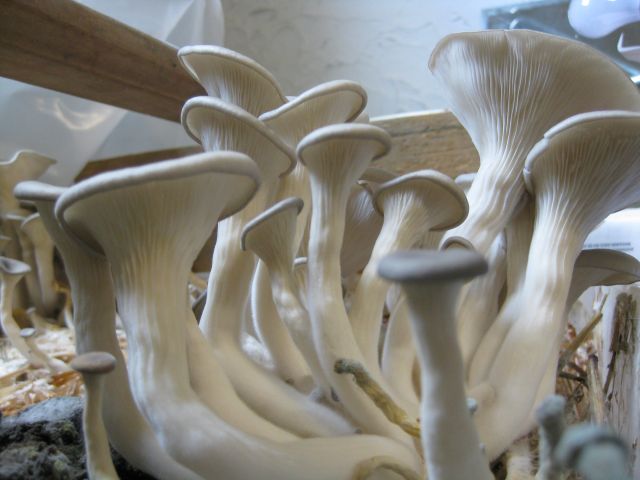
I purchased grain spawn grey dove oyster (Pleurotus ostreatus) in February and today I harvested some of the mushrooms from my grow box and sauteed them with olive oil and chopped garlic – delicious. In fact the whole meal was delectable – home made whole wheat bread, home brewed dark German style beer, free range eggs (my hens are producing approximately 9 a day) and mounds of garlic, lettuce and other greens from the raised beds.
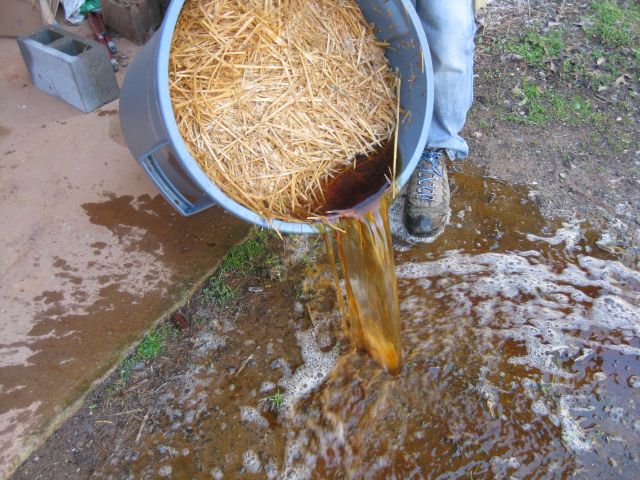
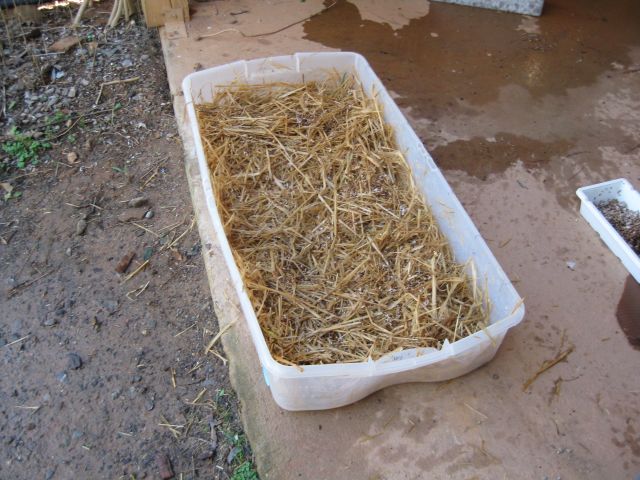
But to return to the oyster mushrooms. I have two operations going – an outdoor mushroom shelter where I am waiting for them to emerge from tulip poplar logs, and an indoor grow box. For the grow box I submerged a bale of straw in water for several days, then packed the straw (substrate) into a plastic grow container which is 36″ long, 22″ wide and 7″ high, sprinkled with grain spawn.
after thoroughly wetting the straw, time to empty the water
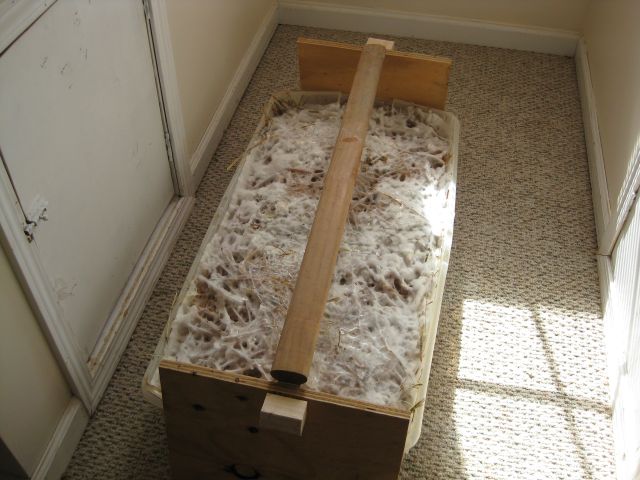
plastic grow container packed with straw sprinkled with grain spawn
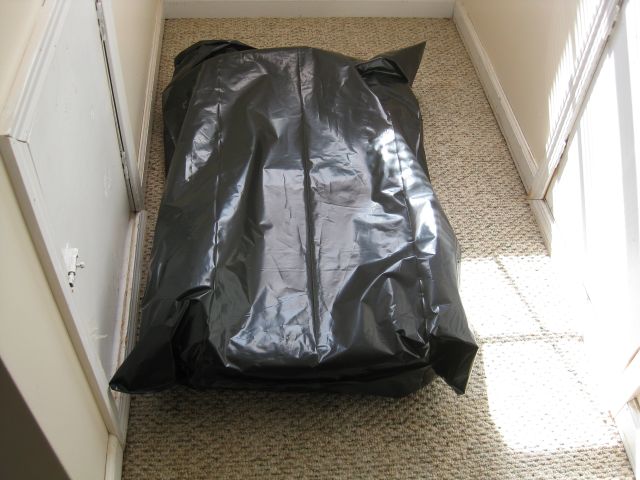
grow box incubating in warm, dark enclosure
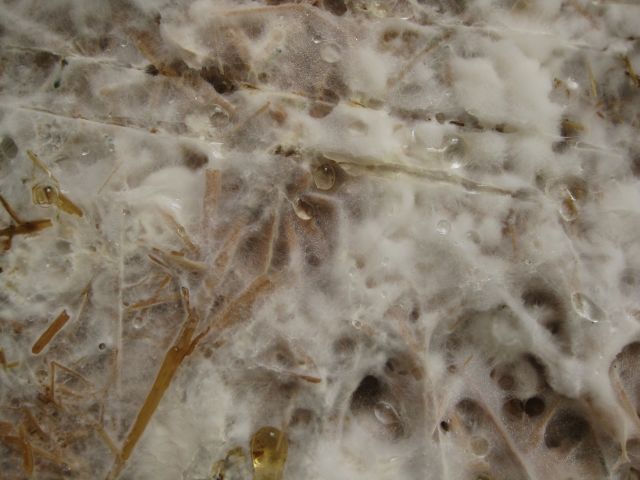
straw blanketed with mycelium
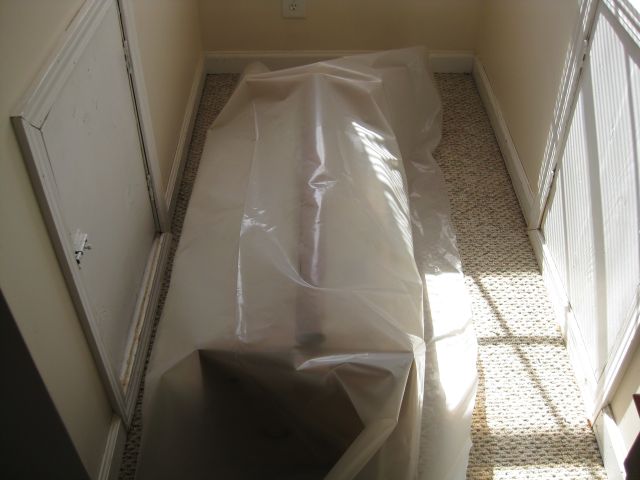
I enclosed the container fully in a black trash bag for a few weeks in the upstairs room where it is warm, checking that it was moist at all times. The black trash bag prevented cereal seeds from sprouting. When the fungus (mycelium sounds better) had colonized the straw (the straw was covered with a soft white layer), I made a plastic (see through) tent over the container to maintain a high humidity level.
wood frame for plastic tent
plastic tent enclosing grow box
My first mistake was to allow outside light to hit the container. The mycelium staggered from the light onslaught, visibly slowed its efforts and appeared to assume a yellowish pallor – presumably it was thinning and showing the straw underneath . I moved the container to a less bright area of the upstairs room and hoped growing activities would resume, but when activity had obviously abated, I concluded the room temperature was too high (my second mistake). So I relocated the container to the basement where it is cooler and there is some but not much outside natural light. And the mycelium got back into the swing of life and began growing actively. I have also been adding coffee grounds from my cappucino machine (my afternoon indulgence) and the grounds have been colonized but have not yet produced mushrooms.
My land slopes and since I rely entirely on rainwater for irrigation, I catch the rain however I can – in storage tanks or directly into the ground with contour ditches. Contour ditches are similar to swales – built on contour or dead level survey lines to intercept and hold water and to let it infiltrate the ground, therefore they are not compacted or sealed. While a ditch is narrow, a swale can be broader like a basin and, according to the permaculture bible by Bill Mollison, trees are essential to swales and must accompany swaling in arid areas.
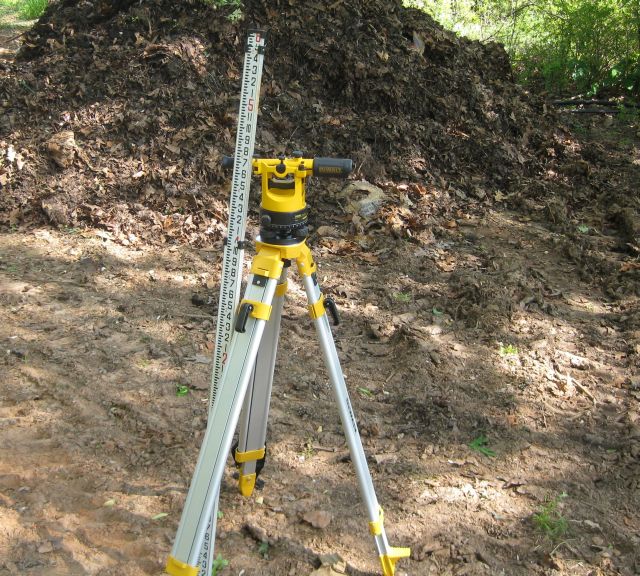
I start my contour ditches towards the top of the slope where there will be sufficient runoff (if the ditches were located at the bottom of the slope they could be overwhelmed by torrents of water). Once I decide approximately where the ditch will run I use my transit level and a helper (my rod man) to locate the middle and two ends of the ditch on a contour. I mark these three points with stakes. Usually, by this time, my helper’s patience is exhausted and I am on my own for the rest of the project.
transit level and measuring rod
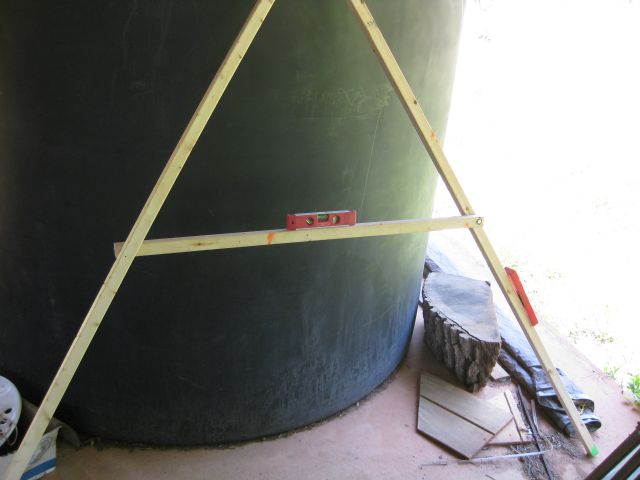
simple A frame with bubble levels (red) on horizontal and vertical legs
If the ditch is say 200 ft long, even with the three stakes in place, it can be difficult to figure how the ditch should run between the three stakes since the ground is uneven. So I use my A frame, which is simply three pieces of wood connected to form the letter “A”. The two sides of the A are 8ft long and the feet are about 8.5 ft wide. The horizontal piece is 4ft long and all the wood is 1.5″ (nominal) square, so it is not too heavy to carry about. A simple bubble level is attached to the horizontal and one of the vertical legs. I construct the A frame on a level surface and ensure that the horizontal piece (to which the bubble level is secured) is horizontal before bolting it in place.
I gather some rocks and a can of aerosol spray paint and with my A frame start from the stake which marks one end of the future contour ditch. One leg of the A frame is next to the first stake and I point the other leg in the direction of the next stake and move it along the ground until the bubble level tells me the A frame is horizontal and the second bubble tells me the frame is vertical. I place a spray painted stone to mark this spot and then swing the first leg around the second in the direction of the next stake until it too is horizontal and vertical. It is important to advance the legs alternately since this will counteract any inaccuracy in the A frame. I can tell how accurate I have been when my A frame eventually reaches the next stake – if the leg of the A frame is at the same level as the stake, all is well.
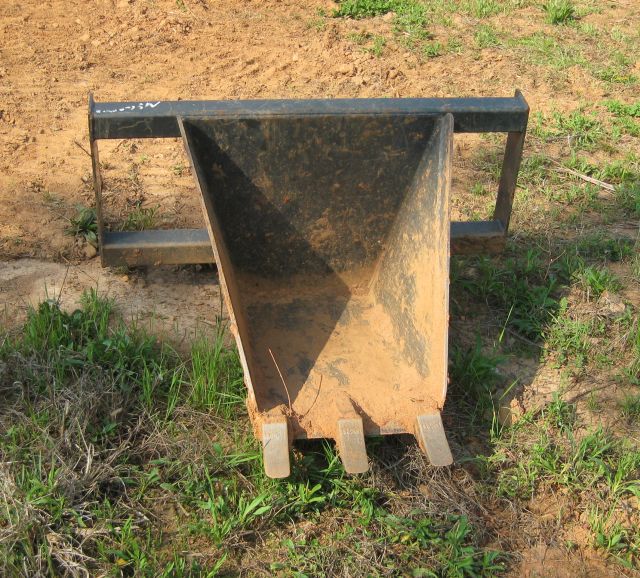
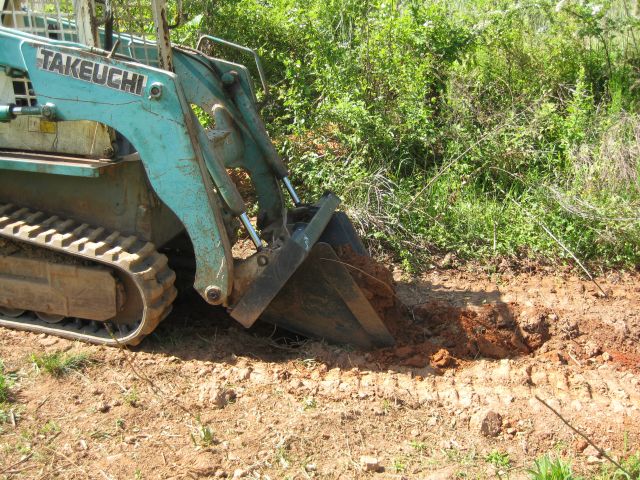
Having marked out the line of the contour ditch with the three stakes and painted stones, next step is to dig the ditch. I work mainly by myself – I will not engage paid workers and volunteers are scarce. So I have no qualms using my old machines, which I nurture along. My Takeuchi tracked loader (bobcat) has a stumper attachment, which is good for removing stumps and digging ditches. Digging the ditch becomes quite simple, I simply use the bobcat to carve out the ditch following the trail of spray painted stones and I save the removed soil in a heap for some future use.
I seed the ditch and sides with grass seed to stabilize the banks. And then I make my plantings on either side of the ditch. An earlier (shorter) contour ditch I dug for my muscadines (grape vines) has proven so effective at catching and holding water that supplementary watering will be minimal (the ditch is assisted by a diversion slot cut across an access road which directs water into the ditch). After planting up my new ditch with trees perhaps I will call it a “swale”.
All my irrigation is from harvested rainwater. I used to pump the water from the main storage tanks to an elevated tank near the growing area but since this tank was only a few feet off the ground and the water was moved by gravity, it trickled slowly from a hose. And so I gave up and installed water lines and bubblers and let the water do its own thing at its own pace. An unsatisfactory result, since I wouldn’t notice when individual bubblers clogged and, more importantly, I missed out on the pleasure of observing each day’s advance.
Last year I was able to purchase the adjoining property which sits on a hill. Now, with my gravity feed tanks on the top of the hill, the water rushes out the hose and hand watering the vegetables is quicker and enjoyable. And I look out for all the changes over the past 24 hours.
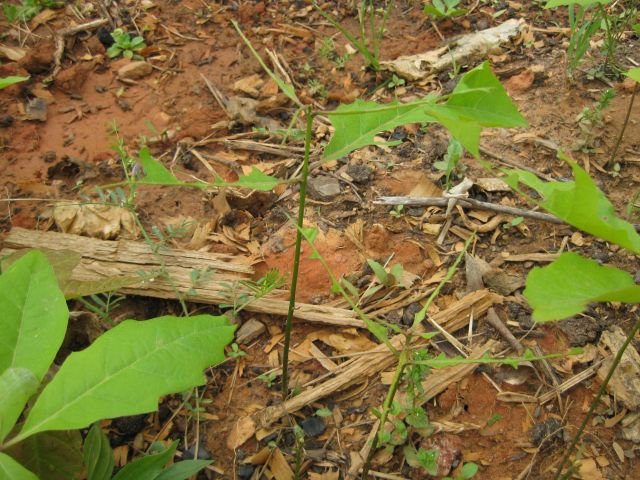
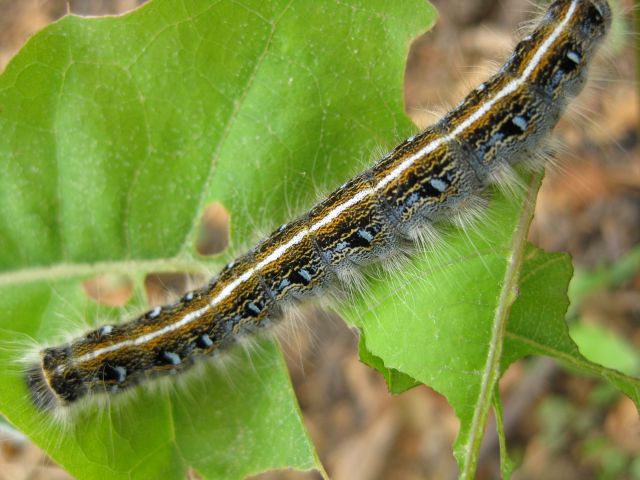
Last fall I planted acorns in a raised bed with the intention of transplanting the oak saplings in a year’s time (before their taproots grew too long). This morning some of the leaves were shredded and then I spotted the culprits.
shredded oak leaf - yesterday it was fine
the culprit, one of a gang of 5
I located and collected the 5 caterpillars, then googled whether chicken ate caterpillars and the answer seemed to be “no”. So I did them in.
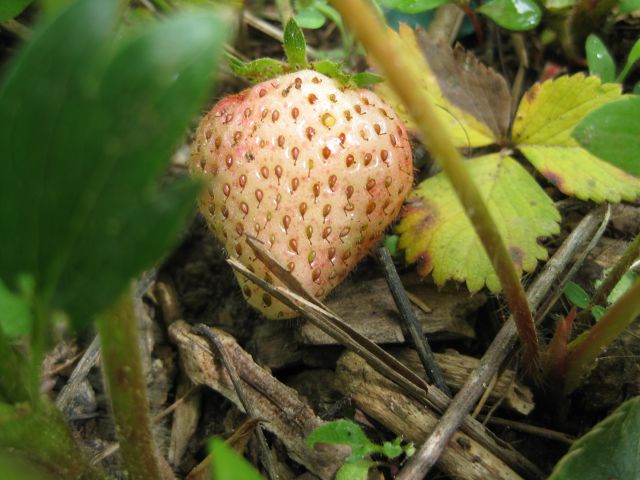
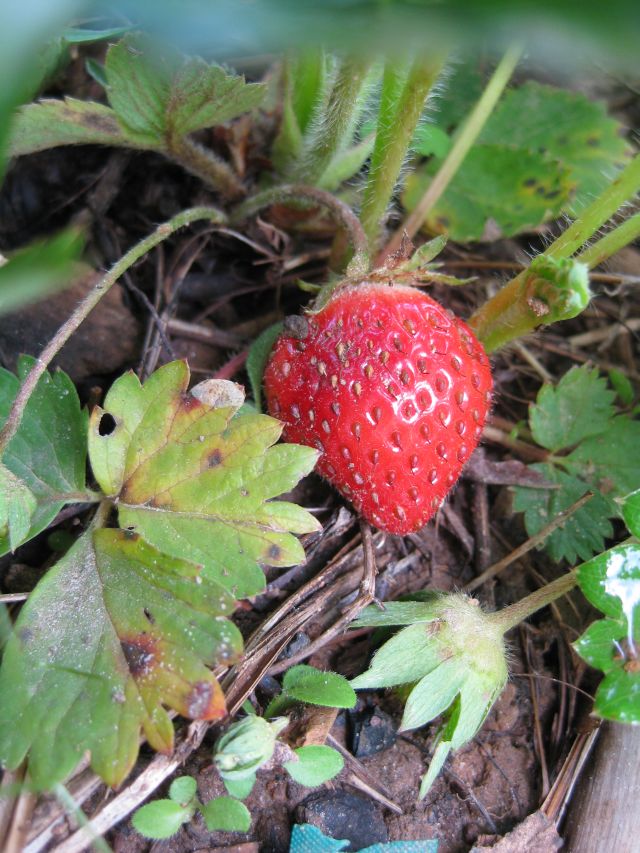
I have a bed of early season strawberries and noticed the berries are forming. Then I spotted one berry ripening quickly and another which will be ready for the eating this weekend. Unlike the supermarket offerings, my strawberries, if the last 3 years are anything to go by, will be deliciously sweet and plentiful.
strawberry beginning to ripen
strawberry almost ready for the eating
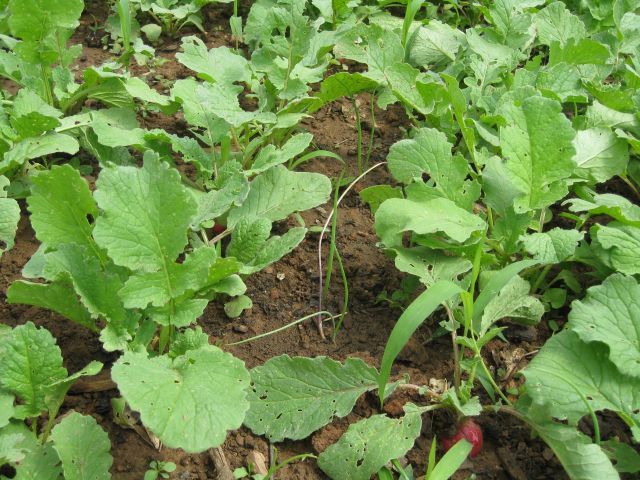
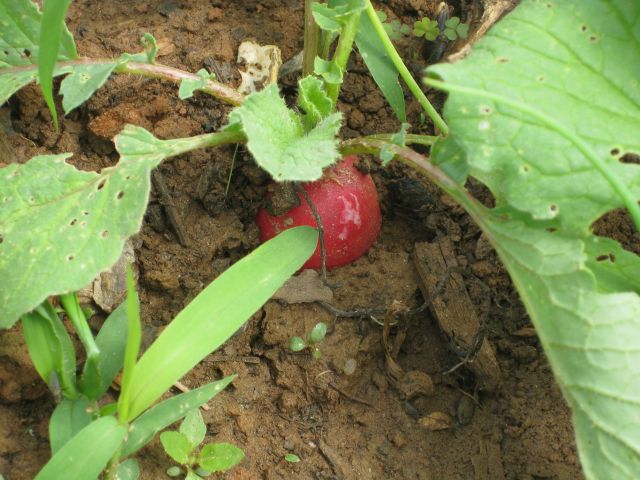
The radishes are ready for picking and the big treat each day, the asparagus, are turning up in greater numbers and have to be picked promptly before they get too tall.
radishes intersprinkled with onions
this radish soon ready for the plate
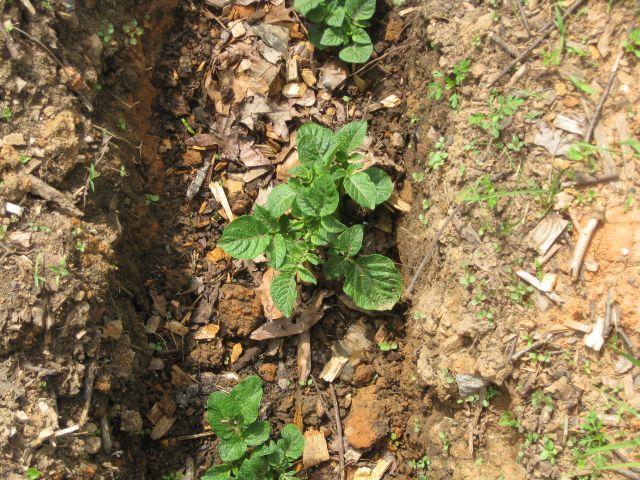
the potato plants in the trench must soon be mounded
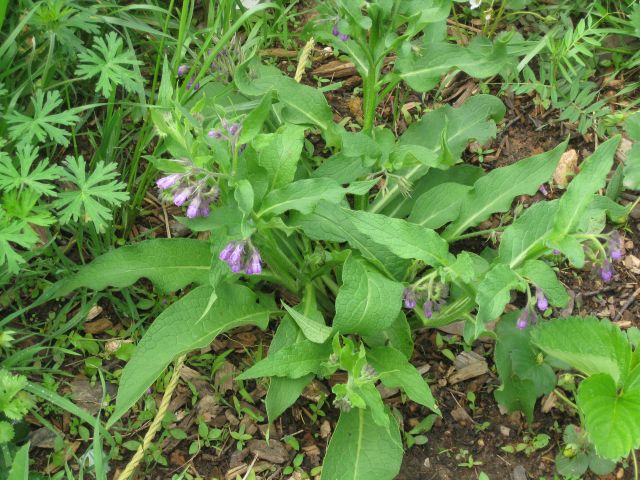
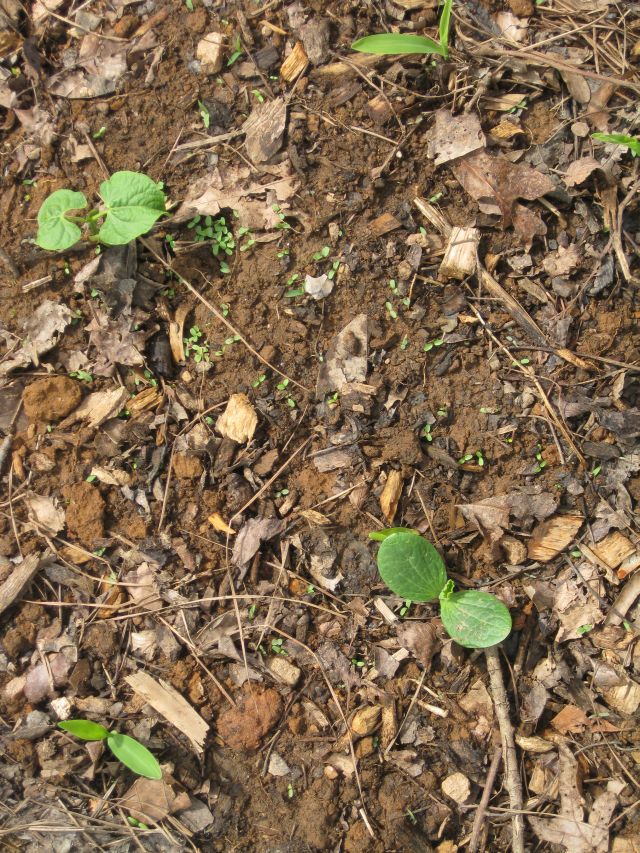
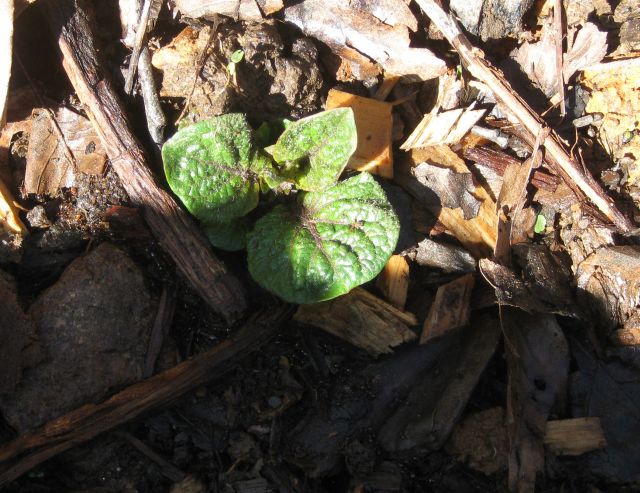
I am pleased to see the “three sisters” (corn, bean and squash) are emerging in places. I have never been successful with squash – always foiled by the squash borer which levels the plant at its peak – will it be different this year? Although considered an invasive the comfrey officinalis, which spreads by seed, is seductively attractive.
comfrey officinalis, which spreads by seed and can be invasive
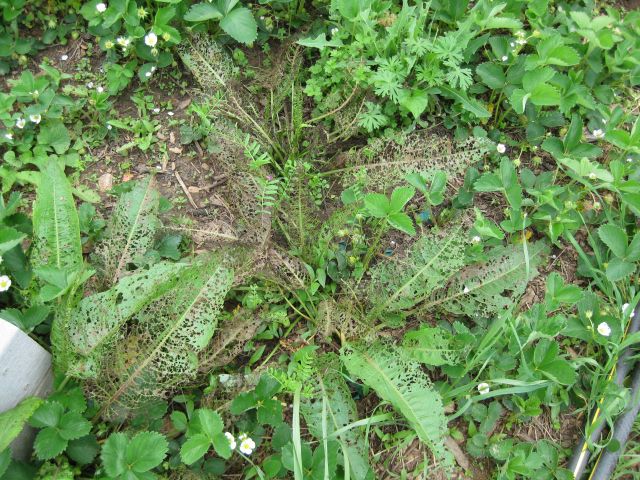
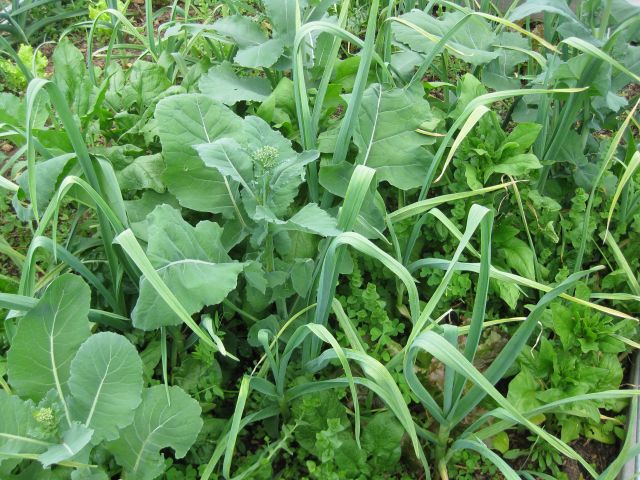
Before I get to the coop, a quick update on my “Spring activity” journal. I mentioned that pokeweed is an unwelcome visitor, difficult to extricate because of its long thick taproot. In permaculture “the problem is the solution” and it occurred to me that the taproot, like that of comfrey was performing a valuable function mining minerals two or more feet below the surface. But this seemed inadequate justification for its presence until I noticed that it, and it alone, has been attacked and eaten by insects, as yet unidentified. So it is also serving the role of a trap crop and attracting these hungry feasters from my diverse array of vegetables which, so far, are unscathed.
the pokeweed invader is the banquet for hungry feasters
a few feet away the spinach, collard, chard, garlic et al. are unscathed
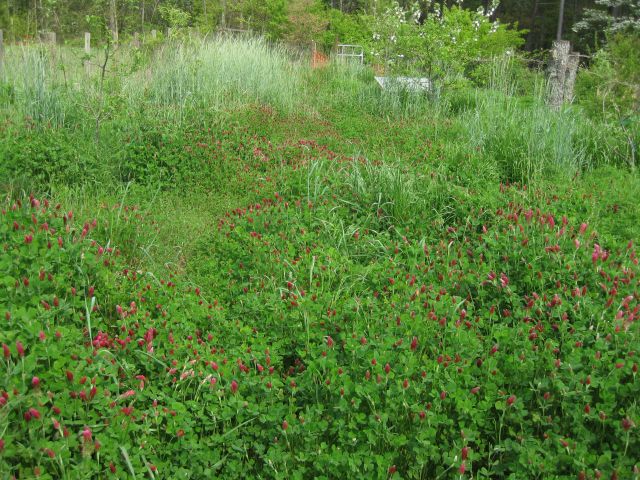
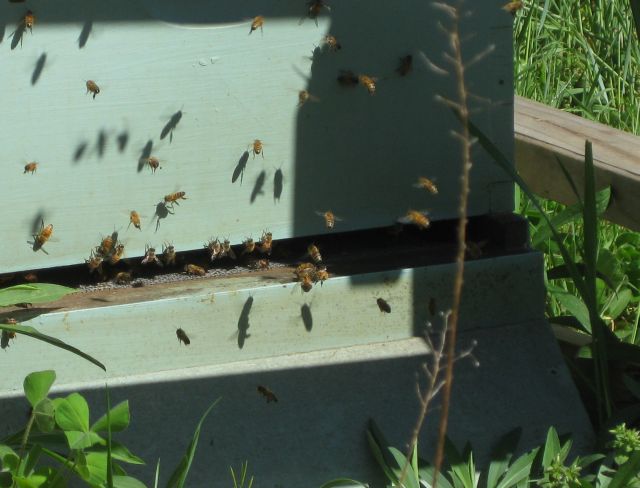
I also mentioned I was leaving the crimson clover to flower to provide succour for the bees and seed for next growing season. Well the clover is maturing quickly and today the honey bees and bumblebees and others were busy at them, so my next honey harvesting will include some clover honey.
crimson clover in flower with bees in attendance
Now to the chicken coop.
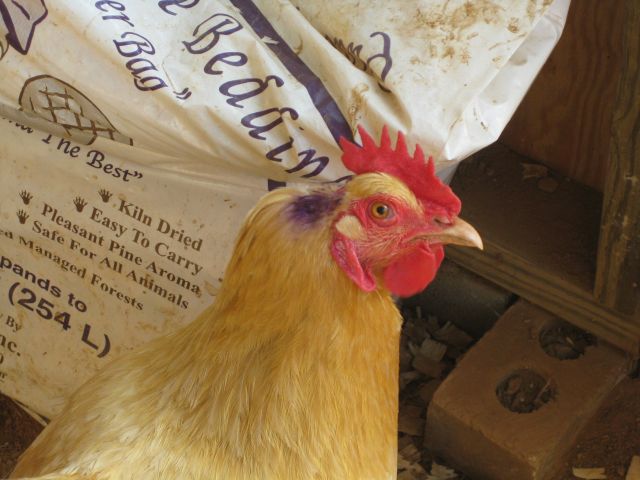
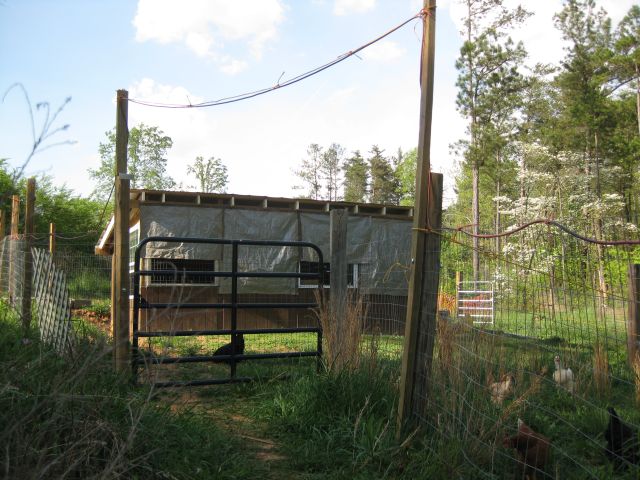
I have 3 coops, two constructed on two sides (north and east) of the barn. The east coop is well protected from the summer sun and would be good for summer quarters. Last year, as winter approached, I built a new larger coop (building details elsewhere on this website) which was well exposed to the winter sun and, since there are no neighboring deciduous trees (yet) even better exposed to the summer sun. I had considered moving the chicken to the east coop for the duration of the hot weather. And then a development – Buffy, the Buff Orpington rooster, fixated on Lady Macbeth, his sister. She is the only hen missing feathers on the back of her head and she is vociferous and will have not truck with him, when she can avoid him. Which is difficult when they share the same coop and so to escape him she immediately goes to the roosting ledge when they are housed for the night and consequently misses the much anticipated evening meal.
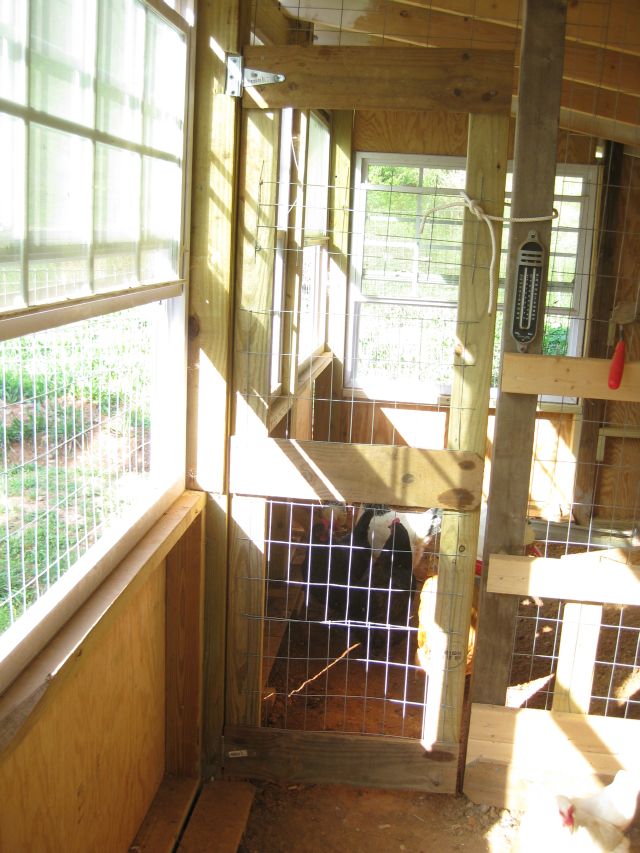
Matters came to a head when she refused to enter the coop one evening and with me trying to coax her in and Buffy charging at her as soon as she crossed the threshold, she became vociferous and agitated, and the two males increasingly frustrated. The upshot was she spent the night in the north coop with the two comets for companions. This got me thinking about the wisdom of transferring them all to the east coop. Their new coop has a partition, all that is missing is a door. So rather than spring $80 for a gate from HD or Lowes, I constructed a simple door with left over lumber and chicken fencing and two $1.54 hinges from Walmart.
the aggrieved Lady Macbeth
new partition door for coop
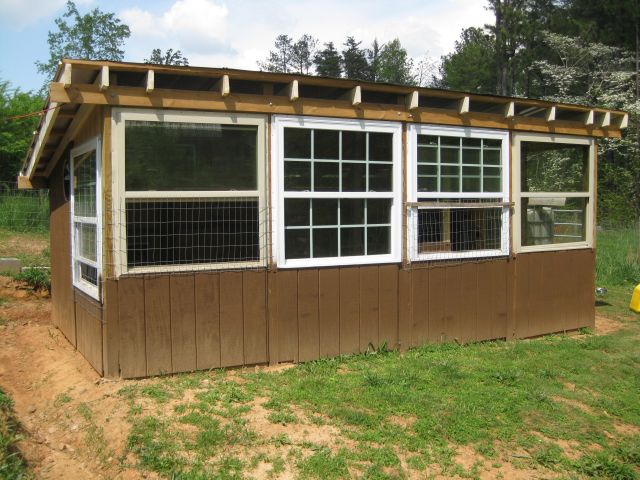
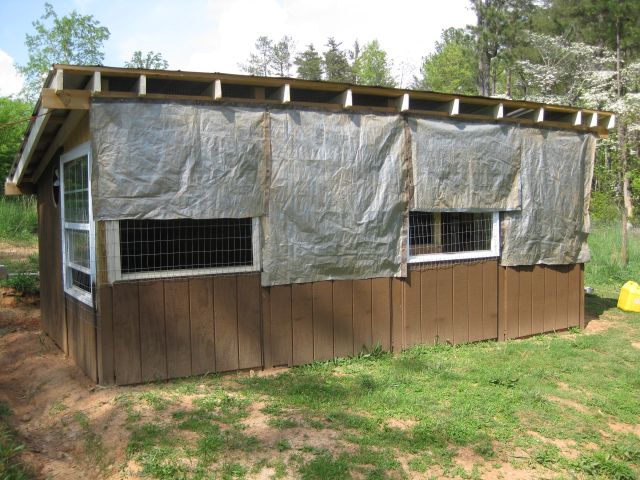
So with the winter coop the designated summer home, next steps were to reduce the heat buildup. It has four south facing windows and a window each on the east and west sides. Two of the south facing windows and the east and west windows have been predator proofed (I hope) with wire fencing material and are left open. I found an old tarp (8ft by 10ft) with brown colored and silver sides and scrubbed the mud off the silver, soon to be sun facing side. I cut it into 4 sections – two ‘5 by 5′ and two 5′ by 3’. The two larger pieces were fitted over the two closed south facing windows and the two smaller pieces over the two open south facing windows.
new coop, south side, before sun covers
new coop after sun covers installed
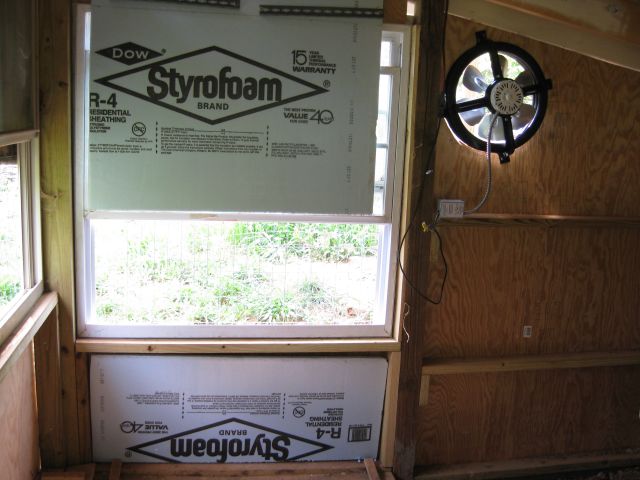
More work remained. I decided to install a powered attic exhaust fan. Since in the afternoon and evening the air will be cooler on the east side, I installed the fan on the west facing wall of the coop. I considered using a roof vent (i.e. one installed on the top of the roof) which would have therefore been higher up and removed more of the hot air at the higher levels of the coop, but I was unsure where that air would be drawn from. By installing the exhaust fan on the west side I can ensure that it pulls air from the east window and therefore the air will be moving across the two roosts which are located in between the east window and the installed vent fan. To power the fan, I installed an exterior power outlet box on the barn wall closest to the coop and led a cable the 100 feet from the barn to the coop.
new power vent and insulation added to west side
power cable to the coop
Apart from the powered vent and the hinges, all the other items were recycled i.e. lying around unused. As you can see from the ‘photo, I attached the cable to the top of the chicken paddock fencing and to surmount the gates, I bolted 2×4’s to the gate posts and raised the cable 8’ above the gate entrance.
My next venture, and a new one for me, will be to install solar panels on the barn roof and a battery bank and inverter in the barn and thus power the exhaust fan using the summer sun (as well as a powered timed coop door to let the flock out early in the mornings). To return to an earlier theme, albeit crudely – in the problem (the summer sun) will be found the solution (solar energy powered fan).
I learn new things every day. If I was an attorney I would be studying up on the impact of new legislation and recently decided cases. An accountant – the impact of new GAAP and the merging with international standards; a business executive – new moves by competitors as they strive for competitive advantage. For me, my classroom is observing what’s going on around me.
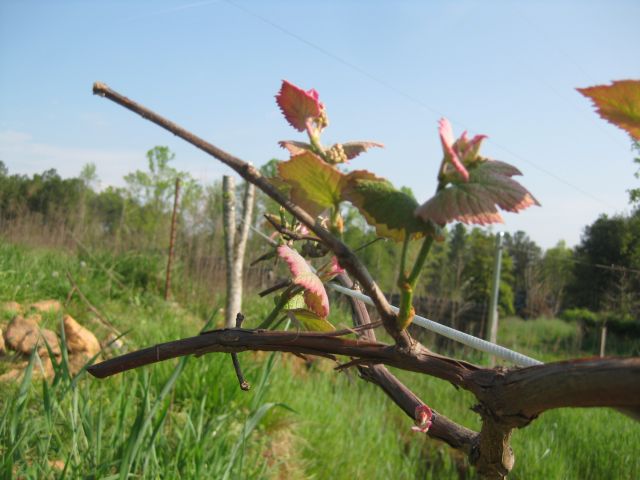
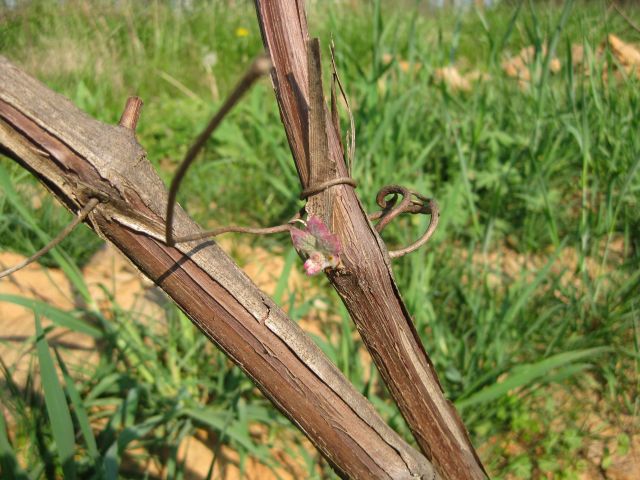
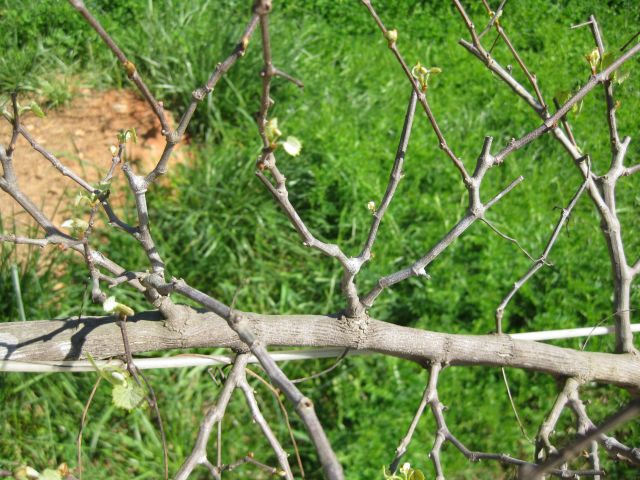
In my post of February 23 I noted that one of twelve muscadines (grape vines) I transplanted did not survive and I provided a sensible (to me) explanation for the failure. My test for viability (the universal test) is to scrape the trunk and if there is green underneath then it is ok. Eleven vines had green, this did not and its trunk was peeling and a piece at the end of the vine had broken off. So it was dead, or so I thought. This morning as I tended the vines, I noticed it was leafing.
my “dead” muscadine is alive
the trunk certainly appeared dead, but now there is a leaf
So I learn the slow way through trial and observation.
ps – it occurs to me that I planted 11 muscadine and one grape vine and the specimen above is the grape vine, which is why it looked so different/dilapidated compared with the others. It still failed my scrape test – perhaps I didn’t scrape deep enough or this is a characteristic of grape vines?
I have a constant companion for the ride to the farm and throughout the day – Trudy. She is a Heinz 57 who awaited us at the dog shelter after trying out and, presumably, rejecting two other families. A real cutie. At times I think of the dismissive comment of the Nearings in “Living the Good Life” (1954 page 28, one of my favorite books):”Cats and dogs live dependent subservient lives under the table tops of humans. Domestic pets kill and drive away wild creatures, whose independent, self-respecting lives seem far more admirable than those of docile, dish-fed retainers.”
Can this be my Trudy they are referring to? When we return to the house after working the fields she waits patiently for her snack. I usually hold it in my hand and she gently takes it from me. Once, being in a rush I dropped it on the floor for her to eat. She was not happy and ignored it. On another occasion she waited a bit and then ate it. And then it occurred to me, my second learning of the day. When she takes the food from my hand this is not an act of subservience but acceptance of reward for work performed, which in her case involves diligent searching for rabbits and rats and keeping an eye on me at all times. I think she views it as a fair exchange for services provided. I could go on about her and I will, together with pictures, at a future date.
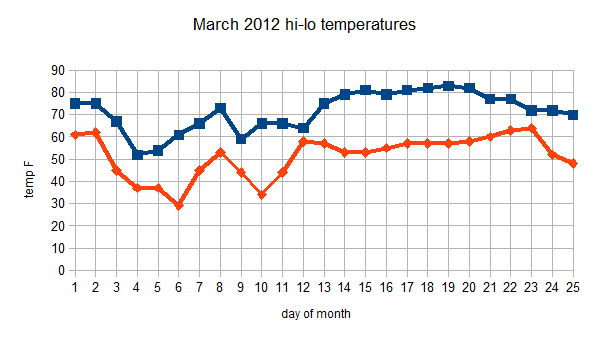
We have had a warm March to date here (latitude N34 22’52”), 50 miles north of Atlanta, with several days breaking 80 F.
Not surprisingly, there is a lot of growing activity.
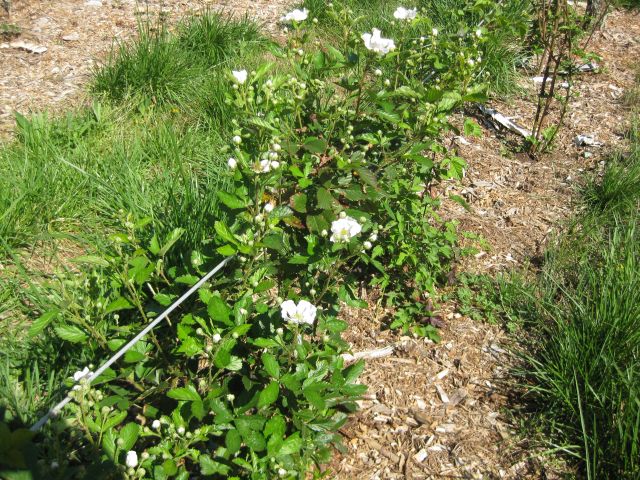
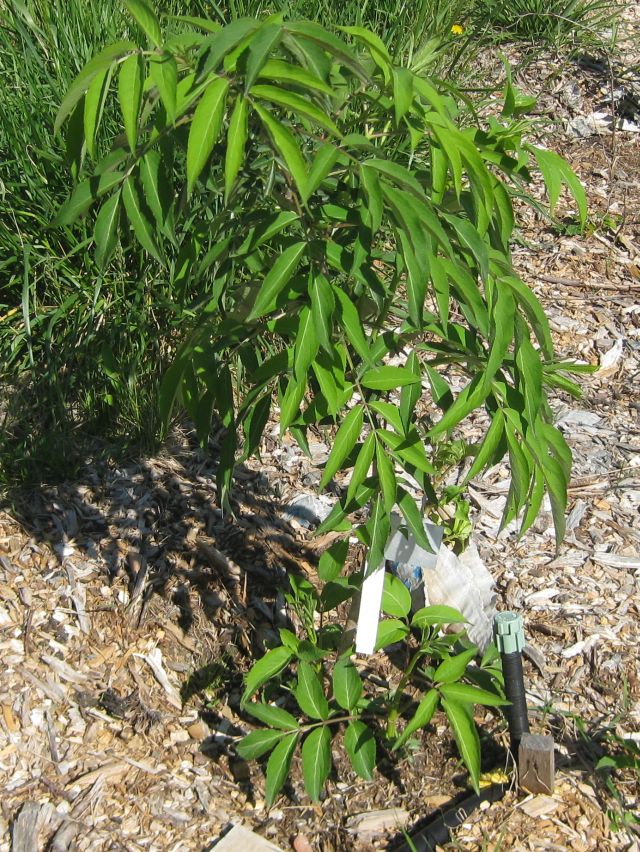
My Kiowa blackberry has begun to flower and the American elderberry I bought last year, which looked anemic throughout the year, is leafing strongly.
Kiowa blackberry in flower
American elderberry looking healthy
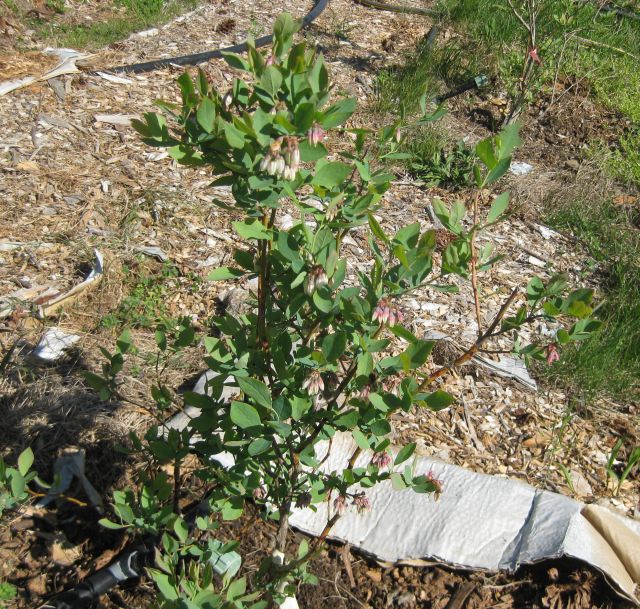
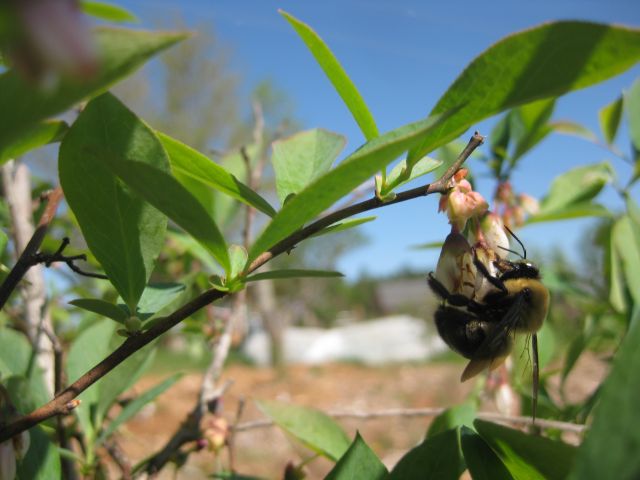
Some of the blueberries are in flower – most of my blueberries are rabbiteyes, which have a lower chill requirement than the highbush variety. I do have a southern highbush, which is in flower, and the bumblebee is busy with a Baldwin rabbiteye.
Southern highbush blueberry in flowerBumblebee on Baldwin rabbiteye blueberry
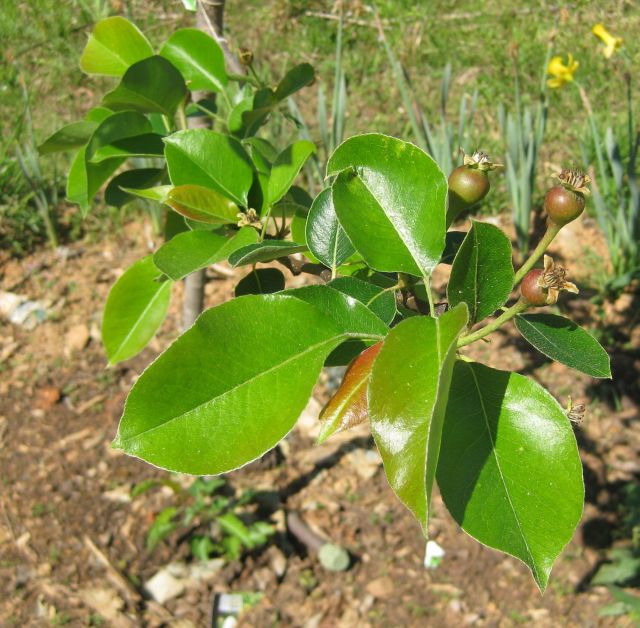
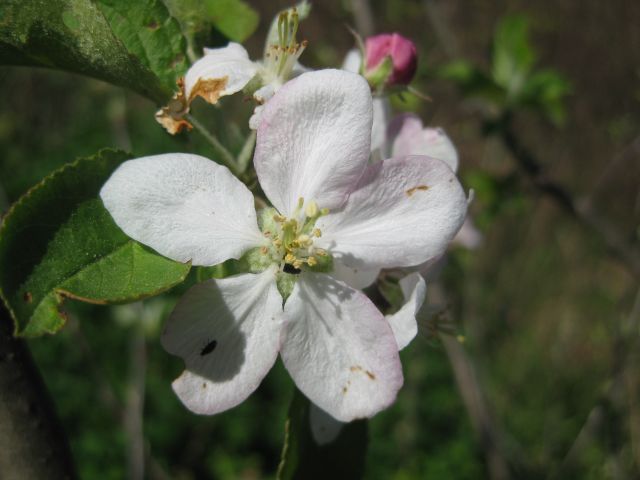
Since our last frost date is mid-April I was concerned that my pears, which blossom early could be frost killed, which happened last year. However, most of my pears have already fruited and the apples are now in flower.
Kieffer pear has already set fruitGold Rush apple tree is in blossom
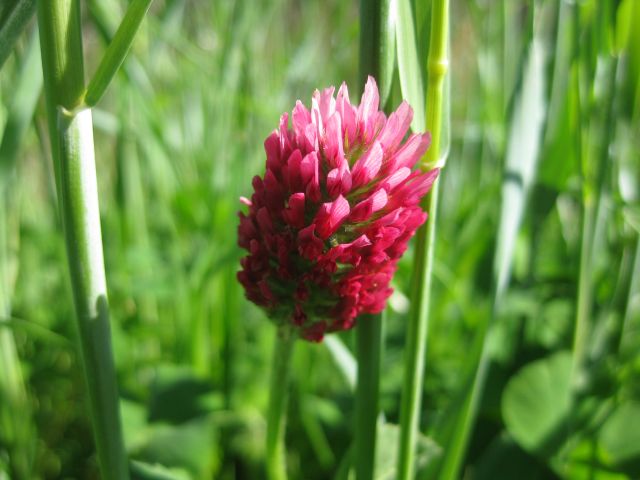
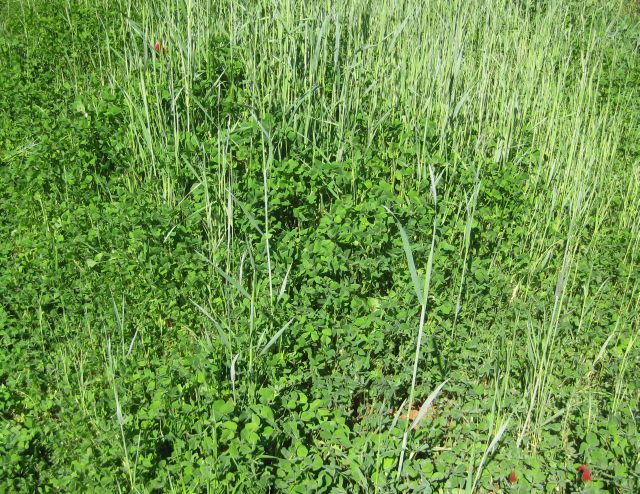
The crimson clover is beginning to flower and, once the bees have had their share and it has seeded, I will level it and the winter rye, which is providing a great scaffold for it.
Crimson clover is in flowerIn the orchard a mass of crimson clover climbing winter rye
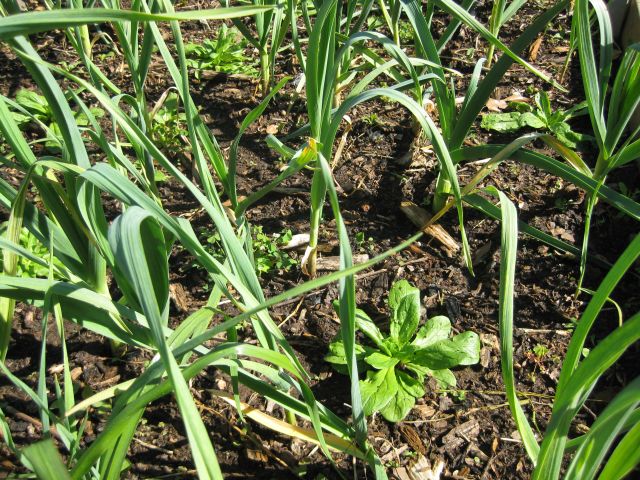
My garlic made it through the winter and is looking good. Less welcome is pokeweed which spreads easily and has a thick long taproot which is difficult to dig out.
Garlic looking goodPokeweed - an unwelcome visitor, difficult to eject
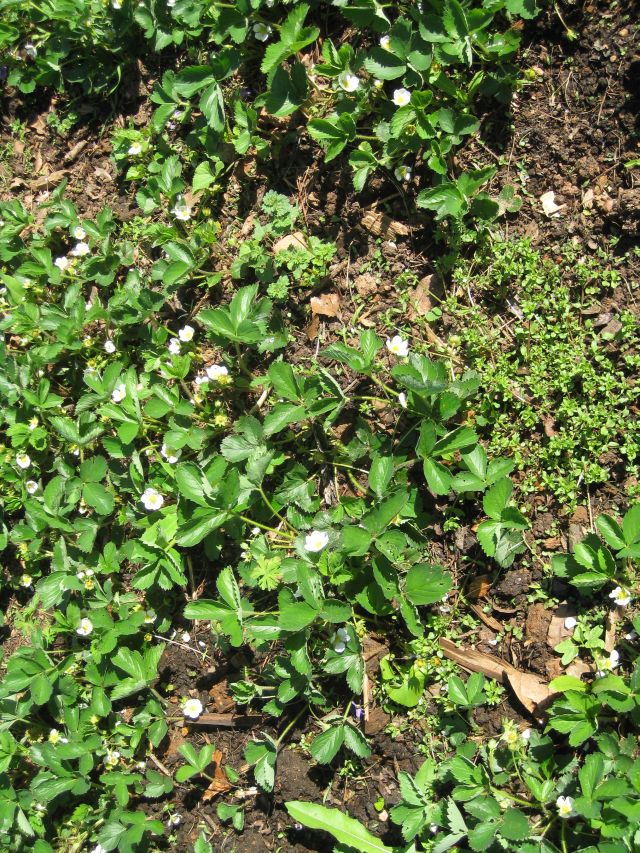
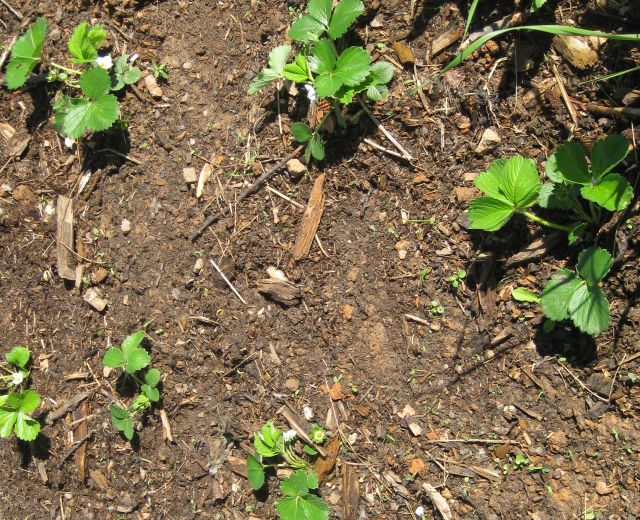
My earliglow strawberries are deliciously sweet, seem invulnerable to diseases and pests and are now in their 4th year in the same spot, which defies conventional wisdom. To extend the picking season I purchased and installed last year an everbearing strawberry variety which survived the winter without any cover and is beginning to spread.
Earliglow early season strawberry, now in its 4th yearEverbearing strawberry, planted last fall, now beginning to spread
The 4 year old muscadines I uprooted and transplanted are coming to life (whew!) and the bees are very active. I really would like to split the hive but no mated queen bees are available for purchase and, unless I do it soon, they will swarm.
Transplanted muscadine showing signs of lifeBusy bees
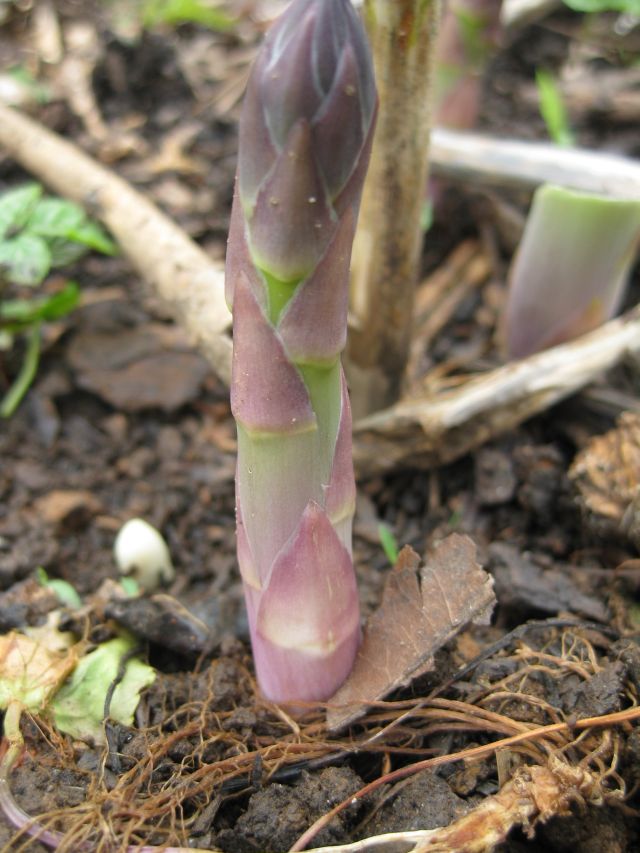
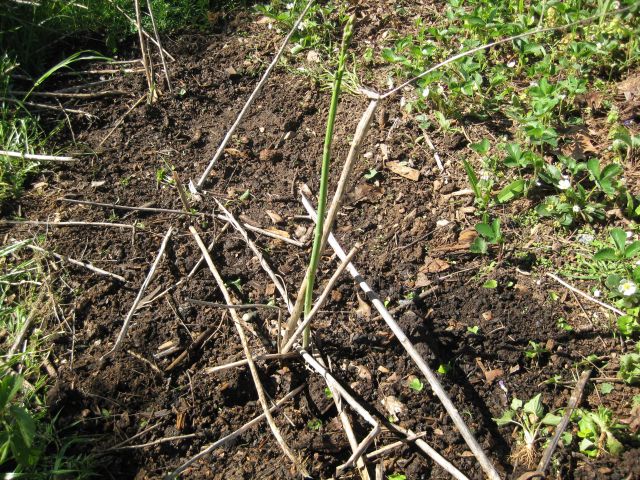
Finally, my first asparagus has emerged and a potato shoot has appeared at the bottom of the trench. When the other potato plants emerge I will begin the process of covering them with soil as they grow higher, until eventually they will flower atop a soil mound.
first asparagus of the seasonfirst potato shoot has emerged
I was forking the compost into a new bed (better to use a fork than shovel to save the earth worms) and my mind as usual was galloping along revisiting past scenarios, themes and friends. And the phrase from Hamlet “to thine own self be true” hovered into view.
Of all the bandied guidelines such as “a good name is better than great riches” or “love your neighbor as yourself” being true to our own self is for me the most difficult. And the difficult part is figuring out my own self.
I worked for major professional firms in London and New York in pressured environments where the mantra often was “you eat what you kill”. The body is immensely adaptable. And yes, physically, you can de-stress – for me running was the quickest, cheapest and healthiest de-stressor. But you lose something along the way and the loss occurs when you have conflicts. You have to pitch for an engagement/complete a critical project on a child’s birthday, or concert event, or family sporting event. I think the stress arises because you cannot control the options -two are in conflict and, absent deft footwork, a compromise or sacrifice must occur. For some there can be other conflicts too, where what they believe is right may not be right for the situation. And rationalization comes to the rescue – I must do this because my first responsibility is to put bread on the table for my family and if I do not then our source of income is at risk. And so it goes on and so we become more desensitized.
Along the way our value set also changes – worth and success are measured by income, and status is measured by possessions. These are easy yardsticks and do not require careful analysis. Also, self defeating, because enough is never enough and the bar for income and new goodies is continuously raised.
And with desensitization we lose touch with whom we once were – sensitive, optimistic, believing. So as I work with nature I am re-tuning myself to the draw of life, its cycles, infinite complexities and complete lack of pretense. And perhaps along the way I shall rediscover my own self.
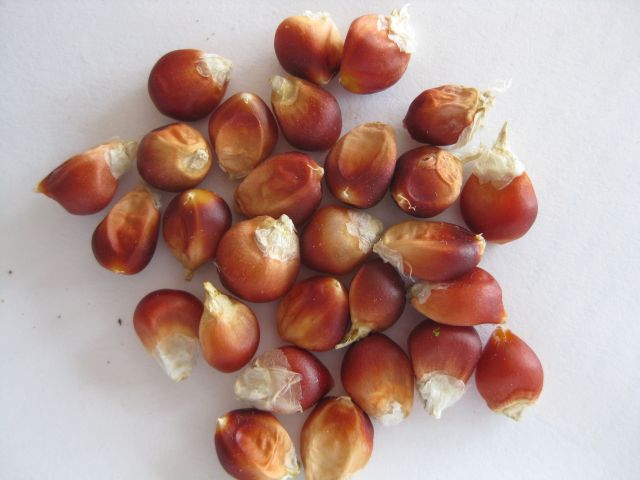
I received a gift from west coast visitors – Floriani Red Flint Corn. The accompanying information mentions it is a staple polenta corn and family heirloom grown for many years in the Valsugana Valley of Italy. The uninitiated would assume this corn originated in Italy, but it did not.
Floriani Red Flint Corn
I am enjoying snippets from “1491” by Charles Mann which describes the Americas before Columbus. As we know, the corn kernels we eat grow on a corn cob. It is also apparent that a corn cob cannot self seed – it has no mechanism to shatter or shake the kernels off the cob/husk and the kernels will not survive a trip through the intestines of a bird or animal. Corn (maize) is entirely dependent on humans to seed it in the fields (unlike wheat, rice, millet and barley, the ancestors of which could self seed). If corn cannot self seed then how did it originate?
A recurring theme in “1491” is that the inhabitants of the Americas prior to Columbus were far more sophisticated than most of us suppose. Mann states that the early inhabitants of Mesoamerica (roughly Central America) developed not only corn but also tomatoes, peppers, most of the squashes and many of the beans. But corn is the most intriguing. Since it cannot reproduce itself the Indians must have developed it from another species. The closest genetic relative is a grass called teosinte, which looks very different. A debate raged amongst scientists as to whether corn developed from a mutation of teosinte or from a now vanished ancestor, Tripsacum, or from repeated mixings of other types of grasses. There appears to be agreement, however, that its development must have required biological manipulation by determined, skilled plant breeders.
There is a wide variety of corn in lots of different colored kernels and sizes with more than 50 genetically distinguishable “landraces”. Because corn is open pollinated and the wind can blow the pollen from field to field, if uncontrolled the result would be an homogeneous entity. But because early farmers sorted their seed and were careful with their plantings, they were able to maintain a large variety of different corn.
Mann also mentions that Indian farmers grown corn in a milpa, or maize field and will plant a dozen crops at once including corn, avocados, multiple varieties of squash and bean, melon, tomatoes, chilis, sweet potato etc. The “three sisters” corn, squash and beans are well known in permaculture but the milpa which Mann refers to is far more extensive. He suggests the milpa is superior not only to monoculture and its dependence on artificial fertilizers, but also to the practice of crop rotation, and that this is evidenced by its continuous cultivation and long term use.
It is corn planting time (advanced by the unseasonal warm weather we are having), the rain has let up, and I am heading for the field.
“TGFI” – you may have thought this was a typo and should be “TGIF” – Thank God its Friday, but for me it is Thank God for Internet.
Most tractors have a three hitch system, which means the heavy implements at the back are hitched or connected to the tractor at three points, two horizontal at the bottom and one at the top. The top point is connected to the tractor with a top link. I damaged my top link and needed a replacement – one of the arms of the top link was bent, which meant I could not adjust its length in situ and so had to remove it each time I needed to adjust it. The top link I damaged was a replacement which cost <$30 from a local tractor dealer, now unfortunately out of business. So I was thinking in the $30 price range.
With the local dealer out of business, the next closest dealers are about 30 miles away and, to avoid a wasted trip, I called ahead. I was flummoxed when told the replacement would cost $109 (before taxes). So since this wasn't time critical, off to the internet I went - even if it had been time critical I would not have paid that price!. I do not know whether the part they were selling was U.S. made or imported, and I will pay up to 20% more for U.S. made, but the price quoted did not merit further discussion.
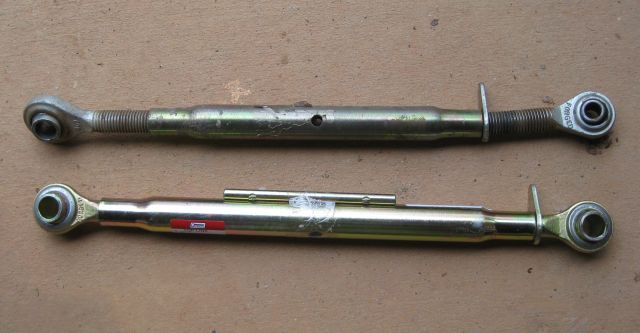
[caption id="attachment_1706" align="aligncenter" width="640" caption="damaged top link on top - note bend on right side, replacement below"][/caption]
A top link has holes on each end through which pins are inserted to connect it to the implement and the tractor. The size of the holes is determined by the size of the tractor – larger tractors have larger holes. My tractor (Case 585) is 60hp which makes it a category 2 tractor (category 2 tractors have horse power ranging from 40hp to 100hp), and the holes are 1″ and 3/4″. I found a top link with 1″ diameter holes for $24 and for $2.20 I purchased a bushing kit, which reduces the internal diameter of the 1″ hole to 3/4″ diameter. Shipping was $11, and so for $37.20 and a 4 day wait, I had a new replacement top link.
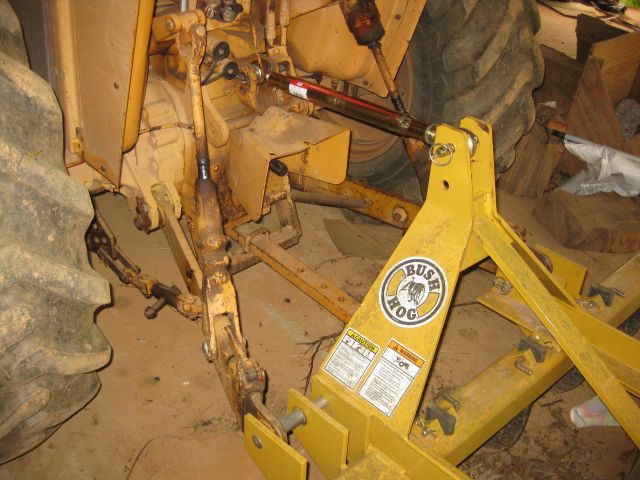
It takes a couple minutes to replace a top link and, below, you can see the new top link in place.
new (shiny) top link in place connecting top of yellow box blade to tractor
Now Georgia is about to pass new tax laws which will probably tax internet sales but even an 8% tax will not diminish the benefit of having an alternative source of supply for uncommon parts. TGFI!