gumption and the intermittent failure

If the South’s summer heat and humidity bear any consolation, it is that I have to seek shelter in the house for much of the day and thus am able to extend my reading.

I enjoyed the first third of Zen and the Art of Motorcycle Maintenance by Pirsig but struggled as the protagonist ascended higher into the mountain and into rarefied philosophical issues for which I was not prepared.  Now in the last third of the book the running is easier.  His thoughts on gumption and practical issues of machine maintenance bring back memories.

At p. 310 he says “I like the word “gumption” because it’s so homely and so forlorn and so out of style it looks as if it needs a friend and isn’t likely to reject anyone who comes along”.  I recall “gumption” too with affection.  The only time I heard it used was by Tommy Cairns our lecturer in cost accounting at my university in Johannesburg during the early 70’s.  His lectures were punctuated by reference to a general lack of gumption and the criticality of gumption for success.

Now, many years later I see it dancing on the pages of Pirsig’s book before me, such as “Gumption is the psychic gasoline that keeps the whole thing going.  If you haven’t got it there’s no way the motorcycle can possibly be fixed.  But if you have got it and know how to keep it there’s absolutely no way in this whole world that motorcycle can keep from getting fixed.”

One of the gumption traps he refers to is the “intermittent failure” which fools you into thinking you have an engine problem fixed and then it recurs.  He suggests methods to identify and fix the problem with the advice that “In some intermittents you have to resign yourself to a long fishing expedition, but no matter how tedious that gets it’s never as tedious as taking the machine to a commercial mechanic five times”.

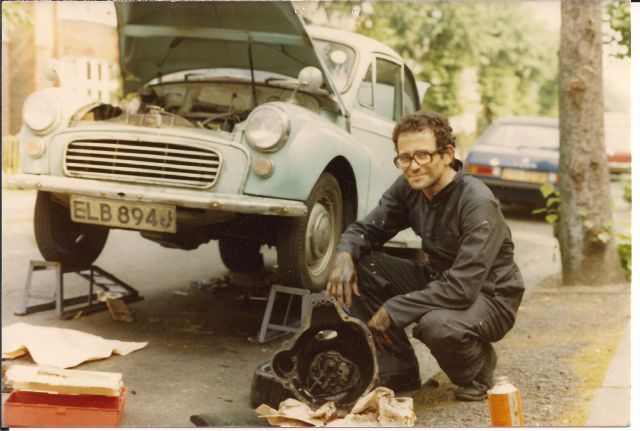
All of which brings back my second memory.  When I lived in London I had a Morris Minor – a two door beetle-like friend (formerly a police car) which I worked on extensively and affectionately called “Elbee” for its licence plate.  Elbee developed an intermittent fault – when I rounded corners quickly the electrics would falter.  I searched everywhere for the culprit, without success.  Elbee’s tools were kept in a rollup bag and one day, upon lifting the bag, I noticed an aimless, loose wire beneath.  This was an earthing wire held in place by the tool bag and I figured that when I cornered and put Elbee through her paces, the bag shifted and the wire lost contact with the frame.  It was an easy fix to secure the wire.
gumption
Elbee receiving a new clutch. The suburban street was my workshop

ideas from the past – the kang

I am reading the F. H. King classic “Farmers of Forty Centuries: Organic Farming in China, Korea, and Japan” written in 1911 and there are so many nuggets of useful information, including the “kang”.

He observed the  kang  during his visit to Mongolia and his commentary  made me think of the rocket mass heater (now popular in permaculture circles)  with which it shares a number of features.

He describes several kangs – in one case it was 7ft by 7ft and about 28″ high and “could be warmed in winter by building a fire within” or “warmed by the waste heat from the kitchen whose chimney flue passed horizontally under the kangs before rising through the roof”.

“The top was fitted for mats to serve as couch by day and as a place upon which to spread the bed at night.”  They were constructed from brick “made from the clay subsoil taken from the fields and worked into a plastic mass, mixed with chaff and short straw, dried in the sun and then laid in a mortar of the same material.  These massive kangs are thus capable of absorbing large amounts of the waste heat of from the kitchen during the day and of imparting congenial warmth to the couches by day and to the beds and sleeping apartments during the night.”  He goes on to mention problems after 3 or 4 years and how they turn the problem into a solution.  His book can be freely downloaded.

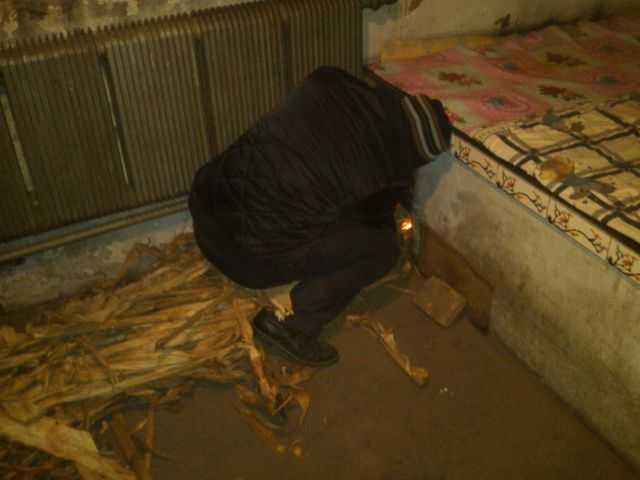
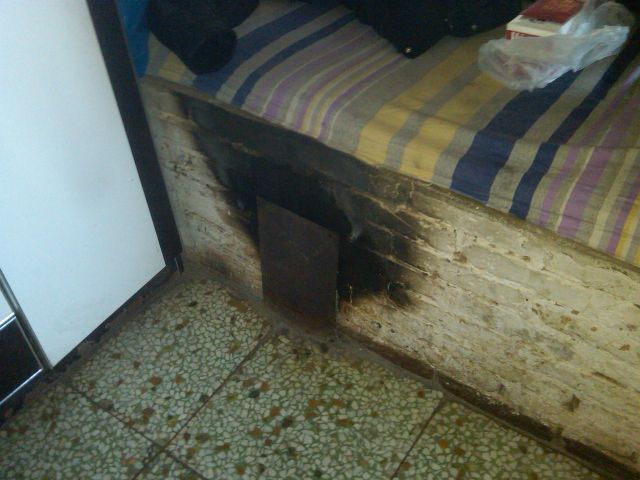
These kangs are still used today.  I include below several recent ‘photos taken by a visitor  to eastern inner Mongolia.

kang mass heater
lighting the fire of a kang
mass heater kang
interior fire of a kang
mass heater kang
‘photo of another kang

The visitor could not recall if the exterior flue of the kang was horizontal or vertical – he thought it may have been horizontal

honey harvesting – mistakes

Yesterday, Sunday, I had my best honey harvest in the two years I have been collecting honey from my bees.  I filled just over 32 pint jars, which equals 4 gallons.  Earlier this year (4/29 and 6/3) I collected 1.2 and 1.4 gallons of honey, so total yield is 6.6 gallons.  If I assume an average weight of 12 lbs per gallon, this is about 80 lbs of honey, which is good going for me.  But my activities were tinged with regrets.  I made some mistakes and regret them.

I have two hives.  The one I started this year with members from the main hive is doing ok but not great and, after a quick inspection, I decided it did not have honey to contribute.  So I focused on my main hive which I have had for 2 plus years.  It has 3 hive bodies or boxes on top of each other.  The bottom is a deep (9.625″ high) and the two above it are medium supers (6.625″ high).  I had placed the super I harvested in June and April in the middle and so the super on top had not been harvested this year.  I inspected the first frame in the top super (there are 10 frames in a box) and saw it was filled with honey.  So I concluded all the other frames in the top super were also filled with honey (my first mistake – I should have examined the individual frames).

wax after the honey was removed
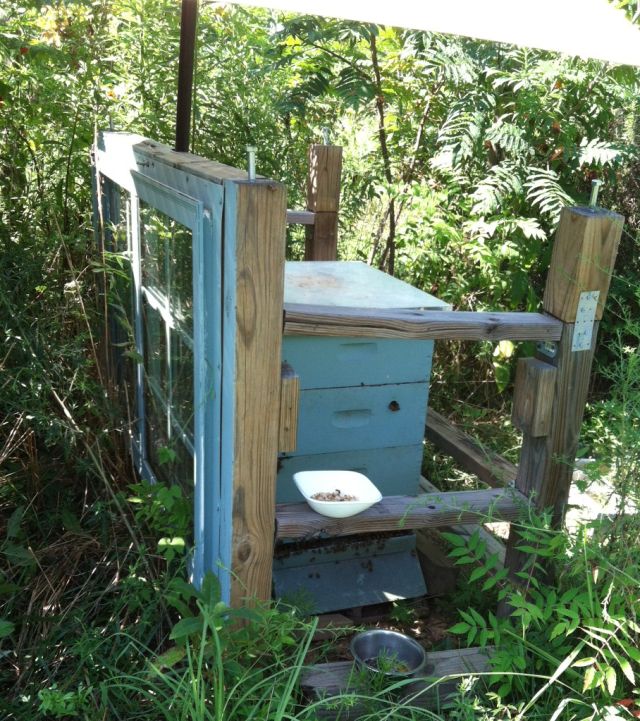
bee hive (1 deep, 2 supers and sun umbrella and structure for winter rigging) after honey harvest – note containers of wax scrappings left for recycling

I don’t use chemicals on my bees with one exception – I use butyric acid, which is vile smelling, to make the bees leave the hive body. I am now reconsidering this practice.  Anyhow, I applied the butyric acid to the fume board, which is a lid you place above the hive body you wish to harvest, and the bees all departed the hive body  or so I thought.  Then I transported the hive body to the kitchen where the harvesting and extraction equipment awaited.

Before moving the hives into the kitchen I inspected them outside and found a lot of bees still on the middle frames.  I looked to see if they included the queen, did not see her and with a bee brush I gently brushed them off the frames.  To my surprise they held on tenaciously and it took several attempts to get them all off.  Then I moved the frames into the kitchen.

I thought all 10 frames would contain honey and the first 3 did.  But, to my upset, the next 4 contained larva.  In other words, the queen and her retinue had moved up from the deep and she had laid eggs in the top super.  I harvested honey from the 3 frames at the other end and then returned the 10 frames (6 empty and 4 with brood) to the hive.  It had not occurred to me that the queen could have moved to the top super.  The bee club I belong to encourages the use of a queen  excluder (a metal grill which prevents the queen moving up) but I chose not to use it.

When I returned the top super I carefully went through the frames in the deep and middle super and selected 6 frames laden with honey which I harvested, without mishaps.

I was upset for several reasons.  The bees which clung to the frames were nurse bees not foragers.  Nurse bees are young bees which have not yet been outside the hive.  Therefore they have not performed their orientation flights, which means that the bees I had buzzing outside the kitchen did not know where they were or how to return to the hive.  I could tell they were nurse bees because when they landed close I could see from their size, fuzziness and gentle color they were young bees.  I tried to make amends by placing pieces of wax cuttings containing honey on plates outside the kitchen and when the offerings were covered with bees I covered the plates and moved the assembly to the hive entrance and hopefully some found their way back.  But at the end of the day there were still a lot of bees buzzing around, some of which were the forever lost nurse bees.  I think when I placed the wax scraps outside, word was quickly transmitted to the hives and a lot of the bees which were flying around were seasoned foragers bent on opportunistic honey treasure.

My second concern and a bigger concern was that somewhere amongst my missteps I may have lost or done in the queen.  I hope not.  My third concern is the larva (my future bees) could have been damaged from the exposure to the butyric acid.  I now read that in Europe there are concerns about the use of butyric acid and next year I shall probably not use it.  I could develop more concerns such as whether, with nurse bees absent, the functions of the hive will continue normally, but I will stop.

So a very good honey harvest, with a number of honey frames left unharvested for the bees use, but some regrets.

some summer observations

Each year I learn a little and try out different techniques.  Although 50 miles north of Atlanta and slightly higher, it gets really hot.  So one of the changes was to establish a new growing area which receives full sun through mid-day and is shaded from the afternoon sun by large maple trees (I must remember to check the trees’ roots are not invading my growing area).  And I have noticed a difference.

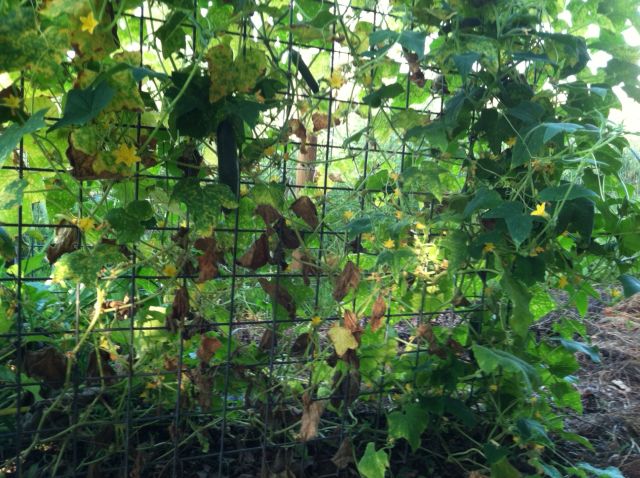
I battled last year with cucumbers and this year they are doing much better protected from the scorching afternoon heat.  Lots of flowers and already harvested a lot of cucumbers but some demises and its a race to see how much more will be produced before they fade away.

cucumber plants
cucumber plants on hog panel fencing doing well but beginning to fade

Last year my nasturtiums barely survived – this year, protected from the afternoon sun they are doing better but are a pale shadow of the lusty specimens I saw in the San Francisco area.

nasturtiums
nasturtium persevering in Georgia

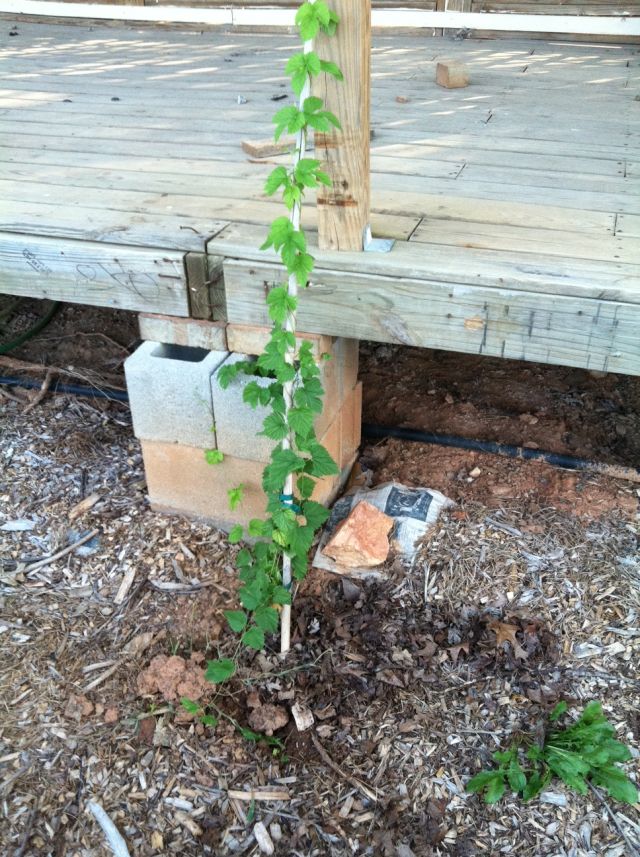
I brew my own beer and, in a spirit of enterprise and optimism, I decided to grow some hop plants.  The flowers of the hop plant are used for flavoring and stability in beer brewing.  My plants are growing slowly and hesitatingly.  Maybe they will speed up and I will have something for my brew next year?

hop plants
one of the hop plants – a long way to go but seems in good health

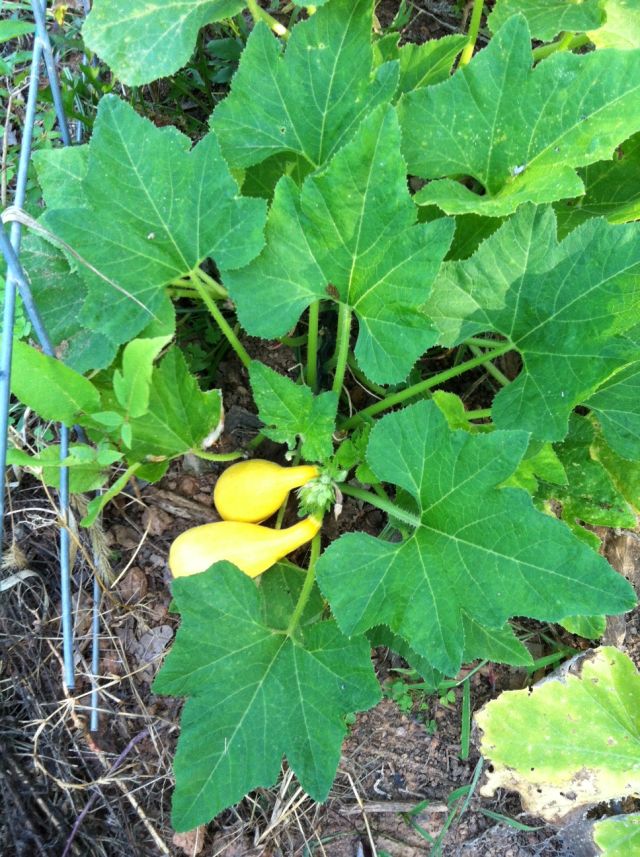
Although the vine borer is hard at work I am still getting squash plants.  A much better outcome than last year.

squash despite the borer
squash still on the way

I did not do very well with my cuttings.  Although the apple cuttings took root they did not survive the heat.  I waited too long and this year I will take my cuttings in the fall.  However, the fig cuttings were very easy to propagate and below is one of my new fig saplings.

fig plant
fig plant from cutting

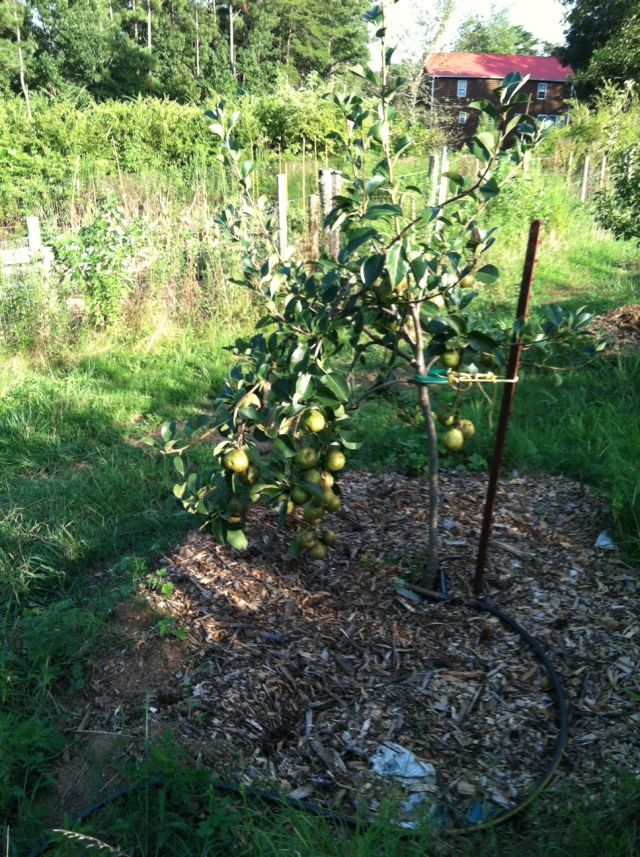
I am looking forward to some pears.  Three of my pear trees are bearing for the first time and are bearing well.  Unlike the apples they seem to be free of visitors.

young pear trees
young pear tree bearing its first pears

Finally, a little color always helps.  Two years ago I seeded some zinnia flowers (must have read they are beneficial in some way) and now they self seed and spread and seem well acclimatized to survive without any irrigation.

zinnia flowers
self seeded zinnia happy to be left to their own devices

timing the tomatoes

My tomatoes plants bear well but usually by August they look bedraggled.  The yellowing of the leaves which begins at the lower limbs progresses upwards and I am left with skeletal remains and a few lonely tomatoes.  A few years ago I tried to extend the harvest by breaking my rule (all my vegetables are from my seed sowing) and buying several large healthy looking tomato plants.  They did poorly.  Perhaps they were nurtured on energetic synthetic fertilizers and could not acclimatize to my all natural compost environment?

Got me thinking.  What if I kept some tomatoes plants in reserve and planted them out say 6 weeks later than the others.  They were all seeded at the same time but the reserve force was footed in 2″ soil blocks and kept in the shade so they barely grew  as a result of lack of sun and nutrition.  My question was would they age and deteriorate at the same rate as their brethren in the field or would they be 6 weeks younger?

Today I looked at the later planted tomatoes and, unlike their siblings which have been bearing heavily and showing severe signs of wear and tear, they look young and strong and are bearing flowers – so it appears they are on their way.

tomatoes
tomatoes which were seeded early but planted out late doing well wiht mullein neighbors

But conclusions are difficult to draw – unlike a laboratory there are unconstrained variables – the later planted tomatoes are in raised beds which may have larger deposits of compost and less soil and less soil may mean less wilt, and for the first time I have planted out mullein and maybe the mullein, which accompanies the more recent batch, is helping as well.  Finally, they have not yet borne tomatoes so I must reserve conclusions until August/September.

tomatoes
other later planted tomatoes

For most of my tomatoes I use wire cages cut from 5′ by 150′ lengths of remesh.  But the later tomatoes were a bit of an afterthought and I had already deployed all the wire cages.  Since I had a stand of gradually invasive bamboo I simply cut lengths of bamboo stakes and secured the plants to the stakes.

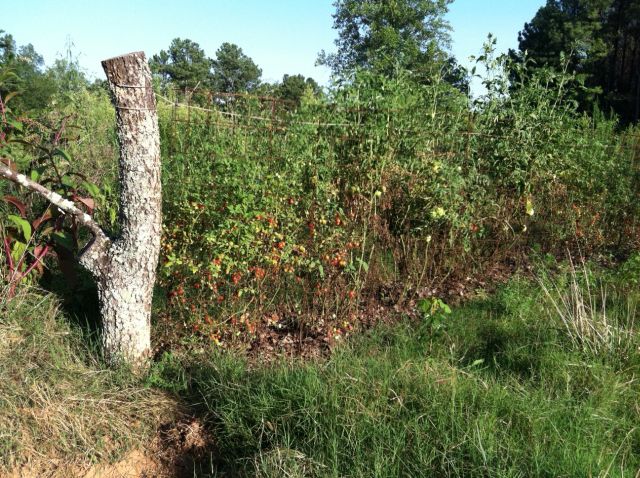
older tomatoes
some of the veteran tomato plants in wire cages secured with cable between cherry trunk uprights

Trudy the hunter

I have posted on Trudy’s successful pest patrol activities.  But she has graduated now.  She is a hunter.  A hunter could be defined as killing game or other wild animals for food or sport and, perhaps you would rank a hunter who kills for food higher than one who kills for sport.  If you follow this progression, then the higher the % of the prey consumed the higher should rank the status of the hunter.  Trudy this week achieved the highest status.

She raided a rabbit’s nest and it was only by her (I thought” guilty” but may it was “proud” – a recurring problem when we project our emotions on others) behavior, that I figured something was amiss.  And then I spotted two round pale colored tusk like objects emerging from her right jaw.  She refused to release her capture and growled threateningly when I tried to prise it out.  The usual ruse – give her a biscuit and she drops her mouth’s contents to eat the preferred delicacy, didn’t work.  The conclusion was that her mouth’s contents ranked higher than the biscuit.

Trudy, a hunter with prey
is that a leg protruding from Trudy’s mouth?

So I took a few ‘photos and stood by as she chewed on the baby rabbit and eventually with one big gulp down it went.  And then, with barely a pause, she turned her attention to the two biscuits (when one didn’t work I had offered another type) and down they went too.

So true hunter status to Trudy!

DIY and its virtues

I just read a good essay in the New York Times – “A Nation that’s losing its Toolbox” by Louis Uchitelle (July 21, 2012).  He laments the loss, not only of factories and good manufacturing jobs, but also “mastering tools and working with one’s hands is receding in America as a hobby, as a valued skill, as a cultural influence that shaped thinking and behavior in vast sections of the country. ”  He says that manufacturing is important, not just to create jobs and reduce the trade deficit and help us out of the recession, but “a growing manufacturing sector encourages craftsmanship and that craftsmanship is, if not a birthright, then a vital ingredient of the American self-image as a can-do, inventive, we-can-make-anything people.”

Maybe the shift from manufacturing jobs to the service sector was because of higher pay, higher status or less physical exertion.  Or is it a cultural thing.  In an earlier post I referred to German technology and competitiveness which is unbruised by Asian competition. The author quotes Richard Sennett, a NYU sociologist  “Corporations in Germany realized that there was an interest to be served economically and patriotically in building up a skilled labor force at home; we never had that ethos.”

Some books resonate with me.  I enjoyed  “Shop Class as Soulcraft” by Matthew Crawford and now, at long last, I am reading “Zen and the Art of Motorcycle Maintenance”.  Lots of delightful quotes – here the author (at page 44) comments on how different two motorcycles of the same make, model and year can turn out years later  “Each machine has its own, unique personality ….This personality constantly changes, usually for the worse, but sometimes surprisingly for the better, and it is this personality that is the real object of motorcycle maintenance.  The new ones start out as good-looking strangers and, depending on how they are treated, degenerate rapidly into bad-acting grouches or even cripples, or else turn into healthy, good-natured, long-lasting friends.”

It is probably the case that now we have progressed beyond the intricacies and quirks of carburettors and manually actuated devices to computer controlled fuel injected vehicles and other digital devices, that the personality of machines has been buried and they all act much the same, except where grossly abused.  And with this transition we have lost some of the connectedness we once had to the world around us.

I remember some 30 years back I had a large tube tv, long on its legs, which regularly began to flicker erratically after 10 minutes use.  I concluded there must be some failing part which malfunctioned when it got hot.  I bought a can of compressed cold spray, opened the rear, switched on the tv, waited 10 minutes and, taking good care not to come in contact with any high voltage wires, sprayed each component, largest first.  To my delight when I sprayed one particular tubular device, the flicker on the tv disappeared.   I waited, the component warmed up, I sprayed it again and the flicker disappeared.  It was then a simple matter to remove the component, go to the electronics store, order a replacement and solder the substitute in place.  Presto – easy fix.  I will not try this on modern tv’s and even replacing the spark plugs on my truck (manifolds and various devices have to be first removed) fills me with apprehension.

So maybe also, the advent of new technologies has reduced our ability and wish to tinker, as we did in the past and, because they cost relatively so much less than did products of the past, our incentive as well.

feeding the contour ditches

I have several contour ditches cut on the side of the hill.  Each ditch is horizontal, catches rainwater sliding down the hill and irrigates plantings horizontally aligned with it – such as tomatoes, fruit orchard, blueberries and blackberries.  Since almost all of my irrigation is with rainwater I try to make every drop count.  I lose water which streams beyond the reach of the ditches, especially down an access road I cut up the hill.

Previously I dug finger drainage ditches which intercepted the streaming water and directed it to the ditches.  But with foot and vehicle traffic, the sides of the ditches shallowed and also filled with vegetation and thus lost their efficiency.

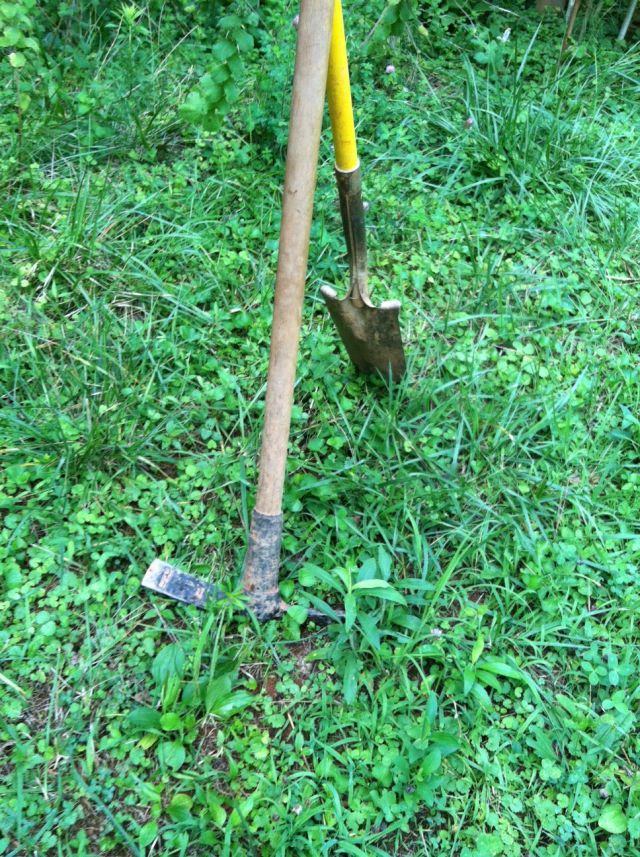
So I engaged again with my mattock and trenching shovel.  In summer (and generally) you want to minimize effort in Georgia humidity and the trenching shovel with its long 5″ wide blade excavates deeply to the desired width, so it is more efficient than a regular shovel.

equipment for contour ditches
mattock and trenching shovel for maintaining contour ditches

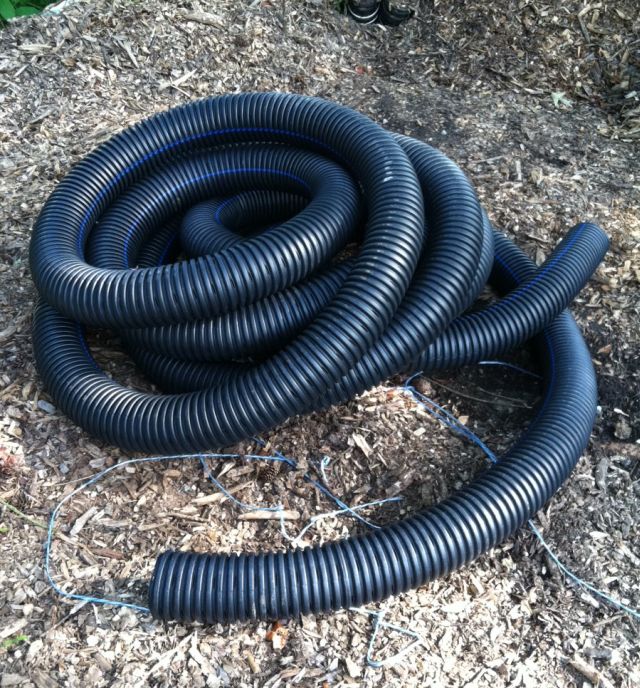
Next a visit to one of the big DIY stores to buy a 100 ft of slitted 4″ corrugated pipe.  I was surprised at the $60 price, I am sure it was around $45 a year ago.

corrugated pipe for contour ditches
slitted 4inch corrugated pipe to feed rainwater to contour ditches

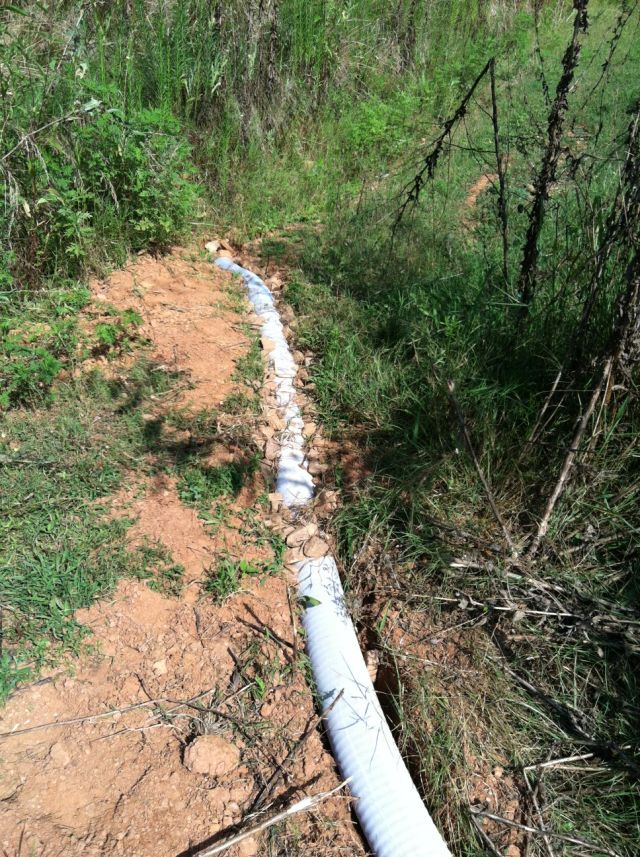
I widened the three feeder ditches to the contour ditches, measured their length, cut the pipe and checked it fitted so the top was below ground surface.  Then I “socked” it to reduce infiltration by soil and roots.

pipe in place leading to contour ditches
“socked” drainage pipe in place along access road ending in contour ditches

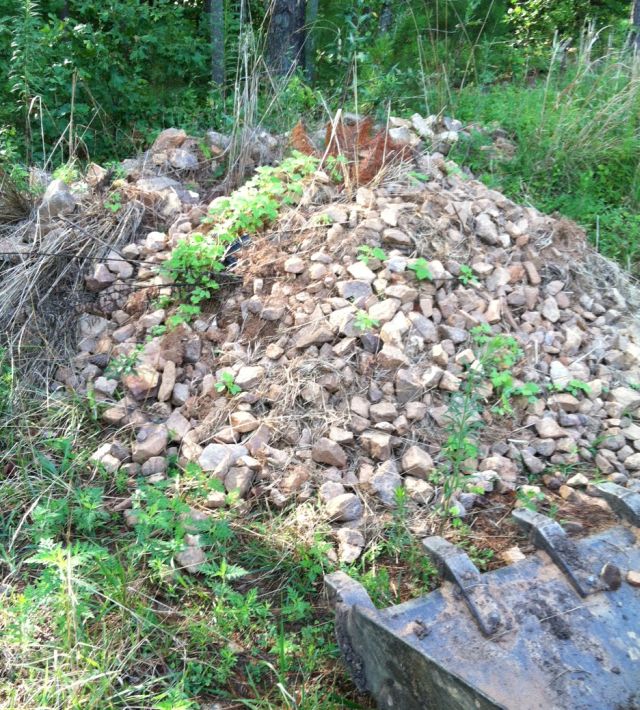
Finally a visit to my stone mound to pick out smaller stones to surround the pipe.

stone mound contributes to efficiency of contour ditches
stone mound with candidates to fill in around the drainage pipes leading to contour ditches

In the past I may have visited the local gravel yard and purchased a load of gravel, but why do so when I have so many stones laying around.

drainage ditch leading to contour ditches
drainage ditch diverting water to contour ditches

More stones are needed and I shall make the habit of picking up right sized stones and depositing them in the drainage ditches for the benefit of my contour ditches, when I visit my plantings each day.


the upending of the West?

My focus on organic growing has recently been distracted by intrusions from reality – the fox raid on the chicken, a robbery while I was away from the house and, now, by unusual summer heat and the question of the economy.

I have always lived in the West – South Africa, the UK, and the USA and accepted the notion that the West led the way. But not anymore. For me it was the Olympics in Beijing, that signaled the rising ascendency of Asia.

In the 90’s and beginning of this decade we in the West lamented the industrial work camps of Asia where fellow humans toiled in (to our eyes) sub-human conditions producing clothing and footwear for our use.  We did not appreciate that these cheap imports represented the export of our jobs. And the press, which guides or maybe reflects conventional thinking, didn’t help either. The view was that we, as an advanced country, shouldn’t worry about losing simple manufacturing processes (clothing and footwear), we would focus on the more complicated products and, of course, services. And then quite suddenly we were not manufacturing tv sets or other electronic products and a whole raft of other manufacturing skills had departed as well.

Conventional warfare where you fire bullets and lob shells and drop bombs has been superseded by economic warfare where the bullets are the consumer goods and the bombs are the vehicles we import. This is not fanciful thinking. A bomb destroys lives and infrastructure. An imported product displaces jobs that used to manufacture it, as well as the factories, technology and experience that produced it, and then disrupts communities and lives. Global competition is good, good for the consumer and for keeping our processes lean and vigorous, but when manufactured imports so greatly engulf our manufactured exports and over such a long period, the result is attrition and decline.

It has taken a long time to get there but we are now lamenting the lost jobs and trying to figure how to get them back and this topic may dominate our politics in coming months.

Perhaps, for starters, we should try figure why we lost the jobs in the first place. Or why do civilizations and nations which were triumphant, decline?

We could consider the decline of ancient Greece, or Rome or other great civilizations. Or look at more familiar topics – the business started by the founder, continued by his son and driven into the ground by the grandson. A familiar recurring theme. Does success go to our heads and hubris lead us to unsafe choices, or do we grow soft, fat and happy with good fortune and have the bread taken from our plate by desperate, wily competitors?

I read an excellent book some years ago (I cannot locate it now) about the decline of British steel manufacturing in the late 1800’s. How was it that Britain, the cradle of the industrial revolution in the late 1700’s and early 1800’s, had by the late 1800’s been overtaken by Germany in steel technology and production? The author’s contention was that priorities changed – that having accumulated great wealth from manufacturing, the tough ruthless industrialists were happy for their children to study the humanities (ancient Greek, Latin, the fine arts) at Oxbridge while in Germany the focus was on technical colleges and manufacturing. This seemed to make sense to me – Maslow’s hierarchy etc. And then, while googling for the above mentioned book, I came across another explanation for German superiority in steelmaking in the late 19th century– tariffs and cartels. With steelmaking the bigger the plant the greater the efficiencies but, with recurring cycles of prosperity and decline, it is more sensible to construct smaller plants with less fixed overhead to burden you during down cycles, than a big plant. However, steel tariffs (import duties and restrictions) and cartels (pricing agreements) provided stability in steel production and pricing and therefore encouraged German manufacturers to commit to large productive plants. I am sure there are several explanations for why German steel production escalated. But interesting isn’t it that controlling the market (Government intervention) may have been a big driver?

So is this relevant? Well Germany is doing very well today and, if Europe does recover, it will probably be due to Germany, and there is precedent for a European recovery – just consider how Germany absorbed East Germany and how powerful the combined entity is today. Although Australia and Canada, which are part of the West, are doing well (in Australia’s case, very well) today, we can attribute much of that success to large deposits of natural resources. Germany is doing very well without natural resources – just sheer competitiveness. And to compound the answer, Germany has strong trade unions – so don’t blame the unions. And German labor is not cheap and German’s lead a good lifestyle so we don’t have to live in dormitories on low wages to compete.

My conclusion is we have to get smart and make tough adjustments to enable us to compete – but we can do it.

rat and rabbit patrol

While I attend to the irrigation, Trudy my Heinz 57 canine companion, investigates and patrols.  A few weeks ago, as we returned to the house, I noticed her cheeks were puffed and when I coaxed her mouth open a little rabbit slid to the ground.  It was too mangled to survive, so I despatched and buried it.  This morning at the door entrance was a token of appreciation from Trudy – a rat which she had captured in the vegetable garden.  No despatching was required this time and after a quick photo snap (below) I buried it.  So no need for a rat terrier as discussed in a recent Paul Wheaton podcast, my Trudy is up to the task.

present of a rat
rat gifted by Trudy