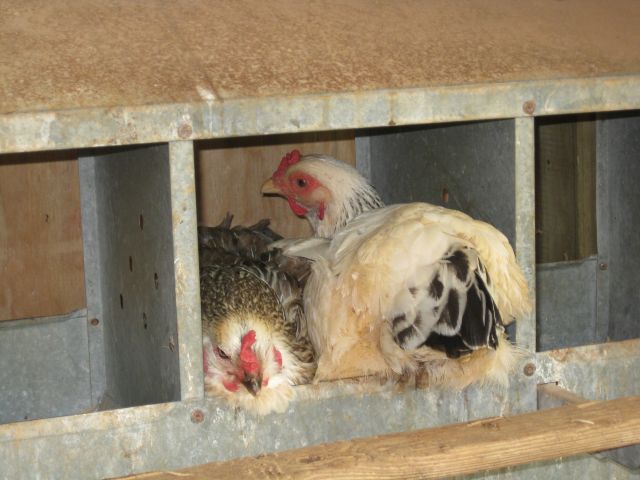
When the need to lay is too great, and only one nest box will do, then the need for privacy and dignity are a distant second.
new life tracks – growing organic, self reliance, permaculture
When the need to lay is too great, and only one nest box will do, then the need for privacy and dignity are a distant second.
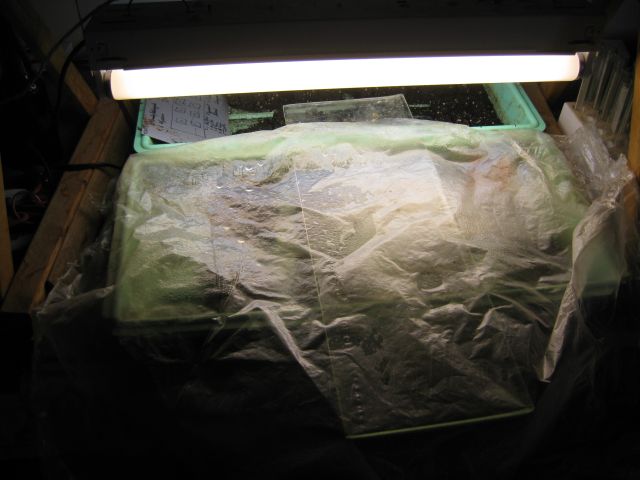
Now is the time I focus on my tomato growing. As discussed in the growing organic tab, I start with tomato seeds in .75″ blocks on a heating pad and fluorescent lighting. For the first few days the tomato seeds are covered in plastic to raise the humidity and temperature.
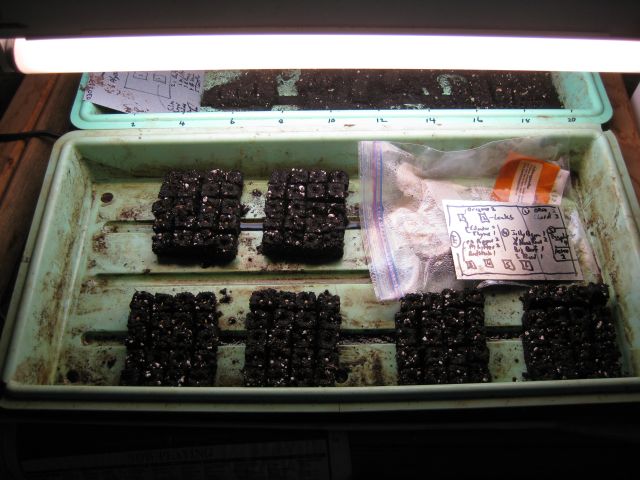
The tomato seeds are individually located in .75″ seed blocks and there are 20 seed blocks in each of the 6 bigger blocks – so there are 120 seeds germinating in this tray. On the right is my summary of which seeds are in each block.
In my greenhouse I have set out some tomato seedlings. The .75″ blocks are inserted into larger 2″ blocks and each 2″ block carries a description of the tomato variety. You can see a few empty 2″ blocks with their square indentations awaiting a .75″ block.

From the tags you can identify some of the tomato varieties I am growing – both heirloom and hybrid.
Now that my cool season plants are in the ground I am also growing out various herbs as shown in the next tray.
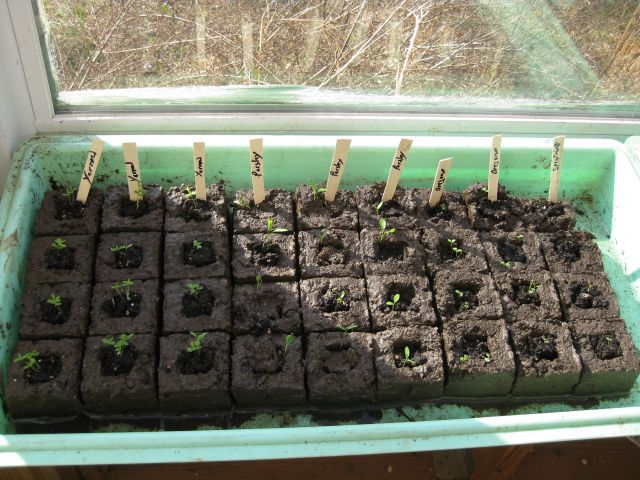
Finally, one of my two indoor lettuce trays. Several times a week I clip the outer leaves for my organic lettuce salad.
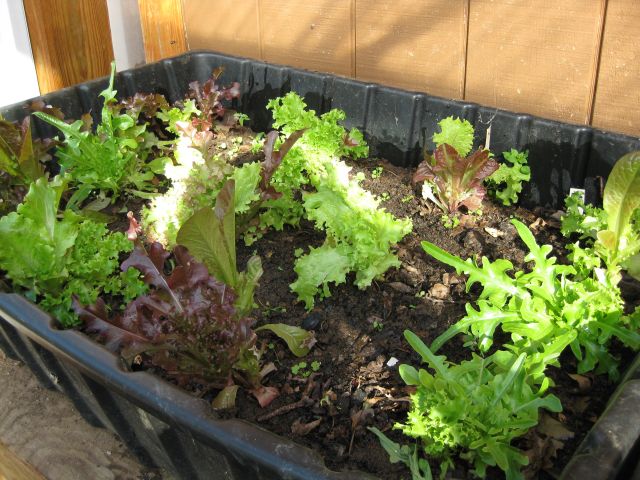
Soon I will plant out the lettuce in an area protected from the afternoon sun. And all this area will be occupied by 32 oz yogurt containers each with a tomato plant.
I have 2 peach trees and last year their blossoms were freeze damaged and I had no fruit. I really shouldn’t have any peach trees because they are difficult to produce fruit using organic methods and they blossom very early in the spring. But Georgia is known as the “Peach state” and Peachtree is a very popular street name in Georgia, and the Peachtree 10K Road Race is the world’s largest 10k race (I have run it 20 times), so my enthusiasm got the better of prudence.
Freeze damage occurs differently based on the type of fruit tree and its stage of development. For the peach at first bloom stage, where is where my one tree is, 10% of the blossoms will be destroyed at 26 deg F and 90% at 21 deg F. My second tree is at the first calyx red stage where the relevant temperatures are 23 deg F and 9 deg F, so I was not too worried about it. I decided that if I do not get any peaches this year I will replace the peach trees. With this ultimatum issued, I feel I have to do my best to help them along. With freeze warnings in place for most of the past week, I took the initiative and wrapped my most vulnerable tree with Agribon row covers which give about 6 deg F protection. I have never wrapped a tree before. Rather than web the technique, I decided to try figure it out myself. The covers are 7 ft wide so I took covers from my raised bed and wrapped them round the tree.

The wind was gusting >15mph and in a very short time the covers were undone and the tree looked like a weird ghost with flapping garments. So I decided to be more deliberate. I pruned off the taller branches and with a rope belted the limbs closer together.
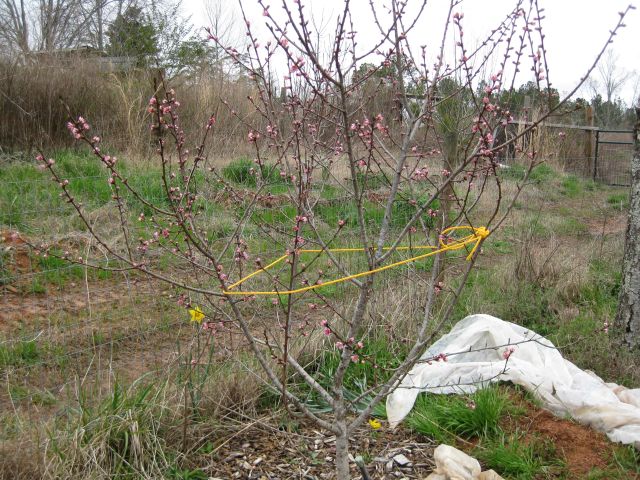
I again wrapped the tree in row covers and added two encircling ropes to hold them in place.
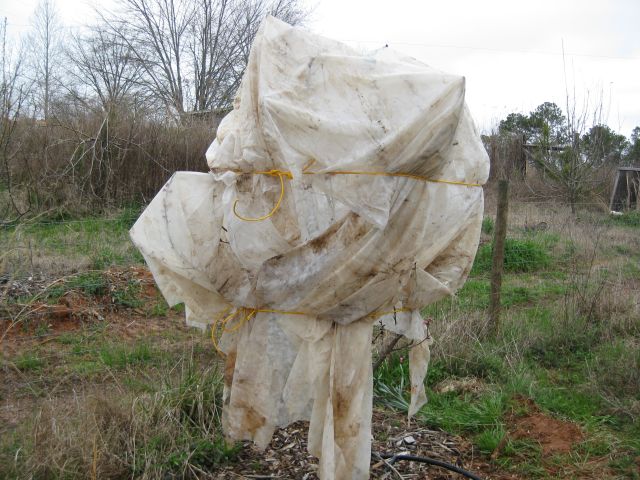
I thought this would do it, but the wind increased in intensity and was persistent. So I remembered I had several bulldog clips on hand and used them to secure the loose ends of the covers together.
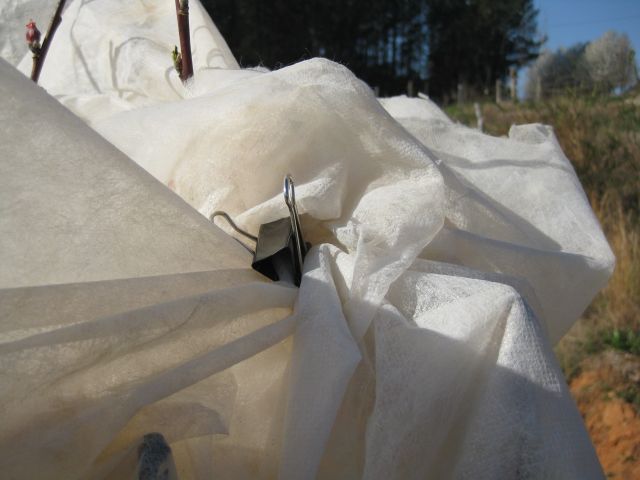
This seemed to do the trick and the covers stayed pretty much in place. Now, with no freeze forecast for next week I removed the covers to inspect the damage. All the blossoms were ok except for a few at the extremities which probably had poked through the covers.
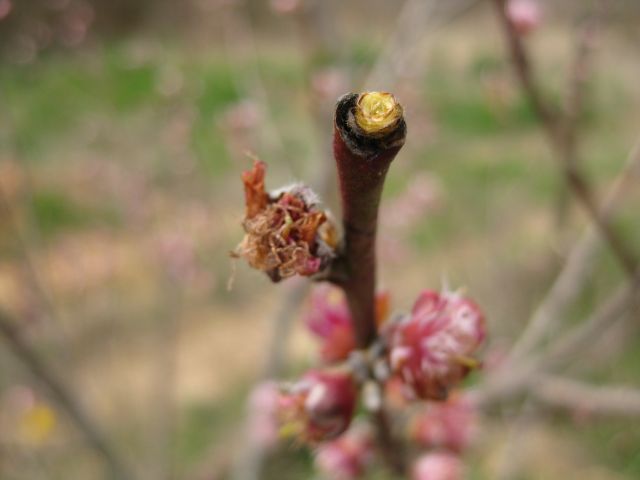
And interestingly, a budding leaf also appeared partly damaged.
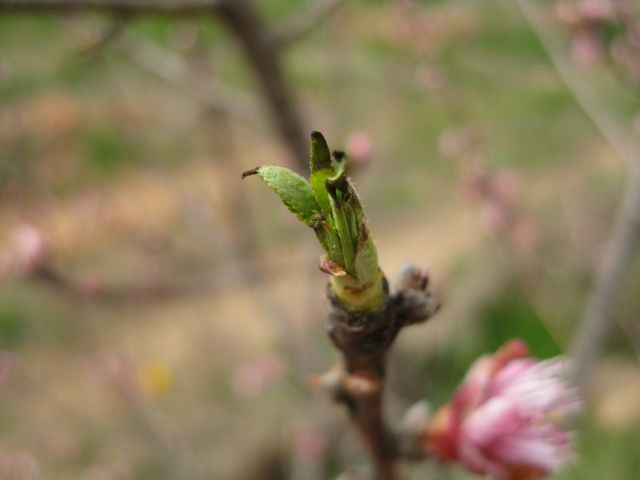
Beats me why the peach tree insists on producing blossoms first and then leaves while with most of my other trees it is the other way round. So, for now, the peach blossoms are ok. But as I consult my notes from last year I see there was a late frost in April which wiped out the blossoms of both peach trees.
An examination of post mortem records of Finnish hospitals before and after the 2nd World War shows that deaths from heart disease declined significantly during the war years. Some researchers have concluded that the decrease was because of reduced consumption of fats (meat, eggs, dairy and butter) as a result of shortages during the war years. Apparently deaths from atherosclerosis (hardening of the arteries) did not decline as much in the United States and this is attributed to more severe food shortages in Europe than in America. This trend was also observed in the Scandinavian countries. See this link -http://www.epi.umn.edu/cvdepi/slider_morta.swf . A full blown analysis is available at http://healthylongevity.blogspot.com/2012/08/forks-over-knives-and-healthy-longevity.html.
Correlation does not mean cause. Subscribers to the Paleolithic diet, also referred to as the hunter-gatherer diet, take an opposite tack and believer that a large intake of meat and fish is good for you. Their meat and fish is not purchased in a supermarket but taken directly from nature. A hunter acquaintance said he will only eat meat he has personally killed/”harvested” since only then does he know what he is eating. He also avoids most fish.
Now to complicate matters a new study released in March 2013 suggests there was atherosclerosis in mummies from 5,000 years ago. This has produced a slew of differing interpretations. A friend, who is not against junk food, argues that these findings show that junk food is not the cause of artery hardening since junk foods were not around 5,000 years ago. Another argument is that hardening of the arteries is a natural aging process influenced perhaps, but not significantly, by nutrition. To further confuse matters the mummies which were analyzed came from different parts of the world where some were hunter-gatherers who ate a lot of fatty meats, and others were from agricultural societies where they ate grains as well as domesticated animals.
This stuff is complex (as opposed to complicated, which means you can eventually figure it out) and, as with the debate on global warming, the experts are not definitive. The best they can offer is the palliative that exercise, avoiding tobacco, and eating healthy will all help to reduce heart disease.
About 20 years ago I dug a 100 ft trench for a 4″ drain pipe, which led from a concave area of the yard where the rainwater gathered, to a nearby creek. Over the years I planted many trees and shrubs in this area. The pipe worked well until the past few months when it completely ceased functioning. With downpours seemingly more intense than ever, I decided I had to fix the problem.
I have a 50 ft plumber’s snake and I inserted it in the hole and it moved along easily for 45 ft and then hit a blockage. I pulled the snake and inserted a contractor grade hose to the blockage and turned on the faucet thinking/hoping the water pressure would clear the blockage. To no avail, even after several days attempts. I concluded I should dig up and replace the blocked section of the pipe.
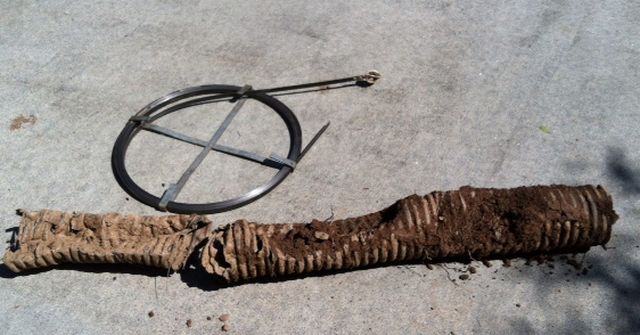
Problem was I didn’t know exactly where the pipe ran under the ground since, over the past 2 decades the landscape had changed. I tried digging a 5ft trench perpendicular to the supposed run of the pipe, but did not find it. The pipe is about 1 ft underground and digging a 1ft deep trench should not take much effort or time. Problem is the whole area is interlaced with the roots of good trees including a Japanese maple, Harry Lauder’s walking stick, and other worth preserving species. Plus some pretty thick pine roots as well.
How to locate the underground pipe? Plumbers use a transmitter on their underground probes, but they are expensive for a one time use. I googled personal locator devices and saw there are two options for the absent minded – with the cheaper device you attach a transmitter to your keys or other often lost items (not a cell phone because you just dial your # and it will ring) and, when lost, you press a button on the locator and the transmitter will flash and make a noise and you should find it. This wouldn’t work for an underground scenario. So I had to spring for the more expensive device (loc8tor lite) which has red and green directional lights on the locator as well as a beeper. You press the button, the locator calls the transmitter, the transmitter responds and then, with the locator in your hand you do a little circle and when you are nearer to the location of the transmitter, the locator becomes excited and even more excited with red and green lights glowing and noisier as you get nearer to the transmitter.
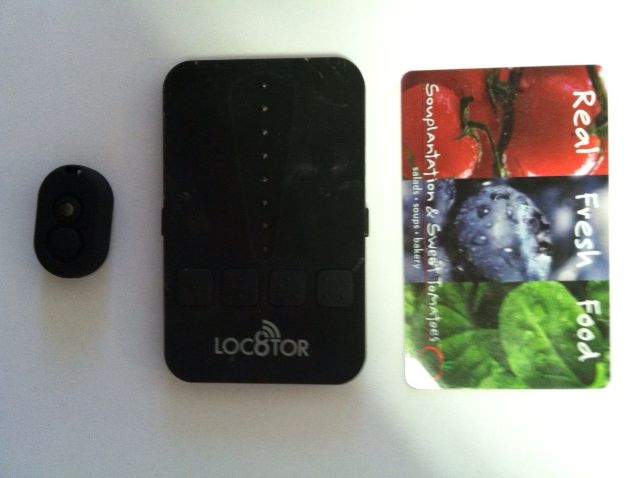
I placed the transmitter in a secure waterproof container (actually an old cylindrical 35mm film container) secured it with duct tape to the end of the plumber’s snake and sent it down the pipe. Initially my locator failed completely to detect the transmitter. So I figured its range must be limited when the transmitter is underground and to ensure I had the locator as close as possible to the position of the transmitter, I pushed the snake exactly 10 ft down the hole and measured exactly 10ft ground distance and, after removing some topsoil, I was able to locate the transmitter when it was directly below the locator separated by about 8″ of soil. The cheerful chirping and flashing green lights after hours of fruitless work was recompense enough. From there on it was easy going – measure out 10 ft distance on the ground, advance the snake 10 ft, clear the soil and the magical beeping and light flashing re-commenced. And so I continued until I located the blockage which was about 10 ft away from where I had thought the pipe ran and also much deeper than I had imagined. A worthwhile $68 investment and no doubt it will be handy for locating my often lost keys.
My root crops (carrots, turnips and beets) are growing better as my soil has improved with time and I am now planning for the sweet potato. There are several vogue diets circulating – the Mediterranean diet; the Esselstyn vegan diet I posted a few weeks ago, and the new Nordic diet (a free Coursera MOOC starts September 2013). So why go back in time to the traditional Okinawan diet with its reliance on the sweet potato?
I was pointed to the Journal of the American College of Nutrition 2009 article titled: “The Okinawan Diet: Health Implications of a Low-Calorie, Nutrient-Dense, Antioxidant-Rich Dietary Pattern Low in
Glycemic Load”. The title tells you much about the diet. Okinawa is a prefecture of Japan whose residents are very long lived and this is attributed to their healthy life style including their traditional diet. The authors compare this diet with the traditional Mediterranean diet and DASH (Dietary Approaches to Stop Hypertension) and note that the traditional Okinawan diet is lowest in fat intake and highest in carbohydrate intake especially of orange-yellow root vegetables primarily the sweet potato, which is also antioxidant rich, and green leafy vegetables.
You probably notice “traditional” surfacing a lot – the authors note that changes in the diet since World War II have been for the worse with younger Okinawans now more prone to obesity and other chronic diseases than older Japanese. A helpful chart shows that in 1949 almost 60% of the calories were from the sweet potato with about 13% from rice and 0% from bread. In 1972 less than 5% was from the sweet potato. Other features of the traditional Okinawan diet are lots of vegetables and legumes (mostly soy); some fish; little meat and dairy, and some alcohol (phew!). The emphasis is on low GI carbohydrates – the sweet potato has a GI of 55 compared with 75 for the Yam and 90 for the Irish potato. The article details other functional components of the traditional diet.
So I was pointed, I read, I converted and have now placed an order for 36 Southern sweet potato slips to be delivered and planted in April.
Hurricane Sandy late last year hammered the northeast. I read the articles and listened carefully to NPR for a consensus from the scientific community attributing the cause of the hurricane to global warming (I use “global warming” and “climate change” interchangeably). There was no consensus nor did I hear a scientific expert unequivocally say that global warming caused Hurricane Sandy. No shortage of laypeople expressing their views, including Mayor Bloomberg, but it seemed the scientific community was silent.
While there is agreement that the climate is changing and that man has a lot to do with this, only generalities have been offered as to the impact of all this on the weather. Weather is the short term state of the atmosphere, while climate describes the typical or average atmospheric conditions.
It really is important for the scientific community to determine if the droughts in the mid-west and the severe storms we are bearing are caused by human activity. If the droughts persist, and once the reservoirs have been drained, prime farmland will no longer be good for growing food and there will be huge loss in asset values and food shortages. I view this not emotionally but pragmatically – if human activity is causing massive degradation in our environment which will seriously impact us, then the experts must expedite their research and step up and say so.
So I was very interested to read in the NYT yesterday that “Report Blames Climate Change for Extremes in Australia” (March 5, 2013: http://www.nytimes.com/2013/03/05/world/asia/australian-government-blames-climate-change-for-angry-summer.html?_r=0).
The Australian summer over the past few months has been brutal. On almost every weekly chat with my Mom, who lives in Perth, the temperature was mentioned. Many days it was in the low to mid- 40’s Celsius (for comparison 43 degrees Celsius equates to 109 degrees Fahrenheit). This is truly HOT!
The report, issued by the Climate Commission (per the NYT “an independent panel of experts that issues reports on behalf of the government but is not subject to its direction or oversight”) is titled “The Angry Summer”. It includes a slide which has catchy titles: “Hottest January on record”, “Hottest Summer on Record”, “Hottest Day on record for Australia as a whole” etc. A quick reading of the NYT article leads you to think that the Commission was saying that climate change caused the record setting temperatures and bush fires. That is a problem with quick readings since you tend to merge the quotes from interviews with quotes from the report. The interview quotes had good stuff such as the probability the heat was caused by natural events is 500:1 and “Not too many people would want to put their life savings on a 500-to-1 horse” or an analogy that the climate is like an athlete on steroids. Persuasive images, but not in the report.
The report’s wording is more cautious such as: “All weather, including extreme weather events, is influenced by climate change” and “It is highly likely that extreme hot weather will become even more frequent and severe in Australia and around the globe over the coming decades” and, finally as to causation “The decisions we make this decade will largely determine the severity of climate change and its influence on extreme events for our grandchildren”.
“Influenced by”, “Highly likely” and “Largely determine” are hardly words which will catalyze action. But still, a step in the right direction.
One of my takeaways from the recent GO conference (see two previous posts) is that a raised bed can be constructed from untreated pine and will last a number of years. I have previously constructed my raised beds from composite decking planks.
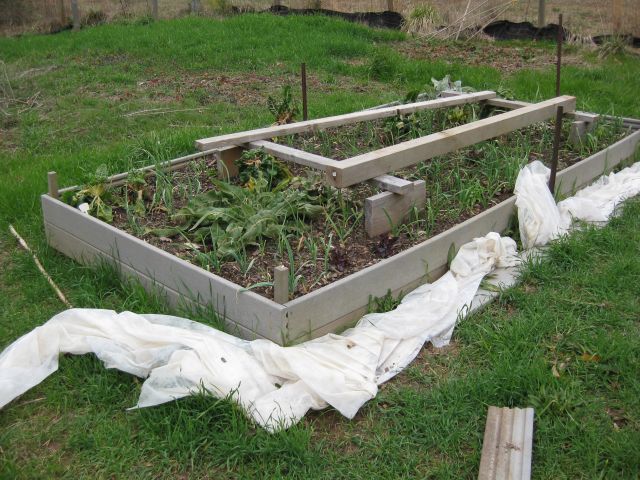
On the first day of the conference we visited local farms and the small farm I visited was on 2.5 acres of mainly granite and therefore made extensive use of raised beds. The composite decking planks I used for my raised beds cost $21.97 for 1.25″x6″x12′ or 30.5cents per sq inch. I had not thought to use untreated pine for raised beds since I thought it would rot within a few years. The farm we visited, which provides for 40 CSA customers, has been using the same untreated pine for raised beds for 8 years. The cost of untreated pine is $11.71 for 2″x10″x12′ or 9.8c per sq inch. So the cost of constructing a raised bed with untreated pine is less than 1/3 the cost of a raised bed with composite materials. And if my raised bed will last even 5 to 6 years I will be very happy.
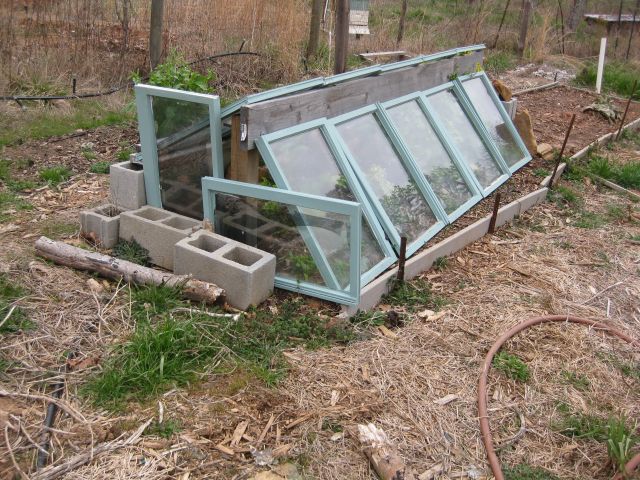
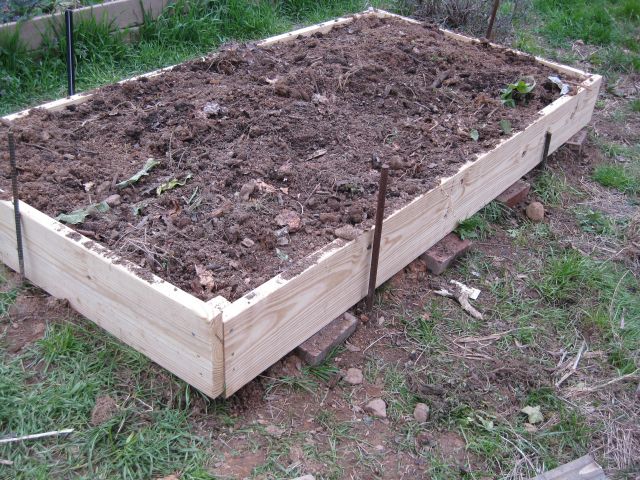
As a trial I purchased 2 10″by 12′ lengths and had the store cut each 12′ length into an 8′ and 4′ piece. I also bought a 2″x2″x8′ stud for joining the corners. It was quick work to construct the raised bed.
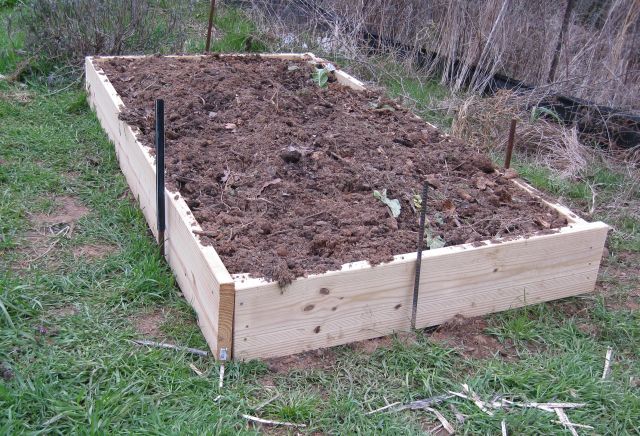
Since the raised bed is on sloping ground and I wanted it reasonably level I had two choices. I could dig the higher side into the ground or raise the lower side. Since I wanted to reduce earth contact as much as possible (to minimize rotting), I decided to raise the lower side of the raised bed by placing it on surplus bricks. The raised bed is reasonably level now. I pinned the corners of the raised bed using 2.5″ weather resistant screws and also buttressed the sides with scrap iron rods hammered vertically into the ground. I filled the raised bed with soil which previously covered rotted logs so it is rich in organic materials. And then I added a wheel barrow of compost to the top and forked it in. The raised bed is now ready for its first occupants and after the next rains, when it has settled, I will seed with root plants (carrots, turnips and beets) interspersed with my favorite kale seedlings.
I find that my memory does not work as well as in the past. As a student I could easily memorize hundreds of law cases, now the labels I read one day are gone the next. So where is the silver lining consolation?
I believe we have different skill sets and we compensate for those we lack. The kid who can analytically unravel and reassemble complicated concepts tends to be independent and does not require and consequently does not develop, good social skills. The ambitious kid, who does not have this intellectual firepower, develops intuitive and empathy skills and thus can effectively recruit others to assist with or perform the tasks he/she finds difficult. Perhaps it is our innate intellectual and physical abilities that fashion to a large extent our personalities?
So I am now more interested in how and why things happen than in the fact of their happening. If I can link causation with result then my mind can re-navigate the route without having to remember the start or end point or even the directions taken. An example from the recent GO conference (see previous post) was the excellent session on organic insect control by two entomologists from Auburn university. I was particularly interested in their comments on the BMSB (brown marmorated stink bug) which is becoming the organic growers nightmare. Not all stink bugs are pests and there are predatory stink bugs which are beneficial and whose prey are the pests we wish to eliminate. You can google and find descriptions of the difference between the good and the bad stink bugs perhaps the shape of their shield or certain colorations. But these are facts which must be memorized, not my strong point. Much more helpful was the comment by one of the entomologists – look at their jaws/mandibles. A powerful apparatus is for munching prey, a pointed beak type is for piercing and sucking out plant nutrients. Now that logic I can recall without having to memorize. As for eliminating this pesky pest they advocate trap crops and perhaps a vacuuming device tonguetwister titled “backpac bug vac”. Worth pondering as I await the onslaught in late summer.
IPM (integrated pest management) was mentioned in several sessions and I found the schematic in the session on organic management of diseases easy to follow and remember. At the base of the triangle are “preplant considerations” which includes soil fertility; site selection (for sun exposure, soil drainage); site preparation; rotation; using disease free seed and disease free planting material, timing of planting, spacing of plantings, plant selection (if a disease is blighting your crops then choose a disease resistant variety) and diversity of plantings. These are all logical first steps for before and at the time of planting.
Next level up are the biological controls which includes beneficials (this pm I transferred more lady beetles from the bathroom to the cold frames), Bt, and other ecologically sustainable techniques.
Another level includes physical and cultural controls such as row covers, lure traps, cultivation of weeds, sanitation, and adequate irrigation (but not overhead spraying because of foliar disease, especially in the hot humid Southeast).
And all the while observing and monitoring and if a certain threshold of pest/disease invasion is reached, then resorting as a last resort to nastier remedies which, while organic, will impact not only the bad guys but the good guys as well. The basic premise is that healthy strong plants, which are not stressed (lack of watering is a big culprit) or injured, will be able to resist pests and diseases adequately. If you grow organic you should be prepared to share, but not too much.
So this is all logical and dovetails with my growing experiences and this is one reason why I enjoy growing. I sense that among sports enthusiasts recalling and recounting the details of past games and greats and scores is part of the pleasure. Or the opera enthusiast who happily describes to those unfortunates within earshot how this particular aria though well delivered, does not compare with soprano A, in opera house B, in year C. These feats are beyond me and I settle for the simple pleasure of trying to better understand, without committing labels to memory, what is going on in the outside spaces.
This weekend (Fed 22 -23) I attended the 15th annual conference of Georgia Organics (“GO”), which emphasized the importance of nutrition. This was my 8th conference and each time I wonder if I will learn anything new and the result is always a resounding “yes”. The organization has grown robustly. Lots of young food activists. I asked one last evening at the concluding Farmers Feast dinner why Atlanta has such a strong movement and he said “leadership”. Atlanta has growing ethnic populations such as its Korean community but they are not active in GO. Atlanta is relatively liberal, the rest of Georgia less so, but the support for GO is not confined to Atlanta. Maybe it is economics and the growing realization that small farmers can only compete against the distant large scale farms with local niche products and that the label “organic” makes a very big difference. And, of course, there is growing awareness of importance of good food and nutrition. But give big credit to the leadership. Certainly it was poor leadership in several large (supposedly top) companies I invested in which resulted in their disastrous outcomes so it is only fair to credit the leaders when the results are great.
The title of this year’s GO was “Farm Rx” with “Rx” being the abbreviation for a medical prescription and this represented a pivot (an increasingly overused term following our President’s pivot to the East) to the medical community. Makes a lot of sense – if the influential medical community recognizes the importance of good food and nutrition to good health outcomes, what a big step this will be. A key sponsor was Kaiser Permanente, a mainly west coast organization, and this will hopefully galvanize interest from the large local hospital groups (Emory, Wellstar and Piedmont).
The keynote speakers were very good especially Robyn O’ Brien who linked the food we eat to allergies and many of the serious illnesses we suffer, and gave her presentation a patriotic bent by asserting that bad food weakens our standing as a nation. It is all about good nutrition. I do not blame the food companies because I believe a company’s first duty is to its shareholder owners, which it fulfills by effectively and legally promoting and selling its products, thereby increasing its profits and their return. Loyalty to employees and the community are, at best, secondary. It is the government and the regulators and the practitioners and the consuming public who bear the responsibility for avoiding bad outcomes.
Another keynote speaker was Dr. Sanjay Gupta of CNN who interspersed his talk with a physical demonstration of the recommended and actual amounts of sugar we consume daily – mind boggling. He included extracts from his one hour documentary “The Last Heart Attack” (easily googled). Well presented with interviews with President Clinton and the outspoken Dr Ellestyn and his vegan diet. I am focusing more now on the quality of my nutrition – I eat a lot of nuts and cheese and, following the documentary, I am resolved to cut back on, but not eliminate, oils (nuts) and anything which has a mother (meat, fish, chicken) and dairy. My daily home machined cappucino treat will now use soy milk.
In my next post I include some insights from the workshops and lectures I attended.
——————–
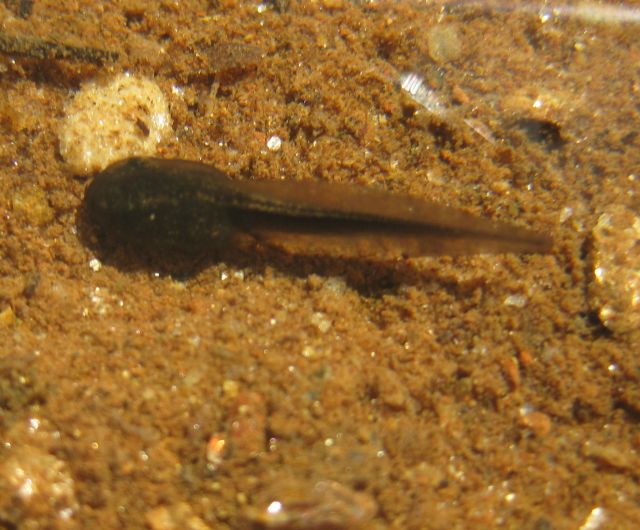
Tadpole update – the tadpole bubble in the pond in the woods now only contains a few tadpoles. Where are the others – eaten or surviving? And then I noticed in the far corner, which catches the afternoon sun, several motionless below the water and only bestirring themselves when I got too close.
Chicken update – the hens returned to egg laying duties a couple of weeks ago, except for the Ameraucana. I assumed she might be too old. And then this week – 3 dark green eggs!