Each year I learn a little and try out different techniques. Although 50 miles north of Atlanta and slightly higher, it gets really hot. So one of the changes was to establish a new growing area which receives full sun through mid-day and is shaded from the afternoon sun by large maple trees (I must remember to check the trees’ roots are not invading my growing area). And I have noticed a difference.
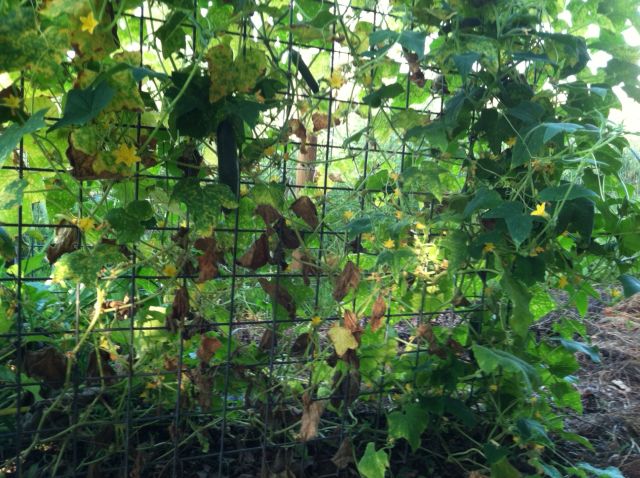
I battled last year with cucumbers and this year they are doing much better protected from the scorching afternoon heat. Lots of flowers and already harvested a lot of cucumbers but some demises and its a race to see how much more will be produced before they fade away.
cucumber plants on hog panel fencing doing well but beginning to fade
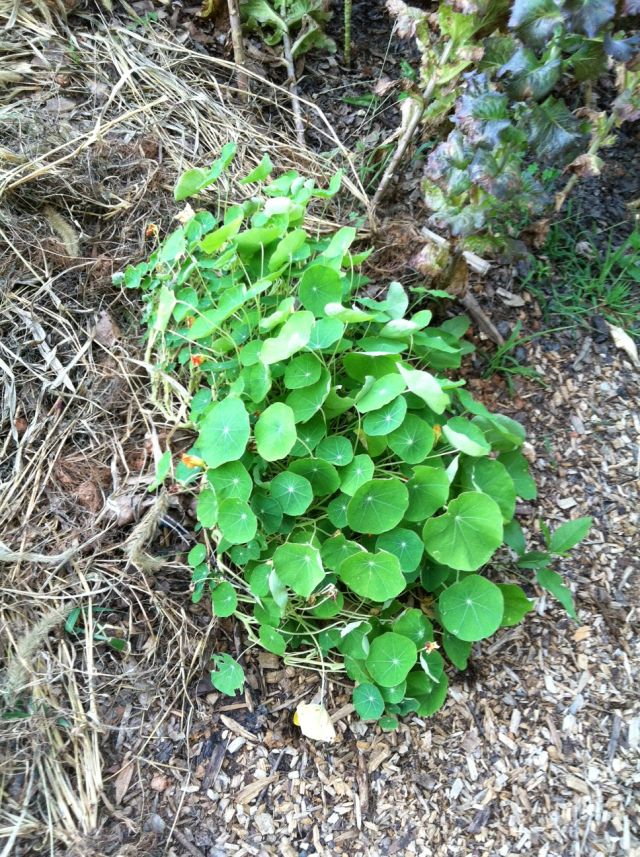
Last year my nasturtiums barely survived – this year, protected from the afternoon sun they are doing better but are a pale shadow of the lusty specimens I saw in the San Francisco area.
nasturtium persevering in Georgia
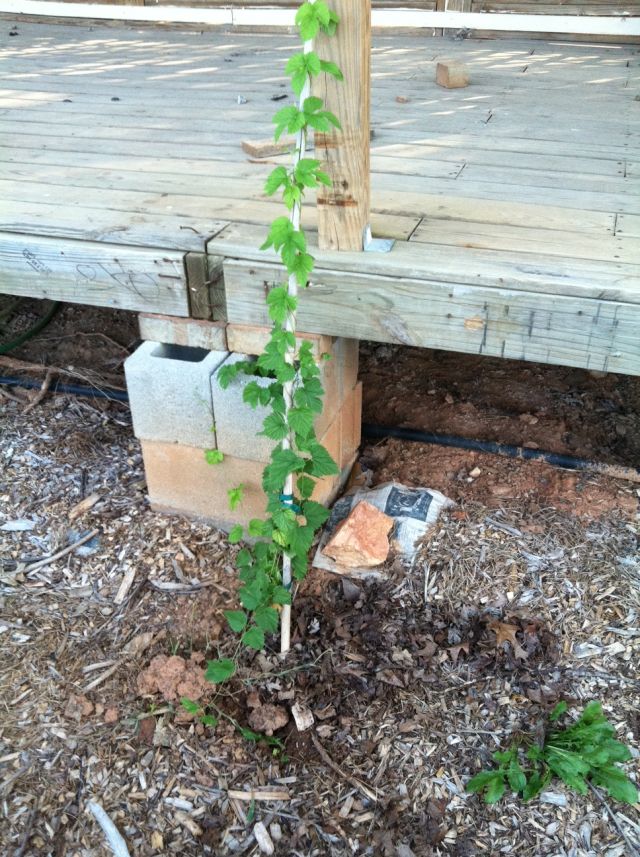
I brew my own beer and, in a spirit of enterprise and optimism, I decided to grow some hop plants. The flowers of the hop plant are used for flavoring and stability in beer brewing. My plants are growing slowly and hesitatingly. Maybe they will speed up and I will have something for my brew next year?
one of the hop plants – a long way to go but seems in good health
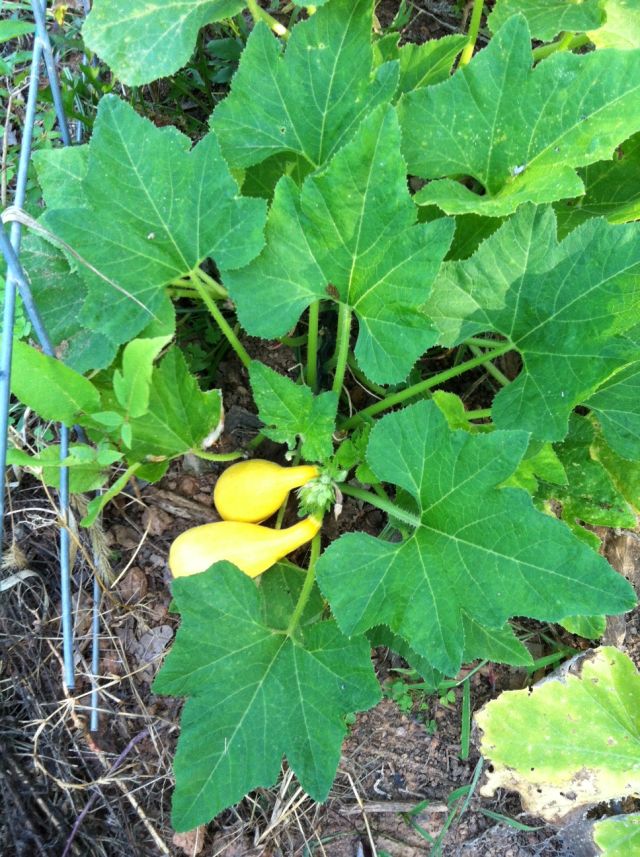
Although the vine borer is hard at work I am still getting squash plants. A much better outcome than last year.
squash still on the way
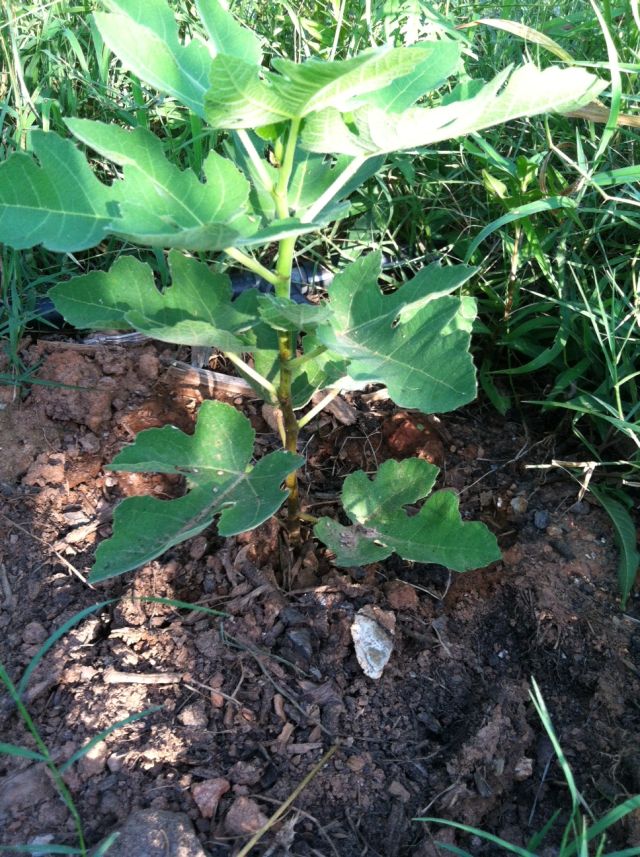
I did not do very well with my cuttings. Although the apple cuttings took root they did not survive the heat. I waited too long and this year I will take my cuttings in the fall. However, the fig cuttings were very easy to propagate and below is one of my new fig saplings.
fig plant from cutting
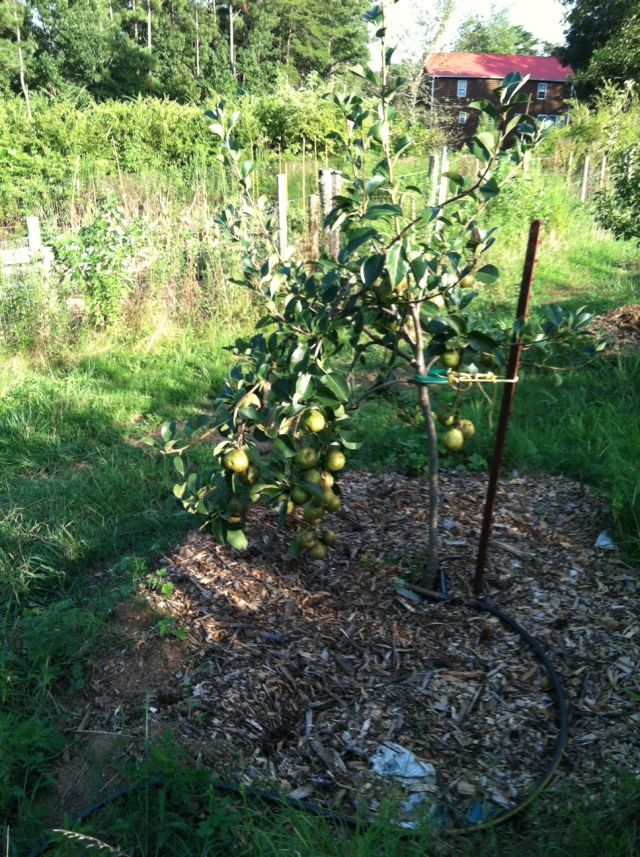
I am looking forward to some pears. Three of my pear trees are bearing for the first time and are bearing well. Unlike the apples they seem to be free of visitors.
young pear tree bearing its first pears
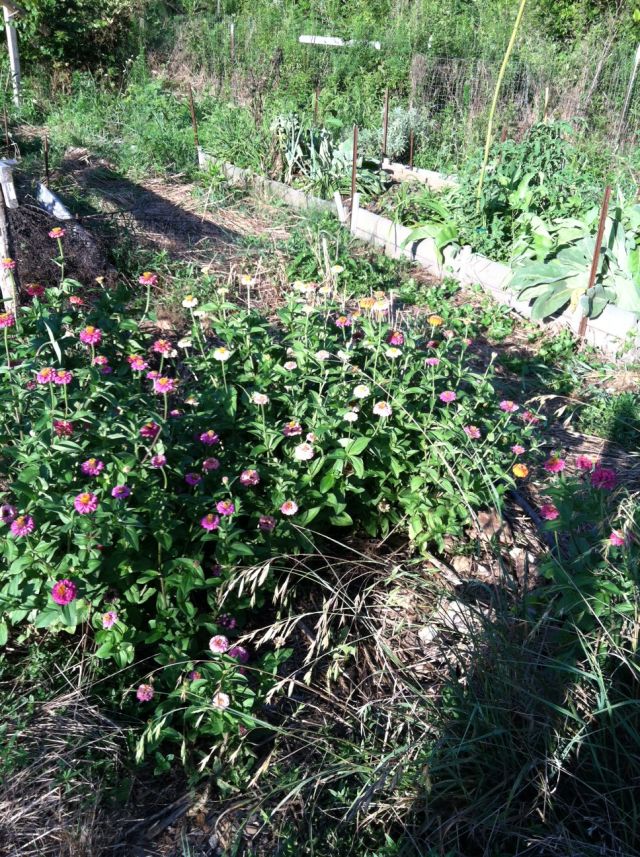
Finally, a little color always helps. Two years ago I seeded some zinnia flowers (must have read they are beneficial in some way) and now they self seed and spread and seem well acclimatized to survive without any irrigation.
self seeded zinnia happy to be left to their own devices
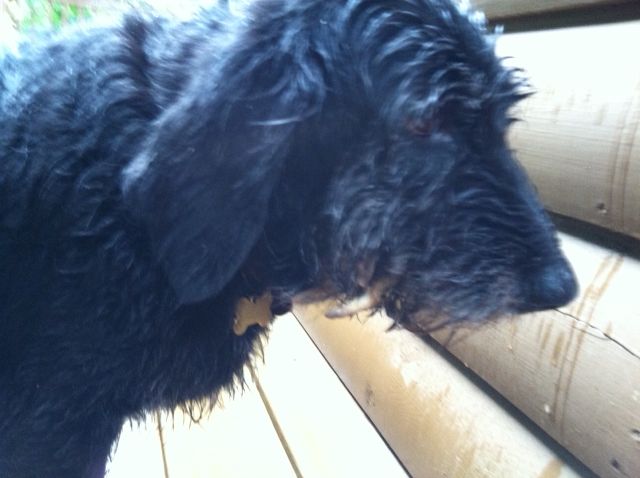
I have posted on Trudy’s successful pest patrol activities. But she has graduated now. She is a hunter. A hunter could be defined as killing game or other wild animals for food or sport and, perhaps you would rank a hunter who kills for food higher than one who kills for sport. If you follow this progression, then the higher the % of the prey consumed the higher should rank the status of the hunter. Trudy this week achieved the highest status.
She raided a rabbit’s nest and it was only by her (I thought” guilty” but may it was “proud” – a recurring problem when we project our emotions on others) behavior, that I figured something was amiss. And then I spotted two round pale colored tusk like objects emerging from her right jaw. She refused to release her capture and growled threateningly when I tried to prise it out. The usual ruse – give her a biscuit and she drops her mouth’s contents to eat the preferred delicacy, didn’t work. The conclusion was that her mouth’s contents ranked higher than the biscuit.
is that a leg protruding from Trudy’s mouth?
So I took a few ‘photos and stood by as she chewed on the baby rabbit and eventually with one big gulp down it went. And then, with barely a pause, she turned her attention to the two biscuits (when one didn’t work I had offered another type) and down they went too.
While I attend to the irrigation, Trudy my Heinz 57 canine companion, investigates and patrols. A few weeks ago, as we returned to the house, I noticed her cheeks were puffed and when I coaxed her mouth open a little rabbit slid to the ground. It was too mangled to survive, so I despatched and buried it. This morning at the door entrance was a token of appreciation from Trudy – a rat which she had captured in the vegetable garden. No despatching was required this time and after a quick photo snap (below) I buried it. So no need for a rat terrier as discussed in a recent Paul Wheaton podcast, my Trudy is up to the task.
The heat of the past week is lifting and a breeze and distant thunder decided me to mulch some apple trees. The trees are on a gradual slope and with a mattock I create a half circle mound on the lower side and flare the ends of the mound away from the tree so as to ensnare as much running rainwater as possible. The mattock makes quick work of the weeds and larger stemmed growth and because it is lightweight (I am learning, in the past I would have purchased the heaviest sturdiest implement) I am not tired in the 80 to 90 degree heat. Next I cover the catchment area around the trunk with newspapers, at least 10 pages thick fully opened and overlapping. And then I use my bobcat to move wood chip mulch to the tree where I dump it and spread it over the newspapers with a shovel. Not hard work. The mulch will absorb water which would otherwise have penetrated the ground but it prevents weeds for a time and the water in the soil will not be stolen by weeds nor evaporate as much as without the mulch. It is a win win when I irrigate since the bubbler heads are below the mulch.
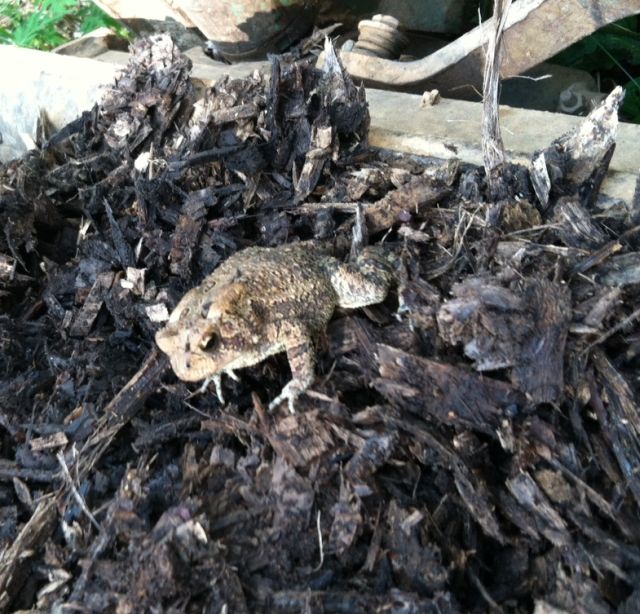
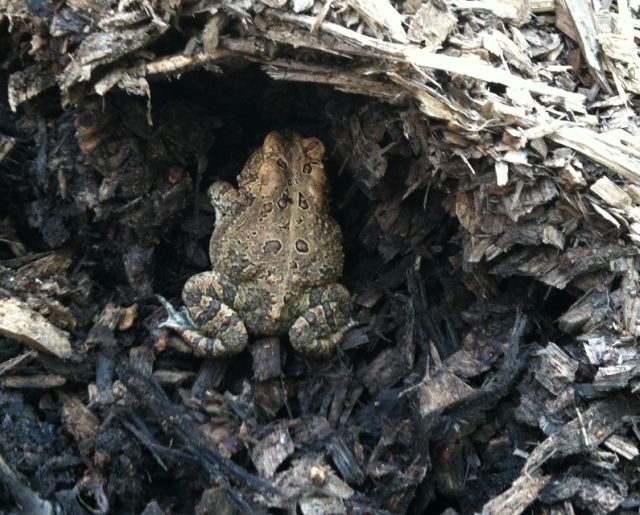
As I was moving my first load of mulch I noticed (there must have been a movement) a toad in the mulch.
I assume it was a toad not a frog since it satisfied the criteria:not near the water, bumpy skin, wider body, shorter legs and football eyes. Here he/she is:
toad in mulch
The bobcat provides a bumpy ride so, on the way to the orchard, the toad became a little concerned and snuggled into the mulch. You can see the skin color and short squat legs clearly in the photo. He/she arrived safely at the destination and I hope will play a role in insect control.
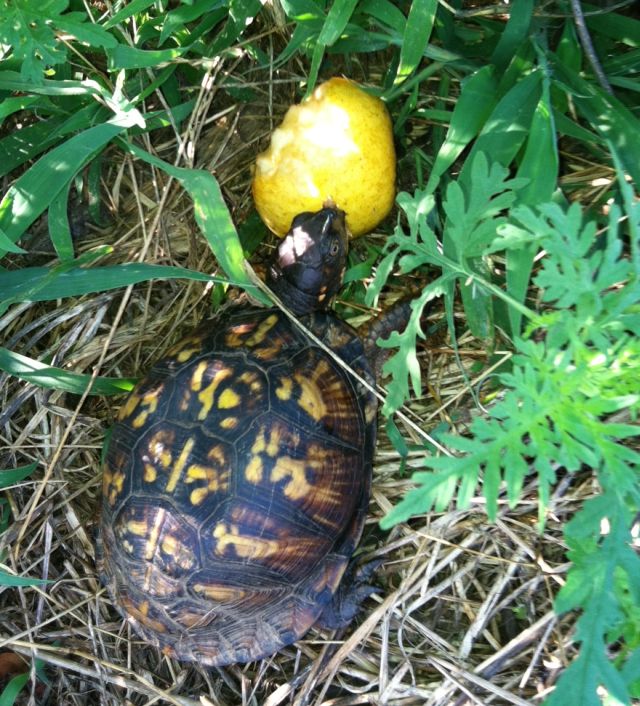
One of the advantages of keeping chicken is their nutrient supply in the form of poop. Twice a week I gather their extrudences (new word?) in a 5 gallon bucket and head to the apple orchard to gift a lucky tree. This morning, as I was about to upturn the bucket at the base of my favorite apple tree (it provides the best apples), I noticed a little fellow (sex assumed) hard at work on a fallen delicacy. There were a couple of wasps also participating at the meal but they flew off as I neared the camera.
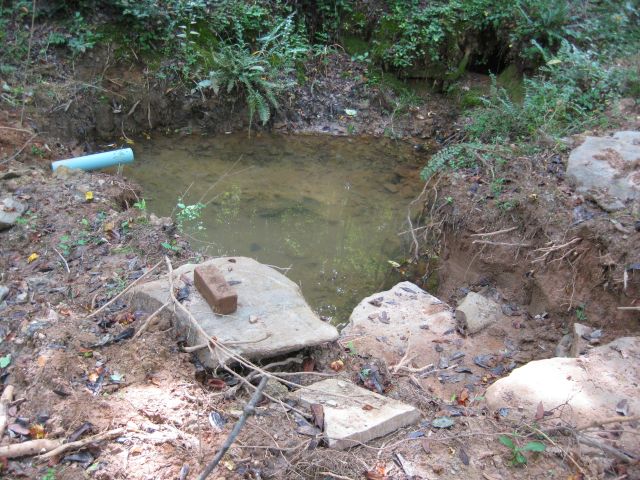
When I purchased the woods I had dreams of a 1/4 acre lake/dam and invested time identifying a locale and internally promoting the feasibility. After all, what can be more satisfying than a sheltered expanse of water nurturing fish, a watering hole for the wildlife, a solace for the stresses of life. And so on. But, apart from a good watershed which flowed plentifully during heavy storms, which we get over here, there was no ongoing supply of water such as a spring. And then I heard of the failures, the couple who had a good dam constructed but it never filled. And I concluded that even if I had a well sealed dam, evaporation during the summer would undo the concept. So recently I focused on the only spring in the woods and almost lost my bobcat in the mud which I was trying to excavate – see post “lucky save”. So with the help of a contractor and excavator (I broke my rule to do everything myself) I enlarged the existing hole where the spring appears but could not make it deep because there are large boulders which are difficult to extricate. An unsatisfying result – for now.
With my lofty aspirations now reduced to a small pond I decided to make the best of it and visited a pet store and bought some small goldfish and minnows and fish food and a water plant. I hoped the fish would survive. And they did for about a week. Now they are gone – eaten I suspect by the frogs. The drainage pipe which extends over the water is one of the launching pads of the frogs. They enter the water like arrows and I suppose the percussive impact of their water entry stuns the fish and makes them easy prey – like shooting fish in a barrel. So instead I will look at the other insect and wildlife when I visit the pond and I am growing various herb and other shade loving plants to introduce among the ferns, which proliferate.
small pond with drainage pipe and unusually sized brick in foreground, found at location
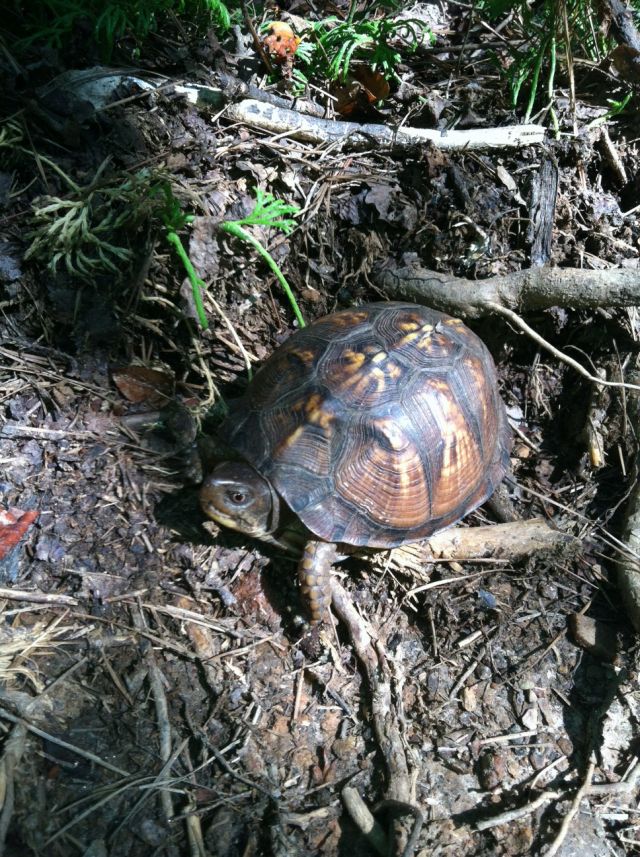
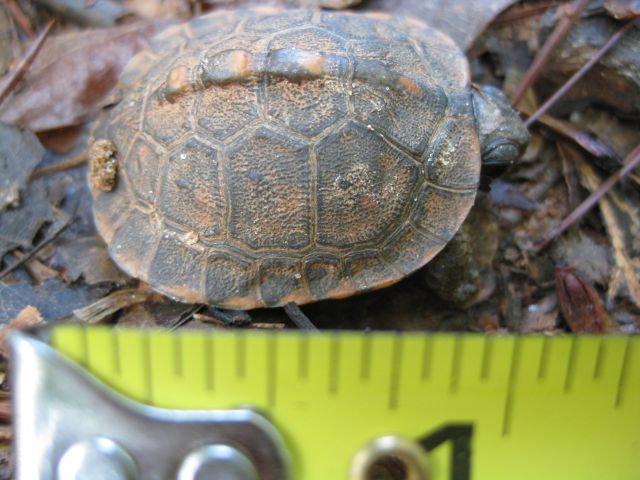
On the way to the pond I have noticed a number of turtles – here is one from this morning.
one of several turtles exploring the woods not far from the pond
Matching wits with a chicken predator is not a contest I chose. But I have no option but to contend, as best I can.
Some 3 weeks ago on a Saturday evening as I readied to close up the chicken coop I did my count and noticed that Goldie 2 was missing. We searched the three paddocks and then the perimeter zone without result. It was only when I went 50 yards into the woods that I noticed one of her feathers. Golden Comets have distinctive gold colored feathers. Goldie 2 was my favorite chicken – intelligent, trusting, inquisitive – and probably with less honed survival skills. A few paces further I saw more feathers and then a bundle of feathers where she must have made her last struggle, and then no more feathers. I suspected the culprit was a fox, probably a red fox I had spotted in the past.
Since foxes are supposed to be active early morning and late afternoon, I decided to reset the automatic coop door opener from 7.30am to 9am and I hoped the chicken would be safe until 5.30pm to 6pm when I typically coop them. A week passed without incident. Then I spotted the fox again one evening. Then some more time passed. Last Thursday at 4.30pm the rooster gave his serious distress call – four distress calls in quick succession. Onto the deck I stumbled and I heard some commotion at the bottom gate and then I saw this lithe attractive fox head down the hill into the woods, alone. Then two days later, Saturday afternoon at 4.15pm, we happened to glance outside and saw the red fox heading for the chicken paddocks. Upon seeing us it swiftly turned around and moved quickly up the hill and, without seeming to slow down, under a gate where the space between the gate and the ground was approximately 5.5″ and then up the hill and it was gone. Pity, a really good looking animal.
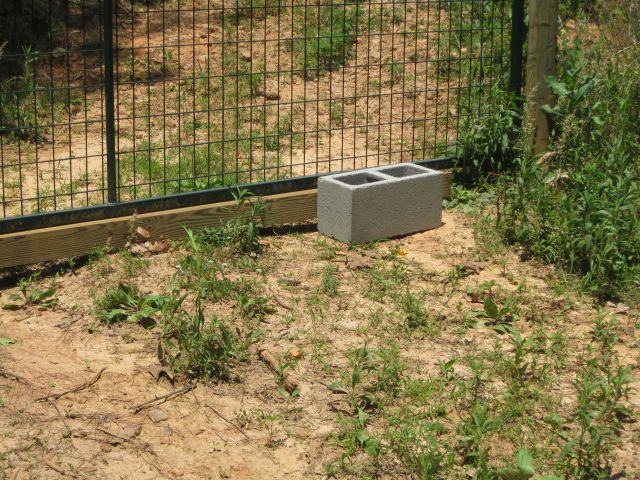
I decided to engage. First make it more difficult to get past the field gate by blocking the space under the gate.
gate to #3 chicken paddock with 4 by 4 post blocking access between ground and gate
This quick fix will not discourage him/her, just motivate it to find another route and at least foster the realization that my holding is not a cafetaria where you can just saunter up for your next meal.
Then I turned my attention to the paddocks – some of the fences are 4 ft high and some 5 ft. I laid one or more strands of barbed wire above all the exterior 4 ft fences.
barbed wire strands above 4 ft horse fence which surrounds some of the chicken paddock
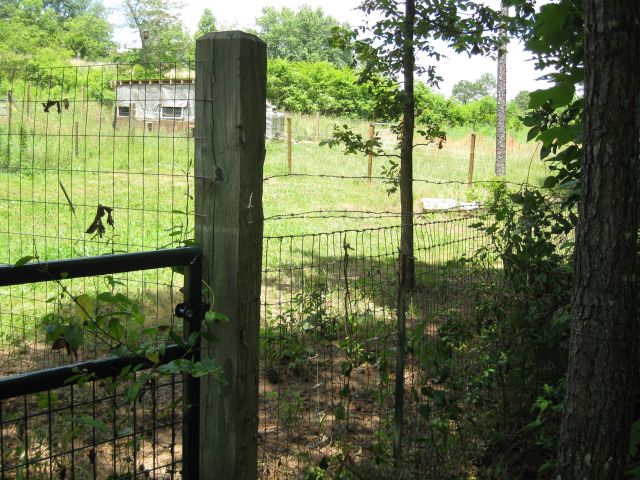
Then I tried plugging gaps beneath the fences with large stones/boulders. The next area of weakness was the gates – one is 7ft high, the other 3 about 4 ft high. I encircled the top rail of all 3 gates with barbed wire to discourage climbing activities.
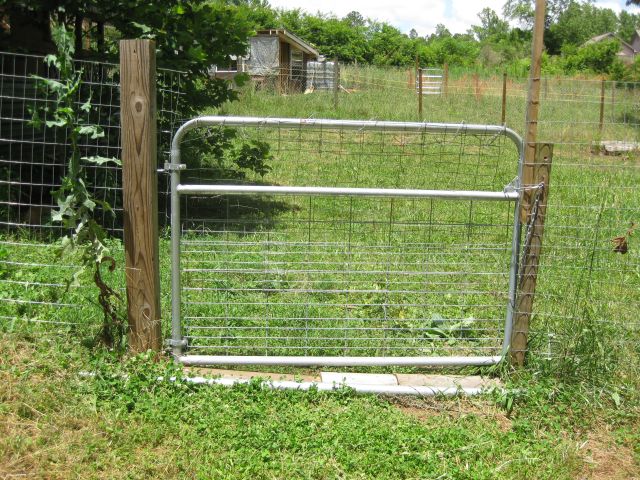
4 ft gate to chicken paddock with barbed wire on top rail and interstices blocked with fencing material
Sundry other improvements were made including clearing the growth on the paddocks’ west exterior so that I and the rooster could more readily spot a stealthy intruder.
west side of chicken paddock before clearingwest side of chicken paddock after clearing
My next steps will be to resort to technology and install motion sensors which may alert me to the fox’s approach. I believe the coop will withstand a predator so my concern is about day attacks when I am deep in the woods or temporarily away from the property. I have considered and rejected traps – would hate to ensnare my Trudy or a neighbor’s dog. But there are other options and so I have cleared surrounding brush and obstacles for a clear line of sight.
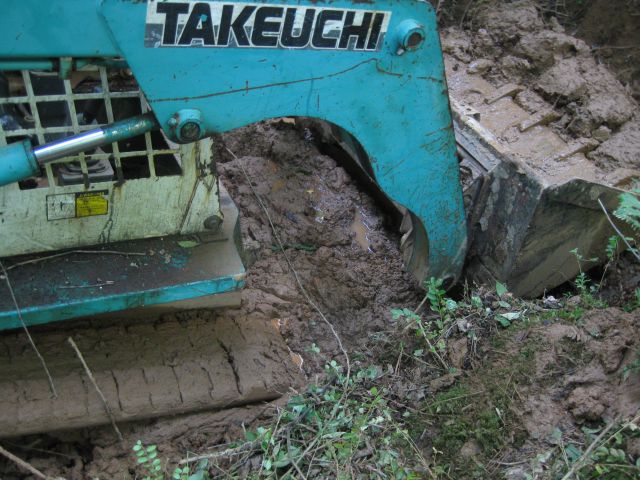
Luck shouldn’t factor into daily events – maybe it has a role in investing, or coincidental meetings, but surely not when it comes to my tracked Takeuchi bobcat. The way I am feeling right now is lucky and this is probably because I acted carelessly and was able to extricate myself from a sticky jam, actually muddy patch, without much loss.
I mentioned previously a trail I cut through the woods which ran close to a spring. The spring fills a small pool from which it saunters down the hill, mostly unseen, below the surface of a dry stream bed. My thought was to cut an access path from the trail to the spring and then enlarge the pool. Because this is rough terrain my friend Mike volunteered to be on hand for the unforeseen. Cutting the access path was relatively straightforward – we agreed on the route, then highlighted the route with yellow rope, then me with the bobcat and Mike with the machete, cut the path to the spring.
How to deepen the pool. The lowest side of the pool was on the northwest but it was barred by briar necklaces. So I initially approached with the bobcat from the higher west bank and quickly realized the incline was too steep. So I backed out the bobcat and we hacked an approach from the northwest which shouldered between two large trees. The bobcat loader made quick work of thick roots and, because I was tired from my previous attempt and lack of sleep the previous evening (to sleep at 1am and up at 5am to drop a relative at the airport), I was impatient and did not widen the new ramp or cut it for a more gentle approach angle. I headed down the ramp in the bobcat, loaded the bucket with mud backed out and dumped the contents. That was easy, so without pause I went in again, deeper. As I backed out the bobcat’s tracks began to spin.
I have learned a lot the past 24 hours. Tracks are great and provide much, much more traction on wet soil than wheels. But, if the front of the bobcat is in water and you are backing out, the mud covered track at the front moves to the rear and slathers the dry soil under the rear tracks with water and mud. The first, primeval instinct is panic, I gotta get out, so you increase the throttle and more mud and water are rapidly transferred to the back and the front of the bobcat settles deeper into the mud because it is digging a hole by the tracks scooping up the mud and water in the front, and transferring it to the rear. I plunged the loader edge vertically into the mud and tried to use the leverage of the loader to push the bobcat backward up the ramp. To no avail.
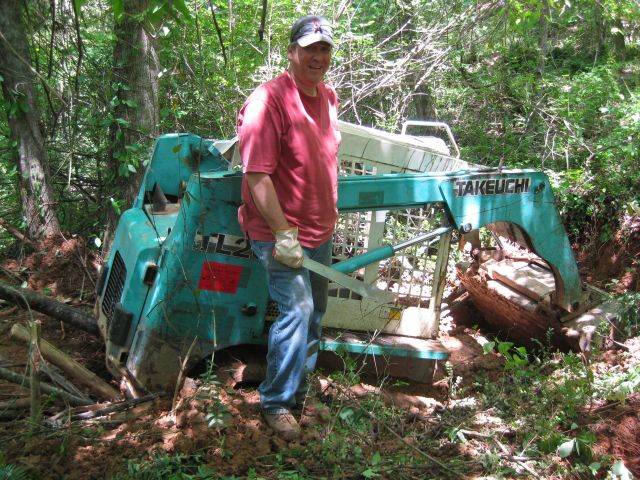
machete Mike and a mud ensnared bobcat
So I cut the engine and together with Mike we strategized. When a vehicle is trapped in soft sand you place sticks and branches and rough material behind or in front of the engine driven wheels for the treads to grip and, with some luck (again the “luck” word) you can get out. We cut lengths of 4″ to 6″ diameter trunks (lots of trees around) and jammed these under the tracks – this was possible because using the loader I was able to move the bobcat forward onto its front edge and expose the rear tracks. Then with full throttle and using the loader for leverage I powered the bobcat backwards – and barely moved.
I suggested to Mike that rather than place the trunks parallel and under the tracks we should place them at right angles to the tracks. A lot of work and full bore throttle and – no progress.
bobcat trapped deep in the mud
We thought the rear of the bobcat was catching the ground and so with long handled shovels we dug out the dirt and, with a lot of throttle, gained a few inches to freedom. At this point, with 4 hours invested to little avail, Mike had to leave and kindly agreed to return the next day and his parting words were “you are tired, leave it for tonight, you can get injured.” Which is good advice when you are deep in the woods with no one around.
Getting stuck in the mud, especially with a tracked vehicle, which should not get stuck anywhere, is an insult to ones sense of independence, self reliance, and ego. Needless to say, I spent another hour digging, investigating and throttling and concluded a) remnants of the roots of the biggest tree were snagging the bobcat (revenge of the tree whose roots I had savaged); b) pushing wood under the tracks was a bad idea – the wood became slippery from the mud and water and because it did not span the width of the tracks, a good part of the gripping surface of the tracks was not getting traction; and c) the spring, which I had thought was a dribbler seemed more of a gusher and the water from the spring was transforming the area into a mud bath.
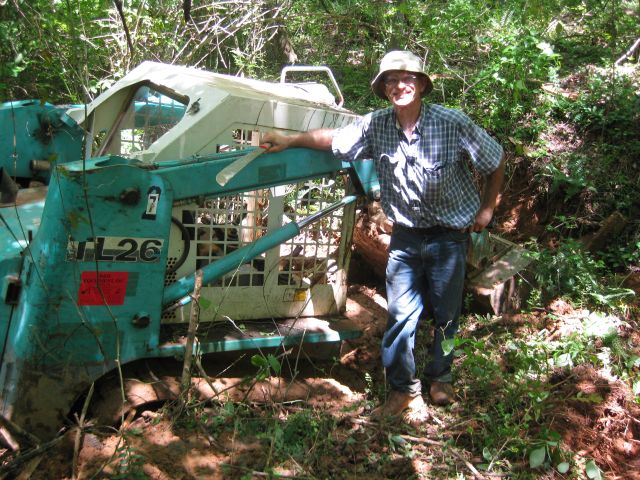
a trapped bobcat is not much to grin about, except its a photo
After a really good night’s sleep and early next morning I was back at the muddy site – my hope was to single handed retrieve the situation and save Mike a trip. I replaced the new chain on my chainsaw with an older chain and cut through some of the blocking roots – their diameter was 4″ to 6″ and I decided the old chain would be temporarily sacrificed cutting roots surrounded by soil and pebbles (until I could re-sharpen it). This helped and I got the bobcat back about 6″. I then decided the rising water was a problem and with the machete cleared a path down the dry stream bed and then with shovel and pick axe dug a 40ft trench in the stream bed. The bed appeared dry on the top but the holes dug by the shovel quickly revealed the water running just below the surface. This helped to remove the water which had been building up around the bobcat.
But it still wasn’t moving. I was convinced that the bobcat was snagging on concealed obstacles and, as I dug deeper around the rear of the bobcat and its tracks, these came to light. By this time Mike had arrived and together, with an array of tools from long handled edgers, mattock, grubbing tools, hand saws and the rapidly blunting chain saw we cleared a path to the rear. With the benefit of a night’s sleep we agreed that the tracks would grip better if they were not covered with mud and that spinning the tracks quickly in frustration just dug the machine in deeper. So the new modus operandi after clearing obstacles, including belatedly all the wood we had the previous day shoved under the tracks, was to use our gloved hands to pull the mud out of the exposed treads in the track. Then, in a frequently repeated sequence, with hopes high, I would fire up the bobcat, apply throttle and slowly power the bobcat rearwards and gain a few inches more to freedom. Unlike the previous day we were thinking rather than just acting and we were following a procedure that appeared to have traction. It was surprising how many times we were sure it would get out and it didn’t. But, eventually, with Mike yelling encouragement I escaped the clutches of the mud and got to level ground.
Was it luck? Probably not, but an education into new techniques, the importance of thinking it out and a good night’s sleep.
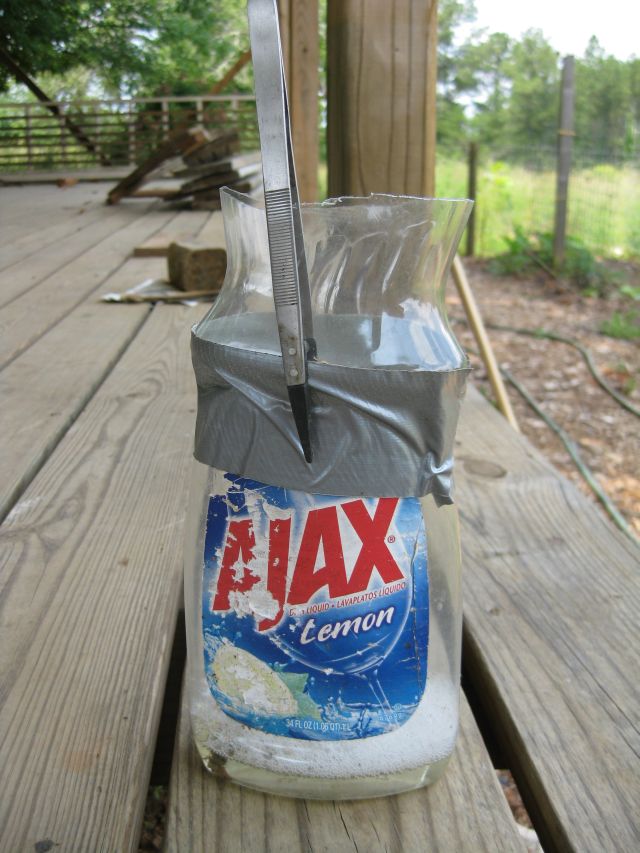
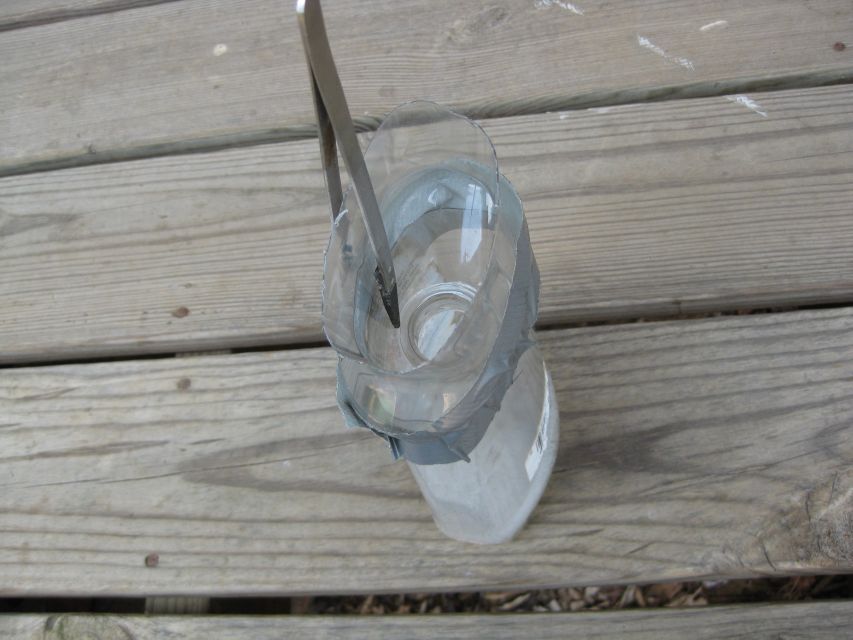
I have never had much luck with squash. A clan of squash vine borers benignly observe my squash growing efforts and, just when the squash begins its dash for the finish line, they take up residence in the base of the stem of the squash plant, chew away, and the vine keels over. In previous years I noticed mating stink bugs in the vicinity of the squash plants before their demise and, guilt by association, when I spotted them this morning, I quickly fashioned by bug dispatcher. My bug dispatcher is based on a handy internet tip – a soda bottle, or in my case a plastic dish detergent bottle, sliced horizontally with the top third inverted into the bottom third and secured with duct tape. Add a teaspoon of detergent, some water, shake, and this becomes the final destination for the offenders. To secure the miscreants I use long handled rubber tipped tweezers – the rubber tips have a better grip on hard shelled insects. So in to the soapy mix went the doting, connected couple. Another way is to locate the funnel of the bug dispatcher directly below the bug and then knock it or shake its perch and, with some luck, it will tumble into the funnel. My squash plants are in a new location this year and I hope, probably unrealistically, that they will escape the attentions of the vine borers.
assembled bug dispatcher with long handled tweezers
squash bug dispatcher – vertical view
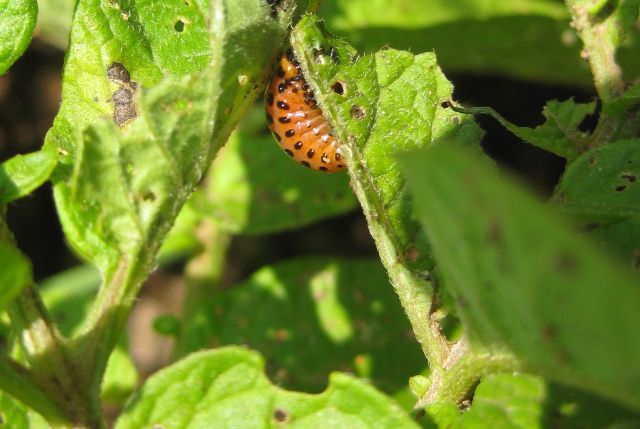
The leaves of my potato plants were afflicted by all types of bug biters. A biggish, slow moving feaster was easily taken and added to the dispatcher.
a potato plant leaf lover before entering the bug dispatcher
Fig tree
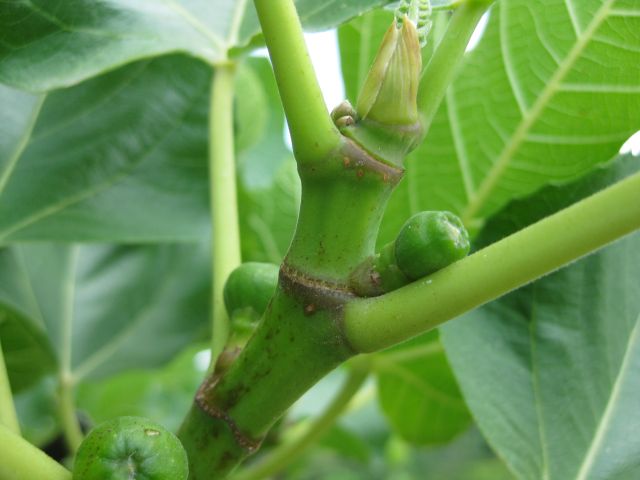
I was concerned when my main fig tree did not sport figlets – my word for little figs, and I thought the tree was taking a sabbatical or I had over fertilized it with manure the previous year. But suddenly, in the past week, figlets have appeared and I am now hoping for a bumper crop, what with the manuring, and having the overflow from my rainwater storage tanks directed at the base of the tree, and the removal of competitors.
future figs
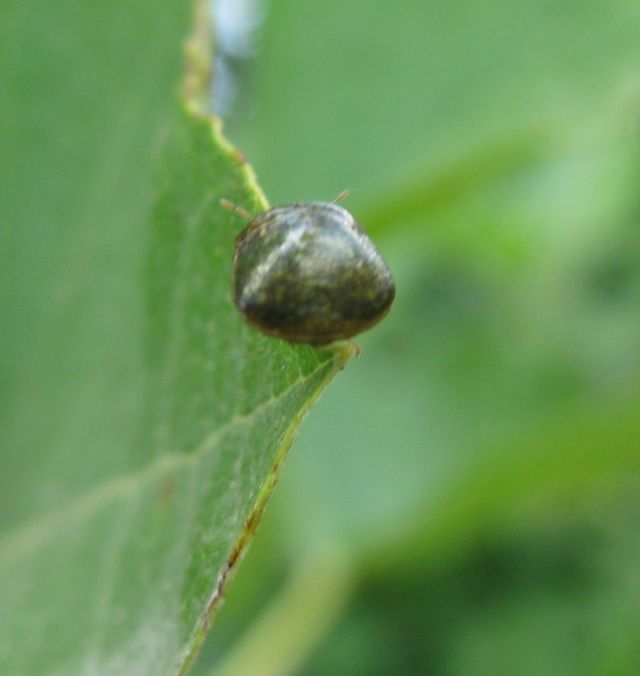
Though there are bug visitors to the tree – large numbers a few weeks ago and just the occasional bystopper now – not sure who they are or their intent.
fig tree visitor – unusual bug
Tomatoes
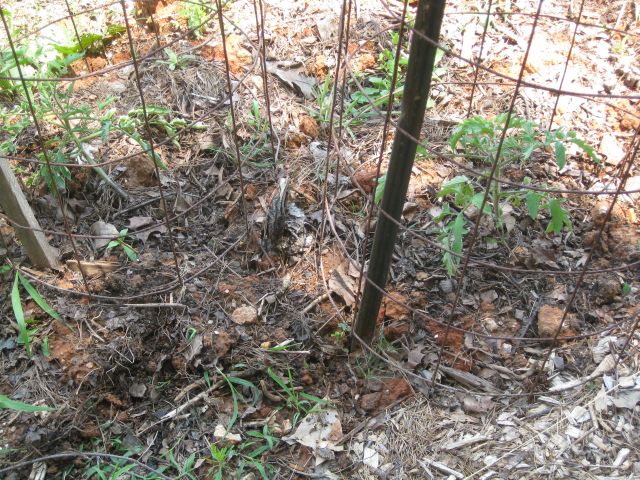
Last year was not a great tomato year for me. I have again planted out a number of different varieties and will keep an eye on them. When I noticed two strong volunteers emerge from compost spreads I decided to embrace them with wire cages and I will water them well and hopefully in due course, learn their identity and enjoy them.
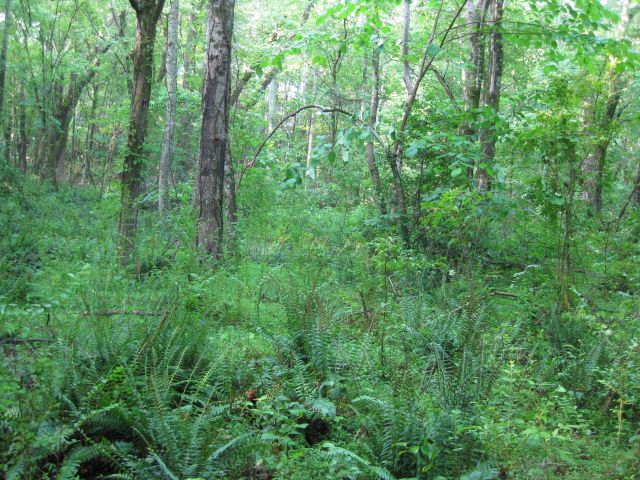
The past few weeks I have been preoccupied with cutting a new trail through the woods. The northwest part of the property slopes down a hill and its face is creased with contour ditches and berms installed I know not by whom or when. There is a small spring which forms a stream which slides off the property. My new trail is designed to give me access to the spring and to meander among the fast growing tulip poplars. Since this is the north facing slope, which is sheltered from the sun and benefits from the contour ditches, it also has ferns and mosses and a wildness of growth.
lush wild area at base of hill
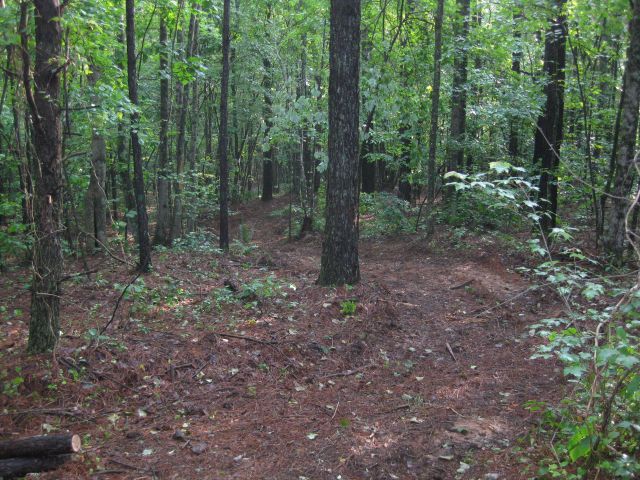
My trail is maybe half a mile long. I marked its intended route a year ago with yellow rope. Two weeks ago I began construction. Initially my thought was to make a road which my tractor could access, but my tractor is 7 ft wide and when hitched with a chipper cannot make sharp turns. So the road would have had to be fairly straight. My tracked bobcat on the other hand is 5 ft wide and can turn on a dime, which means it can easily dribble among the larger trees. So I settled on a trail rather than a road and saved a lot of larger trees and a lot of work.
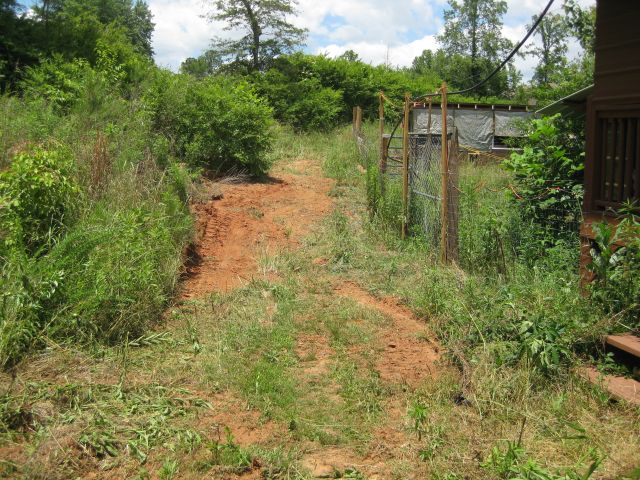
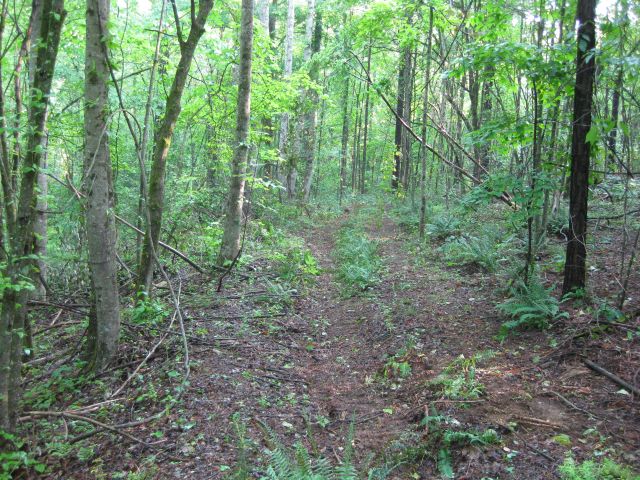
beginning of the trail
From previous experience I know not to leave any stumps, especially the smaller ones which upset the unwary, so instead of chainsawing and pulling the trees out of the way (and leaving stumps in place), I used my tracked bobcat to clear the way. Two alternative procedures.
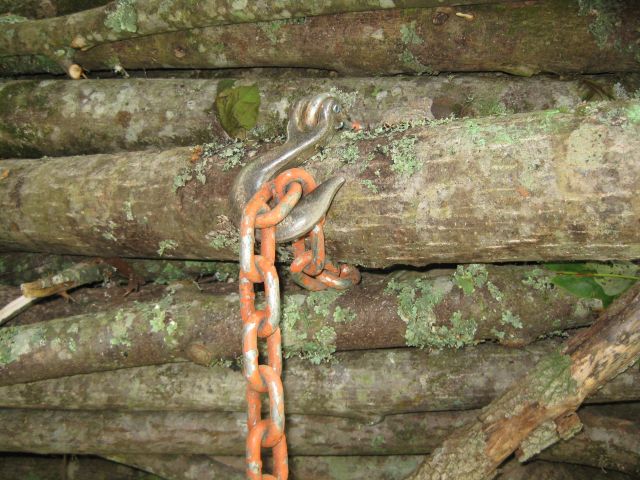
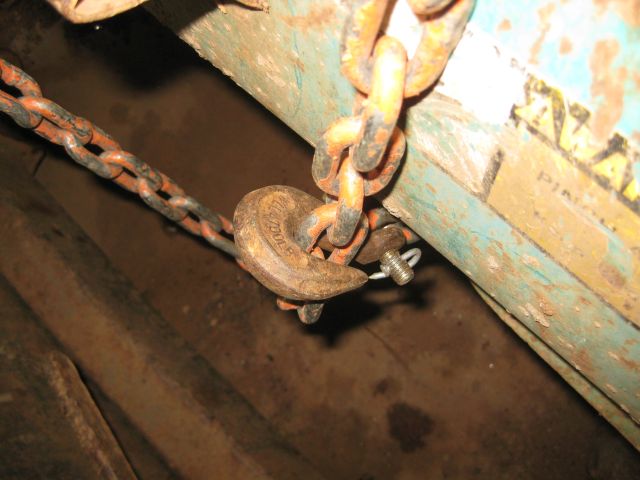
For those trees with diameters up to 3″, I simply lifted them up out of the ground with a chain and slip hook. A slip hook allows the chain to run freely through it so as the bobcat pulled on the chain the hook tightened on the trunk of the tree. The other end of the chain was secured to the bobcat body with a grab hook which gripped onto a link of the chain. The slip hook worked fine on most of the trees except for one kind where the bark peeled off easily. In this situation I had to revert to the second procedure.
example of slip hook
example of grab hook
The second procedure, primarily for the larger trees, was to attempt to push the tree over with the bobcat loader pushing the trunk at about 5 ft off the ground. If the tree refused to budge I would cut the roots on either side of it with the loader teeth and then it usually could be pushed sufficiently to expose the base of the tree. Then, with the loader at ground level I would bulldoze the tree out of the ground and push it sufficiently far to sever its roots. The trees are interlocked by vines, mainly muscadine (grape vines) and they would have been hung up if I had merely chainsawed them. So the assistance of the bobcat was invaluable.
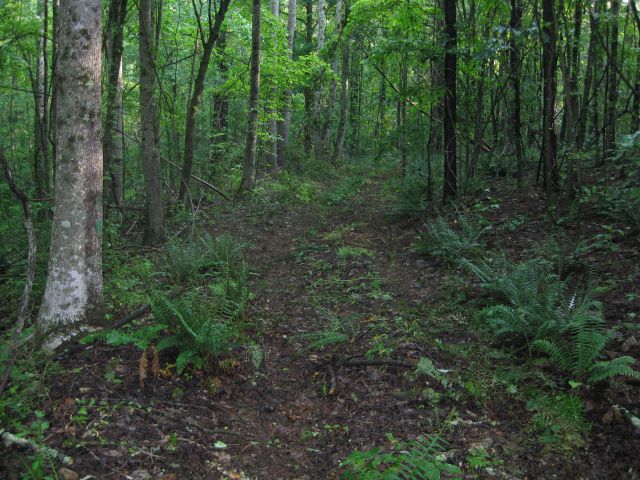
trail along slope of hill
Once the trees were down I limbed and bucked the trees, that is to say I cut off the branches where they joined the trunks, and I cut the trunk into 5 ft lengths. The 5ft lengths of the hardwood trees fit into the bobcat’s loader and I brought them back to the log cabin and stored under shelter to dry for firewood use at year’s end. The pine trees trunks I will leave to degrade and return nutrients to the soil.
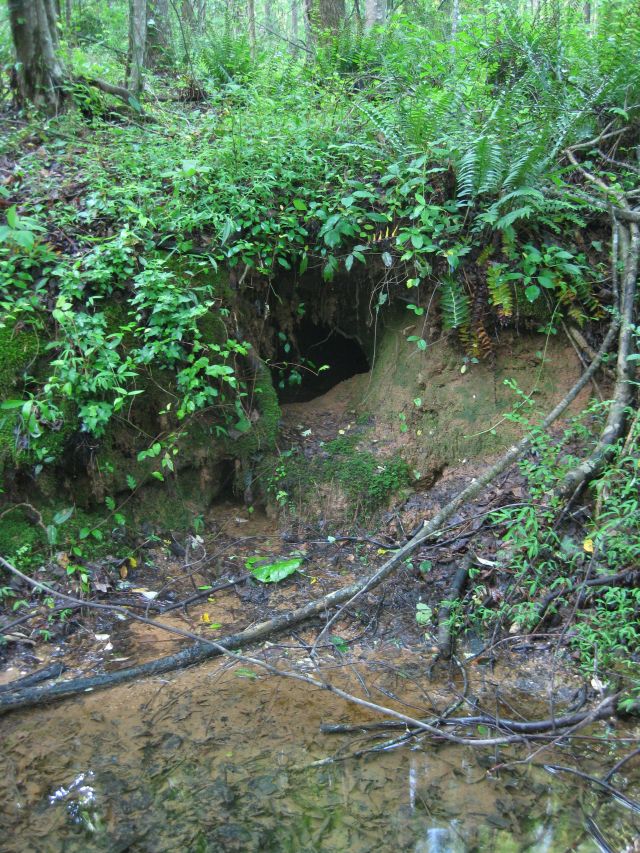
small spring at base of hill
I made several additional trips with the bobcat – down the trail to collect the rootballs and dump them in a large gully at the foot of the slope, and up the trail to collect the 5ft wood lengths for transport to the storage area.
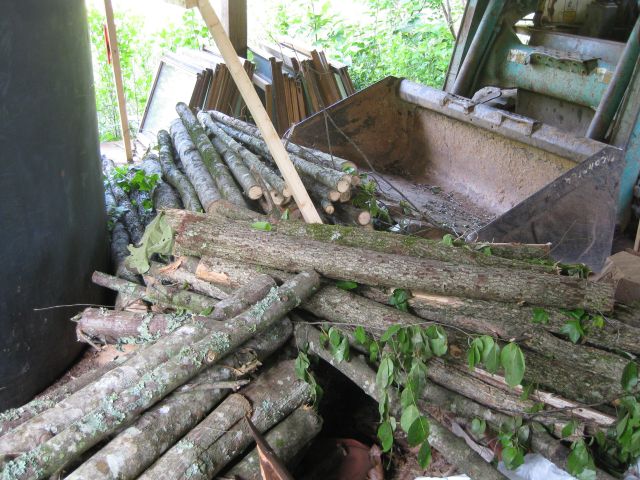
5 ft lengths of future firewood
Finally my tractor came into play. I attached a woodchipper to the rear, which is driven by the tractor’s engine, and I have begun chipping the branches and odd wood lengths. The chippings will be spread along the trail.
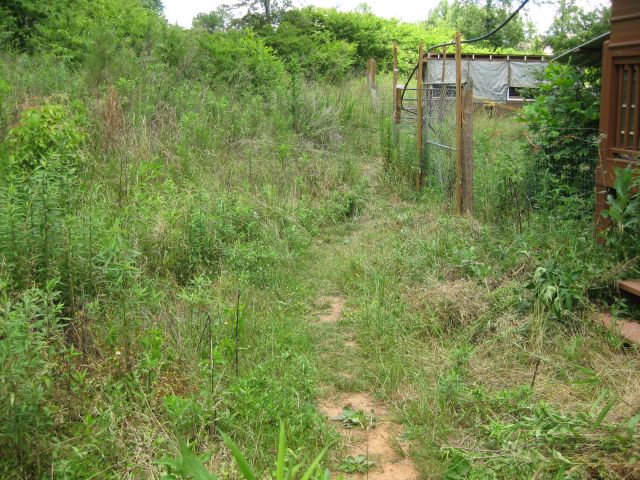
trail along base of hill
So much strenuous pleasurable work and a good result to date. I must acknowledge the contributions of Mike, who assisted on the first day with lassoing and removing the trees, and Simon, who on two days worked hard amidst the mosquitoes and diesel fumes to help me complete the task. On the way back this morning along the trail almost stepped on a baby turtle – it was on 1″ long – see below.