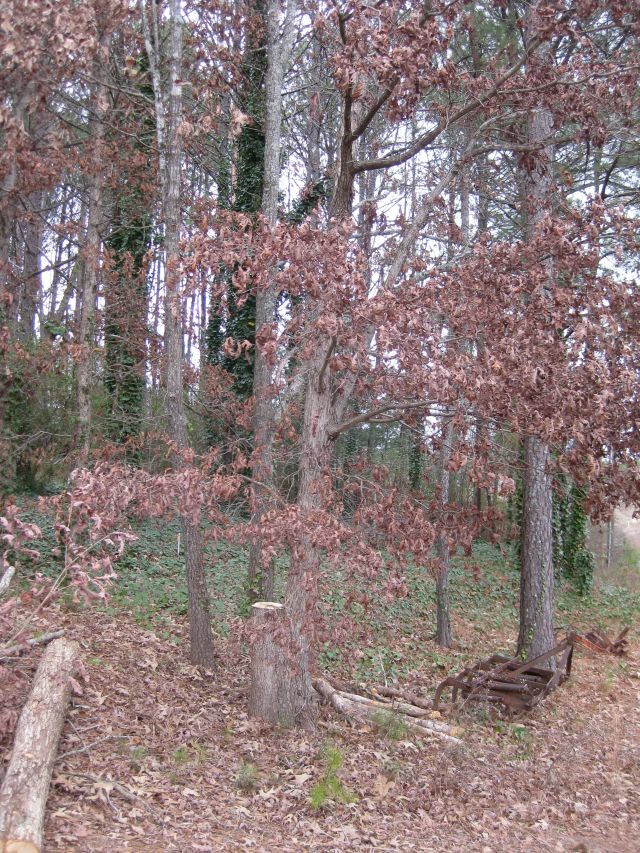
I really am not into cutting down trees gratuitously, especially not an oak tree, which is one of my favorite trees. When I made a road through the woods I selected a path which would require the fewest and smallest trees to be removed. But this week I needed wood posts. I did not wish to purchase the treated 4″ by 4″ posts because they are loaded with preservatives which will leach and be absorbed by the roots of my fruit trees, vines etc. Composite posts deform and are expensive. Even cedar posts rot over time. I concluded oak posts should hold their ground for several years, which is all I need at this time. But which oak tree to cut. Unusually, several oak trees have two trunks from the same base. Eventually the tree may split. It seems to incur little sacrifice to cut one of the trunks, the one which appears less vibrant. Then the root structure can feed the surviving trunk which will put out branches on the side where the other trunk stood.
twin trunked oak tree with left trunk removed at point where trunks met
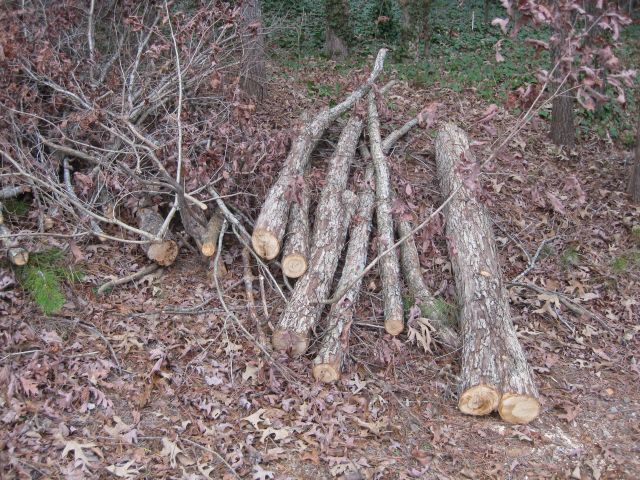
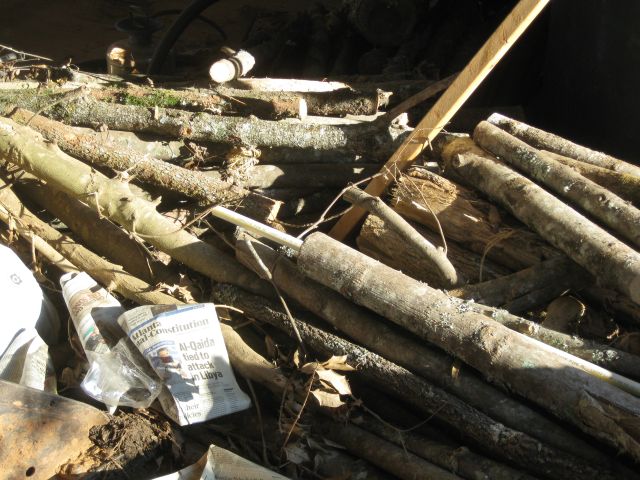
It was quick work to cut down the one trunk and then slice it to leave a main trunk and six 8 foot length future posts. Plus the branches will dry and provide good firewood. The main trunk is too large for a post and I ordered shitake inseminated dowel plugs so I can have shitake mushroom logs. I have been very successful with shitake growing from oak logs. Some of the posts will be used to carry the trellis for my kiwi vines which I recently planted.
products from the oak tree – the trunk on the right will make shitake mushrooms, the 6 8′ posts will be used for trellises and the branches on the left cannibalized for firewood
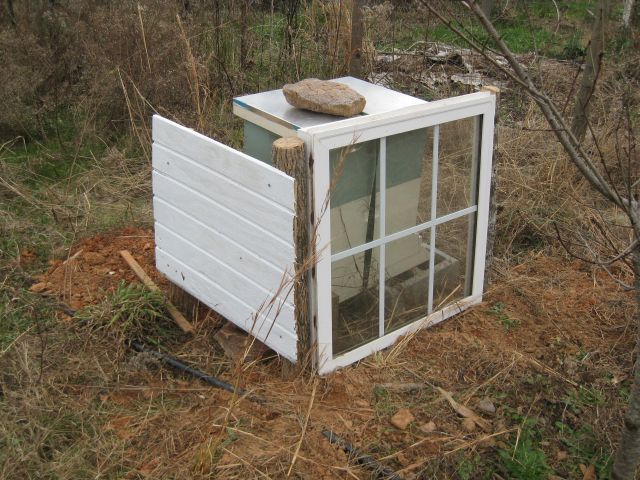
And there is always a use for oak posts. My first beehive is well protected from winter winds but my second beehive needed protection. With my clam posthole digger I dug 3 2 foot holes and grounded 3 small diameter oak posts to which I attached a surplus window for west wind protection yet still providing setting sun exposure, and a primed plywood rectangle for north wind protection. My woods provide a windbreak to the east and I leave the south side open for the south facing entrance and because winds from the south are less common.
#2 beehive with west facing window and north facing plywood protection from winterly winds held in place by oak tree mini posts#2 beehive seen from east side, the three small diameter oak tree posts sunk 2 ft into the ground are clearly visible. also a strap to protect against upheaval from nocturnal visitors
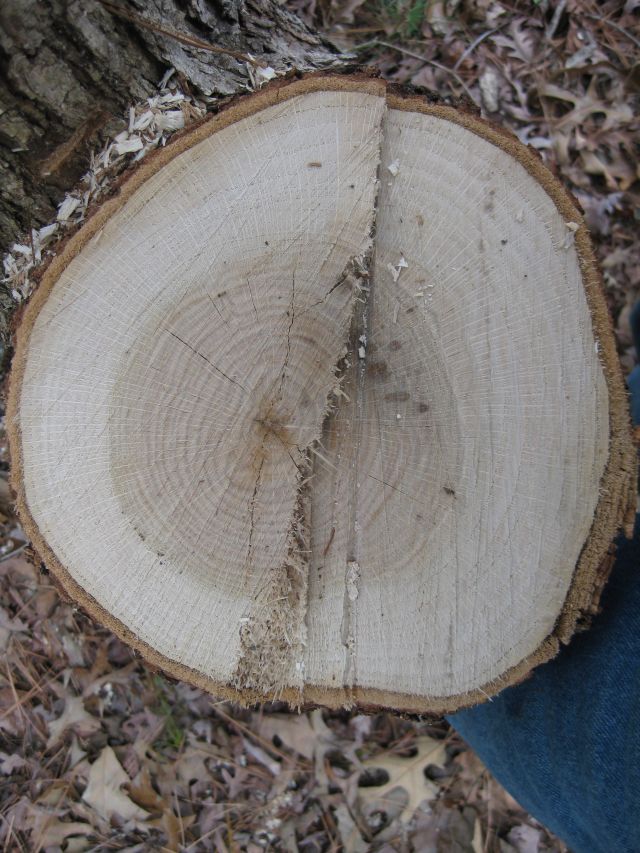
I happened to notice the growth rings on the stump of the oak tree and this got me thinking as to why there are growth rings. I know about heartwood and sapwood – the heartwood which is at the center of the trunk is darker in color (from accumulation of compounds), provides structural support and no longer transports water and the lighter colored sapwood conducts water.
heartwood, sapwood and growth rings on trunk of oak tree. I must still saw the face smooth and at an angle to shed rain
But what causes the growth rings which are the alternating bands of light wood and dark wood. The light ring is produced by large thin-walled cells and the dark ring by small, thick-walled cells. The large cells are formed during the rainy season when the cells grow and the small cells during the period of dormancy or no growth. Dormancy occurs during the winter in cold climates and during the dry season in tropical climates. I suppose if it rained evenly throughout the year you would not get growth rings?
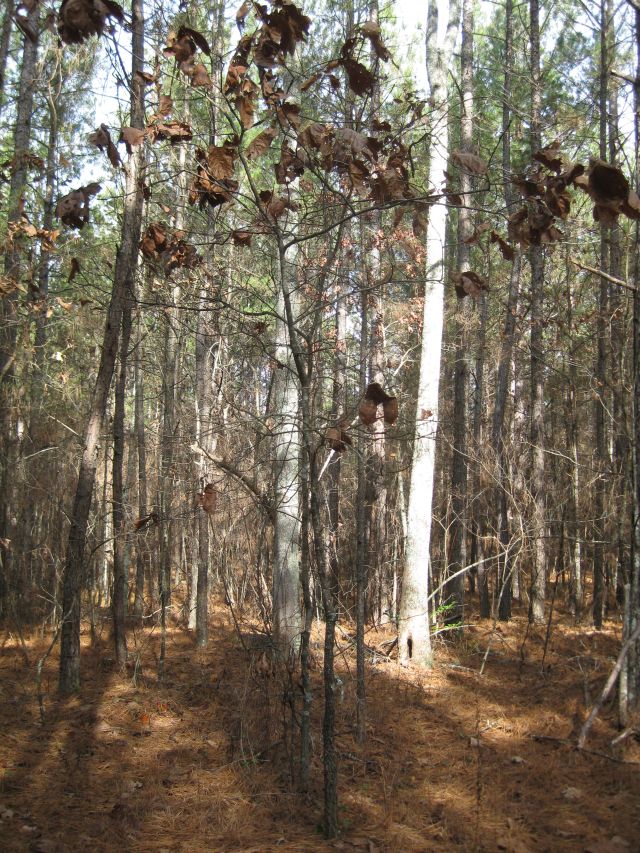
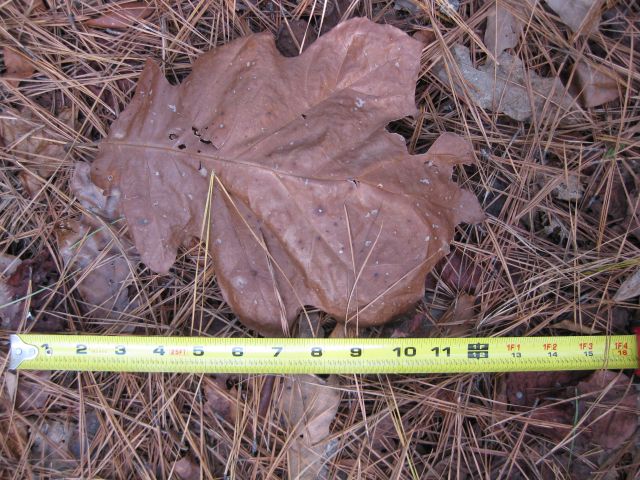
Yesterday, while walking through the woods, I noticed a very large oak tree leaf. Automatically, I looked up and around for the parent and saw just large pines and then, on the side, a smallish 14 ft oak tree. Could this small tree have produced such a large leaf, I wondered. It still retained some leaves and indeed they were very large.
small oak tree surrounded by much bigger pine and poplar trees
Now I know that oak trees will wait patiently in shrub form for an opening in the canopy above and then they spring to life. I have found 1ft high oak trees with 4 ft tap roots and know that a shrub like tree can be many years old. So to return to the riddle I hypothesized that the leaf size depends on the age of the tree and this smallish tree could be many years old. But that doesn’t work since a large nearby oak tree which I know is very old, has smallish leaves. And then, this morning, as I worked my way through my biology textbook, it fortuitously provided the answer.
a big leaf from a small oak tree – measures a foot in length
Some variation within a species is due to genetic diversity within individuals but some is due to response to the environment and this is called “phenotypic plasticity” meaning that the plant (its roots, shoots or leaves) are plastic or changeable depending on environmental conditions. The textbook (Biological Science by Scott Freeman 3rd edition page 798) states that oak leaves are a prominent example of phenotypic plasticity. Shade leaves (grow in the shade) are big and sun leaves are small. Shade leaves provide a large surface in order to absorb as much sunlight as possible. So that’s the reason why the small oak tree has big oak leaves compared with high standing oak trees which have direct access to the sunlight.
But then, the question could be asked, if absorbing sunlight is the priority why shouldn’t a big oak tree also grow big leaves? Leaves lose water (transpiration) and the more exposure to the sun the more water loss. In the shade however, humidity is higher and water loss is less so the large oak tree leaf in the shade can capture more light with minimum loss of water.
If we accept that the living world around us did not just happen, but is the result of millions of years of adaptation and improvement the question rises for me – why do so many insects (and frogs etc.) go through metamorphosis? I am referring to whole-change or complete metamorphosis where the juvenile form (called a larva) looks very different from the adult form. Think of butterfly and moth caterpillars (larvae) which change into flying adults. Or mosquito larvae which live and feed in freshwater and then change into pesky annoying mosquitoes.
I am not thinking here of the social insects such as ants and bees which also have complete metamorphosis and live in colonies where they are fed and protected by the adults. I can understand that in a colony where everyone hangs out, it makes sense for the adults to take care of the kids and to groom them into community behavior and it is easier to feed and groom little dependent larvae.
But what purpose is served by having a caterpillar larva precede the dainty butterfly? After all, grasshoppers don’t have complete metamorphosis. Instead there is a juvenile looking grasshopper called a nymph (wingless and sexually immature) which grows to become an adult. Or the tadpole the frog?
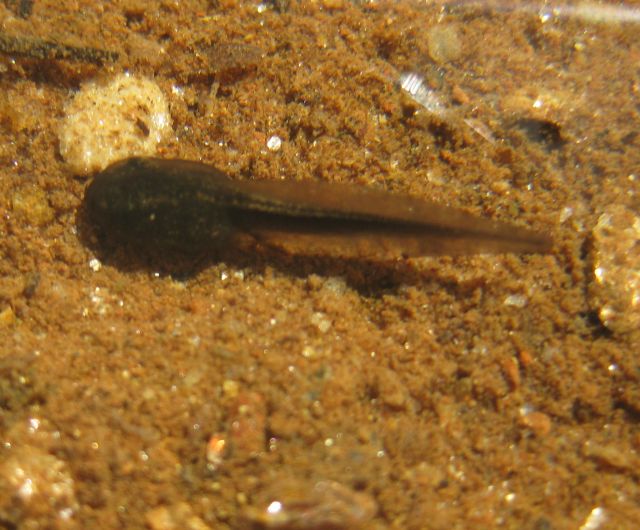
tadpole in the pond in the woods, just emerged from frogspawn
I posted that I was reading up on biology and in addition to the $10 textbook I acquired, I recently purchased a competing version for $4 (cost 1 cent, postage $3.99) – Biological Science by Scott Freeman 2007 edition 1,300 pages which delves more into understanding the why’s of life around us.
The Freeman book offers two explanations for complete metamorphosis. First is feeding efficiency, in that the adults and larvae usually feed on different materials such as the butterfly larvae on my vegetables and the adult butterflies on nectar. So the kids are not competing with the adults for food, which improves the survival prospects of both adults and juveniles (the juveniles more than the adults). The second explanation for metamorphosis is based on specialization in feeding and mating. The juveniles are sexually immature meaning they cannot breed so they focus just on eating and since this is their specialty, they do so exceeding well. The priority of the adults is mating and procreation and indeed some adults do not eat at all as they dedicate their life to ensuring future life.
All attractive hypotheses for this phenomenon of metamorphosis, something I had noticed but not considered.
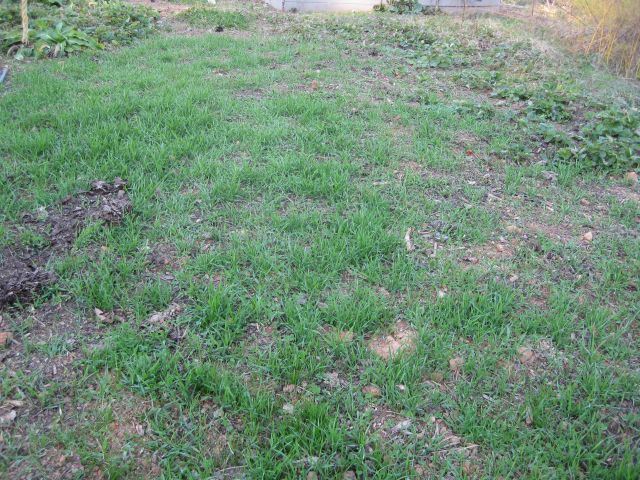
cover crops – I cleared the tomatoes and weeds, added compost and sowed winter rye and crimson clover. A few years ago I used hairy vetch, which worked well and next year I will order more since the local supplier, who originally sold me the seed, no longer carries it.
a vegetable growing area seeded with winter rye and crimson clover cover crops
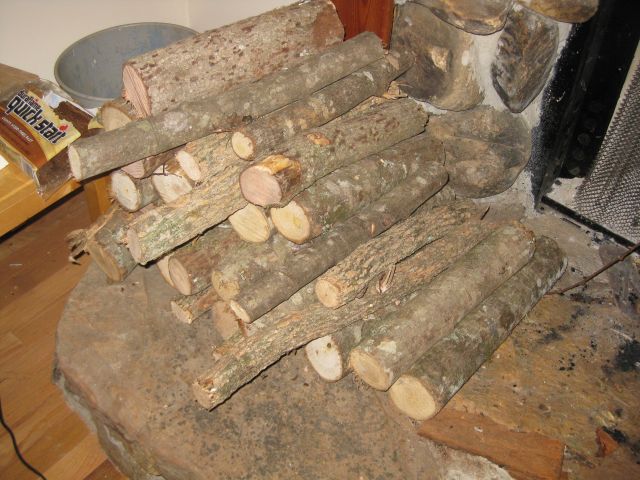
firewood – during the year I cut a new 5 foot wide route through the woods and I steered the path to avoid the larger trees. I had to uproot and remove smaller trees and I cut their trunks into 5 foot lengths and stored under cover for fuel for winter. I am now chain sawing the wood into 2 foot lengths to fit the grate. Last Sunday was cold and the wood burnt well.
firewood stored under cover drying for winter use. I have used some of the oak trunks as mini posts for structural jobs
firewood cut to size next the fireplace
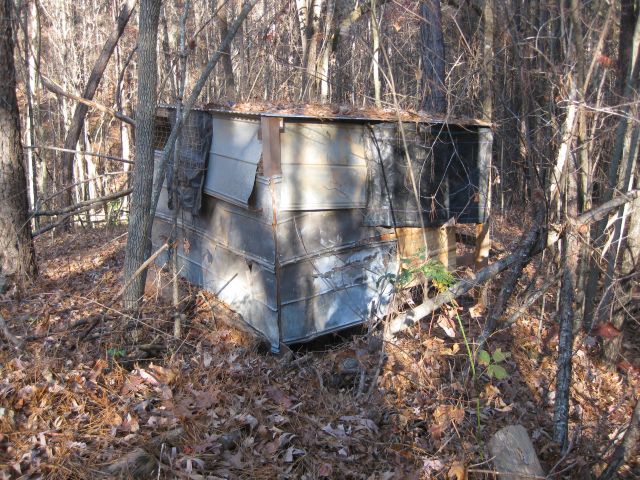
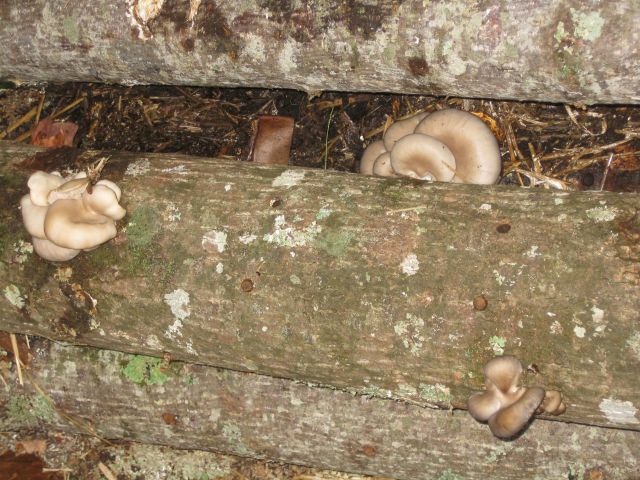
mushrooms – I built a mushroom house, which I filled with logs impregnated with sawdust spawn, and then neglected to water. A few weeks ago I watered the logs and some oyster mushrooms have surfaced. Encouraged, I shall water more regularly. Also I must affix a gutter to the roof of the shelter and direct the rainwater onto the logs – this is obvious and I should have done it at the outset.
mushroom shelter with solid sheeting or barrier cloth on north and west sides for sun protection, and chicken wiring and door protecting remaining access pointsmushrooms have begun to grow
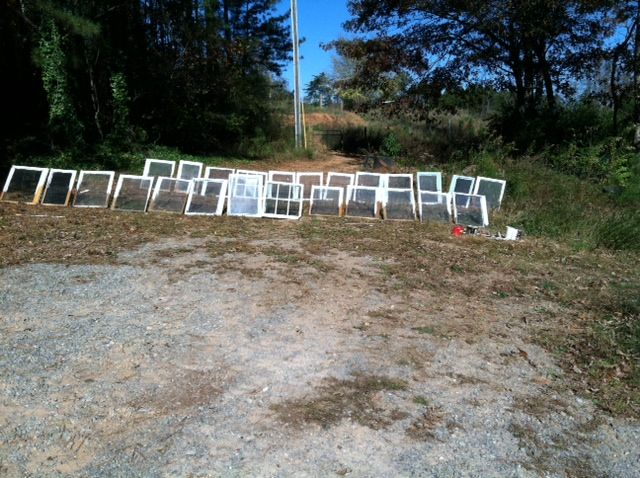
winter growing shelters – last year I was able to purchase a number of wooden windows for a $1 each and constructed rudimentary cold frames. This year I would like to create a larger structure but to do this I need posts. Pressure treated posts would be ideal but I do not want to pollute the soil or my vegetables. So the options are cedar wood (which rots with time), composite posts (which are expensive and may distort), metal structural posts (ideal but where will I find them) or use some oak trees from the woods (cheapest, self reliant and maybe the way to go). In the meantime I painted the wooden windows, first with Kilz primer and then a good quality exterior latex.
painted windows drying in the sun
seed gathering – now the cosmos and zinnia have finished flowering and set seed, I sortie out to gather seed for next year.
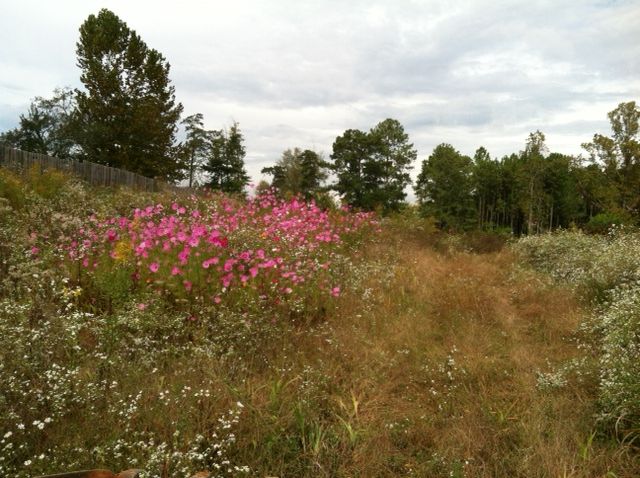
ebullient cosmos in a field
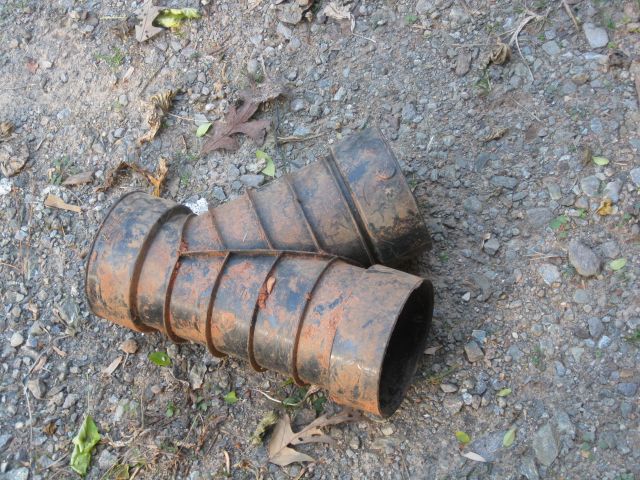
rainwater collection – when it comes to my rainwater harvesting systems the invariable rule is that it will fail wherever I have not checked. The main flow from the house roof went through a “Y” and the “Y” leaked in small amounts and eroded the ground supporting the connection so one of the 4″ pipes disconnected (maybe also assisted by the rodent hunting activities of my dog).
this is the old, cheaper, now replaced Y connection
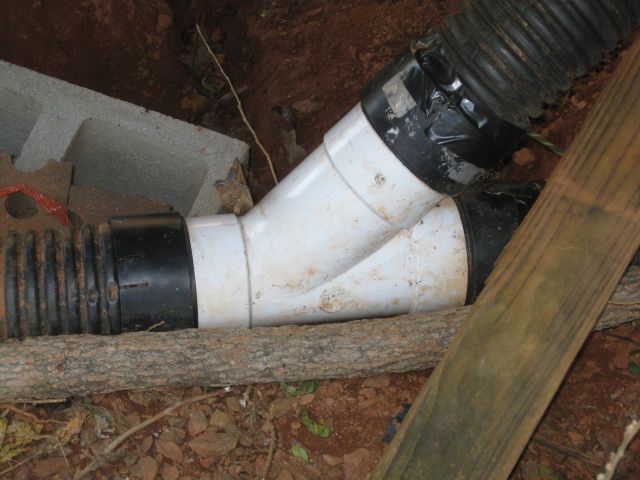
I replaced the old Y with a more substantial Y, I rebuilt the underpinnings and I secured the inlet pipes to the Y with duct tape and am resolved to keep a good eye on this joint and have instructed Trudy to leave the water drainage pipes well alone.
rainwater harvesting – the more expensive replacement Y secured with duct tape
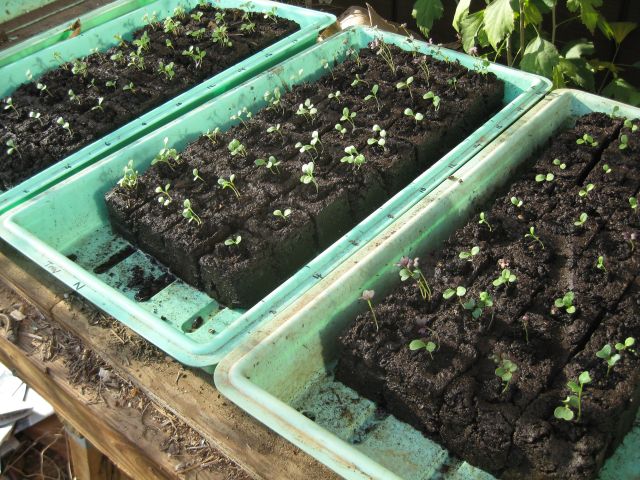
winter vegetables – I decided to seed more lettuce since I already have sufficient kale. The lettuce was seeded initially into 3/4″ soil blocks and are now in 2″ soil blocks in the greenhouse. I will probably grow some full size in the greenhouse and the remainder will be ground planted once I have figured out the construction of my new windowed winter shelter.
4 varieties of lettuce seedlings in 2″ soil blocks. the reason there are several in one block is this was older seed and I thought germination would be irregular. silly me, they all came up and I will have to thin or transplant.
cuttings and acorns/nuts – I have taken cuttings from trees I would like to replicate like mulberries, pears (my neighbor’s pear tree was prolific this year and my Giant Korean, which bore for the first time, was excellent), cherry, plum and one of my neighbor’s apple trees which had very sweet small apples. I know with the apple tree I may have a problem with the root stock. Perhaps next year, when I am successful with grafting, I will graft scions to root stock. As for nuts – my other neighbor gave me a dozen pecan nuts from his magnificent pecan tree and I also buried Ohio buckeye nuts, acorns from selected oak trees and nuts from other local trees. The cuttings and nuts are in an area which I visit and weed and water most days, with good sun exposure and the soil is well mixed with compost. So I am hopeful. If the cuttings are viable I may transplant them in spring next year or, better, wait till fall and then plant them out with the nut seedlings.
in earlier posts I mentioned other activities such as terracing the hill in anticipation of delivery of assorted fruit trees promised for the end of November, and winterizing the bee hives and the chicken coop. When really cold weather threatens I will wrap my fig and other cold sensitive trees in swadling and leaves to prevent die back.
I never studied biology and as I pursue my “new track “in growing and interacting with nature I am at a disadvantage.
I recently completed the excellent “Introduction to Sustainability” MOOC provided by www.coursera.org entirely free, and learned a lot. I enjoyed the experience and have now decided to study biology. There is a coursera course starting summer next year “Introduction to Biology: DNA to Organisms” and the notes suggest acquiring “Biology” by Campbell Reece. I was able to purchase the 2007 edition for less than $10 (including shipping) and am happily working my way through it. I also discovered an excellent website: http://www.dnaftb.org/1/animation.html titled “DNA from the Beginning” which is an animated primer on modern genetics, so as winter closes in, I have much to work on.
A few days ago I was plucking pea pods from the pea plants and I wondered how the peas would be pollinated now it was getting cold and my bees stay indoors when the temperature is less than 50 degrees. Since it was getting cold I headed indoors and began working through the website primer on genetics and, by pure serendipity, the first topic was on the Father of Genetics, Gregor Mendel, who in 1865 began his experiments on pea plants, which when left alone self fertilize. This answered my question on pollination.
Mendel focused on individual traits of pea plants (phenotypes) and by cross fertilizing them and careful analysis he concluded that each alternative form of a trait is specified by alternative forms of a gene (allele) and a pair of alleles is called a genotype. It was Mendel who identified dominant and recessive alleles and how the first generation (F1) will have the dominant trait but the second generation can begin to show the recessive trait. Which is why seeds from F1 hybrids will not produce true to the hybrid.
While working my way through the animated primer I read about Crick and Watson who discovered the DNA double helix and the book “The Double Helix” by Watson was referenced as a good read. I just finished reading it and it is excellent. Watson was an American student at the Cavendish Laboratory of Cambridge University and his insousiance and self-deprecating dialogue makes it an exciting romp with lots of humorous asides as he and Crick competed to beat Linus Pauling to solve the DNA configuration. At one point, when Crick and Watson were stumped “the problem was then put aside for a rapid scanning of a novel on the sexual misjudgments of Cambridge dons.” Or when visiting an aristocratic home “Sol Spiegelman and I went straight for a butler carrying smoked salmon and champagne, and after a few minutes sensed the value of a cultivated aristocracy.” When Watson excitedly informed Crick he had found the answer and was rebuffed, he notes: “Reporting that even a former birdwatcher could now solve DNA was not the way to greet a friend bearing a slight hangover.” There were four principal researchers and three of them got the Nobel prize but the fourth, Rosalind Franklin, died before the award and the prize is not awarded post-humously. There has been controversy about whether her contributions were fully recognized and I was pleased to read the unqualified tribute made by Watson in the Epilogue. A good read.
My property is about 50 minutes (=50 miles) north of Atlanta. Some 30 minutes into the trip I will often find a pretext to stop at the convenient Lowes DIY store for a “necessary ” purchase as well as for the free coffee, friendly cashier and to ease springs. The last reminds me of my army days when, after serious imbibing in the NCO mess, we would “request permission to ease springs” and then stumble over the tent guy ropes into the darkness of the night.
So this morning was no different and it occurred to me as I scouted the store, that I should visit the nursery area because this time of year they have large markdowns. Generally I do not buy plants at DIY stores but grow from seed or order from specialty internet providers, though some have disappointed! However, the trees and the shrubs were all marked down 50% and the decision was whether to go for the nectarine or the pomegranates. I tried to recall whether either were problematic for my area or required cross pollination, and failed. So I took a chance and bought the pomegranates, one of each of the two varieties, so I had cross pollination covered, their combined cost was less than the nectarine and, since they are smaller they would fit nicely as semi-understory plantings in my orchard. Plus my neighbor has a pomegranate shrub (from which I took a cutting a week ago) which bears sound but sour fruit and I delusion myself that with better sun exposure and my compost, the outcome will be better.
Not a very scientific method to reach a decision and so I was relieved when I later consulted my reference book, “Gardening in the South – Vegetables and Fruits” with Don Hastings, and the handy reference table informed me that nectarine are “very hard” to grow with worst problem being insects and diseases (the only other “very hard” is apricot), while the pomegranate is “easy except for cold” and its worst problem is cold damage. So I was lucky in my choice.
The book offers similar comments for fig and persimmon as for the pomegranate, and last year my two fledgling figs both died to the ground but came back strongly from their established roots. The native persimmon was similarly mauled and is growing more slowly. I may try protecting the figs, persimmon and pomegranates with wrappings or tomato cages filled with leaves. And with global warming, this problem too may pass.
(As for why two posts in the same day? Thank you Sandy, which headed north with her coattails blowing briskly and coldly – enough to keep me in doors after planting out the pomegranates.)
My permaculture readings have focused me on developing an edible forest garden and earthworks figure prominently in my designs. Although I already have a number of different fruit trees in my orchard I decided to expand the selection and expect, by the end of November, to receive 2 goumi, 2 pawpaw, 3 kiwi (2 female, 1 male), and a medlar, aronia, sour cherry, and juneberry. With these pending arrivals I have been at work preparing their planting sites on the side of the hill.
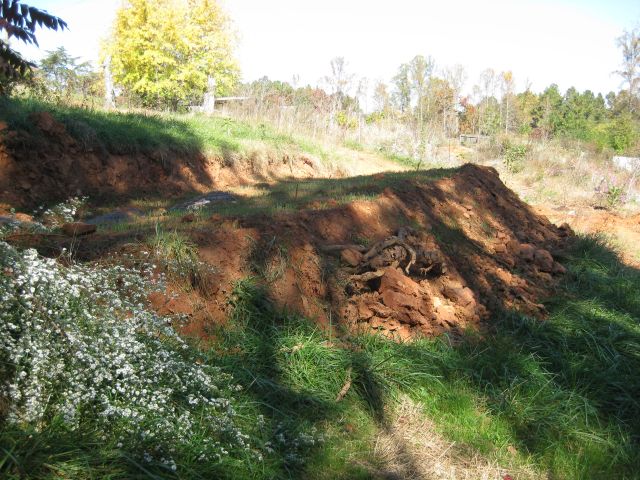
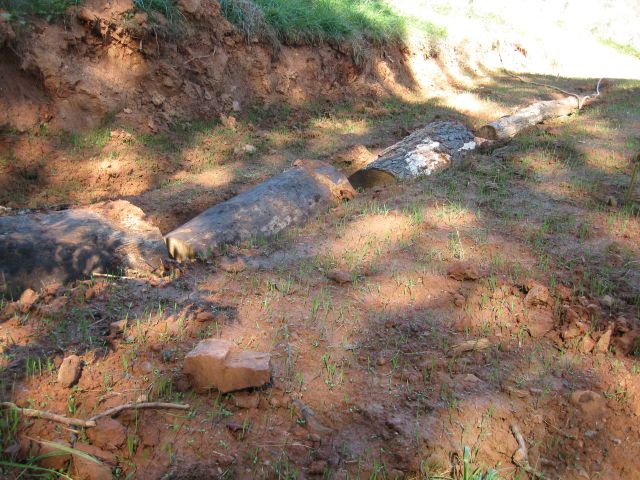
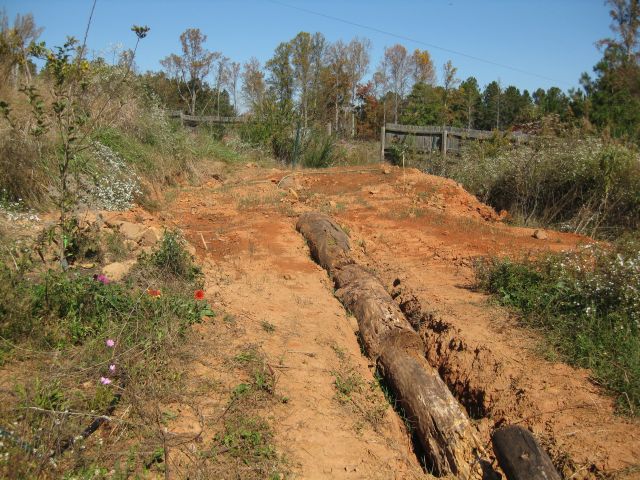
The earthworks are dug by my scruffy Takeuchi tracked bobcat. My approach is to terrace the slope with the terrace canted to the slope and with a contour ditch in the middle of the terrace. So rainwater on the terrace will move to the contour ditch and that which misses the contour ditch will move to where the terrace intersects with the slope. I fill the contour ditches with logs, for several reasons: a) my readings suggest that grasses promote bacteria and trees promote fungi and since the slope was grass covered, by filling the ditches with rotting tree trunks I am hoping to accelerate beneficial fungi in the soil; b) the contour ditches are a couple feet deep and without infill it is easy to fall in; c) if the ditches are left as ditches, they are quickly invaded by vegetation which competes with the tree roots and hides the location of the ditches (facilitating (b) above); d) parallel with (a) the tree trunks will provide nutrients to the soil as they degrade and will absorb and retain water for the benefit of the plantings.
earthworks – a view of my new terrace showing the grading toward the slope and the cut made into the face of the slope
After grading the terrace I planted winter rye and crimson clover on the exposed earthworks and watered every couple of days with rainwater. I have marked the location of the future tree plantings with stones – they will be at least 15 ft apart. And, since my comfrey did so well this year, I have planted out root snippets from a couple of my comfrey plants.
earthworks – terrace and contour ditch – looking north you can spot the winter rye seedlings. interspersed amongst them are crimson clover seedlingsearthworks – terrace and contour ditch – I am fortunate to have degrading tree trunks for filling the ditch
I created a second terrace as an extension to the terrace and tree plantings I made last year.
earthworks – terrace with contour ditch and tree trunks, follows the same principle as the one above and the two together will accommodate the new arrivals
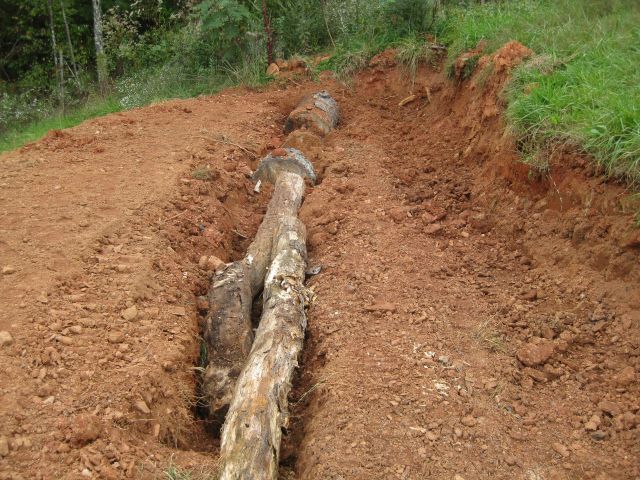
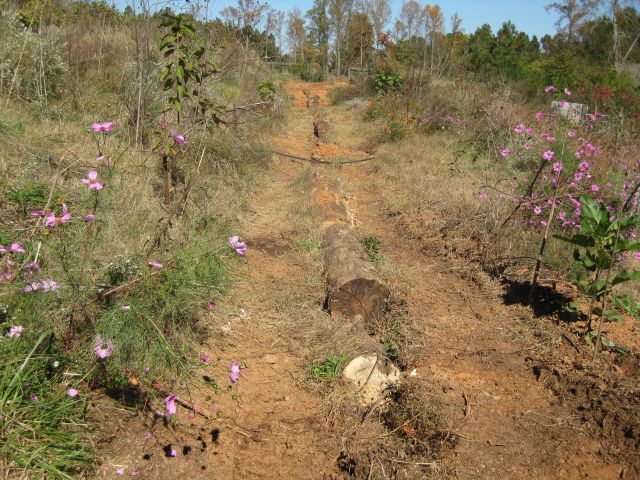
And while I was at it I went back to last year’s terrace, deepened the contour ditch and filled it with tree trunks which had been left on the property by a previous owner.
earthworks – last year’s terrace upgraded to include tree trunks in the contour ditch. The cosmos and aster are still in bloom and the air is heavy with bees
In my previous post I mentioned my battle with brambles and referred to brier in passing. Coincidentally, that evening I happened to listen to the Ballad of Barbara Allen in which the suitor dies from unrequited love for Barbara Allen. From his grave a rose grows and from hers a briar. The brier I just dug out and photographed is from the genus Smilax and got its name from Greek mythology. Krokus, a mortal man, tragically loved the woodland nymph Smilax and on his death he was turned into a flower and she into a prickly vine. And that is how the thorny vine I find in my growing area was given the Latin name Smilax.
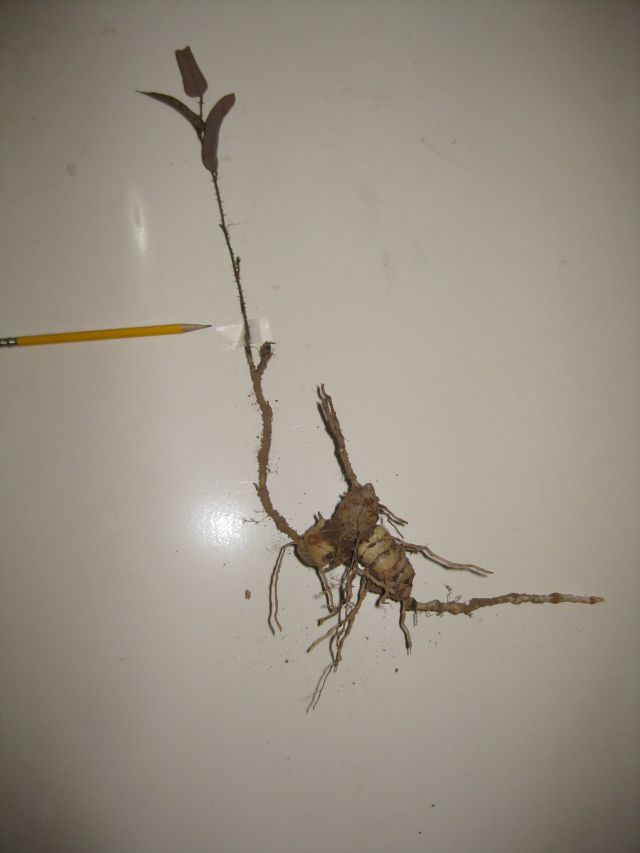
Unlike brambles which have shallow horizontal running roots, this brier is more formidable. It holds its resources in large tubers about 8 inches below ground level. In the photograph below the pencil points to ground level and you can see the size of the tubers and their distance from ground level.
a youngish brier I dug out of the vegetable patch. the tubers are large in relation to the plant. the thorns on the larger briers in the adjacent woods are like barbed wire
My previous attempts to eliminate the brier failed because I did not know how it operated. I would dig up the accessible roots and think, with my perseverance, it would fade away. I now know I have to dig much deeper and locate and remove the tubers, to succeed.
The house I purchased a few years ago is on sloping ground and between the house and the tarmac road was a gully which the previous owner, a contractor, had filled with trash. (Not as bad as contractors digging holes for landscaping dirt for a new house and then filling with tree trunks, which results in sinkholes, anguish and expense for home owners.) I tried clearing the trash myself with trips in my pickup to the recycling center but made little progress. I did not have my bobcat at the time and so I engaged a contractor who removed several dump truck loads of trash and then filled in the gully with more dump truck loads of soil. And so I had a bare slope to work with. And I made a number of mistakes.
My initial steps, with hindsight, were ok. I cut down a big pine, delimbed it and positioned it diagonally about halfway up the slope. At its bottom end I constructed a french drain. The idea was to divert rainwater streaming down the slope to the drain and prevent erosion of the slope. There has been no erosion, so this probably helped.
Next, to populate the slope, I ordered various hardwoods from the South Carolina and Georgia forestry commissions. The price is reasonable when you order at least 10 trees of a kind, and ever cheaper as your order increases from 50 to 100 to 500 to 1,000. For a large tract this is the way to go. For my smallish area not the best solution. Most of the seedlings arrived in January and February. A better time to plant would have been in September and October when the roots could have established themselves before the cold weather. The seedlings were shipped bare root and some had minimal side roots just a large severed tap root. More side roots would have enabled the seedlings to establish themselves more quickly. Some of the items I liked were out of stock and so I did not have the variety I wished for.
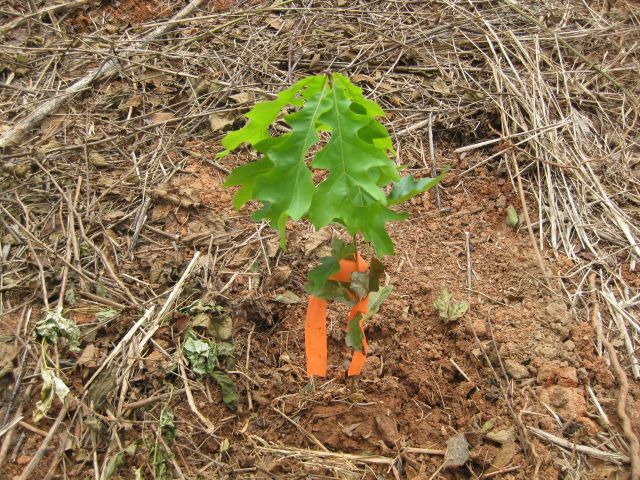
So what should I have done? Simple, just pick the acorns of the red and white oaks in the nearby woods and the nuts of the hickories, bury them in the ground alongside my vegetable plantings and then plant them on the slope a year later. This is what I did a few years later and had excellent results. By planting the nuts in the vegetable garden they were guaranteed ample watering, good sun exposure and good soil. And the good soil had another bonus. When I forked out the seedlings for replanting on the slope, because the ground was soft (and wet) most of the roots were intact, including the tap root. And these seedlings were from my area and so are well adapted to quickly populate the slope. Had I initially gone this route I apparently would have lost a growing season but the purchased seedlings took a long time to get going and I expect that my own seeded local sourced trees will grow at a faster pace.
a seedling grown from an acorn planted last fall. although small in size, the root exceeds 1 foot. the red surveyor’s tape increases visibility and reduces inadvertent destruction from a scythe
When I planted each seedling I dug out a good sized hole and filled it with a mixture of soil and my home made compost and watered well, following the adage “dig a $10 hole for a $1 plant”. Not a good idea – there were large trees bordering the slope and their roots immediately headed for the newly introduced nutrients and moisture. So I burdened the newcomers with fierce competition. I probably should have introduced them surreptitiously, below the radar.
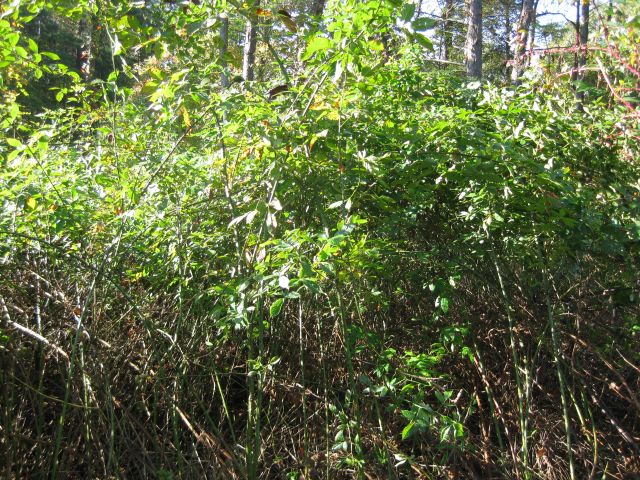
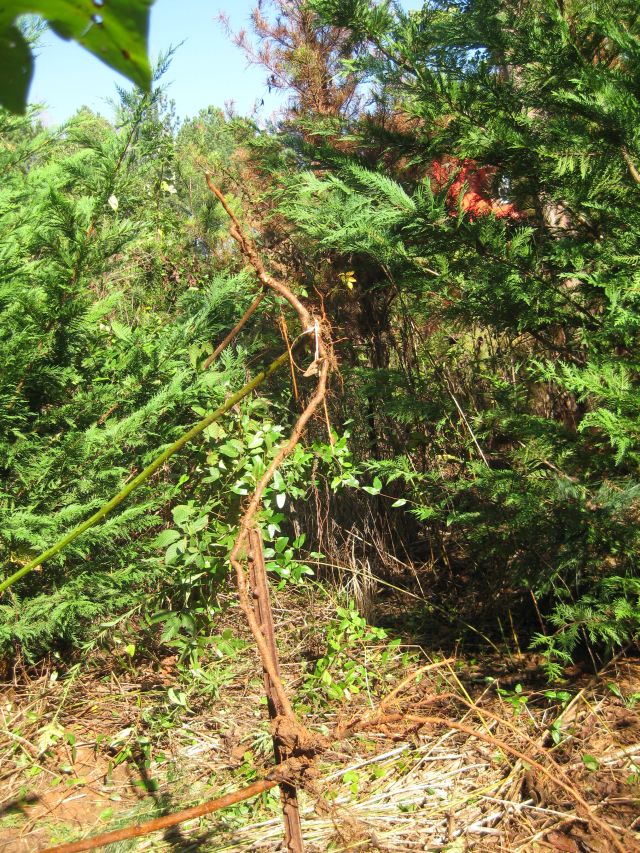
Other mistakes. After the slope was graded in the fall, I seeded with hairy vetch and clover and they took off well and helped combat erosion and added nutrients (nitrogen) to the ground. This was fine. But in following years I was focused on my edible plantings elsewhere and ignored the slope and it was invaded by brambles and brier which displaced my ground cover and competed with my tree plantings for moisture, nutrients and sun. In their excellent 2 volume book “Edible Forest Gardens” the authors (Jacke and Toensmeier) interview Martin Crawford, U.K. author of the equally excellent “Creating a Forest Garden” and on several occasions he stresses the importance of controlling brambles. He notes “very important – I have seen forest gardens taken over by these.” Well, I took my eye off the ball and the brambles completely took over, reaching heights in excess of 10 feet.
an example of the mass of brambles, dense, tall and overarching, forbidding easy access to their base
The past few weeks as I dug out the invader I became acquainted with its strategies. It has strong lateral roots which grow just below the surface and then pop up to establish new plants.
you can see the horizontal bramble root (shown here vertically) with the canes emerging every few feet to the left of it
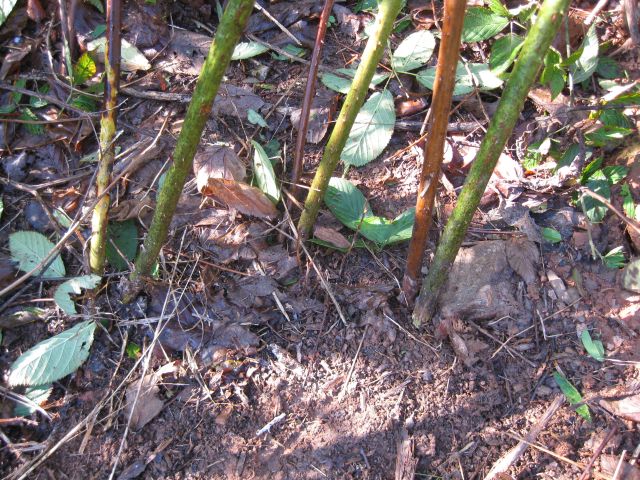
Also in winter the cane dies back and in spring a new cane emerges from the same base, so it is common to see a thin brown cane (previous year) and a thicker new green bramble cane for this year.
here are three pairs of brambles, each pair consisting of last year’s predecessor and this year’s replacement
The reason for increased diameter is not just because the old cane is dried out – the new cane can grow bigger because it is starting with the root base established by the previous year’s cane.
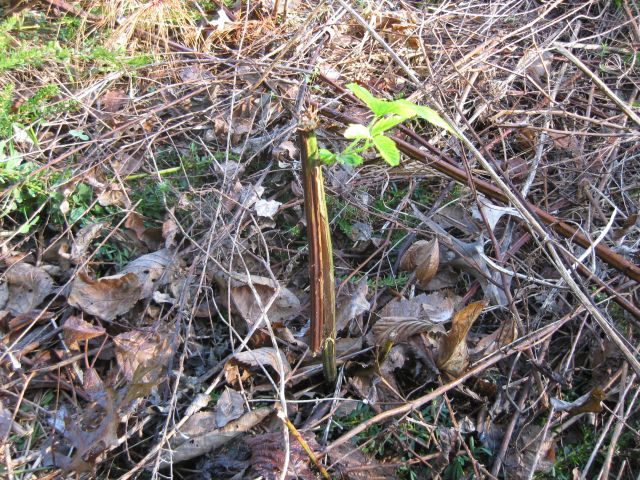
scything is not effective. within a week or so new shoots appear from the stump. you have to pull out the bramble which is much easier after rain has softened the ground. although for getting close to the bramble a long handled scythe for cutting and clearing is great
Just as I have been digging out bermuda grass in my berry planting area so am I committed to clean up the slope and release the hardwoods so they can grow vigorously and outshade their competitors which also include some tough rooted 2 foot grasses. It needs continuous attention and hard work to help the favorites outcompete the bramble and allied invaders.
We have started making our own kefir fermented milk products. Kefir originated when shepherds discovered that milk carried in leather pouches would ferment and produce a fermented beverage which has a pleasing taste, once your are accustomed to it.
We were given a starter culture and the procedure is you add milk to the kefir grains and allow it to ferment for 24 hours at room temperature. A tablespoon of the kefir grains is adequate for 8 ozs of milk. After 24 hours the grains have converted the lactose in the milk to lactic acid. You strain off the product and it contains probiotic bacteria and fungi which are great for GI health. You return to your jar the residue in the strainer and top it up with fresh milk and 24 hours later you have more kefir. You can blend the kefir with frozen blueberries or strawberries and add some honey to produce a smoothie.
Initially we added the kefir starter grains to 1% conventional milk and they were unhappy and refused to do their magic dance. We do not have easy access to raw milk and besides we (currently) have little use for the fat/cream which comes with the milk. We do not usually use organic milk. but on an inspiration we switched to 1% organic milk and the kefir is thriving.
So when studies are done on the benefits of organic produce and focus only on nutritional content, they are overlooking possible components such as anti-biotics in conventional milk. The question is whether these overlooked components affect not only the bacteria in kefir but the bacteria in our GI tract and therefore our health.