propagation

Winter is a good time to turn my thoughts to propagating plants.  Although I live in the south (Georgia) some days are really miserably cold, windy and rainy.  What better time to learn up on new propagation techniques.

Oaks

Oaks do not transplant easily.  Even young oaks seem to have interminably long tap roots.  And it is difficult to tell a small sapling young oak from a 5 or 10 year old sapling old oak since oaks are content to bide their time in the shade of larger trees until the umbrella is pierced and growth giving light encourages them to get going.  I walked the woodland yesterday looking for acorns and found none though there are many >20 year old white and red oaks.  At first I thought they may not be producing acorns since they are hemmed in on all sides by pines and tulip poplars.  But then I remembered all the oak saplings surrounding these trees and concluded that squirrel or deer had been feasting on the mast (as it is called).  Too late to the party.  However, in Sandy Springs, Atlanta near our suburban home there is a huge oak tree which has littered the sidewalk with thousands of acorns.  I collected 100 this morning and seeded them 25 rows, 4 each, 1″ depth, in a new long raised bed I have built.  I shall water, keep an eye on them and, with some luck in early summer there may be signs of life.

Fruit tree cuttings

I mentioned in an earlier blog that I am new to cuttings and a reader gently nudged me to a better understanding of the mechanics, for which I am thankful.  You have to establish first if you are dealing with hardwood or softwood cuttings.  Hardwood is not necessarily harder than softwood and an example frequently quoted is balsa wood, which is a very light wood but is classified as a hardwood.  The distinction is based on the seed and the seed of hardwoods has a covering, such as fruit or the hard shell of an acorn.  For hardwood cuttings you take the samples in fall or early winter.

My neighbor agreed that I could take cuttings from her many fruit trees, so this morning, with my alcohol sterilized secateurs, I took snips from a number of her trees which include mulberry, cherry, pear and apple.  From these snips I prepared >20 cuttings and rather than using a heated tray and remembering to water and bothering the cuttings with weekly inspections to see if the roots had arrived, I simply prepared a V trench in my outdoor raised bed (which has frost cover protection) and planted them and watered them.  And I will look for buds in the spring.

I know that apple trees should be grafted on appropriate stock but what I want to achieve, rather than a formal orchard, which I already have, is an informal association of fruit trees interspersed with edible or useful perennials.  Since the cuttings are from trees which have thrived in this area, they should be able to take good care of themselves.

Seed germination

My real pursuit has been learning more about seed germination.  Through the comments of MikeH on this website I learned of “Seed Germination Theory and Practice” second edition by Professor Norman Deno (“Deno”) published in 1993 and available for free download. For anyone interested in this topic, this book is great.

Previously I didn’t understand why, although most seed germinated in warm moist conditions, other seed needed cold to germinate and some seed seemed completely indifferent to my efforts.

Deno germinated nearly 2,500 species and the processes he used were relatively simple – he did not use pots and growing media, instead paper towels and polyethylene sandwich bags (thin bags not sealed too tightly so as to maintain aerobic conditions). For some species he used gibberillic acid. He conducted his germination tests at just two temperatures 40 or 70 deg F. Based on the results of his research he developed a number of principles such as all species have mechanisms to delay germination until the seed has been dispersed.  There can be multiple mechanisms such as required sequences of hot and cold temperatures, or cold and hot temperatures, or oscillating temperatures as well as a time clock and/or the need for light or dark etc.

I find interesting why species have particular delay mechanisms and it seems the mechanisms are about ensuring survival of the species. If seed dropped in summer were to germinate in summer, the tender offspring would be killed by winter, hence a programmed requirement that there must be cold (i.e. winter) before the seed can germinate. Apparently for plants growing in swamps or woodland, where having enough light is a bigger problem than having sufficient water, the seeds require light to germinate. Apparently for plants in cold desert areas where moisture is only available in the spring, the seed will germinate at low temperatures in order to be sufficiently developed to benefit from the spring rains. Some species produce quantities of seed coats which are empty and Deno speculates that this is also a survival mechanism – predators which exert themselves to open the seed coats and then find nothing there will lose interest in that particular seed. Some seed require cold then warmth then cold i.e. two winters. The survival mechanism here could be that if all the seed germinated the following year and conditions were bad – drought, fire etc, then the entire species could be destroyed. So requiring two winters appears to double the chances that the species will survive. Fascinating!

I now understand why if you cut a flower before it has seeded, taking care to leave buds on the stalk, the plant will flower again, and if cut, again.  A survival mechanism requires the plant to keep trying to flower so that it will be pollinated and produce seed.  Once it has produced seed it has achieved its mission.  Not to say plants are indifferent to human desires.  Another survival mechanism could be to look beautiful to humans (in addition to the pollinating insects) so that humans will favor them and propagate them.
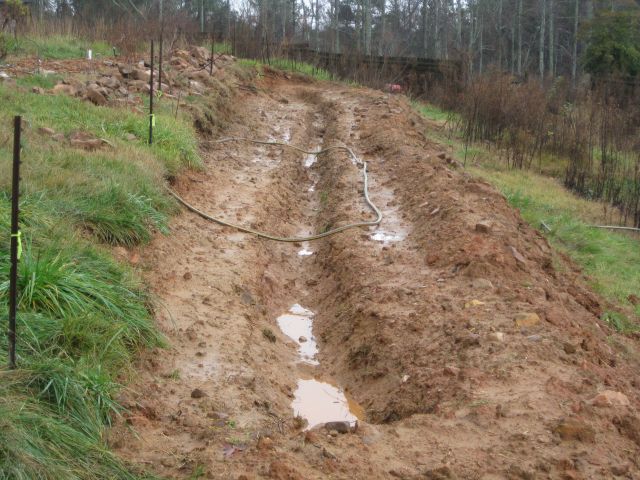
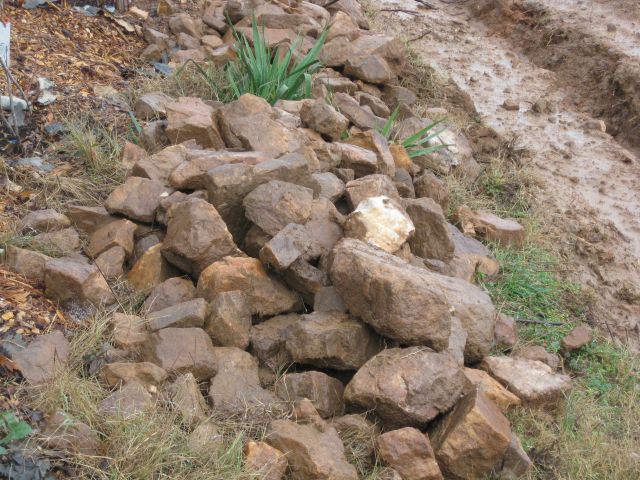
new growing area and contour ditch

In a previous post I mentioned the repercussions experienced from locating my muscadine grape plantings too close to my vegetable beds.  Just as the vines of the muscadine grow interminably so do their roots and the raised beds, tomato planting sites and other vegetable sites were mined by muscadine roots.  I relocated half (6) of the muscadines earlier in November and have now prepared a site for relocating the remainder.

contour ditch
new terrace with contour ditch after recent rain

The site is on the slope of a small hill which has blueberries at the top and a fruit tree orchard lower down.  I decided to carve out a terrace between the two, approximately 8 ft wide and 100 ft long, with my bobcat.  Terracing the first 50 ft was uneventful and then I hit the rocks.  It seemed the slope was made from rocks.  With the teeth of the loader I jiggled the rocks loose and then manually lifted the rocks and stacked them above the terrace.  Seemed interminable.  Eventually a terrace appeared.  But it sloped from the north end to the south end, which meant the intended contour ditch would be more drain than a container of rainwater.

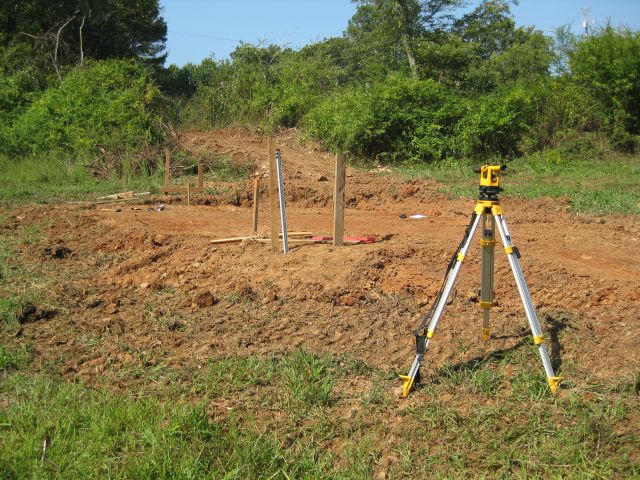
I hammered in 6 – 4ft  metal rods equidistant along the terrace and then with my transit level and surveyors tape tied to the rods, I identified the grade (you can see some of them in the above ‘photo).  With my bobcat I then pretty much leveled the terrace, though there is still some dip from the north end to the south end.

Next step was to dig a trench/ditch down the middle.  I replaced the loader on the bobcat with a trencher/stump remover attachment and after pulling out more rocks had a rough ditch.  A lot more work with a shovel was required to make it presentable.

contour ditch
some of the rocks embedded in the slope which had to be removed

Now I had bare clay earth and the prospect of oncoming wintry rains and erosion.  I discussed with the owner of the local farm supply store whether I could still seed with clover.  He suggested winter rye grain was a better bet for a cover crop.  So I sowed the rye and hope it will germinate.

With the terrace now done, next tasks will be chain sawing some anchor posts for the cables for the muscadine grapes.  There is a toppled maple tree which I may use – though toppled, it is off the ground and its wood hasn’t rotted.  Also a poplar which needs to come out since it blocks my tractor when I go chipping in the woods.  Oak would be a better bet for longevity but I cannot justify (yet) cutting down a good oak for fence posts.

preparing for winter

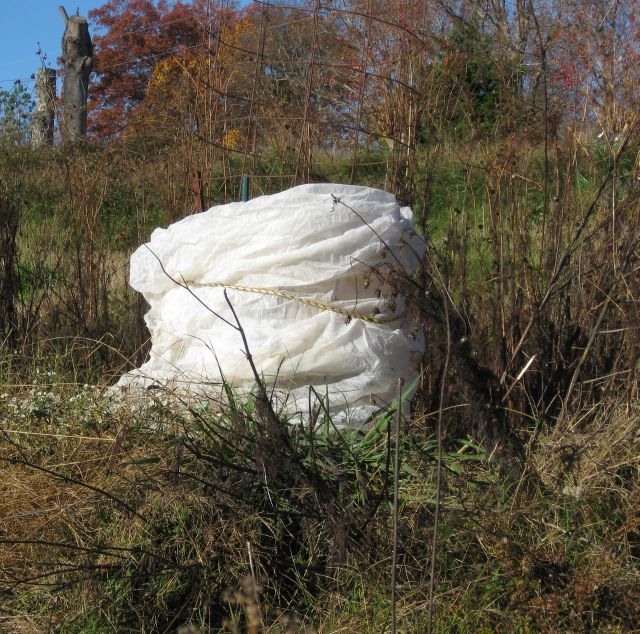
Yesterday morning I did not need a weather forecast to know cold was incoming and that it was time to protect some of the plantings.  Of the 12 fruit trees installed earlier this year, the Gold Nugget loquat was the most vulnerable.  The loquat is suited for sub-tropical to mild temperate zones and freezing temperatures will kill the buds if not the tree.  My loquat did not do very well this summer, probably too hot for it, but I will do what I can to help it and first steps was to winterwrap it.  Since it is only a few feet tall, it fitted easily into one of my tomato cages, which I had made from welded steel wire re-mesh.  I then wrapped the cage and the space above the tree with agripon AG-30 row cover, as shown below.

loquat in tomato cage wrapped with row cover

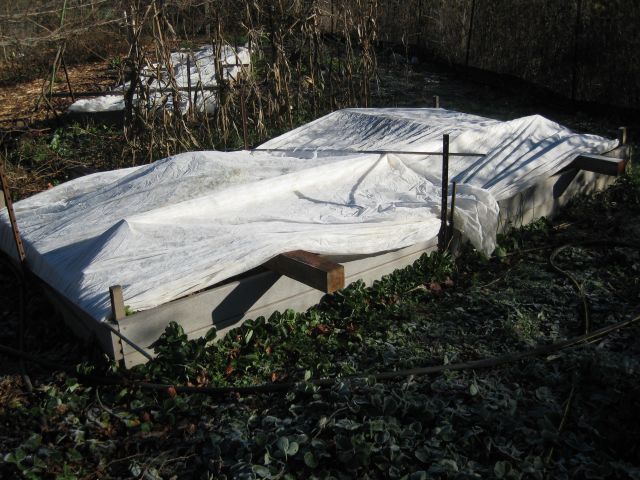
Next to the vegetables.  I have two raised beds where I am growing several varieties of lettuce as well as spinach, kale etc.  Rather than using a hoop system my thought is to drape row covers over the beds just above the vegetables.  This should be less vulnerable to strong winds and may offer better protection.  For my first bed I bridged the long sides of the bed with two cedar posts and then strapped a 4″ pvc drain pipe to the posts and draped the row crop over this.  Below is the finished product as it appeared this morning (you can see the frost on the adjacent strawberries):

raised vegetable bed covered with row cover

If the description was difficult to follow, here is a shot with the row cover removed:

raised vegetable bed with fixtures for row cover

Only half of this bed is being used for vegetables.  I have extensively planted the other half and also the spaces between the vegetables with garlic.  For my second bed I simply placed the row cover over the vegetables and secured with 3 2×4 untreated planks, as shown below:

vegetable bed covered against frost

The temperature fell to 22 degrees and the vegetables did fine, though it was not a heavy frost.  Since temperatures are predicted to stay above freezing for the next five days, I removed the covers this morning, a simple task which took just a few minutes.

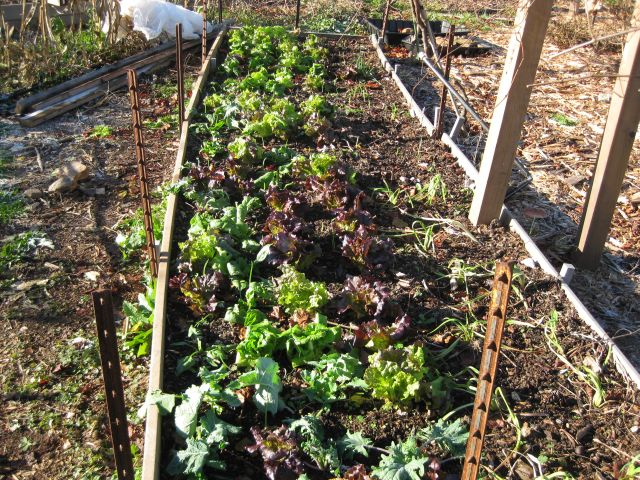
long raised vegetable bed with lettuce interplanted with garlic

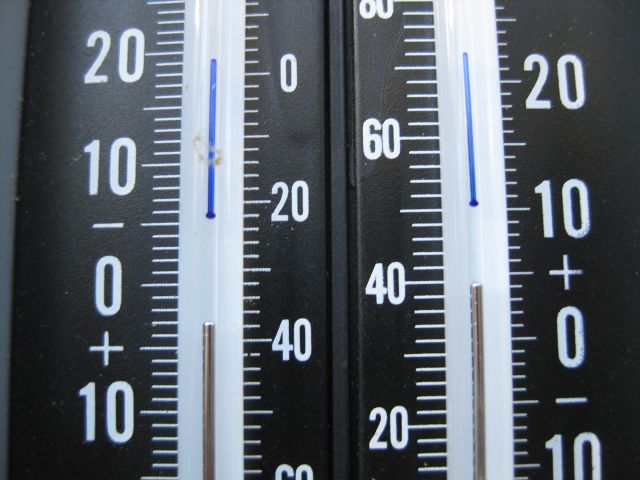
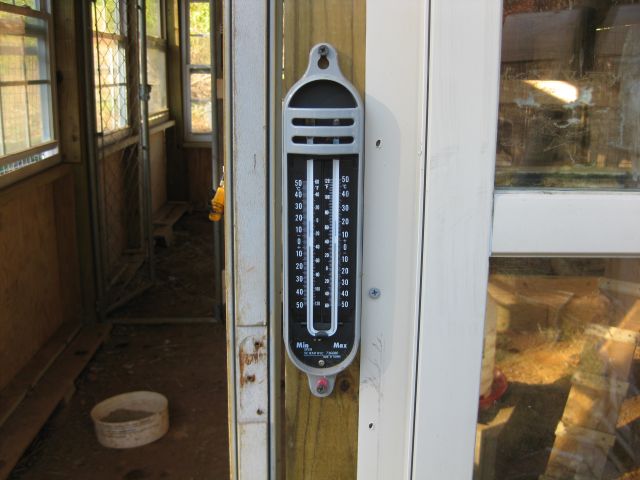
My new chicken coop is working out great.  Air can flow freely out the rafters at the top and I leave two of the windows slightly ajar. I was curious to learn how cold it really gets.  I transplanted my two min max thermometers from my greenhouse to the coop and sited one outside at the door and the other on the partition which divides the coop into the old flock and new flock areas.  This morning the outside temperature was 22 degrees and the inside temperature was 36 degrees, higher mostly I would think because of the heat of the birds.  My greenhouse, which is fully enclosed, only provides a differential of about 10 degrees between outside cold and inside temperatures.

thermometer reading 22 degrees
min max thermometer on coop door


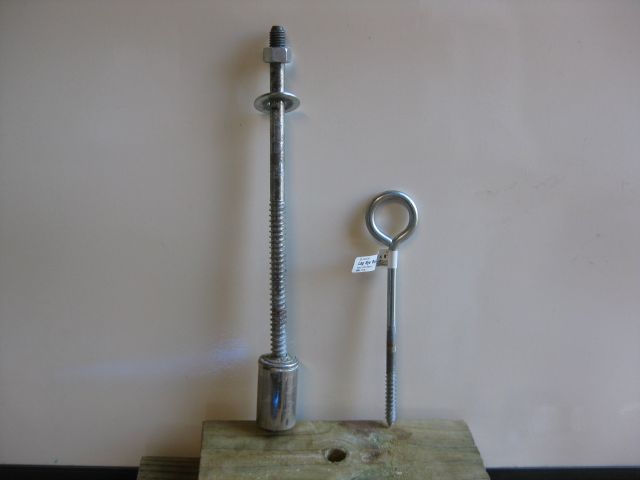
Since power outages may be expected, I checked my flashlights and found that my large 4 cell mag-lite was not functioning. Two of the 4 batteries had leaked and corroded the inside. Removing the batteries proved near impossible. I decided to drill a hole into the bottom of the battery and screw a large lag eye bolt into the battery and, with the assistance of a helper, pull them apart. After much tugging the bolt separated from the battery and the battery remained, unmoved, in the flashlight body. I then located a larger diameter hanger bolt and screwed this into the battery.

hanger bolt on left shown inserted in a battery, and lag eye bolt on right

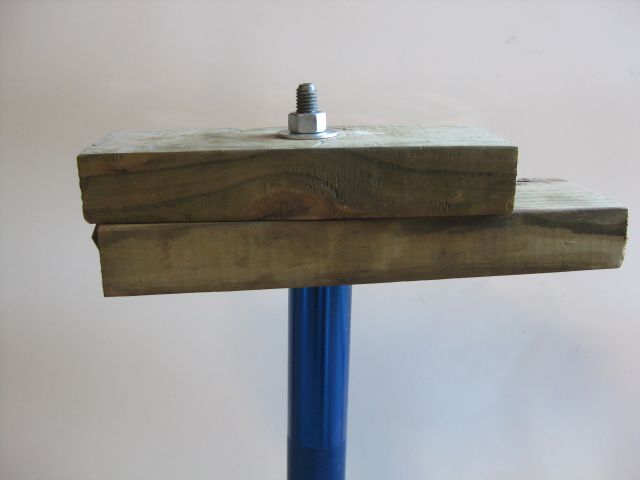
I no longer had my helper but additional help was unnecessary since, with a assortment of 2×4’s I established a platform for the nut on the hanger bolt to leverage against. It was then a simple matter to tighten the hanger bolt nut with a wrench and slowly extricate the two damaged batteries. After rinsing out and scrubbing the flashlight interior with a liquid mix of baking soda (sodium bicarbonate) and installing new, and a better brand of, batteries, the flashlight is good to go.

tighten the nut and the bad battery comes out (slowly)

November tasks

No pics for this post since my camera informed me the battery pack had to be replaced and refused further negotiation.

A pleasurable task, this time of year, is collecting the flower seeds. I did my first Cosmos seeding early 2010 and, from the seeds gathered last November and spread this past spring, I enjoyed a whole new expanse of Cosmos. By November 8, as was the case last year, most of the seeds have dried and spread and are easy to grasp in one’s hand and release into a shopping bag. Lots of Cosmos and every few days I gather more. Also collecting Marigold and Zinnia seeds for new plantings next year.

I am heavily studying permaculture and a recommended plant is the Gumi/Goumi (Elaeagnus multiflora), native to China, Korea and Japan, which provides edible fruit, fixes nitrogen and apparently has medicinal uses. Rather than buy a plant, I bought 12 seeds which arrived after a 2 week trip from NS, Canada accompanied with a note “Has a long germination requirement, often taking 2 full winters before germination.” This will surely test my propagating abilities. For starters, I moistened some seed starting mix and placed, with 6 seeds, in a zip loc bag in the refrigerator. To mimic two years I may remove from the refrigerator in a month’s time and allow to warm for a while and then back into the refrigerator to trick the seeds into thinking this is their second winter. I suspect I will find these seeds are not easily tricked – that’s why I kept 6 seeds in storage for a second go round.

I am also trying, for the first time, to propagate cuttings. I have had success with layering where you pin a low branch of a shrub on the ground, maybe roughen the underside, cover with compost and soil and leave for a few months and, when you return the pinned branch has developed roots and can now be cut from the mother plant and transplanted. Works very well with azaleas and forsythias. But cuttings is something new and, when I have definitive progress, I shall include some pics. I am aware that the best time to be doing this is in spring when the plant is in growth mode, not at the end of fall when systems are shutting down. And spring next year I shall also be trying grafting on my fruit trees.

Next week I should receive some root cuttings of Comfrey, Goldenseal and Jerusalem Artichoke, and also two varieties of mulberry, black bamboo and everbearing strawberries. Just in time to plant before the real cold settles the ground. I have been growing early season strawberries for several years and they were very sweet and spread prolifically. However, their fruiting season is too short, and so I hope to be similarly lucky with the everbearing variety.

With the cooling temperatures I have been progressively winterizing the bee hive. A couple months ago I removed the big sun umbrella which protected them from overhead sun, then I removed the board fence on the west side which protected them from afternoon sun, now I have stapled the plastic sheeting to the frame which encompasses the hive, and I slid in the bottom board, so only the entrance side and the top are open to the elements. I also have left them with a lot of their honey (my last harvesting was August 5) so I hope they will have enough to get through the winter without my having to give them sugared water. Since I do not use any chemicals, I want them as healthy and strong as possible to survive the challenges of winter and their own honey will be infinitely better than a sugared substitute.

And the chicken? The 6 older hens are delivering 3 eggs a day which is ok for now, given the shortening daylight hours. The flock of eight (7 hens and 1 rooster) are now about 6 months old and only one of them (one of the Golden Comets) is egg producing. They love their new coop and seem to be having a great time so I have had a few chats with them about the importance of delivering more eggs – “eggs or the pot” I say to them. In December, if egg production is down, I may use artificial lighting on a timer to get them 14 hours of light and more into an egg laying frame of mind.
succession

“Succession” has been in the news, more so in England than the United States, when last week (October 28) the rules for succession to the British throne were amended to ensure that the first born of any future monarch, whether male or female will inherit the crown. However, though related, this is not the succession I have in mind when I look at my yard, which previously was regularly scalped by a lawn mower, now transforming itself into an impenetrable mass of “weeds”.

When we selected a house in the suburbs of Atlanta I wisely ensured there were no neighborhood covenants requiring all houses conform to a manicured appearance. I guess my priorities are different from most homeowners who stress curbside appearance by which is meant that the house should look good to passersby. For me this entails a loss of privacy – I would rather my dwelling be obscured to passing traffic. So I displaced the rolling lawn between the house and the street with many tree plantings. There still is some lawn and, yes I do mow it, especially when the weeds are about to seed since it would be unfair for my neighbors’ yards to become infested with my “weeds”. These changes did not pass without comment from the subdivision and I became aware of the common sentiment when a visiting teenager said she loved the wildflowers and I should not be influenced by what everyone was saying about my yard (up till that time I didn’t know that anyone was saying anything). I heard more directly when, at a neighborly New Year’s party, after some quaffing of the spirits, and when everyone was encouraged to make a new year wish, someone said they hoped Disney would use our yard as their site for the next Tarzan movie – the guffaws, in which I participated, showed that most everyone knew about our yard.

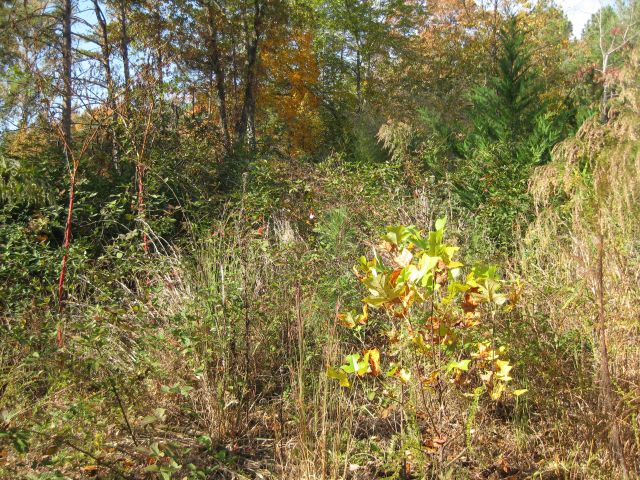
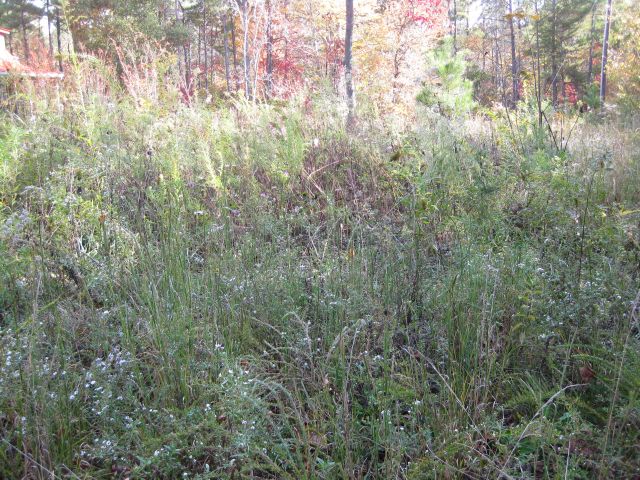
Succession doesn’t really work in a suburban setting because at some point the local authorities will become involved as complaints escalate. But it is great for my rural property. Basically, succession means stepping back and doing nothing and letting nature take over the yard. The grasses which used to be mowed are taken over by more aggressive annuals (pioneer plants) which thrive in an untended natural setting. In time the annuals will be shaded out and displaced by larger perennials, which in turn, some years later, will be displaced by natural seeded trees (in my case pine trees and tulip poplars). Succession is a natural process and maintaining an immaculate lawn is an unnatural process i.e. we are going against nature, which is why so much effort and dollars are expended on herbicides (pre-emergent, post-emergent), pesticides, fertilizer, mowing, spiking, irrigating and leaf clearing operations – we are trying to hold the lawn at an early stage of development while nature is trying to progress matters (my neighbors will quibble with the word “progress”).

So I am allowing succession to occur on my rural property in the areas where I am not growing food. Actually, in some cases I am doing accelerated succession, which means that in addition to allowing the pines and poplars, maples et al. to seed and grow, I visit the woods and extricate white and red oak seedlings and plant them amidst the growing host. Oaks are very difficult to transplant – they send down long tap roots and success is only possible if you select a seedling which means some trial and error since what may appear to be a small oak seedling could be a specimen which has been waiting in the understory for 5 or more years and has a 4 ft taproot. However success is possible.

Perhaps my succession is not that different from the new rules for the British monarchy – whoever arrives first rules (for the time being).

succession
previously mowed area - you can spot pine, tulip poplar and a transplanted oak
succession
previously mowed area, now pine, tulip poplar, and perennials including pokeberry
succession
this looks a mess, but within various saplings are growing and will one day take over

walk in the woods

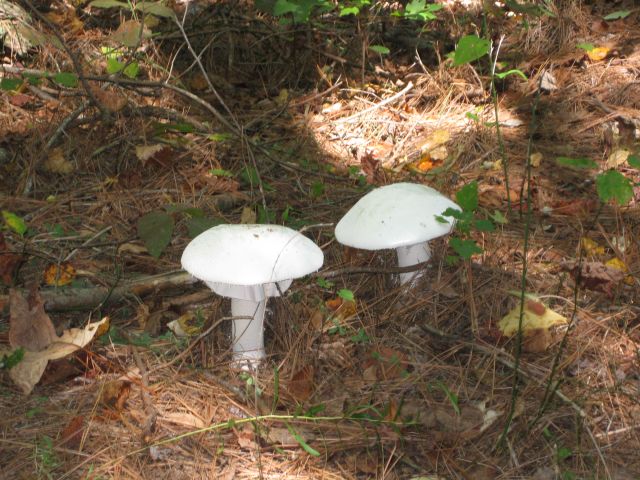
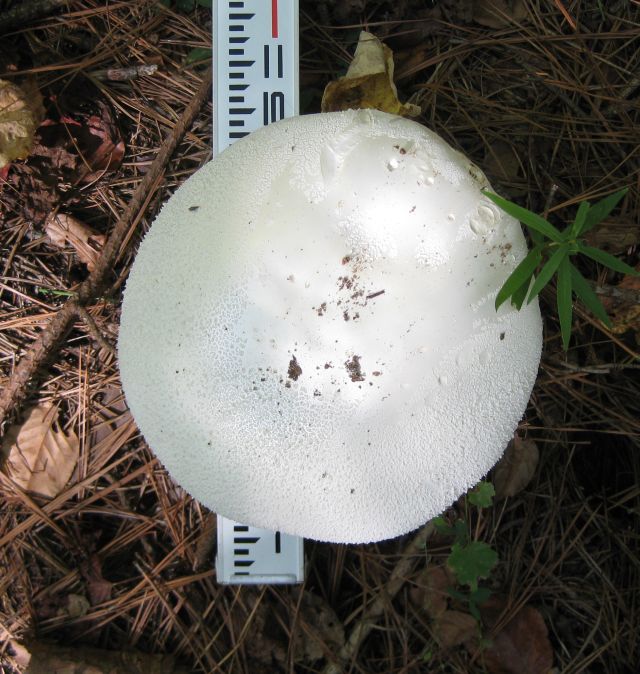
two large mushrooms suddenly appeared in the woods
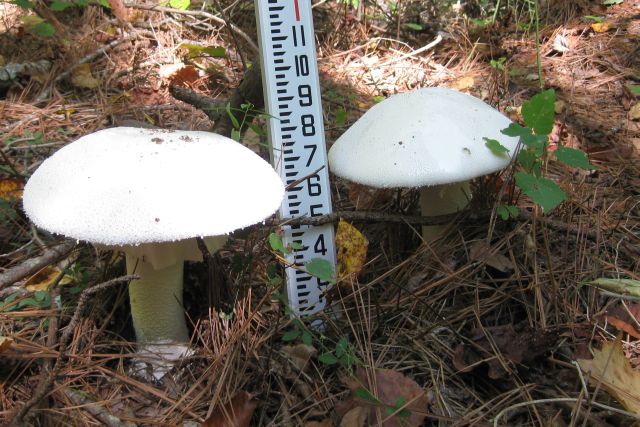
the mushrooms have a height >8"


the mushrooms have a diameter >8"

During fall the woods provide different spectacles.  This morning I came across two large mushrooms.  I have placed a ruler alongside them and it appears their diameter exceeds 8″ and likewise their height.  Not sure what type they are and am not planning to eat them.


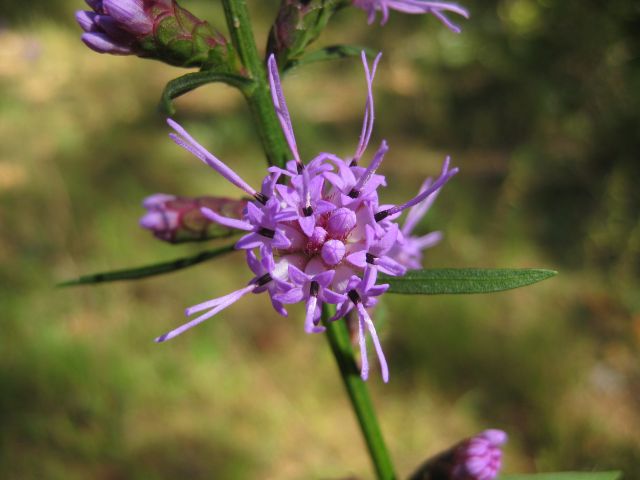
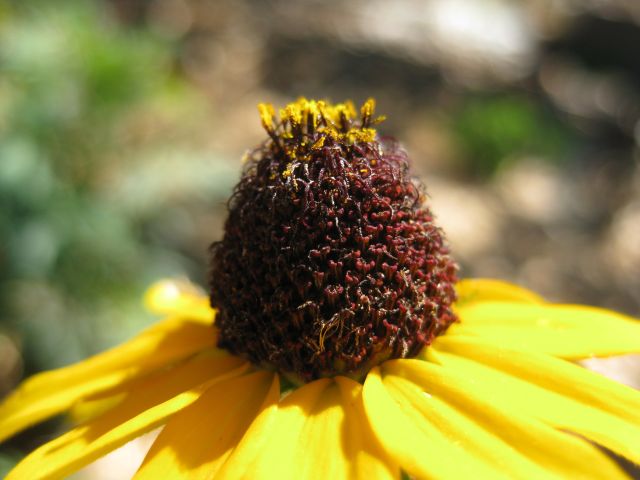
In previous posts I included photos of the lovely goldenrod and horseweed, which are all strikingly now in bloom.  A small but pretty flower when closeup is the blazing star Liatris pilosa (I am no flower expert and for identification I use Forest Plants of the Southeast by Miller & Miller, which was recommended me by several experts).

the purple shaggy blazing star

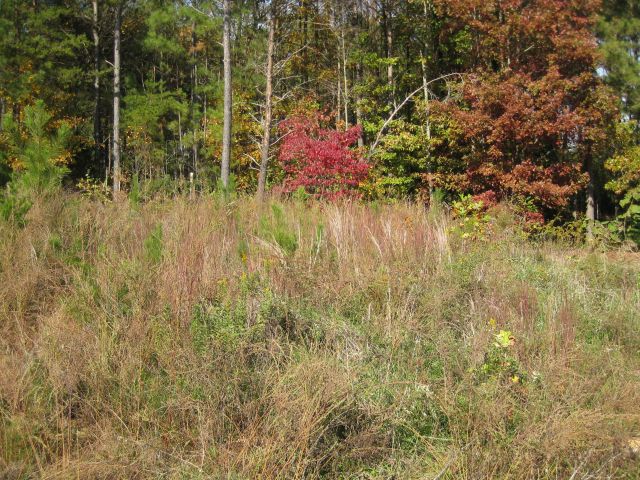
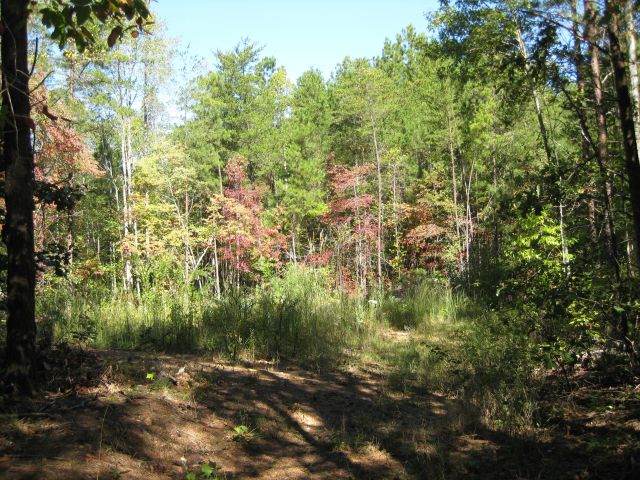
The blazing star and many other wildflowers arrived under their own steam to an area in the middle of the woods which used to be populated with pine trees. The southern pine beetle destroyed the trees and I chainsawed and moved the trunks to the sides and with my bobcat cleared the stumps and leveled it. I installed a few lespedeza but otherwise left it to its own devices and each year more and more wildflowers and forest vegetation appear. Wild turkey and deer like to visit, especially when I leave some corn for them. Below is a ‘photo of the opening.
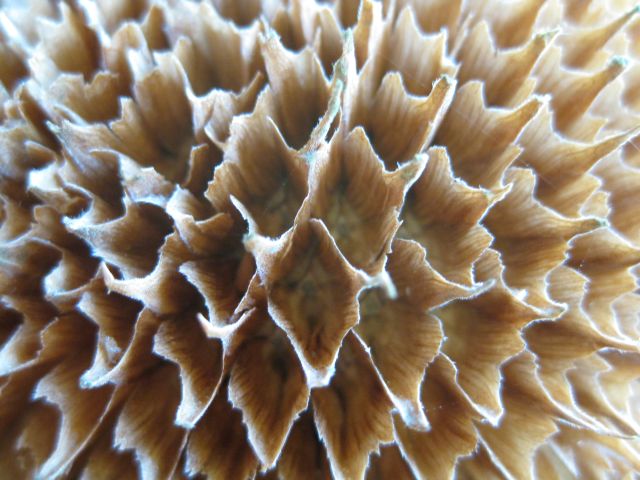
opening in the woods


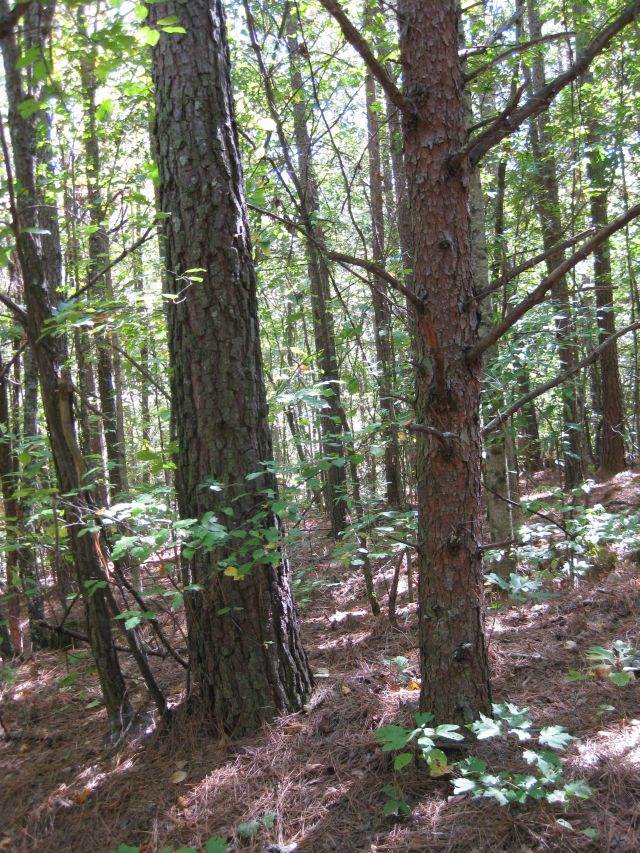
Loblolly pine on left and Virginia pine on right

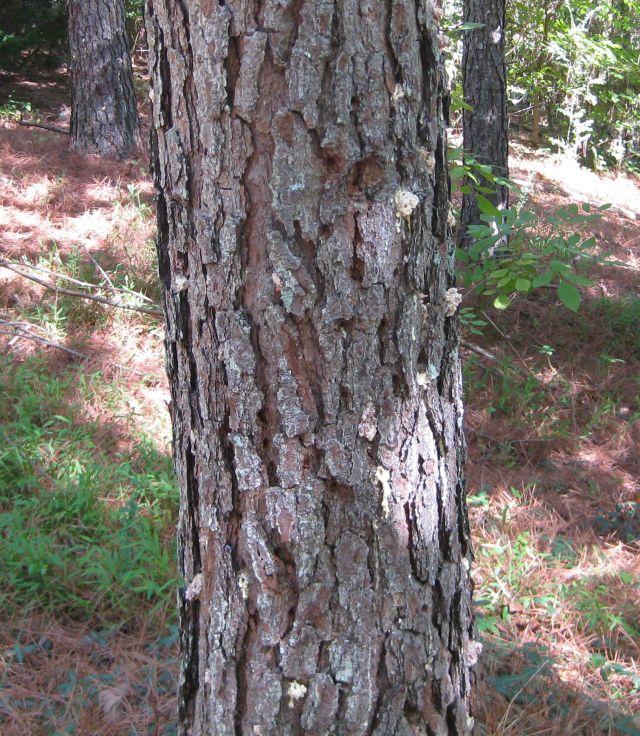
I have previously mentioned some of the trees in the woods.  There are two main types of pine, Virginia pine and Loblolly and it is very easy to distinguish them.  The Loblolly is self pruning, which means that as it grows the lower branches fall off and are covered by bark so that you cannot tell where the branches were.  The Virginia pine retains its branch stubs and its wood is inferior to Loblolly and is used mainly for pulp.  The advice I received from the Georgia forestry adviser was to cut down the Virginia pine to allow the Loblolly to grow better. I have let them be.
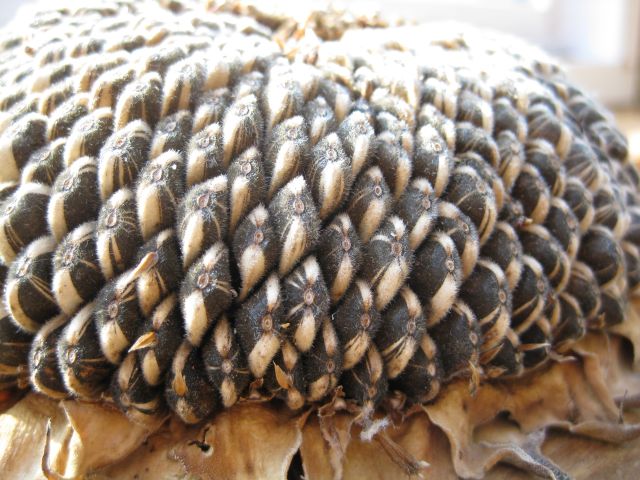


I am collecting seeds from Black Eyed Susan and Zinnia and I noticed seeds germinating in the Black Eyed Susan pods – quite unusual.

Black Eyed Susan seed pod
germinating seeds in Black Eyed Susan seed pod

pine beetles

dead pine tree from a distance
dead pine tree
white mounds can be seen on the bark
close up of white glob of gum from black terpentine beetle
white glob of gum from beetle

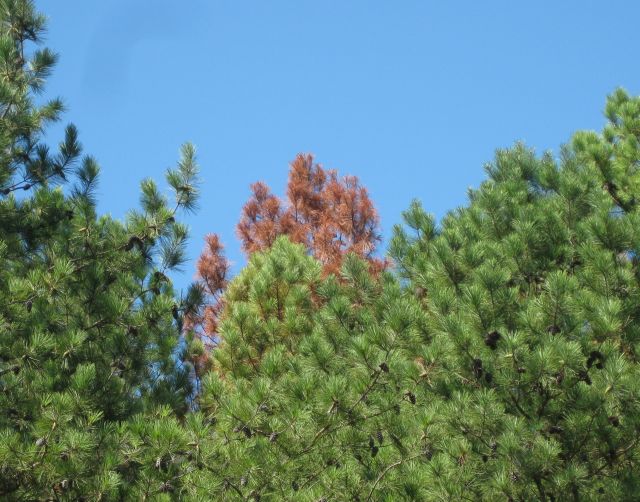
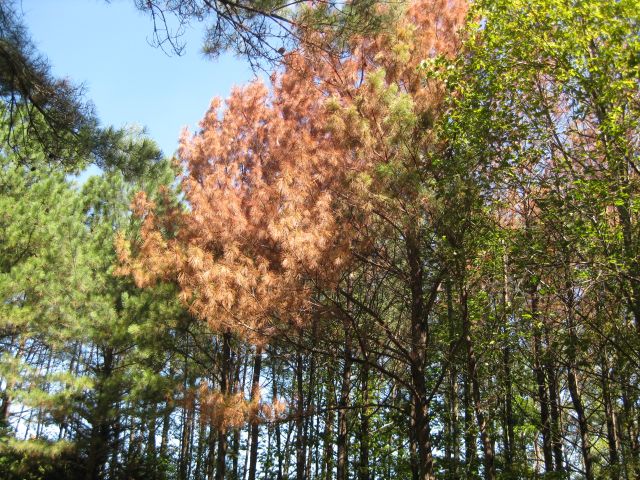
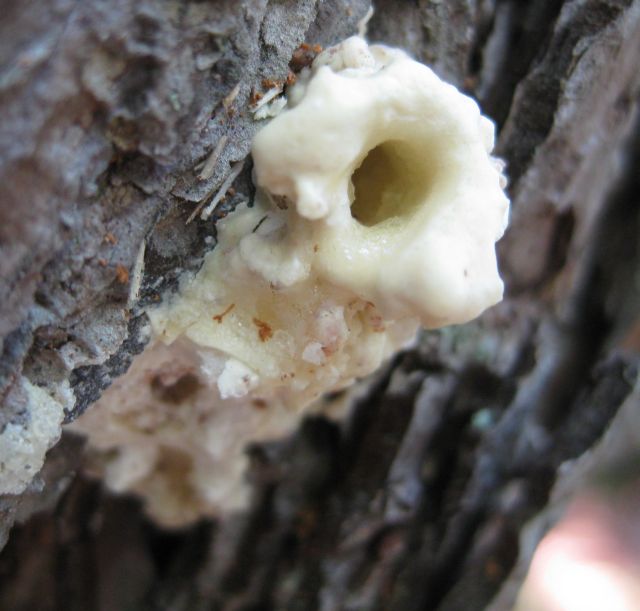
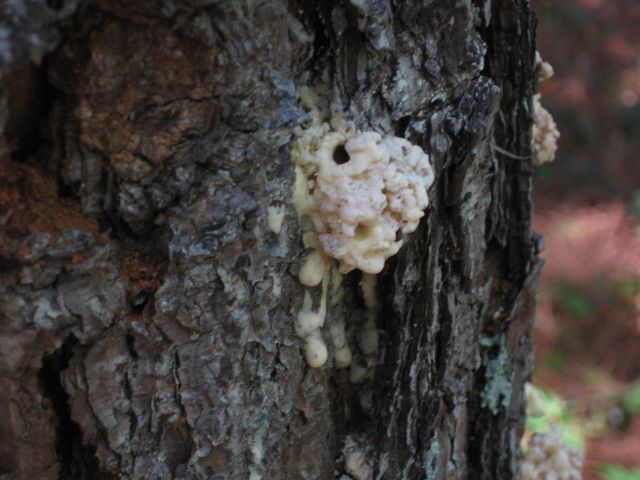
A few days ago my neighbor mentioned to me that several of her pine trees were dying and she thought this was due to pine beetles.  We looked at the trees – their foliage had turned red as you would expect from deciduous trees in the fall, but these are evergreen trees.  Even at a distance we could spot white blobs on the trunk, which from a closer position, appeared to be a crusty excrescence.  This was a pine beetle attack.  There are two main types of pine beetle in Georgia – the southern pine beetle and the black turpentine beetle and the culprits in this case are probably the black turpentine beetle since the infestation does not seem to extend above 8 ft and the white gum blob is typical for this beetle.  With my neighbor’s consent, I will ask the forestry commission for their suggestions as to what we should do to prevent this problem spreading.

The reason I mention all this is the front page (and succeeding two full pages) article titled “The Threats to a Crucial Canopy” which appeared in today’s (10/1/11) New York Times.  An excellent article on how trees are being impacted by rising temperatures and/or lack of water. Shortage of water stresses trees and makes them more vulnerable to beetle attacks and warmer temperatures are enabling beetles to survive winters, which previously would have killed them off.  An interesting offset is that trees are apparently growing more vigorously as a result of increased carbon emissions, since trees and other vegetation depend on carbon as a food supply.  So increased growth on the one hand and increased vulnerability from rising temperatures and water shortages.  The article is well worth reading – http://www.nytimes.com/2011/10/01/science/earth/01forest.html?_r=1&ref=todayspaper

fall wildflowers

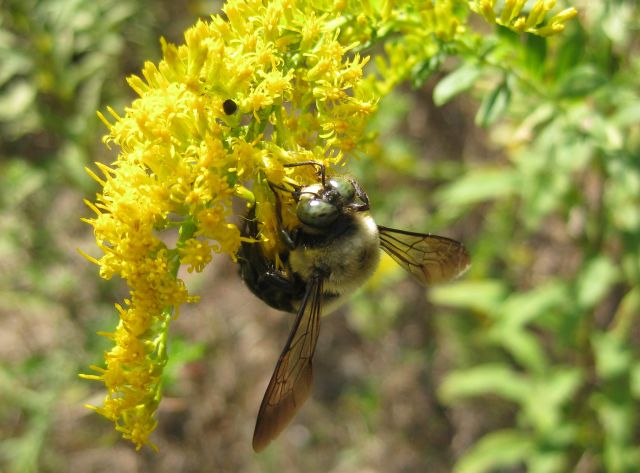
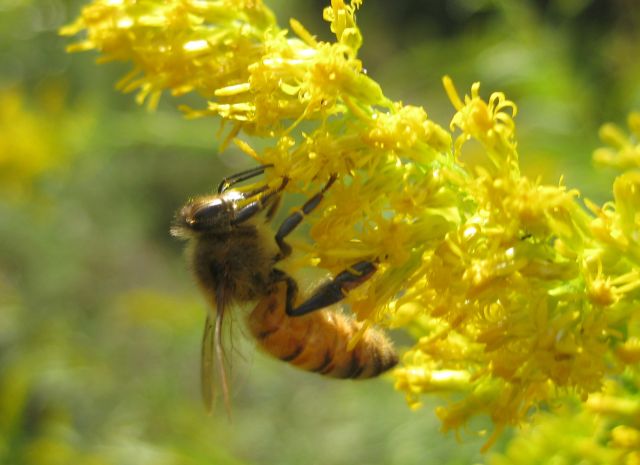
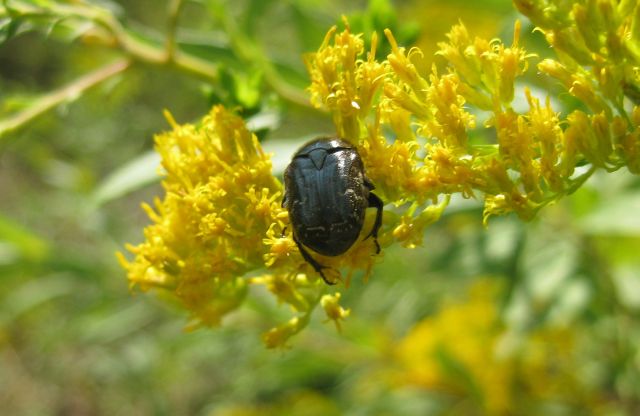
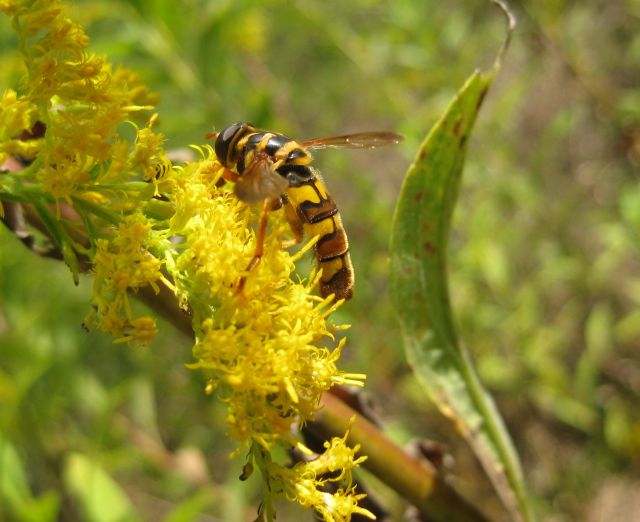
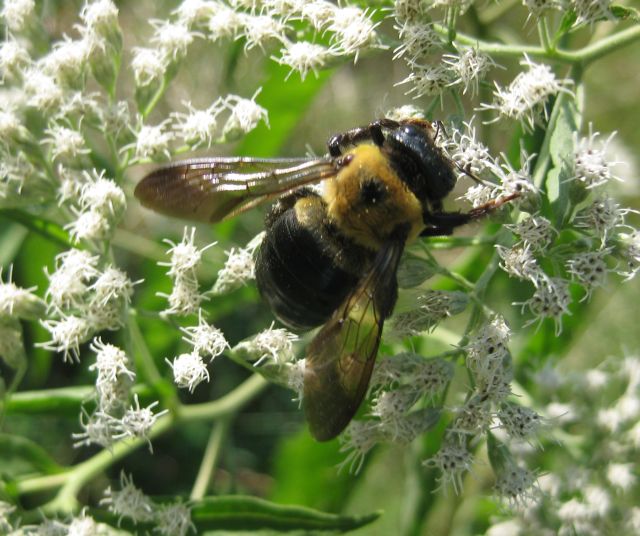
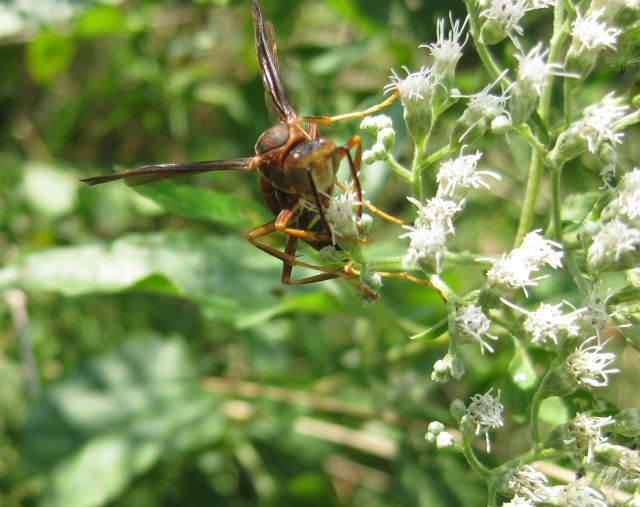
During the summer I allow the tall “weeds” to grow as they wish.  In fall the goldenrod, fleabane and horseweed  (and cosmos which I planted) are transformed to food delights for the bees and wasps.

bumblebee on goldenrod
honey bee on goldenrod
bug on goldenrod
bee on goldenrod
bumblebee on horseweed
wasp on horseweed
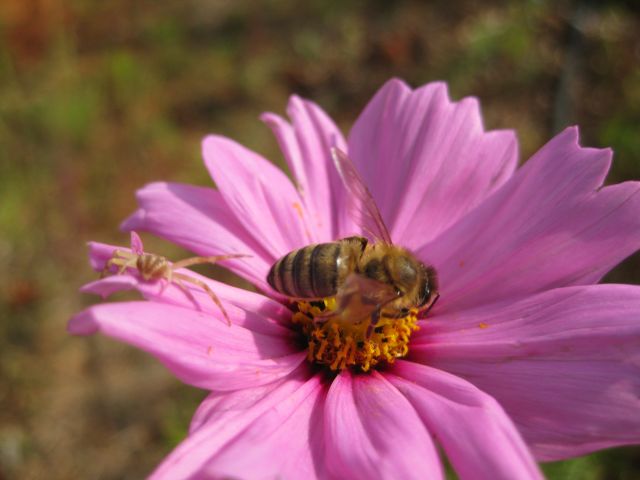
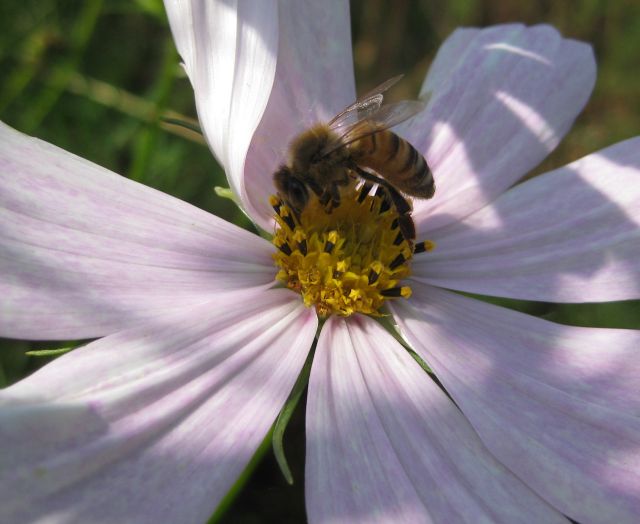
honey bee on cosmos
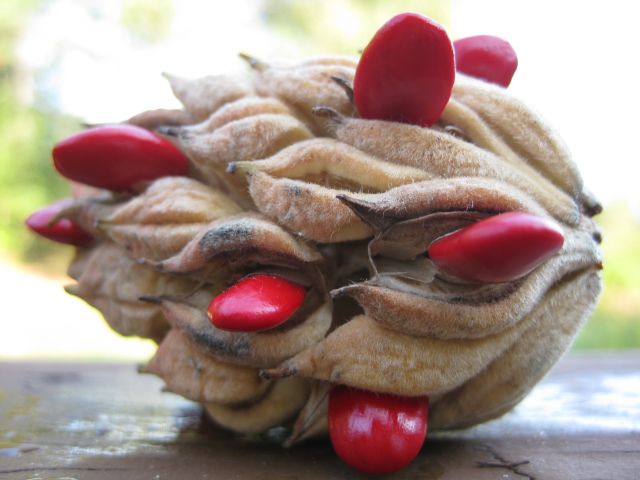
guess what? not M&M's! magnolia seeds emerging from pod
guess what? where the sunflower seeds were before the birds got to them
these sunflower seeds were saved
spinach in 2" soil blocks, a week or so to go and then transplanting
where the new chicken coop will go

autumn has arrived

Today, September 23 is the first day of Autumn.  And our rain and weather the past week has been great – > 2.5″ past 48 hours.

I see so much activity among the fall blooming flowers that I googled macro photography and then downloaded my small camera’s manual and discovered there is a setting for close up photos.  So I have been snapping away.  The drawback with my camera is I have to get real close and the wasps flew off before I got into range and the bumblebees also began to get irritated (I assume they are bumblebees not carpenter bees).

I planted a lot of cosmos for the bees for end of season replenishing of food stocks, there is also another visitor behind the bee


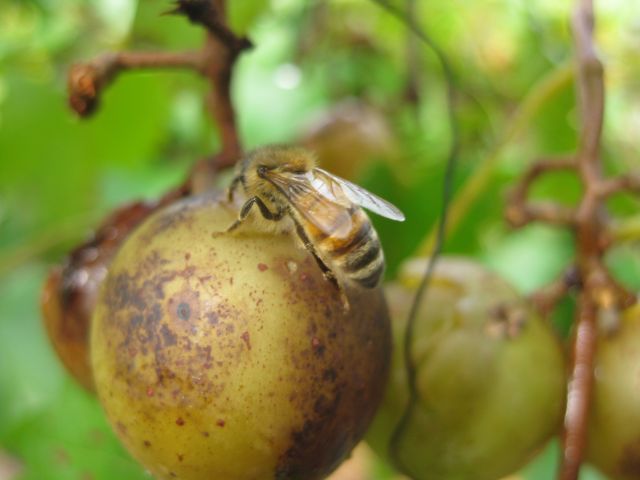
the bees and the wasps love the muscadine, especially scuppernong
bees have powerful jaws & have no problem ripping open a muscadine
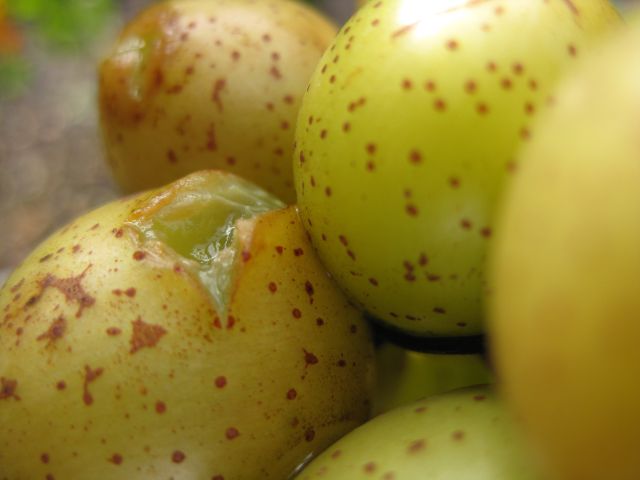
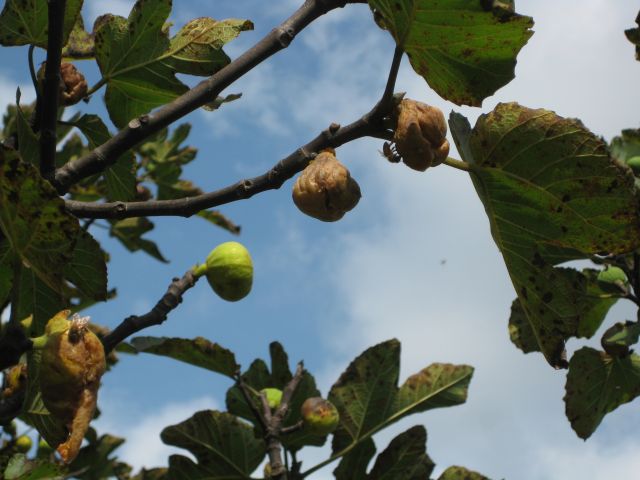
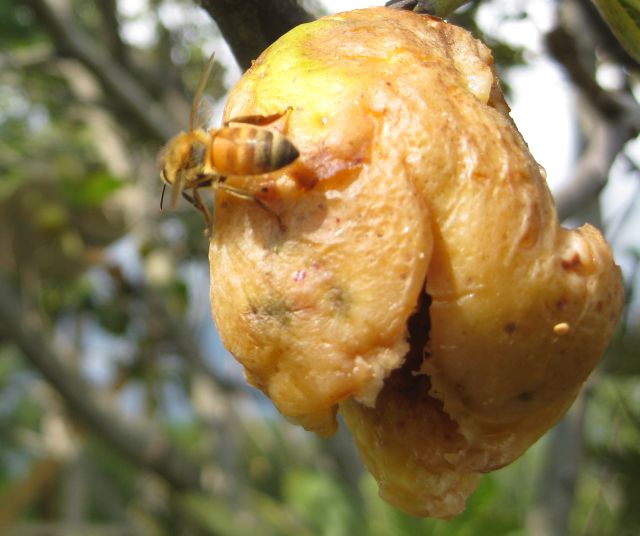
suddenly the figs have ripened and the bees are on to them as well
the bottom of the fig opens up (these were green a few days ago) and attracts lots of visitors
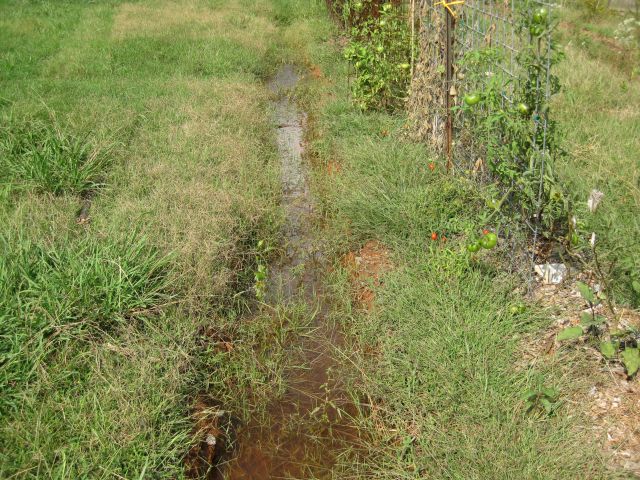
I must include a pic of a rain filled contour ditch, the water sits in the ditch and seeps into the soil and keeps the plants going a while
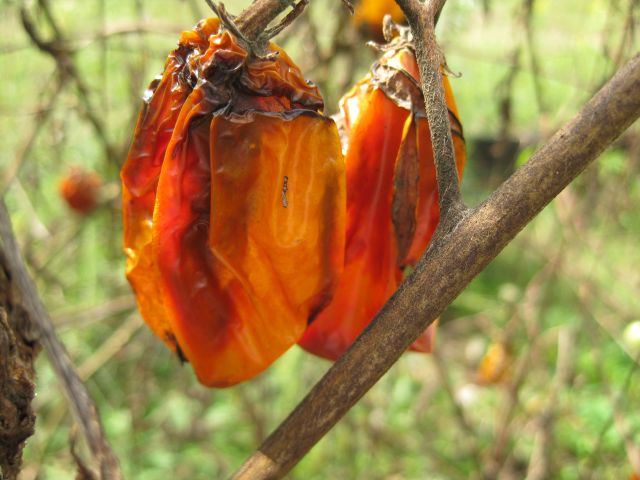
and it's not all success, here are some forlorn looking heirloom tomatoes
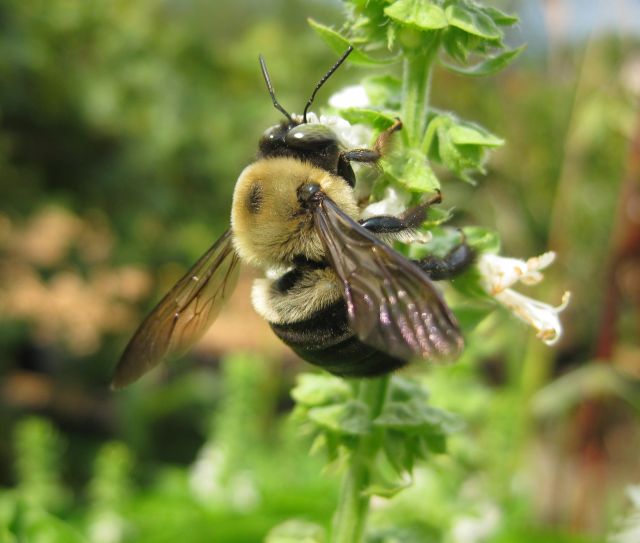
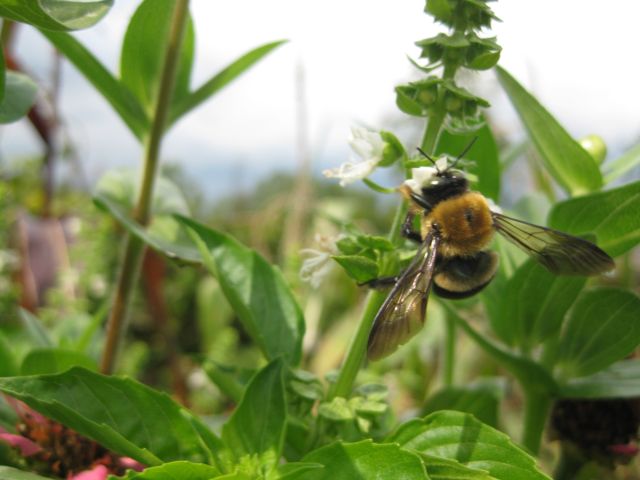
back to a food gatherer on a basil plant
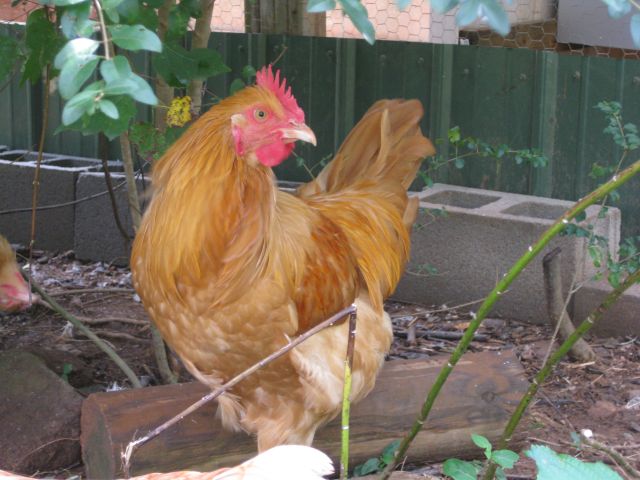
and two last shots, one of Buffy our rooster, who regained his crow (see narrative below)
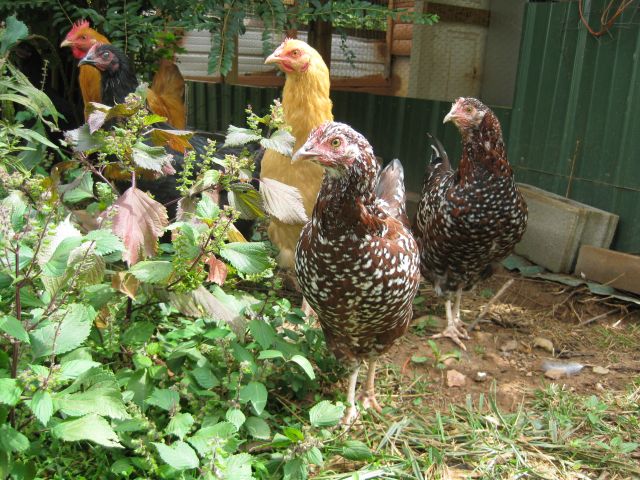
and Buffy at rear and some of his cohorts including Lady Macbeth, a fellow Buff Orpington


Buffy, the rooster, had a good beginner’s crow a few weeks ago, such that the older girls on the other side of the fence became seriously interested. And then he lost his crow. So I did a lot of thinking about what could have caused this. And then I remembered. When we first purchased the chicks, they were just 8 weeks old and Buffy used to come right up to me and ask to be picked up. After he got his crow I thought it would be a good idea to pick him up again since I know they can get aggressive later so why not stay on familiar terms? When I eventually caught him, he shrieked maniacally, but I held onto to him and he quieted down and his flock came by to see and, with hindsight, I think he was so humiliated to have his flock witness his subjugation, that he lost his crow. So, since I like his crowing which has become louder and longer, I will leave him be and we will keep out of each others way.

trying to get smarter

A few evenings ago, after locking the chicks in the pen, I heard an unusual noise and went to investigate.  The coop is divided by an inner partition.  The two Golden Comets were on the one side on the roosting perch, which didn’t surprise me since from the get go they were ostracized and even though now they appear to be accepted, they still act independently.  On the other side of the partition I saw an unusual sight – the other six chicks appeared to be shoving and tugging to get into a corner of the coop.  It appeared each one’s efforts was to get to the bottom of the scrum for even when one climbed on top of the melee it wasn’t satisfied until it had dislodged those below it and was situate on the bottom in the corner.  What was just as interesting was that the two Golden Comets, who had followed me, immediately joined in the proceedings.  It was a continuously revolving spectacle.  I dislodged them momentarily and examined the corner and there was nothing unusual about it, to explain their intense need to access it.

As I pondered, there came to mind a similar event which occurred the previous December.  On a mild winter’s day I had examined the hive to check their food situation and inadvertently dislodged some 40 bees which immediately formed a cluster on a plank.  I placed the plank at the hive entrance and expected them to move the 6 inches or so into the hive.  But they stayed in their cluster, which I saw when I moved closer, was in continuous motion with bees underneath coming to the surface to be replaced by the bees on the surface.  I left them there assuming, when they had concluded their activities, they would move into the hive.  The next morning, the little cluster of bees was still on the plank, frozen in place.  I did not realize they were desperately trying to keep themselves warm, as they do in their hive during the winter, and that what I was watching was desperation and panic.

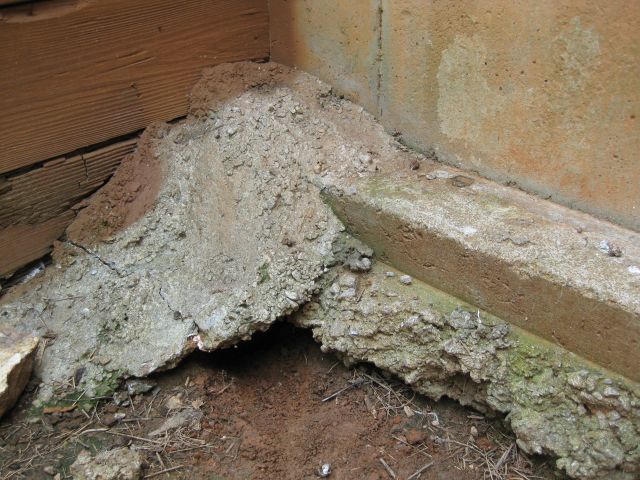
tunnel under concrete layer, into coop


So with this lesson in mind, I continued to study the chicks and came to the conclusion that the reason each one was struggling to get to the bottom of the corner was because this was the safest place to be from a predator.  So something had spooked them.  I reexamined their little fully enclosed courtyard and decided that the hole under a piece of concrete which I had assumed they had made  for sunbathing or dusting purposes, should be more closely examined.  In fact it turned out to be a tunnel and on the outside of the coop I found the entrance hole to the tunnel.  The tunnel was some 4 feet in length and maybe 6″ to 8″ in diameter.  My fortuitous visit had interrupted what may have been a disastrous evening.  I plugged the tunnel and placed cinder blocks all round the coop perimeter.  I had known predators are motivated and can and will dig, but had assumed that the 4″ depth of the perimeter wall/fence would have provided adequate protection.
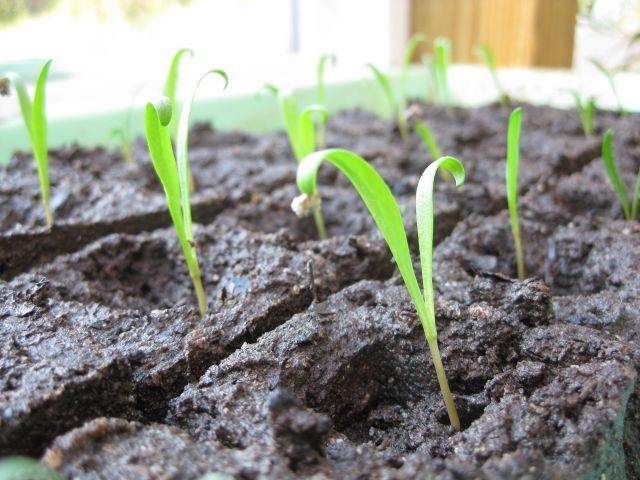
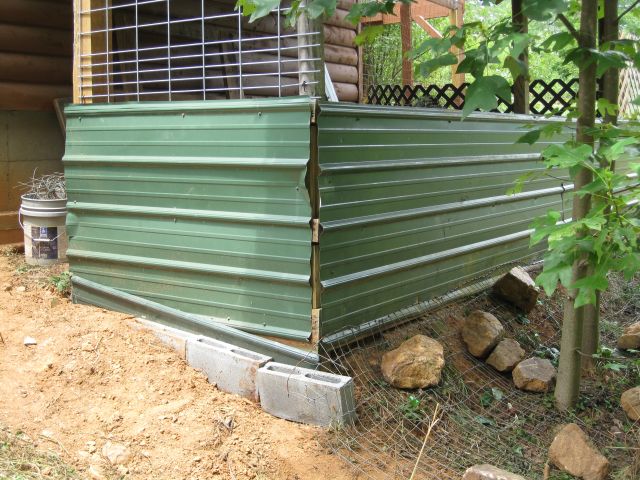
cinder block and horizontal fencing protection

My neighbor who introduced me to chickens has agreed to give me her 6 mature girls – 4 hybrids, 1 Americauna and 1 Rhode Island Red.  Since her girls, which regularly produce 4 eggs daily, are much larger than my 14 week flock, I must keep them separate, which means building them their own coop and outdoor exercise area. With my enhanced respect for the wiles of predators, I am reinforcing the adjoining woodshed which will become the new coop. Because it is situated on a slope, which means even if I put down a 1 ft vertical barrier the invader could probably tunnel under, I have decided to lay horizontally a 4 ft wire wrought fence, which is held in place by surplus 10″ steel tent stakes and rocks. Much work still remains before the coop is ready for service.

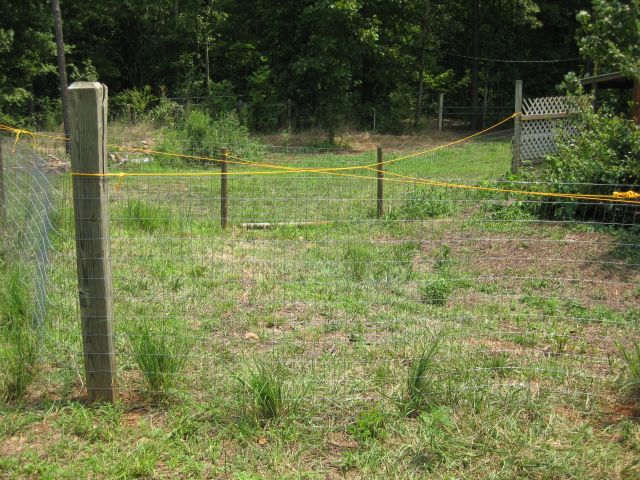
hawk protection?

While walking the adjacent woods early in the morning we startled a Great Horned Owl. This got me thinking about the need to protect the chicks from aerial attack by hawks or this big owl. So I cross laced the fenced exercise area with yellow rope which I hope will complicate and deter any aerial strategies.