corn origins

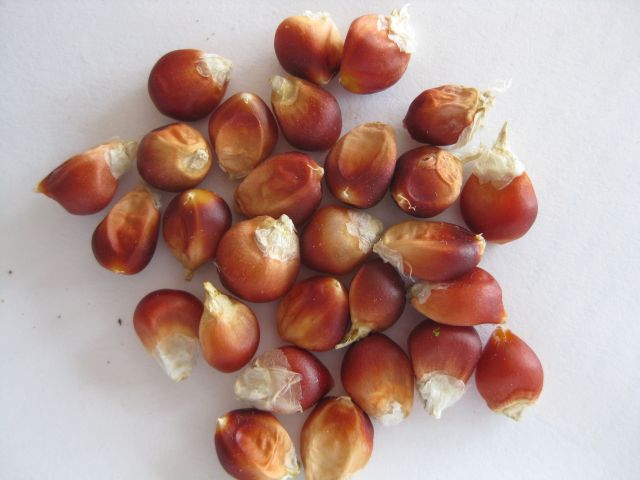
I received a gift from west coast visitors – Floriani Red Flint Corn. The accompanying information mentions it is a staple polenta corn and family heirloom grown for many years in the Valsugana Valley of Italy. The uninitiated would assume this corn originated in Italy, but it did not.
corn
Floriani Red Flint Corn

I am enjoying snippets from “1491” by Charles Mann which describes the Americas before Columbus. As we know, the corn kernels we eat grow on a corn cob. It is also apparent that a corn cob cannot self seed – it has no mechanism to shatter or shake the kernels off the cob/husk and the kernels will not survive a trip through the intestines of a bird or animal. Corn (maize) is entirely dependent on humans to seed it in the fields (unlike wheat, rice, millet and barley, the ancestors of which could self seed). If corn cannot self seed then how did it originate?

A recurring theme in “1491” is that the inhabitants of the Americas prior to Columbus were far more sophisticated than most of us suppose. Mann states that the early inhabitants of Mesoamerica (roughly Central America) developed not only corn but also tomatoes, peppers, most of the squashes and many of the beans. But corn is the most intriguing. Since it cannot reproduce itself the Indians must have developed it from another species. The closest genetic relative is a grass called teosinte, which looks very different. A debate raged amongst scientists as to whether corn developed from a mutation of teosinte or from a now vanished ancestor, Tripsacum, or from repeated mixings of other types of grasses. There appears to be agreement, however, that its development must have required biological manipulation by determined, skilled plant breeders.

There is a wide variety of corn in lots of different colored kernels and sizes with more than 50 genetically distinguishable “landraces”. Because corn is open pollinated and the wind can blow the pollen from field to field, if uncontrolled the result would be an homogeneous entity. But because early farmers sorted their seed and were careful with their plantings, they were able to maintain a large variety of different corn.

Mann also mentions that Indian farmers grown corn in a milpa, or maize field and will plant a dozen crops at once including corn, avocados, multiple varieties of squash and bean, melon, tomatoes, chilis, sweet potato etc. The “three sisters” corn, squash and beans are well known in permaculture but the milpa which Mann refers to is far more extensive. He suggests the milpa is superior not only to monoculture and its dependence on artificial fertilizers, but also to the practice of crop rotation, and that this is evidenced by its continuous cultivation and long term use.

It is corn planting time (advanced by the unseasonal warm weather we are having), the rain has let up, and I am heading for the field.
permaculture trending – comfrey

I like the pragmatic and intellectual underpinnings of permaculture. On the intellectual side, I am reading and enjoying Holmgren’s “Principles and Pathways beyond Sustainability”, at the quasi pragmatic/theoretical level I enjoyed Hemenway’s and Whitecraft’s books on permaculture in the United States and the United Kingdom respectively, and for a hands on approach, of course the two books by Holzer. And some of the suggestions have rubbed off.

Polyculture and biodiversity are not new to organic growing. I purchased in the 80’s Riotte’s book “Carrots Love Tomatoes – Secrets of Companion Planting for Successful Gardening” which was first published in 1975. However, the focus on perennial plants and guild’s is new for me.

I have grown Mullein (several varieties), Black Locust and Osange Orange from seed and will be transplanting them soon. My efforts to grow Gumi from seed have not yet succeeded. The plant that fascinates me the most is comfrey. My father-in-law was a serious organic grower in South Africa and he grew comfrey in the 60’s and 70’s. But its controversial history goes much further back in time.

An interesting read, is “Russian Comfrey – A Hundred Tons an Acre of Stock Feed or Compost For Farm, Garden or Smallholding” by Lawrence D. Hills published in London in 1953, which can be freely downloaded. The book begins with a quote: “Russian Comfrey is a weed; no stock will eat it; its yield in dry matter per acre is below that of orthodox fodder crops; it is impossible to get rid of, and fit only for a half-hearted trial on an odd corner of land where nothing else will grow. Its possibilities have been greatly overrated by those who sell it at high prices, and nothing reliable is known about it…..”

The story of Russian Comfrey begins in 1771 when an English gardener living in Hackney, London sold his nursery and became head gardener to the Palace of St. Petersburg for Empress Catherine The Great, of Russia. Between 1790 and 1891 he sent back to England several varieties of comfrey of which S. asperrimum became more highly regarded than S. officinale, the native species to England. Over the past 200 years it has had staunch supporters and harsh critics.

Apparently all species of comfrey require a deep soil, not necessarily a good one, and they have a reputation for growing on land where nothing else will grow because they have long and powerful roots which dive straight down and access subsoil water and minerals. A hard pan will defeat them, they need at least four feet depth, a 6.0 ph is as low as they can go, and they are at their best on clays, loams and sandy loams. They are used to cold winters and are moderately shade tolerant. However, they are unsuitable for planting under fruit trees not only because of the size to which they grow but because they will compete with the tree for nitrogen and potash. Comfrey must be cut frequently (every 4 to 6 weeks) in summer and not allowed to go to flower.

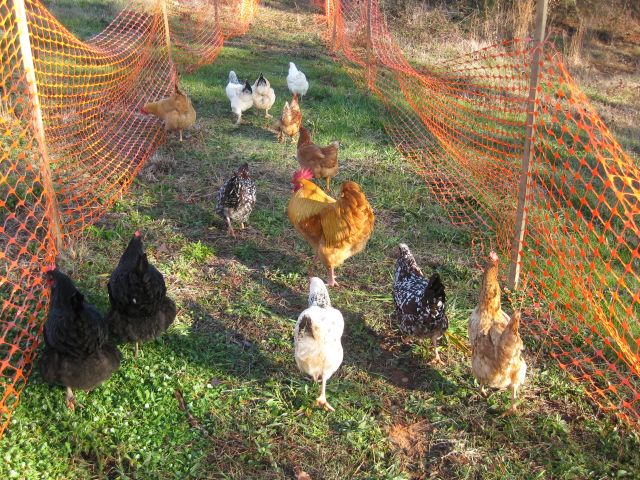
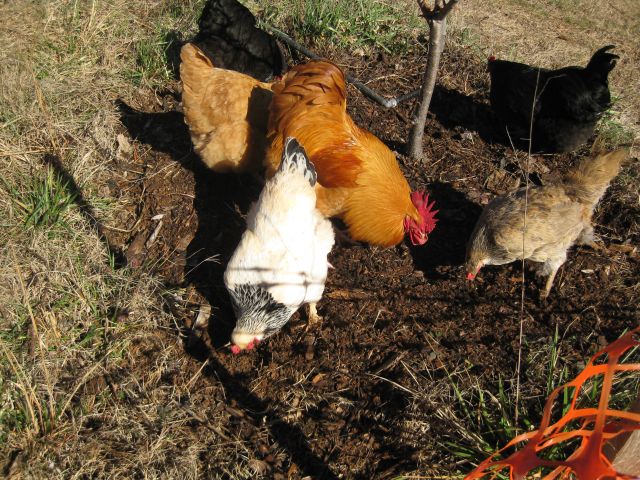
The Russian Comfrey does not spread by seed but by its roots and to prevent it becoming an invasive the ground near it should not be tilled. Since I shall not be using it for fodder, it will be composted. My poultry shall be doing the weeding and providing nitrogen rich droppings.

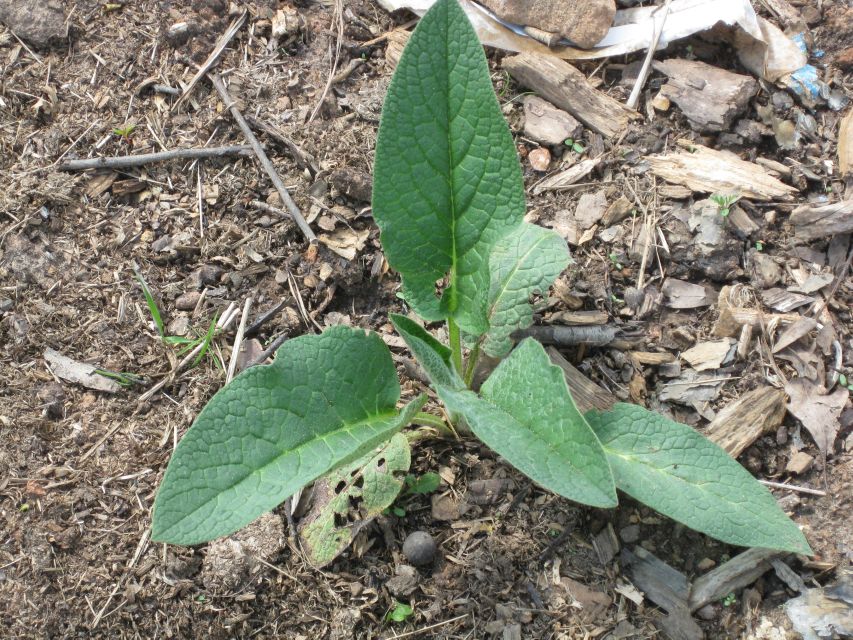
I purchased several Russian Comfrey root cuttings in the fall and they have now surfaced and are growing vigorously.

comfrey
Russian Comfrey growing vigorously, planted in the fall


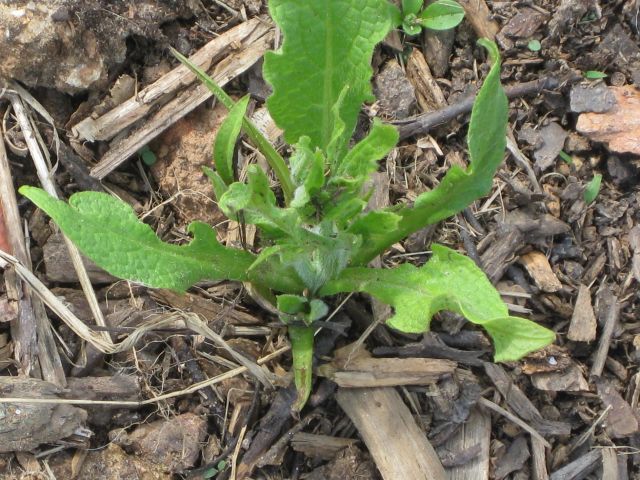
I also installed one cutting of Comfrey officinale, which does spread by seed and must be carefully watched. It has just surfaced and begun growing.

comfrey
Comfrey officinale – just one plant to monitor


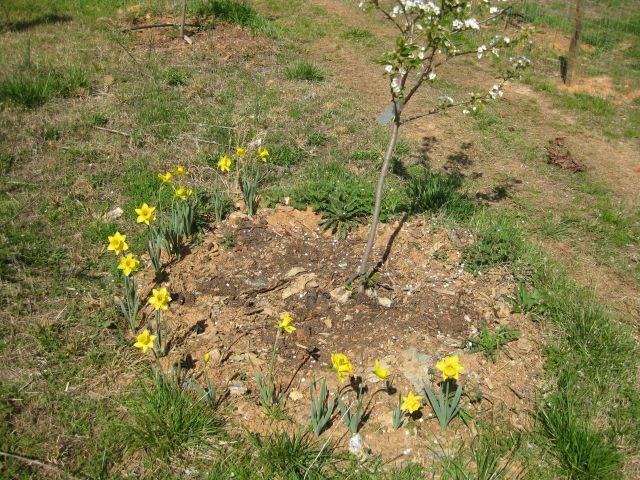
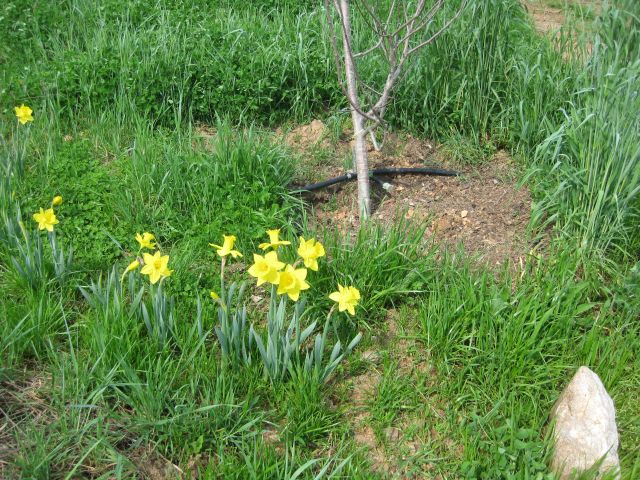
I mentioned my interest in guilds, a frequent permaculture topic. One of Hemenway’s suggestions is to plant daffodils around a fruit tree. They flower early in the season so will not compete for water in the dry months, they are poisonous and may dissuade predators and, they look pretty.

comfrey
blossoming pear with daffodil companions


Most of my pears are now in blossom. Last year I lost all my pears to a late frost. The average last frost day here is mid-April, so I am watching the weather reports and if frost is imminent I may try wrapping my pear trees to protect them. Below is an apple tree with daffodils and various cover crops which I shall cut down after they have seeded – I know I shall lose the benefit of the nitrogen nodules on the hairy vetch and clover but allowing them to seed gives me more for next year.

comfrey
apple tree with daffodils and cover crops including crimson clover, winter rye and hairy vetch


I am not including a photo of an apple tree with a nearby comfrey since, having now read the book on Russian Comfrey I realize I planted the comfrey too close to the tree and must relocate it – watching out of course that I do not leave any root remnants behind.

responsibility to animals

I had a good time at the Georgia Organics annual conference – its 15th and my 7th.  The Friday workshops and farm visit and the Saturday educational sessions were excellent and the two keynote speakers have national repute and lived up to expectations.  At my breakfast table on Friday morning was an organic livestock farmer.  I asked him a question which was triggered by the assistance I am providing to two ailing chickens:  “What do you do when one of your animals get sick?”  His answer was simple and to the point:  “If they get sick it means they do not fit in my system and I eliminate them.”

Later that day during the farm visit the same topic came up when the farmer was asked how often he deworms his sheep.  He deworms them all at the beginning of the season and then if one sheep needs deworming he will deworm it a second time and if it is still wormy (if that is the word) he eliminates it – “three strikes and you’re out” he said.  I am interested in dairy goats so I attended a session on keeping goats.  The presenter was from the west coast (interestingly several presenters had moved from the west coast to Georgia or Alabama) and her stance was different.  She stressed the importance of good management practices and prevention but, if a sheep or goat gets ill and is non responsive to organic treatments, she will use conventional medicine.  She felt she has a responsibility to the animal and cannot let it suffer.  The final viewpoint was expressed by a DVM (doctor of veterinary medicine) who said he would cull the animal to avoid the problem spreading and because its genetics were wrong.  His only exception was if the animal was a pet and then he would do whatever to save it.  So four commercial practitioners came to a three to one vote.

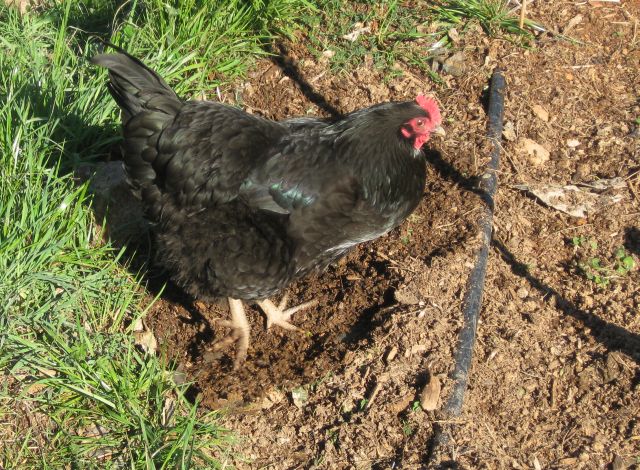
Some decisions are not simple.  If you hew to the organic road then conventional treatments should have no place.  I also understand the “genetics” argument – it is no surprise in humid summers that the tomatoes with inbred resistance to the various blights do far better than the regular tomatoes.  So to travel the organic path you must select robust partners.  I would probably have done much better with hybrid chickens than some of the gorgeous looking birds we bought, a few of which are struggling, which also makes me wonder if perhaps there was some inbreeding down the road.   One chicken has a persistent sour crop, which means the food she eats is not being processed properly by her body.  I watch her closely – she is the only one who won’t eat the occasional greens or yogurt which I provide, which would have helped avoid her condition.   After a couple visits to the vet I am now medicating her with nystatin (using a feeding tube down her throat to administer the medicine) and she may (believe it or not) have to wear a bra to help her crop regain its regular shape.  This is going to extremes, I agree, but I am also interested in how it all works – what causes things to go wrong and how you can fix them.

If you have to make a living from organic farming then culling the inferior specimens seems the way to go.  But then it gets back to why you are doing this anyhow – if it is to experience all the manifestations of life it is hard to let one depart when you could (presumably) have saved it, or at least made the attempt.


water

I think we take water for granted but should not. Friday’s Financial Times (Feb 17, 2012) reports that “Chinese officials have issued a stark warning over growing water shortages saying the situation is worsening every day and that more than two-thirds of cities are affected”.

Texas last year had the driest year on record, but the good news is that the drought may be receding and only 14% of the state is now in “exceptional drought” compared with 41% 3 months ago. In Georgia we continue with intrastate disputes between farmers in south Georgia concerned with metro Atlanta’s water consumption, and interstate disputes between Georgia, Alabama and Florida.

I try to meet the challenge by limiting irrigation to food producing vegetables, shrubs and trees and by capturing rainwater either in containers for later irrigation or directly into the ground (see the tab on “Rainwater harvesting”). My Atlanta running trail is on the banks of the Chattahoochee River, a major river in Georgia which is more than 400 miles long. After it has rained the river is swollen and fast moving and I think during my runs, of all the precious water rushing south and lost to our use. If we were smarter we would retain the rainwater in the earth or containers so we could use it later. If we were smarter we would also reduce our water use – do we have to plant lawns and plants, which require heavy irrigation in the summer? Other than food bearing plants, which we pressed into servitude and must be hydrated to produce to our expectations, why don’t we use plants acclimatized to our weather patterns. Once established with some tender care, and mulched, they should be left to fend for themselves, assisted by our snaring rainwater into the ground for their use.

I continue to be intrigued by a rainwater ditch which winds through the north facing slope of my woodland. Initially I thought it was a contour ditch and a lot of it is on contour. But as I have traced it along it now appears that it slowly winds to lower levels of the hill. I think the intention was to have it on contour (horizontal) but to ensure that when rainfall was heavy the water would not wash over the ditch and erode it, so instead the excess water escapes to lower levels where it follows the contour for a while and then moves to lower levels. The idea apparently was to hold as much water in the ground for as long as possible. I may have mentioned in a previous post that there is a spring at the bottom of the hill which I believe originated from the water captured by this long winding ditch. All this comes to mind from an intriguing book I am reading -“1491” by Charles Mann, which postulates that the inhabitants of the Americas before Columbus were a lot more sophisticated than we think. I know it is a far stretch of the imagination to assume that the water snaring ditch on my woodland was built by earlier peoples, but who knows? And there are terraces also in two of the smaller valleys – who built them?

I do know that I should put this speculation aside and get seriously active with my bobcat in the main watershed area in the woodland by creating contour ditches/swales to forestall the loss of rainwater. A project for me in the coming months.

fungi – growing mushrooms

My woodland has so many naturally occurring mushrooms that I am again inspired to grow my own mushrooms. I say again because when I first purchased the woodland it had no access road and I had to cut down a number of trees including oak trees to gain access to the interior where my tractor building now stands. At the time, I cut the trunk of one of the oak trees into 3ft logs and drilled and inserted shiitake mushroom plug spawn and placed the logs in a valley on the north side of a rise where it was mostly sheltered from the sun. With time the logs sprouted mushrooms, especially prolifically after extended rainy periods. Unfortunately I did not visit the site very often and when I did the mushrooms had either been eaten by wild animals or had matured and spoiled. Below is a ‘photo from April 2009 showing some overmatured mushrooms:

mushrooms
over matured shiitake mushrooms -note the edges of the cap have upturned

I kept myself busy with other matters and I only thought of mushrooms again last year when several wild cherry and maple trees had to be taken down. I thought mushroom growing was easy and, without research, decided to purchase several varieties of mushroom on birch dowel sticks (plug spawn) and innoculate the wild cherry logs. Bad idea! As I have now learned, cherry is not a preferred wood for mushrooms. I would have been better off using the maple logs. Apparently fruit trees, and wild cherry belongs to that class, should not be used. I built a mushroom shelter and watered the cherry logs intermittently and, to date, zero.

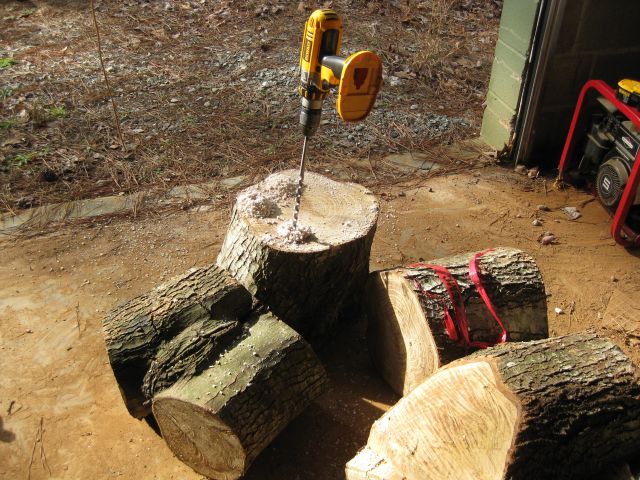
When my neighbor had her sound maple tree cut down (it was threatening the foundation of her house), I decided to get back in the mushroom business and bought grey dove grain oyster spawn. Grain spawn is more difficult to insert into a log than sawdust or plug spawn. Another difficulty – the logs were large in diameter, much more than the 8″ preferred diameter. So I had to make do and drilled vertical holes about a foot long into the face of the logs and filled with the spawn. Not a method I have seen used elsewhere, or recommended.

mushrooms
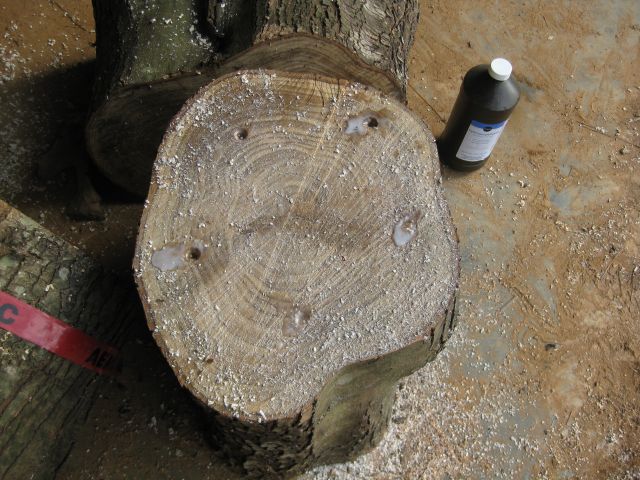
drilling holes in face of maple log for oyster mushroom spawn

I then sealed the holes with wax – I melted the wax with a blow torch and dripped the molten wax into the holes. I tried to keep things reasonably clean and swabbed tools and materials with hydrogen peroxide – the bottle can be seen on the side of the log.

mushrooms
5 vertical holes in face of log sealed with wax

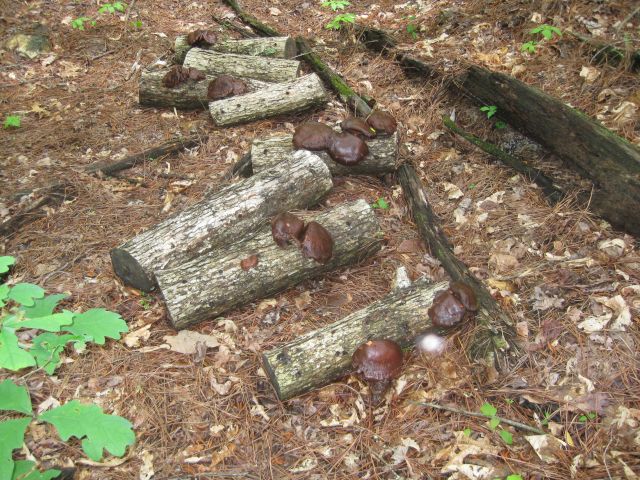
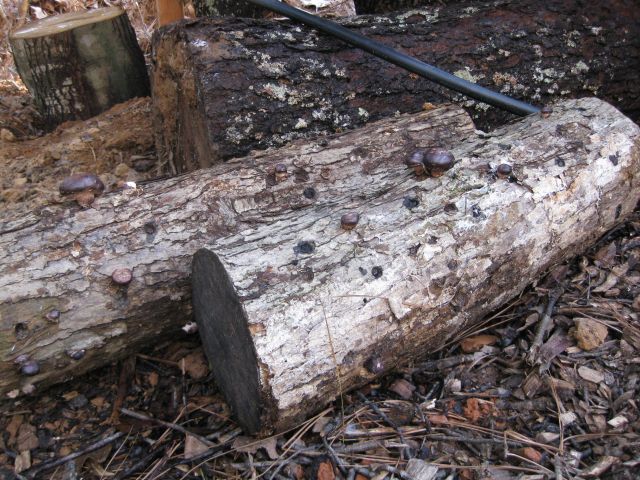
It is interesting how we draw conclusions which are so often wrong. I transferred to the wood shelter 6 of the oak logs from 2008/2009 which had borne shiitake. Four of the logs were light and two were heavy and, I assumed that if the shiitake were to fruit again (seemed unlikely after 4 years of neglect) it would do so on the heavier logs, which had more material remaining. So I placed the 2 heavier logs in the shelter where they enjoyed the same watering routine as the other logs and left the 4 lighter logs under the drip line of the roof. Well – young mushrooms began appearing on the lighter logs and not on the logs in the shelter. Perhaps the logs under the drip line received more water than the logs in the shelter, or the logs were lighter because the mycelium in those logs was more aggressive than the mycelium in the heavier logs. The logs came from the same tree so the wood should not be a factor. Below is a ‘photo of the young shiitake mushrooms now located in the shelter.

mushrooms
small shiitake mushrooms on logs left outside since 2007

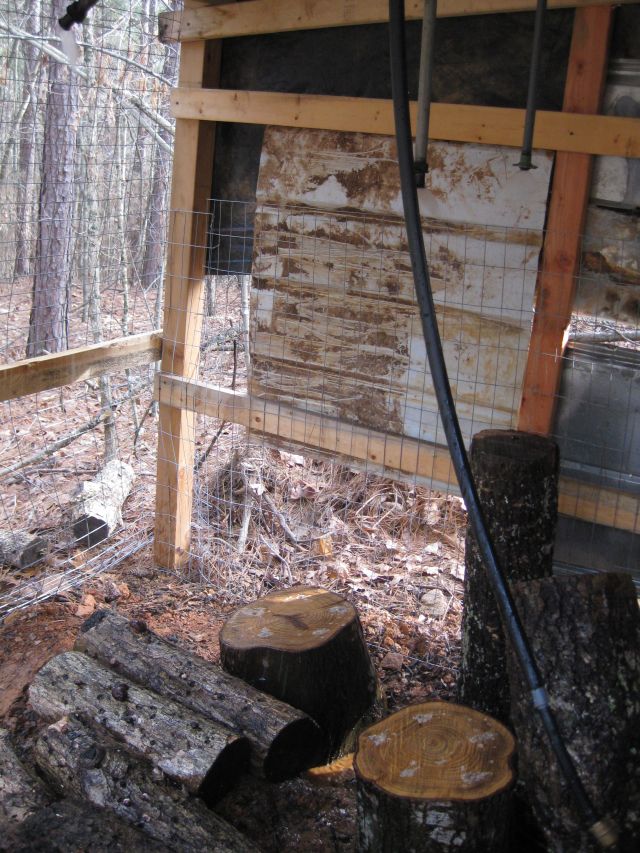
To ensure the logs in the shelter are well watered I rigged a simple spraying system which is gravity fed by rainwater harvested by the tractor building.

mushrooms
simple gravity fed water spray system for cherry, maple and oak logs

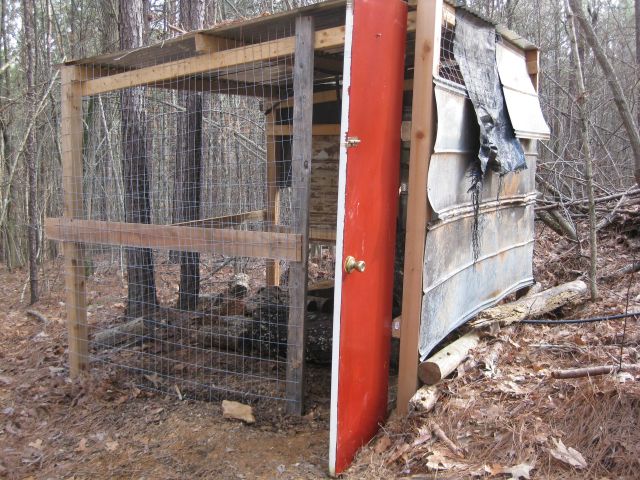
The mushroom shelter is close to the path I use for my woodland walks with Trudy (my canine companion) so I pass it frequently and will be more likely to keep a close eye on mushroom happenings than when the growing took place in the valley which was out of the way. Also, to deter wildlife visitors I have completely enclosed the 8ft by 8ft structure. The 4″ posts are cedar, the 2×4’s are untreated wood, the scraps of metal are just scraps, the black material was used to prevent silt erosion on a construction site, and the fencing material was left overs from a chicken paddock. And the red door, which is not an exterior door and will deteriorate from weather exposure, is a $2 special from the thrift store. Not a particularly attractive construction but should not attract human attention (unless passersby think there is a still in operation) and hopefully will provide food for the table.

mushrooms
simple mushroom shelter

it’s off to work we go

So its off to work we go
now the night long roost is done
and the fledgling sun
brings cheer and early crow

we hear the padlock click
the stay bolt undone
we gather at the coop door
and here’s our keeper Rick

he points out the way
a 50 yard jog
across a field and up a hill
its the fruit trees turn today

a 50 yard jog

he is deep into organics
no sprays at all
munchies abounding
for us his soil mechanics

he wants the bad bugs gone
we’re happy to oblige
we eat them all both good and bad
and give our chicken song

we eat them all both good and bad

some say its like a squawk
or shriek to pierce the ears
our cries and clucks and tuck tuck tucks
that is music and our talk

the paddock has a shelter
with water for our thirst
and egg boxes provided
to cushion the ejector

its fenced to show the playground
we could easily fly above
but grass is greener this side
and grubs to be found

we feel with out splayed feet
the bugs beyond our view
a quick back swipe with claw
finds a wriggle for the beak

a quick back swipe with claw

they visit in the night
the possum, fox and coons
and then we’re in our coop home
secure and snuggled tight

there is a local hawk
we used to duck for cover
but now we’re twice its size
and he can only gawk

as we continue at our play
or should I say its work
the scoot and scratch and eat
a day long happy treat.

fungi

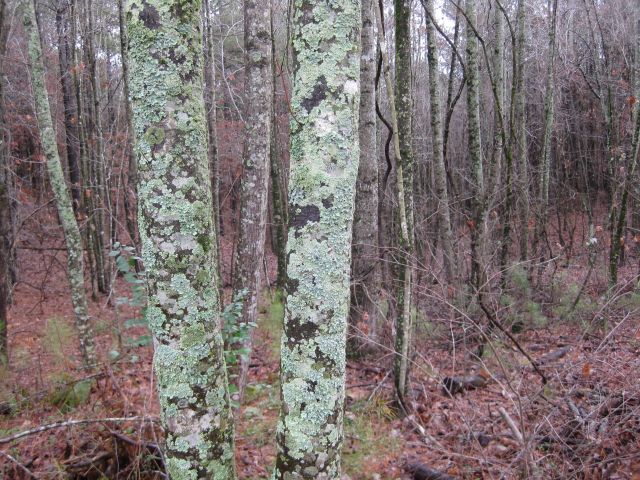
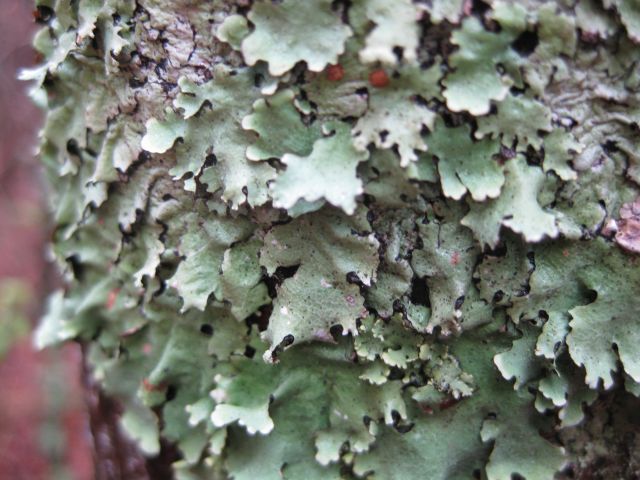
The recent heavy rains and at times warm weather have transformed the appearance of the woodland – the trunks of the trees have assumed a variegated green appearance.

lichen on the trees

On closer examination these are lichen –  a symbiotic alliance between photosynthesizing green alga and fungi.

leaf like lichen


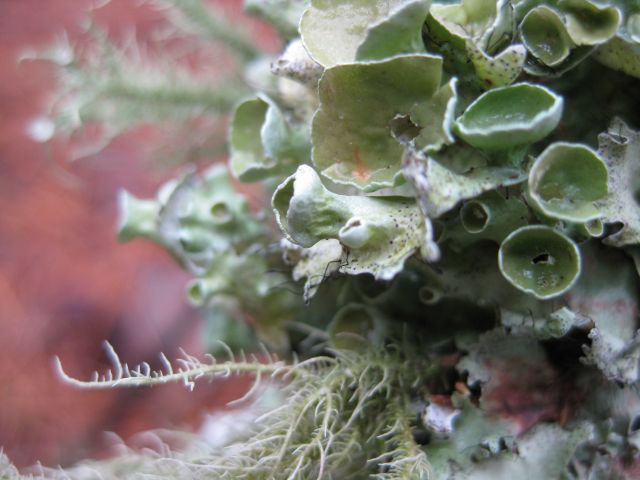
Other growths are more intricate.

unusual trumpet shapes

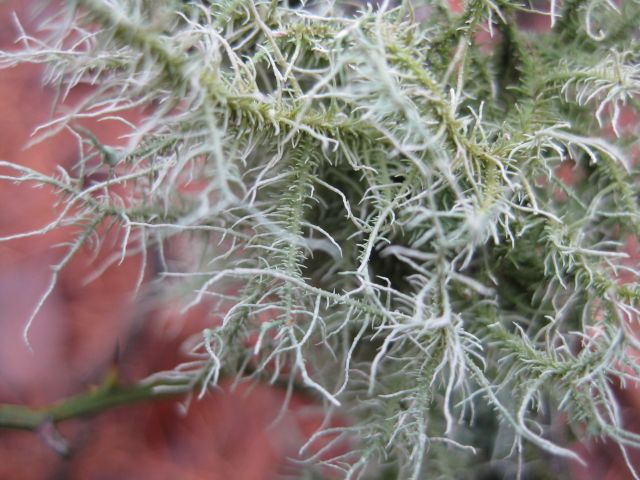
And there are the long reaching arms.

an intricate maze

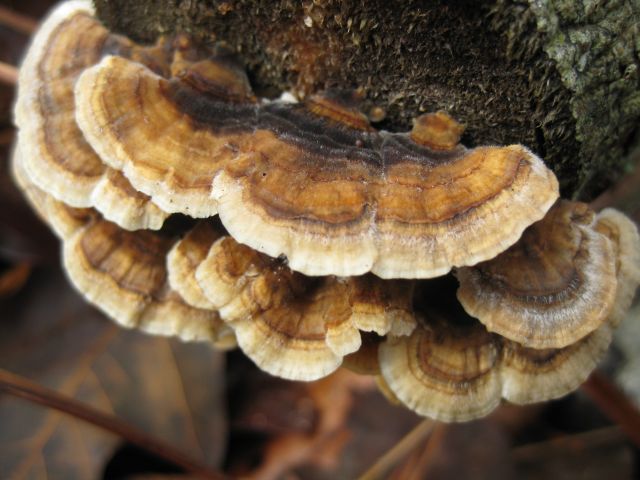
And finally some regular mushroom growths at work decomposing the end of a tree trunk.

regular decomposers


soil test

Eight years ago when I was working full time and all my growing activities took place in an Atlanta subdivision, I convinced myself I had to buy a soil test kit.  I splurged and bought a LaMotte model STH-4 (sounds like a revved up sports car) which is described as a “professional soil testing outfit”  and, in addition to pH, can test for nitrate nitrogen, phosphorus and potassium.  Needless to say, after a cursory test with meaningless results, I packed the model STH away and it has now resurfaced, in my hour of need when, with temps in the teens (before adjusting for wind chill), I need to do something worthwhile.

LaMotte soil test kit

I decided to take a soil sample from an area where I have done no growing so I will know what the unadjusted soil is like, and from my compost heap.  I know I should be focusing on the condition of the soil in my growing area but I have several months of winter ahead to sample more widely.

The LaMotte instructions for taking soil samples are very detailed – after all, if the sample is not representative of what you are interested in, the results may be skewed.  I took the samples carefully and allowed them to dry out in the green house and then ground them through a metal tea strainer to obtain a powdery sample for the tests.  I followed the procedures carefully.  Basically you fill a measured test tube with an extracting solution, then add the measured soil sample and shake for one minute and filter the soil suspension into a second tube.  The filtrate in the second tube is the general soil extract used for the tests.

For the nitrate nitrogen test you take a measure of the soil extract and add two different nitrate reagents, mix and allow to stand for 5 minutes and compare the color with the nitrate nitrogen color chart.  For potassium (potash) you take a measure of the soil extract, add two potassium reagents (the second reagent causes precipitation if potassium is present) and then you place an empty  calibrated narrow tube on white plexiglass which has a solid black line down the middle.  You slowly add the mixture to the narrow tube until the black line just disappears.  The calibration on the tube tells you how much potassium lbs you have per acre.  Finally, the phosphorus test is like the nitrate nitrogen test – you dissolve two potassium reagents in a measured soil sample and compare the color with the phosphorus color chart.

I performed the tests on my soil sample and the results were – zilch, or insipid if I were to be charitable.  I immediately thought that the chemicals in my soil testing kit had deteriorated.  So, before testing the compost sample, I decided to do an extreme test – I found some chemical fertilizer 13:13:13 (over 10 years old since I don’t use the stuff anymore).  And reran my tests.  And the results were off the wall – or certainly off the LaMotte charts for intensity.  Reassured somewhat, I then ran the tests on my compost sample – and it was interesting.  Mediocre nitrogen but strong potassium and phosphorus.  I will now extend my testing and improve my procedures and hopefully gain useful knowledge of my soil conditions and my growing practices.

I also tested for pH using a Hanna pH meter.  This also takes practice – if the electrode is not properly cleaned (I use an electrode cleaning solution) and properly stored (I use a storage solution) the results can be erratic.  My compost is showing a pH of around 6.5.  More food for thought.

cold frame building

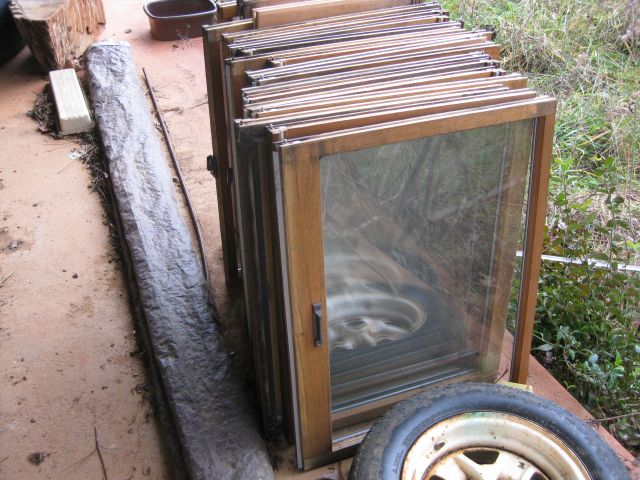
On a recent visit to the thrift store, where there are often solid wood furniture and country painting bargains, I noticed about 50 double insulated small windows each 2 ft wide and  31″ high.  Available for $1 each.  I bought 22.  And have spent a lot of time figuring how to use them effectively in a cold frame.

double insulated, same sized $1 windows from thrift store

My greens are growing very well under an Agripon row cover – it allows air and rain through, protects against frost, keeps the temperature higher inside than out and allows some light through.  However, as with most all solutions, there are negatives.  The cover allows light through, but not all the light and it keeps temperatures higher than ambient temperatures, but not that much higher.  This has worked fine up to now since temperatures have been mild.  Temperatures in January and February will be much lower.  A cold frame using glass windows will let much more light through and will keep temperatures much higher.  Negatives are more labor intensive and costly to construct, does not allow rain to penetrate therefore more supplemental watering required and, on warm days, the temperature will rise too high so I shall have to be watchful to allow ventilation.  An advantage of a cold frame over my greenhouse is the plants will be growing in the ground and their roots will penetrate further than in greenhouse pots.

So having rationalized the need for a cold frame I developed a simple construction plan requiring minimal additional expenditures.

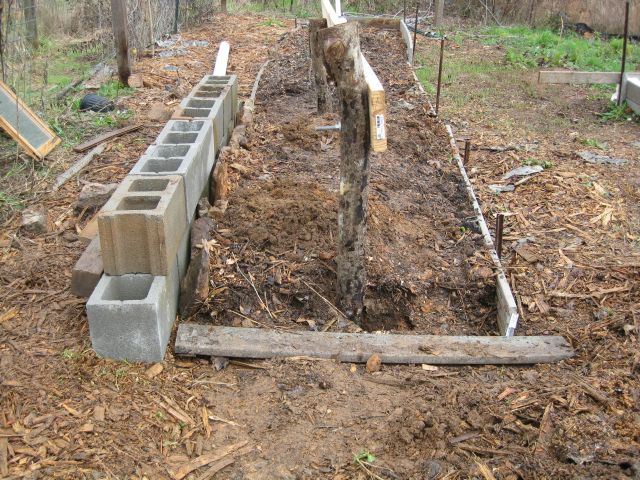
skeleton of cold frame, cement blocks on north side of raised bed, ridgeline down center

I appropriated a section of a newly built raised bed, which has stones on the north side to store heat.  I assembled a two level wall of cement blocks (8″x8″x16″ –  $1.25 each).  9 blocks on the ground and 8 above them (not mortared).  Most of the construction time was ensuring the bottom blocks were level.  I recycled two cherry branches for my uprights to which I bolted a 2″x8″x10ft untreated plank ($5.85) which acts as the ridge on which the windows will rest.

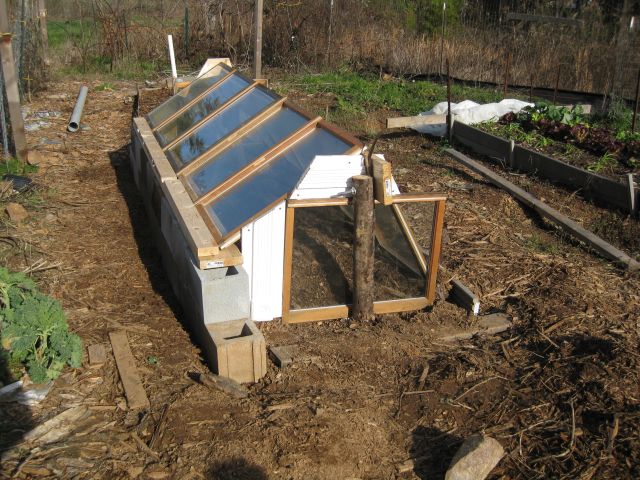
cold frame showing 2nd plank on cement blocks and windows in place

Since cement blocks have cavities, I aligned a second 2″x8″x10ft plank along the top of the second block layer to which I screwed 5 right angle brackets which grip the inside face of the cement blocks to prevent the plank sliding off the blocks.  Additionally I screwed a 2″x4″ plank along the left side of the plank as a step to prevent the windows sliding off the plank.

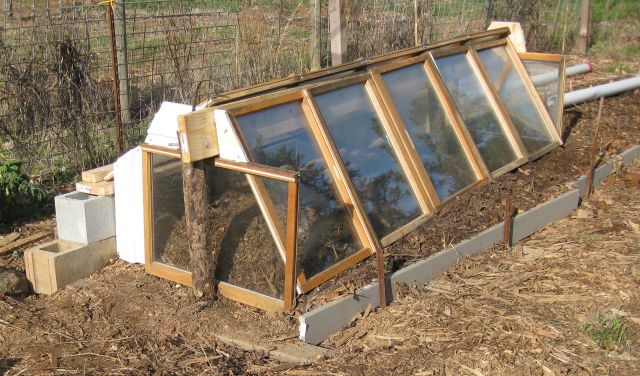
a view of the south side of the cold frame

On the south side of the cold frame I have the 5 windows with bottom edges resting on the ground and top edge resting on the ridge line.  A total of 12 windows were used, 5 facing up and north, 5 facing south and 1 on each end.  By having the south windows and the end windows resting on the ground this will maximize exposure to the low southern sun (also, unfortunately, accelerate moisture penetration and wood rot).  The areas not enclosed by the windows were filled with sized surplus lumber.  For access and ventilation I remove the south facing windows.  I placed an electronic min/max thermometer in the cold frame and tomorrow, hopefully, I will find there was reasonable heat retention.  The ground should also have warmed up and I will plant out more of my kale, collard, mache, broccoli raab, and turnip greens seedlings.

some winter tasks

Vegetable growing in winter

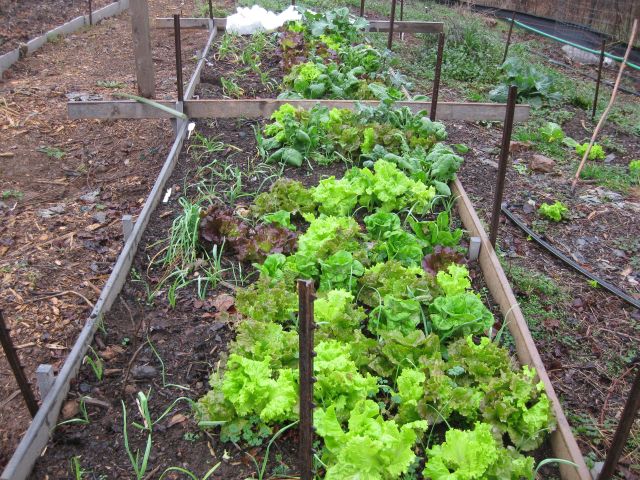
I know it is still early days and we may yet have blizzards and really low temperatures, but I am much encouraged with the growth of my greens (lettuce, spinach, kale, collards) and the protection provided by my row covers, so I have been growing more vegetables for transplanting in a few weeks. I googled winter hardy vegetables and bought Rapini Broccoli Raab seeds and Mache Corn Salad seeds – very reasonably priced and very quick delivery from Hirt’s Gardens.  They germinated in my 3/4″ blocks quickly and are now in the greenhouse in 2″ soil blocks growing well and will be transplanted soon, together with my regulars – I really like kale and have several varieties going.  Below is a snapshot of one of my raised beds – with temps>40 for next several days, I am trying one bed without covers and the other with, and will see if it makes any difference.

Dec 22 raised veg bed, garlic on left, greens on right

Composting

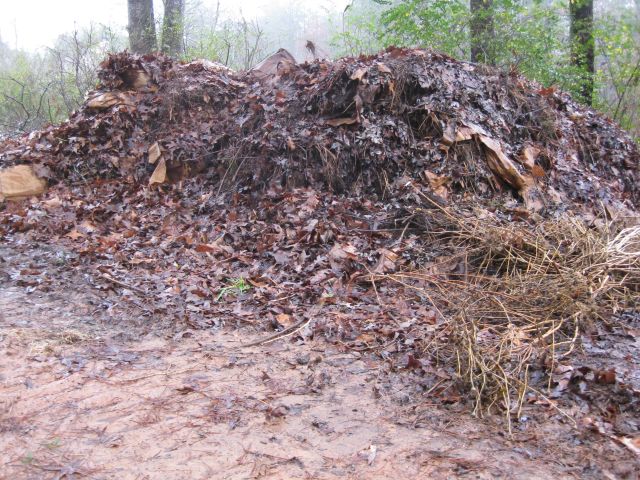
My new heap has more than 60 leaf bags.  It is too much leaf and too little green.  Every other day, when I clean out the coop, I toss the chickens’ contribution on the top and have also contributed some of the horse manure I picked up from the stables.  I have a continuing reservation about the horse manure – don’t know what ‘cides were used to produce the hay or what chems the horses may have received – but I hope the composting process and all my soil workers will break down whatever is  there that shouldn’t be.  The heap is self standing and for turning it, my bobcat is invaluable.  It is breaking down well, evidenced by wisps of steam and diminishing size.

Dec 22 - compost heap


Transplanted muscadines

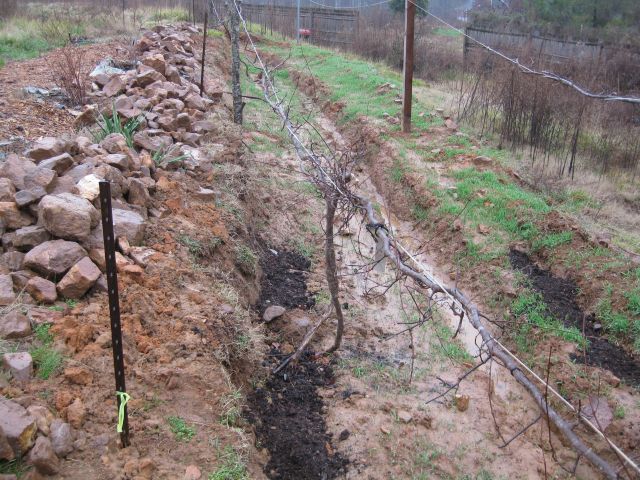
I completed transplanting the muscadines.  I have real concerns about the outcome.  Their roots had extended everywhere and I doubt that I saved even 20% of the roots.  I cut back the vines by 80% and placed the roots in trenches covered with compost (compost is my universal remedy) and spring will tell how well I succeeded.  To stabilize the terrace from wintry rains I seeded with winter rye and it is growing nicely as can be seen below, together with the truncated muscadines.

new muscadine terrace with winter rye, contour ditch and lots of excavated stones

I intend to put the stones to use building stone walls – to be described in a later post.

New raised bed

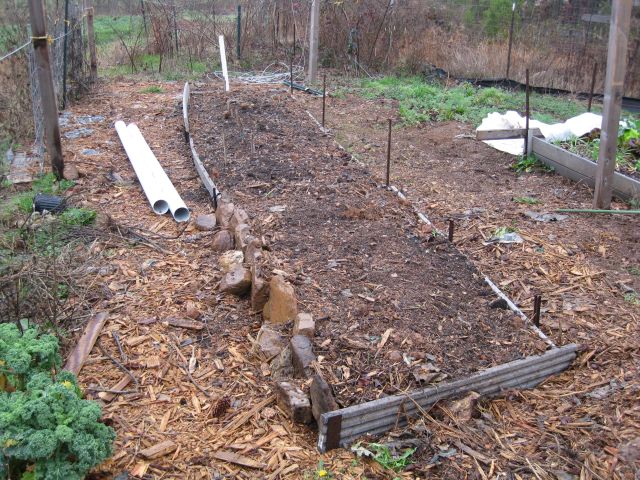
With the muscadines out of the way, I decided to make a third raised bed – this is 4 ft wide and 24 ft long and is awaiting residents.  As an experiment I used a few of the stones as a north border for the bed, the idea being they will act as a heat sink – absorb the heat of the winter son and create a micro climate ( I noticed that my strawberry plants which abut the south side of one of the raised bed i.e. the raised bed side is to the north of it, have produced strawberries in the middle of December!). The two 4″wide 10 ft long pipes will be positioned in the middle and above the bed for the purpose of keeping the winter cover off the vegs.

Dec 22 - new raised veg bed, with heat sink rocks on north border

 Apple tree restoration

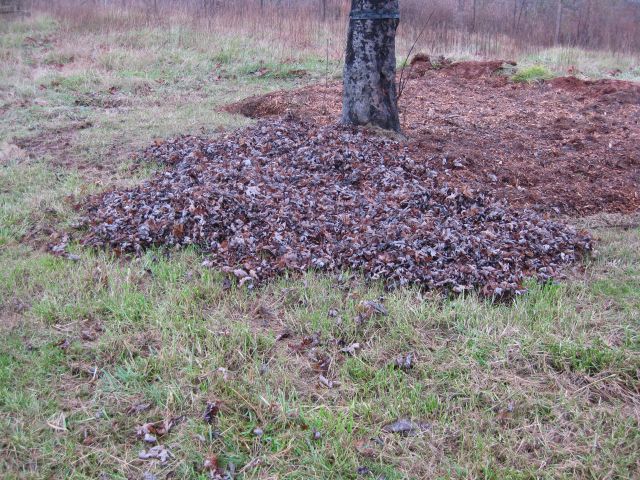
There is a large apple tree on the hill property I recently acquired which did poorly this past year.  One reason, I surmised, is that its roots tapped into a septic system which has been decommissioned and therefore it was deprived of valuable nutrients on which it had become dependent.  Or it could have been the weather, or it may only bear well every other year.  It is surrounded by a vigorous tough grass which competes with its roots for food.  I decided to get rid of the grass.  Imagine a circle with the tree in the center.  I mowed all the grass in the circle.  Then for 50% of the circle I spread horse manure and then wads of newspapers and then covered the lot with a generous load of wood chips.  For the other half I decided on a different approach.  Adjacent trees shed lots of leaves and I gathered these leaves and spread them out on the grass.  Next step will be to add the wood chips.  My reasoning is the leaves will block the light on which grass depends to grow, more effectively than spread newspapers.  And it is quicker to spread the leaves than the paper and the leaves, being more natural than paper will probably contribute better to the health life of the soil.  I am hoping the wood chips will promote growth of fungi which is better for the trees than the grass bacteria.

mulching the apple tree, wood chips on newspaper at rear, leaves in front (in progress)

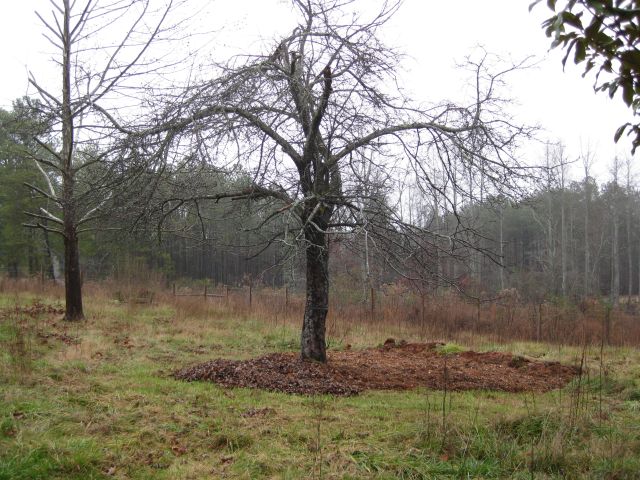
The apple tree itself does not look too impressive right now.  The top half was sheared by a storm and I still have to do more pruning.  Time will tell. By the way the sweet gum behind it fell victim to shearing by the local utility which has a right of way which extends to within a few feet of the trunk of the sweet gum.  So the utility religiously protects its right of way with no favoritism extended.  The one benefit is I received a truck load of wood chips.

Dec 22 - apple tree


Lots of pipes

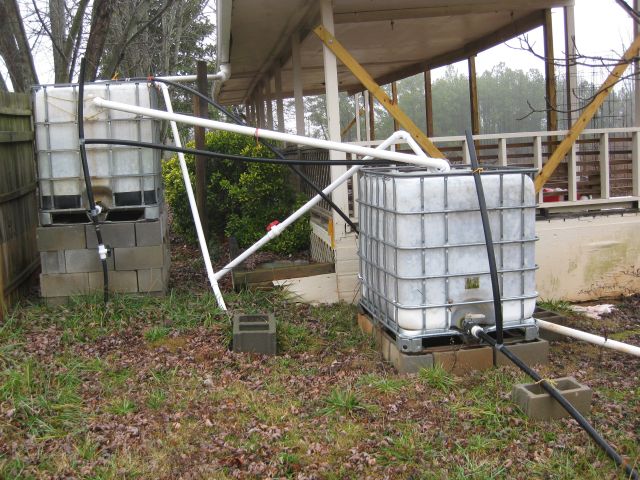
Finally a snapshot of my two gravity feed irrigation tanks. I just added the last and final pipe.  Each of the pipes serves a purpose.

gravity feed irrigation tanks with related necessary pipes

The “Y” brings the rainwater from the storage tanks. If the red valve on the lower limb is open the water goes to the right tank, if closed to the left tank.  The two vertical black pipes are to facilitate bleeding out air bubbles when the valves below them are opened and water runs to the crops.  The left, raised tank, irrigates hill crops, the right tank the crops at the bottom of the hill. You can spot at the top of the left tank the horizontal white pipe bringing rainwater from the roof of the deck and the diagonal black pipe bringing water from a well (only as a last resort and only pumped 3 times this past year).  There are two overflow pipes from the left tank – the lower overflow is if I want the left tank to be half filled before the lower tank is filled, the upper overflow is if I want the left tank to be completely filled before the lower tank is filled.  Finally, the pipe I just added is the overflow from the lower tank – you can see it is directed to the right where the fig tree resides and whichas a berm to capture as much water as possible.