what’s growing and recent reads

Recent good rains have juiced my crops.  We thought by now the tomatoes would be done, and some are, but others keep producing.  Most everyone complimented the taste of the small tomatoes.  We feel the larger tomatoes are less tasty probably from too much rain.
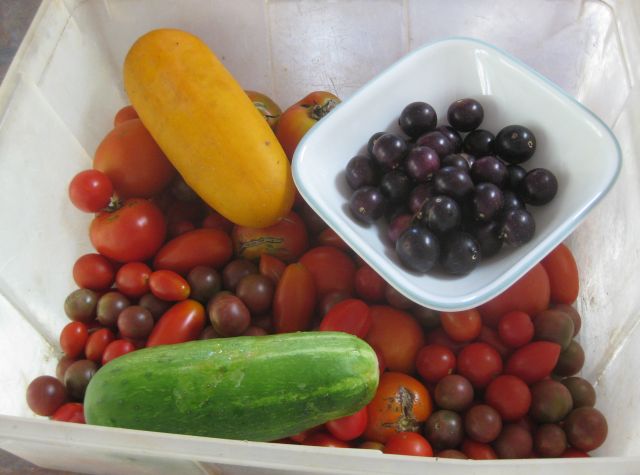
whats growingbMuscadine season has almost arrived and the black ones above although sweet, will be sweeter still when they roll into my hand and do not have to be tugged.  But then there will be many yellow jackets at the smorgasbord and M. developed a nasty reaction when 2 yellow jackets, apparently without provocation, stung her ankle.

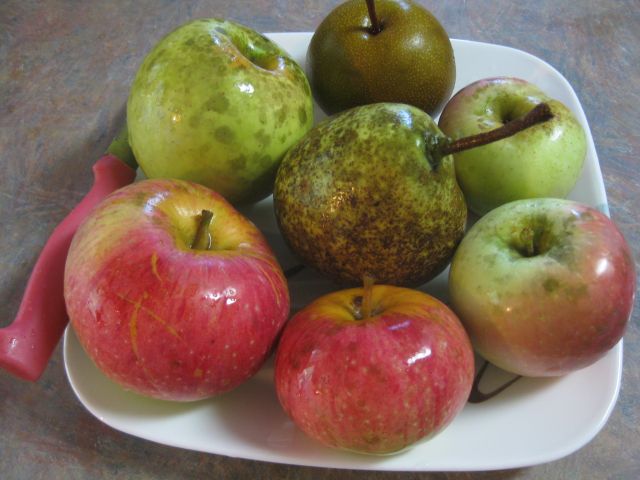
And the apples and pears are abundant.  In my 7/31 post I criticized the Paduckah apple as a good producer with little taste.  Now these apples have fully ripened they really are tasty.  I locate fully ripened apples not by feeling for which nudges easily free but by selecting from those that have fallen to the ground.  Very few pests this year probably because of my kaolin spraying.
aa
the two bottom apples are Paduckahs, top left is the Matsu (tastes great), 2 on the right are Ein Shemer (not yet ready), Kieffer pear in the middle, and at the top the Giant Korean pear, which needs a few more weeks.

Recent reads

I finished reading 3 interesting books.  The Dark Forest by Cixin Liu (tsih-sheen leo) apparently China’s top science fiction writer, is the sequel to The Three-Body Solution. One of my sons read the Mandarin originals, recommended them, gifted them to me, encouraged me persistently, and once I was into it, it was a good read.  Another book he recommended The Mandibles by Lionel Shriver, is a dystopian finance drama, very well written and much easier to access.  And finally I enjoyed the short stories in The Periodic Table (1984) by Primo Levi – gentle instruction, humor and sadness.

And, a first.  My running/walking group has good-naturedly tolerated my digressions on nutrition – that you are what you eat.  Yesterday at breakfast after our stint on the river trail, I noticed  there were more oatmeal settings (5) than bacon and eggs (4).  My comment that this was a first, caused some embarrassment.  It seems more folks are correlating health outcomes with what they eat.  Good!
gumption and the intermittent failure

If the South’s summer heat and humidity bear any consolation, it is that I have to seek shelter in the house for much of the day and thus am able to extend my reading.

I enjoyed the first third of Zen and the Art of Motorcycle Maintenance by Pirsig but struggled as the protagonist ascended higher into the mountain and into rarefied philosophical issues for which I was not prepared.  Now in the last third of the book the running is easier.  His thoughts on gumption and practical issues of machine maintenance bring back memories.

At p. 310 he says “I like the word “gumption” because it’s so homely and so forlorn and so out of style it looks as if it needs a friend and isn’t likely to reject anyone who comes along”.  I recall “gumption” too with affection.  The only time I heard it used was by Tommy Cairns our lecturer in cost accounting at my university in Johannesburg during the early 70’s.  His lectures were punctuated by reference to a general lack of gumption and the criticality of gumption for success.

Now, many years later I see it dancing on the pages of Pirsig’s book before me, such as “Gumption is the psychic gasoline that keeps the whole thing going.  If you haven’t got it there’s no way the motorcycle can possibly be fixed.  But if you have got it and know how to keep it there’s absolutely no way in this whole world that motorcycle can keep from getting fixed.”

One of the gumption traps he refers to is the “intermittent failure” which fools you into thinking you have an engine problem fixed and then it recurs.  He suggests methods to identify and fix the problem with the advice that “In some intermittents you have to resign yourself to a long fishing expedition, but no matter how tedious that gets it’s never as tedious as taking the machine to a commercial mechanic five times”.

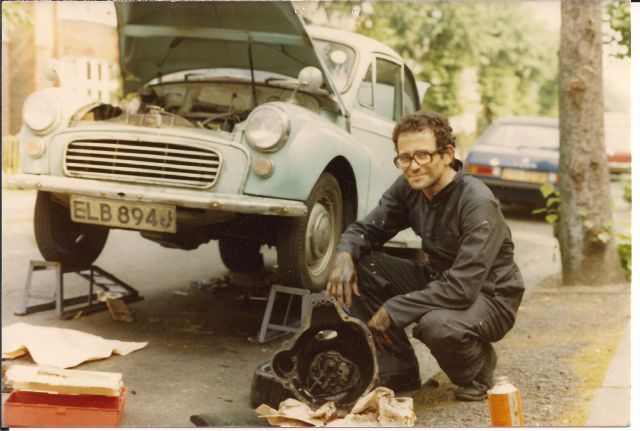
All of which brings back my second memory.  When I lived in London I had a Morris Minor – a two door beetle-like friend (formerly a police car) which I worked on extensively and affectionately called “Elbee” for its licence plate.  Elbee developed an intermittent fault – when I rounded corners quickly the electrics would falter.  I searched everywhere for the culprit, without success.  Elbee’s tools were kept in a rollup bag and one day, upon lifting the bag, I noticed an aimless, loose wire beneath.  This was an earthing wire held in place by the tool bag and I figured that when I cornered and put Elbee through her paces, the bag shifted and the wire lost contact with the frame.  It was an easy fix to secure the wire.

gumption
Elbee receiving a new clutch. The suburban street was my workshop

ideas from the past – the kang

I am reading the F. H. King classic “Farmers of Forty Centuries: Organic Farming in China, Korea, and Japan” written in 1911 and there are so many nuggets of useful information, including the “kang”.

He observed the  kang  during his visit to Mongolia and his commentary  made me think of the rocket mass heater (now popular in permaculture circles)  with which it shares a number of features.

He describes several kangs – in one case it was 7ft by 7ft and about 28″ high and “could be warmed in winter by building a fire within” or “warmed by the waste heat from the kitchen whose chimney flue passed horizontally under the kangs before rising through the roof”.

“The top was fitted for mats to serve as couch by day and as a place upon which to spread the bed at night.”  They were constructed from brick “made from the clay subsoil taken from the fields and worked into a plastic mass, mixed with chaff and short straw, dried in the sun and then laid in a mortar of the same material.  These massive kangs are thus capable of absorbing large amounts of the waste heat of from the kitchen during the day and of imparting congenial warmth to the couches by day and to the beds and sleeping apartments during the night.”  He goes on to mention problems after 3 or 4 years and how they turn the problem into a solution.  His book can be freely downloaded.

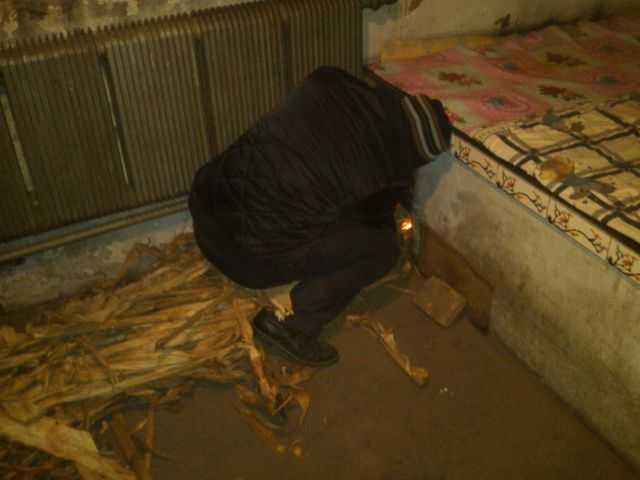
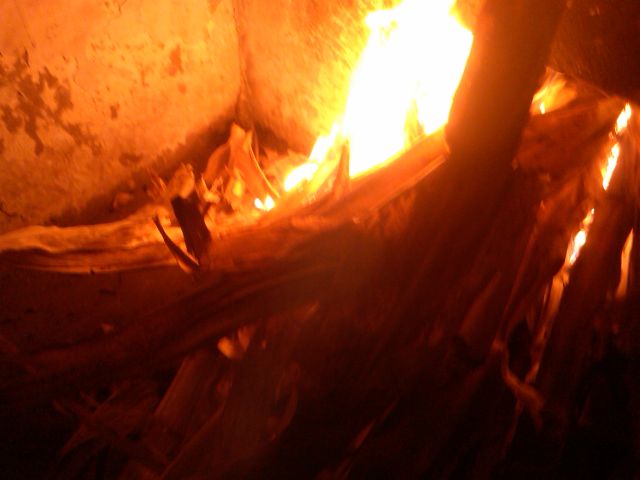
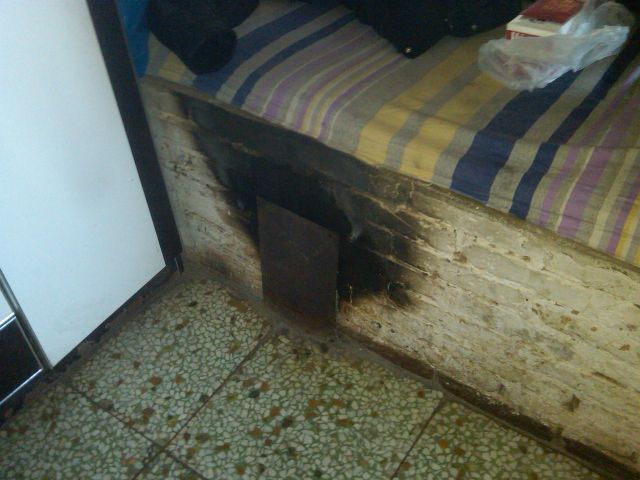
These kangs are still used today.  I include below several recent ‘photos taken by a visitor  to eastern inner Mongolia.

kang mass heater
lighting the fire of a kang
mass heater kang
interior fire of a kang
mass heater kang
‘photo of another kang

The visitor could not recall if the exterior flue of the kang was horizontal or vertical – he thought it may have been horizontal

DIY and its virtues

I just read a good essay in the New York Times – “A Nation that’s losing its Toolbox” by Louis Uchitelle (July 21, 2012).  He laments the loss, not only of factories and good manufacturing jobs, but also “mastering tools and working with one’s hands is receding in America as a hobby, as a valued skill, as a cultural influence that shaped thinking and behavior in vast sections of the country. ”  He says that manufacturing is important, not just to create jobs and reduce the trade deficit and help us out of the recession, but “a growing manufacturing sector encourages craftsmanship and that craftsmanship is, if not a birthright, then a vital ingredient of the American self-image as a can-do, inventive, we-can-make-anything people.”

Maybe the shift from manufacturing jobs to the service sector was because of higher pay, higher status or less physical exertion.  Or is it a cultural thing.  In an earlier post I referred to German technology and competitiveness which is unbruised by Asian competition. The author quotes Richard Sennett, a NYU sociologist  “Corporations in Germany realized that there was an interest to be served economically and patriotically in building up a skilled labor force at home; we never had that ethos.”

Some books resonate with me.  I enjoyed  “Shop Class as Soulcraft” by Matthew Crawford and now, at long last, I am reading “Zen and the Art of Motorcycle Maintenance”.  Lots of delightful quotes – here the author (at page 44) comments on how different two motorcycles of the same make, model and year can turn out years later  “Each machine has its own, unique personality ….This personality constantly changes, usually for the worse, but sometimes surprisingly for the better, and it is this personality that is the real object of motorcycle maintenance.  The new ones start out as good-looking strangers and, depending on how they are treated, degenerate rapidly into bad-acting grouches or even cripples, or else turn into healthy, good-natured, long-lasting friends.”

It is probably the case that now we have progressed beyond the intricacies and quirks of carburettors and manually actuated devices to computer controlled fuel injected vehicles and other digital devices, that the personality of machines has been buried and they all act much the same, except where grossly abused.  And with this transition we have lost some of the connectedness we once had to the world around us.

I remember some 30 years back I had a large tube tv, long on its legs, which regularly began to flicker erratically after 10 minutes use.  I concluded there must be some failing part which malfunctioned when it got hot.  I bought a can of compressed cold spray, opened the rear, switched on the tv, waited 10 minutes and, taking good care not to come in contact with any high voltage wires, sprayed each component, largest first.  To my delight when I sprayed one particular tubular device, the flicker on the tv disappeared.   I waited, the component warmed up, I sprayed it again and the flicker disappeared.  It was then a simple matter to remove the component, go to the electronics store, order a replacement and solder the substitute in place.  Presto – easy fix.  I will not try this on modern tv’s and even replacing the spark plugs on my truck (manifolds and various devices have to be first removed) fills me with apprehension.

So maybe also, the advent of new technologies has reduced our ability and wish to tinker, as we did in the past and, because they cost relatively so much less than did products of the past, our incentive as well.