mushroom shelter – improved irrigation

In a recent post I mentioned that mushroom production in my mushroom shelter has been poor due to inadequate watering.  The system I installed had a 0.5″ diameter water pipe run from a nearby slightly higher rainwater collection tank to the ceiling of the mushroom shelter from which the water flowed via bubblers onto the spawn impregnated logs.  Water flow was weak and the bubblers often clogged.

harvested rainwater for growing mushroom
source of water for mushroom shelter is the elevated rainwater collection tank which collects from the north facing roof

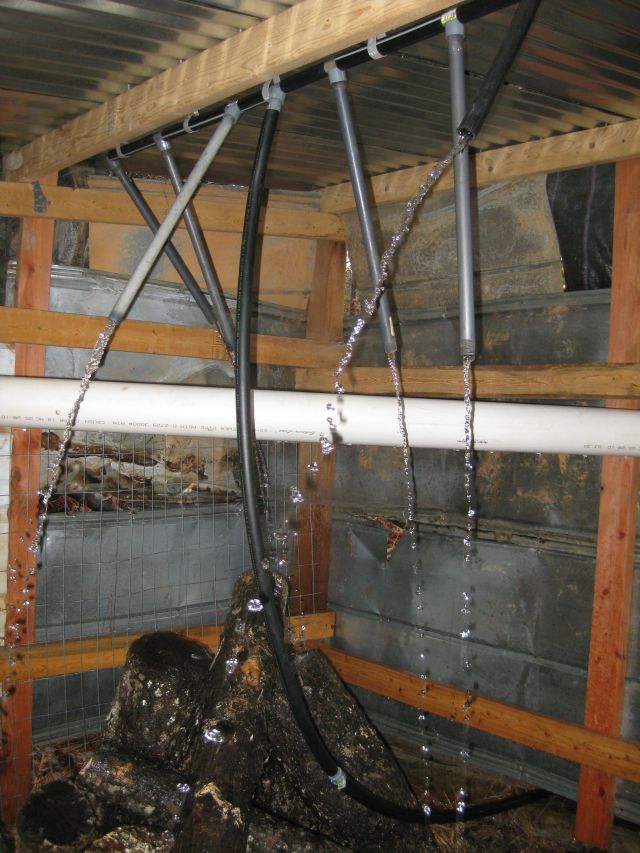
I rectified this by replacing the 0.5″ diameter pipe with a 1″ pipe and by eliminating the bubblers and using adjustable .75″ pipes to torrent the water onto the logs.    I do not have the dispersion I had with the bubblers but the flow is strong and there is no clogging – any debris is blown out.

watering mushroom logs
rainwater from the storage tank directed by adjustable pipes to the mushroom logs (ignore the horizontal white pipe)

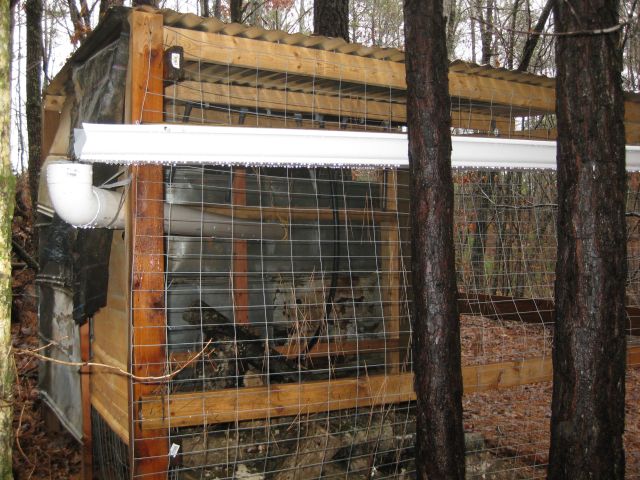
Another watering improvement I made is to collect rainwater from the roof of the mushroom shelter and direct it onto the logs.  First step was to install a gutter.

directing rain onto mushroom logs
gutter attached to catch rainwater from mushroom shelter roof with pronounced dip to the left to feed into 4″ elbow

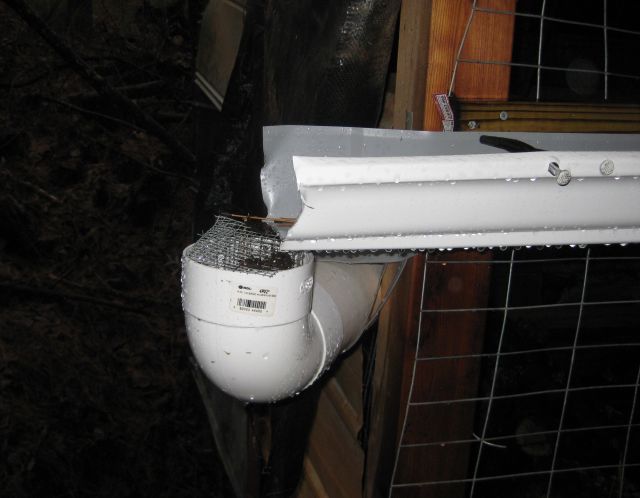
The open lower end of the gutter feeds into a 90 degree 4″ elbow attached to a 10ft 4″ water pipe.  I crumpled chicken netting into a ball and inserted it into the open end of the elbow to trap leaves and debris before they entered the water pipe.

harvesting rainwater from mushroom shelter roof
gutter on mushroom shelter feeds into elbow with protective chicken wire

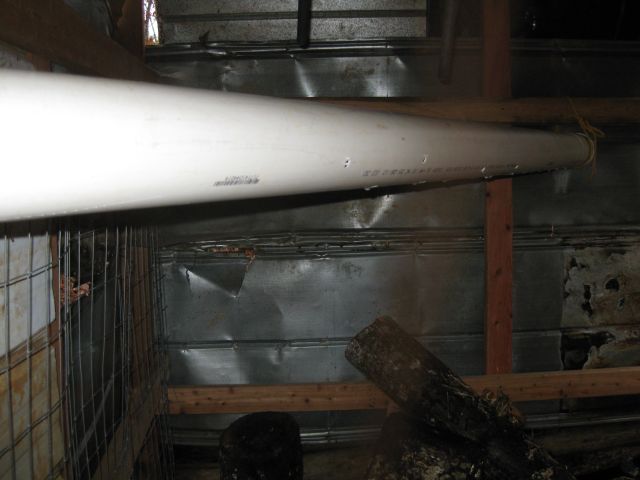
It was then a simple matter to lead the 4″ diameter 10ft pipe into the shelter, cap the far end, and secure it ensuring it dipped from the elbow end to the capped end.  With a power drill I made  holes staggered along the length of the pipe.

watering the mushroom logs
4″ diameter 10 ft water pipe in place with staggered holes to ensure good coverage of mushroom logs

The improvements should ensure more reliable mushroom production.

tasks for Fall

I am preparing for winter.

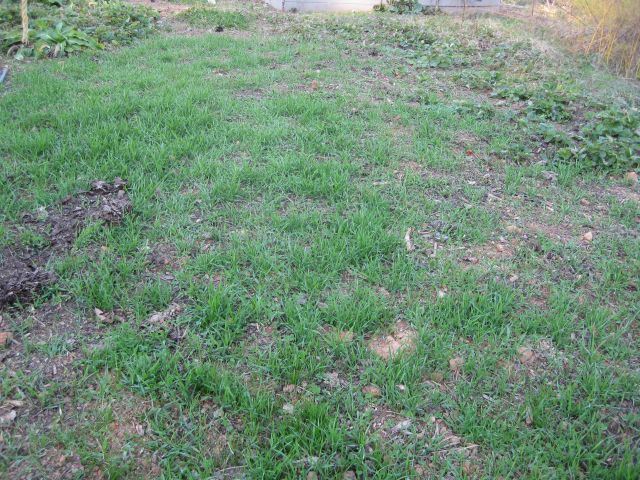
  • cover crops – I cleared the tomatoes and weeds, added compost and sowed winter rye and crimson clover.  A few years ago I used hairy vetch, which worked well and next year I will order more since the local supplier, who originally sold me the seed, no longer carries it.
winter cover crop
a vegetable growing area seeded with winter rye and crimson clover cover crops
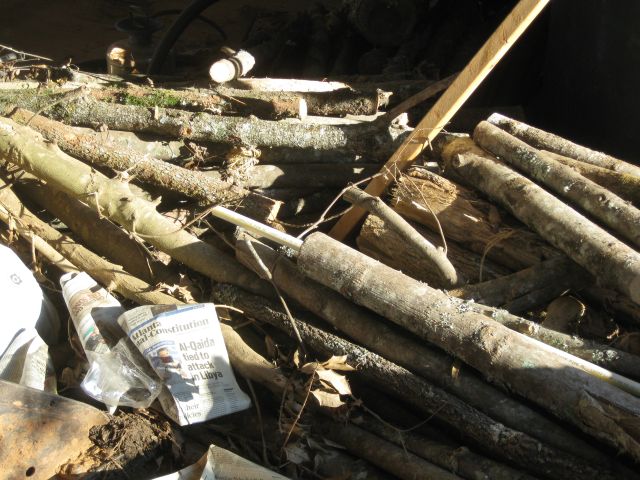
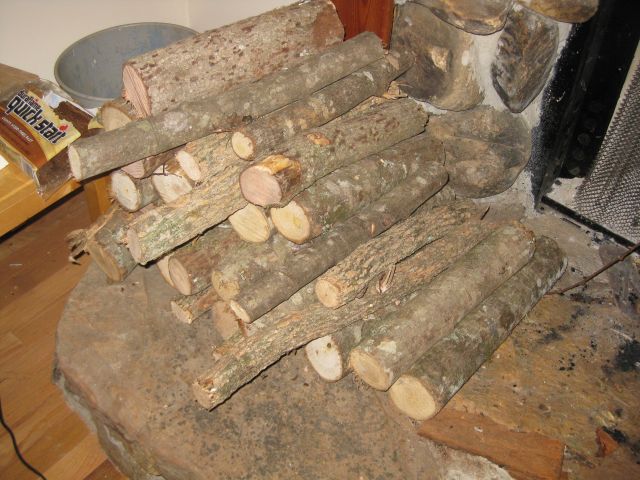
  • firewood – during the year I cut a new 5 foot wide route through the woods and I steered the path to avoid the larger trees.  I had to uproot and remove smaller trees and I cut their trunks into 5 foot lengths and stored under cover for fuel for winter.  I am now chain sawing the wood into 2 foot lengths to fit the grate.  Last Sunday was cold and the wood burnt well.
firewood and mini posts
firewood stored under cover drying for winter use. I have used some of the oak trunks as mini posts for structural jobs


firewood
firewood cut to size next the fireplace
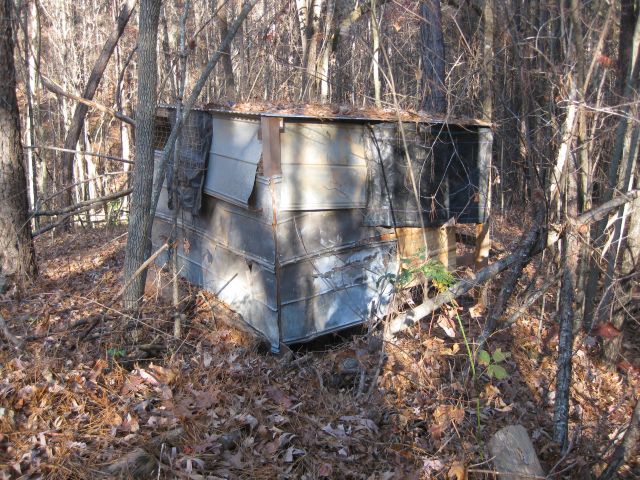
  • mushrooms – I built a mushroom house, which I filled with logs impregnated with sawdust spawn, and then neglected to water.  A few weeks ago I watered the logs and some oyster mushrooms have surfaced.  Encouraged, I shall water more regularly.  Also I must affix a gutter to the roof of the shelter and direct the rainwater onto the logs – this is obvious and I should have done it at the outset.
growing mushrooms
mushroom shelter with solid sheeting or barrier cloth on north and west sides for sun protection, and chicken wiring and door protecting remaining access points
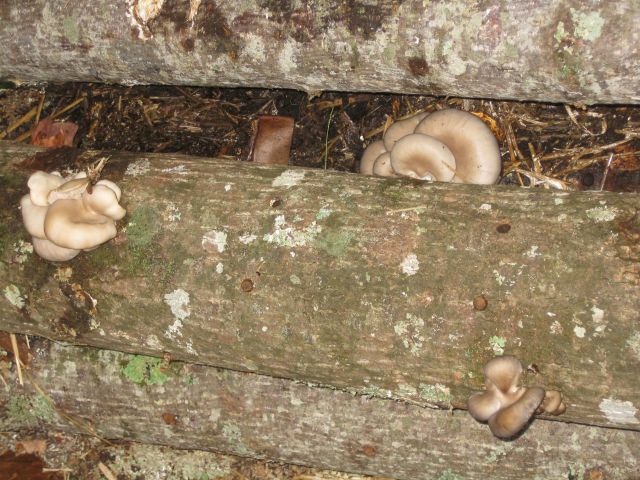
some oyster mushrooms
mushrooms have begun to grow
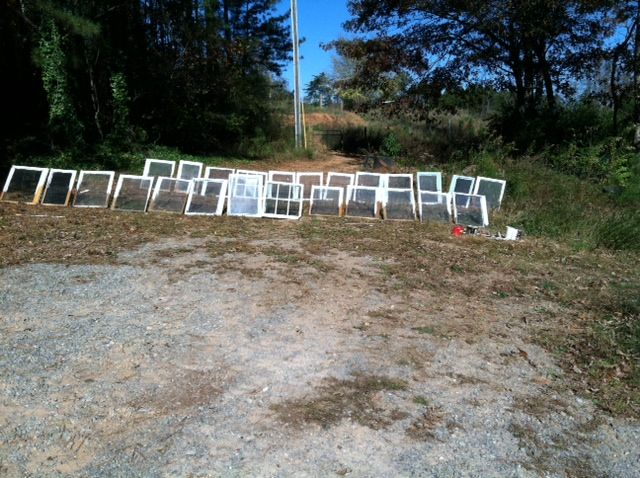
  • winter growing shelters – last year I was able to purchase a number of wooden windows for a $1 each and constructed rudimentary cold frames.  This year I would like to create a larger structure but to do this I need posts.  Pressure treated posts would be ideal but I do not want to pollute the soil or my vegetables. So the options are cedar wood (which rots with time), composite posts (which are expensive and may distort), metal structural posts (ideal but where will I find them) or use some oak trees from the woods (cheapest, self reliant and maybe the way to go).  In the meantime I painted the wooden windows, first with Kilz primer and then a good quality exterior latex.
painted windows drying in the sun
  • seed gathering – now the cosmos and zinnia have finished flowering and set seed, I sortie out to gather seed for next year.
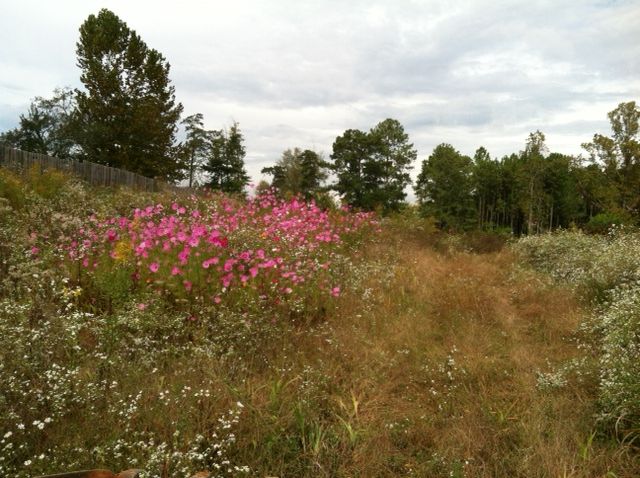
cosmos
ebullient cosmos in a field


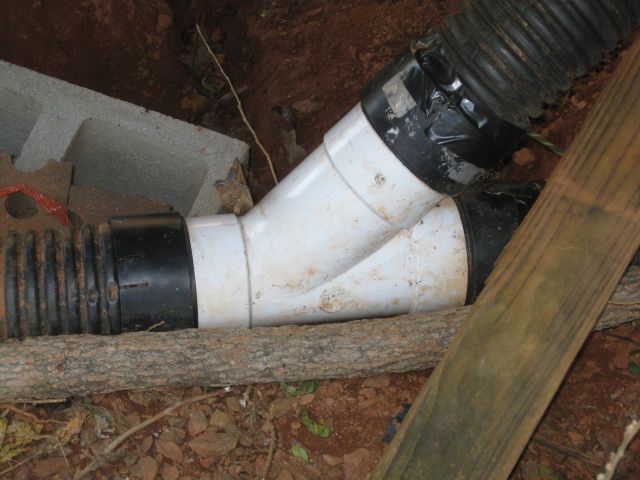
  • rainwater collection – when it comes to my rainwater harvesting systems the invariable rule is that it will fail wherever I have not checked.  The main flow from the house roof went through a “Y” and the “Y” leaked in small amounts and eroded the ground supporting the connection so one of the 4″ pipes disconnected (maybe also assisted by the rodent hunting activities of my dog).
plumbing for rainwater harvesting
this is the old, cheaper, now replaced Y connection

I replaced the old Y with a more substantial Y, I rebuilt the underpinnings and I secured the inlet pipes to the Y with duct tape and am resolved to keep a good eye on this joint and have instructed Trudy to leave the water drainage pipes well alone.

rainwater harvesting
rainwater harvesting – the more expensive replacement Y secured with duct tape
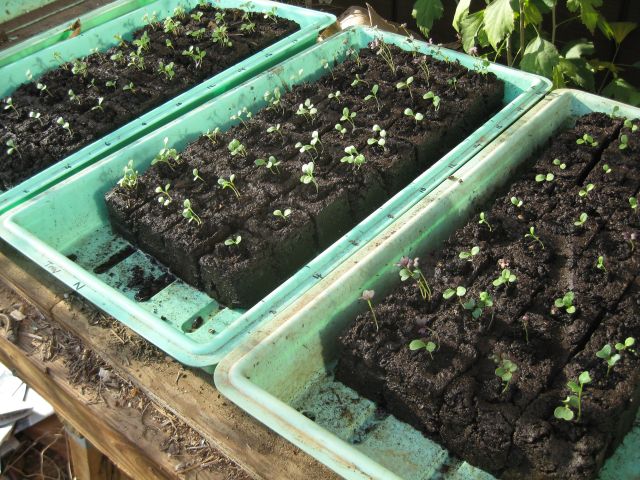
  • winter vegetables – I decided to seed more lettuce since I already have sufficient kale.  The lettuce was seeded initially into 3/4″ soil blocks and are now in 2″ soil blocks in the greenhouse.  I will probably grow some full size in the greenhouse and the remainder will be ground planted once I have figured out the construction of my new windowed winter shelter.
lettuce in soil blocks
4 varieties of lettuce seedlings in 2″ soil blocks. the reason there are several in one block is this was older seed and I thought germination would be irregular. silly me, they all came up and I will have to thin or transplant.
  • cuttings and acorns/nuts – I have taken cuttings from trees I would like to replicate like mulberries, pears (my neighbor’s pear tree was prolific this year and my Giant Korean, which bore for the first time, was excellent), cherry, plum and one of my neighbor’s apple trees which had very sweet small apples.  I know with the apple tree I may have a problem with the root stock.  Perhaps next year, when I am successful with grafting, I will graft scions to root stock.  As for nuts – my other neighbor gave me a dozen pecan nuts from his magnificent pecan tree and I also buried Ohio buckeye nuts, acorns from selected oak trees and nuts from other local trees.  The cuttings and nuts are in an area which I visit and weed and water most days, with good sun exposure and the soil is well mixed with compost.  So I am hopeful.  If the cuttings are viable I may transplant them in spring next year or, better, wait till fall and then plant them out with the nut seedlings.
  • in earlier posts I mentioned other activities such as terracing the hill in anticipation of delivery of assorted fruit trees promised for the end of November, and winterizing the bee hives and the chicken coop.  When really cold weather threatens I will wrap my fig and other cold sensitive trees in swadling and leaves to prevent die back.


earthworks – terraces, contour ditches and tree trunks

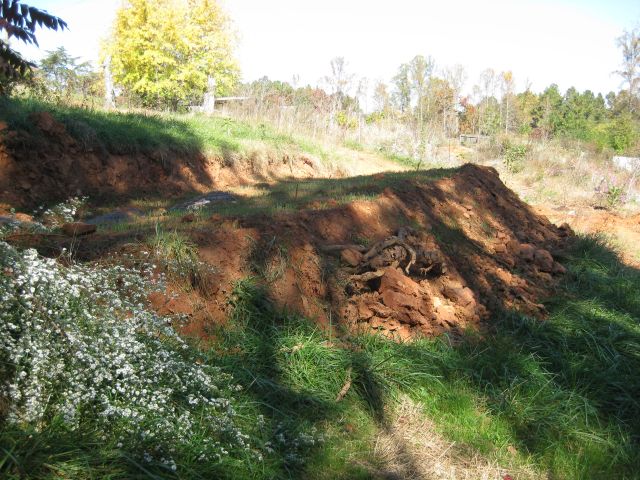
My permaculture readings have focused me on developing an edible forest garden and earthworks figure prominently in my designs.  Although I already have a number of different fruit trees in my orchard I decided to expand the selection and expect, by the end of November, to receive 2 goumi, 2 pawpaw, 3 kiwi (2 female, 1 male), and a medlar, aronia, sour cherry, and juneberry.  With these pending arrivals I have been at work preparing their planting sites on the side of the hill.

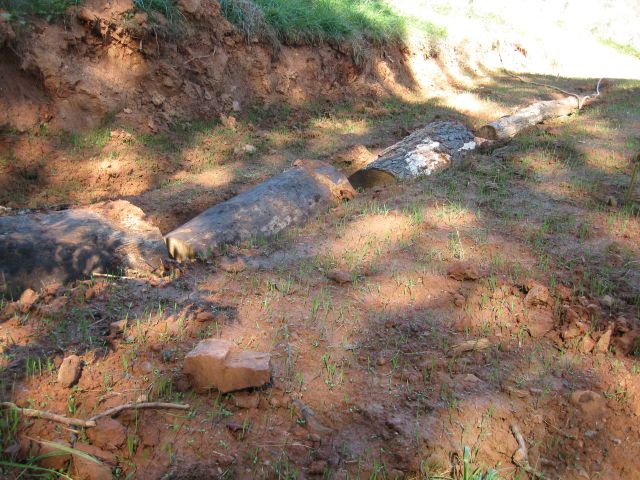
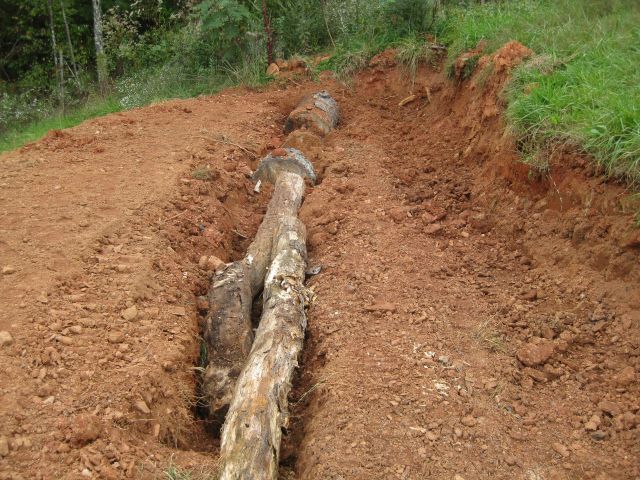
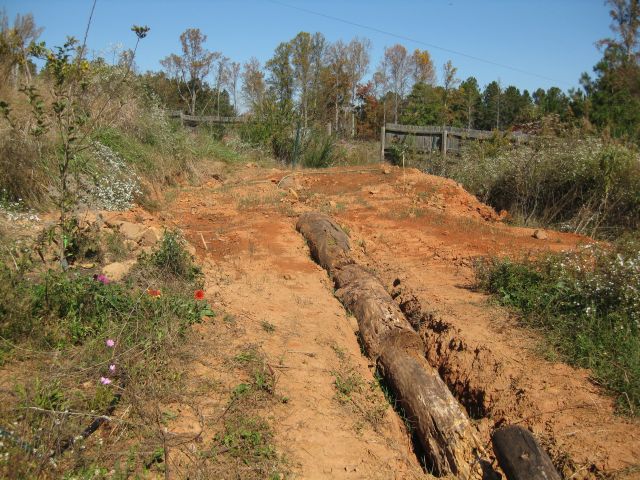
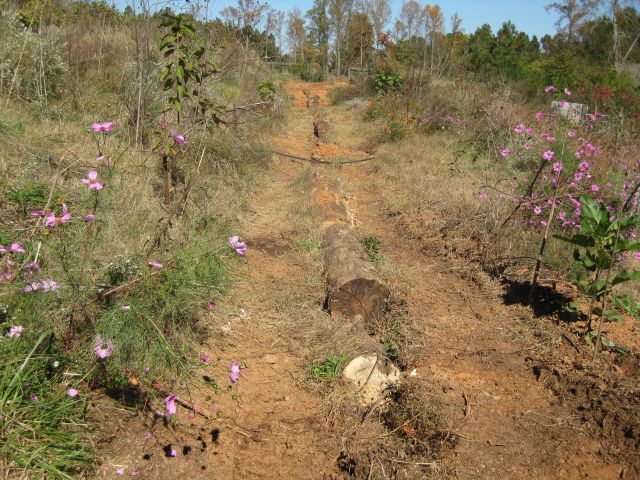
The earthworks are dug by my scruffy Takeuchi tracked bobcat.  My approach is to terrace the slope with the terrace canted to the slope and with a contour ditch in the middle of the terrace.  So rainwater on the terrace will move to the contour ditch and that which misses the contour ditch will move to where the terrace intersects with the   slope.  I fill the contour ditches with logs, for several reasons: a) my readings suggest that grasses promote bacteria and trees promote fungi and since the slope was grass covered, by filling the ditches with rotting tree trunks I am hoping to accelerate beneficial fungi in the soil; b) the contour ditches are a couple feet deep and without infill it is easy  to fall in; c) if the ditches are left as ditches, they are quickly invaded by vegetation which competes with the tree roots and hides the location of the ditches (facilitating (b) above);  d) parallel with (a) the tree trunks will provide nutrients to the soil as they degrade and will absorb and retain water for the benefit of the plantings.

terrace earthwork
earthworks – a view of my new terrace showing the grading toward the slope and the cut made into the face of the slope

After grading the terrace I planted winter rye and crimson clover on the exposed earthworks and watered every couple of days with rainwater.  I have marked the location of the future tree plantings with stones – they will be at least 15 ft apart.  And, since my comfrey did so well this year, I have planted out root snippets from a couple of my comfrey plants.

contour ditch earthwork
earthworks – terrace and contour ditch – looking north you can spot the winter rye seedlings. interspersed amongst them are crimson clover seedlings
terraced earthworks
earthworks – terrace and contour ditch – I am fortunate to have degrading tree trunks for filling the ditch

I created a second terrace as an extension to the terrace and tree plantings I made last year.

 earthworks - terrace with contour ditch and tree trunks
earthworks – terrace with contour ditch and tree trunks, follows the same principle as the one above and the two together will accommodate the new arrivals

And while I was at it I went back to last year’s terrace, deepened the contour ditch and filled it with tree trunks which had been left on the property by a previous owner.

terrace with contour ditch earthworks
earthworks – last year’s terrace upgraded to include tree trunks in the contour ditch. The cosmos and aster are still in bloom and the air is heavy with bees

rainwater harvesting – vigilance needed

As a matter of principal (or is it pride) I try do all my irrigation with rainwater collected in storage tanks.  Total storage capacity exceeds 6k gallons.  The design is fairly simply – I collect directly into 3 large storage tanks and then pump to two temporary tanks at the top of the hill, from which the water gravity feeds to the watering areas (see tab at top of website for full details).  I also collect rainwater at two remote locations (the chicken coop and tractor building) and pump the water to the storage tanks.  The rainwater entering the 3 large storage tanks passes through basket filters before entering the tanks.  The rainwater at the two remote locations goes directly into the three temporary tanks, each with about 280 gallons capacity.

Unlike municipal or well water, rainwater arrives with debris.  I have learned that I have to vigilantly check the water is flowing to the watering areas since algae or vegetation can easily clog the works.  With a low pressure gravity system this invariably occurs whenever you don’t check.  I am used to the routine and while observing water flow I also monitor the health of the plant or tree and look out for problems.  Yesterday there was silver tracery around the base of a blueberry and a little investigating with a small stick unearthed a large slug which was then ejected to a less hospitable area.  And I found numerous caterpillars demolishing my kale and hop plants and egg clutches of many more in waiting.  They were consigned to a soap water container.

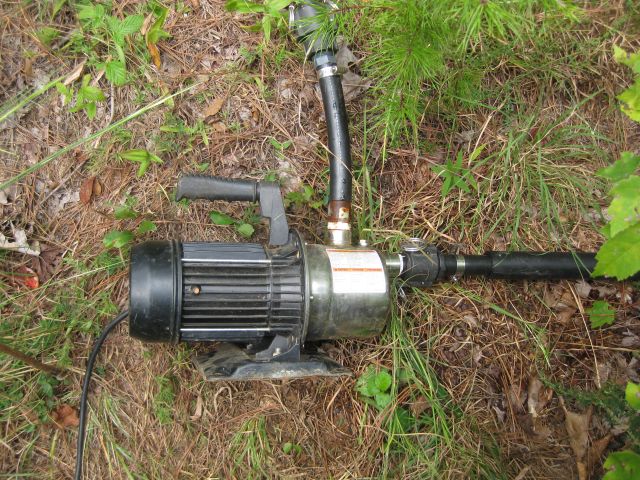
But this morning I had a new problem.  I was pumping from the temporary tanks at the tractor building to a storage tank and after the pump had been in action for a few minutes I decided to check on water flow and noticed nothing was flowing.  If there is air in the pump housing this can be the cause so I released the priming screw and made sure the housing was full of water but this did not solve the problem.  The pump engine was working so I assumed the problem was with the impeller which the engine spins and the spinning of which drives the rainwater.  As mentioned above, the temporary tanks do not have water filters and so I guessed that debris had clogged the impeller.

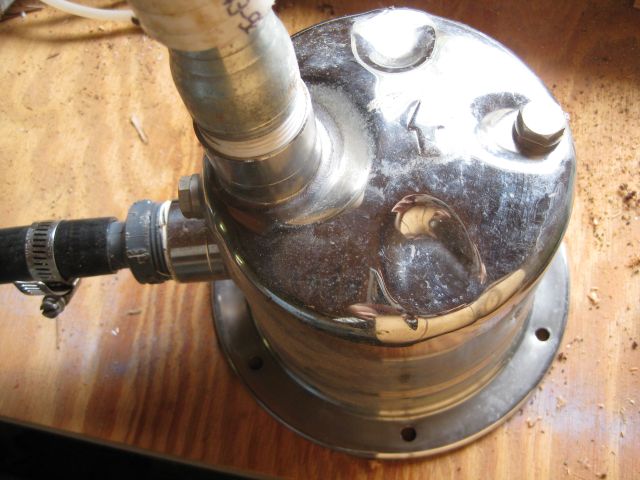
my rainwater pump
my portable rainwater pump with convenient carrying handle, water enters from the right and goes out through the top

The part of the pump through which the rainwater moves is called the volute and can be clearly seen below.

top view of rainwater pump
the volute of the pump into which the rainwater enters, is pressured by the impeller and exits

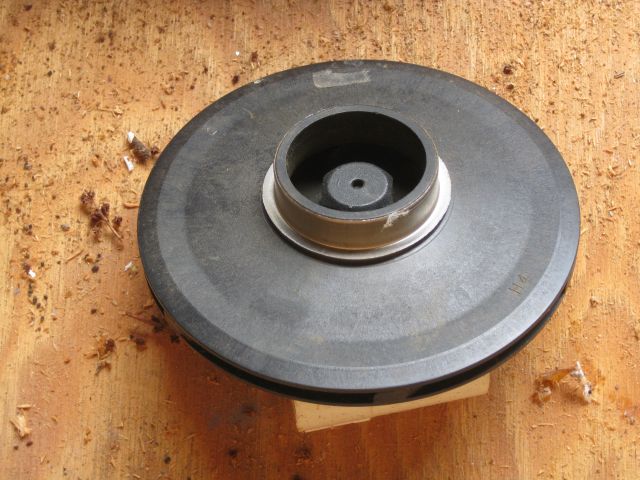
The rainwater is pressured by the impeller which is spun by the motor.  The water enters through the hole in the middle of the impeller.

part of rainwater pump
the rainwater enters through the hole in the center of the impeller

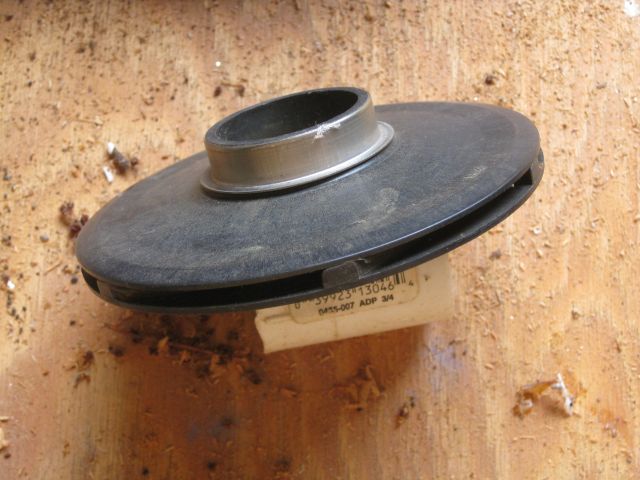
Centrifugal forces created by the spinning of the impeller eject the rainwater through vanes on the circumference of the impeller as can be seen below.

rainwater impeller
when the impeller is spun by the motor, rainwater is forced out through the slits in the circumference of the impeller

It was a simple repair.  I removed the housing (volute) and then cleared the twigs which had gathered at the entrance hole to the impeller.  I carefully replaced the housing and the pump was vigorously back in action.

My conclusions from this episode are that I should:  a) filter the rainwater entering the temporary storage tanks to eliminate debris; b) not pump all the rainwater out of the storage tank since the debris comes out last and if I had left 3 inches of rainwater at the bottom of the chicken coop tank the problem would likely not have occurred when I transferred the then clogged pump to the tractor building tanks,  or (c) replace the standard pump with one designed to pump trash water.  A trash water pump has a larger centrifugal impeller which will not clog as easily.


unintended consequences – Bermudagrass, vegetation in contour ditches

When I began planting my vines and blueberry bushes in the field, Bermudagrass (also known as “devil grass” because it can be an highly aggressive difficult to eradicate weed) was not a problem.  Yes it lurked among the broad bladed tall grasses but it was one of many.  Now it is a major problem and it can thank me!

Bermudagrass is a wiry perennial (easy to cut your fingers if you are pulling hard on it), and is low-growing (hence easily checked by taller grasses) and it spreads by above ground shoots called stolons and below ground shoots called rhizomes. Every so often at a node on the shoot, a root is sent deep into the soil with at least two objectives:  secure water in drought conditions, and act as an anchor to resist my eradication efforts.

I made two big mistakes.  For each new planting I diligently dug out a 2 ft diameter hole, added a copious helping of my high grade compost and inserted and watered the new plant.  This was mistake #1.  Think of a house in a run down neighborhood which has been ignored until new occupants arrive with expensive possessions.  The house attracts interest and invaders move in to seize the possessions.  Previously it wasn’t worth the trouble, now there is booty and the risk of being caught (in the case of a weed, being plucked and ejected) is more than offset by  the rich rewards.  And who was the opportunistic invader – quick footed Bermudagrass stolons and rhizomes.

Its called the competitive exclusion principle where two species compete for the same niche – my high grade compost.  The species with the greatest advantage will drive the other to exclusion.  Blueberry bushes have short roots and they didn’t stand a chance and were overwhelmed by the Bermudagrass.  As were too,  my raspberries.

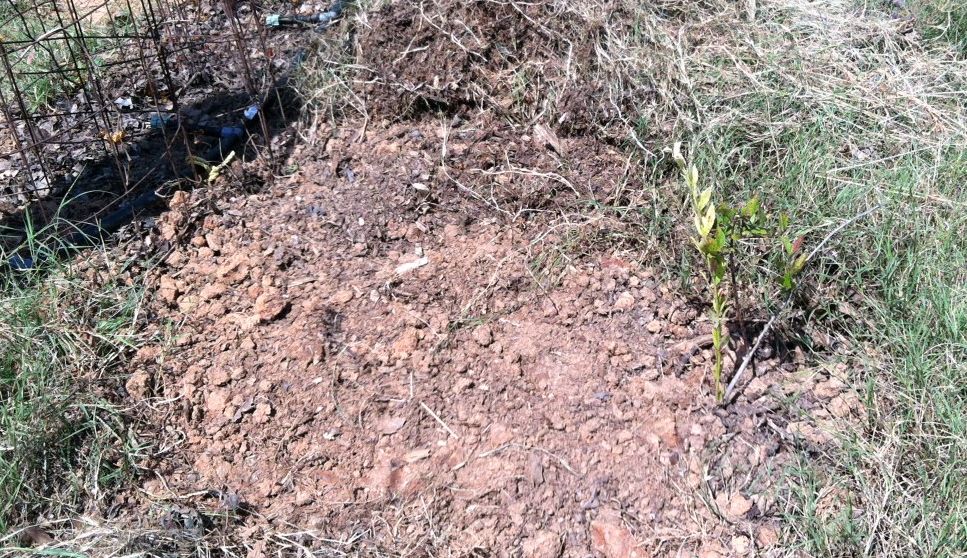
Bermudagrass
an insipid blueberry bush with adjacent pulled back mass of Bermudagrass

My logic had been that if I nourish and water the plants, they will quickly grow and outshade the competition.  And this would probably have worked with the other grasses, but not against the overwhelming rapacity of Bermudagrass.

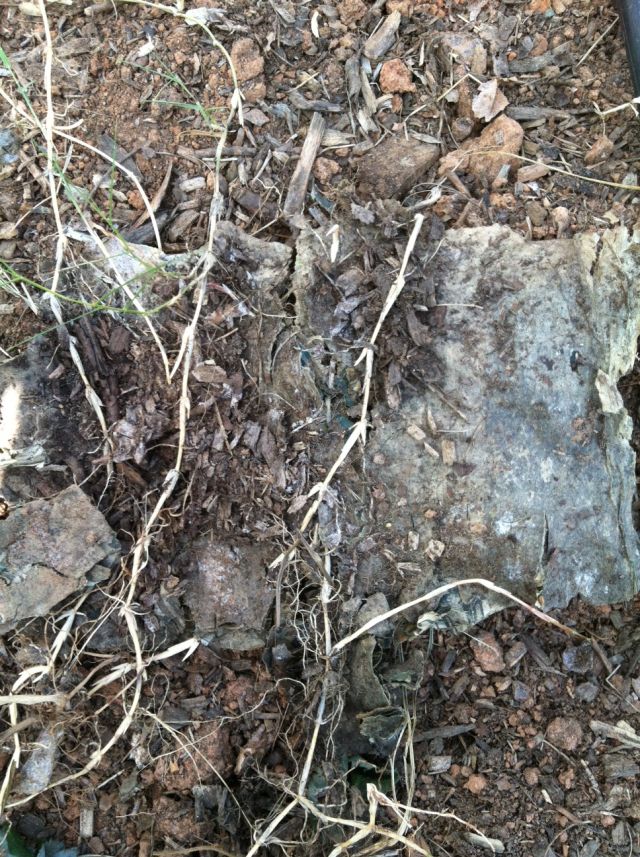
But I made a second mistake, which was just as devastating.  I gave the Bermuda grass a decisive advantage over the other grasses competing for the 2ft circle.  I mulched extensively with newspaper and woodchips.  I first laid the newspaper, at least 8 pages thick, and then the 4″ layer of woodchips above so the chips would not compete with the shrub roots for nitrogen.  The thick mulch effectively excluded all the other grasses and competition, but not the Bermuda grass.  It quickly despatched scout rhizomes deep into the mulch and when they reported back on the superior quality of the compost an advance guard and then an entire regiment quickly invaded.  So the deep mulching helped the Bermuda by favoring its competitive advantage of being able to delve in the dark into mulches on long exploratory missions and then to tunnel to the surface to capture sunlight.

Bermudagrass
Bermudagrass shoots at least 2 ft in length on the underside of thick wad of newspaper mulch

I suspect, but cannot prove, that the Bermudagrass shoots may host agents which demoralize the roots of my shrubs (allelopathic?).

And now I am hard at work with deep digging to locate and remove the rhizomes.  And this time I am using plastic edging to guard the frontiers, which I hope will stop most of the Bermudagrass, but I shall have to be continuously vigilant.

Contour ditches

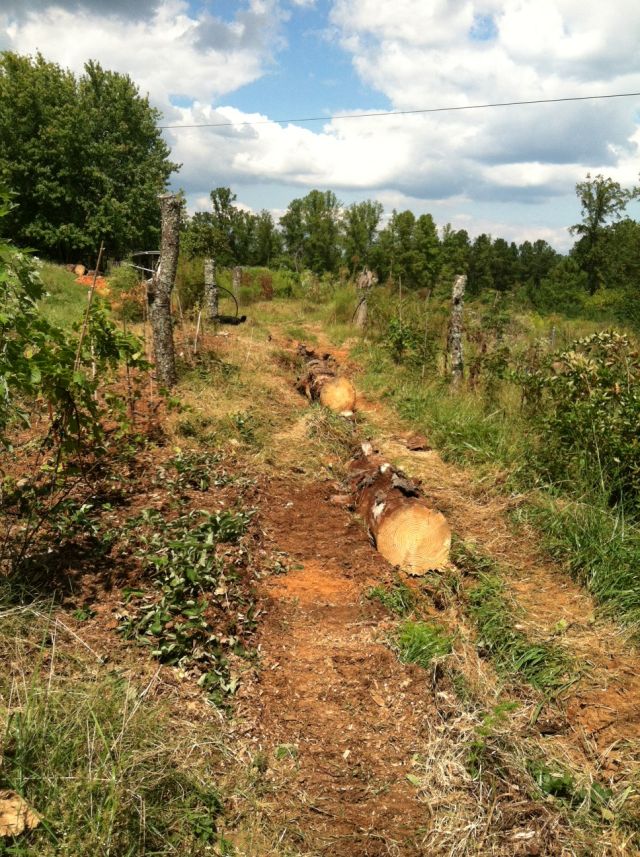
In a previous post I mentioned that large grasses and plants had moved into my contour ditches, which were established to catch, retain and infiltrate rainwater sliding down the hill.  Cleverly some of  the plants established themselves on the walls of the ditch – thus they were close to the entrapped rainwater at the bottom of the ditch but did not have to endure having their feet in the water for extended periods of time.  My solution, as previously mentioned was to stoke the ditches with tree trunks and branches (stoke as in stoking a fireplace).   A year ago some large pine trees were brought down with base trunk diameters exceeding 36″.  My bobcat cuts a 24″ wide trench.  So today I chainsawed the trunks of the pine trees, which did not exceed a 24″ diameter, into 10 ft lengths and relocated them to one of my contour ditches.  Rather than have the nutrients and organisms of the pine tree logs slowly dissipate into the air or the field, they will now be embraced by the soil in the ditch and nurture the roots of my plantings.  Also they will prevent new weedy growth in the ditches and will absorb rainwater and retain it.  Hopefully, this time round, a win win solution.

contour ditch earthwork
+20″ diameter pine tree trunks now berthed in a contour ditch


gumption and the intermittent failure

If the South’s summer heat and humidity bear any consolation, it is that I have to seek shelter in the house for much of the day and thus am able to extend my reading.

I enjoyed the first third of Zen and the Art of Motorcycle Maintenance by Pirsig but struggled as the protagonist ascended higher into the mountain and into rarefied philosophical issues for which I was not prepared.  Now in the last third of the book the running is easier.  His thoughts on gumption and practical issues of machine maintenance bring back memories.

At p. 310 he says “I like the word “gumption” because it’s so homely and so forlorn and so out of style it looks as if it needs a friend and isn’t likely to reject anyone who comes along”.  I recall “gumption” too with affection.  The only time I heard it used was by Tommy Cairns our lecturer in cost accounting at my university in Johannesburg during the early 70’s.  His lectures were punctuated by reference to a general lack of gumption and the criticality of gumption for success.

Now, many years later I see it dancing on the pages of Pirsig’s book before me, such as “Gumption is the psychic gasoline that keeps the whole thing going.  If you haven’t got it there’s no way the motorcycle can possibly be fixed.  But if you have got it and know how to keep it there’s absolutely no way in this whole world that motorcycle can keep from getting fixed.”

One of the gumption traps he refers to is the “intermittent failure” which fools you into thinking you have an engine problem fixed and then it recurs.  He suggests methods to identify and fix the problem with the advice that “In some intermittents you have to resign yourself to a long fishing expedition, but no matter how tedious that gets it’s never as tedious as taking the machine to a commercial mechanic five times”.

All of which brings back my second memory.  When I lived in London I had a Morris Minor – a two door beetle-like friend (formerly a police car) which I worked on extensively and affectionately called “Elbee” for its licence plate.  Elbee developed an intermittent fault – when I rounded corners quickly the electrics would falter.  I searched everywhere for the culprit, without success.  Elbee’s tools were kept in a rollup bag and one day, upon lifting the bag, I noticed an aimless, loose wire beneath.  This was an earthing wire held in place by the tool bag and I figured that when I cornered and put Elbee through her paces, the bag shifted and the wire lost contact with the frame.  It was an easy fix to secure the wire.

gumption
Elbee receiving a new clutch. The suburban street was my workshop

ideas from the past – the kang

I am reading the F. H. King classic “Farmers of Forty Centuries: Organic Farming in China, Korea, and Japan” written in 1911 and there are so many nuggets of useful information, including the “kang”.

He observed the  kang  during his visit to Mongolia and his commentary  made me think of the rocket mass heater (now popular in permaculture circles)  with which it shares a number of features.

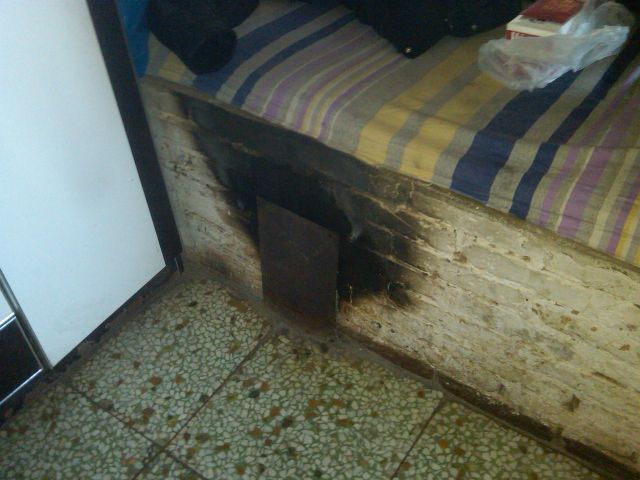
He describes several kangs – in one case it was 7ft by 7ft and about 28″ high and “could be warmed in winter by building a fire within” or “warmed by the waste heat from the kitchen whose chimney flue passed horizontally under the kangs before rising through the roof”.

“The top was fitted for mats to serve as couch by day and as a place upon which to spread the bed at night.”  They were constructed from brick “made from the clay subsoil taken from the fields and worked into a plastic mass, mixed with chaff and short straw, dried in the sun and then laid in a mortar of the same material.  These massive kangs are thus capable of absorbing large amounts of the waste heat of from the kitchen during the day and of imparting congenial warmth to the couches by day and to the beds and sleeping apartments during the night.”  He goes on to mention problems after 3 or 4 years and how they turn the problem into a solution.  His book can be freely downloaded.

These kangs are still used today.  I include below several recent ‘photos taken by a visitor  to eastern inner Mongolia.

kang mass heater
lighting the fire of a kang
mass heater kang
interior fire of a kang
mass heater kang
‘photo of another kang

The visitor could not recall if the exterior flue of the kang was horizontal or vertical – he thought it may have been horizontal

DIY and its virtues

I just read a good essay in the New York Times – “A Nation that’s losing its Toolbox” by Louis Uchitelle (July 21, 2012).  He laments the loss, not only of factories and good manufacturing jobs, but also “mastering tools and working with one’s hands is receding in America as a hobby, as a valued skill, as a cultural influence that shaped thinking and behavior in vast sections of the country. ”  He says that manufacturing is important, not just to create jobs and reduce the trade deficit and help us out of the recession, but “a growing manufacturing sector encourages craftsmanship and that craftsmanship is, if not a birthright, then a vital ingredient of the American self-image as a can-do, inventive, we-can-make-anything people.”

Maybe the shift from manufacturing jobs to the service sector was because of higher pay, higher status or less physical exertion.  Or is it a cultural thing.  In an earlier post I referred to German technology and competitiveness which is unbruised by Asian competition. The author quotes Richard Sennett, a NYU sociologist  “Corporations in Germany realized that there was an interest to be served economically and patriotically in building up a skilled labor force at home; we never had that ethos.”

Some books resonate with me.  I enjoyed  “Shop Class as Soulcraft” by Matthew Crawford and now, at long last, I am reading “Zen and the Art of Motorcycle Maintenance”.  Lots of delightful quotes – here the author (at page 44) comments on how different two motorcycles of the same make, model and year can turn out years later  “Each machine has its own, unique personality ….This personality constantly changes, usually for the worse, but sometimes surprisingly for the better, and it is this personality that is the real object of motorcycle maintenance.  The new ones start out as good-looking strangers and, depending on how they are treated, degenerate rapidly into bad-acting grouches or even cripples, or else turn into healthy, good-natured, long-lasting friends.”

It is probably the case that now we have progressed beyond the intricacies and quirks of carburettors and manually actuated devices to computer controlled fuel injected vehicles and other digital devices, that the personality of machines has been buried and they all act much the same, except where grossly abused.  And with this transition we have lost some of the connectedness we once had to the world around us.

I remember some 30 years back I had a large tube tv, long on its legs, which regularly began to flicker erratically after 10 minutes use.  I concluded there must be some failing part which malfunctioned when it got hot.  I bought a can of compressed cold spray, opened the rear, switched on the tv, waited 10 minutes and, taking good care not to come in contact with any high voltage wires, sprayed each component, largest first.  To my delight when I sprayed one particular tubular device, the flicker on the tv disappeared.   I waited, the component warmed up, I sprayed it again and the flicker disappeared.  It was then a simple matter to remove the component, go to the electronics store, order a replacement and solder the substitute in place.  Presto – easy fix.  I will not try this on modern tv’s and even replacing the spark plugs on my truck (manifolds and various devices have to be first removed) fills me with apprehension.

So maybe also, the advent of new technologies has reduced our ability and wish to tinker, as we did in the past and, because they cost relatively so much less than did products of the past, our incentive as well.

a little pond

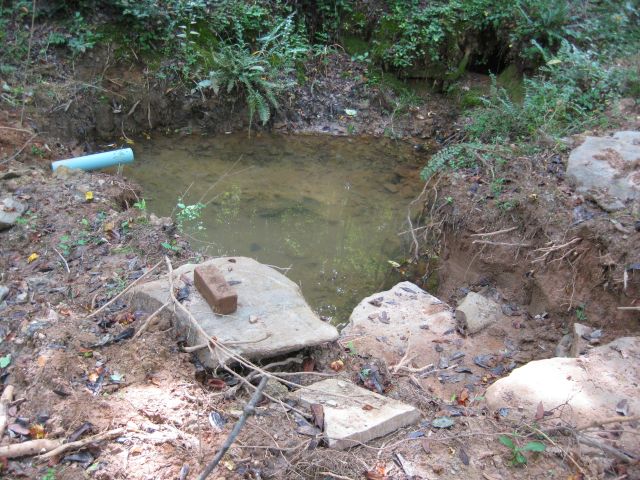
When I purchased the woods I had dreams of a 1/4 acre lake/dam and invested time identifying a locale and internally promoting the feasibility.  After all, what can be more satisfying than a sheltered expanse of water nurturing fish, a watering hole for the wildlife, a solace for the stresses of life.  And so on.  But, apart from a good watershed which flowed plentifully during heavy storms, which we get over here,  there was no ongoing supply of water such as a spring.  And then I heard of the failures, the couple who had a good dam constructed but it never filled.  And I concluded that even if I had a well sealed dam, evaporation during the summer would undo the concept.  So recently I focused on the only spring in the woods and almost lost my bobcat in the mud which I was trying to excavate – see post  “lucky save”.  So with the help of a contractor and excavator (I broke my rule to do everything myself) I enlarged the existing hole where the spring appears but could not make it deep because there are large boulders which are difficult to extricate.  An unsatisfying result – for now.

With my lofty aspirations now reduced to a small pond I decided to make the best of it and visited a pet store and bought some small goldfish and minnows and fish food and a water plant.  I hoped the fish would survive.  And they did for about a week.  Now they are gone – eaten I suspect by the frogs.  The drainage pipe which extends over the water is one of the launching pads of the frogs.  They enter the water like arrows and I suppose the percussive impact of their water entry stuns the fish and makes them easy prey – like shooting fish in a barrel.  So instead I will look at the other insect and wildlife when I visit the pond and I am growing various herb and other shade loving plants to introduce among the ferns, which proliferate.

pond
small pond with drainage pipe and unusually sized brick in foreground, found at location

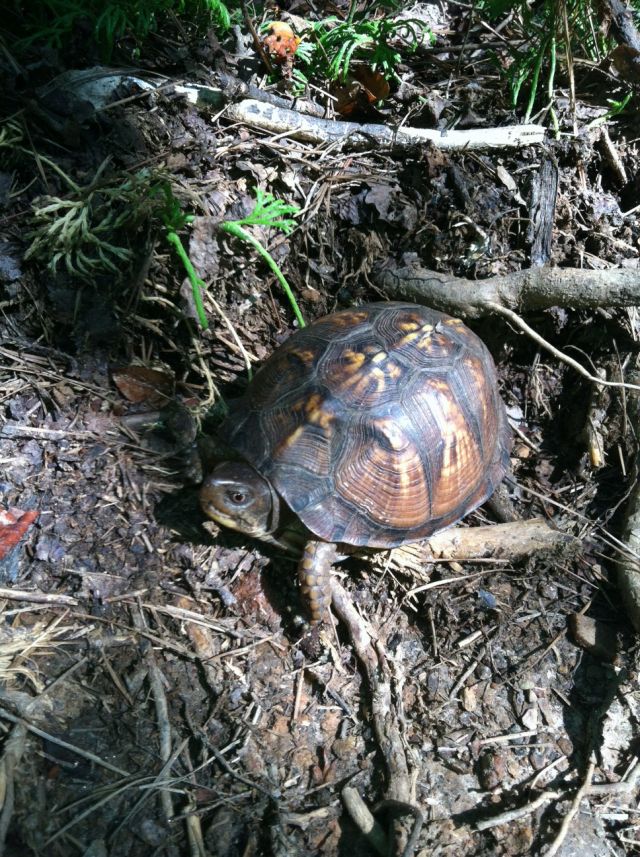
On the way to the pond I have noticed a number of turtles – here is one from this morning.

turtle near pond
one of several turtles exploring the woods not far from the pond

“Paradise Lost”?

So, some time has passed since my last post and that’s because my focus has been distracted.  Reality has a way of intruding on the cocoon we build around us.  It may be sudden severe ill health.  Or, as in my case, an intrusion.

In my “battle of wits” post last month I mentioned the advent of the fox which seized my favorite chicken.  A predator from the outside.  Well, a few weeks ago, another predator surfaced – the human kind, and one evening, when I was away from the property, they broke into the log cabin and stole (I was going to say “removed” but why mince words?) a bunch of items.  Although I am at the property every day, I am not there every night.  In the beginning, in anticipation of such an event, I resolved to not keep any valuable/significant items at the log cabin.  And then, as the months rolled by uneventfully, complacency set it and I began leaving (for convenience sake) more and more tools and possessions.

When I first purchased my pickup truck I acquired a large tool box, which fits over the truck bed, and each day I selected the tools I needed and transported them in the tool box to and from the property.  For the past few years the tool box was unused in storage.  It is now back in commission and I will continue using it until I have better secured the property.

To secure the property I have been working on several fronts:

  • the excessive vegetation, which provided privacy, comes with a cost – lack of security because it impedes surveillance by neighbors and may even give the impression that the house is abandoned or rarely visited.  So a lot has been cut back.
  • neighbors are important for deterrence and detection and I am lucky to have two supportive neighbors who are keeping an eye on things.
  • gates.  It is not enough to chain gates since they can be lifted off their hinges, which actually happened to me.  So I have cabled secured the hinge side of the gates.
  • lighting.  I have sprung for the very efficient LED dawn to dusk lights and dawn to dusk fluorescent lights.  Initially I used halogen  300W lights, which are very inefficient, and I was going to transition to halide or sodium until I decided to spend a bit more for LED.
  • when I purchased the log cabin I replaced all the external locks with Kwikset SmartKey locks, which can be easily rekeyed – less than a minute to rekey each lock.
  • alarm system.  I have installed internal motion detectors and a siren and will in due course include a monitoring system.
  • surveillance cameras.  These are being expanded and upgraded.
  • I re-sited my outside motion detectors, which were intended to locate the fox, to the exterior of the house to provide early warning of human visitors.

In future posts I will provide more information on the various techniques.  Of course the proof is in the pudding, so will wait and see how matters proceed.

To return to normalcy, today I replaced the shattered window, which provided access to the intruders.  It was actually a fairly simple operation.  The key was to find the exact replacement and I was lucky that Lowe’s carried the match, which came with a few extra features, for a reasonable price.  Replacement windows do not have “nail fins” which are on the original windows.  So the first step is to cut off the nail fins which secure the old window to the opening.  I have an old, good quality reciprocating saw (fortunately never stored at the log cabin) and I was able to cut through the plastic nail fins on all four sides of the damaged window without too much hassle.  The window came out easily, I then cleaned the frame, applied caulk, inserted the new window and screwed it secure.  My other step towards normalcy was to post to this website.

I have some catching up to do – a recent good honey harvest, squash which are producing and have not yet fallen victim to the borers, a decent garlic harvest, and more – for future posts.