building a bookshelf

how I built a large bookshelf

My logcabin has a large basement and I have many books in piles around the living areas – time for a large bookshelf.  The Atlanta house we bought 20 years ago had a built in bookshelf in a couple of rooms (that’s what attracted us) and in the attic was surplus wood shelves of varied lengths – 36″, 33″ and 32″.

Preparation
I cleared a wall and corner in the basement, polyfilled the holes in the sheetrock, painted the wall with the color I will use for the rest of the room and began construction of the bookshelf.  The shelves are 11″ wide so I purchased two lengths of  16 ft by 12″ wide wood and had them cut into manageable 8 ft lengths at the store (although described as 12″ wide the wood is actuall 11″ wide).  I selected the wood carefully avoiding bowing, splits and disfigurations.  I also bought 3 10ft lengths of 2″ by 4″ wood.

Construction
I will not go into too many details since the design is simple and evident from the photographs.
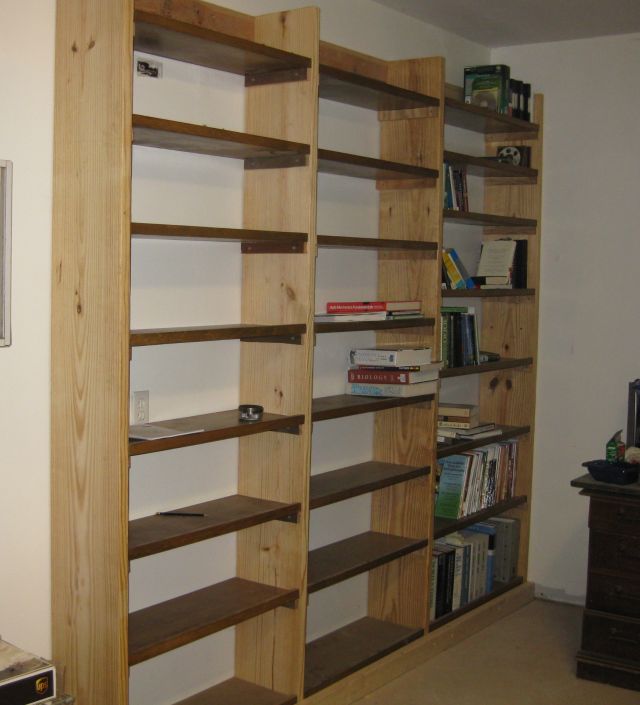
completed bookshelf 0805
the completed bookshelf

The bookshelf is 8 ft high and the 3 sections are respectively 36″ wide, 33″ wide and 32″ wide.  The shelves for two of the sections are aligned.  The furthest section has extra height at the lower shelves for very large books.  To prevent toppling, the four vertical lengths are screwed into horizontal 2-4’s  at the top and also to a 10′ 2-4 at the base where the wall meets the floor.  A 3rd 10′ 2-4 in the front secures the front edge of the verticals and provides extra footprint stability.
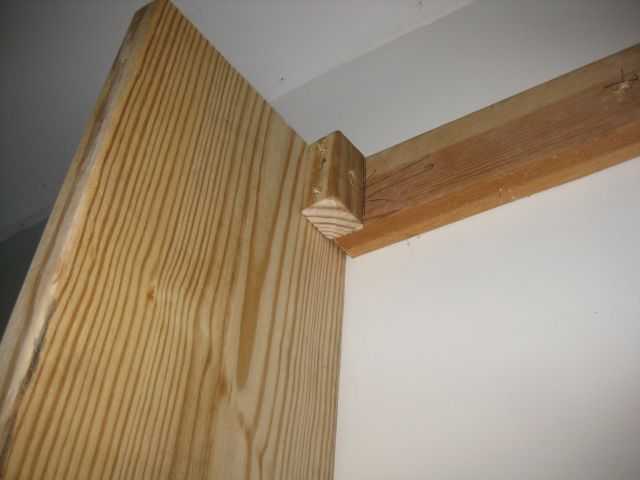
securing the vertical to the top of the wall

The horizontal 2-4’s at the top have two functions – to keep the vertical the right distance apart and to secure the verticals to the wall to prevent toppling.  As shown, a scrap piece of wood is all I used to secure the vertical to the horizontal 2-4.
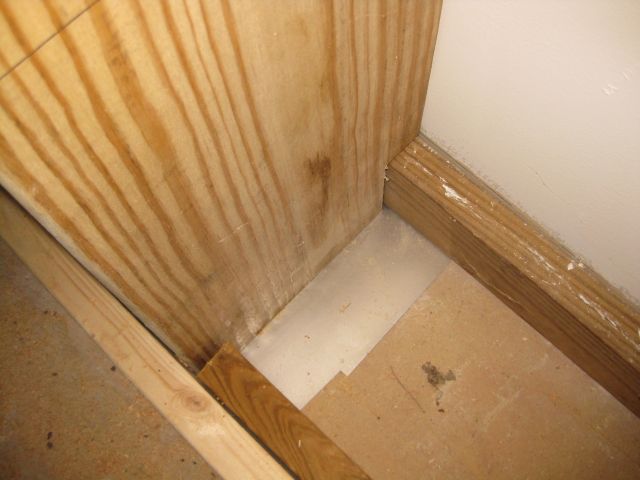
flashing at base of vertical
I used flashing at the base of the vertical

Since the vertical rests directly on the concrete floor I decided to place some flashing between the base of the vertical and the concrete floor, lest the vertical wick moisture from the concrete.
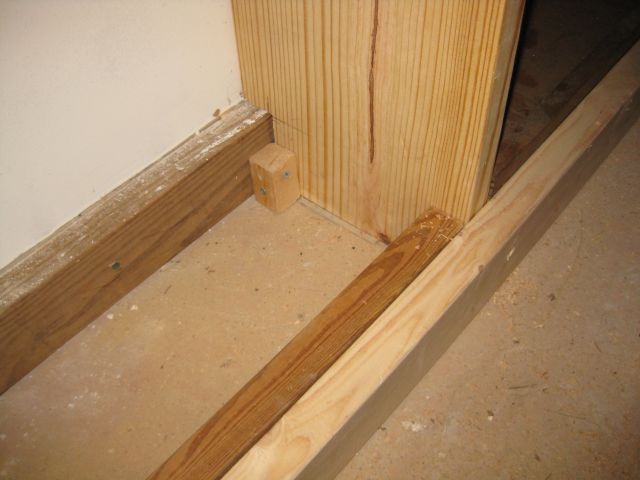
securing the base of the vertical

I also secured the base of the vertical to the rear 2-4 using scrap wood and screws, and a single screw to the 2-4 in front of the vertical.

For the horizontal ledges for the shelves, I cut 10.5″ lengths 1.5″ wide from scrap wood and plywood.  I predrilled the ledges  for 2 screws to reduce splitting and effort of screwing them into the verticals.
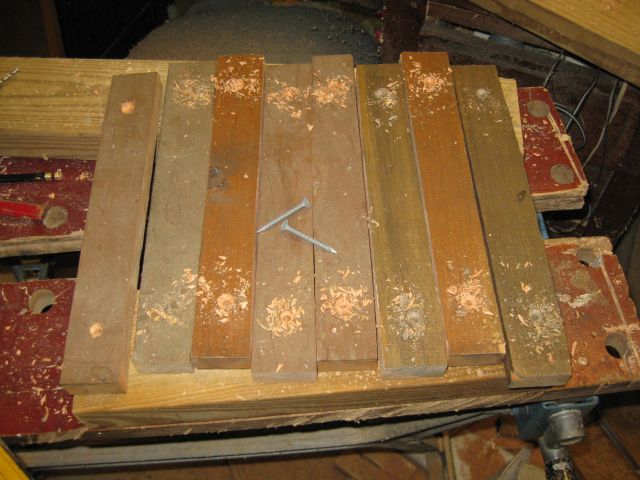
horizontal ledges for shelves

The procedure is to place the lowest shelf, then measure the height for the next shelf and draw a horizontal line with a square, screw the ledge into place, then rest the shelf on the ledge and with a spirit level ensure it is level, pencil in the line on the other vertical.  This ensures each shelf is level each time.

Now the bookshelf is done I will begin populating the shelves.
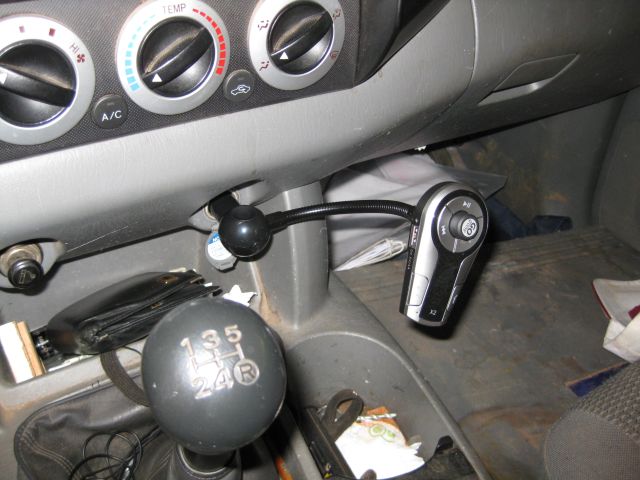


bluetooth & my basic truck

I have a base model Toyota Tacoma 2005 pickup (base means manual shift, windup windows and small but efficient engine) which came with a simple radio and CD player.  The challenge for me has always been playing podcasts (especially during the NPR fundraising season – 4 weeks a year).  I have downloaded my podcasts via my computer to MP3 players and then connected them to a  speaker which I have jammed between my shoulder and ear as I drove along.  Pretty basic, distracting and difficult to adjust while driving, plus the sound was poor.  My next stratagem was to download the podcasts onto CD’s and use the CD player – sound was fine but this took time and I now have a lot of one time use CD’s laying around.

Just returned from my son’s wedding in San Francisco where, in the tradition of exchanging gifts, he upgraded me to the 21st century by giving me a FlexSmart x2, which is a wireless bluetooth FM transmitter.   I have been catapulted into a new listening experience.

The setup steps are relatively simple.  I have an Apple iPhone, so I visited the App Store and downloaded the free podcast app.  I then visited  my favorite source of podcasts – www.permies.com and downloaded the 10 most recent Paul Wheaton permaculture podcasts.  I can simply play the podcasts on my iPhone, which is an improvement on the mp3 route since the downloads are easier to do, I can subscribe for automatic downloading of future podcasts, and the sound is louder than my previous convoluted configuration.  But, this is not as good as playing the podcasts through the car’s audio system.  To do this I use FlexSmart.

I inserted the FlexSmart DC adaptor into the cigarette socket as you can see below.

FlexSMART plugged into cigarette lighter

Then I pressed a button for the device to enter pairing mode and told the iPhone to search for a bluetooth connection.  The two devices quickly found each other.  The play, pause, advance and previous song controls on the FlexSmart operate those functions on the iPhone.  With the two devices in sync, I switched on the radio and instructed the FlexSmart to autoseek a free FM station.  It told me which FM frequency was available and I tuned the radio to that frequency.  And, crystal clear and as loud as I wished, I can listen to my podcasts and control them via the FlexSmart rather than groping for the iPhone and risk an irritable growl or snap from Trudy when the iPhone has settled under her.  I can also take calls via the FlexSmart.  I realize this is old hat for recent model car owners but is a big step forward for me.


I have an Apple iPhone

new camera old lens (continued)

In my previous post I mentioned the challenges of crisp focusing, the flatness produced by the flash directly above the camera (it should be to the side), camera shake and the need for a tripod.  I discovered among our possessions an old tripod (a Velbon VE-3, >30 years old) and today I returned to the field.  When using a macro lens the slightest jarring of the body blurs the image.  One answer could be to increase the speed of the shutter.  But then less light reaches the sensor.  So I could open the aperture of the lens to allow more light to reach the sensor but depth of field (clearness of image in front and behind the point of focus) is sacrificed.  Or I could increase the sensor ISO speed but this results in “noise”.  So if I want to shoot with a small aperture (say f22) and a slow film speed (say ISO 400) on a cloudy day (to avoid bright sunlight bleaching) I have to use a tripod.

flower with some depth of field

flower with some depth of field

 I also have to choose a time when there is no wind since the slightest movement of the flower produces blurring.

some varieties of onion are going to seed and I am leaving a few heads to see if they can self seed

Now I am looking at flowers more carefully, I am noticing lots of small pollinators I had not seen before.

OLYMPUS DIGITAL CAMERA
a small visitor I had not previously noticed

I continue to be attracted to patterns – here the pattern of a fig leaf.

fig leaf with the clouded sun behind it

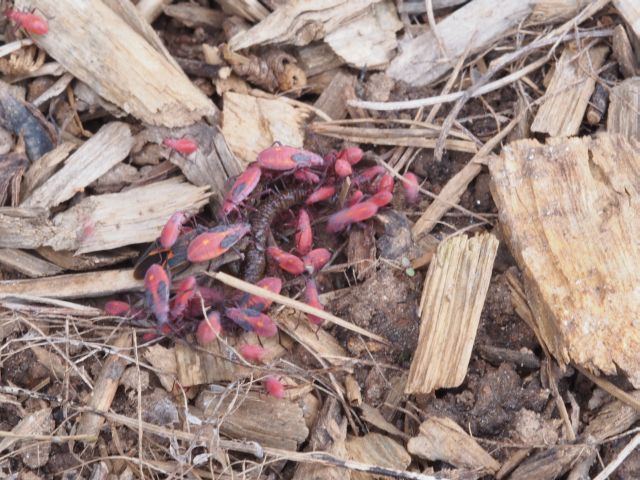
I took several snaps of small red bugs which are teeming around a vegetable growing area.  Never saw them on the plants but they parade everywhere else.  They gather in clusters and one of my pics reveals why.

OLYMPUS DIGITAL CAMERA
they probably did not kill the centipede so they may be scavengers rather than predators?

This flower stood out from the others so I had to take a snap.

a luminescent attractive offering

I notice that my tripod, which is sturdy, is still unsteady – this is because the tripod feet rest on mulch and soft soil.  So the slightest touch can move the platform – I may need a shutter release cable in due course.  Also the pics on my website are compressed, typically as in those above, below 100 kilobytes.  The original pics are >3 megabytes so the compression is more than 30 times and yet the pics look decent, but there is an inevitable loss of definition.

new camera and old lens

I have taken photographs since I was a kid.  Initially with a box camera, then my Dad’s Zeiss Ikon f2.8 bellows camera, then a single lens reflex and then most recently for this website a Canon PowerShot SD1100.  The PowerShot has been fine but it has limitations for good close up pictures.  I recently found a boxed assortment of Pentax lenses, one of which is an Asahi SMC Macro Takumar f4 100mm, which is about 40 years old.  This lens should be great for close ups I thought, so why not pair it with a modern digital camera.  After considerable research I decided to buy the Olympus EPL-5, which arrived this week and I snapped a few pictures.  Using an older lens has some disadvantages – there is no automatic focusing, you have to do it yourself.  Also the aperture does not automatically open for focusing and the stop down for exposure, you have to manually step it down.  So it takes time to develop these lost skills.  But I don’t take action photos and I will try master these techniques.

comfrey leaf early morning rain backlit by sun

I should mention that for this website I compress photos considerably, so if they are not razor sharp attribute this to compression or user error, but not the equipment.

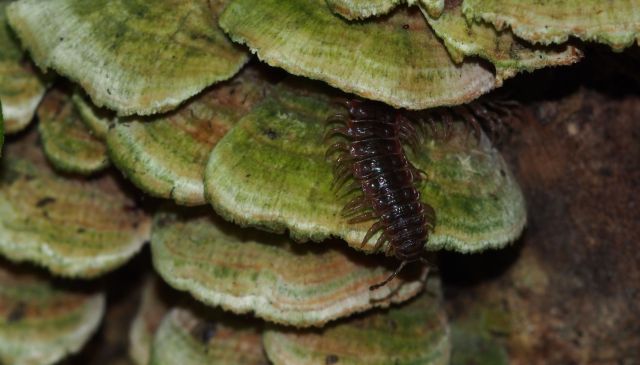
The photographs were taken using a monopod but this is not stable for long exposures.  I will use a more rigid platform and then I will be able to stop using a flash which tends to flatten the subject.  The centipede appeared suddenly as I was focusing on the log oyster mushrooms.

millipede amongst oyster mushrooms
centipede amongst oyster mushrooms

With all the recent rains (my property is fortunate it receives rain from the Gulf  i.e. the southwest and also the northwest) the kale was sparkly with raindrops.kale leaf with raindrops

kale leaf with raindrops

The only chicken to co-operate with my slow manual focusing requirements was the New Jersey Giant who was attracted to the distinctive click of the Olympus.

New Jersey Giant attracted to the sound of the camera


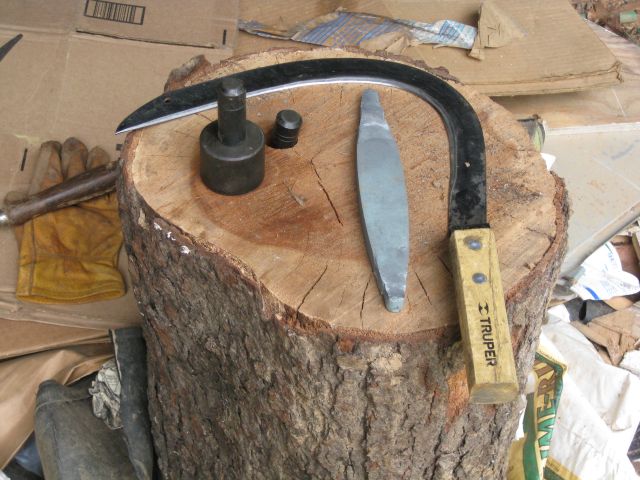
my new hand sickle

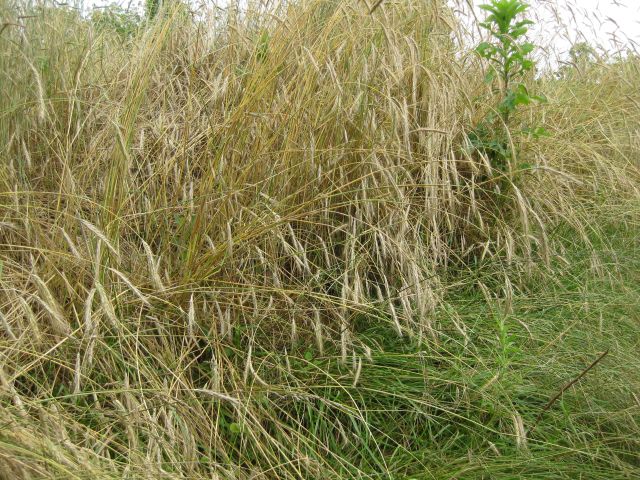
The winter rye is tall and surrounds and shades my berry plants.

rampant winter rye
rampant winter rye

Now it is summer the winter rye is drying out and will soon drop its seed.  I like the wilderness of this luscious growth and see no point in cutting it down, except where it dwarfs my plantings.  It is shallow rooted and after a rain comes easily out of the ground, but that leaves an open spot quickly invaded by weeds and Bermuda grass.  For clearing the rye away from my plantings my large scythe is ill suited since it requires large two handed sweeps which can easily slice off the unintended.  I remembered the one hand sickle from my childhood days, googled it and found several variations for sale.  I wanted something solid and not with a serrated blade.  The Truper 33576 grass hook (as it is called) with a riveted handle best suited my requirements and cost $18.11 on the internet.  It arrived with a slight bevel on the blade but completely blunt, as is customary.  I have a peening jig mounted on a broad oak log.

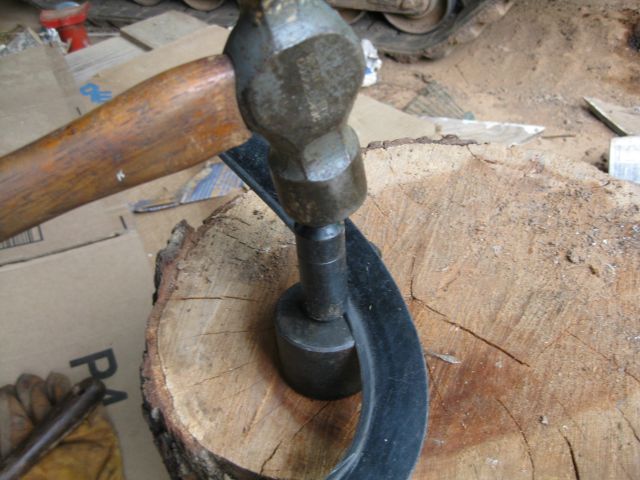
you can see the sickle, my sharpening stone and the peening jig with two caps

The peening procedure is fairly simple – you place the blade between the anvil and the cap and then you tap the #1 cap along the length of the blade and then the #2 cap.  Peening flattens and expands the blade making it thinner for better sharpening.

peening the blade - my right hand usually holds the blade flat on the anvil, but it was holding the camera instead
. peening the blade – my right hand usually holds the blade flat on the anvil, but it was holding the camera instead

I then hand sharpened the blade with the stone.  Which was not a good idea since it took an inordinate time.  So, instead I fitted a small grinding wheel on my dremel  and this sped things up.

I am very happy with the hand sickle.  Cutting grass is simple but needs care.  With one hand you grasp the tall grass and pull it taut.  You place the sickle blade at the base of the grass and with a slicing motion you sever the grass.  Since some force is exerted pulling the sickle toward you and it can come quickly swinging clear, you should keep limbs well out of the way of its path.  Also take care not to slice the hand holding the grass.  You can fold the grass in half (if it is several feet long) and use it to border the planting.  This acts as a mulch, keeps the ground moist and dissuades weeds.  A weed whacker would work but it flings the grass about and could damage the plantings.  The sickle is very precise since you encircle the grass to be cut with the hook before cutting it.  And since you now have the cut grass in your hand it is easy to place it where you wish.

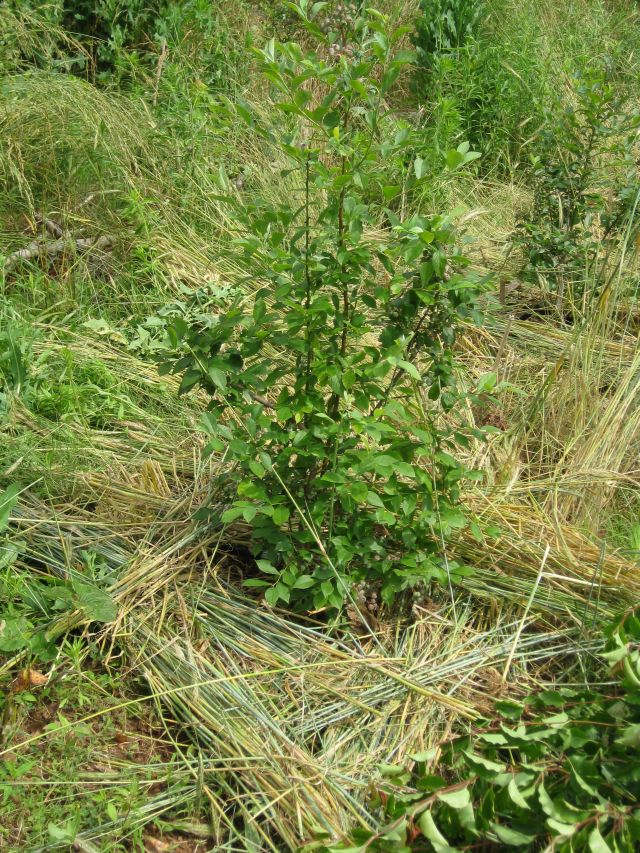
a blueberry bush with its tall neighbors removed and at its feet

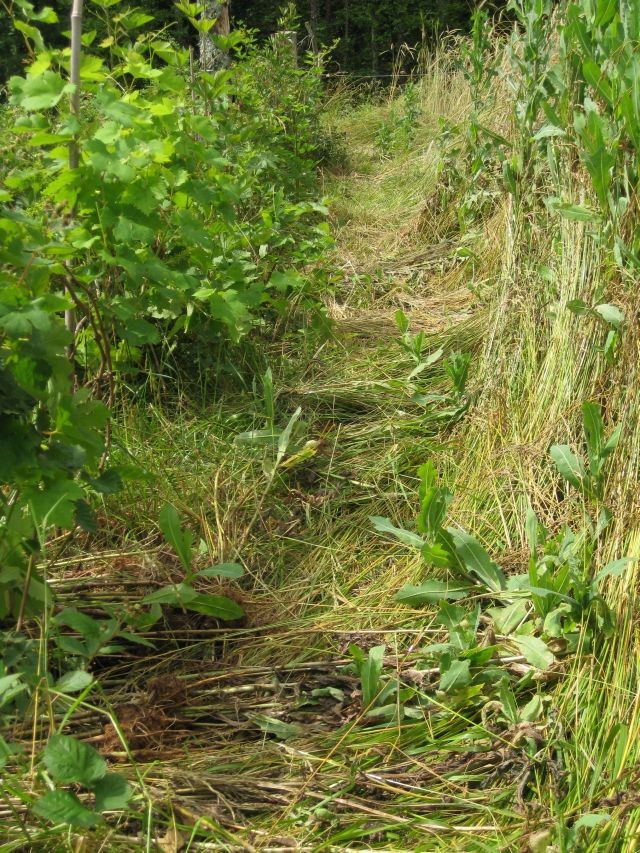
And here is a row of raspberry and blackberry plantings liberated from the rye which concealed them.

blackberry and raspberry plants now accessible


locating a buried 4″ drainage pipe

About 20 years ago I dug a 100 ft trench for a 4″ drain pipe, which led from a concave area of the yard where the rainwater gathered, to a nearby creek.  Over the years I planted many trees and shrubs in this area.  The pipe worked well until the past few months when it completely ceased functioning.  With downpours seemingly more intense than ever, I decided I had to fix the problem.

I have a 50 ft plumber’s snake and I inserted it in the hole and it moved along easily for 45 ft and then hit a blockage.  I pulled the snake and inserted a contractor grade hose to the blockage and turned on the faucet thinking/hoping the water pressure would clear the blockage.  To no avail, even after several days attempts.  I concluded I should dig up and replace the blocked section of the pipe.

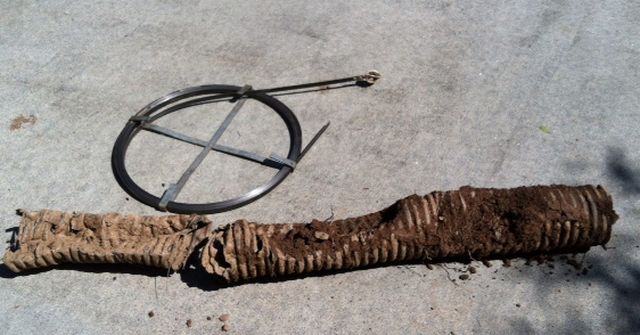
plumber's snake and damaged pipe
plumber’s snake at top and the blocked pipe. section on left had completely collapsed and section on right was a few feet further downline and was partially collapsed, all from roots of the same tree

Problem was I didn’t know exactly where the pipe ran under the ground since, over the past 2 decades the landscape had changed.  I tried digging a 5ft trench perpendicular to the supposed run of the pipe, but did not find it.  The pipe is about 1 ft underground and digging a 1ft deep trench should not take much effort or time.  Problem is the whole area is interlaced with the roots of good trees including a Japanese maple,  Harry Lauder’s walking stick, and other worth preserving species.  Plus some pretty thick pine roots as well.

How to locate the underground pipe?  Plumbers use a transmitter on their underground probes, but they are expensive for a one time use.  I googled personal locator devices and saw there are two options for the absent minded – with the cheaper device you attach a transmitter to your keys or other often lost items (not a cell phone because you just dial your # and it will ring) and, when lost, you press a button on the locator and the transmitter will flash and make a noise and you should find it.  This wouldn’t work for an underground scenario.  So I had to spring for the more expensive device (loc8tor lite) which has red and green directional lights on the locator as well as a beeper.  You press the button, the locator calls the transmitter, the transmitter responds and then, with the locator in your hand you do a little circle and when you are nearer to the location of the transmitter, the locator becomes excited and even more excited with red and green lights glowing and noisier as you get nearer to the transmitter.

the locator is credit card sized and the transmitter on the left much smaller and worked for locating buried pipe
the locator is credit card sized and the transmitter on the left much smaller

I placed the transmitter in a secure waterproof container (actually an old cylindrical 35mm film container) secured it with duct tape to the end of the plumber’s snake and sent it down the pipe.  Initially my locator failed completely to detect the transmitter.  So I figured its range must be limited when the transmitter is underground and to ensure I had the locator as close as possible to the position of the transmitter, I pushed the snake exactly 10 ft down the hole and measured exactly 10ft ground distance and, after removing some topsoil, I  was able to locate the transmitter when it was directly below the locator separated by about 8″ of soil.  The cheerful chirping and flashing green lights after hours of fruitless work was recompense enough.  From there on it was easy going – measure out 10 ft distance on the ground, advance the snake 10 ft, clear the soil and the magical beeping and light flashing re-commenced.  And so I continued until I located the blockage which was about 10 ft away from where I had thought the pipe ran and also much deeper than I had imagined.  A worthwhile $68 investment and no doubt it will be handy for locating my often lost keys.

raised beds for growing vegetables

One of my takeaways from the recent GO conference (see two previous posts) is that a raised bed can be constructed from untreated pine and will last a number of years.  I have previously constructed my raised beds from composite decking planks.

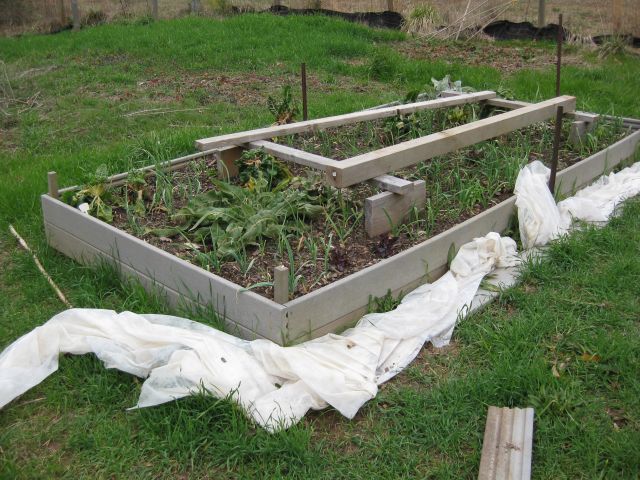
an example of a raised deck from composites
an example of a raised deck from composites. the wooden planks in the middle support the row cover, when needed

On the first day of the conference we visited local farms and the small farm I visited was on 2.5 acres of mainly granite and therefore made extensive use of raised beds.  The composite decking planks I used for my raised beds cost $21.97 for 1.25″x6″x12′ or 30.5cents per sq inch.  I had not thought to use untreated pine for raised beds since I thought it would rot within a few years.  The farm we visited, which provides for 40 CSA customers, has been using the same untreated pine for raised beds for 8 years.  The cost of untreated pine is $11.71 for 2″x10″x12′ or 9.8c per sq inch.  So the cost of constructing a raised bed with untreated pine is less than 1/3 the cost of a raised bed with composite materials.  And if my raised bed will last even 5 to 6 years I will be very happy.

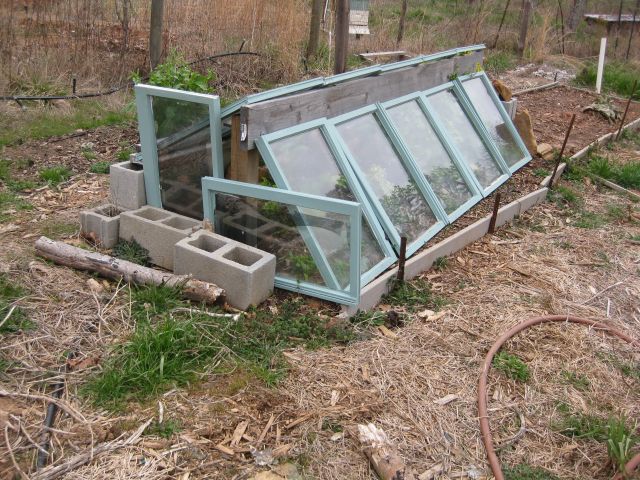
the composite raised bed half of which serves as a simple cold frame
a one tier composite raised bed half of which serves as a simple cold frame

As a trial I purchased 2 10″by 12′ lengths and had the store cut each 12′ length into an 8′ and 4′ piece.  I also bought a 2″x2″x8′ stud for joining the corners.  It was quick work to construct the raised bed.

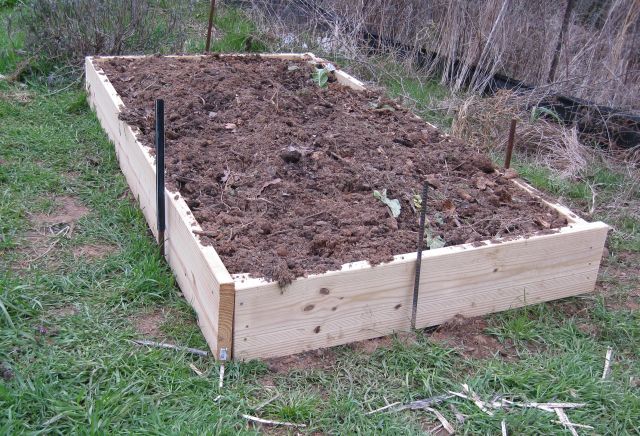
new raised bed constructed from untreated pine with steel rods buttressing the middles of the sides

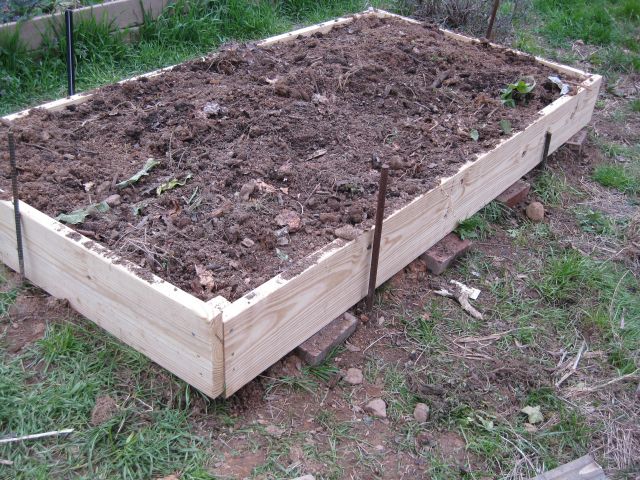
Since the raised bed is on sloping ground and I wanted it reasonably level I had two choices.  I could dig the higher side into the ground or raise the lower side.  Since I wanted to reduce earth contact as much as possible (to minimize rotting), I decided to raise the lower side of the raised bed by placing it on surplus bricks.  The raised bed is reasonably level now.  I pinned the corners of the raised bed using 2.5″ weather resistant screws and also buttressed the sides with scrap iron rods hammered vertically into the ground.  I filled the raised bed with soil which previously covered rotted logs so it is rich in organic materials.  And then I added a wheel barrow of compost to the top and forked it in.  The raised bed is now ready for its first occupants and after the next rains, when it has settled, I will seed with root plants (carrots, turnips and beets) interspersed with my favorite kale seedlings.

new raised bed showing bricks supporting the lower side


a black powder event

Now for something different!

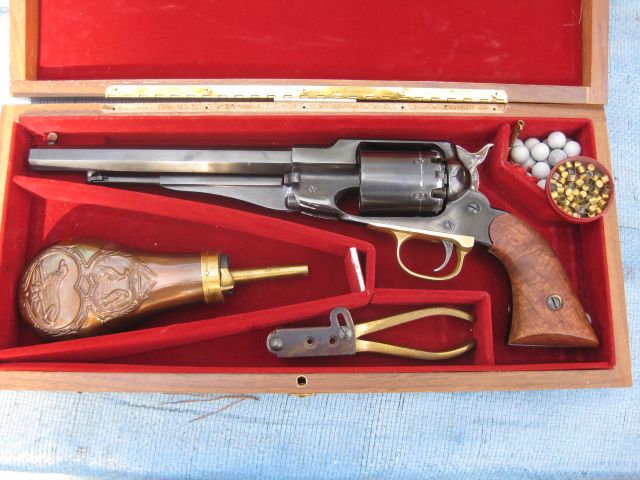
The Remington Model 1858 was a 6 shot revolver patented in 1858.  My buddy Mike has an Italian made replica with an 8″ barrel in .44 caliber and he, and I, were keen to try it out on my range in the valley of the woods.

the case contains the revolver, a powder flask, a mould for making your own bullets, the bullets (top right) and the caps (in the tin next the bullets)

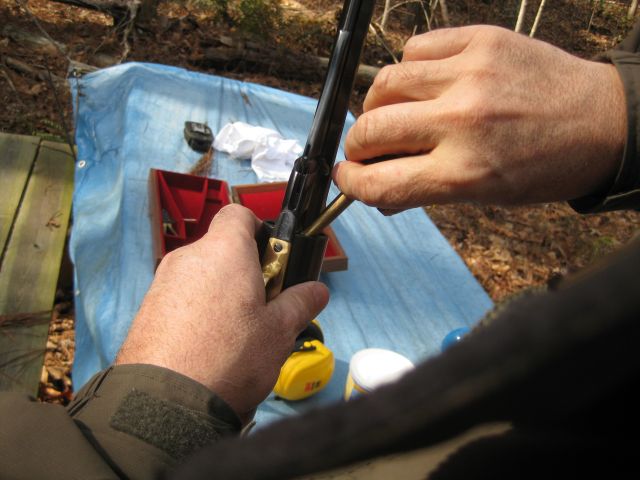
The firearm is called a revolver because it has a cylinder, which is removable, and contains 6 chambers. The procedure is you fill the 6 chambers with powder from the powder flask.  The flask has a manual valve which you open, place you finger on the end of the flask tube, invert the flask and, when the flask is full, close the valve.  The tube of the flask now has the required amount of powder and you invert the tube into a chamber in the cylinder.

 filling the cylinder
a chamber is filled with powder from the flask

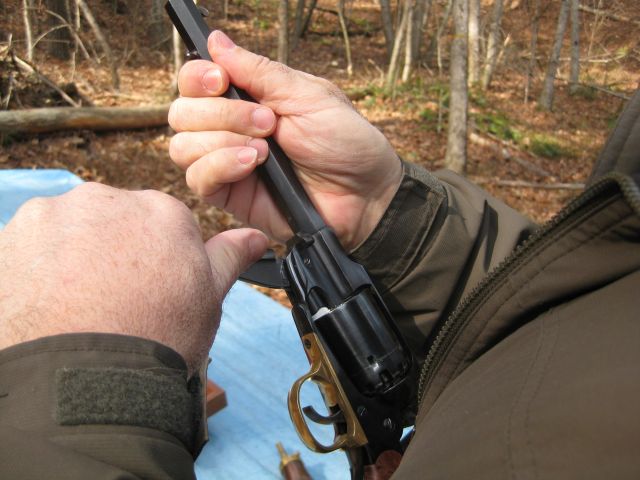
After all 6 chambers are filled with powder you then insert a bullet into each chamber.  The caliber of the revolver is .44 which means the diameter of each bullet is .44 of an inch.  The diameter of the bullet, which is made of lead, is slightly larger than the diameter of the chamber so the bullet has to be compressed into the chamber, which is done with the loading lever of the revolver.

022013 compressing the bullet
pulling down on the loading lever compresses the bullet into the chamber

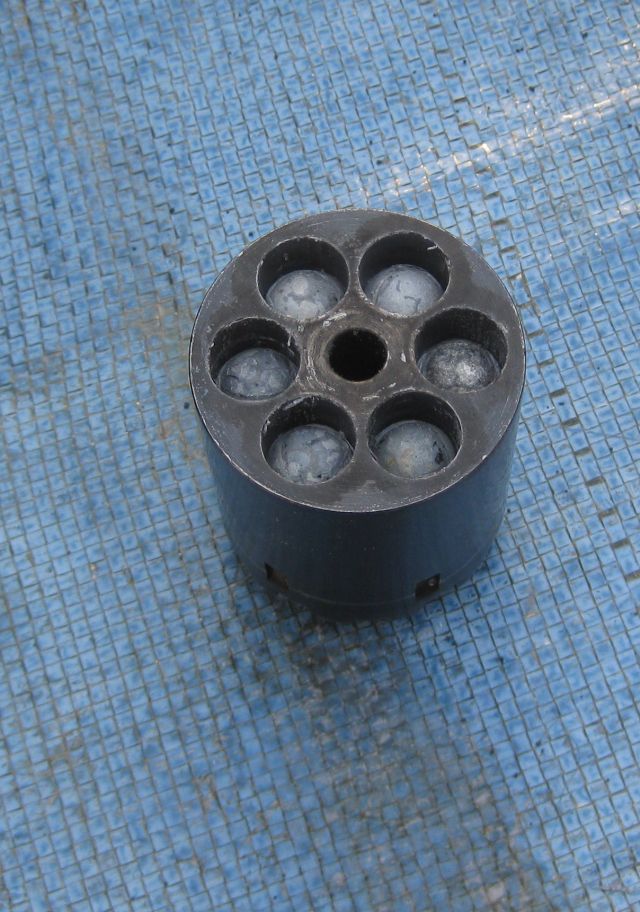
After loading the powder and the bullets into the 6 chambers we removed the cylinder for the last two steps.

022013 cylinder
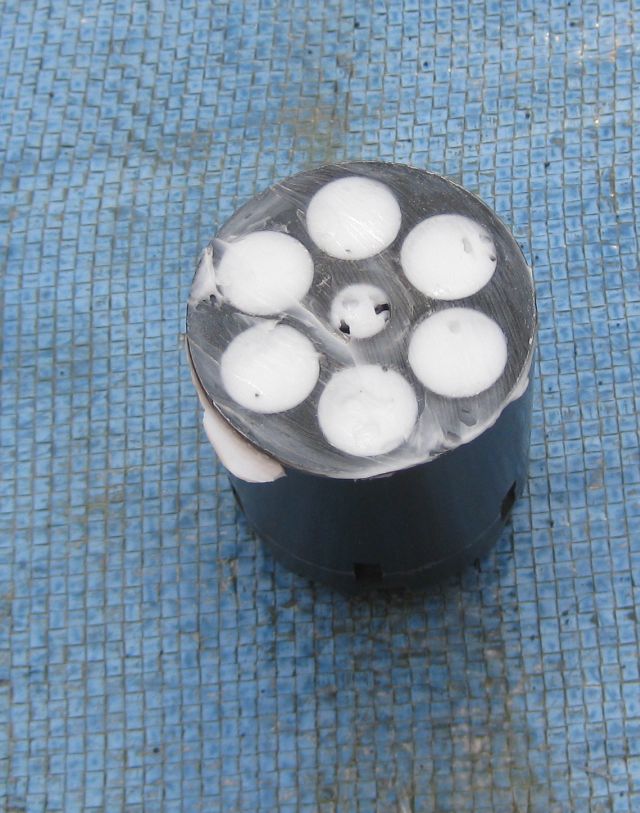
the cylinder removed from the frame showing the 6 loaded bullets

A safety concern is cross fire which could occur when you fire one chamber and the ignition triggers the other chambers.  To avoid this we purchased a tin of Cresco.

a tin of Crisco some of which was placed in each cylinder on top of the bullet

And here is the Criscoed cylinder.

cylinder with each of the 6 chambers covered with Crisco

The final step was to place a percussion cap on each of the 6 nipples which are at the rear of the cylinder.

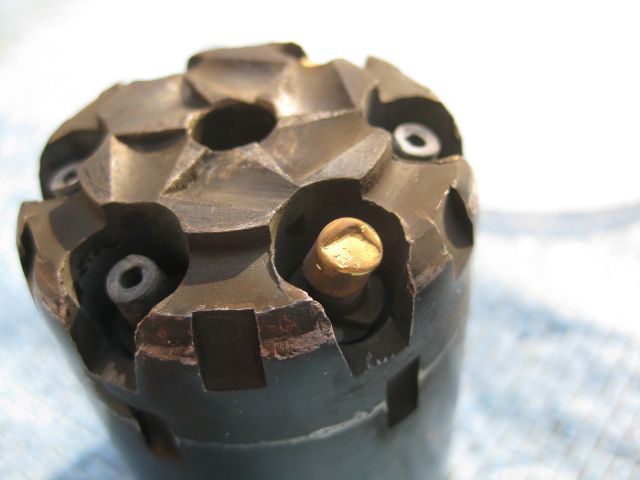
you can see the nipples and a cap which was fired, hence the indentation in the cap
you can see three nipples and a cap which was fired, hence the indentation in the cap

Then, with the cylinder in the frame, it was time to fire.

IMG_0135

Oh, by the way, a confession.  The gun store did not have black powder so we purchased a substitute which was also a black powder and worked just as well as the real thing.

the black powder substitute which we used

update – Mike was unhappy with the inaccuracy of the revolver.  I thought the 2ft grouping at 50ft was ok for first time firing of this weapon.  He says with its 8″ barrel and grooving this is a very accurate weapon and should have produced a tighter 6″ cluster.  He studied the photos on this site and identified several reasons.  First, the bullets should be close to the cylinder face – the reason they are so deeply seated is because we didn’t use wads, which we will use next time.  His reasoning is that it is important the bullet be close to the grooving in the barrel so it starts rotating immediately.  Seated deep in the cylinder means it will travel a short distance without rotation and this will adversely affect its subsequent rotation.  He also noted that some bullets were more depressed in the cylinder than others which means the powder charge was inconsistent and this will affect accuracy.  Finally, not all the trigger pulls fired first time and the reason we surmised was because the caps were not properly seated on the nipples and with the first trigger pull the hammer seated the cap on the nipple and then it fired on the second hammer pull.  Mike notes from the picture that some of the nipples are deformed from dry firing and he will investigate acquiring a nipple remover tool and new nipples to correct this problem.  Finally, Mike says black powder is more accurate than the powder we used.  It is like diagnosing intermittent firing on an older vehicle – so many things to consider and skills to acquire, now redundant from modern technology.

truck maintenance – changing the spark plugs

I have a  base model, no frills, manual transmission wind up window 2005 Toyota Tacoma pickup purchased new in 2005 for approximately $14k.  It now has 160k miles and, apart from replacing the tires, I have done all the maintenance work.  Which has been minimal – such as oil and filter (I always include a qt of fully synthetic oil), new battery, windshield wipers.  Because the miles are highway miles, the brakes have been rarely tapped and therefore have not required replacement.  And, these being truck tires, tire replacement is after more than 60k miles.  A very economical vehicle with good mileage per gallon.

The recommendation is to replace the spark plugs every 90k and I bought 4 new spark plugs as the mileage approached that mark.  The replacement procedures seemed complicated and, since the truck went fine and I was lazy, I deferred the moment.  Recently the truck has lugged while going up hills  and seemed to need more gas pedal encouragement than usual.  So yesterday with the mileage gauge almost on 160k miles,  I decided to get on with the job.

I used the Haynes Repair Manual for my vehicle and followed the step by step illustrated procedures.  In the past I did not need a repair manual – simply follow the spark wire to the plug, carefully pull the wire connector from the plug, remove and replace the plug (after gapping) and reattach the wire.  Problem with modern vehicles is they do not have spark wires but ignition coils and above the ignition coils there is superstructure which must first be removed.

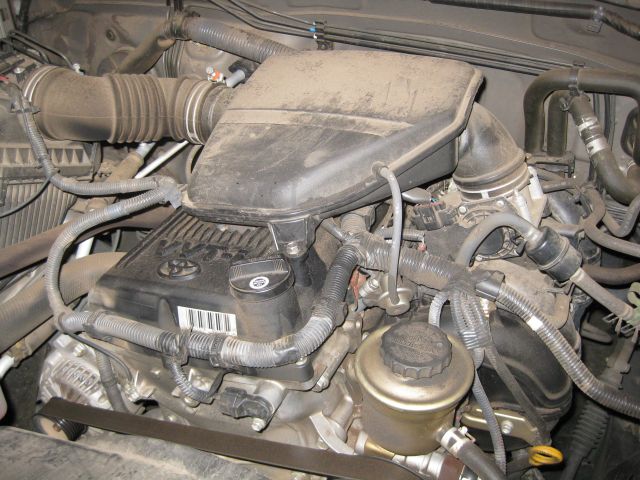
engine before removal of any components

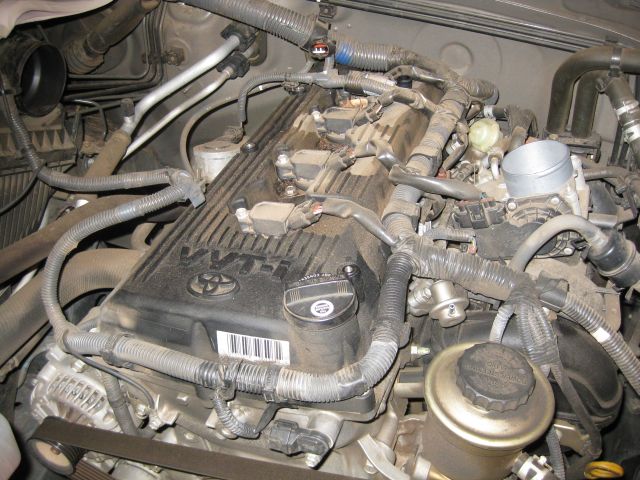
So the first steps (after disconnecting the negative lead to the battery) were to remove the air intake duct or large pipe which connects the air filter housing on the left to the intake air connector, which sits above the engine.  Then numerous electrical connections, a vacuum hose and a fresh air inlet hose had to be carefully disconnected from the intake air connector, which was then itself removed.  I have learned that the key with removing all these items (apart from not losing them or forgetting how to connect them back again) is to use gentle and intelligent force. And also to have the right tools at hand.  It is so easy to break a connector especially after it has been in use for more than 7 years and has become somewhat brittle.

the engine with the intake air connector removed and the wires leading to the ignition coils exposed

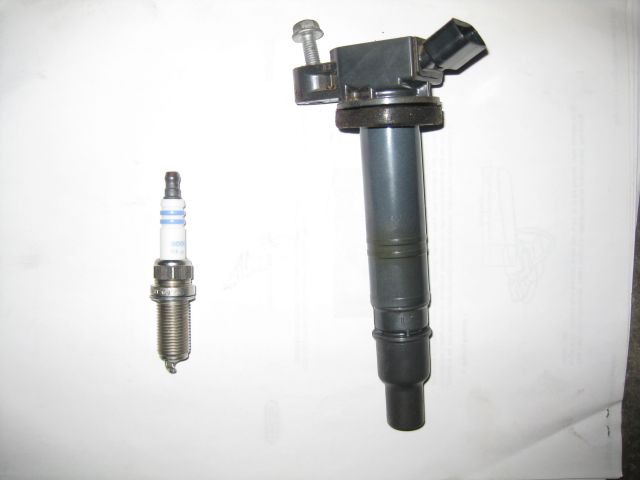
Next steps were, to remove the ignition coil starting with the easiest most accessible ignition coil and using a lot of care not to damage anything. Not having done this before, I had thought the ignition coil sat just above the spark plug.  As the photo below shows, where it is compared to a spark plug, it is actually a long tube.

ignition coil on right which fits over and onto the spark plug

Once I got the knack for disconnecting the electrical connector it was quick work to remove and replace all 4 spark plugs.  I was relieved to see that all the plugs were in good condition with no signs of oil, carbon, or ash deposits or anything untoward, except for electrode wear.  Then I followed the disassembly instructions in reverse (my memory which was never that great could not be trusted to locate and connect all the fittings), re-connected the battery and started the motor.  And it goes great – takes the hills with gusto and requiring little encouragement.

Inspired by my success I also tackled the task of adjusting the parking brake.  With time the cable had stretched and the parking brake could not be relied upon to hold the truck in place on even gentle slopes.  This task took almost as long as replacing the plugs.  To adjust the brake you have to remove the center console (where the manual shift lever is) and slide the bench seat back.  Clearing the center console of its accumulated contents took time enough.  More time was needed to remove all the equipment (chain saw, machete, crowbar, tools, kits, straps etc.) and debris, accumulated over 7 years, behind the bench seat.  The center console removed easily, the carpet was shifted aside, a cover plate unscrewed and it was quick work to adjust the parking brake cable.

A dealer had quoted either $120 or $180, I forget which, to adjust the parking brake – it was an unsolicited quote provided when I took the vehicle in for a minor recall (why are there so many recalls?).  I have no ideal how much replacing the spark plugs would cost – the spark plugs (platinum or iridium) are not cheap and I suppose this would also have been in the hundreds.  I felt good doing this myself with no complications – feels good to be self sufficient and also to save money.

when it rains incessantly – then build a bat house

Rain has been unrelenting in the Atlanta area.  I have captured all I can in my storage tanks and contour ditches and I hope most of the surplus is recharging the underground reservoirs and not running for the Gulf.  So, with little to do outside, I decided to build a bat house.

I am increasingly relying on natural predators to combat pests.  Because the weather has been unusually warm, a number of pest families are happily populating themselves on my lettuce in my cold frames.  So I was pleased to see that the ladybugs, which overwinter in the logcabin, have also turned their thoughts to population expansion.  I captured several preoccupied couples and gently deposited them on the lettuce plants in the cold frame and hope, when their immediate priorities have been satisfied, they will turn their attentions to food snacking and find something worth eating.  My biggest challenge will be towards the end of summer when the BMSB (brown marmorated stink bug) returns.  Neighbors suggested using a nicotine spray (cigarette contents liquified) to fight them but yesterday a visitor, who is a local master gardener, was surprised with this concept and said I could be turning tobacco mosaic virus loose on my tomatoes.  Some research is needed here.  But, back to the bats which are great predators of night insects (moths) and are surely, a more natural and effective solution than using red light traps and lures.

I recently replaced 23/32 plywood sheathing on the Atlanta house with hardiplank cement siding (a much better long term solution) and the weathered plywood sheathing has waited patiently for a new use – why not, for starters, a one chamber bat house.  Several websites offer finished models or books (thin books <60 pages >$8) but with little effort I found a great conservation website with free instructions for my bat house:  http://www.batcon.org/pdfs/bathouses/SingleChamberBHPlans.pdf.

I shall be attaching the bat house high up on the east side of my barn where I know there is bat activity.  My  raw materials outlay has been modest – just a 1″x 2″- 8ft length of cedar for $2.47.  The cedar is a compromise since I did not want to use treated wood and untreated pine wood will not endure.  I hope bats do not have an issue with cedar.  All the other materials were either left overs or recycled from disassembled structures.  I also decided, when I saw the price, to buy a second circular saw.  I have a heavy duty professional model which I keep in Atlanta and am using to cut the hardiplank.  Lowe’s was selling a light duty Blue Hawk saw for $30 and I decided to splurge and will keep it at my log cabin and, if it should be stolen, it will be an easier loss to bear (by the way it works fine).

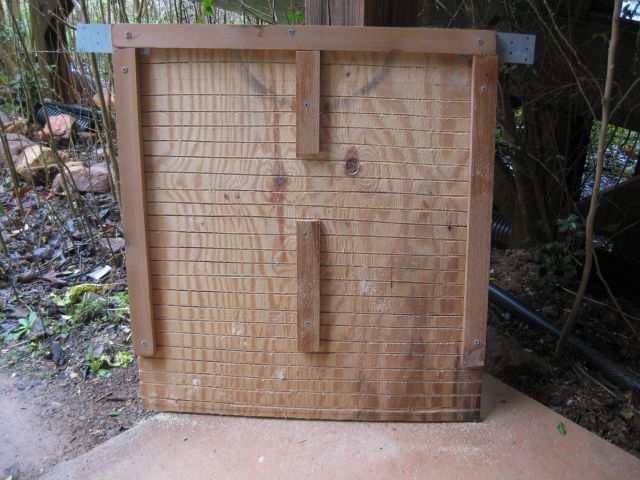
The one chamber bat house is simple to construct – you just follow the plan provided by the website.  The plan suggested applying 2 coats of dark, water-based stain to interior surfaces.  I skipped this step.  Not sure of the logic here.  If the intention is to reduce wood deterioration then the stain should be an exterior stain which has all types of nasties to prevent mildew etc.  Interior stains make the wood look nice and I am sure this is not high on the bats’ preferences.  Even linseed oil has inorganic components.  So I skipped the interior decoration but I did roughen the backboard as recommended by cutting horizontal grooves with the circular saw.

bat house
the bat house backboard with horizontal scored grooves and central support spacers to minimize warping

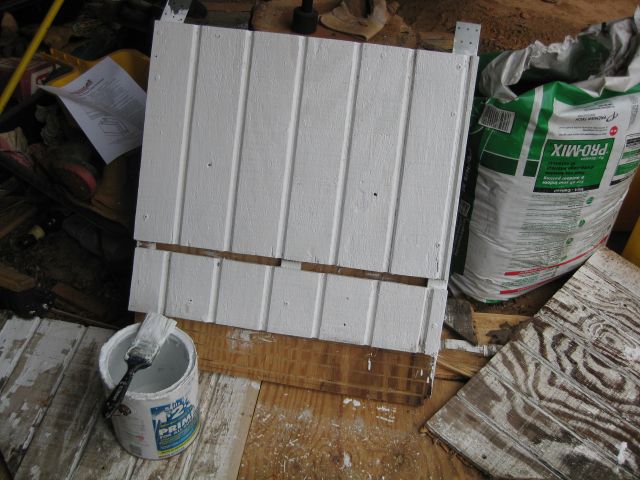
For the exterior, I first applied a good primer.  The unpainted area at the bottom is the landing board from which the bats enter the chamber.  The width between the front board (facing the photo) and the backboard is only 0.75″.  I would have made it wider but those who produced the plan know better than me.

bat house with landing strip
bat house with white primer and 0.5″ vent space and landing area at the bottom

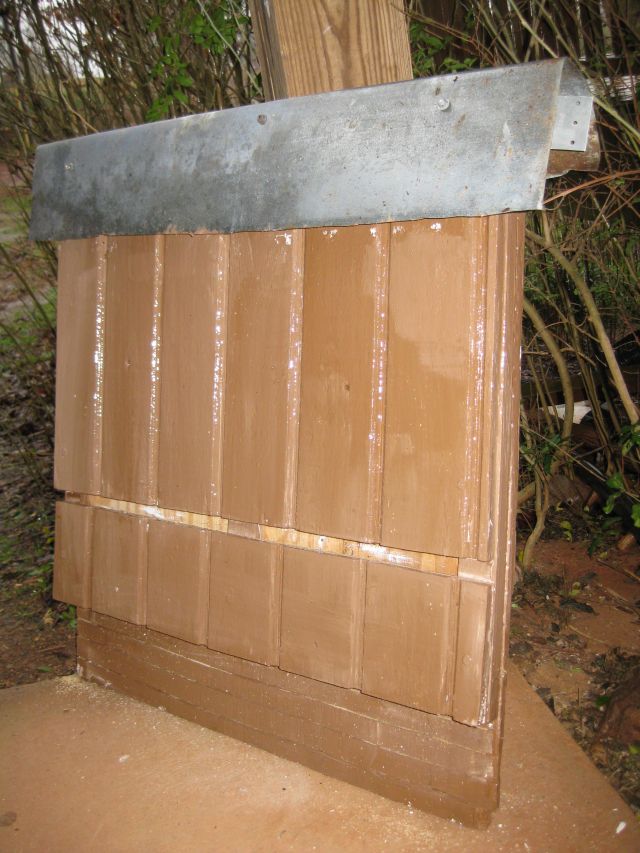
I assume self-respecting bats prefer natural wood colored habitats for their bat house and not a glossy white exterior and so I added an exterior solid brown stain.  I also cut out a piece of surplus roof sheeting and folded it over the top to provide a roof for the dwelling.

bat house with roofing material
the bat house – finished product

Now all I have to do is wait for the rain to stop as it eventually must and then I will attach the bat house to the barn and await the new occupants.