a lucky save – rescuing my bobcat

Luck shouldn’t factor into daily events – maybe it has a role in investing, or coincidental meetings, but surely not when it comes to my tracked Takeuchi bobcat.  The way I am feeling right now is lucky and this is probably because I acted carelessly and was able to extricate myself from a sticky jam, actually muddy patch, without much loss.

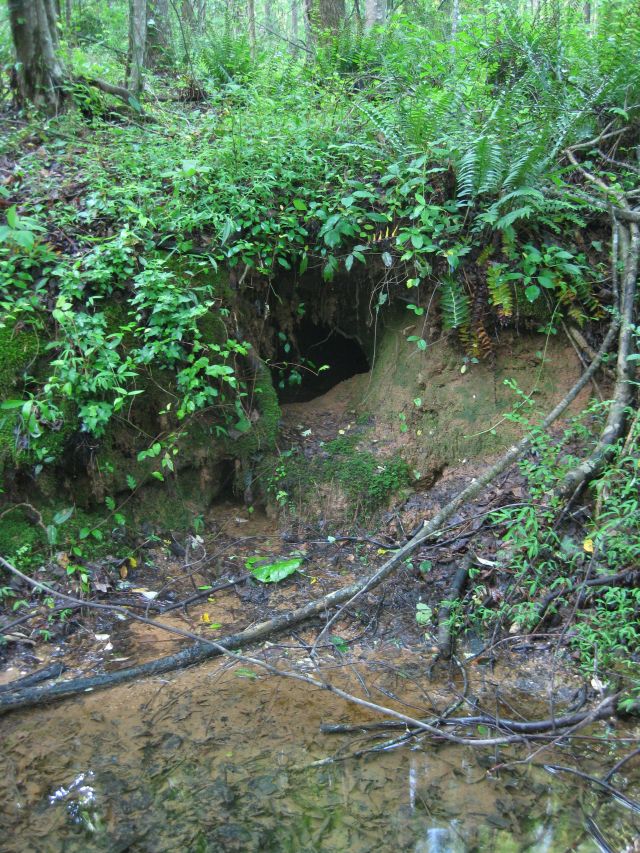
I mentioned previously a trail I cut through the woods which ran close to a spring.  The spring fills a small pool from which it saunters down the hill, mostly unseen, below the surface of a dry stream bed.  My thought was to cut an access path from the trail to the spring and then enlarge the pool.  Because this is rough terrain my friend Mike volunteered to be on hand for the unforeseen.  Cutting the access path was relatively straightforward – we agreed on the route, then highlighted the route with yellow rope, then me with the bobcat and Mike with the machete, cut the path to the spring.

How to deepen the pool.  The lowest side of the pool was on the northwest but it was barred by briar necklaces.  So I initially approached with the bobcat from the higher west bank and quickly realized the incline was too steep.  So I backed out the bobcat and we hacked an approach from the northwest which shouldered between two large trees.  The bobcat loader made quick work of thick roots and, because I was tired from my previous attempt and lack of sleep the previous evening (to sleep at 1am and up at 5am to drop a relative at the airport), I was impatient and did not widen the new ramp or cut it for a more gentle approach angle.  I headed down the ramp in the bobcat, loaded the bucket with mud backed out and dumped the contents.  That was easy, so without pause I went in again, deeper.  As I backed out the bobcat’s tracks began to spin.

I have learned a lot the past 24 hours.  Tracks are great and provide much, much more traction on wet soil than wheels.  But, if the front of the bobcat is in water and you are backing out, the mud covered track at the front moves to the rear and slathers the dry soil under the rear tracks with water and mud.  The first, primeval instinct is panic, I gotta get out, so you increase the throttle and more mud and water are rapidly transferred to the back and the front of the bobcat settles deeper into the mud because it is digging a hole by the tracks scooping up the mud and water in the front, and transferring it to the rear.  I plunged the loader edge vertically into the mud and tried to use the leverage of the loader to push the bobcat backward up the ramp.  To no avail.
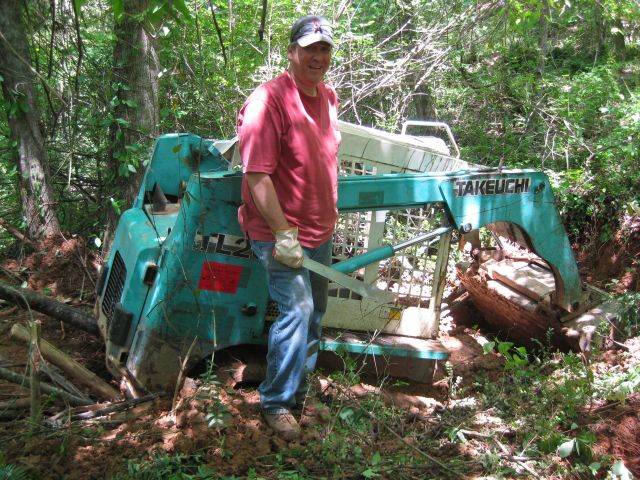
trapped bobcat
machete Mike and a mud ensnared bobcat

So I cut the engine and together with Mike we strategized.  When a vehicle is trapped in soft sand you place sticks and branches and rough material behind or in front of  the engine driven wheels for the treads to grip and, with some luck (again the “luck” word) you can get out.  We cut lengths of 4″ to 6″ diameter trunks (lots of trees around) and jammed these under the tracks – this was possible because using the loader I was able to move the bobcat forward onto its front edge and expose the rear tracks.  Then with full throttle and using the loader for leverage I powered the bobcat backwards – and barely moved.

I suggested to Mike that rather than place the trunks parallel and under the tracks we should place them at right angles to the tracks.  A lot of work and full bore throttle and – no progress.
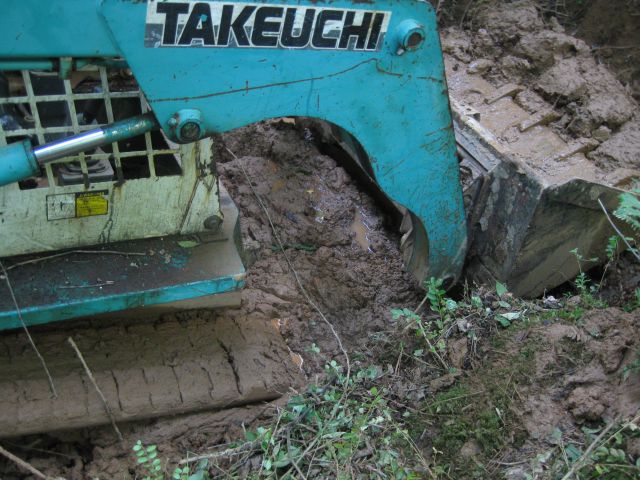
bobcat trapped in mud
bobcat trapped deep in the mud

We thought the rear of the bobcat was catching the ground and so with long handled shovels we dug out the dirt and, with a lot of throttle, gained a few inches to freedom.  At this point, with 4 hours invested to little avail, Mike had to leave and kindly agreed to return the next day and his parting words were “you are tired, leave it for tonight, you can get injured.”  Which is good advice when you are deep in the woods with no one around.

Getting stuck in the mud, especially with a tracked vehicle, which should not get stuck anywhere, is an insult to ones sense of independence, self reliance, and ego.  Needless to say, I spent another hour digging, investigating and throttling and concluded a) remnants of the roots of the biggest tree were snagging the bobcat (revenge of the tree whose roots I had savaged); b) pushing wood under the tracks was a bad idea – the wood became slippery from the mud and water and because it did not span the width of the tracks, a good part of the gripping surface of the tracks was not getting traction; and c) the spring, which I had thought was a dribbler seemed more of a gusher and the water from the spring was transforming the area into a mud bath.
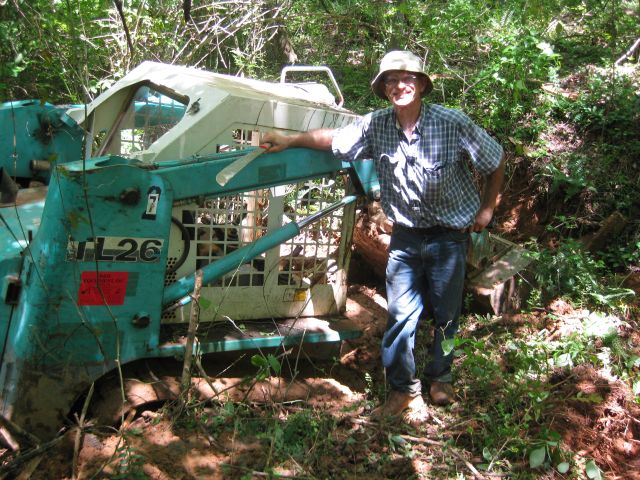
my trapped bobcat
a trapped bobcat is not much to grin about, except its a photo

After a really good night’s sleep and early next morning I was back at the muddy site – my hope was to single handed retrieve the situation and save Mike a trip.  I replaced the new chain on my chainsaw with an older chain and cut through some of the blocking roots – their diameter was 4″ to 6″ and I decided the old chain would be temporarily sacrificed cutting roots surrounded by soil and pebbles (until I could re-sharpen it).  This helped  and I got the bobcat back about 6″.  I then decided the rising water was a problem and with the machete cleared a path down the dry stream bed and then with shovel and pick axe dug a 40ft trench in the stream bed.  The bed appeared dry on the top but the holes dug by the shovel quickly revealed the water running just below the surface.  This helped to remove the water which had been building up around the bobcat.

But it still wasn’t moving.  I was convinced that the bobcat was snagging on concealed obstacles and, as I dug deeper around the rear of the bobcat and its tracks, these came to light.  By this time Mike had arrived and together, with an array of tools from long handled edgers, mattock, grubbing tools, hand saws and the rapidly blunting chain saw we cleared a path to the rear.  With the benefit of a night’s sleep we agreed that the tracks would grip better if they were not covered with mud and that spinning the tracks quickly in frustration just dug the machine in deeper.  So the new modus operandi after clearing obstacles, including belatedly all the wood we had the previous day shoved under the tracks, was to use our gloved hands to pull the mud out of the exposed treads in the track.  Then, in a frequently repeated sequence, with hopes high, I would fire up the bobcat, apply throttle and slowly power the bobcat rearwards and gain a few inches more to freedom.  Unlike the previous day we were thinking rather than just acting and we were following a procedure that appeared to have traction.  It was surprising how many times we were sure it would get out and it didn’t.  But, eventually, with Mike yelling encouragement I escaped the clutches of the mud and got to level ground.

Was it luck?  Probably not, but an education into new techniques, the importance of thinking it out and a good night’s sleep.
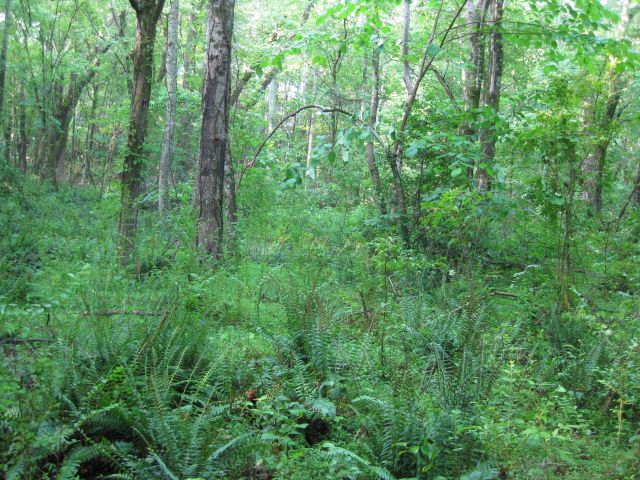
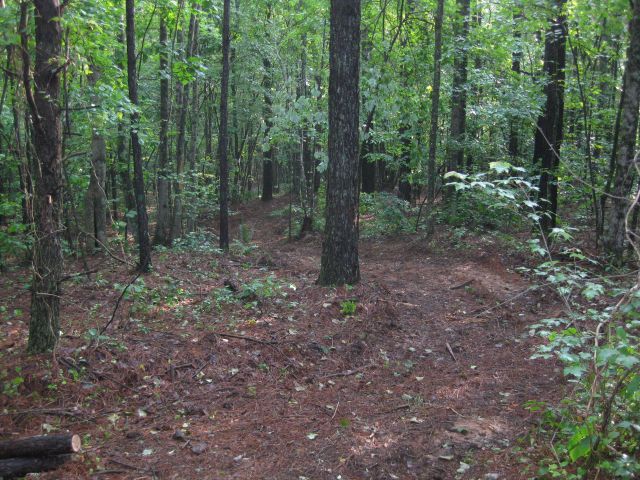
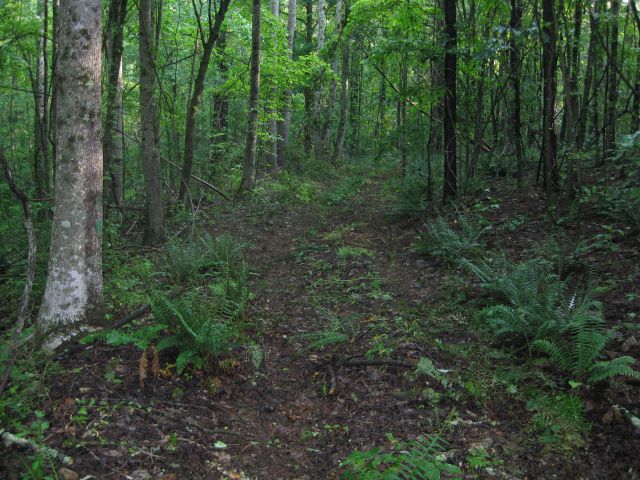
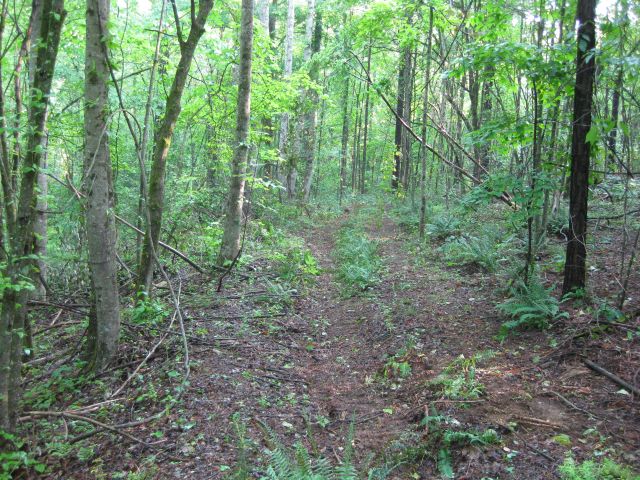
trail through the woods

The past few weeks I have been preoccupied with cutting a new trail through the woods.  The northwest part of the property slopes down a hill and its face is creased with contour ditches and berms installed I know not by whom or when.  There is a small spring which forms a stream which slides off the property.  My new trail is designed to give me access to the spring and to meander among the fast growing tulip poplars.  Since this is the north facing slope, which is sheltered from the sun and benefits from the contour ditches, it also has ferns and mosses and a wildness of growth.

lush wild area at base of hill

My trail is  maybe half a mile long.  I marked its intended route a year ago with yellow rope.  Two weeks ago I began construction.  Initially my thought was to make a road which my tractor could access, but my tractor is 7 ft wide and when hitched with a chipper cannot make sharp turns.  So the road would have had to be fairly straight.  My tracked bobcat on the other hand is 5 ft wide and can turn on a dime, which means it can easily dribble among the larger trees.  So I settled on a trail rather than a road and saved a lot of larger trees and a lot of work.

beginning of the trail

From previous experience I know not to leave any stumps, especially the smaller ones which upset the unwary, so instead of chainsawing and pulling the trees out of the way (and leaving stumps in place),  I used my tracked bobcat to clear the way.  Two alternative procedures.

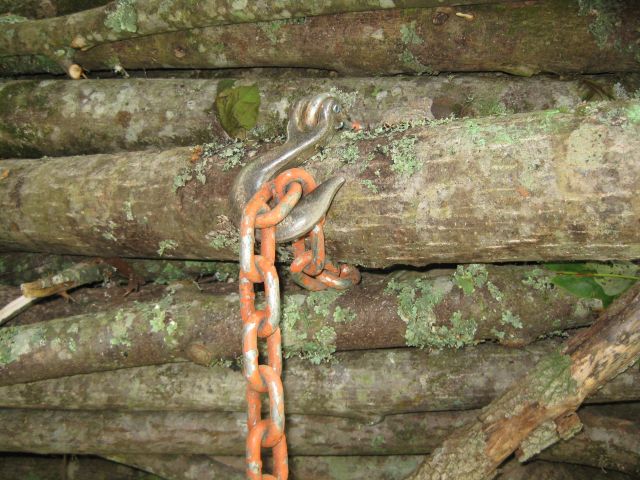
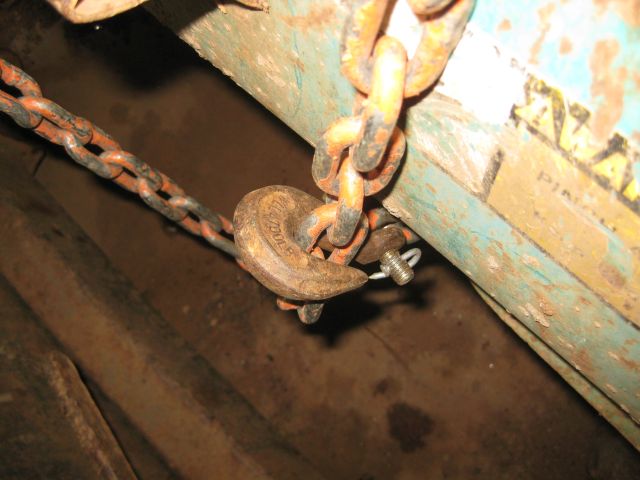
For those trees with diameters up to 3″, I simply lifted them up out of the ground with a chain and slip hook.  A slip hook allows the chain to run freely through it so as the bobcat pulled on the chain the hook tightened on the trunk of the tree.  The other end of the chain was secured to the bobcat body with a grab hook which gripped onto a link of the chain.  The slip hook worked fine on most of the trees except for one kind where the bark peeled off easily.  In this situation I had to revert to the second procedure.

example of slip hook


example of grab hook

The second procedure, primarily for the larger trees, was to attempt to push the tree over with the bobcat loader pushing the trunk at about 5 ft off the ground.  If the tree refused to budge I would cut the roots on either side of it with the loader teeth and then it usually could be pushed sufficiently to expose the base of the tree.  Then, with the loader at ground level I would bulldoze the tree out of the ground and push it sufficiently far to sever its roots.  The trees are interlocked by vines, mainly muscadine (grape vines) and they would have been hung up if I had merely chainsawed them.  So the assistance of the bobcat was invaluable.

trail along slope of hill

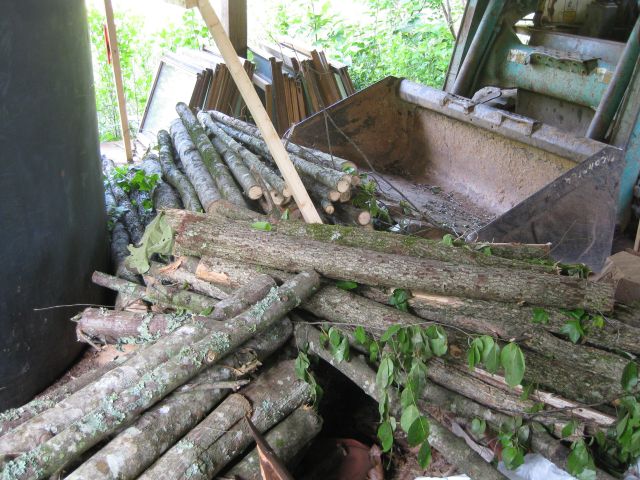
Once the trees were down I limbed and bucked the trees, that is to say I cut off the branches where they joined the trunks, and I cut the trunk into 5 ft lengths.  The 5ft lengths of the hardwood trees fit into the bobcat’s loader and I brought them back to the log cabin and stored under shelter to dry for firewood use at year’s end.  The pine trees trunks I will leave to degrade and return nutrients to the soil.

small spring at base of hill

I made several additional trips with the bobcat – down the trail to collect the rootballs and dump them in a large gully at the foot of the slope, and up the trail to collect the 5ft wood lengths for transport to the storage area.

5 ft lengths of future firewood

Finally my tractor came into play.  I attached a woodchipper  to the rear, which is driven by the tractor’s engine, and I have begun chipping the branches and odd wood lengths.  The chippings will be spread along the trail.

trail along base of hill

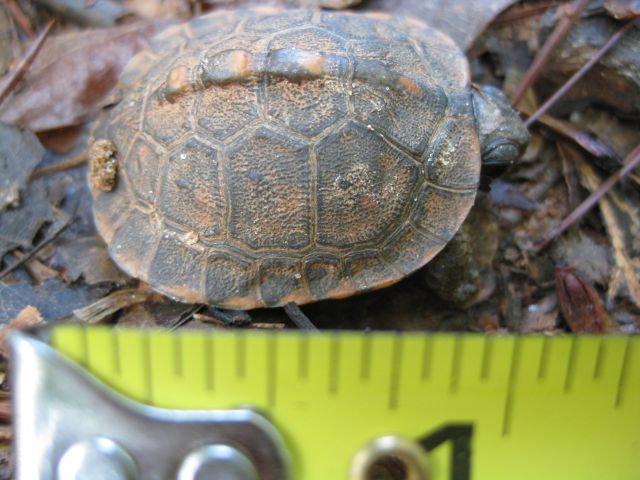
So much strenuous pleasurable work and a good result to date.  I must acknowledge the contributions of Mike, who assisted on the first day with lassoing and removing the trees, and Simon, who on two days worked hard amidst the mosquitoes and diesel fumes to help me complete the task.  On the way back this morning along the trail almost stepped on a baby turtle – it was on 1″ long – see below.

the 1 inch turtle

wildflower seeding

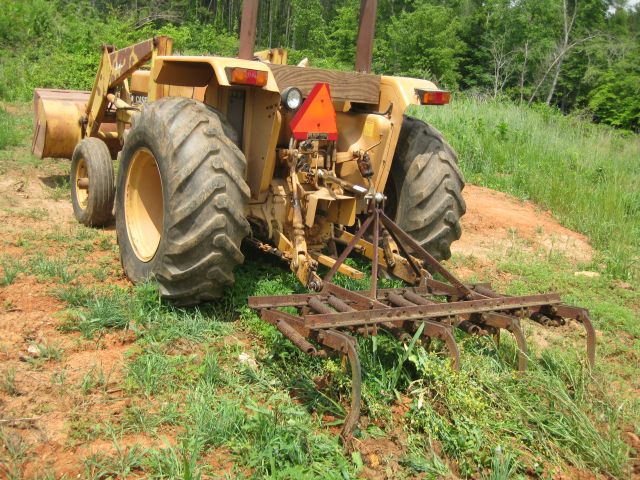
Last fall I collected a large quantity of wildflower seed and stored it in a cloth shopping bag.  Now that I have planted out my tomatoes and with rain in the offing, I decided to sow the seed – cosmos, sunflower, marigold and zinnia.  I was gifted two old cultivators – they are 5 feet wide and connect to the three point hitch at the back of the tractor.  The tines are spring tensioned.  I have a 60hp tractor which typically would pull a larger cultivator and so I had to make some adjustments to fit the cultivator to the tractor.  But the hitch fitted without a hitch, so to speak, and with my tractor in its lowest (slowest) gear I made several passes on contour across the sloping field.  The tines did a great job making furrows in the field and displacing stones.  I then hand sowed my collected seed in the furrows.  I probably should have finished the job dragging large planks with chains, which came with the cultivator, to bury the seeds.  I am hoping we get rain, but not too much, and the rain will settle the seeds in the soil.  Below is a ‘photo of the cultivator.

rainwater from coop roof

When I built the new coop in October last year I fitted  a gutter which directs rainwater to an adjacent 250 gallon storage tank.  My thought was to (a) collect all rainwater landing on impervious surfaces, and (b) use the water to irrigate a chicken food growing area.  To grow food for the chicken I would have to cordon off a growing area and maintain it with vegetables and irrigation, which involves extra work, so instead I now give them excess vegetables from the vegetable garden.  And the storage tank, which has been full almost since it was installed, now overflows each time it rains.  A waste of water!

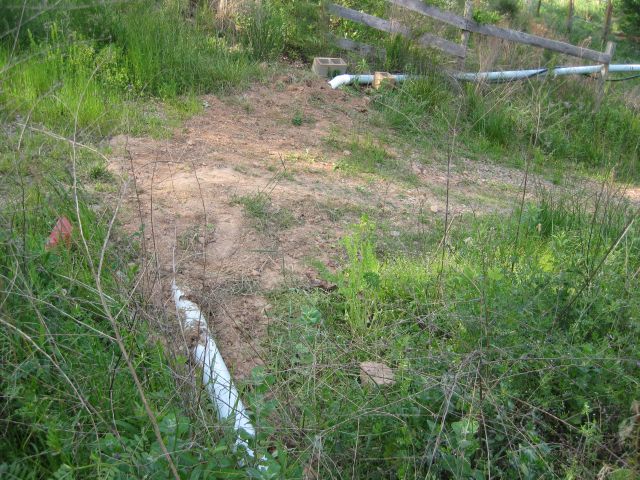
With the coop “summerized” with a powered vent fan, insulation and two semi-automatic coop doors, I turned my attention to the rainwater storage tank, which may also be the culprit for the mosquitoes which hang out in that area.  I have a portable electric water pump and it was a simple matter to run a 1″ diameter water pipe from the coop to the barn where two large storage tanks are parked.  For the water to flow as easily as possible, I avoided sharp turns and led the pipe in a gradual sweep and rise from the coop along the ground to a gradual turn to the barn and then, gaining altitude, up to a gutter on the barn which feeds into the rainwater collection system.  I may decide to trench the pipe when the ground is soft after the next decent rainfall.

The exit pipe from the storage tank and the pipe to the barn are fitted with Norwesco fittings, as is the electric water pump.  It is a simple operation to couple the pump to the two pipes, open the tank valve to flow water from the storage tank to prime the pump and then power the pump with electricity already cabled to the coop.  Some 20 minutes later all 250 gallons have been transferred to a large storage tank from which it will be pumped, as needed to irrigate my crops.

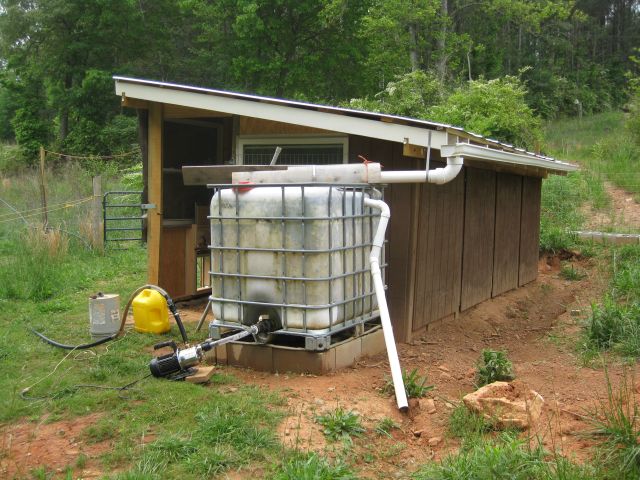
east side of coop showing gutter, downpipe to tank, overflow pipe from tank and exit connection to pump
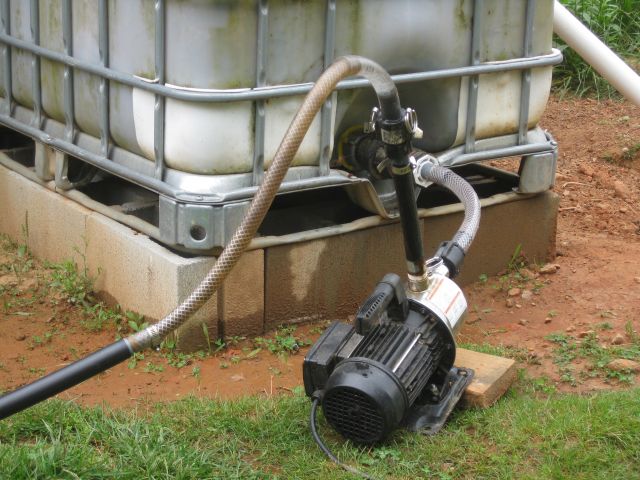
closer up view of conection from storage tank to pump to water pipe to barn
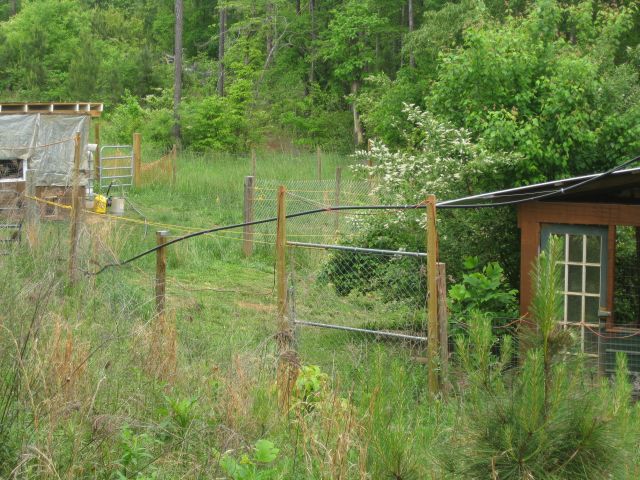
view of the water pipe run from the coop initially on the ground then climbing higher along paddock fence, surmounting gate and ending in gutter


2nd chicken coop door installed

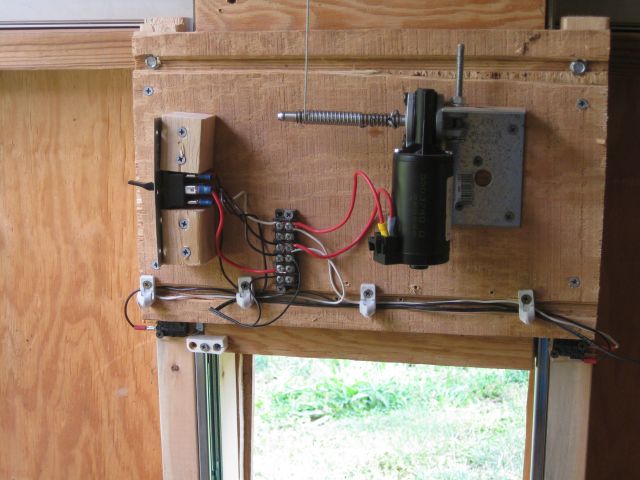
Last week I designed, constructed and installed my first coop door opener – it has operated flawlessly the past week automatically opening the door at about 8am and then late afternoon I reverse the current and close it when I feed the chickens and settle them for the night.

An ongoing issue has been the aggressiveness of the Buff Orpington rooster  to his Buff Orpington sister.  The coop has a partition door and, prior to the advent of the door opener, I would house Lady Macbeth (such a fierce sounding name yet such a timid bird) and the gentle New Jersey Giants and the two Golden Comets on the one side, and the rooster and the other birds on the other.  But since I now arrive later and the door is opened by my new gadget they all have to have access to the exit door, which means no partition.  So the drill the past few evenings was to enforce the partition while Lady Macbeth ate and then, when she had had her fill, I opened the partition door, the rooster charged in and she hopped onto the roost for the night where she was safe from him.  I notice it takes her longer to fill her crop than the other birds and I surmise that, unlike her companions who snack the feed during the day, she probably doesn’t because she does not wish to be cornered by the rooster.  So each evening I wait about 10 minutes while she eats.  Time for a second door.

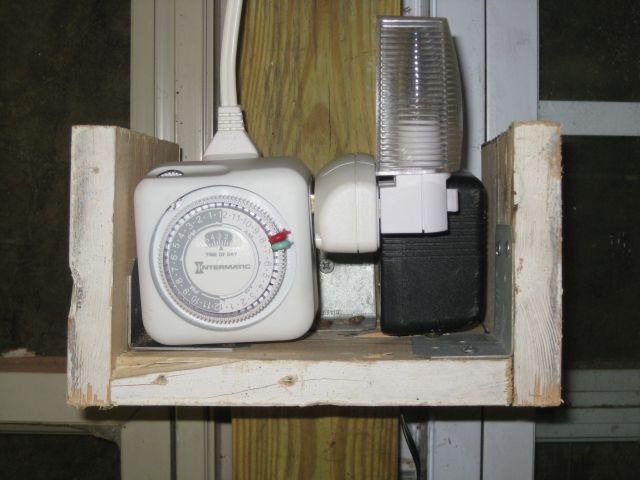
My second door follows the same design as the first with a few refinements.  I acquired a sturdy double pole double throw automotive switch from Radio Shack, which is easier to use than the two separate switches I used on version 1.  I ordered a transformer 10VDC with an advertised 1.5 amps on the internet but it was a puny affair and could not turn the motor and certainly did not deliver 1.5amps, even though the specs  made this claim.  It was cheap and the adage “cheap is costly” applied in this case.  I rummaged and found a 10VDC transformer rated at 0.8amps and it works just fine.  Again I used an inexpensive timer and a night light to remind me at the end of the day   to switch the live circuit to timer circuit.  So tonight Lady Macbeth can sup at her leisure with her 4 docile companions and the rooster can rant and rave to no avail.

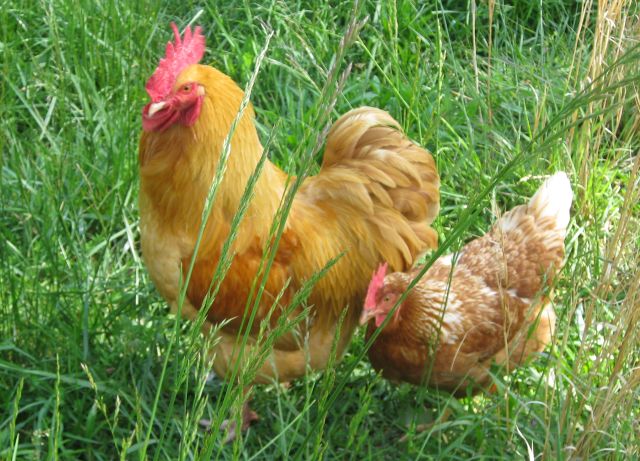
Buffy, the rooster, with a Golden Comet


the "summerized" coop (the tarps exclude the light and keep it cool), and the two recently installed coop door openers
simple housing for timer, night lite and transformer
simplified design, one DPDT switch to reverse door direction, contact switches on either side


water conservation – “Heart of Dryness”

I just read Heart of Dryness by James Workman about the plight of the Bushmen in the Kalahari desert when the Botswana government cut off their water supplies and how they adapted and how we can learn from them. I was interested in the book because I am originally from South Africa which abuts Botswana, and also here in Georgia we are engaged in legal water wars with neighboring states.  Workman interlaces the story of the Bushmen with a narrative on the use and abuse of water worldwide and his view that water shortages will result in increased conflicts across the world as the world grows hotter.  He does not believe dams are the solution in arid countries -dry heat and wind result in massive evaporation and build up of sediment reduces storage capacity.  He suggests that artificial aquifer recharge where water is pumped and stored underground is more sensible, akin to the Bushmen burying their water in evaporation proof containers. Some of his findings are counter-intuitive, for example during holidays one Botswana school leaked nine times what it used while in session, due to pressure build up forcing water leaks through cracks.   The 250 page book has 50 pages of notes/bibliography and appears well researched.

His reference to water wastage got me thinking of my own rainwater harvesting system and, since rain was in the forecast, I inspected and found several issues.  Two gutter downpipes were blocked and no water would have been collected from them.  Even more significant – the 4″ pipe which transfers water from my main collection point (the house roof) to my barn storage tanks, had again opened a leak where the 4″ corrugated pipe attaches to the 4″ pvc pipe.

The advantages of corrugated drainage pipe are that it is flexible so it will fit easily in a trench which isn’t straight or which has bends different from the available 90 deg, 45 deg or 22.5 deg fittings.  And it is much cheaper, both the pipe itself and not needing expensive fittings for bends.  Which is why I had used it for a section of the  water run.  Its disadvantages are that it does not make a tight fit when joined with pvc pipe and therefore can leak if there is a small shift in the moorings and, because it is corrugated, debris collects in it and causes blockages.  Now I had to bite the bullet and replace the corrugated pipe with pvc pipe.  I had used 4″ Sch 40 pvc pipe for the exposed overhead run – this is a thicker more expensive pipe.  For the section I was replacing, which runs in a trench, I opted to save money (on the pipe and the fittings) and bought the considerably cheaper DWV pipe.  DWV pipe (drain, waste and vent) is for non pressurized applications and because the pipe will be buried, fully supported by the ground and not sun exposed, this seemed a reasonable choice.  It took some time digging a new trench (the old one was gradually curved and not usable) and aligning the pieces and fittings since the direction change was closer to 80 deg than an easier 90 deg. But now it is done and, with a dry season looming, I hope to be  make every drop count.

newly replaced rainwater pipe

chicken coop door opener

After several weeks spinning my thoughts, I finally got down to it and built and installed an automatic chicken coop door opener.  For the time being it is half automatic – it will open the coop door in the morning (time set for 7.30am) and I will close it in the evening after I have housed and fed the chicken.  Cost of components, excluding scrap wood, hardware, and the transformer which was laying around, was less than $50.

I have included full details and photos under the “Self reliance” tab at the top of this website or just click here.

I previously mentioned how I had summerized the coop by adding a powered vent and insulation.  The rooster did not like the  sound of the vent when it was at full blast and there were no controls to slow it down since its intended location is in the attic of a house where its noise is less obvious.  The rooster’s concerns were resolved with the addition of a fan speed switch so, until he is more at ease, I have set it to spin at about half speed, which does not upset him.

contour ditch construction

My land slopes and since I rely entirely on rainwater for irrigation, I catch the rain however I can – in storage tanks or directly into the ground with contour ditches.  Contour ditches are similar to swales – built on contour or dead level survey lines to intercept and hold water and to let it infiltrate the ground, therefore they are not compacted or sealed.  While a ditch is narrow, a swale can be broader like a basin and, according to the permaculture bible by Bill Mollison, trees are essential to swales and must accompany swaling in arid areas.

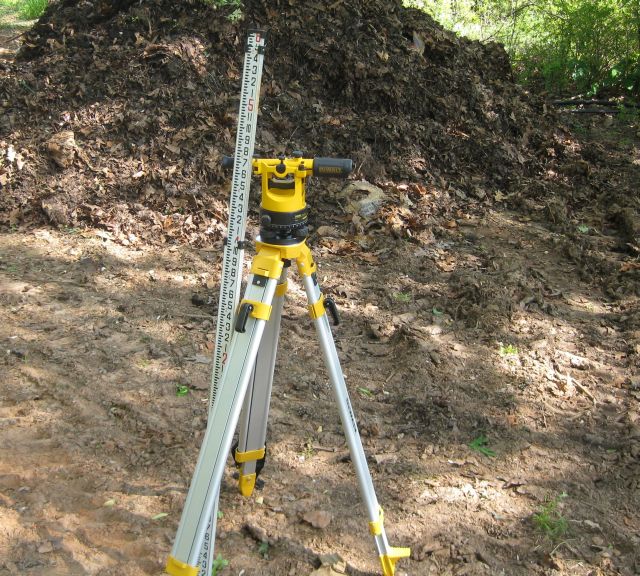
I start my contour ditches towards the top of the slope where there will be sufficient runoff (if the ditches were located at the bottom of the slope they could be overwhelmed by torrents of water).  Once I decide approximately where the ditch will run I use my transit level and a helper (my rod man) to locate the middle and two ends of the ditch on a contour.  I mark these three points with stakes.  Usually, by this time, my helper’s patience is exhausted and I am on my own for the rest of the project.

transit level and measuring rod

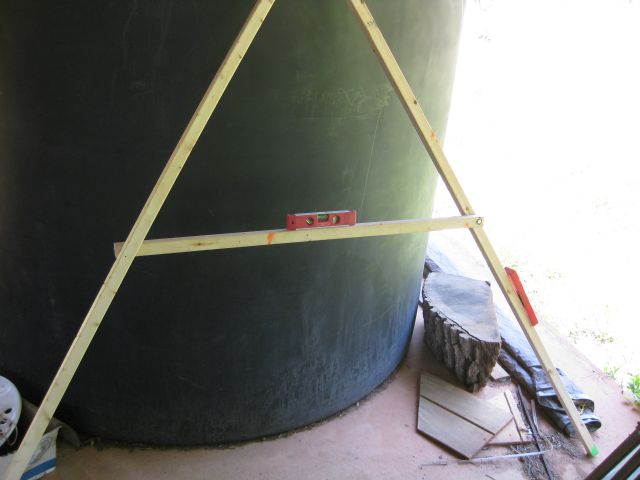
simple A frame with bubble levels (red) on horizontal and vertical legs


If the ditch is say 200 ft long, even with the three stakes in place, it can be difficult to figure how the ditch should run between the three stakes since the ground is uneven.  So I use my A frame, which is simply three pieces of wood connected to form the letter “A”.  The two sides of the A are 8ft long and the feet are about 8.5 ft wide.  The horizontal  piece is 4ft long and all the wood is 1.5″ (nominal) square, so it is not too heavy to carry about. A simple bubble level is attached to the horizontal and one of the vertical legs.  I construct the A frame on a level surface and ensure that the horizontal piece (to which the bubble level is secured) is horizontal before bolting it in place.

I gather some rocks and a can of aerosol spray paint and with my A frame start from the stake which marks one end of the future contour ditch.  One leg of the A frame is next to the first stake and I point the other leg in the direction of the next stake and move it along the ground until the bubble level tells me the A frame is horizontal and the second bubble tells me the frame is vertical.   I place a spray painted stone to mark this spot and then swing the first leg around the second in the direction of the next stake until it too is horizontal and vertical.  It is important to advance the legs alternately since this will counteract any inaccuracy in the A frame.  I can tell how accurate I have been when my A frame eventually reaches the next stake – if the leg of the A frame is at the same level as the stake, all is well.

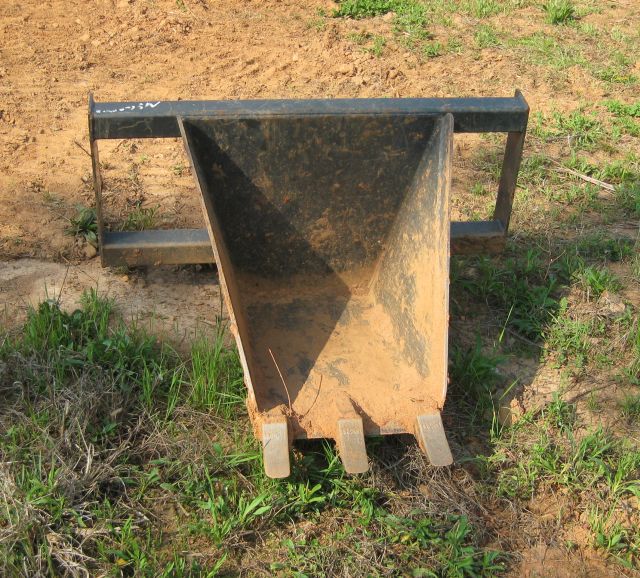
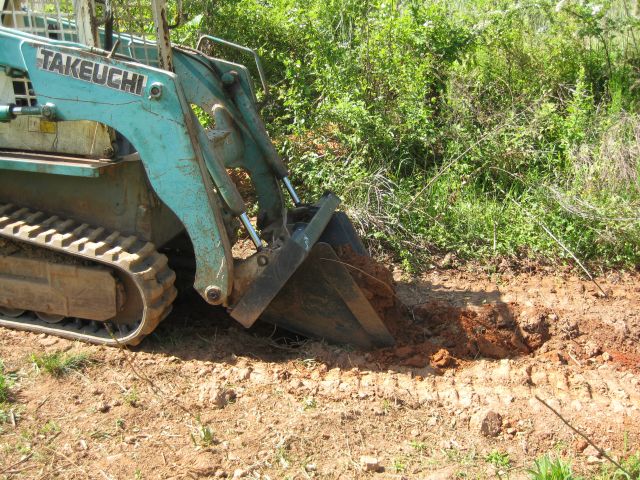
Having marked out the line of the contour ditch with the three stakes and painted stones, next step is to dig the ditch.  I work mainly by myself – I will not engage paid workers and volunteers are scarce.  So I have no qualms using my old machines, which I nurture along.  My Takeuchi tracked loader (bobcat) has a stumper attachment, which is good for removing stumps and digging ditches.  Digging the ditch becomes quite simple, I simply use the bobcat to carve out the ditch following the trail of spray painted stones and I save the removed soil in a heap for some future use.

I seed the ditch and sides with grass seed to stabilize the banks.  And then I make my plantings on either side of the ditch.  An earlier (shorter) contour ditch I dug for my muscadines (grape vines) has proven so effective at catching and holding water that supplementary watering will be minimal (the ditch is assisted by a diversion slot cut across an access road which directs water into the ditch).  After planting up my new ditch with trees perhaps I will call it a “swale”.

attachment for stump removal/digging ditches
Takeuchi with attachment digging a contour ditch

summerizing the coop

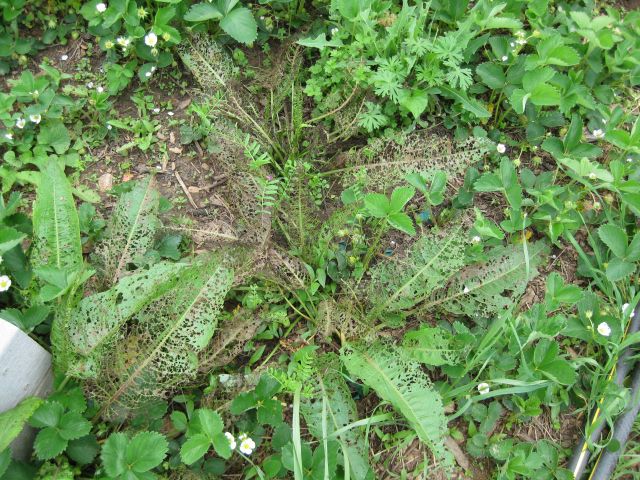
Before I get to the coop, a quick update on my “Spring activity” journal.  I mentioned that pokeweed is an unwelcome visitor, difficult to extricate because of its long thick taproot.  In permaculture “the problem is the solution” and it occurred to me that the taproot, like that of comfrey was performing a valuable function mining minerals two or more feet below the surface.  But this seemed inadequate justification for its presence until I noticed that it, and it alone, has been attacked and eaten by insects, as yet unidentified.  So it is also serving the role of a trap crop and attracting these hungry feasters from my diverse array of vegetables which, so far, are unscathed.

the pokeweed invader is the banquet for hungry feasters

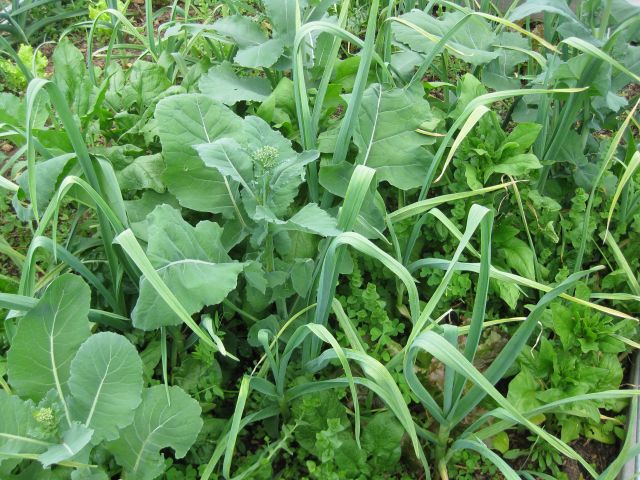
a few feet away the spinach, collard, chard, garlic et al. are unscathed

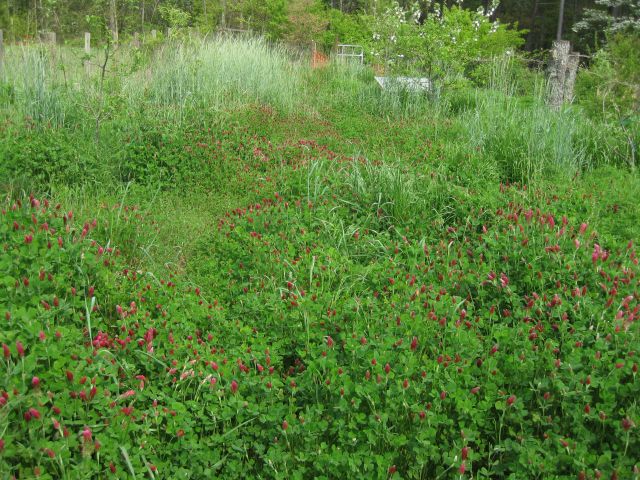
I also mentioned I was leaving the crimson clover to flower to provide succour for the bees and seed for next growing season.  Well the clover is maturing quickly and today the honey bees and bumblebees and others were busy at them, so my next honey harvesting will include some clover honey.

crimson clover in flower with bees in attendance

Now to the chicken coop.

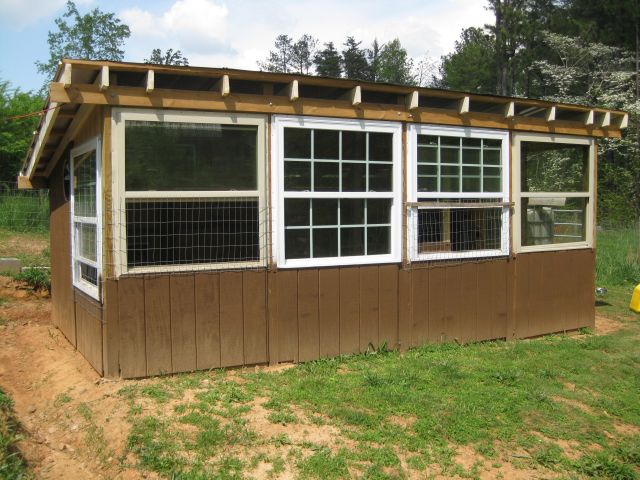
I have 3 coops, two constructed on two sides (north and east) of the barn.  The east coop is well protected from the summer sun and would be good for summer quarters.  Last year, as winter approached, I built a new larger coop (building details elsewhere on this website) which was well exposed to the winter sun and, since there are no neighboring deciduous trees (yet) even better exposed to the summer sun.  I had considered moving the chicken to the east coop for the duration of the hot weather.  And then a development – Buffy, the Buff Orpington rooster, fixated on Lady Macbeth, his sister.  She is the only hen missing feathers on the back of her head and she is vociferous and will have not truck with him, when she can avoid him.  Which is difficult when they share the same coop and so to escape him she immediately goes to the roosting ledge when they are housed for the night and consequently misses the much anticipated evening meal.

Matters came to a head when she refused to enter the coop one evening and with me trying to coax her in and Buffy charging at her as soon as she crossed the threshold, she became vociferous and agitated, and the two males increasingly frustrated.  The upshot was she spent the night in the north coop with the two comets for companions.  This got me thinking about the wisdom of transferring them all to the east coop.  Their new coop has a partition, all that is missing is a door.  So rather than spring $80 for a gate from HD or Lowes, I constructed a simple door with left over lumber and chicken fencing and two $1.54 hinges from Walmart.

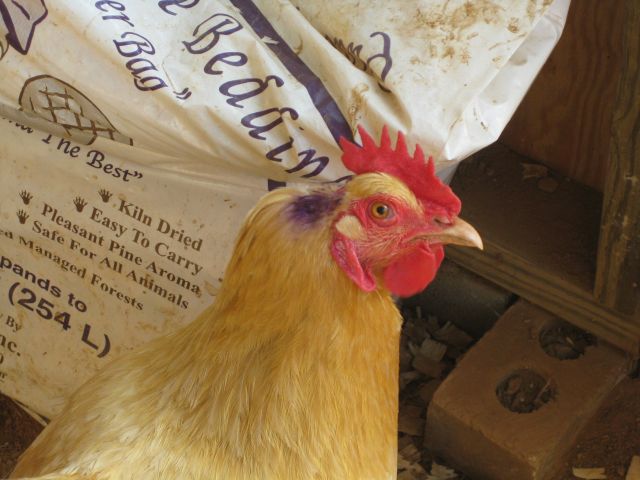
the aggrieved Lady Macbeth

new partition door for coop

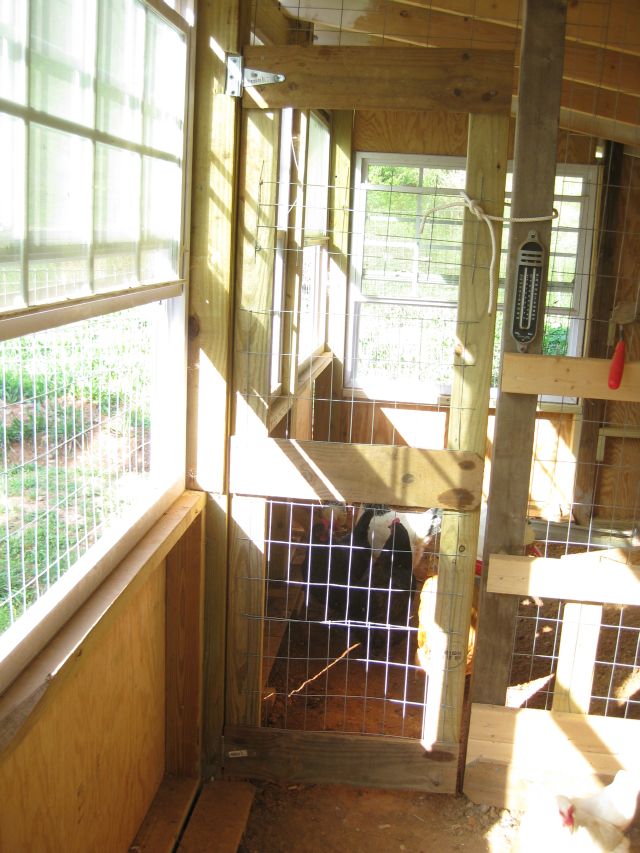
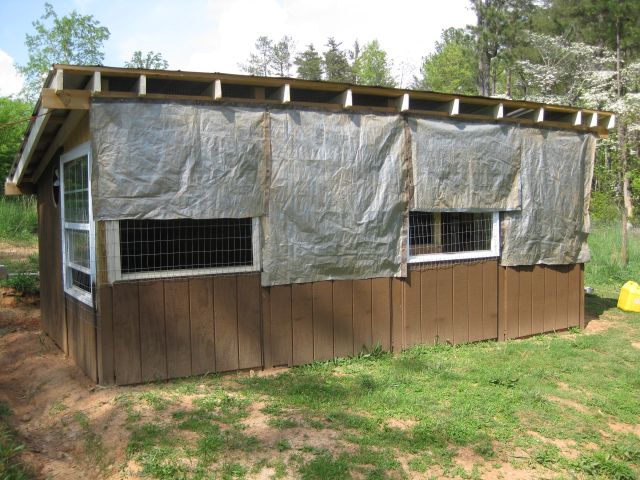
So with the winter coop the designated summer home, next steps were to reduce the heat buildup.  It has four south facing windows and a window each on the east and west sides.  Two of the south facing windows and the east and west windows have been predator proofed (I hope)  with wire fencing material and are left open.  I found an old tarp (8ft by 10ft) with brown colored and silver sides and scrubbed the mud off the silver, soon to be sun facing side.  I cut it into 4 sections – two ‘5 by 5′ and two 5′ by 3’.  The two larger pieces were fitted over the two closed south facing windows and the two smaller pieces over the two open south facing windows.

new coop, south side, before sun covers

new coop after sun covers installed

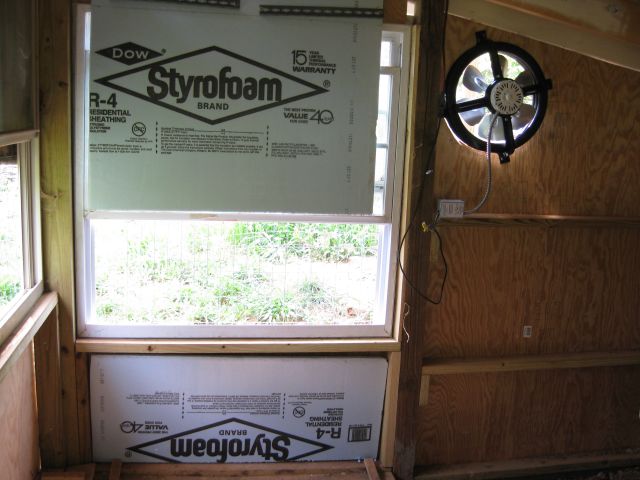
More work remained.  I decided to install a powered attic exhaust fan.  Since in the afternoon and evening the air will be cooler on the east side, I installed the fan on the west facing wall of the coop.  I considered using a roof vent (i.e. one installed on the top of the roof)  which would have therefore been higher up and removed more of the hot air at the higher levels of the coop, but I was unsure where that air would be drawn from.  By installing the exhaust fan on the west side I can ensure that it pulls air from the east window and therefore the air will be moving across the two roosts which are located in between the east window and the installed vent fan.  To power the fan, I installed an exterior power outlet box on the barn wall closest to the coop and led a cable the 100 feet from the barn to the coop.

new power vent and insulation added to west side

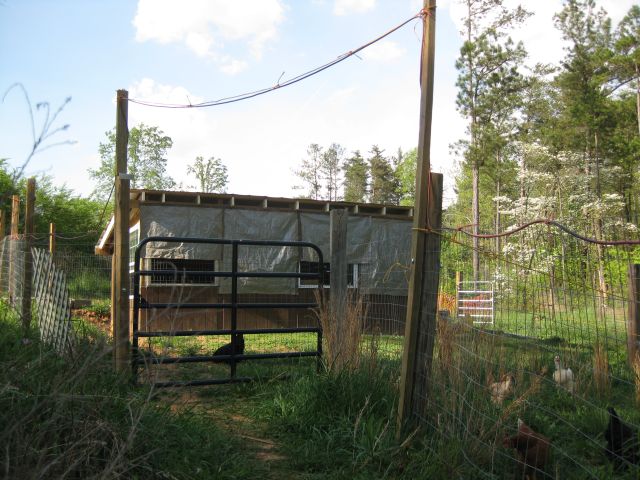
power cable to the coop

Apart from the powered vent and the hinges, all the other items were recycled i.e. lying around unused.  As you can see from the ‘photo, I attached the cable to the top of the chicken paddock fencing and to surmount the gates, I bolted 2×4’s to the gate posts and raised the cable 8’ above the gate entrance.

My next venture, and a new one for me, will be to install solar panels on the barn roof and a battery bank and inverter in the barn and thus power the exhaust fan using the summer sun (as well as a powered timed coop door to let the flock out early in the mornings).  To return to an earlier theme, albeit crudely – in the problem (the summer sun) will be found the solution (solar energy powered fan).

TGFI – tractor top link

“TGFI” – you may have thought this was a typo and should be “TGIF” – Thank God its Friday, but for me it is Thank God for Internet.

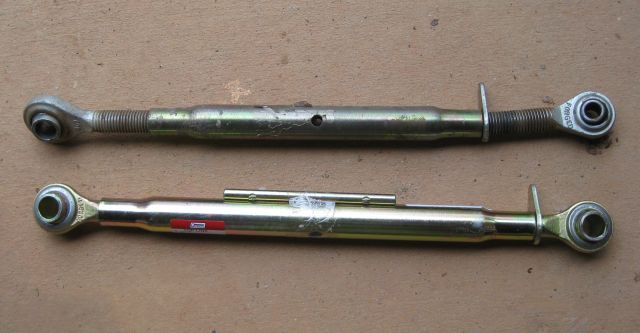
Most tractors have a three hitch system, which means the heavy implements at the back are hitched or connected to the tractor at three points, two horizontal at the bottom and one at the top. The top point is connected to the tractor with a top link. I damaged my top link and needed a replacement – one of the arms of the top link was bent, which meant I could not adjust its length in situ and so had to remove it each time I needed to adjust it. The top link I damaged was a replacement which cost <$30 from a local tractor dealer, now unfortunately out of business. So I was thinking in the $30 price range. With the local dealer out of business, the next closest dealers are about 30 miles away and, to avoid a wasted trip, I called ahead. I was flummoxed when told the replacement would cost $109 (before taxes). So since this wasn't time critical, off to the internet I went - even if it had been time critical I would not have paid that price!. I do not know whether the part they were selling was U.S. made or imported, and I will pay up to 20% more for U.S. made, but the price quoted did not merit further discussion. [caption id="attachment_1706" align="aligncenter" width="640" caption="damaged top link on top - note bend on right side, replacement below"][/caption]

A top link has holes on each end through which pins are inserted to connect it to the implement and the tractor. The size of the holes is determined by the size of the tractor – larger tractors have larger holes. My tractor (Case 585) is 60hp which makes it a category 2 tractor (category 2 tractors have horse power ranging from 40hp to 100hp), and the holes are 1″ and 3/4″. I found a top link with 1″ diameter holes for $24 and for $2.20 I purchased a bushing kit, which reduces the internal diameter of the 1″ hole to 3/4″ diameter. Shipping was $11, and so for $37.20 and a 4 day wait, I had a new replacement top link.

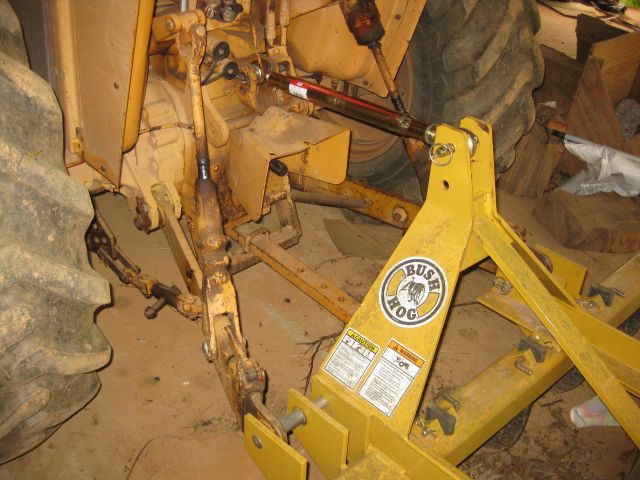
It takes a couple minutes to replace a top link and, below, you can see the new top link in place.

new (shiny) top link in place connecting top of yellow box blade to tractor

Now Georgia is about to pass new tax laws which will probably tax internet sales but even an 8% tax will not diminish the benefit of having an alternative source of supply for uncommon parts. TGFI!