my 4 mowers, and mower deck repair

I have 4 mowers.  I use a scythe (21″ blade)  to clear the growth under  fruit trees for which it is ideal.  Extend the blade to the near side of the trunk and pull sharply toward you and the weeds are leveled, all while standing a distance away without worries of snagging branches or snakes (I refer to the venomous ones – copperheads or occasional rattler).  It is also useful on a hillside where riding a mower is iffy. For how I peen my scythe and hand sickle, search “peen” on this site.
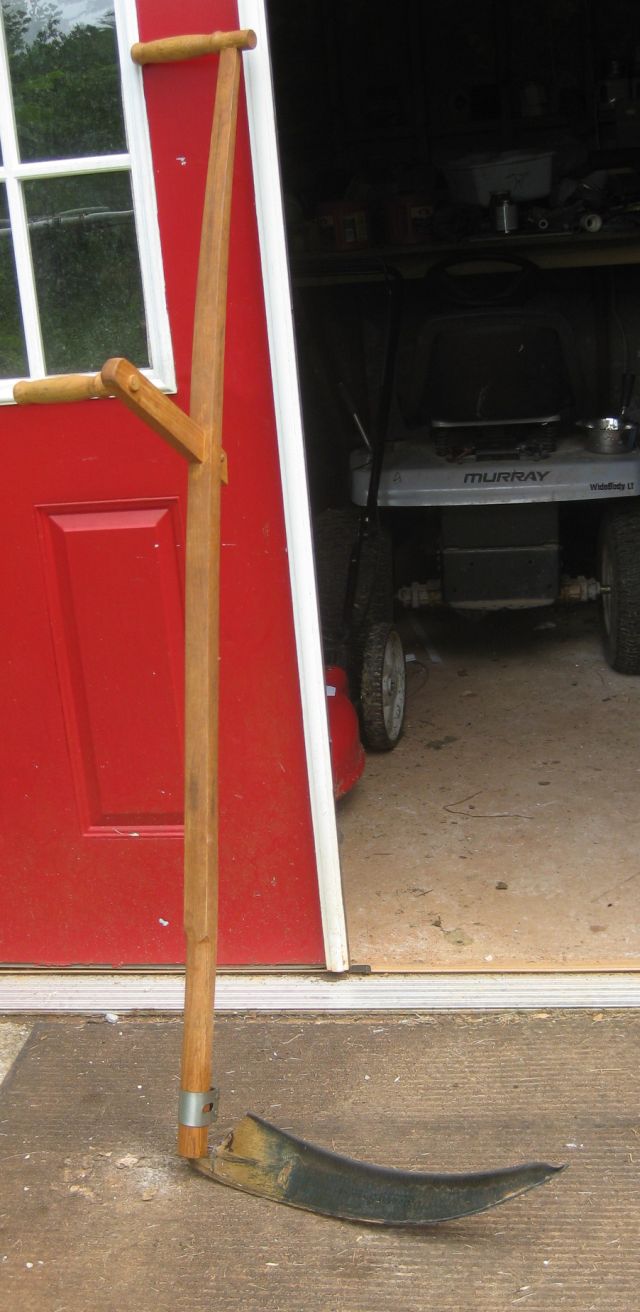
scythe
scythe good for clearing fields, if you are up to it, otherwise handy for difficult to access spots

Next up is my 21″ push mower, basic model purchased new this year from a big DIY store.  Note the large rear wheels for rough ground.  I use it for cutting and mulching the walkways between the raised beds.  It has a sophisticated Briggs Stratton motor which does not require use of a choke and starts (so far) on first pull.
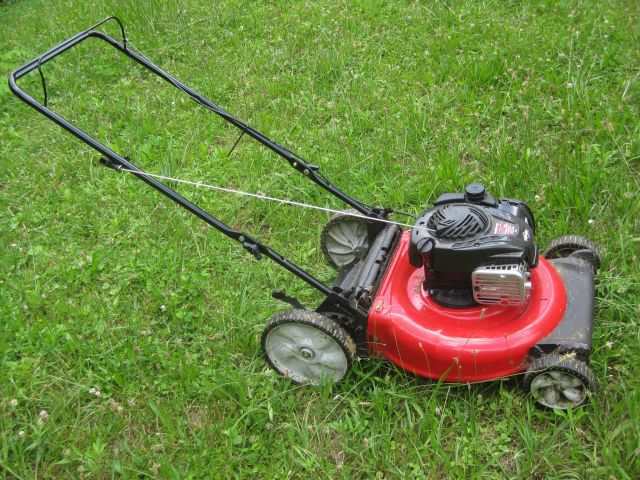
handy gas powered push mower

The biggest mower is the Bush Hog, which is 5 ft wide and shown here attached to my tractor.  I bought it used and use it to clear fields and heavy growth and it seems indestructible.
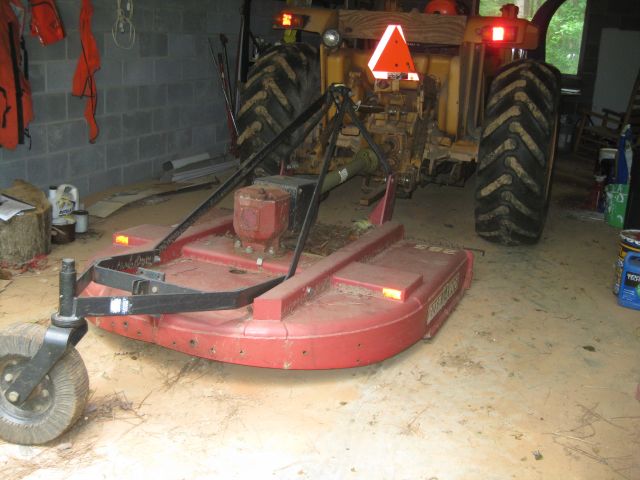
Bush Hog attached to Case tractor

Finally, and the topic for this post, the Murray 40508×92  40″ mower which I bought used and damaged 7 years ago from a neighbor and have kept going with occasional ad hoc repairs and replacements.  Until last week when the mower drive belt kept slipping off the pulleys and all came to a halt.  The engine turns the drive belt and the belt turns two pulleys which are connected to the two blades which do the cutting.  So what was the problem?  Each pulley turns a jackshaft which turns a blade.  The shaft is held in position by a mandrel secured by 5 bolts to the mower housing/deck.  3 bolts on one mandrel were missing  and the 4th was loose.  So when the belt applied torque to the pulley the pulley lifted and the belt slipped off.  Replacing the bolts wouldn’t work – it was apparent that as individual bolts loosened the vibration of the blade had torn the metal housing to which the other bolts were attached, and as each bolt came off the vibration and damage increased.  A stitch in time would have saved nine.
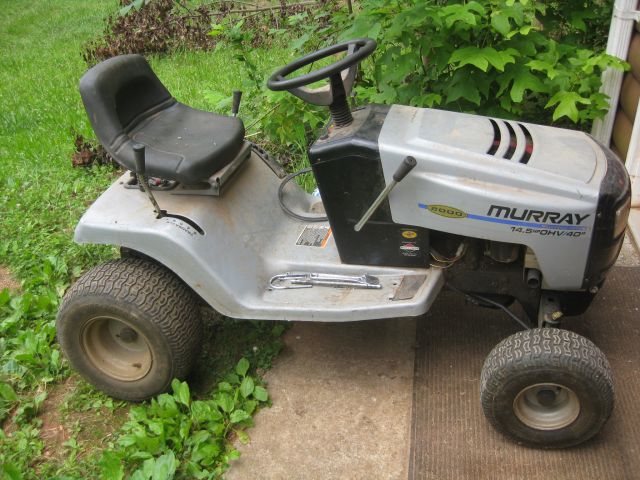
Murray mower with mower housing removed

It seemed I had several options – buy a new deck; buy a used deck; buy a replacement mower or have the deck fixed.  Internet search showed no new decks matching this part #, though comparable new decks >$400 before shipping.  On Craigslist I could buy a newer more powerful mower for $400.   eBay showed similar decks used for $70 to $100 before shipping cost of say $70.  And they probably would not fit and would have to be adapted.  So, could it be repaired?  Welding, regrettably, is a skill I do not (yet) have.  But there is a local shop which I previously used which does good work for reasonable cost.  I took it in and they said sure.  I asked cost and they said $30 if it took 30 mins. but not to exceed $60.

Two days later it was ready.  They decided that in addition to welding the torn housing together it was prudent to weld on two plates – total cost $55.
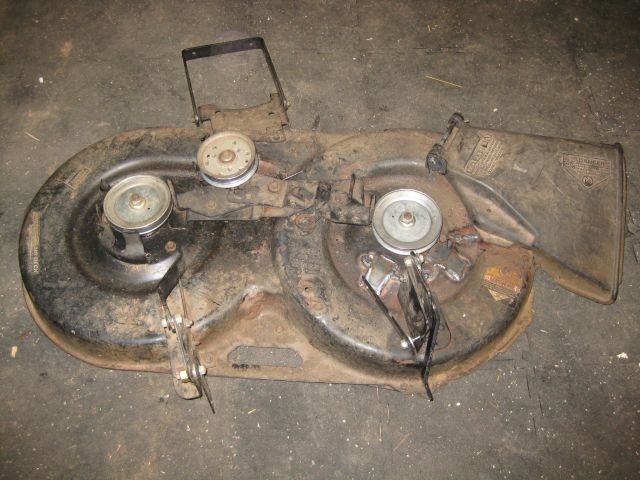
a view of the mower housing removed from the lawn tractor.

The welding was done to the housing to which the right pulley is attached.
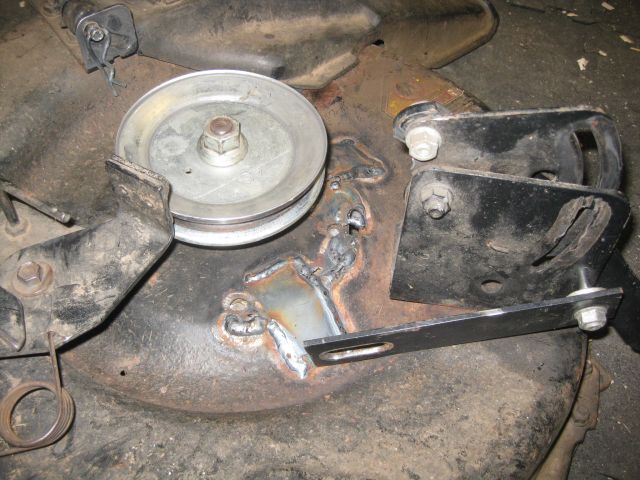
this close up shows the 2 plates and the stitching of the torn material

I really felt foolish for having allowed this damage to progress but the welder, noting my embarrassment, said he does 4 to 5 mower decks a week and he showed me a newly arrived patient.  This was larger than mine with 3 pulleys driving 3 blades and the housing for the one pulley had completely disintegrated and major welding plate surgery was now needed.  So I felt a bit better.

I purchased new bolts and coated the threads with Loctite to discourage them from loosening.
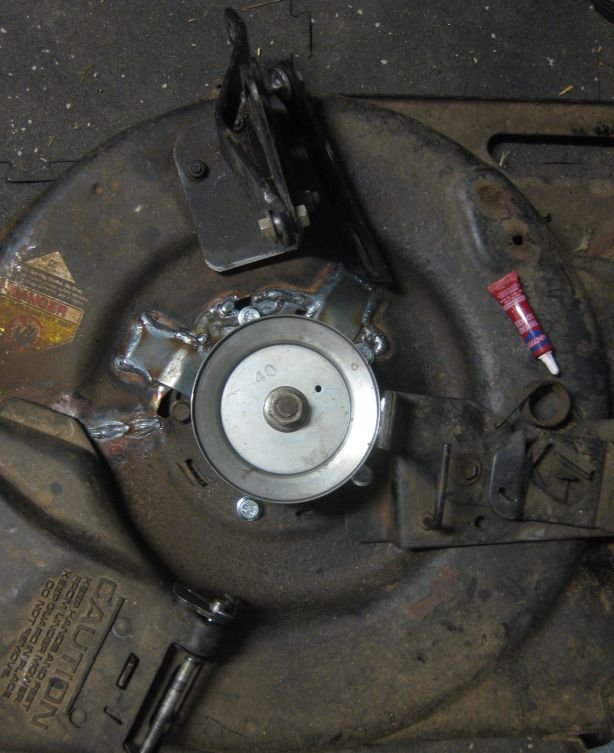
close up showing all the bolts in place
close up showing all the bolts in place, there are 5 of them

The other drive pulley was distorted and so, while I was at it, I installed a new pulley.  The nut on a pulley can be difficult to remove because the pulley shaft turns as you apply pressure on the nut.  I remember in the 90’s I was unable to undo the nut on a generator so I took it to an auto shop and in a few seconds it was off – they used an impact wrench.  I bought an electric impact wrench and it has been invaluable for removing nuts on shafts.
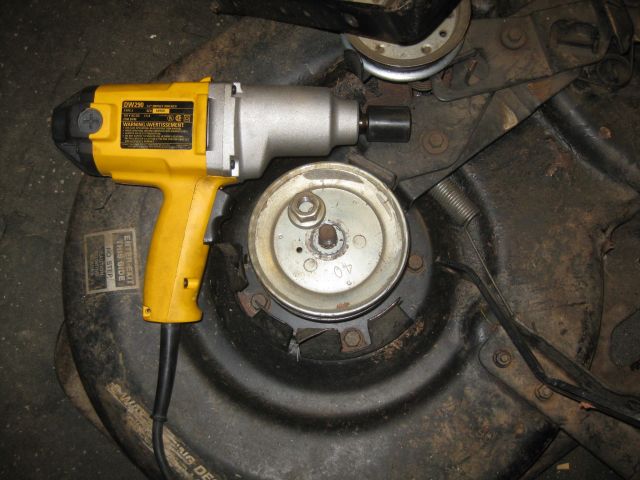
impact wrench, loosened nut and new pulley

So I decided to also examine and sharpen the mower blades.
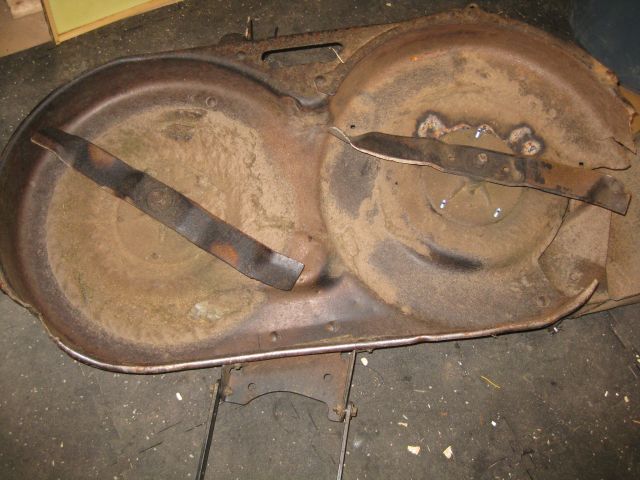
underside of mower housing with blades revealed

The impact wrench loosened the two nuts securing the blades.  Since I had a balancing jig I decided to use it.

a jig to test if the weight of the blade is balanced, otherwise undue vibration

My father-in-law bought me my first bench grinder and instructed me how to use it.  They can be very dangerous if misused – if a fast revolving grindstone shatters, there will be injury.  I always wear extensive eye protection from my experience some years ago when I was grinding the valves of an Accord and a metal speck flew under my conventional glasses and lodged in my eye and this necessitated a visit to the emergency room.
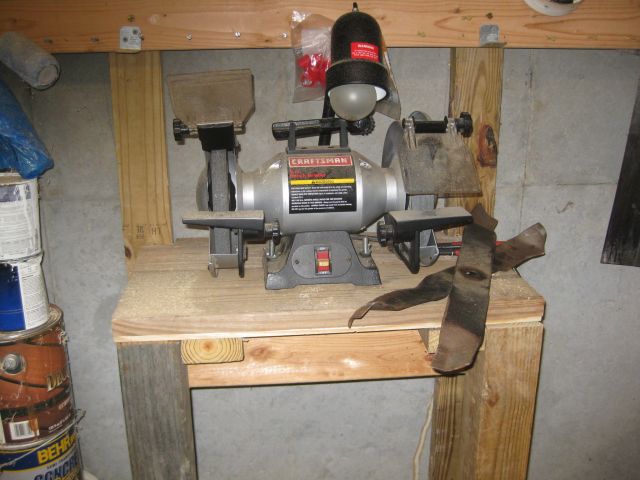
my bench grinder - if a fast revolving grindstone shatters, there will be injury
my bench grinder mounted on a platform in the basement

All that remained was to re-install the mower housing.
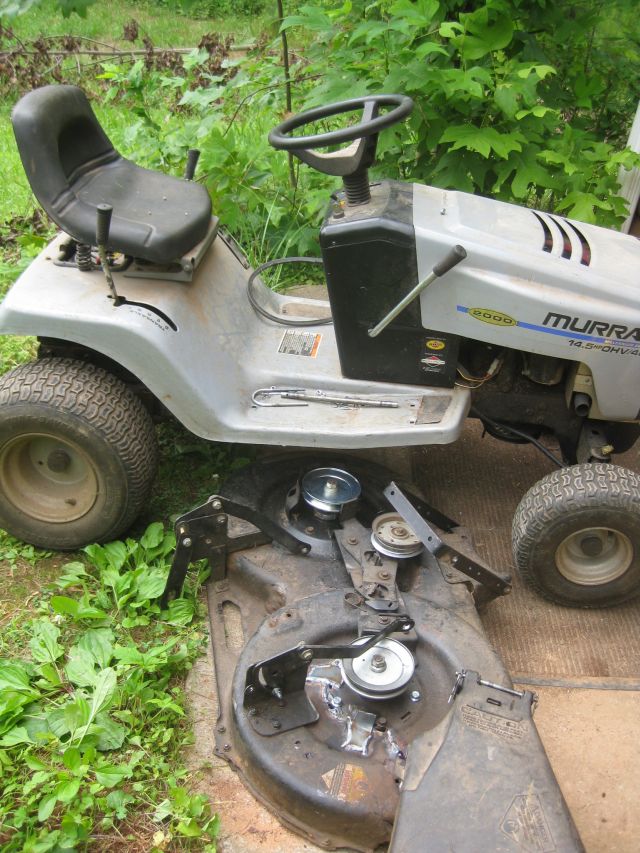
re-installing the housing

And it works just fine!
what to do with surplus eggs

Spring is production season and my hens are producing 6-7 eggs a day.  Although there are 10 hens, 2 are retired (Gimpie and Ameracauna) and 2 are matrons (Onyx and Lady MacBeth) so the main producers are the 6 offspring. My running group certainly enjoy the free range eggs with deep orange colored yolks, as do my neighbors who watch out for me when I am elsewhere.  But we had 5 dozen extra and this morning we tripped to CARES (Community Assistance Resources and Emergency Services) a local charitable organization, which was happy to receive our contribution.

a local community food bank

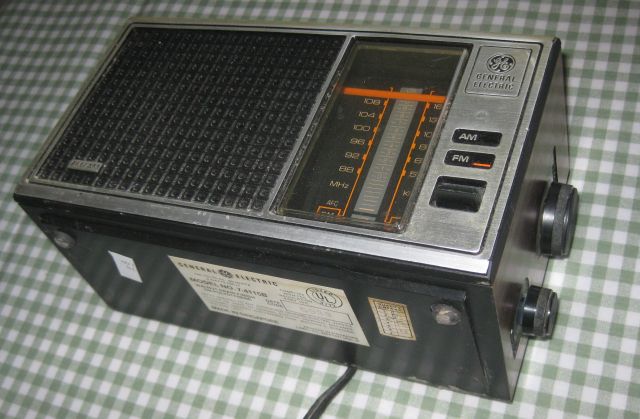
And, whilst in the area why not visit the Thrift Store which has revolving usual and unusual items.  Today’s visit resulted in a  General Electric FM/AM radio model 7-4115B circa 1981 which cost $1.  When I have time on my hands I will explore and test the circuitry and rehabilitate it.

an older radio to tinker with, which will be much easier than today's devices
an older radio to tinker with, which will be much easier than today’s devices

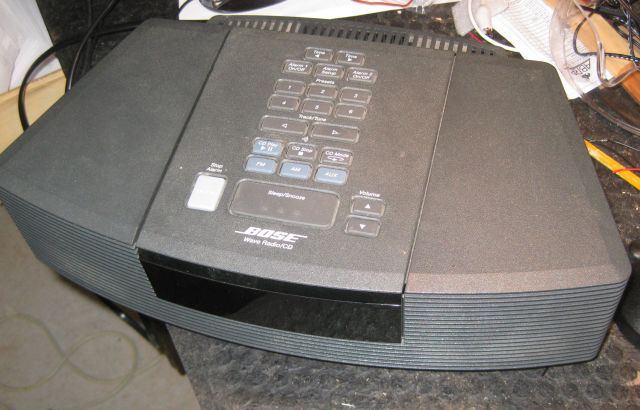
Bose Wave Radio/CD – quick repair

In July 2014 a power surge incapacitated a bunch of electronic equipment – see my tale of 2 destroyed desktops.    One of the affected items was our Bose Wave Radio – a small package with good sound, for which Bose is well known.

the Bose radio/CD player

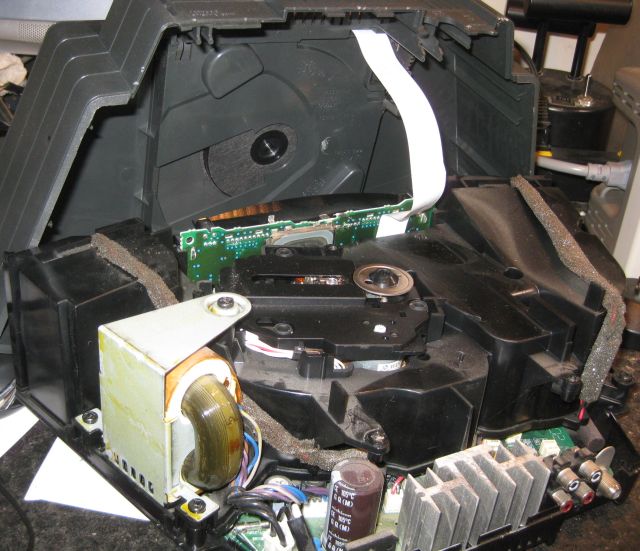
I stored the radio in the basement until I was ready to work on it.  Caution – if you are not competent working with electricity, leave well alone.  I was prepared for the worst – having to test and replace defective components but was hoping for the best – a shorted fuse.  I removed the 3 top screws and carefully lifted the cover taking care not to pull on the ribbon which, if damaged, would substantially increase repair costs.

with the cover lifted the inside is revealed


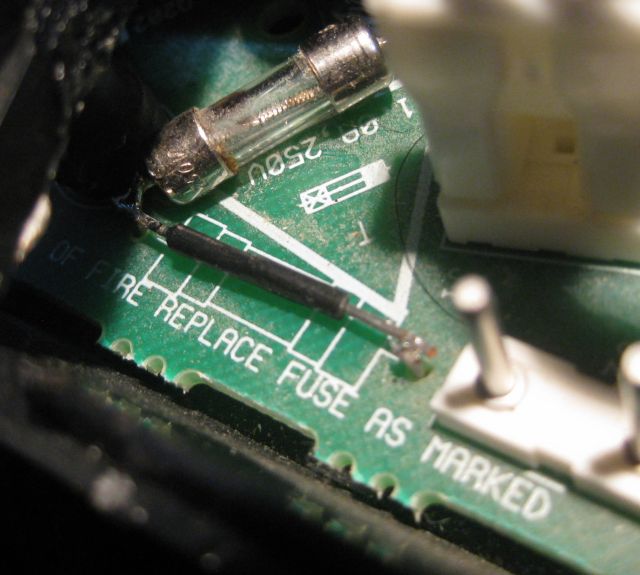
But where is the fuse.  I found it front left.  I tested it and it was defective. It was soldered to the board.  Some dismantling of components was required to access it.  I snipped one end of the fuse and rotated it out of the way and soldered a short piece of wire (22AWG) to connect the 2 points which the fuse had bridged.

bose fuse a
you can see the old fuse and the new wire shunt

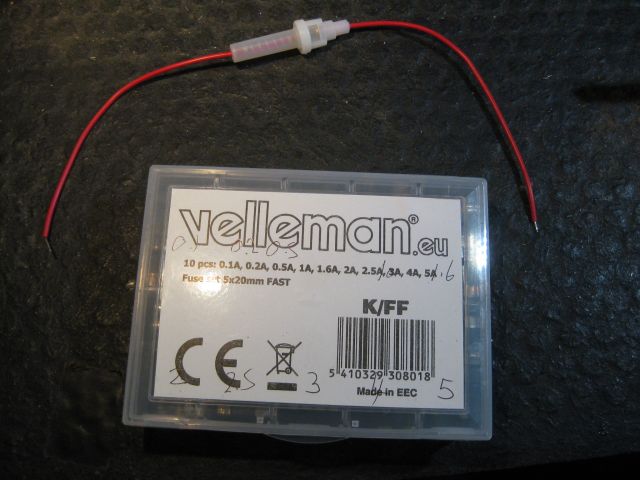
I reassembled the Bose and it played fine.  But I was bothered – it no longer had a fuse and would be damaged if there was another power surge.  So I ordered a fuse holder and a box of replacement fuses.

a fuse holder and replacement fuses

And I again opened the Bose, disconnected the shunt wire and soldered the fuse holder in place together with an appropriately sized fuse.  And it still works fine  and is now protected from power fluctuations.


new gable fan for coop – problems and savings

With temperature in north Georgia back in the 80’s it was time to summerize the coop.  On the south and west facing sides I atttached the pre-cut tarp pieces from prior years, silver side facing the sun to reflect heat away from the building.  Then I plugged in the cord to the gable fan – and there was no response.  I examined the cord from the power socket to the thermostat and noticed that the white (neutral) line had been chewed by rats (now why didn’t they chew on the positive line?).   I replaced the cord, plugged it in and there was a hum from the motor but no rotation.   The fan blade did not turn freely.  Time for a new motor.  I had purchased the gable fan at least 4 years ago for close to $100 from a big DIY store.  Was there a cheaper option?  Amazon to the rescue – their #1 best seller  was $57 with Prime (so just sales tax on top of the cost).  A click and it arrived 2 days later.  And then my problems began.

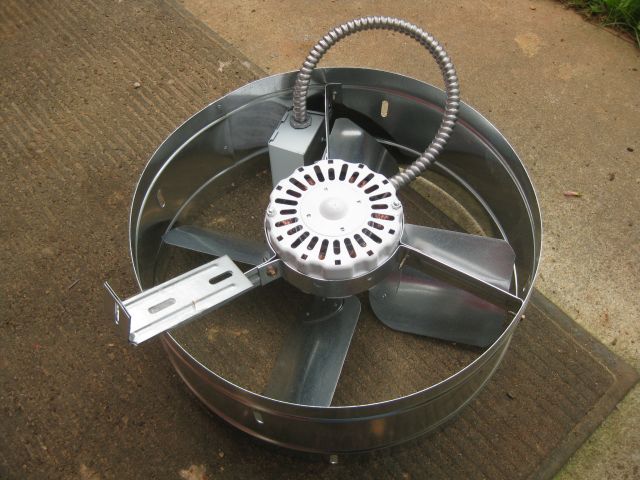
new fan
new gable fan consisting of motor with fan blade in housing, cable to a thermostat box and right angle brackets to be attached to the housing and then to the exterior wall

WARNING – WORKING WITH ELECTRICITY CAN BE DANGEROUS – IF YOU ARE NOT COMPETENT IN THIS AREA, STAY WELL CLEAR

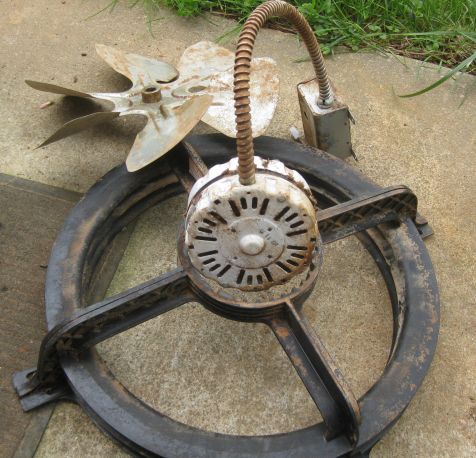
As may be seen above, the fan housing is attached to the wall with 4 brackets but there were no bolts in the package to attach the brackets to the fan housing.  Also the fan has a 14″ diameter and the existing fan was 13″.  The housing of the old fan could flex with the spinning of the fan so there would be less vibration, but the new housing was rigid  – I guess that’s why it all cost much less.

old fan disassembled - you can see the housing has built in brackets and a cushioning design
old fan disassembled – you can see the housing has built in brackets and a cushioning design


I didn’t want to delay to locate or buy bolts to attach the brackets to the  new housing or to have to cut a larger hole in the exterior wall to accommodate the larger diameter fan.  The old and new motors appeared identical.  Which got me thinking – why not simply replace the motors and use the old fan blade?

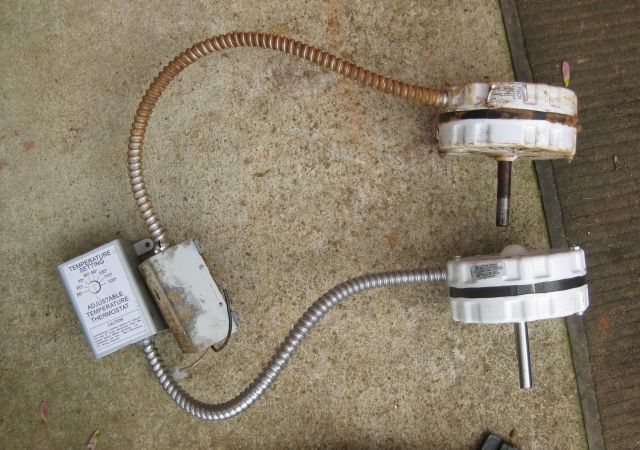
So I removed the old fan from its location and with oil and sand paper removed the fan blade from the motor shaft and then extracted the motor from the housing and placed the old and new motors side by side.

the motors appear identical

I installed the new motor in the old housing and attached the old fan blade to the shaft of the new motor.   The thermostat wires were in the thermostat casing so I fished them out and connected them to the new cord and switched on the outlet.  All was silent and I realized the thermostat was set too high so I turned it down and – pop.  The socket shorted.  How was this possible – could a new purchase arrive with a malfunctioning motor.  I disassembled my installation and tried to open the motor to locate a wiring short.  No luck.  Then I noticed it was manufactured in Texas – got to be decent quality inspection procedures.  So either the wire in the armored cable to the thermostat or the thermostat was the problem.  I opened the thermostat housing and there was the answer.

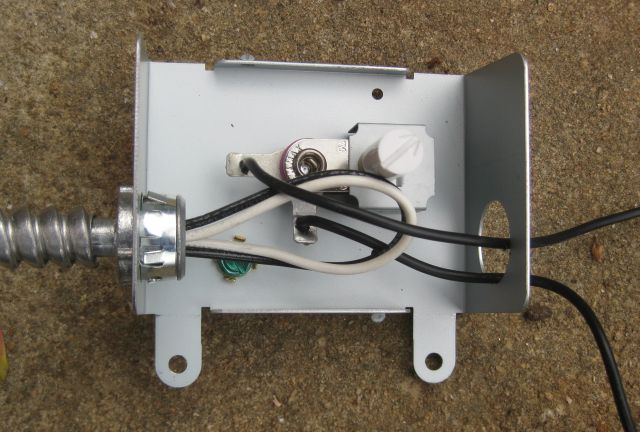
mystery solved
mystery solved

The 2 wires I had fished out were the wires to and from the thermostat and that’s why it kept shorting.  Silly me – them being the same color should have told me.  And you can see the black and white wires from the motor doubled over.  It was a simple matter now to connect the black wire from the motor to a black thermostat wire and lead the white wire and the other black thermostat wire out the housing to the power supply.  I reassembled all the parts and installed the fan back in the coop.

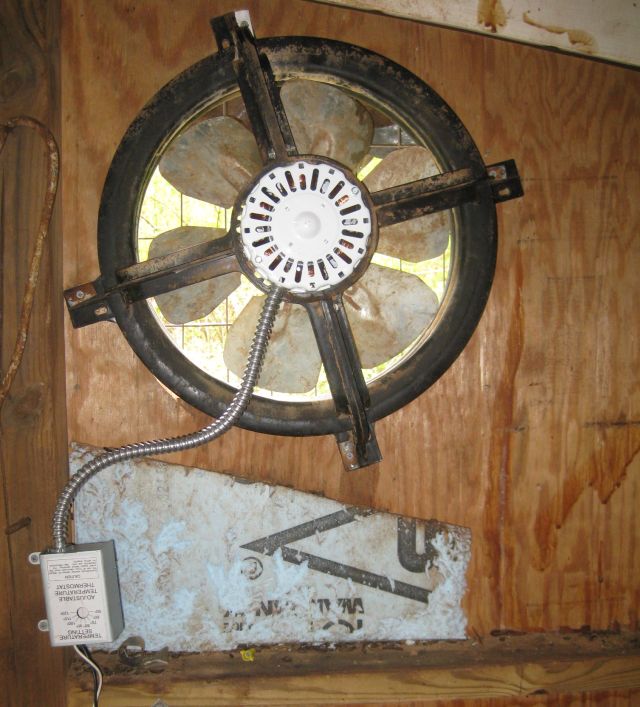
the new motor, old housing, old fan blade installed in the coop.  note the black and white wire emerging from the thermostat housing
the new motor, old housing, old fan blade installed in the coop. note the black and white wires emerging from the thermostat housing

And, of course it worked.  Some simple lessons there for me.  It also would have been nice if the new fan purchase had come with some instructions and the nuts and bolts to attach the brackets to the housing.  And the old motor – I will disassemble it some day and see if I can fix it.

old house & appliance repairs

Past month I have been fixing electrical things in the Atlanta house which >35 years old.  The garage opener went dead so I replaced the whole caboodle (quaint word lodged in the past) – motor, track, chain plus the new required sensors to prevent the door closing on an infant.  Took a good few hours to figure out the components and how they fitted together and to come to the conclusion that the sensors have to be used and there is no override.  The new opener operates very smoothly and before the old opener failed there was a lot of clattering, which I now realize was due to a loose chain and this probably caused the failure.  A stitch in time saves nine.

Then the exhaust fan in the bathroom failed.  I ordered a replacement motor and the supposed quick 10 minute change out took ages.  The motor ($15) arrived with “reverse mounting instructions” – it seems it was incorrectly assembled at the factory and the bearings had to be reversed.  Then when I attached it to the mounting plate it would not fit in the receptacle – the spindle was too long.  It took time to craft a satisfactory fix.  But now it purrs happily.

The subject of this post is the refrigerator.  It’s a  GE Profile Arctica, 36″ wide, large top freezer refrigerator  (24.6 cu ft) which they no longer make in that size since most who want a large refrigerator go for the double door configuration, which my house boss categorically does not want.  So I was dual motivated (money and peace) to get it working again after it suddenly died this past week.

Actually why it died is very interesting.  Tuesday of last week the lights began flickering and the flourescent fixtures would dim and then brighten.  I have a UPS (uninterruptible power supply) which beeps when the voltage changes and it was beeping incessantly.  The boss blamed it on old wiring and everything going wrong in the house and the world.  But when I noticed that lights on unrelated circuits were also blinking I figured this was a general problem.  And then, Wednesday am we both identified a distinct burning plastic smell at the garage entrance.  We figured all hell was about to break loose.  That evening I examined the main fuse board for loose wires – all were tight.  I removed an access panel and examined the area where we had smelt the burning – all was fine, cable insulation had not been gnawed by rats ( a wild supposition) and no sign or smell of burning.  I called the utility company and their automaton said the problem had been called in and they were on it.  Thursday I had a voice message (and I listened carefully) that power at the house was fine and a work crew would not be dispatched.  The message did not say there had been a problem which was fixed, but maybe this is the protocol to avoid being sued.  Sued for what?  Well our refrigerator no longer worked and the voltage surges could have been the cause, the proverbial last straw.  But the flickering has not recurred, the UPS is silent and we have consigned the burning plastic smell to the imagined.

Note – before working with a refrigerator always unplug it from the power source and discharge the capacitor.   If not competent with electricity, leave alone.

Prior to the refrigerator failing I heard a lot of clicking so I thought the issue was a bad capacitor (it usually is) and I extracted the capacitor and tested it with my capacitor tester and it was fine.

the small capacitor which starts the compressor motor of the fridge

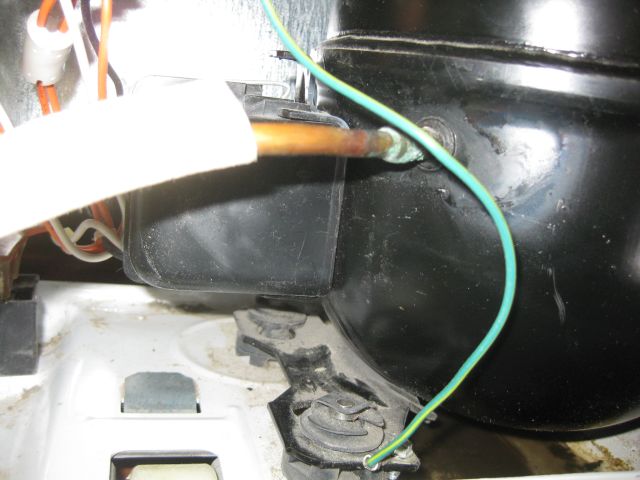
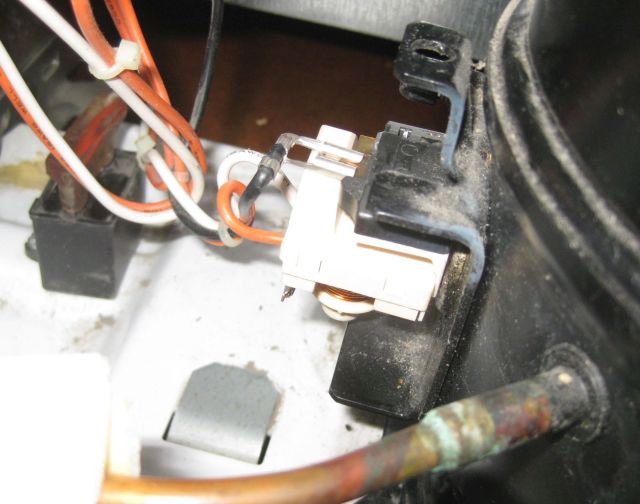
My next thought was the starter relay – it is hidden behind a black plastic box.

behind the black covering is the starter relay

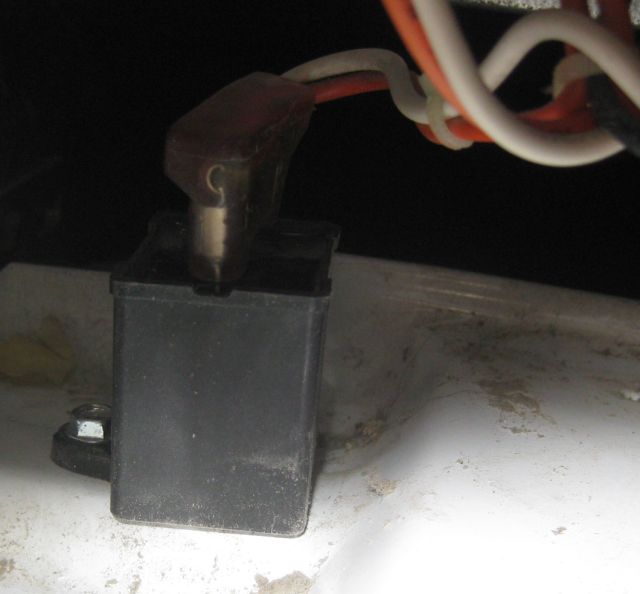
You can see it clearly once the cover is removed.

relay switch exposed

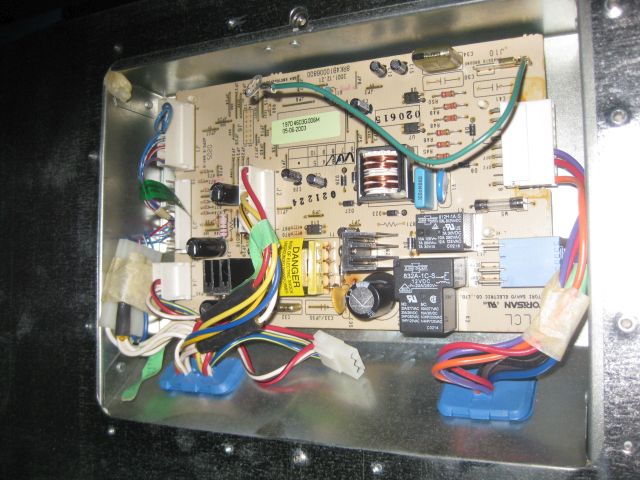
But it was also ok.  And then I opened the fridge door (the interior lights came on) and looked at the electronic panel for setting the fridge and freezer temperatures, and it was dead.  So I silently cursed, since this was the first thing I should have checked and I could have saved myself time.  If the control panel is dead then the problem is most likely the motherboard.  So I exposed the motherboard and it looked fine though there were signs of age and heating.

old motherboard in situ

In for a penny, in for a pound.  From the GE website I located the motherboard for our model and the new part # and via Amazon I scrutinized the various suppliers both for price, delivery time and delivery cost (the cheapest supplier wanted an exorbitant fee for quick delivery).  I placed the order Saturday am and the part arrived today, Tuesday (refrigerator main control board for GE WR55X10942) cost  including shipping <$70.  I carefully detached the wire clips from the old board, connected them to the new board, attached the earth and panel and plugged in the power and it works!!

I had been concerned the motherboard failure was because of problems with the compressor or relay starter so I also purchased a Supco 3 ‘n 1 start combination ($13) in case the refrigerator had difficulty starting and 2 new GE sensors ($9 each) since there were prior complaints about unsatisfactory temperatures.  The 3 ‘n 1 I will keep for another day and I may have to replace the sensors if the temperatures are out, though I hope the new motherboard will resolve any issues.

Some final comments – the reverse side of the motherboard has a black scorch mark from a failed component which theoretically I could have unsoldered and replaced, though this would have taken more time, may not have fixed the problem and time was of the essence.  The clicking noises I heard before the fridge failed was probably the compressor trying to start on reduced volt supply when we had intermittent power.   And I have just been informed “it seems to be cooling” so peace reigns again.


.

repair of double electric wall oven

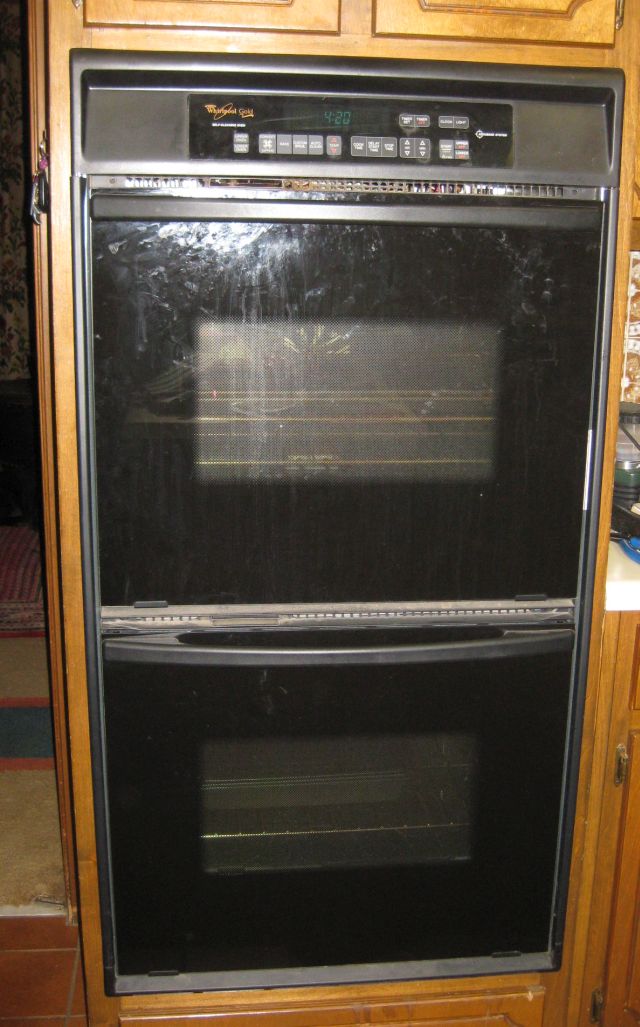
Growing my own food, harvesting rainwater, using a well are part of being self sufficient, and so too is maintaining and repairing the house, automobiles and appliances.  So when, a couple weeks ago,  the wall oven showed no sign of life, no beeps, no noise, no lights, nada, I began thinking why.  And with me about to leave for Australia and the Thanksgiving meal fast approaching, I felt pressured.

the wall oven which went dead

Usually there are warning signs before a shut down,  but not in this case.  I checked the fuse box – it was fine.  I located the paperwork – purchased October 1999 and the control panel was replaced within a year of purchase under warranty because of intermittent problems.  And since then, for the past 14 years, it had been fine.  I checked current prices and figured a new one would cost >$1,800.  I scoured the internet and concluded the problem must be with the power supply to the control panel or the control panel itself.

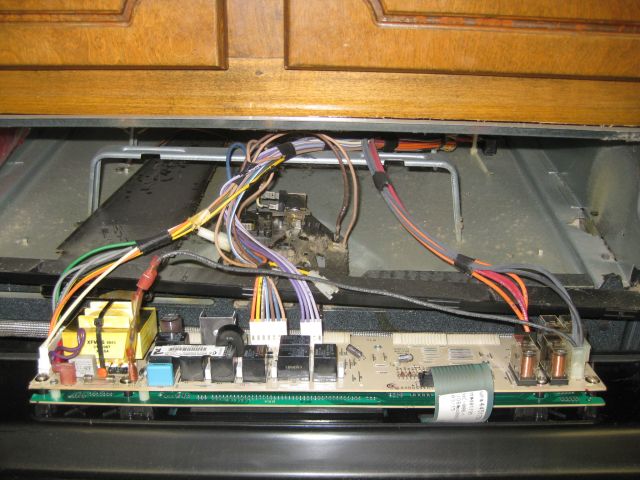
Before I go further – WARNING -this can be dangerous stuff – the oven uses 240 volts which is lethal so if you are not competent with electricity, leave well alone.  I noted that there was 120 volts at the panel, so power to the panel was ok.  A panel operates on 24 volts and often there is a transformer separate from the panel which steps down from 120v to 24v, but there was no separate transformer.  I noted that the transformer was located on the panel.

control panel with transformer on left

So probably the transformer or the connections had failed.   If I was not leaving for Australia within 4 days and if Thanksgiving was not less than 3 weeks away I would have tried to locate and fix the problem myself.  But I did not have this option.  Buy a new one?  No such luck no new panels were offered anywhere on the internet.  And then I found an interesting website “fixyourboard.com” where they specialize in repairing control panels.  Lots of good references supporting their work.

My panel model # was not listed on their website so I emailed and within a few hours they replied they could fix it for a flat fee of $190 which included a 2 year warranty and return shipping.  The day of my departure to Australia I sent it off via UPS, 2 days later they emailed they had received it, and within 3 working days they emailed it was on its way back.  I received the panel today (mailed Tuesday and received Friday of the following week).  It was accompanied with an analysis stating their diagnosis (failure in power supply circuit), and that they had replaced additional components “shown to be failure prone as a preventative measure” and had fully tested the control board.  I attached the cables, reinstalled and switched on at the fuse box and it works.  And the atmosphere of dread in the house has lifted.

wood stove – details completed

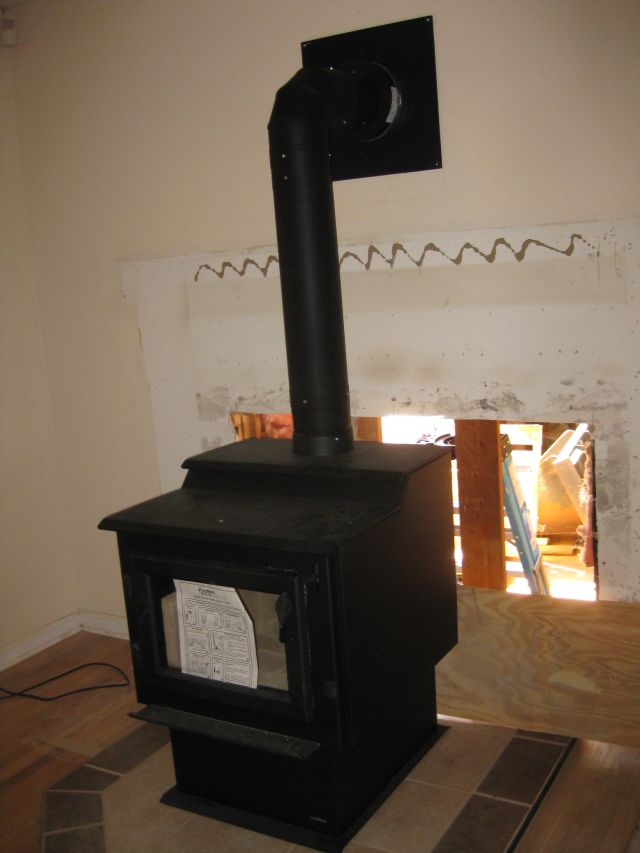
In March 2014 I dedicated two posts to the process of removing the old fireplace and installing a new, efficient wood stove.  In the last post the stove was fully functional but looked “bleh”.

installed wood stove but a lot of finishing is needed

I had a lot of work to do – on the exterior the wood siding had deteriorated and had to be replaced and caulked.  And then on the inside the question was to either replace the sheetrock, not a real skill of mine, or do something extra.  I decided to tile the wall behind the stove, since the tiling would look nice and is not combustible.   So I installed cement backer board and spent ages looking for tiles which would match the new hearth pad.   I mentioned that the mantle of the old fireplace included good wood, which I decided to re-use for the surround.

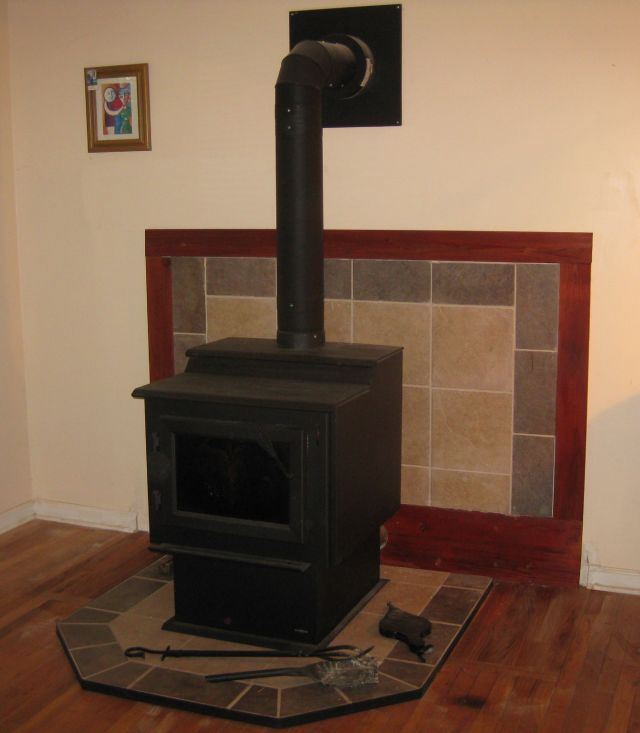
So here is the finished product.

wood stove and surround

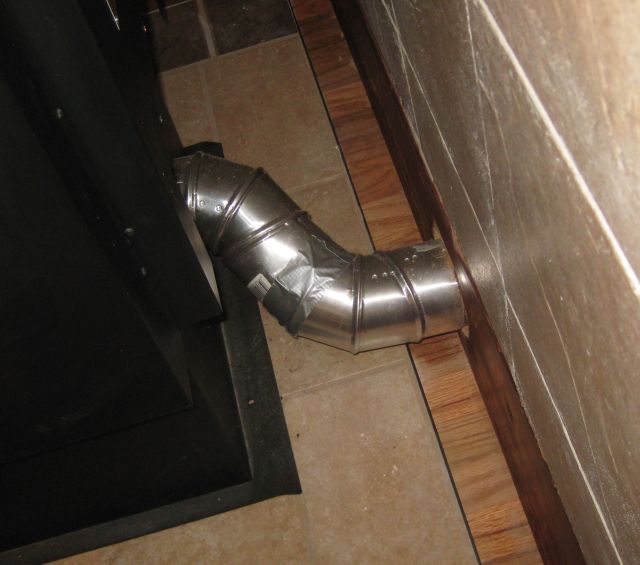
To reduce heat loss I connected the air inlet pipe at the rear of the stove to the exterior so the stove will not consume heated air from the room.

4" inch piping to duct exterior air to the stove
4″ inch piping to duct exterior air to the stove

Initially I used the concertina type ducting you install for clothes dryers, but I concluded that the concertina crinkles impeded the air flow and so I replaced that with standard duct piping, which seems to work well.

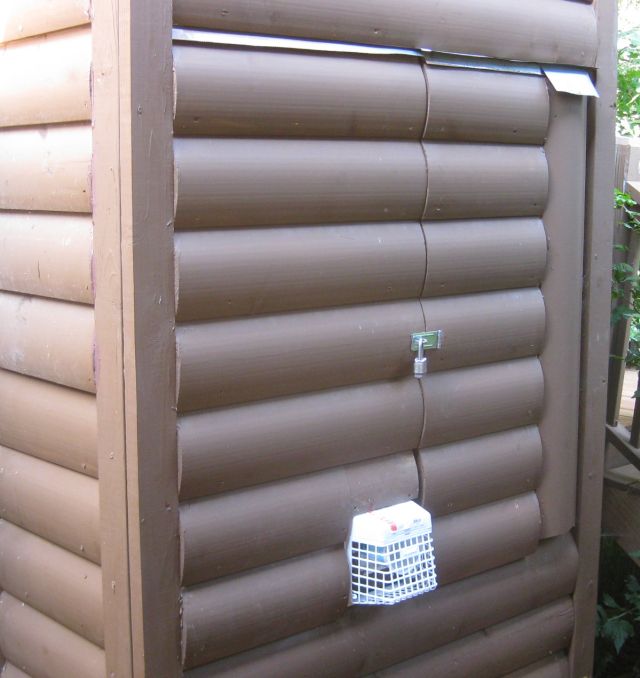
And on the exterior air inlet, I fitted a plastic grate to keep out animals.  It is hinged and during the summer, when the stove is not in use, I have also plugged the interior pipe with an empty 1qt yogurt container.

chimney exterior all of which had to be replaced

Whilst I was at it, I also installed a small door which provides access to the interior of the chimney chase so I can brush clean the chimney flue pipe, as needed.


repairing a bathroom exhaust fan

In the past, when a bathroom fan failed, I simply removed the cover, unscrewed and unplugged the insert and installed a replacement – this was the NuTone brand and the replacement cost <$15.  However, at the log cabin it was not so simple.  The fan was manufactured in Canada and a replacement blower assembly was not available locally or at Amazon.  It could be purchased from the manufacturer but the cost plus shipping was greater than the $70 cost for a complete unit from Amazon.

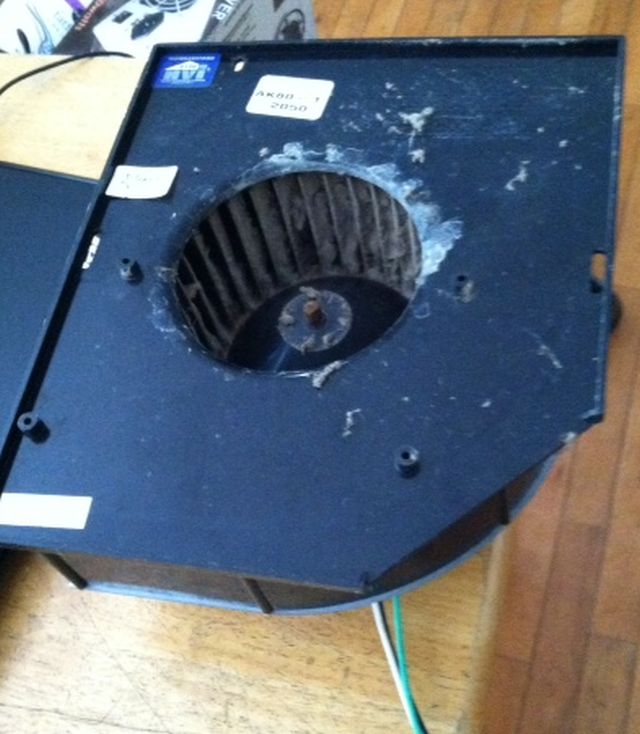
Since the manufacturer touted the reliability of its product I considered whether I could simply repair the fan.  When I removed the unit I noticed that the vanes of the blower were clogged with dust and debris.  This was why the fan had sounded weaker and weaker with the passing months – the motor had been struggling to turn the blower.  And perhaps this had burnt out the capacitor or the motor was defective.  If the motor was bad I would have to buy the Amazon unit.  I tested the capacitor with a capacitor meter and it seemed ok.  However this did not mean it was ok.

I could buy a new capacitor for <$4 from the manufacturer but with flat rate shipping of $11 this would be close to $15.  Or I could buy a similar capacitor with the same farad spec from Amazon for approx $5 with no shipping cost add on.  I invested $5 and when I installed the new capacitor the motor turned slowly.  Then I cleaned the vanes and the fan spun to life.  Fixed.  NB – don’t try this unless you know what you are doing, it can be dangerous.

why it failed - you can clearly see the accumulated dust and grime on the inlet vanes of the rotor
why it failed – you can clearly see the accumulated dust and grime on the inlet vanes of the blower

And the lesson – clean the blower vanes with a sized, soft paint brush regularly and you can avoid a lot of aggravation down the road.

tale of 2 destroyed desktops

In addition to my nu trac life north of Atlanta, we also have a house in Atlanta.  The gas company decided to install new gas lines in the subdivision where our house is located.  They called in the “locators” who with different colored sprays identified the electricity, water, telephone, sewage and gas lines.  Then with a sophisticated omni-directional drilling machine they bored small diameter tunnels underground from one excavated point to another.  When the drill bit reached its destination they attached the new flexy gas line to it and hauled the drill bit and the new gas line back to the starting point.

The excitement began mid day July 2 – it was a Wednesday and 2 days before July 4, which was on the Friday.  A loud bang was heard in the kitchen accompanied with a burning plastic smell and the house lost power.  The local power company restored power within 3 hours.  However 2 desktops, a Bose CD player, the telephone and other items no longer worked.  Thursday 8am I walked over to the subcontractors who are installing the new gas lines and asked the supervisor for their claims department contact information.  The supervisor denied responsibility because, although his crew hit the power line (he couldn’t deny that) , the power line location had allegedly not been accurately marked.  We are not responsible the supervisor said, the blame lies either with the power company  for not mapping the power line or the locator for not accurately marking it.  He added that this would take weeks to resolve.  Nothing like a challenge to fire me up.  I called the power company and the gas company and left numerous voice mails – it being the day before July 4, many folks were not at work.

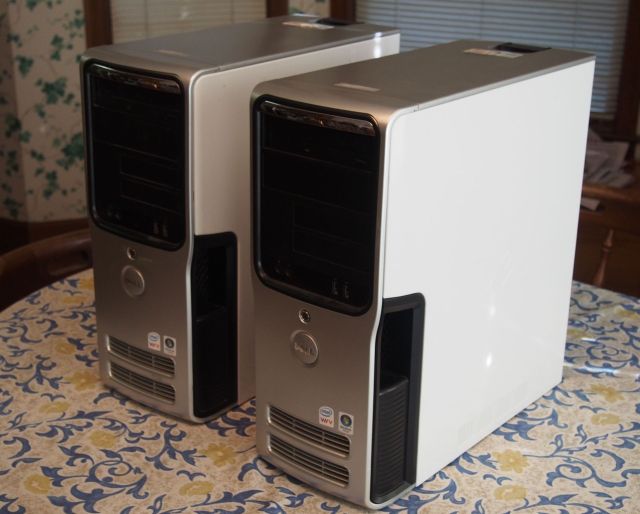
2 Dell computers destroyed by power surge

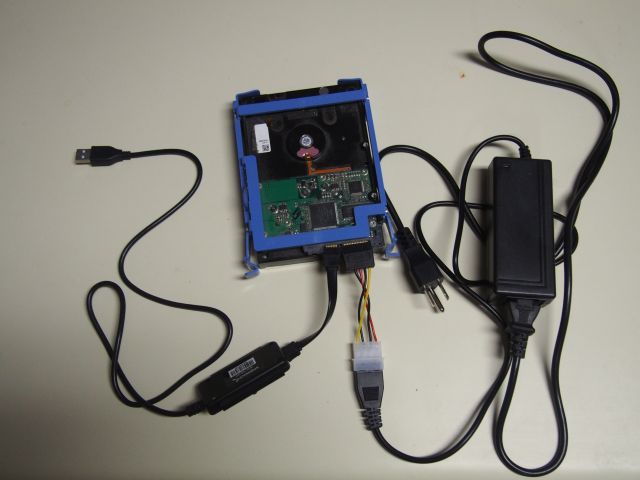
I figured that the desktops might just need a new power supply and, on my way to the farm, I stopped at Fry’s, which is a very impressive electronics store, and bought a new power supply for $12 (a bargain, actually $21 less $9 rebate).  The desktops which had shown no life at all after the power surge now sorta switched on with the new power supply and there was a cursor on the screen but nothing else.  So I decided to buy a new low end desktop and began reinstalling software from CD’s I had kept.  I won’t go into the details except for one challenge I encountered.  The information on the 2 destroyed desktops had not been backed up recently so I wanted to transfer from the old desktop hard drives to the new desktop.  When I bought the new desktop I had asked if it had a bay for a 2nd hard drive and was advised that it did and, when I opened up the new desktop it did have a bay for a 2nd hard drive.  But – there were no connectors to attach to the 2nd hard drive.  In other words I could not simply attach my hard drive to the new computer and transfer the files.  A hard drive needs two connectors – one to provide power for it to spin and the other to save or retrieve information.  I was thinking of powering the hard drive with the new power supply I had purchased and temporarily using the connector to the CD/DVD drive for the hard drive.  But I was concerned this could do damage.  And then I was given the solution – it’s great to have family or friends who know something about technology.

The Sabrent connected to the hard drive.  In the left is the power cord and on the right the USB connection.  All for $15!
The Sabrent connected to the hard drive. On the left is the power cord and on the right the USB connection. All for $15!

There is a very nifty device manufactured by Sabrent which costs just $15 and it both provides the power for the hard drive and also, via a USB hookup transfers information back and forth between the hard drive and the computer.  The device arrived within a few days and, with a lot of googling help, I was able to identify and transfer all the files on the 2 hard drives and the browser book marks and the desktop icons.  And life was back to normal.

And what happened with the claim?  The following Monday, when folks were back at work, I had lengthy calls with the claims departments of the power and gas companies.  They were just 2 of the 4 parties involved since there was also the locating service and the sub-contractors who were installing the new gas lines for the gas company.  But I wanted to keep things simple and so I said to the two utility companies that since their head offices were in our county, if the matter was not quickly resolved, rather than pursuing claims against them individually and the locating company and the sub-contractors, I was simply going to name the 2 big companies as joint defendants and proceed against them in small claims court, and by the time we were finished, their legal costs would probably exceed my damages, which I estimated at $1,600.  Two days later (Wednesday) the power company called and said if my damages were still around $1,600 they would settle up.  On the Thursday, I emailed a very detailed claims analysis with photos and Amazon cut outs and lengthy notes.  On the Friday they said they would pay, and on the following Monday, less than 2 weeks after the incident I received my check for approximately $1,600.

Moral – by DIY I was able to keep the downtime and my costs to a minimum, and keeping my costs low made settlement attractive (a computer technician would have increased the costs significantly).  Also by suggesting small claims court (another DIY resource, I suppose) I was able to motivate the parties to move quickly.


2 gravity feed tanks with 9 valves

All my irrigation is from harvested rainwater collected from impermeable surfaces, stored in large tanks at the bottom of the hill and then pumped to 2 tanks at the top of the hill for gravity feeding to the orchard and crops.  Today I added my 9th valve to the pipe system for the 2 gravity feed tanks.  Are 9 valves used and are they necessary?  I have concluded – yes.

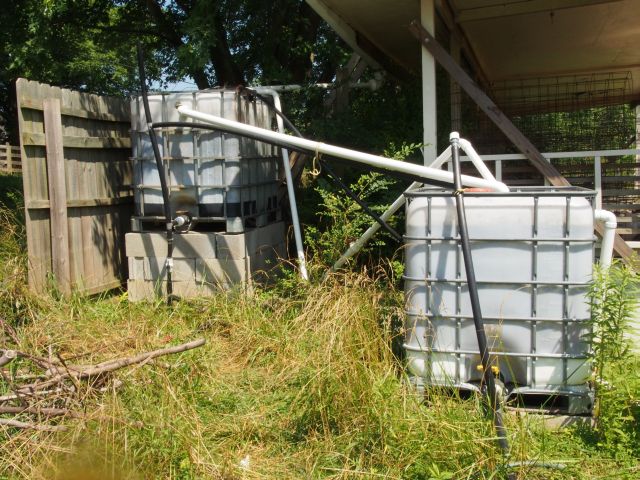
Here is a ‘photo of the 2 tanks:

2 gravity feed tanks with numerous valves and pipes

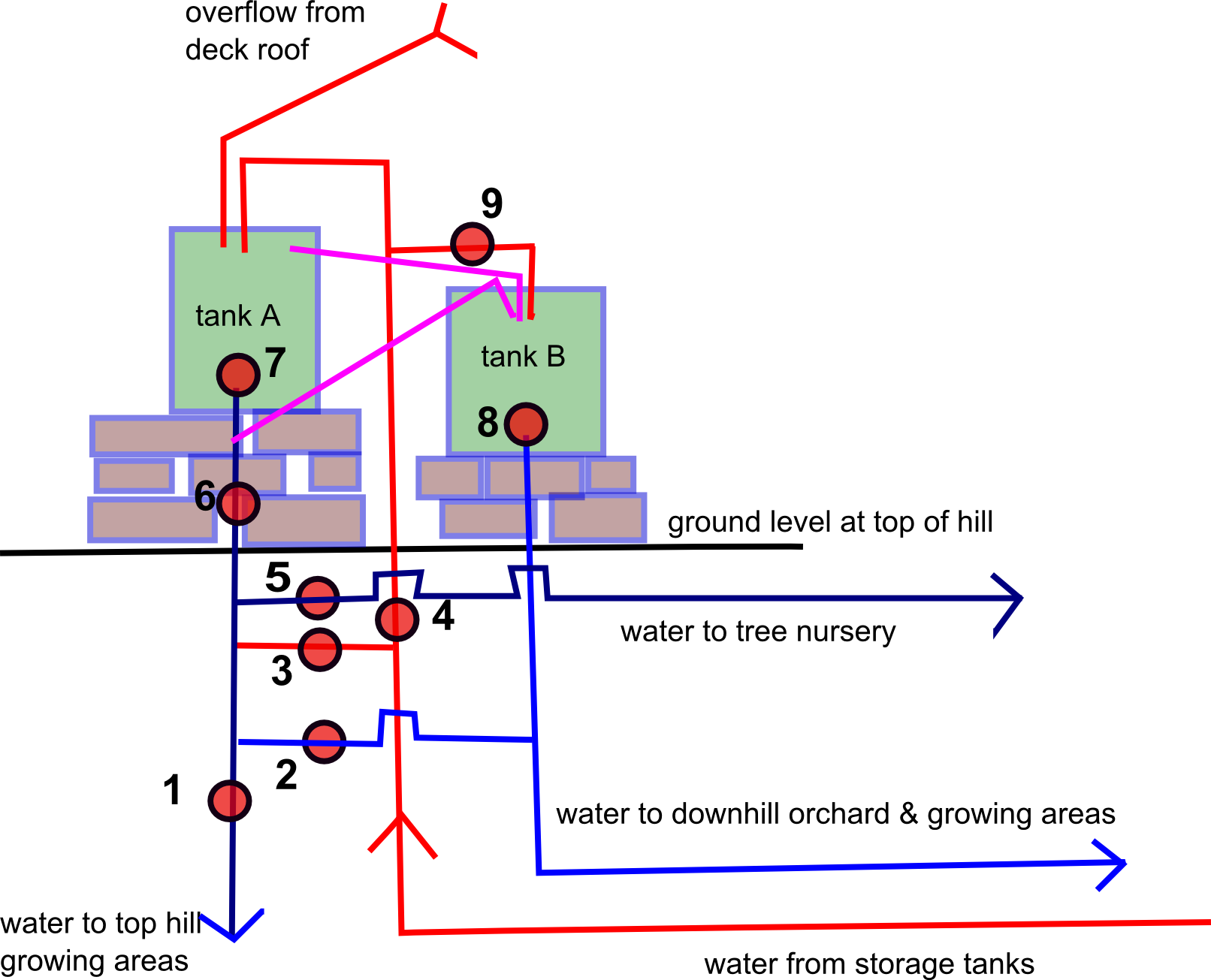
And here is a schematic of the pipe system:

tank valves

You can see the 9 numbered valves.  Here are some combinations:
Pumping to tank A – 3C, 4O, 9C (i.e. valve 2 closed, valve 4 open and valve 9 closed)
Pumping to tank B – 3C, 4O, 9O
Harvesting deck roof water – 7O, 6C, 8C (when A is full, water moves via 2 routes)
Water to tree nursery – 7O, 6O, 5O, 3C, 1C, 2C
Gravity feed to downhill from B – 😯
Gravity feed to downhill from A – 7O, 6O, 5C, 3C, 1C, 2O
Gravity feed to tophill – 7O, 6O, 5C, 3C, 2C, 1O
Pump feed to tophill – 4C, 3O, 5C, 6C, 2C, 1O

One of my best innovations is the last combination.  I previously gravity fed my blueberries at tophill with an in situ bubbler system but, because pressure was slight, the distribution was uneven and unreliable.  Now, with the last combination I can switch on the storage tank pump timer at the bottomhill and directly pump and distribute water via a hand held hose to the tophill plantings, which means thorough quick daily watering with daily inspection.

So now, in addition to my daily soduku exercises, I also challenge my mind with correctly setting the various valve combinations for the changing tasks.