I just read Heart of Dryness by James Workman about the plight of the Bushmen in the Kalahari desert when the Botswana government cut off their water supplies and how they adapted and how we can learn from them. I was interested in the book because I am originally from South Africa which abuts Botswana, and also here in Georgia we are engaged in legal water wars with neighboring states. Workman interlaces the story of the Bushmen with a narrative on the use and abuse of water worldwide and his view that water shortages will result in increased conflicts across the world as the world grows hotter. He does not believe dams are the solution in arid countries -dry heat and wind result in massive evaporation and build up of sediment reduces storage capacity. He suggests that artificial aquifer recharge where water is pumped and stored underground is more sensible, akin to the Bushmen burying their water in evaporation proof containers. Some of his findings are counter-intuitive, for example during holidays one Botswana school leaked nine times what it used while in session, due to pressure build up forcing water leaks through cracks. The 250 page book has 50 pages of notes/bibliography and appears well researched.
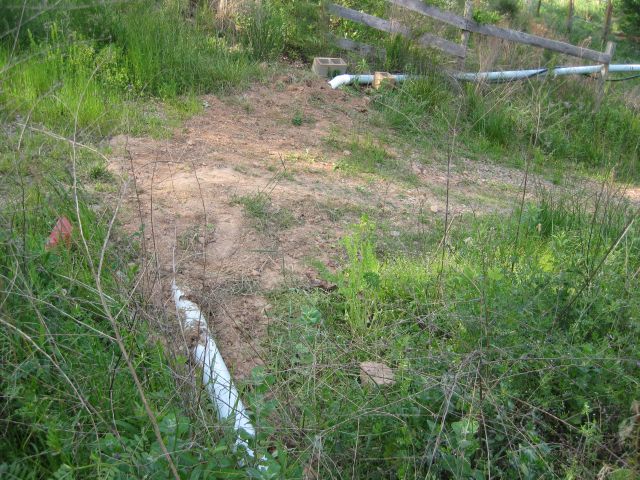
His reference to water wastage got me thinking of my own rainwater harvesting system and, since rain was in the forecast, I inspected and found several issues. Two gutter downpipes were blocked and no water would have been collected from them. Even more significant – the 4″ pipe which transfers water from my main collection point (the house roof) to my barn storage tanks, had again opened a leak where the 4″ corrugated pipe attaches to the 4″ pvc pipe.
The advantages of corrugated drainage pipe are that it is flexible so it will fit easily in a trench which isn’t straight or which has bends different from the available 90 deg, 45 deg or 22.5 deg fittings. And it is much cheaper, both the pipe itself and not needing expensive fittings for bends. Which is why I had used it for a section of the water run. Its disadvantages are that it does not make a tight fit when joined with pvc pipe and therefore can leak if there is a small shift in the moorings and, because it is corrugated, debris collects in it and causes blockages. Now I had to bite the bullet and replace the corrugated pipe with pvc pipe. I had used 4″ Sch 40 pvc pipe for the exposed overhead run – this is a thicker more expensive pipe. For the section I was replacing, which runs in a trench, I opted to save money (on the pipe and the fittings) and bought the considerably cheaper DWV pipe. DWV pipe (drain, waste and vent) is for non pressurized applications and because the pipe will be buried, fully supported by the ground and not sun exposed, this seemed a reasonable choice. It took some time digging a new trench (the old one was gradually curved and not usable) and aligning the pieces and fittings since the direction change was closer to 80 deg than an easier 90 deg. But now it is done and, with a dry season looming, I hope to be make every drop count.
My land slopes and since I rely entirely on rainwater for irrigation, I catch the rain however I can – in storage tanks or directly into the ground with contour ditches. Contour ditches are similar to swales – built on contour or dead level survey lines to intercept and hold water and to let it infiltrate the ground, therefore they are not compacted or sealed. While a ditch is narrow, a swale can be broader like a basin and, according to the permaculture bible by Bill Mollison, trees are essential to swales and must accompany swaling in arid areas.
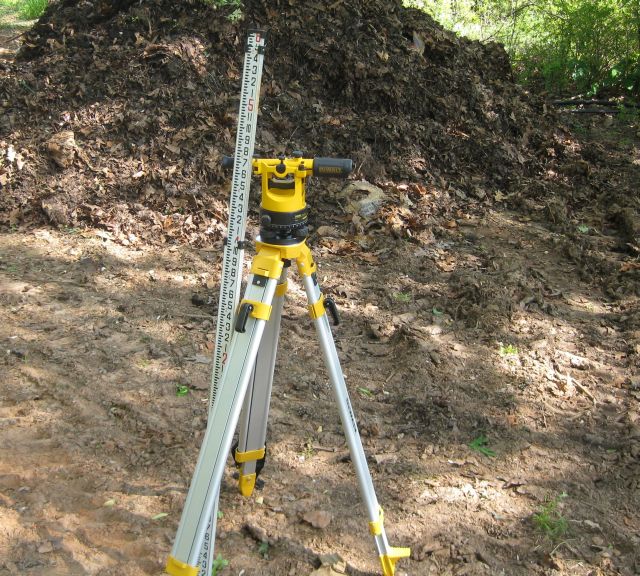
I start my contour ditches towards the top of the slope where there will be sufficient runoff (if the ditches were located at the bottom of the slope they could be overwhelmed by torrents of water). Once I decide approximately where the ditch will run I use my transit level and a helper (my rod man) to locate the middle and two ends of the ditch on a contour. I mark these three points with stakes. Usually, by this time, my helper’s patience is exhausted and I am on my own for the rest of the project.
transit level and measuring rod
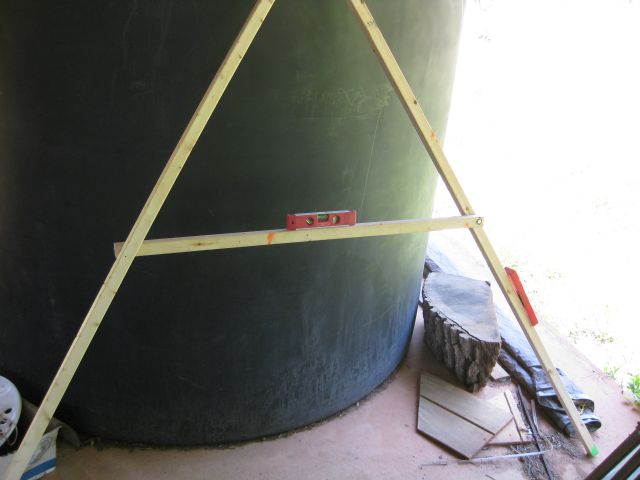
simple A frame with bubble levels (red) on horizontal and vertical legs
If the ditch is say 200 ft long, even with the three stakes in place, it can be difficult to figure how the ditch should run between the three stakes since the ground is uneven. So I use my A frame, which is simply three pieces of wood connected to form the letter “A”. The two sides of the A are 8ft long and the feet are about 8.5 ft wide. The horizontal piece is 4ft long and all the wood is 1.5″ (nominal) square, so it is not too heavy to carry about. A simple bubble level is attached to the horizontal and one of the vertical legs. I construct the A frame on a level surface and ensure that the horizontal piece (to which the bubble level is secured) is horizontal before bolting it in place.
I gather some rocks and a can of aerosol spray paint and with my A frame start from the stake which marks one end of the future contour ditch. One leg of the A frame is next to the first stake and I point the other leg in the direction of the next stake and move it along the ground until the bubble level tells me the A frame is horizontal and the second bubble tells me the frame is vertical. I place a spray painted stone to mark this spot and then swing the first leg around the second in the direction of the next stake until it too is horizontal and vertical. It is important to advance the legs alternately since this will counteract any inaccuracy in the A frame. I can tell how accurate I have been when my A frame eventually reaches the next stake – if the leg of the A frame is at the same level as the stake, all is well.
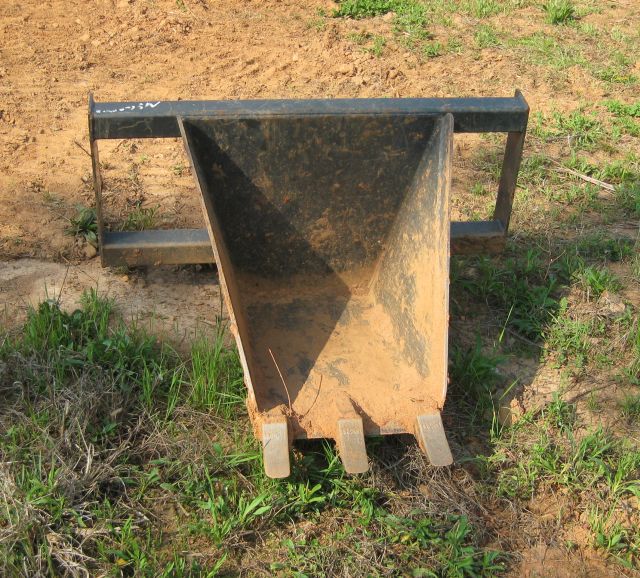
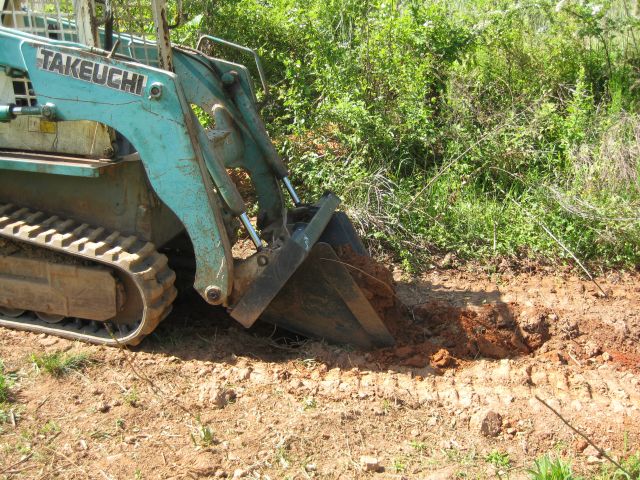
Having marked out the line of the contour ditch with the three stakes and painted stones, next step is to dig the ditch. I work mainly by myself – I will not engage paid workers and volunteers are scarce. So I have no qualms using my old machines, which I nurture along. My Takeuchi tracked loader (bobcat) has a stumper attachment, which is good for removing stumps and digging ditches. Digging the ditch becomes quite simple, I simply use the bobcat to carve out the ditch following the trail of spray painted stones and I save the removed soil in a heap for some future use.
I seed the ditch and sides with grass seed to stabilize the banks. And then I make my plantings on either side of the ditch. An earlier (shorter) contour ditch I dug for my muscadines (grape vines) has proven so effective at catching and holding water that supplementary watering will be minimal (the ditch is assisted by a diversion slot cut across an access road which directs water into the ditch). After planting up my new ditch with trees perhaps I will call it a “swale”.
All my irrigation is from harvested rainwater. I used to pump the water from the main storage tanks to an elevated tank near the growing area but since this tank was only a few feet off the ground and the water was moved by gravity, it trickled slowly from a hose. And so I gave up and installed water lines and bubblers and let the water do its own thing at its own pace. An unsatisfactory result, since I wouldn’t notice when individual bubblers clogged and, more importantly, I missed out on the pleasure of observing each day’s advance.
Last year I was able to purchase the adjoining property which sits on a hill. Now, with my gravity feed tanks on the top of the hill, the water rushes out the hose and hand watering the vegetables is quicker and enjoyable. And I look out for all the changes over the past 24 hours.
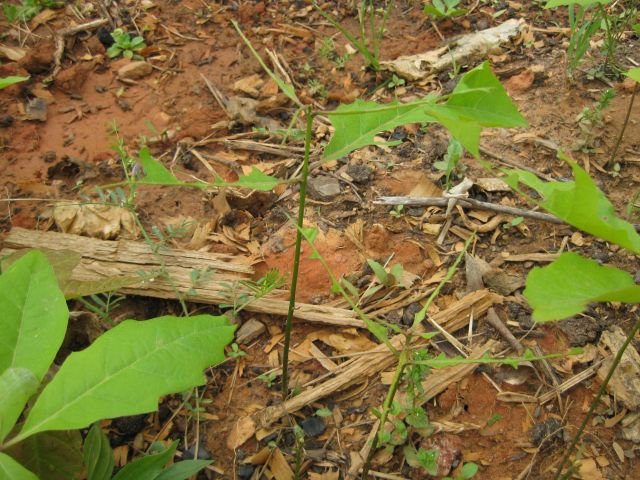
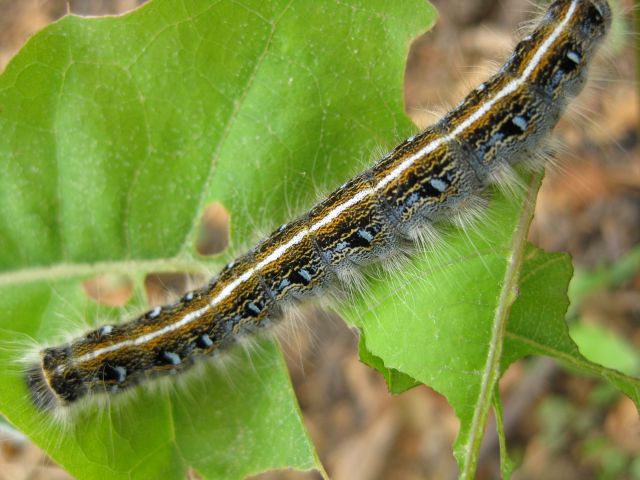
Last fall I planted acorns in a raised bed with the intention of transplanting the oak saplings in a year’s time (before their taproots grew too long). This morning some of the leaves were shredded and then I spotted the culprits.
shredded oak leaf - yesterday it was fine
the culprit, one of a gang of 5
I located and collected the 5 caterpillars, then googled whether chicken ate caterpillars and the answer seemed to be “no”. So I did them in.
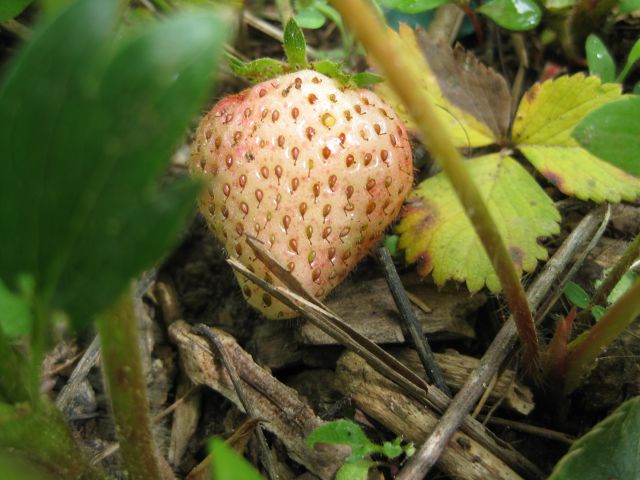
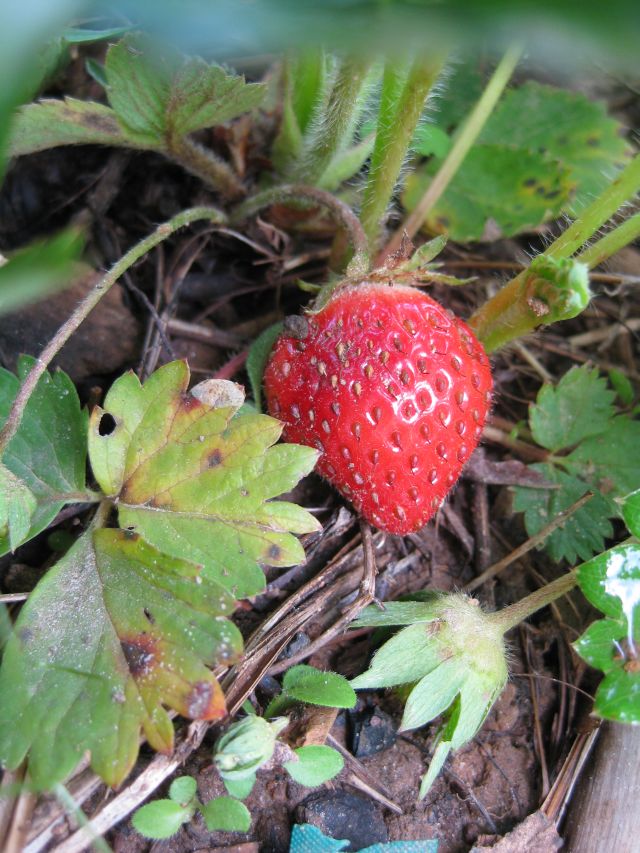
I have a bed of early season strawberries and noticed the berries are forming. Then I spotted one berry ripening quickly and another which will be ready for the eating this weekend. Unlike the supermarket offerings, my strawberries, if the last 3 years are anything to go by, will be deliciously sweet and plentiful.
strawberry beginning to ripen
strawberry almost ready for the eating
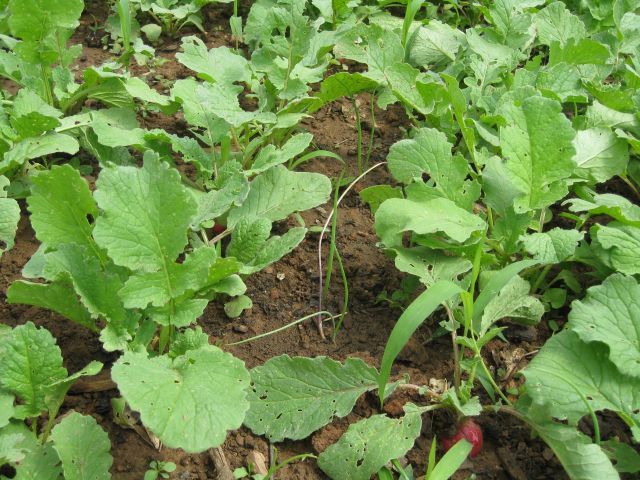
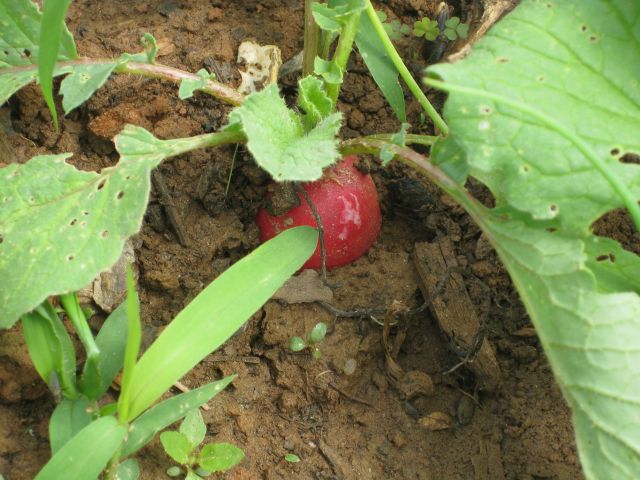
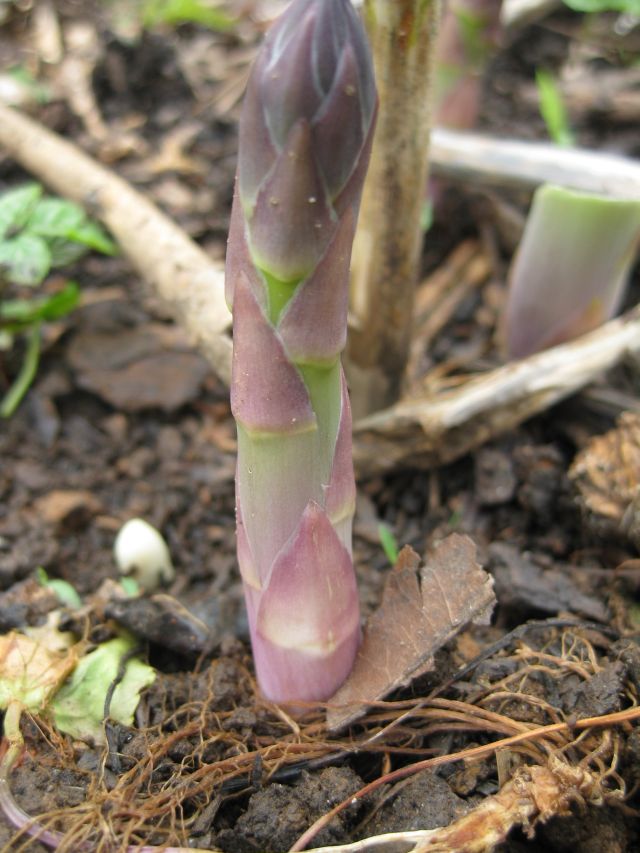
The radishes are ready for picking and the big treat each day, the asparagus, are turning up in greater numbers and have to be picked promptly before they get too tall.
radishes intersprinkled with onions
this radish soon ready for the plate
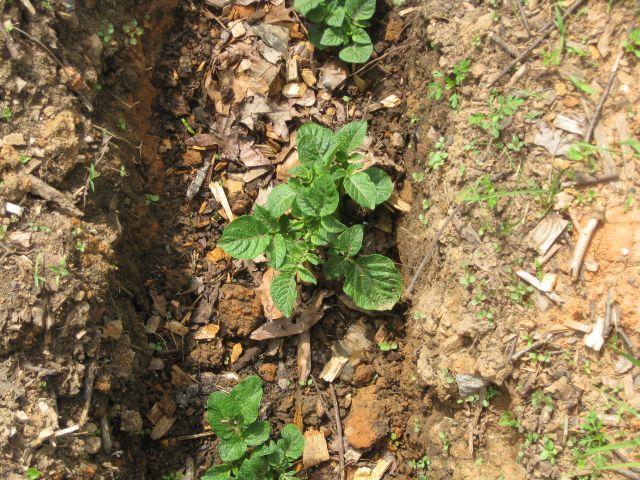
the potato plants in the trench must soon be mounded
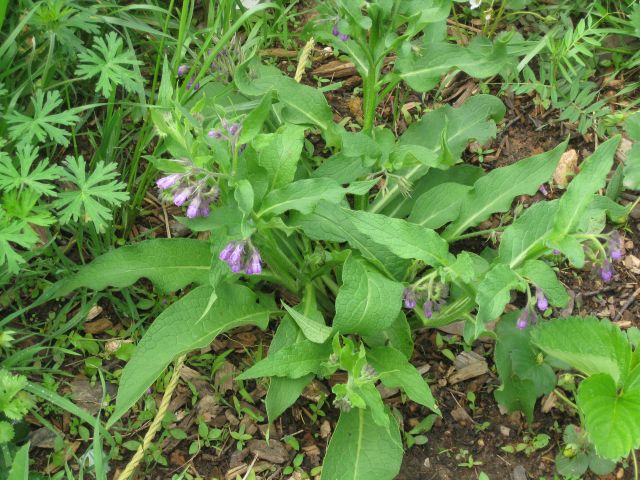
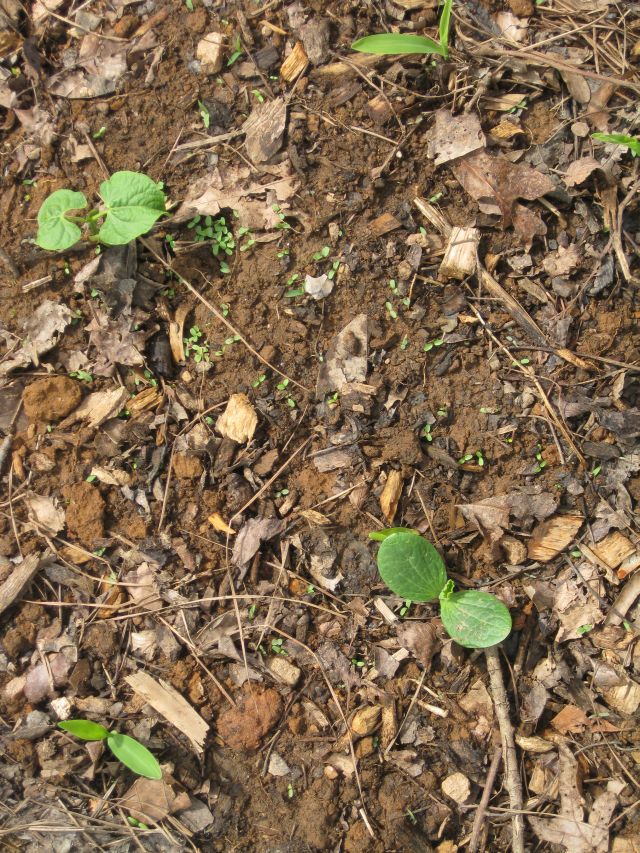
I am pleased to see the “three sisters” (corn, bean and squash) are emerging in places. I have never been successful with squash – always foiled by the squash borer which levels the plant at its peak – will it be different this year? Although considered an invasive the comfrey officinalis, which spreads by seed, is seductively attractive.
comfrey officinalis, which spreads by seed and can be invasive
The next couple of days I shall be at the Georgia Organics annual conference held this year in Columbus GA, south of Atlanta. This shall be my 5th year of attendance – my first few years I learned a lot and with each year there is less new information but I enjoy meeting other growers and learning from them. I was torn between doing a permaculture design course or the conference and have not ruled out a PDC for the future.
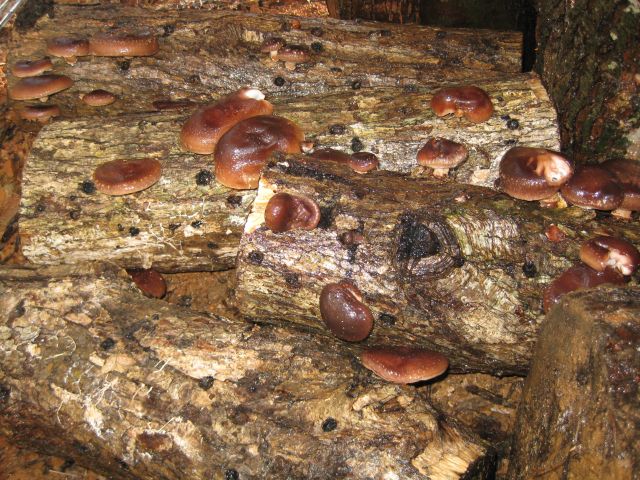
Shiitake mushrooms
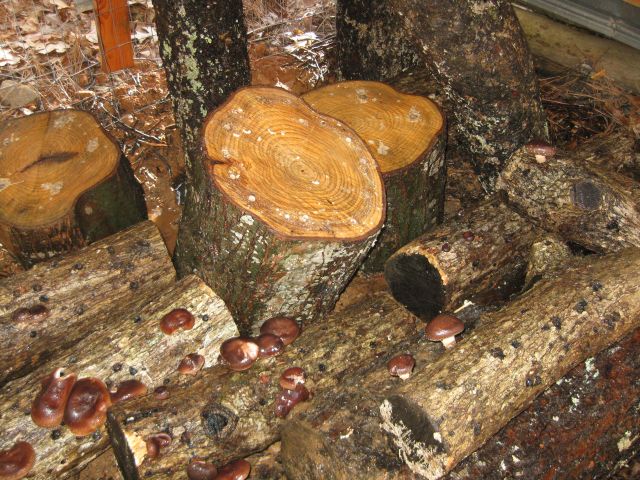
I picked about 15 mushrooms today. Just as well I enclosed the growing area since, as I approached the shelter, I startled several large white tail deer, which are not usually there and may have been attracted by the smell of the mushrooms. Notwithstanding my enclosure, someone small, perhaps a squirrel or smaller, did get in and savored a few chunks.
Shiitake mushrooms growing from 5 year logs
Today I also prepared another maple log with oyster mushroom spawn, this time grown on birch dowel plugs. You can notice, in the photo below, on the center maple log the holes on the face of the log where I inserted the plugs and then covered with melted wax. I also inserted plugs on the exterior trunk.
maple log with oyster mushroom dowel plugs
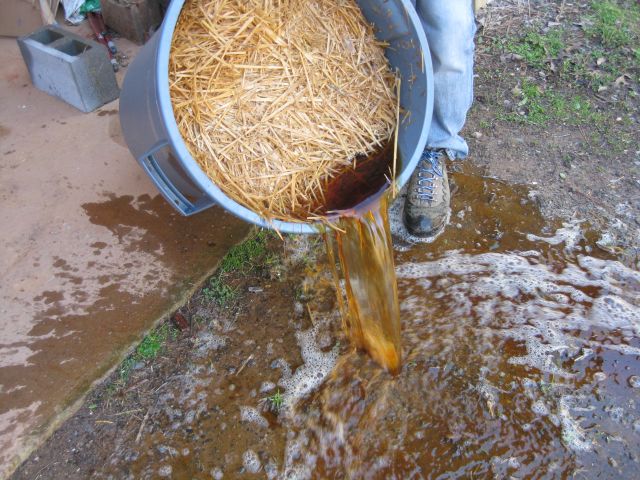
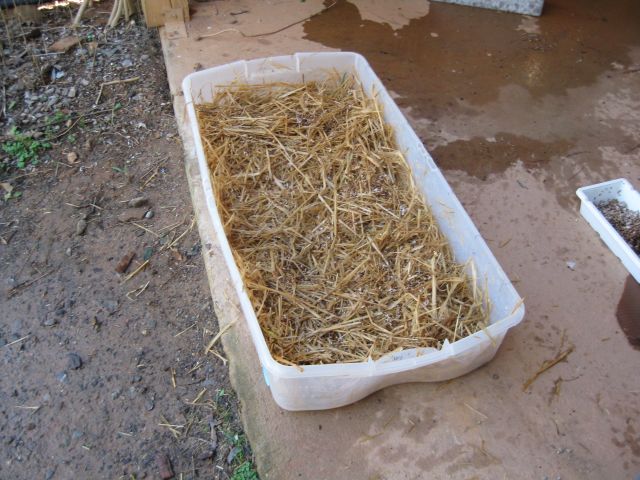
Another mushroom venture earlier this week was to soak straw for 5 days in a large trash bin weighted down with a cement block. I located an unused plastic container, placed a sheet of wet cardboard (corrugations exposed) on the bottom and built up layers of oyster grain spawn and the wet straw. I fitted the container with its lid and, since the contents were rather cold, I placed the container in a black trash bag and left it outside in the sun for a few hours to warm up. Once warm, I transferred the brew indoor to a warmish location and I will leave it (in the black bag with access to some air) for a while until I see results, which I hope will be masses of white mycelium and not green/black bacteria blobs.
straw substrate for mushroom bed
You can see below the container in which the grain spawn and straw was packed.
oyster mushroom growing bed
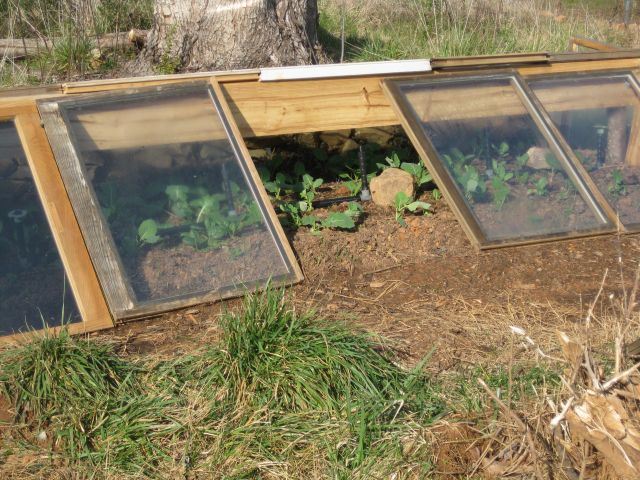
Cold frame
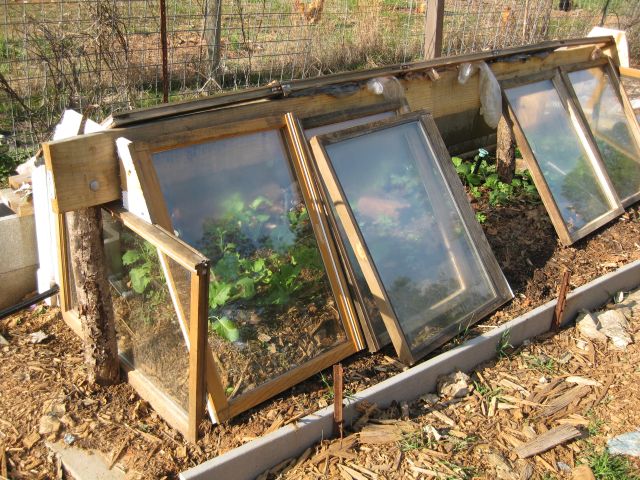
My two cold frames are performing as expected. My regret is that I did not start them at the beginning of winter. Had I done so I would have had larger pickings. On warm days I lift off one of the windows to prevent temperatures rising too high, as you can see in the photo below.
cold frame at top of hill with modest sized vegetables
Both cold frames have internal irrigation (gravity fed from my rainwater tanks) so watering them, which must be done every couple days, is an easy matter. When spring truly arrives I shall remove the windows and grow squash in the frames protected by row crop covers. My squash has always been nailed by squash borers and perhaps this year I will be successful.
cold frame at bottom of hill with window temporarily displaced until day's end
Muscadine transplants
It appears that 11 of the 12 muscadine grape vines I transplanted have survived. I know well why the one muscadine failed. It takes much effort to relocate a muscadine – their roots travel far and wide and, so long as I limited my efforts to two a day, all went well. It only takes about an hour to transplant a muscadine but when you are tired and impatient it is easy to tear off the roots. The one that failed was the third I did in a morning and I rushed it and now it stands there, bark eroding, moistureless, silent fingers pointed at me. I do not expect to get anything like the grape harvests of previous years when the muscadine roots happily invaded my composted vegetable beds and sucked nutrients wholesomely. There were so many grapes my bees abandoned pollen gathering to suck their sweetness (as well as all manner of wasps and beetles). I shall be satisfied with a limited offering and maybe more in future years as their roots go roaming.
6 muscadine vine tranplants, 3 on each side of the contour ditch
I think we take water for granted but should not. Friday’s Financial Times (Feb 17, 2012) reports that “Chinese officials have issued a stark warning over growing water shortages saying the situation is worsening every day and that more than two-thirds of cities are affected”.
Texas last year had the driest year on record, but the good news is that the drought may be receding and only 14% of the state is now in “exceptional drought” compared with 41% 3 months ago. In Georgia we continue with intrastate disputes between farmers in south Georgia concerned with metro Atlanta’s water consumption, and interstate disputes between Georgia, Alabama and Florida.
I try to meet the challenge by limiting irrigation to food producing vegetables, shrubs and trees and by capturing rainwater either in containers for later irrigation or directly into the ground (see the tab on “Rainwater harvesting”). My Atlanta running trail is on the banks of the Chattahoochee River, a major river in Georgia which is more than 400 miles long. After it has rained the river is swollen and fast moving and I think during my runs, of all the precious water rushing south and lost to our use. If we were smarter we would retain the rainwater in the earth or containers so we could use it later. If we were smarter we would also reduce our water use – do we have to plant lawns and plants, which require heavy irrigation in the summer? Other than food bearing plants, which we pressed into servitude and must be hydrated to produce to our expectations, why don’t we use plants acclimatized to our weather patterns. Once established with some tender care, and mulched, they should be left to fend for themselves, assisted by our snaring rainwater into the ground for their use.
I continue to be intrigued by a rainwater ditch which winds through the north facing slope of my woodland. Initially I thought it was a contour ditch and a lot of it is on contour. But as I have traced it along it now appears that it slowly winds to lower levels of the hill. I think the intention was to have it on contour (horizontal) but to ensure that when rainfall was heavy the water would not wash over the ditch and erode it, so instead the excess water escapes to lower levels where it follows the contour for a while and then moves to lower levels. The idea apparently was to hold as much water in the ground for as long as possible. I may have mentioned in a previous post that there is a spring at the bottom of the hill which I believe originated from the water captured by this long winding ditch. All this comes to mind from an intriguing book I am reading -“1491” by Charles Mann, which postulates that the inhabitants of the Americas before Columbus were a lot more sophisticated than we think. I know it is a far stretch of the imagination to assume that the water snaring ditch on my woodland was built by earlier peoples, but who knows? And there are terraces also in two of the smaller valleys – who built them?
I do know that I should put this speculation aside and get seriously active with my bobcat in the main watershed area in the woodland by creating contour ditches/swales to forestall the loss of rainwater. A project for me in the coming months.
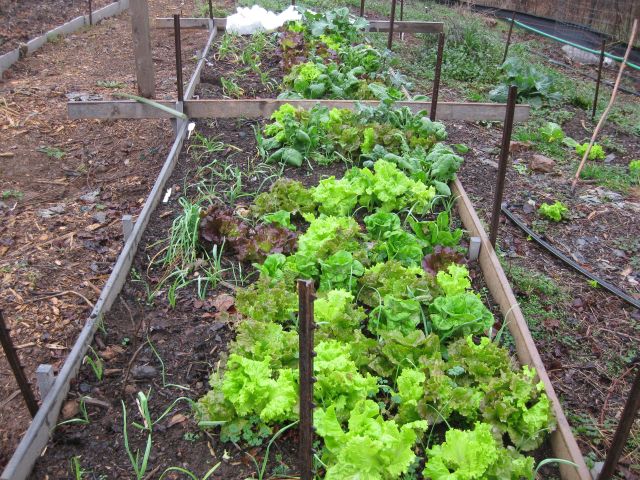
I know it is still early days and we may yet have blizzards and really low temperatures, but I am much encouraged with the growth of my greens (lettuce, spinach, kale, collards) and the protection provided by my row covers, so I have been growing more vegetables for transplanting in a few weeks. I googled winter hardy vegetables and bought Rapini Broccoli Raab seeds and Mache Corn Salad seeds – very reasonably priced and very quick delivery from Hirt’s Gardens. They germinated in my 3/4″ blocks quickly and are now in the greenhouse in 2″ soil blocks growing well and will be transplanted soon, together with my regulars – I really like kale and have several varieties going. Below is a snapshot of one of my raised beds – with temps>40 for next several days, I am trying one bed without covers and the other with, and will see if it makes any difference.
Dec 22 raised veg bed, garlic on left, greens on right
Composting
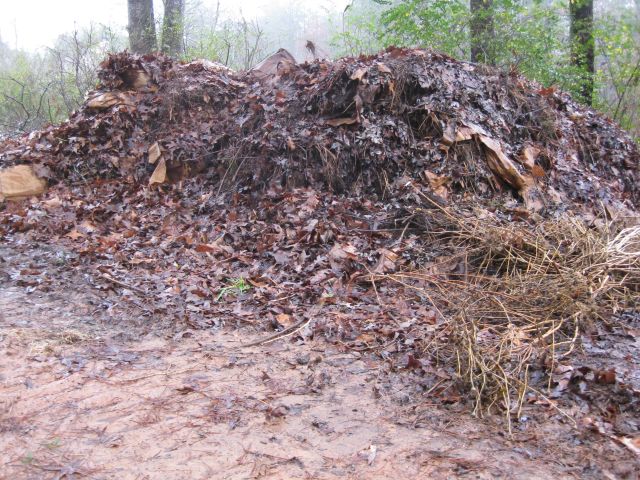
My new heap has more than 60 leaf bags. It is too much leaf and too little green. Every other day, when I clean out the coop, I toss the chickens’ contribution on the top and have also contributed some of the horse manure I picked up from the stables. I have a continuing reservation about the horse manure – don’t know what ‘cides were used to produce the hay or what chems the horses may have received – but I hope the composting process and all my soil workers will break down whatever is there that shouldn’t be. The heap is self standing and for turning it, my bobcat is invaluable. It is breaking down well, evidenced by wisps of steam and diminishing size.
Dec 22 - compost heap
Transplanted muscadines
I completed transplanting the muscadines. I have real concerns about the outcome. Their roots had extended everywhere and I doubt that I saved even 20% of the roots. I cut back the vines by 80% and placed the roots in trenches covered with compost (compost is my universal remedy) and spring will tell how well I succeeded. To stabilize the terrace from wintry rains I seeded with winter rye and it is growing nicely as can be seen below, together with the truncated muscadines.
new muscadine terrace with winter rye, contour ditch and lots of excavated stones
I intend to put the stones to use building stone walls – to be described in a later post.
New raised bed
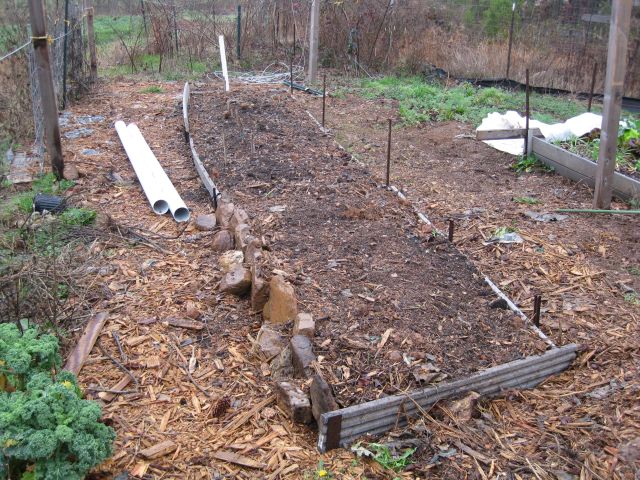
With the muscadines out of the way, I decided to make a third raised bed – this is 4 ft wide and 24 ft long and is awaiting residents. As an experiment I used a few of the stones as a north border for the bed, the idea being they will act as a heat sink – absorb the heat of the winter son and create a micro climate ( I noticed that my strawberry plants which abut the south side of one of the raised bed i.e. the raised bed side is to the north of it, have produced strawberries in the middle of December!). The two 4″wide 10 ft long pipes will be positioned in the middle and above the bed for the purpose of keeping the winter cover off the vegs.
Dec 22 - new raised veg bed, with heat sink rocks on north border
Apple tree restoration
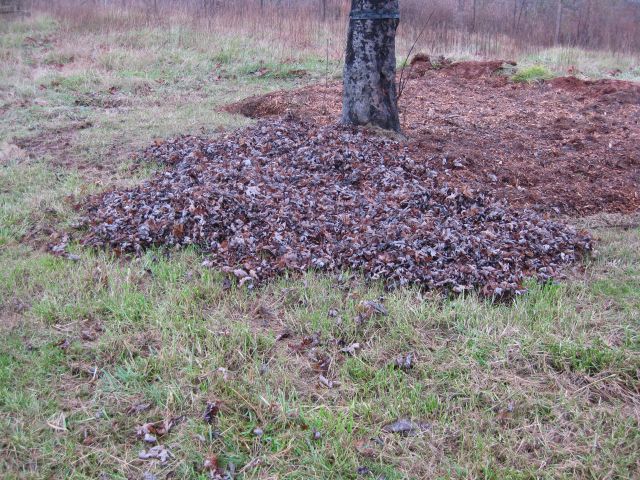
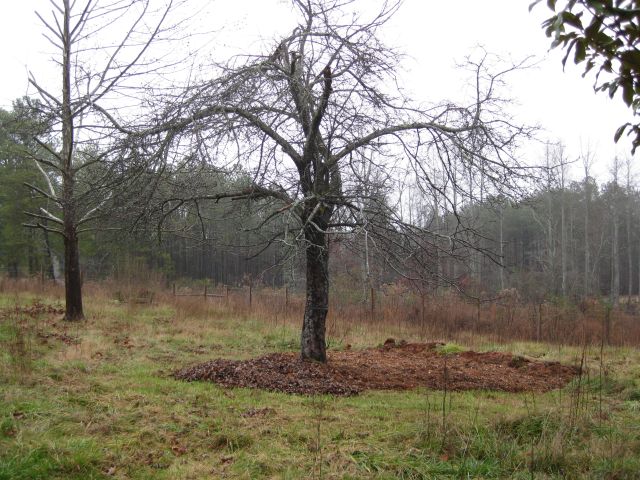
There is a large apple tree on the hill property I recently acquired which did poorly this past year. One reason, I surmised, is that its roots tapped into a septic system which has been decommissioned and therefore it was deprived of valuable nutrients on which it had become dependent. Or it could have been the weather, or it may only bear well every other year. It is surrounded by a vigorous tough grass which competes with its roots for food. I decided to get rid of the grass. Imagine a circle with the tree in the center. I mowed all the grass in the circle. Then for 50% of the circle I spread horse manure and then wads of newspapers and then covered the lot with a generous load of wood chips. For the other half I decided on a different approach. Adjacent trees shed lots of leaves and I gathered these leaves and spread them out on the grass. Next step will be to add the wood chips. My reasoning is the leaves will block the light on which grass depends to grow, more effectively than spread newspapers. And it is quicker to spread the leaves than the paper and the leaves, being more natural than paper will probably contribute better to the health life of the soil. I am hoping the wood chips will promote growth of fungi which is better for the trees than the grass bacteria.
mulching the apple tree, wood chips on newspaper at rear, leaves in front (in progress)
The apple tree itself does not look too impressive right now. The top half was sheared by a storm and I still have to do more pruning. Time will tell. By the way the sweet gum behind it fell victim to shearing by the local utility which has a right of way which extends to within a few feet of the trunk of the sweet gum. So the utility religiously protects its right of way with no favoritism extended. The one benefit is I received a truck load of wood chips.
Dec 22 - apple tree
Lots of pipes
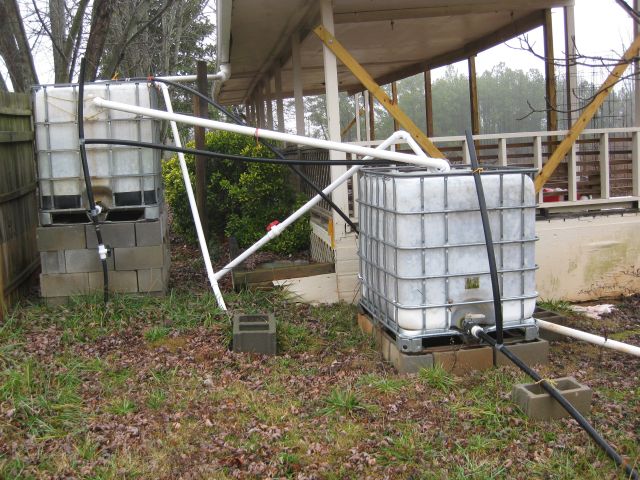
Finally a snapshot of my two gravity feed irrigation tanks. I just added the last and final pipe. Each of the pipes serves a purpose.
gravity feed irrigation tanks with related necessary pipes
The “Y” brings the rainwater from the storage tanks. If the red valve on the lower limb is open the water goes to the right tank, if closed to the left tank. The two vertical black pipes are to facilitate bleeding out air bubbles when the valves below them are opened and water runs to the crops. The left, raised tank, irrigates hill crops, the right tank the crops at the bottom of the hill. You can spot at the top of the left tank the horizontal white pipe bringing rainwater from the roof of the deck and the diagonal black pipe bringing water from a well (only as a last resort and only pumped 3 times this past year). There are two overflow pipes from the left tank – the lower overflow is if I want the left tank to be half filled before the lower tank is filled, the upper overflow is if I want the left tank to be completely filled before the lower tank is filled. Finally, the pipe I just added is the overflow from the lower tank – you can see it is directed to the right where the fig tree resides and whichas a berm to capture as much water as possible.
In a previous post I mentioned the repercussions experienced from locating my muscadine grape plantings too close to my vegetable beds. Just as the vines of the muscadine grow interminably so do their roots and the raised beds, tomato planting sites and other vegetable sites were mined by muscadine roots. I relocated half (6) of the muscadines earlier in November and have now prepared a site for relocating the remainder.
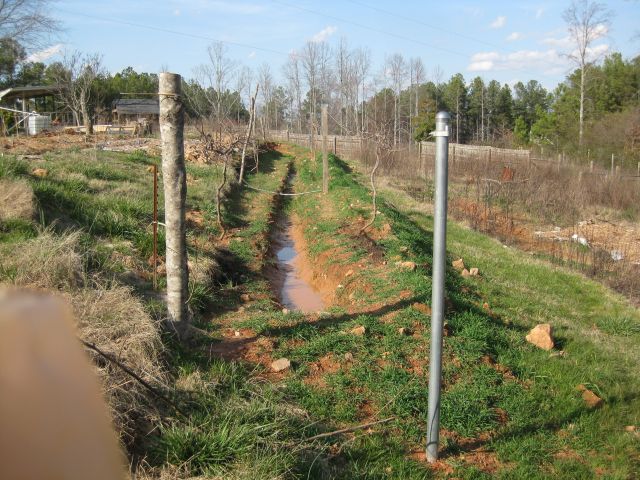
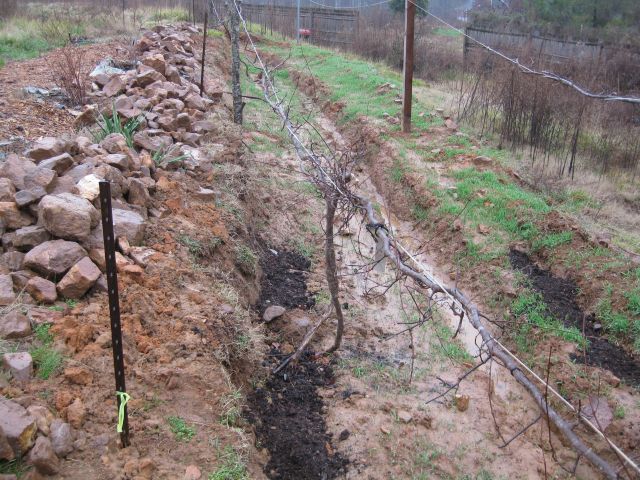
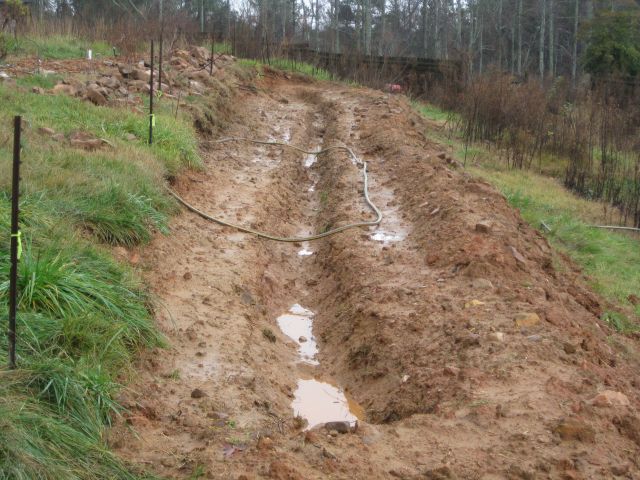
new terrace with contour ditch after recent rain
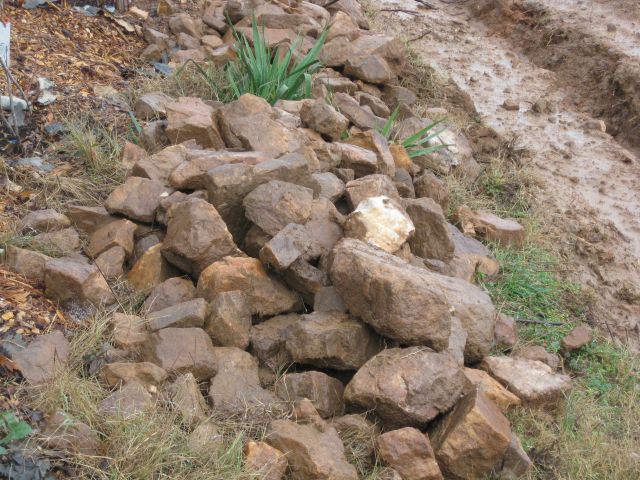
The site is on the slope of a small hill which has blueberries at the top and a fruit tree orchard lower down. I decided to carve out a terrace between the two, approximately 8 ft wide and 100 ft long, with my bobcat. Terracing the first 50 ft was uneventful and then I hit the rocks. It seemed the slope was made from rocks. With the teeth of the loader I jiggled the rocks loose and then manually lifted the rocks and stacked them above the terrace. Seemed interminable. Eventually a terrace appeared. But it sloped from the north end to the south end, which meant the intended contour ditch would be more drain than a container of rainwater.
I hammered in 6 – 4ft metal rods equidistant along the terrace and then with my transit level and surveyors tape tied to the rods, I identified the grade (you can see some of them in the above ‘photo). With my bobcat I then pretty much leveled the terrace, though there is still some dip from the north end to the south end.
Next step was to dig a trench/ditch down the middle. I replaced the loader on the bobcat with a trencher/stump remover attachment and after pulling out more rocks had a rough ditch. A lot more work with a shovel was required to make it presentable.
some of the rocks embedded in the slope which had to be removed
Now I had bare clay earth and the prospect of oncoming wintry rains and erosion. I discussed with the owner of the local farm supply store whether I could still seed with clover. He suggested winter rye grain was a better bet for a cover crop. So I sowed the rye and hope it will germinate.
With the terrace now done, next tasks will be chain sawing some anchor posts for the cables for the muscadine grapes. There is a toppled maple tree which I may use – though toppled, it is off the ground and its wood hasn’t rotted. Also a poplar which needs to come out since it blocks my tractor when I go chipping in the woods. Oak would be a better bet for longevity but I cannot justify (yet) cutting down a good oak for fence posts.
I had a lot (for me) of visits to my site yesterday but not many comments – if you visit and would like to add or question, please do. I think a number of visitors were interested in rainwater harvesting and this is one of my passions.
I read a review in the FT (Financial Times) for Wednesday August 31 titled “Water is the new weapon in Beijing’s armoury”. Apparently China is the source of cross-border river flows to the largest number of countries in the world, including Russia and India, and is rapidly building mega-dams to control this water. The Amazon description of this new book by Brahma Chellaney says: “The battles of yesterday were fought over land. Those of today are over energy. But the battles of tomorrow may be over water.”
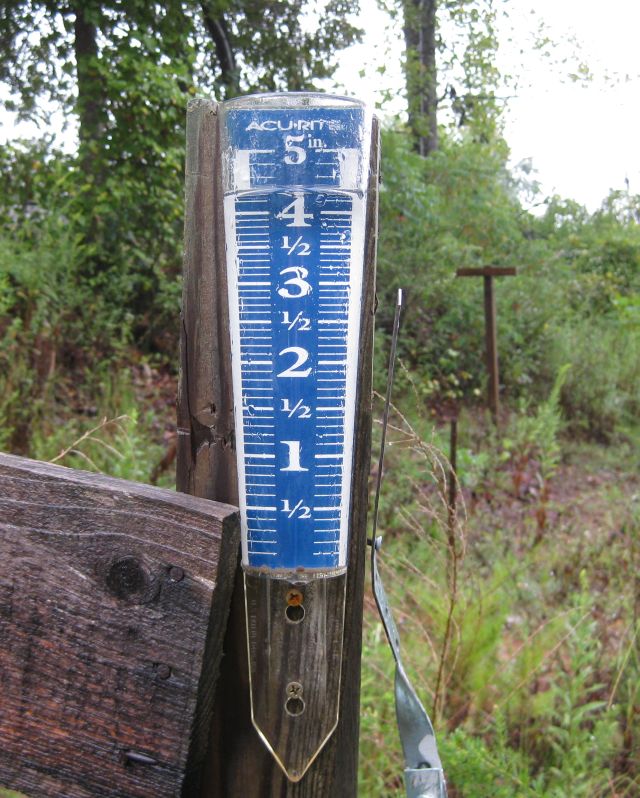
Our local paper (the AJC) reports this morning that most of Georgia south of the mountains is now in “extreme drought”. This may change, and hopefully it will change for Texas too (otherwise our food prices will continue to escalate) but who can tell the future. So I conserve whenever I can.
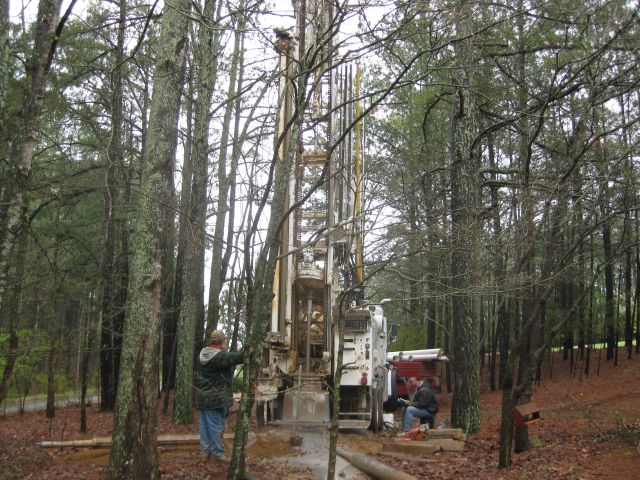
All the houses around my property use well water. The precariousness of this supply was brought home to me in 2009 when my next door neighbor’s well ran dry. They told me their well was 600 ft deep so all the more surprising it should fail and all the more concern for me since my well is less than 600 ft. I took some ‘photos of the equipment for drilling their new well.
Their new well was drilled a couple of hundred feet distance from their old well. The new well was also 600 ft which, at a cost of $10 for each foot, came to $6,000. There was insufficient water at the bottom so plus $3,000 was incurred to hydraulic fracture the bottom of the well, then an additional plus $3,000 for the pump, wiring and piping.
Interestingly, the drillers used rolls of poly pipe. Another driller told me that if the well is more than 300ft you have to use rigid 20ft pipe lengths (threaded pvc drop pipe) since the poly pipe stretches each time it is removed. It costs much more to replace a well pump if you have rigid pvc pipes since each has to be lifted out of the well and uncoupled, whilst with poly pipe you thread the pipe over a pulley, attach it to a pickup and drive down the road a couple of hundred yards and the pipe, cable and pump are quickly pulled to the surface.
I digress, the point is that the new well cost my neighbors in excess of $11,000. For this reason as well, I use my well water sparingly and try squeeze every drop I can out of my rainwater harvesting system.
With rainwater harvesting whatever can go wrong does. After fall I cleared my gutter of leaf debris and left it at that. Silly me! I didn’t consider that the 2″ pipe from the downspout outlet to the storage tank might be clogged with leaves. It was only when rainwater collection by the one tank was less than expected and when, during a downfall, I saw rainwater cascading over the gutter, that I figured I had a problem.
Clearing the blockage was not too difficult. I removed what I could by hand and then expelled the rest with water pressure from the hose. I decided in future to use a mesh screen in the outlet to catch leaves before they enter the pipe. However, I also needed a simple means for identifying and preventing the recurrence of future blockages.
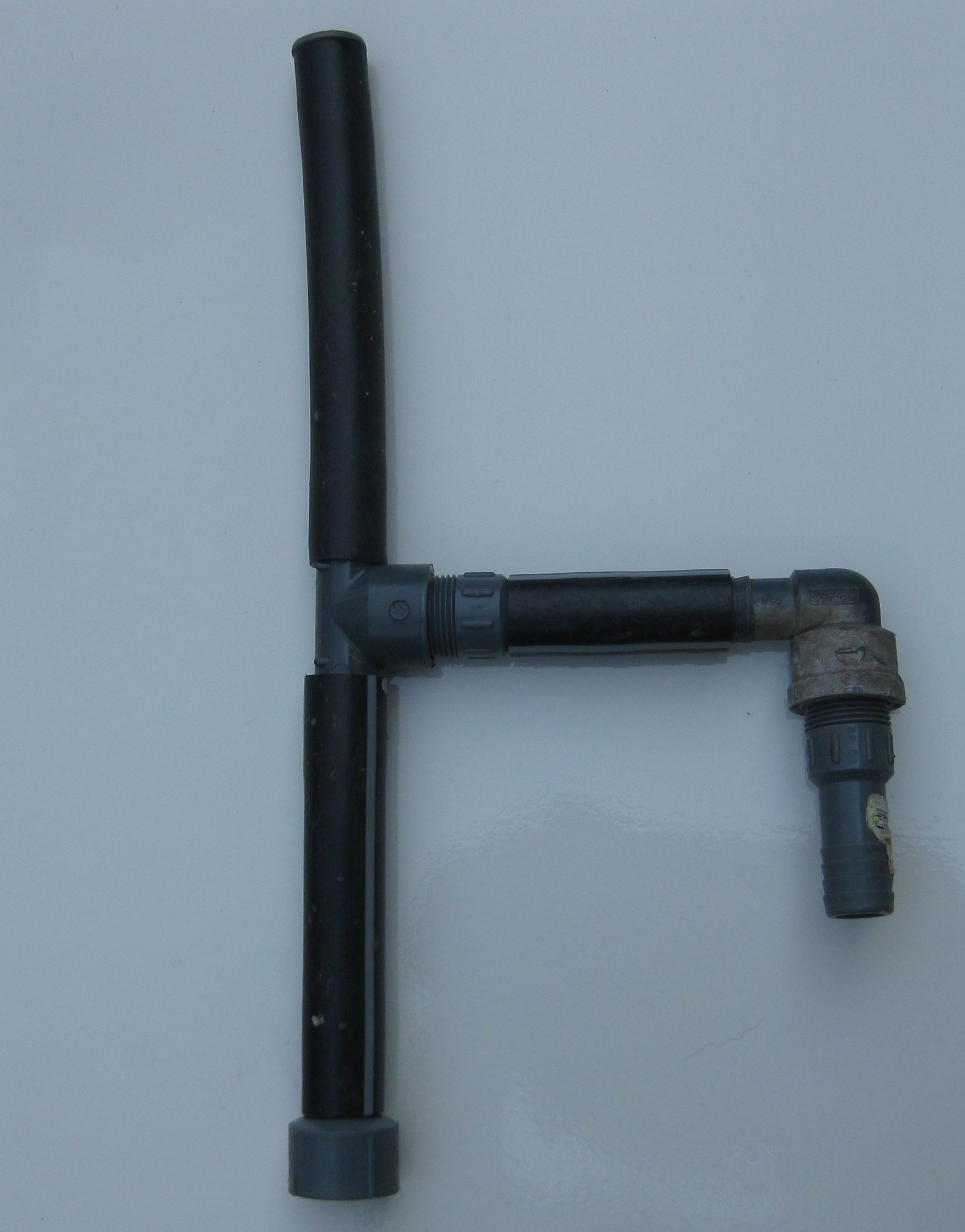
Rather than spray water from the hose onto the roof and let it dribble into the gutter I cobbled together a simple fixture which is attached to a hose and, with the aid of a long stick (or broom), hoisted in place over the gutter. The hose is switched on and water enters the gutter, the downspout and then (audibly) the tank. The bottom left link (in the picture) is attached to the hose. The top left link is sealed and its purpose is probably redundant. Water enters from the bottom left, veers right at the tee and then down at the elbow into the gutter.
How a drip of rainwater produces a flood
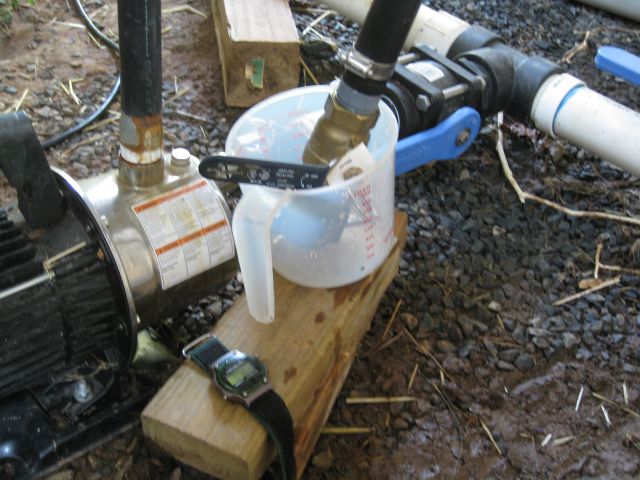
The other problem I encountered with my rainwater harvesting was unexpected rainwater loss. During my 7 day vacation to the West Coast there was 0.5″ of rain. I expected all my catchment tanks to rise. However, the carport tank level did not go up, in fact it fell. I did not give this too much thought until I noticed how wet the gravel was around the lower level storage tanks and I then noticed that a connector at the lower level was copiously leaking rainwater from the higher level carport tank. I measured the rainwater loss and it was 250ml in 1 minute (metric is so much easier to use). Which equates to 1 litre in a 4 minutes and therefore 15 litres in an hour. I was gone 7 days which is 168 hours (7×24) which is 2,520 litres (168×15) which is 665 gallons (2,520x.264). So in 1 week I lost approximately 670 gallons of rainwater.
The carport has a length of 27 ft and a width of 24 ft. So the capture/catchment area is 648 sq. ft (27×24). There are 7.48 gallons of water per cubic ft. The recent 0.5″ of rainfall on the carport produced 27 cubic ft of rainwater (648 sq ft x 0.5″/12) which equates to 202 gallons (27 cu ft x 7.48 gal/cubic ft). When I left on vacation I had approximately 500 gals and with the rainfall there should have been say 700 gals and when I returned there was barely any water because I had lost almost 700 gals from leakage.
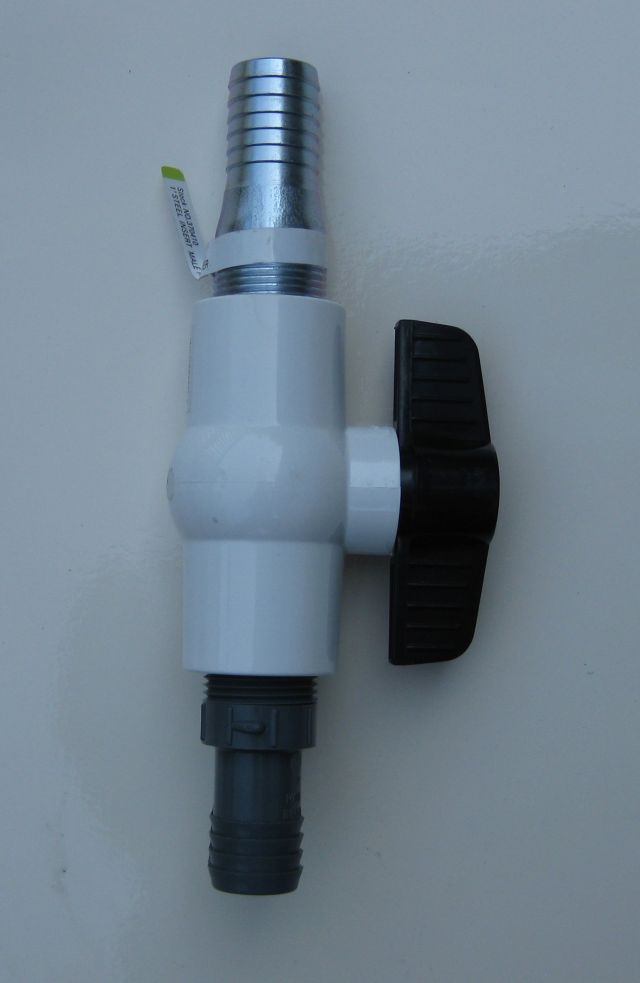
measuring water loss with graduated beaker + stopwatchnew valve components before ptfe tape assembly
My solution was two fold: 1) tighten the clamp at the fitting; 2) since the fitting was at the bottom of the hill where water pressure is greatest, I inserted a second valve at the top of the hill where psi is less and therefore there is less pressure to force a leak. For the second valve I used a steel insert into the high pressure end rather than a plastic insert since steel inserts are longer and provide a tighter fit. Hopefully this ends my rainwater losses and my rainwater harvesting will be more efficient.