replacing IBC tote valve

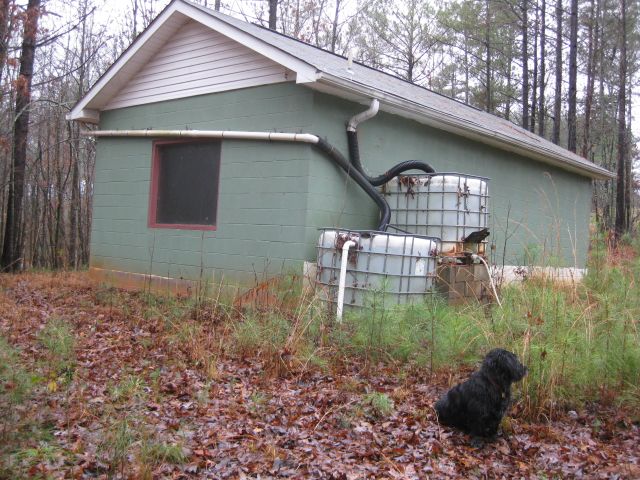
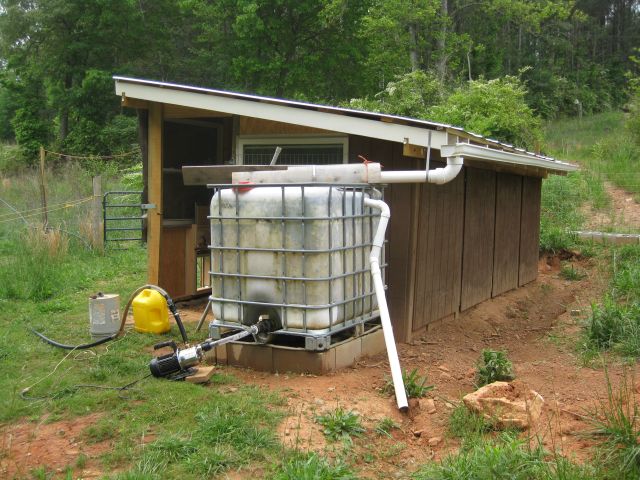
My rainwater harvesting system includes 5 IBC (intermediate bulk container) totes, each with a 1,000 litre (280 gal) capacity.  It was inevitable that the valve at the bottom of one would misfunction – in this case a crack developed at the handle shaft housing and water came out steadily.

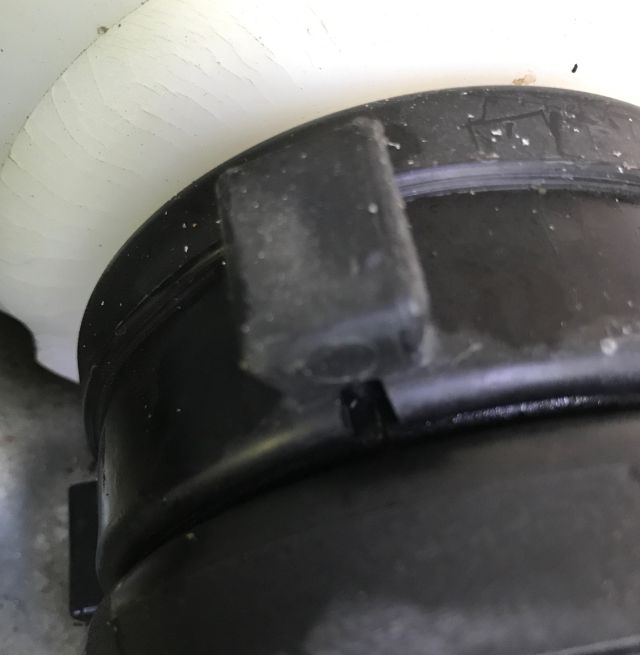
This meant I had to study up on how to replace a tote valve.  The valve is removed by turning anti clockwise the ridges on the metal coupler shown below.
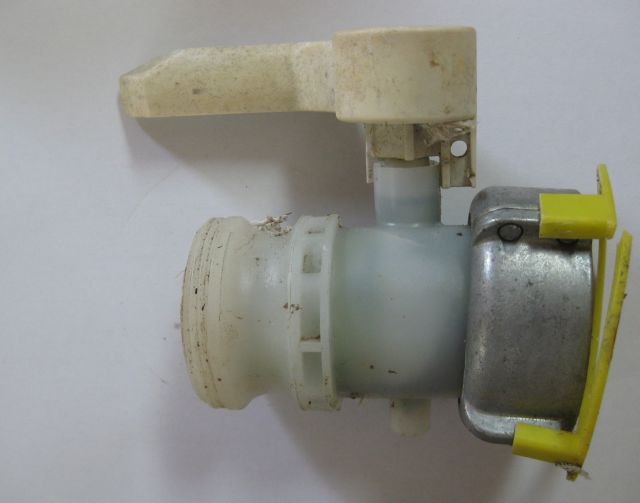
the female thread on the right fits into the tank

There are ibc valve spanner wrenches offered at around $80 which seems steep for a simple tool.  Instead I requisitioned my basin wrench tool which was able to undo the defective valve.
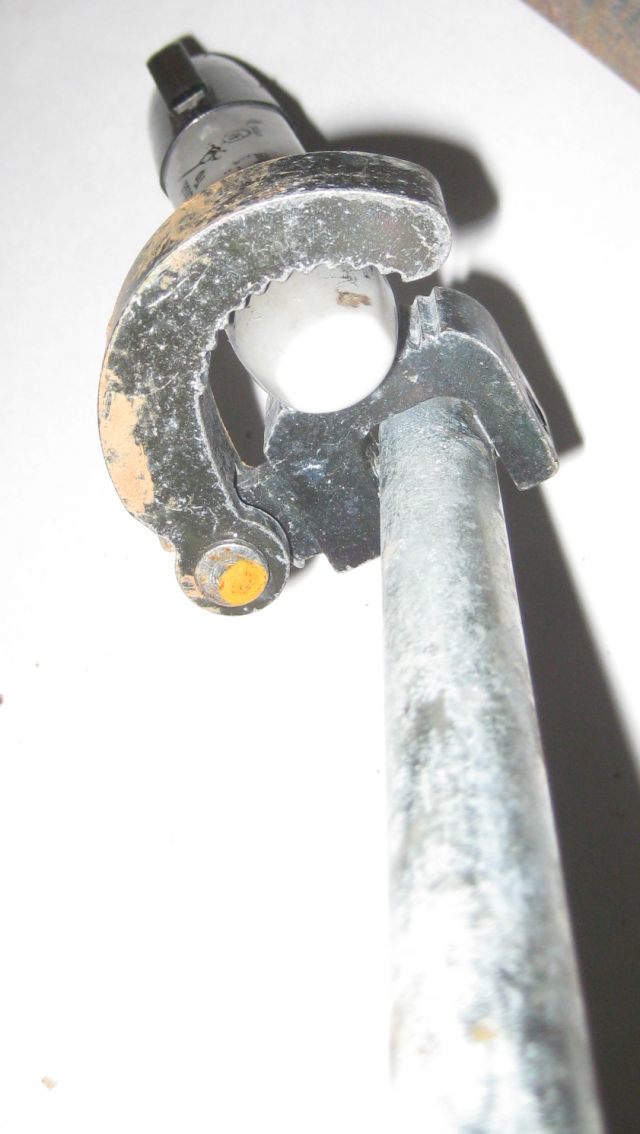
 

my basin wrench tool on display gripping a marker

When the valve is removed you clearly see the male thread of the tank.
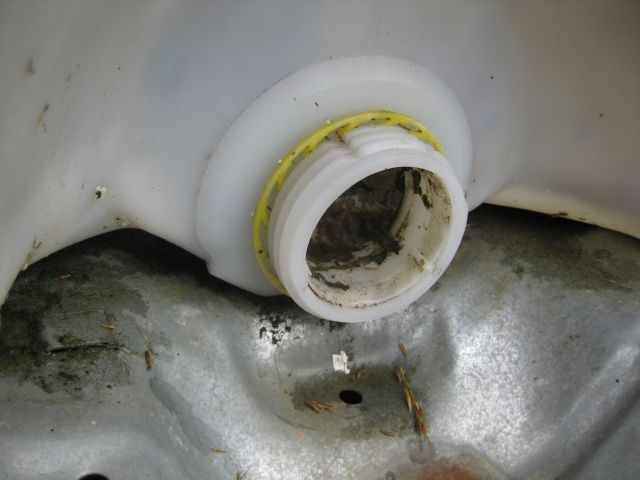
male thread of tote - this is called a buttress thread
male thread of tote – this is called a buttress thread

The thread is called a buttress thread which means the thread has one side that is vertical, the other side is inclined and a flat top and bottom.  The water exits the tank through the male thread above.  There were various female buttress threads on internet offer such as S60x6 and S75x6.  Which was the right one for me?  The “60” or “75” refers to the outside diameter in mm of the male thread or, equivalently, the inside diameter of the female thread.  The inside diameter of my defective valve is 75mm.  The “6” refers to the pitch or distance between threads – since the products on offer had the same pitch I didn’t worry about this.

I ordered the new valve through Amazon since a) I know if a problem Amazon will fix it; and b) although the product cost the same on the suppliers website the Amazon delivery charge was less.

The part arrived in 2 days (impressive) but it did not fit – the female thread was too large.  Had I messed up?  I checked and rechecked my measurements and it appeared that the valve I received was an “80” dimension rather than the “75” I had ordered.  What was frustrating was there were no markings on the valve body to identify what size it was.  With the Amazon trump card up my sleeve I called the supplier whose sales rep initially gave me a hard time but when I said that I would simply file a complaint with Amazon there was a sea change and he assured me the replacement part would be shipped that day.  When it didn’t arrive 4 days later (Tuesday) I called again and he, being adroit, thanked me for calling and said he didn’t know how to contact me (duh!) so my call was welcome and they were going to ship that day and I would receive it that Friday plus they would let me keep the wrong part for no change.  I called the following Monday and he said it would arrive that day and IT DID.  And it fitted!
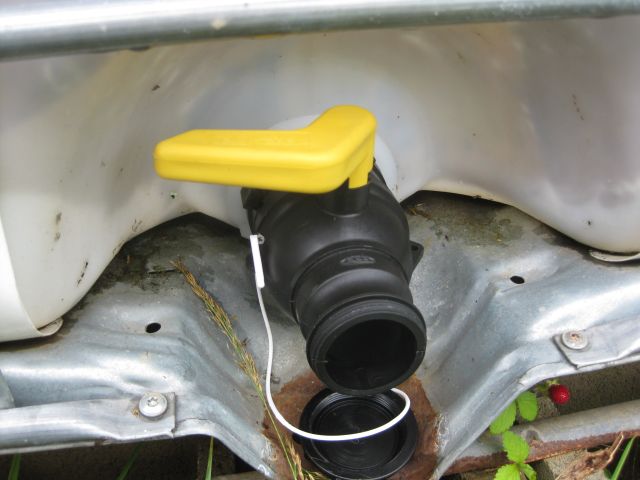
new tote valve installed

So the Amazon viaduct was helpful, I was not seriously inconvenienced by the delay and I have an extra wrong sized valve which I may be able to cannibalize when the next valve fails.

Follow up

I received 2 comments – 1 below and 1 which I managed to lose, sorry, – questioning whether the basin wrench shown in the photo above could actually grasp the ridges or lugs of the valve.  So I decided to go back to the tank with my basin wrench and take photos of it accomplishing this task.  And I made a discovery – it does grasp the ridges of the valve shown in the first picture but not the ridges of a more recent valve.

Below is a pic of the basin wrench gripping (just) the ridges of the valve with sufficient force to turn it.
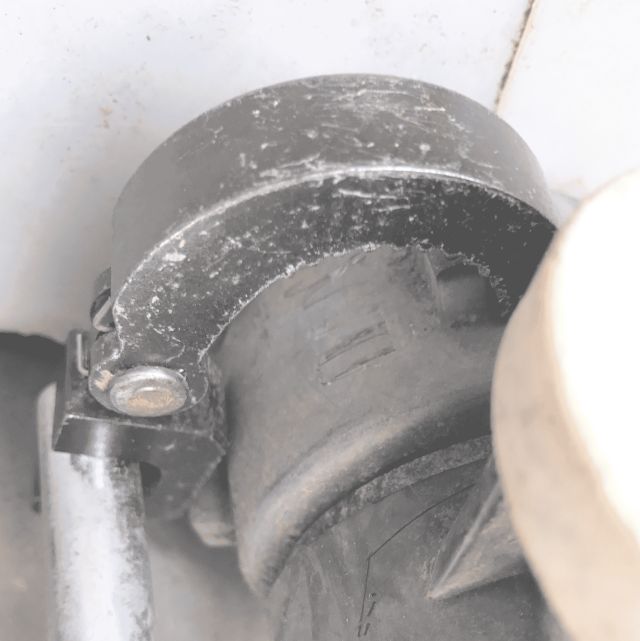
fully extended basin wrench can grip both ridges

The reason why it works on some valves but not others has to do with the width of the ridge.  If you think of 2 ridges, one on the left and one on the right, the wrench has to extend from the left side of the left ridge to the right side of the right ridge.  So, if the ridges are equally spaced on the circumference of the valve, the wrench has to cover a lesser distance with narrow ridges (which it can) than with wider ridges (which mine cannot).  Below are pics of a narrow ridge and a wide ridge.
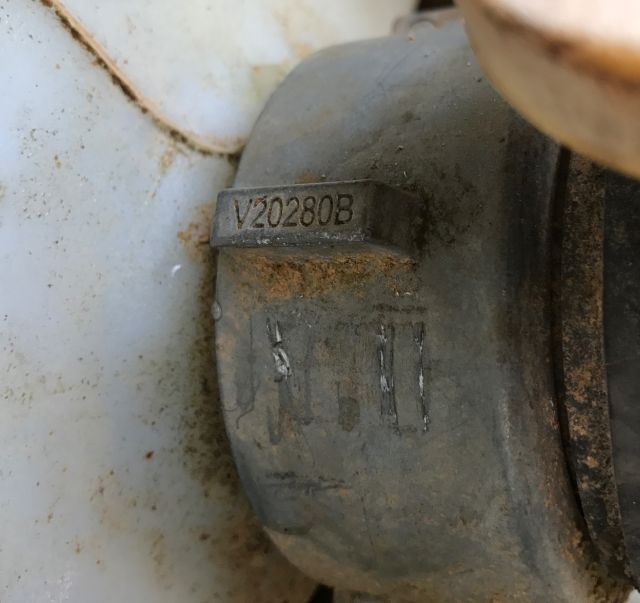
this is a narrow ridge and my wrench is wide enough to grasp 2 narrow ridges
and this is a wide ridge and my wrench cannot simultaneously grasp 2 such ridges


water pump repair

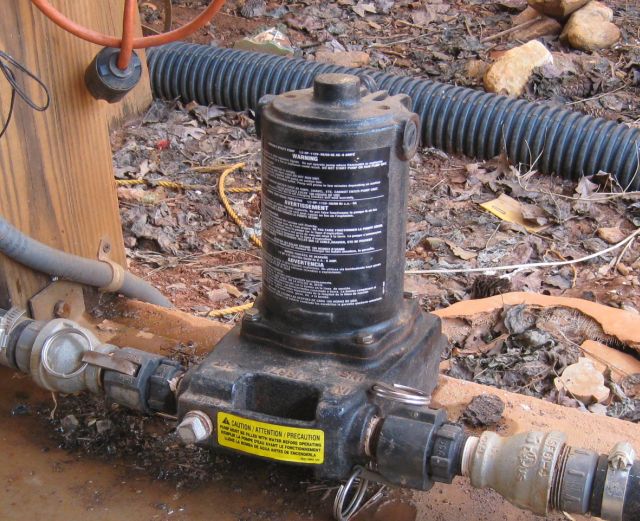
I use two water pumps – a 1HP Water Ace (cost circa $150) with handy carrying handle which I move to various rainwater collection tanks and then pump to the larger storage tanks (2,800 gallons) and thence to the top of the hill; and a Wayne PC4 0.5HP pump (cost $130) whose sole purpose is to pump from my 2,400 gallon carport tank to the top of the hill.  At the top of the hill I have tanks which gravity feed the rainwater to the plantings.  The Wayne worked fine until a couple years ago when I forgot to disconnect it in winter and the internal membrane (called the backhead) was shattered by ice.  I did a cursory examination for parts on the internet, couldn’t find any, and replaced it.  This past January, can you believe it, I again neglected to remove all the water from the pump (it was disconnected from the tanks but had water in it) and the backhead of the second pump also shattered.  I googled and found on eBay a backhead replacement kit for $15 plus $3 for shipping.  It made sense to self repair since if the repair worked I could also repair the previously damaged pump (I keep everything).
my Wayne workhorse - never let me down until I let it down
my Wayne workhorse – never let me down until I let it down

It is easy to dismantle, just remove 4 screws at the base of the motor housing which secures it to the pump housing, and the ice damage is easy to see.

the broken backhead can be clearly seen

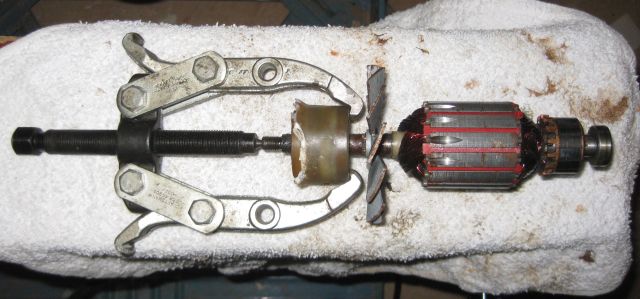
First time round it is always difficult – how do I remove the backhead.  Fortunately the manual is easily accessible on the internet and it suggested smashing the ceramic seal with a hammer driven screwdriver.  I tried this at first but the concept did not appeal.  So I found a puller I used for automotive work.

with the right tools everything becomes much easier and less dangerous

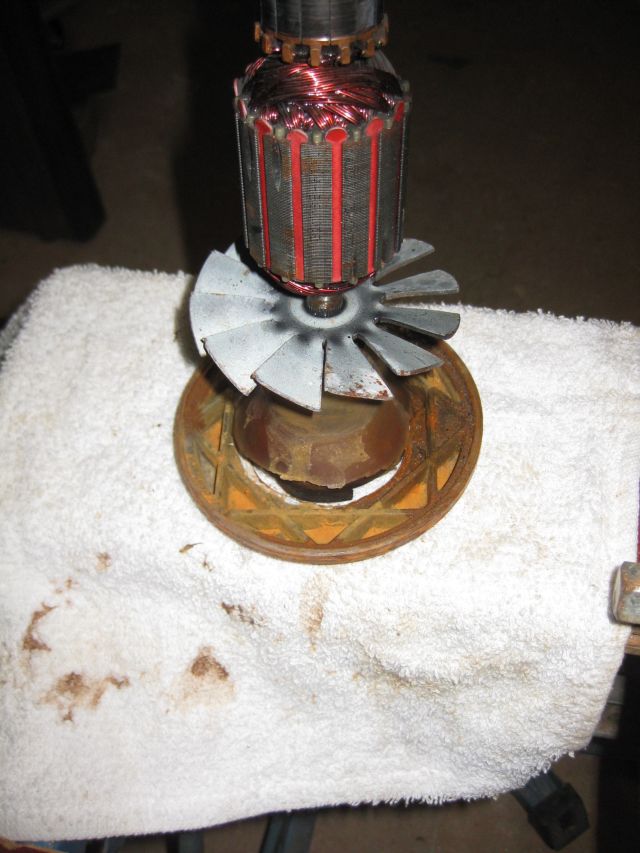
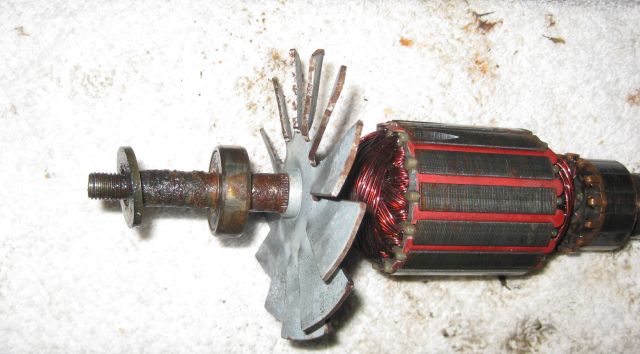
And with a few turns of the wrench the backhead was off, leaving behind the bearing to which it had been press fitted.

after removing the backhead the bearing and a water seal remain

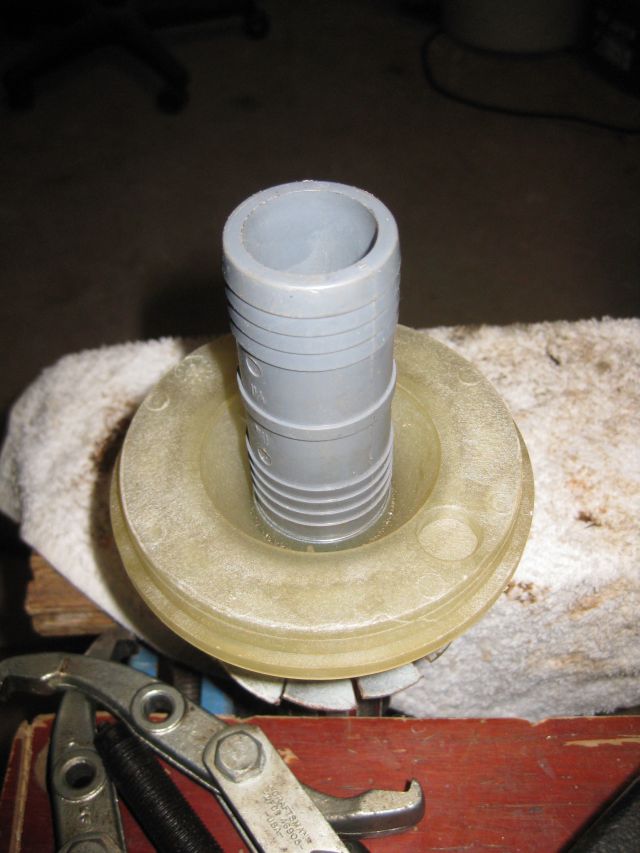
From here it was relatively simple to re-assemble the motor following the manual’s instructions and taking care, as I press fit parts together, to tap gently with a hammer and use improvised tactics, like this water pipe connector to ensure pressure is applied evenly to the part being fitted.

a plastic water pipe connector with ideal dimensions is used with gentle hammer taps to press fit a part

When all was assembled I decided to test the repair, and it works perfectly.


some winter tasks

charging the Takeuchi

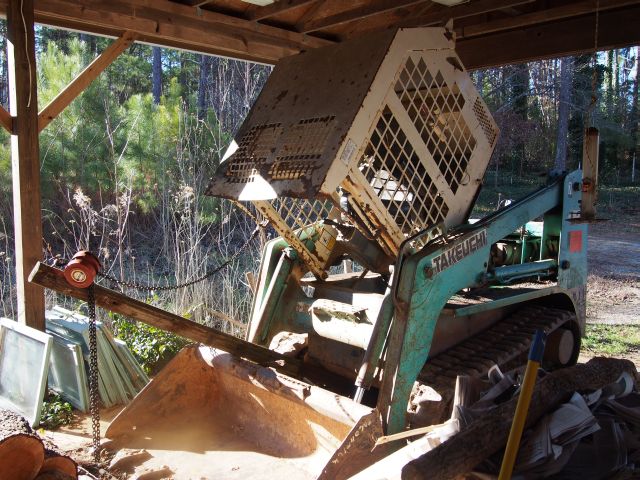
After some cold nights (12 below freezing) my Takeuchi bobcat refused to start.  Cold and tired battery.  The best way to charge the battery is to pull the cab forward on its hinges and then you have direct access to the battery.  It is heavy and best done with an assistant.  In the past I had an anchor point in front of the Take and winched the cab forward.  However, there was no anchor point for the Take this time just a 2,400 gal rainwater tank.  The last time I had no anchor point I attached the negative charging wire to the body and the positive to a nail which I inserted into a slot in the fusebox.  I really didn’t want to do this again.  So I pondered and created my own anchor point.  I found an 8ft fence post, located it between the loader and the body of the Take, attached a hook and winched the cab up.  Effortless and the charging was uneventful.

raising the cab of the Take

work in the orchard

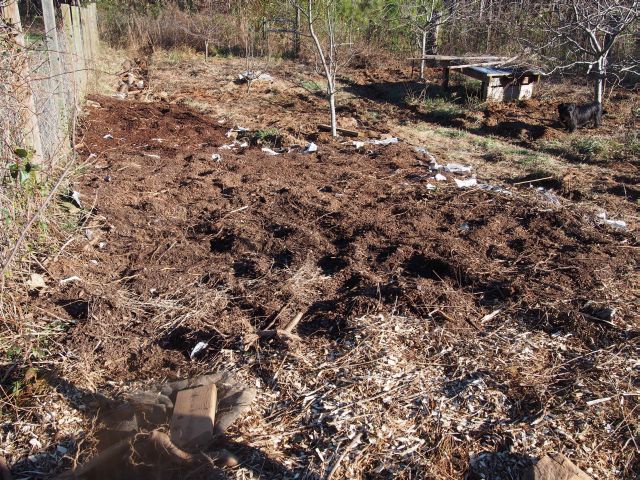
This year, for the first time, my first row of apple trees produced apples but the second row which is nearest my neighbor’s fence did not, and the trees appeared lackluster.  I diagnosed this to competition from vines, shrubs and small trees, some of which have thick roots 10ft long which have been out competing my apple trees for compost nutrients.  I am avidly reading The Holistic Orchard by Michael Phillips in order to thwart the pests that nourished on many of my apples.  He makes the interesting point that wood chips from hardwood trees create beneficial fungus for fruit trees.  So I have worked hard to clear the growth between my trees with an eyehoe (what a wonderful invention).  I then spread manure from the stables, layer newspapers thickly and now, with my Take recharged I ferry loads of woodchips and dump and spread over the newspapers.

mulching the orchard

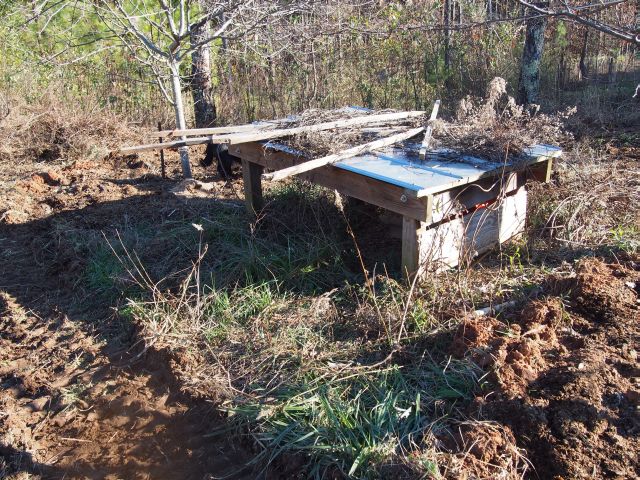
When the orchard is respectable I will bring in a flock of helpers to scratch and turn up over wintering pests.  A couple years ago I improvised a simple chicken shelter which has a couple of nestboxes and I will clean it up for my chickens.

simple chicken shelter in the orchard

water and nutrient infiltration

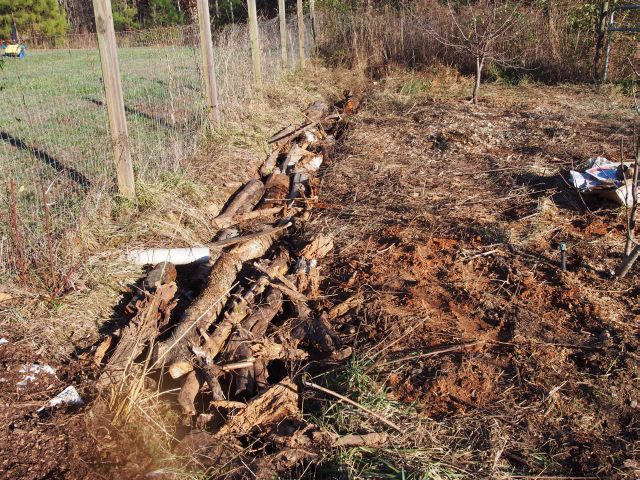
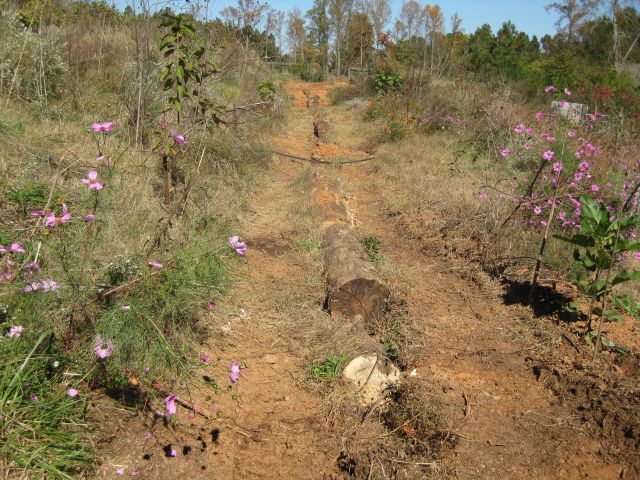
I dug a trench alongside part of the orchard to capture and infiltrate rainwater run off.  I am now filling it with hardwood (mainly) logs, the idea is that the wood will decompose and the nutrients and fungi will benefit my fruit trees along the lines suggested in The Holistic Orchard book (and will also physically block the growth of tall weeds in the ditch).

various logs stacked in the rainwater ditch

clearing the slope bordering the vegetable growing area

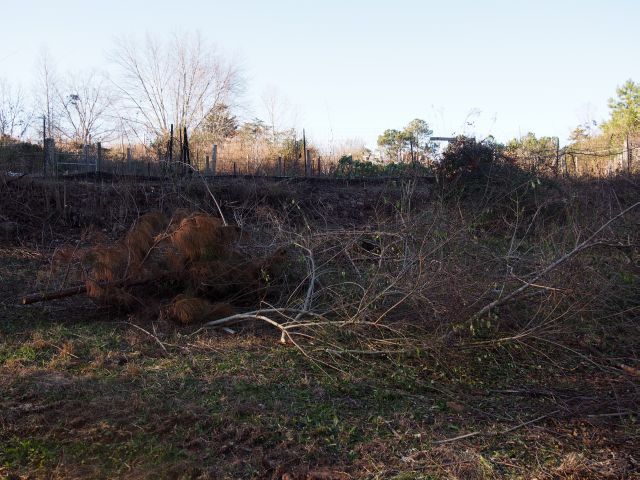
My main vegetable growing area is fenced in and along the southeast border a thicket of privet and briar sprung up over the past several years.  I tolerated the growth since I reasoned it provided vantage points and shelter for insect loving birds which were helping me control pests in the vegetables.  However there were two problems – a) the roots invaded my raised beds – there is one type of small tree which has very long wily roots which evaded all my attempts to obstruct it; b) in the winter, when sunlight is dear, the wild hedge blocked the sun from my frost ridden beds.  So I worked hard to cut down and remove the growth and have been chipping away with the chipper, carried and powered by my tractor.  This mulch I have also been adding to the orchard.  Some chipping remains and when the clay soil has dried I will bring out the tractor again and chip away.

some of the small trees awaiting chipping in the foreground and the fenced growing area at the top of the slope

winter hive protection

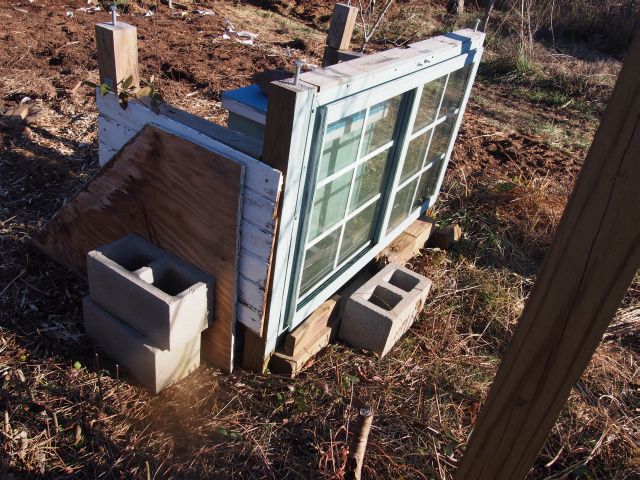
My bee hive faces south.  Chilling winds tend to come from the west and north.  On the west side I have a window which allows the sun but not the wind access to the hive, and on the north side I have plywood protection.

the sheltered winter protected bee hive

how the clover fares

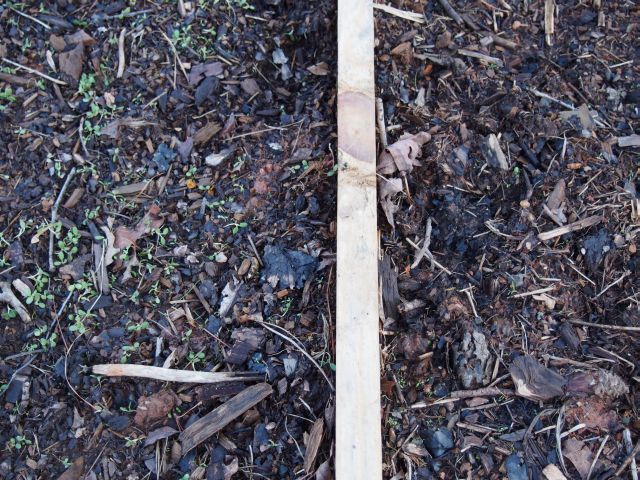
I recently installed a 20ft by 4ft raised bed and sowed half of it with crimson clover and the other half with white (ladino) clover.  The crimson clover is larger but both seemed to germinate equally well.  However, following the recent cold, the ladino clover almost disappeared while the crimson is holding on well.  Will be interesting to see how they comparatively perform in the spring.

the crimson clover is on the left of the divider and the barely surviving ladino clover is on the right

veggies for eating

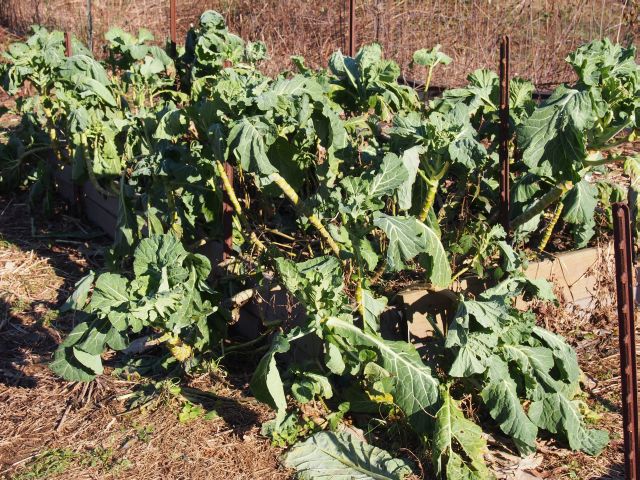
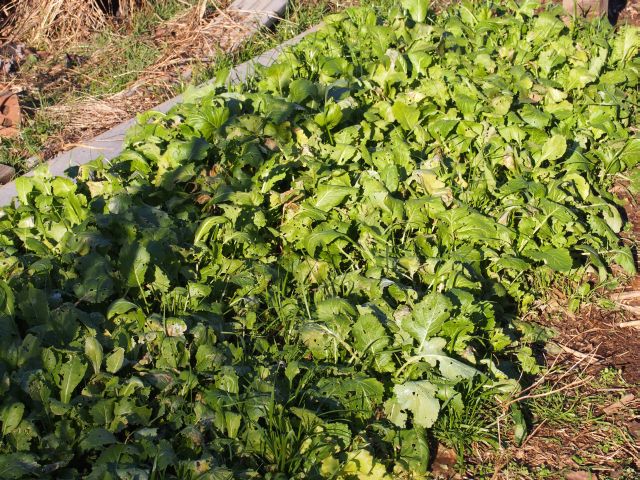
.I am not using crop covers right now and my collard and turnip and mustard greens are surviving, tho at time the collard looks a little bedraggled.

tasty collard for the picking

A tasty (and healthy) dish is newly hatched eggs (yes my younger hens are laying in the winter without artificial lighting), collard, greens and garlic stir heated, eaten with home made whole wheat bread.


lots of winter greens which keep growing in the winter

So these are some of my winter tasks.  And on the inclement days, Coursera, the free online college course compendium, awaits.  I just completed calculus, precalculus and a fascinating history on mankind from 250,000 years ago to the present.

mushroom shelter – improved irrigation

In a recent post I mentioned that mushroom production in my mushroom shelter has been poor due to inadequate watering.  The system I installed had a 0.5″ diameter water pipe run from a nearby slightly higher rainwater collection tank to the ceiling of the mushroom shelter from which the water flowed via bubblers onto the spawn impregnated logs.  Water flow was weak and the bubblers often clogged.

harvested rainwater for growing mushroom
source of water for mushroom shelter is the elevated rainwater collection tank which collects from the north facing roof

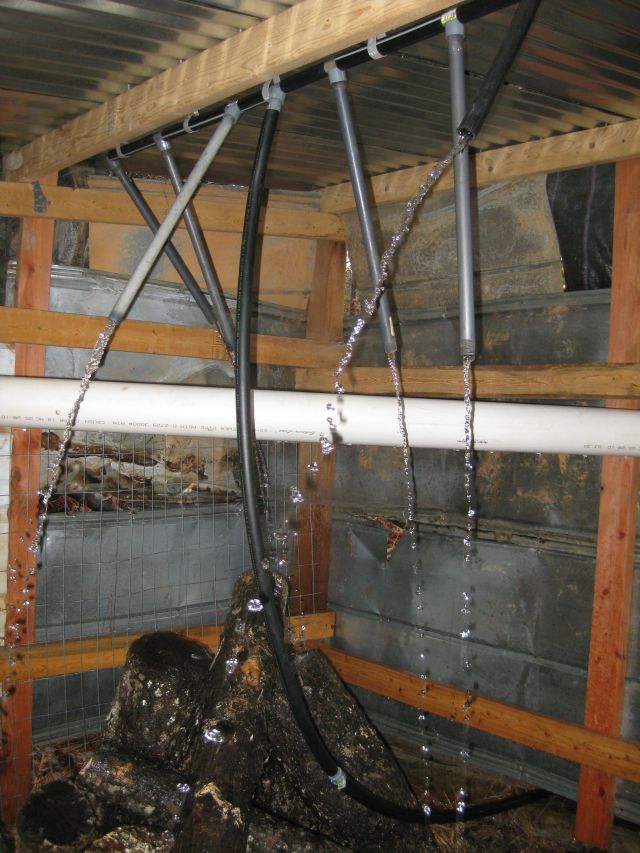
I rectified this by replacing the 0.5″ diameter pipe with a 1″ pipe and by eliminating the bubblers and using adjustable .75″ pipes to torrent the water onto the logs.    I do not have the dispersion I had with the bubblers but the flow is strong and there is no clogging – any debris is blown out.

watering mushroom logs
rainwater from the storage tank directed by adjustable pipes to the mushroom logs (ignore the horizontal white pipe)

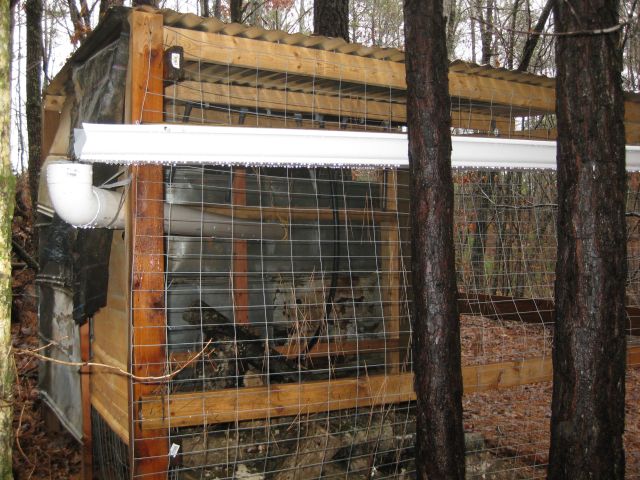
Another watering improvement I made is to collect rainwater from the roof of the mushroom shelter and direct it onto the logs.  First step was to install a gutter.

directing rain onto mushroom logs
gutter attached to catch rainwater from mushroom shelter roof with pronounced dip to the left to feed into 4″ elbow

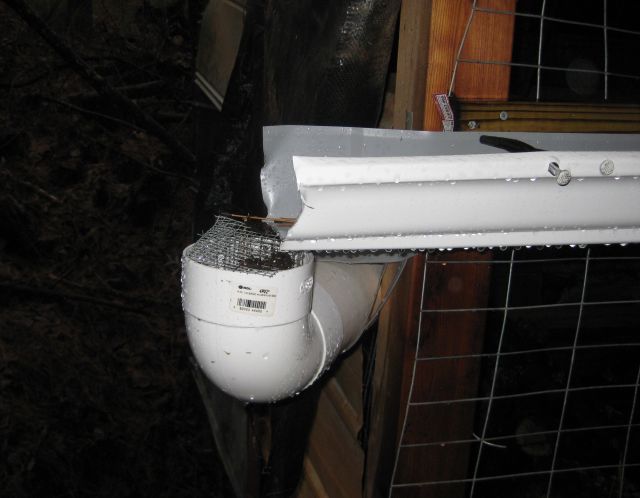
The open lower end of the gutter feeds into a 90 degree 4″ elbow attached to a 10ft 4″ water pipe.  I crumpled chicken netting into a ball and inserted it into the open end of the elbow to trap leaves and debris before they entered the water pipe.

harvesting rainwater from mushroom shelter roof
gutter on mushroom shelter feeds into elbow with protective chicken wire

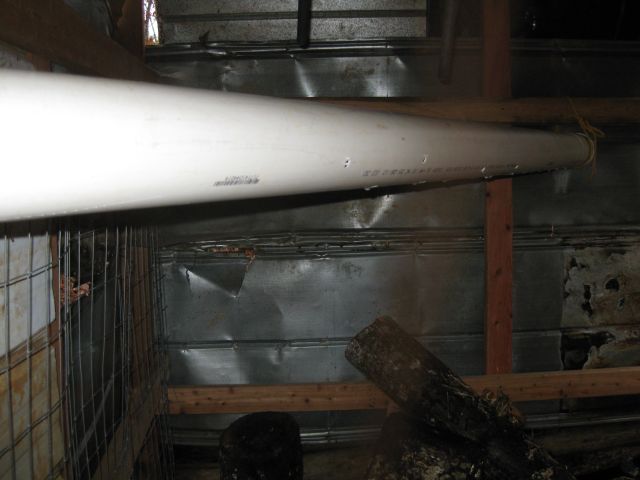
It was then a simple matter to lead the 4″ diameter 10ft pipe into the shelter, cap the far end, and secure it ensuring it dipped from the elbow end to the capped end.  With a power drill I made  holes staggered along the length of the pipe.

watering the mushroom logs
4″ diameter 10 ft water pipe in place with staggered holes to ensure good coverage of mushroom logs

The improvements should ensure more reliable mushroom production.

earthworks – terraces, contour ditches and tree trunks

My permaculture readings have focused me on developing an edible forest garden and earthworks figure prominently in my designs.  Although I already have a number of different fruit trees in my orchard I decided to expand the selection and expect, by the end of November, to receive 2 goumi, 2 pawpaw, 3 kiwi (2 female, 1 male), and a medlar, aronia, sour cherry, and juneberry.  With these pending arrivals I have been at work preparing their planting sites on the side of the hill.

The earthworks are dug by my scruffy Takeuchi tracked bobcat.  My approach is to terrace the slope with the terrace canted to the slope and with a contour ditch in the middle of the terrace.  So rainwater on the terrace will move to the contour ditch and that which misses the contour ditch will move to where the terrace intersects with the   slope.  I fill the contour ditches with logs, for several reasons: a) my readings suggest that grasses promote bacteria and trees promote fungi and since the slope was grass covered, by filling the ditches with rotting tree trunks I am hoping to accelerate beneficial fungi in the soil; b) the contour ditches are a couple feet deep and without infill it is easy  to fall in; c) if the ditches are left as ditches, they are quickly invaded by vegetation which competes with the tree roots and hides the location of the ditches (facilitating (b) above);  d) parallel with (a) the tree trunks will provide nutrients to the soil as they degrade and will absorb and retain water for the benefit of the plantings.

terrace earthwork
earthworks – a view of my new terrace showing the grading toward the slope and the cut made into the face of the slope

After grading the terrace I planted winter rye and crimson clover on the exposed earthworks and watered every couple of days with rainwater.  I have marked the location of the future tree plantings with stones – they will be at least 15 ft apart.  And, since my comfrey did so well this year, I have planted out root snippets from a couple of my comfrey plants.

contour ditch earthwork
earthworks – terrace and contour ditch – looking north you can spot the winter rye seedlings. interspersed amongst them are crimson clover seedlings
terraced earthworks
earthworks – terrace and contour ditch – I am fortunate to have degrading tree trunks for filling the ditch

I created a second terrace as an extension to the terrace and tree plantings I made last year.

 earthworks - terrace with contour ditch and tree trunks
earthworks – terrace with contour ditch and tree trunks, follows the same principle as the one above and the two together will accommodate the new arrivals

And while I was at it I went back to last year’s terrace, deepened the contour ditch and filled it with tree trunks which had been left on the property by a previous owner.

terrace with contour ditch earthworks
earthworks – last year’s terrace upgraded to include tree trunks in the contour ditch. The cosmos and aster are still in bloom and the air is heavy with bees

rainwater harvesting – vigilance needed

As a matter of principal (or is it pride) I try do all my irrigation with rainwater collected in storage tanks.  Total storage capacity exceeds 6k gallons.  The design is fairly simply – I collect directly into 3 large storage tanks and then pump to two temporary tanks at the top of the hill, from which the water gravity feeds to the watering areas (see tab at top of website for full details).  I also collect rainwater at two remote locations (the chicken coop and tractor building) and pump the water to the storage tanks.  The rainwater entering the 3 large storage tanks passes through basket filters before entering the tanks.  The rainwater at the two remote locations goes directly into the three temporary tanks, each with about 280 gallons capacity.

Unlike municipal or well water, rainwater arrives with debris.  I have learned that I have to vigilantly check the water is flowing to the watering areas since algae or vegetation can easily clog the works.  With a low pressure gravity system this invariably occurs whenever you don’t check.  I am used to the routine and while observing water flow I also monitor the health of the plant or tree and look out for problems.  Yesterday there was silver tracery around the base of a blueberry and a little investigating with a small stick unearthed a large slug which was then ejected to a less hospitable area.  And I found numerous caterpillars demolishing my kale and hop plants and egg clutches of many more in waiting.  They were consigned to a soap water container.

But this morning I had a new problem.  I was pumping from the temporary tanks at the tractor building to a storage tank and after the pump had been in action for a few minutes I decided to check on water flow and noticed nothing was flowing.  If there is air in the pump housing this can be the cause so I released the priming screw and made sure the housing was full of water but this did not solve the problem.  The pump engine was working so I assumed the problem was with the impeller which the engine spins and the spinning of which drives the rainwater.  As mentioned above, the temporary tanks do not have water filters and so I guessed that debris had clogged the impeller.

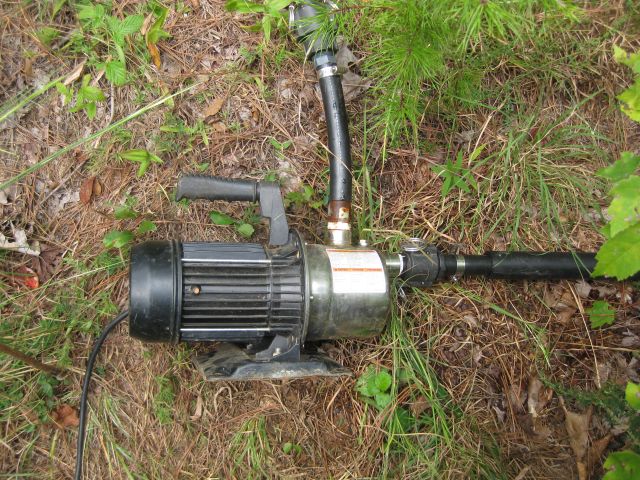
my rainwater pump
my portable rainwater pump with convenient carrying handle, water enters from the right and goes out through the top

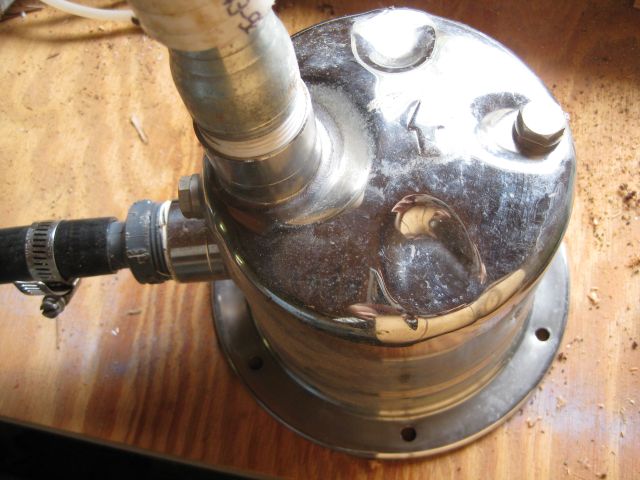
The part of the pump through which the rainwater moves is called the volute and can be clearly seen below.

top view of rainwater pump
the volute of the pump into which the rainwater enters, is pressured by the impeller and exits

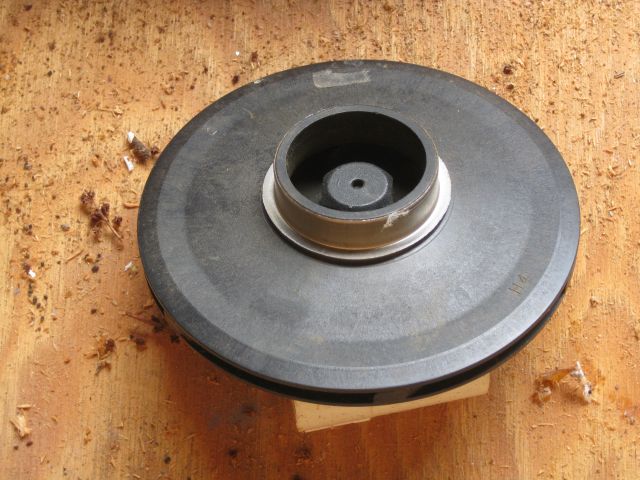
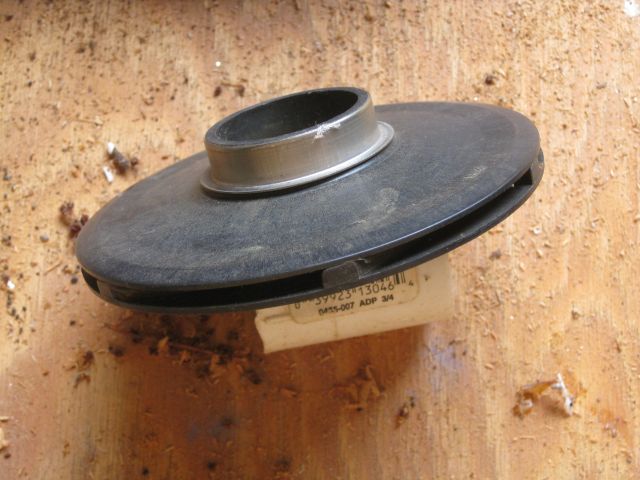
The rainwater is pressured by the impeller which is spun by the motor.  The water enters through the hole in the middle of the impeller.

part of rainwater pump
the rainwater enters through the hole in the center of the impeller

Centrifugal forces created by the spinning of the impeller eject the rainwater through vanes on the circumference of the impeller as can be seen below.

rainwater impeller
when the impeller is spun by the motor, rainwater is forced out through the slits in the circumference of the impeller

It was a simple repair.  I removed the housing (volute) and then cleared the twigs which had gathered at the entrance hole to the impeller.  I carefully replaced the housing and the pump was vigorously back in action.

My conclusions from this episode are that I should:  a) filter the rainwater entering the temporary storage tanks to eliminate debris; b) not pump all the rainwater out of the storage tank since the debris comes out last and if I had left 3 inches of rainwater at the bottom of the chicken coop tank the problem would likely not have occurred when I transferred the then clogged pump to the tractor building tanks,  or (c) replace the standard pump with one designed to pump trash water.  A trash water pump has a larger centrifugal impeller which will not clog as easily.


unintended consequences – Bermudagrass, vegetation in contour ditches

When I began planting my vines and blueberry bushes in the field, Bermudagrass (also known as “devil grass” because it can be an highly aggressive difficult to eradicate weed) was not a problem.  Yes it lurked among the broad bladed tall grasses but it was one of many.  Now it is a major problem and it can thank me!

Bermudagrass is a wiry perennial (easy to cut your fingers if you are pulling hard on it), and is low-growing (hence easily checked by taller grasses) and it spreads by above ground shoots called stolons and below ground shoots called rhizomes. Every so often at a node on the shoot, a root is sent deep into the soil with at least two objectives:  secure water in drought conditions, and act as an anchor to resist my eradication efforts.

I made two big mistakes.  For each new planting I diligently dug out a 2 ft diameter hole, added a copious helping of my high grade compost and inserted and watered the new plant.  This was mistake #1.  Think of a house in a run down neighborhood which has been ignored until new occupants arrive with expensive possessions.  The house attracts interest and invaders move in to seize the possessions.  Previously it wasn’t worth the trouble, now there is booty and the risk of being caught (in the case of a weed, being plucked and ejected) is more than offset by  the rich rewards.  And who was the opportunistic invader – quick footed Bermudagrass stolons and rhizomes.

Its called the competitive exclusion principle where two species compete for the same niche – my high grade compost.  The species with the greatest advantage will drive the other to exclusion.  Blueberry bushes have short roots and they didn’t stand a chance and were overwhelmed by the Bermudagrass.  As were too,  my raspberries.

Bermudagrass
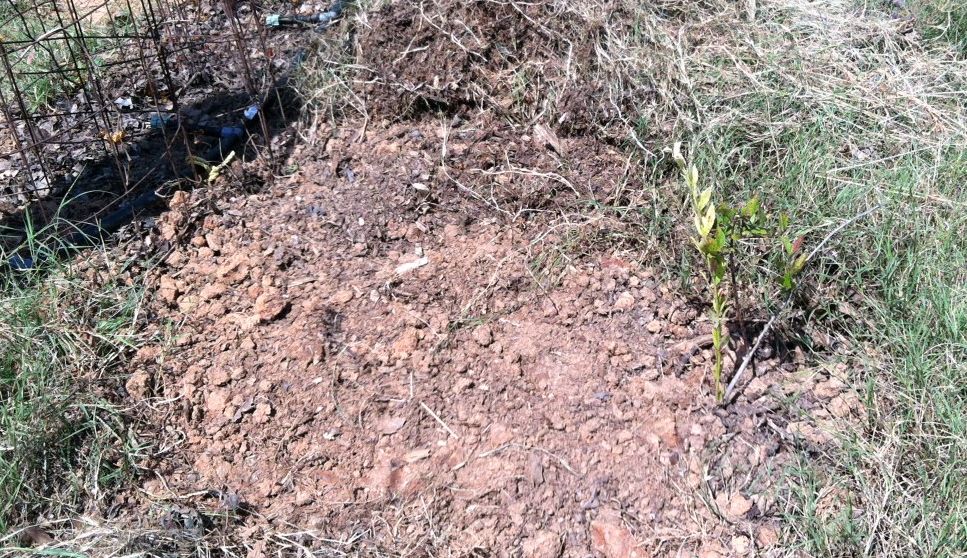
an insipid blueberry bush with adjacent pulled back mass of Bermudagrass

My logic had been that if I nourish and water the plants, they will quickly grow and outshade the competition.  And this would probably have worked with the other grasses, but not against the overwhelming rapacity of Bermudagrass.

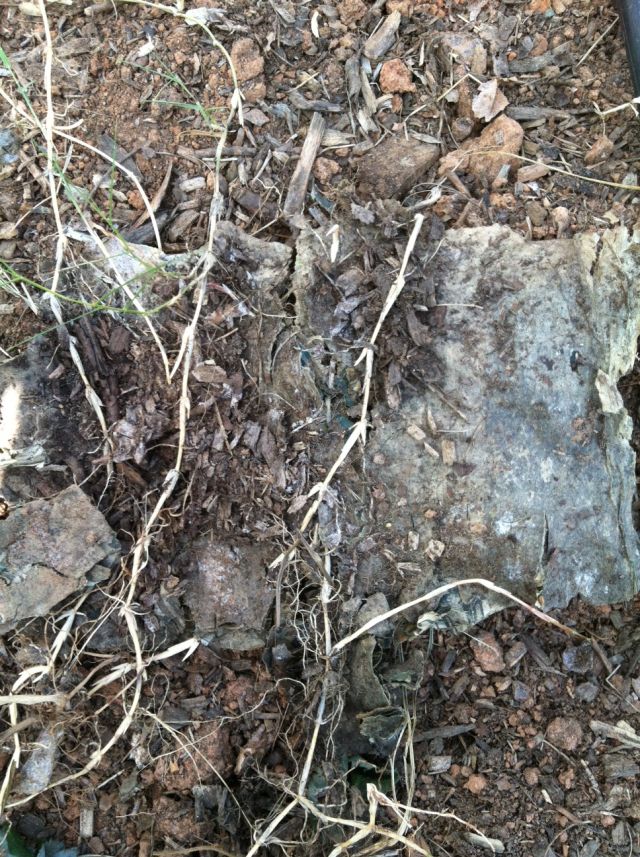
But I made a second mistake, which was just as devastating.  I gave the Bermuda grass a decisive advantage over the other grasses competing for the 2ft circle.  I mulched extensively with newspaper and woodchips.  I first laid the newspaper, at least 8 pages thick, and then the 4″ layer of woodchips above so the chips would not compete with the shrub roots for nitrogen.  The thick mulch effectively excluded all the other grasses and competition, but not the Bermuda grass.  It quickly despatched scout rhizomes deep into the mulch and when they reported back on the superior quality of the compost an advance guard and then an entire regiment quickly invaded.  So the deep mulching helped the Bermuda by favoring its competitive advantage of being able to delve in the dark into mulches on long exploratory missions and then to tunnel to the surface to capture sunlight.

Bermudagrass
Bermudagrass shoots at least 2 ft in length on the underside of thick wad of newspaper mulch

I suspect, but cannot prove, that the Bermudagrass shoots may host agents which demoralize the roots of my shrubs (allelopathic?).

And now I am hard at work with deep digging to locate and remove the rhizomes.  And this time I am using plastic edging to guard the frontiers, which I hope will stop most of the Bermudagrass, but I shall have to be continuously vigilant.

Contour ditches

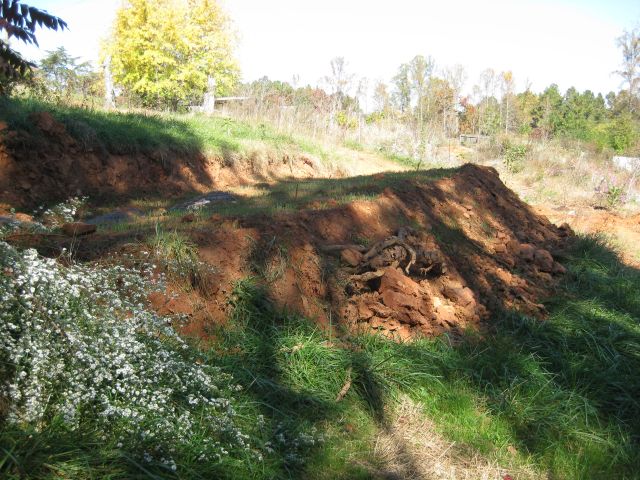
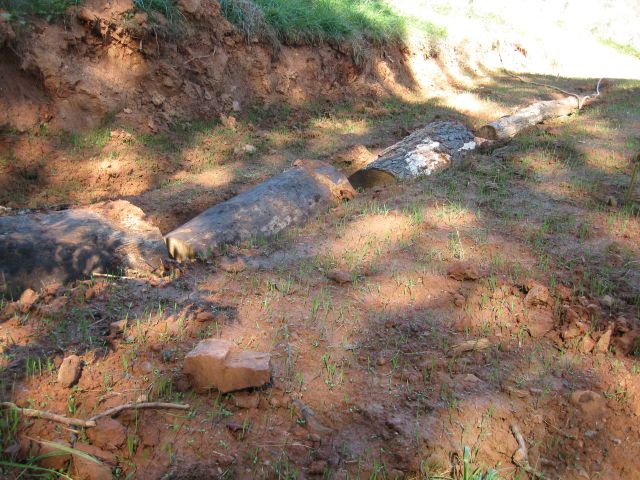
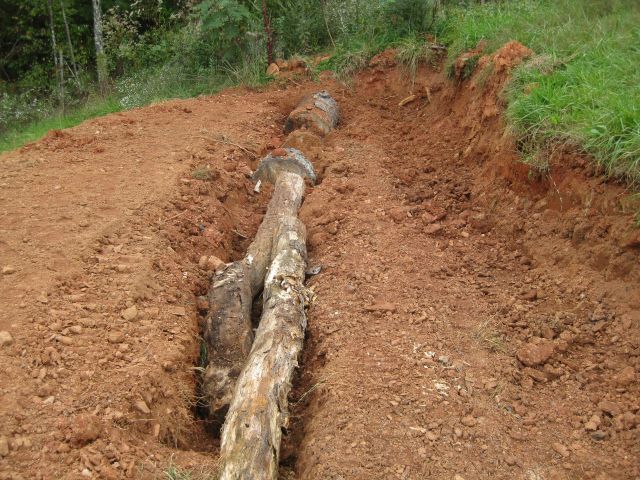
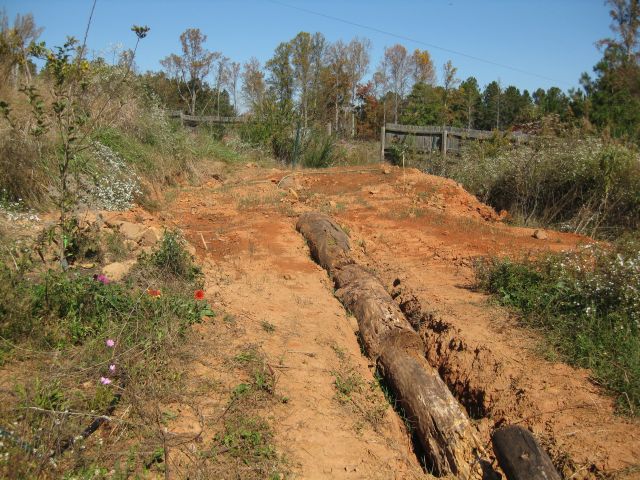
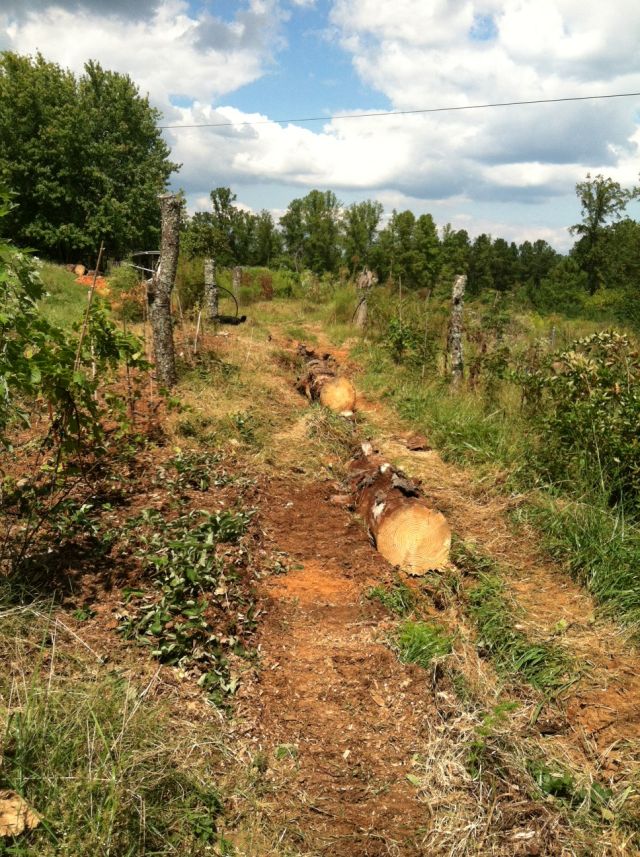
In a previous post I mentioned that large grasses and plants had moved into my contour ditches, which were established to catch, retain and infiltrate rainwater sliding down the hill.  Cleverly some of  the plants established themselves on the walls of the ditch – thus they were close to the entrapped rainwater at the bottom of the ditch but did not have to endure having their feet in the water for extended periods of time.  My solution, as previously mentioned was to stoke the ditches with tree trunks and branches (stoke as in stoking a fireplace).   A year ago some large pine trees were brought down with base trunk diameters exceeding 36″.  My bobcat cuts a 24″ wide trench.  So today I chainsawed the trunks of the pine trees, which did not exceed a 24″ diameter, into 10 ft lengths and relocated them to one of my contour ditches.  Rather than have the nutrients and organisms of the pine tree logs slowly dissipate into the air or the field, they will now be embraced by the soil in the ditch and nurture the roots of my plantings.  Also they will prevent new weedy growth in the ditches and will absorb rainwater and retain it.  Hopefully, this time round, a win win solution.

contour ditch earthwork
+20″ diameter pine tree trunks now berthed in a contour ditch


rethinking contour ditches

I have excavated at least half a dozen contour ditches and, in the months following construction, they performed as advertised.  After heavy rains they dutifully filled with water and, because they are on contour i.e. horizontal, they held the rainwater and allowed it to infiltrate into the soil benefiting the plantings on each side of the ditch (actually the plantings on the side of the contour ditches which adjoined the lower slope did better, probably because there was more topsoil on that side which allowed the water to move more easily to their roots).

So why a “rethinking” of contour ditches?  The bottom of the ditch has proven an ideal breeding ground for high growing grasses and wildflowers (I avoid the perjorative “weed” – these invaders I am sure serve some purpose).  The reason is because the water sliding down the hill brings with it soil and nutrients and the easy access to ample water at the bottom of the ditch is fuel enough for growth.  So the water which should be infiltrating the ground is now sponsoring these tall growers.  The extensive growth hinders access to the plantings and because the contour ditches are now semi-concealed it is easy for the unwary visitor to be injured.

contour ditches
contour ditch between two rows of berry plants – the berry plants are small and the tall growth locates the ditch

I recently completed reading “Farmers of Forty Centuries” by F.H. King.  An excellent book filled with insights.  It unlocks the techniques used by the Chinese, Japanese and Koreans who farmed the same land for 4,000 years without our modern fertilizers and ‘cides and with dense populations too.  If anything meets the definition of “sustainable farming” it must be their practices.  After manures (animal and human) their main source of nutrients was the soil and organic matter lodged in their canals.  So their canals like my contour ditches also filled up and they turned their problem into a solution.  This got me thinking – why not remove the growth in the contour ditches and stack it for use at a later date.

contour ditches
an example of the growth and soil which had filled one of the contour ditches


contour ditches cleared
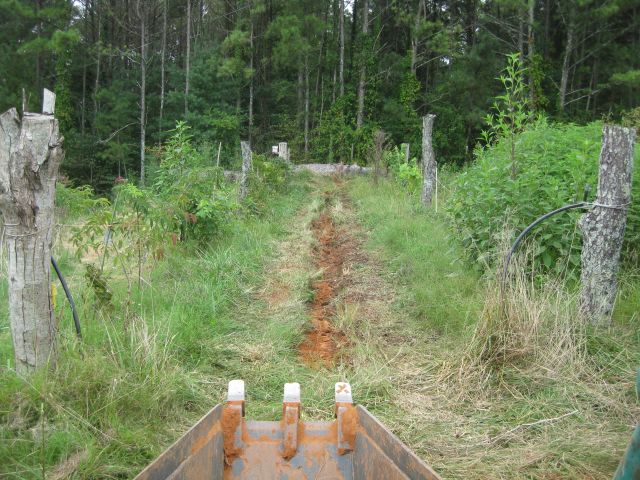
now you can see where one of the contour ditches was lurking, cleared with the help of my bobcat and stump remover, teeth of which visible at bottom of ‘photo

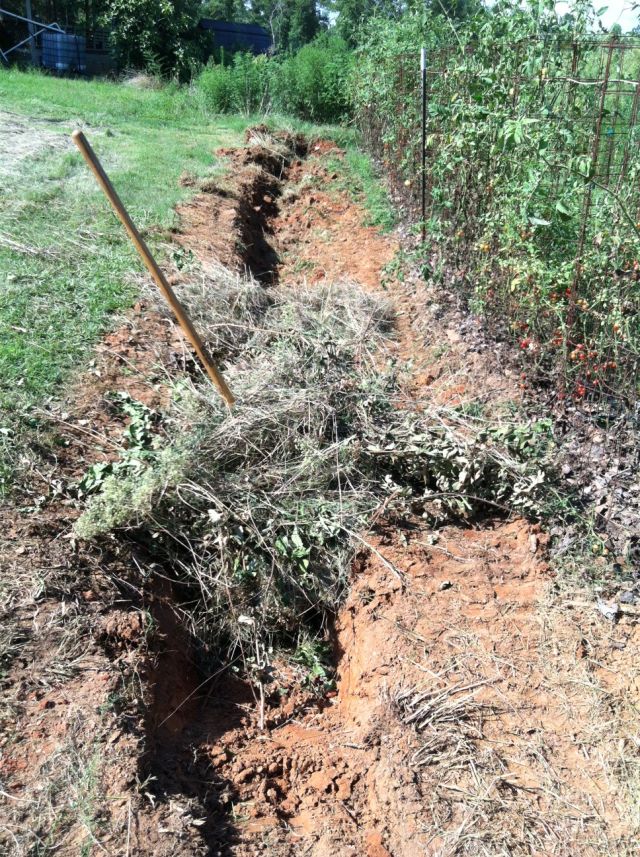
Another of their techniques was to either bury their compost or cover it with mud.  The logic, I assume is this accelerates breakdown by keeping the contents moist, and also reduces loss of nutrients to the air.  So I have decided to fill the enlarged contour ditches first with material leveled by my scythe such as long grasses and other growth, and then with tree branches and trunks.  I am hopeful that these materials will absorb and hold the rainwater and, as they degrade, will provide nutrients to the soil.  Two other advantages – the wood will be stacked to just above ground level so less risk of injury and the wood will prevent the growth of grasses and unwanted plants.

contour ditches
one of the contour ditches is alongside tomatoes. I am filling it with grasses leveled by my scythe

The berry contour ditch does not extend all the way south to the pine trees since this area does not receive much sunlight.  But when it rains a lot of rainwater goes down the hill south of and beyond the contour ditches.  So while I had my bobcat out I decided to angle a feeder ditch which could catch this water as it traveled over the ground and direct it to the contour ditch.

contour ditches
feeder ditch extending from the woods to one of the contour ditches designed to redirect rainwater which swamped the foot of the hill

feeding the contour ditches

I have several contour ditches cut on the side of the hill.  Each ditch is horizontal, catches rainwater sliding down the hill and irrigates plantings horizontally aligned with it – such as tomatoes, fruit orchard, blueberries and blackberries.  Since almost all of my irrigation is with rainwater I try to make every drop count.  I lose water which streams beyond the reach of the ditches, especially down an access road I cut up the hill.

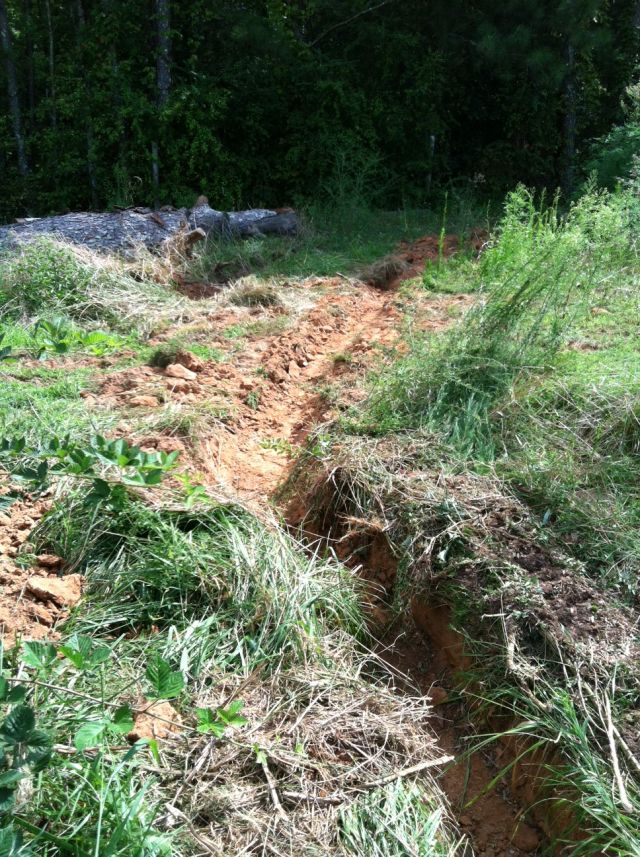
Previously I dug finger drainage ditches which intercepted the streaming water and directed it to the ditches.  But with foot and vehicle traffic, the sides of the ditches shallowed and also filled with vegetation and thus lost their efficiency.

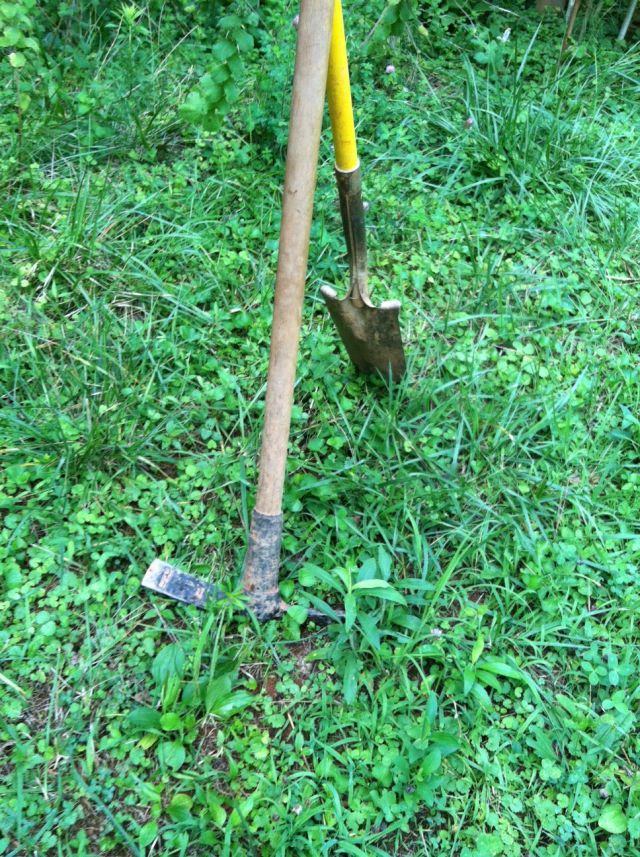
So I engaged again with my mattock and trenching shovel.  In summer (and generally) you want to minimize effort in Georgia humidity and the trenching shovel with its long 5″ wide blade excavates deeply to the desired width, so it is more efficient than a regular shovel.

equipment for contour ditches
mattock and trenching shovel for maintaining contour ditches

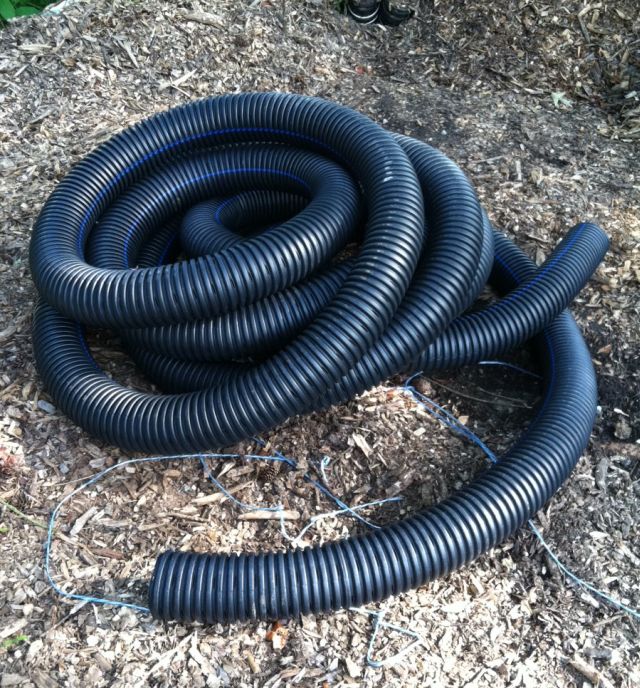
Next a visit to one of the big DIY stores to buy a 100 ft of slitted 4″ corrugated pipe.  I was surprised at the $60 price, I am sure it was around $45 a year ago.

corrugated pipe for contour ditches
slitted 4inch corrugated pipe to feed rainwater to contour ditches

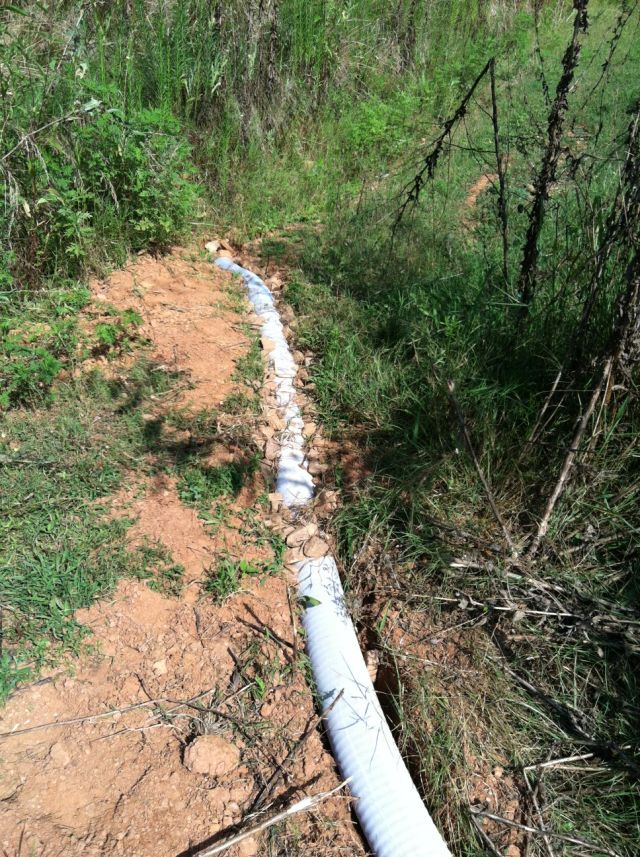
I widened the three feeder ditches to the contour ditches, measured their length, cut the pipe and checked it fitted so the top was below ground surface.  Then I “socked” it to reduce infiltration by soil and roots.

pipe in place leading to contour ditches
“socked” drainage pipe in place along access road ending in contour ditches

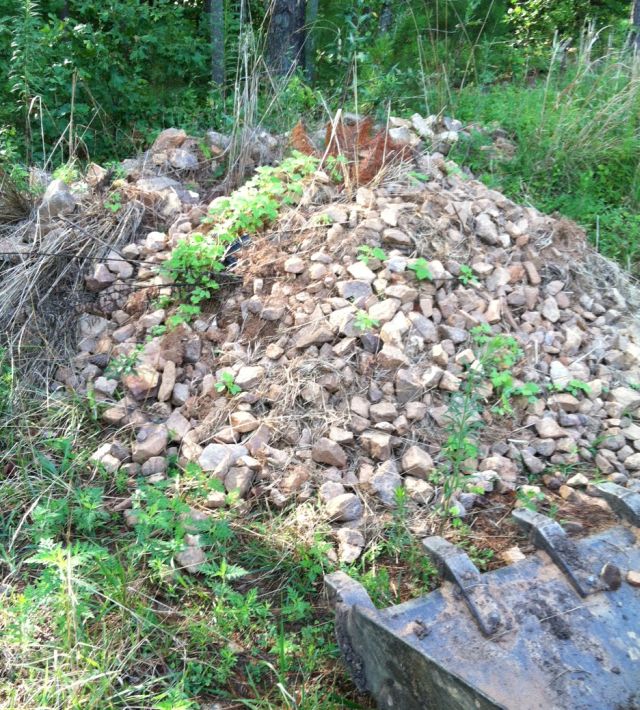
Finally a visit to my stone mound to pick out smaller stones to surround the pipe.

stone mound contributes to efficiency of contour ditches
stone mound with candidates to fill in around the drainage pipes leading to contour ditches

In the past I may have visited the local gravel yard and purchased a load of gravel, but why do so when I have so many stones laying around.

drainage ditch leading to contour ditches
drainage ditch diverting water to contour ditches

More stones are needed and I shall make the habit of picking up right sized stones and depositing them in the drainage ditches for the benefit of my contour ditches, when I visit my plantings each day.


rainwater from coop roof

When I built the new coop in October last year I fitted  a gutter which directs rainwater to an adjacent 250 gallon storage tank.  My thought was to (a) collect all rainwater landing on impervious surfaces, and (b) use the water to irrigate a chicken food growing area.  To grow food for the chicken I would have to cordon off a growing area and maintain it with vegetables and irrigation, which involves extra work, so instead I now give them excess vegetables from the vegetable garden.  And the storage tank, which has been full almost since it was installed, now overflows each time it rains.  A waste of water!

With the coop “summerized” with a powered vent fan, insulation and two semi-automatic coop doors, I turned my attention to the rainwater storage tank, which may also be the culprit for the mosquitoes which hang out in that area.  I have a portable electric water pump and it was a simple matter to run a 1″ diameter water pipe from the coop to the barn where two large storage tanks are parked.  For the water to flow as easily as possible, I avoided sharp turns and led the pipe in a gradual sweep and rise from the coop along the ground to a gradual turn to the barn and then, gaining altitude, up to a gutter on the barn which feeds into the rainwater collection system.  I may decide to trench the pipe when the ground is soft after the next decent rainfall.

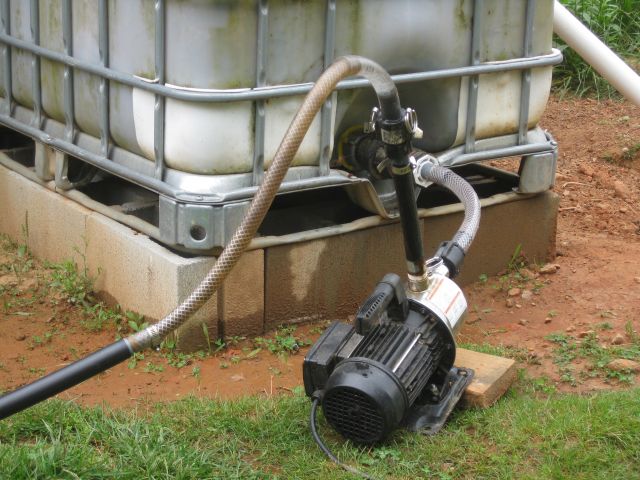
The exit pipe from the storage tank and the pipe to the barn are fitted with Norwesco fittings, as is the electric water pump.  It is a simple operation to couple the pump to the two pipes, open the tank valve to flow water from the storage tank to prime the pump and then power the pump with electricity already cabled to the coop.  Some 20 minutes later all 250 gallons have been transferred to a large storage tank from which it will be pumped, as needed to irrigate my crops.

east side of coop showing gutter, downpipe to tank, overflow pipe from tank and exit connection to pump
closer up view of conection from storage tank to pump to water pipe to barn
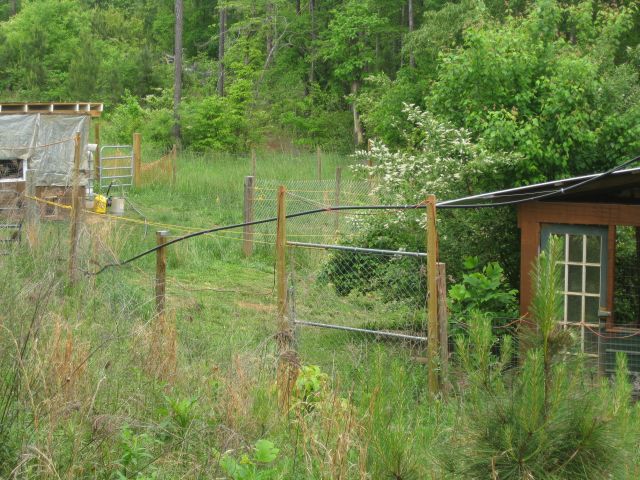
view of the water pipe run from the coop initially on the ground then climbing higher along paddock fence, surmounting gate and ending in gutter