Georgia Organics conference – importance of nutrition

This weekend (Fed 22 -23) I attended the 15th annual conference of Georgia Organics (“GO”), which emphasized the importance of nutrition.  This was my 8th conference and each time I wonder if I will learn anything new and the result is always a resounding “yes”.  The organization has grown robustly.  Lots of young food activists.  I asked one last evening at the concluding Farmers Feast dinner why Atlanta has such a strong movement and he said “leadership”.  Atlanta has growing ethnic populations such as its Korean community but they are not active in GO.  Atlanta is relatively liberal, the rest of Georgia less so, but the support for GO is not confined to Atlanta.  Maybe it is economics and the growing realization that small farmers can only compete against the distant large scale farms with local niche products and that the label “organic” makes a very big difference.  And, of course, there is growing awareness of importance of good food and nutrition.  But give big credit to the leadership.  Certainly it was poor leadership in several large (supposedly top) companies I invested in which resulted in their disastrous outcomes so it is only fair to credit the leaders when the results are great.

The title of this year’s GO was “Farm Rx” with “Rx” being the abbreviation for a medical prescription and this represented a pivot (an increasingly overused term following our President’s pivot to the East) to the medical community.  Makes a lot of sense – if the influential medical community recognizes the importance of good food and nutrition to good health outcomes, what a big step this will be.  A key sponsor was Kaiser Permanente, a mainly west coast organization, and this will hopefully galvanize interest from the large local hospital groups (Emory, Wellstar and Piedmont).

The keynote speakers were very good especially Robyn O’ Brien who linked the food we eat to allergies and many of the serious illnesses we suffer, and gave her presentation a patriotic bent by asserting that bad food weakens our standing as a nation.  It is all about good nutrition.   I do not blame the food companies because I believe a company’s first duty is to its shareholder owners, which it fulfills by effectively and legally promoting and selling its products, thereby increasing its profits and their return.  Loyalty to employees and the community are, at best, secondary.  It is the government and the regulators and the practitioners and the consuming public who bear the responsibility for avoiding bad outcomes.

Another keynote speaker was Dr. Sanjay Gupta of CNN who interspersed his talk with a physical demonstration of the recommended and actual amounts of sugar we consume daily – mind boggling.  He included extracts from his one hour documentary “The Last Heart Attack” (easily googled).  Well presented with interviews with President Clinton and the outspoken Dr Ellestyn and his vegan diet.  I am focusing more now on the quality of my nutrition – I eat a lot of nuts and cheese and, following the documentary, I am resolved to cut back on, but not eliminate, oils (nuts) and anything which has a mother (meat, fish, chicken) and dairy.  My daily home machined cappucino treat will now use soy milk.

In my next post I include some insights from the workshops and lectures I attended.

——————–

Tadpole update – the tadpole bubble in the pond in the woods now only contains a few tadpoles.  Where are the others – eaten or surviving?  And then I noticed in the far corner, which catches the afternoon sun, several motionless below the water and only bestirring themselves when I got too close.

one of the tadpoles emerged from the bubble sunning in the shallow water
one of the tadpoles, now emerged from the bubble, sunning in the shallow water

Chicken update – the hens returned to egg laying duties a couple of weeks ago, except for the Ameraucana.  I assumed she might be too old.  And then this week – 3 dark green eggs!
the largest yet least considered interaction

We interact with the world through our senses.  The five traditional senses are sight, hearing, touch, smell and taste.  We have other senses as well such as balance, perception of time, pain etc.  If our senses warn us that our environment is unfriendly we respond – too much sun we cover ourselves, use an umbrella or sun screen or withdraw to the shade.  To much glare we put on sunglasses, close our eyes or squint and look the other way.  Too bitter a taste then we stop eating.  Too loud a noise we put on ear muffs or withdraw to a safer distance.  So we modify our behavior according to our sense perception of the interaction with our environment.

But there is one interaction with our environment where most of us proceed whilly nilly.  Our gastrointestinal tract, often referred to as the “GI tract” digests the food we eat.  It is immensely complicated.  It also covers a huge area – according to Wiki:  “The surface area of the digestive tract is estimated to be the surface area of a football field”.  So in terms of size this is the largest interaction we have with the world around us.  Many of our ailments derive from GI problems.  It seems to me, using the analogy of a factory, that the problem can be stress, the functioning of the processing equipment or the raw materials used.

I know when I was under stress I would resort to antacids, a quick fix of the symptom but not the cause. But leave aside stress induced problems and think only of the effect of bad raw materials entering the processing facility.  The sophisticated equipment will struggle to process inferior input.  There will be delays, break downs, protests and a degradation of the whole plant.  And what do we do – we are aware things aren’t right so we suffer and then head for the aisle with cures for digestive ailments, and then later take prescribed medicines or are compelled to more drastic intrusive measures.  And our assessment often is there is not much to be done about it – just grin and bear it.

A bit like staying uncovered in the bright sun and then taking pain relievers to alleviate the sunscreen.  Surely time to take more interest in what we eat in the first place?


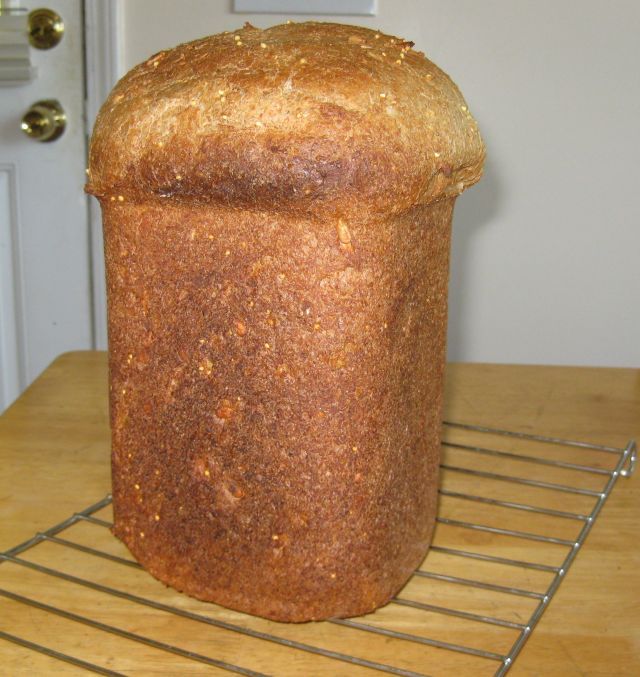
the perfect loaf (of whole wheat bread)

How we achieved the perfect whole wheat loaf

whole wheat
whole wheat loaf

After considerable trial and error we produced a perfect loaf of whole wheat bread.  Previous iterations experienced fallen tops or were short and heavy.  Here is the recipe:

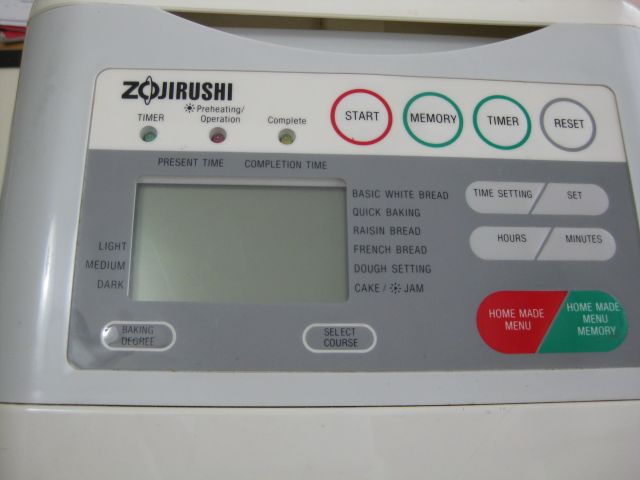
Add to the baking pan of Zojirushi (model BBCC-S15 which has capacity of 1 loaf of approximately 1.0 to 1.5 lbs with height 6″ to 8″):

  • 1.5 cups warm water (not too hot);
  • 1/3 cup pure canola oil including a dash of olive oil;
  • 1/3 cup raw honey;
  • 2 tsp salt;
  • 1 free range egg;
  • 2 tbs lecithin;
  • 1 tbs gluten (the original recipe called for 1 tsp but increased to 1 tbs);
  • 1 tbs yeast

Stir and let sit for 5 minutes, then:

  • 4.5 cups freshly ground hard red whole wheat (organic);
  • 1/2 cup flax seed (ground in coffee blender);
  • 1/2 cup sunflower seed (not ground);
  • 1/5 cup millet seed (not ground);

Mix whole wheat flour and other ingredients with spatula and then  insert baking pan in Zojirushi and then with the custom home made memory option follow this timetable:

  • preheat (time determined by machine);
  • Knead 1 for  10 minutes;
  • Rest – 5 minutes;
  • Knead 2 for  10 minutes;
  • Rise 1 for  45 minutes;
  • Stir down – done by machine automatically;
  • Rise 2 for 25 minutes;
  • Bake – 45 minutes;
  • Cool – 10 minutes.

The whole wheat loaf looked and tasted great throughout.  I followed the recipe carefully using knife leveled teaspoon and tablespoon quantities.  I think the water, salt, yeast and gluten are critical quantities and I measured them extra carefully.  Also warm, not hot water, and allowing the yeast to brew for 5 minutes were, I think, important.  The chicken particularly delight in left over scraps of the whole wheat bread.

making whole wheat bread

A wise man once told me “You are what you eat”.  At the time I ate whatever I wished and being in my mid- 20’s and healthy, I saw little need to change my eating habits.  Nowadays I eat “healthy” which includes whole wheat bread and, noting the cost of 100% whole wheat bread and wishing to be as self-reliant as possible, I decided to venture down the bread making route.

Acquiring a whole wheat bread maker

wheat breadFirst stop was a bread making machine (I could have tried hand kneading but I like machines) and my preference was for a good quality used machine.  Craig’s list showed a make “zojirushi” and some research indicated this is a durable, well regarded but pricey item.  I was able to buy, for a reasonable price, the model “BBCC-S15” which is at least 10 years old and was made in Japan (more recent models I believe are made in China). The  manual included recipes for whole wheat bread so that closed the deal.

The machine worked fine except the battery, which keeps the date, had expired.  From the internet I learned that the battery is soldered to the circuit board but can, with care, be replaced.  This I was able to do.

wheat bread
circuit board showing original battery soldered to the board
wheat bread
new battery inserted in a battery holder


Grinding whole wheat kernel/berry

The seller mentioned to me she also had a grain mill (brand name “Whisper Mill”) which I also purchased, and that she acquired her whole wheat and other ingredients and advice from Bread Beckers company, which fortuitously is located en route to  my property.

The family members who operate the business are most knowledgeable and helpful, and I acquired hard red wheat, lecithin, gluten, flax seed and yeast.  The Whisper Mill ground the red whole wheat well and I used a coffee grinder for the flax seed.  I experimented with their Ezekiel bread mix, but the result was too dense for me.  However, the whole wheat loaves are delicious.  I include in the mix a free range egg,  my harvested honey and 1/4 cup of unground sunflower seed.

There is one area for improvement – the top rises and then falls a little.  I have experimented with increasing the gluten above the recommended amounts to compensate for moisture and will try out differing combinations to arrive at an unblemished loaf of whole wheat bread.  In the meantime, the fallen top goes to the chicks.