“choose your parents wisely” he said

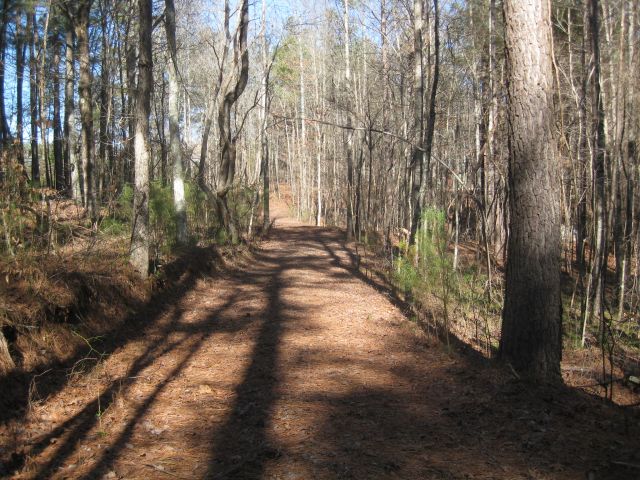
This Monday morning it was colder than it had been for weeks and the breeze along the river trail was chilling, inside and out.  I was therefore happy to see Bill walking toward me – a good reason to stop running and chat.  Bill began his morning river walks when he was diagnosed as pre-diabetic and now he is out all mornings.

Bill  (a former surgeon) informs me that since more heart attacks occur on Mondays than on any other day he, that morning, tripled his daily aspirin intake.    We enjoy ribbing each other and I suggest a morning walk is more helpful than aspirin.  He counters he will leave  a book, “The Sports Gene”, in my mailbox.    I vaguely recall “it’s about slow-twitch and fast-twitch muscles and, at the top of the game, a slow twitch athlete will do better at distance running and never outperform a fast twitch sprinter?”  He nods.  “But we can influence our outcomes – what about epigenetics, the way our genes are expressed, and now we have crispr to edit them?”I ask.  He understands epigenetics and knows little about crispr (nor do I) and sums up “It all about your genes, the best thing you can do is choose your parents wisely”.  I have now recovered my breath and it’s  time to try catch M. who had sailed past Bill with a friendly smile,  so we adjourn.

With the closing of the local Einstein’s Bagels and Bruegger’s Bagels, M. and I read our morning papers at McDonald’s where the coffee is good  and no sugar added oatmeal acceptable.  With me as the interlocutor, she and Bill have waged several offstage debates.  I remember the one with Bill stating that, as a surgeon, he wanted his patients happy both before and after the surgery since this helped for a quicker recovery, and if hospital provided sodas and fried foods did the trick, he was fully supportive.  To which M., RD, throws up her arms in frustration.  Now, as to Bill’s insight of choosing your parents wisely, her quick response is “too late” (wish I had thought of that).  Her  measured comment – “80% of chronic disease (heart attack, diabetes, cancer, stroke etc.) is caused by avoidable factors such as environment, the food we eat, inadequate exercise and stress – and less than 20% is attributable to genes.  And Bill accepts this, to some degree, hence his early morning walks.

But, notwithstanding some conciliation, two different cliff views and no bridge between.
“how’s your oatmeal?” he asked

“How’s your oatmeal?” he asked and his face broadened to his ever friendly, genial grin.  Too friendly, considering he asks this question every Saturday morning when our run/walk group concludes the exercise phase and relocates to the breakfast restaurant.  This is “Bob” who recently survived a pulmonary embolism, whose specialists never raised the diet topic, and for whom a good meal is one of his life joys.  And a good meal does not include oatmeal – rather fried eggs and rashers of bacon.  I once asked him if he knew the Hippocrates quote “let food be thy medicine and medicine thy food” and he grinned and ducked and weaved like Muhammad Ali, and my question sailed away.

So today I quickly acknowledge Bob and focus on “Pete” (early seventies) who  is describing his first week on anti-hypertensive medication and, though his blood pressure has not yet come down, it surely will.  I ask Pete why  the sudden rise in blood pressure and he says “aging” and tucks into his eggs and bacon.

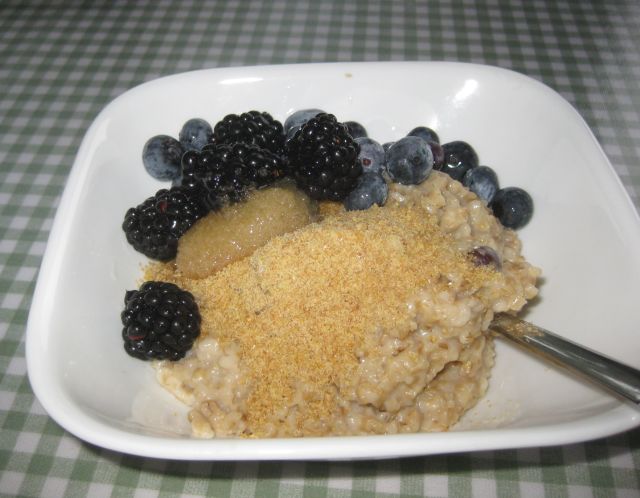
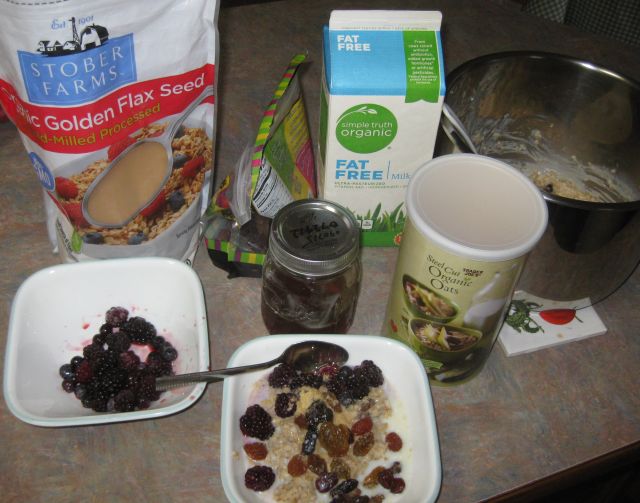
Now I really like these guys, and they are pretty knowledgeable and smart, and Pete in his younger days ran sub 40 minute 10k’s, which is good going by my book.  I am not after converts and so I enjoy the oatmeal (not comparable with my home brew – see pic below) and every so often one of the group (usually after a visit to his physician) will have oatmeal for a few weeks too.  And then it’s back to traditional breakfasts, all part of living the good life.  Safe in the knowledge that conventional medicine and an arsenal of medications are on standby for when the music slows down.

a tasty start to the day with home grown blackberries, blue berries and honey

my dog Trudy

We had a Scottie, Angus, who died from melanoma at age 11.  We missed him and decided our next dog would not be pedigreed, we would find a Heinz 57 perhaps less susceptible to inbreeding diseases and, anyhow, we are not into status dogs, or cars.  So Trudy it was, a year old female terrier hound mix who had been tried and rejected at (at least) 2 homes and sidled up to us at the Atlanta Pet Rescue and promptly rolled onto her back – utter submissiveness and desperate to be adopted.  After 2 days my wife said this was the worst decision of her life – several shoes, a good carpet and some furniture destroyed and non stop scratching.  But the scratching stopped when her diet was changed (my wife is a dietitian) and, as she settled down the destruction stopped and she became our lovable companion.  Now 11 years later she accompanies me every day to our north Georgia location, routs out the rabbits and groundhogs with her excellent nose, loves the walks, and tho her eyesight (particularly night vision) is fading makes for an excellent guard dog for the chickens.  And knows how to tweak our guilt by staring intently at my wife late evening to motivate her for a walk.

And then this past Saturday things went wrong.  The early morning walk  was fine.  By 10am she was unsteady on her feet and I had to carry her and load her into the car for the trip to the farm.  The vet was booked Sat pm but could see her Sun pm or Monday. By 6pm Saturday she had difficulty standing and by 10pm she could not stand at all.  What could it be?  Spinal injury – but she was fine in the morning.  Perhaps when we were out she had climbed the stairs and fallen down the stairs and injured herself.  But she did not seem in pain and there was no swelling of her hind legs, which were the unstable part and earlier had kept giving in.  Perhaps a snake bite to the rear right leg but again no sign of swelling.  Sudden onset of arthritis?  A nasty tick disease?  A stroke?  Bladder stone?  A stroke or a growth pressing on her spinal nerves and numbing her legs?  The only bit of encouragement was that she seemed otherwise fine – alert, breathing steady, nose cold, reasonable appetite.  Since she weighs around 47lbs and couldn’t move I devised a way to ambulate her outdoors.  A large towel around her body spread between her front and rear legs and me lifting the towel ends and her vertically so she was right side up with 4 legs pointing down.  Then lowering her on the grass outside and encouraging her to “pee-pee”, but to no avail.  There is a lot on the internet and the stuff we read Saturday night counseled an immediate visit to the emergency room.  I decided not to do this.

We slept poorly that Saturday night and would wake and listen to Trudy asleep beside the bed on her old towel and blanket bed.  She seemed fine.  Next morning I watered the crops and she stayed inside.  Normally she would be there with me.  But when I went inside and she saw me, she wagged her tail vigorously.  What could this be about?  The she struggled to her feet and lurched forward and with a drunken gait staggered across the room before falling sideways.  But she wanted out so with the towel hoist I got her outside and holding the towel to prevent her falling over, she walked about.  A remarkable turnaround.  And most pleasing of all, a long uninterrupted pee-pee (so no bladder stone) and an equally extended very normal looking #2 (so no major intestinal distress). Rather than rush her to the vet on Sunday which I had originally planned though it would have meant a 100 mile round trip to Atlanta for a function and then back again to the vet in north GA, I decided to take her in Monday pm.  More research on the web surfaced old dog vestibular disease – an ear infection causing dizziness, could it be this?  And I noticed that now when she walked she sidled up to the wall on her right.  Since she kept falling to the right I assumed she was using the wall as a crutch to prevent a fall.

Monday pm we visited her regular vet.  The pleasant receptionist explained they had 3 emergencies on Saturday and that was why they had been unable to see her.  With hindsight I was pleased we had not gone in on an emergency basis which may have produced emergency measures.  Now we all had time to consider the matter.  The inspection revealed no spinal bruising, good musculature of rear legs, good foot reaction to bending tests.  The blood work was “perfect”.  The vet stated that her eyesight was not good, which we knew, and that animals with poor eyesight would use wall and surfaces as a guide for walking.  Ok – but why the problem on Saturday and the good continuing turn around?  He was initially dismissive of the ear infection suggestion since she was not holding her head to the side and her eyes were looking forward and not flitting from side to side as is apparently common with balance issues.  But he noted a slight discharge in her right ear and so he provided ear drops to resolve an outer ear infection and antibiotics in case it was an inner ear infection.

Upshot is that from being unable to move on Saturday night she is now on Monday miraculously regaining form though still unsteady at times.

simple lunch

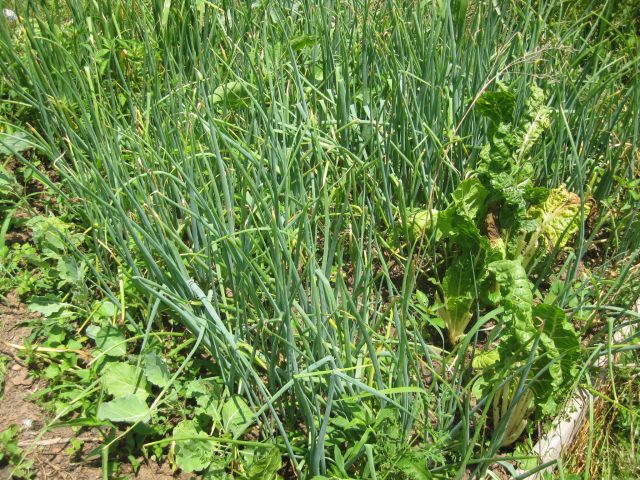
It being Father’s Day I was permitted to prepare lunch for the two of us.  A rare event – usually I gather the produce and wash the dishes.  I kept it simple.  I like onions and garlic and have a lot growing.

one of my onion beds.  you can also spot some chard and small collard in foreground
one of my onion beds. you can also spot some chard and small collard in foreground

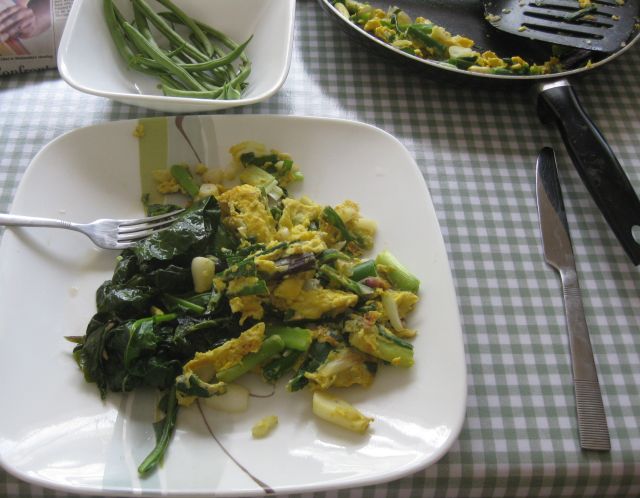
I also gathered large chard and collard leaves.  I chopped the onions into 0.5″ segments including the green stems  and also peeled and chopped the garlic.  The mound went into a pan, with olive oil to gently saute.

The chard and collard I hand washed keeping a sharp lookout for green camouflaged  caterpillars.  Then into a pot with a lick of olive oil and some water and gentle heat with the lid retaining and accelerating the steaming.  Turning occasionally and temperature low to avoid burning with a dash of vinegar and pepper to finish.

When the onions and garlic had softened, but not too much, I added 5 of our free range eggs, just whisked.  Then keeping temperatures around medium  I turned the scrambled eggs, onion and garlic combination with a spatula until it was done.  But not too done.

To me it all tasted great.  The onions, garlic and greens retained their crunchiness.  And I even earned an “ok” which is high praise.  I should have added turnip greens for extra flavoring and kale – next time.  On the side were some fresh picked beans.  The beans reminded me of recent press about “blue zones” and the prominent role beans play in longevity diets (WSJ 052215 “Want Great Longevity and Health?  It Takes a Village”).

a simple quick put together lunch

Not high cuisine but healthy enough and all from my place, chemicals free.  Tonight we will eat out with one of our sons to celebrate Father’s Day.

breakfast and garlic harvest

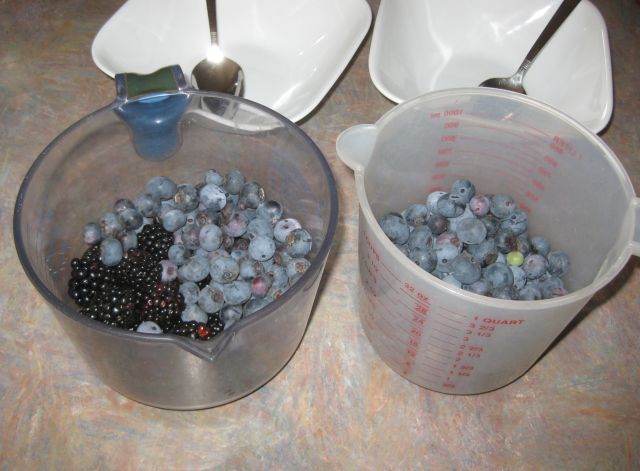
Breakfast this morning (Father’s Day) was a simple affair.  We wandered to the top of the hill and picked a couple containers of blueberries and blackberries.

freshly picked blueberries and blackberries

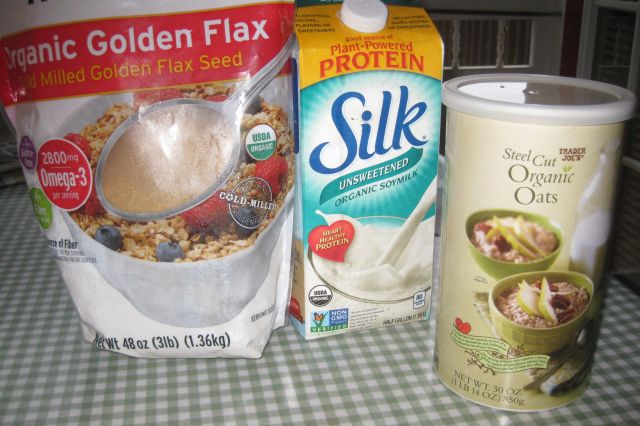
The other ingredients were steel cut oats (pressure cooked 7 mins), flax for omega 3 fats, soy milk and a spoon of my own honey.

the ingredients
the ingredients

And it tasted good and was filling.

a bowl of oatmeal
a bowl of oatmeal

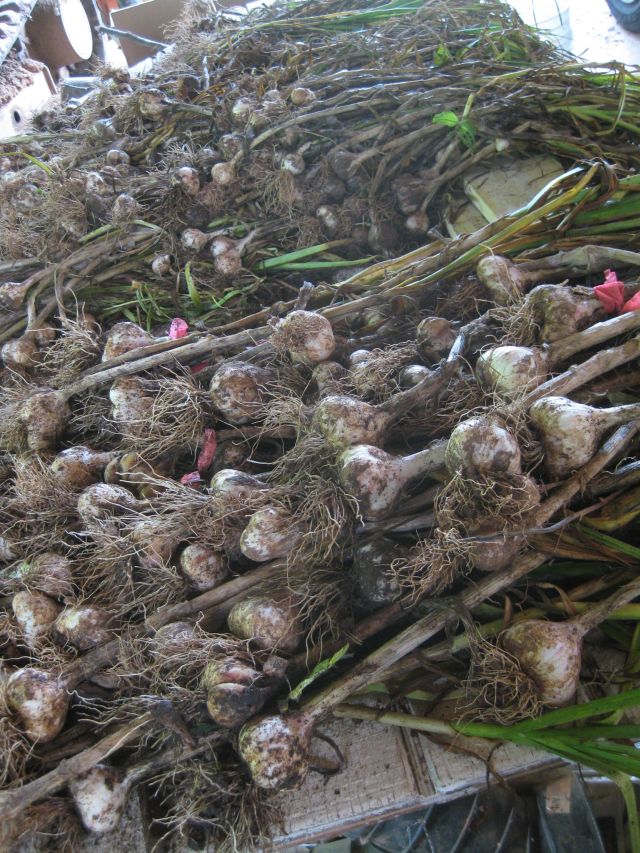
Also this morning, early, I finished harvesting my garlic.  May have left it a bit late since some of the stalks had detached and there are now garlic cloves in the ground for next year.  I segregated the larger garlic (includes hard- and soft-neck) and these are not for eating but for planting in the fall.

larger garlic is closest for  seeding in the fall, the remainder is for eating and friends
larger garlic is closest for seeding in the fall, the remainder is for eating and friends

I will allow the garlic to dry under cover of the carport and then, as I did last year, I will string them up in bundles and hang from the carport rafters.  I had less rotten garlic this way than when I had stored in mesh bags in the basement.

the dna cop-out

We generally accept responsibility for our actions but not for our circumstances.  When I told a nonagenerian I was fortunate to have good health and to retire in my early 60’s, I was told “that’s not luck, that’s decisions made”.

Food plays a big role in people’s lives, and I don’t mean survival.  To quote: “some eat to live and some live to eat”.  I am (mostly) in the first category.  Folks with health problems usually resist changing their diet – food is one of their chief enjoyments.  And they rationalize that diet isn’t that important anyhow  – more important are the genes you are born with.  So accept your gene determined health and soldier on.  And why bother when medication will fix the problem?

Try telling parents whose kids have digestive problems that they should consult a registered dietitian.  Their reaction is “I give my kids good food” i.e. I am a good parent and it has nothing to do with the food they eat, must be the genes.  Then you hear the apocryphal story of the athlete who ate and exercised meticulously and nonetheless had a major health problem.  Must be the genes.  The accepted wisdom was if you lived to your 80’s that was from good lifestyle but to live through the 90’s depended on genes.   Until  recent  findings that exercise, diet and community are also important determining factors.

A buddy “Bob” in his early 60’s recently had a pulmonary embolism (lung blockage).  He survived and was examined by a raft of medical specialists.  I asked if the topic of diet surfaced.  He said he was never asked about his diet nor were there any diet recommendations.   The tests have not revealed an overt cause and so it must be his genes.  Again.

Another buddy suffers from gird and his son suffers from gird and he explained to me it is obvious that his son inherited his genes.  The fact they lived in the same household and ate the same food is not relevant.

Why change if change makes no difference?  As one obese patient assured the hospital dietitian “don’t worry I’m on a sea food diet”  and then, seeing the smile on her face he added “I eat what I see”.

However, nutrition science must step up its game.  When I ran distance in the 60’s I sucked salt tablets.  Not because it was pleasant but because I perspire easily and this was the recommendation for replenishing  lost salt and reducing cramps.  Seemed logical.  Then salt became BAD.  Now it is not so bad.  Fats were BAD now not so much.  Sugar is now the culprit – last year fruit juice was not good but eating raw fruit was ok.  Now eating raw fruit high in sugars is not ok, according to some.  And then the faddists – avoid grain and go for meat or maybe do the reverse.  And the platitude – “everything in moderation”, is another cop-out.  I know diet is complicated and compromised guts make it more so, but  these turnarounds and banalities produce skepticism, not confidence.

And what is the message?  Research indicates that cardiovascular disease, cancer and diabetes, which are chronic diseases that account for most deaths, are largely preventable.  And four lifestyle decisions – never smoking, maintaining a healthy weight ( BMI<30 ), exercising at least 3.5 hours weekly, and having a healthy diet (large amounts of fruits and vegetables and reduced meat intake) appear to be associated with almost an 80% reduction of developing deadly chronic diseases.  So I watch what I eat and accept responsibility for my health, just as I do with relationships and financial circumstances.


season update – what grew, is growing, and still to come

This morning the sun ducked behind clouds and instead of retreating before the heat I took some pics of growing activity.

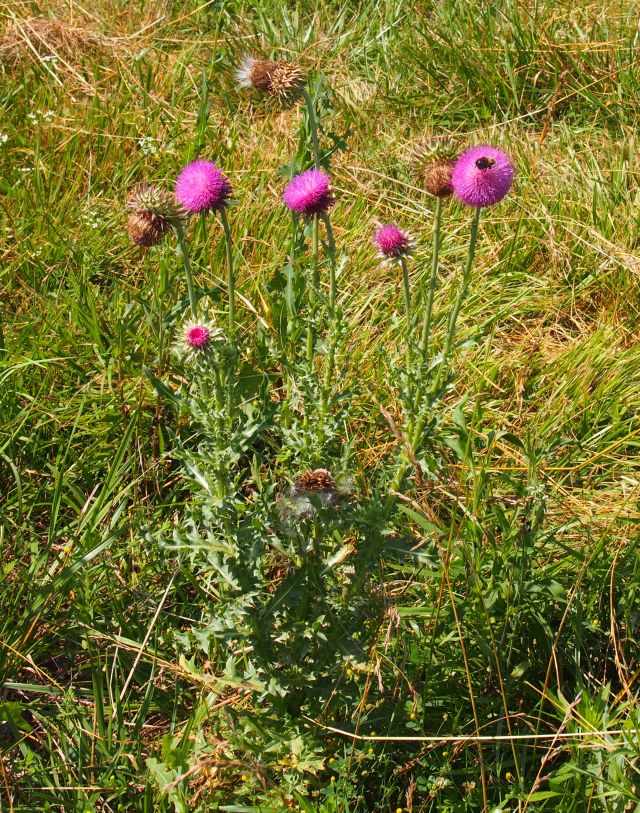
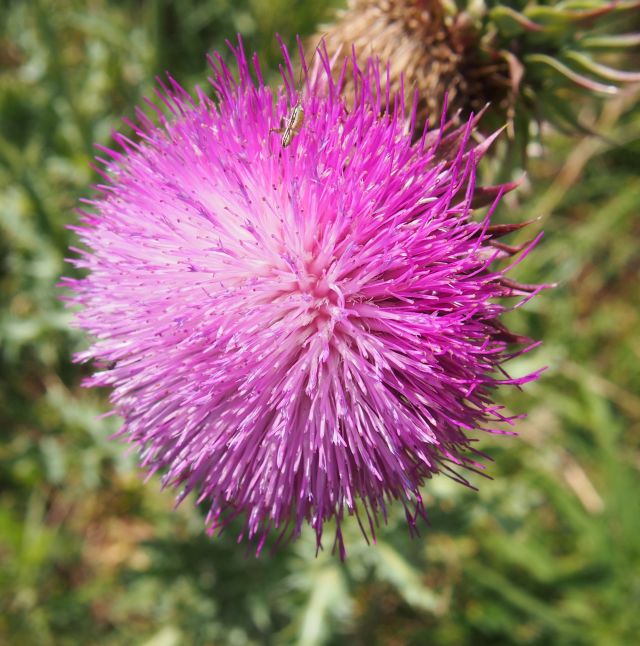
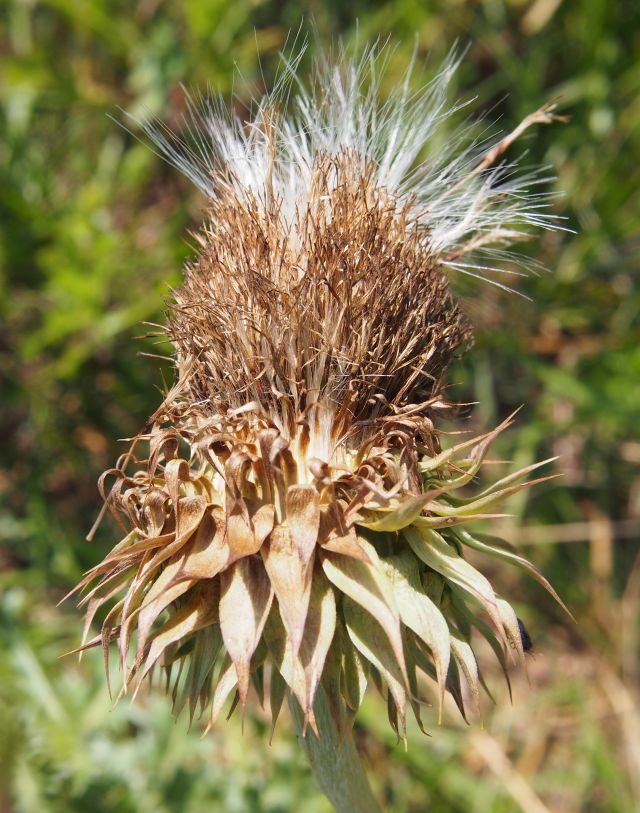
At the top of the hill stands a solitary thistle. Thistle, a symbol of Scotland, brings back memories of vacations in the Highlands. And the pipes of the Black Watch swirling through our living room when my Dad, who fought in a Scottish regiment in WW2, would play our favorite record.  Not that it is universally admired – here is a quote from Botanical.com: In agriculture the Thistle is the recognized sign of untidiness and neglect, being found not so much in barren ground, as in good ground not properly cared for.

OLYMPUS DIGITAL CAMERAand here are 2 closeups

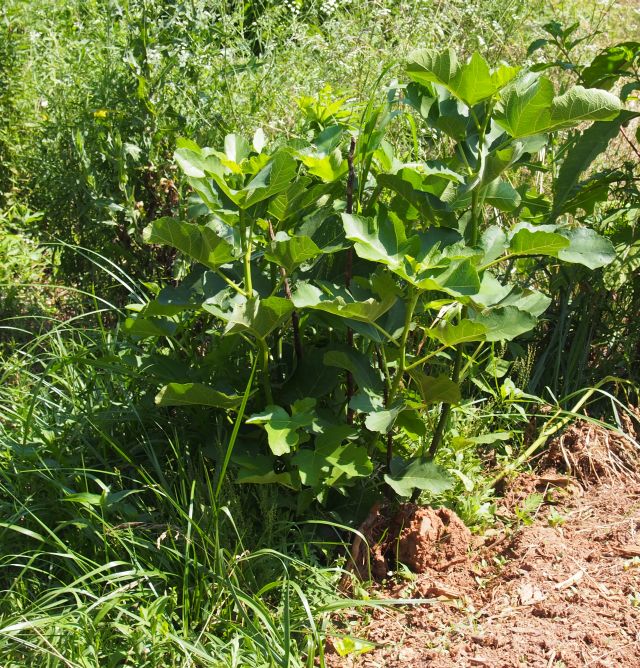
OLYMPUS DIGITAL CAMERAOLYMPUS DIGITAL CAMERAThe savage January lows doomed all my fig trees and some blueberries and a hardy citrus.  But the figs, ever optimistic are growing again (and will likely be again felled in January).

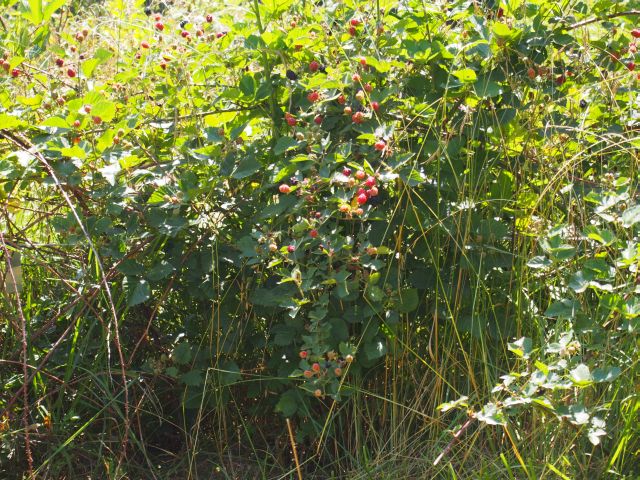
OLYMPUS DIGITAL CAMERANow is blueberry and blackberry picking time and each morning I fill a couple yogurt 1 qt containers with fresh pickings in between scoffing down healthy helpings.

blackberry
blackberry

I walk slowly through the high grass to give snakes time to move out of the way, but I was unprepared for the silent yellow wasp attack.  No buzz warning or preliminary fly around, just a quick landing and nasty bite/sting.  And when I returned having lost the contents of 1 container in the hasty exit, they were still there and gave me a 2nd lesson.  I shall have to better time my visits to this blackberry patch.

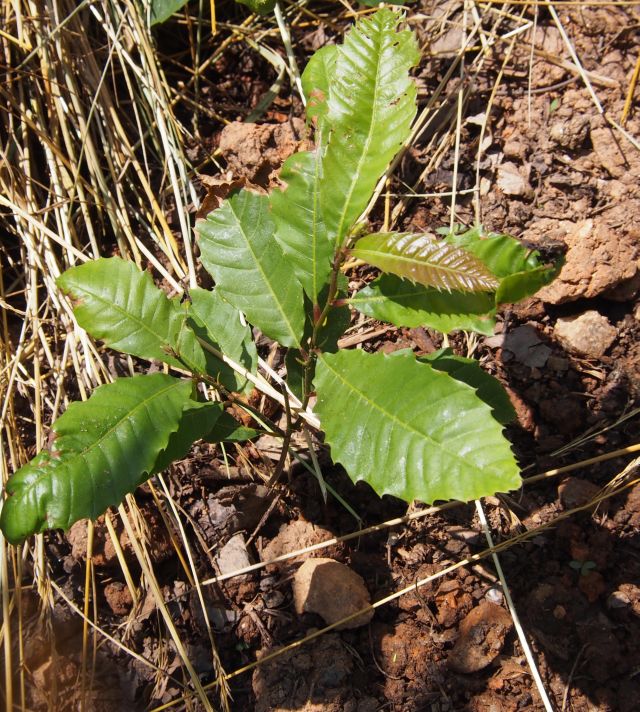
I ordered and just received 15 chestnut and 15 hazelnut trees and, since it is hot now and some hazelnut were suffering, I am nursing them in my tree nursery next to the deck which provides afternoon sun shade.

a small chestnut - whether it will survive our weather and the inevitable blight attack will be seen
a small chestnut – whether it will survive our weather and the inevitable blight attack will be seen

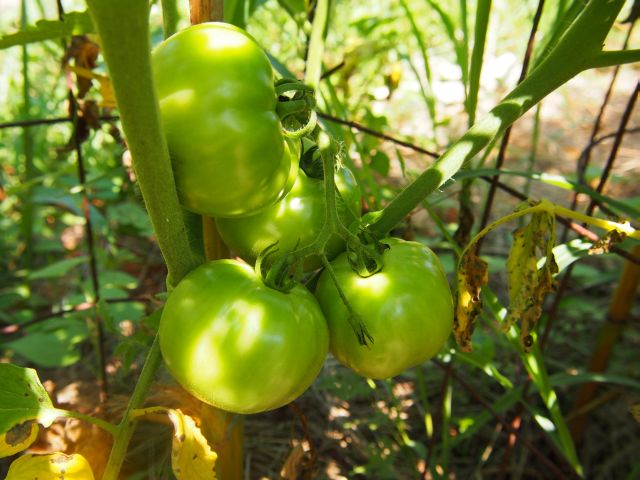
I have introduced several new features to my tomato growing and will not enumerate on them until I see whether they produce a measurable difference.  There are lots of green tomatoes and, at this time, they are looking good.

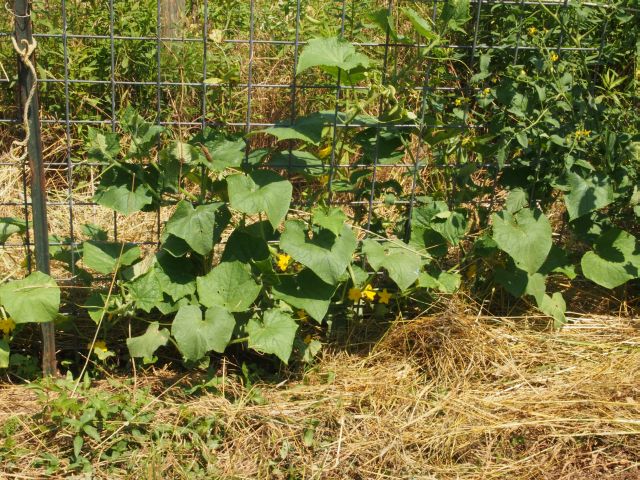
OLYMPUS DIGITAL CAMERAThis season has been good, so far – lots of lettuce (tho next year I will do more Cherokee than Black Seeded Simpson which have been insipid), radish, kale etc.  A pleasant surprise has been the size and quality of my   onions – I planted several varieties from bulbs and they all tasted mild and great.  Next on will be cucumbers, okra,  beans, squash, potatoes.  My cucumber plants are growing well.

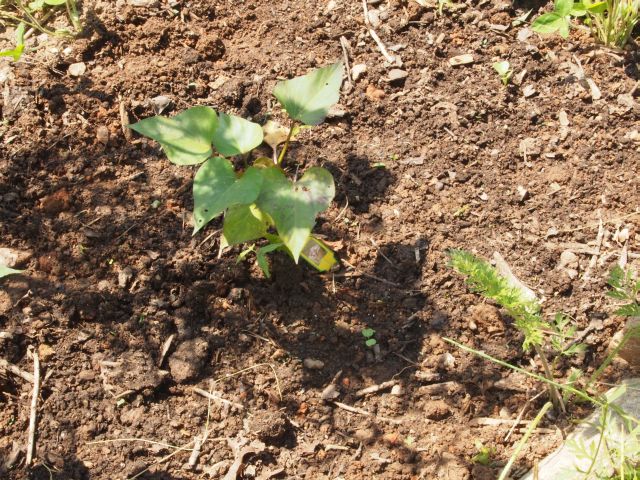
OLYMPUS DIGITAL CAMERAAnd this week I bought 9 Beuregard sweet potato vines which I planted out in the areas cleared of onions and lettuce.

OLYMPUS DIGITAL CAMERA

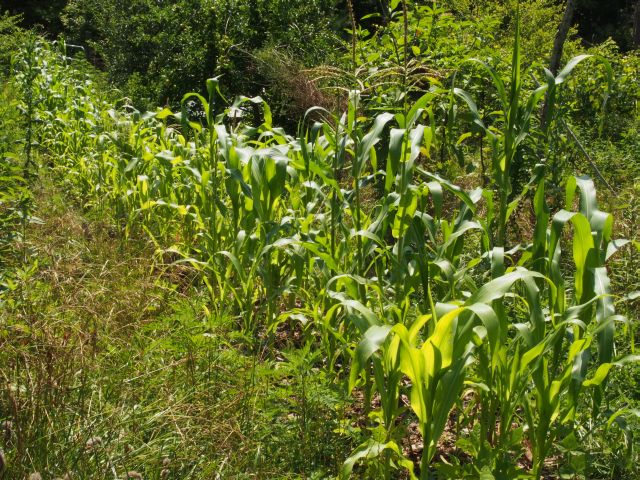
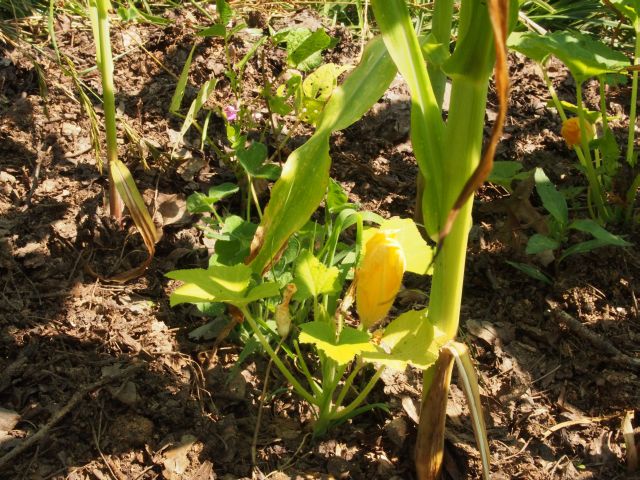
In my orchard, which is acquiring more permaculture trappings, I earlier planted a strip of 4 rows of different corn plus beans and squash.  The corn is looking good.

OLYMPUS DIGITAL CAMERAAnd if you look carefully you will see the small squash and bean plants which have some catching up to do.

the three sisters
the three sisters

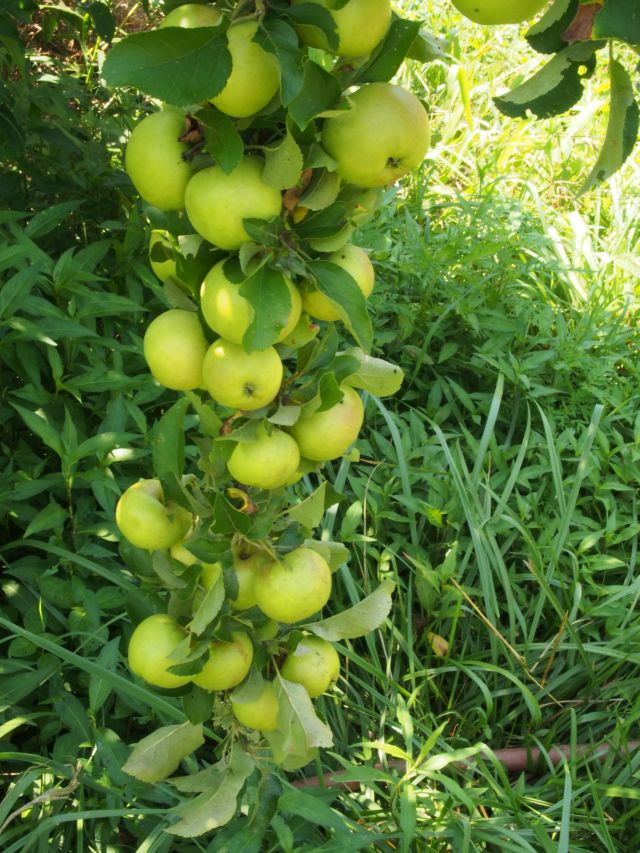
The late April 15 freeze harmed a number of my apple trees and the peach tree.  However, most importantly, my best apple tree with the sweetest apples was not affected and is bearing heavily.  Here is just one down laden branch (which I really should thin).

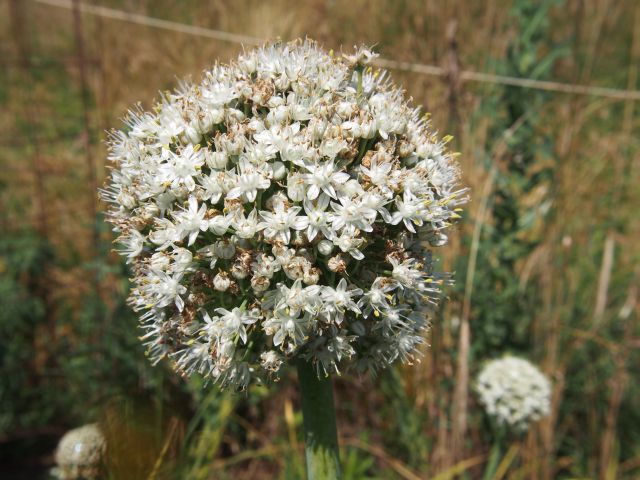
OLYMPUS DIGITAL CAMERAThere are so many contenders for imaging – the hop plant reaching greater heights, the muscadine vines ever multiplying.  I shall have to be selective and show one of my onion plant heads which I am allowing to go to seed and provide for next year.

OLYMPUS DIGITAL CAMERA

first apple harvest

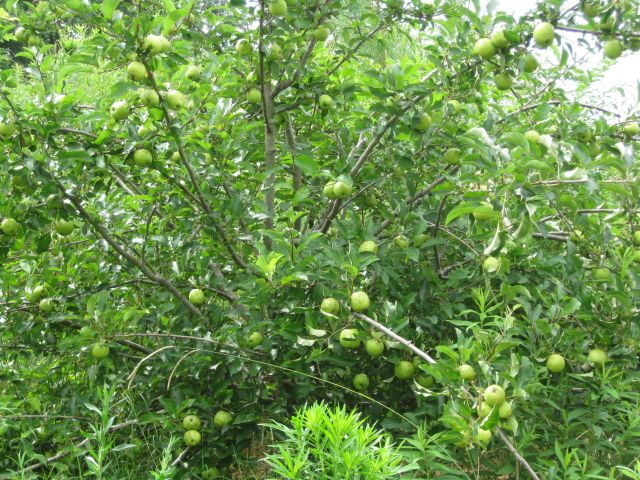
My Pristine apple tree is the first to ripen in my orchard and each day drops many apples.  In Atlanta and northwest Georgia we have had record making rains, so the apples are relatively large, very juicy and, for the Pristine, relatively sweet. I do not spray so, inevitably, there are occasional visitors but these are easily removed with my pocket knife as I gorge away.   Nice thing about not spraying is I don’t wash my fruit and I eat the skin.

the Pristine apple tree - it had a lot more apples last week
the Pristine apple tree – it had a lot more apples last week

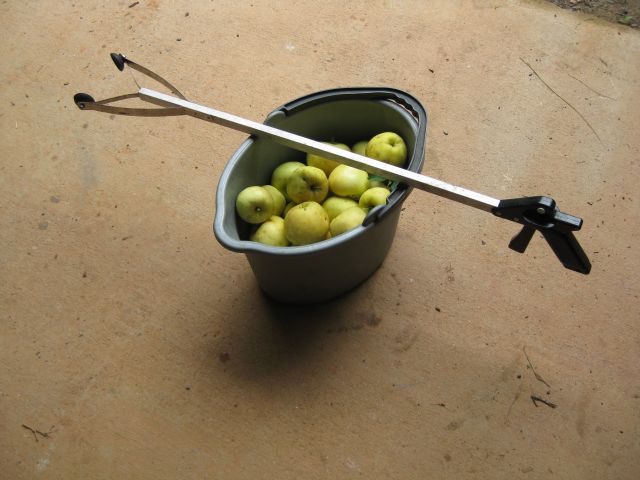
Since there are too many apples for consumption I decided to dry and store them.  We had a rigorous debate about using apples which had fallen to the ground.  My view is they fell because they were ripe for eating and, provided I clear them each day, they are relatively fresh.  The more informed view was that there is a risk of contamination (salmonella) which even washing and skinning does not allay and, if I was the only one eating them – fine, otherwise no ground apples.  So I hand pick the apples from the tree – the trick is to test only the yellow ones (ripe Pristine apples are yellow) and if they need more than a nudge, leave them for tomorrow.  I also use my arm extender shown below.  (see update)

my extension arm apple picker

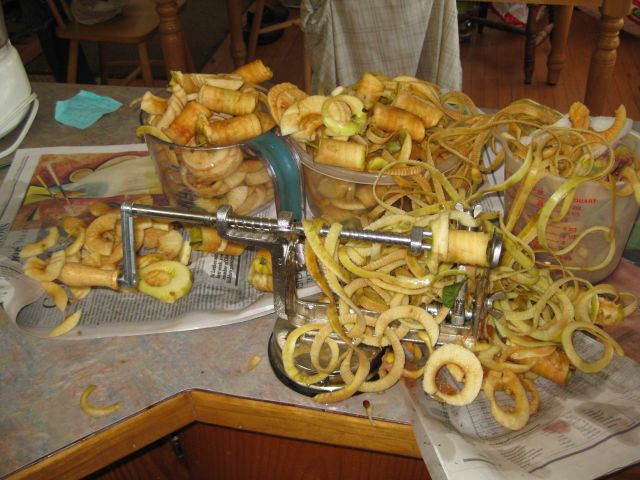
Then to the coring station – I use a handy contraption which peels, cores and slices at the same time, and very quickly too.  Since the slices are thin it is easy to notice any ingredient other than apple and to exclude that segment from the lineup for the dehydrator.

the handy apple peeler, corer and slicer

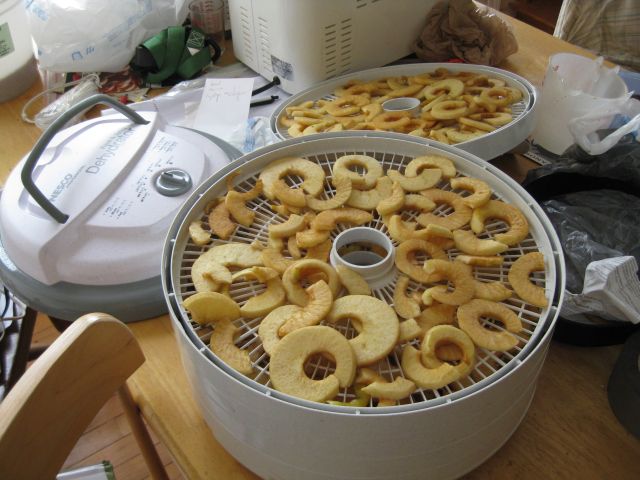
I do not pre-treat the apple slices since I don’t mind some discoloration and I want to keep out all additives, even fruit juice.  Then I load each of the trays which come with the dehydrator.


one of five dehydrator trays

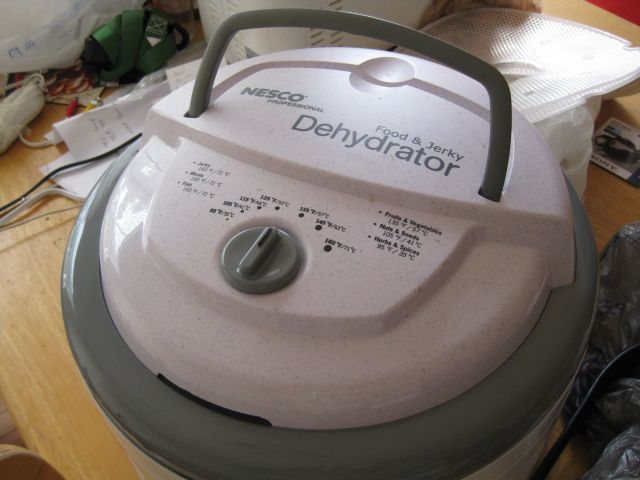
Finally, close up the dehydrator, set the temp initially to 155 deg for 15 mins and then back off to 135 deg and take a look see 6 hours later.  When the slices are leathery dry I pack into zip lock bags and freeze.  And they taste so good.

my Nesco dehydrator
my Nesco dehydrator

Update

Picking, processing and dehydrating apples is now a regular first thing in the morning event.  To avoid wastage and missing out on the ripest apples, I cut 2 6′-10′ sections of 6mil clear plastic sheets which I located under the apple tree.  Now each morning, rather than picking from the tree I simply collect the apples which fell the previous day.  Because they have not come into contact with my animal fertilizer, compost or the ground we are not concerned about contamination.


Is meat good for you? – the Finnish debate and Mummies

An examination of post mortem records of Finnish hospitals before and after the 2nd World War shows that deaths from heart disease declined significantly during the war years.  Some researchers have concluded that the decrease was because of reduced consumption of fats (meat, eggs, dairy and butter) as a result of shortages during the war years.  Apparently deaths from atherosclerosis (hardening of the arteries) did not decline as much in the United States and this is attributed to more severe food shortages in Europe than in America.  This trend was also observed in the Scandinavian countries.  See this link -http://www.epi.umn.edu/cvdepi/slider_morta.swf .   A full blown analysis is available at http://healthylongevity.blogspot.com/2012/08/forks-over-knives-and-healthy-longevity.html.

Correlation does not mean cause.  Subscribers to the Paleolithic diet, also referred to as the hunter-gatherer diet, take an opposite tack and believer that a large intake of meat and fish is good for you.   Their meat and fish is not purchased in a supermarket but taken directly from nature.  A hunter acquaintance said he will only eat meat he has personally killed/”harvested” since only then does he know what he is eating.  He also avoids most fish.

Now to complicate matters a new study released in March 2013 suggests there was atherosclerosis in mummies from 5,000 years ago.  This has produced a slew of differing interpretations.  A friend, who is not against junk food, argues that these findings show that junk food is not the cause of artery hardening since junk foods were not around 5,000 years ago.  Another argument is that hardening of the arteries is a natural aging process influenced perhaps, but not significantly, by nutrition.  To further confuse matters the mummies which were analyzed came from different parts of the world where some were hunter-gatherers who ate a lot of fatty meats, and others were from agricultural societies where they ate grains as well as domesticated animals.

This stuff is complex (as opposed to complicated, which means you can eventually figure it out) and, as with the debate on global warming, the experts are not definitive.  The best they can offer is the palliative that exercise, avoiding tobacco, and eating healthy will all help to reduce heart disease.


the traditional Okinawan diet and the sweet potato

My root crops (carrots, turnips and beets) are growing better as my soil has improved with time and I am now planning for the sweet potato.  There are several vogue diets circulating – the Mediterranean diet; the Esselstyn vegan diet I posted a few weeks ago, and the new Nordic diet (a free Coursera MOOC starts September 2013).  So why go back in time to the traditional Okinawan diet with its reliance on the sweet potato?

I was pointed to the Journal of the American College of Nutrition 2009 article titled: “The Okinawan Diet: Health Implications of a Low-Calorie, Nutrient-Dense, Antioxidant-Rich Dietary Pattern Low in
Glycemic Load”.  The title tells you much about the diet. Okinawa is a prefecture of Japan whose residents are very long lived and this is attributed to their healthy life style including their traditional diet.  The authors compare this diet with the traditional Mediterranean diet and DASH (Dietary Approaches to Stop Hypertension) and note that the traditional Okinawan diet is lowest in fat intake and highest in carbohydrate intake especially of orange-yellow root vegetables primarily the sweet potato, which is also antioxidant rich, and green leafy vegetables.

You probably notice “traditional” surfacing a lot – the authors note that changes in the diet since World War II have been for the worse with younger Okinawans now more prone to obesity and other chronic diseases than older Japanese.  A helpful chart shows that in 1949 almost 60% of the calories were from the sweet potato with about 13% from rice and 0% from bread.  In 1972  less than 5% was from the  sweet potato.  Other features of the traditional Okinawan diet are lots of vegetables and legumes (mostly soy); some fish; little meat and dairy, and some alcohol (phew!).  The emphasis is on low GI carbohydrates – the sweet potato has a GI of 55 compared with 75 for the Yam and 90 for the Irish potato.  The article details other functional components of the traditional diet.

So I was pointed, I read, I converted and have now placed an order for 36 Southern sweet potato slips to be delivered and planted in April.