why austerity should work, but doesn’t – from an organic grower’s perspective

Austerity is not a novel tactic.  Micawber recommended, though failed to implement it when he proclaimed in David Copperfield:

“Annual income twenty pounds, annual expenditure nineteen pounds nineteen and six, result happiness. Annual income twenty pounds, annual expenditure twenty pounds ought and six, result misery.”.

With an austere regimen, including food discipline and exercise, the overweight human gone to seed can be restored his former efficient self.  And it can also work for struggling countries.  The problem is when the degenerative process has gone too far.

When planting a tree you wish to become self sufficient you make sure to give it a good start.  A planting hole with boulders removed and some, but not too much nutrition for the first few months, is good.  Watering is key and should be weekly and deep.  If you water daily and feed it well, it will become accustomed to easily available surface water and nutrients and so it will not need to extend its roots deep into the ground.  And all will be well provided you continue its cosseted lifestyle with periodic spraying against pests and fungi.  It will be happy and productive but dependent on your continuous support.  And if one day the source of water and nutrients fails, it may not survive.  It roots will not be able to tap the water and nutrients located deep in the soil.  And if pesticides are withdrawn its succulent unchallenged growth will provide easy fodder for the insects, browsers and fungi that descend upon it.

You may say this analogy is far fetched.  But is it?  Populations that have lost their self reliant ways as typified by the expression “you eat what you hunt”  depend for their succour on past treasures (wealth accumulated by disciplined ancestors), or present resources (fortuitous mineral reserves) or future earnings (spending with debt to be borne by future generations).  The extent of the problem can be gauged from the amount and duration of trade deficits.  The trade deficit is an objective, timely (every month), accurate measurement of how well a country’s people, infrastructure and resources compete on the international stage.  For some countries good luck goes a long way such as countries rich in mineral resources (Middle East, Australia, Canada, and Russia for natural gas).  But for most countries the balance of trade (surplus or  deficit) measures competitiveness.  For a rapidly growing country a deficit may be expected in the early years of growth as the industrializing country develops its transport, communications and manufacturing infrastructures.  But when  mature countries such as the United States and Europe (Germany excepted) run continuous huge monthly trade deficits then this is the clearest indication they have lost their competitiveness to hungrier more agile competitors.  Their deep roots have shriveled and they are dependent on continuing doses of synthetic nourishment from their central banks.  In these circumstances a hefty dose of austerity not only won’t work, it can threaten the patient, as would sudden exercise the obese human.

The road to recovery must be slow and arduous – such countries will have to dismount their pedestals, tighten their belts, and learn to compete again for the manufacturing jobs which they bid quick good byes to in the happier days when service jobs seemed preferable.   Now distant competition is doorstep competition and service jobs (excepting those requiring a physical presence such as construction, plumbing or hairdressing) can be delivered quickly and efficiently through the internet from anywhere in the world.   Whole swaths of services from accounting, legal and medical research, to engineering, education and design services can now be contracted out to the best international competitor.

Remaining resources should be shepherded – the fracking bonanza must be frugally deployed, lest 30 years down the road we find ourselves where Britain is today with diminishing North Sea oil reserves and a steep hill to climb.  And the yardstick for measuring recovery should be, as Micawber suggested, the net of our inflows and outflows i.e. our  imports and exports as shown in the monthly balance of trade results, rather than unemployment, interest or inflation data, which respond to various stimuli but do not truly reflect the innate health and viability of the country.


rampant nostalgia

I have heard of misty nostalgia when we revisit scenes from the past, often with selective vision ignoring what was bad.  I am now seized with rampant nostalgia.

A couple weeks ago the NYT Sunday magazine featured an interview with the author John Le Carre’.  I had tried his books several times the past 30 years and never got past the first 30 pages.  I was out of tune with his writing.  With T.S. Eliot it had been different.  I was aware that Eliot was a top poet (though he held several unfortunate views, from my perspective) and admission to the level of cognoscenti required diligent reading and learning until suddenly, as a plane emerges from the clouds, the turbulence slipped and I could see and appreciate.

But LeCarre’ was not on a mountain peak but a well regarded spy story writer.  And despite the recommendations of several London colleagues who read him on the tube and wherever else possible, I was not attracted.  So I was drawn out of curiosity to the NYT interview and liked that he was in the spy business and therefore well qualified to write on this genre.  I decided, to order through Amazon used copies of the 4 recommended novels.  And I am now 100 pages into the second, “Tinker, Tailor, Soldier, Spy” which was written in 1974 and I am flooded with memories of my 8 year’s life in London during the late 70’s and early 80’s.

My first few month’s in London had required rapid adaptation.  The checkered suit which my Johannesburg tailor assured me was the business fashion in London, immediately drew my manager’s attention “do you think we are going hunting?”.  But as the months and years rolled by I acclimated to London and the City of London and the culture and norms.  Then on to America and another big change.  And now I am avidly reading the cloaked  banter amongst individuals in a firm, ironically called the “Circus”, and the buildings and weather of London and I am instantly transported back in time and yes I probably do have my selective vision glasses on, as I again walk those streets.


Is not impermanence the very fragrance of our days?

I have a 50 minute drive to my property.  And NPR informs and entertains.  Except during the 2 week fund raising campaign.  Then I have to improvise and, since I have a basic truck which does not have a connection for mp3, I burn podcasts on CD’s and listen, intently, since you cannot rewind a missed phrase but must go b ack to the beginning of the track.

A review by Paul Wheaton on the self sufficiency and sustainability practices of the Japanese during the Edo period (book “Just Enough” by Azby Brown) kept me going for several days.  But I needed more.  In the past I listened to and enjoyed Krista Tippett broadcast interviews.  I downloaded a few and today I heard her interview with Joanna Macy, a Buddhist scholar and translater of Rainer Maria Rilke.  Exquisite.  They discuss two different ways to approach environmental degradation – the scientific informed approach armed with research, statistics and photographs, or from our being as part of this world.  I am working my way through the former but a beckoning portal has been illumined for me.

Here is the poem  from which this post’s header is taken:

Wild Love

Is not impermanence the very fragrance of our days?

Flare up like flame
and make big shadows I can move in.

Let everything happen to you: beauty and terror.
Just keep going. No feeling is final.
Don’t let yourself lose me.

Nearby is the country they call life.
You will know it by its seriousness

Give me your hand.

– the poetry of Rainer Maria Rilke translated by the philosopher of ecology Joanna Macy

Down Under takes a stand – almost

Hurricane Sandy late last year hammered the northeast.  I read the articles and listened carefully to NPR for a consensus from the scientific community attributing the cause of the hurricane to global warming (I use “global warming” and “climate change” interchangeably). There was no consensus nor did I hear a scientific expert unequivocally say that global warming caused Hurricane Sandy.  No shortage of laypeople expressing their views, including Mayor Bloomberg, but it seemed the scientific community was silent.

While there is agreement that the climate is changing and that man has a lot to do with this, only generalities have been offered as to the impact of all this on the weather.  Weather is the short term state of the atmosphere, while climate describes the typical or average atmospheric conditions.

It really is important for the scientific community to determine if the droughts in the mid-west and the severe storms we are bearing are caused by human activity.  If the droughts persist, and once the reservoirs have been drained, prime farmland will no longer be good for growing food and there will be huge loss in asset values and food shortages.  I view this not emotionally but pragmatically – if human activity is causing massive degradation in our environment which will seriously impact us, then the experts must expedite their research and step up and say so.

So I was very interested to read in the NYT yesterday that “Report Blames Climate Change for Extremes in Australia” (March 5, 2013: http://www.nytimes.com/2013/03/05/world/asia/australian-government-blames-climate-change-for-angry-summer.html?_r=0).

The Australian summer over the past few months has been brutal.  On almost every weekly chat with my Mom, who lives in Perth, the temperature was mentioned.  Many days it was in the low to mid- 40’s Celsius (for comparison 43 degrees Celsius equates to 109 degrees Fahrenheit).  This is truly HOT!

The report, issued by the Climate Commission (per the NYT “an independent panel of experts that issues reports on behalf of the government but is not subject to its direction or oversight”) is titled “The Angry Summer”.  It includes a slide which has catchy titles:  “Hottest January on record”, “Hottest Summer on Record”, “Hottest Day on record for Australia as a whole” etc.   A quick reading of the NYT article leads you to think that the Commission was saying that climate change caused the record setting temperatures and bush fires.  That is a problem with quick readings since you tend to merge the quotes from interviews with quotes from the report.  The interview quotes had good stuff such as the probability the heat was caused by natural events is  500:1 and “Not too many people would want to put their life savings on a 500-to-1 horse” or an analogy that the climate is like an athlete on steroids.  Persuasive images, but not in the report.

The report’s wording is more cautious such as: “All weather, including extreme weather events, is influenced by climate change”  and “It is highly likely that extreme hot weather will become even more frequent and severe in Australia and around the globe over the coming decades” and, finally as to causation “The decisions we make this decade will largely determine the severity of climate change and its influence on extreme events for our grandchildren”.

“Influenced by”, “Highly likely” and “Largely determine” are hardly words which will catalyze action.  But still, a step in the right direction.

a silver lining to faltering memory, also BMSB and IPM

I find that my memory does not work as well as in the past.  As a student I could easily memorize hundreds of law cases, now the labels I read one day are gone the next.  So where is the silver lining consolation?

I believe we have different skill sets and we compensate for those we lack.  The kid who can analytically unravel and reassemble complicated concepts  tends to be independent and does not require and consequently does not develop, good social skills.  The ambitious kid, who does not have this intellectual firepower, develops intuitive and empathy skills and thus can effectively recruit others to assist with or perform the tasks he/she finds difficult.  Perhaps it is our innate intellectual and physical abilities that fashion to a large extent our personalities?

So I am now more interested in how and why things happen than in the fact of their happening.  If I can link causation with result then my mind can re-navigate the route without having to remember the start or end point or even the directions taken.  An example from the recent GO conference (see previous post) was the excellent session on organic insect control by two entomologists from Auburn university.  I was particularly interested in their comments on the BMSB (brown marmorated stink bug) which is becoming the organic growers nightmare.  Not all stink bugs are pests and there are predatory stink bugs which are beneficial and whose prey are the pests we wish to eliminate.  You can google and find descriptions of the difference between the good and the bad stink bugs perhaps the shape of their shield or certain colorations.  But these are facts which must be memorized, not my strong point.  Much more helpful was the comment by one of the entomologists – look at their jaws/mandibles.  A powerful apparatus is for munching prey, a pointed beak type is for piercing and sucking out plant nutrients.  Now that logic I can recall without having to memorize.  As for eliminating this pesky pest they advocate trap crops and perhaps a vacuuming device tonguetwister titled “backpac bug vac”.  Worth pondering as I await the onslaught in late summer.

IPM (integrated pest management) was mentioned in several sessions and I found the schematic in the session on organic management of diseases easy to follow and remember.  At the base of the triangle are “preplant considerations” which includes soil fertility; site selection (for sun exposure, soil drainage); site preparation; rotation; using disease free seed and disease free planting material, timing of planting, spacing of plantings, plant selection (if a disease is blighting your crops then choose a disease resistant variety) and diversity of plantings. These are all logical first steps for before and at the time of planting.

Next level up are the biological controls which includes beneficials (this pm I transferred more lady beetles from the bathroom to the cold frames), Bt, and other ecologically sustainable techniques.

Another level includes physical and cultural controls such as row covers, lure traps, cultivation of weeds, sanitation,  and adequate irrigation (but not overhead spraying because of  foliar disease, especially in the hot humid Southeast).

And all the while observing and monitoring and if a certain threshold of pest/disease invasion is reached, then resorting as a last resort to nastier remedies which, while organic, will impact not only the bad guys but the good guys as well.  The basic premise is that healthy strong plants, which are not stressed (lack of watering is a big culprit) or injured, will be able to resist pests and diseases adequately.  If you grow organic you should be prepared to share, but not too much.

So this is all logical and dovetails with my growing experiences and this is one reason why I enjoy growing.  I sense that among sports enthusiasts recalling and recounting the details of past games and greats and scores is part of the pleasure.  Or the opera enthusiast who happily describes to those unfortunates within earshot how this particular aria though well delivered, does not compare with soprano A, in opera house B, in year C.  These feats are beyond me and I settle for the simple pleasure of trying to better understand, without committing labels to memory, what is going on in the outside spaces.

5 steps to conversion and organized skepticism

The nice thing about engaging in politics while running is you work out your anger quickly and without upset.  If you engage too loudly or passionately, your companion/opponent may edge away or pick up speed or become distracted by the passing natural attractions.  In the event, no harm is done, and you both feel better for the exercise and the ridded emotions.

On the topic of global warming, Bob has made some progress over the past 5 years and is now at level three of the five step climb which are 1) the climate is not warming; 2) even if it is warming this may be good not bad since we now have access to the mineral resources of the Arctic, etc.; 3) it is warming, I agree this is probably not good, but there is no reliable evidence it is caused by humans; 4) it is warming, it is bad, it is caused by humans but there is nothing we can do about it or we will become non-competitive if we try fix the problem; 5) I agree, let’s try fix it but isn’t it too late?

A frequent rejoinder by Bob is that the scientific community is in cahoots and cannot be trusted.

And this is where “organized skepticism” enters the picture.  My current MOOC ( massive open online course) at Coursera is titled “Science from Superheroes to Global Warming” and intends to make the layperson (me) knowledgeable about the scientific process.  Organized skepticism is the process where the scientific community aggressively reviews each other’s work to find errors.  This may be done in the pursuit of a higher truth or simply because we are human, competitive and egoistic and if someone else claims to have taken a big step forward our first instincts may not be to congratulate but to find fault.  I hate having to say to myself “now why didn’t I think of that?”

The laws of the universe apply everywhere the same (uniform), are unchanging (invariant), are measurable (discoverable) and, most importantly, experiments demonstrating these laws must be repeatable both by the person doing the experiment and others (reproducible, replicable).  So, unlike the social sciences, scientific evidence must be provided to support a theory and the community will challenge the data and the theory.  This rigorous process ensures that fraud cannot be perpetrated.

So when the scientific community agrees that global warming is occurring and is caused by humans, it is unlikely that it is in “cahoots”.

At this critical point in my narration to Bob he exclaimed “did you see that?” and, as our heads simultaneously swivelled, I realized once again how hard it is to make progress on global warming.

wood ash and the van Helmont experiment

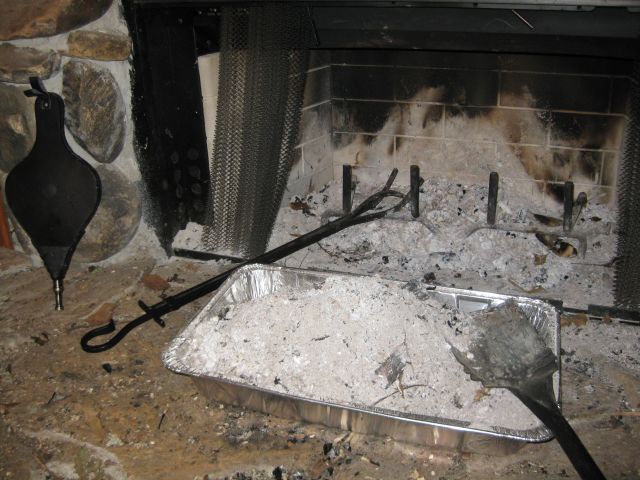
On cold nights I burn wood in the hearth.  Really inefficient with most of the heat going up the chimney and I am resolved to install, some time, a good wood stove.  However, what puzzles me as I stare at the burning embers is why there is so little residue from the logs.  The amount of ash remaining depends on several factors such as type of wood, moisture content and heat of combustion.  Seasoned wood has a moisture content of say 20% (water represents 20% of the total weight).  The ash remaining has a weight equal to say 1% of the weight of the wood logs.   So, after excluding the weight of the water (20%) and the ash (1%) almost all of the dry weight of the wood (79/80) goes up in the air.  And yet I thought that much of the weight of plants and trees came from soil ingredients, which I supposed were inflammable and had mass commensurate with the weight of the vegetables harvested.  And so, after big food harvests, I diligently supplemented the growing areas with compost.

wood ash after hours of burning
little ash remaining after much log burning

In 1600 before the advent of classical science and fancy measuring instruments, van Helmont conducted the famous willow tree experiment.  In his own words:

“I took an earthen pot and in it placed 200 pounds of earth which had been dried out in an oven. This I moistened with rain water, and in it planted a shoot of willow which weighed five pounds. When five years had passed the tree which grew from it weighed 169 pounds and about three ounces. The earthen pot was wetted whenever it was necessary with rain or distilled water only. It was very large, and was sunk in the ground, and had a tin plated iron lid with many holes punched in it, which covered the edge of the pot to keep air-borne dust from mixing with the earth. I did not keep track of the weight of the leaves which fell in each of the four autumns. Finally, I dried out the earth in the pot once more, and found the same 200 pounds, less about 2 ounces. Thus, 164 pounds of wood, bark, and roots had arisen from water alone.” (Howe 1965)

van Helmont believed that the 2 ounces loss in soil weight was a measuring mistake and that all the additional weight of the tree came from water.  We now understand photosynthesis where water and carbon dioxide are transformed into sugar (glucose) and that typically, 96% of the dry weight of plants is made up of carbon, hydrogen and oxygen which are obtained from water or carbon dioxide.   And the 2 ounces of soil missing in the van Helmont experiment represented vital macro- and micro-nutrients which are critical for the health of the soil.

So, I now realize that my challenge is not to replace soil consumed by my plants but to ensure my soil stays in balance and that I maintain an adequate supply of essential nutrients – light in weight but heavy in importance.  And I carefully save and disburse the wood ash as part of the recycling process, except to my acid loving blueberries and other low ph plants.

harvesting an oak tree and growth rings

I really am not into cutting down trees gratuitously, especially not an oak tree, which is one of my favorite trees.  When I made a road through the woods I selected a path which would require the fewest and smallest trees to be removed.  But this week I needed wood posts.  I did not wish to purchase the treated 4″ by 4″ posts because they are loaded with preservatives which will leach and be absorbed by the roots of my fruit trees, vines etc.  Composite posts deform and are expensive.  Even cedar posts rot over time.  I concluded oak posts should hold their ground for several years, which is all I need at this time.  But which oak tree to cut.  Unusually, several oak trees have two trunks from the same base.  Eventually the tree may split.  It seems to incur little sacrifice to cut one of the trunks, the one which appears less vibrant.  Then the root structure can feed the surviving trunk which will put out branches on the side where the other trunk stood.

mid sized oak tree
twin trunked oak tree with left trunk removed at point where trunks met

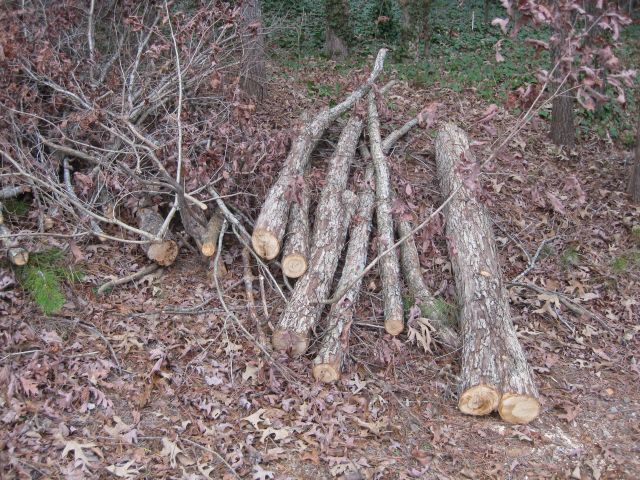
It was quick work to cut down the one trunk and then slice it to leave a main trunk and six 8 foot length future posts.  Plus the branches will dry and provide good firewood.  The main trunk is too large for a post and I ordered shitake inseminated dowel plugs so I can have shitake mushroom logs.  I have been very successful with shitake growing from oak logs.  Some of the posts will be used to carry the trellis for my kiwi vines which I recently planted.

oak tree offcuts
products from the oak tree – the trunk on the right will make shitake mushrooms, the 6 8′ posts will be used for trellises and the branches on the left cannibalized for firewood

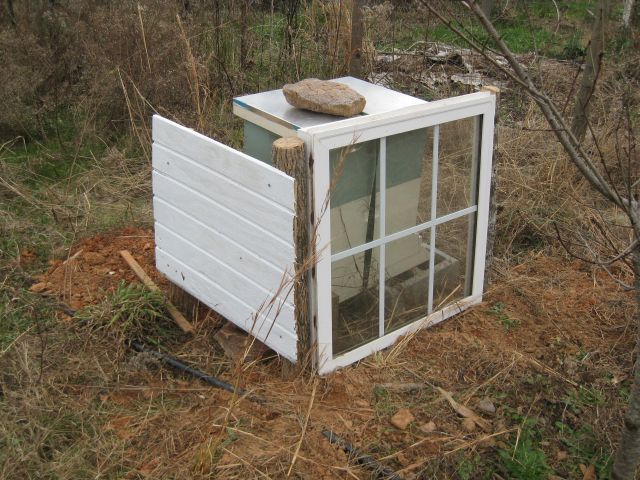
And there is always a use for oak posts.  My first beehive is well protected from winter winds but my second beehive needed protection.  With my clam posthole digger I dug 3 2 foot holes and grounded 3 small diameter oak posts to which I attached a surplus window for west wind protection yet still providing setting sun exposure, and a primed plywood rectangle for north wind protection.  My woods provide a windbreak to the east and I leave the south side open for the south facing entrance and because winds from the south are less common.

oak tree posts to support beehive protected sides
#2 beehive with west facing window and north facing plywood protection from winterly winds held in place by oak tree mini posts
winter protection held in place by mini oak tree posts
#2 beehive seen from east side, the three small diameter oak tree posts sunk 2 ft into the ground are clearly visible. also a strap to protect against upheaval from nocturnal visitors

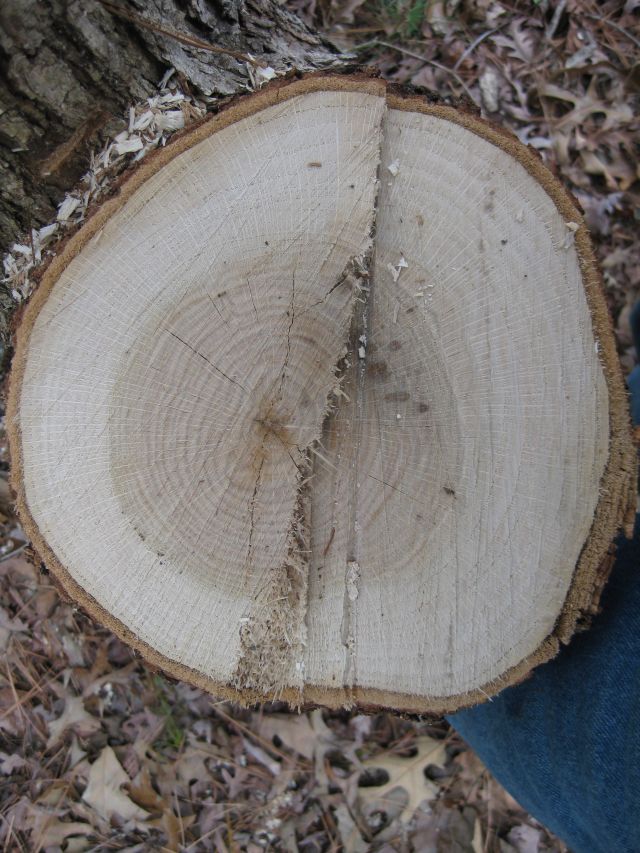
I happened to notice the growth rings on the stump of the oak tree and this got me thinking as to why there are growth rings.  I know about heartwood and sapwood – the heartwood which is at the center of the trunk is darker in color (from accumulation of compounds), provides structural support and no longer transports water and the lighter colored sapwood conducts water.

face of oak tree
heartwood, sapwood and growth rings on trunk of oak tree. I must still saw the face smooth and at an angle to shed rain

But what causes the growth rings which are the alternating bands of light wood and dark wood.  The light ring is produced by large thin-walled cells and the dark ring by small, thick-walled cells.  The large cells are formed during the rainy season when the cells grow and the small cells during the period of dormancy or no growth.  Dormancy occurs during the winter in cold climates and during the dry season in tropical climates.  I suppose if it rained evenly throughout the year you would not get growth rings?

why, in a forest, are the leaves of a small oak tree larger than a big oak tree?

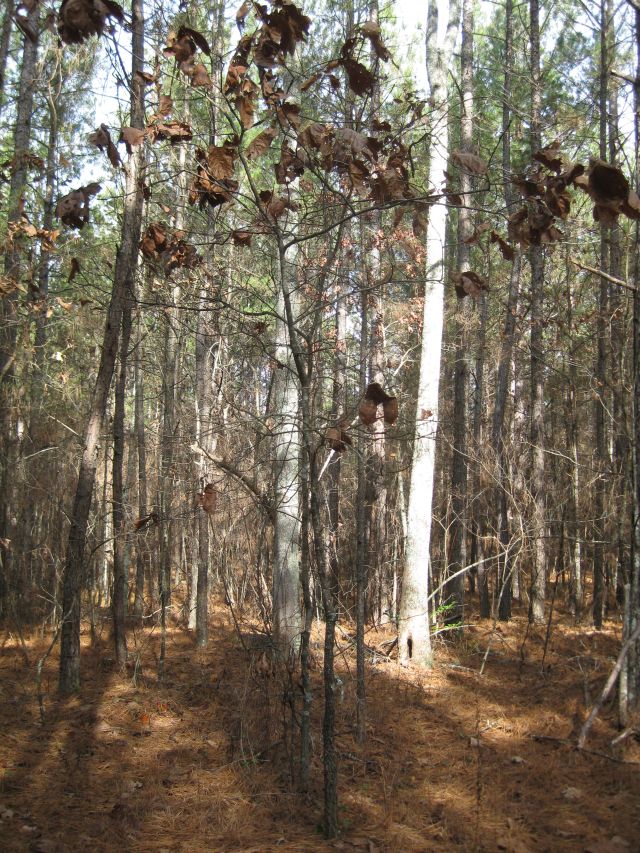
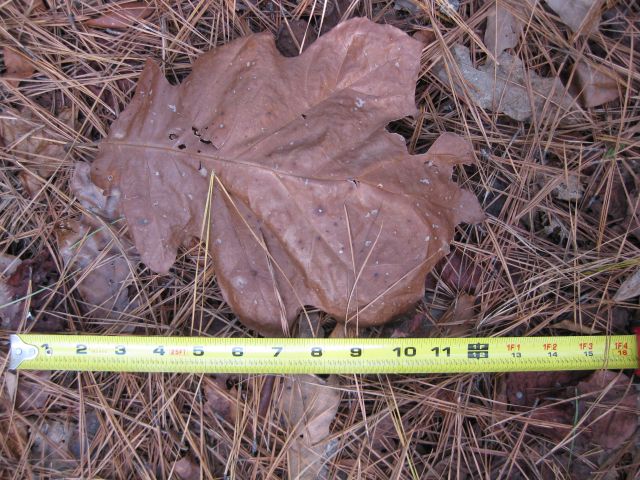
Yesterday, while walking through the woods, I noticed a very large oak tree leaf.  Automatically, I looked up and around for the parent and saw just large pines and then, on the side, a smallish 14 ft oak tree.  Could this small tree have produced such a large leaf, I wondered.  It still retained some leaves and indeed they were very large.

small oak tree surrounded by much bigger trees
small oak tree surrounded by much bigger pine and poplar trees

Now I know that oak trees will wait patiently in shrub form for an opening in the canopy above and then they spring to life.  I have found 1ft high oak trees with 4 ft tap roots and know that a shrub like tree can be many years old.  So to return to the riddle I hypothesized that the leaf size depends on the age of the tree and this smallish tree could be many years old.  But that doesn’t work since a large nearby oak tree which I know is very old, has smallish leaves.  And then, this morning, as I worked my way through my biology textbook, it fortuitously provided the answer.

one of the large oak tree leaves - measures a foot long
a big leaf from a small oak tree – measures a foot in length

Some variation within a species is due to genetic diversity within individuals but some is due to response to the environment  and this is called “phenotypic plasticity” meaning that the plant (its roots, shoots or leaves) are plastic or changeable depending on environmental conditions.  The textbook (Biological Science by Scott Freeman 3rd edition page 798) states that oak leaves are a prominent example of phenotypic plasticity.  Shade leaves (grow in the shade) are big and sun leaves are small.  Shade leaves provide a large surface in order to absorb as much sunlight as possible.  So that’s the reason why the small oak tree has big oak leaves compared with high standing oak trees which have direct access to the sunlight.

But then, the question could be asked, if absorbing sunlight is the priority why shouldn’t a big oak tree also grow big leaves?  Leaves lose water (transpiration) and the more exposure to the sun the more water loss.  In the shade however, humidity is higher and water loss is less so the large oak tree leaf in the shade can capture more light with minimum loss of water.

why metamorphosis?

If we accept that the living world around us did not just happen, but is the result of millions of years of adaptation and improvement the question rises for me – why do so many insects (and frogs etc.) go through metamorphosis?  I am referring to whole-change or complete metamorphosis where the juvenile form (called a larva) looks very different from the adult form.  Think of butterfly and moth caterpillars (larvae) which change into flying adults.  Or mosquito larvae which live and feed in freshwater and then change into pesky annoying mosquitoes.

I am not thinking here of the social insects such as ants and bees which also have complete metamorphosis and live in colonies where they are fed and protected by the adults.  I can understand that in a colony where everyone hangs out, it makes sense for the adults to take care of the kids and to groom them into community behavior and it is easier to feed and groom little dependent larvae.

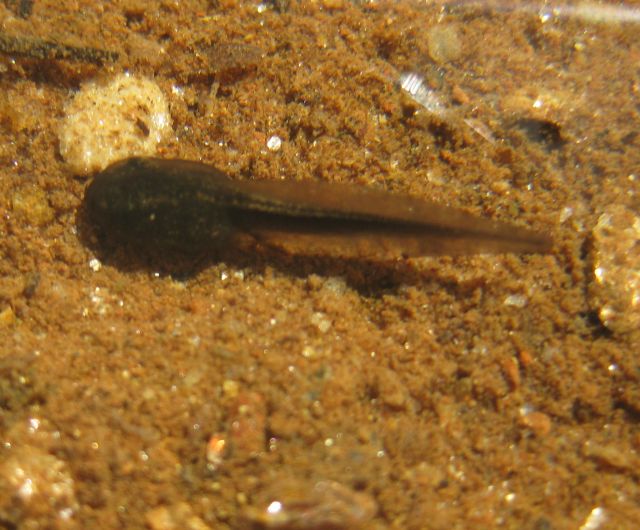
But what purpose is served by having a caterpillar larva precede the dainty butterfly?  After all, grasshoppers don’t have complete metamorphosis.  Instead there is a juvenile looking grasshopper called a nymph (wingless and sexually immature) which grows to become an adult.  Or the tadpole the frog?

tadpole in a pond
tadpole in the pond in the woods, just emerged from frogspawn

I posted that I was reading up on biology and in addition to the $10 textbook I acquired, I recently purchased a competing version for $4 (cost 1 cent, postage $3.99)  – Biological Science by Scott Freeman 2007 edition 1,300 pages which delves more into understanding the why’s of life around us.

The Freeman book offers two explanations for complete metamorphosis.  First is feeding efficiency, in that the adults and larvae usually feed on different materials such as the butterfly larvae on my vegetables and the adult butterflies on nectar.  So the kids are not competing with the adults for food, which improves the survival prospects of both adults and juveniles (the juveniles more than the adults).  The second explanation for metamorphosis is based on specialization in feeding and mating.  The juveniles are sexually immature meaning they cannot breed so they focus just on eating and since this is their specialty, they do so exceeding well.  The priority of the adults is mating and procreation and indeed some adults do not eat at all as they dedicate their life to ensuring future life.

All attractive hypotheses for this phenomenon of metamorphosis, something I had noticed but not considered.