quick visit to Australia

My Mother, two brothers and their families live in Perth, Australia and now my nephews and nieces have reached the marrying age, so trips to attend weddings occur frequently.  I was in Perth in January for a wedding and I just returned y’day from attending another delightful wedding.  Perth is on the other side of the world from Atlanta and it takes about 34 hours to reach there door to door.  There and back takes 68 hours and if you call it 72 hours then it is 3 days travel.  I was gone a week so 3 days travel for a 4 day visit.  But well worth it.

You cannot make a threat with impunity and Australia’s prime minister learned this when he said he would “shirt front” (grab a guy by the front of his shirt) Russian president Putin over the destruction of the Malaysian airplane which carried > 30 Australians.  This threat was intended for Putin’s visit to Brisbane for the G20 summit last weekend.  But when I arrived 2 days before the summit, Australia was distracted by the sudden appearance of a Russian flotilla including a nuclear armed cruiser, a heavily armed destroyer, a large tug boat and supply ship, and maybe a submarine.  There was much discussion and some anxiety about their purpose, whether  they would enter Australian waters etc.  In the event nothing happened but I don’t think Putin will be verbally threatened again by an Australian PM.

Australia is a beautiful country and with wealth derived over the past decade from its natural resource sales to China, an excellent infrastructure.  In Perth real estate is highly priced and more relevant to me is the cost of more than AU$4 for  a “flat white” coffee (similar to a latte).  But the big decline in iron ore, coal and copper prices as a result of the slow down in China, has hurt the economy, produced budget deficits and weakened the currency from more than US$1 a few years ago to US 0.86 per Australian dollar on my recent visit.  Which made the high prices more swallowable.

Australia, the birthplace of Permaculture, after much agonizing took a tack away from regulating CO2 emissions.  With the recent U.S./China agreement on steps to combat climate change, it was caught wrong footed and there was some embarrassment.  It has to  manoeuvre adroitly to keep both its banker (China) and its bodyguard (U.S.) happy.  A day after it was censored by the U.S. for not doing enough about climate change, it was happy to report a new free tariff agreement with China.

I like to find an Australian book to read on the journey back – fiction or non fiction, I don’t mind.  A nephew mentioned Monash and I bought the paperback “Monash – the outsider who won the war” by Roland Perry.  Monash was an Australian general and is credited with organizing and executing the fierce attacks on the German positions in the first world war, which broke the German army and ended the war.  I was unaware of this.  He is described as an “outsider” for good reason.  He was a volunteer not regular army, he was from Australia not Britain, his family was from Germany (though he was born in Australia) and in WWI anyone of German descent was regarded with suspicion, and finally he was Jewish.  Who would have thought that someone with this background would achieve such power and regard.

I have fired up the wood stove and wait for this early Arctic chill to abate.  Some say it will be a harsh winter.  My greens are holding up and the chicken were cheered when I tossed them some scratch.  No sign of life from the bee hive – hopefully they will emerge when it warms up the next couple days.
the worth of a civilization

I just received the Audubon special issue:  “Birds & Climate Change”.  I was forewarned of its depressing contents by news articles and recent podcasts.  Paging through it steered my mind to a discussion last weekend with one of my running buddies.

He said it was surprising how long the Sunni-Shiite divide had persisted especially considering the advances and scientific knowledge of the  Islamic Golden Age.  I replied this brought to mind my history studies of the tribal warfare which persisted among the tribes of southern African culminating with the conquests by the Zulus.  And then I added a comment I had read, that notwithstanding the killings and destruction, those events paled in comparison with the savagery amongst the so called civilized Western countries during the First and Second World Wars. So it is all about perspective, I said.

He  said “good point” and then added “we should leave the world in as good a condition as we find it”, thinking this was innocuous and would not occasion much discussion.  But this brought me to my next theme.  This is a worthy objective for an individual and for a society and civilization as well, but when we accept this as the primary yardstick for a nation’s or civilization’s contribution  (let’s ignore medical advances, rule of law, democracy, the technological revolution) the results of the analysis are disturbing.

For instance it can well be argued that the American Indians tended to and enhanced their natural surroundings.  This is the unavoidable conclusion you reach after reading “Tending the Wild:  Native American Knowledge and the Management of California’s Natural Resources” by Kat Anderson.  I have heard similar comments on the role of Australian aboriginals before they were largely obliterated.  So these native peoples left their environment as good as or better than when they found it.  And if this is the worth of a civilization then our accomplished civilization is doing poorly indeed.

chaos, determinism and health

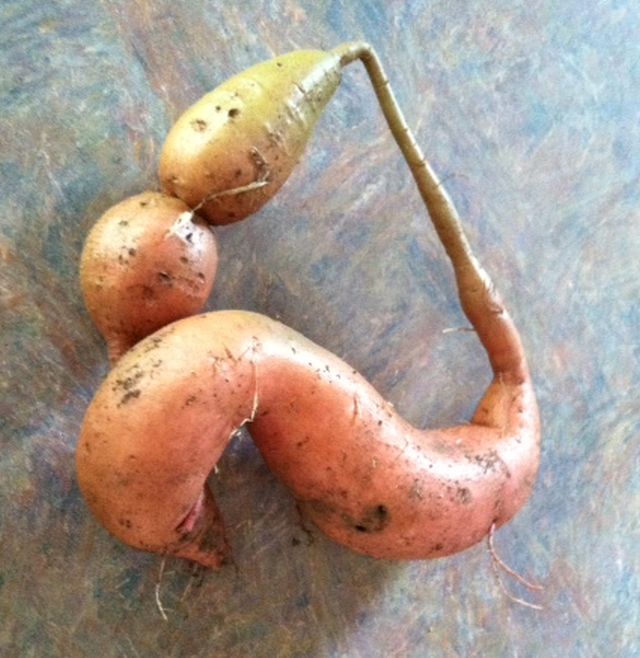
I am harvesting carrots, okra, muscadine, carrots, peppers and the occasional non insect damaged kale, collard and chard.  I am hoping for a decent crop of sweet potatoes – here is my first unearthed specimen:

my first sweet potato of the season - tasted good, not too sweet
my first sweet potato of the season – tasted good, not too sweet (much, much better than the “organic” sweet potato we purchased)

I am also clearing the beds of tomato plants and weeds and layering on compost, and seeding for fall.  Gives me time to mull on past conversations.  We just returned from a West coast visit where I met an old acquaintance and we began discussing climate change.  He said no one can predict the climate and exampled the so called “butterfly effect” as evidence of the existence of chaos.  When I challenged the concept of chaos he gave as proof, the double pendulum example.  Think of a pendulum swinging back and forth and attach a second pendulum to the first pendulum.  As of now no one can predict how the second pendulum will swing.  My friend said this proved there is chaos out there such that where things are influenced by chaos we cannot predict the outcome.

And this is where I disagree.  Pendulums swinging back and forth are mechanical operations and therefore deterministic, by which I mean if we can identify  (know and measure) all the factors which influence the movement of the pendulum (friction, temperature, wind movement, gravitational pulls etc.) and if we have the technology and know how to compute all these factors, then we can predict the movement of the second pendulum.  I do not accept that with mechanical operations there is some wreaking force out there which confounds predictions.  Similarly one day we should be able to better predict climate change and weather.

The concept of determinism sidled into a different conversation.  I have varied discussions with my runner/walker buddies (more of the latter as the years advance) and since I cannot participate in the college football discussions (don’t have the environmental conditioning or background) I become more vocal when they veer to health (interest in health waxes as running wanes).  And also in this area I encounter strong views such as that genetics determines most health outcomes (e.g. “my son and I both have GERD, it is genetic” – GERD =gastro esophageal reflux disease).   So here in a non-mechanistic environment where we are dealing with immense complexity, variability and unpredictable genetic evolutions, a deterministic approach is adopted. And in the previous example where we describe a mechanistic setup uncomplicated by life forms, a non-deterministic, chaos theory is proposed.  What gives?

For the health scenario, probably when things go wrong we accept the event better if we can convince ourselves that we are in no way responsible for the outcome – it was either someone or something else that caused it or the genes we inherited.

My runner/walker buddies exercise weekly and avoid junk foods,  and look out for the happy combination of fine dining and healthy eating, with the emphasis on the former.  We always breakfast after our run/walk and as they tucked into their ornate egg omelets, and me my oatmeal, I was asked me casually if the “food Nazis” had yet attacked eggs.  So even for the well informed, guidance on healthy eating is not welcomed.

PS – I enjoy eggs produced by my free range, untreated chicken, tho I will admit, if pressed, that the grain which supplements their browse, does have GMO content.

leveling my fig tree and preparing the tree nursery

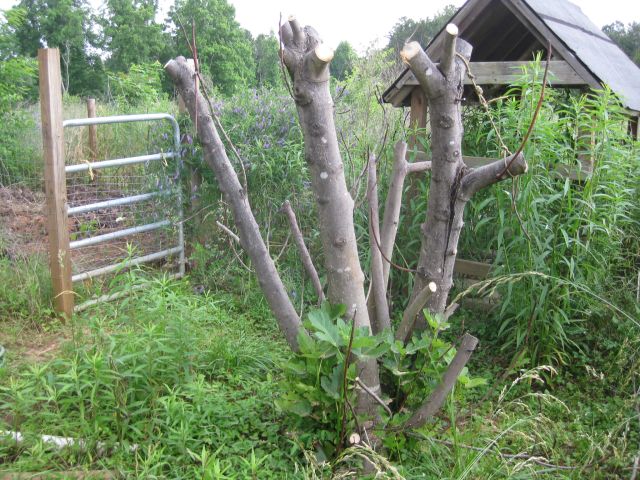
The property came with a big fig tree about 15 ft high and 15 ft broad which bore delicious figs each year for the wasps and me.  Then came the cold January weather when the temperature fell close to 0 deg F, which is cold for this area and unaccustomedly cold for fig trees which had not seen less than 10 deg F in the past 30 years.  Most of the fig tree died and, as they will do, it has produced growth at the foot of the tree.  My neighbor came by and nicked the tree in various places and suggested I prune the dead wood and leave the green tissue bearing trunks.  Which I did.

the still live trunks of the fig tree

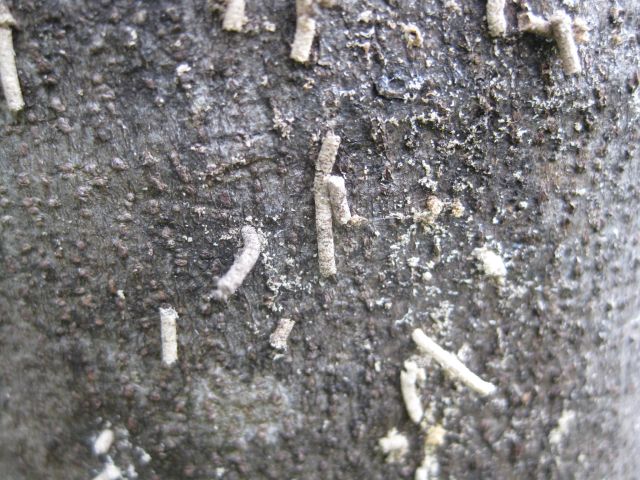
But the trunks did not sprout any growth and the activity which I noticed was not what I wanted to see.

excrement from borer attack on fig tree trunks

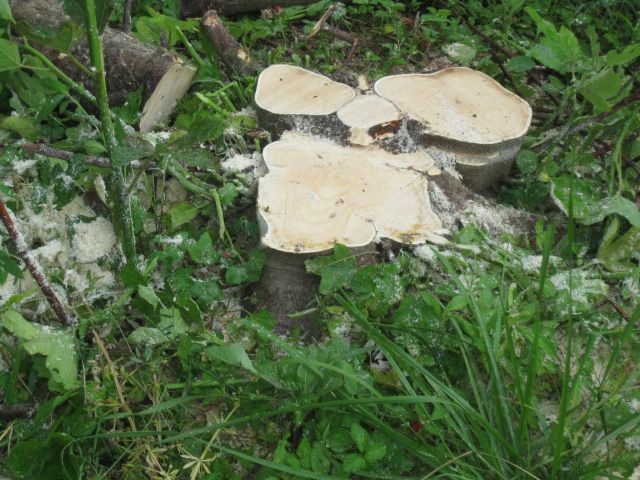
So the nutrition provided by the roots was feeding borer insects.  Another neighbor confirmed that all the fig trees in the area had died and the advice he had received was to cut them down to ground level.  Which I did.

my decapitated fig tree

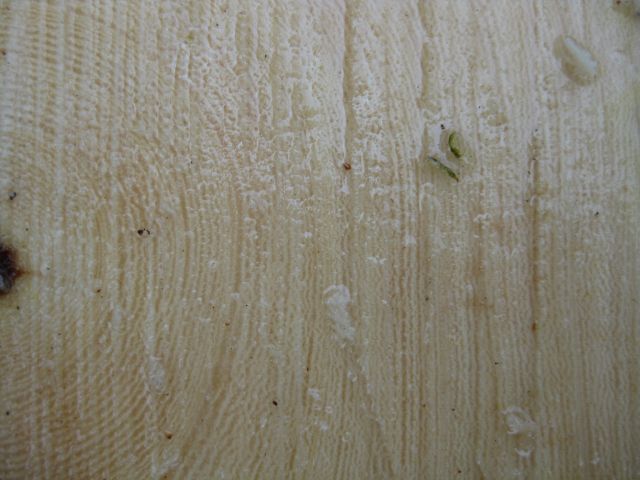
I was curious as to the age of the tree and looked at the annual rings but could not make sense of them – there appeared to be over 80 rings, perhaps they were not all annual rings.

many many tree rings - surely the tree was not that old!?
many many tree rings – surely the tree was not that old!?

And what to do with the trunks.  A few paces from the fig tree site is my tree nursery – I call it so because when I receive (purchase or cultivate) trees after early spring I grow them in this area until the fall when, with cooler weather, they have a better chance of surviving.  I am preparing the site for 40 nut trees expected in June.  This area is shaded from the setting sun by a huge maple tree.

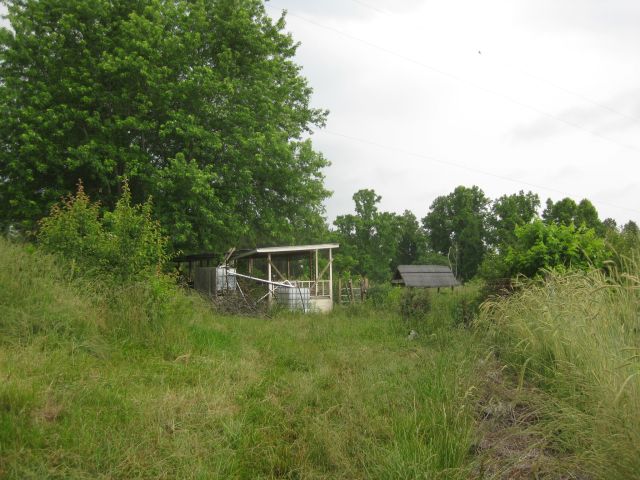
the "tree nursery" is to the right (east) of the deck and the large maple tree
the “tree nursery” is to the right (east) of the deck and the large maple tree

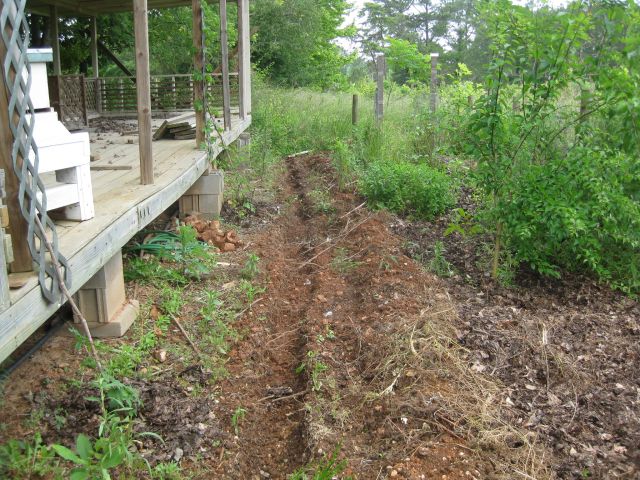
Only problem with the maple tree is its roots which sneak in and feed on my composted soil.  So I dug a trench between the growing area and the maple tree and severed offending roots.

to the right of the trench are a couple of black locust saplings - their roots are supposed to fix nitrogen and I am leaving them in place
to the right of the trench are a couple of black locust saplings – their roots are supposed to fix nitrogen and I am leaving them in place

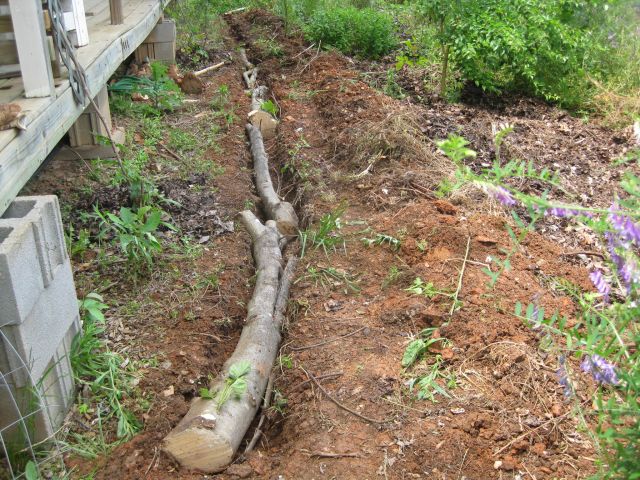
And then I placed the fig tree trunks in the trench where they will keep soil out of the trench, prevent weed growth, provide stepping stones for easy movement, absorb rainwater coming down the slope and add nutrients to the soil.

ditch partially filled with fig tree members

And while I was doing this I mulled over the events which produced such a cold winter with a polar vortex during an otherwise warming cycle.  My more conservative friends have explained to me that there is a silver lining to the warming in that mineral and fossil reserves in formerly ice covered lands will now be available for our benefit (I would say exploitation) as well as sea passages previously barred by ice (let’s ignore Miami, Florida and other low lying areas for the moment).  And even gardening enthusiasts have found solace from the expectation of growing less hardy trees such as citrus further and further north.  But if we have severe cold every few years then these southern transplants will be nailed.  It seems ironical and no cause for celebration, and perhaps nature is saying “if you f**k with me, I will with you”.


dilemma unraveled

In my previous two posts I described Randa the flying chicken who established a nest containing 15 eggs in the bush and how, after much debate, I relocated Randa and her eggs to the safety of a spare coop.  The dilemma was what would I do if say half of the eggs hatched, since I have chicken enough and would wind down rather than expand my chicken operations.

The potential dilemma dematerialized.  Although I had prevailed on Randa to sit on her  transferred eggs in the new nest box she quickly abandoned both and stared longingly at the rest of the flock lounging in the tree shade outside.  I think of the film cameras we used to use – the unexposed film sits in the dark behind the lens shutter and when you press the button the shutter opens for a period of time and light from the outside reaches the negative, and then it is dark again.  For 15 days Randa was in the pull of nature – she was not a domesticated chicken but a wild jungle fowl with an established nest in the wild matching wits with roving predators.  But once I caught her and moved her and her eggs to the coop the spell was broken, the shutter closed, and she became an ordinary chicken again.  She was still broody but did not recognize her eggs or the nest box I had made.

After two days of coop isolation I released her yesterday to the flock and although she and Wanda, the other flying chicken, quickly overflew the paddock fence to the outside, both came willingly to the coop for shutdown in the evening.  And the 15 eggs?  They have sat untouched for the past few days in the coop and I will bury them beneath a fruit tree to recycle their nutrients.

All of this instructive for me.  When we tinker with nature the processes are more complex than we think and the outcomes can be different than imagined.

dilemma – postponed

In y’days post I outlined the dilemma with Randa, the flying hen who established a nest beyond the pale (paddock) and my provisional decision to leave her there and let nature take its course.  Well my better half prevailed with the argument that once we take on pets (or chicken since they are not pets in our case) we assume responsibility for them and when we have domesticated them (select bred for egg productivity) they lose their instincts to survive in the wild.  Ergo, we could not leave little Randa on her nest and should bring Randa and her eggs under our protection.  A counter argument is that if she could survive for 10+ days out there she was perhaps not as vulnerable as we thought.

So, armed with secateurs to cut through the brambles and leather gloves I approached her hideout.

Randa on her nest as I approached

To my surprise she showed little reaction – did not hightail into the bush as I thought she would, and only protested as I reached out to hold her.  I transferred her to a spare coop where she made a lot of noise to the chicken spectators looking in.  Then I located a plastic container filled it with pine shavings and transferred the eggs from the nest.  How many eggs were there?

there are 15 eggs, all pale olive green showing mixed line from Ameracauna and Buff Orpington

15 eggs!  Wow this means she was accumulating eggs for the past 15 days.   She had been awol for 13 days so probably the 1st 2 she laid she did not sit on consistently.  Now here is a question – how many of these eggs are fertile.  If the rooster did not have contact with her during the 13 days she was gone will the eggs she produced during that period be fertile?  Bad news for me – apparently  the rooster’s sperm can remain viable in the hen for 3 weeks so it is possible that all her eggs could have been fertilized.  

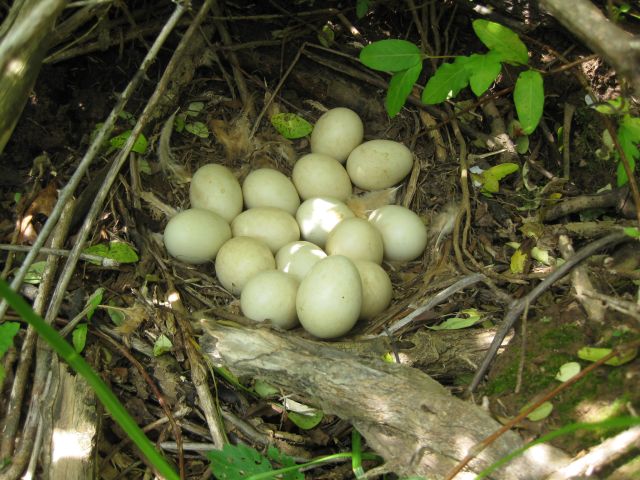
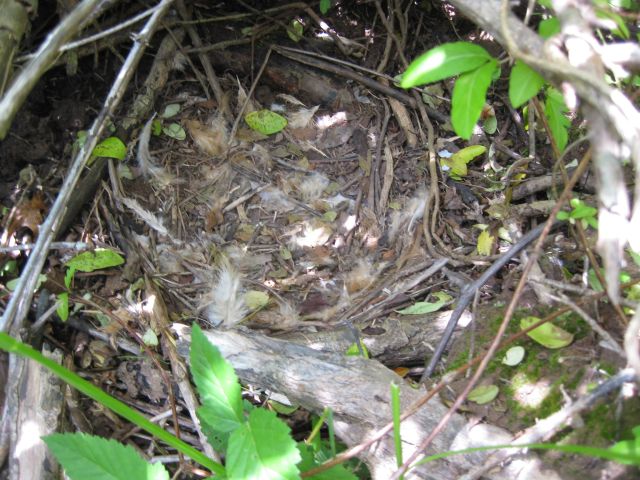
After I removed Randa and her eggs I took a pic of her nest, which is shipshape and furnished with some feathers.


Randa's nest
Randa’s nest

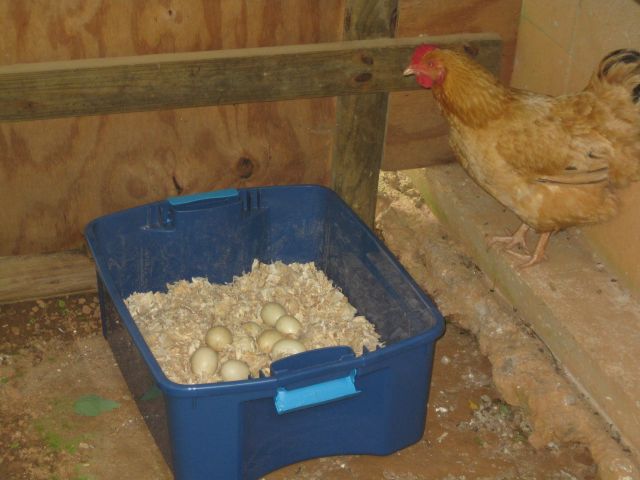
I introduced Randa to the blue plastic container which held the pine shavings and her eggs.  She was not happy.

Randa does not take to her new nest

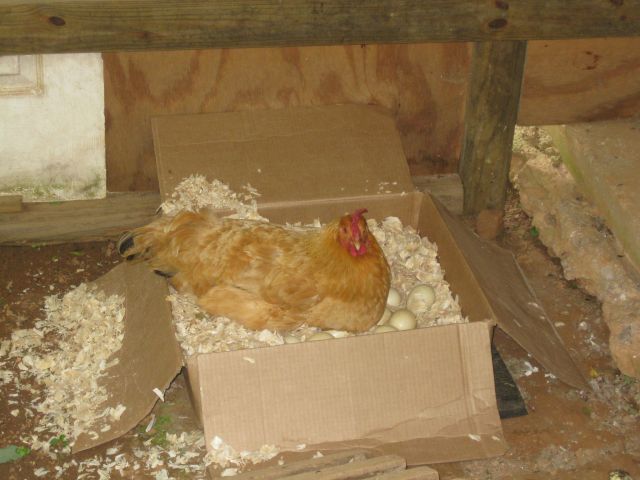
Perhaps the blue color was offputting, or the sides were too high or it was just too synthetic.  So I decided to use a low rimmed cardboard box placed on a thick rubber mat to protect it from the damp in the soil.  And I placed the aggrieved Randa on the new nest and stroked her for some time and then stepped back and she stayed put.

Randa on the new nest

So for the moment there is peace.  But I have a looming dilemma – if a lot of eggs hatch viably what will I do with them?

dilemma

I have a dilemma.  Since I retired I have had few dilemmas – no more the quandary of whether I should attend an important business meeting or pitch, vs a child’s sporting event/concert performance or family function.  But now I have a dilemma!

I mentioned in previous posts that we have 2 nimble chicken, Wanda and Randa, who easily fly over the paddock fence and that Randa had disappeared one evening but was there the next morning and we all celebrated with sunflower seeds.  But the next night she disappeared again and was not to be seen for the next 9 days.

We searched everywhere – there were no telltale feathers signifying a predator attack but even without the evidence I had concluded she probably had been done in.  And then yesterday (Monday) after a rain washed weekend, there she was outside the paddock, very bedraggled.  She greedily ate the sunflower seed and chicken feed I offered her.  I surmised that she had had a nest, that it had failed and that she had returned to the flock.  But a few hours later she was gone again.  What was going on?

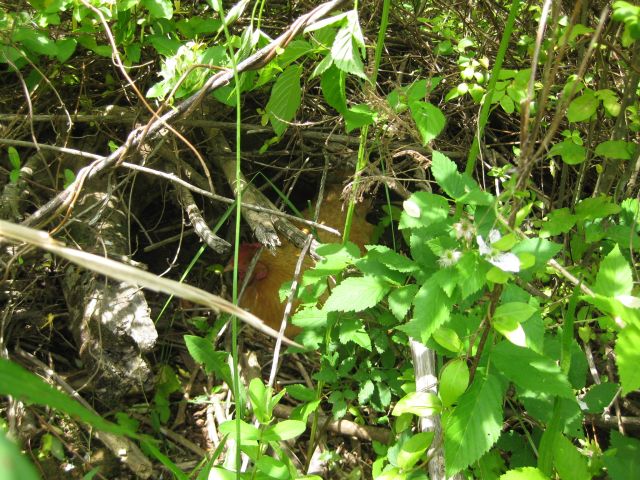
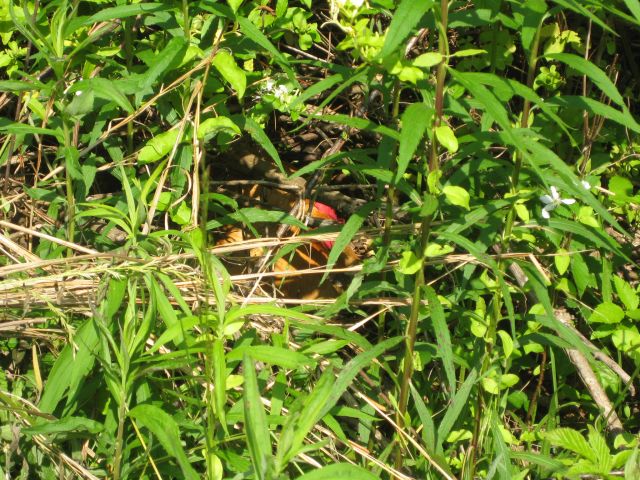
I decided that she must still have a nest and that it was probably close by.  I began looking and there, not to far from where she had appeared on Monday morning, was Randa on a well concealed nest.

Randa on her nest in the bush

The dilemma is what to do.  I can leave her be and there is a likelihood some predator (fox, possum, dog etc.) will find her.  I can try capture her and relocate her and her eggs to a 2nd coop.  Or I can chase her off the eggs, destroy the eggs and she will likely return to the flock.  And if she remains broody I can provide the same treatment which worked successfully on Yellow Legs who is cured of her broodiness and is now a regular flock member.

Since I would like to wind down my chicken operations in the near future, the last option seems the most practical and perhaps the kindest since in following her natural impulse she has placed herself in dangers way and if she is not discovered now, then when the chicks hatch and chirp a predator may get to them all before I can relocate them.

Relocating her and the eggs to a coop seems the best compromise but I doubt she will allow herself to be caught and will take off and return to her nest when I have given up  and will be more stressed.

Leaving her be could be considered cruel and uncaring.  But I am leaving her alone for now.  I feel at times that though we may delight in having pets and chicken there is something a little unnatural going on.  After all, chicken were once forest birds which we have bred to produce an unnatural large number of eggs, which has stressed them and reduced their lifespan and deprived them of the most natural of events – producing offspring.  Though with an incubator we do this for them as I have done a couple of times.  Perhaps I am thinking too deeply since this reasoning applies to my Trudy who has been neutered and seems to enjoy being with me and keeps a vigilant eye out for me and barks whenever necessary and keenly undertakes her daily rodent patrols.  But still I see nature’s hand here and will leave Randa alone for now, recognizing that each next morning all I may see of her are some scattered feathers.

what value different life forms?

I have been thinking of the different manifestations of life and their relative value.  Triggered by a recent local report of a man who had two dogs and had to relocate and could not take his dogs with him.  He approached neighbors to take his dogs and when no one was interested he shot them.  And was arrested. I cannot locate the news article and there may be more to it than I recall, but I can only speculate – maybe he didn’t take them to a shelter because they would be separated and maybe he thought it was better they were dead than lead a miserable life.  I don’t know.  But if he had killed a couple of chicken he would not have been charged.  And so, is the life of a dog worth more than the life of a chicken?

And what is life anyway?  There was a recent debate ( Intelligence Squared 120413 ) titled “Don’t Eat Anything with a Face”  which included Joel Salatin, a well known grass fed cattle farmer, who argued against the motion, and Neal Barnard an equally well known vegan who argued for the emotion.  The debate turned on both the health aspects and the morality of eating anything with a face.  Salatin became frustrated with the emotional appeal of the proposition and argued that not only animals but even plants and “every tablespoon of soil……has a million living organisms that are communicating, reacting, exuding auxins, creating DNA memories…,” and therefore if we think it is ethically wrong to eat animals we also shouldn’t eat plants and bacteria.  In similar vein a recent article by Michael Pollan (The Intelligent Plant – The New Yorker 122313) describes the new field of plant neurobiology and the view that plants have intelligence and consciousness (much turns on definition of these words), can communicate with each other and do things humans can’t.  So are they also a form of life?

Is the life of a big thing (elephant, giraffe, whale) worth more than the life of a small thing like a squirrel or mouse or insect?  We view human life as different from and more valuable than animal life so therefore a human life is of higher value than the life of a chimpanzee.

Is “value” the right word to use since it connotes $ value and then you have to think of the Davos forum report this week that the world’s 85 richest people have as much $ wealth as the poorest 3.5 billion – in simpler terms on average one of the 85 richest has as much wealth as +40 million of the poorest.  But we ignore wealth when we value human life and say all human life is equally valuable and stick with this convention, though an argument could be made about the relative merits of an infant vs. a geriatric and the fact is the wealthy through good eating, good healthcare and costly new life enhancing procedures can overcome genetic deficiencies and extend the duration and quality of their lives compared with a poor person.  But all human lives are treated as equally valuable and we hew that road – to do otherwise would result in an arbiter and the hysterically titled “death panels”.

We only value what we cannot get enough of – good air and water were previously not highly valued but in China good air in the cities is increasingly a critical concern and water in drought ravaged California could be a big issue in 2014.  So as we become more aware of our environment and why it makes sense to be good custodians, I predict we will expand our horizons to accept animals as sentient beings, stall the continuing extinction of species and extend a considerate hand to fellow sojourners on our earth.

recent visit to Australia and Thailand

I have family in Perth, Australia which is a long way to go when you depart from Atlanta.  On previous visits I travelled via Los Angeles and then Sydney or Melbourne to Perth.  I had never been to Bangkok and decided to include Bangkok en route which meant Atlanta to Tokyo to Bangkok to Singapore to Perth.  A longer travel time but an opportunity to explore Bangkok and Thailand en route.  I abandoned plans to spend a week in Thailand because the protests which started in December seemed unending and so I truncated the visit to a few days in Bangkok and departed the day before the protests gathered momentum and shut down the city center.  My visit to both countries was during the first two weeks of January 2014 and following are some observations.

Australia was named the gold country last year and for good reason.  It has a treasure trove of minerals, which it is mining and selling to China, and mining revenues have made it financially strong and financed the development of its infrastructure.  Some negatives are that its strong dollar has hampered other exports, and made it an expensive place for tourists and for local manufacturing.  Ford is ceasing car manufacture as is Holden, and other big employers are looking for government handouts.

An anomaly for me is the cost of a cup of coffee.  This must be a cultural thing – the only coffee you can buy for consumption comes out of a espresso machine and is variously styled cappucino, espresso, latte or flat white and costs at least A$4.  Drip coffee in a carafe is non existent though I vaguely recall I spotted and nabbed a cup in an out of the way gas station several years ago.  The coastline is beautiful

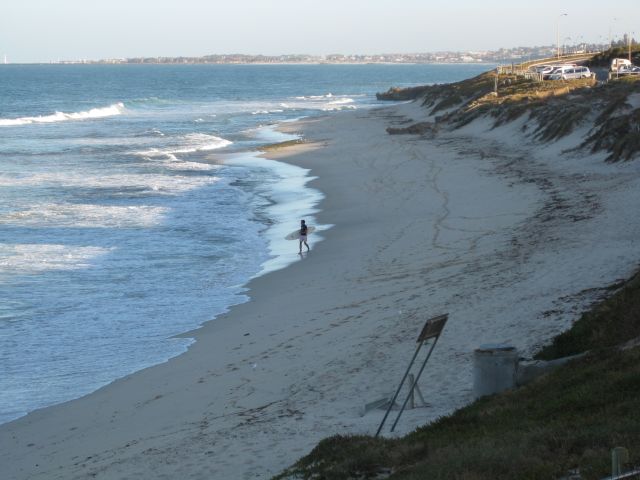
coast line at Trigg a northern suburb of Perth

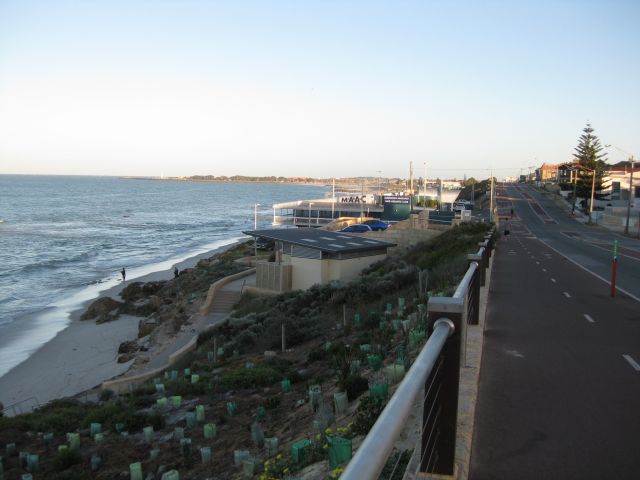
and I approve the practice of keeping the shore and adjacent land open to the public with the nearest private residences on the other side of the coastal road.

in order of priority from left to right is the sea; shore; plant preservation project; public vantage points; walker, jogger cyclist path; the road; and then private residences

They have a practice of “cutting down the tall poppies” which can manifest itself in locating government funded housing adjacent to expensive suburbs – I am no populist but an occasional dose of reality is healthy for turbocharged egos.  Finally, before I leave the golden shores, a thought on what I think, but no one I spoke to accepted, is the biggest problem facing Australia.  And it is not the drought or the fires or the unwanted immigrants.  It is the escalating problem in the South China sea where Japan and South Korea and other small countries are confronting a rising giant.  And at some point in the next few years Australia will have to decide whether to continue its fence sitting policy which does not incur the giant’s wrath, or join with the smaller countries and incur the anger and economic retaliation from its biggest customer.

En route to Bangkok a 4 hour stopover at Changi Singapore, which must be the nicest airport in the world for a stopover.  I am not referring to the stores nor the m&m store which beckons the sugar addict :

for those with a sweet tooth

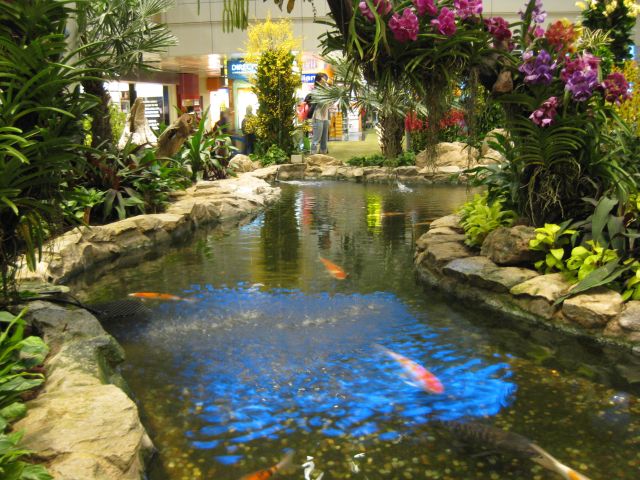
No, what sets Changi apart are the numerous quiet natural oases where you can escape the hustle and charge of an international airport.

one of several natural hide outs in Changi

Bangkok is very cheap and the people are friendly and helpful.  However the signs are indecipherable and English, when provided, is in smaller print and sparse.  But not a problem and passers by will stop and help.  I say it is cheap but that is if you buy as the locals do.  If you wish to stay at an American brand hotel or have coffee at Starbucks the prices are similar to the United States.  Although Bangkok has a big population exceeding 10 million and is notorious for major traffic congestion, it has excellent rail services with air conditioned coaches and it costs just a few dollars for example to get from the huge modern airport to the city center.

quick cheap transport from the airport to the city

The only negative on arrival in Thailand and on departure is the immigration line – they really should staff more positions so that after a long flight in the delay is minimal.

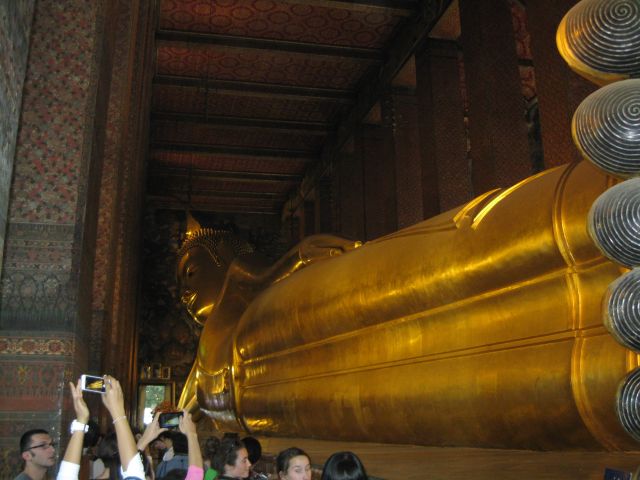
I won’t describe the many temples visited,

the reclining Buddha at Wat Pho 15m (49ft) high, 43m (149 ft long) - one of many splendid sights
the reclining Buddha at Wat Pho 15m (49ft) high, 43m (149 ft long) – one of many splendid sights

the excitement and convenience of the river ferries,

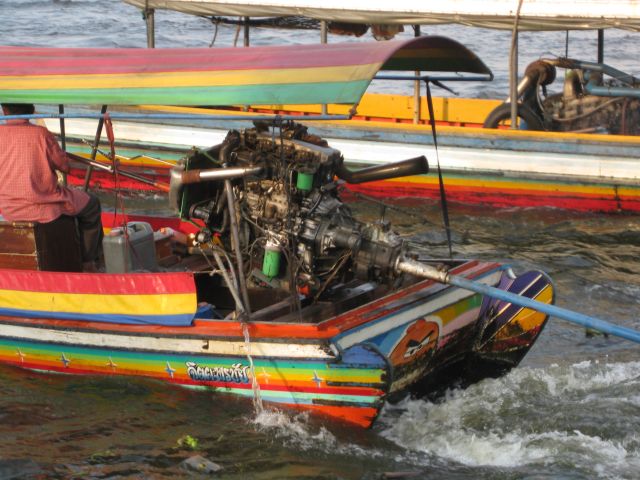
a river taxi - I marvel at the huge engine engine which popels it quick amongst the ferries and large barges
a river taxi – I marvel at the huge engine engine which propels it quickly amongst the ferries and large barges

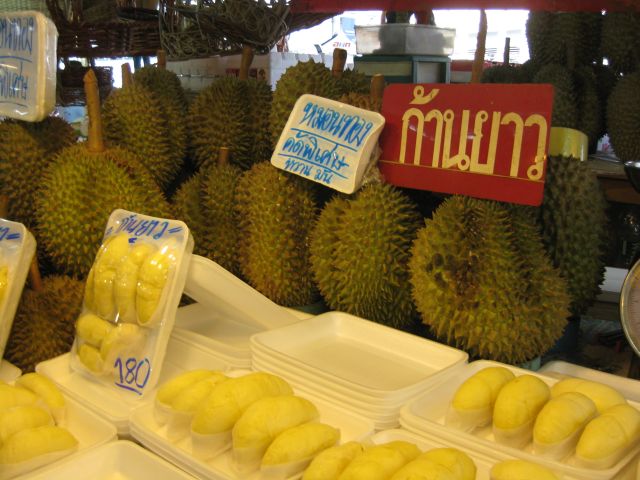
or my first experience eating a durian fruit which smells absolutely awful, tastes ok and is banned from the railways.

the durian fruit with snack sized slices for the curious

The interesting item for me is the protests.  Usually the downtrodden are protesting against the power, influence and wealth of the upper classes.  Here it is the other way round – the middle and wealthy classes are protesting against the government which has been in power for about 10 years voted in by elections which were fairly held.  So here is democracy and it is working and yet there are ongoing wrenching protests.  The prime minister offered to hold new elections in February and this threw the protesters into a tizzy – they don’t want elections – they want to select  an unelected committee to run the country.  Their complaint it seems is that the government bought the vote of the poor rural majority by providing gifts such as free universal health care.  (There were some reports that the wealthy were funding the protesters, so what’s new).  We think democracy is a goal to which all countries should strive and we have even tried to help countries like Iraq get there, though without much success.  Perhaps democracy is not the universal gold standard, and perhaps capitalism our other western accomplishment, does not have the legs for an unremitting slugfest with a centrally controlled country such as China.

why I feel better about the appearance of my organic veggies

I recently attended an open house event at a  local organic farm trending to permaculture.  I wandered the fields with the manager and we discussed many topics.  It was only later when I was by myself and walking his rows that I noticed how perfect his vegetables looked.  No weeds – well I could manage that too if I was doing an open house, but not a single insect chewed leaf!   By that time the manager was busy with other visitors and not accessible.

I thought long on what I had seen.  Their compost heap was far from humming which made me think their organic growing skills were still on the uptake.  Now when I build a new compost heap it also looks pretty rough but I always keep finished compost on the side to provide a bio-organic boost.  They did not have any finished compost in sight and their heap didn’t look that new either.  So it seemed to me unlikely that they could have mastered pest free organic growing, which incidentally if you use a tight definition for “organic” , I regard as an impossible goal.  I mean think about it – if your system is in balance with well nourished high immune level plants and beneficials on the standby to consume pests as soon as they appear, then yes, the pests will not get to first base on the first leaf.  But this is an improbable assumption – the beneficials depend on pests for sustenance (that’s why pests precede beneficials in the march of Spring) and cannot survive and be on red alert if there is not a continuous supply of pests and for pests to be around they have to snack and so you gotta have chewed leaves.

So how could this relatively new farm have perfect looking vegetables?  Yesterday the manager visited my outpost and I casually raised the topic and the answer – a well known pyrethrin spray.  It is an effective and expensive knock down spray and is OMRI approved which means you can use it and say you are organic growing.  I suppose because it is derived from natural ingredients (chrysanthemum) this means it is natural.  It will take out all insects including honey bees and beneficials, so as for honey bees you spray when they are not around and as for beneficials, since your spraying killed the lot of them, then per the instructions “plan to reapply them” 1 to 2 days after the spraying.  We have reached the stage where beneficials are applied just like a chemical!  It seems that once you go down this route you probably going to end up doing a lot of spraying.

So is this really organic growing?  Depends on how tight your definition is.  Are natural ingredients empowered by human ingenuity that much different from synthetic ingredients?  Are pesticide sprays from natural ingredients less toxic to humans than synthetic sprays? For me, growing organic is assisting but not enforcing – I encourage beneficials, I make compost, I want nature to run its course and I am perfectly happy with sharing some veggies with pests.  And my take away is that with the exception of some veggies which seem to grow perfectly with little pest pressure (lettuce, radish and garlic come to mind) the next time I see perfect looking organic vegetables I will wonder if spraying was used.