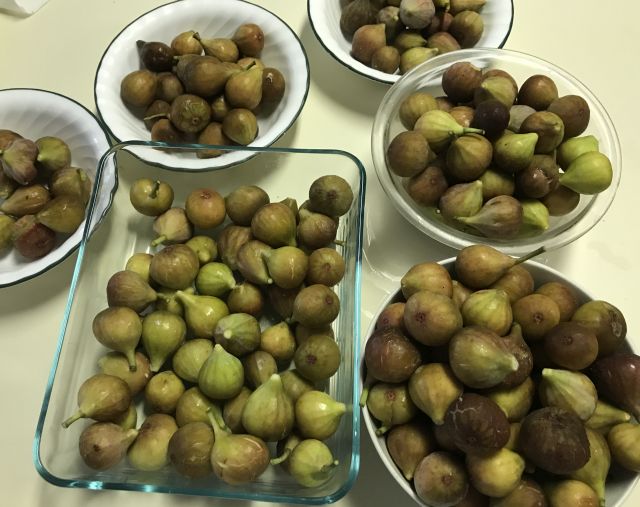
(Pic above – the Atlanta house has a big fig tree and recent rains produced a good crop. The pic shows 2 days harvesting, net of consumption.)
The Rolling Stones lyric (1965) – “can’t get no satisfaction” played in my mind during my run through the woods. Probably because I just watched “Norman: The Moderate Rise and Tragic Fall of a New York Fixer” and in one scene the fixer offers his help to a woman and she says “I need the satisfaction of knowing that I am doing good in the world” (48:27) and the fixer is stumped and says “That’s a big one”. Finding pleasure and enjoyment are easy, finding satisfaction is a “big one”.
A hospital physician told me yesterday that today (Sunday) he will be trained in the new electronic medical records system his facility is rolling out. A few thoughts – digitization should improve customer care with immediate access to records and reduction of mistakes.
Two BUT’s:
1) with more data on medical practitioners’ work output more efficiency can be encouraged/demanded and this will reduce practitioner satisfaction and customer satisfaction. Reminds me of the time and motion studies during the early 1900’s – then factory workers were corralled now service providers are also snared, and the maxim – “what goes around comes around” comes to roost 100 years later.
2) the electronic brain in the background is probably doing more than just recording and regurgitating the data. It is probably tracking inputs (patient vital signs and issues) and health outcomes and should be able soon, based on relevant data, to diagnose and recommend treatments which in most cases will rival or outstrip the experience and judgement of the practitioner. So not only less job satisfaction but probably fewer jobs.
As mentioned couple posts back, the 1’s and 0’s give with one hand and take with the other.
After leaving South Africa in the late 70’s I worked in London for one of the “big 8” accounting firms, now called the “big 4”. I remember a multi-day training event where in the evenings we drank a lot of beer, socialized and I discovered the addictive Space Invaders arcade video game which was housed in a large console. As the commander of the only remaining space ship I had to dodge from side to side to evade incoming missiles and simultaneously destroy the horde of menacing invaders which moved across the screen left to right and lower and lower, and faster and faster all the while to a heart thumping hypnotizing background sound.
I have now completed a 16 week embedded systems IoT (Internet of Things) course with University of Texas, Austin, which was excellent, and one of the last projects was to write the software for Space Invaders and build the hardware.
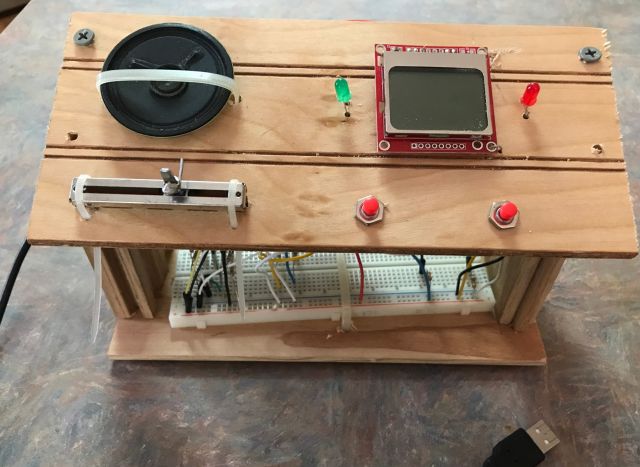
inputs and outputs
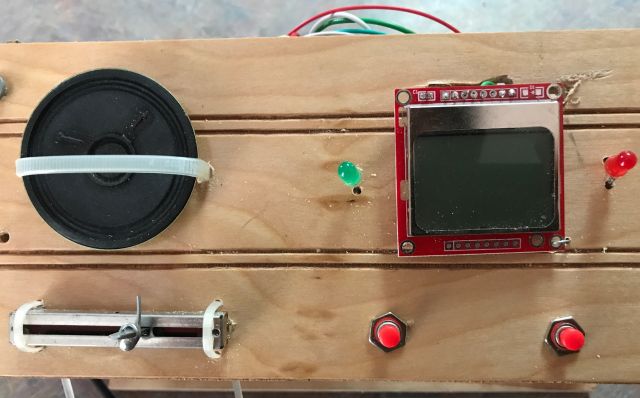
Above are the inputs and outputs. The inputs are the slidepot (bottom left) which moves the defender ship horizontally across the screen and the 2 red buttons which are the fire buttons – one fires vertical take off missiles, the other 2 diagonally veering missiles.
The outputs are the speaker which transmits battle sounds, the LCD screen which shows the field of combat with invaders moving across the sky lower and lower and exchange of missiles and explosions; and 2 signal lights – the green shows success, the red shows failure.
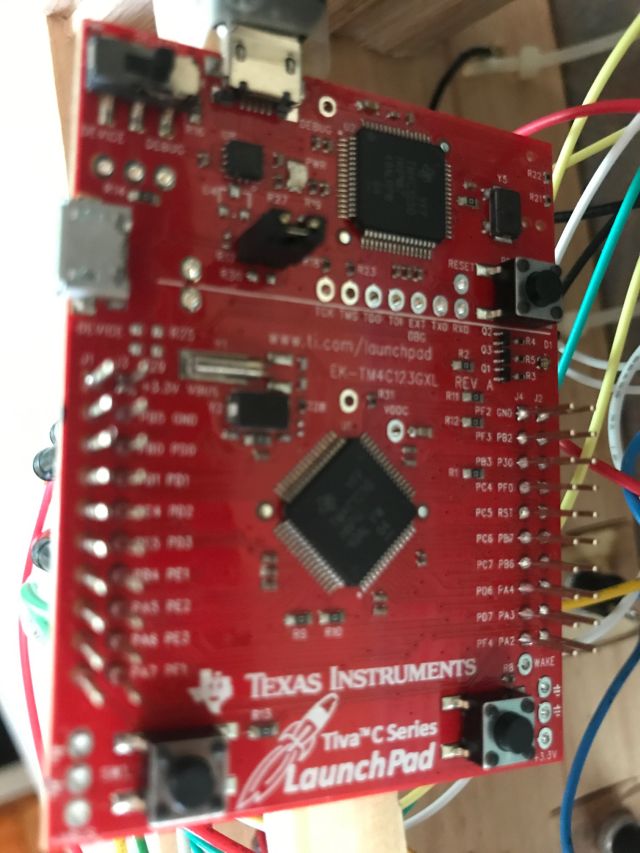
this Cortex TM4C microcontroller is the brains behind the scenes. we used this powerful device throughout the course
My game software is relatively simple – I do not have levels to attain and the enemy does not move faster as the game progresses. If my space ship is destroyed then I lose, if the enemy invaders or “sprites” are destroyed first, then I win. Here is a YouTube video of my software in action – https://www.youtube.com/watch?v=Zok8T3PWSEE
We used to inhabit an analog world where even our record players and film cameras were analog with the film directly capturing the nuances of the image, and the groove in the record directly transmitting to the pickup stylus the recorded sounds of voice and music. Now the digital world of 1’s and 0’s intermediates – sound is converted to binary digital sound and images to digital images. And when we hear the sound through a speaker or headphone it has been converted back to analog sound.
In the Space Invader game, ADC (analog to digital converter) software is used to convert the movement of the slide pot (which is analog) into a digital signal and DAC (digital to analog converter) is used to convert the sounds of the invaders, the missiles and explosions from digital code to analog output for the speaker. (It is clever how the invaders are coded to advance digitally across the screen and I would explain the principles except that I will lose most all the readers who have persevered to this point.)
We immerse ourselves increasingly in the digital world for information, socializing, entertainment and transactions. First the CD players, then the internet, now smart phones and soon more of us will fall under the spell of AR (augmented reality) and VR (virtual reality).
Through VR we will be able to visit world heritage sites and see animals and birds and fish more vividly than we could possibly do in the wild. But will it be a satisfying experience? Can there be satisfaction when instead of a strenuous hike, pestered by mosquitoes, to see an isolated waterfall, we ask our digital assistant for the Victoria Falls (the Smoke that Thunders) or the Niagara Falls and we zoom in to all their splendor.
The world of 1’s and 0’s will enhance our safety (house security & car sensors) and health (personal monitoring sensors, data compilation & analysis) and efficiency. But for me it has limits and working in the field and growing food is far more satisfying than working out in a gym accompanied by sound and video generated from 1’s and 0’s. For me live guitar music or theater or a local sport event is more satisfying (most of the time) than the best guitarist, actors or sports heroes, recorded in video?
Ps1 – the edX Austin MOOC uses the ARM Cortex processor and is challenging unless you are a competent programmer. There are easier courses and I just started a Coursera course on Arduino hosted by MIPT (Moscow Institute of Physics and Technology) which is for beginners and is fun.
Ps2 – the ADC (analog digital converter) uses successive approximation to discover the unknown analog input and convert it to binary number. The technique is similar to the process used in a game where a friend imagines a number between (say) 0 and 255 and you have to determine the number and your friend will only tell you if the answer is higher or lower than your guessed number. So You guess 128 (half of 256); Friend says lower. You guess 64 (half of 128); Friend says lower. You guess 32; Friend says lower. You guess 16, Friend says higher. You guess 24; Friend says higher. You guess 28; Friend says higher. You guess 30; Friend says lower. You say 29 and friend says that is the answer. The software follows a similar technique and codes “higher” with a 1 and “lower” with a 0, and at the end of it all has determined the analog number and translated it into 1’s and 0’s.
Pacifica is a community of about 40,000 extending 6 miles of beaches and hills along the Pacific ocean south of San Francisco. We are regular annual visitors since 2 sons and better halves and now a grand child live in the area. And Pacifica is undergoing stress of change as new money moves into a once lower middle class area.
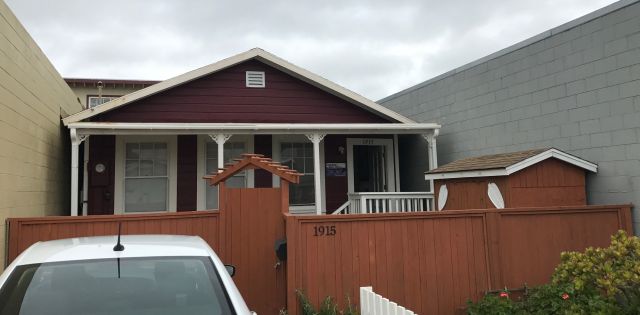
Nudged by my sons we now use uber for airport trips and airbnb for lodging and this time we rented a delightful beach house just one block (say 80 yards) from the ocean. It came with 2 bedrooms and all amenities. Though M described is as basic, it was a more pleasant way to spend some days in one location.
our beach house squeezed between 2 shops a short distance from the beach, with space in front for our car rental
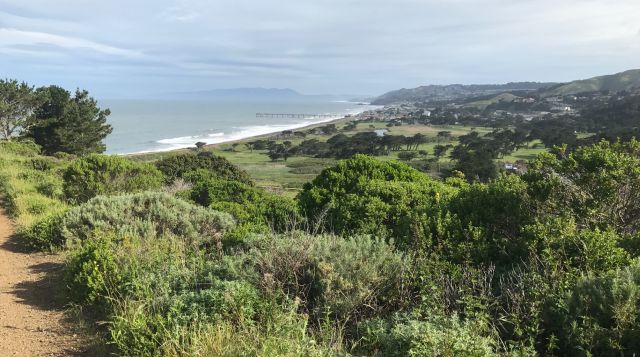
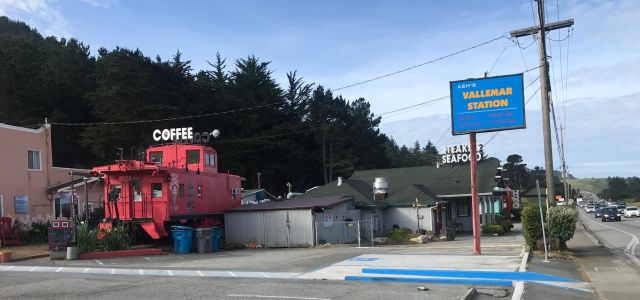
We have a regular morning schedule – jog a few miles along the shore and cliffs to our coffee shop.
a view from our trail of one of the beaches, and the pierour caboose coffee shop
It was at the coffee shop I purchased the local weekly Pacifica Tribune and became aware of a gnawing community issue. In fall 2016 the owner of xxx mobile home park decided to evict every tenant claiming there was a plan to do upgrades. Many residents had lived there for decades; many were low-income people, including veterans, elderly and disabled people, with few affordable options for other rentals. At the Council meeting the Council majority refused to help and as a result 77 households were evicted. Subsequently a proposal for rent stabilization was developed and efforts are underway to make it effective. It will cost money to implement and opponents say this money could be better spent on physical improvements.
I wonder how this will be resolved. There are no upmarket restaurants or shops on the high street where our rented beach house is located. There is Florey’s bookstore which we religiously visit each year and which hosts weekly meetings for the book club, writers group, grieving pet owners group and others. If renters can be ejected then more expensive housing and buildings will arrive, property values will increase even more (prices already appear astronomical), property tax revenues will increase and the simple charm of the place will be dissipated. Some will call that progress. Much the same happened in Sandy Springs, Atlanta where we have lived for many years. It gained cityhood and then the mayor who was smart and frugal passed on and now big civic structures and apartments and shops are choking the center, and traffic and sales taxes have increased, and this is progress.
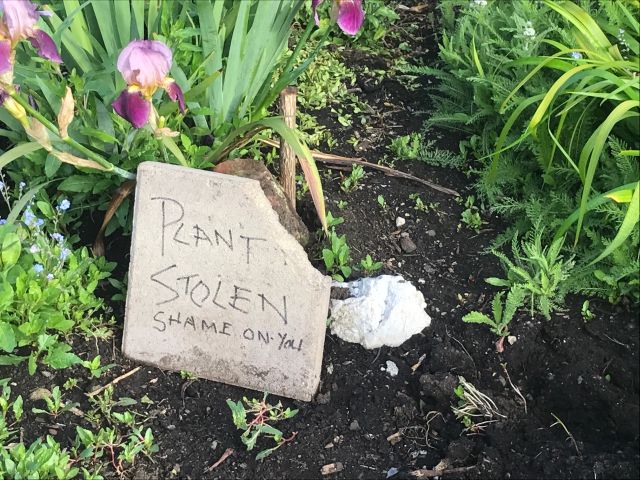
Close to the caboose is the Memorial Gardens established and maintained by Mike Mooney which now has notices about plant thefts.
We again, coincidentally, met with Mike and wondered aloud why people would steal plants. No avid gardener surely will look at a lovely plant in their garden and think “that’s the one I stole!”. Probably thieves for commercial re-sale.
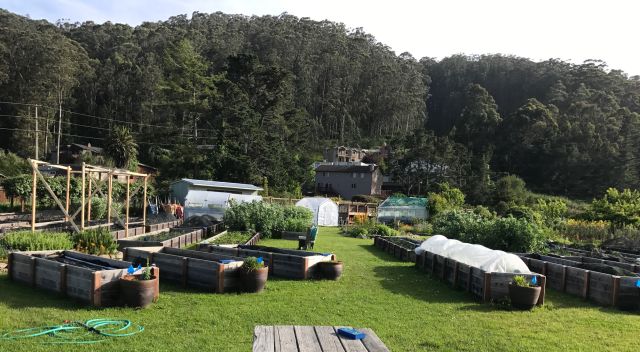
But back to the delights of Pacifica. It has community gardens with weekly bio-intensive growing classes.
Pacifica Gardens – Educate, Cultivate, Inspire
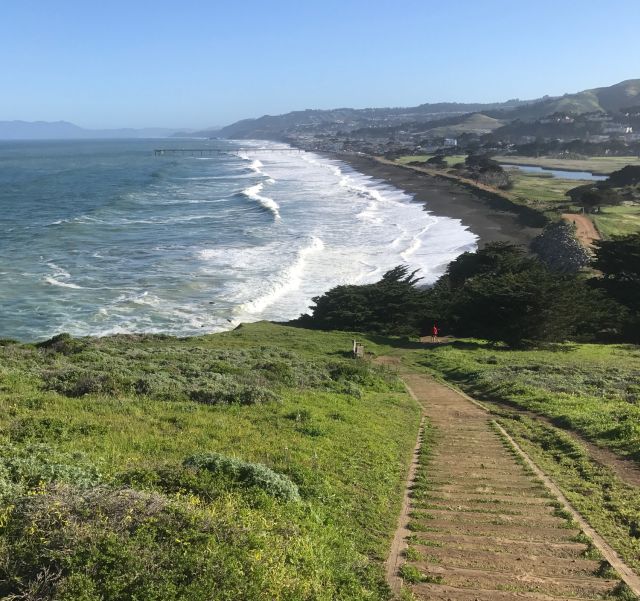
And a history of rum smuggling during the Prohibition.
Bootleggers’ Steps Trail at Mori Point
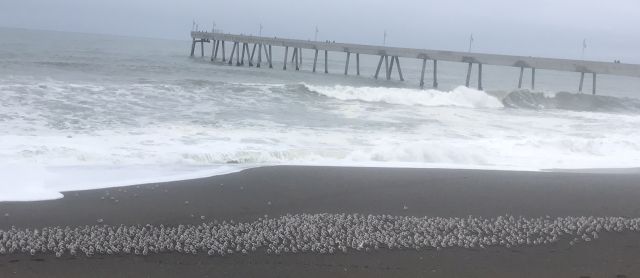
And unusual beach sights.
masses of birds gathered on the shore
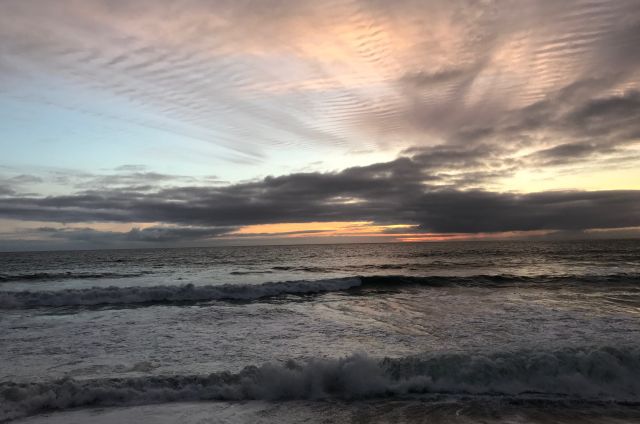
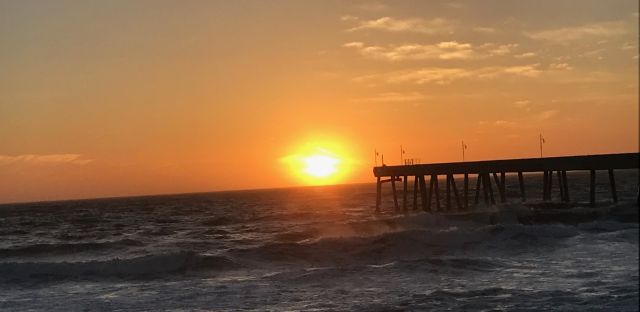
And often brilliant sunsets
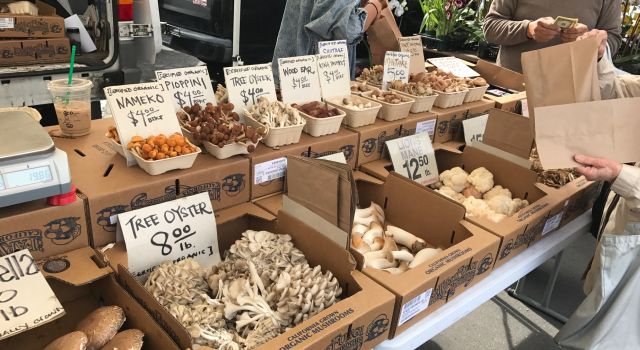
And nearby interesting places to visit such as the Farmer’ Market Serramonte, Daly City.
seeing these mushrooms motivates me to get back to growing shiitake
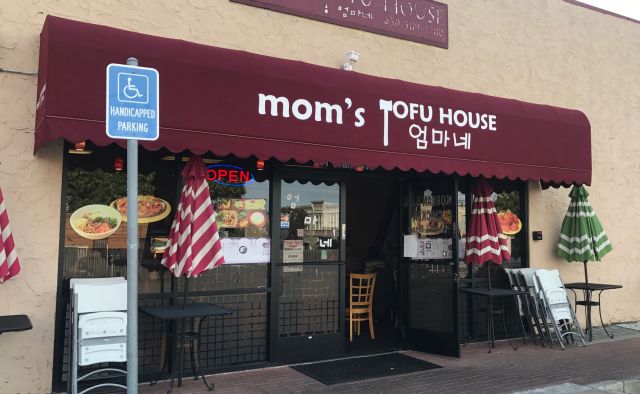
And finally our favorites places to eat, including this tofu shop
Mom’s Tofu House, a Korean restaurant in South San Francisco has delectable stone pot dishes
And of course the attractions of San Francisco where the technology money is making it culturally competitive with NYC. We visited and enjoyed its MOMA (museum of modern art).
Air is generally better in the country because there is less traffic and other emissions. Unless you are close to a power plant or farm spraying operation. Atlanta has an air quality index and warnings are issued when the AQI veers from good/moderate to unhealthy and very unhealthy. Because we have lots of traffic, air quality becomes a problem particularly in the warmer months when smog forms.
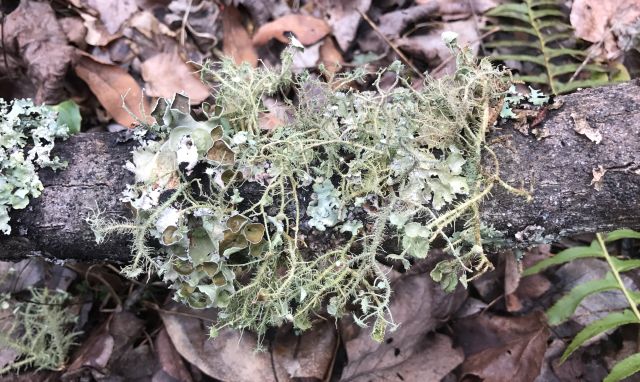
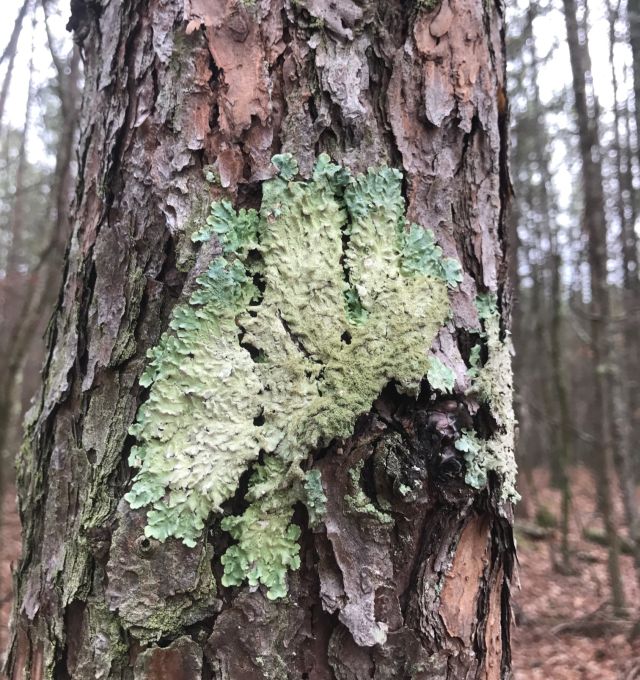
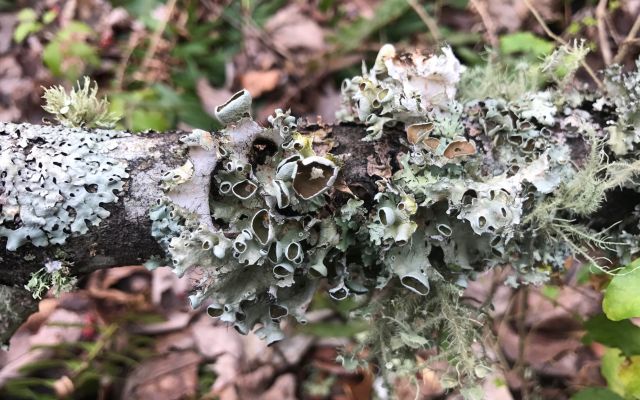
I can see the difference in air quality when I walk outdoors – just look at the lichens. Lichen is a combination of fungus and algae, usually forms on trees or downed branches and trunks and is very sensitive to air quality. For my purposes there are three basic types – a) the crusty version (crustose) which can tolerate poor air quality; b) the leafy type with lobes (foliose) which can tolerate moderate air quality; and c) the one with the little bushes (fruticose) which only survives where the air quality is good.
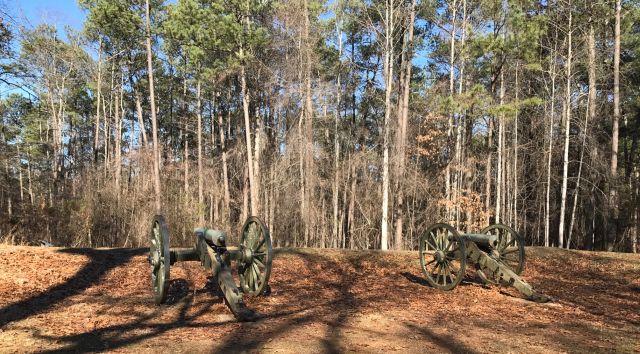
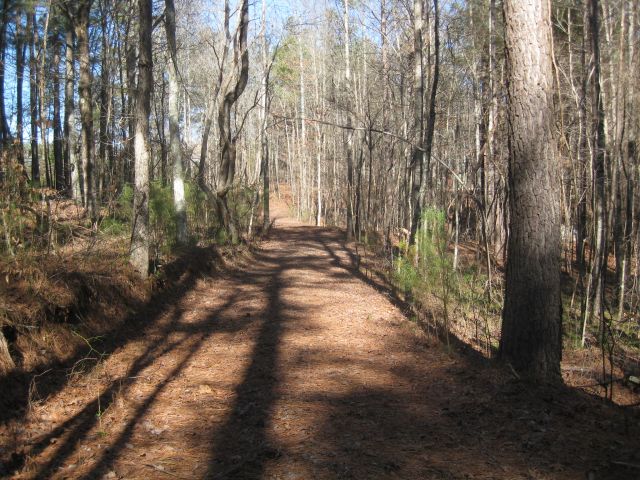
No surprise that in Atlanta I only see the crustose version, even when I go north to the Kennesaw Mountain National Battlefield Park where there are excellent running trails.
beautiful surroundings with many trails and streams, but not much lichen
But head further north to the foothills of Appalachia to my little place, and there it is.
it begins with the crusty form but already you can see lobes developingand then it takes off into the third dimension with little bushes appearing
Wouldn’t it be nice to have good air quality where we live and exercise.
I just finished reading “Guns, Germs and Steel” by J. Diamond. A well documented and persuasively argued book with the main conclusion that peoples in different continents and in different areas in the same continent developed differently, not because of race/genetic/biology differences, but because of differences in their physical environments. Food for thought.
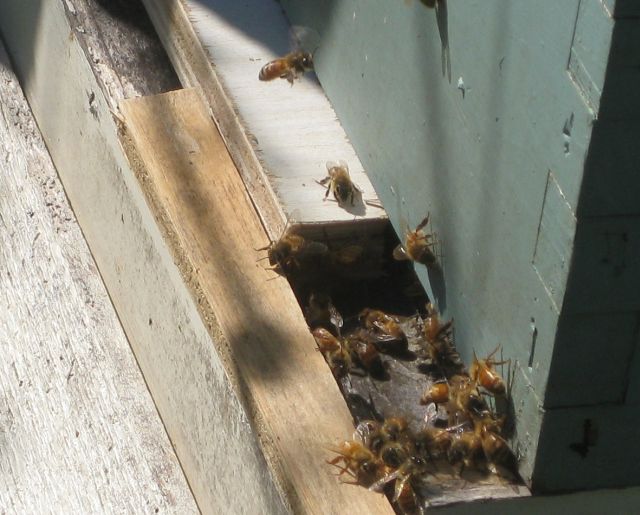
Last year I installed 2 packages of bees on the same day in very similar spots. Both had Hawaiian queens. I watched the development of the two hives. One hive had busy bees and from mid-morning to late afternoon they were zipping in and out of their hive. The bees of the second hive were very different – they gathered at the entrance and there seemed little flying activity. They were idled, as with an extended factory tea break. I wondered what caused this difference and concluded they had bad genes, whatever that means. When I harvested honey in late summer there was no surplus honey in the second hive and lots of honey in the first hive. In fall I began feeding (sugared water) both hives so they would have sufficient reserves to make it through the winter. What puzzled me was the second hive appeared to consume the liquid nourishment more voraciously than the first hive. Odd.
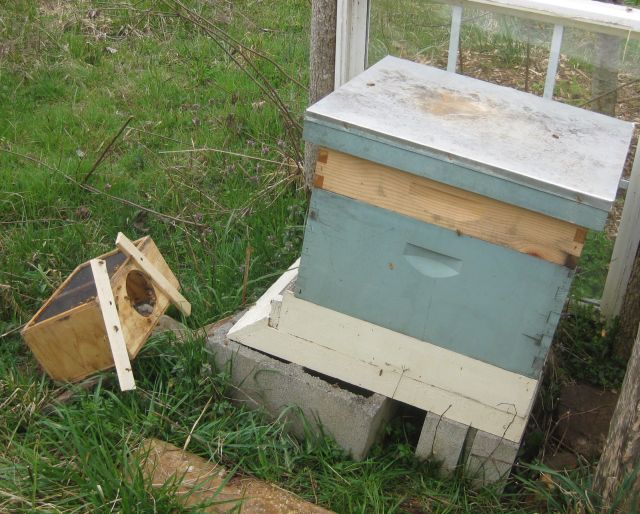
Last week I installed 2 packages of bees and followed the same instructions as the previous year – except last year I neglected item 15 “Insert your entrance reducer, leaving a one-finger opening for the bees to defend. Leave the opening in this manner until the bees build up their numbers and can defend a larger hive entrance against intruders.”
my cobbled together entrance reducer. most of the entrance is barred by the white strip of wood and access to the remaining is complicated by the brown strip
And then the penny dropped! My #2 hive last year succumbed to intruders from the get go and this continued throughout the season. Whatever food the #2 hive forager bees brought home was robbed by other bees. Presumably their guard bees were killed off continuously or became demoralized. I remember from high school an explanation of why agriculture collapsed in the Soviet Union. Once the farmers were disenfranchised from their land holdings and had to meet annual production quotas they became disincentivised and production collapsed. This may not longer be the accepted explanation but it made sense to me then and now.
So my theory is #2 hive was continuously raided and they gave up. And this explains why the food I gave them in the fall was consumed so quickly – the hive inhabitants and the marauders from #1 hive were both consuming the food. And quite possibly the honey I harvested from #1 hive included honey stolen from #2 hive.
Which brings me back to “Guns, Germs and Steel”. If the entrance to #2 hive had been reduced in accordance with instructions, then quite likely that hive would have built up strong numbers and thrived. So you could argue that the fate of that hive was determined by its physical environment – no entrance reducer in the early days when it was most needed.
But #1 hive also had no entrance reducer and the foragers of #1 hive attacked and stole the food of #2 hive. So it was more than physical environment – perhaps there were more bees in the #1 package I installed and this made the difference. Or, as I suspect, #1 hive was just a superior hive and its residents overwhelmed the competition.
“Guns, Germs and Steel” posits that the good luck of certain peoples being in good environments was what made the difference. But perhaps those fortunate peoples were not sited in the good environments ab initio. Perhaps even before the development of Guns, Germs and Steel some hunter gatherers or tribes or groupings recognized that some land was better than others – more water, fish, animal, edible vegetation – and defeated the occupants and took control of the better resources.
And if there is some truth in this, then we are back to the old debate of nature vs nurture.
This Monday morning it was colder than it had been for weeks and the breeze along the river trail was chilling, inside and out. I was therefore happy to see Bill walking toward me – a good reason to stop running and chat. Bill began his morning river walks when he was diagnosed as pre-diabetic and now he is out all mornings.
Bill (a former surgeon) informs me that since more heart attacks occur on Mondays than on any other day he, that morning, tripled his daily aspirin intake. We enjoy ribbing each other and I suggest a morning walk is more helpful than aspirin. He counters he will leave a book, “The Sports Gene”, in my mailbox. I vaguely recall “it’s about slow-twitch and fast-twitch muscles and, at the top of the game, a slow twitch athlete will do better at distance running and never outperform a fast twitch sprinter?” He nods. “But we can influence our outcomes – what about epigenetics, the way our genes are expressed, and now we have crispr to edit them?”I ask. He understands epigenetics and knows little about crispr (nor do I) and sums up “It all about your genes, the best thing you can do is choose your parents wisely”. I have now recovered my breath and it’s time to try catch M. who had sailed past Bill with a friendly smile, so we adjourn.
With the closing of the local Einstein’s Bagels and Bruegger’s Bagels, M. and I read our morning papers at McDonald’s where the coffee is good and no sugar added oatmeal acceptable. With me as the interlocutor, she and Bill have waged several offstage debates. I remember the one with Bill stating that, as a surgeon, he wanted his patients happy both before and after the surgery since this helped for a quicker recovery, and if hospital provided sodas and fried foods did the trick, he was fully supportive. To which M., RD, throws up her arms in frustration. Now, as to Bill’s insight of choosing your parents wisely, her quick response is “too late” (wish I had thought of that). Her measured comment – “80% of chronic disease (heart attack, diabetes, cancer, stroke etc.) is caused by avoidable factors such as environment, the food we eat, inadequate exercise and stress – and less than 20% is attributable to genes. And Bill accepts this, to some degree, hence his early morning walks.
But, notwithstanding some conciliation, two different cliff views and no bridge between.
“How’s your oatmeal?” he asked and his face broadened to his ever friendly, genial grin. Too friendly, considering he asks this question every Saturday morning when our run/walk group concludes the exercise phase and relocates to the breakfast restaurant. This is “Bob” who recently survived a pulmonary embolism, whose specialists never raised the diet topic, and for whom a good meal is one of his life joys. And a good meal does not include oatmeal – rather fried eggs and rashers of bacon. I once asked him if he knew the Hippocrates quote “let food be thy medicine and medicine thy food” and he grinned and ducked and weaved like Muhammad Ali, and my question sailed away.
So today I quickly acknowledge Bob and focus on “Pete” (early seventies) who is describing his first week on anti-hypertensive medication and, though his blood pressure has not yet come down, it surely will. I ask Pete why the sudden rise in blood pressure and he says “aging” and tucks into his eggs and bacon.
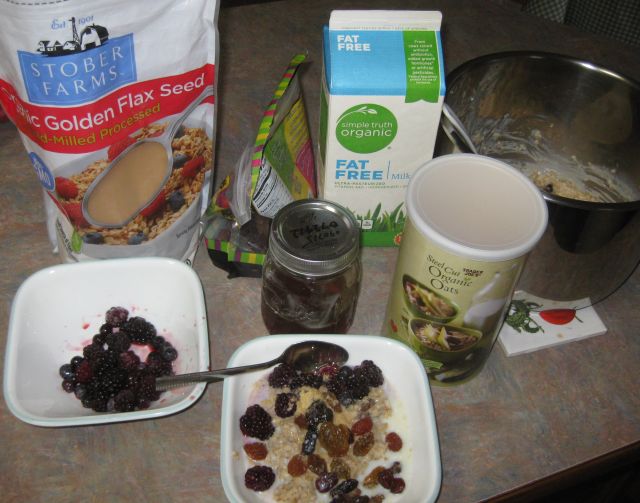
Now I really like these guys, and they are pretty knowledgeable and smart, and Pete in his younger days ran sub 40 minute 10k’s, which is good going by my book. I am not after converts and so I enjoy the oatmeal (not comparable with my home brew – see pic below) and every so often one of the group (usually after a visit to his physician) will have oatmeal for a few weeks too. And then it’s back to traditional breakfasts, all part of living the good life. Safe in the knowledge that conventional medicine and an arsenal of medications are on standby for when the music slows down.
a tasty start to the day with home grown blackberries, blue berries and honey
Larry
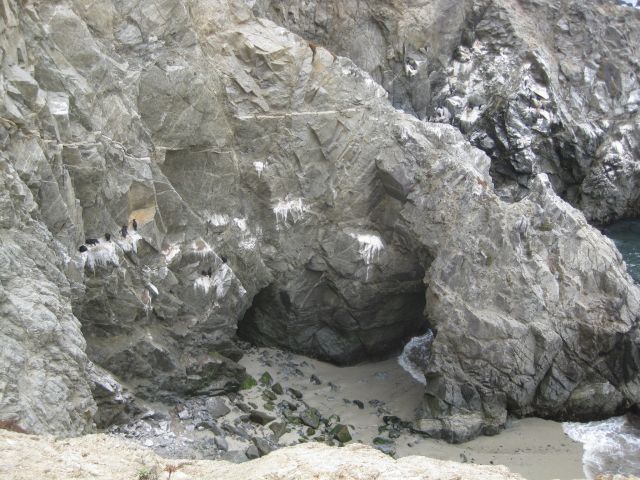
North of SanFran is Marin county and north of it is Sonoma county and Bodega Bay. The promontory called Bodega Head has craggy cliffs overlooking the ocean with crowds of cormorants and seagulls soaring and calling.
rocky cliff with cormorants (middle left), guano sketches and a steep drop to the sea
On a rocky guano caked outpost flecked with salt foam, squadrons of Pelicans have gathered. And then they pitch forward and off and with powerful wings thrumming they beat above the foaming sea and ascend higher and higher in broad V wave formations until they disappear around the headlands.
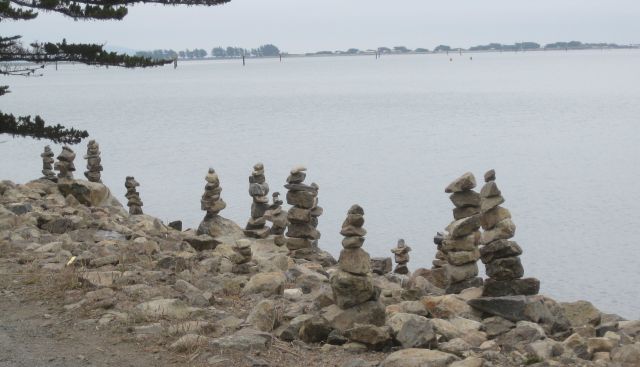
On the drive back we notice on the shoreline small piles of balanced rocks. We have seen them before in Vancouver’s Stanley Park and even in Atlanta along the ‘Hooch river, but this is different – clusters and clusters of stone towers up to a foot high.
some of Larry’s creations
I stop for a photo and notice a lean tanned man walking toward me. Suddenly he scrambles down the side of the embankment and begins gathering stones. I greet him and ask if he knows why people build these stone piles. He glares at me – there are no people building these he says, I built all of them and there are now, and he waves across the bay, about 170 of them.
But why I persist. For good luck for the sailors he says.
His name is Larry, 72 years and retired and the idea came from his time in Hawaii. Is skill required? With time you get the feel of balance. As to size he has built small and big piles and the only injury was when he struggled to balance a large boulder and it tipped and sliced his foot and toe. He has a regular routine walking the shoreline caring for his creations and then on to the marine laboratory for a visit. Had we visited the cliffs? Take care he says – it was a foggy day when a 12 year old wandered too close and fell 200 ft to the rocks below and has never fully recovered. Now follow stories of large family reunions and driving a Sherman tank over the dunes. He punctuates his reminiscences with hand greetings to passing locals. And then it is time and he vigorously shakes our hands and moves on.
So, two retired guys, Mike and Larry with outdoor pastimes bringing pleasure to others.
I never used to read science fiction. But technology and sustainability hold my attention and I read good futuristic books on these topics. “Ghost Fleet” a technothriller on the next world war portends problems with technology and is well researched with extensive footnotes. Now I have completed my interactive Python programming course with Rice University via Coursera, I have begun my next read, the Water Knife about a water starved west beset with dust clouds and violence. Both are excellent reads.
Which brings me to water sustainability. I store about 6k gallons rainwater and I restrict my growing activities to get by on rain and harvested rainwater. This would not be possible in California (we make our annual visit to San Francisco in a few weeks) where Summer rainfall is minimal. But here in north Georgia it is possible, with some luck. My stored water is sufficient for about 3 weeks and then I need rain. And so far the rains have arrived timely. I hand water with a 3/4″ hose – takes time but for me is the most efficient method. My water is gravity fed and though it goes thro a gauze filter before entering the tanks it grows algae and would not work with drip feed unless I installed filters and increased the water pressure, which I am not prepared to do. When water runs low I have to choose where to best use it and so some will thrive while others have to endure. And it is enjoyable to see what is growing, how the pests are doing, and admire the butterflies.
looks good but not so the offspring
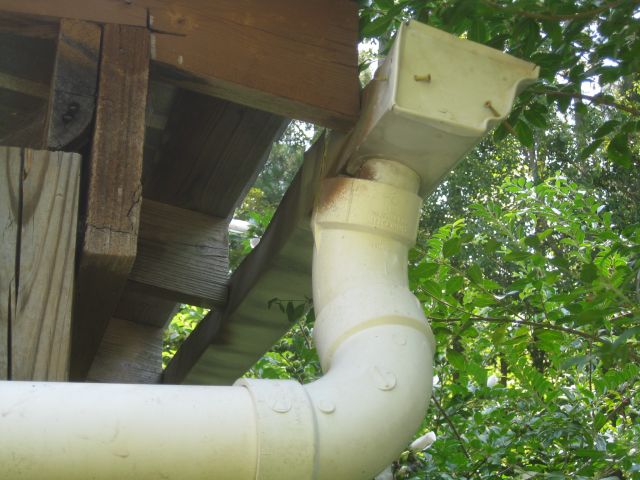
But things go wrong with the collection system and I have to watch that everything is connected and blockages removed. An endcap I had fitted to a gutter installed on a shed kept coming loose. So, effective but not attractive, I used a couple screws to hold it in place.
note the 2 screws in the endcap
At my tractor building a 4″ corrugated pipe formed a u-bend, then filled with water, and broke loose. Now with screws and straps I have secured it again and tried to prevent another u-bend forming.
ignore the pipe at the bottom which feeds a lower tank with water captured from the other side of the building
Previously I used my heavy portable drill for inserting screws. Now I use a real handy portable screwdriver which fits in my pocket and is easy to use.
a big time saver and powerful enough
Tomatoes are a plenty and now the unusual okra plant is beginning to produce. It has a striking flower.
the shadowed flower and behind it, small okra pods
The flower transforms into future pods.
baby okras
Which then grow into regular okra which we eat off the plant, when small, or grill with squash.
And, finally some more butterflies.
my decorative flowers in the growing area, pleasing to the eye and visitorsand my greens will soon harbor caterpillars
We generally accept responsibility for our actions but not for our circumstances. When I told a nonagenerian I was fortunate to have good health and to retire in my early 60’s, I was told “that’s not luck, that’s decisions made”.
Food plays a big role in people’s lives, and I don’t mean survival. To quote: “some eat to live and some live to eat”. I am (mostly) in the first category. Folks with health problems usually resist changing their diet – food is one of their chief enjoyments. And they rationalize that diet isn’t that important anyhow – more important are the genes you are born with. So accept your gene determined health and soldier on. And why bother when medication will fix the problem?
Try telling parents whose kids have digestive problems that they should consult a registered dietitian. Their reaction is “I give my kids good food” i.e. I am a good parent and it has nothing to do with the food they eat, must be the genes. Then you hear the apocryphal story of the athlete who ate and exercised meticulously and nonetheless had a major health problem. Must be the genes. The accepted wisdom was if you lived to your 80’s that was from good lifestyle but to live through the 90’s depended on genes. Until recent findings that exercise, diet and community are also important determining factors.
A buddy “Bob” in his early 60’s recently had a pulmonary embolism (lung blockage). He survived and was examined by a raft of medical specialists. I asked if the topic of diet surfaced. He said he was never asked about his diet nor were there any diet recommendations. The tests have not revealed an overt cause and so it must be his genes. Again.
Another buddy suffers from gird and his son suffers from gird and he explained to me it is obvious that his son inherited his genes. The fact they lived in the same household and ate the same food is not relevant.
Why change if change makes no difference? As one obese patient assured the hospital dietitian “don’t worry I’m on a sea food diet” and then, seeing the smile on her face he added “I eat what I see”.
However, nutrition science must step up its game. When I ran distance in the 60’s I sucked salt tablets. Not because it was pleasant but because I perspire easily and this was the recommendation for replenishing lost salt and reducing cramps. Seemed logical. Then salt became BAD. Now it is not so bad. Fats were BAD now not so much. Sugar is now the culprit – last year fruit juice was not good but eating raw fruit was ok. Now eating raw fruit high in sugars is not ok, according to some. And then the faddists – avoid grain and go for meat or maybe do the reverse. And the platitude – “everything in moderation”, is another cop-out. I know diet is complicated and compromised guts make it more so, but these turnarounds and banalities produce skepticism, not confidence.
And what is the message? Research indicates that cardiovascular disease, cancer and diabetes, which are chronic diseases that account for most deaths, are largely preventable. And four lifestyle decisions – never smoking, maintaining a healthy weight ( BMI<30 ), exercising at least 3.5 hours weekly, and having a healthy diet (large amounts of fruits and vegetables and reduced meat intake) appear to be associated with almost an 80% reduction of developing deadly chronic diseases. So I watch what I eat and accept responsibility for my health, just as I do with relationships and financial circumstances.