I have been spending time with my bees – recently did my first split (split the one hive into two separate hives) and will soon do the first honey harvest of 2012. So, with bees on my mind, I want to include some excerpts from an engrossing book written in 1958 in South Africa by Laurens Van Der Post titled “The Lost World of the Kalahari” about the Bushmen.
The Bushmen loved honey and used a special herbal smoke to drug the bees before he dared reach for the honey because “the wild bees of Africa are the most formidable bees I have ever encountered. They are smaller than most but quick, fearless, and quite unpredictable. In the village where I was born no hive was allowed by special by-law within four miles of the township because one sleepy summer’s afternoon all the bees had carried out a combined operation against everything that moved in the streets and sun-filled courtyards and paddocks. I have forgotten the precise extent of the casualty list but I remember there were two little coloured boys, pigs, hens, sheep, goats, dogs and several horses among the dead.”
To locate a hive the Bushman had an ally in a little bird called Die Heuning-wyser, the honey-diviner, who loved honey as much as did the Bushman. When the bird found a nest it would alert the Bushman who would follow it and after harvesting the honey “he would never fail to reward the bird with honey and, on a point of mutual honour, share with it the royal portion of the harvest: a comb as creamy as the milk of Devon with its own cream made of half-formed grubs.”
And if you did not reward the bird? Why then, according to a narrator at the camp fire “it will punish you heavily….I once knew a man whose stomach was too big for his eyes- no, not a man of my own people but of the stupid Bapedi – he cheated the bird out of its share and the very next day it called on him again and led him straight to a hole where there was no honey but an angry female puff-adder who bit him on his greedy hand and killed him…..Another bird who had been cheated once led a man into the mouth of a lion….I tell you that bird is too clever for a man to cheat.”
I just read Heart of Dryness by James Workman about the plight of the Bushmen in the Kalahari desert when the Botswana government cut off their water supplies and how they adapted and how we can learn from them. I was interested in the book because I am originally from South Africa which abuts Botswana, and also here in Georgia we are engaged in legal water wars with neighboring states. Workman interlaces the story of the Bushmen with a narrative on the use and abuse of water worldwide and his view that water shortages will result in increased conflicts across the world as the world grows hotter. He does not believe dams are the solution in arid countries -dry heat and wind result in massive evaporation and build up of sediment reduces storage capacity. He suggests that artificial aquifer recharge where water is pumped and stored underground is more sensible, akin to the Bushmen burying their water in evaporation proof containers. Some of his findings are counter-intuitive, for example during holidays one Botswana school leaked nine times what it used while in session, due to pressure build up forcing water leaks through cracks. The 250 page book has 50 pages of notes/bibliography and appears well researched.
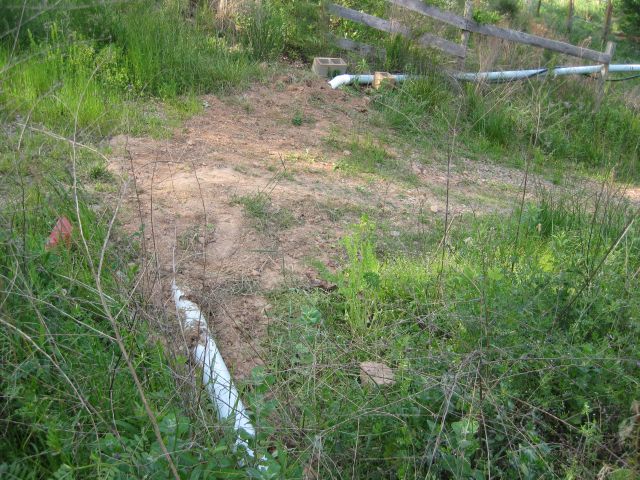
His reference to water wastage got me thinking of my own rainwater harvesting system and, since rain was in the forecast, I inspected and found several issues. Two gutter downpipes were blocked and no water would have been collected from them. Even more significant – the 4″ pipe which transfers water from my main collection point (the house roof) to my barn storage tanks, had again opened a leak where the 4″ corrugated pipe attaches to the 4″ pvc pipe.
The advantages of corrugated drainage pipe are that it is flexible so it will fit easily in a trench which isn’t straight or which has bends different from the available 90 deg, 45 deg or 22.5 deg fittings. And it is much cheaper, both the pipe itself and not needing expensive fittings for bends. Which is why I had used it for a section of the water run. Its disadvantages are that it does not make a tight fit when joined with pvc pipe and therefore can leak if there is a small shift in the moorings and, because it is corrugated, debris collects in it and causes blockages. Now I had to bite the bullet and replace the corrugated pipe with pvc pipe. I had used 4″ Sch 40 pvc pipe for the exposed overhead run – this is a thicker more expensive pipe. For the section I was replacing, which runs in a trench, I opted to save money (on the pipe and the fittings) and bought the considerably cheaper DWV pipe. DWV pipe (drain, waste and vent) is for non pressurized applications and because the pipe will be buried, fully supported by the ground and not sun exposed, this seemed a reasonable choice. It took some time digging a new trench (the old one was gradually curved and not usable) and aligning the pieces and fittings since the direction change was closer to 80 deg than an easier 90 deg. But now it is done and, with a dry season looming, I hope to be make every drop count.
I learn new things every day. If I was an attorney I would be studying up on the impact of new legislation and recently decided cases. An accountant – the impact of new GAAP and the merging with international standards; a business executive – new moves by competitors as they strive for competitive advantage. For me, my classroom is observing what’s going on around me.
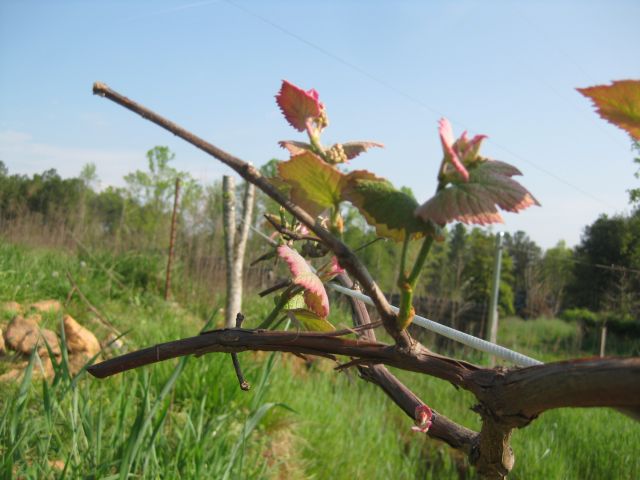
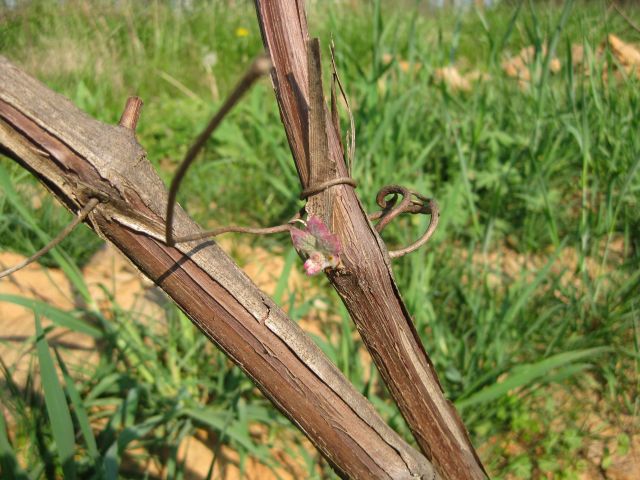
In my post of February 23 I noted that one of twelve muscadines (grape vines) I transplanted did not survive and I provided a sensible (to me) explanation for the failure. My test for viability (the universal test) is to scrape the trunk and if there is green underneath then it is ok. Eleven vines had green, this did not and its trunk was peeling and a piece at the end of the vine had broken off. So it was dead, or so I thought. This morning as I tended the vines, I noticed it was leafing.
my “dead” muscadine is alive
the trunk certainly appeared dead, but now there is a leaf
So I learn the slow way through trial and observation.
ps – it occurs to me that I planted 11 muscadine and one grape vine and the specimen above is the grape vine, which is why it looked so different/dilapidated compared with the others. It still failed my scrape test – perhaps I didn’t scrape deep enough or this is a characteristic of grape vines?
I have a constant companion for the ride to the farm and throughout the day – Trudy. She is a Heinz 57 who awaited us at the dog shelter after trying out and, presumably, rejecting two other families. A real cutie. At times I think of the dismissive comment of the Nearings in “Living the Good Life” (1954 page 28, one of my favorite books):”Cats and dogs live dependent subservient lives under the table tops of humans. Domestic pets kill and drive away wild creatures, whose independent, self-respecting lives seem far more admirable than those of docile, dish-fed retainers.”
Can this be my Trudy they are referring to? When we return to the house after working the fields she waits patiently for her snack. I usually hold it in my hand and she gently takes it from me. Once, being in a rush I dropped it on the floor for her to eat. She was not happy and ignored it. On another occasion she waited a bit and then ate it. And then it occurred to me, my second learning of the day. When she takes the food from my hand this is not an act of subservience but acceptance of reward for work performed, which in her case involves diligent searching for rabbits and rats and keeping an eye on me at all times. I think she views it as a fair exchange for services provided. I could go on about her and I will, together with pictures, at a future date.
I have been intrigued with neem oil for some time. Something exotic about it. When I first planted tomatoes in north Georgia four years ago, and they were overwhelmed by aphids, neem came to my rescue. Aphids were never a problem again, not because of the neem but my voracious ladybug population. (This week I have been collecting my overwintering ladybug guests and ushering them out to their workplace in my vegetable garden). My second recourse to neem was a couple years ago when the stinkbugs arrived. With my pistol grip sprayer I doused the offenders and they looked dazed and disgusted. Last year I awaited them but they did not arrive, again not due to neem but to some mysterious forces at work. And so my neem oil sat unused in the cool basement for more than a year, until last week when it was recalled to the front line.
But a word about neem. A neat little book by John Conrick titled “Neem The Ultimate Herb” goes into much detail on its origins and uses. He traces its first use as a medical treatment to 4,500 years ago. He states it is a major element in preventing and healing diseases among Ayurvedic practitioners (a system of traditional medicine in India). The neem tree (Azadirachta indica) is a tropical evergreen which grows in much of Southeast Asia, welcomes extreme heat of up to 120 F but will not tolerate hard freezes – so unlikely to call my yard home. My interest is not in its medical properties, or how it is made, but its use for insect control. Unlike synthetic pesticides, most of which have quick acting nerve toxins, neem’s main action is as an anti-feedant, which dissuades pests from eating neem covered plants. It can also reduce an insect’s ability to reproduce. No wonder the stinkbugs looked dazed and disgusted! Conrick also mentions that neem has been found to be beneficial on bees.
So how did I use it as a remedy for my chickens? Our Buff Orpington rooster has a good looking comb but the tips of his comb turned black a few weeks ago from frost bite. He didn’t seem to mind and, as he is becoming more aggressive, I decided to leave him be. Then I noticed black spots at the base of the comb. One of the Golden Comets tried to peck at his comb (for food or as a grooming favor?) and he discouraged her endeavors. But this made me think that this was an insect problem not a frost bite issue. So how to treat it? Diatomaceous earth and Sevin dust have been suggested for mites and lice etc. but I didn’t want to powder a young vigorous rooster near his eyes. I also didn’t want to use a synthetic treatment given my recent success with an organic treatment, psyllium, for chicken crop problems. And then came the idea of neem – I cannot claim credit for this inspiration since I believe it was derived from internet browsing.
Neem is usually mixed with water but I was concerned this mixture could dribble into his eyes. So I took a little dropper bottle and mixed the neem with Johnson’s baby oil at 10% strength i.e. 36 drops of the baby oil and 4 drops of the neem oil (the neem oil is described as having 70% extract of neem oil). Administering the concoction single handed was not as big a challenge as I had thought. I cornered him in the coop, and held him firmly between my knees and then one hand held and pivoted his neck and crown and the other retrieved the pre-charged bulb dropper and doused the infected areas with the mixed oils. After initial hysterical protestations he submitted to the treatment. A day later most of the black infestation was gone and two days later he was cured. Easy enough now but, when his spurs are developed, I do not think this will be a happy experience for either of us.
This winter was very mild and the bugs are out and about and multiplying. I really would like not to use any organic treatments this year. I am hoping that with my expanded beneficial insects army and diverse plantings and good compost and strong plants I will be able to withstand the onslaught. Except in the month of August when we tend to become overwhelmed and then the best is to cut back on the plantings (so as not to subsidize future generations), and look the other way. But if I have to, then neem will be reactivated.
I like the pragmatic and intellectual underpinnings of permaculture. On the intellectual side, I am reading and enjoying Holmgren’s “Principles and Pathways beyond Sustainability”, at the quasi pragmatic/theoretical level I enjoyed Hemenway’s and Whitecraft’s books on permaculture in the United States and the United Kingdom respectively, and for a hands on approach, of course the two books by Holzer. And some of the suggestions have rubbed off.
Polyculture and biodiversity are not new to organic growing. I purchased in the 80’s Riotte’s book “Carrots Love Tomatoes – Secrets of Companion Planting for Successful Gardening” which was first published in 1975. However, the focus on perennial plants and guild’s is new for me.
I have grown Mullein (several varieties), Black Locust and Osange Orange from seed and will be transplanting them soon. My efforts to grow Gumi from seed have not yet succeeded. The plant that fascinates me the most is comfrey. My father-in-law was a serious organic grower in South Africa and he grew comfrey in the 60’s and 70’s. But its controversial history goes much further back in time.
An interesting read, is “Russian Comfrey – A Hundred Tons an Acre of Stock Feed or Compost For Farm, Garden or Smallholding” by Lawrence D. Hills published in London in 1953, which can be freely downloaded. The book begins with a quote: “Russian Comfrey is a weed; no stock will eat it; its yield in dry matter per acre is below that of orthodox fodder crops; it is impossible to get rid of, and fit only for a half-hearted trial on an odd corner of land where nothing else will grow. Its possibilities have been greatly overrated by those who sell it at high prices, and nothing reliable is known about it…..”
The story of Russian Comfrey begins in 1771 when an English gardener living in Hackney, London sold his nursery and became head gardener to the Palace of St. Petersburg for Empress Catherine The Great, of Russia. Between 1790 and 1891 he sent back to England several varieties of comfrey of which S. asperrimum became more highly regarded than S. officinale, the native species to England. Over the past 200 years it has had staunch supporters and harsh critics.
Apparently all species of comfrey require a deep soil, not necessarily a good one, and they have a reputation for growing on land where nothing else will grow because they have long and powerful roots which dive straight down and access subsoil water and minerals. A hard pan will defeat them, they need at least four feet depth, a 6.0 ph is as low as they can go, and they are at their best on clays, loams and sandy loams. They are used to cold winters and are moderately shade tolerant. However, they are unsuitable for planting under fruit trees not only because of the size to which they grow but because they will compete with the tree for nitrogen and potash. Comfrey must be cut frequently (every 4 to 6 weeks) in summer and not allowed to go to flower.
The Russian Comfrey does not spread by seed but by its roots and to prevent it becoming an invasive the ground near it should not be tilled. Since I shall not be using it for fodder, it will be composted. My poultry shall be doing the weeding and providing nitrogen rich droppings.
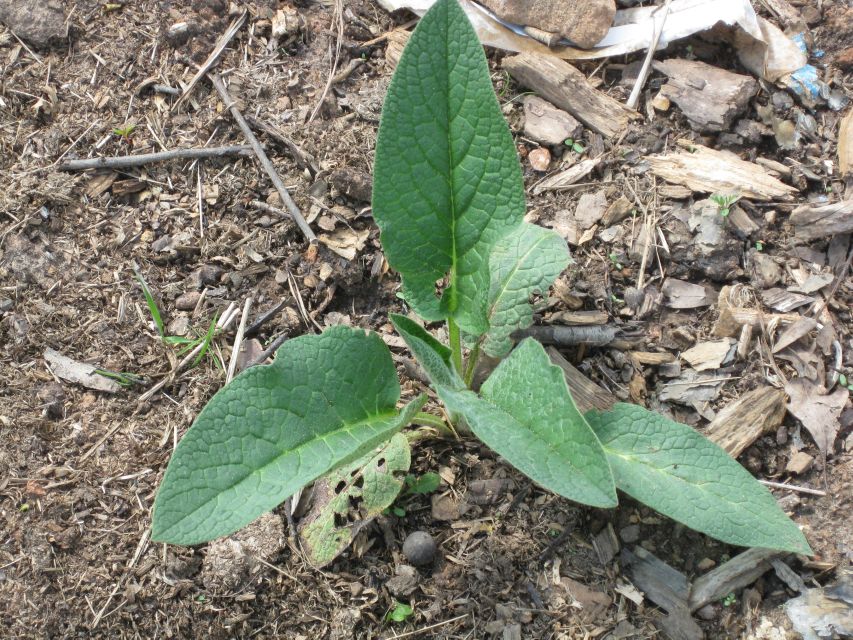
I purchased several Russian Comfrey root cuttings in the fall and they have now surfaced and are growing vigorously.
Russian Comfrey growing vigorously, planted in the fall
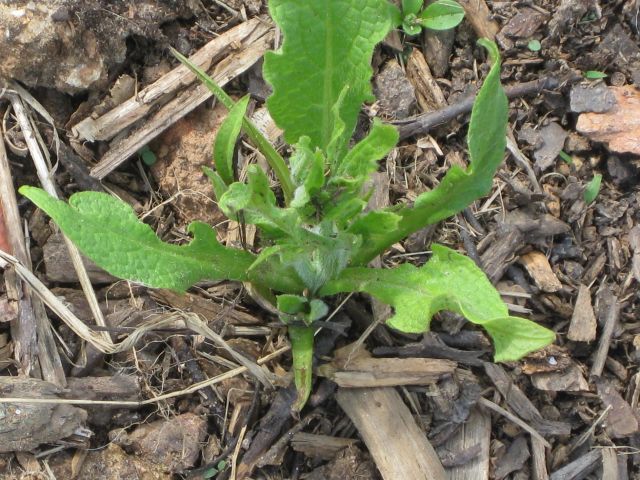
I also installed one cutting of Comfrey officinale, which does spread by seed and must be carefully watched. It has just surfaced and begun growing.
Comfrey officinale – just one plant to monitor
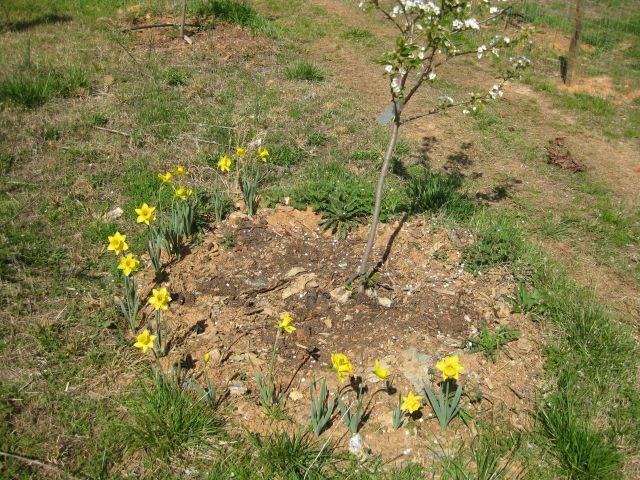
I mentioned my interest in guilds, a frequent permaculture topic. One of Hemenway’s suggestions is to plant daffodils around a fruit tree. They flower early in the season so will not compete for water in the dry months, they are poisonous and may dissuade predators and, they look pretty.
blossoming pear with daffodil companions
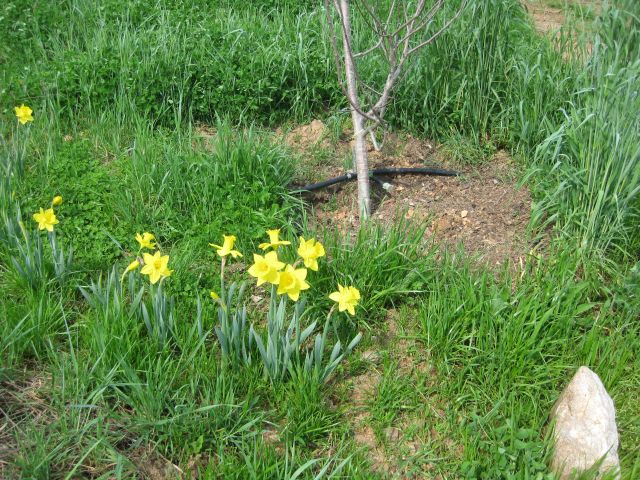
Most of my pears are now in blossom. Last year I lost all my pears to a late frost. The average last frost day here is mid-April, so I am watching the weather reports and if frost is imminent I may try wrapping my pear trees to protect them. Below is an apple tree with daffodils and various cover crops which I shall cut down after they have seeded – I know I shall lose the benefit of the nitrogen nodules on the hairy vetch and clover but allowing them to seed gives me more for next year.
apple tree with daffodils and cover crops including crimson clover, winter rye and hairy vetch
I am not including a photo of an apple tree with a nearby comfrey since, having now read the book on Russian Comfrey I realize I planted the comfrey too close to the tree and must relocate it – watching out of course that I do not leave any root remnants behind.