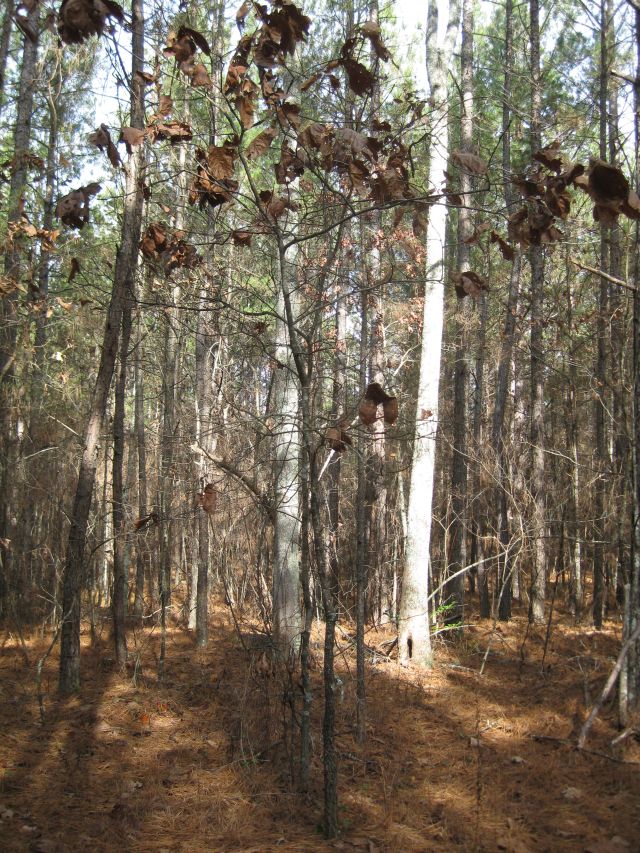
Yesterday, while walking through the woods, I noticed a very large oak tree leaf. Automatically, I looked up and around for the parent and saw just large pines and then, on the side, a smallish 14 ft oak tree. Could this small tree have produced such a large leaf, I wondered. It still retained some leaves and indeed they were very large.
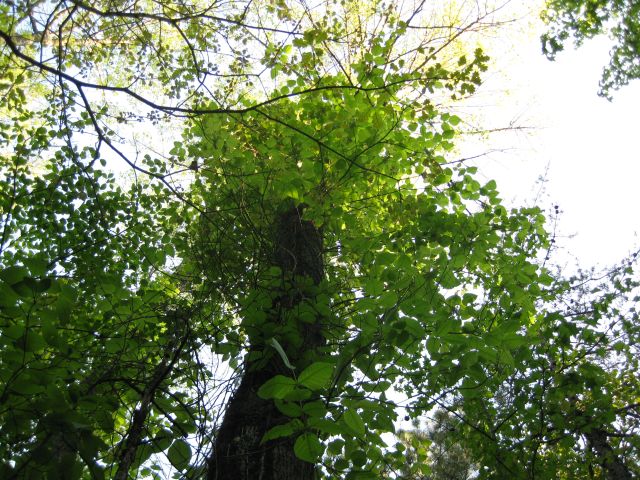
small oak tree surrounded by much bigger pine and poplar trees
Now I know that oak trees will wait patiently in shrub form for an opening in the canopy above and then they spring to life. I have found 1ft high oak trees with 4 ft tap roots and know that a shrub like tree can be many years old. So to return to the riddle I hypothesized that the leaf size depends on the age of the tree and this smallish tree could be many years old. But that doesn’t work since a large nearby oak tree which I know is very old, has smallish leaves. And then, this morning, as I worked my way through my biology textbook, it fortuitously provided the answer.
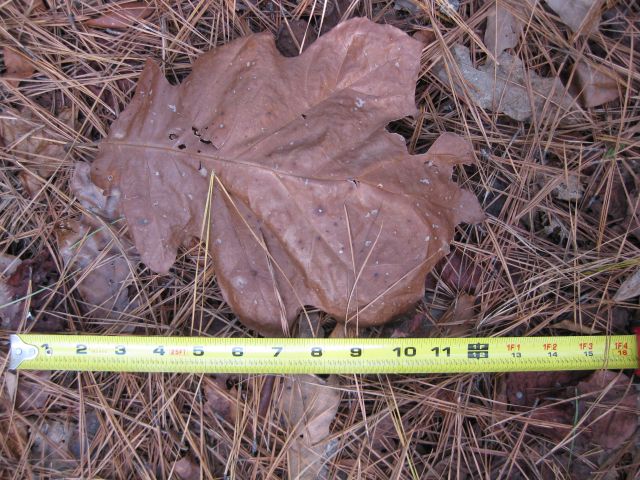
a big leaf from a small oak tree – measures a foot in length
Some variation within a species is due to genetic diversity within individuals but some is due to response to the environment and this is called “phenotypic plasticity” meaning that the plant (its roots, shoots or leaves) are plastic or changeable depending on environmental conditions. The textbook (Biological Science by Scott Freeman 3rd edition page 798) states that oak leaves are a prominent example of phenotypic plasticity. Shade leaves (grow in the shade) are big and sun leaves are small. Shade leaves provide a large surface in order to absorb as much sunlight as possible. So that’s the reason why the small oak tree has big oak leaves compared with high standing oak trees which have direct access to the sunlight.
But then, the question could be asked, if absorbing sunlight is the priority why shouldn’t a big oak tree also grow big leaves? Leaves lose water (transpiration) and the more exposure to the sun the more water loss. In the shade however, humidity is higher and water loss is less so the large oak tree leaf in the shade can capture more light with minimum loss of water.
“task” and “pleasure” seem opposed but not when it comes to fruit trees. I enjoy planting fruit tree saplings. Fruit trees are a long term investment and some of the best advice I received was to plant the trees first and then focus on the vegetables and berries. While in Portland last September I visited the Powell bookstore, which is a landmark. In the growing section I found the Lee Reich book “Uncommon Fruits for Every Garden” marked down to $9. I snapped it up, read it and then joined the Atlanta Fruits internet group where a member mentioned “Hidden Springs Nursery”. After coursing their website and cross referencing to Reich’s book, I ordered 11 fruit trees in mid-September. Yesterday, 11/28, the shipment arrived and today I planted out the saplings. The reason for the delay, they explained, was to ensure the fruit tree saplings had entered dormancy, which makes sense. The small fruit trees were carefully packed and arrived in good condition.
The fruit trees I ordered are somewhat unusual – pawpaw, medlar, juneberry, aronia, goumi, kiwi and sour cherry. The two pawpaw (Mango and Overleese) and the sour cherry I planted on a new terrace which I dug out of the hillside a few months ago. The sour cherry is located close to a sour cherry gifted by my neighbor and I hope the two will cheer each other along. The pawpaw in their early years are sensitive to summer sun and in spring I will build a sun shelter for each.
The instructions suggested that the juneberry and medlar fruit trees should be planted with the graft covered by soil to encourage rooting of the scion, which Reich confirmed.
I had earlier decided to plant the kiwi (2 females and 1 male of the Hardy variety) in a well exposed site. But the instructions said they should be planted on a north-facing slope or north of tree cover in order to delay their habit of early spring blossoming. So the site I selected is to the north of tall pine trees – the kiwi likes forest conditions and I hope they will be happy there.
I selected the medlar in part because of its history – it reached its peak popularity in the Middle Ages and Wiki says it was grown by the ancient Greeks and Romans beginning in the 2nd century BCE. Apparently its appearance is unappetizing, but not its taste – I hope I get to savor it in a few years.
I never studied biology and as I pursue my “new track “in growing and interacting with nature I am at a disadvantage.
I recently completed the excellent “Introduction to Sustainability” MOOC provided by www.coursera.org entirely free, and learned a lot. I enjoyed the experience and have now decided to study biology. There is a coursera course starting summer next year “Introduction to Biology: DNA to Organisms” and the notes suggest acquiring “Biology” by Campbell Reece. I was able to purchase the 2007 edition for less than $10 (including shipping) and am happily working my way through it. I also discovered an excellent website: http://www.dnaftb.org/1/animation.html titled “DNA from the Beginning” which is an animated primer on modern genetics, so as winter closes in, I have much to work on.
A few days ago I was plucking pea pods from the pea plants and I wondered how the peas would be pollinated now it was getting cold and my bees stay indoors when the temperature is less than 50 degrees. Since it was getting cold I headed indoors and began working through the website primer on genetics and, by pure serendipity, the first topic was on the Father of Genetics, Gregor Mendel, who in 1865 began his experiments on pea plants, which when left alone self fertilize. This answered my question on pollination.
Mendel focused on individual traits of pea plants (phenotypes) and by cross fertilizing them and careful analysis he concluded that each alternative form of a trait is specified by alternative forms of a gene (allele) and a pair of alleles is called a genotype. It was Mendel who identified dominant and recessive alleles and how the first generation (F1) will have the dominant trait but the second generation can begin to show the recessive trait. Which is why seeds from F1 hybrids will not produce true to the hybrid.
While working my way through the animated primer I read about Crick and Watson who discovered the DNA double helix and the book “The Double Helix” by Watson was referenced as a good read. I just finished reading it and it is excellent. Watson was an American student at the Cavendish Laboratory of Cambridge University and his insousiance and self-deprecating dialogue makes it an exciting romp with lots of humorous asides as he and Crick competed to beat Linus Pauling to solve the DNA configuration. At one point, when Crick and Watson were stumped “the problem was then put aside for a rapid scanning of a novel on the sexual misjudgments of Cambridge dons.” Or when visiting an aristocratic home “Sol Spiegelman and I went straight for a butler carrying smoked salmon and champagne, and after a few minutes sensed the value of a cultivated aristocracy.” When Watson excitedly informed Crick he had found the answer and was rebuffed, he notes: “Reporting that even a former birdwatcher could now solve DNA was not the way to greet a friend bearing a slight hangover.” There were four principal researchers and three of them got the Nobel prize but the fourth, Rosalind Franklin, died before the award and the prize is not awarded post-humously. There has been controversy about whether her contributions were fully recognized and I was pleased to read the unqualified tribute made by Watson in the Epilogue. A good read.
My property is about 50 minutes (=50 miles) north of Atlanta. Some 30 minutes into the trip I will often find a pretext to stop at the convenient Lowes DIY store for a “necessary ” purchase as well as for the free coffee, friendly cashier and to ease springs. The last reminds me of my army days when, after serious imbibing in the NCO mess, we would “request permission to ease springs” and then stumble over the tent guy ropes into the darkness of the night.
So this morning was no different and it occurred to me as I scouted the store, that I should visit the nursery area because this time of year they have large markdowns. Generally I do not buy plants at DIY stores but grow from seed or order from specialty internet providers, though some have disappointed! However, the trees and the shrubs were all marked down 50% and the decision was whether to go for the nectarine or the pomegranates. I tried to recall whether either were problematic for my area or required cross pollination, and failed. So I took a chance and bought the pomegranates, one of each of the two varieties, so I had cross pollination covered, their combined cost was less than the nectarine and, since they are smaller they would fit nicely as semi-understory plantings in my orchard. Plus my neighbor has a pomegranate shrub (from which I took a cutting a week ago) which bears sound but sour fruit and I delusion myself that with better sun exposure and my compost, the outcome will be better.
Not a very scientific method to reach a decision and so I was relieved when I later consulted my reference book, “Gardening in the South – Vegetables and Fruits” with Don Hastings, and the handy reference table informed me that nectarine are “very hard” to grow with worst problem being insects and diseases (the only other “very hard” is apricot), while the pomegranate is “easy except for cold” and its worst problem is cold damage. So I was lucky in my choice.
The book offers similar comments for fig and persimmon as for the pomegranate, and last year my two fledgling figs both died to the ground but came back strongly from their established roots. The native persimmon was similarly mauled and is growing more slowly. I may try protecting the figs, persimmon and pomegranates with wrappings or tomato cages filled with leaves. And with global warming, this problem too may pass.
(As for why two posts in the same day? Thank you Sandy, which headed north with her coattails blowing briskly and coldly – enough to keep me in doors after planting out the pomegranates.)
The house I purchased a few years ago is on sloping ground and between the house and the tarmac road was a gully which the previous owner, a contractor, had filled with trash. (Not as bad as contractors digging holes for landscaping dirt for a new house and then filling with tree trunks, which results in sinkholes, anguish and expense for home owners.) I tried clearing the trash myself with trips in my pickup to the recycling center but made little progress. I did not have my bobcat at the time and so I engaged a contractor who removed several dump truck loads of trash and then filled in the gully with more dump truck loads of soil. And so I had a bare slope to work with. And I made a number of mistakes.
My initial steps, with hindsight, were ok. I cut down a big pine, delimbed it and positioned it diagonally about halfway up the slope. At its bottom end I constructed a french drain. The idea was to divert rainwater streaming down the slope to the drain and prevent erosion of the slope. There has been no erosion, so this probably helped.
Next, to populate the slope, I ordered various hardwoods from the South Carolina and Georgia forestry commissions. The price is reasonable when you order at least 10 trees of a kind, and ever cheaper as your order increases from 50 to 100 to 500 to 1,000. For a large tract this is the way to go. For my smallish area not the best solution. Most of the seedlings arrived in January and February. A better time to plant would have been in September and October when the roots could have established themselves before the cold weather. The seedlings were shipped bare root and some had minimal side roots just a large severed tap root. More side roots would have enabled the seedlings to establish themselves more quickly. Some of the items I liked were out of stock and so I did not have the variety I wished for.
So what should I have done? Simple, just pick the acorns of the red and white oaks in the nearby woods and the nuts of the hickories, bury them in the ground alongside my vegetable plantings and then plant them on the slope a year later. This is what I did a few years later and had excellent results. By planting the nuts in the vegetable garden they were guaranteed ample watering, good sun exposure and good soil. And the good soil had another bonus. When I forked out the seedlings for replanting on the slope, because the ground was soft (and wet) most of the roots were intact, including the tap root. And these seedlings were from my area and so are well adapted to quickly populate the slope. Had I initially gone this route I apparently would have lost a growing season but the purchased seedlings took a long time to get going and I expect that my own seeded local sourced trees will grow at a faster pace.
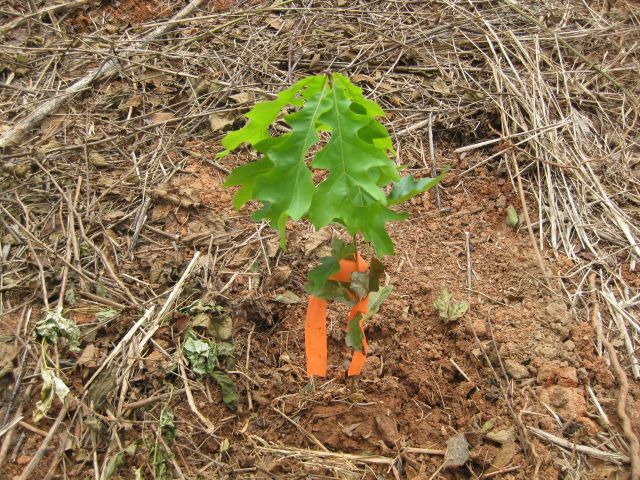
a seedling grown from an acorn planted last fall. although small in size, the root exceeds 1 foot. the red surveyor’s tape increases visibility and reduces inadvertent destruction from a scythe
When I planted each seedling I dug out a good sized hole and filled it with a mixture of soil and my home made compost and watered well, following the adage “dig a $10 hole for a $1 plant”. Not a good idea – there were large trees bordering the slope and their roots immediately headed for the newly introduced nutrients and moisture. So I burdened the newcomers with fierce competition. I probably should have introduced them surreptitiously, below the radar.
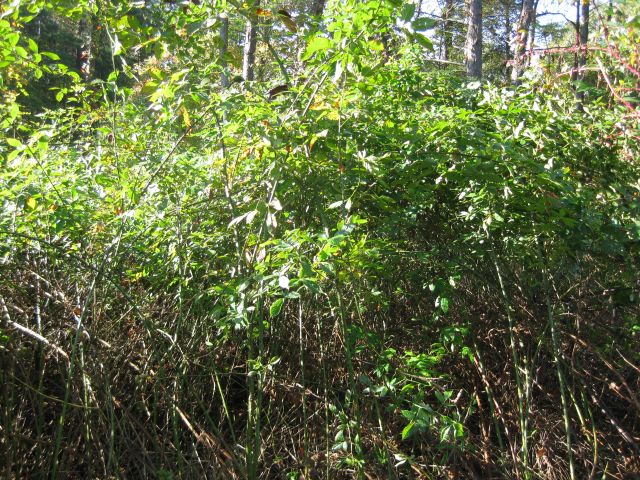
Other mistakes. After the slope was graded in the fall, I seeded with hairy vetch and clover and they took off well and helped combat erosion and added nutrients (nitrogen) to the ground. This was fine. But in following years I was focused on my edible plantings elsewhere and ignored the slope and it was invaded by brambles and brier which displaced my ground cover and competed with my tree plantings for moisture, nutrients and sun. In their excellent 2 volume book “Edible Forest Gardens” the authors (Jacke and Toensmeier) interview Martin Crawford, U.K. author of the equally excellent “Creating a Forest Garden” and on several occasions he stresses the importance of controlling brambles. He notes “very important – I have seen forest gardens taken over by these.” Well, I took my eye off the ball and the brambles completely took over, reaching heights in excess of 10 feet.
an example of the mass of brambles, dense, tall and overarching, forbidding easy access to their base
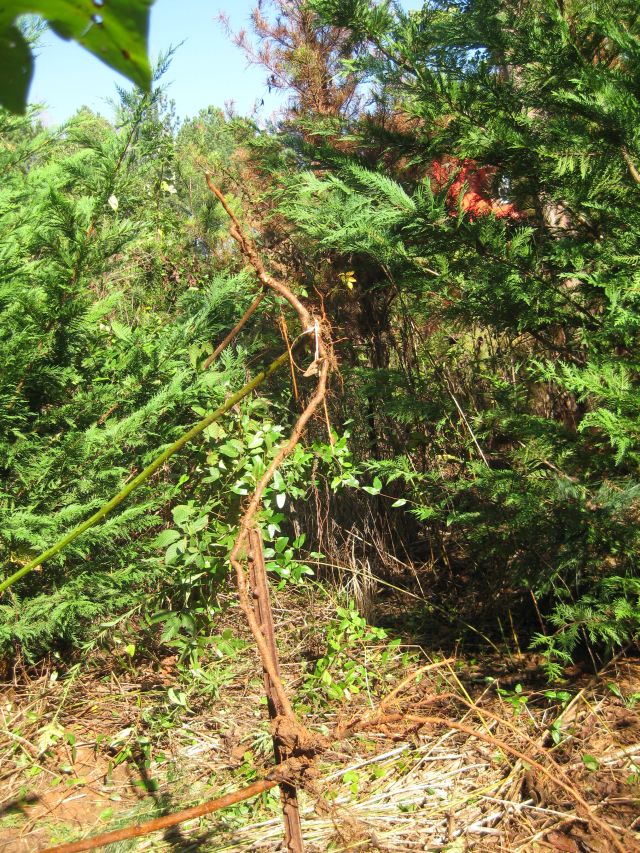
The past few weeks as I dug out the invader I became acquainted with its strategies. It has strong lateral roots which grow just below the surface and then pop up to establish new plants.
you can see the horizontal bramble root (shown here vertically) with the canes emerging every few feet to the left of it
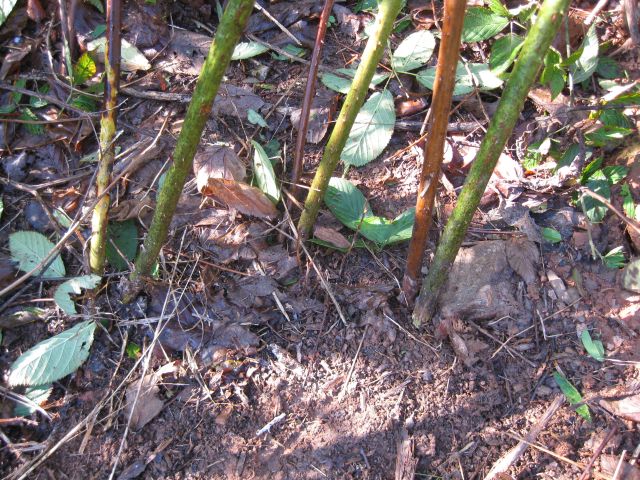
Also in winter the cane dies back and in spring a new cane emerges from the same base, so it is common to see a thin brown cane (previous year) and a thicker new green bramble cane for this year.
here are three pairs of brambles, each pair consisting of last year’s predecessor and this year’s replacement
The reason for increased diameter is not just because the old cane is dried out – the new cane can grow bigger because it is starting with the root base established by the previous year’s cane.
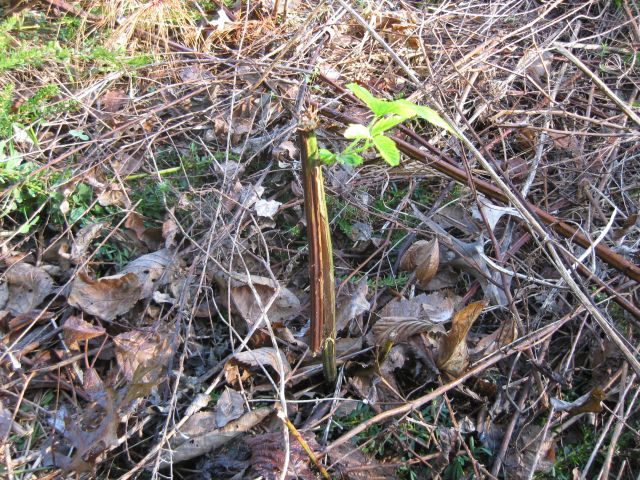
scything is not effective. within a week or so new shoots appear from the stump. you have to pull out the bramble which is much easier after rain has softened the ground. although for getting close to the bramble a long handled scythe for cutting and clearing is great
Just as I have been digging out bermuda grass in my berry planting area so am I committed to clean up the slope and release the hardwoods so they can grow vigorously and outshade their competitors which also include some tough rooted 2 foot grasses. It needs continuous attention and hard work to help the favorites outcompete the bramble and allied invaders.
My interest is moving from annual vegetable crops to tree crops and perennials. Perhaps the bonanza of pears from my Kieffer, Warren and Giant Korean, plus lots of figs from an old established tree have spurred me on.
With the summer heat deterring outdoor activity for much of the day, I have been reading extensively. Now that “Farmers of Forty Centuries” by F.H King (published 1911) is behind me, I moved on to “Tree Crops a Permanent Agriculture” by JR Smith published 1929 (freely downloadable) and enjoyed part one (titled “The Philosophy”) and read extracts on selected trees, all of which was very informative and relevant since the examples were taken from the southeast.
My knowledge and interest in trees was further expanded by a visit last week to Oregon including drives through large state forests and a 3 hour visit to the World Forestry Center. Located in Washington Park in Portland, the center’s mission is to “educate and inform people about the world’s forests and trees, and their importance to all life, in order to promote a balanced and sustainablefuture.” There is a wealth of information and I enjoyed the exhibits on different forests of the world and logging practices. Much emphasis was made of sustainable practices and yet it appeared to me that the practices they were promoting were not as sustainable as they could have been. It seems they monocrop i.e. after harvesting timber the new plantings are all of the same species. I wonder if this is truly sustainable? You don’t get diversity of plantings or of associated wildlife or other life forms, and, with no diversity it is much easier for a disease or insect attack to spread across the whole forest. A more diversified planting will produce a more varied canopy, encourage more diversity, with species perhaps supplementing each other and making better use of resources, and should be more resilient. Granted, when it comes to harvesting it is much easier to process similarly sized and similar tree species but in the long term is this the best practice?
I am now reading a very well written, insightful magnus opus – Edible Forest Gardens by Jacke and Toensmeier. Although I am familiar with a number of the concepts and there is some repetition, it is really a good read. I am also working on converting my fruit orchard to an edible forest garden by introducing lower canopy trees, shrubs, herbs and edible roots, and the book is a good reference. I just joined the Atlanta Fruits Yahoo group and there is a wealth of information in posts made over the past 10 years of what works and doesn’t work in the Atlanta area, which is proximate to my growing area.
Oh, I forgot to mention – I signed up for and am participating in a Coursera online course with 26,000 other students. The topic is “Introduction to Sustainability”. A 600 page textbook (current – published May 2012) is provided and each week for the 8 week duration there is required reading, lecture videos to watch and articles to read, plus quizzes to complete. And we are encouraged to participate in the forums where students from across the world (young and old) exchange information and views. And it is interesting, challenging and free!
I have excavated at least half a dozen contour ditches and, in the months following construction, they performed as advertised. After heavy rains they dutifully filled with water and, because they are on contour i.e. horizontal, they held the rainwater and allowed it to infiltrate into the soil benefiting the plantings on each side of the ditch (actually the plantings on the side of the contour ditches which adjoined the lower slope did better, probably because there was more topsoil on that side which allowed the water to move more easily to their roots).
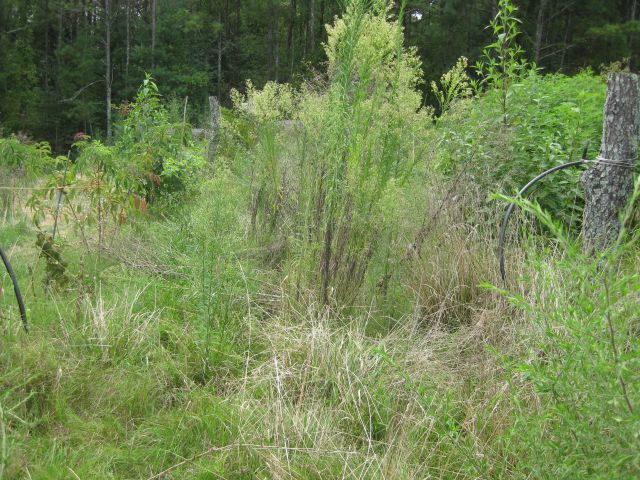
So why a “rethinking” of contour ditches? The bottom of the ditch has proven an ideal breeding ground for high growing grasses and wildflowers (I avoid the perjorative “weed” – these invaders I am sure serve some purpose). The reason is because the water sliding down the hill brings with it soil and nutrients and the easy access to ample water at the bottom of the ditch is fuel enough for growth. So the water which should be infiltrating the ground is now sponsoring these tall growers. The extensive growth hinders access to the plantings and because the contour ditches are now semi-concealed it is easy for the unwary visitor to be injured.
contour ditch between two rows of berry plants – the berry plants are small and the tall growth locates the ditch
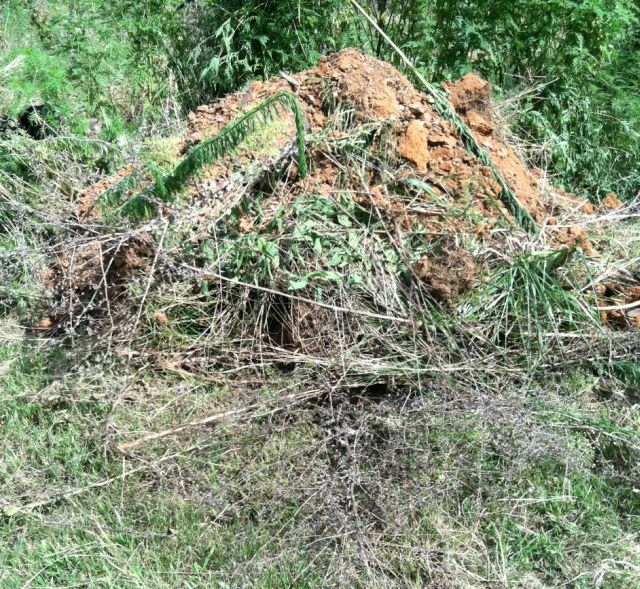
I recently completed reading “Farmers of Forty Centuries” by F.H. King. An excellent book filled with insights. It unlocks the techniques used by the Chinese, Japanese and Koreans who farmed the same land for 4,000 years without our modern fertilizers and ‘cides and with dense populations too. If anything meets the definition of “sustainable farming” it must be their practices. After manures (animal and human) their main source of nutrients was the soil and organic matter lodged in their canals. So their canals like my contour ditches also filled up and they turned their problem into a solution. This got me thinking – why not remove the growth in the contour ditches and stack it for use at a later date.
an example of the growth and soil which had filled one of the contour ditches
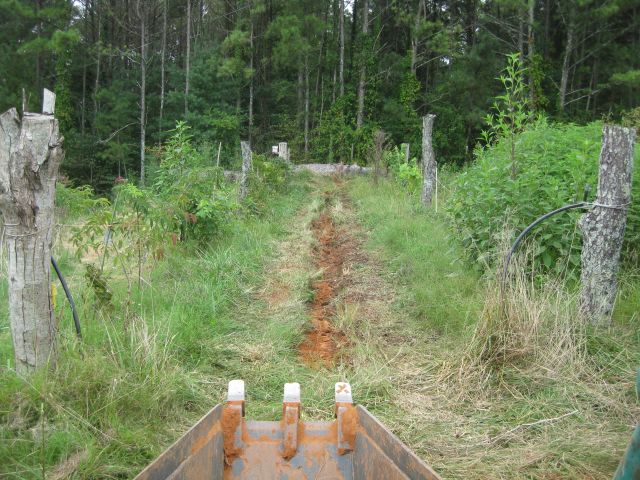
now you can see where one of the contour ditches was lurking, cleared with the help of my bobcat and stump remover, teeth of which visible at bottom of ‘photo
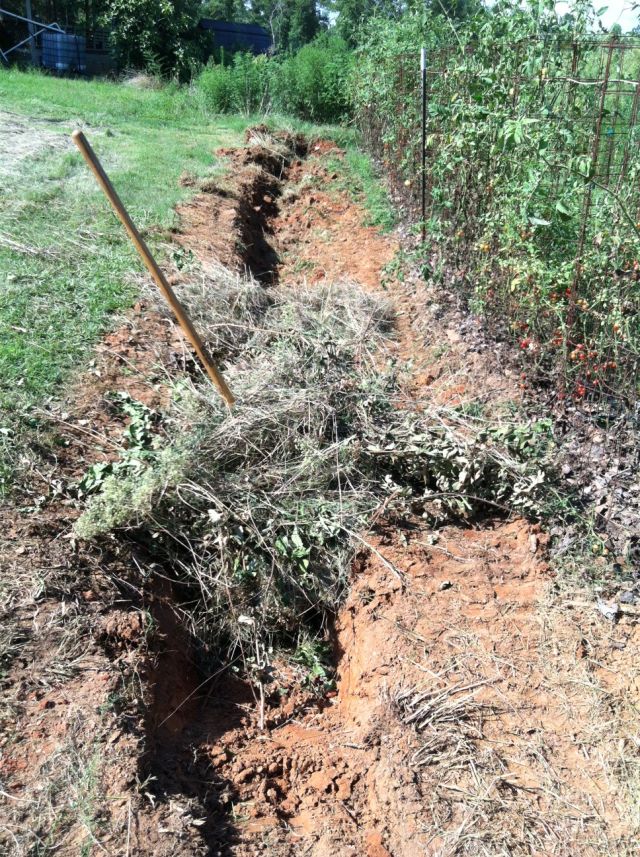
Another of their techniques was to either bury their compost or cover it with mud. The logic, I assume is this accelerates breakdown by keeping the contents moist, and also reduces loss of nutrients to the air. So I have decided to fill the enlarged contour ditches first with material leveled by my scythe such as long grasses and other growth, and then with tree branches and trunks. I am hopeful that these materials will absorb and hold the rainwater and, as they degrade, will provide nutrients to the soil. Two other advantages – the wood will be stacked to just above ground level so less risk of injury and the wood will prevent the growth of grasses and unwanted plants.
one of the contour ditches is alongside tomatoes. I am filling it with grasses leveled by my scythe
The berry contour ditch does not extend all the way south to the pine trees since this area does not receive much sunlight. But when it rains a lot of rainwater goes down the hill south of and beyond the contour ditches. So while I had my bobcat out I decided to angle a feeder ditch which could catch this water as it traveled over the ground and direct it to the contour ditch.
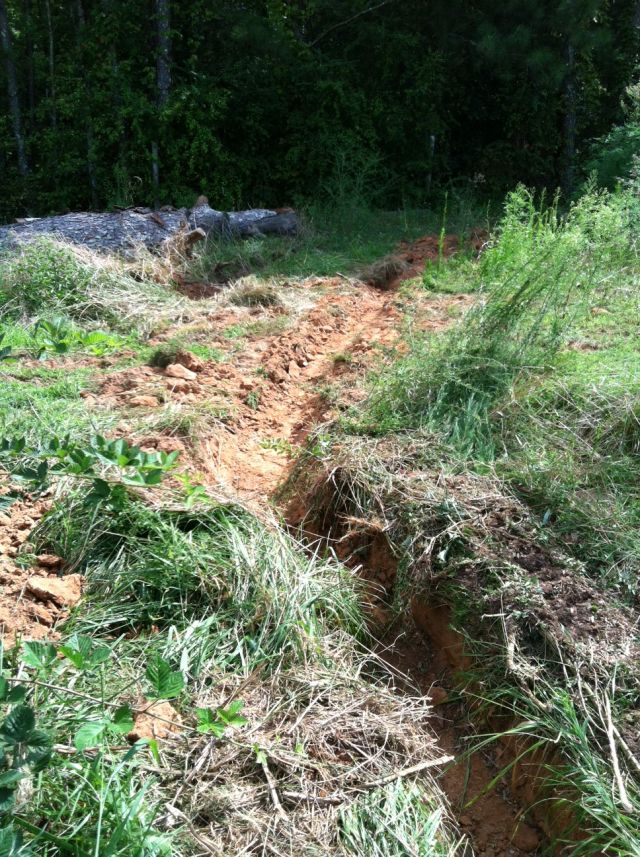
feeder ditch extending from the woods to one of the contour ditches designed to redirect rainwater which swamped the foot of the hill
If the South’s summer heat and humidity bear any consolation, it is that I have to seek shelter in the house for much of the day and thus am able to extend my reading.
I enjoyed the first third of Zen and the Art of Motorcycle Maintenance by Pirsig but struggled as the protagonist ascended higher into the mountain and into rarefied philosophical issues for which I was not prepared. Now in the last third of the book the running is easier. His thoughts on gumption and practical issues of machine maintenance bring back memories.
At p. 310 he says “I like the word “gumption” because it’s so homely and so forlorn and so out of style it looks as if it needs a friend and isn’t likely to reject anyone who comes along”. I recall “gumption” too with affection. The only time I heard it used was by Tommy Cairns our lecturer in cost accounting at my university in Johannesburg during the early 70’s. His lectures were punctuated by reference to a general lack of gumption and the criticality of gumption for success.
Now, many years later I see it dancing on the pages of Pirsig’s book before me, such as “Gumption is the psychic gasoline that keeps the whole thing going. If you haven’t got it there’s no way the motorcycle can possibly be fixed. But if you have got it and know how to keep it there’s absolutely no way in this whole world that motorcycle can keep from getting fixed.”
One of the gumption traps he refers to is the “intermittent failure” which fools you into thinking you have an engine problem fixed and then it recurs. He suggests methods to identify and fix the problem with the advice that “In some intermittents you have to resign yourself to a long fishing expedition, but no matter how tedious that gets it’s never as tedious as taking the machine to a commercial mechanic five times”.
All of which brings back my second memory. When I lived in London I had a Morris Minor – a two door beetle-like friend (formerly a police car) which I worked on extensively and affectionately called “Elbee” for its licence plate. Elbee developed an intermittent fault – when I rounded corners quickly the electrics would falter. I searched everywhere for the culprit, without success. Elbee’s tools were kept in a rollup bag and one day, upon lifting the bag, I noticed an aimless, loose wire beneath. This was an earthing wire held in place by the tool bag and I figured that when I cornered and put Elbee through her paces, the bag shifted and the wire lost contact with the frame. It was an easy fix to secure the wire.
Elbee receiving a new clutch. The suburban street was my workshop
I am reading the F. H. King classic “Farmers of Forty Centuries: Organic Farming in China, Korea, and Japan” written in 1911 and there are so many nuggets of useful information, including the “kang”.
He observed the kang during his visit to Mongolia and his commentary made me think of the rocket mass heater (now popular in permaculture circles) with which it shares a number of features.
He describes several kangs – in one case it was 7ft by 7ft and about 28″ high and “could be warmed in winter by building a fire within” or “warmed by the waste heat from the kitchen whose chimney flue passed horizontally under the kangs before rising through the roof”.
“The top was fitted for mats to serve as couch by day and as a place upon which to spread the bed at night.” They were constructed from brick “made from the clay subsoil taken from the fields and worked into a plastic mass, mixed with chaff and short straw, dried in the sun and then laid in a mortar of the same material. These massive kangs are thus capable of absorbing large amounts of the waste heat of from the kitchen during the day and of imparting congenial warmth to the couches by day and to the beds and sleeping apartments during the night.” He goes on to mention problems after 3 or 4 years and how they turn the problem into a solution. His book can be freely downloaded.
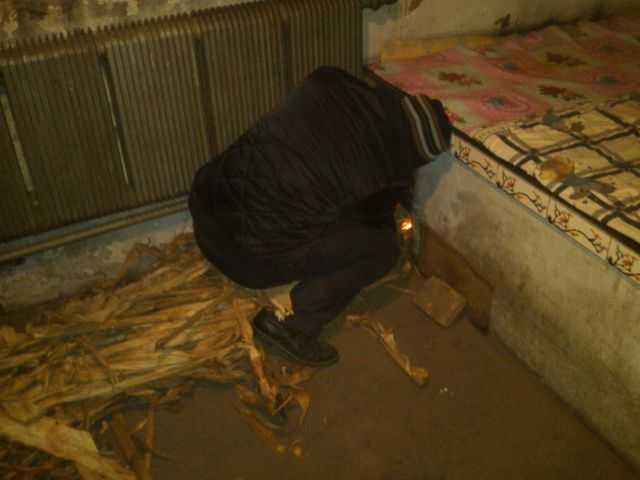
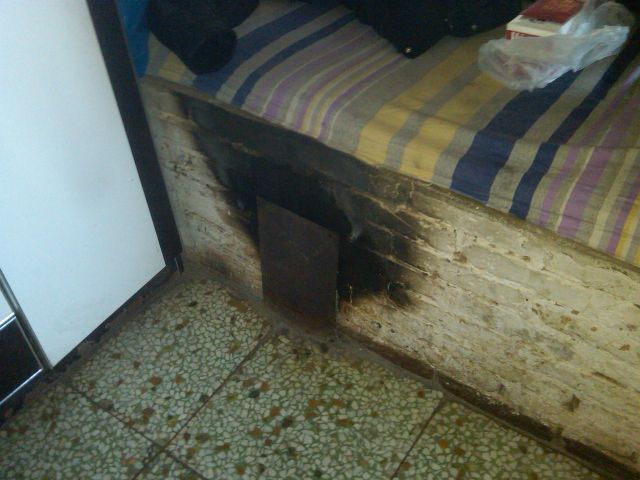
These kangs are still used today. I include below several recent ‘photos taken by a visitor to eastern inner Mongolia.
lighting the fire of a kanginterior fire of a kang‘photo of another kang
The visitor could not recall if the exterior flue of the kang was horizontal or vertical – he thought it may have been horizontal
I used to think observation was the key talent. On trips through the Kruger game reserve in South Africa my siblings and I competed to spot the lion, cheetah, leopard or unusual game first. On a river boat trip through north Australia we competed to be the first in the launch to spot the saltwater crocs (“salties”) lazing on the banks. And for such contests a sharp eye was all that was needed.
But in my interactions with nature, observing the discordant object is only the first step. Understanding why is equally important.
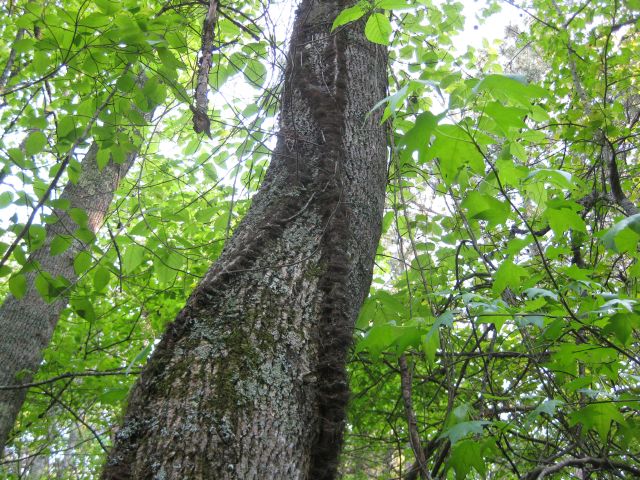
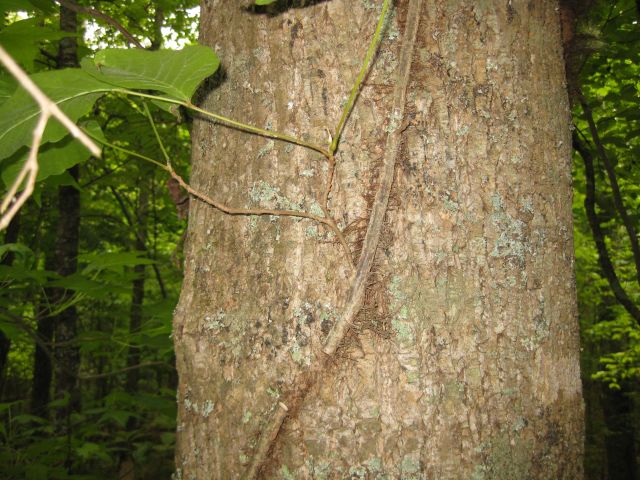
For several years my spring routine has been to spray roundup on the poison ivy alongside my walking paths in the woods. I believe in live and let live, but my dog is an investigator which requires her to explore scents and droppings off the trail, which are often in the poison ivy patches, and she then transfers the poison to all who contact her. So I use roundup for this purpose and this purpose alone. There is a glade alongside the trail where poison ivy thrives, despite repeated attentions from the sprayer. I observe the poison ivy, I drench and then later in the season spray again and the next year, there it is again, and more spraying. This year, as I was about to spray, I received a cell call and so lingered at the spot longer than usual and then happened to notice two snake like vines heading up a tree. Yes, they were poison ivy vines, which explains why, despite my ministrations, the poison ivy continually resurfaced sponsored by seed from overhead. Had I reflected on the persistence of the poison ivy I may have thought to look up and not always down.
poison ivy high in a treepoison ivy vines climbing a tree
Of course, once you know about it, it is a simple matter to identify it elsewhere, as in this other tree, 10 ft away.
a smaller poison ivy vine
But often more is needed than just knowing what to look for. Analyzing what you are looking at and being aware of the changing environment is a necessary skill.
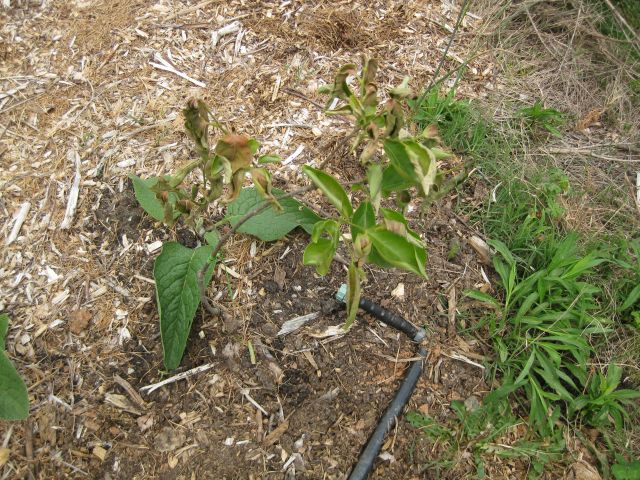
A couple weeks ago as I passed my new orchard I happened to notice that one of the small trees (tanenashi persimmon) was suffering. Half of its leaves had turned brown. I remembered that I hadn’t watered this area for a week and, except for the previous day which had been cold, the spring weather had been in the 80’s. None of the other trees was afflicted but I reasoned this particular tree was probably more susceptible to lack of water, so I promptly irrigated the orchard. I did notice I had planted Russian comfrey too close to the small tree but reasoned this could not be the cause since comfrey is not allelopathic. Then a little later that morning, I noticed that my tomato and cucumber seedlings were also afflicted – in their case I had watered every day, except the previous day which was cold. This seemed unusual hardship for one day’s missed watering. My mind wandered idly over these facts – perhaps there were root nemitodes attacking the one fruit tree and the tomatoes and cucumbers – such selective treatment seemed unlikely. Then I noticed, in a separate planting the cucumbers were doing fine and they also had not been watered the previous day because it had been cold. So why was the one lot ok and the other lot disaster. Then it dawned on me – the previous day had been cold, but how cold – had there been a freeze? I happened to meet my neighbor and he said the water in his hose had frozen the previous morning.
Now it made sense – the fig tree and the tomatoes and cucumbers are cold sensitive and had been hammered by the freeze. And the reason the other cucumber planting was ok was because it is on the crest of a hill with no obstructions below it, so the frost, like water, slid down the hill away from it, which was not the case with the other planting which was on level ground.
All of this conjecturing and misdiagnosing could have been avoided had I, the previous day, just glanced at my min/max outdoor thermometer, which would have told me how cold it had been and then, with this knowledge I would have understood the changes. So I need to remove distractions and attune myself better to my surroundings.
Or pursue a more analytical approach as Bill Mollison suggests in “Permaculture – A Designers’ Manual”: first make value-free non interpretative notes about what is seen; then select some observations and prepare a list of speculations; then confirm or deny the speculations by research, asking others, and/or devising more observations to test the hypothesis; then make a final examination of all the information to hand to arrive at a conclusion; and finally decide how to use the knowledge gleaned. A disciplined approach for me to consider.