“task” and “pleasure” seem opposed but not when it comes to fruit trees. I enjoy planting fruit tree saplings. Fruit trees are a long term investment and some of the best advice I received was to plant the trees first and then focus on the vegetables and berries. While in Portland last September I visited the Powell bookstore, which is a landmark. In the growing section I found the Lee Reich book “Uncommon Fruits for Every Garden” marked down to $9. I snapped it up, read it and then joined the Atlanta Fruits internet group where a member mentioned “Hidden Springs Nursery”. After coursing their website and cross referencing to Reich’s book, I ordered 11 fruit trees in mid-September. Yesterday, 11/28, the shipment arrived and today I planted out the saplings. The reason for the delay, they explained, was to ensure the fruit tree saplings had entered dormancy, which makes sense. The small fruit trees were carefully packed and arrived in good condition.
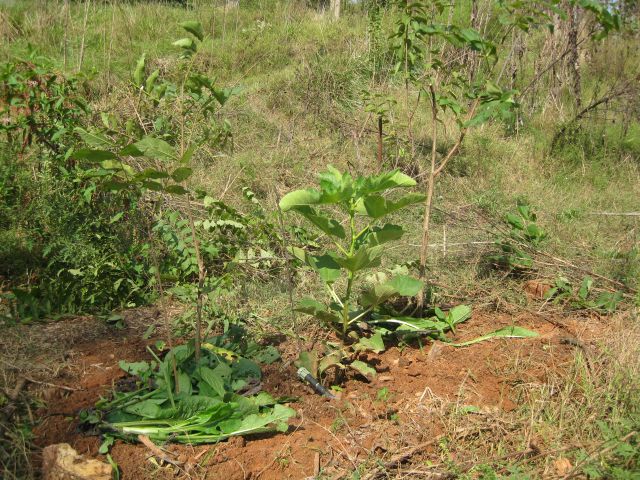
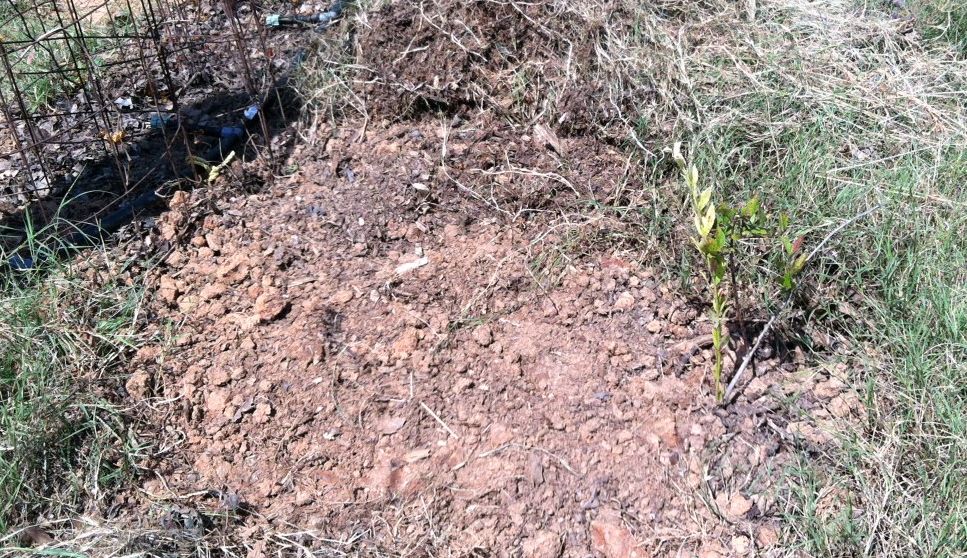
The fruit trees I ordered are somewhat unusual – pawpaw, medlar, juneberry, aronia, goumi, kiwi and sour cherry. The two pawpaw (Mango and Overleese) and the sour cherry I planted on a new terrace which I dug out of the hillside a few months ago. The sour cherry is located close to a sour cherry gifted by my neighbor and I hope the two will cheer each other along. The pawpaw in their early years are sensitive to summer sun and in spring I will build a sun shelter for each.
The instructions suggested that the juneberry and medlar fruit trees should be planted with the graft covered by soil to encourage rooting of the scion, which Reich confirmed.
I had earlier decided to plant the kiwi (2 females and 1 male of the Hardy variety) in a well exposed site. But the instructions said they should be planted on a north-facing slope or north of tree cover in order to delay their habit of early spring blossoming. So the site I selected is to the north of tall pine trees – the kiwi likes forest conditions and I hope they will be happy there.
I selected the medlar in part because of its history – it reached its peak popularity in the Middle Ages and Wiki says it was grown by the ancient Greeks and Romans beginning in the 2nd century BCE. Apparently its appearance is unappetizing, but not its taste – I hope I get to savor it in a few years.
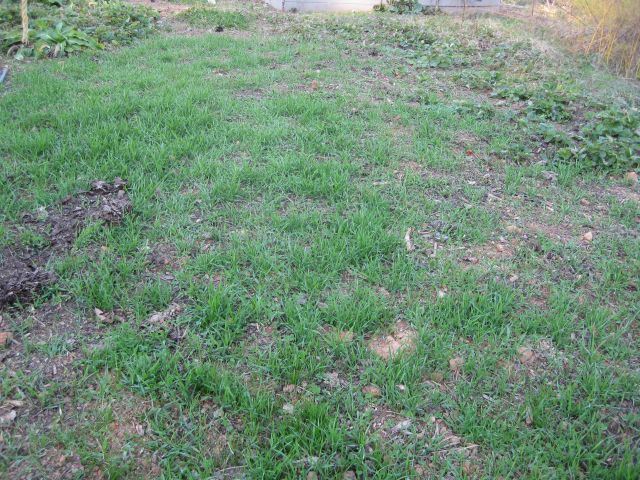
cover crops – I cleared the tomatoes and weeds, added compost and sowed winter rye and crimson clover. A few years ago I used hairy vetch, which worked well and next year I will order more since the local supplier, who originally sold me the seed, no longer carries it.
a vegetable growing area seeded with winter rye and crimson clover cover crops
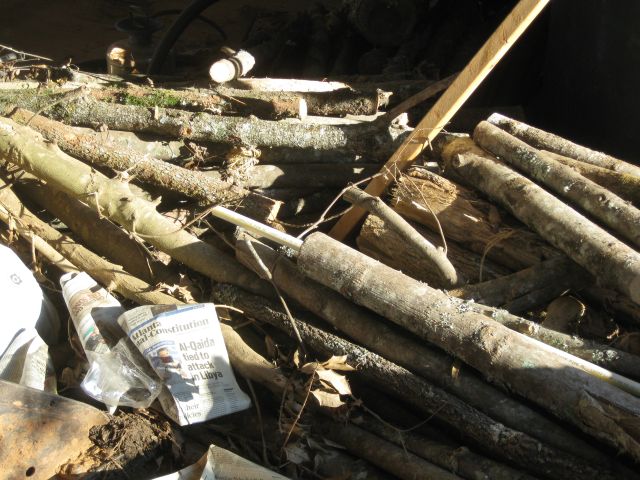
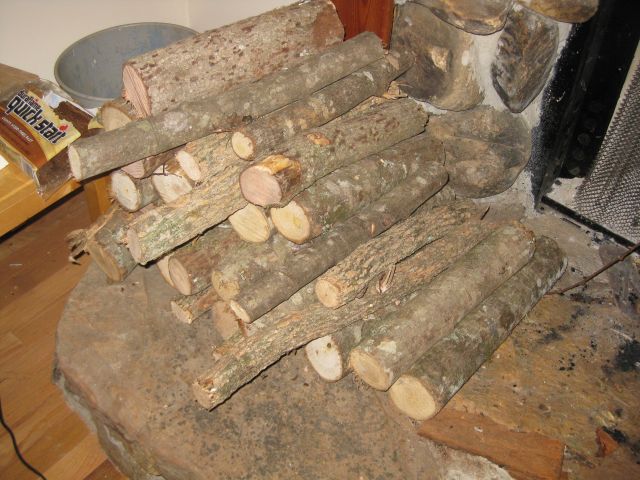
firewood – during the year I cut a new 5 foot wide route through the woods and I steered the path to avoid the larger trees. I had to uproot and remove smaller trees and I cut their trunks into 5 foot lengths and stored under cover for fuel for winter. I am now chain sawing the wood into 2 foot lengths to fit the grate. Last Sunday was cold and the wood burnt well.
firewood stored under cover drying for winter use. I have used some of the oak trunks as mini posts for structural jobs
firewood cut to size next the fireplace
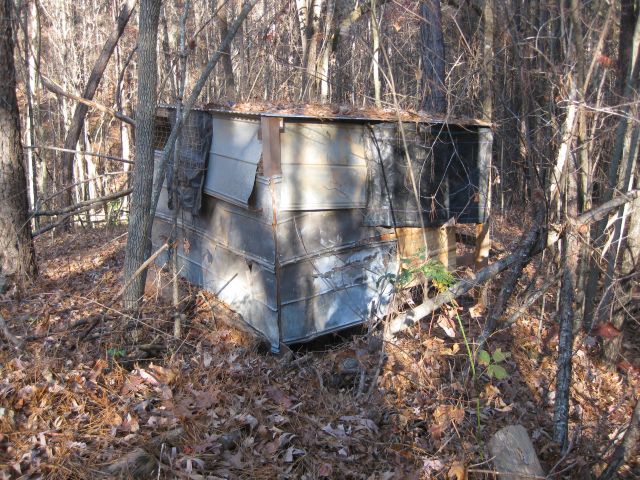
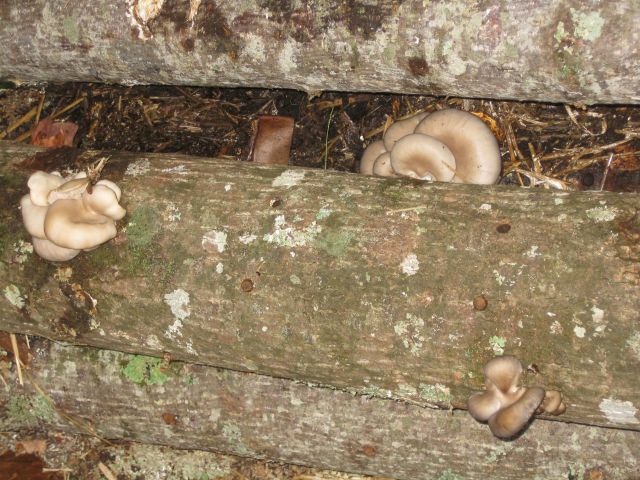
mushrooms – I built a mushroom house, which I filled with logs impregnated with sawdust spawn, and then neglected to water. A few weeks ago I watered the logs and some oyster mushrooms have surfaced. Encouraged, I shall water more regularly. Also I must affix a gutter to the roof of the shelter and direct the rainwater onto the logs – this is obvious and I should have done it at the outset.
mushroom shelter with solid sheeting or barrier cloth on north and west sides for sun protection, and chicken wiring and door protecting remaining access pointsmushrooms have begun to grow
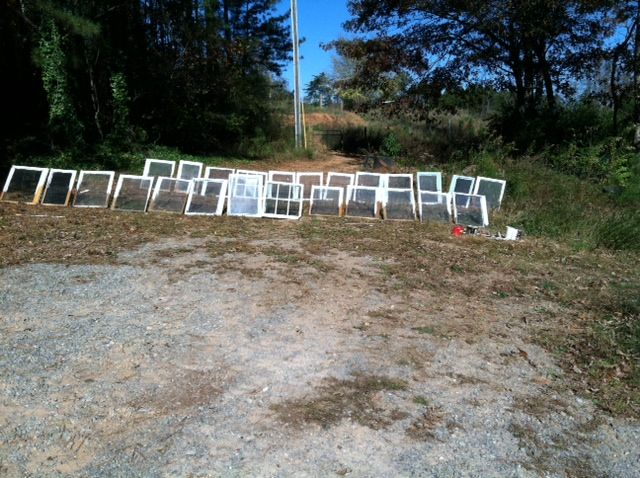
winter growing shelters – last year I was able to purchase a number of wooden windows for a $1 each and constructed rudimentary cold frames. This year I would like to create a larger structure but to do this I need posts. Pressure treated posts would be ideal but I do not want to pollute the soil or my vegetables. So the options are cedar wood (which rots with time), composite posts (which are expensive and may distort), metal structural posts (ideal but where will I find them) or use some oak trees from the woods (cheapest, self reliant and maybe the way to go). In the meantime I painted the wooden windows, first with Kilz primer and then a good quality exterior latex.
painted windows drying in the sun
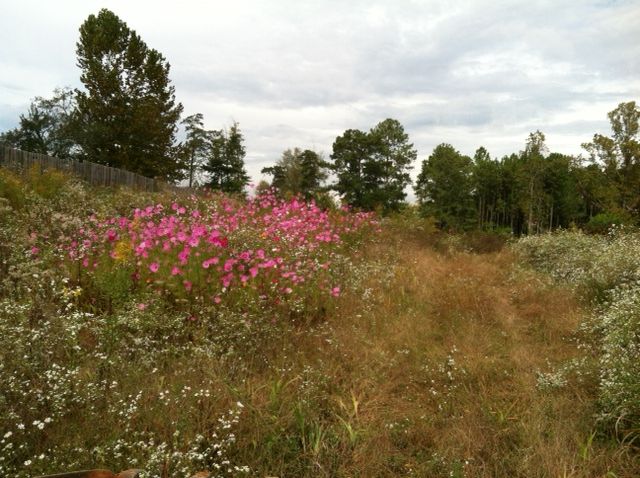
seed gathering – now the cosmos and zinnia have finished flowering and set seed, I sortie out to gather seed for next year.
ebullient cosmos in a field
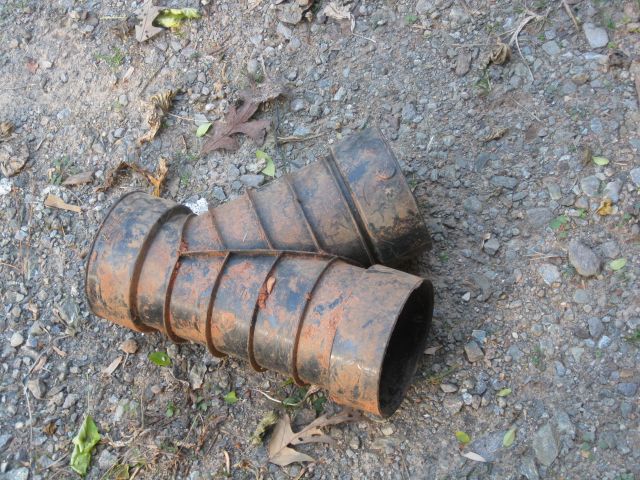
rainwater collection – when it comes to my rainwater harvesting systems the invariable rule is that it will fail wherever I have not checked. The main flow from the house roof went through a “Y” and the “Y” leaked in small amounts and eroded the ground supporting the connection so one of the 4″ pipes disconnected (maybe also assisted by the rodent hunting activities of my dog).
this is the old, cheaper, now replaced Y connection
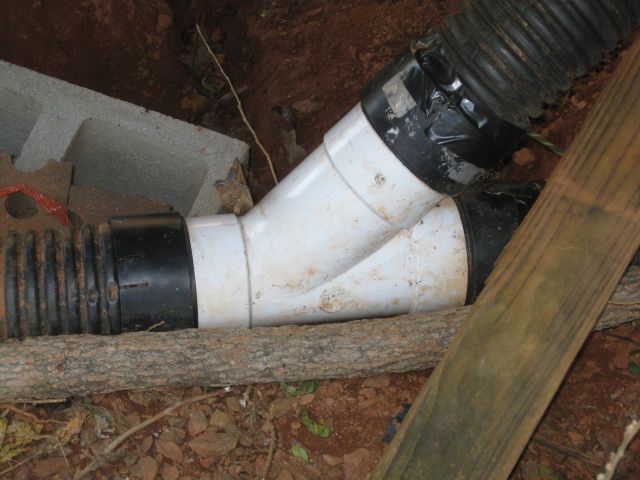
I replaced the old Y with a more substantial Y, I rebuilt the underpinnings and I secured the inlet pipes to the Y with duct tape and am resolved to keep a good eye on this joint and have instructed Trudy to leave the water drainage pipes well alone.
rainwater harvesting – the more expensive replacement Y secured with duct tape
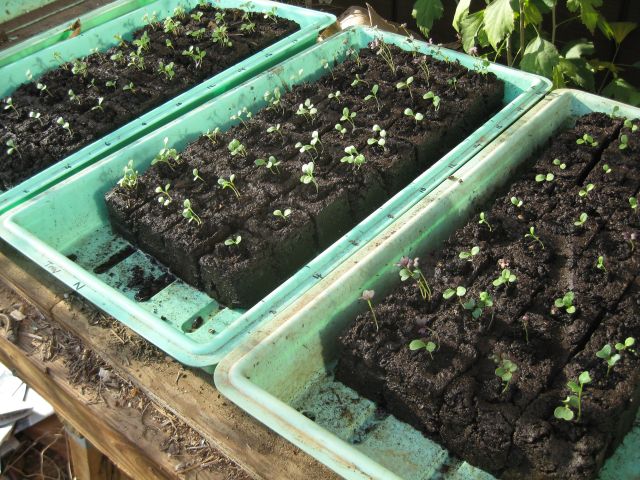
winter vegetables – I decided to seed more lettuce since I already have sufficient kale. The lettuce was seeded initially into 3/4″ soil blocks and are now in 2″ soil blocks in the greenhouse. I will probably grow some full size in the greenhouse and the remainder will be ground planted once I have figured out the construction of my new windowed winter shelter.
4 varieties of lettuce seedlings in 2″ soil blocks. the reason there are several in one block is this was older seed and I thought germination would be irregular. silly me, they all came up and I will have to thin or transplant.
cuttings and acorns/nuts – I have taken cuttings from trees I would like to replicate like mulberries, pears (my neighbor’s pear tree was prolific this year and my Giant Korean, which bore for the first time, was excellent), cherry, plum and one of my neighbor’s apple trees which had very sweet small apples. I know with the apple tree I may have a problem with the root stock. Perhaps next year, when I am successful with grafting, I will graft scions to root stock. As for nuts – my other neighbor gave me a dozen pecan nuts from his magnificent pecan tree and I also buried Ohio buckeye nuts, acorns from selected oak trees and nuts from other local trees. The cuttings and nuts are in an area which I visit and weed and water most days, with good sun exposure and the soil is well mixed with compost. So I am hopeful. If the cuttings are viable I may transplant them in spring next year or, better, wait till fall and then plant them out with the nut seedlings.
in earlier posts I mentioned other activities such as terracing the hill in anticipation of delivery of assorted fruit trees promised for the end of November, and winterizing the bee hives and the chicken coop. When really cold weather threatens I will wrap my fig and other cold sensitive trees in swadling and leaves to prevent die back.
Georgia is the center of the poultry industry. At a local luncheon the former president of the largest poultry operation in the state recently (October 2012) said the industry grew tremendously since 1970 from 1.5 billion to 7.5 billions pounds of chicken a year. He added that by 2050 the world’s population will be 9.1 billion up 34 percent from the current 6.8 billion and meat production must increase by 74 percent.
His comments and others like his, operate at two levels – the explicit and the implicit. Explicitly there is huge growing demand (not only from the population increase but from increased demand for meat as people around the world earn more) and this is a selling opportunity so long as the infrastructure is in place, otherwise production will move to Latin America, etc. But there is also an implicit assertion – that there is a moral imperative to provide food for the growing population of the world.
And once you accept the implicit assertion you are boxed in. Because only conventional agriculture (Green Revolution now enhanced by GMO’s) can demonstrably supply the quantity of food required by the growing masses. I remember discussing organic growing with an intelligent younger person who accepted all the virtues of safer more nutritious food produced sustainably while caring for the environment, but concluded by saying that the big drawback, if organic production was the norm, was there wouldn’t be enough food for everyone. And that is the box I find myself in.
A big reason for the increase in world populations has been the availability of cheap food as a consequence of the Green Revolution, you can trace the correlation. But these production practices are not sustainable, using the definition of sustainable development as “…development that meets the needs of the present without compromising the ability of future generations to meet their own needs.” How do you brake a runaway train charging down a hill? No one wants wars or famine nor environmental collapse. No easy answers, but at least escape the box and say it would be no bad thing if food prices began to gradually rise as we transition to more sustainable growing methods with better quality food and it would be no bad thing either if the world population gradually fell to sustainable levels. Or do I have it wrong?
My property is about 50 minutes (=50 miles) north of Atlanta. Some 30 minutes into the trip I will often find a pretext to stop at the convenient Lowes DIY store for a “necessary ” purchase as well as for the free coffee, friendly cashier and to ease springs. The last reminds me of my army days when, after serious imbibing in the NCO mess, we would “request permission to ease springs” and then stumble over the tent guy ropes into the darkness of the night.
So this morning was no different and it occurred to me as I scouted the store, that I should visit the nursery area because this time of year they have large markdowns. Generally I do not buy plants at DIY stores but grow from seed or order from specialty internet providers, though some have disappointed! However, the trees and the shrubs were all marked down 50% and the decision was whether to go for the nectarine or the pomegranates. I tried to recall whether either were problematic for my area or required cross pollination, and failed. So I took a chance and bought the pomegranates, one of each of the two varieties, so I had cross pollination covered, their combined cost was less than the nectarine and, since they are smaller they would fit nicely as semi-understory plantings in my orchard. Plus my neighbor has a pomegranate shrub (from which I took a cutting a week ago) which bears sound but sour fruit and I delusion myself that with better sun exposure and my compost, the outcome will be better.
Not a very scientific method to reach a decision and so I was relieved when I later consulted my reference book, “Gardening in the South – Vegetables and Fruits” with Don Hastings, and the handy reference table informed me that nectarine are “very hard” to grow with worst problem being insects and diseases (the only other “very hard” is apricot), while the pomegranate is “easy except for cold” and its worst problem is cold damage. So I was lucky in my choice.
The book offers similar comments for fig and persimmon as for the pomegranate, and last year my two fledgling figs both died to the ground but came back strongly from their established roots. The native persimmon was similarly mauled and is growing more slowly. I may try protecting the figs, persimmon and pomegranates with wrappings or tomato cages filled with leaves. And with global warming, this problem too may pass.
(As for why two posts in the same day? Thank you Sandy, which headed north with her coattails blowing briskly and coldly – enough to keep me in doors after planting out the pomegranates.)
A good friend had a Hatteras 58 ft long range cruiser. I loved the boat. It had a big engine room and, as it had been outfitted over the years with new electronics and other necessities, it had different DC voltages for different circuits and a spaghetti of wires in all directions. When components failed, and they often did, I would haul out the wiring diagrams and try trace the fault. The diagrams enabled me to understand the function of the wires. When we left harbor I found my bearings from the buoys and the rule was simple – as you exit the harbor keep the red buoys on the left and the green buoys on the right – the rule was reversed when you entered the harbor “red, right, return”. And in the open seas where we had no discourse with civilization, nature provided our bearings – the magnetic compass, or the arc of the sun. Although gps via satellites was an easier alternative.
This past Saturday as my running/walking group munched at the bagel house, religion surfaced (a welcome change from presidential politics). And I wondered why, in an age of greatly enhanced electronic communication of news and knowledge, the three religions still build such fervor among their followers. A bemused silence followed. And then on Sunday I was discussing prop 37 (proposes labeling of genetically engineered foods) with one of my sons in California and I said it was hard to understand why anyone would vote against it and yet it is looking as though it won’t pass. And he said he still had to read up but if passed it would increase his grocery bill by $400 pa. He suggested I visit the “noprop37.” website Which I have done. It is a persuasive website. It hammers on so many touch points and in doing so it provides bearings for the undecided to navigate their ship.
I prize integrity, which is holding fast to your moral and ethical principles, but to do so we need bearings. Without bearings how would you progress in a dark churning sea? So we take our bearings from those we have elevated to role models (the noprop37 website included farmers, small business owners, scientists, medical practitioners, nobel prize winners etc). But then we find that our role models are flawed or also adrift or (worst) have a dog in the fight. And so perhaps this is why religions attract some – a safe harbor where the rules are clear and you don’t have the responsibility to decide, you just have to abide.
My permaculture readings have focused me on developing an edible forest garden and earthworks figure prominently in my designs. Although I already have a number of different fruit trees in my orchard I decided to expand the selection and expect, by the end of November, to receive 2 goumi, 2 pawpaw, 3 kiwi (2 female, 1 male), and a medlar, aronia, sour cherry, and juneberry. With these pending arrivals I have been at work preparing their planting sites on the side of the hill.
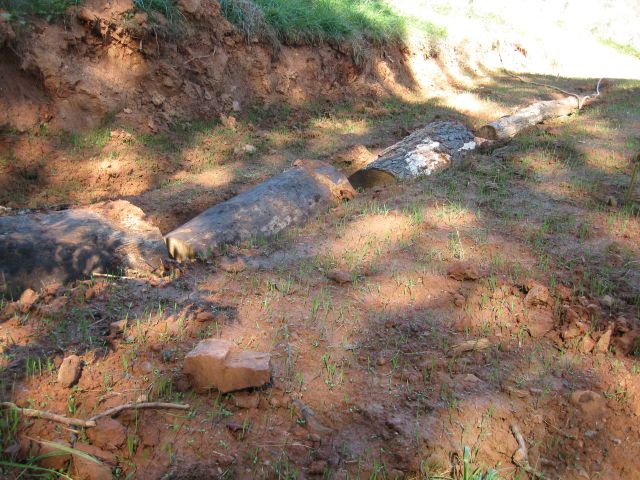
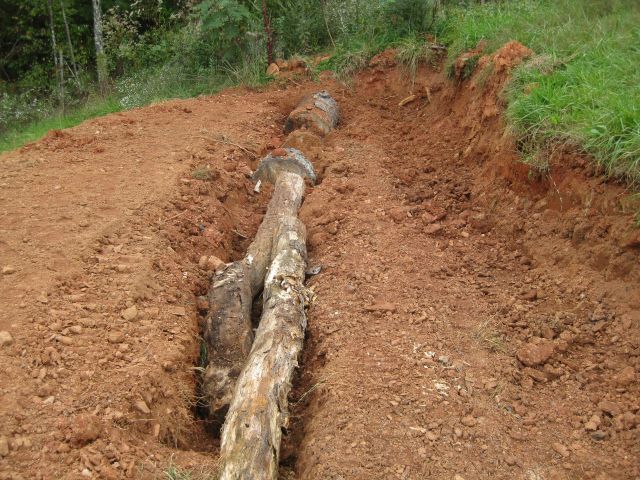
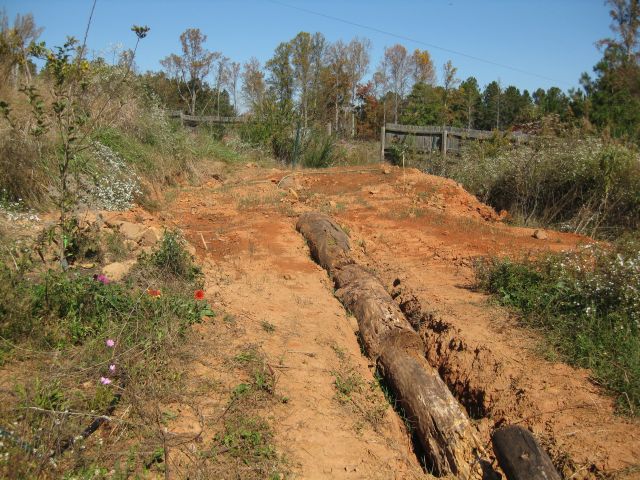
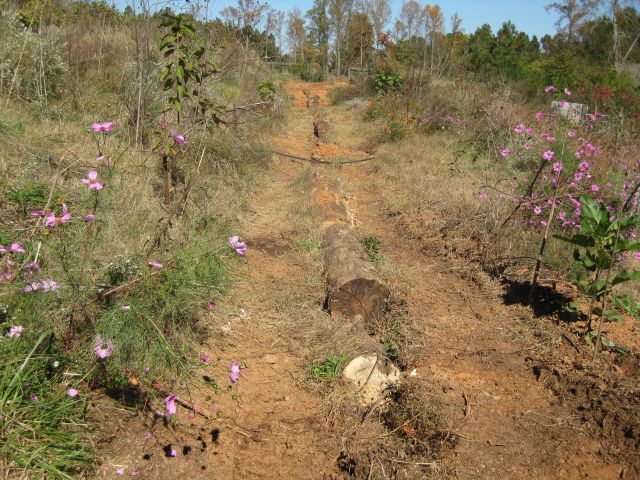
The earthworks are dug by my scruffy Takeuchi tracked bobcat. My approach is to terrace the slope with the terrace canted to the slope and with a contour ditch in the middle of the terrace. So rainwater on the terrace will move to the contour ditch and that which misses the contour ditch will move to where the terrace intersects with the slope. I fill the contour ditches with logs, for several reasons: a) my readings suggest that grasses promote bacteria and trees promote fungi and since the slope was grass covered, by filling the ditches with rotting tree trunks I am hoping to accelerate beneficial fungi in the soil; b) the contour ditches are a couple feet deep and without infill it is easy to fall in; c) if the ditches are left as ditches, they are quickly invaded by vegetation which competes with the tree roots and hides the location of the ditches (facilitating (b) above); d) parallel with (a) the tree trunks will provide nutrients to the soil as they degrade and will absorb and retain water for the benefit of the plantings.
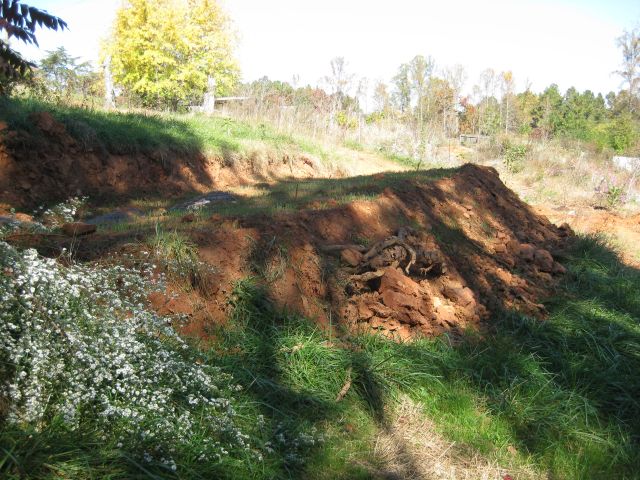
earthworks – a view of my new terrace showing the grading toward the slope and the cut made into the face of the slope
After grading the terrace I planted winter rye and crimson clover on the exposed earthworks and watered every couple of days with rainwater. I have marked the location of the future tree plantings with stones – they will be at least 15 ft apart. And, since my comfrey did so well this year, I have planted out root snippets from a couple of my comfrey plants.
earthworks – terrace and contour ditch – looking north you can spot the winter rye seedlings. interspersed amongst them are crimson clover seedlingsearthworks – terrace and contour ditch – I am fortunate to have degrading tree trunks for filling the ditch
I created a second terrace as an extension to the terrace and tree plantings I made last year.
earthworks – terrace with contour ditch and tree trunks, follows the same principle as the one above and the two together will accommodate the new arrivals
And while I was at it I went back to last year’s terrace, deepened the contour ditch and filled it with tree trunks which had been left on the property by a previous owner.
earthworks – last year’s terrace upgraded to include tree trunks in the contour ditch. The cosmos and aster are still in bloom and the air is heavy with bees
We have started making our own kefir fermented milk products. Kefir originated when shepherds discovered that milk carried in leather pouches would ferment and produce a fermented beverage which has a pleasing taste, once your are accustomed to it.
We were given a starter culture and the procedure is you add milk to the kefir grains and allow it to ferment for 24 hours at room temperature. A tablespoon of the kefir grains is adequate for 8 ozs of milk. After 24 hours the grains have converted the lactose in the milk to lactic acid. You strain off the product and it contains probiotic bacteria and fungi which are great for GI health. You return to your jar the residue in the strainer and top it up with fresh milk and 24 hours later you have more kefir. You can blend the kefir with frozen blueberries or strawberries and add some honey to produce a smoothie.
Initially we added the kefir starter grains to 1% conventional milk and they were unhappy and refused to do their magic dance. We do not have easy access to raw milk and besides we (currently) have little use for the fat/cream which comes with the milk. We do not usually use organic milk. but on an inspiration we switched to 1% organic milk and the kefir is thriving.
So when studies are done on the benefits of organic produce and focus only on nutritional content, they are overlooking possible components such as anti-biotics in conventional milk. The question is whether these overlooked components affect not only the bacteria in kefir but the bacteria in our GI tract and therefore our health.
In Cherokee county bees attract a lot of interest. I attended the beekeepers’ monthly meeting last Thursday. We are fortunate to have a commercial beekeeper as our coach and guru. I had missed the previous month’s meeting where they discussed inspecting for mites and chemical treatments. The meeting last Thursday was about Fall inspections and feeding.
First as to mites – most of the attendees were doing sugar dustings and mite counts -you sprinkle sugar on the bees and they vigorously groom themselves and each other and the mites fall onto a sticky board at the bottom of the hive and you count them and decide whether chemical treatment is necessary. Seems like most were applying chemical treatments in any case. Now I am still a beginner beekeeper – I think I have graduated from “novice” since I have kept the same bees (or rather their descendants) going since early 2010. And from philosophy or laziness I don’t count mites or do any chemical treatments. The philosophy springs from the belief that intervention usually causes more harm than good. I had some mishaps with some chicken where I tried to help and believe I exacerbated the situation. Even humans (if newspaper accounts are accepted) occasionally/often experience setbacks in hospitals from mishaps. As for bees, I think the lesser experienced of us can harm the queen and upset the equilibrium each time we intrude in the hive, even though with the best of intentions. I think the vigor of the bees and their ability to resist mites etc. is weakened by the poisons we spray in the environment, the poisons we treat them to make them stronger and the stress we create when we open the hive and disturb them (though I have often opened the hive for cursory inspections and not disturbed them at all). I grow organically, my immediate neighbors don’t spray and my bees have been doing fine, though our guru told me it is just a matter of time until the varroa mites and other dreads afflict me.
As for the feeding. Most of the attendees were feeding their bees with sugar mixed with water. Our coach asked who wasn’t feeding their bees and no one raised their hand and I didn’t, since I don’t want to appear controversial. If the bees have no food then now is the time to feed them since if you wait until temperatures fall below 47 degrees it will be too cold for the bees to feed on their sugary liquid food. So you feed them now and they store it in their cells and they partake of it during the wintry months. I don’t feed my bees – if I want them strong and healthy for the tough winter months they will survive much better on their honey than on sugared concoctions – after all that is why they harvest the honey in the first place. However, after all the dire warnings issued at the meeting and given that bee mortality over winter is high (around 30% I think), I concluded that I should take a look at my bees.
The last time I visited the bees was on July 29 of this year. I am certain of the date since I harvested about 4 gallons of honey from my # 1 hive (34 bottles all lid marked “072912”, nominally 12 0zs but filled to the top, say 15 ozs each = 510/128 = 4 gallons). It was my third harvesting in this year from the #1 hive. My #1 hive consists of a deep and two half deeps and I left 4 half frames for the bees expecting they would have sufficient time by summer end to replenish their supplies. During the July harvesting I also inspected my second new hive, which I started earlier this year with conscriptees from the #1 hive plus a new queen bee. It did not have much honey and, since it was its first year, I decided to leave it be.
This morning I inspected both hives. Lots of worker bees (phew! not drones which would indicate no queen) and lots of activity. The #1 hive, disappointingly did not have a lot of honey supplies. The top super had say 30 lbs, very little in the middle super, and the bottom deep had pollen and brood and some honey. I decided to intervene and since it will soon be getting cold, I reversed the supers by putting the top super with the honey above the deep containing the brood.
The #2 hive which consists of two deeps is in good shape. There are 10 full frames in a deep and the top deep, apart from the two outer frames on each side had 6 frames filled with honey. The bottom deep, again with the exception of the outer frames, had honey, pollen and well placed brood.
Conclusions. Now we have the goldenrod and aster in bloom and the bees are hard at work. When the blooms are finished and there is no more food to gather, I shall inspect the hives again and, if the #1 hive is looking thin on the honey side I shall give it a couple of deep frames of honey from the #2 hive. And hopefully that will be enough to get them through the winter.
I mentioned a couple posts ago the battle I am having with Bermudagrass. A few days ago we had really good rains which softened the soil and made it much easier to slowly withdraw the long Bermudagrass shoots. When the ground is dry the shoots clinging to the lumps of sod are easily broken and they remain in the ground to incubate a new invasion. I have a rototiller which I hardly ever use now I subscribe to the view that the spinning tines, which move at a set depth in the ground, create a hardpan in the soil just beyond their reach. However, tiring of forking out the shoots I recruited the tiller with mixed results. The tines were quickly woven with the long shoots which required frequent stopping to disentangle them.
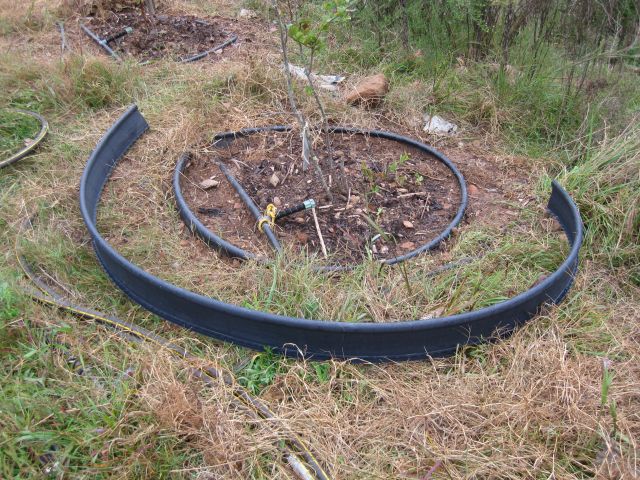
So I gave up and pondered and came up with two new strategies. First defense – I purchased a 40 ft black landscape edging roll ($19) and cut it into four 10 ft lengths, each of which was used to make a circumference around individual blueberry bushes.
10 ft black edging in place around plant with Bermudagrass removed and another 10ft length awaiting deployment
The diameter is about 3.2 ft (pi is 3.1 which is the ratio of a circumference to the diameter) which is sufficient for the time being. Have established the perimeter and dug out the Bermudagrass I will now have to defend against invaders sneaking under or over.
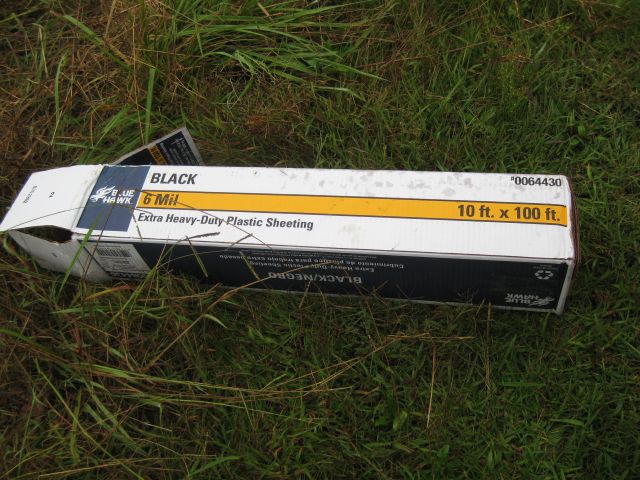
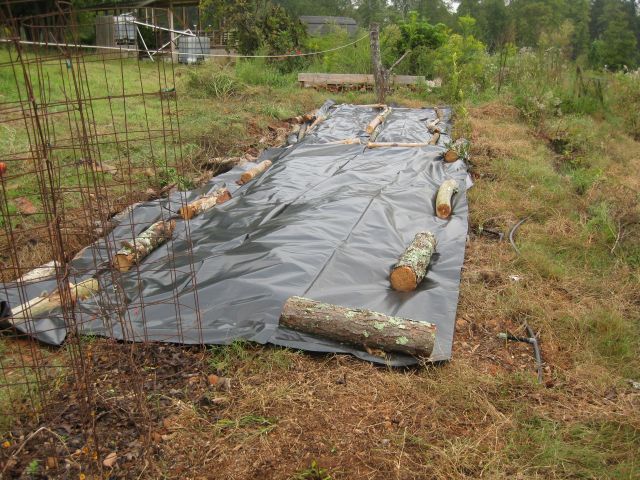
In chess often the best form of defense is attack. One Bermudagrass invested corridor runs between my 20 tomato cages and some young blueberry plantings. From this corridor the Bermudagrass invaded the tomato cages and the blueberries repeatedly this past season. Since we are now in September and temperatures are lower I decided that solarization using clear plastic may be ineffective. Instead I purchased commercial grade 6mm black plastic and, after removing the declining tomatoes and their cages, I covered the entire Bermudagrass area.
commercial grade 6mm black plastic used to deny light to Bermudagrass
Hopefully, now the Bermudagrass is entirely deprived of light, it will weaken and maybe depart. To be monitored.
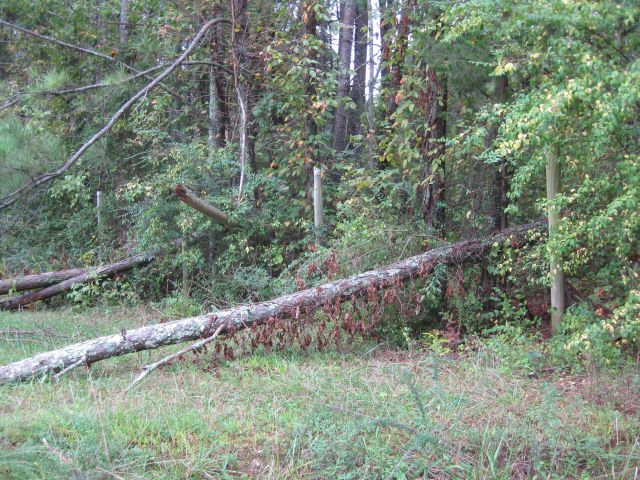
To secure the plastic in place I cut up some thick branches from a couple of my neighbor’s pine trees which collapsed over the fence into my field.
some of my neighbor’s pine trees which collapsed into my field, lengths of which will be used to pin the black plastic over the Bermudagrass
The wood is thoroughly rotted and when I am done with the black plastic, I will toss the wood into the contour ditches where it will continue to disintegrate and feed the fungi.
the problematic Bermudagrass area now fully covered with black plastic which is secured with pine trees limbs
Neighborly gifts
Another of my neighbors has 12 acres of fields and woods. This spring he offered me some pecans which had grown from his large pecan trees and which had evaded his mower. We decided to wait until it was cooler. Today I gave him some green tomatoes from the recently leveled tomato planting and he suggested we tackle the pecans. He also has a huge black walnut which had several offspring in the vicinity. Although the ground was soft from the recent rains, the pecans and walnuts, individually less than 4ft, had sunk deep tap roots. I did my best to free them but in the end had to sever the tap roots. I took two pecans and one walnut and, for the time being, until their planting area is ready (a week or so), I have planted them alongside one of my figs. The ground is rich, catches the sun nicely and is close to my walk path so I can keep an eye on them and water them frequently. I removed about 60% of their branches and leaves and, to retain moisture and maybe add some nutrients, I covered the base with comfrey leaves.
not that easy to see – in the middle is a fig tree from a cutting earlier this year, close to it on the right is a black walnut and on the left are two pecan saplings and their bases are covered with comfrey leaves
One of the pecans he had identified for me to remove was actually a coppicing – he had cut the 3 inch trunk close to the ground some time ago and new growth made it look like a young tree. I took a cutting of this new growth which I shall try start with other hardwood cuttings I shall be taking in the next few weeks.
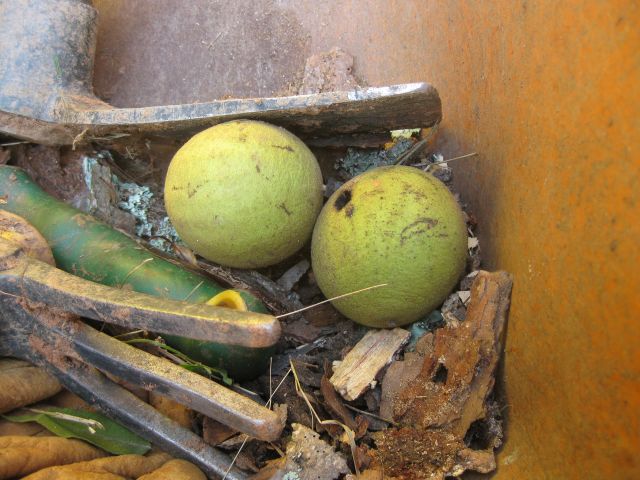
Finally, the black walnut tree, which produced the sapling had large walnuts, and I took a few and will bury them and maybe get some seedlings.
two large walnuts from my neighbor which may grow into black walnut trees
When I began planting my vines and blueberry bushes in the field, Bermudagrass (also known as “devil grass” because it can be an highly aggressive difficult to eradicate weed) was not a problem. Yes it lurked among the broad bladed tall grasses but it was one of many. Now it is a major problem and it can thank me!
Bermudagrass is a wiry perennial (easy to cut your fingers if you are pulling hard on it), and is low-growing (hence easily checked by taller grasses) and it spreads by above ground shoots called stolons and below ground shoots called rhizomes. Every so often at a node on the shoot, a root is sent deep into the soil with at least two objectives: secure water in drought conditions, and act as an anchor to resist my eradication efforts.
I made two big mistakes. For each new planting I diligently dug out a 2 ft diameter hole, added a copious helping of my high grade compost and inserted and watered the new plant. This was mistake #1. Think of a house in a run down neighborhood which has been ignored until new occupants arrive with expensive possessions. The house attracts interest and invaders move in to seize the possessions. Previously it wasn’t worth the trouble, now there is booty and the risk of being caught (in the case of a weed, being plucked and ejected) is more than offset by the rich rewards. And who was the opportunistic invader – quick footed Bermudagrass stolons and rhizomes.
Its called the competitive exclusion principle where two species compete for the same niche – my high grade compost. The species with the greatest advantage will drive the other to exclusion. Blueberry bushes have short roots and they didn’t stand a chance and were overwhelmed by the Bermudagrass. As were too, my raspberries.
an insipid blueberry bush with adjacent pulled back mass of Bermudagrass
My logic had been that if I nourish and water the plants, they will quickly grow and outshade the competition. And this would probably have worked with the other grasses, but not against the overwhelming rapacity of Bermudagrass.
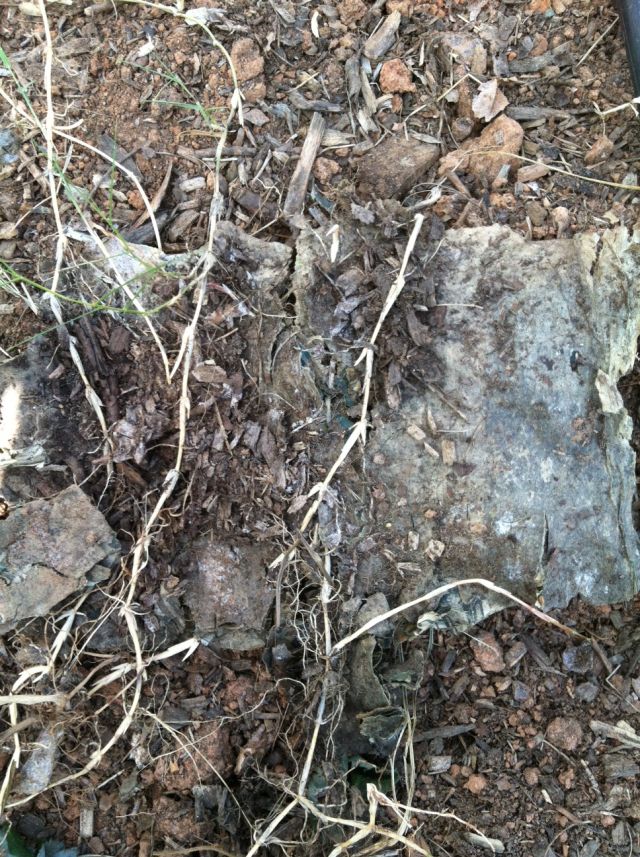
But I made a second mistake, which was just as devastating. I gave the Bermuda grass a decisive advantage over the other grasses competing for the 2ft circle. I mulched extensively with newspaper and woodchips. I first laid the newspaper, at least 8 pages thick, and then the 4″ layer of woodchips above so the chips would not compete with the shrub roots for nitrogen. The thick mulch effectively excluded all the other grasses and competition, but not the Bermuda grass. It quickly despatched scout rhizomes deep into the mulch and when they reported back on the superior quality of the compost an advance guard and then an entire regiment quickly invaded. So the deep mulching helped the Bermuda by favoring its competitive advantage of being able to delve in the dark into mulches on long exploratory missions and then to tunnel to the surface to capture sunlight.
Bermudagrass shoots at least 2 ft in length on the underside of thick wad of newspaper mulch
I suspect, but cannot prove, that the Bermudagrass shoots may host agents which demoralize the roots of my shrubs (allelopathic?).
And now I am hard at work with deep digging to locate and remove the rhizomes. And this time I am using plastic edging to guard the frontiers, which I hope will stop most of the Bermudagrass, but I shall have to be continuously vigilant.
Contour ditches
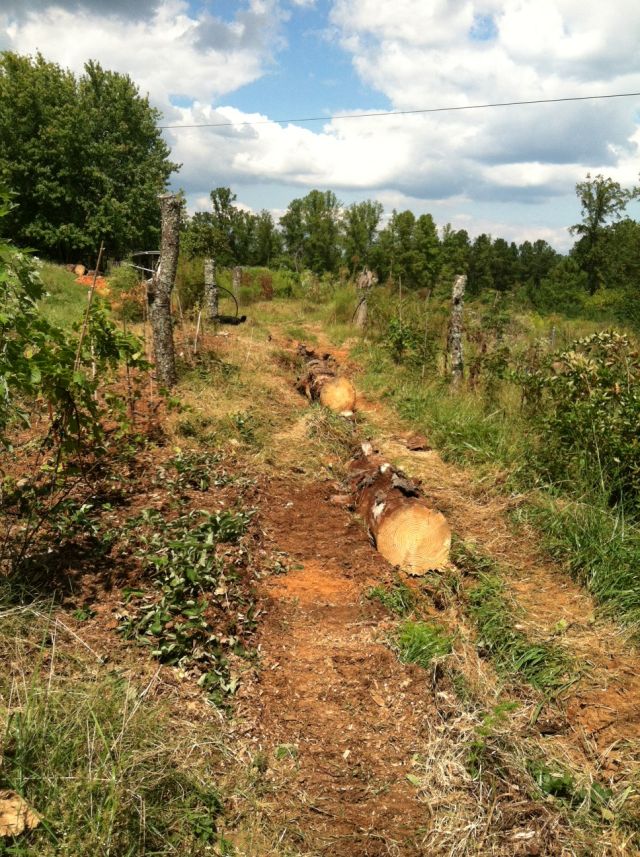
In a previous post I mentioned that large grasses and plants had moved into my contour ditches, which were established to catch, retain and infiltrate rainwater sliding down the hill. Cleverly some of the plants established themselves on the walls of the ditch – thus they were close to the entrapped rainwater at the bottom of the ditch but did not have to endure having their feet in the water for extended periods of time. My solution, as previously mentioned was to stoke the ditches with tree trunks and branches (stoke as in stoking a fireplace). A year ago some large pine trees were brought down with base trunk diameters exceeding 36″. My bobcat cuts a 24″ wide trench. So today I chainsawed the trunks of the pine trees, which did not exceed a 24″ diameter, into 10 ft lengths and relocated them to one of my contour ditches. Rather than have the nutrients and organisms of the pine tree logs slowly dissipate into the air or the field, they will now be embraced by the soil in the ditch and nurture the roots of my plantings. Also they will prevent new weedy growth in the ditches and will absorb rainwater and retain it. Hopefully, this time round, a win win solution.
+20″ diameter pine tree trunks now berthed in a contour ditch