My tomatoes having progressed from 0.7″ soil blocks to 2.3″ soil blocks are now ready for transplanting to pots. In early years I used 0.5 gal (64ozs) nursery pots but they took up too much space and needed too much soil. Now I transplant to 1qt (32 ozs) yogurt pots with holes drilled in their base. Later I will transplant to their final destination, except for a handful which I will hold in 0.5 gal or 1 gal pots as a reserve for failing tomatoes.
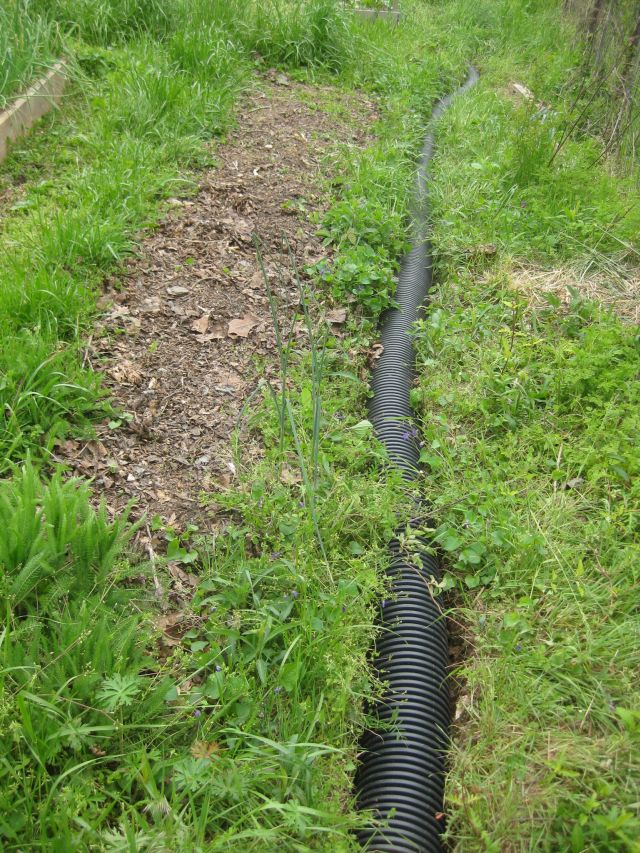
I have compost but am short soil for the pot mix. Where to get soil? Buying is out of the question – why use sterile or bad soil when my own soil is so rich and free of ‘cides. I then remember my annual chore to clear the 8″ wide, 8″ deep trench/moat which protects my raised beds from invading roots. One year I hacked down all the nearby hedges and small trees – wasted effort (they grew back the next year) and silly since they were the hunting perches and cover for insect eating birds such as the brown thrasher, which is our state bird. So now I ignore the growth and annually I clear and deepen the trench to transect and deter enfilading roots. I remove 5 barrows of soil, mix with compost, remove rocks and weeds and have potting soil for my tomatoes. I have another thought – I have surplus 70 ft – 6″ corrugated pipe – why not put the pipe in the trench? This achieves 2 goals – prevents weeds filling the trench and bridges the trench for my push mower.
a section of the root protection trench. on the left is a perennial asparagus bed with a few shoots on the way
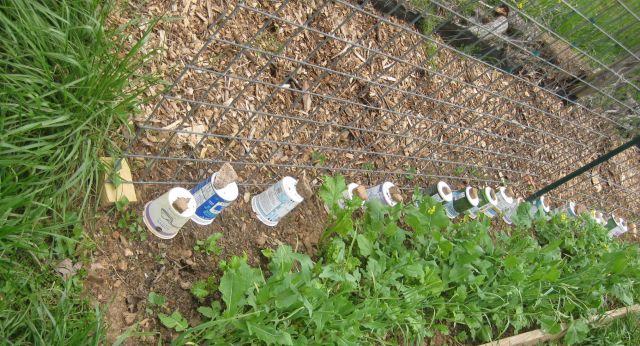
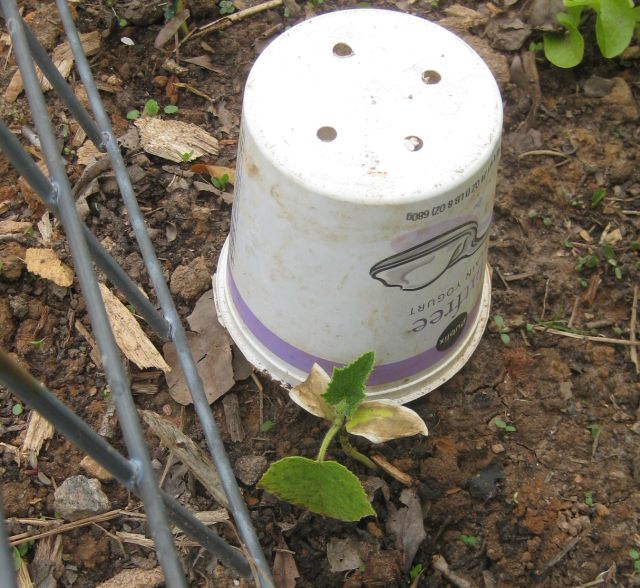
Now to fill the pots. Our average last frost date is mid-April and on April 8 the 5 day forecast indicates 30 degrees on April 10. I use some yogurt pots as domes over my tender cucumber plants with stones on top to prevent wind disturbance.
some of the protected cucumber plants
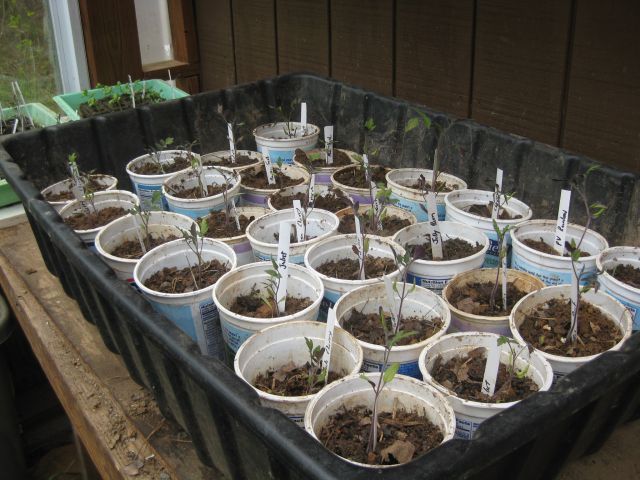
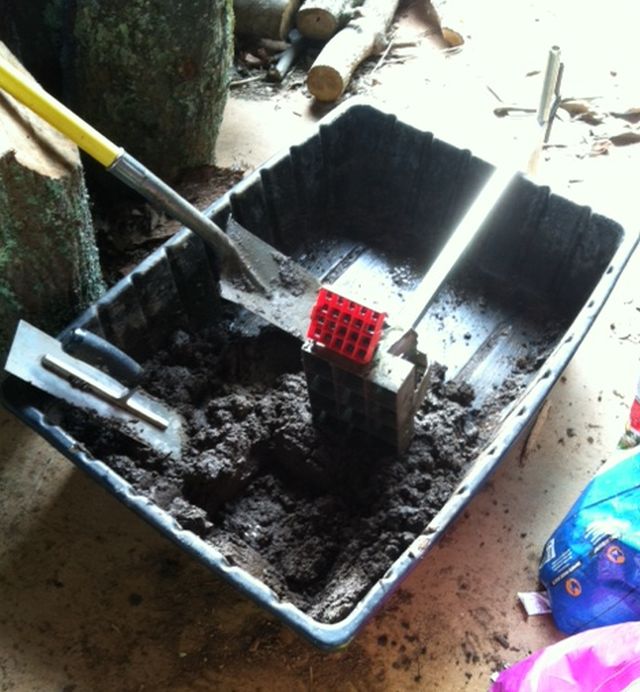
I fill pots with my new soil mix and transplant some tomatoes. Below is a cement mixing trough with 28 transplanted tomatoes.
tomato plants including Rutgers (a southern favorite), Oxheart, Black Cherry, Sugar Cherry, Juliet, Jelly Bean, Rainbow, Mountain Fresh, Big Beef
And today I uncovered the cucumbers and used the freed up pots for more tomatoes. The cucumbers suffered a bit (lowest 2 leaves affected) but they survived and next year I may delay planting out the cucumbers until after mid April.
the pots probably saved the cucumbers, though the bottom 2 leaves were cold damaged
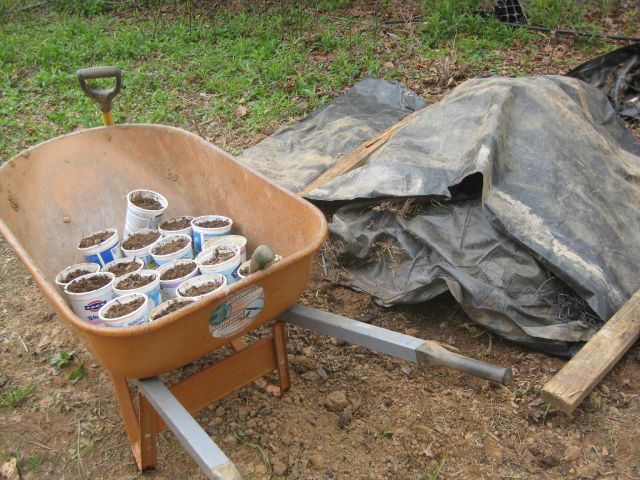
And I still have a mound of soil mix remaining – the chickens have worked it over and I now cover the mound with black plastic to stop weeds growing so there will be less preparation needed when I pot more tomatoes.
soil mix shielded from the sun and a barrow with some yogurt pots
With the beginning of winter I now always ensure that I have disconnected my water pumps and drained the water. My carport pump (moves 2,400 storage gals) started fine, but my 1hp Water Ace (moves 2,800 storage gals) just made a humming sound when I tried pumping today. Another challenge!
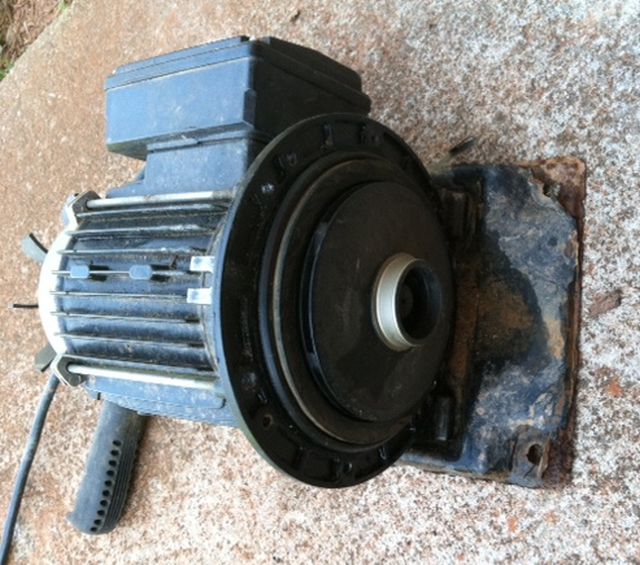
Probably bad brushes I thought but usually there is warning – a lot of spluttering and starting in fits. Not this time and why should it fail to start after the winter break? I moved it to the workshop and removed the front end where the centrifugal impeller is – it turned with difficulty.
the pumping end -the motor spins the disc which has slits in it to catch the water and force it through the center hole
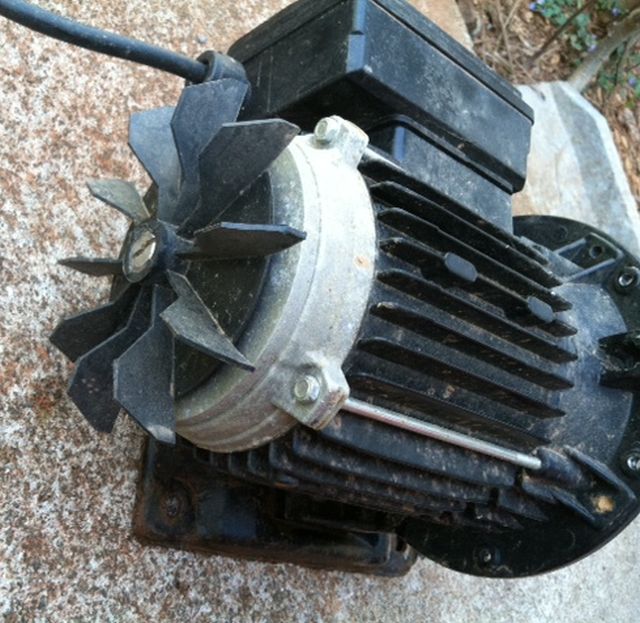
Odd, I thought something must be jammed. While it was open I removed some small stones caught in the slits. So what could it be? I happened to look at the rear end and the cover was not seated properly. Beneath the cover is the fan which is also driven by the motor.
cooling fan with cover removed
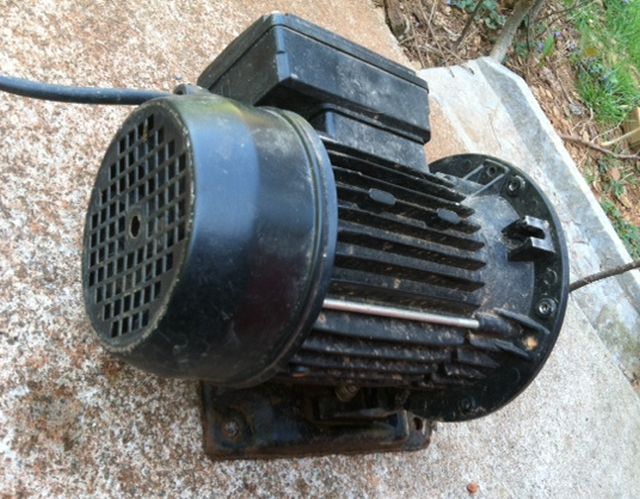
Now, with the cover removed, the impeller and the fan (they are connected to the same drive shaft) turned easily. I carefully replaced the fan cover and the front end cover and the pump started fine and pumped without leaking. All done!
pump fan cover replaced
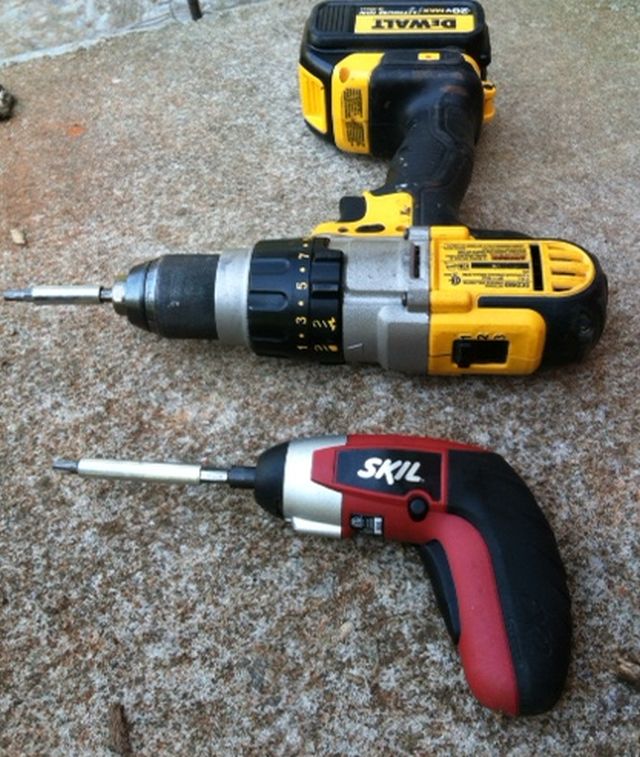
To remove the bolts I looked for my battery powered screwdriver, could not find it and so used my drill at lowest speed and torque setting. Mistake! Even at the lowest settings it is too fast and too powerful. I more determinedly looked for the powered screwdriver, found it and then removing the remaining bolts and re-assembly was fine. Moral – don’t rush.
the small powered screw driver turns more slowly and with less torque – why strip bolt heads needlessly?
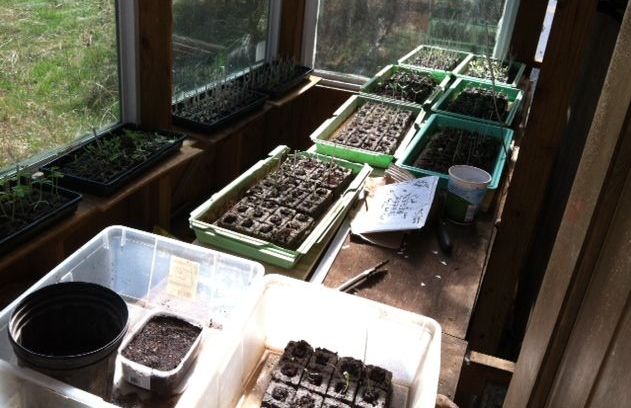
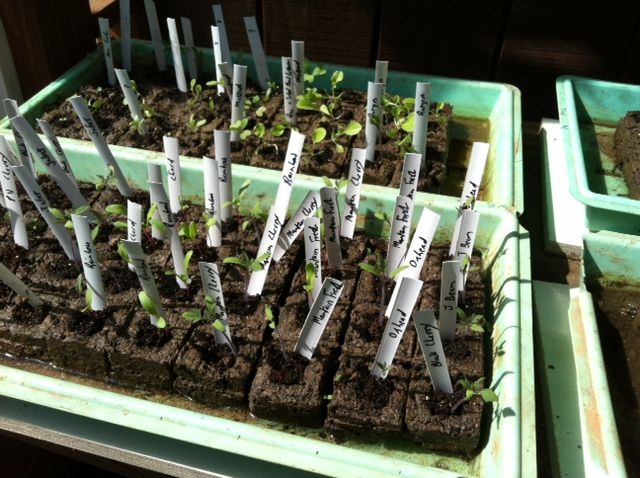
My seedlings are progressing well – below is a snap of some of my tomatoes in 2″ soil blocks in the greenhouse.
some tomatoes identified with venetian blind plastic strips
My recent visit to the west coast set me back on my spring schedule and I have been catching up.
Foremost was to get my tomato seeds going. Last year I collected seed from good heirloom tomato plants and this year, for the first time, I did not purchase any tomato seed. Though I did buy “Surround” (Kaolin clay) which I will spray on my apple trees when the blossoms have set fruit, and the supplier included gratis, seeds for Rainbow and Cherry tomatoes. Plus I had some 2014 and 2015 packets most of which are viable. Although last year I clustered the tomato plants by variety I am sure some were cross pollinated with other varieties so it will be interesting to see what emerges.
my 2″ and o.5″ soil block moulds
Preparing the 0.5″ soil blocks is quick since I use purchased seed starter mixture. More work is required for the 2″ soil blocks for which I use topsoil, my compost and peat (all manually sieved) and to which I add building sand and lime (to offset the peat ph). When the seeds have germinated and grown about 0.5″ I transplant them to the 2″ soil blocks. And later I will transplant the tomato soil blocks into 32 oz yogurt containers. For maximum sun exposure and monitoring I grow the tomatoes in my greenhouse until they are ready for the outdoor raised beds.
I also germinated from 0.5″ soil blocks lots of other vegetables – the common such as lettuce, broccoli, kale as well as peppers, cucumbers and herbs.
Additionally I have been preparing the raised beds with weeding, composting, dusting with ash from the wood stove and seeding with lettuce, mustard, radish, kale etc. This all takes time and work but the weather is pleasant, I enjoy physical labor and, for the first time, I am using headphones attached to my iPhone and listening to my podcasts.
Each day I carefully collect in a yogurt container the ladybugs which appear in our bathroom and, if the collection exceeds 10 or so, I transport them to the vegetable area where they will work beneficially until again in the fall taking refuge in the bathroom. This they have done consistently for several years, like salmon returning to their breeding grounds.
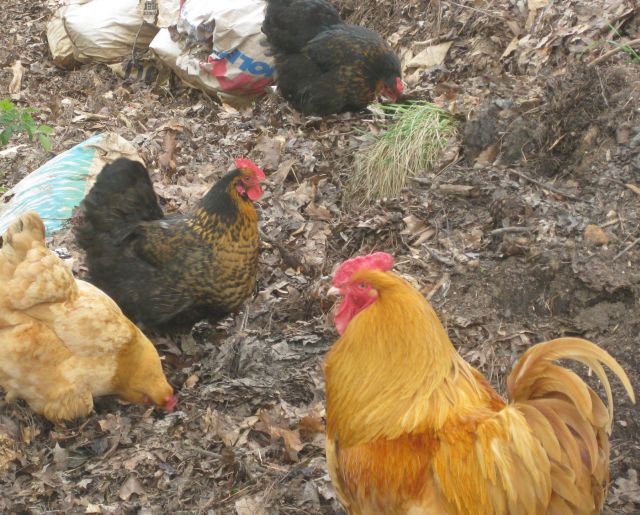
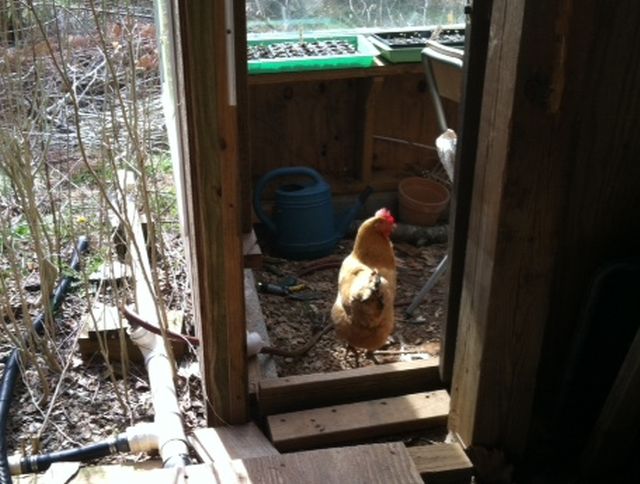
My chickens are free range and I notice Randa (the most intelligent) standing beside the closed greenhouse door. Flashback to when I discovered last year she had made a nest out of sight in the greenhouse with >10 eggs. I open the door for her and when I come back an hour later, she has laid an egg in a little nest she has fashioned. What to do? Initial thought is to keep her out of the greenhouse. On reflection this is not a solution since she will probably then make a nest somewhere hidden in the surrounding growth, as she did 2 years ago and accumulated 16 eggs. So now I leave the door ajar and she lays an egg each day in the green house which I collect at day’s end, together with all the other eggs laid by the normal chickens in the nest box in the coop.
Randa entering the greenhouse
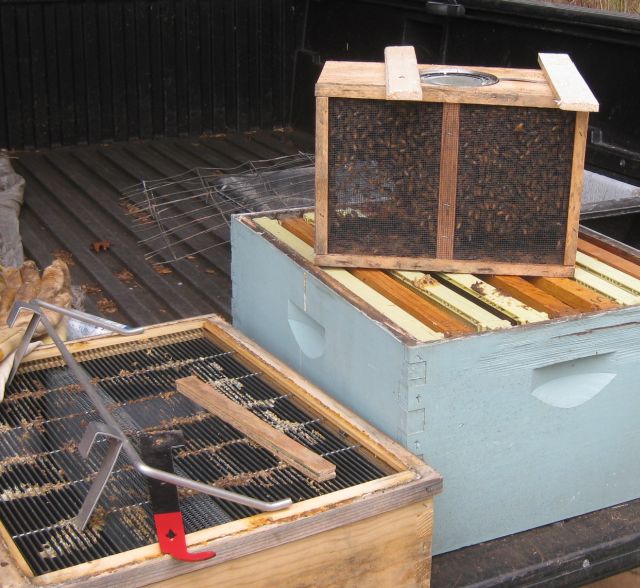
And on Saturday I took delivery and installed 2 packages of bees from our local professional beekeeper who maintains >500 hives and is the oracle of our local bee club.
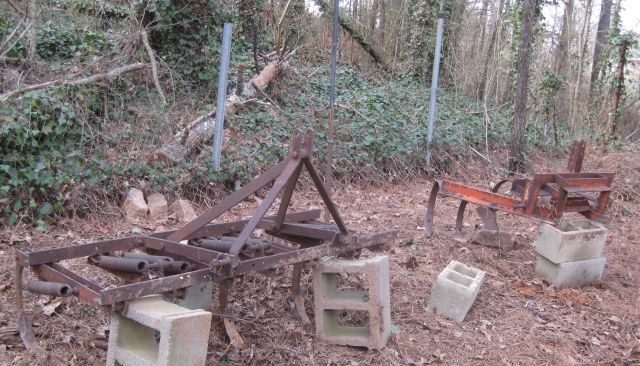
We had some cold days (for Georgia) with temps in mid teens, but that is past and I am emerging from my winter funk. Friday I cranked up the bobcat and worked it a couple hours – moved pine and other logs up the hill to the contour ditches where they will decompose with time; moved two old tractor cultivators from alongside the drive, where they could snag an unwary driver, to a show off location; and turned >150 leaf bags collected in the fall into a semblance of a compost heap.
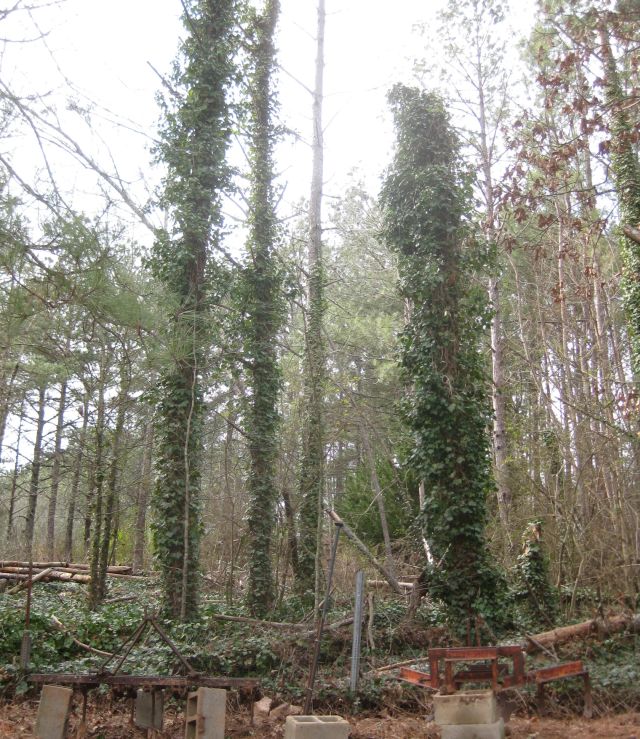
these tractor implements were given to me. the closest weighs >400lbs and would have been hard work for me to move without the bobcata snap of my neighbor’s yard where the pines are strangled by ivy and have succumbed to borers. when they fall into my yard I chainsaw the trunks and add them to my contour ditches
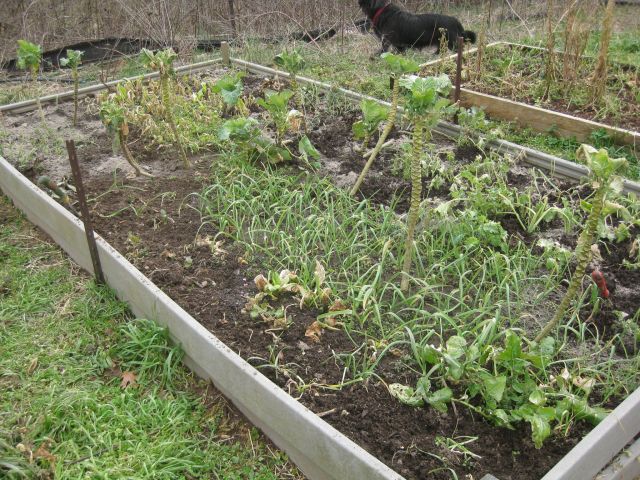
Saturday I weeded my first of 15 raised beds and added wood ash and finished compost.
90% weeded bed, the light patches are the wood ash, more compost to be added
The turnips survived the cold temps and are edible, not so the radishes. The greens were set back by the cold but will recover, all the more quickly without weed competition.
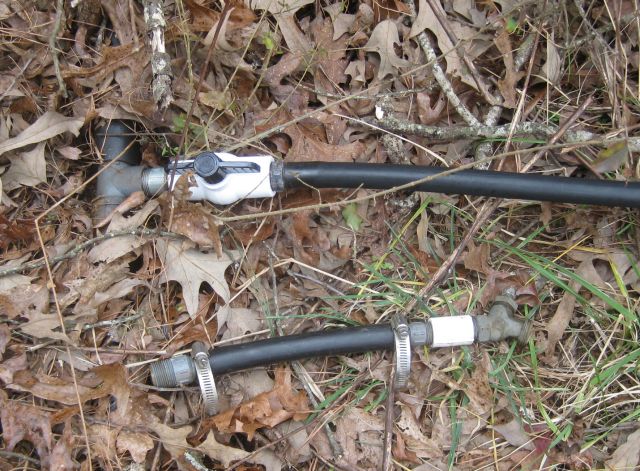
And today, I decided to water the compost heap. I have described my rainwater collection system and tanks holding about 6,000 gallons. All the tanks are full and winter rains go to waste. So why not use some of the water now, not only for irrigating the fruit trees, but also to fire up the compost. Though I added finished compost to the leaf heap nothing happens without moisture. I use 1.25″ pipes to move water and to this is connected a regular hose for watering the compost. This is inefficient – the hose is 5/8″ diameter 100 ft long and connects via a faucet – three negatives right there a) diameter too small; b) length too long; and c) faucet configuration disturbs water flow. I have two 3/4″ diameter 100 ft hoses but they are used elsewhere and are also too long. It took just 10 minutes to make some big improvements. I replaced the faucet with 3/4″ in line PVC valve, and I selected 2 – 20 foot lengths of 3/4″ plastic coil pipe which I connected.
the 2 connections compared – above is the new connection with straight water flow valve connected to 3/4″ black plastic pipe; and below is the traditional water faucet which connects to a hose
Water flow was much better than with the garden hose.
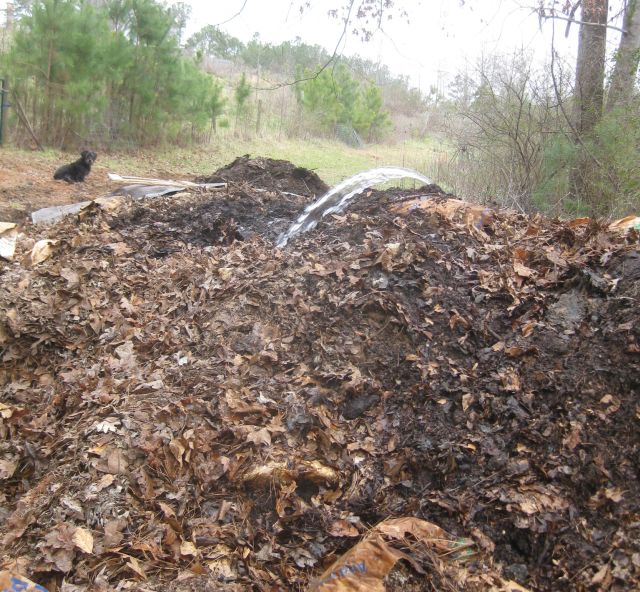
watering the heap with 3/4″diameter 40 foot length pipe connected to 1.25″ diameter pipe, Trudy observing
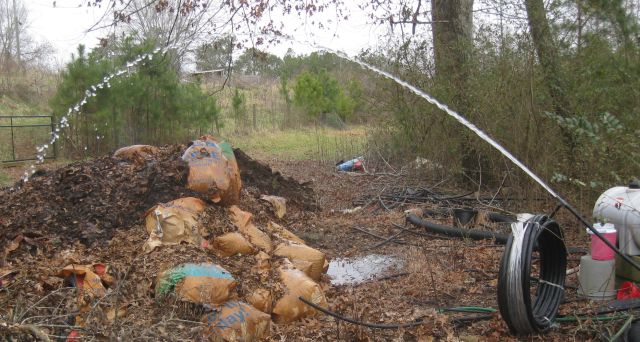
As I moved the pipe to water different parts of the heap, the connection between the 2 lengths separated. I was impressed with the vigor of the water jetting from the shortened pipe and it occurred to me, why not just use a 20 foot length and the increased water pressure will get the water to where it is needed. The image at the head of this post, also below, shows the increased pressure when just a 20 foot length is used (similar dynamics to the flow of electrical current through a cable, the calculations for which I have included elsewhere on this site).
considerably greater pressure when the pipe length is halved. bottom right -red container is liquid nutrient collection station and 30 gal white container is compost tea maker
So I was able to quickly water the heap, and then I covered with a tarp the northern end (winter gusts come from the northwest). When the heap is compacted I will dispense with the tarp. I know tarps conserve heat in the heap which accelerates the action, but then you need to remove it for the rains and, since I am in no rush and have an ample supply of finished compost, I will let the heap proceed at its own pace.
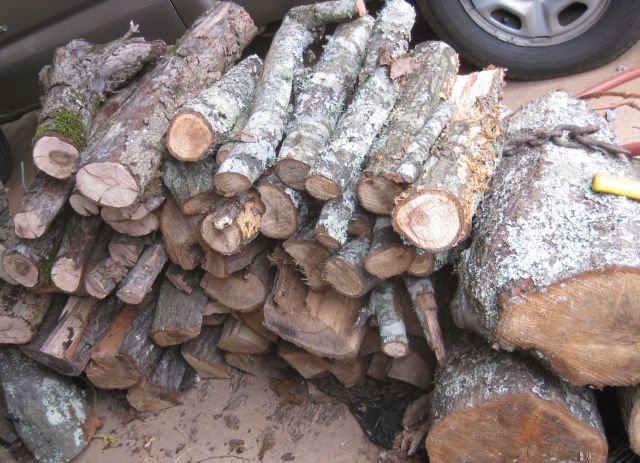
This morning was productive – I also chainsawed an oak and dogwood which had fallen down – though there limbs are small diameter, I added them to the firewood pile.
the small sized diameters were taken this morning. The dogwood is hard and heavy and should make good firewood
And I weeded another bed and picked turnips which we enjoyed in our lunch salad.
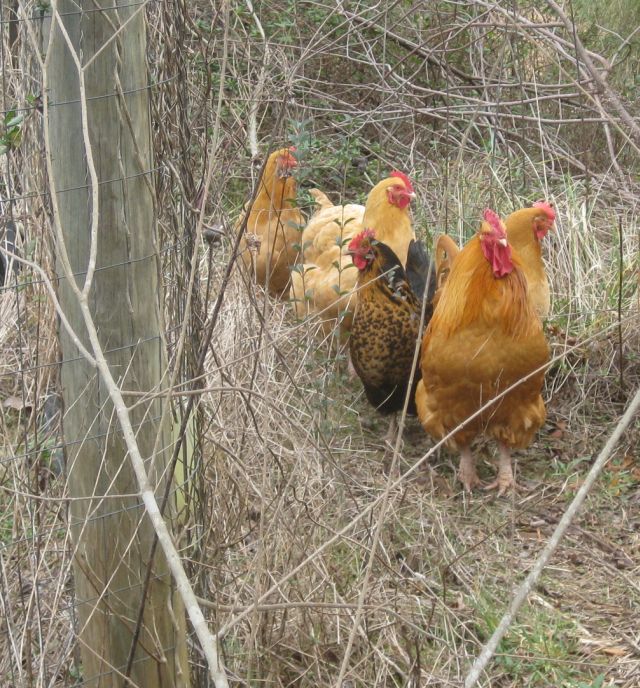
woodland foragers circling the vegetable growing area. Though I would appreciate their work turning the raised beds I cannot risk contamination. Since I trapped and removed a feral cat in December, we have not had predator problems and the chickens are confident exploring the yard.
And there were 5 eggs today and 3 yesterday – the longer days are moving the hens back to production. A productive morning.
With temperatures for several consecutive days falling below 25 deg F (excluding wind chill) I decided to see which vegetables in the open raised beds were doing well.
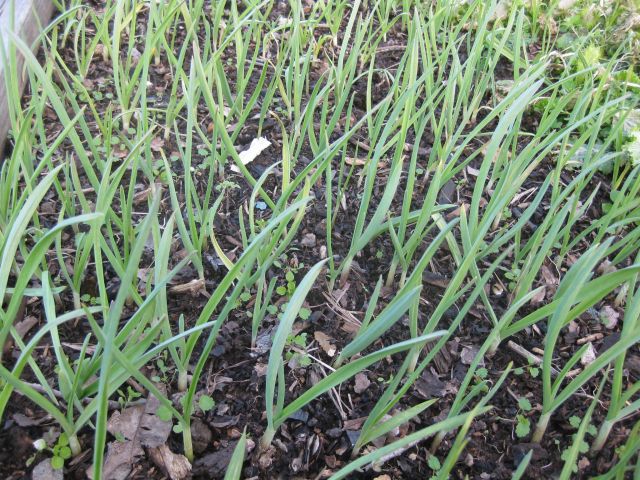
Garlic of course relishes winter but it is not for eating now:
small garlic which will only mature in 3 or 4 month’s time
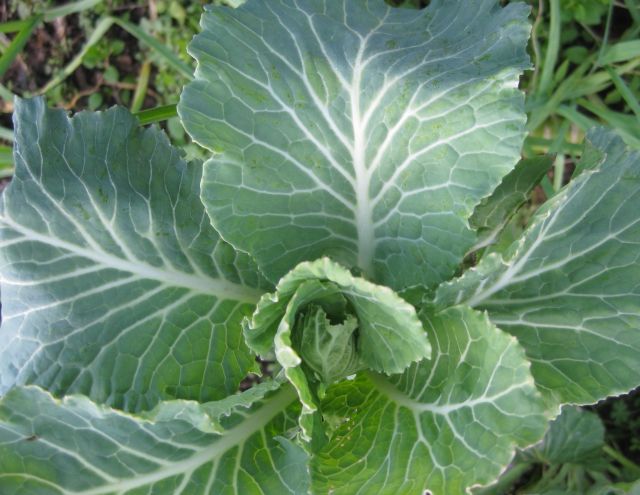
Collard, kale and turnip greens are doing fine. Here is a collard:
bursting with health and no sign of cold (or insect) damage – this collard was planted last spring and made it through the summer
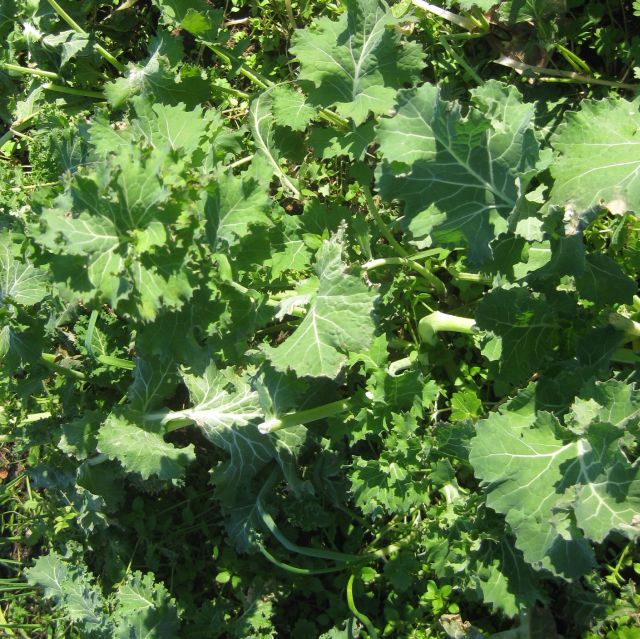
And here is some kale:
this kale looks similar to collard. my dwarf kale is also doing well
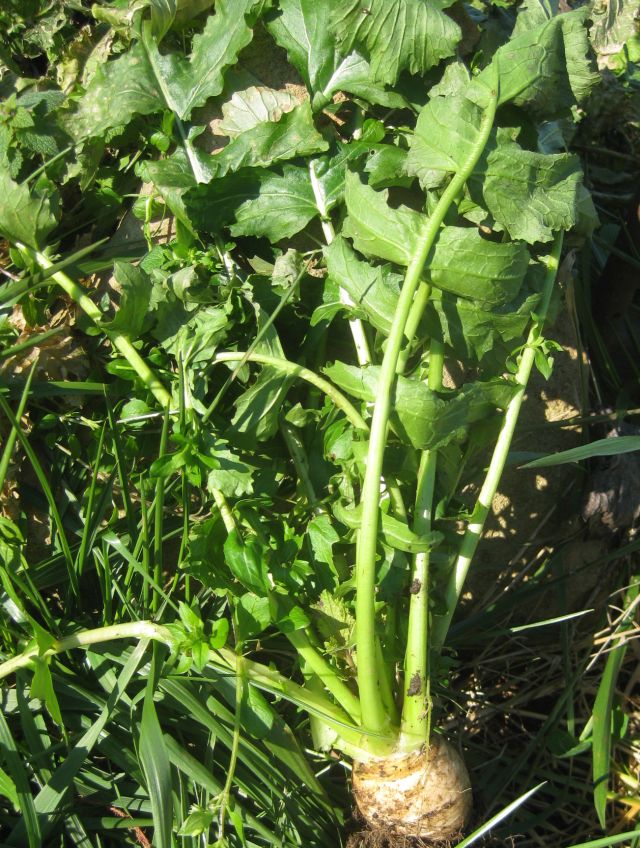
When it comes to turnip greens, it appears there are two kinds – the true turnip greens with very large leaves and a sturdy white base:
This bunch is for the chicken – they find it easier to tear off the leaves when the leaves are attached to the root base
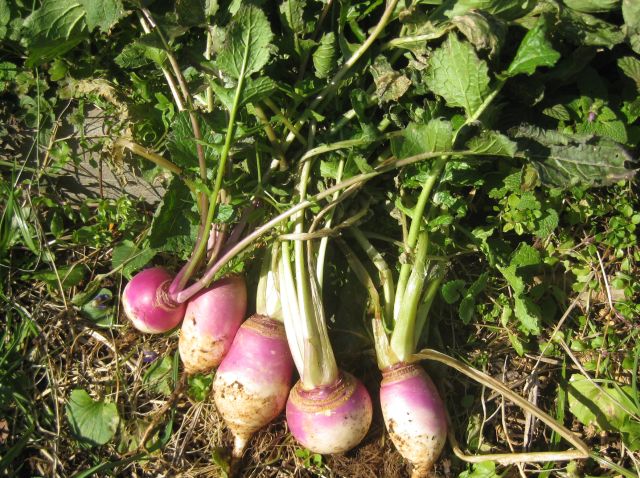
And the other type is the regular turnip which tastes fine despite low 20 temperatures, though its leaves are not as nice as the bona fide turnip greens:
regular turnips we eat raw or sauteed with potatoes and onions
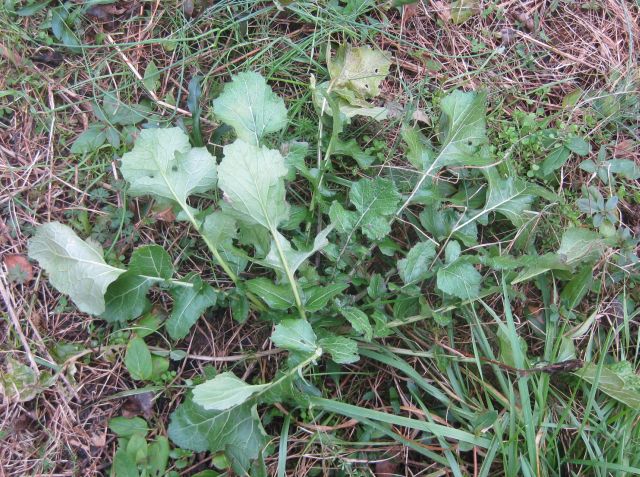
The anomalies make growing interesting. I scattered turnip greens and turnip seed in a planting area between the apple trees and some of the seed scattered too far and those individual seeds, now plants, are very large, perhaps because there was no crowding so they could really spread their leaves; or different nutrients in the soil. Or some other reason. As I was mulching the tree beds I stumbled over one turnip and its size approximated a baseball – I gave it to my neighbor and wish I had snapped a pic.
the seed for this plant strayed far to settle among the orchard grasses
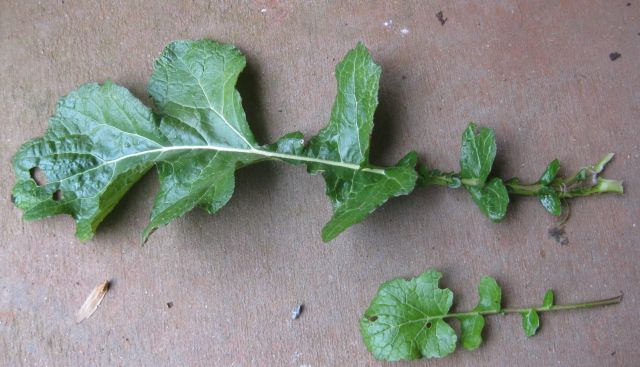
And here is a comparison of a leaf of the above plant with the leaf from a densely sown patch:
the large leaf has at least 4 times the area of the smaller leaf
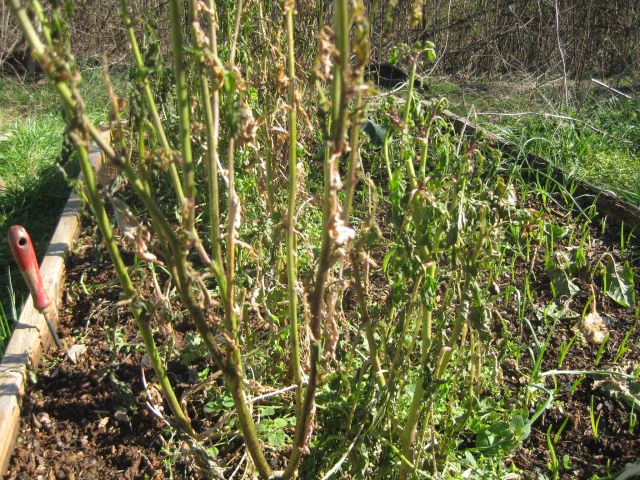
Now for the vegetables which have done poorly. No surprise that arugula is stunted:
the arugula stands stunted stripped of its foliage
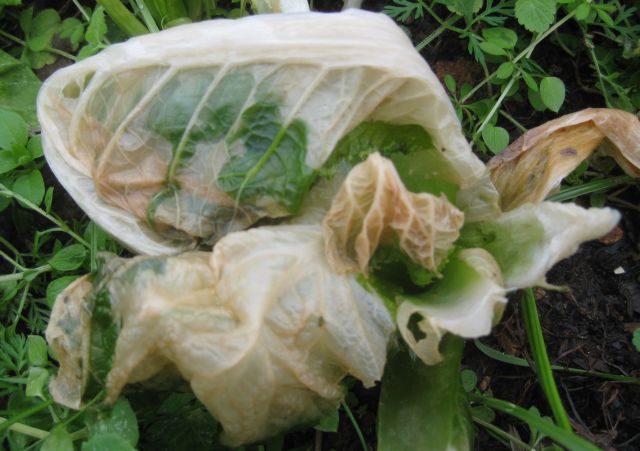
And the chard took a beating:
chard leaves blanched white though I am sure it will recover
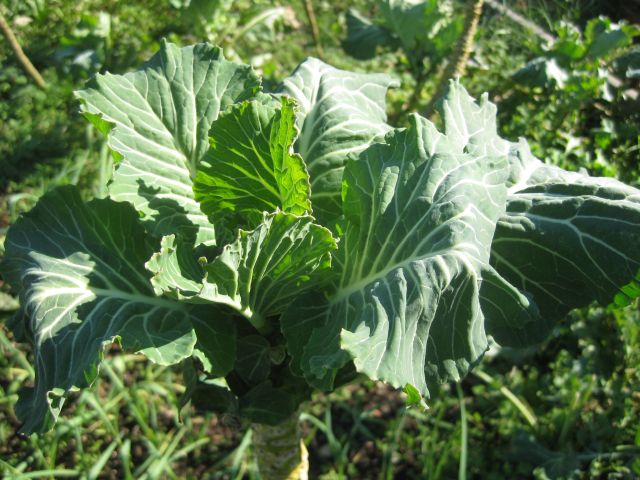
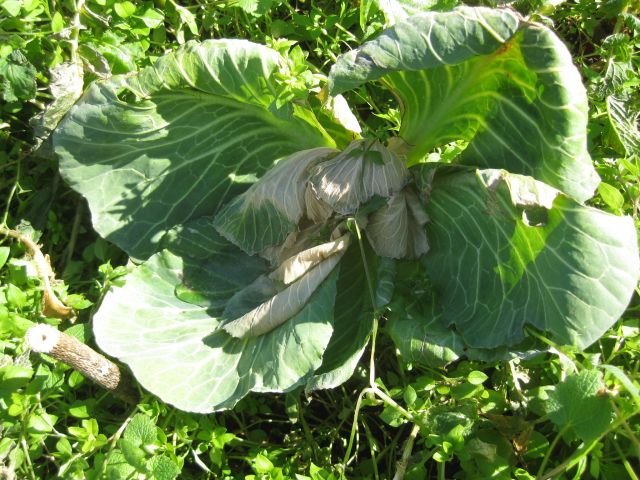
And the cabbage too, did not get off lightly:
I noticed that the larger plants suffered more than the smaller ones – so the large mustard leaves looked as white as the chard but the smaller mustard plants were relatively unscathed. Similarly, radishes become spongy in freezing temps but the smaller radishes fared better.
Next week we expect sub 20 temps and I will be waiting to see how the survivors fare then.
In 2011 I planted an assortment of raspberries and blackberries. The raspberries failed (high heat and humidity?) the blackberries thrived. Collectively known as brambles, raspberries can be easily identified because they have a hollow center where picked. 2015 was a good year for blackberries – I picked many and froze the surplus and now enjoy them with oatmeal breakfasts.
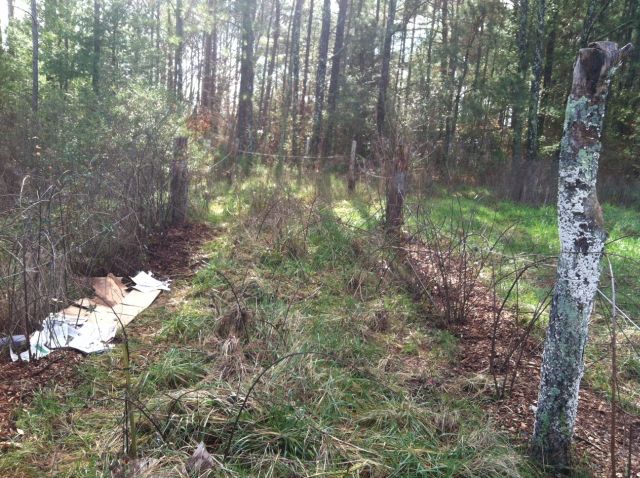
Blackberries propagate by tip rooting – where their long canes come down to the ground they form roots and new plants grow. Although thick grass is supposedly bad for berries, I notice the canes root easily in grass – they descend and snake along for a foot or more before establishing roots. With the plentiful rains and warm weather I have been working the berry trellises – relocating rooted canes to new areas, weeding and fertilizing (chicken manure and compost), and mulching with cardboard and newspapers, and then adding thick layers of oak mulch.
a blackberry location – cardboard on left soon to be mulched
Between the 2 rows of blackberries is a trench (2ft by 3ft) filled with large decomposing logs designed to snare and infiltrate rainwater. The blackberry canes have discovered the trench and are establishing themselves.
I have thorn and thornless blackberries. The thornless Navaho is very tasty, easy to pick and grows prolifically.
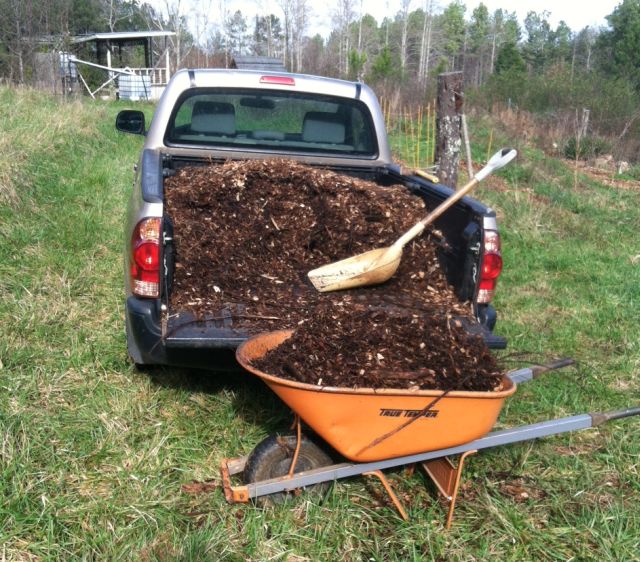
my truck, a large barrow and snow shovel make mulching quick and easy
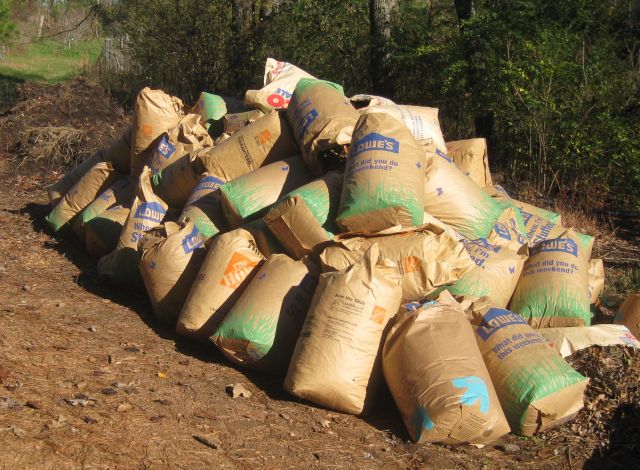
My leaf bag collecting operations produce confusion for some neighbors and emulation with others. A close neighbor, whose current preoccupation is the recent resignation of Mark Richt, the UGA football coach, was unclear whether I was collecting the leaf bags in order to keep the paper bags or for the leaves, and if the latter, why? On a more pleasing but also disconcerting note some, or at least one neighbor, has also begun removing leaf bags from the curbside – new competition for next year?. However, this year I have amassed at least 100 bags and much good compost will result.
lots of leaves, and more on the way
When I have collected all the bags I need, I will break the bags and mix the leaves with other organic materials and compost. In the meantime the dry leaves are enclosed in the bags, protected from rain and wind and achieving little. It occurred to me – why not make a slit at the top of each bag and pump stored rainwater via a hose into each bag. The leaves would be saturated and the bag would prevent evaporation and retain heat produced by the leaves and so the decomposition process could begin even before I mix up all the materials with the bobcat. I will see in a few weeks if this makes any difference.
the cable sizing conundrum
I need an extension cord for 12 volt dc 3amp power and referred to online calculators which produced very different recommendations. So I tried doing the calculation myself and was pleased that one of the websites has similar calculation results though 2 others recommend much thicker cable. This is not my area of expertise so you should go with the recommendations of a reputable site, but for interest only, my calculations are under the self reliance tab/ups.
Today is Nov 20 and, after lots of rain earlier in the week the past few days have been in the 60’s and 70’s and no freezing temps yet. So my fall greens (collard, kale, turnip greens and radishes) have been doing really well with minimal pest evidence.
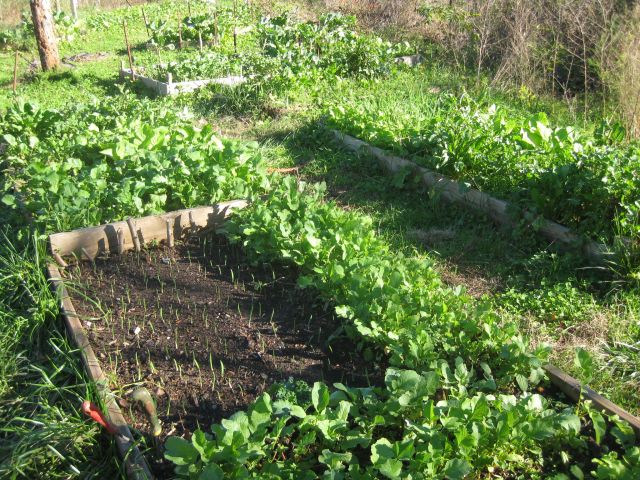
raised growing beds filled with green or garlic
Each year I get a little better. I pull the weeds early and cover the growing areas with growth. Garlic is different since it does not provide shading leaves and does poorly with weeds so I weed carefully before planting garlic and then keep the area clear of weeds. I am trying to upgrade my garlic and as mentioned earlier this year, I kept the larger garlic cloves for replanting, rather than consuming them first.
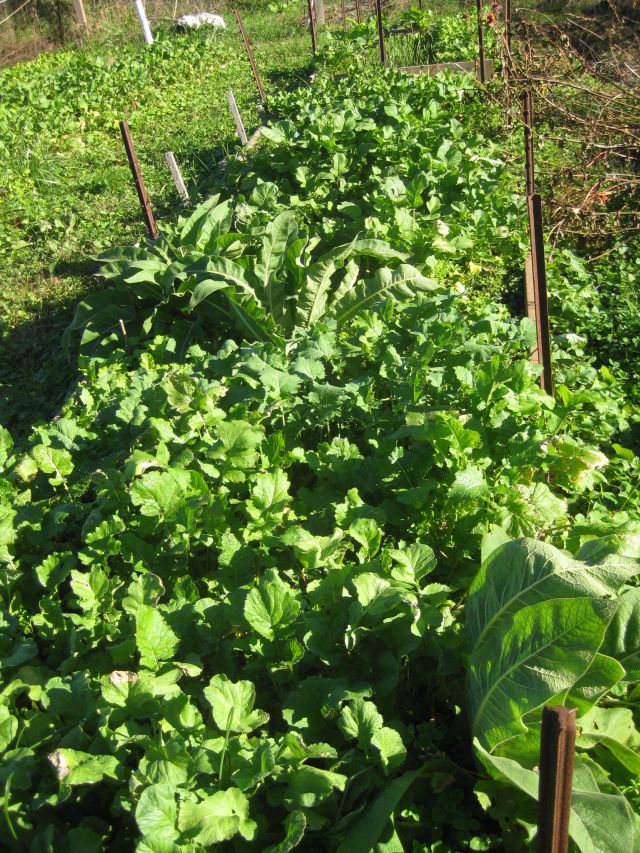
comfrey, radish and others
Radish is so easy to grow I grow plenty of it, tho I know with the first hard freeze the radish will become soft and inedible. I had my neighbors over to help with picking and eating the greens. My neighbor’s wife is industrious and grows many vegetables during the summer (conventionally) and cans them (in bottles) for year round consumption. I think she may decide to do fall crops as well. They were intrigued with the comfrey and I promised them some root cuttings. It grows very well in our area.
Blueberries
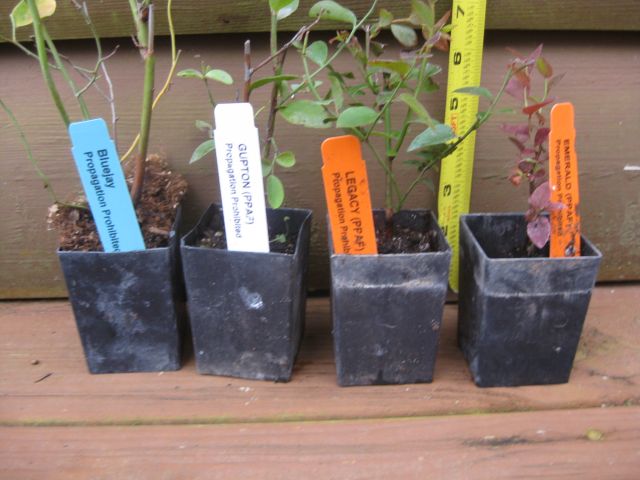
I have a reasonable annual yield of blueberries but nothing like the orchards (if that’s the right word) of blueberries I saw in south Georgia and Oregon. Most of mine are Rabbiteye which is a southern variety. They seem fastidious with a predeliction for acid conditions and because of their small roots they need food and moisture close to hand. I decided to branch out and bought 2 Southern Highbush and 2 Northern Highbush.
rather small Highbush varieties
Compost
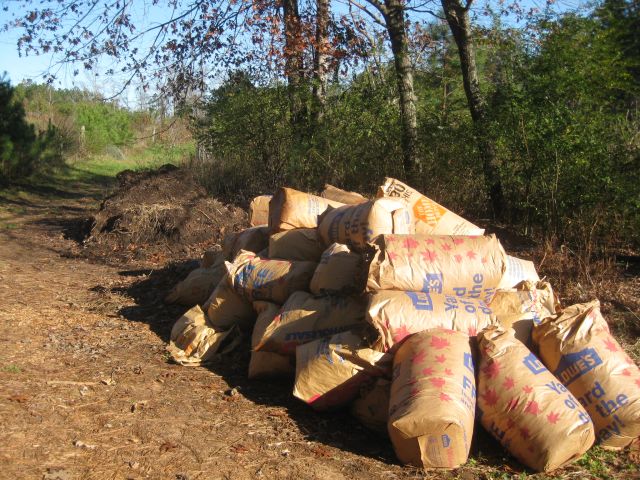
My compost growing is now well established with organisms which thrive on my local mix of leaves and greens. This year I excluded horse manure from the mix out of concern for the lurking ‘cides which may have been given to the fields and horses. Now is leaf bag season and my Tacoma pickup makes the Atlanta subdivision rounds gathering good bags which I stockpile at the Atlanta house and transfer to the farm, 12 bags each trip. The pickup has >216k miles and is >10 years old and performs very well. However, rather than wear it out I purchased an alternative more fuel efficient vehicle which I will use when there are no loads to be transported.
leaf bags for the new compost heap and behind is the old heap
shoe repair
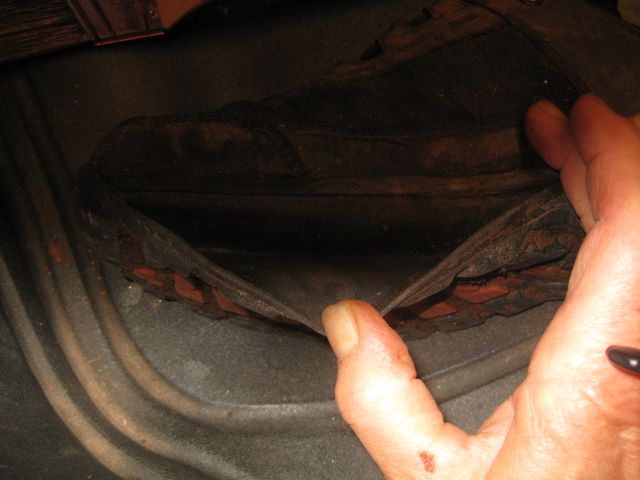
I was disappointed when the sole of my very comfortable, relatively new outdoor shoe detached from the upper. My bad really since I was sideswiping the gravel (see post on gravel drive) into place and they were not designed for this.
right shoe with detached sole
This was the second pair with a detached sole and I decided to try repair them. I ordered shoe goo and used it for both pairs and it seems to have done a good job.
my tube of shoe goo which is working for me
update – the shoe repair has not held up as well as I had hoped. I will not malign the glue I used since the cause could be the surfaces being glued were not in pristine condition or my technique was faulty.
ups
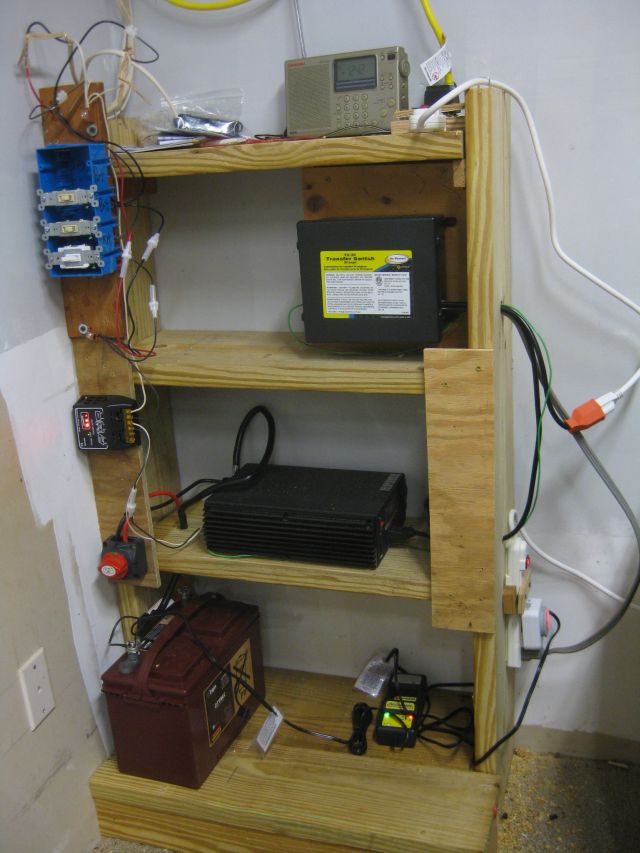
No, not the shipping company but uninterruptible power supply. For both security and convenience. Security because if there is a local power outage or if bad guys simply switch off the power supply (after breaking through the locked steel cover) and wait 30 mins for the backup security battery to run out, then the house is defenceless – no security system, no internet connection, no security cameras. And if I am in the house and the power goes out then no internet access since the modem and wireless router will be off. Below is a pic of my system which I will amend and expand and eventually connect to solar panels.
my ups system
I will provide more info on the system at a later date under the “self reliance” tab on the website. It has several components:
a deep cycle battery and smart charger on the bottom shelf with a marine on/off dc switch;
the second shelf has an inverter which converts dc power to 120ac household current and a solar power controller. The controller is to prevent the 3 dc led lights from excessively draining the battery;
the 3rd shelf has an automatic transfer switch. While utility power is on it powers the load (security system, security cameras, modem, wireless router). When utility power is off, the battery powers the load. You can also see switches for each of the 3 dc led lights and numerous fuse links – it took some time to figure the best fuse size.
the yellow cable on the top shelf goes to the load – it is 12/3 size and I did cable sizing calculations to determine a size which has acceptable resistance loss.
I will provide more info and calculations in the self reliance tab over the next few weeks.
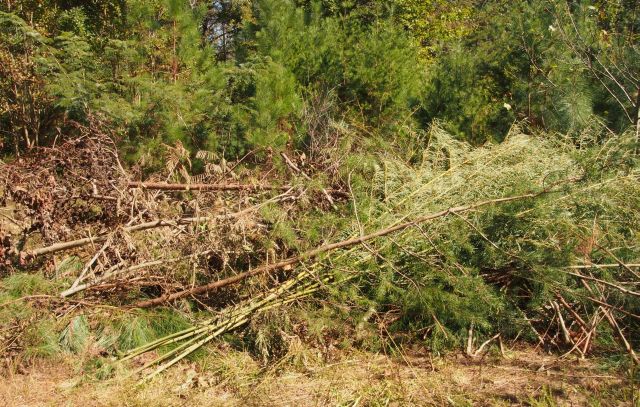
I am in a holding pattern and were it not for the glorious weather I would be frustrated. From my jungle clearing work and regular pruning and also clearing growth around the chicken paddocks (to better spot and dissuade predators) I have amassed a lot of chipping material.
an example of what awaits the chipper – poplar, pine, bamboo etc.
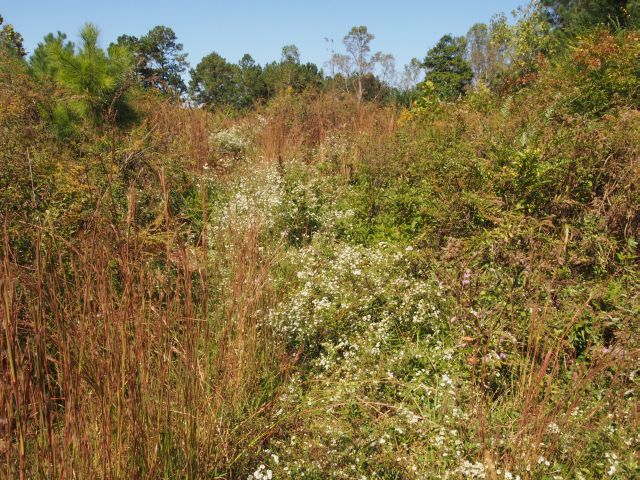
The bush hog is mounted to the tractor and I would like to complete all the bushhogging for the season before I replace it with the chipper. I only bushhog a couple times during the year and growth rather than kempt characterize the non growing areas. And now these areas are populated with daisy fleabane.
where the white daisy bestrides is our walking trail
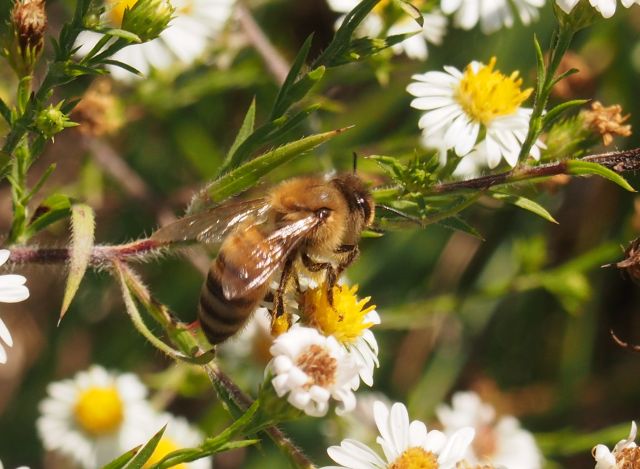
So what, you may say, but approach closer.
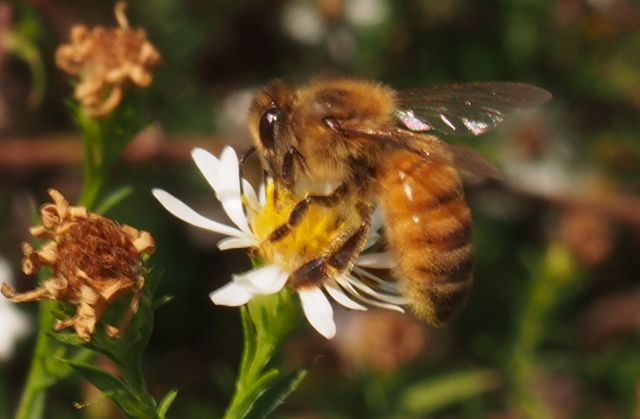
And you will see my busy workers.
this is their last hurrah – the goldenrod festivities ended a few weeks ago and this is their last nutrition source before they hunker down for winter
So I will wait a few more weeks and then switch the implements. Not such a big deal to changeover though it takes some practice to do it quickly. I only use my tractor a few times each year, so I will check the tires, oil and grease the bearings etc. before I commence my fall operations. It’s a large (60hp), old (late 80’s) Case 585 tractor which has been very reliable.
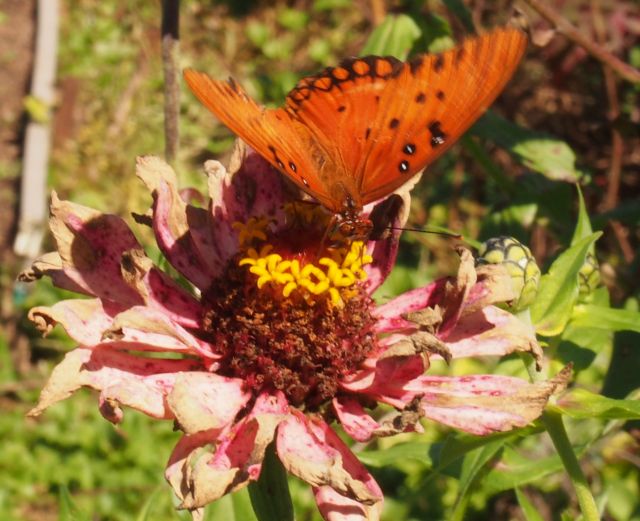
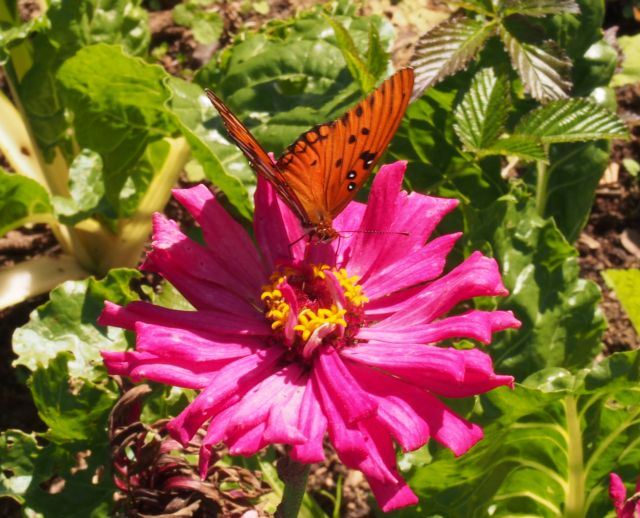
So I continue to admire the goings on.
cosmos butterfly time soon will be over
And will collect the flower seed and disperse in new areas.
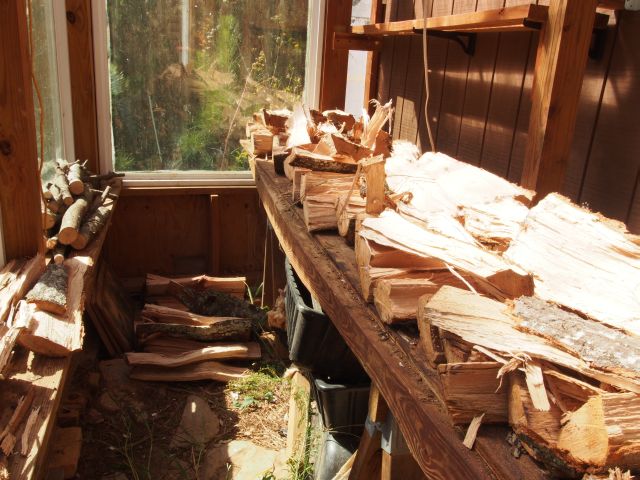
And I transport daily the oak logs from Atlanta (see previous post) and split with my maul, and then I store the firewood in my lean to greenhouse.
late winter and early spring, the greenhouse nurtures my vegetable seedlings, good to dual purpose it for drying firewood
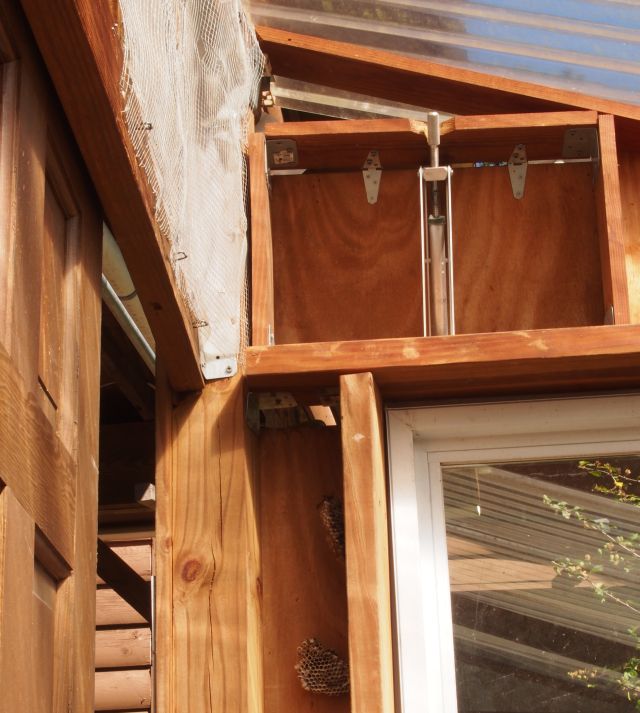
The oak logs have a moisture content of +/- 29% at their ends and >35% in their split middle. I am hoping to reduce this considerably in my greenhouse/solar kiln. But to achieve this I have to close the openings. The temperature controlled vent closes itself and the door I close, but towards the top I stapled plastic and feral cats (of which there are several) each winter make the greenhouse their home and they effortlessly slit the plastic for their entrance. I decided to tack mesh to the plastic. As I raised the hammer to attach the staples I noticed several wasps at the far end of the greenhouse. I like wasps (as opposed to hornets and yellow jackets) – they are generally very docile and only sting if you inadvertently put your hand on them, or mess with their nests. I withheld the first hammer blow and decided to look around. And there, close to where I was going to hammer in the staples, were 2 nests. I was sorry to see them, since for me it meant spraying and killing them. This done I secured the mesh and expect I will have to secure more as the cats devise different ways for entering the greenhouse.
you can see the temperature controlled flap at top, the mesh covering the plastic at top left, and just below in the middle, 2 wasp nests
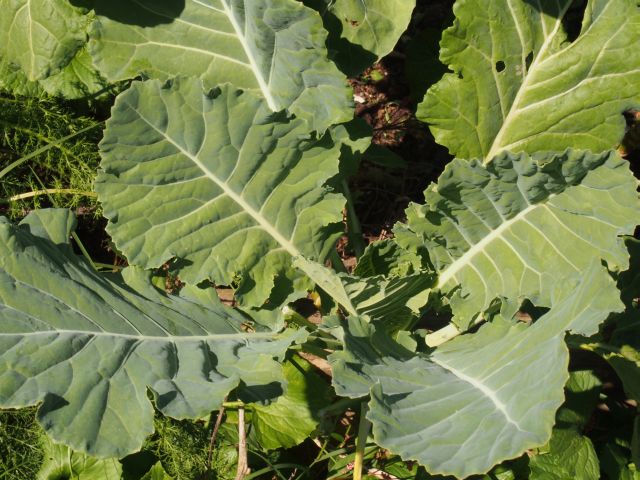
I previously mentioned the luscious growth of green leaf veggies. Here is a collard – large and pest free.
collard grow well this time of year
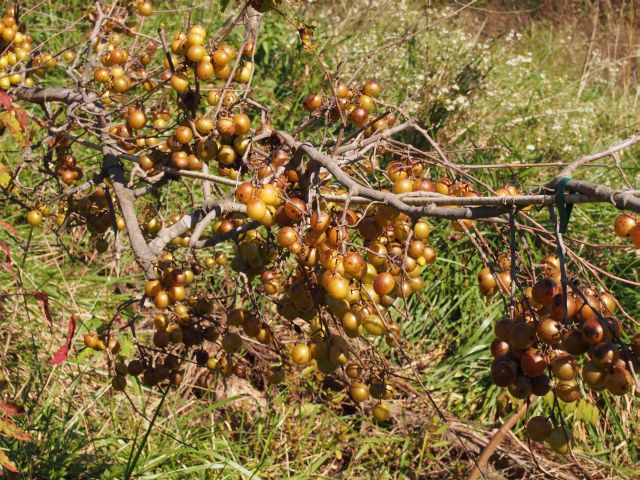
And lest I forget – the muscadine are still ripening and sweetening.
With shortened sun hours and fall in temperatures, my summer vegetables are yielding, as too are the pests which feasted on the chard, collards and greens. So I have been clearing the raised beds, adding compost and cool season seeds such as kale, spinach (after 1 week germinating stint in the refrigerator), and turnip greens. Also lettuce and radishes for harvesting before it gets too cold. I had packets of several years old seed and not knowing which was viable but knowing that with each passing year they were becoming less so, I used them all to seed rows. Now, a few weeks later I know which were too old and rather than thinning the overcrowded rows I am transplanting from the overcrowded rows to the bare rows.
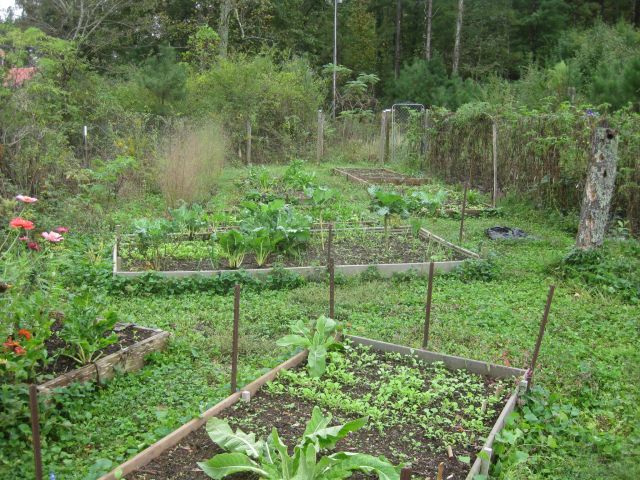
some of the newly composted and seeded raised beds
I left in place the pest shredded collard and chard and I have been rewarded by their luxuriant response to the plentiful rains, cooler temps and reduced pest pressure.
collard with large leaves and chard at the back, both now growing well
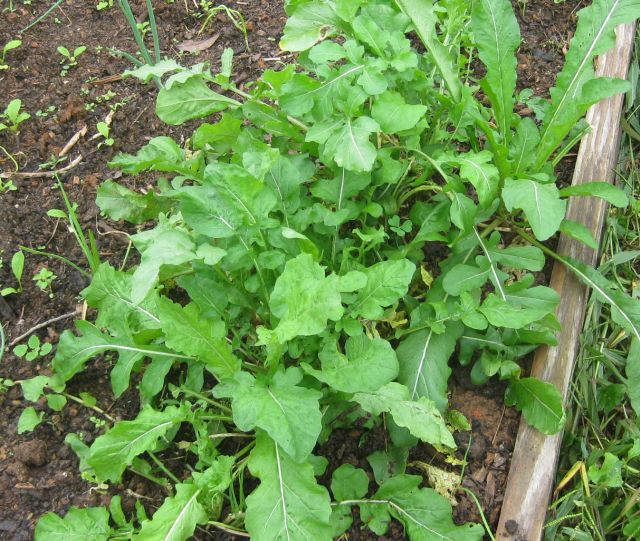
The arugula grows vigorously and is a welcome supplement both to fresh salads and sauteed with the collard, mustard and kale.
vigorous arugula
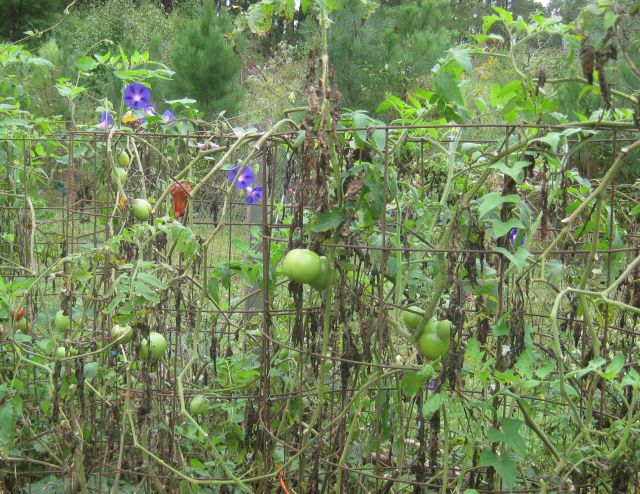
I have steadily removed the tomato cages and stored under cover. A few remain with bearing tomatoes – perhaps they will ripen? And I can wait since the area they occupy will, after composting, be used for planting out garlic and garlic can go into the ground later, while my cool season seeds had to go in earlier to germinate and benefit as much as possible from the dwindling sunlight.
a few tomatoes cages remain crested by morning glory
Apart from removing the summer vegetables I have not had much hassle with weeds. I am more disciplined and weed during the summer and try cover the areas with vegetable growth to forestall the arrival of weeds. So much less work and a better result than previous years.
In the orchard which was overcrowded with weeds, I have been at work clearing the growth and pruning the trees. Last year I used wires to hold down and spread the branches and pruned the vertical apical growths. I am pleased the branches have stayed horizontally in place after the removal of the wires though with some trees, especially the pears, there are a number of vertical growths I have to remove. I am reusing the wires elsewhere and the best time to train the trees is when they are young and supple. Here is a young apple tree whose vertical branches have been splayed horizontal with the recycled wires.
you may notice the wires holding down the branches
It’s all about observing what’s going on and attending timely. Elsewhere in a wooded area I planted out oak saplings a few years ago and they have been outshaded by fast growing pines and tulip poplars and there too I have been busy with pruning saw (and also chainsaw) cutting down the less desirable trees and “releasing” the oak trees.
In the orchard area and at the top of the hill I have been weeding growing areas and seeding with winter rye and Austrian winter peas for cover crops. And I have been seeding with clover around the bases of my blueberry plants. So plenty of work but with the cool weather and occasional drizzles, an exhilarating time to be out doors.
Unusual sightings
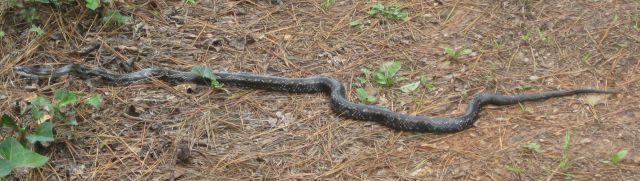
I mentioned previously that my rat and mouse problem (more rat than mouse) in the coop has been solved with the arrival of a large black snake. I have not seen the black rat snake again but I am sure it patrols the area, perhaps in the night and certainly rat droppings have disappeared from the coop ledges and the feed bowls. But I did spot another largish snake about 5 feet long, probably an eastern king snake and was able to snap it (below).
a sight for sore eyes and a boon for vermin control
I really don’t understand those who wish to kill these non venomous snakes. Apart from ridding mice and rats they also devour the venomous smaller snakes. As long as they don’t take a liking to the chickens eggs they are most welcome.
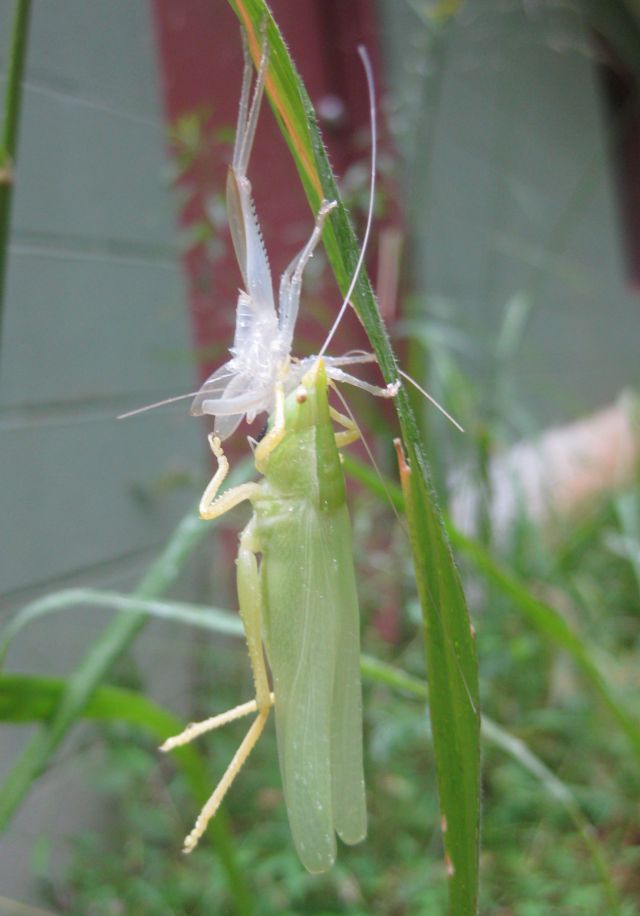
We noticed an unusual sight.
katydid and cricket
The white insect above was attached to the grass blade, the one below was suspended held by the one above, or so it seemed. But why was the one above white? Closer examination indicated that the predator was the green katydid and it presumably had sucked out the nutrients of the cricket (which looked skeletally white). Interesting that the cricket was still attached to the grass blade.
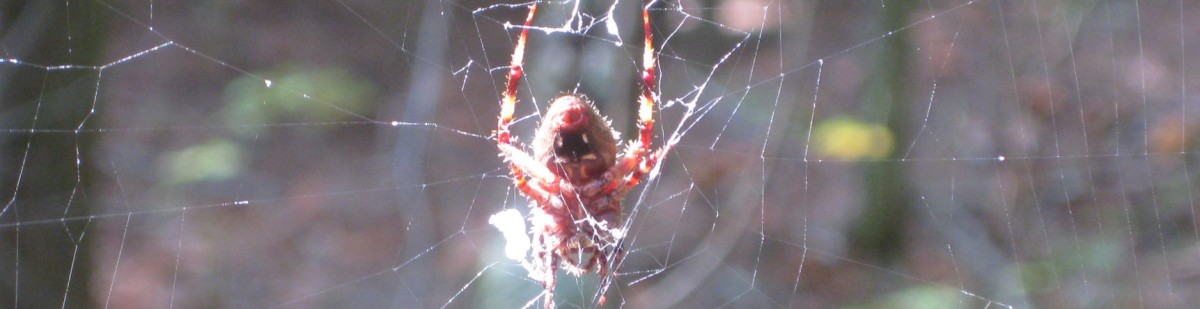
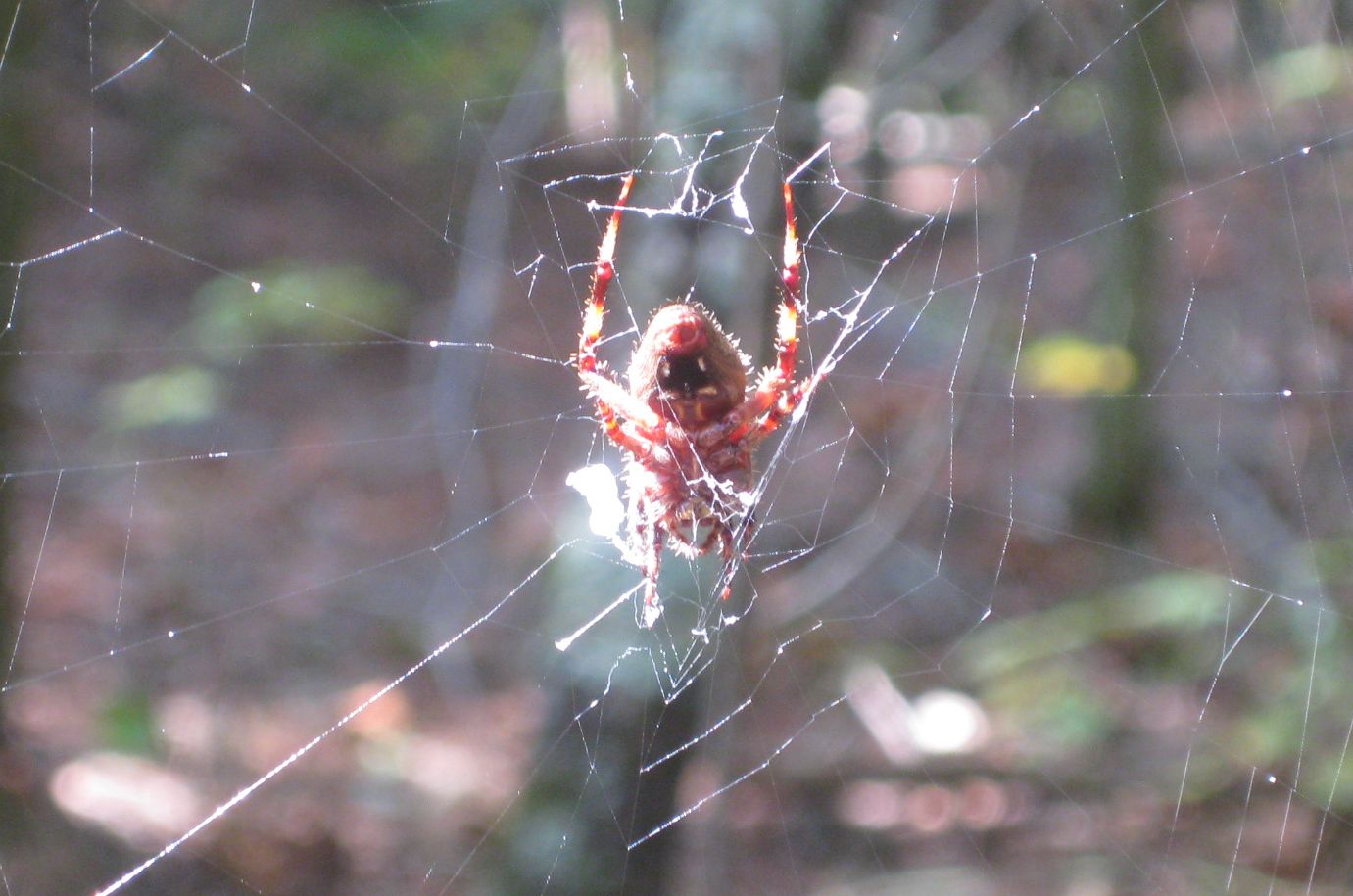
Spiders abound and have webs across my path in the woods, so I carry a stick before me to avoid being wrapped in their webs. Here is one fellow I almost walked into.
one of many webs in the woods
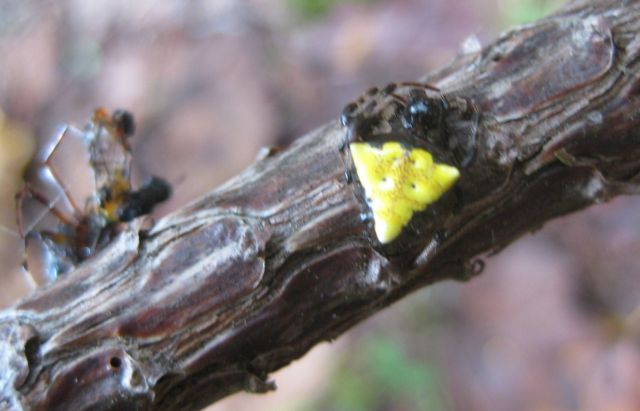
And here is a spider with I think, eggs on its back.
a triangle colored spider – are those eggs on its back?
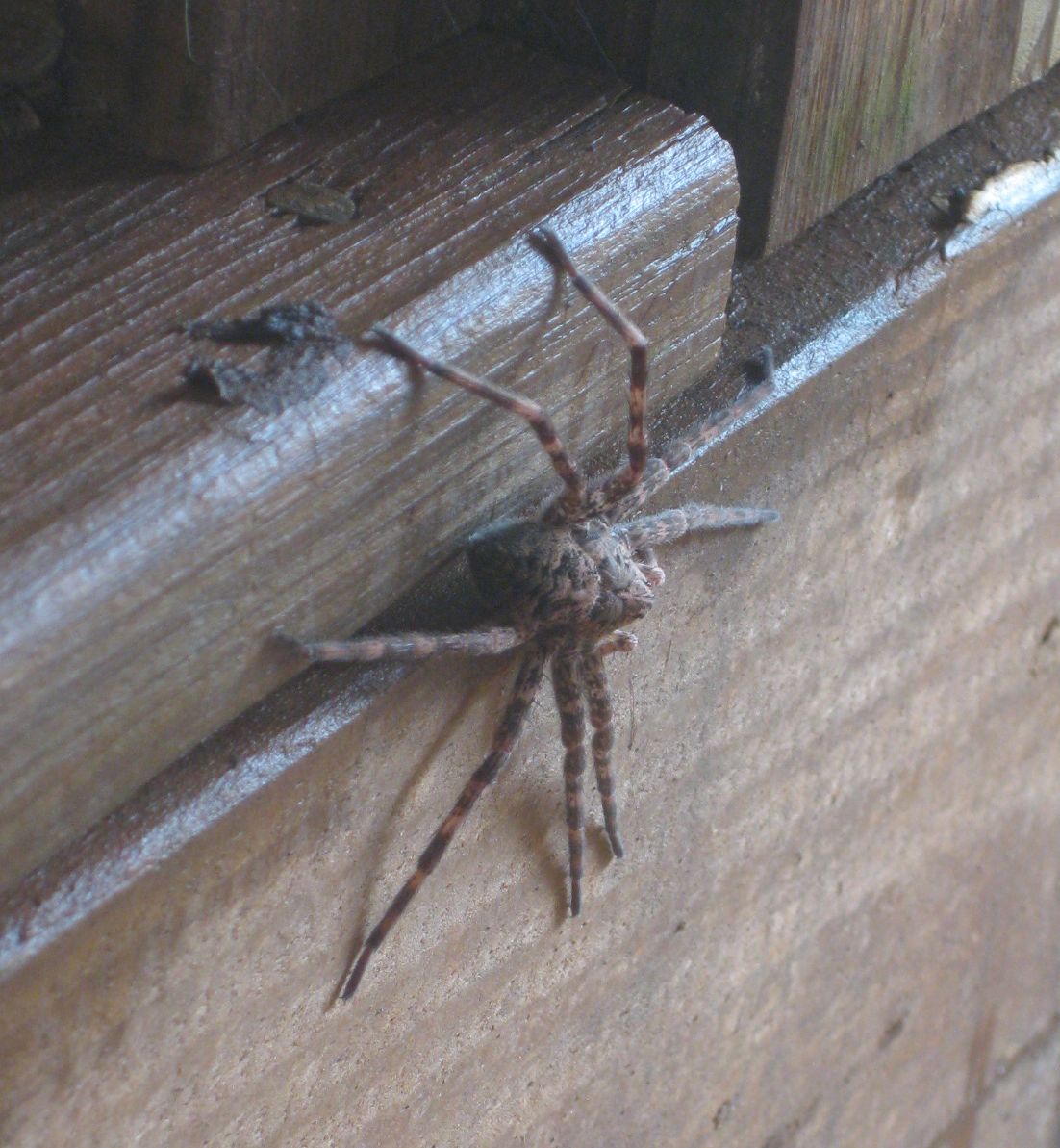
And here is quite a large fellow near the house.
its width from end of leg to end of leg is about 2 inches
The bees are hard at work on the goldenrod and, with all the rain the past week, mushrooms of different sizes, colors and shapes, are emerging.