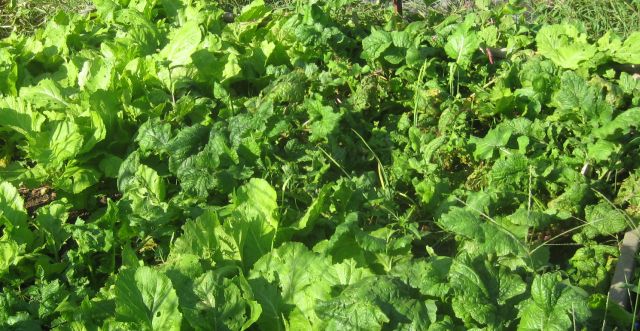
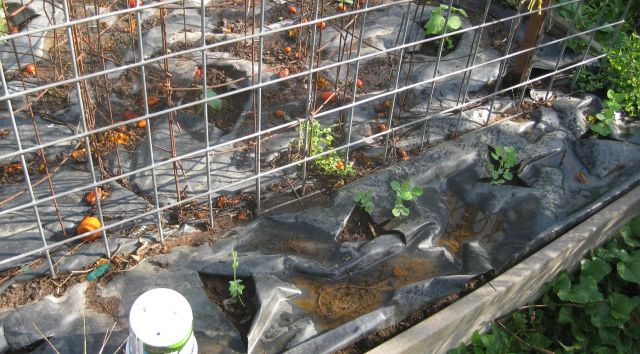
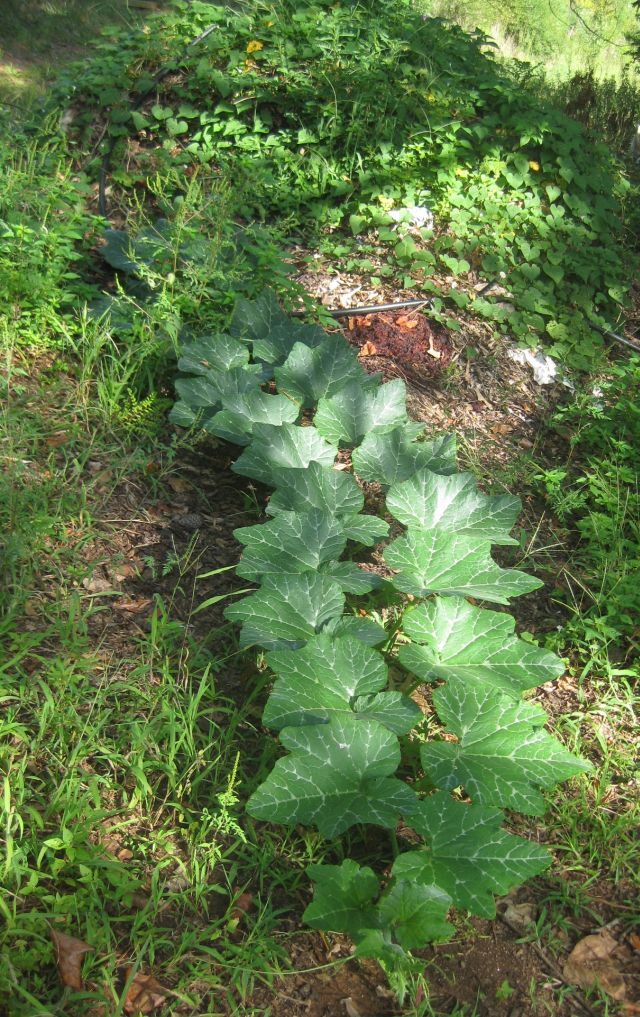
It’s December 18, we have not had temps below 20 deg F, and greens are holding up well.
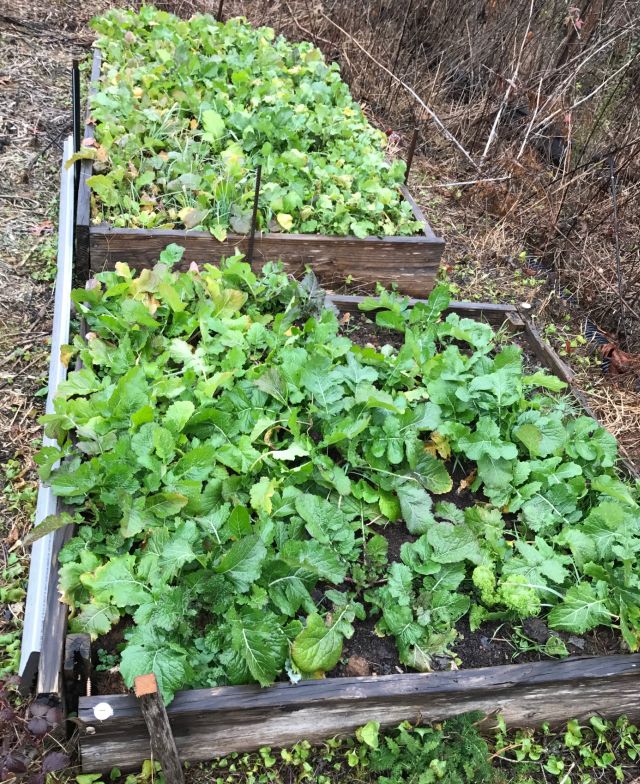
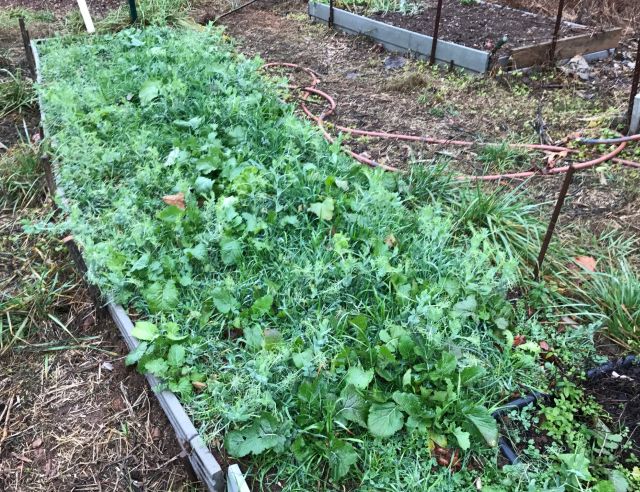
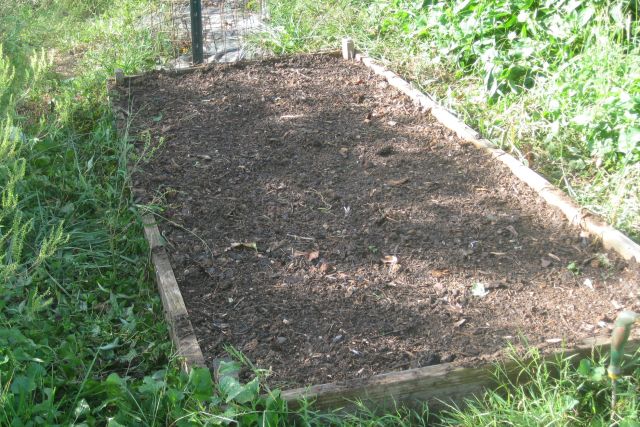
some of the growing beds. the bare beds are planted with garlic
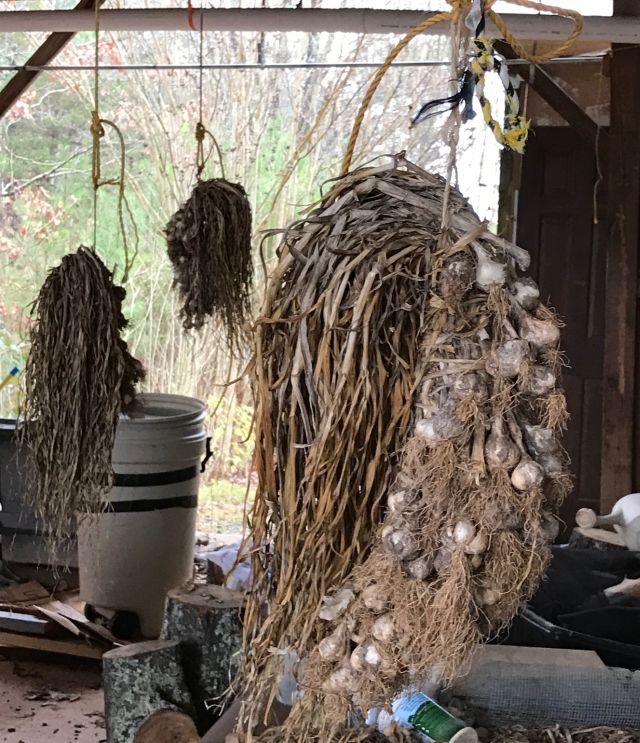
Usually I plant out the garlic cloves in October or November but we had no rain in those months and the ground was dry. When I returned from Australia and New Zealand early December the ground was moist and it was pleasurable to clear the beds, turn in the compost and populate with garlic. I have noticed some leaves emerging and hope the delay will not affect their growth. I used to store the garlic heads in mesh bags in the basement but they became moldy and now I string them together in bundles and store them in the carport and they do fine.
we snip off the garlic heads as needed. garlic grows very well in my area and I am preferring the larger cloves for replanting
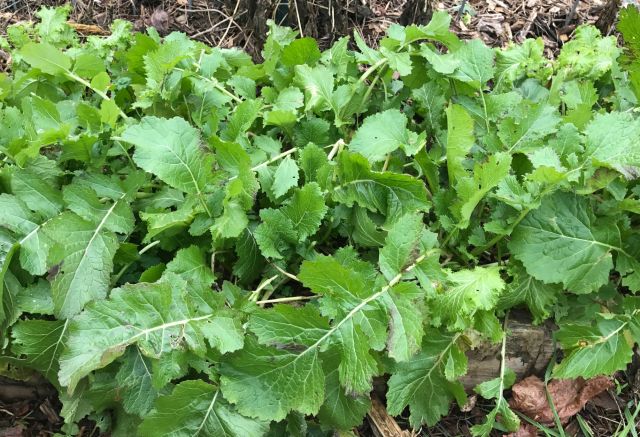
Growing well now are turnip greens, purple top turnips, collard, kale and radishes.
no signs yet of cold damage and lots to pick and eat and share with neighbors. some of the untreated wood sides of the bed are deteriorating and I will replace with composite planks which cost 2x to 3x more but appear immune to weather
Our greens taste like greens should – so much of the store bought stuff is anemic. I planted out some winter cover in October, not much because I was water constrained, and it too is growing well.
the mix included winter rye, winter peas, hairy vetch and crimson clover
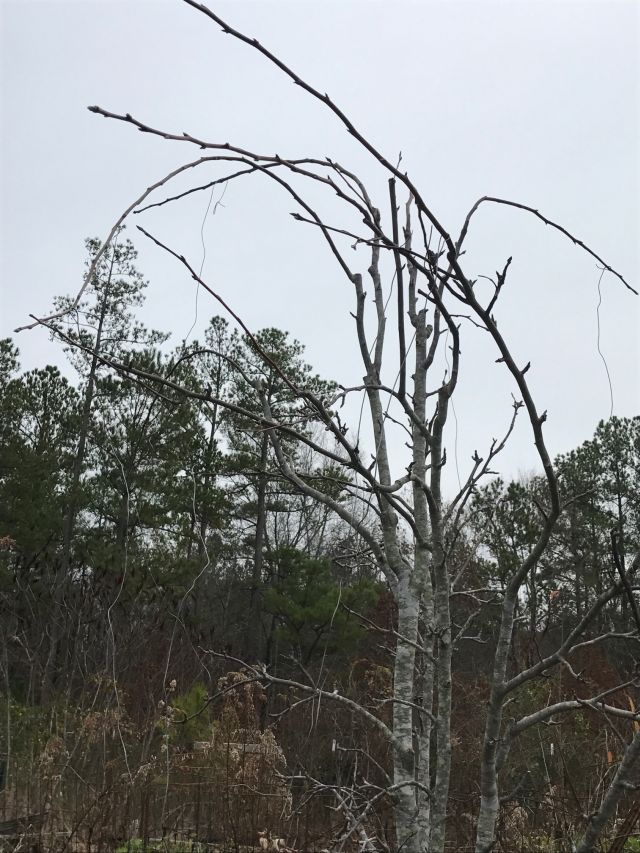
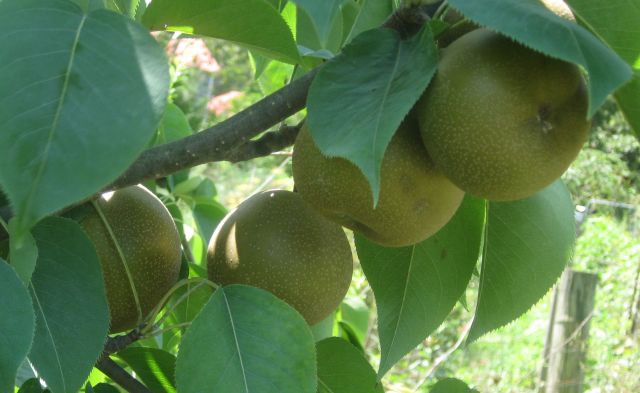
I have not yet added additional storage tanks to harvest surplus rainwater. So, in the meantime, since my tanks are full, I am pumping the water to the contour ditches and the fruit trees to infiltrate the water where it will be useful. I am continuing to prune my fruit trees. The pears have a strong vertical habit and need extra attention. My Asian pear is my best producer and I deferred pruning in the past since it was doing so well by itself, but today I pruned and then bent towards horizontal it topmost boughs.
you can spot the wires holding the stems in place
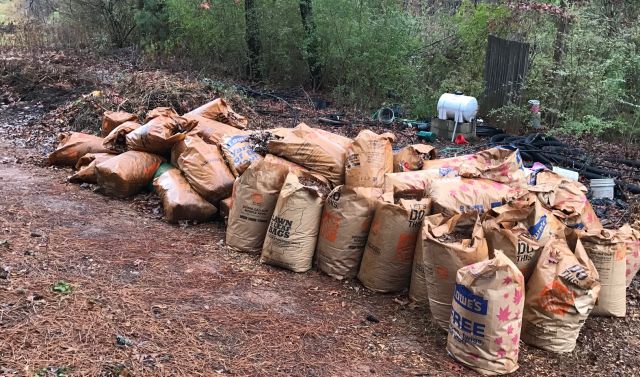
And my big project this time of year is to bring in the leaf bags of my Atlanta neighbors. Leaf fall was delayed and now is busy time.
when I have all the bags I will rebuild my compost heap with help from my bobcat
And so the north Georgia drought continues. Yesterday was hellish – rolling clouds of smoke streamed down from Rabun county, where some houses were being evacuated, and from areas of South and North Carolina. From my neighbors, who are weather hardened house builders, I heard hacking coughs and mine joined theirs as I pruned my trees. And rain not in sight and maybe none until next spring.
My house is on a well and I could pump water for irrigation but this depletes my well (and probably my neighbors too) and though dry, dry conditions are bad, nothing is as bad as a house without water.
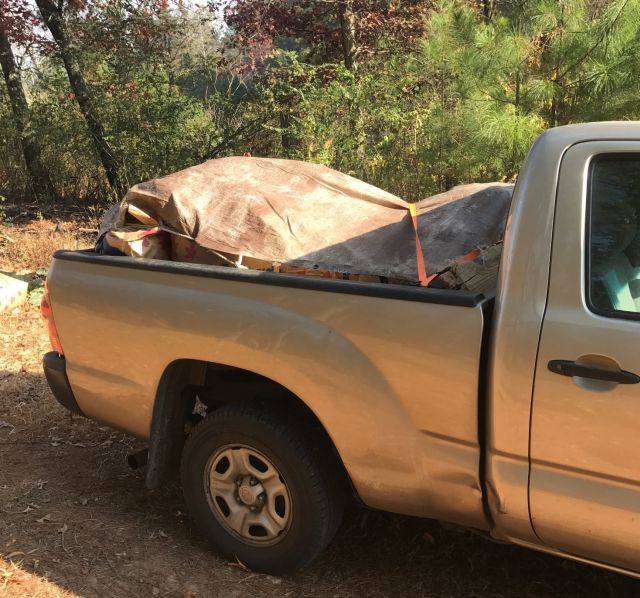
the slump in the tarp indicates this is not the usual 12 leaf bag freight but includes a change in the mix
So I decided to enlist my pickup. Already it has begun making the trips to and from Atlanta to relocate my neighbors’ leaf bags to my compost heap. Why not bring some water as well? There are not yet watering restrictions in Atlanta and our Atlanta house has an irrigation meter which I installed years ago and from which we draw about 4 gallons a month for the bird bath. So time to use the irrigation meter again.
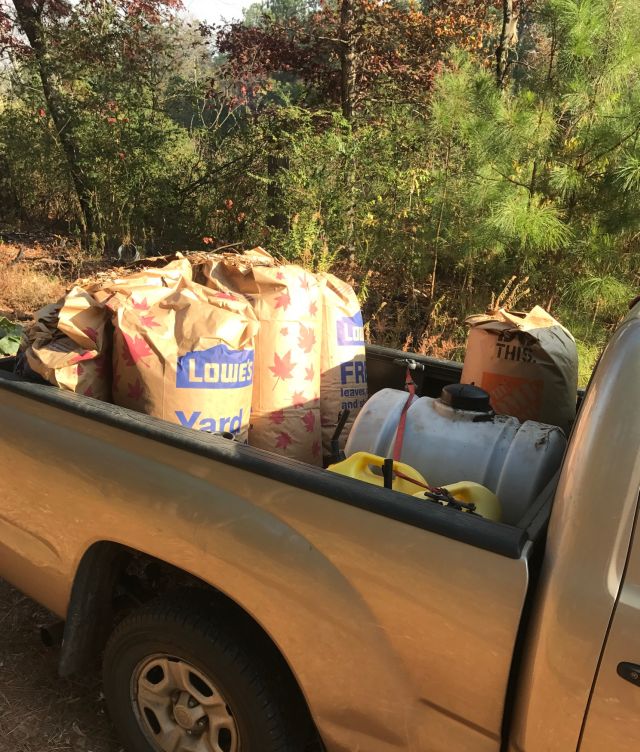
now I move 7 leaf bags and 45 gallons of water
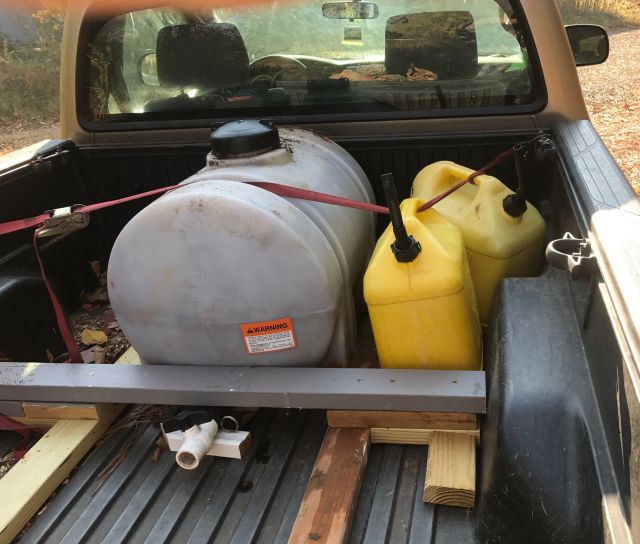
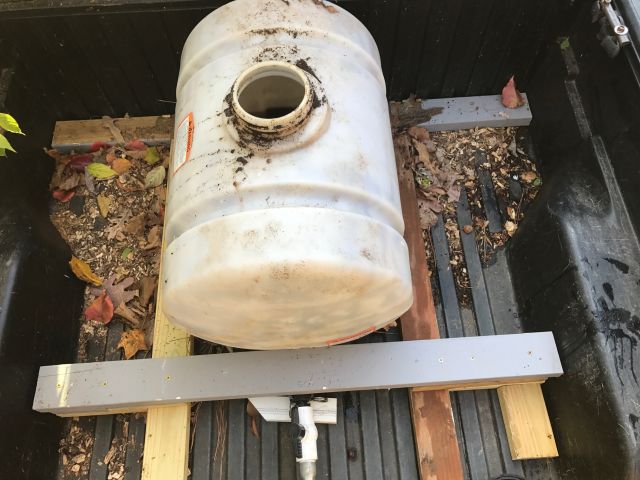
I recommissioned my 35 gallon horizontal storage tank from compost tea maker to water carrier. A gallon of water weights 8.3 lbs so this tank full will weigh about 300 lbs. And if it slides around the truck bed it can do some damage. I fashioned from 2×4’s a brace to hold it in place in the center of the bed up against the cab. I decided to add 2×5 gallon containers on the right side of the bed so that their weight (10 gallons x 8.3lbs per gallon = 83 lbs) plus Trudy’s (my 46lb canine companion) will somewhat counterbalance my weight in the driver’s seat. And so I now transport 45 gallons of water to my logcabin, plus 7 leaf bags with each trip.
you can see the brace which secures the tank -2 long 2×4’s fitted between the cabin and tailgate (to prevent sideways movement) held in place by spacers at the cabin end and front end and a grey 2×4 secured to the 2 long planks to prevent forward sliding
The 2 -5 gallon water containers I transport in a barrow to the orchard and upend each at a fruit tree. Not much, I agree but better than nothing for trees which have not savored water for several months. The fruit trees are surviving and I attribute this to the contour ditches which straddle the hill and infiltrate the rainwater runoff and heavy mulching.
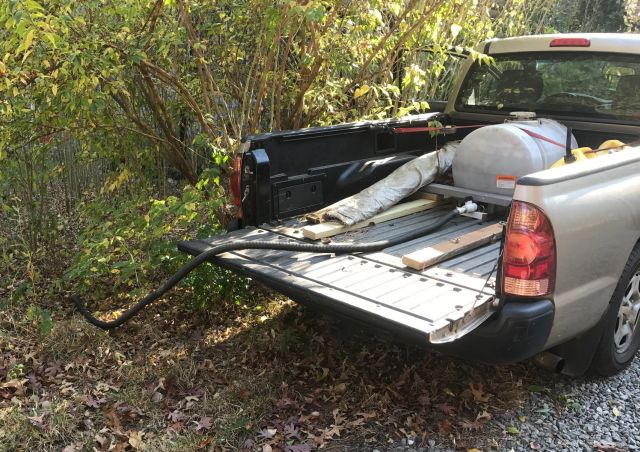
a black pipe drains the water to the 4″ pipe which moves roof water to a storage tank
The 35 gallons of water I pour into a storage tank from which I can pump to the vegetable garden or wherever it is most needed. From watering the vegetable garden > 100 gals every day I am down to 40 gals every 3 days although of course the summer heat is past and evaporation and transpiration are also greatly reduced. I have cut back on plantings and if there is any consolation for this unusual weather, at least I am getting good tasting organic tomatoes and peppers and lots of greens in the middle of November.
you can see the barn at the bottom of the hill which houses 2 -1,400 gallon tanks
Tomorrow, Thurs Sept 22, is the beginning of Fall, or Autumn as we called it in the UK and SA. Time to take stock of what’s growing.
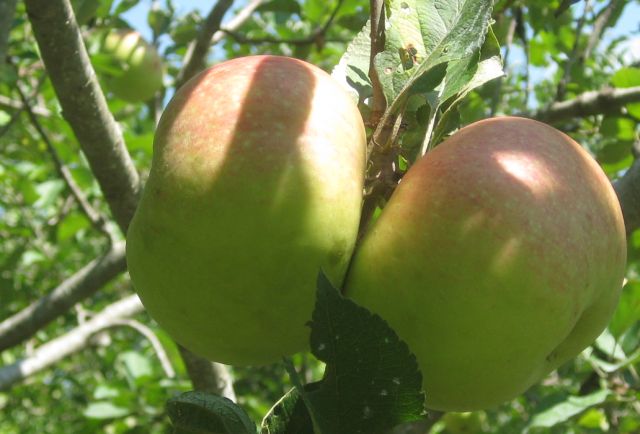
Apple production is ending and the Anna, top left, and Ein Shemer, top right, are almost all gone. It has been a good 2.5 months of apple eating since the Pristine became available early July.
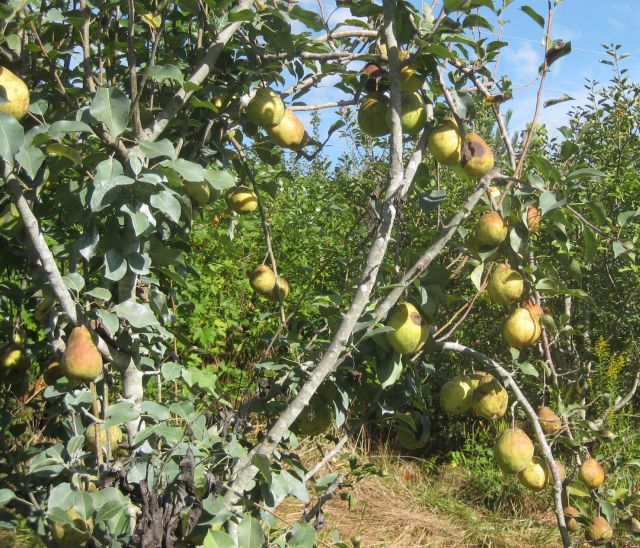
Although the Asian pear is almost done, the other pears are still turning out large, sweet pears and as long as we cut out the bad bits, they are a treat. M. is concerned to see occasional worms emerge from our greens and fruits. She agrees such travelers are never seen in store bought produce and I think she buys in, reluctantly, to my suggestion that if the store bought stuff is so toxicated that the little guys abhor it, why should we big guys be so keen to eat the stuff. It is pleasant indeed to pick breakfast and lunch fresh from the trees and growing beds. And I enjoy eating the fruit with the skin, which I will not do with store bought fruit.
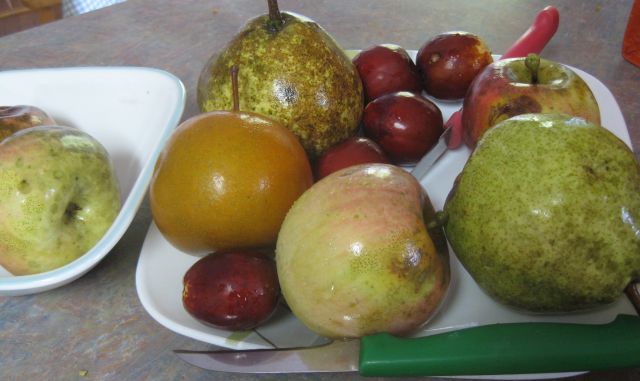
just some of the abundant pears, excise the black spots and it’s delicious
The cooler weather and recent rains have bolstered the greens.
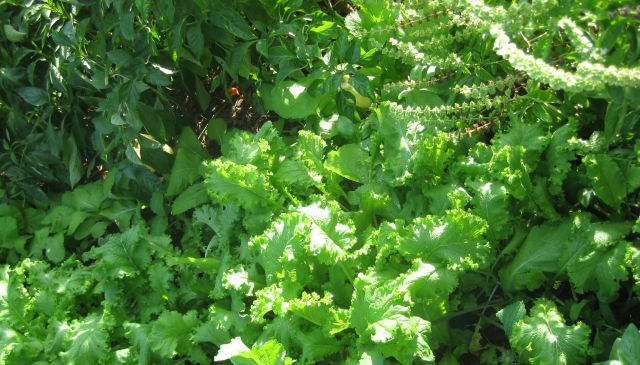
basil top right, sweet peppers top left and lots of mustard greens
And there is little pest or disease pressure.
I am having difficulty with rabbit(s) which nail my pea seedlings shortly after they emerge. I am designing an enclosure which I will 3D print which admits sufficient sunlight, rain and air, is well anchored from rabbit nose nudges, and provides adequate protection. In the meantime I keep trying.
these seedlings have not yet been discovered, the yogurt container is one stratagem to dissuade the rabbit
And since my rainwater tanks are well filled and it is cooler, I am transitioning more raised beds from fallow to production. First stop is the compost heap.
the compost heap should be turned but there is a vigorous butternut vine arrowing from the heap to the sunlit areas and we would like it to finish producing its butternutthe butternut plant self seeded and is vigorous and beneath its leaves is butternut
If the lettuce does not survive the rabbit I shall have to enclose the bed or trap the rabbit.
We have been enjoying water melons and cantaloupe though some were picked too early. It is a dicy business judging when to pick – leave it a few days too late and someone else burrows into the sweet flesh.
this one should be ready and I will pick it tomorrow
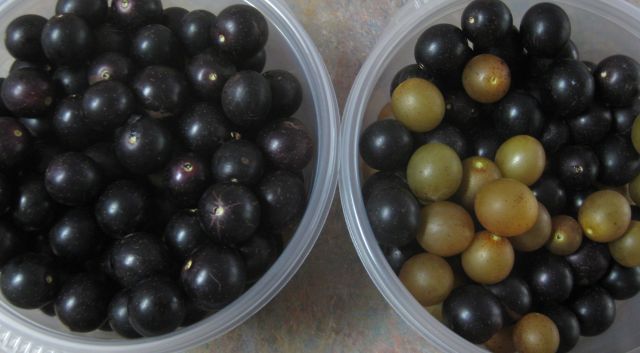
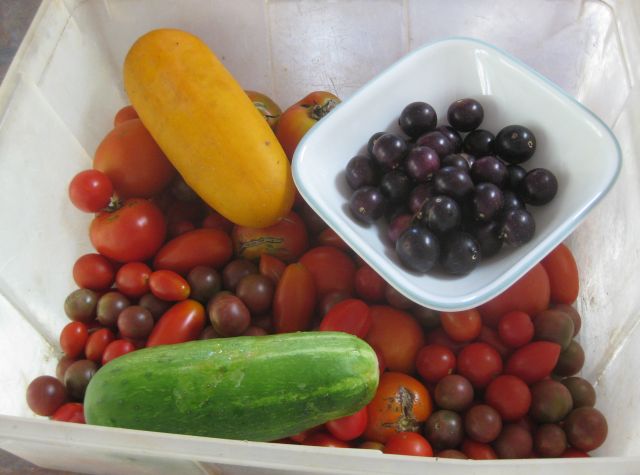
Unlike July which was hot and dry, August has been tempered with rain showers and cloudy days. My property 50 miles north of Atlanta has received a lot of rain while Atlanta very little – could this be the heat island effect? The rain has filled out my muscadine, including the golden scuppernong, shown above and throughout the day they are visited by yellow jackets, wasps and hornets, and me in the earlier morning.
With the exception of the Parks Whopper, most of my tomatoes are done. The Whopper has been an exceptional producer – the first to produce large size tomatoes and the only one still producing, though taste not comparable with the heirlooms.
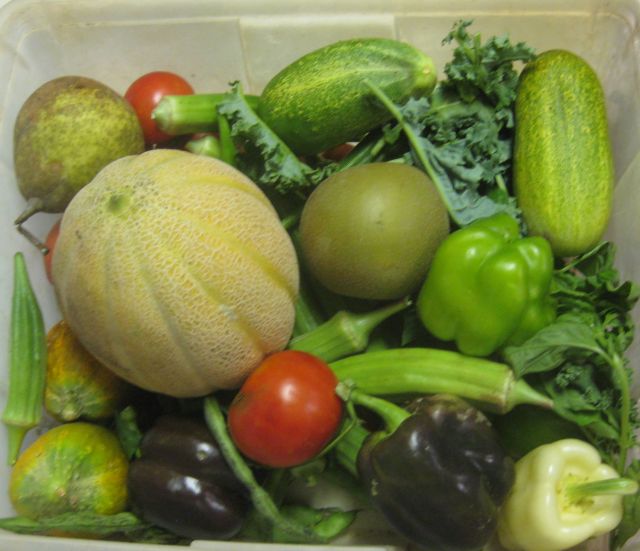
a day’s collection
My colored sweet peppers and okra are flourishing. Now the cantaloupe and watermelon are ripening, and tasting good. Cucumbers and beans are winding down. After removing the tomato plants I have been seeding the tomato cages with peas – will see how this works out. And planting greens in the raised beds – turnips, mustard, kale and collard, and soon the radishes.
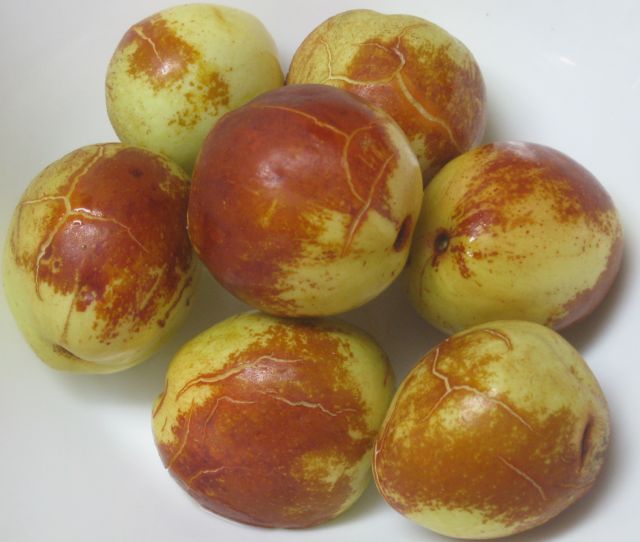
As mentioned in my previous post, lot of pears and muscadine grapes. Some apple varieties still to produce and jujube should be edible in a few weeks although we have begun snacking.
Lang Jujube ripens to a mahogany red color. I planted opposite it a Li Jujube which is not yet fruit bearing.the Kieffer pear (top right) is v. large and sweet. Top left a Giant Korean pear, bottom left a Paduckah apple and bottom right the Anna Apple from Israel with low chill hours requirement
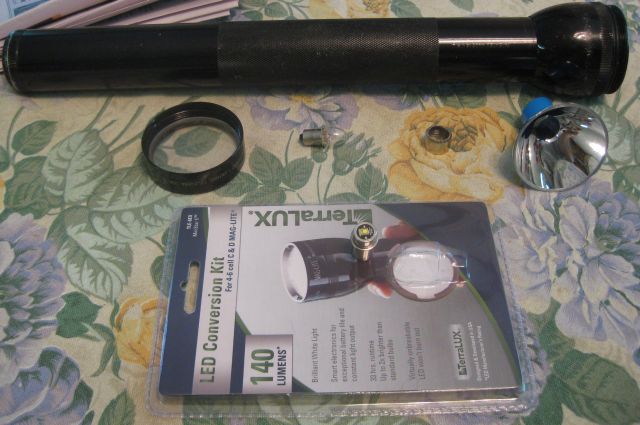
maglite led conversion
With the boxy yellow Eveready LED floating lantern available for <$5, it is difficult to rationalize holding onto the mag-lite flashlights. Except they are so well made and I really did not want to toss my large 4 D cell mag-lite. So I ordered the TerraLux LED conversion kit (140 lumens, $17.48) and it is easy enough to replace the bulb.
a quick replacement of conventional bulb with new LED
Battery life and brightness are greatly increased and I have a handy club, if needed.
Recent good rains have juiced my crops. We thought by now the tomatoes would be done, and some are, but others keep producing. Most everyone complimented the taste of the small tomatoes. We feel the larger tomatoes are less tasty probably from too much rain.
Muscadine season has almost arrived and the black ones above although sweet, will be sweeter still when they roll into my hand and do not have to be tugged. But then there will be many yellow jackets at the smorgasbord and M. developed a nasty reaction when 2 yellow jackets, apparently without provocation, stung her ankle.
And the apples and pears are abundant. In my 7/31 post I criticized the Paduckah apple as a good producer with little taste. Now these apples have fully ripened they really are tasty. I locate fully ripened apples not by feeling for which nudges easily free but by selecting from those that have fallen to the ground. Very few pests this year probably because of my kaolin spraying.
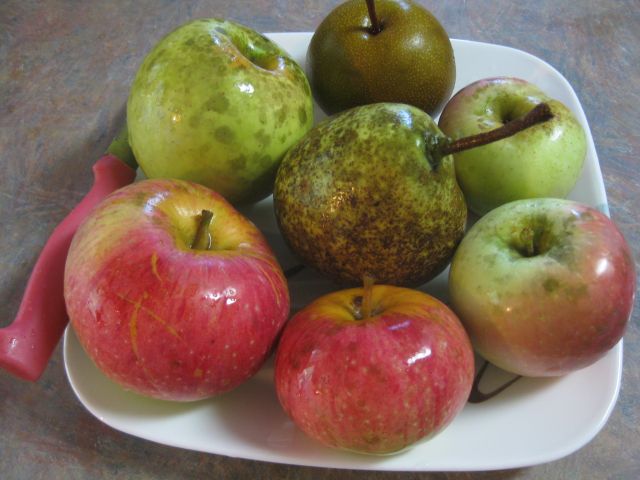
the two bottom apples are Paduckahs, top left is the Matsu (tastes great), 2 on the right are Ein Shemer (not yet ready), Kieffer pear in the middle, and at the top the Giant Korean pear, which needs a few more weeks.
Recent reads
I finished reading 3 interesting books. The Dark Forest by Cixin Liu (tsih-sheen leo) apparently China’s top science fiction writer, is the sequel to The Three-Body Solution. One of my sons read the Mandarin originals, recommended them, gifted them to me, encouraged me persistently, and once I was into it, it was a good read. Another book he recommended The Mandibles by Lionel Shriver, is a dystopian finance drama, very well written and much easier to access. And finally I enjoyed the short stories in The Periodic Table (1984) by Primo Levi – gentle instruction, humor and sadness.
And, a first. My running/walking group has good-naturedly tolerated my digressions on nutrition – that you are what you eat. Yesterday at breakfast after our stint on the river trail, I noticed there were more oatmeal settings (5) than bacon and eggs (4). My comment that this was a first, caused some embarrassment. It seems more folks are correlating health outcomes with what they eat. Good!
Tomato season is peaking and I am doling out bags to neighbors, friends and my running group. A few weeks ago I was plagued with blossom rot but that has disappeared with changes to my watering methods. The best producer is still the Parks Whopper which a neighbor gave me in exchange for 6 of my varieties. It has outperformed the rest, though interesting my neighbor has not done as well with her Parks but is enjoying my Juliet and Cherokee Purple.
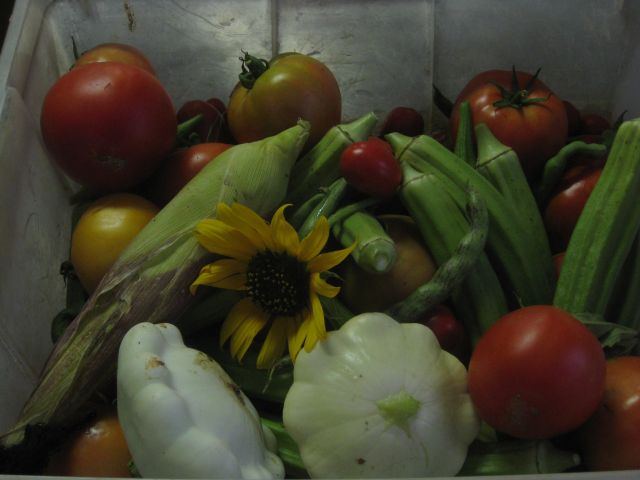
The daily vegetable harvest is tomatoes, cucumbers, beans (rattlesnake and common), pattipan squash and okra.
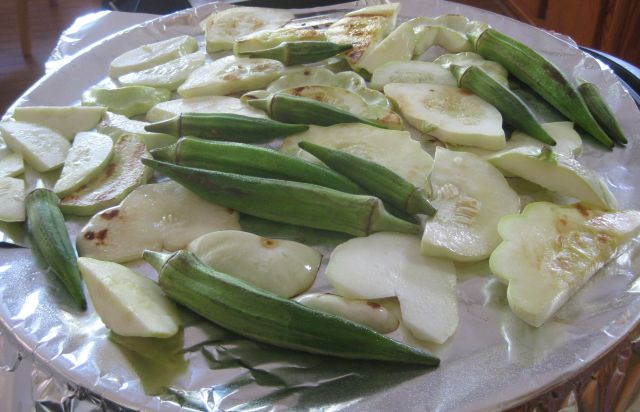
Pattipan squash and okra sprinkled with olive oil in a G Foreman grill. Add pepper to taste. Delicious.
Okra grows rapidly and should be harvested daily. Miss 3 days and it is too large and stringy. The corn disappointed again – I was unable to water sufficiently and they are spindly.
The fruit orchard is bearing well and recent heavy rains have helped tremendously. My best apple tree, the early season Pristine, is about done. The Ginger Gold was ok, prodigiously huge apples and ok taste. The Matsu, which is smaller and younger than the rest produced well for the first time – tasty. The Paduckah has lots of good looking apples, but they have little taste.
the Paduckah look good but little taste
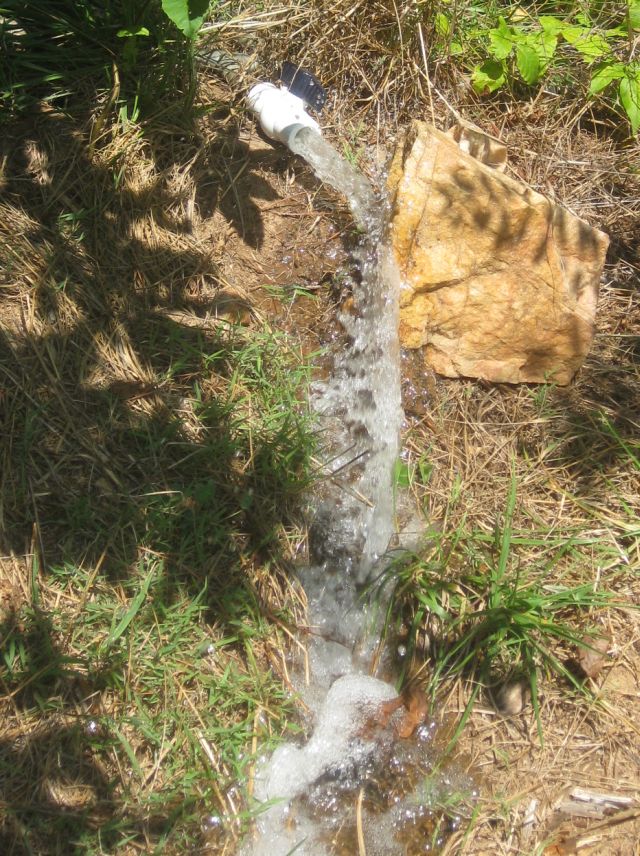
An Arkansas Black apple tree provides setting sun protection to the bee hive and this is its first year of decent production and the apples are promising. In another post I mentioned how I clear airlocks by opening a valve at the bottom of the hill – rather than waste the flush water I direct it in a channel (after bouncing off a rock) to the Arkansas Black which is responding well to this consideration.
water used to flush out bubbles directed by a stone to a quick path to a thirsty apple tree
My pears will soon be ready – the Kieffer and TyTy are almost ready and the prize and jewel, the Giant Korean pear is following closely behind.
Giant Korean Pear – the best of all my fruit trees, firm, slightly sweet but sweet enough and impervious to pests and disease
I have one peach tree (the other died) and it produced delicious peaches though we had to do a lot of cutting out of pests and disease. The reward is sufficient for me to keep it in production. I have a second small orchard planted several years after the first and the Ein Shemer (from Israel, low chill hours) has a pleasing taste. The jujube looks good and we will wait until it turns brown and crinkly, and the fig trees which were cold killed the past few years have tiny little figs. The American and Asian persimmon are growing well and may produce fruit next year.
So there is plenty to eat and it is pleasurable to pick what is ready and, after cutting out pests, eat with the skin without washing and without concern for toxins.
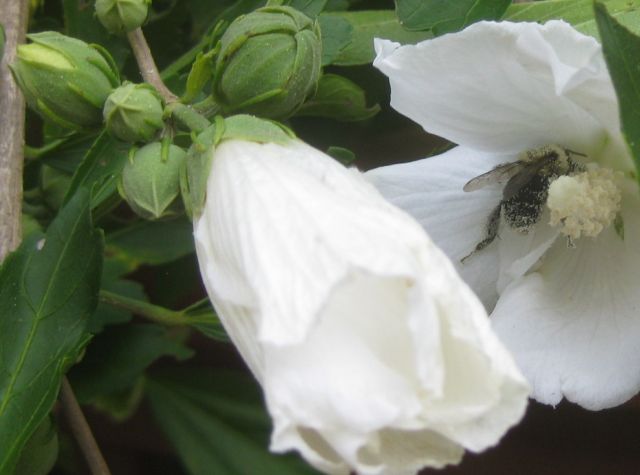
the recent rains brought to life the Rose of Sharon hibiscus and even late morning it is besieged with pollen dusty foragers
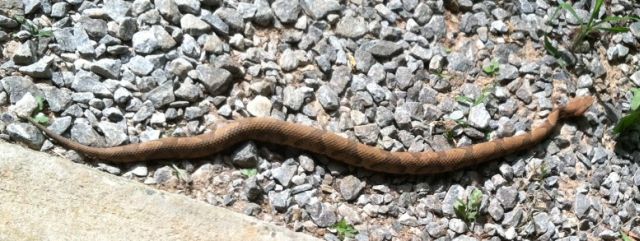
I affectionately refer to the large non venomous snakes around our place. But out here good goes with bad and the copperhead in the header photo, thick of body and (to me) ugly and close to the house, was an unwelcome sight.
In north Georgia it is hot and dry. Blackberry and blueberry season is over and now it’s time for fruit and crops such as squash, cucumbers and tomatoes. And this year my apples and squash are great yet many of my tomatoes have blossom rot. Usually my tomatoes excel and the squash and apples underperform. I wonder why?
succulent, sweet early season Pristine apples
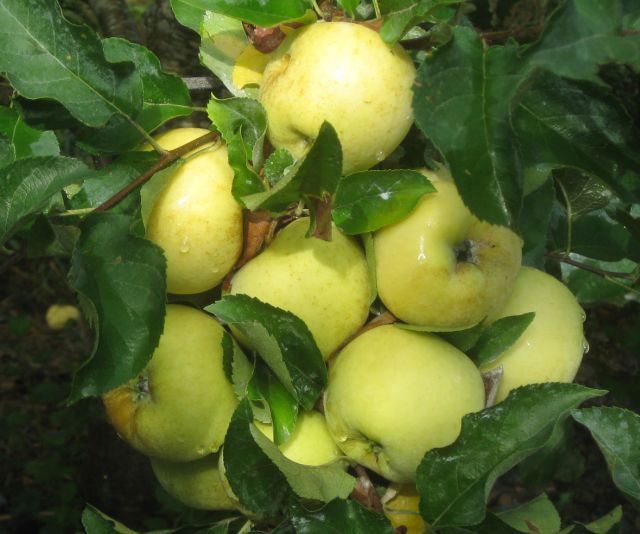
The Pristine apple is the first to ripen, it is yellow skinned and tastes great. Purchased in March 2007. I grow organically and this year there was minimal pest invasion. Although I could attribute this to running my chickens in the orchard where they dug up and ate hibernators around the tree trunk areas; or the increased presence of the brown Thrasher, our state bird, which loves insects; I believe the main reason is my first time use of kaolin clay as a spray applied when the fruit had first formed. Our dehydrator is running non stop (almost), our neighbors are happy, and it’s a pleasure to eat tasty apples without concern for what may have been sprayed.
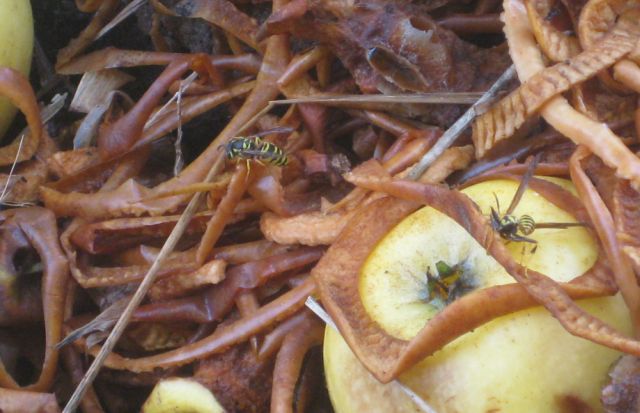
discarded apple peels and apples attract many yellow jackets and other wasps
Equally intriguing is the success of the the pattypan squash. I have never been successful with squash – the plants would grow vigorously and then as the first squash appeared the leaves would wilt and examination revealed vine borer tunnels through the stalk where it emerged from the soil. Not this year (yet). What is different? This is my first year with pattypan squash and maybe it is less attractive to vine borers. Other possibilities are patrols by the brown Thrasher, a new planting area with more disciplined weeding and watering, or my compost tea which looks vile and may be offensive to pests. The main ingredient is comfrey leaves which decompose and produce an unattractive bloom in the 35 gals brew tank to which is added coffee grounds and a supplement of liquid human fertilizer. Or it may be an off year for the borers?
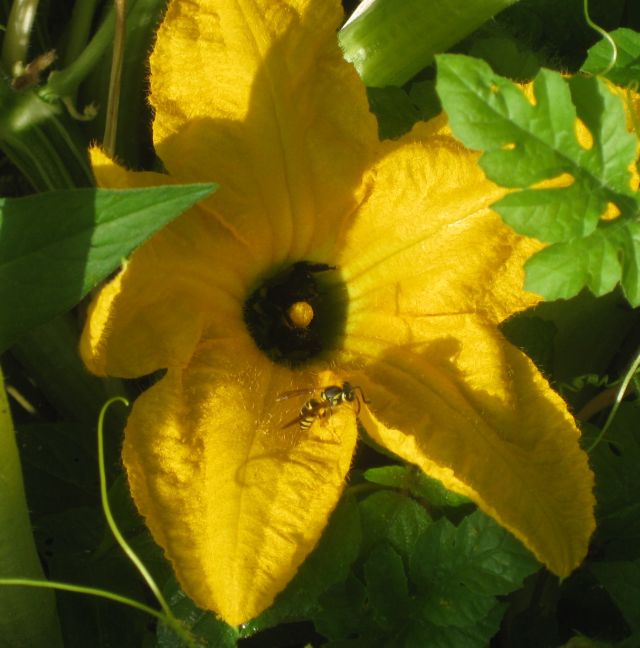
attractive squash flower with a large wasp and at its base a cluster of bumblebees
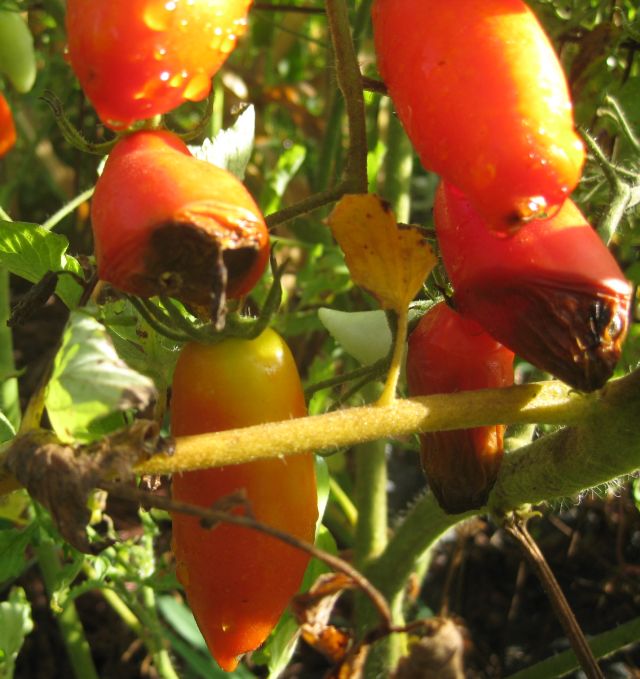
The disappointment is the tomatoes. I previously rarely had blossom rot, this year it is a problem.
the scourge of blossom rot
Why? Prior years I used newspapers and woodchips as mulch, this year black plastic. A theory is the black plastic channels the water to the area at the base of the plant and the rest of the soil dries out, so the roots congregate around the central area and cannot access other nutrients (calcium) which they need. But then I noticed a planting which had no plastic and also had blossom rot and a tomato plant given by a neighbor which is producing large healthy tomatoes yet was planted through black plastic. Were my seedlings prior to planting under nourished or defective?
With growing and life in general it is often difficult to determine cause & effect unlike say electronics where components conform rigidly to their specs and the reason for aberrations can be easily identified.
My conclusion is that I didn’t water adequately and this was exacerbated by the channeling effect of the black plastic. I have now removed the plastic altogether from some plants and rolled it back for others and am irrigating a larger base area.
And why did I not water adequately? We have a drought in north Georgia and all my irrigation is from harvested rainwater. My storage capacity is around 6,000 gals and when levels run low I become frugal. With hindsight it would have been better to plant half the plants with double the irrigation.
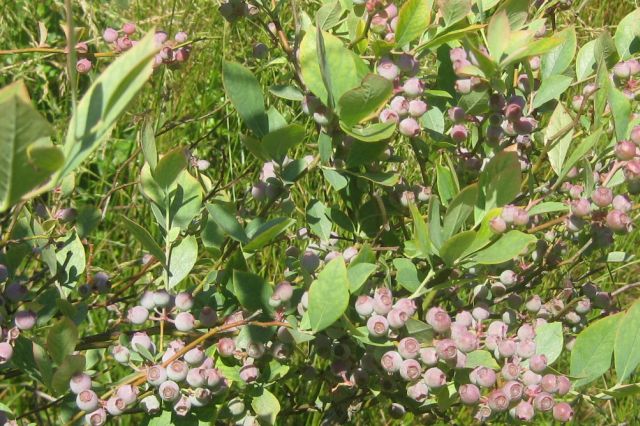
I showed M. the berry laden blueberry plants and ventured they would be ready for picking within a few weeks. But why are the leaves yellow? she asked and drew my attention, as she usually does, to what I had missed. Yellow leaves with green veins can indicate the plant is not receiving enough iron (iron chlorosis) since iron produces cholorphyll which makes the leaves green which enables photosynthesis, sugar production and growth. Blueberries thrive on acid soil (between 4 and 5) and if the soil is not sufficiently acid they cannot uptake iron.
Following my pH experiments last week I decided to sample the pH of my blueberry plants. I selected a sample from each of 3 plants, mixed each sample in a separate container with distilled water, and followed my testing protocol: 1) rinse meter in distilled water; 2) put meter in 4.0 buffer solution – it read 4.1 great; 3) rinse meter in distilled water; 4) put meter in 6.9 buffer solution – it read 6.9 great; 5) rinse meter; 6) put meter in soil sample 1 – it read 6.6; 7) rinse meter; 8) put meter in soil sample 2 – it read 7.4; 9) rinse meter; 10) put meter in sample 3 it read 6.3. Each immersion was for 1 minute and water temp around 65 deg F.
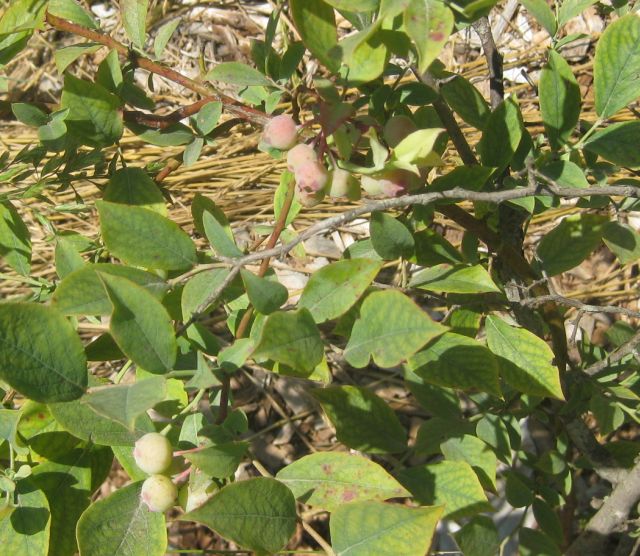
this plant has never really grown over the years, has few berries and has 7.4 pH, no surprise
I was expecting lower pH readings since earlier in the year I had purchased and added sulfur powder to the soil of the blueberry plants. I mentioned to M. that when taking the samples I had noticed sulfur powder in the soil (it is very yellow and easily seen) and she said that was because it had not been absorbed. The sulfur powder I am using does not dissolve in water.
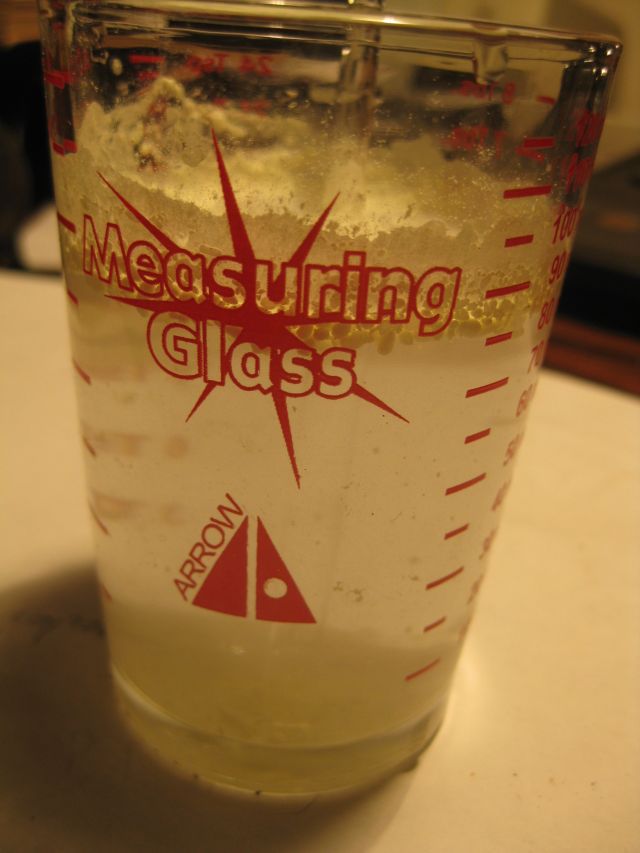
sulfur powder floats on top of the water or in clumps below the surface even after vigorous stirring
I mixed some sulfur powder with distilled water and the pH was 6.6 about what it would have been without the powder, so the sulfur powder was not interacting with the water. M. explained that sulfur loving bacteria, which are equipped with the necessary enzymes, are needed to transform the sulfur powder into soluble form. So the sulfur I added in spring had not yet been transformed and apparently this is a slow process which takes time. It would be quicker if we found some sulfur loving bacteria and added them to the soil, but this is an unlikely route.
So what to do in the meantime? There are synthetic iron chelates (a chelate is a soluble form of the mineral which makes it accessible to the plant) which will work quickly but this is at odds with my organic philosophy. The yellowing blueberry leaves do not presage a good blueberry harvest. Short term remedy – we researched and ordered an organic iron foliar spray which will work directly on the leaves and with some luck (if I don’t over apply or under apply) may get them normal looking and back to their photosynthesis work.
Also, if you look carefully at the leaves you may notice some red blotches which could indicate magnesium deficiency so I will provide an epsom salts drink to the plants as well.
The pH (acidity/alkilinity) is an important must know for growing vegetables, fruits and berries. Blueberries notoriously love acid conditions. Tomatoes like a pH range between 5.5 to 7.5. Since pH can range from 1 (very acid) to 14 (very alkaline) it follows that 7 is neutral. I have tried over the years to independently determine my soil’s pH, with little success. I have sent samples to the extension service for general soil analysis but have always wanted to determine pH myself.
The pH strips I purchased were little help to me since I had difficulty confidently matching the color on the strip after it had been dipped into the liquid I was testing, with the pH graded color chart. An inexpensive pH meter was also little help to me.
I decided to go upmarket and purchased a laboratory grade meter and 7.0 buffer, electrolyte cleaning and storage solutions and I again got unusual results. This may be because I purchased the meter for a discounted price from an alternative supplier and the electrode bulb may have dried before it reached me (I subsequently learned that a dried out bulb doesn’t work) or after it reached me due to my inexperience.
I probably needed a new replacement electrode but this cost >$60 and I was not motivated to go this route. Then it occurred to me that a) I do not need laboratory grade equipment; and b) a whole lot of decent electronic instruments have been flooding the market at much lower prices than the well known brands and should work decently.
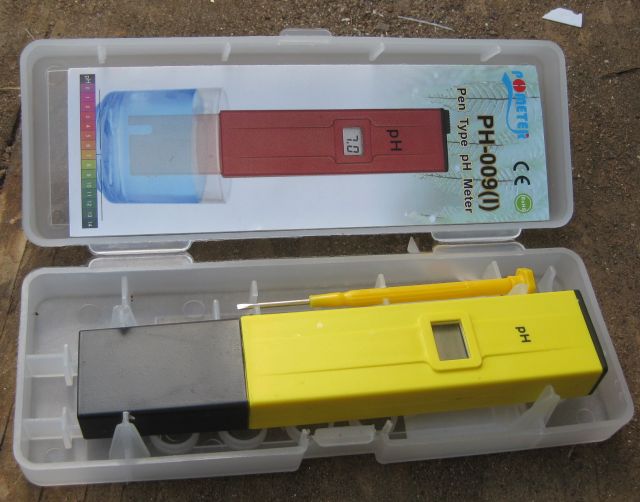
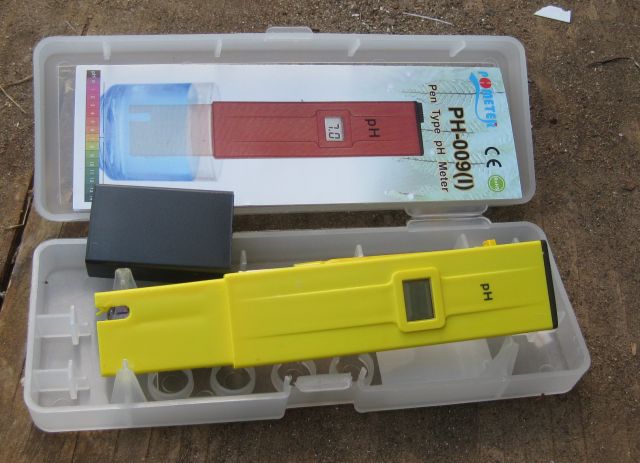
So I studied the options and purchasers’ comments on Amazon and purchased the pH tester below for $11.10 total which included 2 packets of buffer powder.
my new ph meter
I purchased a gallon of distilled water and made up the 2 buffer solutions by dissolving each packet into a separate container holding 250ml of distilled water. The instructions said to use deionized water for preparing the buffer solutions and to use distilled water for rinsing the electrode. I figured nothing could beat distilled water and I had no deionized water available so I made up the solutions with distilled water (more about this later).
my 2 buffer solutions – pH 4.01 and pH 6.86
Now the moment of truth – as instructed I rinsed the electrode with distilled water and then immersed it into the 6.86 pH solution. The meter read 6.7 and with the small screwdriver provided, I adjusted the reading to 6.9. I rinsed the electrode again and put it into the 4.0 pH solution and it read 4.0. I was seriously impressed – this $11 instrument really worked. I rinsed it again and measured the pH of distilled water expecting 7.0 (neutral) and it read 5.5 what the !!!!. Surely distilled water is neutral! Back into the 6.86 solution and it read 6.9, rinsed and back into the 4.0 solution and it read 4.0 and back into the distilled water and again it read 5.5. The meter appeared consistent.
So I pressed ahead. My rainwater measured 4.9 (acid rain?) and my well water 6.0. Time to do the tomatoes – I took 3 soil samples from 3 different tomato beds – 2 samples from beds prepared this year and 1 from a bed I have used for several years. Each sample I mixed with distilled water and then filtered the solution to remove large abrasive particles.
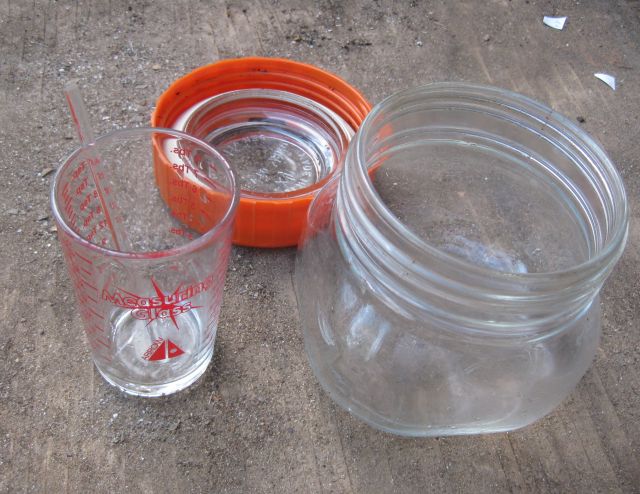
some of my utensils – a glass stirring rod, a measuring beaker and a jar to hold the solution being tested
Samples 1 & 2 both read 6.7 and sample 3 read 7.8. Wow! – a big difference. Then I remembered that I had copiously applied lime and wood ash to the existing bed in previous years so the high alkaline reading made sense. My conclusion was that none of the beds required liming.
The next day I began over again. The 6.86 buffer solution read 6.8, and the 4.0 solution now read 4.3 so I adjusted it to 4.0. and then rinsed and retested the meter on both buffer solutions and they both read true. I mixed coffee grounds with distilled water and the pH was 6.0. My comfrey and coffee compost tea was 5.5 – made using rainwater which had read 4.9 so this made sense. And I took 2 more samples from the bed which read 7.8 the previous day and they read 7.0 and 7.3 so the bed was too alkaline.
It all seemed to make sense except for one big and growing concern – why was the pH of the distilled water 5.5 and was this low pH affecting all the readings of the samples which had been mixed with distilled water. For example if with a soil sample and distilled water solution I get a pH of 7.3 and the distilled water by itself has a pH of 5.5 does this mean the soil sample if mixed with water with a neutral pH (7.0) will have a much higher pH reading?
And why does distilled water have such a low pH? Apparently distilled water when produced has a 7 pH but it reacts with CO2 (carbon dioxide) to produce a mild carbonic acid which lowers the pH of the water. It appears that the pH of distilled water is easily influenced by what it mixes with. My analogy is a shopping cart – if empty and you push with a finger it will move some distance. If heavily loaded then a 1 finger push will barely budge it. If the distilled water is the empty cart and the CO2 moves it one direction then the pH of a soil sample (I would like to think as a one handed push) will overcome the 1 finger push and get it to where it should be. Very simplistic and unproven.
I bought another gallon of distilled water from another large chain and its pH was 5.0. Now I could resolve matters by buying deionized water but it cost >$25 a gallon vs. $1.72 a gallon for distilled water. There is another solution – how about using bottled drinking water. I tested one sample and its pH was 7.4 – much closer to the neutral 7.0. If I mix the soil sample with drinking water with a 7 pH will it give a more accurate result than if mixed with 5.5 pH distilled water?
So a simple test. I filled a container with 200ml of distilled water and another with 200ml of bottled drinking water. And added a small quantity of lime to both and stirred and measured their pH’s. Lime is alkaline so you would think the lime mixed with the 7.4 pH drinking water will have a higher pH than the lime mixed with the 5.5 pH distilled water. And the result?
The drinking water had a pH of 8.4 and the distilled water a pH of 9.7! (Repeat tests with 2 drinking water solutions and 2 distilled water solutions gave pH’s of 8.6 for the former and 9.4 for the latter – a similar trend). So distilled water with a lower starting pH gave a higher pH result when mixed, compared with the drinking water which has a higher starting pH. Using my analogy, the distilled water is a very light cart with well greased wheels and the drinking water is heavily laden and moves sluggishly. I am not scientifically trained so don’t rely on my findings – if this is important to you do your own tests.
For my purposes I will continue using distilled water for my soil pH testing and will not fork out for deionized water.
FYI – a friend who is qualified in this area, says this is a long boring post; not using deionized water for the buffer solutions invalidates my readings; the shopping cart analogy is stupid; and he/she is sceptical of the results but acknowledges that for my purposes distilled water is probably ok for mixing with soil samples.
Additional note: I noticed that distilled water when first poured has a lower pH than when subsequently poured and I hypothesize that the carbonic reaction at the surface of the water, which produces the acid, does not diffuse through the whole solution (unless stirred) but I did not test this by withdrawing a sample from the bottom of the container.
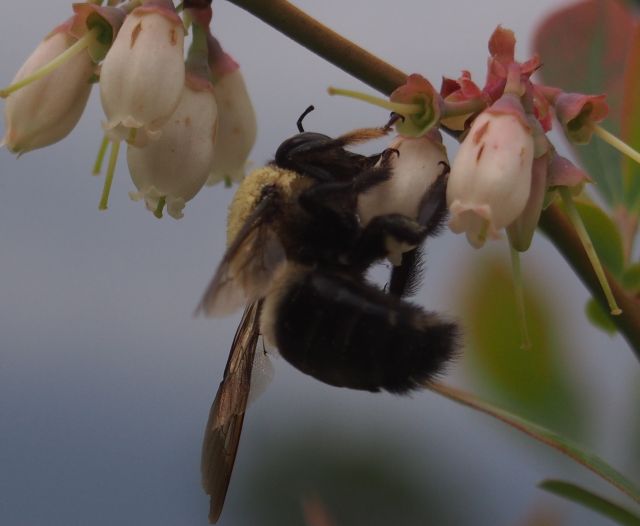
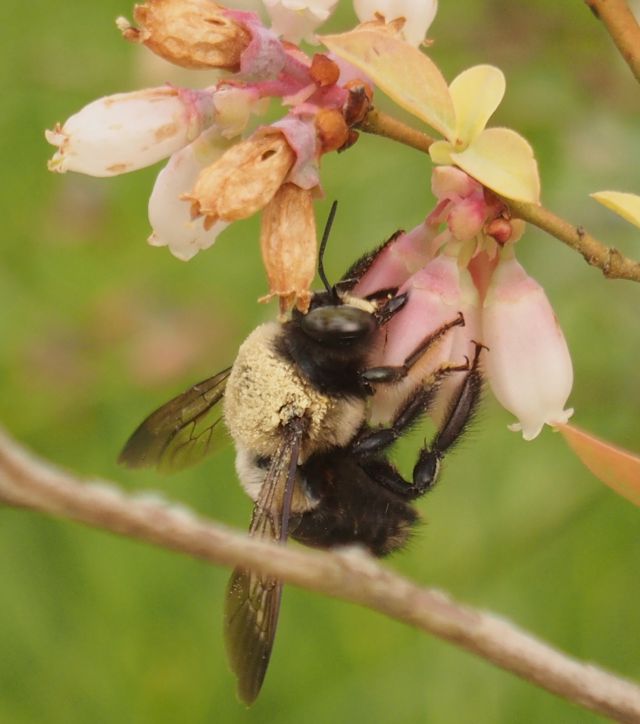
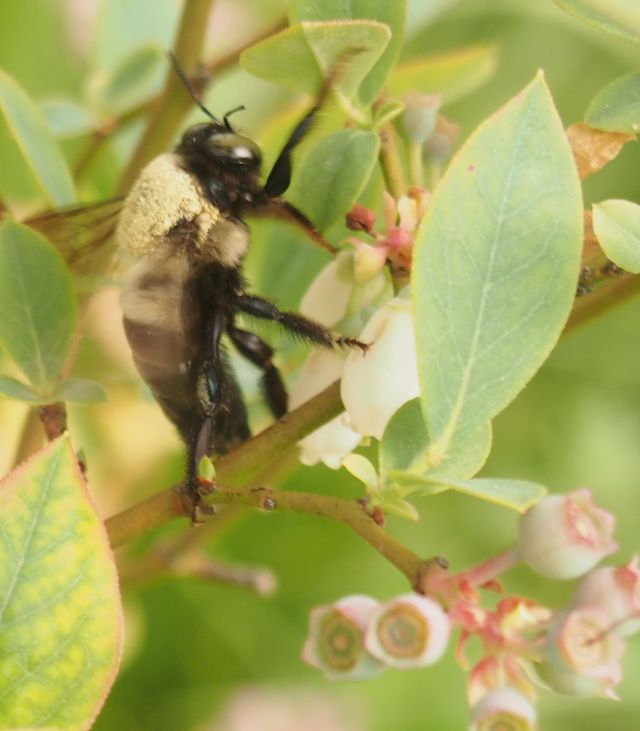
Last week (April 21) I was at the top of the hill watering the blueberries when I saw the busy bumblebees and honey bees.
bumblebees not honey bees pollinate my blueberries
This year I added sulfur powder to lower the ph and also Starbuck coffee grounds and I am hoping for an even better blueberry yield.
bumblebees with their hairy yellow abdomen, I like. Not so the black abdomen carpenter bees which bore into the wood siding of my house
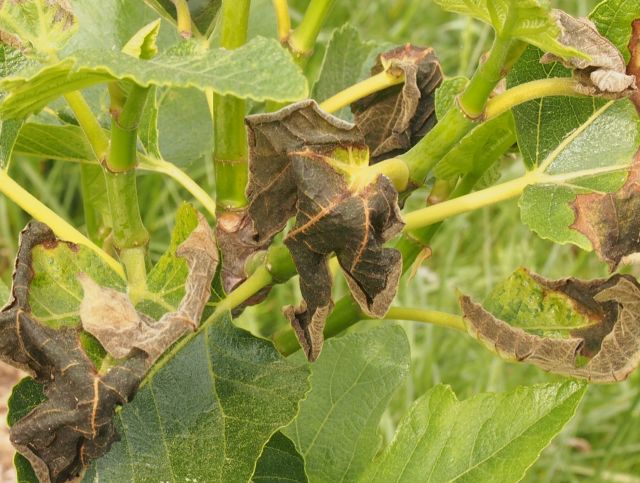
I mentioned to my neighbor a Southern saying that came my way – don’t plant before tax day (April 15) and he replied that where we live which is in the foothills of Appalachia the last cold is when the blackberries flower. And he was right – after tax day we had a cold shiver and my figs were slightly damaged.
some fig leaves turned black but this year, unlike the previous 3 years, the limbs survived
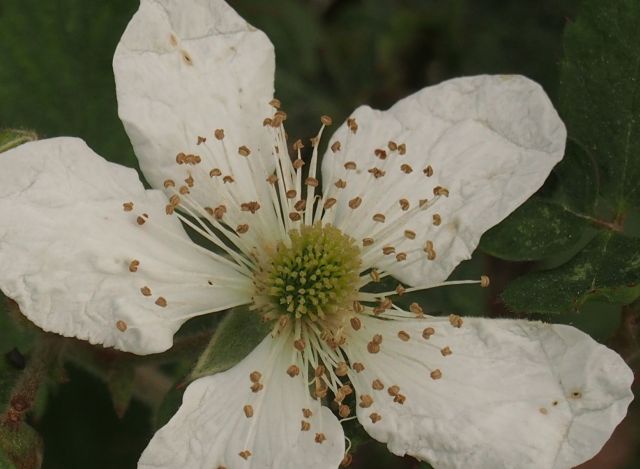
And here is a blackberry in flower.
during the cold months I weeded and mulched my blackberries. I don’t irrigate them and they drink off a contour ditch which snags water sliding down the hill
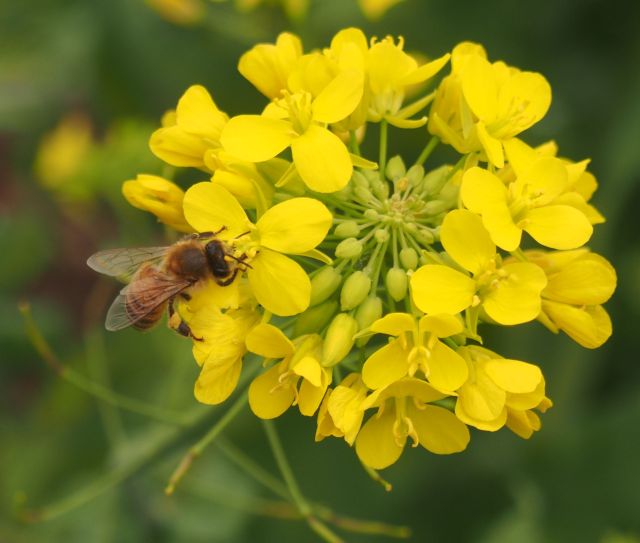
My bees love the turnip flowers which I have growing everywhere.
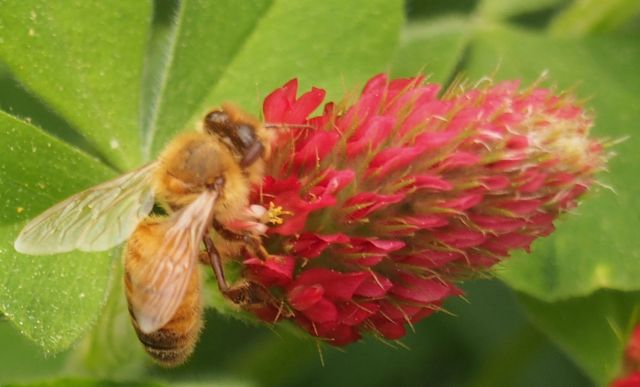
And crimson clover, which I am loathe to cut down.
crimson clover
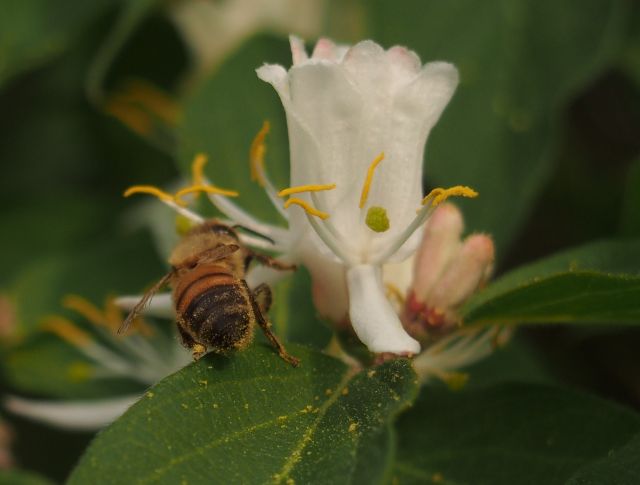
And a fragrant invasive honeysuckle (Lonicera maackii) which appears along the edges of the adjacent woods.
these plants grow naturally in the area
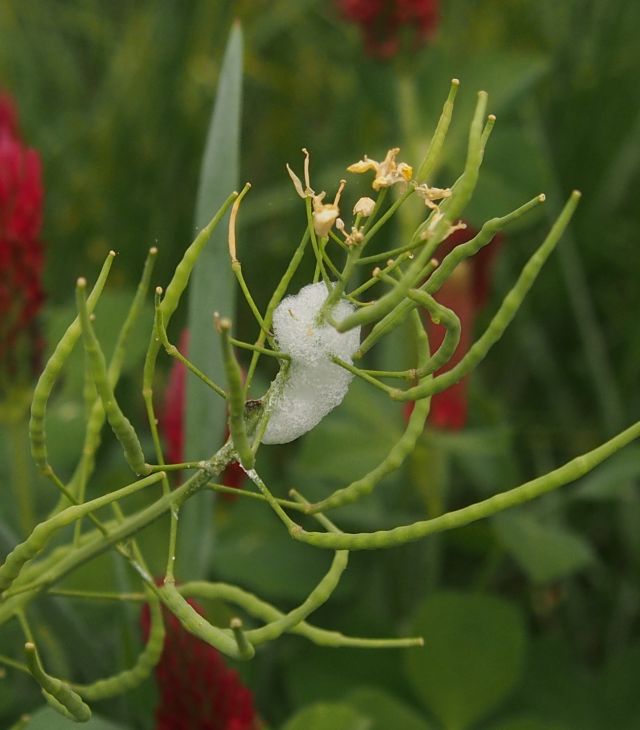
The spittlebug is also hard at work.
a spittlebug deposit on a turnip plant gone to seed
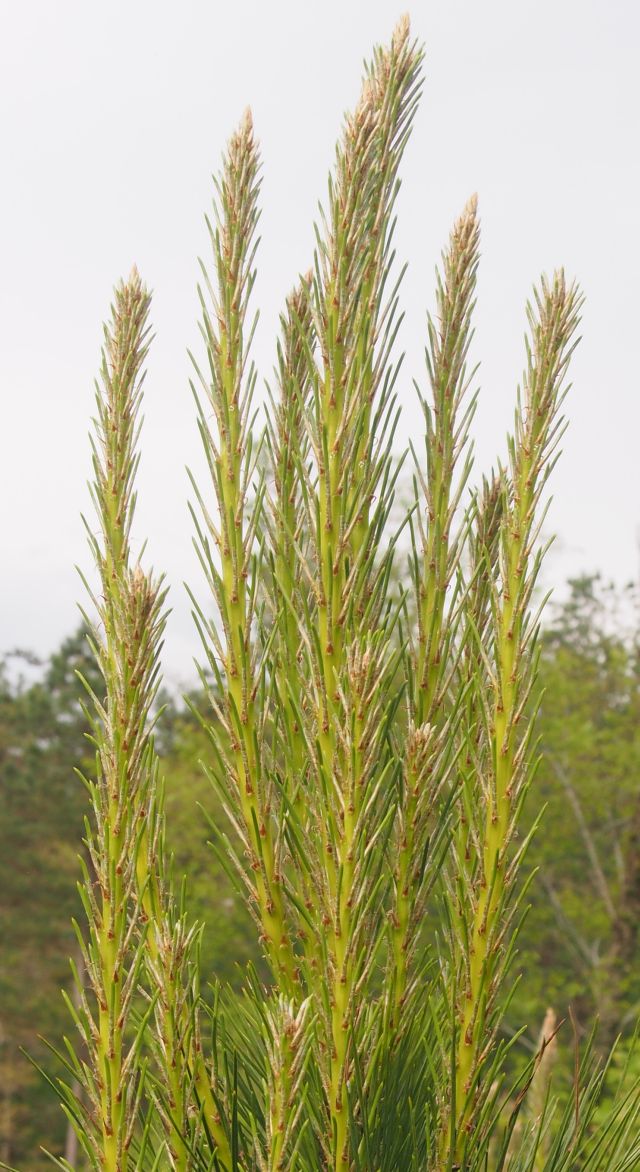
And I have my annual chore of cutting down the pine saplings and wild trees which compete with my orchard and vines on the hill side.
the small pines thrust for the sky but down they must come
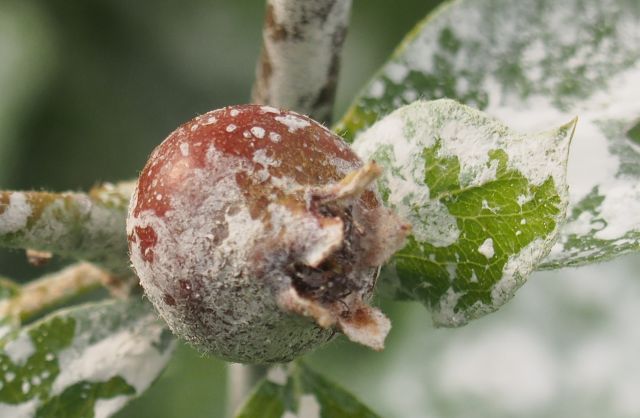
And I must continue spraying the pear and apple fruitlets with kaolin clay (Surround) a new measure I have adopted this year to counter the pests which tunnel into my apples.
several applications are necessary and the limbs, leaves and fruit turn white