trees and Oregon visit

My interest is moving from annual vegetable crops to tree crops and perennials.  Perhaps the bonanza of pears from my Kieffer, Warren and Giant Korean, plus lots of figs from an old established tree have spurred me on.

With the summer heat deterring outdoor activity for much of the day, I have been reading extensively.  Now that “Farmers of Forty Centuries” by F.H King (published 1911)  is behind me, I moved on  to “Tree Crops a Permanent Agriculture” by JR Smith published 1929 (freely downloadable) and enjoyed part one (titled  “The Philosophy”) and read extracts on selected trees, all of which was very informative and relevant since the examples were taken  from the southeast.

My knowledge and interest in trees was further expanded by a visit last week to Oregon including drives through large state forests and a 3 hour visit to the World Forestry Center.  Located in Washington Park in Portland, the center’s mission is to “educate and inform people about the world’s forests and trees, and their importance to all life, in order to promote a balanced and sustainablefuture.”  There is a wealth of information and I enjoyed the exhibits on different forests of the world and logging practices.  Much emphasis was made of sustainable practices and yet it appeared to me that the practices they were promoting were not as sustainable as they could have been.  It seems they monocrop i.e. after harvesting timber the new plantings are all of the same species.  I wonder if this is truly sustainable?  You don’t get diversity of plantings or of associated wildlife or other life forms, and, with no diversity it is much easier for a disease or insect attack to spread across the whole forest.  A more diversified planting will produce a more varied canopy, encourage more diversity, with species perhaps supplementing each other and making better use of resources, and should be more resilient.  Granted, when it comes to harvesting it is much easier to process similarly sized and similar tree species but in the long term is this the best practice?

I am now reading a very well written, insightful magnus opus – Edible Forest Gardens by Jacke and Toensmeier.  Although I am familiar with a number of the concepts and there is some repetition, it is really a good read.  I am also working on converting my fruit orchard to an edible forest garden by introducing lower canopy trees, shrubs, herbs and edible roots, and the book is a good reference.  I just joined the Atlanta Fruits Yahoo group and there is a wealth of information in posts made over the past 10 years of what works and doesn’t work in the Atlanta area, which is proximate to my growing area.

Oh, I forgot to mention – I signed up for and am participating in a Coursera online course with 26,000 other students.  The topic is “Introduction to Sustainability”.  A 600 page textbook (current – published May 2012) is provided and each week for the 8 week duration there is required reading, lecture videos to watch and articles to read, plus quizzes to complete.  And we are encouraged to participate in the forums where students from across the world (young and old) exchange information and views.  And it is interesting, challenging and free!
 

new visitors

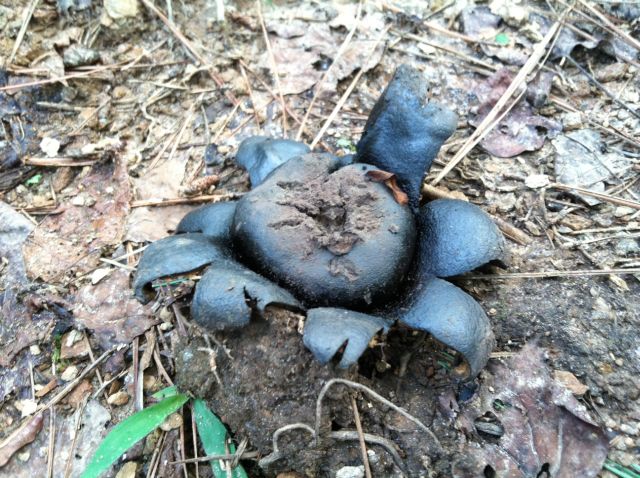
In the woods I came across losts of fungal growth as a result of the recent rains.  In particular groups of strange flower looking mushrooms –

Geastrum fimbriatum (Fringed Earthstar)

Geastrum means earthstar.  The manual shows them white in color with a note that at maturity the spore case is dark brown.  My visitors are black and I assume I missed their earlier appearance (or my identification may be wrong).

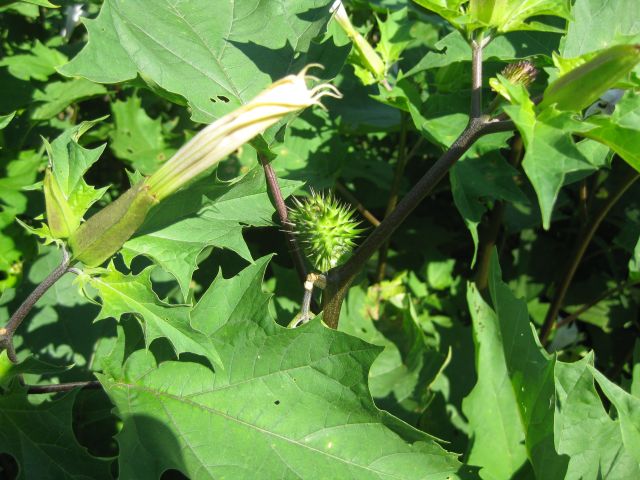
The name datura comes from the Hindu dhatura meaning thorn apple.

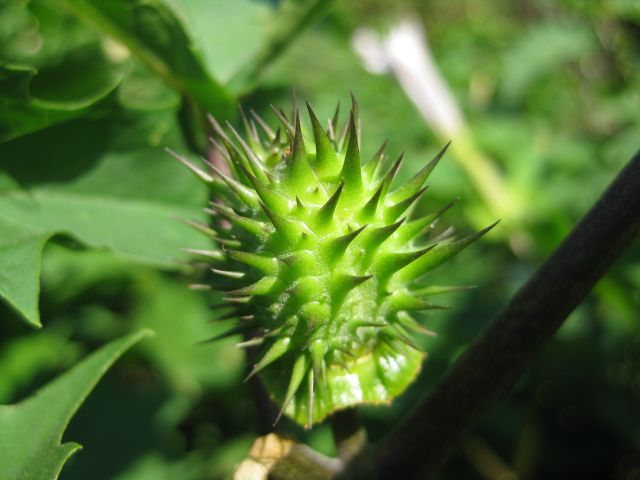
you can spot the young thorn apple

Here is a close up view of the thorn apple

Datura – as yet small spiny fruit

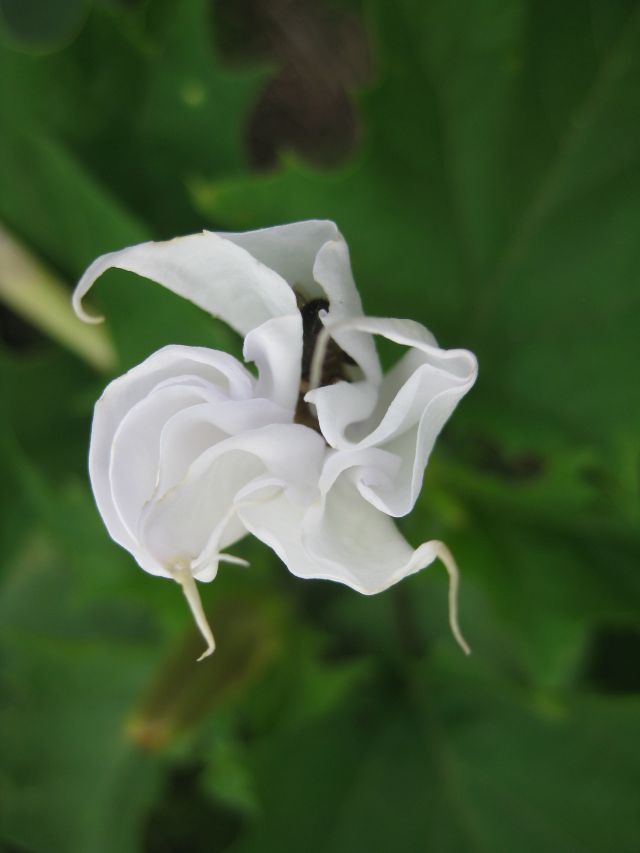
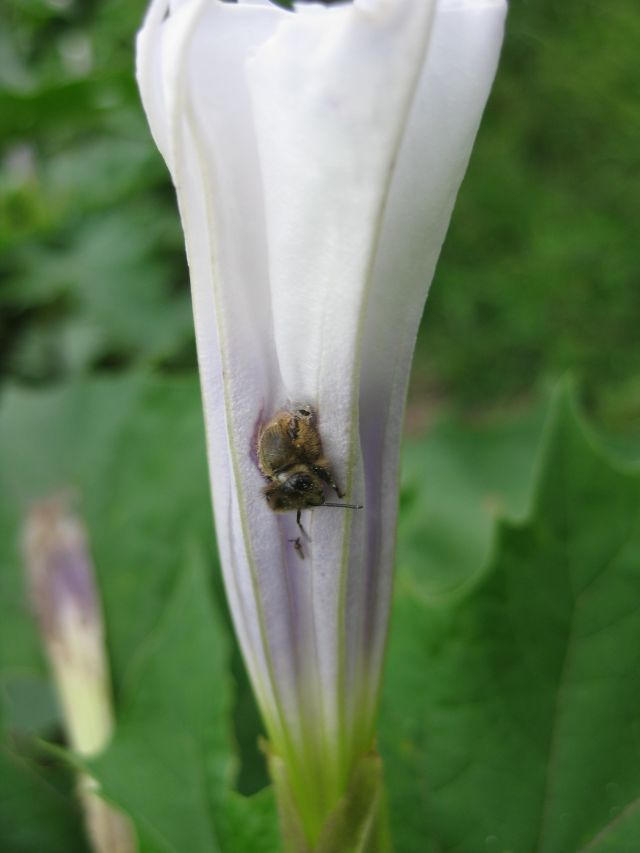
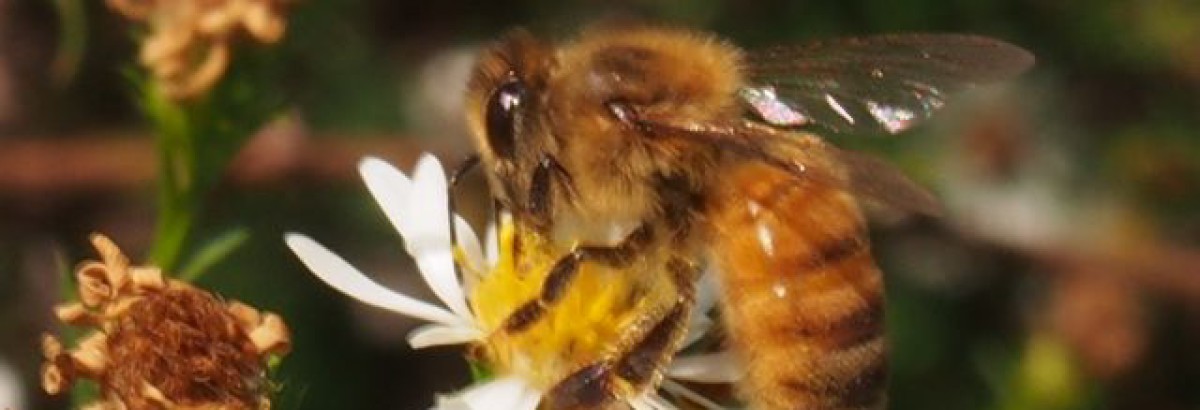
Many of these have taken up residency.  What attracts me to them is their flower for which they are sometimes called Moonflower or Angel’s Trumpet.  My bees love them but the entrance is constricted.

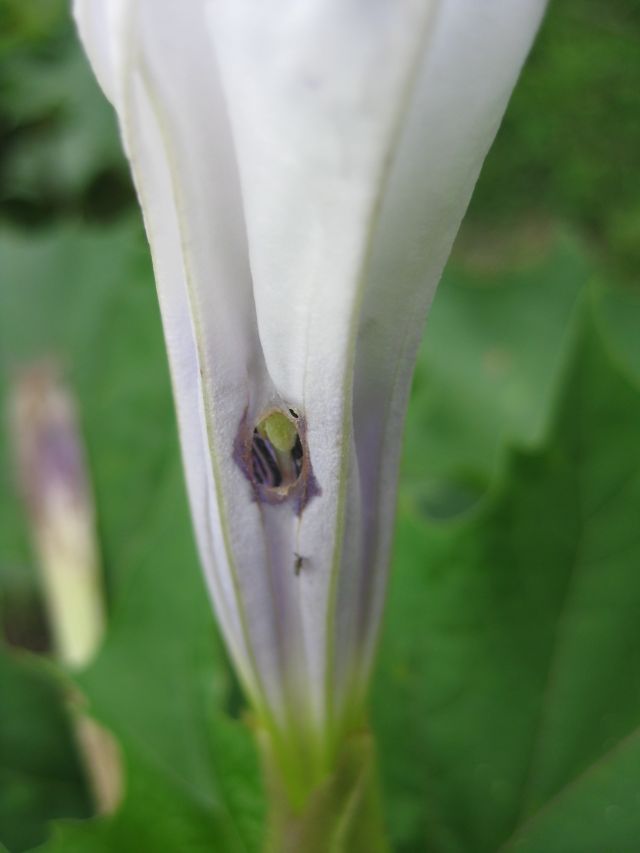
entrance to the Moonflower – the bees struggle to get in, you can see one working her way down

So this may be the reason why my enterprising bees cut a hole in the side for easier access

an access and egress hole

And here is a worker on her way out

a worker bee exiting the Moonflower

Datura is an hallucinogen and, in excess, a poison.  My neighbor complained that the bees were less focused on his vegetables now this unusual plant was in bloom.  Serious and dedicated as my bees are, perhaps they were also getting a little high from their visits.

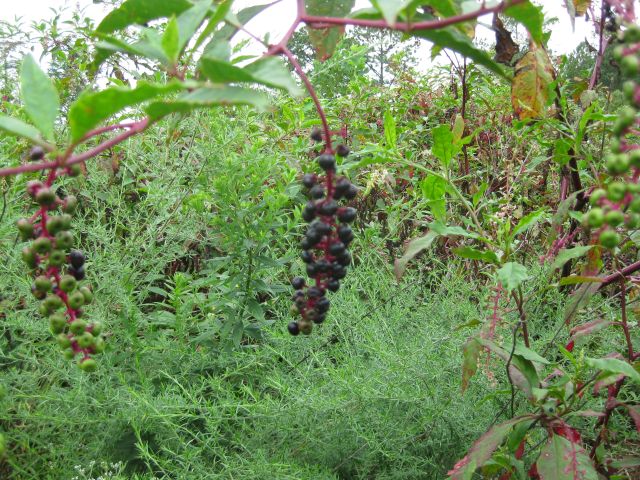
I have an abundance of Pokeweed or Pokeberry with the hanging berries providing additional fruit for the songbirds.

Pokeweed in abundance

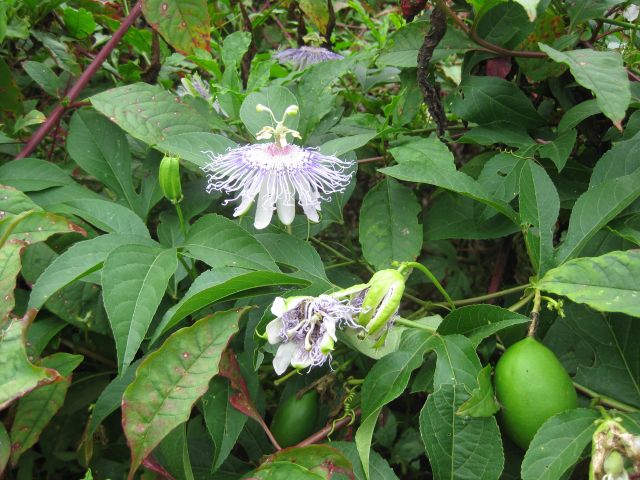
And finally something for me – passion fruit


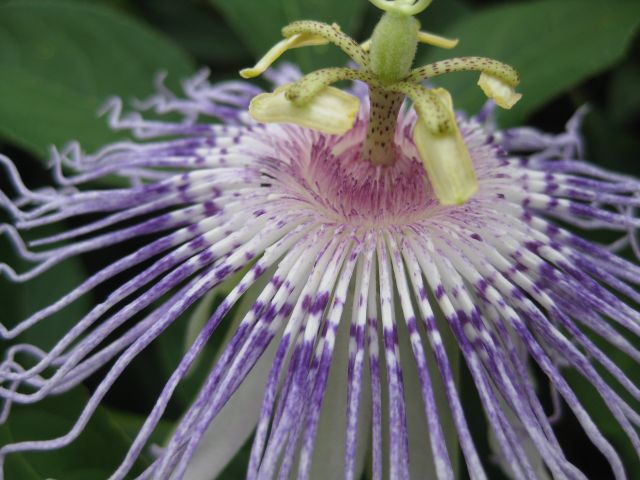
With its lovely tendrils and stigma

a Giant Korean pear surprise

Summer crops have been going well and now I am into the season of the pear.  Though a few setbacks – my assorted cucumber plants delivered the cucumbers – large succulent cucumbers – but the cucumber pickelworm, a small green caterpillar is now resident in almost all of them.  I will probably uproot the plants and start my fall crops in their place and next year keep a vigilant lookout for the larvae which appear at the budding stage.

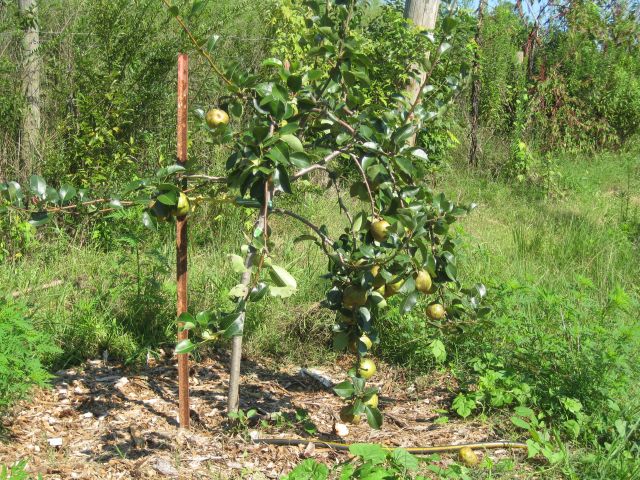
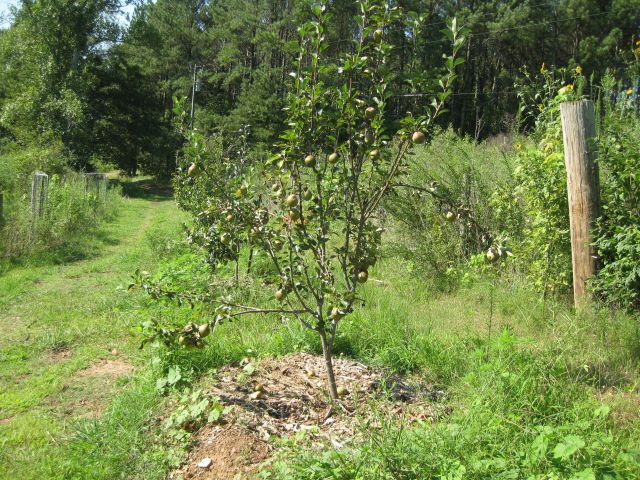
It is nice to be surprised.  I planted four pear trees.  The blossoms on the Eldorado pear (purchased Mar ’09) were frost killed.  I have been waiting patiently for the pears on the other three trees to ripen.  All the pears feel firm so I decided to wait until the trees began dropping their pears and then I would start snacking.  The past week I (and the chickens) have enjoyed the pears of the Warren pear tree (purchased Feb ’07) and the Kieffer pear tree (purchased May ’10).  Although their exteriors were dimpled and uneven there were no worm infestations.  Their flesh is firm, juicy and the Kieffer is slightly sweet, the Warren slightly sour.

pear tree
Kieffer pear, branches borne down by pears, branches and trunk pliable so note the stake and collar to secure the trunk

The branches of both these trees seem very pliable and the weight of the pears has lowered some of the branches to almost ground level.  Understandable that in Asia they can scaffold the branches horizontally.

another pear tree
the branches of the Warren pear are also weighted down by the pears

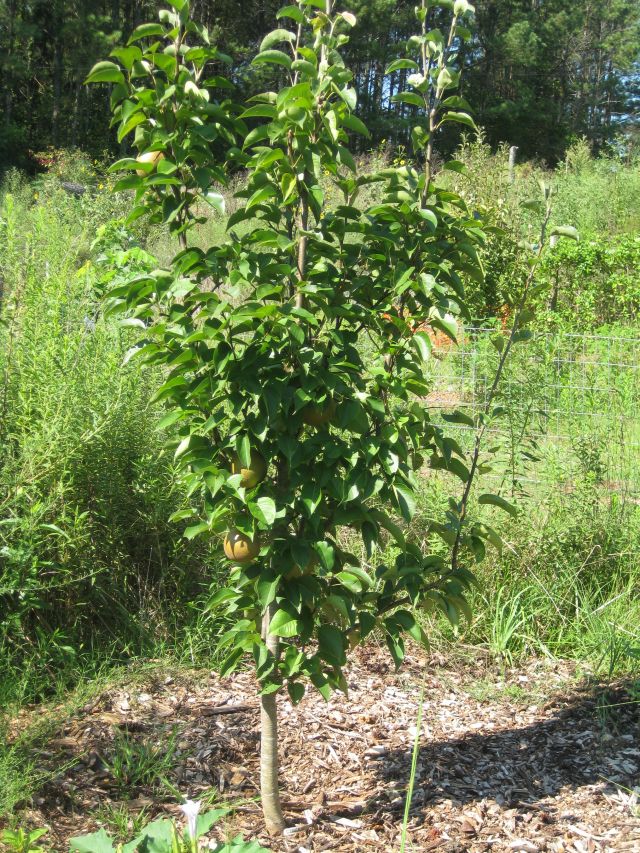
However the fourth pear tree has not dropped any of its pears, also it branches are rigid and grow almost vertically.  A mystery tree.

korean pear
this is the smallest of the pear trees, its branches grow vertically yet they carry large heavy pears

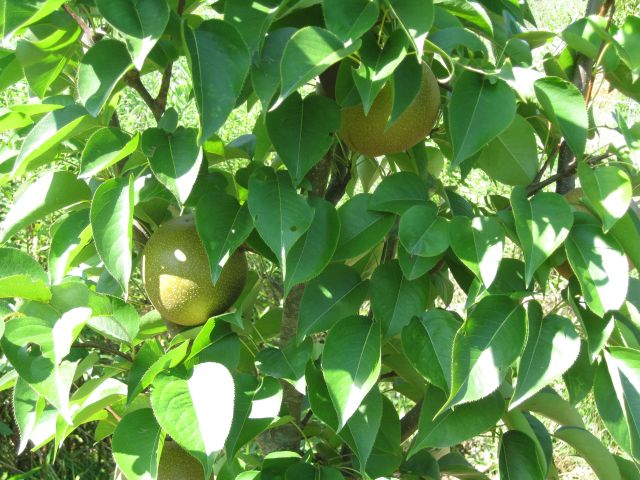
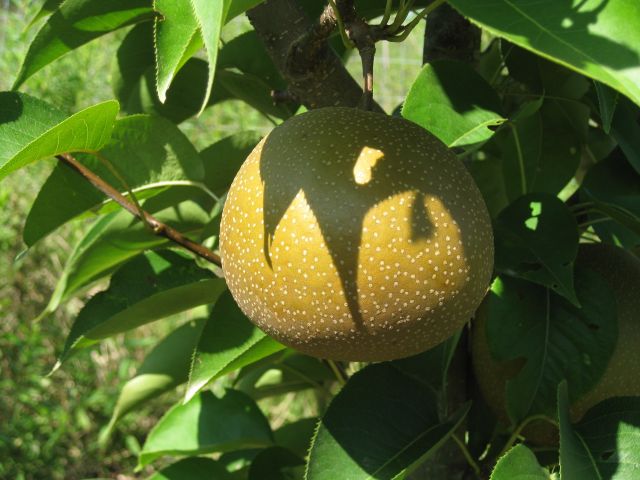
It has just 8 pears but they are very large, round, russet colored and unblemished.  Since it has so few pears I would rather eat them now than risk them falling on the ground for other feasters.

examples of the korean pear
the Giant Korean pear is perfectly round and unblemished, as are the leaves


So I picked my first pear and it was delicious.  No imperfections on the exterior or interior.  The flesh is firm, succulent and slightly sweet.  Unlike the store bought pears which are very sweet but have soft, easily bruised flesh.  A different type of pear eating experience.

a large pear
an example, in situ, of a Giant Korean pear

My records tell me this is a Giant Korean pear which I purchased in March ’09.  It is still small but I shall nurture it and take a few cuttings as well.  I am especially impressed that it appears to be completely disease and insect resistant – well adapted for my environment.

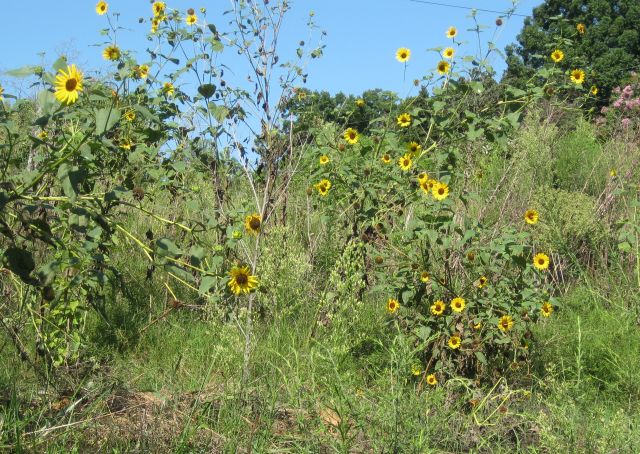
Finally, a pic of some sunflowers.

sunflowers
some happy sunflowers

The late season cosmos are beginning to flower and soon I should have a stupendous display.

rethinking contour ditches

I have excavated at least half a dozen contour ditches and, in the months following construction, they performed as advertised.  After heavy rains they dutifully filled with water and, because they are on contour i.e. horizontal, they held the rainwater and allowed it to infiltrate into the soil benefiting the plantings on each side of the ditch (actually the plantings on the side of the contour ditches which adjoined the lower slope did better, probably because there was more topsoil on that side which allowed the water to move more easily to their roots).

So why a “rethinking” of contour ditches?  The bottom of the ditch has proven an ideal breeding ground for high growing grasses and wildflowers (I avoid the perjorative “weed” – these invaders I am sure serve some purpose).  The reason is because the water sliding down the hill brings with it soil and nutrients and the easy access to ample water at the bottom of the ditch is fuel enough for growth.  So the water which should be infiltrating the ground is now sponsoring these tall growers.  The extensive growth hinders access to the plantings and because the contour ditches are now semi-concealed it is easy for the unwary visitor to be injured.

contour ditches
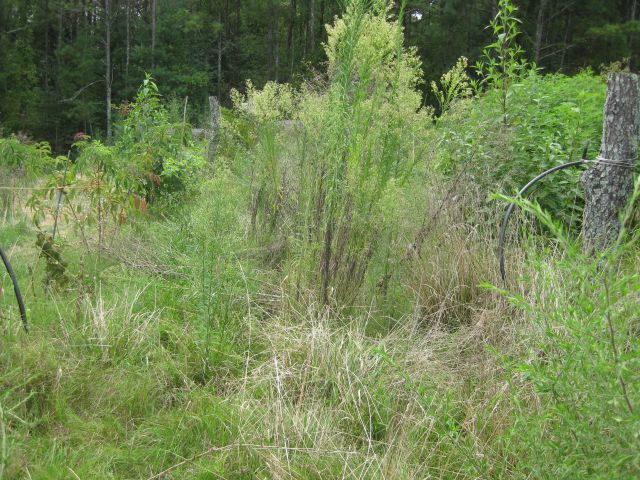
contour ditch between two rows of berry plants – the berry plants are small and the tall growth locates the ditch

I recently completed reading “Farmers of Forty Centuries” by F.H. King.  An excellent book filled with insights.  It unlocks the techniques used by the Chinese, Japanese and Koreans who farmed the same land for 4,000 years without our modern fertilizers and ‘cides and with dense populations too.  If anything meets the definition of “sustainable farming” it must be their practices.  After manures (animal and human) their main source of nutrients was the soil and organic matter lodged in their canals.  So their canals like my contour ditches also filled up and they turned their problem into a solution.  This got me thinking – why not remove the growth in the contour ditches and stack it for use at a later date.

contour ditches
an example of the growth and soil which had filled one of the contour ditches


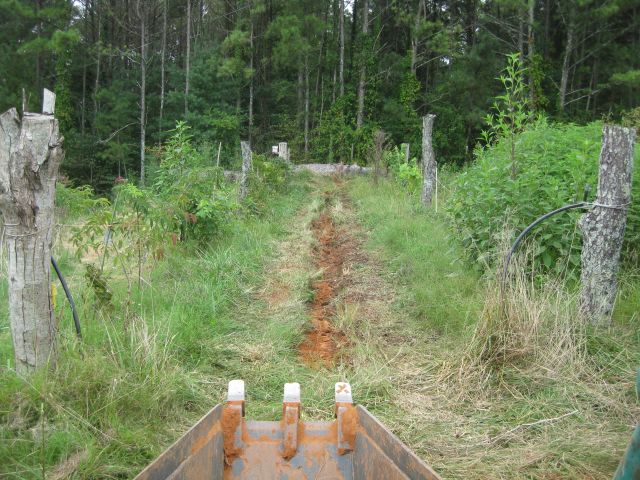
contour ditches cleared
now you can see where one of the contour ditches was lurking, cleared with the help of my bobcat and stump remover, teeth of which visible at bottom of ‘photo

Another of their techniques was to either bury their compost or cover it with mud.  The logic, I assume is this accelerates breakdown by keeping the contents moist, and also reduces loss of nutrients to the air.  So I have decided to fill the enlarged contour ditches first with material leveled by my scythe such as long grasses and other growth, and then with tree branches and trunks.  I am hopeful that these materials will absorb and hold the rainwater and, as they degrade, will provide nutrients to the soil.  Two other advantages – the wood will be stacked to just above ground level so less risk of injury and the wood will prevent the growth of grasses and unwanted plants.

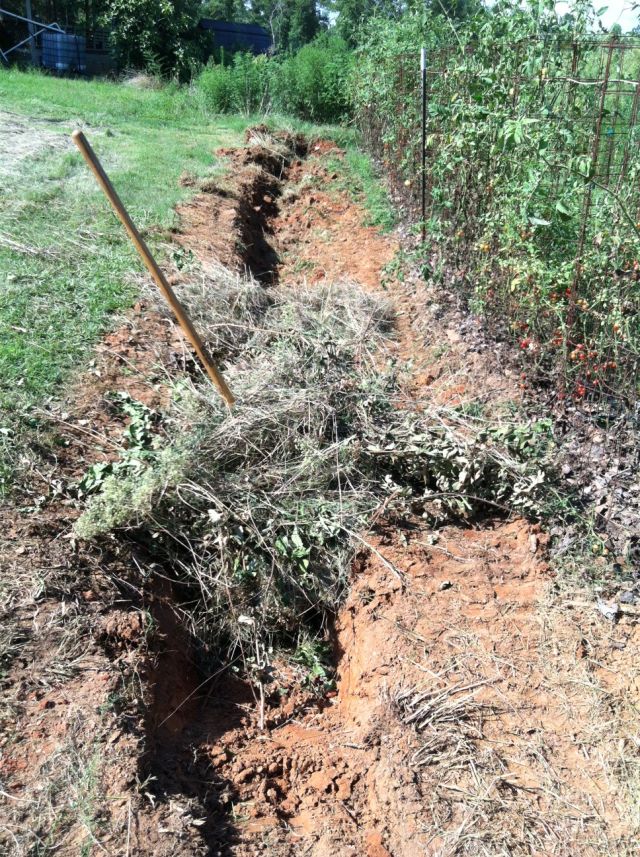
contour ditches
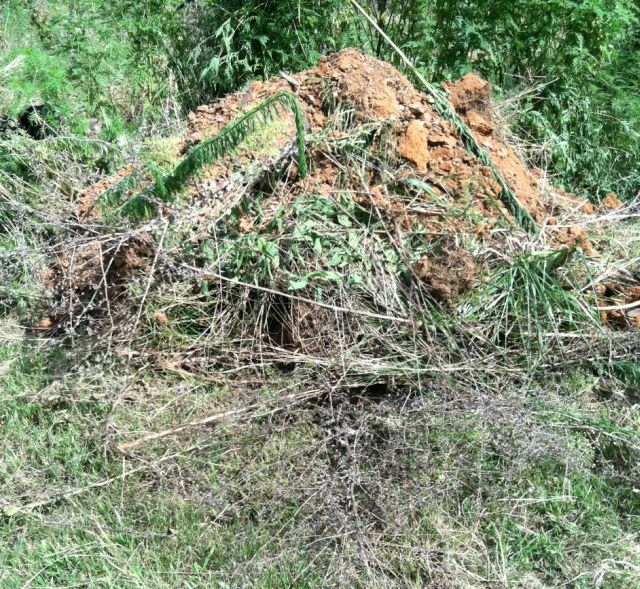
one of the contour ditches is alongside tomatoes. I am filling it with grasses leveled by my scythe

The berry contour ditch does not extend all the way south to the pine trees since this area does not receive much sunlight.  But when it rains a lot of rainwater goes down the hill south of and beyond the contour ditches.  So while I had my bobcat out I decided to angle a feeder ditch which could catch this water as it traveled over the ground and direct it to the contour ditch.

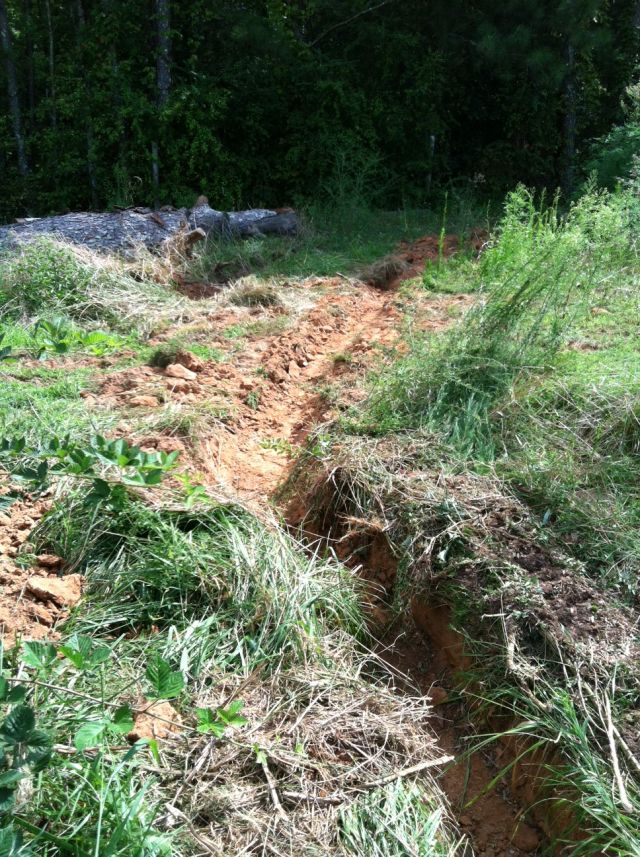
contour ditches
feeder ditch extending from the woods to one of the contour ditches designed to redirect rainwater which swamped the foot of the hill

honey harvesting – mistakes

Yesterday, Sunday, I had my best honey harvest in the two years I have been collecting honey from my bees.  I filled just over 32 pint jars, which equals 4 gallons.  Earlier this year (4/29 and 6/3) I collected 1.2 and 1.4 gallons of honey, so total yield is 6.6 gallons.  If I assume an average weight of 12 lbs per gallon, this is about 80 lbs of honey, which is good going for me.  But my activities were tinged with regrets.  I made some mistakes and regret them.

I have two hives.  The one I started this year with members from the main hive is doing ok but not great and, after a quick inspection, I decided it did not have honey to contribute.  So I focused on my main hive which I have had for 2 plus years.  It has 3 hive bodies or boxes on top of each other.  The bottom is a deep (9.625″ high) and the two above it are medium supers (6.625″ high).  I had placed the super I harvested in June and April in the middle and so the super on top had not been harvested this year.  I inspected the first frame in the top super (there are 10 frames in a box) and saw it was filled with honey.  So I concluded all the other frames in the top super were also filled with honey (my first mistake – I should have examined the individual frames).

wax after the honey was removed
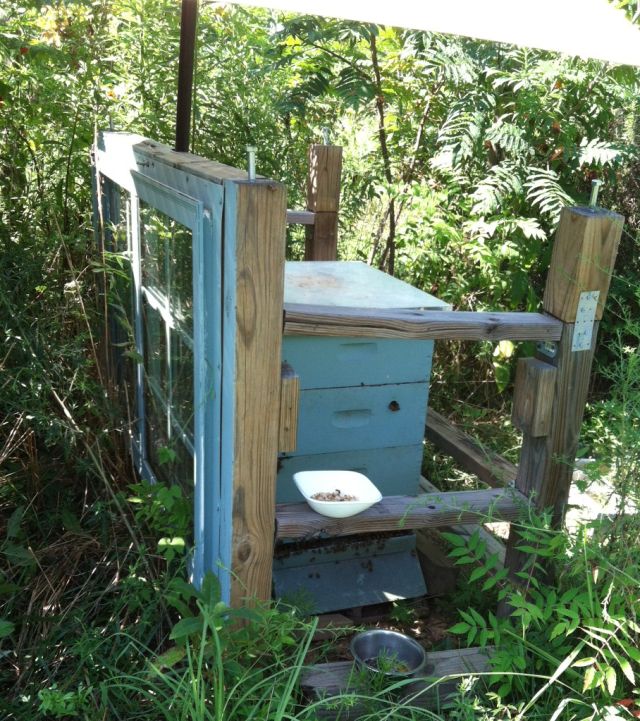
bee hive (1 deep, 2 supers and sun umbrella and structure for winter rigging) after honey harvest – note containers of wax scrappings left for recycling

I don’t use chemicals on my bees with one exception – I use butyric acid, which is vile smelling, to make the bees leave the hive body. I am now reconsidering this practice.  Anyhow, I applied the butyric acid to the fume board, which is a lid you place above the hive body you wish to harvest, and the bees all departed the hive body  or so I thought.  Then I transported the hive body to the kitchen where the harvesting and extraction equipment awaited.

Before moving the hives into the kitchen I inspected them outside and found a lot of bees still on the middle frames.  I looked to see if they included the queen, did not see her and with a bee brush I gently brushed them off the frames.  To my surprise they held on tenaciously and it took several attempts to get them all off.  Then I moved the frames into the kitchen.

I thought all 10 frames would contain honey and the first 3 did.  But, to my upset, the next 4 contained larva.  In other words, the queen and her retinue had moved up from the deep and she had laid eggs in the top super.  I harvested honey from the 3 frames at the other end and then returned the 10 frames (6 empty and 4 with brood) to the hive.  It had not occurred to me that the queen could have moved to the top super.  The bee club I belong to encourages the use of a queen  excluder (a metal grill which prevents the queen moving up) but I chose not to use it.

When I returned the top super I carefully went through the frames in the deep and middle super and selected 6 frames laden with honey which I harvested, without mishaps.

I was upset for several reasons.  The bees which clung to the frames were nurse bees not foragers.  Nurse bees are young bees which have not yet been outside the hive.  Therefore they have not performed their orientation flights, which means that the bees I had buzzing outside the kitchen did not know where they were or how to return to the hive.  I could tell they were nurse bees because when they landed close I could see from their size, fuzziness and gentle color they were young bees.  I tried to make amends by placing pieces of wax cuttings containing honey on plates outside the kitchen and when the offerings were covered with bees I covered the plates and moved the assembly to the hive entrance and hopefully some found their way back.  But at the end of the day there were still a lot of bees buzzing around, some of which were the forever lost nurse bees.  I think when I placed the wax scraps outside, word was quickly transmitted to the hives and a lot of the bees which were flying around were seasoned foragers bent on opportunistic honey treasure.

My second concern and a bigger concern was that somewhere amongst my missteps I may have lost or done in the queen.  I hope not.  My third concern is the larva (my future bees) could have been damaged from the exposure to the butyric acid.  I now read that in Europe there are concerns about the use of butyric acid and next year I shall probably not use it.  I could develop more concerns such as whether, with nurse bees absent, the functions of the hive will continue normally, but I will stop.

So a very good honey harvest, with a number of honey frames left unharvested for the bees use, but some regrets.

some summer observations

Each year I learn a little and try out different techniques.  Although 50 miles north of Atlanta and slightly higher, it gets really hot.  So one of the changes was to establish a new growing area which receives full sun through mid-day and is shaded from the afternoon sun by large maple trees (I must remember to check the trees’ roots are not invading my growing area).  And I have noticed a difference.

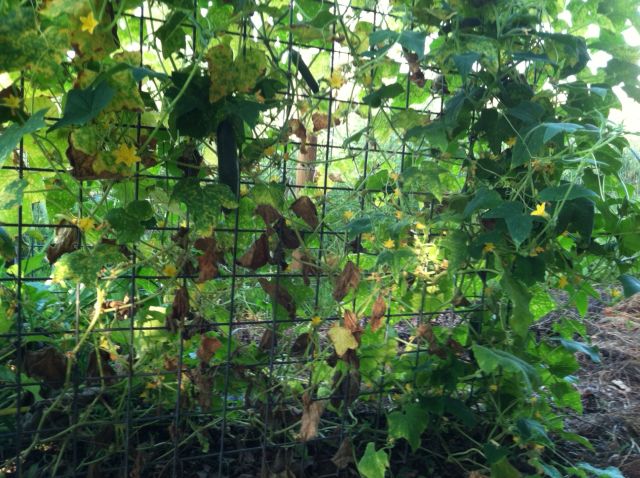
I battled last year with cucumbers and this year they are doing much better protected from the scorching afternoon heat.  Lots of flowers and already harvested a lot of cucumbers but some demises and its a race to see how much more will be produced before they fade away.

cucumber plants
cucumber plants on hog panel fencing doing well but beginning to fade

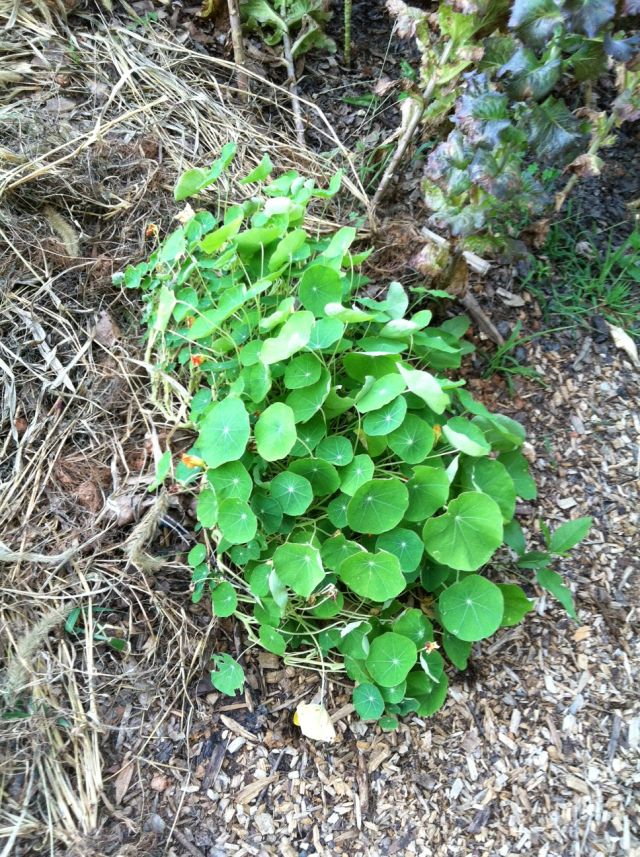
Last year my nasturtiums barely survived – this year, protected from the afternoon sun they are doing better but are a pale shadow of the lusty specimens I saw in the San Francisco area.

nasturtiums
nasturtium persevering in Georgia

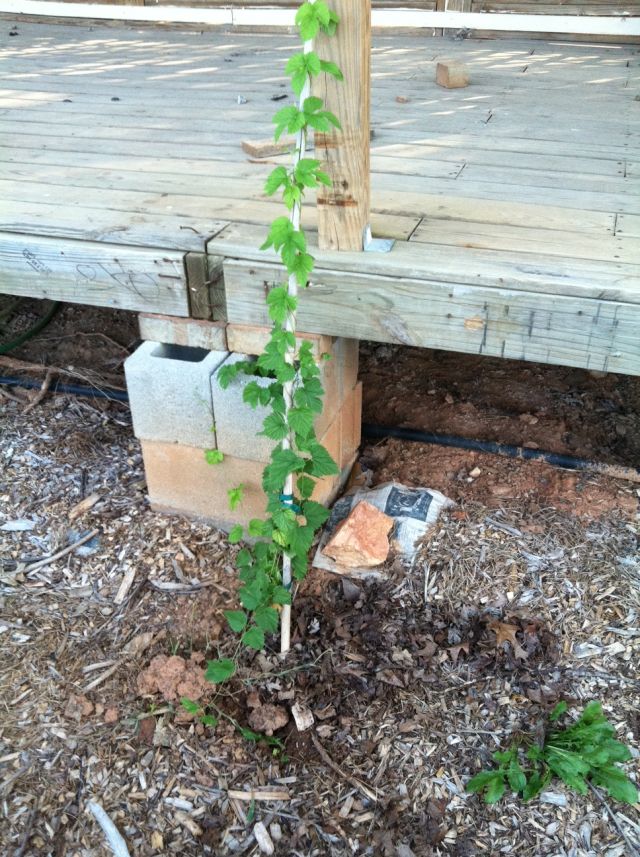
I brew my own beer and, in a spirit of enterprise and optimism, I decided to grow some hop plants.  The flowers of the hop plant are used for flavoring and stability in beer brewing.  My plants are growing slowly and hesitatingly.  Maybe they will speed up and I will have something for my brew next year?

hop plants
one of the hop plants – a long way to go but seems in good health

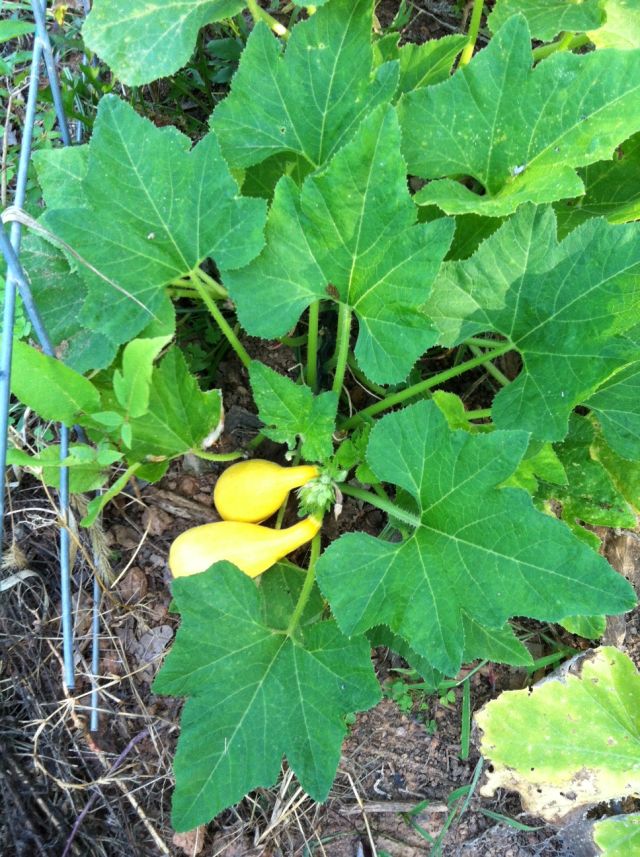
Although the vine borer is hard at work I am still getting squash plants.  A much better outcome than last year.

squash despite the borer
squash still on the way

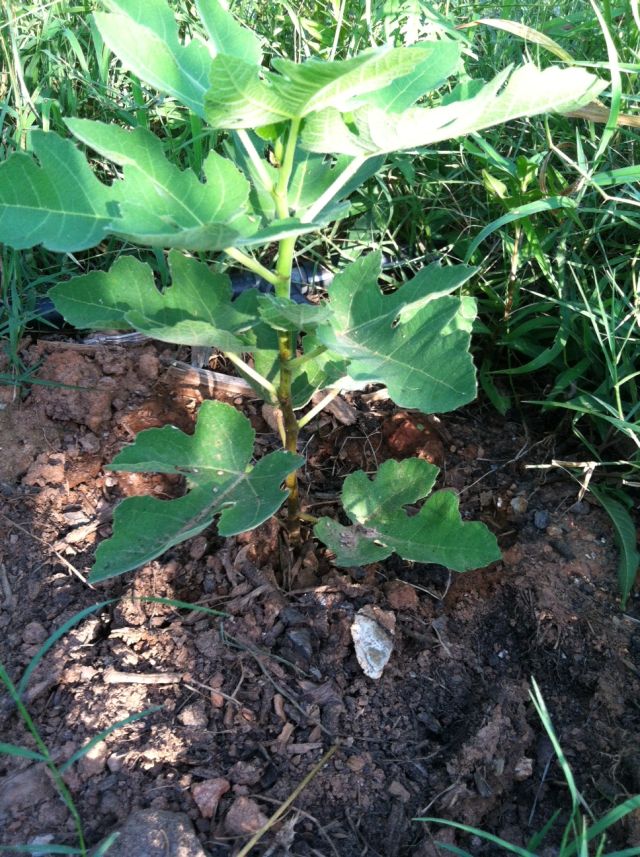
I did not do very well with my cuttings.  Although the apple cuttings took root they did not survive the heat.  I waited too long and this year I will take my cuttings in the fall.  However, the fig cuttings were very easy to propagate and below is one of my new fig saplings.

fig plant
fig plant from cutting

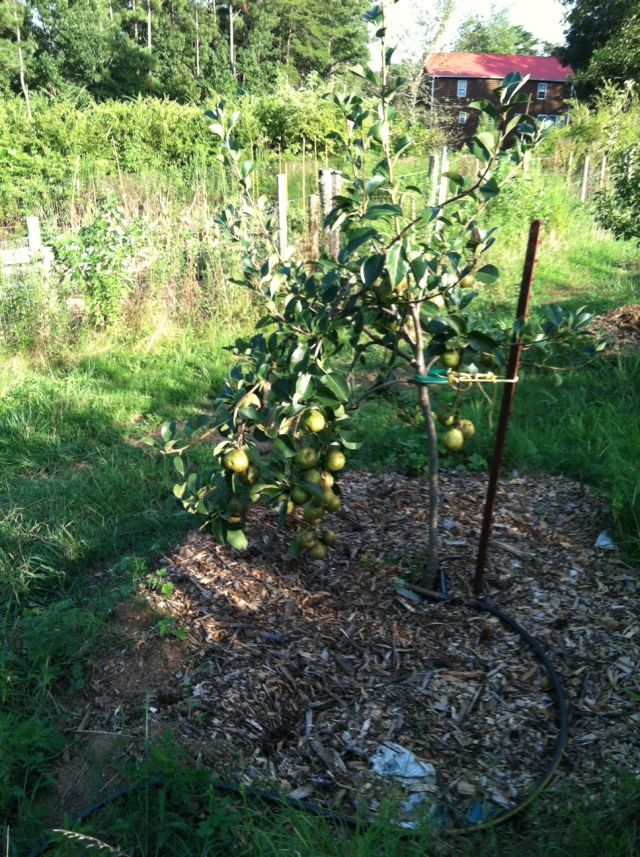
I am looking forward to some pears.  Three of my pear trees are bearing for the first time and are bearing well.  Unlike the apples they seem to be free of visitors.

young pear trees
young pear tree bearing its first pears

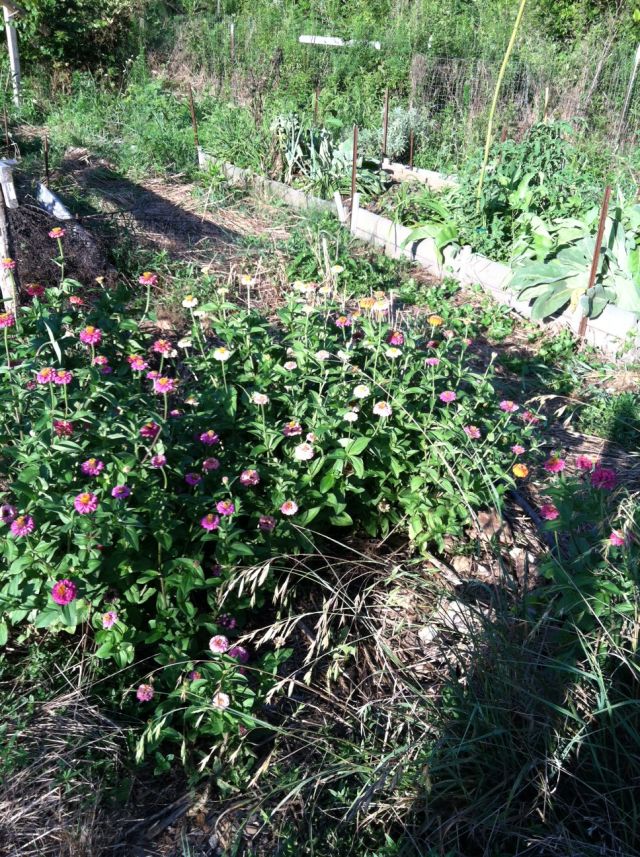
Finally, a little color always helps.  Two years ago I seeded some zinnia flowers (must have read they are beneficial in some way) and now they self seed and spread and seem well acclimatized to survive without any irrigation.

zinnia flowers
self seeded zinnia happy to be left to their own devices

timing the tomatoes

My tomatoes plants bear well but usually by August they look bedraggled.  The yellowing of the leaves which begins at the lower limbs progresses upwards and I am left with skeletal remains and a few lonely tomatoes.  A few years ago I tried to extend the harvest by breaking my rule (all my vegetables are from my seed sowing) and buying several large healthy looking tomato plants.  They did poorly.  Perhaps they were nurtured on energetic synthetic fertilizers and could not acclimatize to my all natural compost environment?

Got me thinking.  What if I kept some tomatoes plants in reserve and planted them out say 6 weeks later than the others.  They were all seeded at the same time but the reserve force was footed in 2″ soil blocks and kept in the shade so they barely grew  as a result of lack of sun and nutrition.  My question was would they age and deteriorate at the same rate as their brethren in the field or would they be 6 weeks younger?

Today I looked at the later planted tomatoes and, unlike their siblings which have been bearing heavily and showing severe signs of wear and tear, they look young and strong and are bearing flowers – so it appears they are on their way.

tomatoes
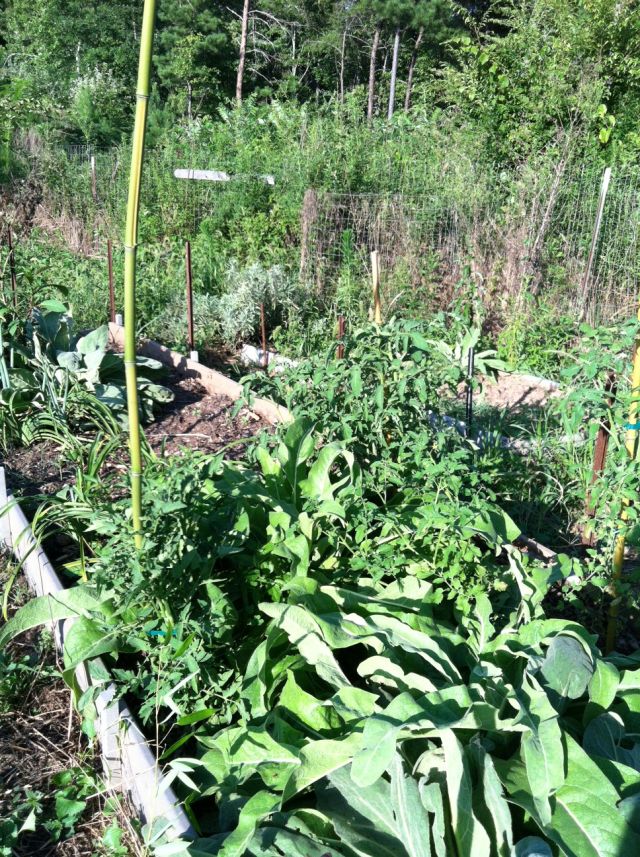
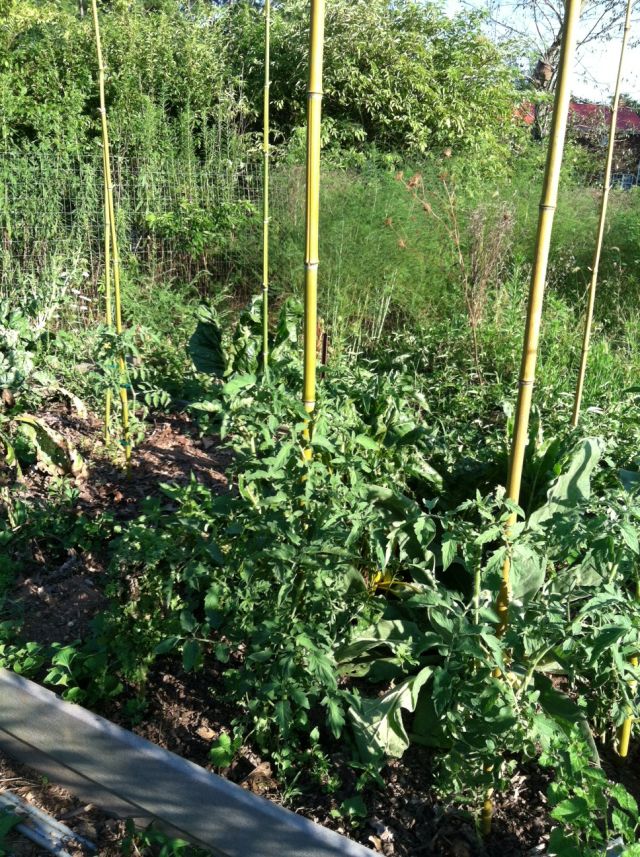
tomatoes which were seeded early but planted out late doing well wiht mullein neighbors

But conclusions are difficult to draw – unlike a laboratory there are unconstrained variables – the later planted tomatoes are in raised beds which may have larger deposits of compost and less soil and less soil may mean less wilt, and for the first time I have planted out mullein and maybe the mullein, which accompanies the more recent batch, is helping as well.  Finally, they have not yet borne tomatoes so I must reserve conclusions until August/September.

tomatoes
other later planted tomatoes

For most of my tomatoes I use wire cages cut from 5′ by 150′ lengths of remesh.  But the later tomatoes were a bit of an afterthought and I had already deployed all the wire cages.  Since I had a stand of gradually invasive bamboo I simply cut lengths of bamboo stakes and secured the plants to the stakes.

older tomatoes
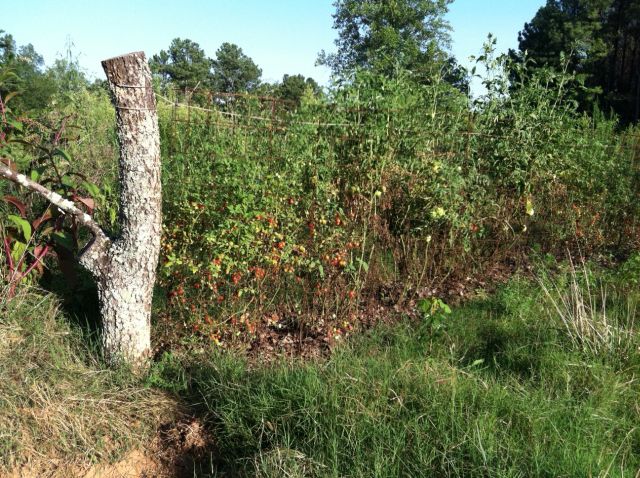
some of the veteran tomato plants in wire cages secured with cable between cherry trunk uprights

feeding the contour ditches

I have several contour ditches cut on the side of the hill.  Each ditch is horizontal, catches rainwater sliding down the hill and irrigates plantings horizontally aligned with it – such as tomatoes, fruit orchard, blueberries and blackberries.  Since almost all of my irrigation is with rainwater I try to make every drop count.  I lose water which streams beyond the reach of the ditches, especially down an access road I cut up the hill.

Previously I dug finger drainage ditches which intercepted the streaming water and directed it to the ditches.  But with foot and vehicle traffic, the sides of the ditches shallowed and also filled with vegetation and thus lost their efficiency.

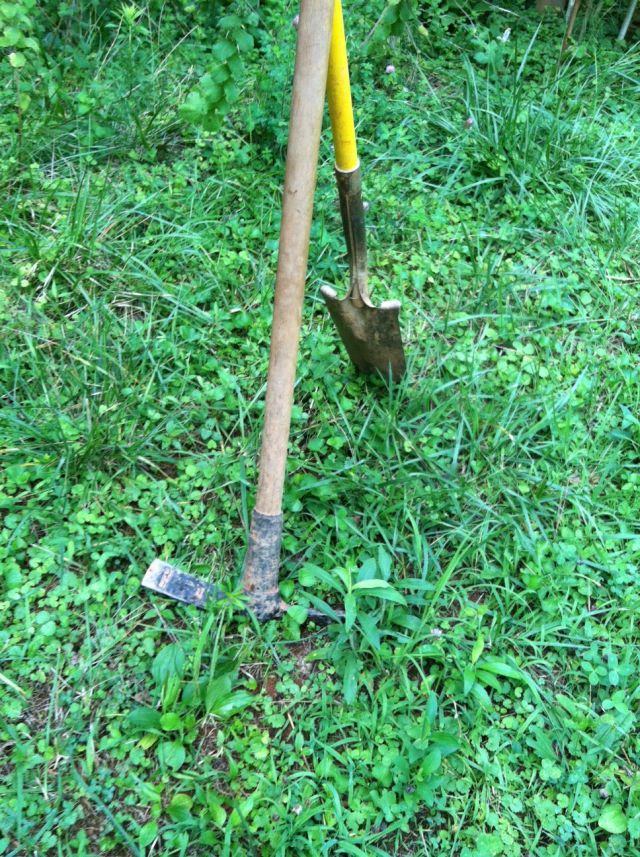
So I engaged again with my mattock and trenching shovel.  In summer (and generally) you want to minimize effort in Georgia humidity and the trenching shovel with its long 5″ wide blade excavates deeply to the desired width, so it is more efficient than a regular shovel.

equipment for contour ditches
mattock and trenching shovel for maintaining contour ditches

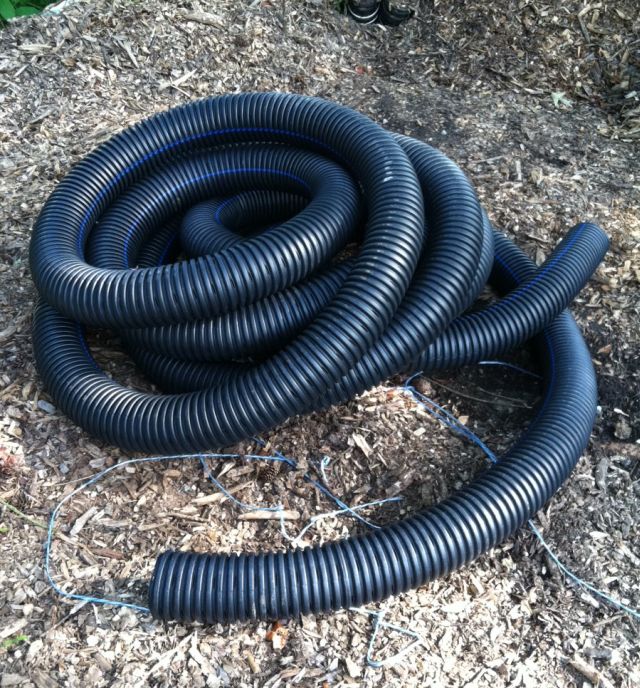
Next a visit to one of the big DIY stores to buy a 100 ft of slitted 4″ corrugated pipe.  I was surprised at the $60 price, I am sure it was around $45 a year ago.

corrugated pipe for contour ditches
slitted 4inch corrugated pipe to feed rainwater to contour ditches

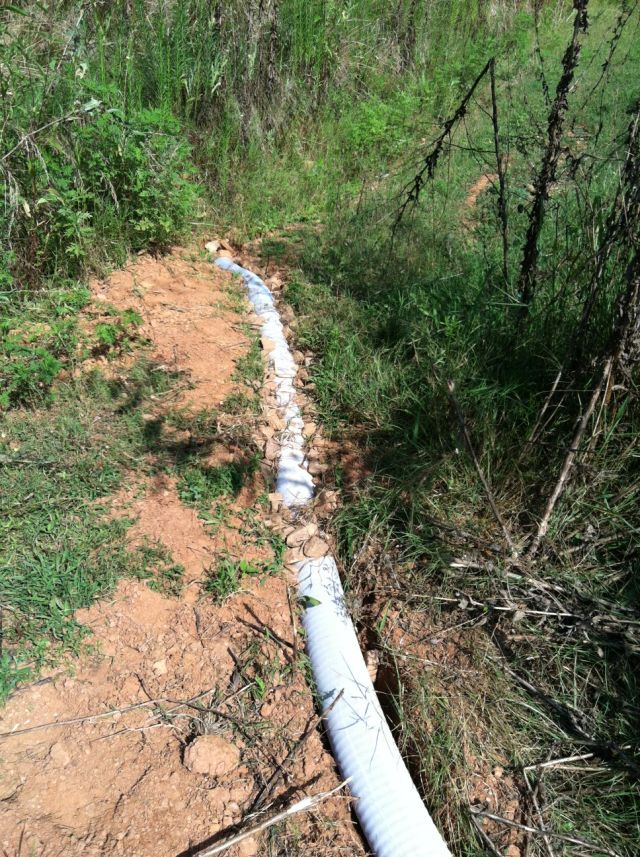
I widened the three feeder ditches to the contour ditches, measured their length, cut the pipe and checked it fitted so the top was below ground surface.  Then I “socked” it to reduce infiltration by soil and roots.

pipe in place leading to contour ditches
“socked” drainage pipe in place along access road ending in contour ditches

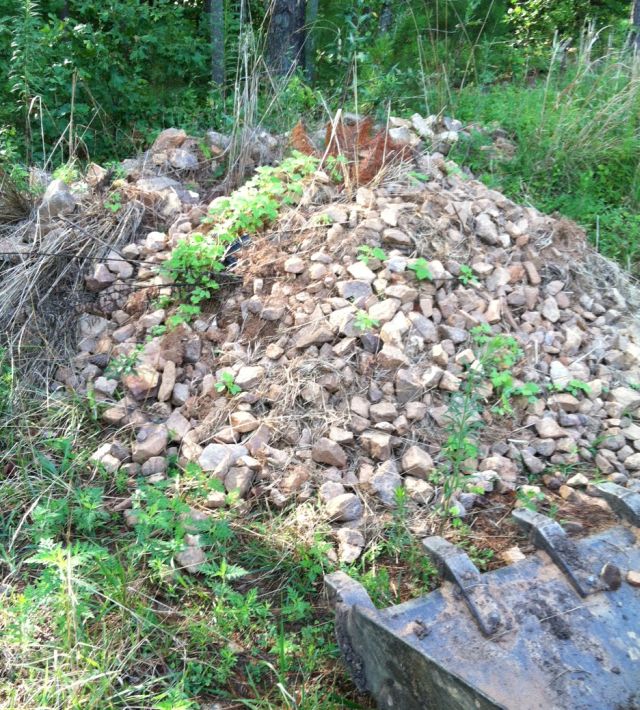
Finally a visit to my stone mound to pick out smaller stones to surround the pipe.

stone mound contributes to efficiency of contour ditches
stone mound with candidates to fill in around the drainage pipes leading to contour ditches

In the past I may have visited the local gravel yard and purchased a load of gravel, but why do so when I have so many stones laying around.

drainage ditch leading to contour ditches
drainage ditch diverting water to contour ditches

More stones are needed and I shall make the habit of picking up right sized stones and depositing them in the drainage ditches for the benefit of my contour ditches, when I visit my plantings each day.


rat and rabbit patrol

While I attend to the irrigation, Trudy my Heinz 57 canine companion, investigates and patrols.  A few weeks ago, as we returned to the house, I noticed her cheeks were puffed and when I coaxed her mouth open a little rabbit slid to the ground.  It was too mangled to survive, so I despatched and buried it.  This morning at the door entrance was a token of appreciation from Trudy – a rat which she had captured in the vegetable garden.  No despatching was required this time and after a quick photo snap (below) I buried it.  So no need for a rat terrier as discussed in a recent Paul Wheaton podcast, my Trudy is up to the task.

present of a rat
rat gifted by Trudy

toad in the mulch

The heat of the past week is lifting and a breeze and distant thunder decided me to mulch some apple trees.  The trees are on a gradual slope and with  a mattock I create a half circle mound on the lower side and flare the ends of the mound away from the tree so as to ensnare as much running rainwater as possible.  The mattock makes quick work of the weeds and larger stemmed growth and because it is lightweight (I am learning, in the past I would have purchased the heaviest sturdiest implement) I am not tired in the 80 to 90 degree heat.  Next  I cover the catchment area around the trunk with newspapers, at least 10 pages thick fully opened and overlapping.  And then I use my bobcat to move wood chip mulch to the tree where I dump it and spread it over the newspapers with a shovel.  Not hard work.  The mulch will absorb water which would otherwise have penetrated the ground but it prevents weeds for a time and the water in the soil will not be stolen by weeds nor evaporate as much as without the mulch.  It is a win win when I irrigate since the bubbler heads are below the mulch.

As I was moving my first load of mulch I noticed (there must have been a movement) a toad in the mulch.

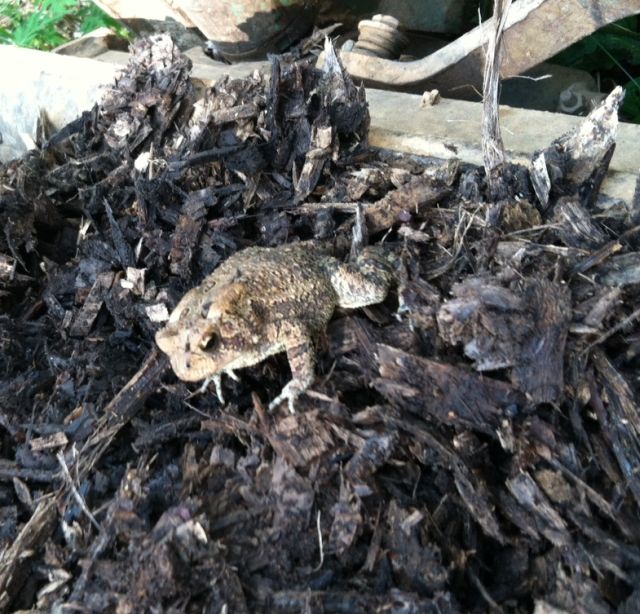
I assume it was a toad not a frog since it satisfied the criteria:not near the water, bumpy skin, wider body, shorter legs and football eyes.  Here he/she is:

a toad
toad in mulch

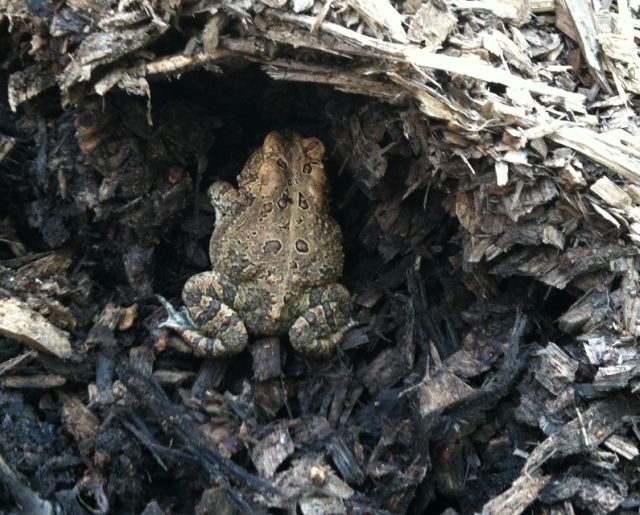
The bobcat provides a bumpy ride so, on the way to the orchard, the toad became a little concerned and snuggled into the mulch.  You can see the skin color and short squat legs clearly in the photo.  He/she arrived safely at the destination and I hope will play a role in insect control.

picture of a toad
toad en route to new hunting grounds