chicken synergies

The chicken are still doing well.  Six hens from my former neighbor (4 hybrids, 1 Ameraucana, 1 ISA brown) and 8 youngsters ( 2 Buff Orpingtons (1 of which is a rooster called “Buffy”), 2 Golden Comets, 2 New Jersey Giants and 2 Speckled Sussex).  No casualties, though one of the hybrids walks with a noticeable limp and is now called “Gimpy”.  The two dominant hens are the Ameraucana and the ISA brown, which curiously are also among the smallest.  The two largest hens, the New Jersey Giants, are the most timid and the 2 Speckled Sussex are the most antisocial.  Whenever there is a commotion amongst the hens, Buffy rushes in to settle the dispute.  He also charges out when there is a disturbance or security risk and crows throughout the day.  Notwithstanding shortened daylight hours I am getting 5 to 6 eggs a day.  I have decided against supplementing daylight with artificial lighting on a timer.  The coop I constructed is working well for them – no moisture from outside and inside temperatures have not fallen below 30 F (when the outside has fallen to mid teens).  They seem healthy enough though occasionally there is a soft shelled egg (to my dog’s delight) , so I supplement with yogurt and oyster shells.

I grow organically and my small orchard of 12 apple and assorted fruit trees began bearing fruit last year (actually I also have a 2nd orchard of first year fruit trees some years away from fruit bearing).  With the appearance of fruit there also appeared a variety of bugs, especially on my apple trees.  I know sanitation is important – removing the fallen fruit and wood cuttings because the pests overwinter in the fruit and cuttings.  But how to remove the soil slumberers?

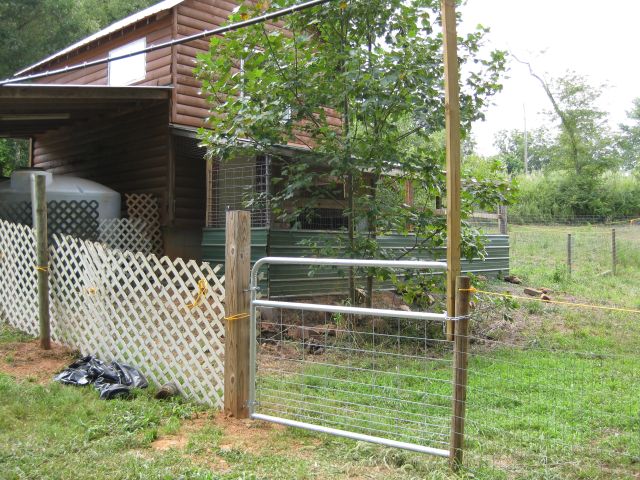
I installed a fence and 2 gates around the orchard and built a chicken day shelter and constructed a passage way to span the 120 ft from the main chicken enclosure to the orchard.  And now my flock are hard at work in the orchard,  removing debris and mulch with vigorous back swipes of their feet and voraciously eating the grubs and other soil dwellers.
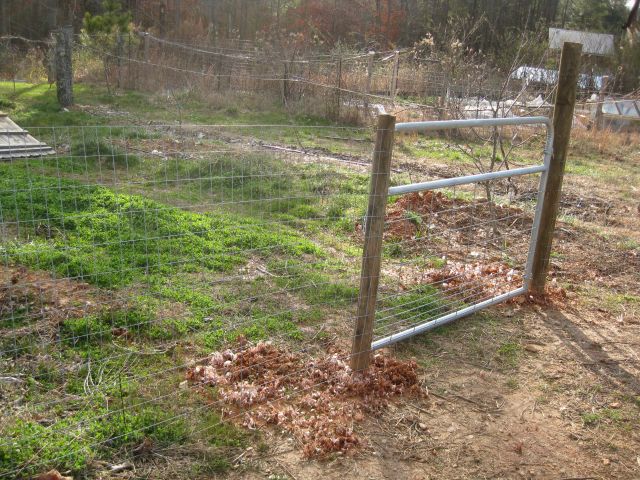
a 6 ft galvanized mesh gate installed to the orchard chicken paddock

Fencing is a fairly costly business.  I used welded rather than the more expensive woven wire fences which are necessary for horses and goats, so there is a saving there.  However, the gates cost from $65 to $100 and, if I had welding skills and access to surplus metal, I would make them myself – but I don’t, so I pay – and they should last indefinitely.

The passage way is temporary and I bought the red plastic material and stakes for about $9 per 100 ft from Lowes – marked down from $30.
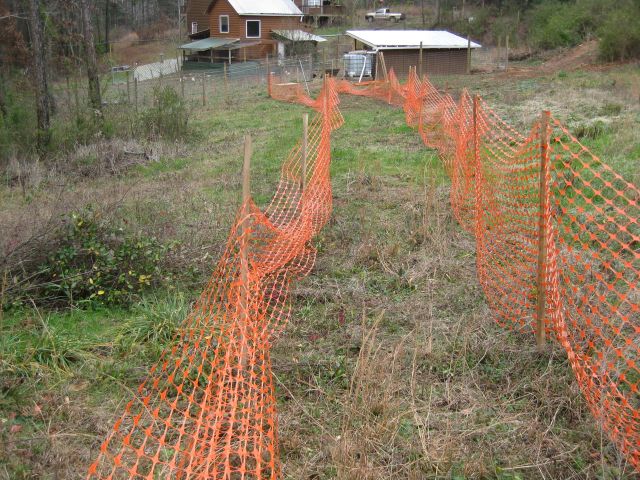
passage way from main chicken enclosure to orchard paddock

I remedied the problem of the fence slipping down the posts by drilling a hole through each post near the top and tying string through the hole and the top of the fence.

Finally, the day shelter.  I dug 2 ft holes for each of the 4 posts, bolted on 6″ wide planks to the 2 long sides and then 2′ by 4″ purlins and then screwed down galvanized roof sheeting.  The roof sheeting was $20 for a 12ft long 2 ft wide sheet, which I cut in half to fit in my truck and to produce a 6ft by 4ft roof. I will board up the south and west sides to make them feel more secure and sheltered from the sun.  In the shelter I have horizontally placed a 5 gal bucket with straw in the hope the hens will use it for egg laying, and a water container. To alert the flock to the advantages of the shelter I threw in a few handfuls of scratch corn, which immediately got their attention.
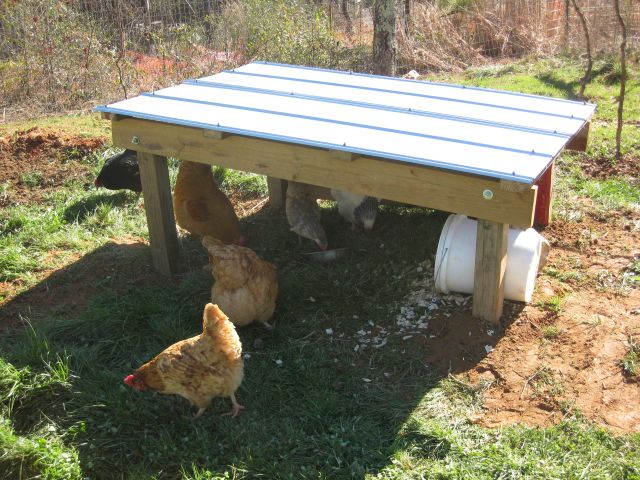
chicken day shelter 6 ft by 4 ft, with 5 gal bucket for egg laying

The roof slopes to the west to ensure the rain will run to the west and not over the east entrance.  In addition to reducing orchard pests I expect the flock will enjoy a more varied diet, get more exercise, and consume less of the purchased food I provide.


preparing for winter

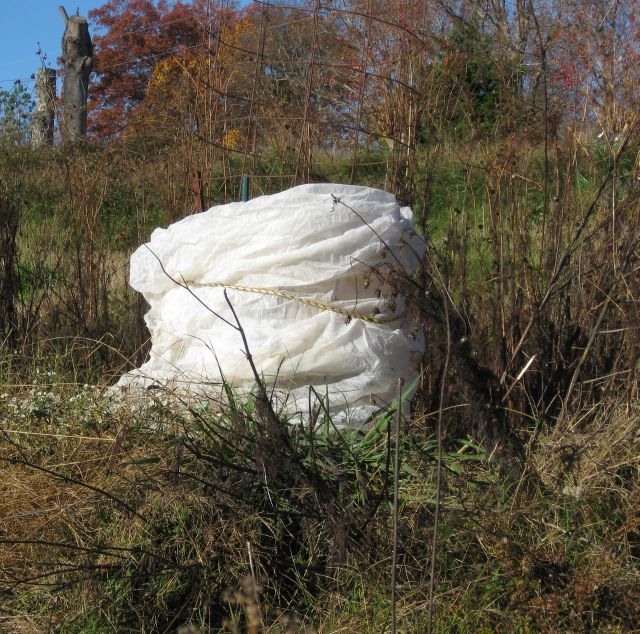
Yesterday morning I did not need a weather forecast to know cold was incoming and that it was time to protect some of the plantings.  Of the 12 fruit trees installed earlier this year, the Gold Nugget loquat was the most vulnerable.  The loquat is suited for sub-tropical to mild temperate zones and freezing temperatures will kill the buds if not the tree.  My loquat did not do very well this summer, probably too hot for it, but I will do what I can to help it and first steps was to winterwrap it.  Since it is only a few feet tall, it fitted easily into one of my tomato cages, which I had made from welded steel wire re-mesh.  I then wrapped the cage and the space above the tree with agripon AG-30 row cover, as shown below.

loquat in tomato cage wrapped with row cover

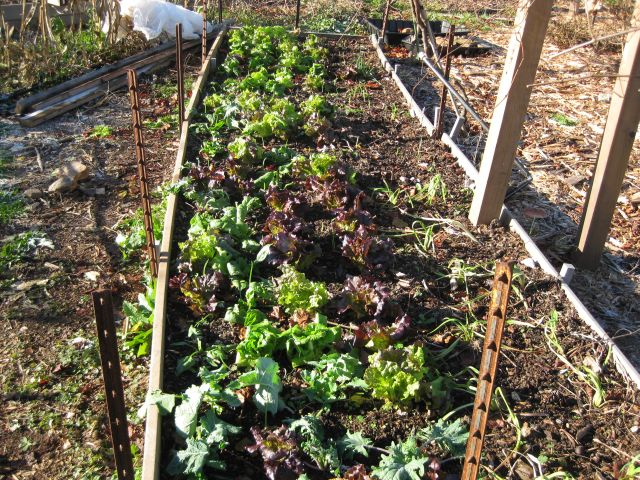
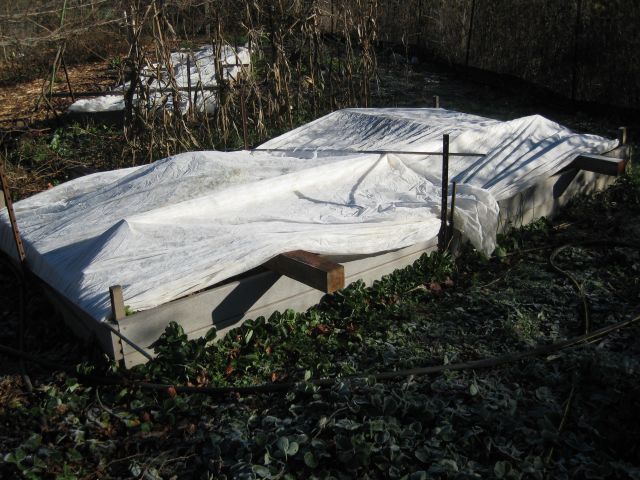
Next to the vegetables.  I have two raised beds where I am growing several varieties of lettuce as well as spinach, kale etc.  Rather than using a hoop system my thought is to drape row covers over the beds just above the vegetables.  This should be less vulnerable to strong winds and may offer better protection.  For my first bed I bridged the long sides of the bed with two cedar posts and then strapped a 4″ pvc drain pipe to the posts and draped the row crop over this.  Below is the finished product as it appeared this morning (you can see the frost on the adjacent strawberries):

raised vegetable bed covered with row cover

If the description was difficult to follow, here is a shot with the row cover removed:

raised vegetable bed with fixtures for row cover

Only half of this bed is being used for vegetables.  I have extensively planted the other half and also the spaces between the vegetables with garlic.  For my second bed I simply placed the row cover over the vegetables and secured with 3 2×4 untreated planks, as shown below:

vegetable bed covered against frost

The temperature fell to 22 degrees and the vegetables did fine, though it was not a heavy frost.  Since temperatures are predicted to stay above freezing for the next five days, I removed the covers this morning, a simple task which took just a few minutes.

long raised vegetable bed with lettuce interplanted with garlic

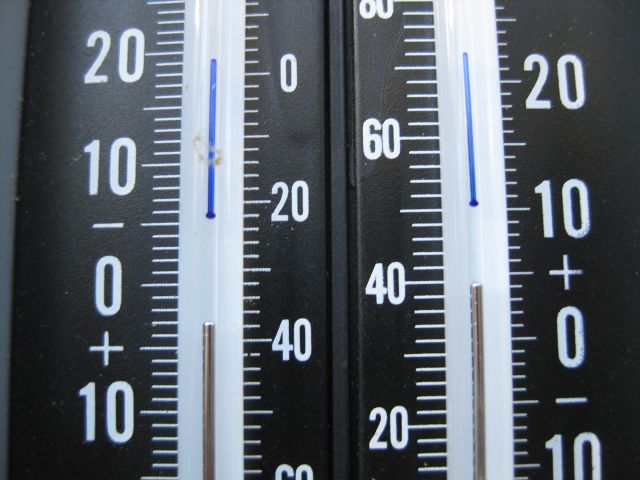
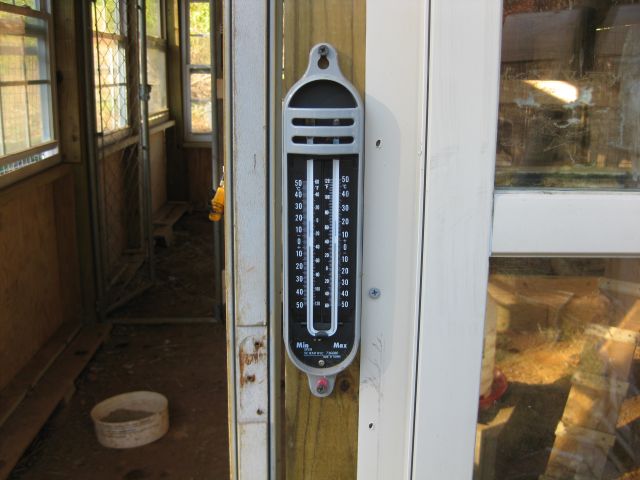
My new chicken coop is working out great.  Air can flow freely out the rafters at the top and I leave two of the windows slightly ajar. I was curious to learn how cold it really gets.  I transplanted my two min max thermometers from my greenhouse to the coop and sited one outside at the door and the other on the partition which divides the coop into the old flock and new flock areas.  This morning the outside temperature was 22 degrees and the inside temperature was 36 degrees, higher mostly I would think because of the heat of the birds.  My greenhouse, which is fully enclosed, only provides a differential of about 10 degrees between outside cold and inside temperatures.

thermometer reading 22 degrees
min max thermometer on coop door


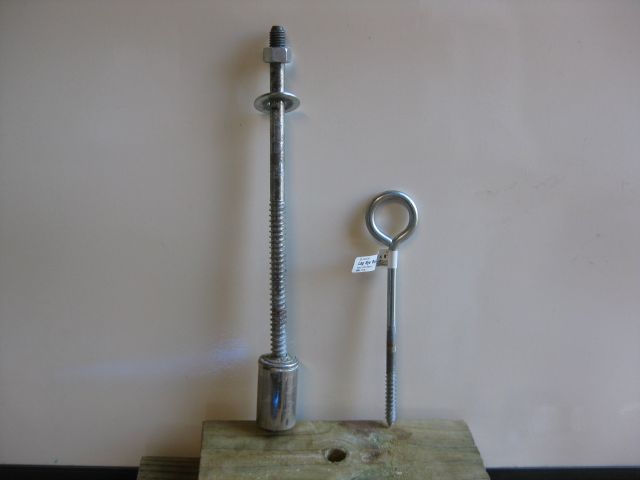
Since power outages may be expected, I checked my flashlights and found that my large 4 cell mag-lite was not functioning. Two of the 4 batteries had leaked and corroded the inside. Removing the batteries proved near impossible. I decided to drill a hole into the bottom of the battery and screw a large lag eye bolt into the battery and, with the assistance of a helper, pull them apart. After much tugging the bolt separated from the battery and the battery remained, unmoved, in the flashlight body. I then located a larger diameter hanger bolt and screwed this into the battery.
hanger bolt on left shown inserted in a battery, and lag eye bolt on right

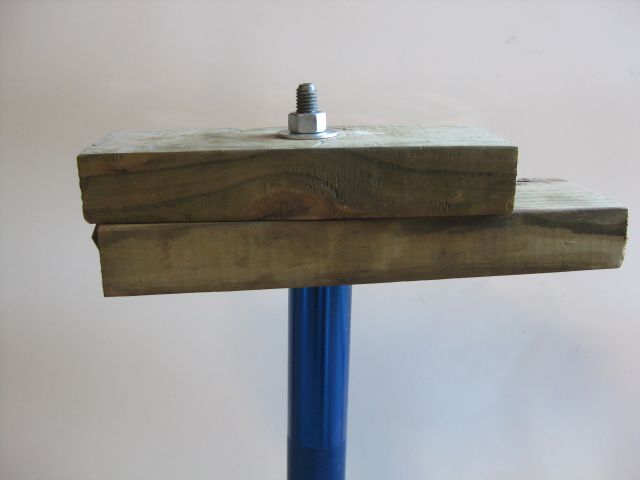
I no longer had my helper but additional help was unnecessary since, with a assortment of 2×4’s I established a platform for the nut on the hanger bolt to leverage against. It was then a simple matter to tighten the hanger bolt nut with a wrench and slowly extricate the two damaged batteries. After rinsing out and scrubbing the flashlight interior with a liquid mix of baking soda (sodium bicarbonate) and installing new, and a better brand of, batteries, the flashlight is good to go.

tighten the nut and the bad battery comes out (slowly)

new chicken coop – completed

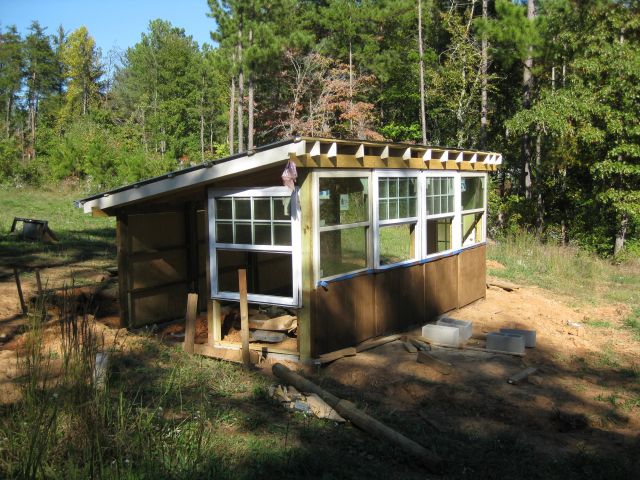
I completed the chicken coop project over the past weekend. I did all the work myself except for the assistance of a friend who helped me hoist 5 of the 6 windows into place and fit the entrance door. In previous posts I mentioned my progress on its construction. It is built on sloping ground so I started by using my bobcat to build a level pad, half of which was cut into the slope and the other half was infill from soil removed from the slope. Then with my trencher/stump remover attached to the bobcat I dug drainage trenches on the two sides of the pad which cut into the slope. The building is 18 ft by 10 ft and secured by posts concreted into the ground. Digging the post holes took a lot more time than anticipated since there were a number of largish stones (boulders) which had to be removed and this resulted in some cases in very wide holes. With the posts finally in place, construction went quickly. A time consuming task was digging the trenches between the posts for the cement blocks which I lined up 8″ deep to form my barrier against predator tunnels. I am concerned that predators can dig deeper than 8″ tunnels and will keep a lookout for perimeter activity.

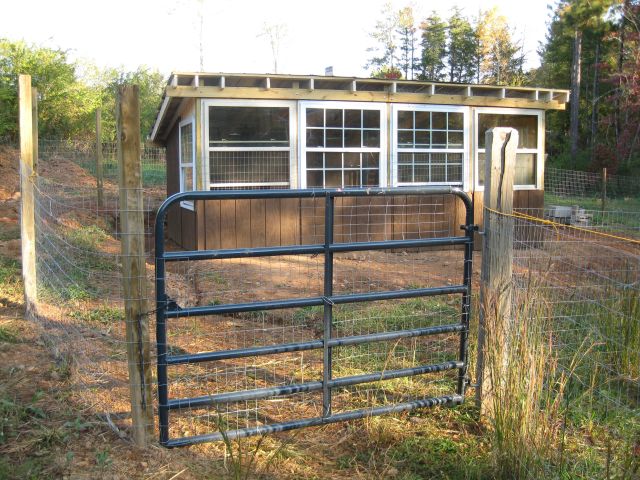
The first photo is the entrance. The only 6ft wide gate available at the time of purchase is for larger animals rather than chicken, so I used some of my fence wire to cover the gaps between the horizontal bars.


coop
coop seen from entrance gate

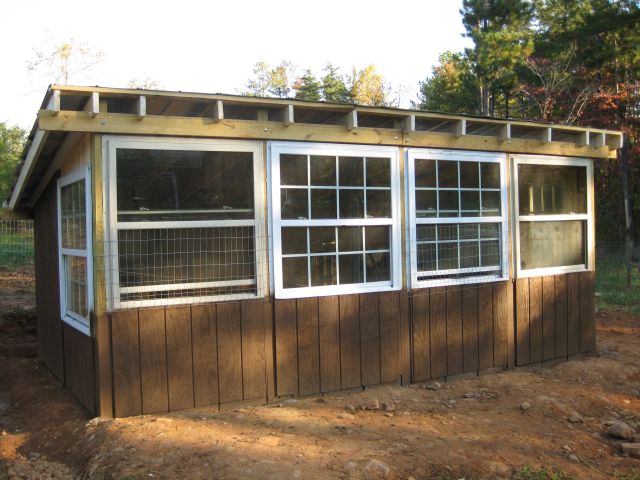
I screened all openings which remained after construction with hardware cloth. I also added the hardware cloth to two of the windows (lower half which opens) so that I can leave the windows ajar during the nights. To attach the cloth to the timber I used a pneumatic stapler (and safety glasses) and this sped up the work considerably.

coop
coop south facing side with four 4 ft windows

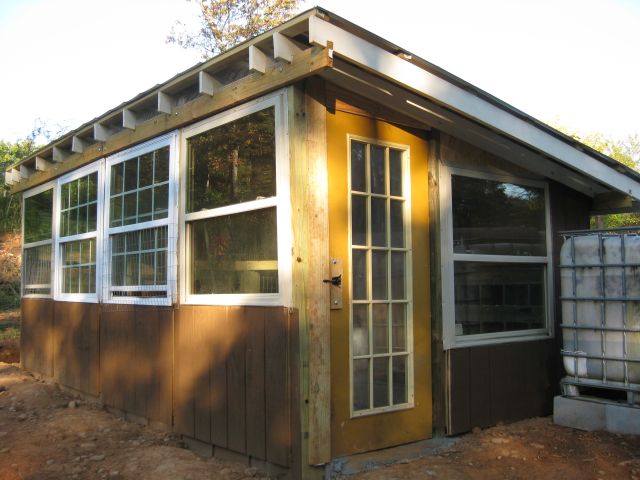
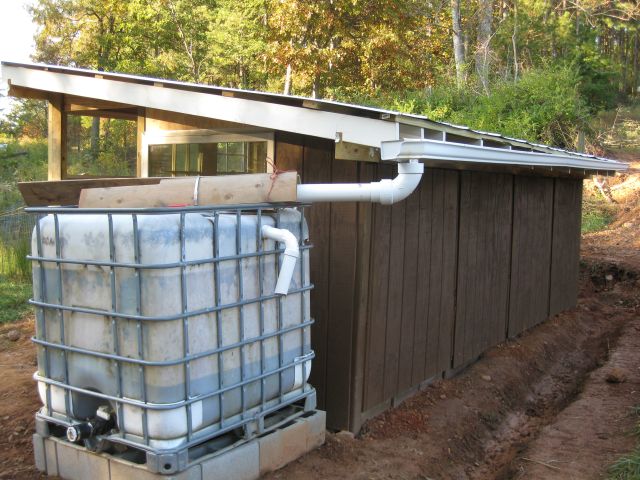
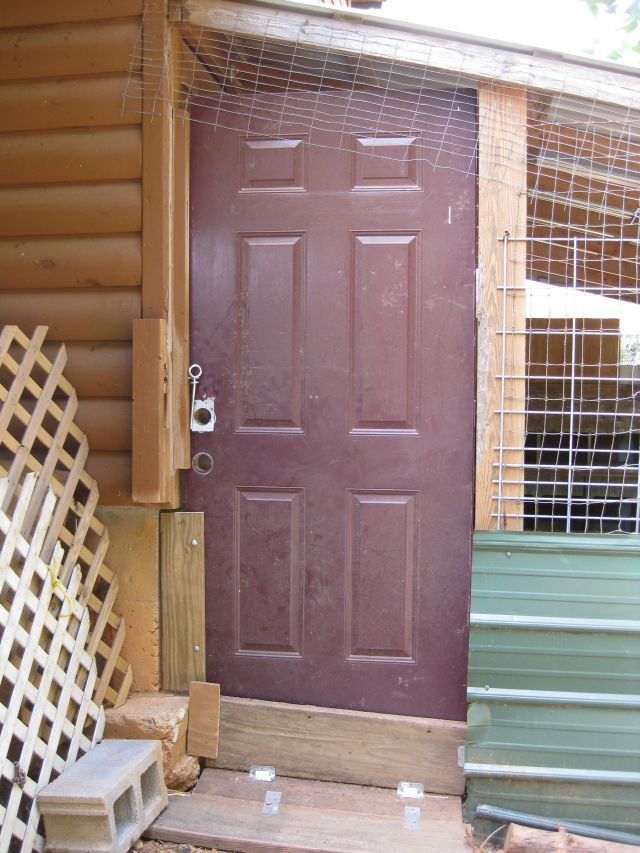
There are a total of 6 windows, four in the front and one on each side. This photo shows the entrance, with my $8 front door purchased from the thrift store and my rainwater storage tank. I will use the rainwater to irrigate the tree and shrub plantings I am installing in the chicken range areas.
coop
coop front entrance at rainwater storage tank

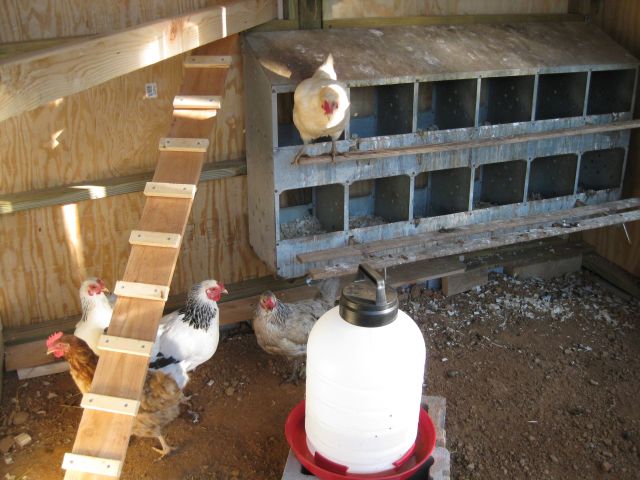
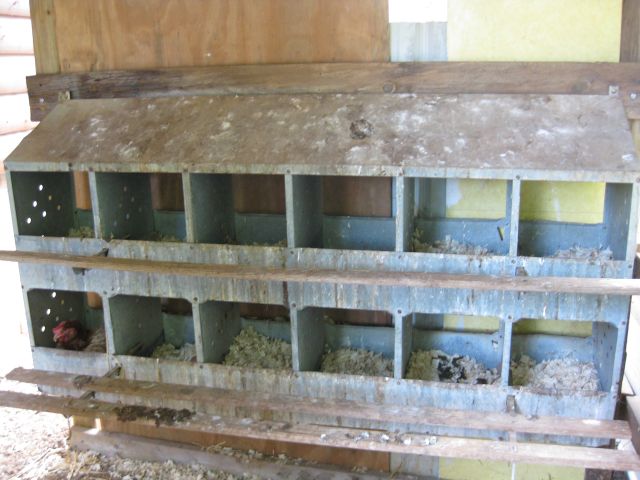
The coop is divided into two halves – one for the 8 younger chicken and the other for the 6 older hens. I intended to keep them all in the one half and use the other for growing and other activities. However, it appeared too cramped and there is still some friction between the two flocks. Each half has its own water container, food container, perches and nesting box. This photo shows the half closest to the entrance in which the 6 older girls now live, and the large nesting box inherited from my neighbor as well as the steps (4.5″ spacing) on the inclined plank to facilitate accessing the perch (horizontal, non pressure treated 2×4 at top left).

coop
coop area for older hens

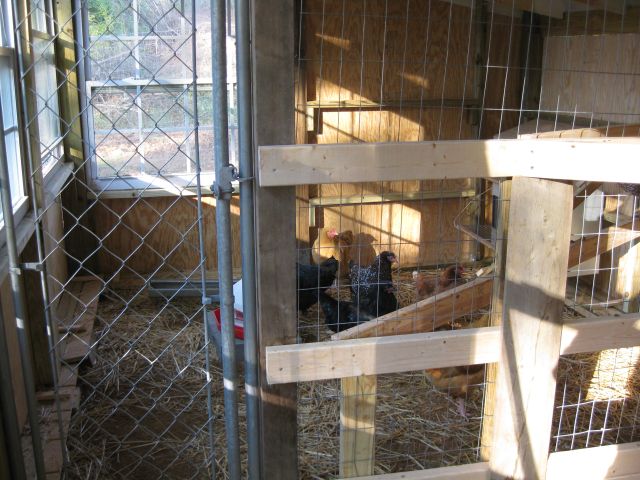
The two areas are separated by fencing material and a gate I salvaged.

coop
coop partition

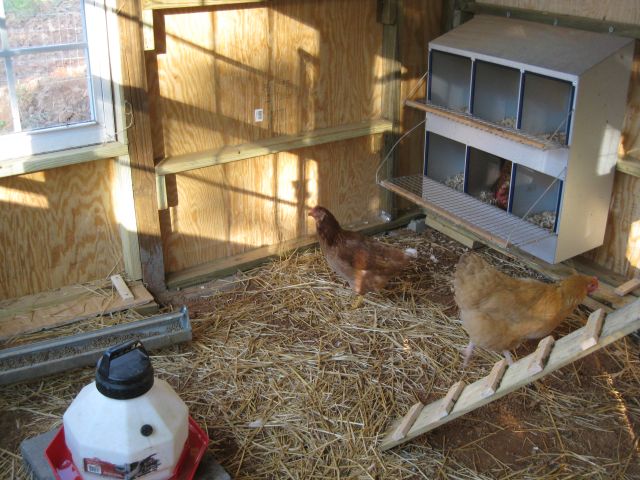
The other half is outfitted much as the first. Incidentally, in one of the nest boxes is a Golden Comet and, I discovered later, she is in the process of laying her first egg. Maybe living in close quarters with the older egg laying hens accelerated the process.  The step spacing in this coop is 6″ which I think is a bit too far apart – you can see Lady Macbeth on her way up to the perch.

coop
coop for younger hens

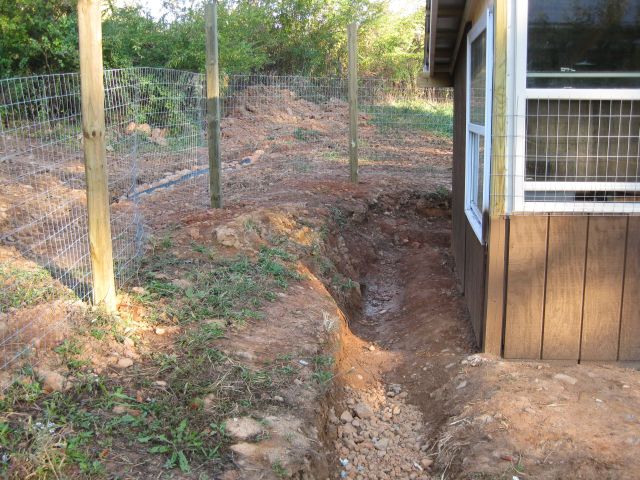
I spray painted the exterior with a block stain. This photo of the rear of the coop shows the slanting gutter leading to the storage tank and the drainage ditch on the north, slope side, of the coop.

coop

And, finally, this photo shows the west side with the drainage ditch between the slope and the pad on which the coop is built.  I have used 4 ft fencing which a number of the birds can easily fly over, but as longer as there is habitat and things to scrounge for they appear content to stay within the fenced areas.

coop
coop west side, showing drainage ditch

Finally, I must plant up the soil which surrounds the coop before it is eroded by the rains. I may transplant sod from the hill or try seeding it. With temperatures beginning to fall, it may be too late for seeding.

progress on the coop and a simple replacement fix

The future chicken coop

Chicken coop

The future chicken coop is progressing. I installed the windows and door with the help of a friend. Just outside of Atlanta there is a large employee owned window manufacturer and they custom manufacture windows which are occasionally returned because of wrong specs, finish, customer couldn’t pay etc. Nothing actually wrong with the windows. These returned windows are stored separately and are advertised on Craig’s list. I bought 6 of these windows (dimensions 4 ft by 4 ft) for about $50 to $60 each, and now I am putting them to use.
Incidentally, the coop building will be used for more than just the chickens. I intend this year to propagate cuttings of various fruit trees and berries and a ledge along the south facing windows will be a good spot for the cuttings, once they have rooted. I read in a permaculture book that CO2 from the chickens will also help plants stored in this area. However, no vegetables for concern of contamination – they will be grown under cover or in the greenhouse.
I found the exterior door for the coop at the local thrift store for $8. It really didn’t make sense buying an exterior door for >$100 from one of the big box DIY stores.

Click to see details of the finished coop.


A simple fix
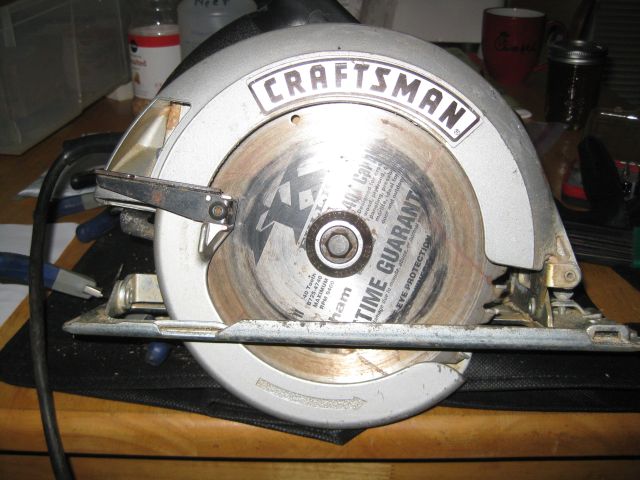
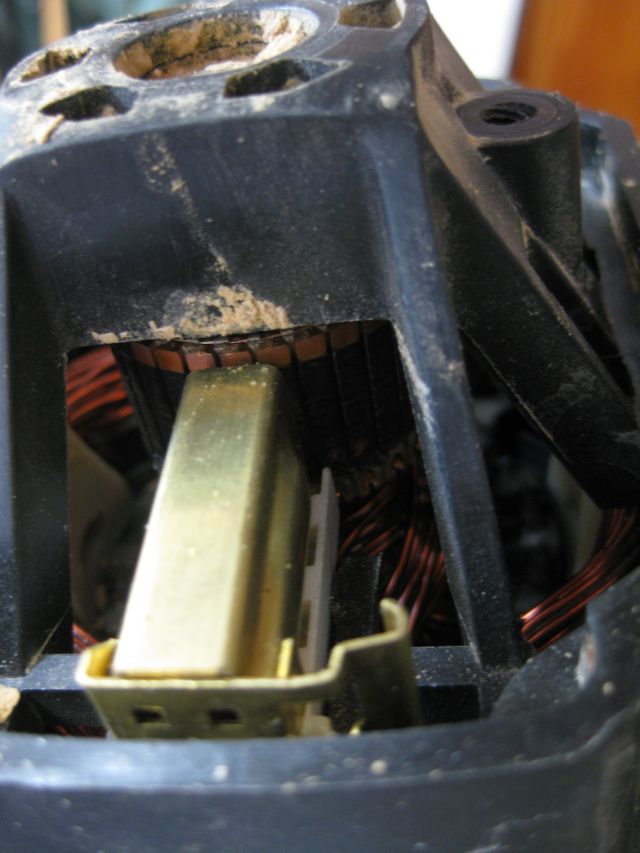
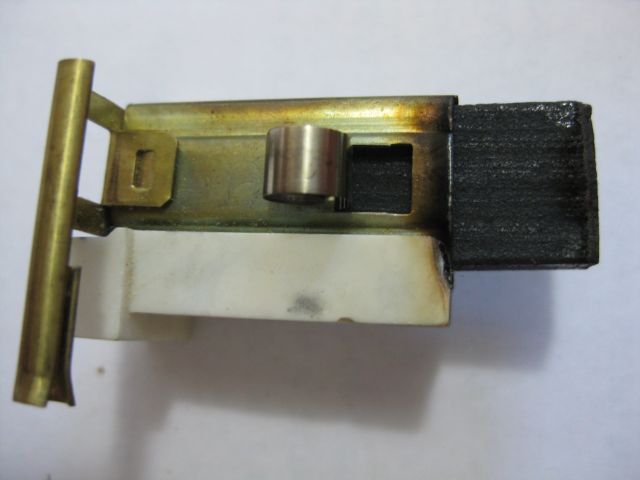
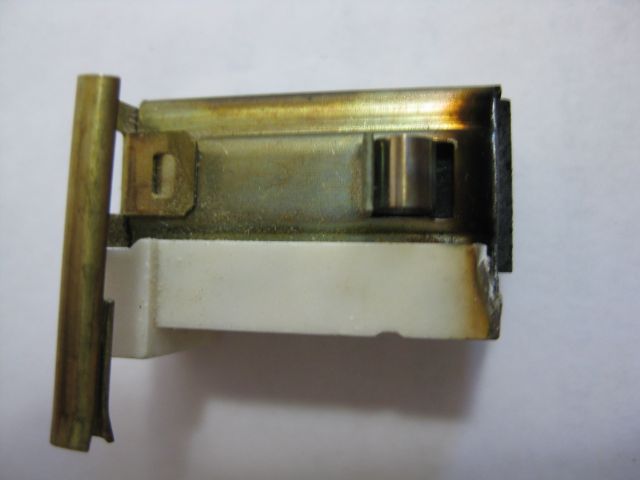
I have a Sears industrial circular saw purchased in the 80’s which has provided excellent service. Recently it would fail to start and I overcame this by turning the saw blade a few inches. Eventually it wouldn’t start at all and I figured it was time to replace the brushes. This usually is the problem when a motor won’t start initially but then starts after you slightly turn the part driven by the motor (or at least in my experience this has been the case). I downloaded the parts diagram, found the part #, found the cheapest supplier (you have to combine part price with shipping cost since the latter can vary greatly) and ordered the part. Except, a few days later the supplier fessed up they didn’t have the part and credited me (they shouldn’t have charged me until they had shipped, but I got the credit). So I paid more, got the part, opened up the saw and replaced the brushes – the whole procedure took less than 10 minutes. There are two brushes and when I removed the first it looked fine and I had real misgivings about my diagnosis. However, as you can see from the photo the second brush was completely worn. And – the saw now works fine and just in time, since I needed it to cut the 4 ft by 8 ft sheathing.

my trusty circular saw
shows brush in holder pressing on commutator
there are 2 brushes, the first looks ok
however, the 2nd brush is completely worn down


Mushrooms

I am seeing more and more mushrooms in the woods following the recent rains. The young mushrooms are rounded at the top and then, when they release their spores they open up and become flat at the top.

a young mushroom
an older mushroom which has released its spores


Permaculture

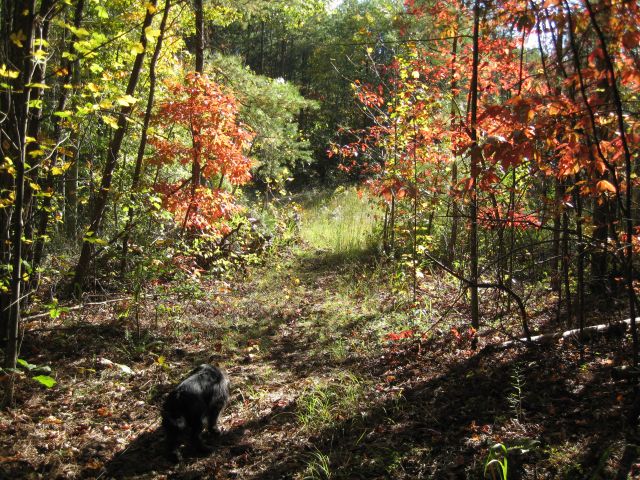
I am becoming increasing interested in permaculture. A few years ago I read the book by Bill Mollison but, though I understood the concepts, they did not resonate with me. Last year I read The One Straw Revolution by Fukuoka and I just finished the permaculture book by Sepp Holzer and am working my way through Gaia’s Garden by Hemenway, which is excellently written. Since I acquired the property I have been doing more than just organic gardening – my contour ditches, my allowing natural growth to overtake the mown areas, my working in the woods – these various projects are neatly encompassed by the permaculture approach. Next step is for me to go on a PDC (permaculture design course). Below is a photo showing fall colors in the opening I cleared in the woods (the “edge” in permaculture):

sourwood fall colors and opening in woods

support the little guy!

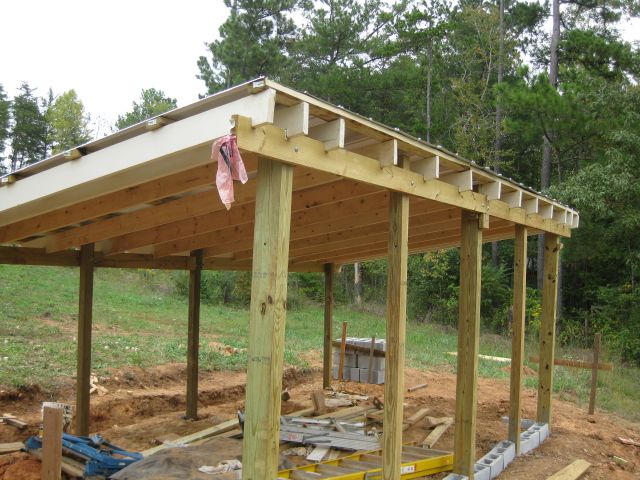
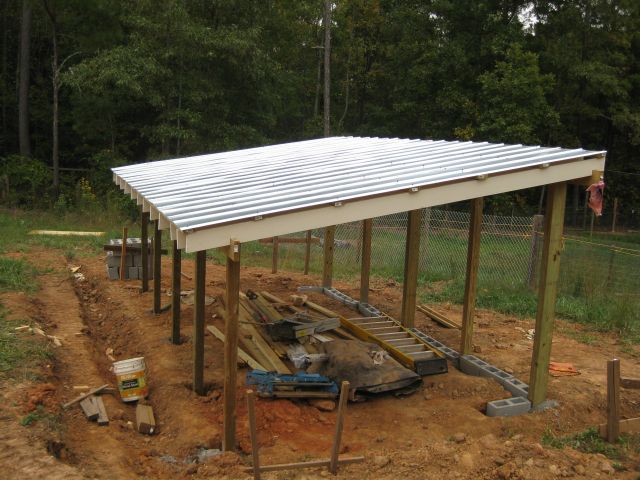
the roof is on the future coop - underside view showing rafters and purlins
topside view of future coop

Today I finished installing the roof of the future coop.  For the rafters I used 2″x6″x12 ft kiln dried wood, not pressure treated; for the purlins I used 2″x4″ pressure treated, and for the roofing 2ft x12ft galvanized steel crimp roof panels.  I painted with exterior enamel paint those parts of the rafters which would be exposed to either rain or carpenter bees.

I deliberated long on how to transport the 12 ft lengths of wood and roof panels.  My pickup has a 6 ft bed so either I would have had 6 ft hanging out the back of the truck, or I could have slanted it over the cab, but I was concerned I would further scratch and dent the cab roof (not the first time I have transported 12 ft lengths of material) and that the roof panels could buckle from wind pressure as I was driving.  So I thought I might rent a truck from one of the two big box DIY chains.

I priced the materials at both chains and they were identical and, to my mind, expensive.  So I thought I would visit a local family owned builder supply store.  There used to be two such stores within 15 miles of my property and both were dependent on building contractors for their business.  And then one, which have been operating for over 80 years, closed down in 2009.  So I visited the remaining store.  They were very friendly and said they would ship the lumber and roof panels to my property for a $20 delivery charge.  An even bigger surprise was their prices – the lumber was about 3% less than the price at the big chains and the roof panels were 20% less.  And they were so knowledgeable and helpful!  I decided to make additional purchases at their store and all the prices were competitive. 

Which brings me back to my heading – where possible we should support the little guys, not because we want to be nice or considerate but because it is in our own self interest to do so.  We benefit from the price competition which whittles out the independents but, once they are gone through either liquidation or consolidation, and there are just a few big operators left, as is happening with the airlines, the telecom industry, the banks, the consumer retail stores etc. etc. then we become the victims as the few remaining competitors abandon price competition and gradually price up.  So, support the little guy when you can.

new chicken coop

I am making slow progress with construction of the new chicken coop.  The present coops are well located for summer weather since they are at the bottom of the hill with large trees to the east and west and well screened from the sun, except when it is overhead.  The coops are enclosed by walls on two sides and netting/fencing on two sides, so cold winter winds will easily find the residents.  I considered closing in the remaining sides, but decided an extra coop will be handy in the future and, since it will have many windows,  a portion may be hived off and pressed into service as a greenhouse.  My new location is on slightly higher ground and has much better sun exposure.  Since it is on a slope my first task was to level the ground  with my bobcat and create a level pad.  I dug a perimeter trench between the pad and the two higher sides of the slope so the rain water coming down the hill will be diverted around the pad.

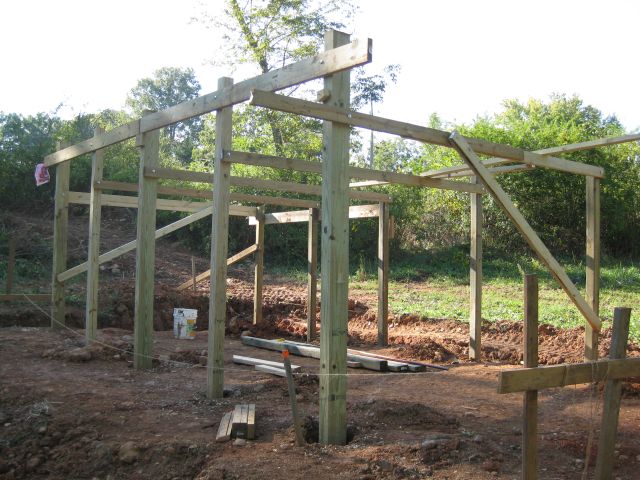
I determined the width by examining roofing materials and noting that most are either 8ft or 12 ft long.  Since I would like an overhang of approximately 1 ft on each side, I decided to use 12 ft long roofing over a 10 ft wide coop.  The coop is on an east-west axis and the higher side faces south.   The most difficult part was digging some of the post holes since there were large rocks in the ground, some bigger than a foot wide, which had to be removed.   Below is a photo of the framing which I installed.  The horizontal braces between the high side and the lower side are to hold them in place until I can install the roof rafters at which time they will be removed.

Click on these links to follow progress:  roof installation and final completion.

framing for new chicken coop

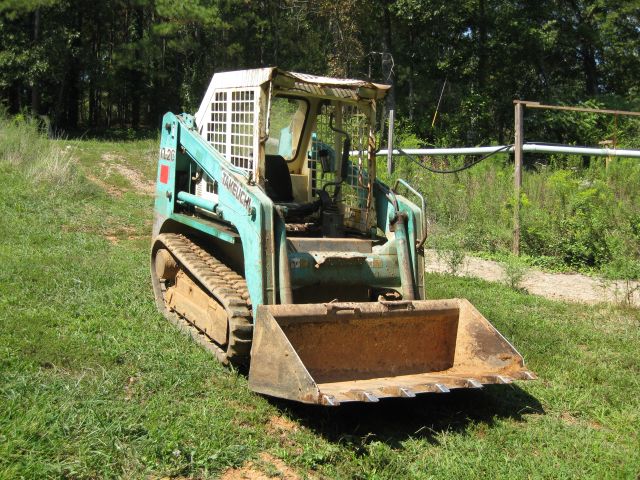
cutting a ramp with Takeuchi

Last year I bought a Takeuchi TL26 track loader.  This machine was made in the 90’s and because it has tracks rather than wheels is ideal for grading or re-shaping the ground surface.  It has 61hp, which makes it a mid-size loader and just right for my limited needs. In the article on the fading battery I mention some of the repairs I have made to it.

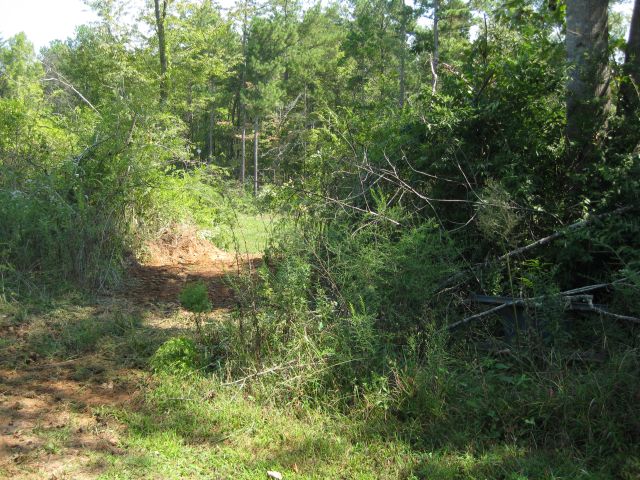
Since the temperature tomorrow is expected to be back in the 90’s and today we are only in the 80’s, I decided to cut a ramp down to the lower field.  My tractor access to the lower field is blocked by the fences I installed for the chicken coop and I figured it would be cheaper to make a new road to the field than to purchase two 10 ft gates for access through the chicken free range.

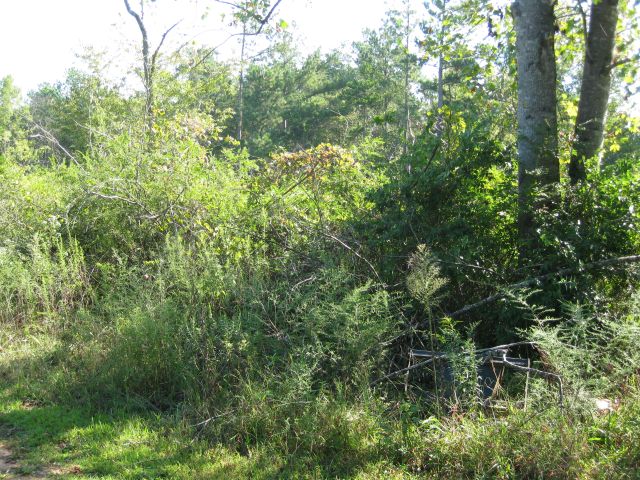
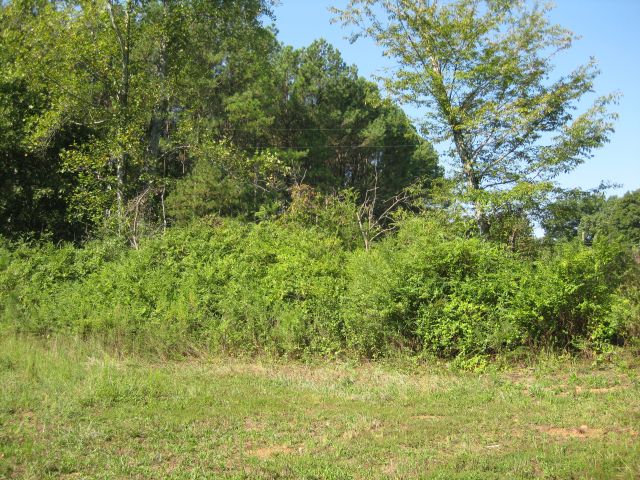
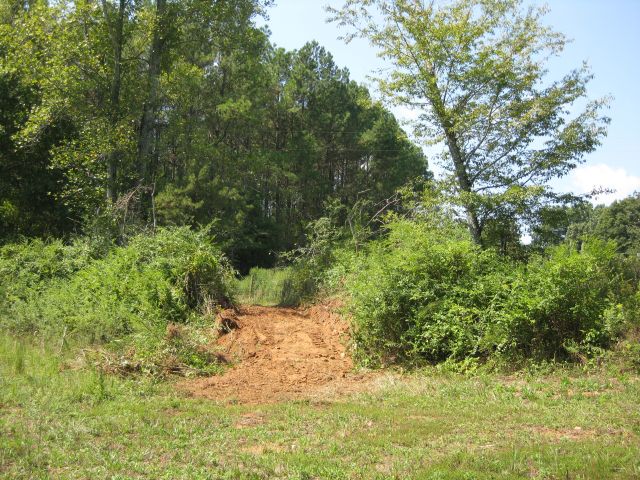
I like thickets for the cover and food they provide to the wildlife.  However, this morning it was necessary to cut a road through vegetation.  The process took less than a couple hours.  I placed the cutting edge of the loader’s tooth bucket a few inches below ground surface and ripped the bushes and small trees out of the ground. Once the roots were free I climbed out of the loader and manually pulled the branches out of the way and stacked them in a pile to be chipped at a later date.  The roots will be stacked in a pile for slow decomposition and to be added to the compost heap.

top of hill before grading
top of hill after grading


Grading the hill i.e. cutting a ramp down to the lower field was more of a challenge. I work by myself and try to avoid situations where I get into trouble, though I always keep my cell phone at my side in case I have to call for help. So I proceeded with care filling the bucket of the loader with soil as I cut a decline into the ground and then advancing to the edge and dumping the contents down the hill. In this way I fashioned a road down the hill. Then it was a matter of leveling the ramp and removing some of the boulders embedded in the hill. My loader is 5ft wide and the tractor is 7ft wide (it has wide rear wheels which increase the width from 6ft to 7ft), so I widened the ramp a bit for future access by the tractor and pickup truck. After it has rained and the soil re-settled I will smooth out the ramp one more time with the loader and then bring the tractor down to bushog the field, chip the branches and small trees, and augur post holes for the new insulated coop I will be building towards the top of the field where it catches the winter sun.

bottom of hill before grading
bottom of hill after grading

2nd chicken coop done

Arrival of the egg laying chicken

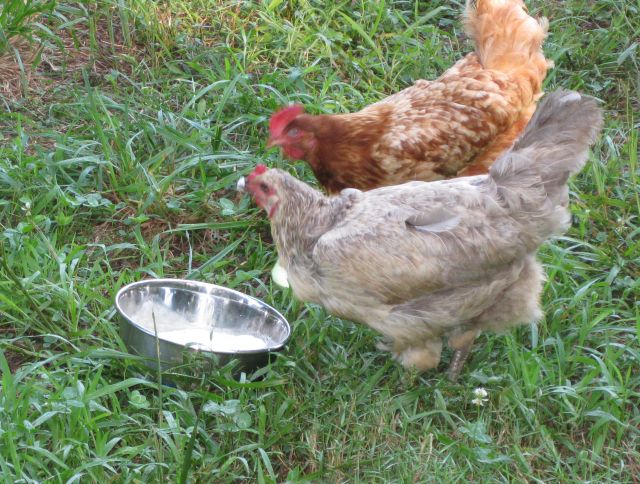
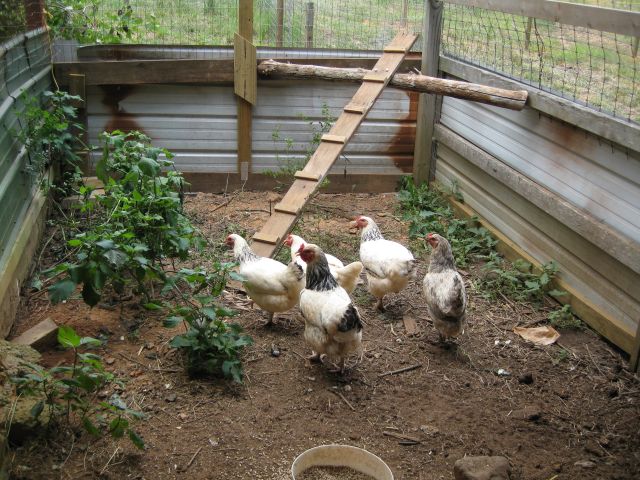
My neighbor offered me her 6 chicken and nesting boxes and metal waterer for a reasonable price and, because of the age and size difference between her mature egg laying chicken and my youngsters, I built a second chicken coop to receive them as well as a separate fenced outdoor exercise and grazing area.

chicken
6ft gate to fenced range with coop at rear

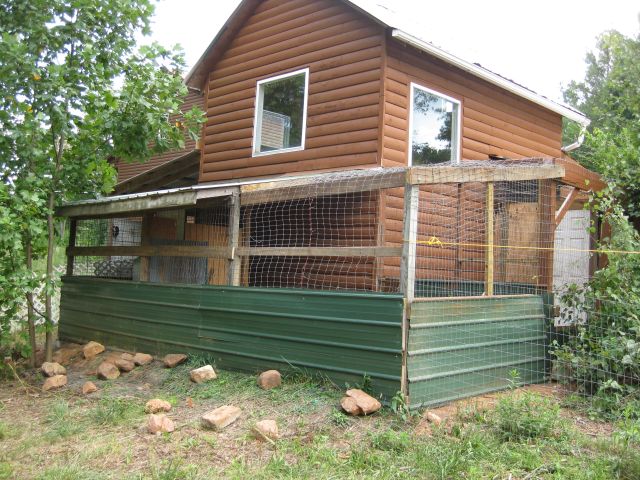
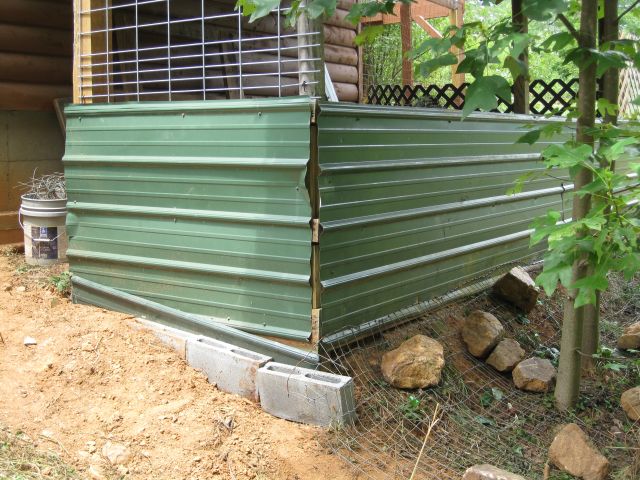
I refurbished a horse stall into a chicken coop using scrap lumber and wire fence leftovers.  I used screws rather than nails since it is easier to undo a mistake with screws and screws, altho’ costlier, hold better than nails.  My preference for the lighter joints was “star drive” screws to “phillips” screws because turning power is better, and for the heavier joints I used hex lag screws and occasional bolts and nuts.  To secure the metal sheeting to the sides I used hex metal roofing/siding screws.

Chicken coop construction

chicken
exterior view of coop

I worked from the ground up –

  • first dug trenches for implanting narrow cinder blocks to thwart tunnel attacks;
  • along the downhill sloping side laid surplus 4 ft wire fence on the exterior ground surface anchored by flat rocks and 10″ tent pins to also deter tunnelers;
  • framed the sides and roof with old but solid 2″ x 6″ and 2″ x 4″ lumber assortments;
  • secured surplus green roof sheeting to the sides to waist height;
  • used surplus fence wire (welded or woven) to close in the sides and the “courtyard” roof;
  • a battered front door was recycled to become the chicken coop entrance;
  • a partition using wood and sheet metal scraps was constructed between the roofed in area and the courtyard;
  • a tree limb secured by lag bolts to the sides became a roosting perch;
  • a plank with screwed on footholds became the stairway to the chicken roosting perch; and
  • finally the nesting box and the metal waterer were installed and thechicken introduced to their new home.
chicken
door entrance to coop

chicken

nesting box secured to partition in coop
chicken
courtyard with roosting perch, stairway and 5 occupants
chicken
view of fully enclosed "courtyard"


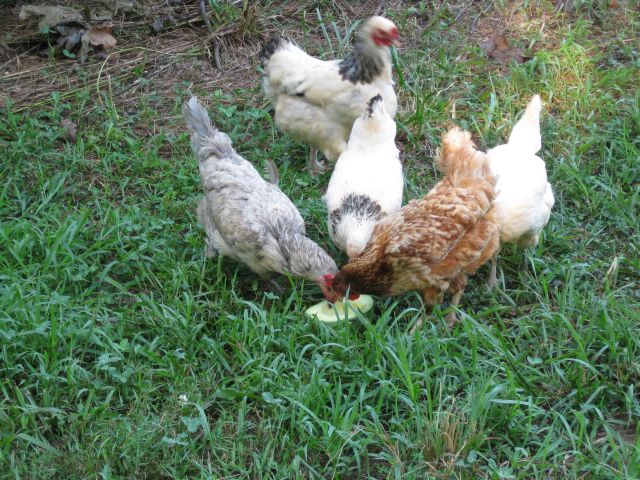
To acclimatize the new residents, treats were provided.

chicken
some yogurt for the new occupants
chicken
as well as a melon treat

trying to get smarter

A few evenings ago, after locking the chicks in the pen, I heard an unusual noise and went to investigate.  The coop is divided by an inner partition.  The two Golden Comets were on the one side on the roosting perch, which didn’t surprise me since from the get go they were ostracized and even though now they appear to be accepted, they still act independently.  On the other side of the partition I saw an unusual sight – the other six chicks appeared to be shoving and tugging to get into a corner of the coop.  It appeared each one’s efforts was to get to the bottom of the scrum for even when one climbed on top of the melee it wasn’t satisfied until it had dislodged those below it and was situate on the bottom in the corner.  What was just as interesting was that the two Golden Comets, who had followed me, immediately joined in the proceedings.  It was a continuously revolving spectacle.  I dislodged them momentarily and examined the corner and there was nothing unusual about it, to explain their intense need to access it.

As I pondered, there came to mind a similar event which occurred the previous December.  On a mild winter’s day I had examined the hive to check their food situation and inadvertently dislodged some 40 bees which immediately formed a cluster on a plank.  I placed the plank at the hive entrance and expected them to move the 6 inches or so into the hive.  But they stayed in their cluster, which I saw when I moved closer, was in continuous motion with bees underneath coming to the surface to be replaced by the bees on the surface.  I left them there assuming, when they had concluded their activities, they would move into the hive.  The next morning, the little cluster of bees was still on the plank, frozen in place.  I did not realize they were desperately trying to keep themselves warm, as they do in their hive during the winter, and that what I was watching was desperation and panic.

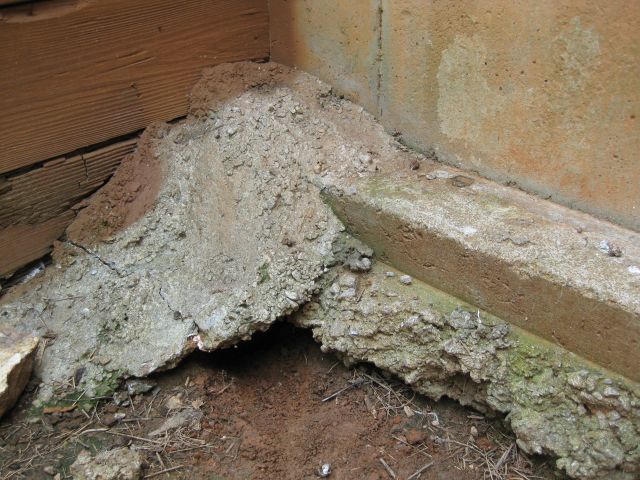
tunnel under concrete layer, into coop


So with this lesson in mind, I continued to study the chicks and came to the conclusion that the reason each one was struggling to get to the bottom of the corner was because this was the safest place to be from a predator.  So something had spooked them.  I reexamined their little fully enclosed courtyard and decided that the hole under a piece of concrete which I had assumed they had made  for sunbathing or dusting purposes, should be more closely examined.  In fact it turned out to be a tunnel and on the outside of the coop I found the entrance hole to the tunnel.  The tunnel was some 4 feet in length and maybe 6″ to 8″ in diameter.  My fortuitous visit had interrupted what may have been a disastrous evening.  I plugged the tunnel and placed cinder blocks all round the coop perimeter.  I had known predators are motivated and can and will dig, but had assumed that the 4″ depth of the perimeter wall/fence would have provided adequate protection.

cinder block and horizontal fencing protection

My neighbor who introduced me to chickens has agreed to give me her 6 mature girls – 4 hybrids, 1 Americauna and 1 Rhode Island Red.  Since her girls, which regularly produce 4 eggs daily, are much larger than my 14 week flock, I must keep them separate, which means building them their own coop and outdoor exercise area. With my enhanced respect for the wiles of predators, I am reinforcing the adjoining woodshed which will become the new coop. Because it is situated on a slope, which means even if I put down a 1 ft vertical barrier the invader could probably tunnel under, I have decided to lay horizontally a 4 ft wire wrought fence, which is held in place by surplus 10″ steel tent stakes and rocks. Much work still remains before the coop is ready for service.

hawk protection?

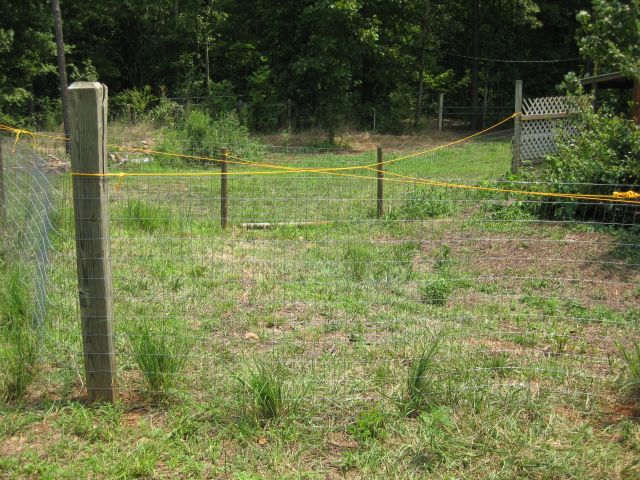
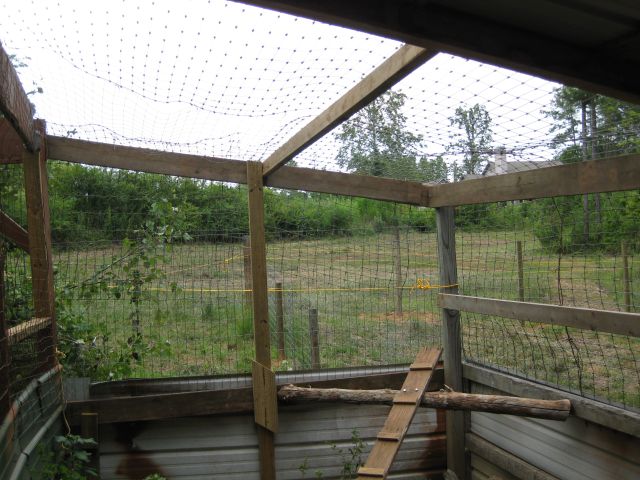
While walking the adjacent woods early in the morning we startled a Great Horned Owl. This got me thinking about the need to protect the chicks from aerial attack by hawks or this big owl. So I cross laced the fenced exercise area with yellow rope which I hope will complicate and deter any aerial strategies.