honey harvesting – mistakes

Yesterday, Sunday, I had my best honey harvest in the two years I have been collecting honey from my bees.  I filled just over 32 pint jars, which equals 4 gallons.  Earlier this year (4/29 and 6/3) I collected 1.2 and 1.4 gallons of honey, so total yield is 6.6 gallons.  If I assume an average weight of 12 lbs per gallon, this is about 80 lbs of honey, which is good going for me.  But my activities were tinged with regrets.  I made some mistakes and regret them.

I have two hives.  The one I started this year with members from the main hive is doing ok but not great and, after a quick inspection, I decided it did not have honey to contribute.  So I focused on my main hive which I have had for 2 plus years.  It has 3 hive bodies or boxes on top of each other.  The bottom is a deep (9.625″ high) and the two above it are medium supers (6.625″ high).  I had placed the super I harvested in June and April in the middle and so the super on top had not been harvested this year.  I inspected the first frame in the top super (there are 10 frames in a box) and saw it was filled with honey.  So I concluded all the other frames in the top super were also filled with honey (my first mistake – I should have examined the individual frames).
wax after the honey was removed
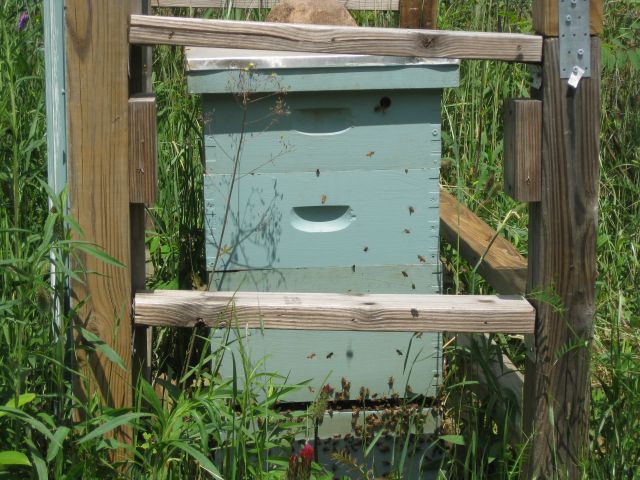
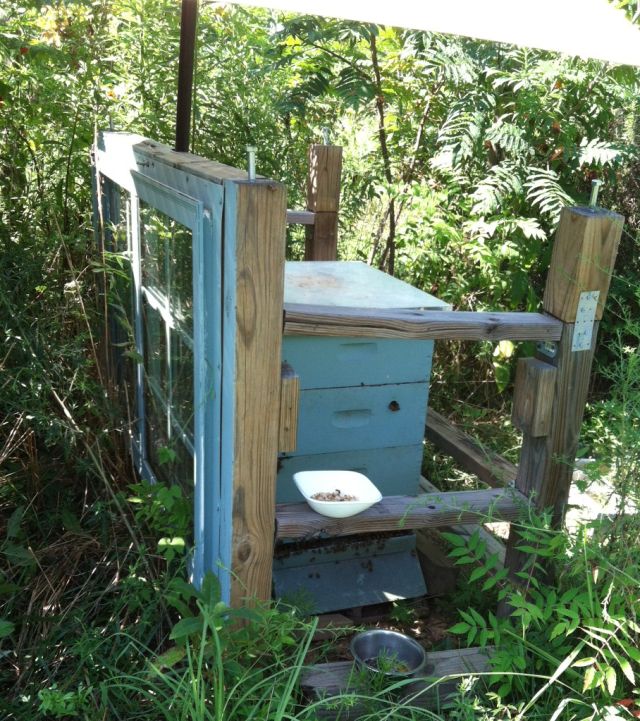
bee hive (1 deep, 2 supers and sun umbrella and structure for winter rigging) after honey harvest – note containers of wax scrappings left for recycling

I don’t use chemicals on my bees with one exception – I use butyric acid, which is vile smelling, to make the bees leave the hive body. I am now reconsidering this practice.  Anyhow, I applied the butyric acid to the fume board, which is a lid you place above the hive body you wish to harvest, and the bees all departed the hive body  or so I thought.  Then I transported the hive body to the kitchen where the harvesting and extraction equipment awaited.

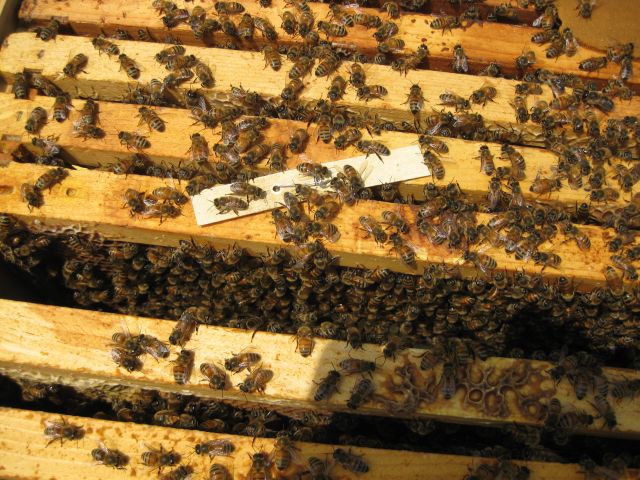
Before moving the hives into the kitchen I inspected them outside and found a lot of bees still on the middle frames.  I looked to see if they included the queen, did not see her and with a bee brush I gently brushed them off the frames.  To my surprise they held on tenaciously and it took several attempts to get them all off.  Then I moved the frames into the kitchen.

I thought all 10 frames would contain honey and the first 3 did.  But, to my upset, the next 4 contained larva.  In other words, the queen and her retinue had moved up from the deep and she had laid eggs in the top super.  I harvested honey from the 3 frames at the other end and then returned the 10 frames (6 empty and 4 with brood) to the hive.  It had not occurred to me that the queen could have moved to the top super.  The bee club I belong to encourages the use of a queen  excluder (a metal grill which prevents the queen moving up) but I chose not to use it.

When I returned the top super I carefully went through the frames in the deep and middle super and selected 6 frames laden with honey which I harvested, without mishaps.

I was upset for several reasons.  The bees which clung to the frames were nurse bees not foragers.  Nurse bees are young bees which have not yet been outside the hive.  Therefore they have not performed their orientation flights, which means that the bees I had buzzing outside the kitchen did not know where they were or how to return to the hive.  I could tell they were nurse bees because when they landed close I could see from their size, fuzziness and gentle color they were young bees.  I tried to make amends by placing pieces of wax cuttings containing honey on plates outside the kitchen and when the offerings were covered with bees I covered the plates and moved the assembly to the hive entrance and hopefully some found their way back.  But at the end of the day there were still a lot of bees buzzing around, some of which were the forever lost nurse bees.  I think when I placed the wax scraps outside, word was quickly transmitted to the hives and a lot of the bees which were flying around were seasoned foragers bent on opportunistic honey treasure.

My second concern and a bigger concern was that somewhere amongst my missteps I may have lost or done in the queen.  I hope not.  My third concern is the larva (my future bees) could have been damaged from the exposure to the butyric acid.  I now read that in Europe there are concerns about the use of butyric acid and next year I shall probably not use it.  I could develop more concerns such as whether, with nurse bees absent, the functions of the hive will continue normally, but I will stop.

So a very good honey harvest, with a number of honey frames left unharvested for the bees use, but some regrets.
wanting to trust – concerns about honey

We think of honey as nutritious and pure, but it ain’t necessarily so.  Most of us want to trust others, and then we get burned and keep our guards up and become cynical.   Recently my emotions oscillated back and forth and I still don’t know where I come out.

I produced just under 5 gallons of honey last year, which should have been sufficient to carry me through the winter and spring until my next honey harvesting sessions.  But it tasted so good and so many wanted a bottle that I ran out of honey early spring and decided to buy some to carry me over.

I bought a container labelled “North American Honey” which tasted ok, not great.  (stage 1 – trust, does not contain honey from China).

One day I scrutinized the label more carefully and read the statement “May contain product of the U.S.A and Canada”.  This caution surprised me – I thought it would say “Contains product of the U.S.A or Canada”.  To me “may contain” means it may or it may not contain.  (stage 2 – cynicism).

So the question for me was what percentage if any of the honey was from North America. I visited the packager’s website (to keep my life simple I will not identify the producer) and it extolled the wonders of their honey.  I did some googling and found they had some years ago filed a petition against alleged honey dumping from China.  My hopes began to rise – these must be the good guys.  (stage 3 – neutral)

So I emailed the packager and, to my pleasant surprise, within a few days received a reply that said: “The North American Honey you purchased is 100% USA. Our labels allow us to use Canada Honey in the product, but we have not done so for a few years.”  Great news, but why not make this clearer in the label by saying “Contains product of the U.S.A or Canada”.  Anyhow, issue resolved as far as I was concerned.  (stage 4 – trust, again).

I must clarify my antipathy for honey from China – not because it is sold at a very low price which undercuts U.S. producers – that’s life (actually I have very strong views on the trade deficit and will one day get onto this topic).  No, the reason is there are health concerns about Chinese honey as detailed in the American Bee Journal (“ABJ”), June 2011 p.593.  So how can you tell from which country the honey originates?  By analyzing the pollen in the honey – so called melissopalynology.  And what would make it impossible to determine the country of origin?  If all the pollen in the honey is filtered out.  California and Florida passed laws prohibiting the removal of pollen except where this was necessary to eliminate foreign inorganic or organic matter.  Well, recent tests found that a lot of honey sold as U.S. honey has been filtered to remove all the pollen – see ABJ June 2012 p.554.   And, guess what, the packager which I have been following is named as one of the producers which has filtered out the pollen from their honey.   (stage  – heading to cynicism, again).

Now the producers have reasons for filtering out the pollen – the honey looks clearer because it has been filtered to remove particles which make it cloudy, and is less likely to crystallize, etc.  But, given all the concerns about country of origin, why not leave the pollen in the honey so everyone knows what they are buying?

Now you may say I am unduly cynical but my experience goes back to a time when my family represented in South Africa one of the best known Bordeaux wine producers, which seeped class and prestige from every pore.  Until one day when the wine inspectors made a surprise visit, found cheap wine from another country in their cellars, and instantaneously this famous house was scandalized and destroyed.   So I want to trust all the representations and soothing explanations about the origin of  some purchased honey, but am not there yet.

remediation

This is not about environmental remediation, just correcting a few deficiencies in my nu trac environment.

Bees

When I split the hive a few weeks ago by taking bees and frames from hive 1 and creating a new hive 2, I noticed that hive 1 had no brood and apparently no queen.  In addition to the new queen I purchased for hive 2, I ordered a second queen for hive 1.  The second queen and several attendants arrived in a queen’s cage last Friday from an Alabama beekeeper. After again confirming that hive 1 was queenless, I inserted the queen cage into the hive.

I mentioned in a previous post how observation can be distorted, often by preconceived notions.  Hive 1 prior to introducing the queen was noisy, restless and it even looked as if robbing might be in progress.  Hive 1 has lots of honey and I am waiting for it all to be sealed before I harvest it, so maybe, with the colony demoralized and on the decline, they were being robbed?  Next day the hive seemed very different – no more agitated activity at the hive entrance and no angry responses to the slightest jarring of the hive bodies.  So, I concluded, the caged queen’s pheromones were being spread around the hive and the inhabitants were settling down.  Sunday I opened the hive to see how the bees were responding to the queen cage – they were gathered around it, could be easily brushed away (which indicates they were not attacking and trying to get at the queen) and seemed content.  So this morning, four days after introducing the queen cage, I removed the cork and some of the candy from the hole in the cage.  The bees should now remove the rest of the candy and I hope, in a few days when I reinspect, the queen cage will be empty and the queen will be busy egg laying.  I should mention that the new queen in hive 2 has settled down well and has laid eggs in a tight pattern on both sides of one of the frames.

Fruit orchard

In February 2011 I began a new orchard and installed 12 different 1 year old trees.  This spring I was sure 4 had died but, surprisingly, 2 unexpectedly produced leaves at their bases, so that left 2 victims – a Bing cherry and a Gold Nugett Loquat.

I took my first cuttings last fall and again earlier this year – most did not survive, but the fig cuttings looked strong, so I decided to replace the two dead fruit trees with a couple of cuttings.  I began with the Bing cherry – I thought it would lift easily out of the ground as is common when the roots have rotted, but this cherry was anchored.  I then found that though the  trunk was dead the root trunk was very much alive and well established, so I left alone and hope I will soon be rewarded with shoots.  The loquat lifted easily – just a short dead root trunk.  I enlarged the hole and added some chicken manure and then compost and then installed the small fig cutting.  I will water it frequently and I hope it will survive the transition.  Since the fig cutting is from  a nearby well established fig tree I know it will thrive in this area.


bees – a swarm trap

Bees swarm to reproduce the colony and a common cause is population density or, according to an Australian beekeeper, dissatisfaction with current living conditions, which can be the same thing.  A primary swarm is when the existing queen leaves with up to 60% of the population and a secondary swarm is when a virgin queen leaves with a large percentage of the bees.  I reckon in my first year of beekeeping my bees swarmed 4 or 5 times.

So one way to prevent swarms is to give them more hive space – more deeps and supers so they don’t feel pressured.  Some beekeepers believe that clippings the wings of the queen will lessen the likelihood of swarming, though this is contested.  First year queens are allegedly less likely to swarm so replacing older queens with young queens may help.  And then there is cutting out the queen cells – before swarming bees ensure that there is a new queen, or a queen on the way, for the hive from which they are departing.  It can take 15 to 17 days for a queen to develop from an egg.  So beekeepers may inspect their frames every 10 days to locate and cut out queen cells.  One beekeeper says he inspects every 7 days.  Before you cut out the queen cells you have to make sure there is still a queen in the colony, for if you cut out the queen cells and the bees have already swarmed then you can end up with a queen less colony which will become weaker and weaker.

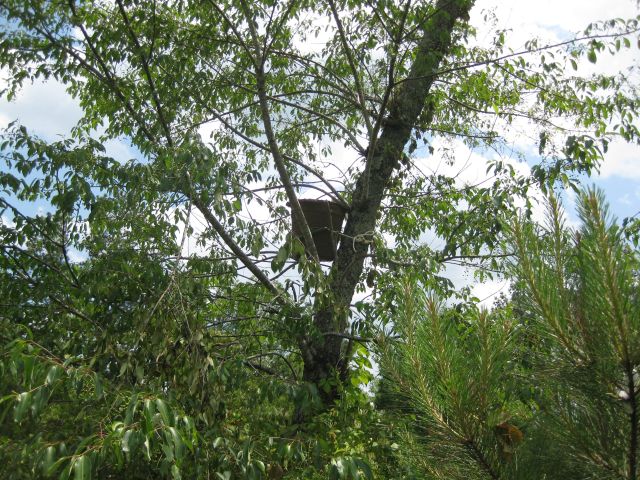
All too much work for me.  So apart from trying to provide optimal living conditions – not too hot or too cold and ample living room, I am a minimalist and keep out of the way.  Until, at a recent beekeeping meeting I learned of swarm traps, and ordered one.  It looks like a hollowed out tree trunk with an access hole at the bottom and a removable lid and came with a swarm lure.  The lure is attached to the lid on the inside of the trap and the trap should be placed 9′ to 12′ above the ground and about 200′ to 250′ from the hive.  I secured the trap to a single standing tree about 180′ from the hive and about 15′ above the ground.   So, with some luck, I may be able to recover my bees if they swarm again.

swarm trap roped to tree beckoning scouts from the next honey bee swarm

splitting the bee hive

I acquired my bees in spring 2010 and am now in my third year with the one hive.  I decided it was time for two hives and there are several ways to go about this.  Rather than buy a “package” or “nuc” I wanted to propagate my existing bees.  After all, they have survived two winters, gave me 4.5 gallons honey last year and appear very healthy and have not needed any medications.  So the genetics are good and, what I should have done, as suggested by a commentator, is used a queen cell in the hive to start the second hive.  Instead I waited and waited for a promised queen bee and had given up hope when, 8 days ago I received an email that there was a queen I could pick up that morning.  The seller is a 10 minutes drive and he had provided me with the nuke which started my beekeeping activities so I have confidence that his queen will be well adapted to my locale (actually he buys his queens from an “excellent” source and I trust him).

queen bee
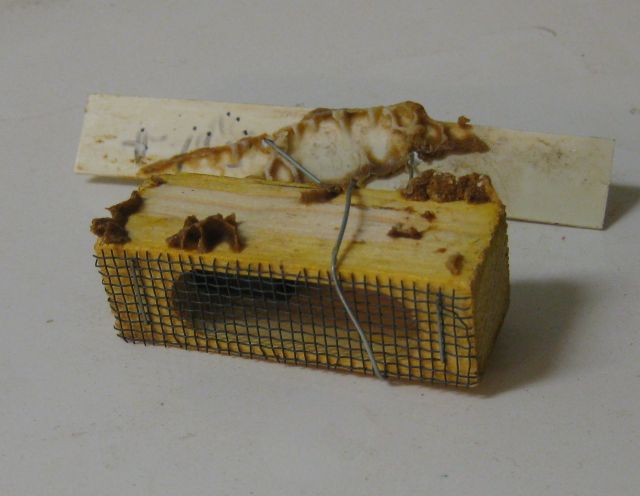
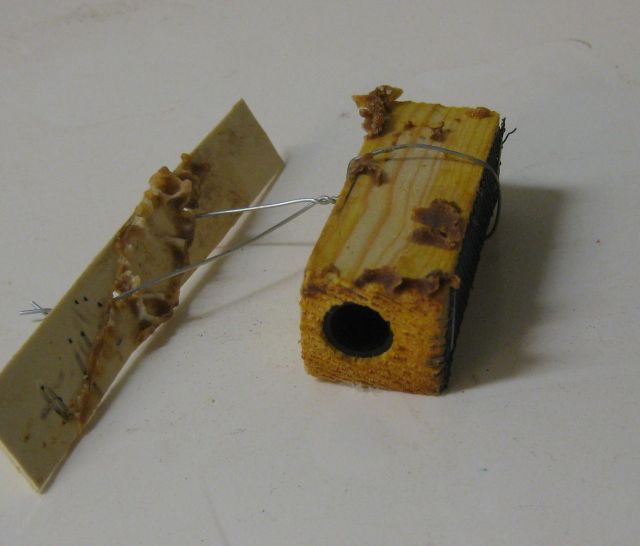
the queen bee cage after the queen was released and wire and plate I fashioned to suspend it between the frames

queen bee
another view of the queen bee cage showing mesh through which the queen is fed prior to her release

So suddenly I had a queen bee and the long wait was over.  The queen is provided in a queen cage which is a little rectangular wood box with mesh along one side and a sealed opening at one of the ends.  I hastened to open my bee hive and, as I had feared it had already swarmed and the queen was gone -I  surmised she was gone since there were no eggs in the cells just sealed brood.  What I mean by this is the queen lays eggs, which after a few days turn into larva and then into a prepupa and then a pupa and then a bee.  After the larva stage the bees seal or cap the cell.  Since I had sealed brood and no eggs or larva it meant the queen had been gone for some days.  There were a number of queen cells on the frames and so I assume, once the bees had ensured there would be a future queen for the colony, a number of them together with the existing queen took off or swarmed to start a new colony elsewhere (and took honey with them to keep them going on this risky undertaking).  If I had been more proactive I could have taken the queen cells out of the hive together with some frames before they swarmed and I could have started a new bee hive and then the bees may not have swarmed because, without the queen cells, there was no ability for the existing hive to propagate itself.  It has been estimated that only 25% of the swarms survive their first year so, quite likely, my former queen and her companions will demise later this year.

I selected 8 frames from the existing bee hive (out of the 16 frames available) choosing 4 with honey and 4 with sealed brood but not with queen cells.  The frames were clustered with bees and the recommended procedure is, while holding the frame above the hive from which it is being removed, to give a sudden down thrust of the frame which sends a lot of the bees off the frame and tumbling onto their hive.  The theory is that field bees (the ones that forage daily for nectar, pollen and water) do not hold tightly to the frame while nurse bees do and so the sudden movement removes the field bees.  So, you may ask, why not have field bees in the new hive?  When bees exit a hive for the first time they study the entrance carefully to memorize its appearance and location for their return after foraging.  However, after this first memorization they don’t bother to do this again since it is wasted effort, they know where their hive is.  So if I had field bees from the main hive in my new hive, when they exited they would have gone food hunting and returned to the old hive.  No gain to the new hive.  Even worse, if they were diligent and noted the location of the new hive, they could have gone to their old hive and told their fellow workers there was lots of honey in a lightly defended hive just 30 ft away.  A suggestion is to place an obstacle at the hive entrance so if you do have field bees when they emerge from the new hive they will see something is radically different and they may decide it worthwhile to take good note and re-memorize the hive appearance and location, and if they do this then they should return to the new hive.

bee hive
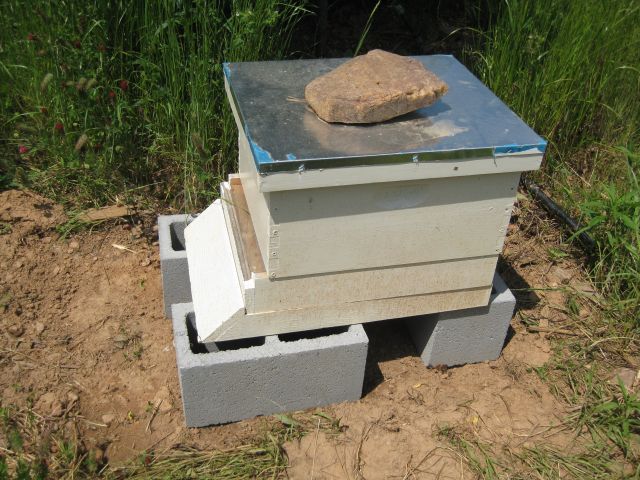
the new bee hive on cinder blocks, not much activity at the entrance

bee hive
the main bee hive with one deep hive frame and two supers, the top one soon to be harvested

I placed the 8 selected frames in a new hive body on the east side of a small fruit tree, which will protect it from the afternoon sun.  As usual my overactive mind got worrying about what could go wrong.  I rechecked the 8 frames in the bee hive and found a queen cell, which I removed.  Next concern – could one of the queen cells have already hatched and I already have a virgin or mated queen bee on my 8 frames.    Young queens are not as noticeable as developed queens – apparently they have more hair and are fuzzier.  I looked but didn’t notice a threat.  Next concern – if there is no queen in a hive for some time then some of the worker bees assume the role of a queen and begin laying eggs but, because they are not real queens and never mated, their eggs produce drones.  And they so take to their new role they may contend with and kill a real new queen.  Enough with the worrying – I fashioned a wire loop to hold the queen cage in position between the two middle frames in the hive body, wished them all well and closed up the new hive.  I checked a day later to see if the workers were balling the caged queen i.e. clustering aggressively on the screen trying to get at her, or whether they seemed happy.  The hive was peaceful, everyone appeared relaxed and content.  So four days after creating the hive I opened it again and removed the tape which covered the hole entrance to her cage.  And, this morning, some days later I opened the hive again and saw the workers had eaten through the candy which plugged the hole and the cage was empty.  I peered fearfully at the bottom of the hive body hoping I would not see a dead queen body, and I did not.  The bees were really very placid, even  a slight jarring of the hive as I moved the frames did not perturb them.  I was working without gloves and without using smoke and I decided to take a quick look and see if I could spot the queen.  She is bigger than a worker bee but size is not the criterion since the drones are also bigger than the workers.  But the drones have big eyes (all the better to spot the virgin queen when she goes on her mating flight) and squat bodies while the queen has a tapered abdomen.  And then I spotted her and she seemed fine.  So I closed up the hive and will leave it be.  I assume she is a laying queen and when next I open the hive I will check for eggs.  In a few days I will add a super on top of the hive body so the bees will have plenty of room for their honey production – for me to savor and for them to get them through the next winter.

bee hive
new bee hive and between frames 3 and 6 you can see plastic securing queen cage
queen bee cage
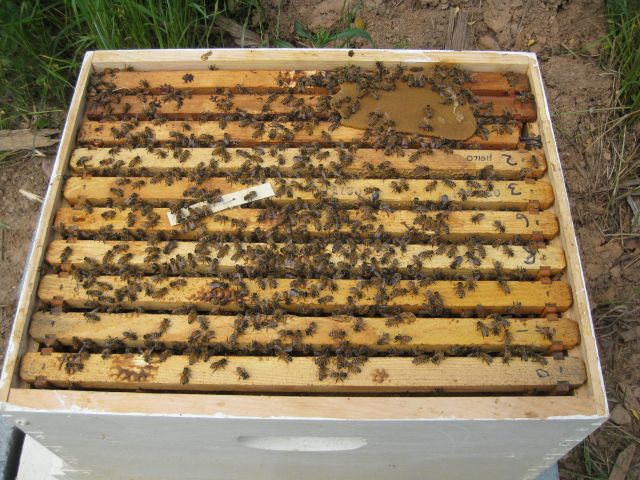
a closer view of the frames in the bee hive, the white plastic strip locates the queen cage


queen bee
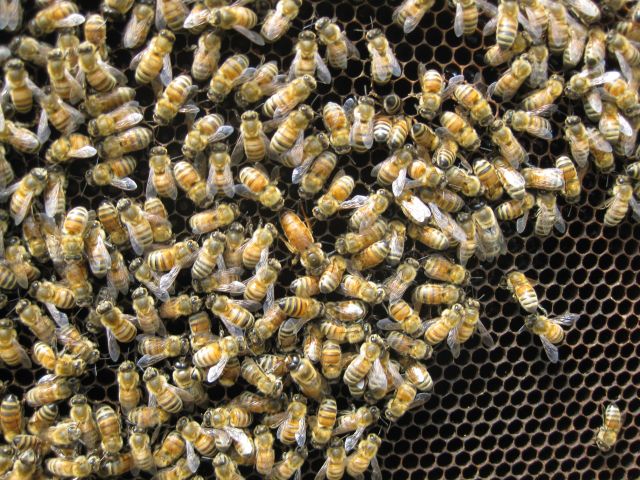
can you spot the queen bee?

bees – “The Lost World of the Kalahari”

I have been spending time with my bees – recently did my first split (split the one hive into two separate hives) and will soon do the first honey harvest of 2012.  So, with bees on my mind, I want to include some excerpts from an engrossing book written in 1958 in South Africa by Laurens Van Der Post titled “The Lost World of the Kalahari” about the Bushmen.

The Bushmen loved honey and used a special herbal smoke to drug the bees before he dared reach for the honey because “the wild bees of Africa are the most formidable bees I have ever encountered.  They are smaller than most but quick, fearless, and quite unpredictable.  In the village where I was born no hive was allowed by special by-law within four miles of the township because one sleepy summer’s afternoon all the bees had carried out a combined operation against everything that moved in the streets and sun-filled courtyards and paddocks.  I have forgotten the precise extent of the casualty list but I remember there were two little coloured boys, pigs, hens, sheep, goats, dogs and several horses among the dead.”

To locate a hive the Bushman had an ally in a little bird called Die Heuning-wyser, the honey-diviner, who loved honey as much as did the Bushman.  When the bird found a nest it would alert the Bushman who would follow it and after harvesting the honey “he would never fail to reward the bird with honey and, on a point of mutual honour, share with it the royal portion of the harvest: a comb as creamy as the milk of Devon with its own cream made of half-formed grubs.”

And if you did not reward the bird?  Why then, according to a narrator at the camp fire “it will punish you heavily….I once knew a man whose stomach was too big for his eyes- no, not a man of my own people but of the stupid Bapedi – he cheated the bird out of its share and the very next day it called on him again and led him straight to a hole where there was no honey but an angry female puff-adder who bit him on his greedy hand and killed him…..Another bird who had been cheated once led a man into the mouth of a lion….I tell you that bird is too clever for a man to cheat.”

the Bees seem ok

The past few days have been warm – at 4pm today (Friday) the temperature is 68 deg F with a slight wind. I have noticed the bees busy at the entrance to the hive and a number of bees helicoptering in front of the hive (i.e going up and down in front of the hive). They do this to memorize the hive so they know where to return. This is good news for me since it means these are new field workers and therefore there is a functioning queen. I am assuming the older bees who overwintered do not need to rememorize the hive entrance.

So, with the happy knowledge that my bees made it through the winter, I decided to make my first attendance at the local bee keepers’ association. The association is fortunate to have, as its leader, a commercial beekeeper “BJ” who is extremely knowledgeable and from whom I bought my bee nuc two years ago. A “nuc” or nucleus was, in my case, 5 frames of nurse bees, eggs and a queen, which I placed in my 10 frame box (I added 5 frames) and from which my colony developed. So last evening I signed up as a member and absorbed the slide show presentation of risks and opportunities for bees during the closing stages of winter. Although I have managed to hold on to my bees for two years and have some idea (though limited) of hive activities, some of the techniques and rationales for frame and super manipulations seemed mind boggling and there appeared to be alternative courses of action as all three instructors chipped in. The key nugget was when BJ said you have to use bee logic not human logic but he then added that it took a long time to learn bee logic – so I will keep observing. Another useful nugget was to make sure the hive is “queen right” which means it has a well functioning queen. This does not mean opening up the hive and finding the queen and counting her legs and checking out her wings – this would be beyond me. Rather it means intelligently looking at the frames to ensure there are new eggs being laid in an orderly fashion (no missed cells) and there are capped eggs – in other words to check that production of new bees is efficient and in process.

I was pleased to learn there is some flexibility in how to keep bees. I follow a minimalist approach which means I rarely open the hive except to harvest honey and quash queen cells so as to forestall the arrival of new queens. The arrival of new queens inevitably leads to swarming when half the colony hives off with a queen. I learned that finding the queen cells is not that easy and to be sure you have found them all you have to scoot the bees off the frame since they are cunning and will hide the queen cells from view.

My main objective for signing up with the association is to learn how to propagate my colony without buying a new queen (I am trying my self reliance jig again). I listened intently when an instructor said he takes the frame with the queen cells and uses this frame to start a nuc. I think he was using shorthand but I will be reading up and trying my hand. He also added that if you split a hive so as to make two hives from one, then the bees lose a lot of momentum in their honey gathering, so it’s a trade off (but isn’t this the case with much of life anyway?)

I am not celebrating that my bees made it through the winter since recent setbacks with some of my chickens have instructed me that my “successes” may be more beginner’s luck than due to any insights and ability. However, my bees have made it through two winters and I attribute this to: a) leaving lots of honey for them for winter food, which I believe is much better for them than sugared water (I opened the hive today and there is still lots of food for them); b) no pesticides or herbicides or any chemicals in my growing activities and, fortunately for me, it appears my neighbors do not use ‘cides either; c) no chemicals used on the bees; d) a well sited hive which has full exposure to the winter sun and is surrounded on the west side by a window and north and east sides by plastic sheeting, all of which provide some protection from the wind and cold (the south side is open for the entrance to the hive). Perhaps I should also give credit to a queen with good genes and, of course, luck.

November tasks

No pics for this post since my camera informed me the battery pack had to be replaced and refused further negotiation.

A pleasurable task, this time of year, is collecting the flower seeds. I did my first Cosmos seeding early 2010 and, from the seeds gathered last November and spread this past spring, I enjoyed a whole new expanse of Cosmos. By November 8, as was the case last year, most of the seeds have dried and spread and are easy to grasp in one’s hand and release into a shopping bag. Lots of Cosmos and every few days I gather more. Also collecting Marigold and Zinnia seeds for new plantings next year.

I am heavily studying permaculture and a recommended plant is the Gumi/Goumi (Elaeagnus multiflora), native to China, Korea and Japan, which provides edible fruit, fixes nitrogen and apparently has medicinal uses. Rather than buy a plant, I bought 12 seeds which arrived after a 2 week trip from NS, Canada accompanied with a note “Has a long germination requirement, often taking 2 full winters before germination.” This will surely test my propagating abilities. For starters, I moistened some seed starting mix and placed, with 6 seeds, in a zip loc bag in the refrigerator. To mimic two years I may remove from the refrigerator in a month’s time and allow to warm for a while and then back into the refrigerator to trick the seeds into thinking this is their second winter. I suspect I will find these seeds are not easily tricked – that’s why I kept 6 seeds in storage for a second go round.

I am also trying, for the first time, to propagate cuttings. I have had success with layering where you pin a low branch of a shrub on the ground, maybe roughen the underside, cover with compost and soil and leave for a few months and, when you return the pinned branch has developed roots and can now be cut from the mother plant and transplanted. Works very well with azaleas and forsythias. But cuttings is something new and, when I have definitive progress, I shall include some pics. I am aware that the best time to be doing this is in spring when the plant is in growth mode, not at the end of fall when systems are shutting down. And spring next year I shall also be trying grafting on my fruit trees.

Next week I should receive some root cuttings of Comfrey, Goldenseal and Jerusalem Artichoke, and also two varieties of mulberry, black bamboo and everbearing strawberries. Just in time to plant before the real cold settles the ground. I have been growing early season strawberries for several years and they were very sweet and spread prolifically. However, their fruiting season is too short, and so I hope to be similarly lucky with the everbearing variety.

With the cooling temperatures I have been progressively winterizing the bee hive. A couple months ago I removed the big sun umbrella which protected them from overhead sun, then I removed the board fence on the west side which protected them from afternoon sun, now I have stapled the plastic sheeting to the frame which encompasses the hive, and I slid in the bottom board, so only the entrance side and the top are open to the elements. I also have left them with a lot of their honey (my last harvesting was August 5) so I hope they will have enough to get through the winter without my having to give them sugared water. Since I do not use any chemicals, I want them as healthy and strong as possible to survive the challenges of winter and their own honey will be infinitely better than a sugared substitute.

And the chicken? The 6 older hens are delivering 3 eggs a day which is ok for now, given the shortening daylight hours. The flock of eight (7 hens and 1 rooster) are now about 6 months old and only one of them (one of the Golden Comets) is egg producing. They love their new coop and seem to be having a great time so I have had a few chats with them about the importance of delivering more eggs – “eggs or the pot” I say to them. In December, if egg production is down, I may use artificial lighting on a timer to get them 14 hours of light and more into an egg laying frame of mind.

bees to honey

The past few days I’ve noticed fewer bees at the hive entrance than a couple of weeks ago.  I’m still a rank amateur at beekeeping so the explanations/fears that came to mind were somewhat exaggerated and untempered by experience: a) half the hive had swarmed; b) worse still, the hive had swarmed and the new queen bee had not returned from her mating flight and the hive was queenless; c) my obstinance against using chemicals had caught up with me and the hive was in collapse from disease, mites etc.; d) there was nothing wrong with the hive and although the temperature was still in the 90’s there was much less humidity and therefore less need for the bees to escape the internal hive heat by clustering the entrance, and they were all still around and industriously at work.

So this morning I gathered dry pine needles, lit the smoker and opened the hive and ….. everything seemed ok.  The configuration from bottom up is two deep supers and one shallow super, which I added 7 weeks ago. All the supers hold 10 frames.   The bottom super is the brood nest area and the deep super above it is where I harvest my honey.  On 5/28/11 I harvested 3 frames, which produced about 1.1 gallons of honey, on 7/10/11 I harvested another 3 frames which produced almost 1.5 gallons of honey.  Today I decided to remove another 3 frames.  All 10 frames in the super held honey and I could have taken nine frames (my extractor handles 3 frames at a time, so the # of frames taken should be divisible by 3) since in north Georgia there are a lot of wildflowers which will still bloom and provide nectar for the bees.  However, I do not sell my honey, so robbing just 3 frames together with my inventory from previous takings is more than enough for gifts to friends and for our own needs through next spring.  And I want the bees to have adequate reserves going into winter so there will be less need for me to feed them sugared water.

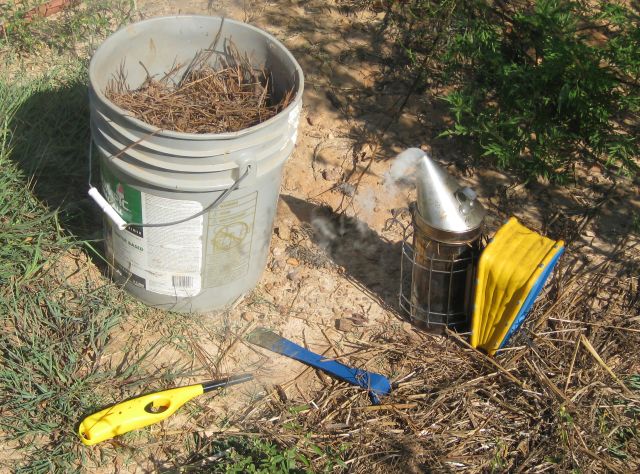
pine needles, smoker, bee hive tool and gas lighter
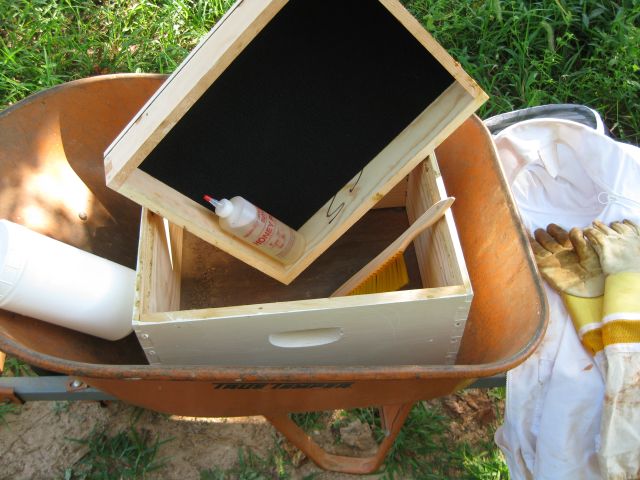
barrow, super, fume board, butyric acid & container, bee gloves and jacket


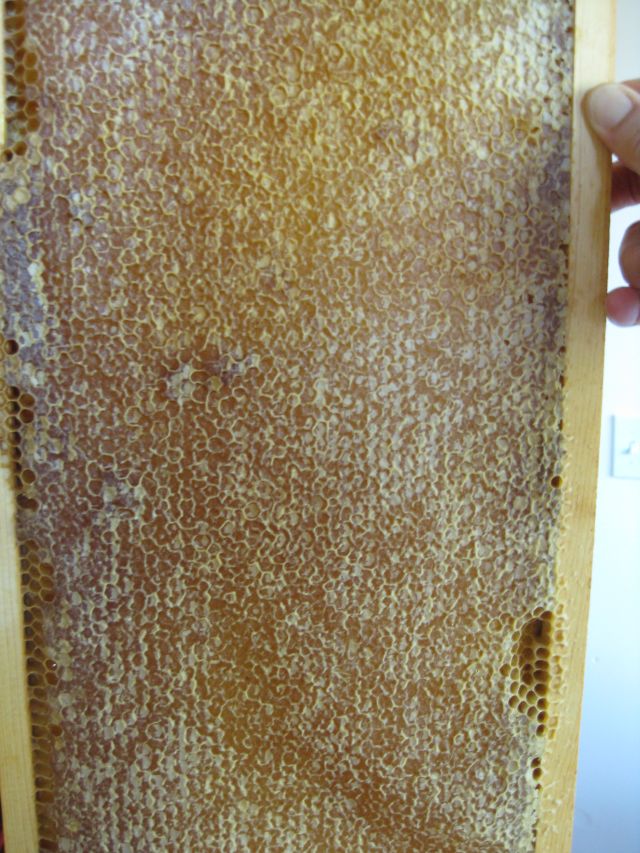
I was asked how I rob the honey.  It is really quite simple.  I trundle my wheelbarrow and equipment to the hive including a fume board, an extra deep super,  a container of butyric acid and my bee brush.    I open the hive and select the three heaviest most capped frames.  The way it works is the bees add nectar to the honey cells and when sufficient moisture has evaporated from the cells, the bees cap the cells.  Ideally, all the cells should be capped.  When I first harvested honey earlier this year, about 30% of the cells were not capped and the honey was too fluid and tasted of nectar, which some of my friends liked, but the more knowledgeable bit their tongues.  So today I was lucky and all the cells on the 6 sides of the 3 frames were honey cells and were capped.

I place the three frames in the extra super I brought along and place it on top of the open hive.  I sprinkle the vile smelling butyric acid on the felt inner cover of the fume board and place the fume board on top of the upper super (the one containing the 3 frames).  The fumes drive most of the bees from the upper super to the lower supers.  I then pick up the super (containing the three frames) with the fume board on top, load them in the barrow and head for the kitchen.  I stop a couple of times to encourage the remaining bees to depart with gentle upward sweeps with the bee brush.  By the time I reach the house I have 3 honey laden frames and no bees.

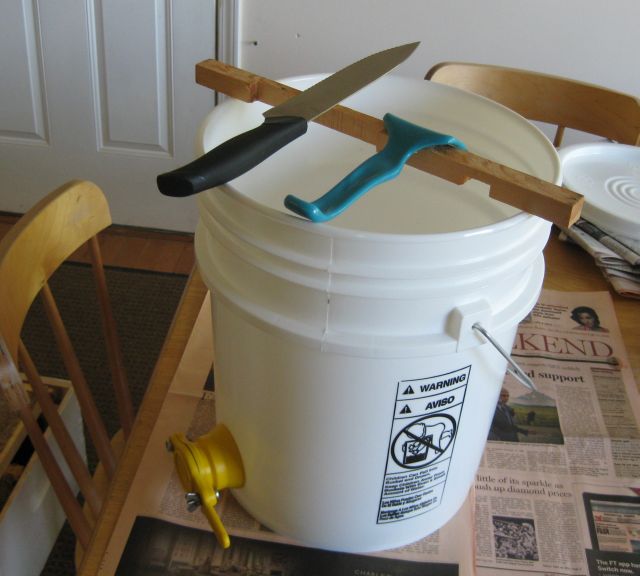
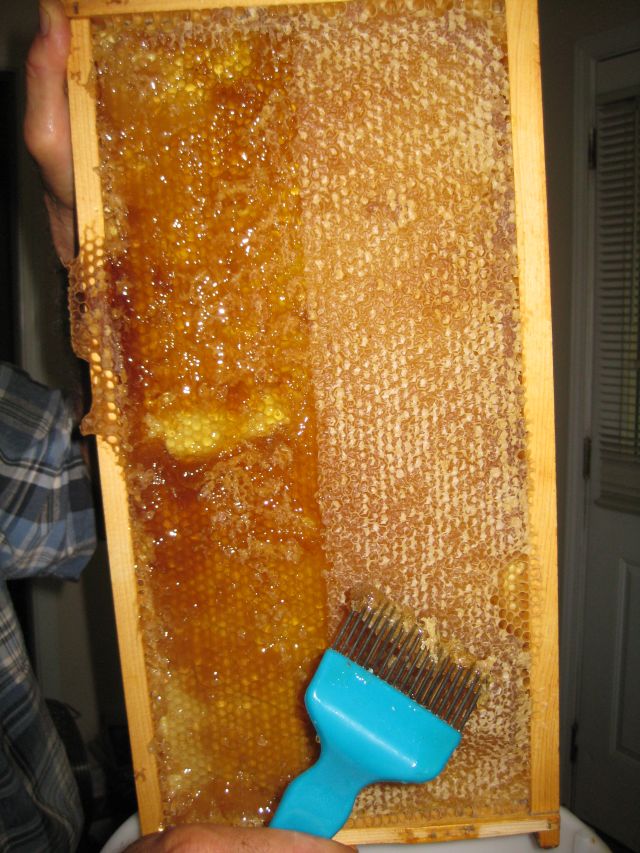
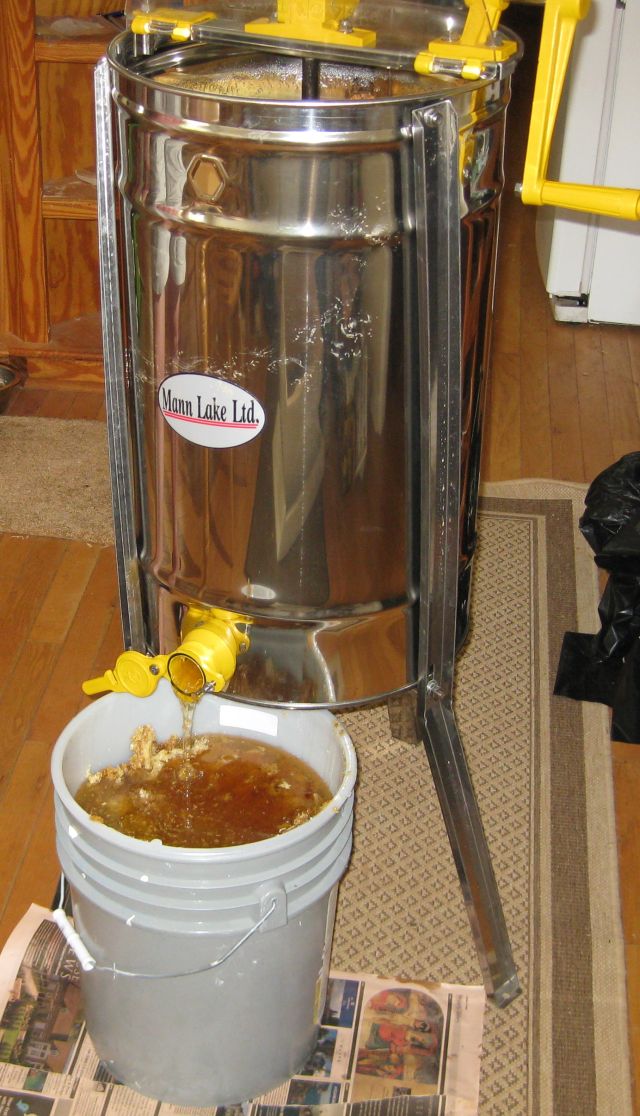
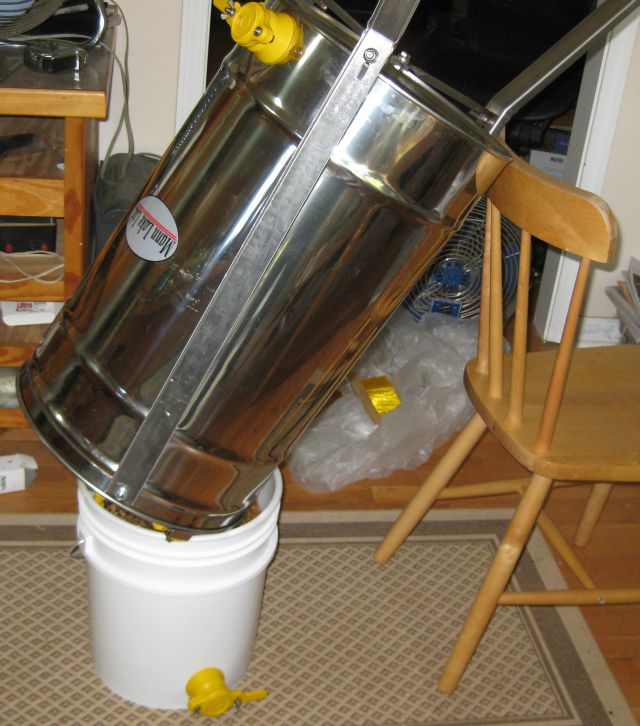
The frames are individually placed on a piece of wood located above a medium filter inserted in the top of a 5 gallon pail.  I use a bread knife or, more often, an uncapping scratcher to remove the capping layer on the honey cells.  Because the temperature is high the wax is soft and the scratcher works effortlessly and efficiently.  I then load the frames individually into the 3 frame hand crank extractor and give them a hard whirl.  The centrifugal motion of the extractor flings the honey contents of the frames onto the sides of the extractor and the honey slides to the bottom.  I then reverse the position of the frames, so their other side is facing outwards, and give them also a fast spin.

awaiting uncapping, 5 gal pail with filter, bread knife, scratcher, wood for frames
a frame of capped honey about to be opened
honey frame, left side scratched, right side still capped
honey from extractor to filter


I return the 3 frames to the hive, place the wax remnants in a container in front of the hive, bottle the honey and clean and store the equipment. The bees readily reclaim their honey remnants and continue with their honey making. The procedures entail a lot of work for just 3 frames and without much more effort I could easily do 6 or 9 frames. Just like with making a loaf of whole wheat bread – a lot of work but a very satisfying result.

saving every last drop at the end of the process