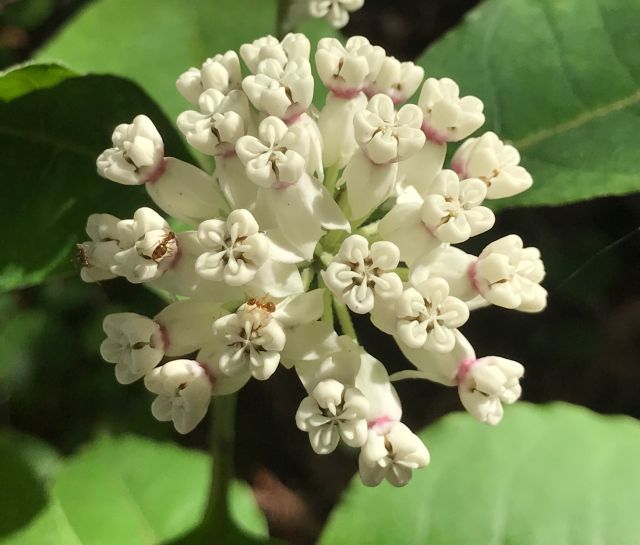
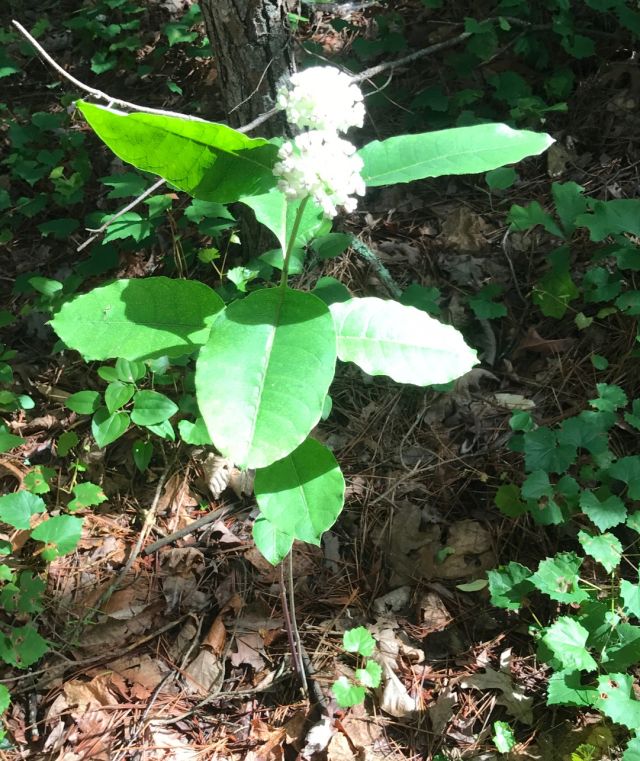
It was M. who noticed them while I, deep in thought, walked right past. From our book “Forest Plants of the Southeast and their Wildlife Uses” (Miller & Miller) she identified it as Asclepias variegata – white milkweed. See picture above showing its distinctive showy 5-lobed petal crown. Milkweed is a favorite of the Monarch butterfly. This is the only one we have seen in the woods and we resolved to collect its seeds and try extend its presence.
per our reference: “All milkweeds are excellent producers of nectar that is attractive to numerous butterflies and other insects”
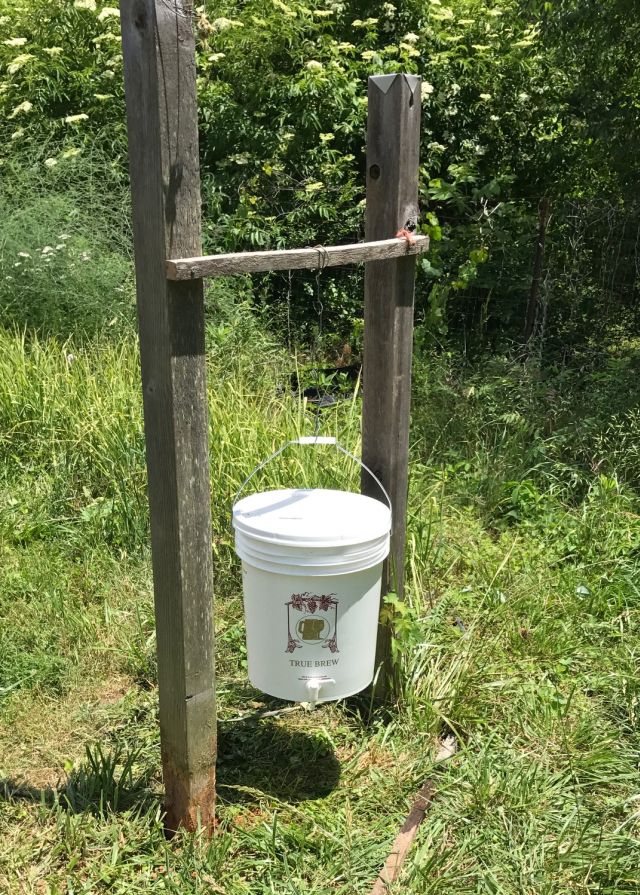
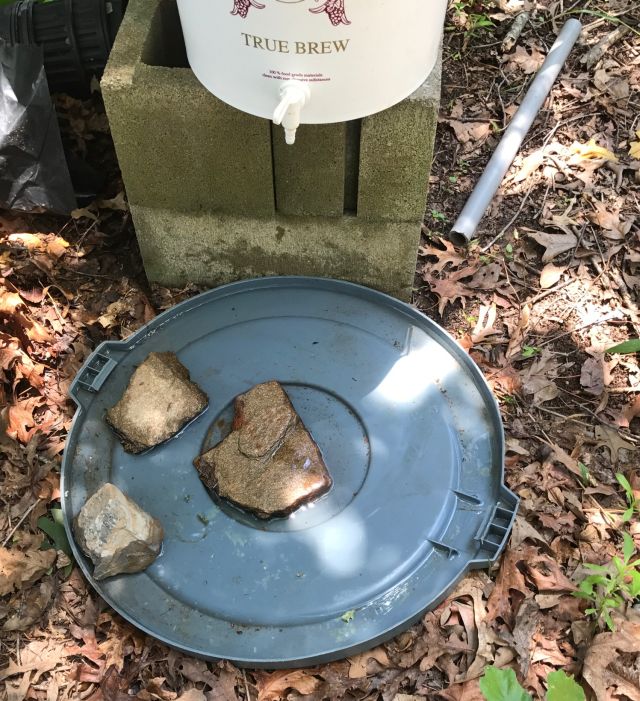
Bees need water and I have not been a good provider. Filling a tray with water and rocks (landing platforms) works as long as I diligently keep the tray full. I am trying a new method – suspend a 5 gal bucket with valve above the tray and set it to drip regularly.
my first location was in the growing area, with the 5 gal container suspended between 2 cedar posts, but it has full sun exposure most of the day
I noticed the water fetching bees were concentrating on the compost area where puddles remained from recent rains.
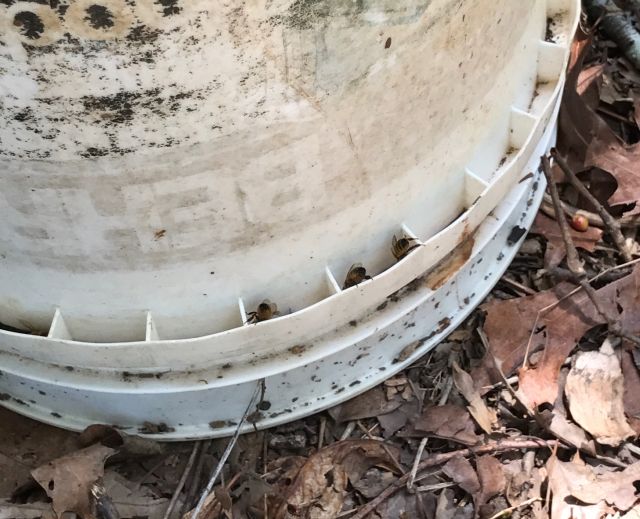
an overtuned 5 gal bucket was receiving a lot of attention – rain had collected in the pockets of the rim and bees were tanking up
The compost heap is much closer to the house and is well shaded for most of the day. I relocated the watering station to the compost area and to entice the bees dabbed some honey on the rocks in the tray.
word must have gotten to base and now the new water spot is regularly visited
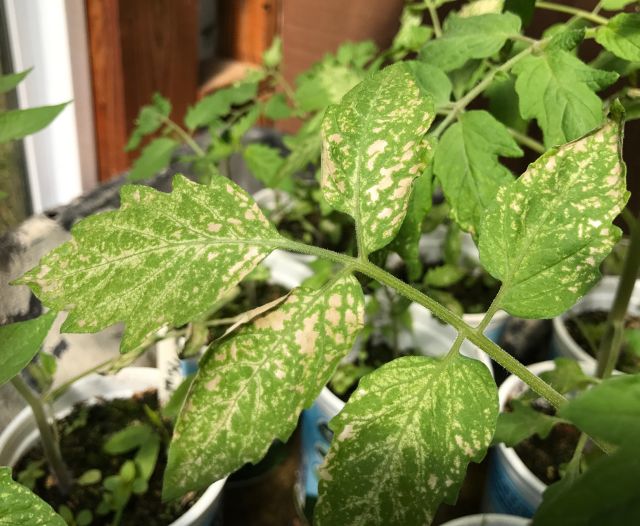
I noticed the leaves of my tomato plants in the greenhouse had white blotches.
white blotches – a fungal attack or too much sun for young plants?
It has warmed up a lot and I suspect greenhouse heat and light is too much for the plants. I could shade them or plant them. A quandary is the average last frost day for Canton, a town to the south, is 4/21 to 4/30 and for Jasper, a town to the north, is 5/1 to 5/10. So on April 10, what should I do? The forecast anticipates no cold weather for the next 10 days. I decided to chance it and planted out 33 tomatoes. If they are not injured by cold them I should have tomatoes before July 4, which is my annual goal. If some are injured, I have plants in reserve. The varieties are: Black Krim (4); Black Cherry (3); Whopper (6); Cherokee Purple (8); German Johnson (5); Juliette(5) and Misc – unidentified (2). So most are heirlooms. The Whopper is a stalwart hybrid producer which was both the first and last to produce in 2016 and, although not as tasty as the heirlooms, does extend the season. The Juliette I collected from last year’s seed and will be interesting to see how they do. The seed for the Black Cherry was purchased in 2015, the remainder in 2016 or 2017. This will be my first tryout of German Johnson tomatoes.
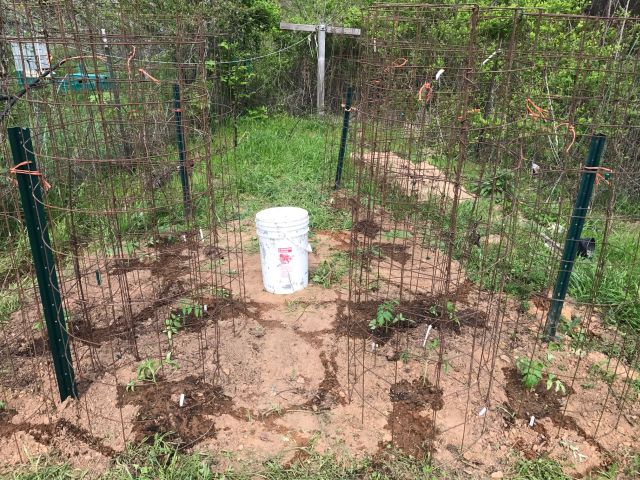
different wire cage configurations
I use different locations each year for the tomatoes and I experiment with different layout techniques. Last year I spread black plastic and inserted the plants in slits in the plastic. Now this may work if you have irrigation lines beneath the plastic which enable diffuse watering, but with my method the water inflow was concentrated where the plant slit was and I had problems with blossom rot which occurs with uneven watering. After introducing additional water inlets the problem was solved. I previously minimized weeding with use of mulches (especially newspaper), but this year I will weed. I use wire cages which I made in April 2012 from rolls of wire remesh (5ft by 150ft) – see my post dated 4/12/2012. They have held up well and this will be my 6th year of use. In the pic above I formed a half circle with double cages along 2 of the edges.
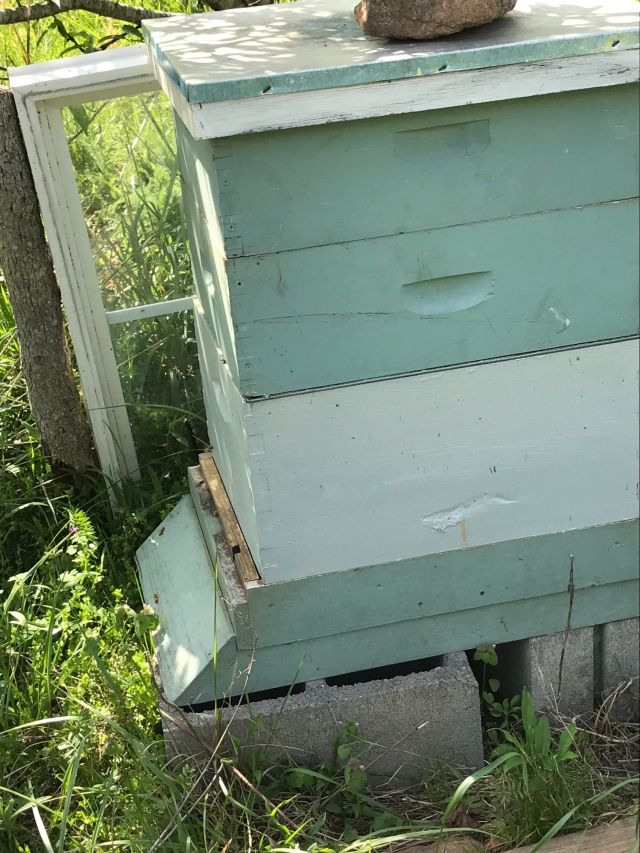
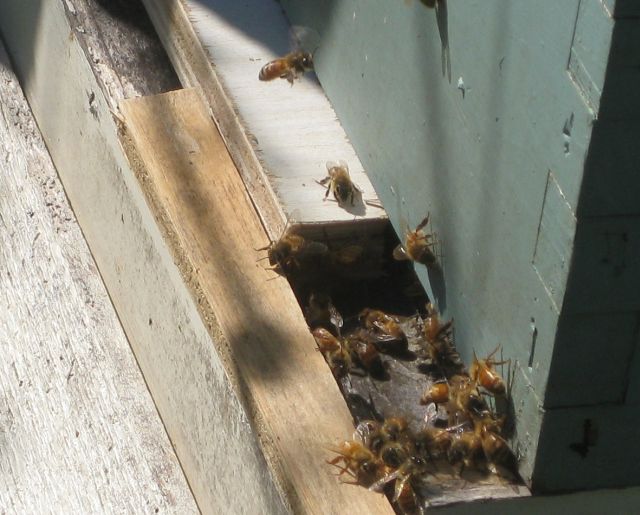
you can see the 2 supers added to the brood box. the entrance is restricted since this hive was previously robbed by bees from the other hive. when numbers build I will remove the entrance restriction
In my March 17, 2017 post I mentioned installing 2 packages of bees. I opened up the hives a week ago not to look for the queens but to look for evidence that they were functioning ok. And I was pleased to see bee larvae in the comb of each hive. Now even worker bees can produce eggs but these will all become drones who do not contribute to the nutrition or maintenance of the hive. So how to tell if the larvae are produced by a real queen or by worker bees? The latter do not uniformly fill all the cells with eggs, so if all the adjacent cells are filled with larvae this is a good sign they were deposited by a queen. And they all were.
With new worker bees on the way it was time to expand the size of the hive from the brood box, where the queen resides, to a couple of added supers where the bees can produce honey, which you can see in the above picture.
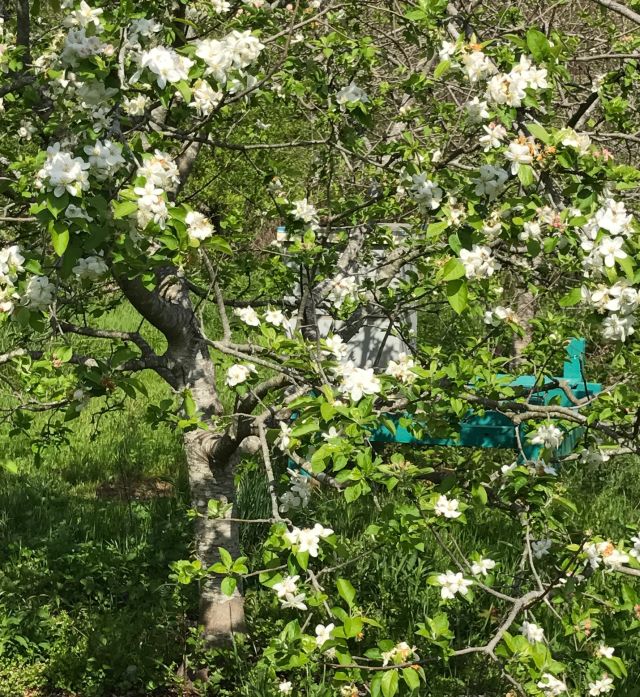
this apple tree is the earliest to bear fruit and its foliage will protect the hive (barely discernible) from the afternoon sun
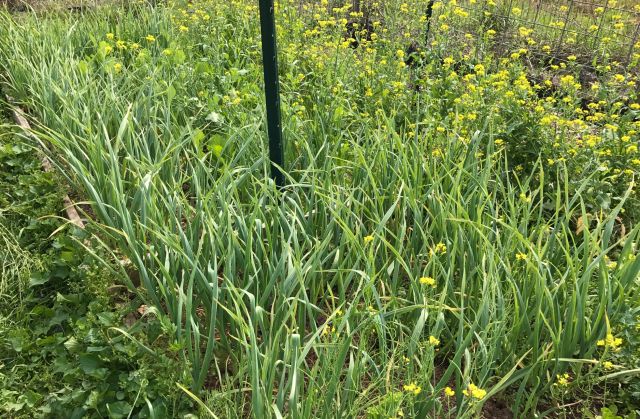
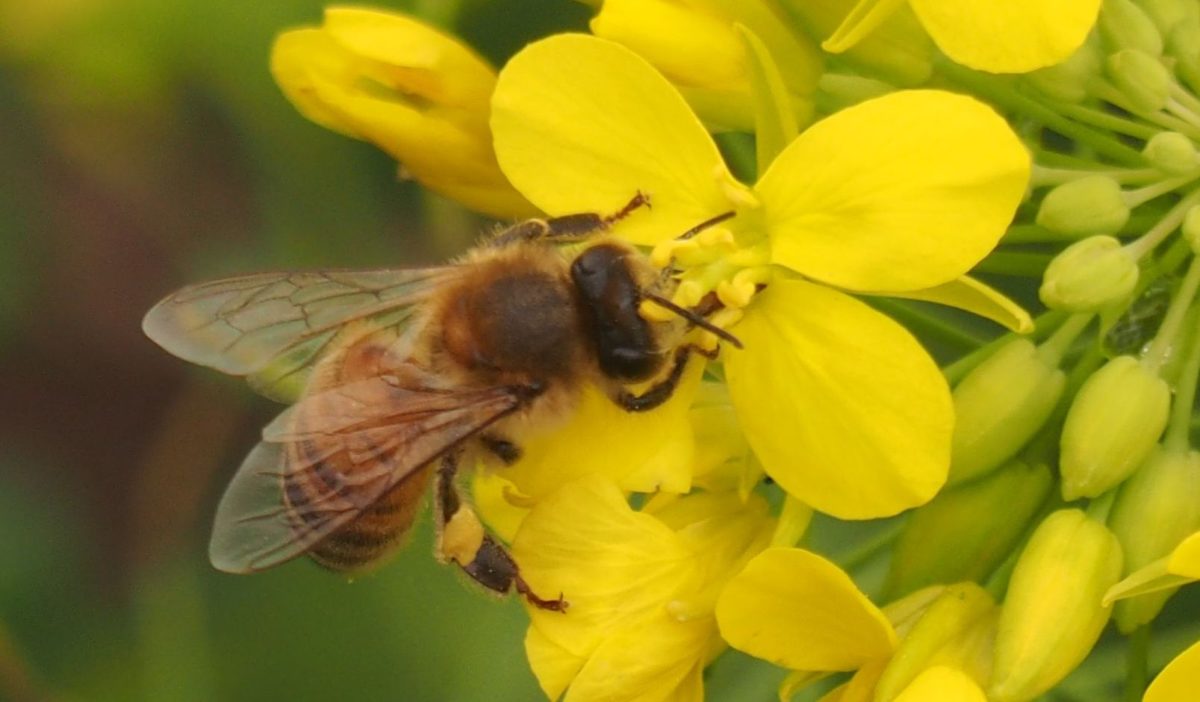
I allowed some of the vegetables to flower and their yellow flowers provide food for the bees and are attractive.
in the foreground garlic is growing well from the recent rains. I met a well traveled ecologist who makes insect sprays from garlic, hot peppers and wood ash. I should learn more since I have an abundance of the first and last
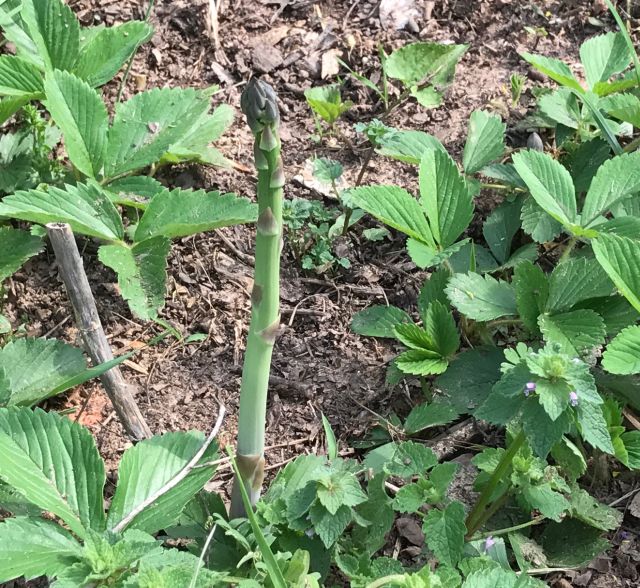
And asparagus are beginning to surface. As an experiment I have added strawberry plants to the asparagus bed and will see how they do together.
asparagus have been delivering in this bed for 5 years
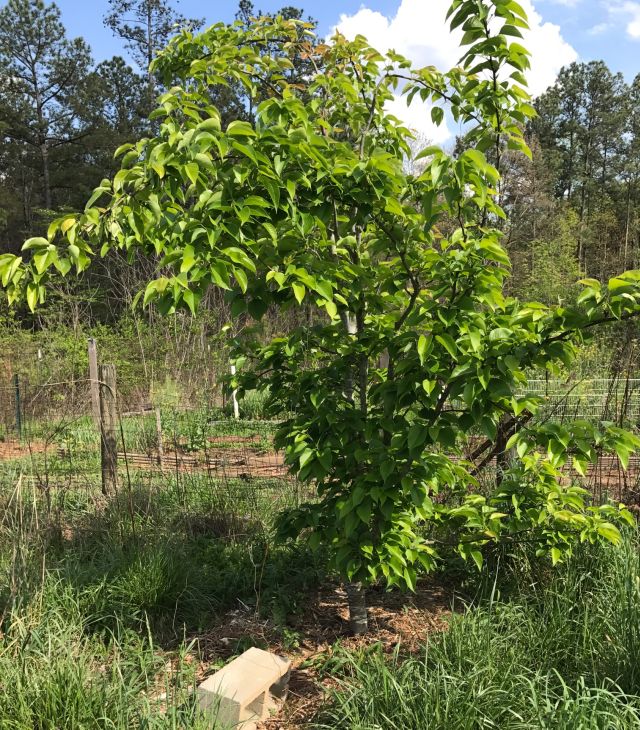
Finally, our most prized fruit tree, the Giant Korean pear which has never disappointed and seems immune to pests. Since all my pears have an upright habit I train them to horizontal with wires stretched to the ground.
this pear tree is looking good and you may notice some of the wires, which are pulling down on the branches, attached to the cement block
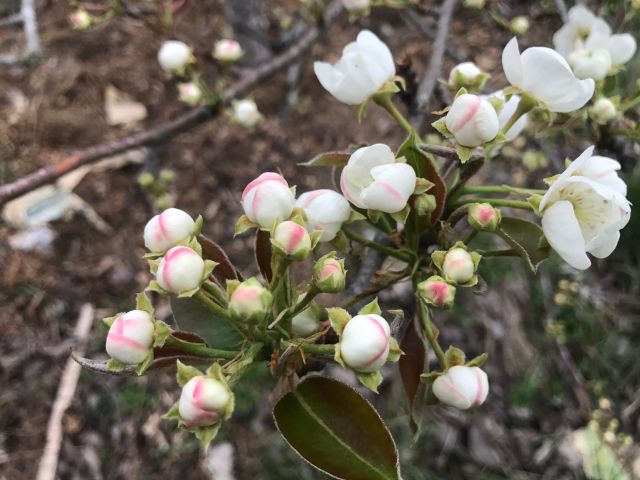
We had (until a few days ago) a very mild winter and blossoms on the pear and peach trees appeared early. My Kieffer pear was the first to produce and the picture above was taken on March 1.
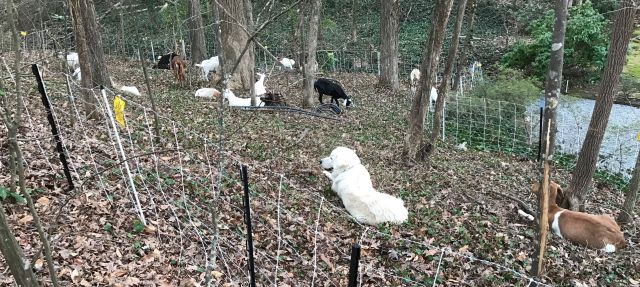
We have kudzu in Georgia but in the suburbs English ivy is a bigger problem and not every one wants to use glyphosate. So in the Atlanta suburb where we also have a house, we were intrigued when we saw a temporary electric fence installed. Our neighbors feel much the same way we do about many things and I asked them if they were renting goats. They will be here tomorrow, come over they said and the next day we visited. There were about 30 goats hard at work including a couple very pregnant goats. My neighbors were hoping a goat would birth during their 2 day sojourn because then they would have naming rights. Did not happen. But all the ivy disappeared.
goats at work with Great Pyrenees guard dog
The Great Pyrenees guard dog was impressive. Big, relaxed, vigilant but suddenly he accelerated toward one end, he had spotted a threat. False alarm or the threat decided otherwise, and he returned to his charges.
And now to the bees. We harvested honey last year and then my bees swarmed and I had nothing. So this was the first winter without bees in at least 5 years. I ordered 2 bee packages and they were available for pickup last Saturday (March 11). Cost $86 each. A package has 3 components – worker bees, a gently dripping can of syrup and a cage containing a queen bee. You only order packages if you have drawn comb for the bees to immediately work on, otherwise you get a nuke which includes frames of drawn comb.
At the pickup location we chatted with an older guy (probably early 80’s) and he said he used to keep 56 hives among his fruit trees and berries. And they were gone. Why were they gone? Mites he said. He and his wife believe that when they no longer have bees their time will be up, so he was buying 4 packages to keep them (he and his wife) going for the next year.
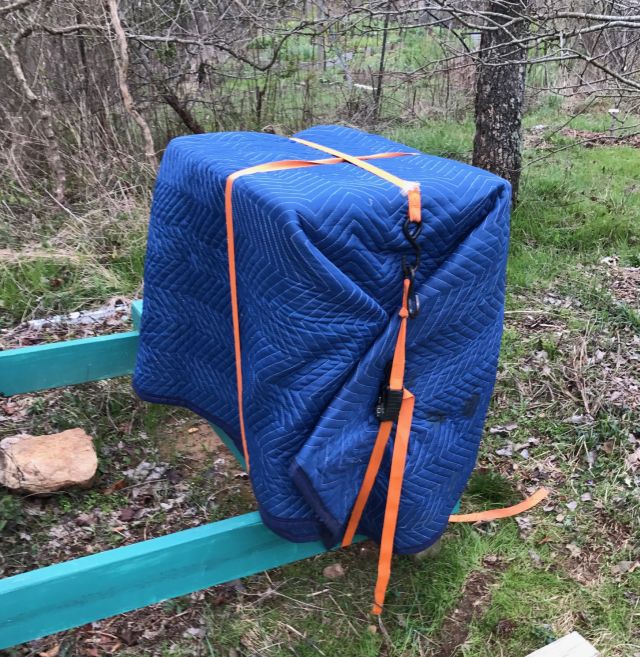
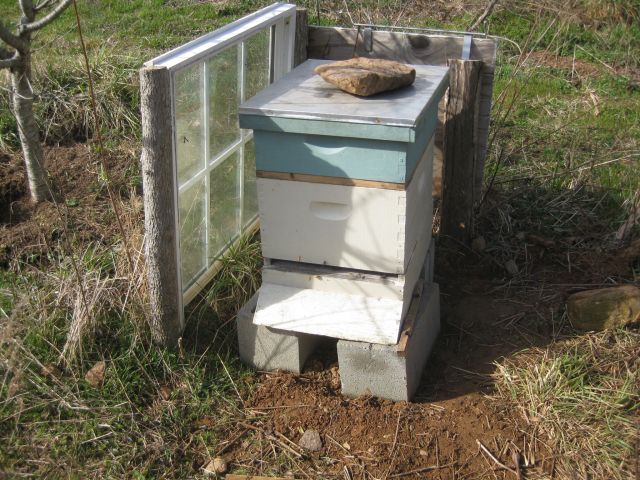
A risk with packages is the bees may not accept the queen. The bees were part of a large colony and now they are confined in a package with a new different queen and if the queen is released too early and they don’t accept her, they will kill her. So you need to keep them as separated neighbors for a few days for the bees to accept her. I installed the packages which means I poured the bees into a hive and attached the queen cage in their midst and provided liquid food and closed them up for a few days. A few days became 5 days because winter returned with a vengeance and we had a number of freezing days. One hive is protected from the wind on the north and west sides by a window and boarding I installed. The second hive has no protection. And since the temps were headed to the low 20’s and no rain in the forecast I draped a thick furniture moving blanket over 3 sides (left the opening south side clear) and strapped it down to secure from the wind.
temporary protection from the cold and wind
Yesterday, Thursday, I opened the hives, examined the queen cages and yes the queens looked fine, and removed the corks blocking the exits of the queen cages and the queens were released to the waiting bees. And hopefully all will go well, though these days with bees it seems more goes wrong than just a few years ago.
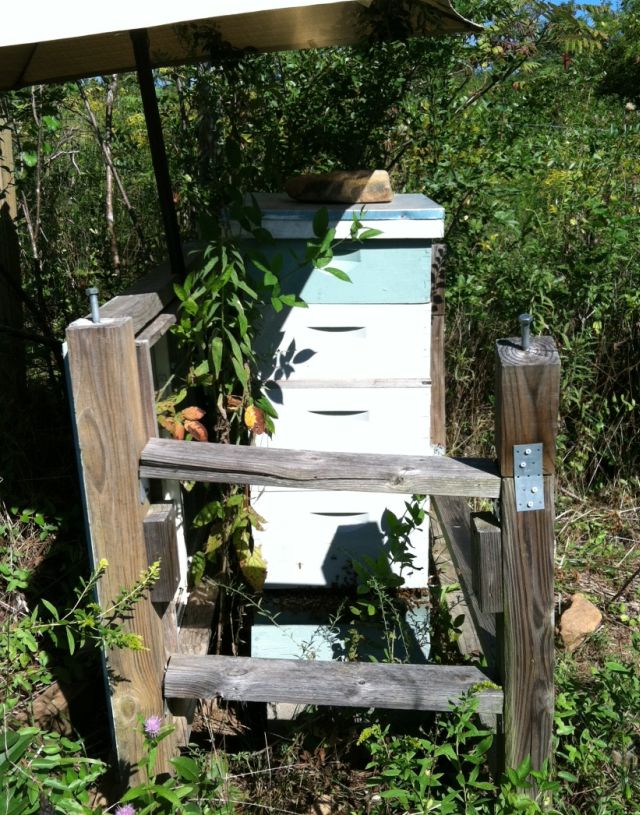
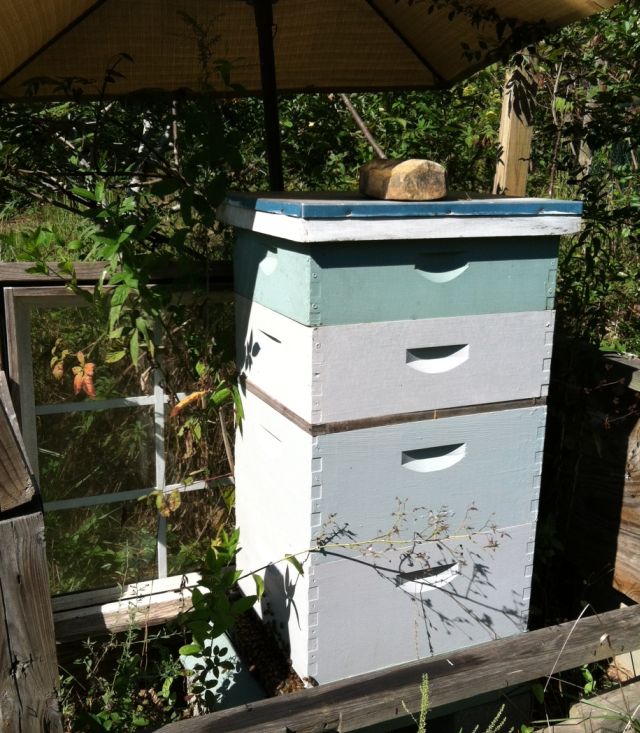
You can see my bee hive above. It faces south, has an umbrella for summer sun protection and a window on the west side to allow the winter sun but not the winter winds. Now that Fall has arrived I begin my winter preparations. There are 2 larger boxes at the bottom, the brood boxes, where the queen resides and the 2 smaller boxes above are supers from which I collect honey. My last honey harvesting was from the top super and I returned the super and its 10 frames to the hive for the bees to repair the comb damaged in the extraction process.
a side view of the hive from the east (access) side, the divider between the bottom 2 and top 2 boxes is a queen excluder – it prevents the queen from moving from the brood boxes to the honey supers and laying eggs where there should just be honey
The bees will go through winter in just the 2 larger bottom boxes and they must have adequate food supplies. So I have to transition out the top 2 supers and then supplement feed the bees. Today I examined the top super and noted the 10 frames had drawn comb but no honey. So I carefully lifted each frame vertically, gently brushed off the bees and put the frame in a separate box. The bees were docile since I was not stealing their honey just rearranging living accommodation. The super below also appears to have no honey and I will remove it in a few days. But first I must deal with the frames I removed.
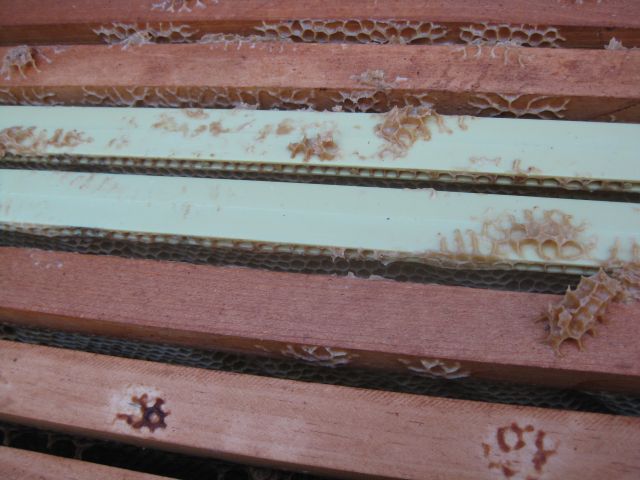
some excess wax on top of the frames which I removed
I scraped off the excess burr comb for my wax collection, and then placed the frames into kitchen trashbin liners, (1 liner had 4 frames, the other 2 liners 3 frames each) and put the 3 bundles into the deep freeze section of the refrigerator. From experience I know I must freeze and kill off the secreted wax moths and other despoilers, and this will take a few days. Then I will store the bundles in black trash bags in the house where they will remain until spring when I will give them back to the bees for the spring nectar flow.
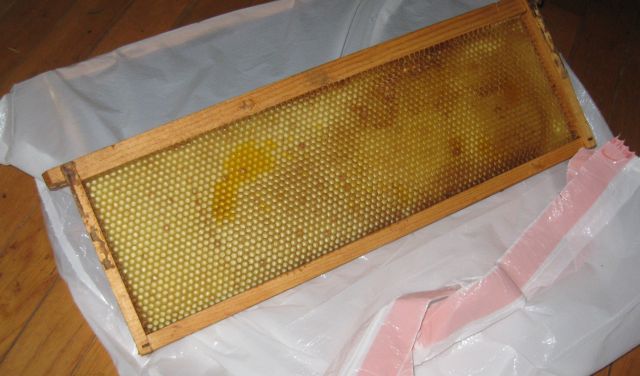
an end frame with some drawn wax, not v. much but enough to give them a headstart
The bees are more productive when they have drawn comb available and do not have to manufacture new comb. So in a few days, when there is room in the freezer I will freeze the frames from the other super. And then I will begin supplementing the feed of the bees with cane sugar water (sounds terrible). But, before then, I hope the good rains we had over the weekend will help the goldenrod and other fall flowers produce lots of nectar for the bees to harvest.
I do not give chemicals to my bees and have been assured that they will die from infections vectored by varroa mites. Maybe not this year, but certainly next year, I am told. I just don’t like chemicals – I don’t take any and I do believe that a strong immune system helps wonderfully. Also I hear the problems – one bee club member dowsed her 3 hives with varroa treatments and now the 3 queens appear impaired (I wonder why) and she wishes to replace them. I also heard that a major queen producer(s) – I won’t say where- had problems with mites and to secure the sign off of inspectors, gave the bees the treatments, was successful with the mites and shipped the queens. Apparently the viability of the sperm of the drones was affected and the egg production of the queens has not been satisfactory.
It seems there are 2 factors – the attacks of the mites and then the diseases which the mites introduce. The varroa treatment nails the mites (until they become resistant and we have to use more toxicity) but also adversely affects the bees and their immune system. Not really understanding all this stuff, I decided I will not medicate my bees and if they make it well through the winter I will maybe do a mite inspection next year and, if necessary, maybe treat them. And maybe its time the queen producers focused more on hygienic (mite grooming) queens with good genes acclimatized to our areas than very productive early season kickstarting queens. But please keep them friendly.
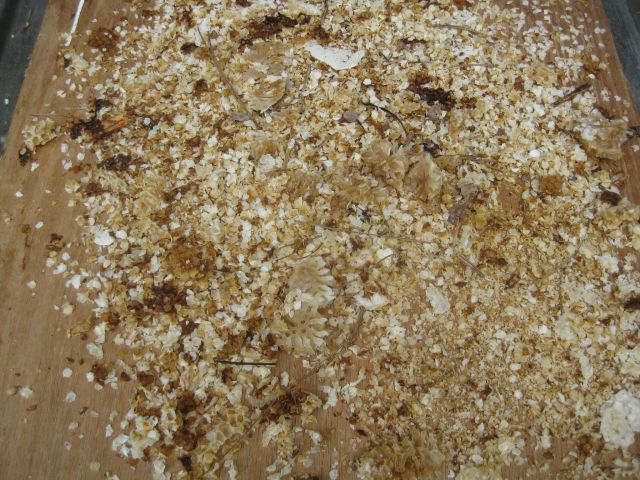
Last week we took about 2.5 gallons of honey from the hive – not a lot since we wish to leave the bees sufficient stores for winter. But enough for our needs for making bread, sweetening our uncooked oatmeal and tea, and a few jars for good friends. Inevitably scraps of wax are left over and what to do with them has been a learning process for me. The first year I placed them in a stainless steel pet bowl outside the hive. Bad idea – the sun heated the bowl, melted the wax and killed bees trying to salvage honey. The next year I added an empty super and placed the bowl in the hive. A few days later when I retrieved the bowl and the super the pissed off bees chased me all the way to the house. The simplest is to put the scraps on a piece of plyw00d near the hive entrance and let the bees take what they wish.
wax scraps cleaned by the bees
And then what to do with the bits of wax?
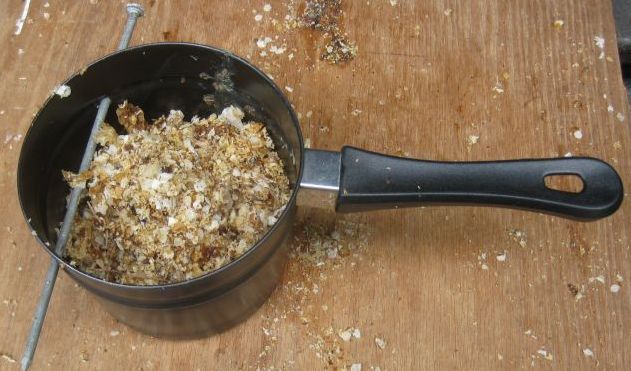
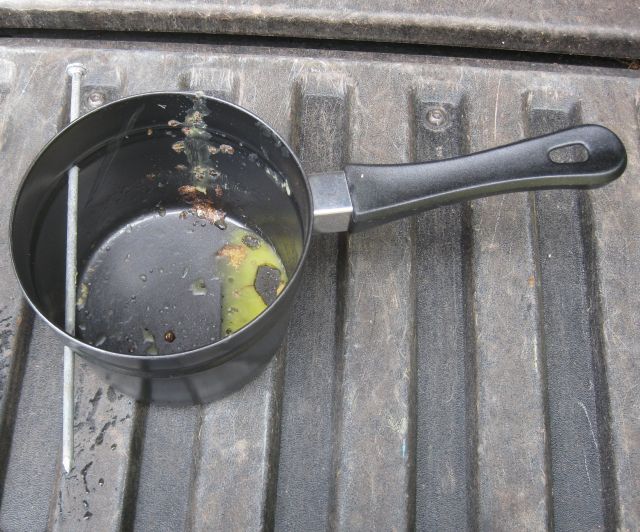
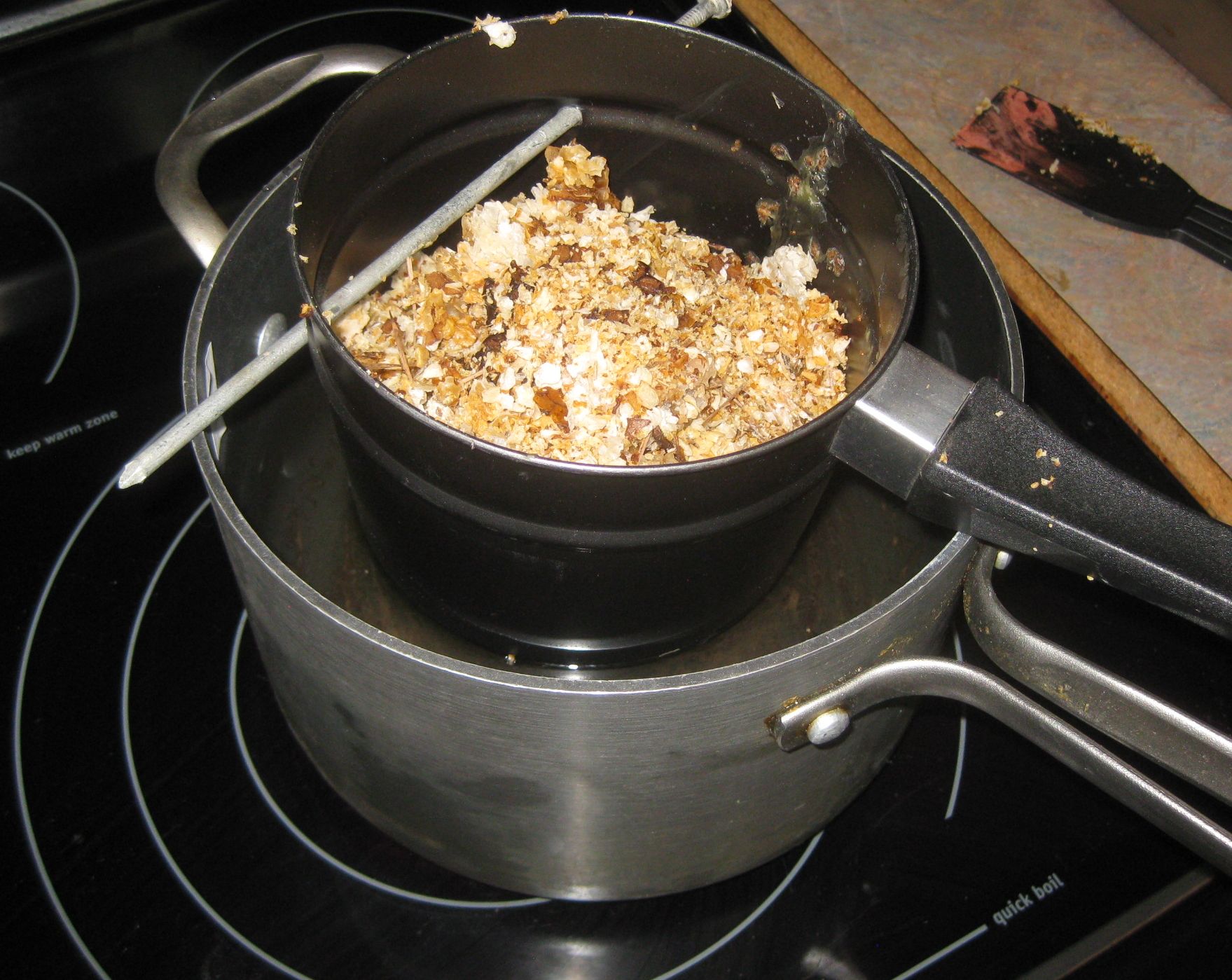
One year I tried gently melting it in a pan over the oven, I turned my back and it all caught aflame. I decided to smarten up and get a double boiler which is a large pot to heat water and a small pot placed inside. But why splurge when we weekly visit the local thrift store. They did not have a double boiler but I found a good large pot ($1) and a smaller pot ($2) which could fit in the larger pot. I solved how to keep the small pot level in the larger pot with the method below.
the pot will only be used for beeswax so driving a nail through the side opposite the handle does not detract from its function
I half filled the big pot with water, inserted the small pot filled with wax scraps, and set the oven to gently boil the water.
once the water reached boil, the wax melted quickly
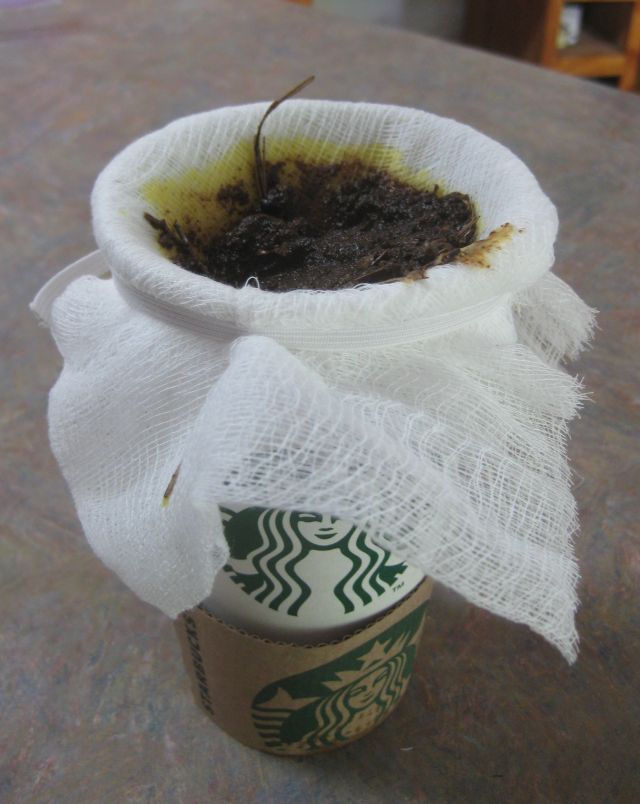
Next I poured the liquid wax through a filter into a mold. Actually it was simpler than it sounds – the filter was cheesecloth folded 4 times secured with an elastic band over a Starbucks coffee cup.
simple setup
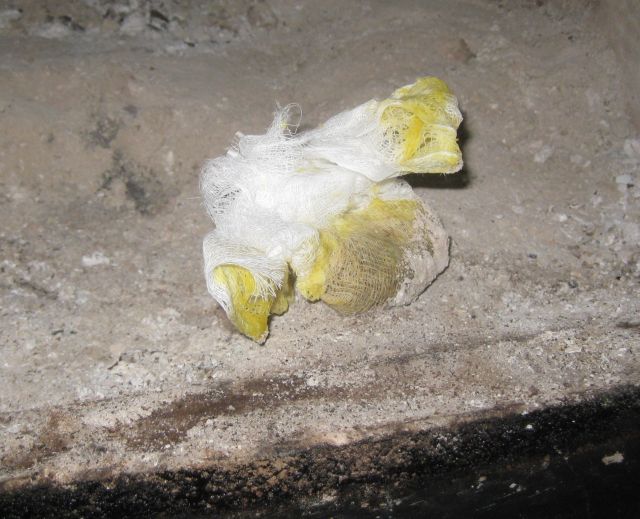
The cheesecloth and wax debris I placed in the wood stove for November to start my first fire.
a scrunched bundle of cheesecloth, wax and debris for a fire starter
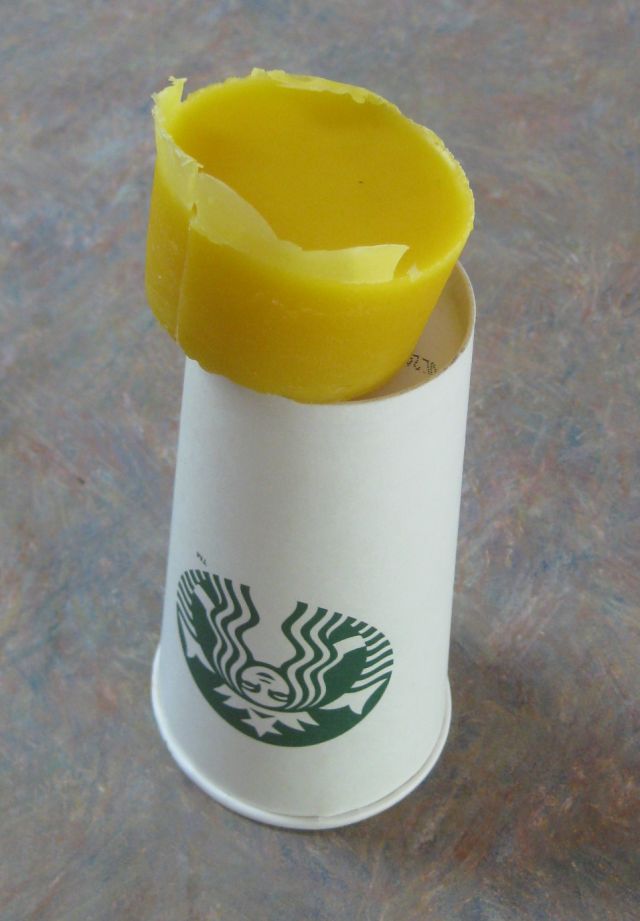
And the wax I will keep – my father in law used to wax screws before driving into hard wood, I may one day try making Dubbin, a leather preservative used in the UK, South Africa and Canada.
It all began when Bill, a club member with several hives 600 feet from the local school, learned that Zika inspired pesticide applications had occurred and would continue. It was little consolation to Bill that the fogging occurred when school was out, since Bill’s bees do not observe the school’s calendar.
The April club meeting was, as usual, well attended and our eyes swiveled to the young man (when you are 66 most look young), Max, who stood uncertainly at the front of the room while the introduction was made. He was the fogger man. He rattled off his pesticide credentials, his training in IPM (integrated pest management), his allergic child and therefore attuned sensitivity to toxins, and said he was there to reassure us that our bees would be ok.
When I was transferred from NYC to the south my then boss took me aside and said “this is how it is. In New York if we don’t like you we tell you to your face, where you are going they are always friendly and you will not be able to tell if they like you or not. Personally, I prefer the latter”. So I watched and listened to the cordial interactions between our members and Max. Hard to discern any animosity, and comments approaching a challenge were couched in gentle assurances would make a statesman proud.
Eventually I asked if these applications could be described as IPM since a tenet of IPM is you first identify the presence of a pest before you begin the treatment; furthermore even if there were Zika carrying mosquitoes frequenting the playgrounds surely when the fogging was done and the spray subsided (and incidentally all the bees in the area nailed), the next day a gust of wind could bring me more Zika carriers. Wouldn’t it be better to larvacide standing water in the area? This opened the floodgate and Max was questioned and acknowledged he had not monitored or identified any Zika mosquitoes prior to spraying; that mosquitoes can and will travel a good few miles in search of protein; and that his ‘cides were harmful to bees.
Our club leaders met with the county school officials, the local radio and TV stations joined the drumbeat and to the relief of our club, all spraying operations have been halted.
However if Zika concerns mount and a vaccination is not speedily developed fogging will increase and insects and bees decrease.
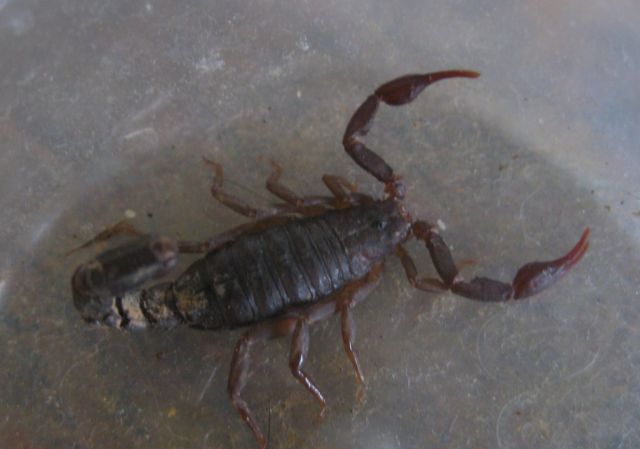
Talking of pests, here are two we found in our house. M. was not happy to see this fellow/gal under the dish washing liquid bottle:
a house scorpion. good practice is to shake out the shoes before putting them on
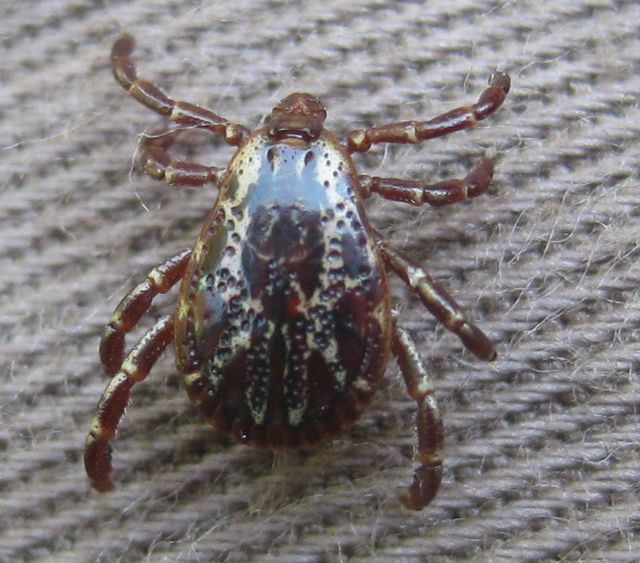
And M. was upset (putting it lightly) to find this on our pillow:
a local tick – there are lots around and my high grass and excessive vegetation doesn’t help
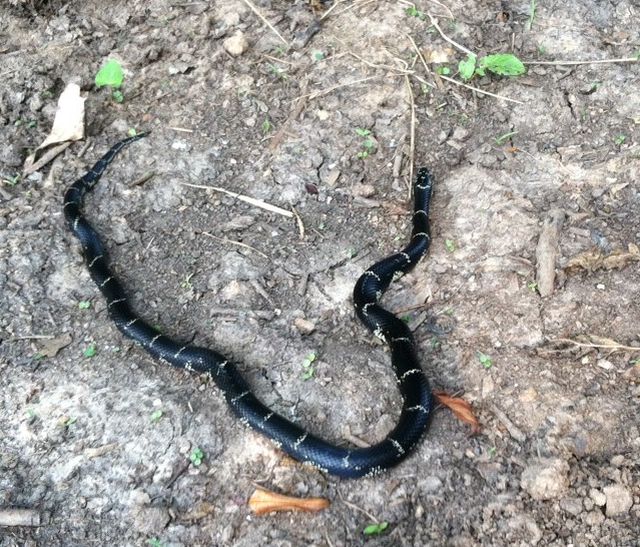
To end on a positive note – I was very happy to spot this young king snake near my compost heap. In previous posts I mentioned how large king snakes >6 feet had vanquished rodents from our chicken coop. I haven’t seen any copperheads at my farm but they are around in our Atlanta subdivision and I attribute this to our Atlanta locals killing off the gentle king snakes, which snack in venomous snakes.
I just finished reading “Guns, Germs and Steel” by J. Diamond. A well documented and persuasively argued book with the main conclusion that peoples in different continents and in different areas in the same continent developed differently, not because of race/genetic/biology differences, but because of differences in their physical environments. Food for thought.
Last year I installed 2 packages of bees on the same day in very similar spots. Both had Hawaiian queens. I watched the development of the two hives. One hive had busy bees and from mid-morning to late afternoon they were zipping in and out of their hive. The bees of the second hive were very different – they gathered at the entrance and there seemed little flying activity. They were idled, as with an extended factory tea break. I wondered what caused this difference and concluded they had bad genes, whatever that means. When I harvested honey in late summer there was no surplus honey in the second hive and lots of honey in the first hive. In fall I began feeding (sugared water) both hives so they would have sufficient reserves to make it through the winter. What puzzled me was the second hive appeared to consume the liquid nourishment more voraciously than the first hive. Odd.
Last week I installed 2 packages of bees and followed the same instructions as the previous year – except last year I neglected item 15 “Insert your entrance reducer, leaving a one-finger opening for the bees to defend. Leave the opening in this manner until the bees build up their numbers and can defend a larger hive entrance against intruders.”
my cobbled together entrance reducer. most of the entrance is barred by the white strip of wood and access to the remaining is complicated by the brown strip
And then the penny dropped! My #2 hive last year succumbed to intruders from the get go and this continued throughout the season. Whatever food the #2 hive forager bees brought home was robbed by other bees. Presumably their guard bees were killed off continuously or became demoralized. I remember from high school an explanation of why agriculture collapsed in the Soviet Union. Once the farmers were disenfranchised from their land holdings and had to meet annual production quotas they became disincentivised and production collapsed. This may not longer be the accepted explanation but it made sense to me then and now.
So my theory is #2 hive was continuously raided and they gave up. And this explains why the food I gave them in the fall was consumed so quickly – the hive inhabitants and the marauders from #1 hive were both consuming the food. And quite possibly the honey I harvested from #1 hive included honey stolen from #2 hive.
Which brings me back to “Guns, Germs and Steel”. If the entrance to #2 hive had been reduced in accordance with instructions, then quite likely that hive would have built up strong numbers and thrived. So you could argue that the fate of that hive was determined by its physical environment – no entrance reducer in the early days when it was most needed.
But #1 hive also had no entrance reducer and the foragers of #1 hive attacked and stole the food of #2 hive. So it was more than physical environment – perhaps there were more bees in the #1 package I installed and this made the difference. Or, as I suspect, #1 hive was just a superior hive and its residents overwhelmed the competition.
“Guns, Germs and Steel” posits that the good luck of certain peoples being in good environments was what made the difference. But perhaps those fortunate peoples were not sited in the good environments ab initio. Perhaps even before the development of Guns, Germs and Steel some hunter gatherers or tribes or groupings recognized that some land was better than others – more water, fish, animal, edible vegetation – and defeated the occupants and took control of the better resources.
And if there is some truth in this, then we are back to the old debate of nature vs nurture.
My recent visit to the west coast set me back on my spring schedule and I have been catching up.
Foremost was to get my tomato seeds going. Last year I collected seed from good heirloom tomato plants and this year, for the first time, I did not purchase any tomato seed. Though I did buy “Surround” (Kaolin clay) which I will spray on my apple trees when the blossoms have set fruit, and the supplier included gratis, seeds for Rainbow and Cherry tomatoes. Plus I had some 2014 and 2015 packets most of which are viable. Although last year I clustered the tomato plants by variety I am sure some were cross pollinated with other varieties so it will be interesting to see what emerges.
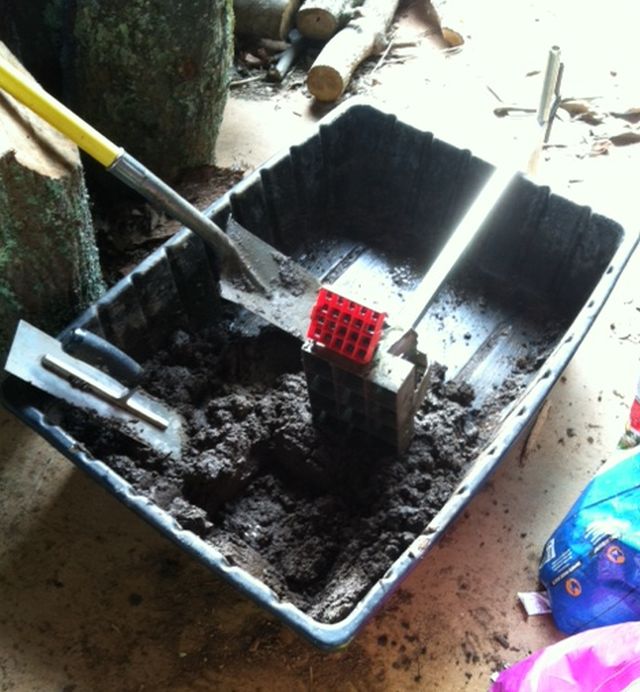
my 2″ and o.5″ soil block moulds
Preparing the 0.5″ soil blocks is quick since I use purchased seed starter mixture. More work is required for the 2″ soil blocks for which I use topsoil, my compost and peat (all manually sieved) and to which I add building sand and lime (to offset the peat ph). When the seeds have germinated and grown about 0.5″ I transplant them to the 2″ soil blocks. And later I will transplant the tomato soil blocks into 32 oz yogurt containers. For maximum sun exposure and monitoring I grow the tomatoes in my greenhouse until they are ready for the outdoor raised beds.
I also germinated from 0.5″ soil blocks lots of other vegetables – the common such as lettuce, broccoli, kale as well as peppers, cucumbers and herbs.
Additionally I have been preparing the raised beds with weeding, composting, dusting with ash from the wood stove and seeding with lettuce, mustard, radish, kale etc. This all takes time and work but the weather is pleasant, I enjoy physical labor and, for the first time, I am using headphones attached to my iPhone and listening to my podcasts.
Each day I carefully collect in a yogurt container the ladybugs which appear in our bathroom and, if the collection exceeds 10 or so, I transport them to the vegetable area where they will work beneficially until again in the fall taking refuge in the bathroom. This they have done consistently for several years, like salmon returning to their breeding grounds.
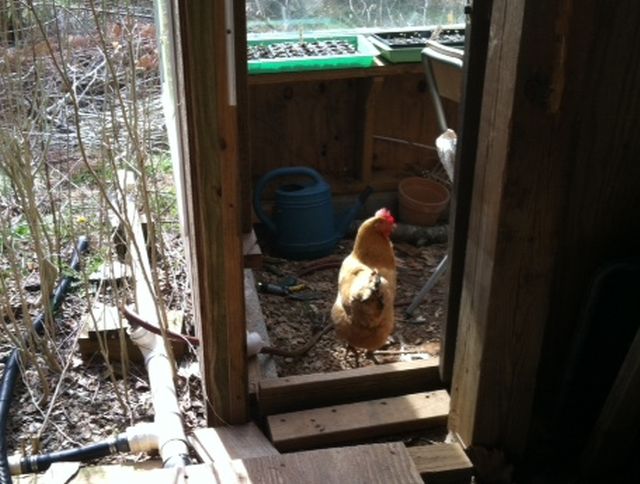
My chickens are free range and I notice Randa (the most intelligent) standing beside the closed greenhouse door. Flashback to when I discovered last year she had made a nest out of sight in the greenhouse with >10 eggs. I open the door for her and when I come back an hour later, she has laid an egg in a little nest she has fashioned. What to do? Initial thought is to keep her out of the greenhouse. On reflection this is not a solution since she will probably then make a nest somewhere hidden in the surrounding growth, as she did 2 years ago and accumulated 16 eggs. So now I leave the door ajar and she lays an egg each day in the green house which I collect at day’s end, together with all the other eggs laid by the normal chickens in the nest box in the coop.
Randa entering the greenhouse
And on Saturday I took delivery and installed 2 packages of bees from our local professional beekeeper who maintains >500 hives and is the oracle of our local bee club.
Now, 2 days after Christmas, the bees are out scavenging. M. says wouldn’t it be nice if they could find food. I say bad idea – if they return with food to the hive, just as a dove returned to Noah’s ark, it will signify good times have returned and the queen will be stimulated to egg bearing. And with no food outside, the new bees will consume the hive’s food supplies and threaten its survival.
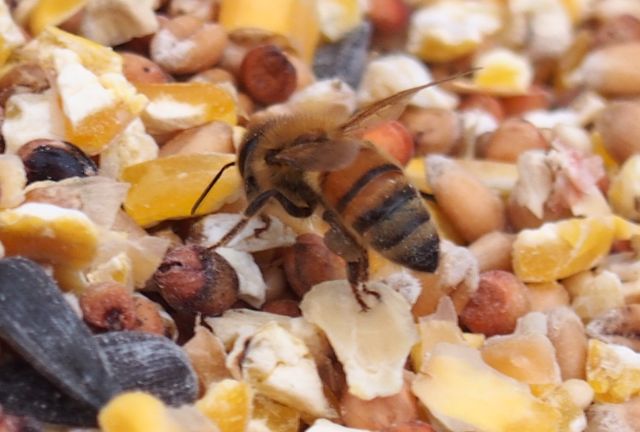
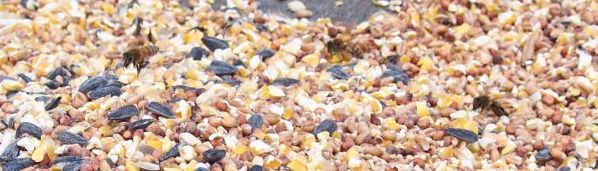
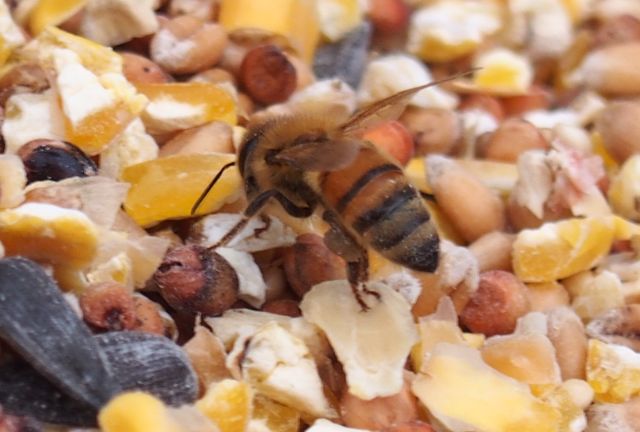
But the foraging bees have found food – the birdseed we provide for our winter dwellers (this morning – blue jay, house finch, chickadee, brown thrasher, tufted titmouse and a solitary woodpecker).
bees foraging birdseed
Perhaps the moisture has produced some fermentation breaking down the starch to release some sugar. A close up
there’s something about birdseed
And with the moisture and warmth more fungi. The uncovered raised beds keep pumping out greens (collard, kale, mustard, chard, turnip greens) and root crops as well.
additions to the salad – turnips, radishes and scallions
After several days rain the sun has appeared, the birds are sounding and Trudy (yes we all age) waits patiently.
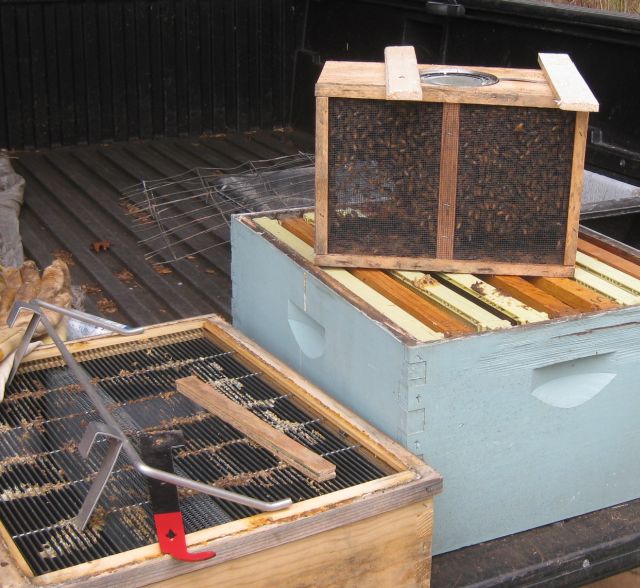
9am March 8, Sunday, was the big day. The #2 packages would be available and I had ordered two (cost $78 each). A package is a small wooden box which contains a lot of bees, a mated queen bee in a small cage, and a tin of sugar syrup.
a package after delivering its occupants. the syrup can is placed in the top hole
The syrup can has small holes in the removable top through which the contents are delivered to the supping bees.
to my mind the slits were too small and I spiked a few larger holes when I provide the can as additional food to the hive
Sunday was a lovely day although 9am new daylight savings time meant an early start to be at the pickup point. BJ our local professional beekeeper arrived shortly after 9am in his flat bed truck at the back of which, covered in tarps were at least 100 packages. After removing the tarps he studied the outer cages and determined that a couple of them had chilled occupants. He started his truck, switched on the cab heater and placed these packages in the cab. The rest of the packages were ready to go. They are held together with long strips of wood and with a large pruning shear he snipped off 2 packages for me. Italian queens he told me as I headed for my car.
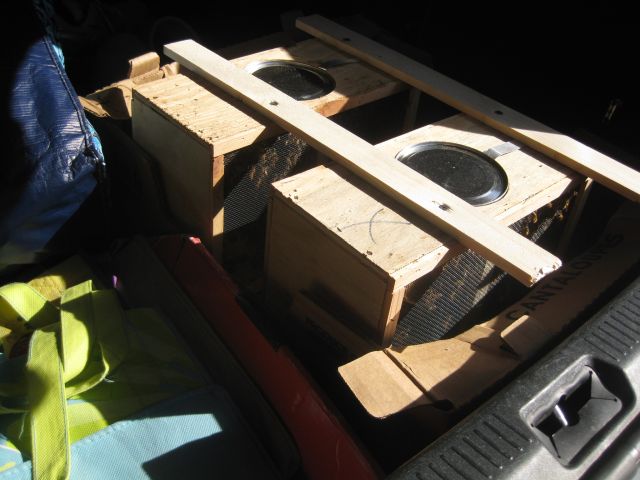
Since there were some bees on the outside of the packages I placed them in the trunk.
Two packages of bees en route to their new home
The two bee hives were ready, my epipen kit was close at hand and I had prepared bee syrup (sugar water 50:50 ratio), so I donned my bee jacket and carefully carried the first package to the awaiting hive. There are usually 10 frames but I was using 9 of which 4 had drawn comb. The reason for using 9 frames was to leave space for the queen’s cage which is small probably 2″ by 1″ by 1″ and contains the queen and her attendants and would be surrounded by 2 frames with drawn comb on each side.
For this procedure gloves are too clumsy. The bees were noisy but I sprayed them with syrup and they instantly quieted down licking the sugar water off themselves. I removed 4 frames so there was space to work. I removed the syrup can and then the queen cage which was covered with bees and was attached to a foil strip. At the top of the cage is a cork which you remove and beneath it is a marshmellow mixture which you leave. I screwed the strip into the top of a wooden frame so the queen’s cage was positioned with the gauze side facing the center. While I was doing this there were bees peacefully crawling all over my hands. Then with the queen cage in position I upturned the package and poured the bees into the hive. Some remained in the package and I placed the package at the hive entrance for them to find their way home. I replaced the 4 frames gently then placed a top feeder on the frames and covered the hive. The process was uneventful.
The installation of the second package should have been easier but I let the queen cage slip to the bottom of the package and then had to reach down among 10 thousand bees to find it and bring it out (not recommended, I should have fished it out with long nose pliers). It was warming up and bees don’t like perspiration and with bees all over my hand as I was screwing down the cage strip I must have squeezed one, so I was rewarded with a sting. But they were remarkably peaceful being young bees without honey stores to protect.
Both hives were voraciously hungry and I replenished their food the following morning. Now they are out and about and a few have found food tho most are just reveling in the good weather and orienting themselves.
one of the hives. it is next to a pear tree which provides sun protection and the window wind protection in the winter. both hives face south
In a couple days I will check on the hives. By then the bees should have eaten through the marshmellow and released the queen and I hope to see, if not the queen and her attendants, then a good laying pattern of eggs.