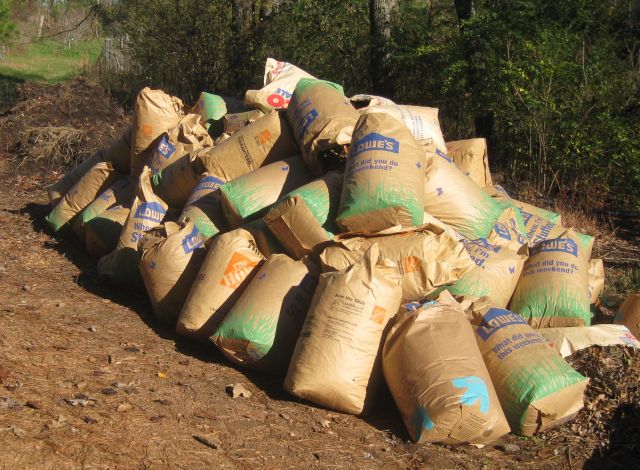
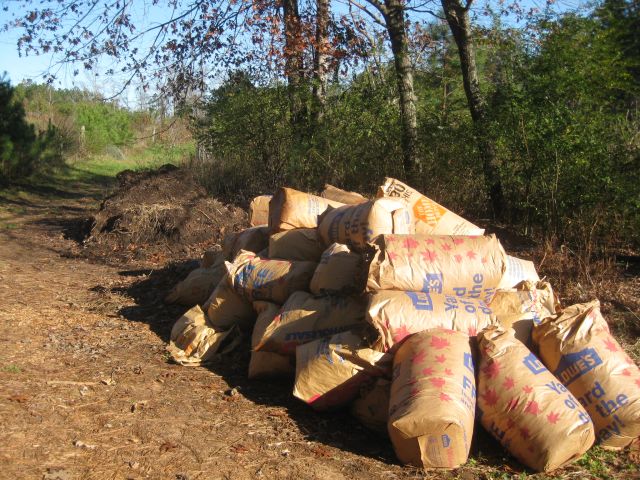
My leaf bag collecting operations produce confusion for some neighbors and emulation with others. A close neighbor, whose current preoccupation is the recent resignation of Mark Richt, the UGA football coach, was unclear whether I was collecting the leaf bags in order to keep the paper bags or for the leaves, and if the latter, why? On a more pleasing but also disconcerting note some, or at least one neighbor, has also begun removing leaf bags from the curbside – new competition for next year?. However, this year I have amassed at least 100 bags and much good compost will result.
lots of leaves, and more on the way
When I have collected all the bags I need, I will break the bags and mix the leaves with other organic materials and compost. In the meantime the dry leaves are enclosed in the bags, protected from rain and wind and achieving little. It occurred to me – why not make a slit at the top of each bag and pump stored rainwater via a hose into each bag. The leaves would be saturated and the bag would prevent evaporation and retain heat produced by the leaves and so the decomposition process could begin even before I mix up all the materials with the bobcat. I will see in a few weeks if this makes any difference.
the cable sizing conundrum
I need an extension cord for 12 volt dc 3amp power and referred to online calculators which produced very different recommendations. So I tried doing the calculation myself and was pleased that one of the websites has similar calculation results though 2 others recommend much thicker cable. This is not my area of expertise so you should go with the recommendations of a reputable site, but for interest only, my calculations are under the self reliance tab/ups.
Today is Nov 20 and, after lots of rain earlier in the week the past few days have been in the 60’s and 70’s and no freezing temps yet. So my fall greens (collard, kale, turnip greens and radishes) have been doing really well with minimal pest evidence.
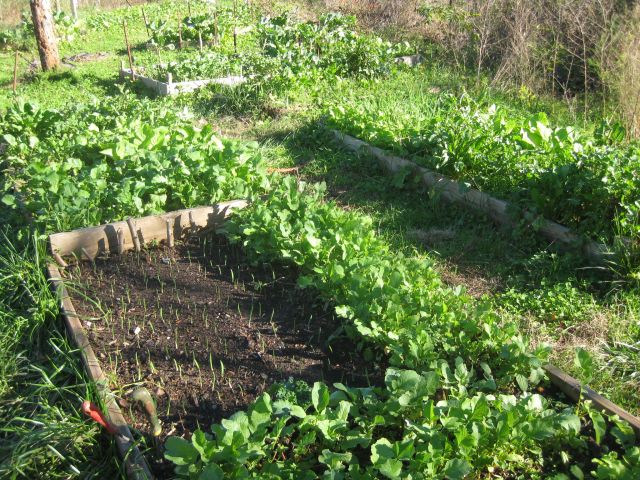
raised growing beds filled with green or garlic
Each year I get a little better. I pull the weeds early and cover the growing areas with growth. Garlic is different since it does not provide shading leaves and does poorly with weeds so I weed carefully before planting garlic and then keep the area clear of weeds. I am trying to upgrade my garlic and as mentioned earlier this year, I kept the larger garlic cloves for replanting, rather than consuming them first.
comfrey, radish and others
Radish is so easy to grow I grow plenty of it, tho I know with the first hard freeze the radish will become soft and inedible. I had my neighbors over to help with picking and eating the greens. My neighbor’s wife is industrious and grows many vegetables during the summer (conventionally) and cans them (in bottles) for year round consumption. I think she may decide to do fall crops as well. They were intrigued with the comfrey and I promised them some root cuttings. It grows very well in our area.
Blueberries
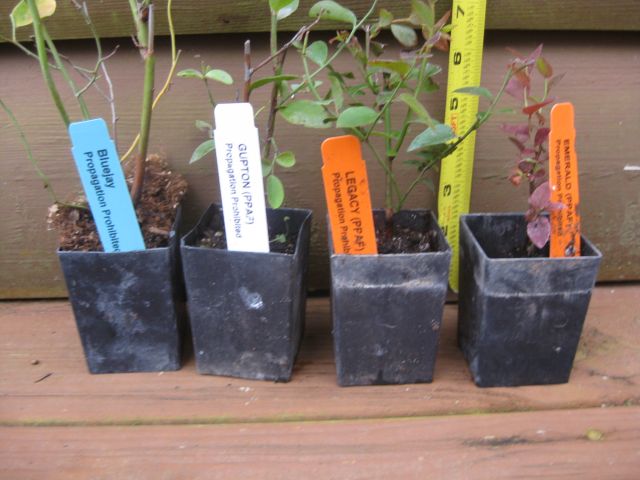
I have a reasonable annual yield of blueberries but nothing like the orchards (if that’s the right word) of blueberries I saw in south Georgia and Oregon. Most of mine are Rabbiteye which is a southern variety. They seem fastidious with a predeliction for acid conditions and because of their small roots they need food and moisture close to hand. I decided to branch out and bought 2 Southern Highbush and 2 Northern Highbush.
rather small Highbush varieties
Compost
My compost growing is now well established with organisms which thrive on my local mix of leaves and greens. This year I excluded horse manure from the mix out of concern for the lurking ‘cides which may have been given to the fields and horses. Now is leaf bag season and my Tacoma pickup makes the Atlanta subdivision rounds gathering good bags which I stockpile at the Atlanta house and transfer to the farm, 12 bags each trip. The pickup has >216k miles and is >10 years old and performs very well. However, rather than wear it out I purchased an alternative more fuel efficient vehicle which I will use when there are no loads to be transported.
leaf bags for the new compost heap and behind is the old heap
shoe repair
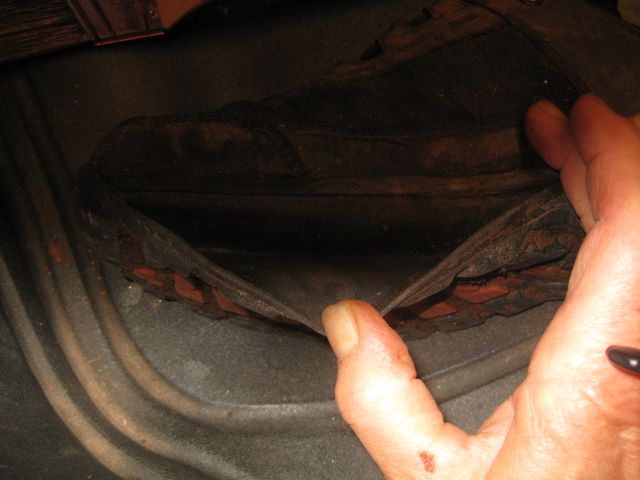
I was disappointed when the sole of my very comfortable, relatively new outdoor shoe detached from the upper. My bad really since I was sideswiping the gravel (see post on gravel drive) into place and they were not designed for this.
right shoe with detached sole
This was the second pair with a detached sole and I decided to try repair them. I ordered shoe goo and used it for both pairs and it seems to have done a good job.
my tube of shoe goo which is working for me
update – the shoe repair has not held up as well as I had hoped. I will not malign the glue I used since the cause could be the surfaces being glued were not in pristine condition or my technique was faulty.
ups
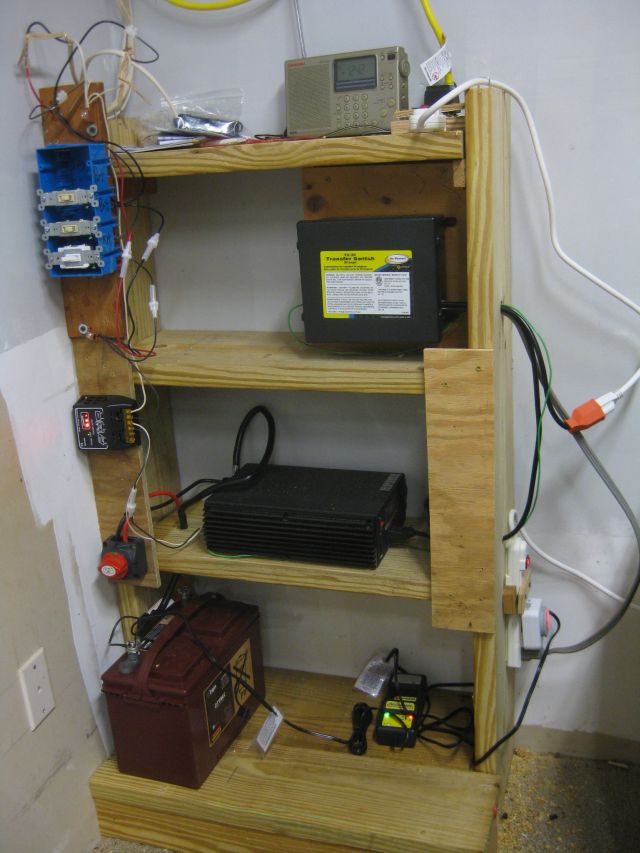
No, not the shipping company but uninterruptible power supply. For both security and convenience. Security because if there is a local power outage or if bad guys simply switch off the power supply (after breaking through the locked steel cover) and wait 30 mins for the backup security battery to run out, then the house is defenceless – no security system, no internet connection, no security cameras. And if I am in the house and the power goes out then no internet access since the modem and wireless router will be off. Below is a pic of my system which I will amend and expand and eventually connect to solar panels.
my ups system
I will provide more info on the system at a later date under the “self reliance” tab on the website. It has several components:
a deep cycle battery and smart charger on the bottom shelf with a marine on/off dc switch;
the second shelf has an inverter which converts dc power to 120ac household current and a solar power controller. The controller is to prevent the 3 dc led lights from excessively draining the battery;
the 3rd shelf has an automatic transfer switch. While utility power is on it powers the load (security system, security cameras, modem, wireless router). When utility power is off, the battery powers the load. You can also see switches for each of the 3 dc led lights and numerous fuse links – it took some time to figure the best fuse size.
the yellow cable on the top shelf goes to the load – it is 12/3 size and I did cable sizing calculations to determine a size which has acceptable resistance loss.
I will provide more info and calculations in the self reliance tab over the next few weeks.
My drive is 220 ft long and is a gravel drive with most of the original gravel buried, worn or washed away. Time for a new face. I contacted the local trucking company and dispatch was not available but the accounting lady, who acknowledged she was not very knowledgeable about gravel, suggested that #34 gravel would work and that it costs $30.50 a ton. A ton is 2,000 lbs which is what she was referring to, though there is also a metric ton which is defined as 1,000 kg which equates to 2,204.6 lbs. The trucking company uses 17 ton trucks so a truck load would be approximately $518.50 (17 * $30.50). I asked her to check with dispatch for a shipping date and to confirm that #34 was the right grade gravel. She called back with a shipping date and said dispatch also mentioned #57 gravel but she wasn’t sure which grade dispatch recommended. Time for research – and I found that #34 is 2″- 3″ diameter, and #57 is 0.75″ to 1.5″ diameter and is the recommended grade for drives. (Larger sized gravel can be used as the base on which #57 is packed, but my drive does not need a base.) So I ordered 2 truck loads of #57, which costs $28.50 per ton.
The drive is reasonably smooth and on a hill and I previously dealt with crossing rainwater by digging a diversion ditch on the uphill side of the drive. Delivery day it was raining incessantly and continued for the next day and until lunchtime the day after. Which is when the trucking company called and said they would really like to deliver the 2 loads. When the truck arrived I asked the driver if he could spread the load as I have seen often done by slowly raising the bed as he drives slowly forward. He said this needed chains and, after a pause, that he had chains in his cab. Clearly this was a favor. And I tend to be independent, eschewing favors. I said do the best you can without chains. To do this he said he would have to angle across the drive and his left rear wheels skewed off the drive and began churning up mud. I said to forget spreading and just dump the load on the drive. Which he did and took off for the next load.
And now to spread the 35,000 lbs of gravel (17 tons*2,000lbs) I fired up my bobcat which I repaired painfully slowly earlier this year (see posts). It worked fine and I had almost all the gravel spread when the dump truck arrived with the second load. Total delivered was 35.94 tons at $28.50 for a total of $1,024.29.
I will not say it was easy spreading the gravel since it has a tendency to slide off to the sides of the drive and my objective was to do all the work with the bobcat and minimal work with a shovel. So it took time and looked a bit disheveled when I was done. But next day I started packing it down with my Murray lawn tractor and it is looking better. Some collateral damage – the large wheel ruts on the side of the drive are still prominent and the raised truck bed ripped away a large branch leaving half behind which I sized down safely with my powered pole saw. And, I hope with time, the gravel will pack down nicely and give years of service.
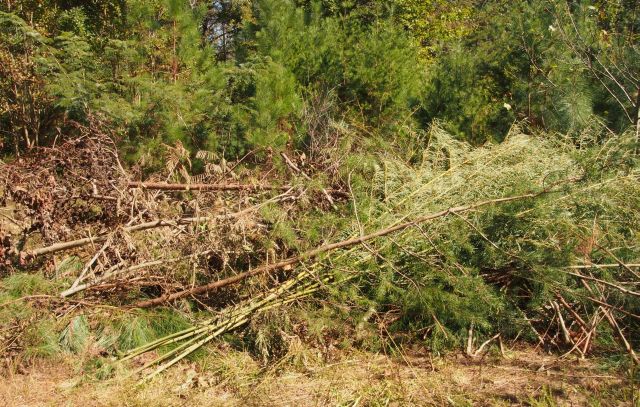
I am in a holding pattern and were it not for the glorious weather I would be frustrated. From my jungle clearing work and regular pruning and also clearing growth around the chicken paddocks (to better spot and dissuade predators) I have amassed a lot of chipping material.
an example of what awaits the chipper – poplar, pine, bamboo etc.
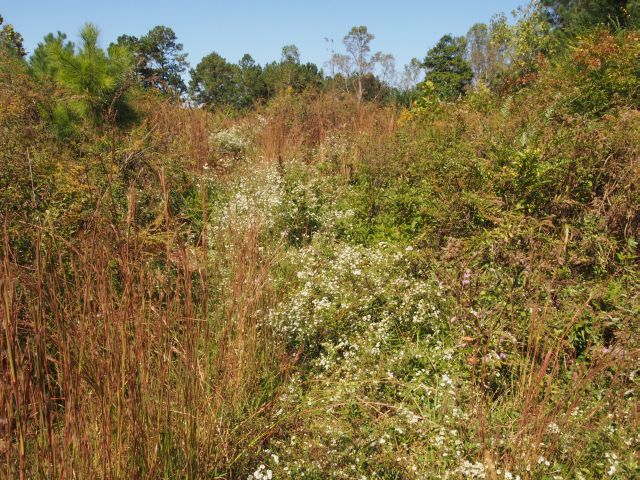
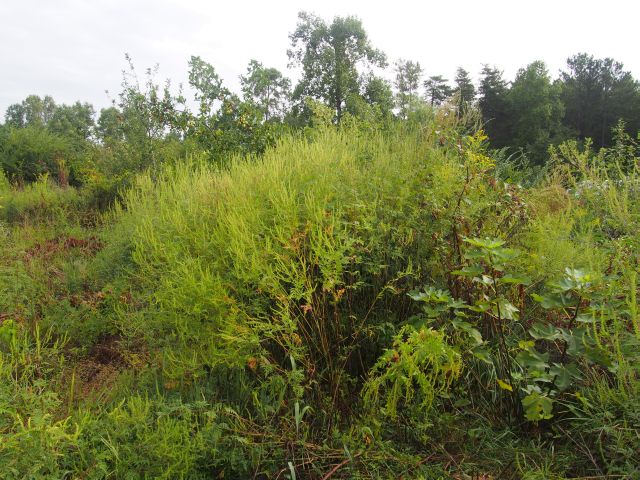
The bush hog is mounted to the tractor and I would like to complete all the bushhogging for the season before I replace it with the chipper. I only bushhog a couple times during the year and growth rather than kempt characterize the non growing areas. And now these areas are populated with daisy fleabane.
where the white daisy bestrides is our walking trail
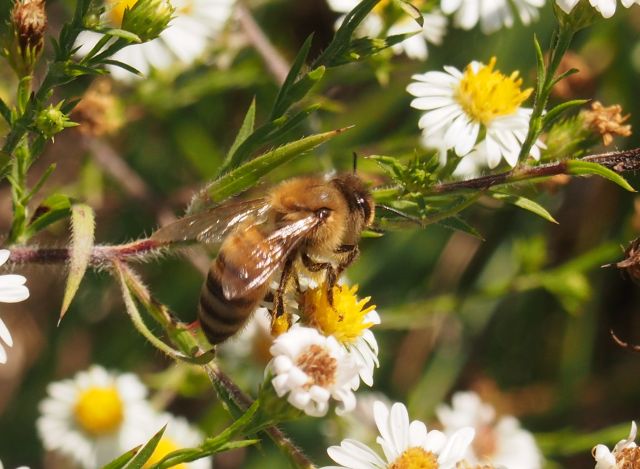
So what, you may say, but approach closer.
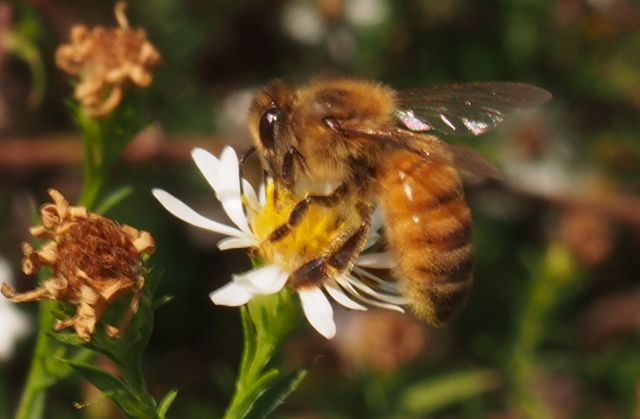
And you will see my busy workers.
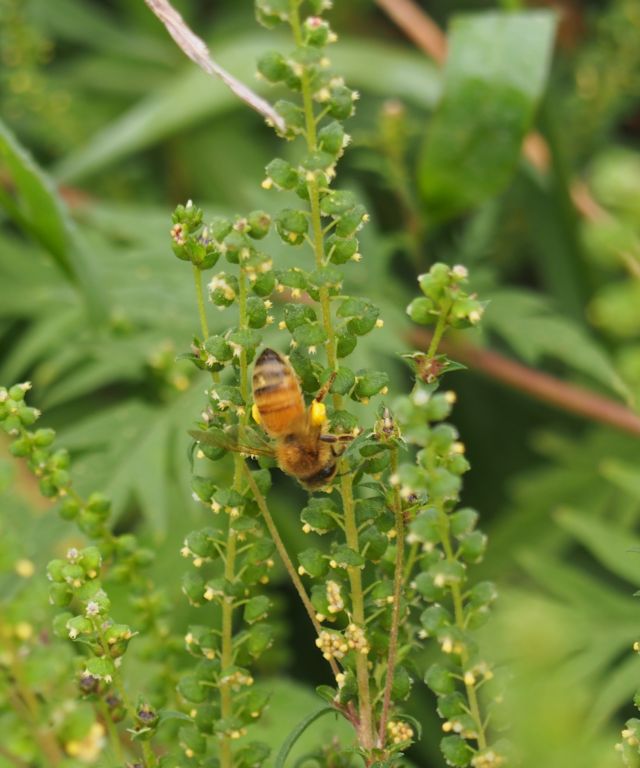
this is their last hurrah – the goldenrod festivities ended a few weeks ago and this is their last nutrition source before they hunker down for winter
So I will wait a few more weeks and then switch the implements. Not such a big deal to changeover though it takes some practice to do it quickly. I only use my tractor a few times each year, so I will check the tires, oil and grease the bearings etc. before I commence my fall operations. It’s a large (60hp), old (late 80’s) Case 585 tractor which has been very reliable.
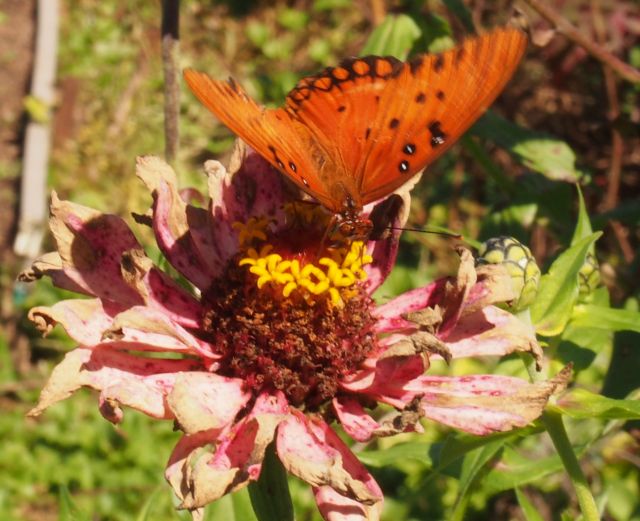
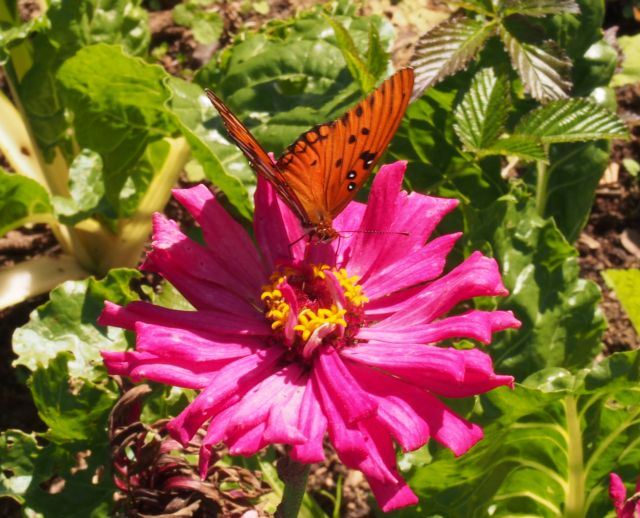
So I continue to admire the goings on.
cosmos butterfly time soon will be over
And will collect the flower seed and disperse in new areas.
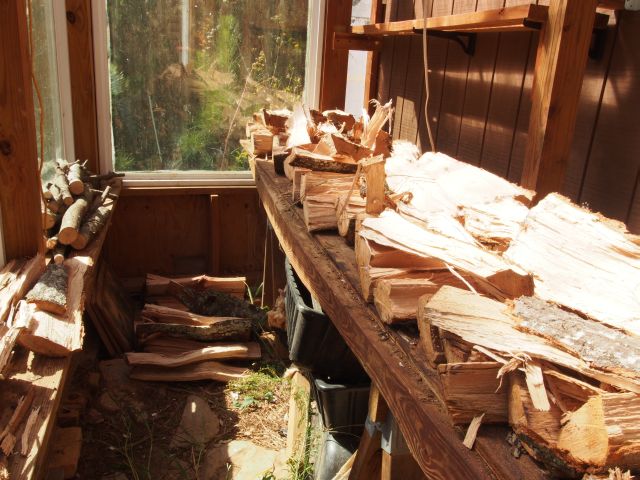
And I transport daily the oak logs from Atlanta (see previous post) and split with my maul, and then I store the firewood in my lean to greenhouse.
late winter and early spring, the greenhouse nurtures my vegetable seedlings, good to dual purpose it for drying firewood
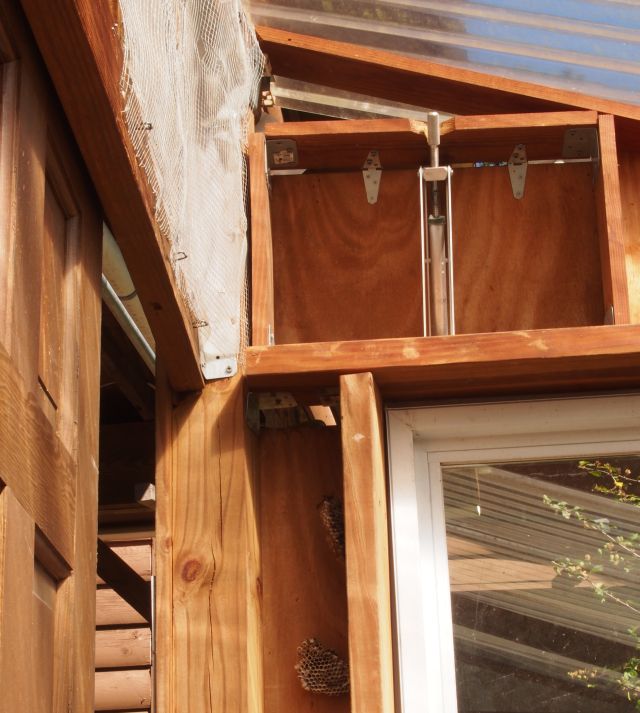
The oak logs have a moisture content of +/- 29% at their ends and >35% in their split middle. I am hoping to reduce this considerably in my greenhouse/solar kiln. But to achieve this I have to close the openings. The temperature controlled vent closes itself and the door I close, but towards the top I stapled plastic and feral cats (of which there are several) each winter make the greenhouse their home and they effortlessly slit the plastic for their entrance. I decided to tack mesh to the plastic. As I raised the hammer to attach the staples I noticed several wasps at the far end of the greenhouse. I like wasps (as opposed to hornets and yellow jackets) – they are generally very docile and only sting if you inadvertently put your hand on them, or mess with their nests. I withheld the first hammer blow and decided to look around. And there, close to where I was going to hammer in the staples, were 2 nests. I was sorry to see them, since for me it meant spraying and killing them. This done I secured the mesh and expect I will have to secure more as the cats devise different ways for entering the greenhouse.
you can see the temperature controlled flap at top, the mesh covering the plastic at top left, and just below in the middle, 2 wasp nests
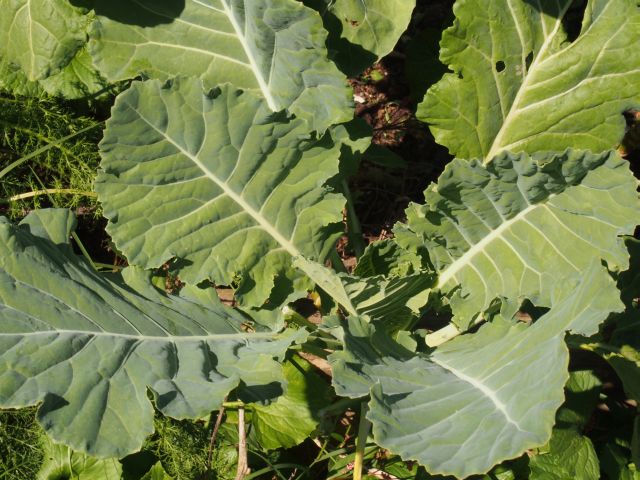
I previously mentioned the luscious growth of green leaf veggies. Here is a collard – large and pest free.
collard grow well this time of year
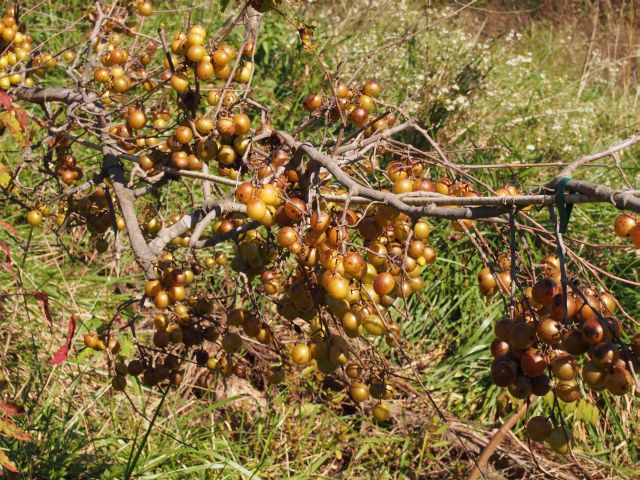
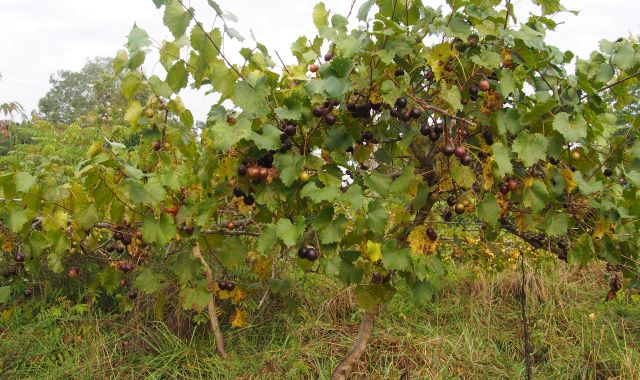
And lest I forget – the muscadine are still ripening and sweetening.
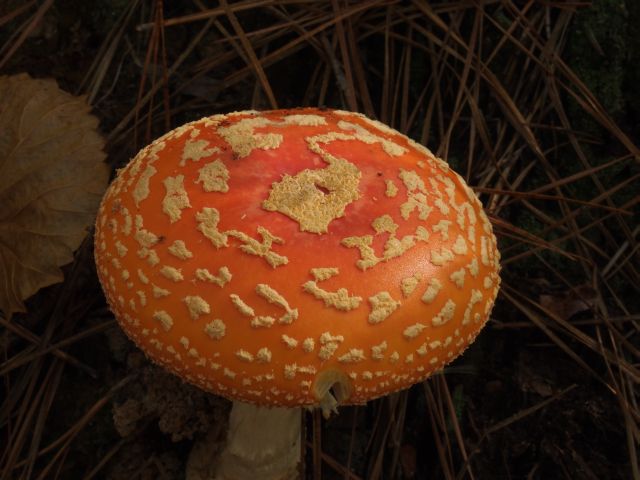
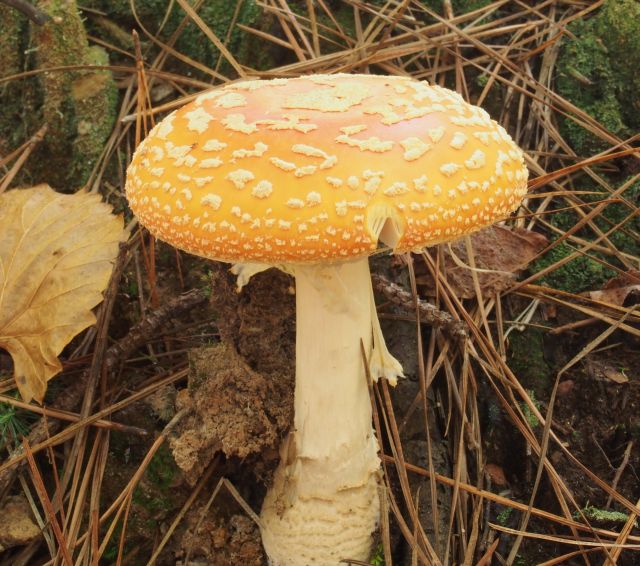
As anticipated, the recent heavy rains kickstarted fungi activity in the woods. Lots and lots of different mushrooms.
this type proliferates near the tractor building
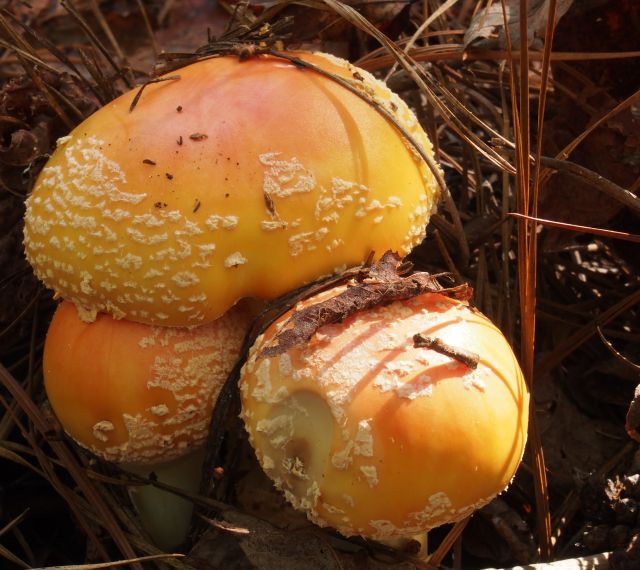
The one above is for me the most attractive. Here is a grouping of various ages.
a threesome
And yet another pic.
Brier
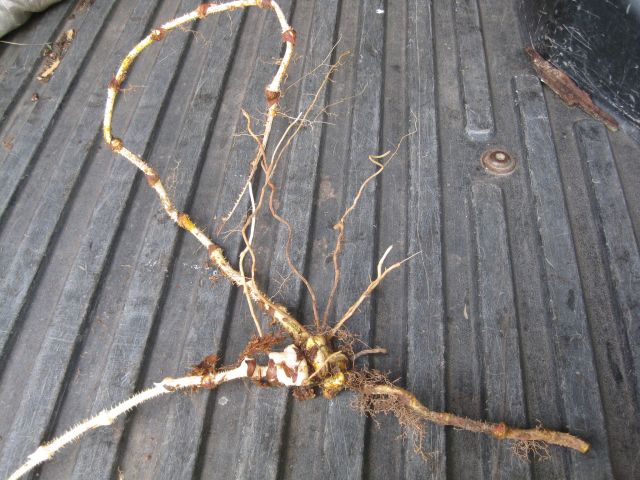
I last cleared the area between the house and the road in October 2012 and worked hard to remove the bramble and brier. Three years was too long to wait and again my oak saplings were submerged below pines, poplars and snared with brambles. And again I met brier. Above the ground they look ordinary – thorny stem and leaves, but below the surface they resemble a horror film monster.
all of this was below the surface – the upper half resembles a scorpion’s tail
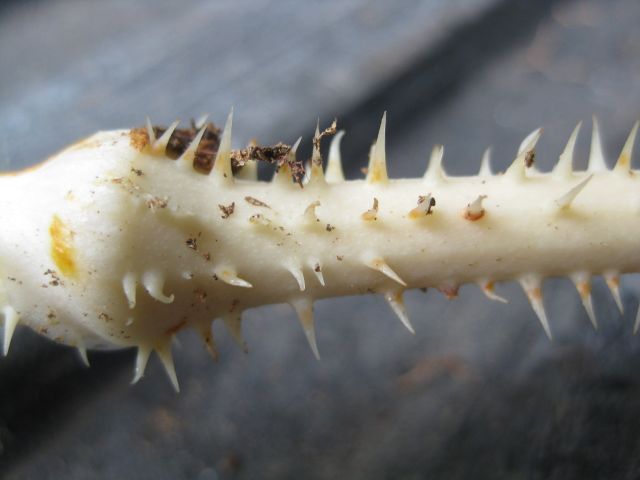
And close up they look like the jagged snout of a swordfish.
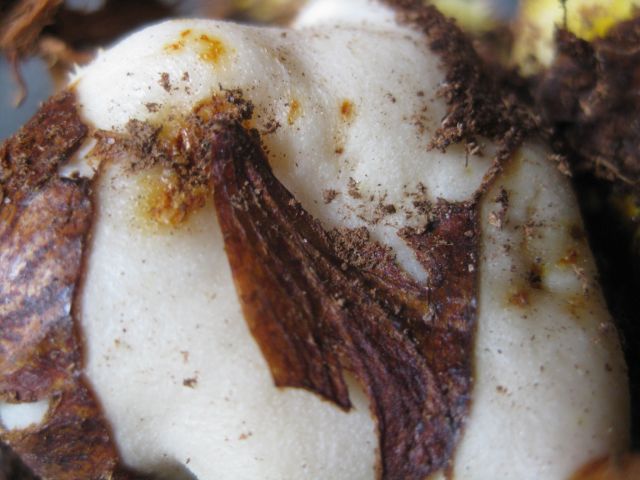
And below is the production center, or so I think, with bulging sacs of new monsters waiting to emerge.
I think it is the ghostly white, untouched by sun, which gives menace
Oak
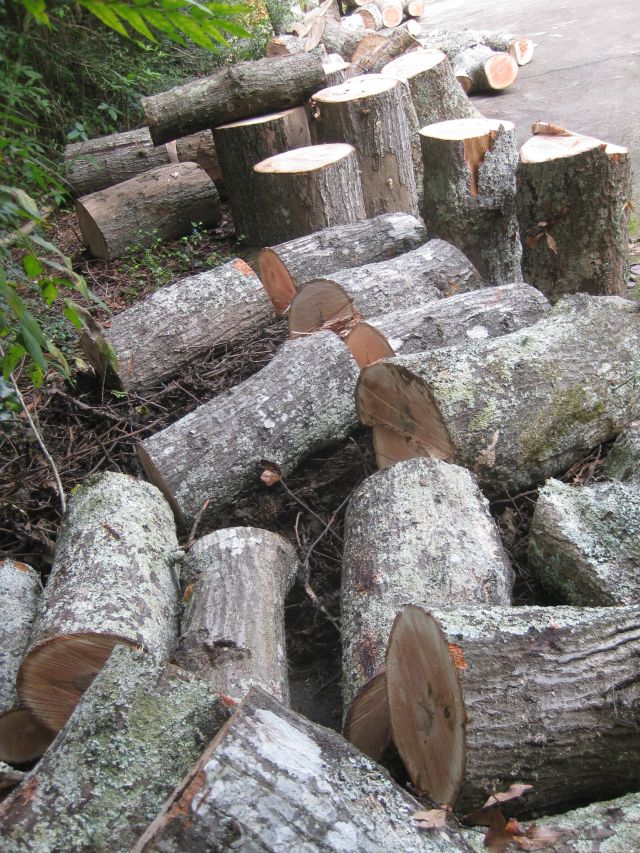
A neighbor in our Atlanta subdivision decided to have a tree removed. I saw the trucks and heard the revving chainsaw and wandered over. What type is it I asked the supervisor? “It’s dead” he said no doubt thinking I was questioning the act. Then hearing me better 2nd time round he said it was an oak. And he said I could take as much as I wanted. So with my trolley I headed back and forth and collected a lot of logs.
firewood enough for several winters, which I will split with a maul and some filial assistance
They also unloaded a truck full of oak chips which I will distribute around the Atlanta yard and apply at the farm. So, I suppose, a silver lining in every cloud.
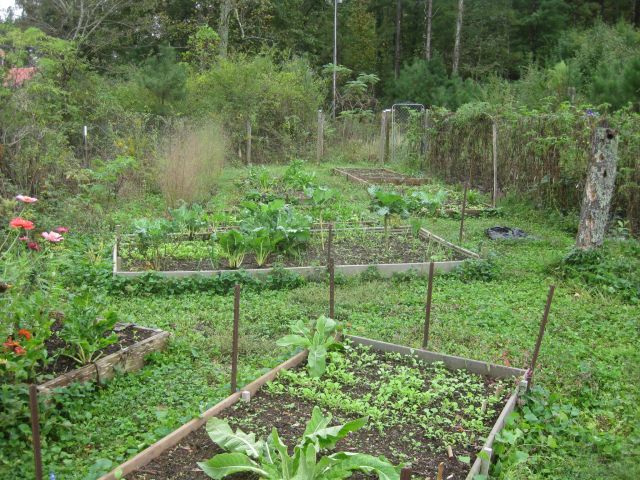
With shortened sun hours and fall in temperatures, my summer vegetables are yielding, as too are the pests which feasted on the chard, collards and greens. So I have been clearing the raised beds, adding compost and cool season seeds such as kale, spinach (after 1 week germinating stint in the refrigerator), and turnip greens. Also lettuce and radishes for harvesting before it gets too cold. I had packets of several years old seed and not knowing which was viable but knowing that with each passing year they were becoming less so, I used them all to seed rows. Now, a few weeks later I know which were too old and rather than thinning the overcrowded rows I am transplanting from the overcrowded rows to the bare rows.
some of the newly composted and seeded raised beds
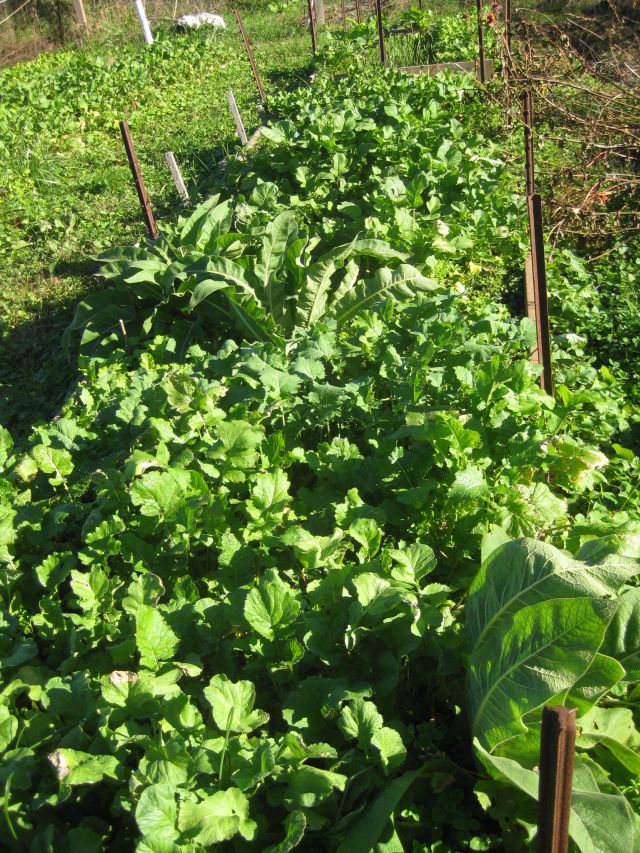
I left in place the pest shredded collard and chard and I have been rewarded by their luxuriant response to the plentiful rains, cooler temps and reduced pest pressure.
collard with large leaves and chard at the back, both now growing well
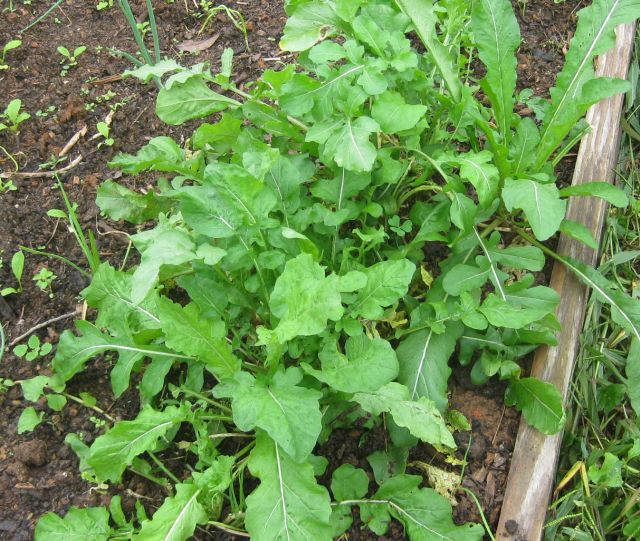
The arugula grows vigorously and is a welcome supplement both to fresh salads and sauteed with the collard, mustard and kale.
vigorous arugula
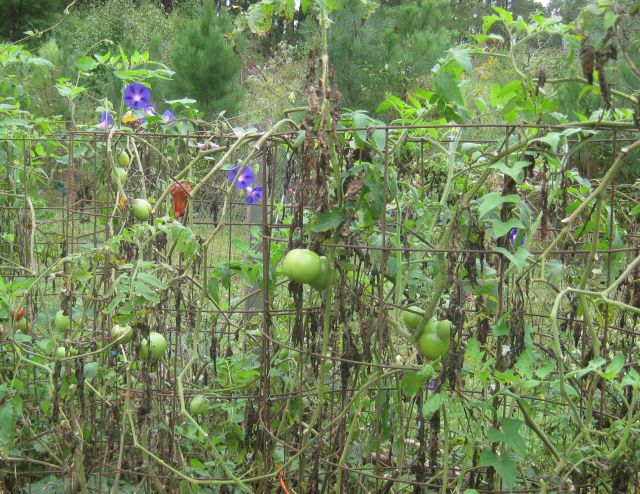
I have steadily removed the tomato cages and stored under cover. A few remain with bearing tomatoes – perhaps they will ripen? And I can wait since the area they occupy will, after composting, be used for planting out garlic and garlic can go into the ground later, while my cool season seeds had to go in earlier to germinate and benefit as much as possible from the dwindling sunlight.
a few tomatoes cages remain crested by morning glory
Apart from removing the summer vegetables I have not had much hassle with weeds. I am more disciplined and weed during the summer and try cover the areas with vegetable growth to forestall the arrival of weeds. So much less work and a better result than previous years.
In the orchard which was overcrowded with weeds, I have been at work clearing the growth and pruning the trees. Last year I used wires to hold down and spread the branches and pruned the vertical apical growths. I am pleased the branches have stayed horizontally in place after the removal of the wires though with some trees, especially the pears, there are a number of vertical growths I have to remove. I am reusing the wires elsewhere and the best time to train the trees is when they are young and supple. Here is a young apple tree whose vertical branches have been splayed horizontal with the recycled wires.
you may notice the wires holding down the branches
It’s all about observing what’s going on and attending timely. Elsewhere in a wooded area I planted out oak saplings a few years ago and they have been outshaded by fast growing pines and tulip poplars and there too I have been busy with pruning saw (and also chainsaw) cutting down the less desirable trees and “releasing” the oak trees.
In the orchard area and at the top of the hill I have been weeding growing areas and seeding with winter rye and Austrian winter peas for cover crops. And I have been seeding with clover around the bases of my blueberry plants. So plenty of work but with the cool weather and occasional drizzles, an exhilarating time to be out doors.
Unusual sightings
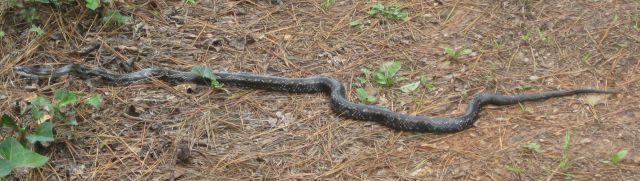
I mentioned previously that my rat and mouse problem (more rat than mouse) in the coop has been solved with the arrival of a large black snake. I have not seen the black rat snake again but I am sure it patrols the area, perhaps in the night and certainly rat droppings have disappeared from the coop ledges and the feed bowls. But I did spot another largish snake about 5 feet long, probably an eastern king snake and was able to snap it (below).
a sight for sore eyes and a boon for vermin control
I really don’t understand those who wish to kill these non venomous snakes. Apart from ridding mice and rats they also devour the venomous smaller snakes. As long as they don’t take a liking to the chickens eggs they are most welcome.
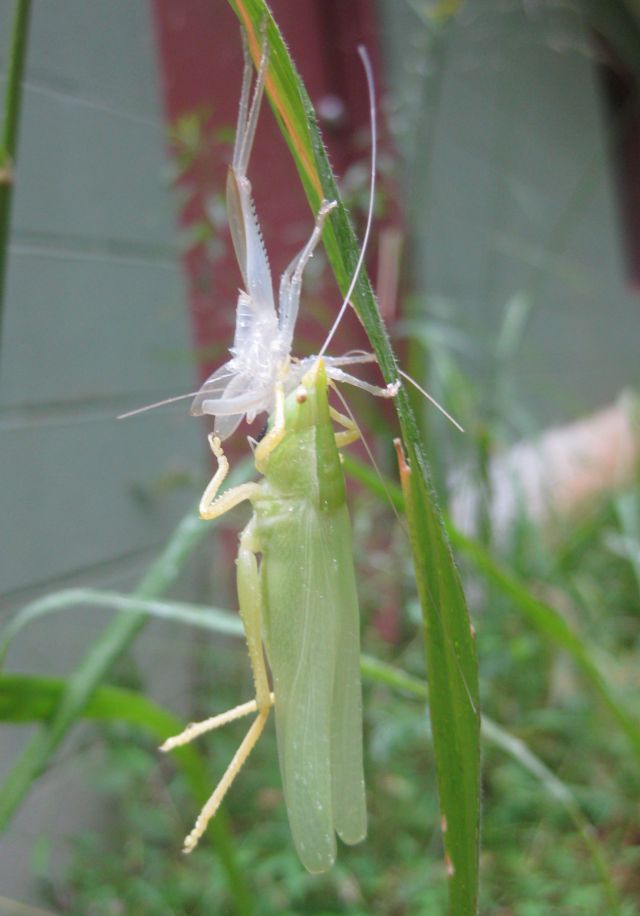
We noticed an unusual sight.
katydid and cricket
The white insect above was attached to the grass blade, the one below was suspended held by the one above, or so it seemed. But why was the one above white? Closer examination indicated that the predator was the green katydid and it presumably had sucked out the nutrients of the cricket (which looked skeletally white). Interesting that the cricket was still attached to the grass blade.
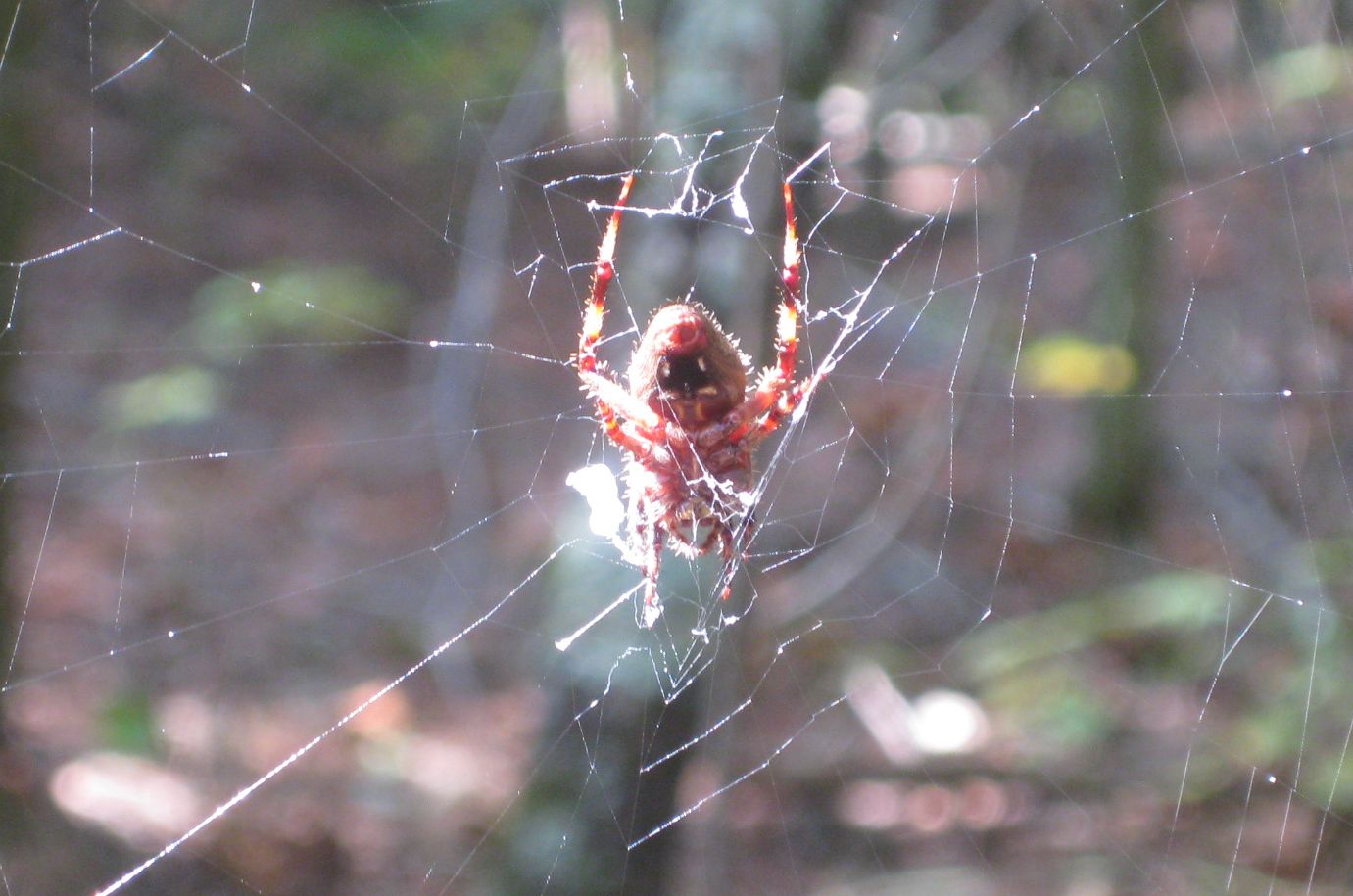
Spiders abound and have webs across my path in the woods, so I carry a stick before me to avoid being wrapped in their webs. Here is one fellow I almost walked into.
one of many webs in the woods
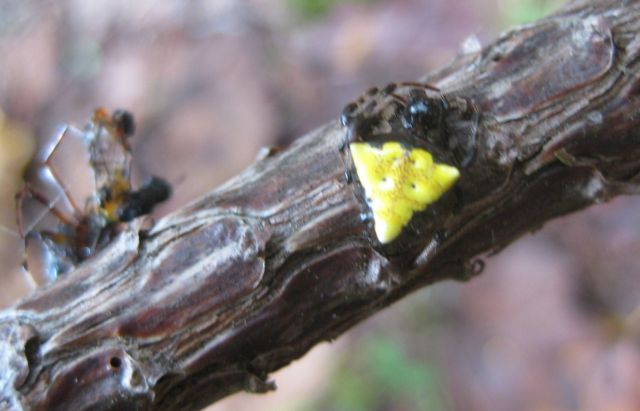
And here is a spider with I think, eggs on its back.
a triangle colored spider – are those eggs on its back?
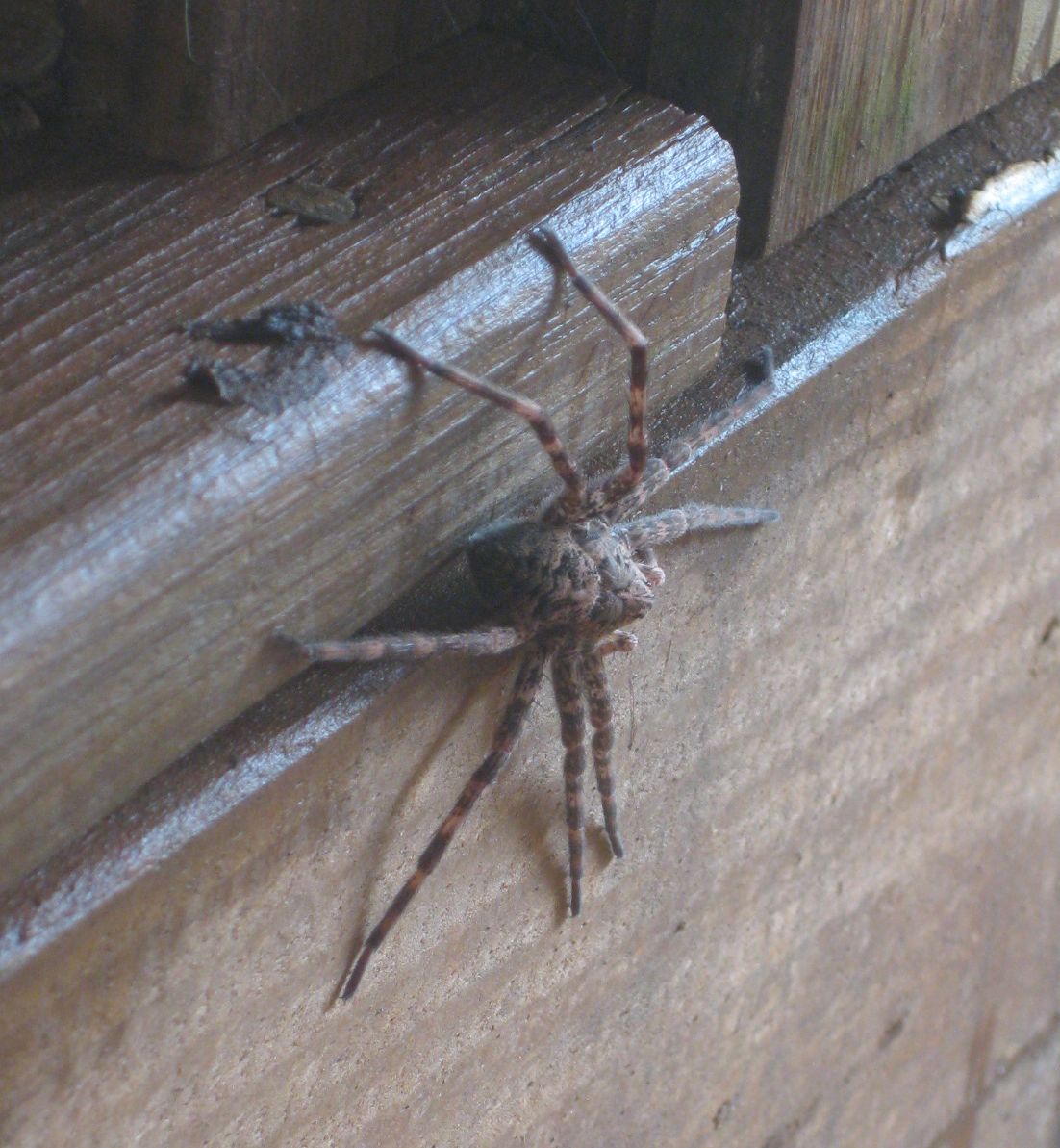
And here is quite a large fellow near the house.
its width from end of leg to end of leg is about 2 inches
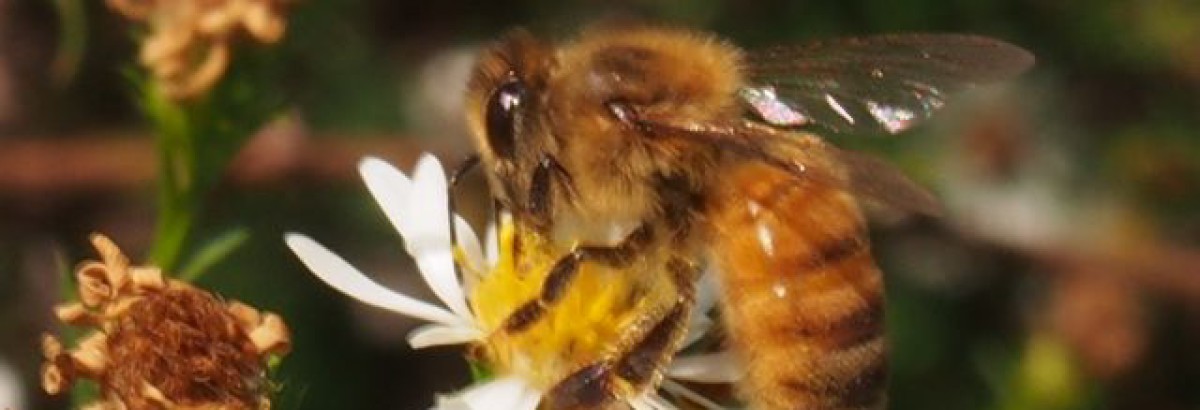
The bees are hard at work on the goldenrod and, with all the rain the past week, mushrooms of different sizes, colors and shapes, are emerging.
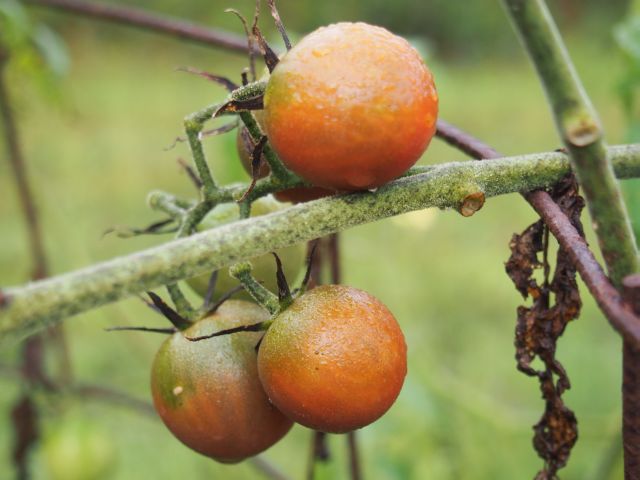
By September the large tomatoes have passed their prime, tho the small varieties – Juliet, Black Cherry (our favorite), Jelly Bean, Sweet Cherry – are still producing.
Black Cherry is an heirloom with an explosive authentic tomato taste
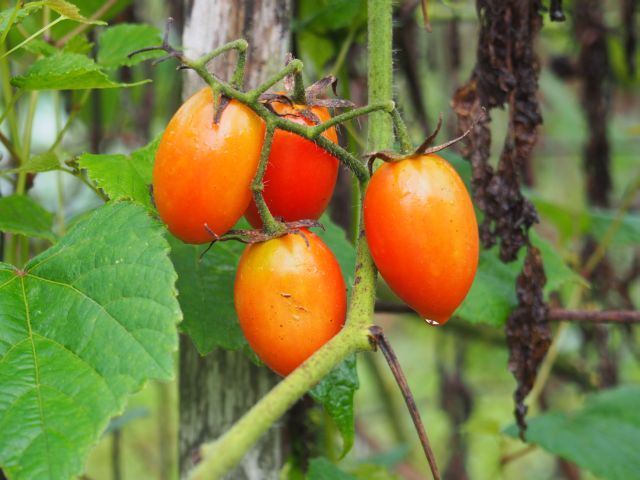
The Juliet is a hybrid and also grows well and tastes good.
a resilient producer
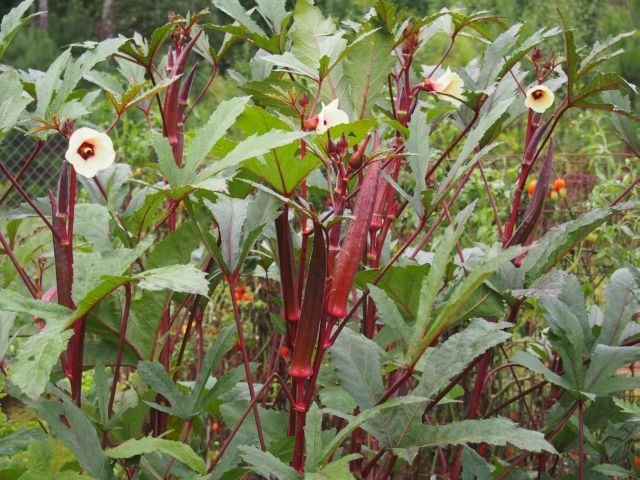
The burgundy okra is producing well – the smaller okra can be eaten raw off the plant, the oversized are tough and the covering is stringy even after grilling (we grill rather than fry) and the transition from small to oversized happens within a few days, so daily okra picking visits are necessary.
the okra flower is always striking
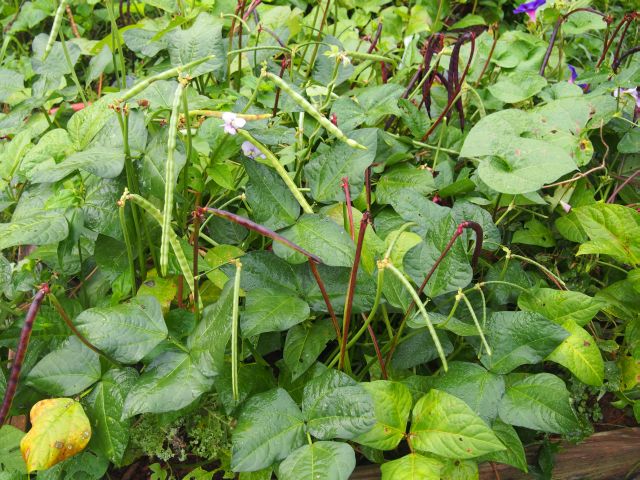
A big hit this season are the rattlesnake beans so called for their coloring which progresses in stripes from green to black and their distinctive rattle. They seem immune to diseases and pests and grow prolifically. If not picked tender they must be shelled, a task I quite enjoy.
each vertical stalk produces, 2, 3 or even 4 beans
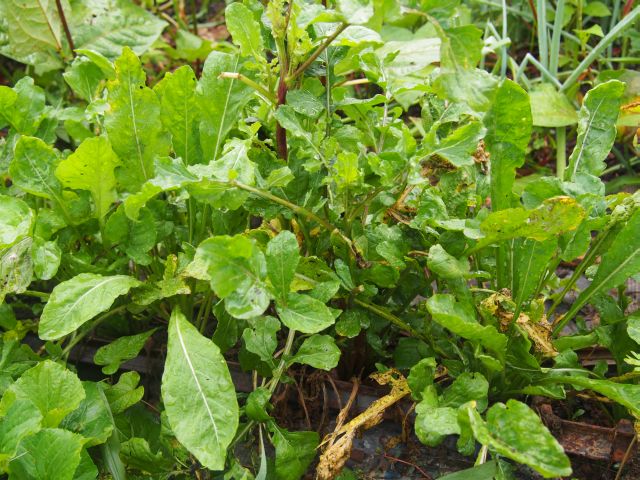
With plentiful rains and cooler temps the arugula is thriving.
arugula growing confidently
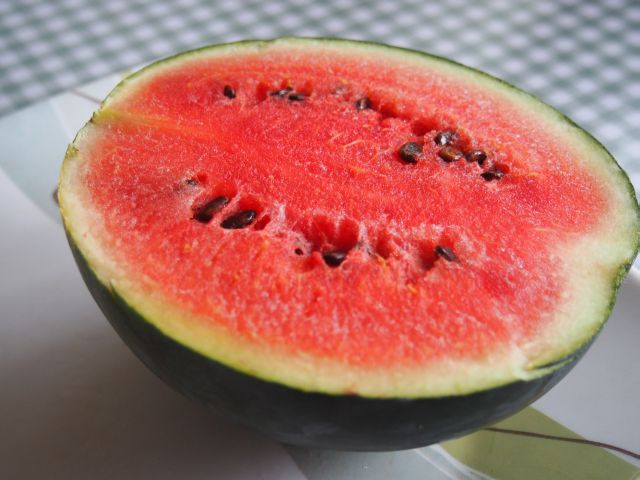
Basil and the other herbs – mint, organo, rosemary – are doing fine. Another first for me this season is water melon and, now I have allowed it to ripen, it tastes great.
the melon is about 6″ diameter and has lots of pits but is sweet
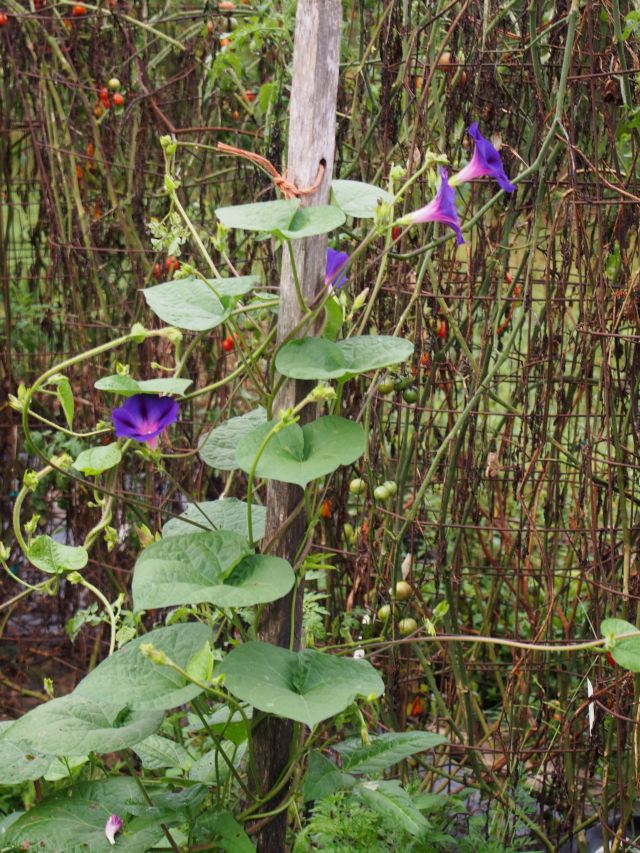
The Morning Glory vine is intertwining my fences, bean plants and trees.
an attractive weed
I don’t mind the”weeds” and trim them back just enough to allow light to reach my shrubs and smaller trees. Diversity is good and now in my hillside orchard you hear the bees working the weeds.
in the foreground is a small fig tree and behind the growth is my young jujube tree
And step closer and you see the bees hard at work.
stocking up for winter
I have several fig varieties and each year they die to the ground but since their roots are intact and larger each year, the above ground fig grows more rapidly and larger too. I hope that when they reach a certain mass they will be able to withstand a winter with min temps of say 12 deg F. The winter a few years ago when temps reached close to zero is what did them in.
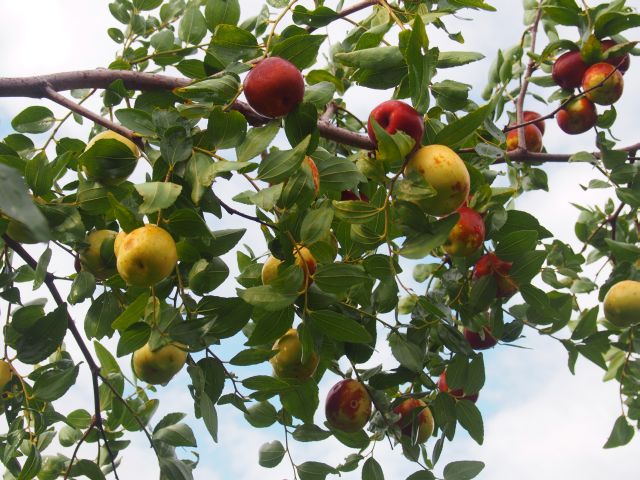
The jujube tree is producing more fruit each year.
tho they look largish in the pic, the largest is 1.5″
Jujube ripens in September and is fragrant and sweetish when the yellow green skin has turned completely brown. I am pleased to see several small jujube trees close to the parent. Whether from root or seed I will only know when I transplant them in October. But a bonanza since the jujube seems immune from disease and pests but not appreciative birds.
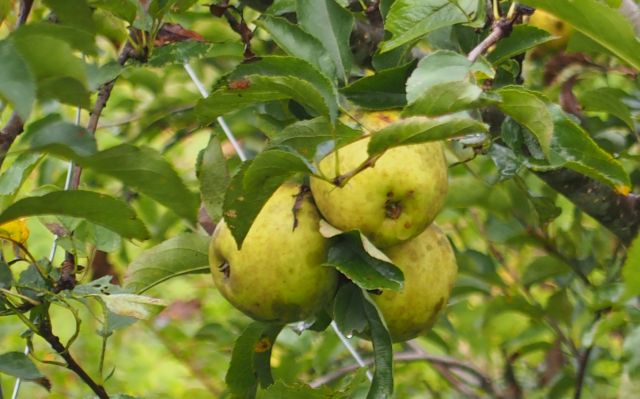
September is also ripen time for my Gold Rush apple tree. The apples are pleasant to eat altho only 30% to 40% is available due to pest presence. With my chickens graduated this year to yard range from paddock range and turning compost assiduously, I will next move them to the orchard to deal with the overwintering pests.
the Gold Rush apple so named because of the yellow gold coloring or the rush of flavor when you bite in
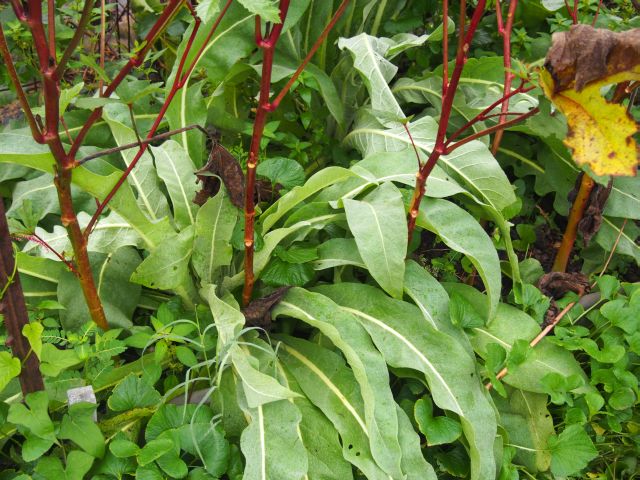
Comfrey is luxuriating in the cooler weather after a tough summer.
I like comfrey and compost its leaves at the end of the season
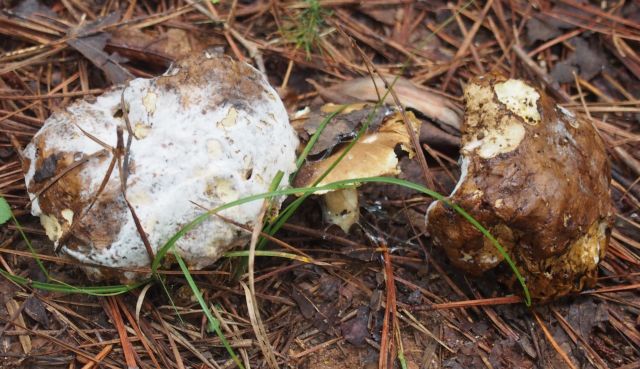
In the woods the rains have produced many different mushrooms which are devoured quickly by wildlife or overtaken by secondary growths.
a disintegrating mushroom
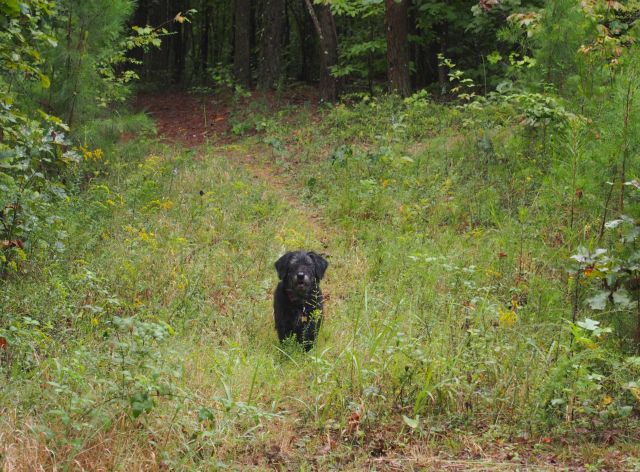
And my dog Trudy who was afflicted and unable to walk a few posts ago, is now back to normal, on patrol among the vegetable beds and locating scents on the walks in the woods.
I thought her hearing was worsening but I believe it to be selective and occasionally she responds, as here
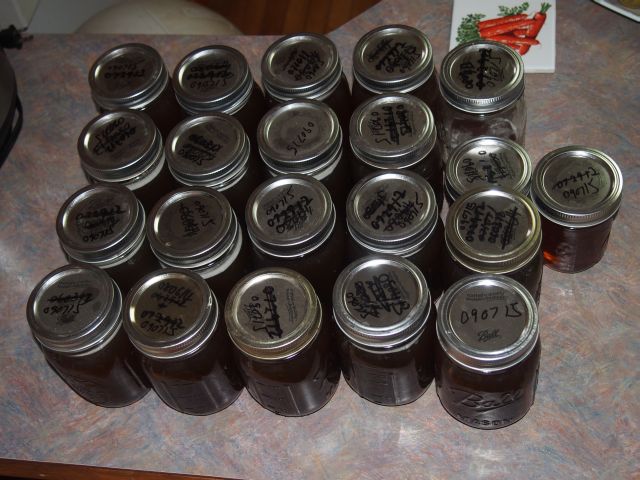
Yesterday was honey harvest day. I have 2 hives – the one somnolent where almost all the occupants gather at the entrance to while away the day. It had no honey for the taking. The second hive is more vigorous and has swarmed several times, that I have seen. September is a bit late for harvesting so I left a lot of honey behind but still gathered about 2.5 gallons.
18 pts, 2 half pints and a partially filled jar
Since I record the date of harvesting I can keep track of prior year dates.
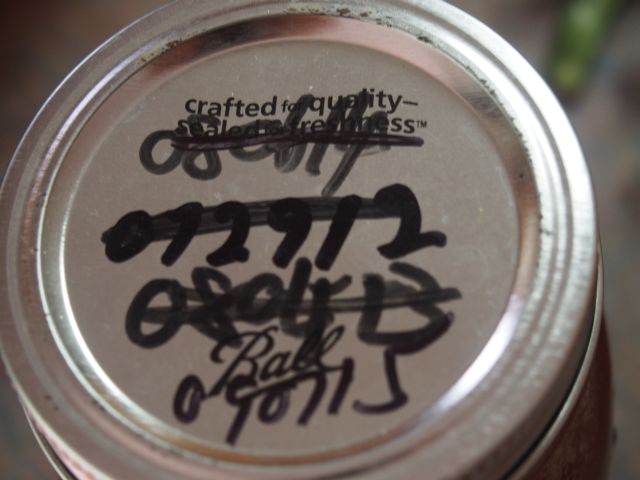
this cap sealed honey collected 7/29/12, 8/4/13, 8/6/14 and y’day 9/7/15
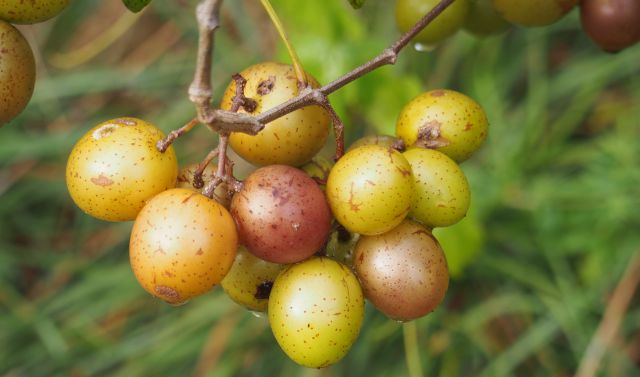
I almost forgot to mention the muscadine which has ripened just the past few days.
the black muscadine must be non reflective black and soft to touch, and then you have delectable sweetnessthe scuppernong graduates from green to yellow to gold to bronze, and then it is ready
And the chickens, the rooster and his 10 hens, are doing fine. 3 to 5 eggs daily and occasionally I uncover a cache of secreted eggs from several hens – probably couldn’t be bothered to make the trip back to the coop when they forage more widely across the yard.
ps – I was wondering where the rats and mice which frequent the coop had gone to and thought maybe a seasonal thing, or late summer vacation. And then this afternoon after refilling the 5 gal water container in the coop, I saw on the outside of the coop, heading for the entrance, a gorgeous black at least 5 ft long, rat snake. Disturbed, it reversed direction and headed away but I hope it will return and do its duty, as long as that does not include polishing off the eggs.
Most towns in Bodega Bay area are small and each has a general store with canned goods and occasional fresh vegetables.
our heritage hotel in the small town of Tamales
Gas stations are sparse and you have to travel several towns to find one. You can measure resident size by the number of gas stations – Bodega (where “Birds” by Hitchcock was filmed) has none, Bodega Bay one. Sebastopol however, has 3 plus a Safeways a Whole Foods and two bookstores!
I felt very at home in Sebastopol which reminds me of Asheville NC. A street is named after the Gravenstein apple, and the town is surrounded by apple orchards and vineyards. A mile from the town center is a remnant of Gold Ridge Farm, an experimental nursery established by Luther Burbank, a plant breeding genius, in 1885.
the barn and nursery at Gold Ridge farm
We were fortunate to have extended discussions with the current curator and the former curator, Steve. Steve used to keep bees until he found empty hives with food stores, classic colony collapse disorder. Made me realize this idealized growing area came with attendant problems of industrialized agriculture. Steve described his 30+ nationwide tour of organic farms including Lovell’s biodynamic farm in N. Georgia, not too far from my location. His objective is to write a book on his life experiences with plant growing. Steve recommended we visit the Occidental Arts & Ecology Center in nearby Occidental.
Much of the original farm was converted to senior residential housing but the area that was saved has magnificent specimens of fruit trees (apples, cherries, quince, pear) and berries, walnuts, chestnuts etc. The trees are well established and there is little need for irrigation, fertilizer (llama), or spraying ( dormant) oils. Activities include pruning, grafting and general care. I noted how skilled pruning opened the inside area of their fruit trees.
an open pruned tree
They weave sticks to form sides for their compost heap.
compost heap with woven sides
The local residents support farm activities and at the nursery we were educated on the naked ladies.
bright colored naked ladies
We had noticed them, attractive and beckoning along the roadsides in their gaudy pink at the end of 20″ stems without any leaves, hence the term “naked”. The leaves die in spring. One of Burbank’s achievements was to cross a naked lady Amaryllis belladonna with another genus the wild Crinum from the swamps of Florida to produce the hybrid Amarcrinum memoriacorsi.
Before leaving Sebastopol I met with a realtor to discuss local practices, with a view to a possible relocation, one day. Rainwater harvesting is not approved. The houses use wells some with just 1 gal per minute flow others with up to 30 gpm. He was interested in my efficient wood stove and said if we were buying we should purchase a house north of a line demarcation where smoke emissions were not subject to controls. Of course this can change as can the flow rate of an apparently healthy well. Rainfall in the area exceeds 30″ pa, mostly between November and March.
I wanted to visit the Occidental permaculture establishment recommended by Steve and left several messages, unreturned. Their website discourages “drop ins”. We visited the town of Occidental which is in a forest setting with a well provisioned general store and an enticing cafe where the staff is attractive, hip and casual, as you would expect of a town located on “Bohemian Highway”. Our server suggested we visit the center but the well posted signs discouraging drop ins discouraged me too. Perhaps for our next visit.
Heading north on the Bohemian Highway we reach Guerneville once called Stumptown for the clear-cut giant redwood stumps left by logging operations for the rebuilding of San Francisco after the 1906 earthquake and fire. A few miles north is the Armstrong Redwoods reserve, 800 acres of magnificent specimens many well over a 1,000 years age.
one of the large redwoods, diameter>14′, age>1,400 years, height>300′
When the trees topple their root mass is striking.
redwood roots spread wide but not very deep
Our destination was Timber Cove a remote hotel on the Pacific cliffs, about 15 miles of cliff twisting road beyond the Russian River Valley and a few miles from Fort Ross founded in 1812 by Russian settlers. A spectacular sunset crowned the day’s end.
Larry
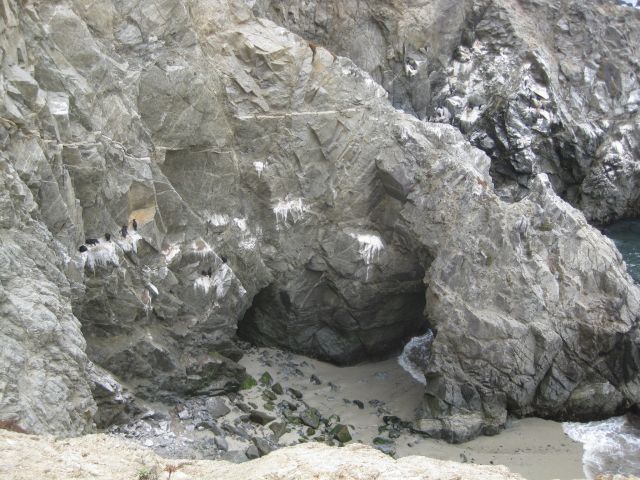
North of SanFran is Marin county and north of it is Sonoma county and Bodega Bay. The promontory called Bodega Head has craggy cliffs overlooking the ocean with crowds of cormorants and seagulls soaring and calling.
rocky cliff with cormorants (middle left), guano sketches and a steep drop to the sea
On a rocky guano caked outpost flecked with salt foam, squadrons of Pelicans have gathered. And then they pitch forward and off and with powerful wings thrumming they beat above the foaming sea and ascend higher and higher in broad V wave formations until they disappear around the headlands.
On the drive back we notice on the shoreline small piles of balanced rocks. We have seen them before in Vancouver’s Stanley Park and even in Atlanta along the ‘Hooch river, but this is different – clusters and clusters of stone towers up to a foot high.
some of Larry’s creations
I stop for a photo and notice a lean tanned man walking toward me. Suddenly he scrambles down the side of the embankment and begins gathering stones. I greet him and ask if he knows why people build these stone piles. He glares at me – there are no people building these he says, I built all of them and there are now, and he waves across the bay, about 170 of them.
But why I persist. For good luck for the sailors he says.
His name is Larry, 72 years and retired and the idea came from his time in Hawaii. Is skill required? With time you get the feel of balance. As to size he has built small and big piles and the only injury was when he struggled to balance a large boulder and it tipped and sliced his foot and toe. He has a regular routine walking the shoreline caring for his creations and then on to the marine laboratory for a visit. Had we visited the cliffs? Take care he says – it was a foggy day when a 12 year old wandered too close and fell 200 ft to the rocks below and has never fully recovered. Now follow stories of large family reunions and driving a Sherman tank over the dunes. He punctuates his reminiscences with hand greetings to passing locals. And then it is time and he vigorously shakes our hands and moves on.
So, two retired guys, Mike and Larry with outdoor pastimes bringing pleasure to others.
We just visited 2 sons in the San Francisco area and as usual lodged at Pacifica. On the BART train we passed the houses clustered on the hillsides of Daly City which inspired:
Little boxes on the hillside,
Little boxes made of ticky tacky,
Little boxes on the hillside,
Little boxes all the same.
There are green ones and pink ones and yellow ones and blue ones and today they all cost a lot of money.
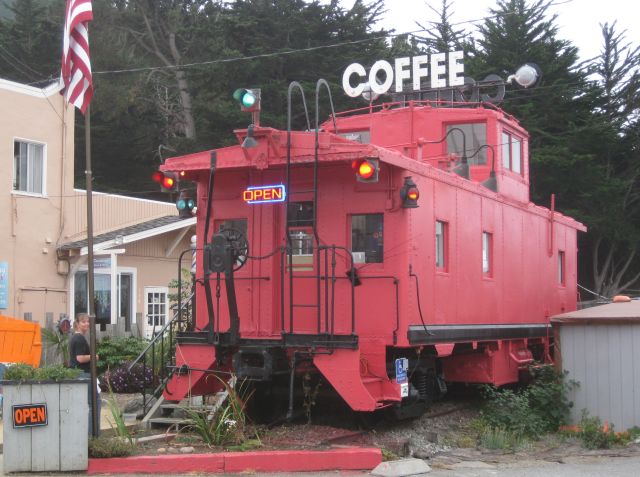
Pacifica is a small town with undistinguished buildings overlooking the ocean and has lovely cliffs and walk/jog trails . The cost of shoreside hotel accommodation has increased rapidly over recent years as technology sourced wealth laps outlying areas. Each morning we follow a gentle trail to our coffee shop train.
early morning coffee stop
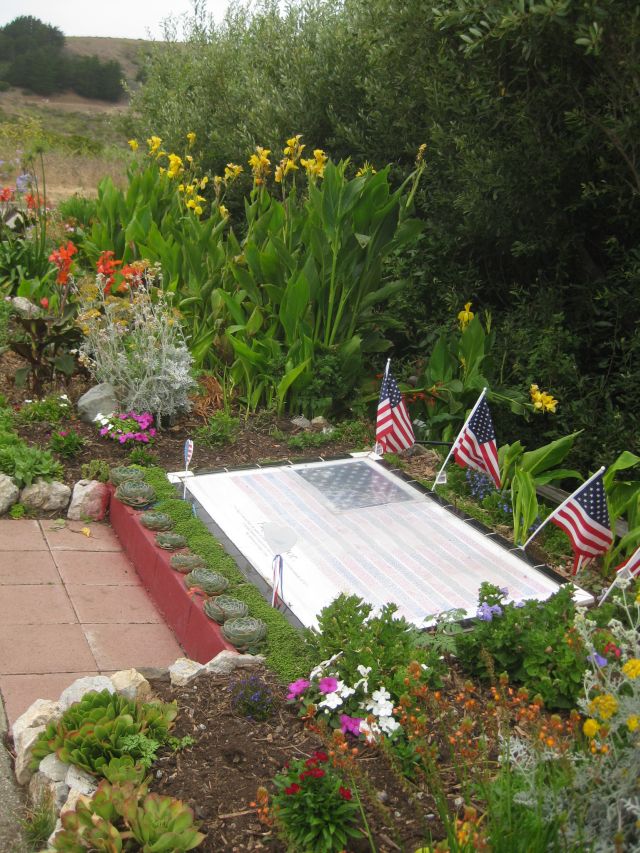
Along the path is a floral memorial to the victims of Sep 2001.
green and color amidst the dry grass shore line
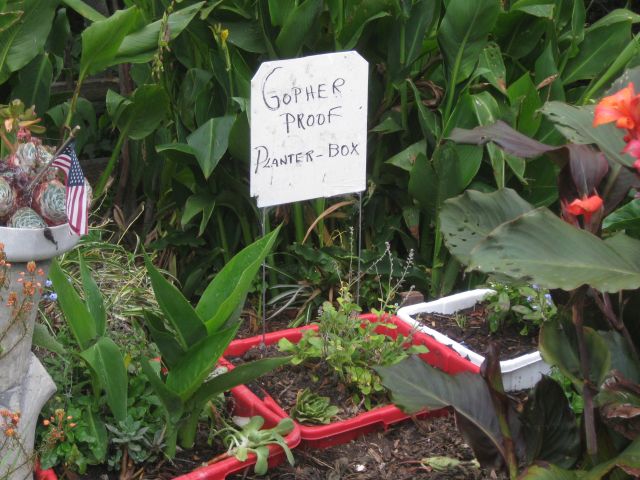
This time I noticed red plant tubs marked “gopher proof”.
gopher proof tubs
Interesting concept and as I paused for a photo an elderly man appeared and asked my interest. He Introduced himself as Mike Mooney and we later discovered he is a celebrity in the area and the founder of the community gardens. He told us the history of the tubs. The previous recycling company had issued to every resident 3 color coded tubs for different materials. The new recycling company provided one man size container for all recyclables and had a contest with a $500 charity award for the best idea for repurposing the old tubs. Mike entered and suggested gopher proof planting containers and won. I asked what diameter holes should be drilled in the bottom of the tubs for water drainage and he said the diameter was not important, just lots of them. He said gophers tunnel horizontally and not from the bottom. His eyes moistened when he discussed September 2001 – if the 3,000 were going to war and were killed that’s one thing, but these were people going to work and did not come home at the end of the day, and that’s wrong, he said gently.
a tribute to the victims
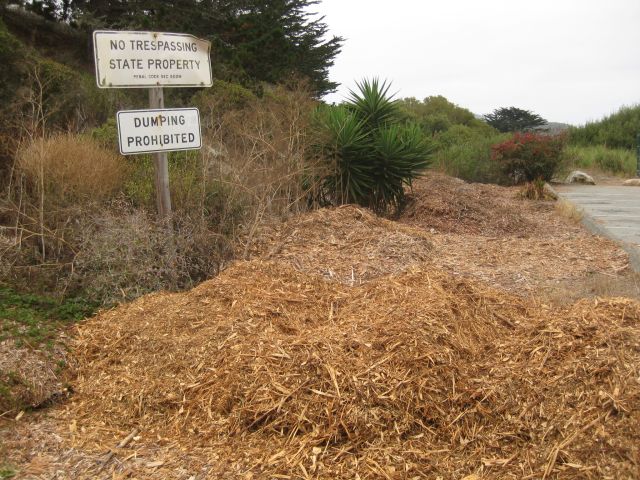
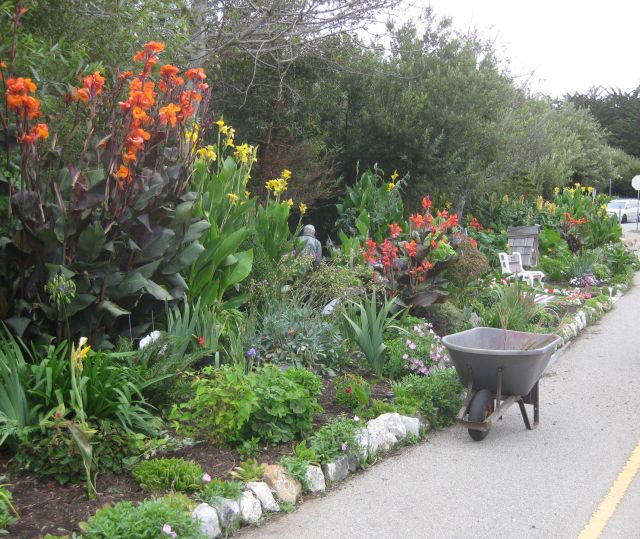
He maintains the gardens alongside the path and they are beautiful. He applies lots of mulch from the nearby disposal site.
mulch for Mike’s garden
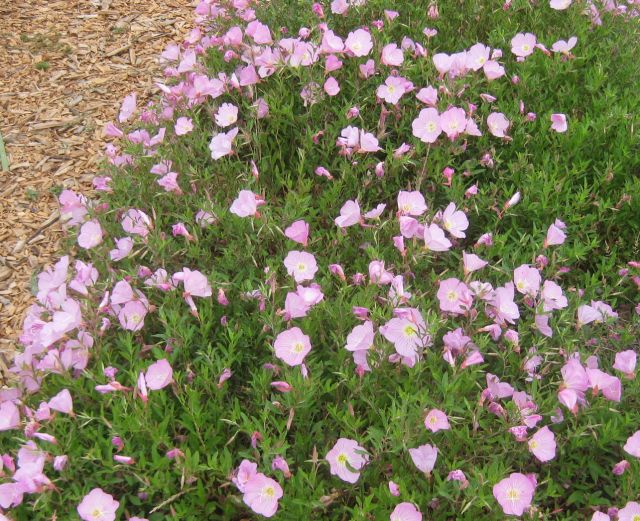
His cap and jacket said “go native”. I asked about invasives and he laughed and said he was given the apparel. But as to invasives he said the Mexican primrose can be a problem.
Mexican primrose
He suddenly reached down and pulled out two large bunches of primrose. Look at their large root structure they are survivors, he said. Lot’s of people try to transplant them but few succeed. The trick he said is to wrap the roots in soft paper, place them in a pot of earth and place the pot in a bucket of water and when the roots have regrown then transplant the roots and soil to their final location. He gave us several bunches of primrose plus a succulent for our son’s garden. He then retrieved his wheelbarrow and with his small dog following, returned to his mission.