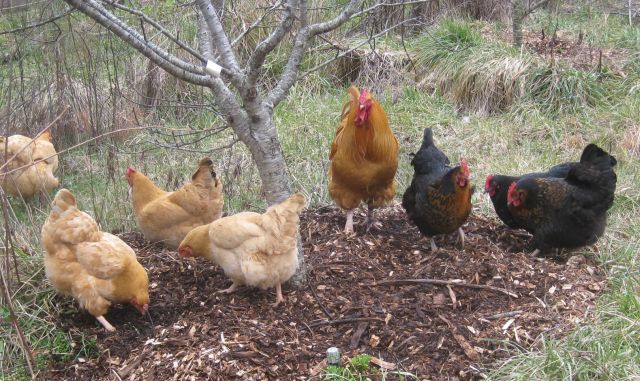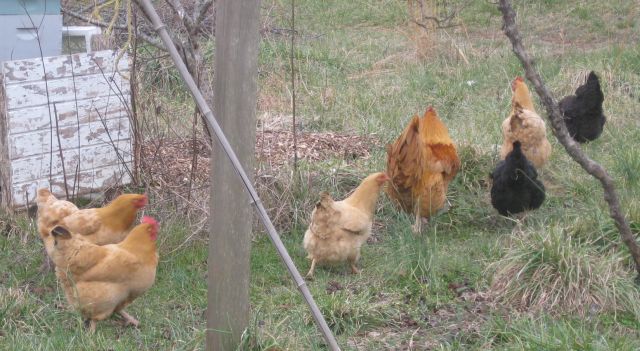
the end to our chicken keeping

This is a post I have been delaying.  And if sad topics upset you, read no further.

We cooped the chickens Monday evening 6pm and left the property.  At 9.45 am Tues morning (April 12) the coop door opened automatically.  When I later reviewed the security cameras I saw Wanda (one of the two hens which can fly over the paddock fences) pass the security camera at 10am and head for the compost heap.  So all was normal at 10am.

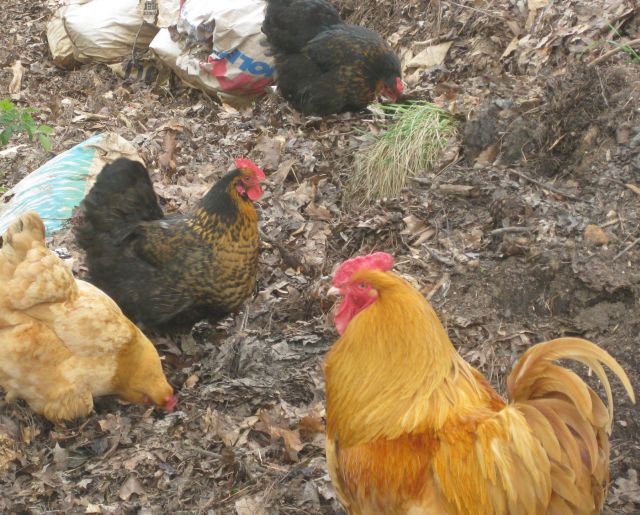
We returned at 12.20pm and the place was quiet.  Normally Buffy, the rooster, crows.  Silence.  And from the deck M. looked toward the coop and paddock areas and said “something is wrong”.  We approached the paddock area and there were feathers everywhere.  Then we saw the first body, and then another, and another.  With feathers ripped off, bodies savaged, a few missing heads.  We were quiet as we walked and counted and I took pictures.  But where was Buffy?  #1 paddock leads to #2 paddock which leads to #3 paddock and the coop.  The hens were in #2 and #3 paddocks.  I eventually found Buffy in #1 paddock by himself.  I thought that’s odd, since it appeared the intruders may have first entered through #3 paddock.  And then I saw in the corner of #1 paddock where the fence attaches to the barn that the fencing and 3 stacked concrete blocks had been forced aside and I realized that Buffy had been  in #2 paddock and had rushed to #1 paddock to confront the intruders and defend his hens.

Sorry Buffy, I should never have doubted you!

I dug a trench with the bobcat and we placed the bodies alongside each other and I covered them  and planted some wildflowers and crimson clover.  Of the 9 chickens Wanda was the only one missing and her remains were deposited by a predator near the coop a few days later.
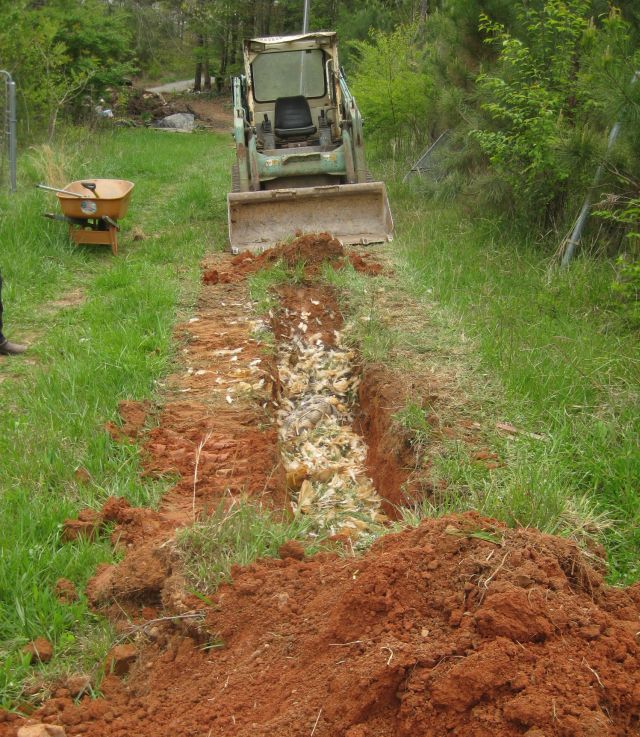
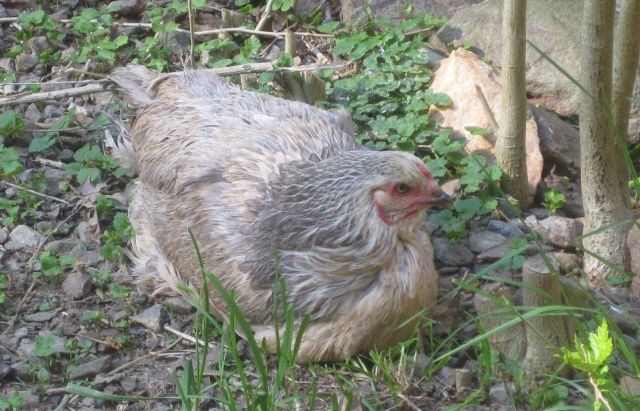
bodies at rest, a chapter closed

I was given the Ameraucana by a neighbor in July 2011 and we acquired Buffy and the older hens in September 2011   The younger hens were offspring of Buffy and his hens.  So we kept them safe, except for 2 lost to predators, for more than 4.5 years.  And now its over.  We had really good times with them and we learned a lot, they entertained us and we enjoyed their excellent eggs.  And now its over.

The security cameras caught a glimpse of 2 largish dogs leaving through a perimeter fence at 11.30am.  And who is to blame – the dogs? the dogs’ owners? or me?  I am still thinking that one out.
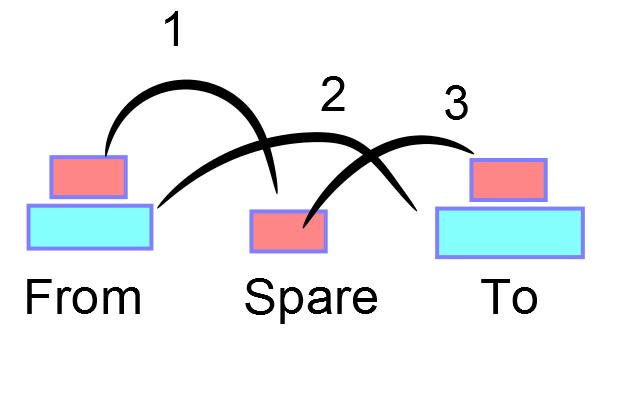
BJC (the Beauty and Joy of Computing) online course completed – Tower of Hanoi

I just completed the 4th and final semester of BJC MOOC via edX hosted by Berkeley, San Francisco.  What a great course!  And I learned so much about basic programming, computer science and technology trends.  All for free if you wish, though I contributed some.  For teaching purposes it uses blocks which you re-arrange called Snap! which is based on Scratch developed by MIT.  A fun exercise was the Tower of Hanoi puzzle.

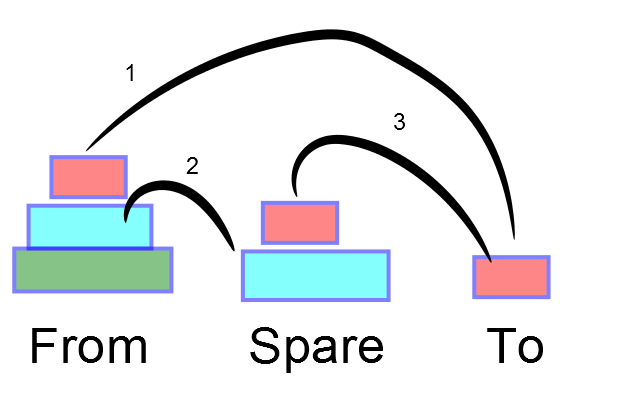
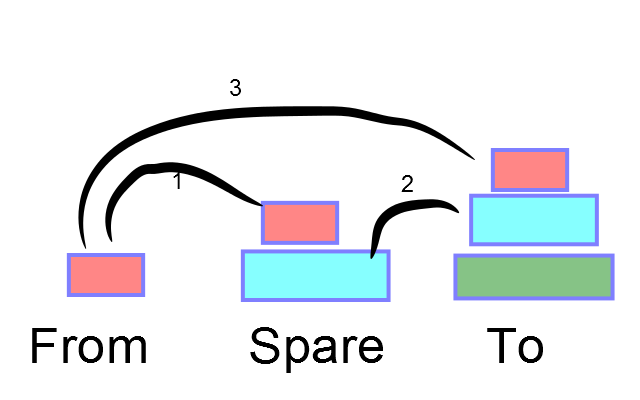
The rules are simple.  There are 3 pegs labelled left to right “From”, “Spare” and “To”.  The puzzle begins with various sized disks, smallest on top, stacked on the leftmost “From” peg.  The object is to move the disks over to the rightmost “To” peg subject to 3 rules: 1) only move 1 disk at a time; 2) take the top disk from one peg and place it on top of another peg; 3) you can never place a bigger disk on a smaller disk.

So if there are just 2 disks on the “From” peg, the solution is simple – just move top disk to “Spare” peg, next disk to “To” peg and then disk on “Spare” peg to “To” peg.

2 layerWith 3 disks it is a bit more complicated.  First:

3layeraThen with red and blue at “Spare”, green is moved to “To”.  The final step is:

3layerbI cut wood rectangles of descending sizes and practiced the puzzle beginning with a few pieces and progressing to 5 pieces.  When I found the recurring sequences I used a technique called recursion to implement the sequences.  Berkeley provided the backdrop and software to move the disks, all I had to do was figure which disks to move when and where.  My program is not fully automated (a remaining challenge) but it works and here is a video showing the solution to a 5 block puzzle.


So what has this to do with growing and sustainable living?  During the very cold and very hot months when outside work is unpleasant or unfruitful and you have time to spare, a MOOC on basic electronics or programming should be a good investment.  Once you understand a bit about electronics and software you will feel confident to install and program your own security system; install strategically placed cameras connected to a DVR to which you set up remote access via a smart phone; and with the expanding world of IoT (internet of things) you can also install perimeter sensors to provide early intruder warning, or an automated chicken coop door opener.  And you can diagnose and repair things which you might otherwise have tossed.  And becoming self reliant makes you feel good.


planning simplifies my growing

My tomatoes having progressed from 0.7″ soil blocks to 2.3″ soil blocks are now ready for transplanting to pots.  In early years I used 0.5 gal (64ozs) nursery pots but they took up too much space and needed too much soil.  Now I transplant to  1qt (32 ozs) yogurt pots with holes drilled in their base.  Later I will transplant to their final destination, except for a handful which I will hold in 0.5 gal or 1 gal pots as a reserve for failing tomatoes.

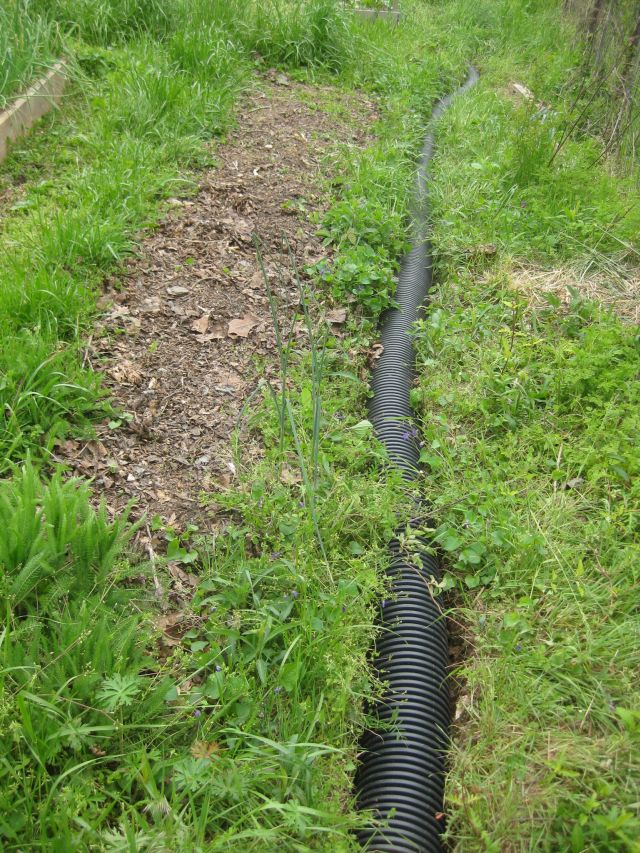
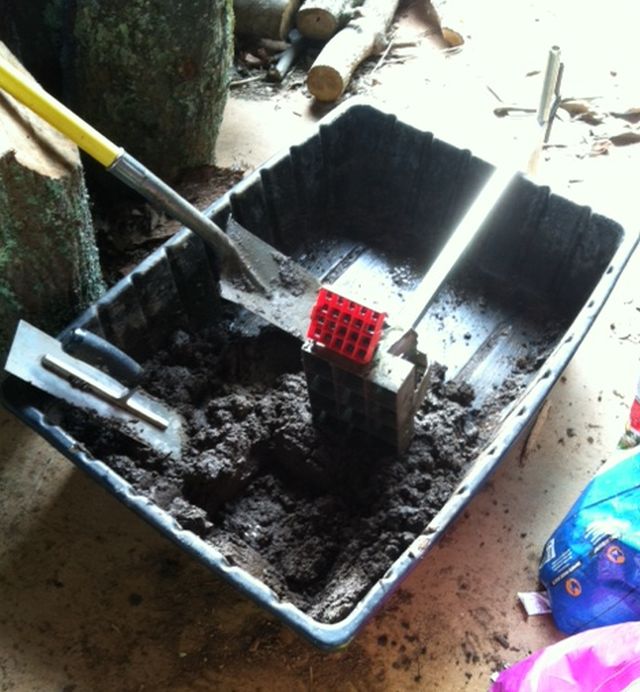
I have compost but am short soil for the pot mix.  Where to get soil?  Buying is out of the question – why use sterile or bad soil when my own soil is so rich and free of ‘cides.   I then remember my annual chore to clear the 8″ wide, 8″ deep trench/moat which protects my raised beds from invading roots.  One year I hacked down all the nearby hedges and small trees –  wasted effort (they grew back the next year) and silly since they were the hunting perches and cover for insect eating birds such as the brown thrasher, which is our state bird.  So now I ignore the growth and annually I clear and deepen the trench to transect and deter enfilading roots.  I remove 5 barrows of soil, mix with compost, remove rocks and weeds and have potting soil for my tomatoes.  I have another thought – I  have surplus 70 ft – 6″ corrugated pipe – why not put the pipe in the trench?  This achieves 2 goals – prevents weeds filling the trench and bridges the trench for my push mower.

a portion of the root protection trench.  on the left is a perennial asparagus bed with a few shoots on the way
a section of the root protection trench. on the left is a perennial asparagus bed with a few shoots on the way

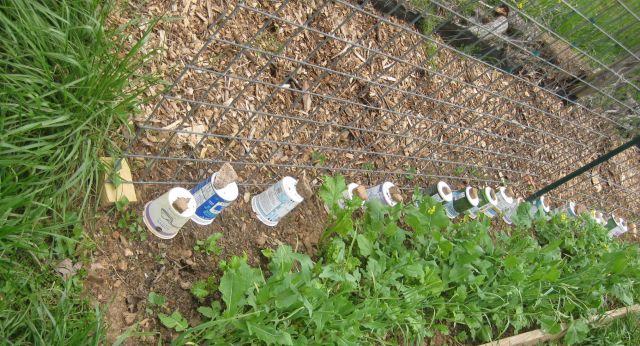
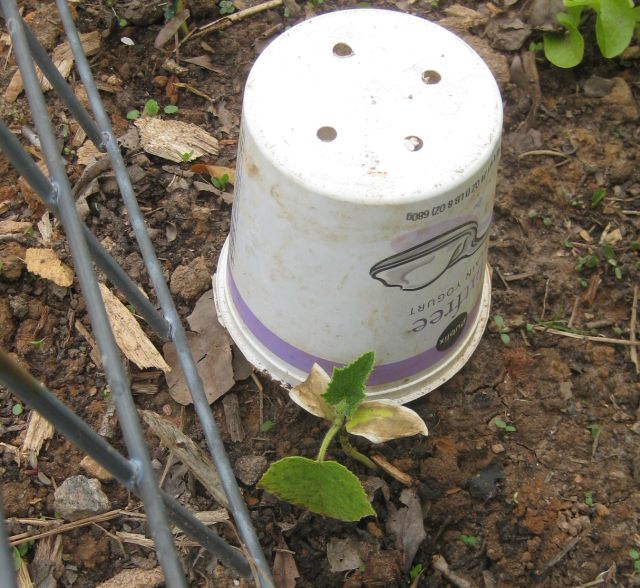
Now to fill the pots.  Our average last frost date is mid-April and on April 8 the 5 day forecast indicates 30 degrees on April 10.  I use some yogurt pots as domes over my tender cucumber plants with stones on top to prevent wind disturbance.

some of the protected cucumber plants

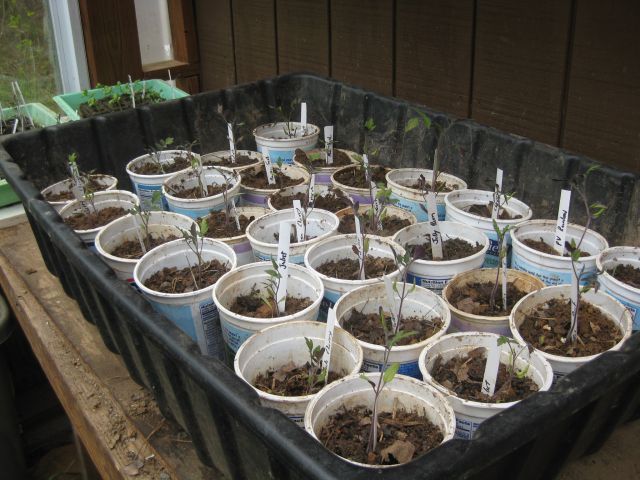
I fill pots with my new soil mix and transplant some tomatoes.  Below is a cement mixing trough with 28 transplanted tomatoes.

some of the repotted tomato plants including Rutgers (a southern favorite), Oxheart, Black Cherry, Juliet
tomato plants including Rutgers (a southern favorite), Oxheart, Black Cherry, Sugar Cherry, Juliet, Jelly Bean,  Rainbow, Mountain Fresh, Big Beef

And today I uncovered the cucumbers and used the freed up pots for more tomatoes.  The cucumbers suffered a bit (lowest 2 leaves affected) but they survived and next year I may delay planting out the cucumbers until after mid April.

the pots probably saved the cucumbers, though the bottom 2 leaves were cold damaged

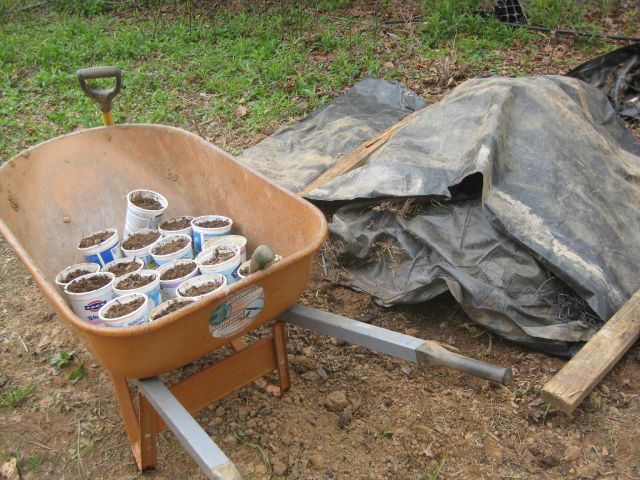
And I still have a mound of soil mix remaining – the chickens have worked it over and I now cover the mound with black plastic to stop weeds growing so there will be less preparation needed when I pot more tomatoes.

soil mix shielded from the sun and a barrow with some yogurt pots

epsom salts bath recovers Ameraucana

I mentioned in my Jan 20 post the passing of Gimpie.  She and the Ameraucana were the two elders in the flock.  The Ameraucana observed a period of mourning and then began associating with the flock at a wary distance, cautious always of the rooster who had dispatched her comrade.  She is over 5 years old and in her waning years and at feeding time she is driven away by the younger hens, some of whom are her offspring.  So much so that I have a routine for her at evening time to eat separated by the interior partition door, which I open afterwards so she can rejoin the flock on the roost.

A few days ago she appeared very sluggish, we saw her in the nest box (to escape the rooster we thought) and then slumped in a corner of the paddock.  I thought her end was nigh, M. thought it was time for an espsom salts bath.  I protested, M. insisted, and there we were me holding the Ameraucana in the bath and M.  circulating the warm water around her limbs, her deteriorating feathers, and scaly wrinkled skin.  This was followed by olive oil treatment of the legs – the idea is that the oil suffocates residing mites.  A bedraggled Ameraucana barely ate her food that evening and we separated her from the flock for the night (perhaps her last).

Next morning, M. thinking the bath had been the final straw and “done her in” kept a close watch on the Ameracauna’s activities and then she came in, eyes ablaze, to announce the Ameracauna had laid an egg.  Now the Ameracauna was transformed, no longer sluggish and collapsed but wandering around with the flock as she used to do.

M. informs me that magnesium salts relax muscles and that the Ameracauna was egg bound (couldn’t push out the egg) and the spa bath did the trick.  And I for once, have little to say.

quick water pump repair; seedlings doing well

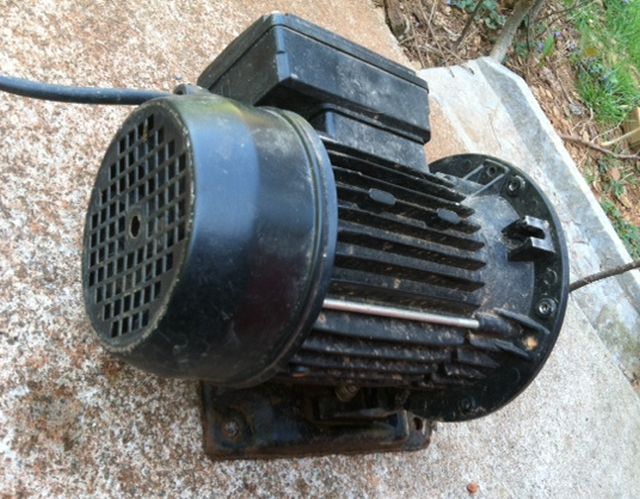
With the beginning of winter I now always ensure that I have disconnected my water pumps and drained the water.  My carport pump (moves 2,400 storage gals) started fine, but my 1hp Water Ace (moves 2,800 storage gals) just made a humming sound when I tried pumping today.  Another challenge!

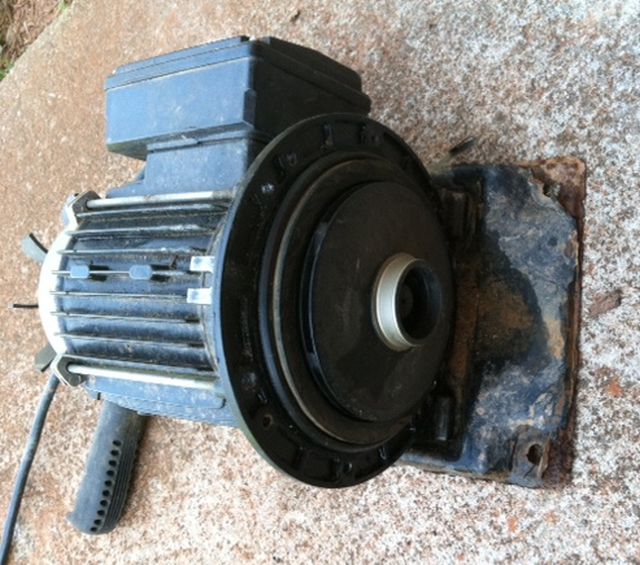
Probably bad brushes I thought but usually there is warning – a lot of spluttering and starting in fits.  Not this time and why should it fail to start after the winter break? I moved it to the workshop and removed the front end where the centrifugal impeller is – it turned with difficulty.

the pumping end -the motor spins the disc which has slits in it to catch the water and force it through the center hole

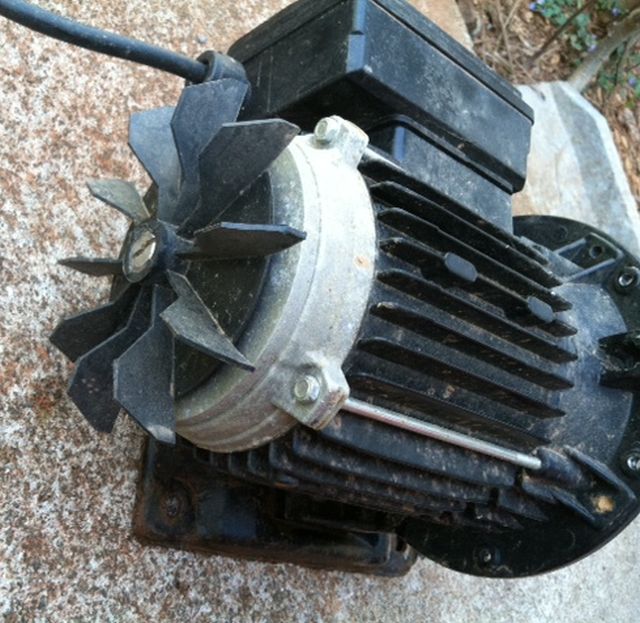
Odd, I thought something must be jammed.  While it was open I removed some small stones caught in the slits.  So what could it be?  I happened to look at the rear end and the cover was not seated properly.  Beneath the cover is the fan which is also driven by the motor.

cooling fan with cover removed

Now, with the cover removed,  the impeller and the fan (they are connected to the same drive shaft) turned easily.  I carefully replaced the fan cover and the front end cover and the pump started fine and pumped without leaking.  All done!

pump fan cover replaced

To remove the bolts I looked for my battery powered screwdriver, could not find it and so used my drill at lowest speed and torque setting.  Mistake!  Even at the lowest settings it is too fast and too powerful.  I more determinedly looked for the powered screwdriver, found it and then removing the remaining bolts and re-assembly was fine.  Moral – don’t rush.

the small powered screw driver turns more slowly and with less torque - why strip bolt heads needlessly?
the small powered screw driver turns more slowly and with less torque – why strip bolt heads needlessly?

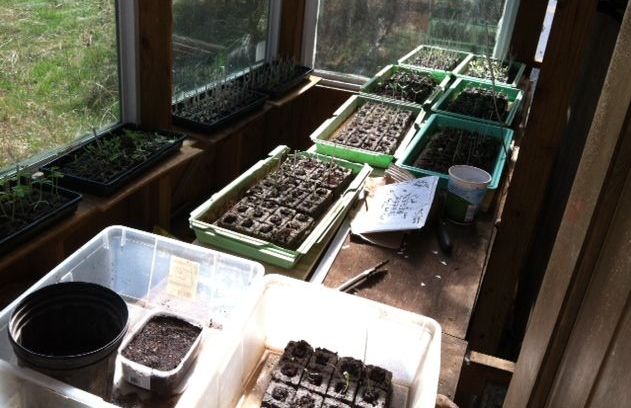
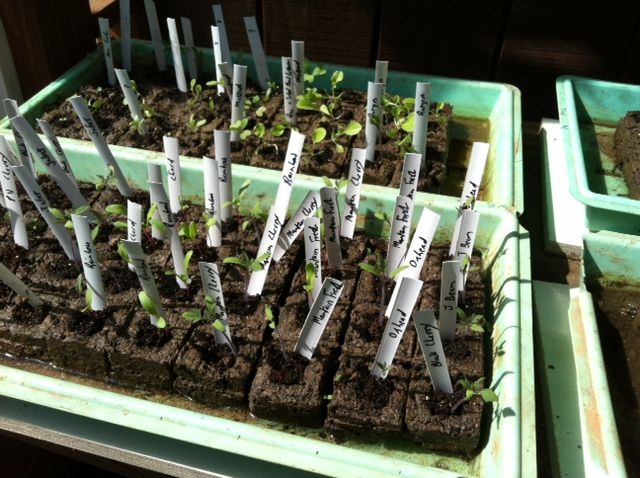
My seedlings are progressing well – below is a snap of some of my tomatoes in 2″ soil blocks in the greenhouse.

some tomatoes identified with venetian blind plastic strips

my bees and “Guns, Germs and Steel”

I just finished reading “Guns, Germs and Steel” by J. Diamond.  A well documented and persuasively argued book with the main conclusion  that peoples in different continents and in different areas in the same continent developed differently, not because of race/genetic/biology differences, but because of differences in their physical environments.  Food for thought.

Last year I installed 2 packages of bees on the same day in very similar spots.  Both had Hawaiian queens.  I watched the development of the two hives.  One hive had busy bees and from mid-morning to late afternoon they were zipping in and out of their hive.  The bees of the second hive were very different – they gathered at the entrance and there seemed little flying activity.  They were idled, as with an extended factory tea break.  I wondered what caused this difference and concluded they had bad genes, whatever that means.  When I harvested honey in late summer there was no surplus honey in the second hive and lots of honey in the first hive.  In fall I began feeding (sugared water) both hives so they would have sufficient reserves to make it through the winter.  What puzzled me was the second hive appeared to consume the liquid nourishment more voraciously than the first hive.  Odd.

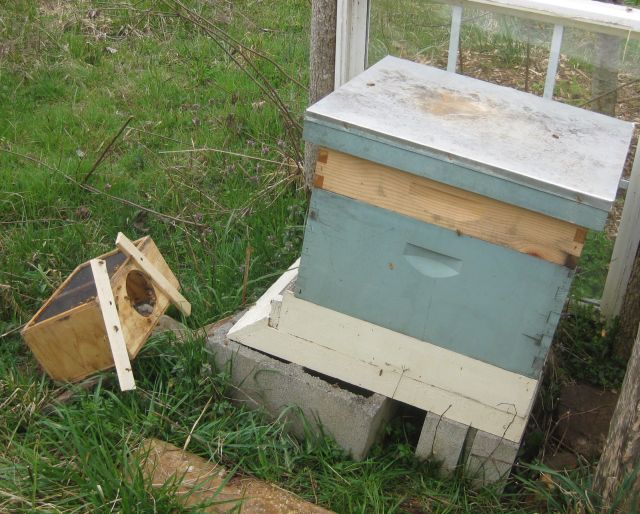
Last week I installed 2 packages of bees and followed the same instructions as the previous year – except last year I neglected item 15 “Insert your entrance reducer, leaving a one-finger opening  for the bees to defend.  Leave the opening in this manner until the bees build up their numbers and can defend a larger hive entrance against intruders.”

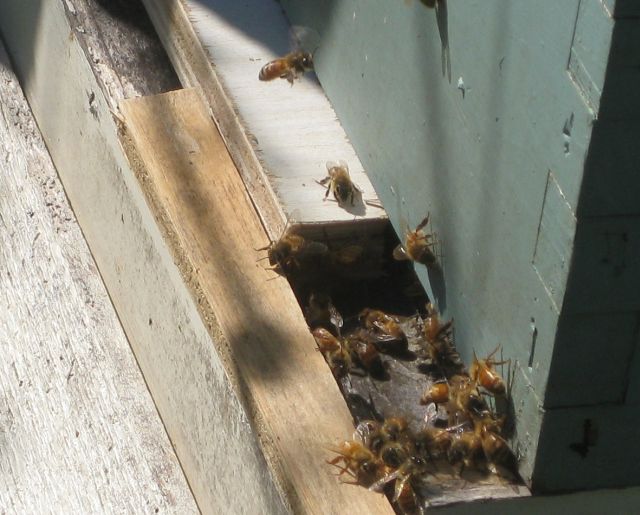
my cobble together entrance reducer. most of the entrance is barred by the white strip of wood and access to the remaining is complicated by the brown strip
my cobbled together entrance reducer. most of the entrance is barred by the white strip of wood and access to the remaining is complicated by the brown strip

And then the penny dropped!  My #2 hive last year succumbed to intruders from the get go and this continued throughout the season.  Whatever food the #2 hive forager bees brought home was robbed by other bees.  Presumably their guard bees were killed off continuously or became demoralized.  I remember from high school an explanation of why agriculture collapsed in the Soviet Union.  Once the farmers were disenfranchised from their land holdings and had to meet annual production quotas they became disincentivised and production collapsed.  This may not longer be the accepted explanation but it made sense to me then and now.

So my theory is #2 hive was continuously raided and they gave up.  And this explains why the food I gave them in the fall was consumed so quickly – the hive inhabitants and the marauders from #1 hive were both consuming the food.  And quite possibly the honey I harvested from #1 hive included honey stolen from #2 hive.

Which brings me back to “Guns, Germs and Steel”.  If the entrance to #2 hive had been reduced in accordance with instructions, then quite likely that hive would have built up strong numbers and thrived.  So you could argue that the fate of that hive was determined by its physical environment – no entrance reducer in the early days when it was most needed.

But #1 hive also had no entrance reducer and the foragers of #1 hive attacked and stole the food of #2 hive.  So it was more than physical environment – perhaps there were more bees in the #1 package I installed and this made the difference.  Or, as I suspect, #1 hive was just a superior hive and its residents overwhelmed the competition.

“Guns, Germs and Steel” posits that the good luck of certain peoples being in good environments was what made the difference.  But perhaps those fortunate peoples were not sited in the good environments ab initio.  Perhaps even before the development of Guns, Germs and Steel some hunter gatherers or tribes or groupings recognized that some land was better than others – more water, fish, animal, edible vegetation – and defeated the occupants and took control of the better resources.

And if there is some truth in this, then we are back to the old debate of nature vs nurture.

spring time catchup

My recent visit to the west coast set me back on my spring schedule and I have been catching up.

Foremost was to get my tomato seeds going.  Last year I collected seed from good heirloom tomato plants and this year, for the first time, I did not purchase any tomato seed.  Though I did buy “Surround” (Kaolin clay) which I will spray on my apple trees when the blossoms have set fruit, and the supplier included gratis, seeds for  Rainbow and Cherry tomatoes.  Plus I had some 2014 and 2015 packets most of which are viable.  Although last year I clustered the tomato plants by variety I am sure some were cross pollinated with other varieties so it will be interesting to see what emerges.

my 2" and o.5" soil block moulds
my 2″ and o.5″ soil block moulds

Preparing the 0.5″ soil blocks is quick since I use purchased seed starter mixture.  More work is required for the 2″ soil blocks for which I use topsoil, my compost and peat (all manually sieved) and to which I add building sand and lime (to offset the peat ph).  When the seeds have germinated and grown about 0.5″ I transplant them to the 2″ soil blocks.  And later I will transplant the tomato soil blocks into 32 oz yogurt containers.   For maximum sun exposure and monitoring I grow the tomatoes in my greenhouse until they are ready for the outdoor raised beds.

I also germinated from 0.5″ soil blocks lots of other vegetables – the common such as lettuce, broccoli, kale as well as peppers, cucumbers and herbs.

Additionally I have been preparing the raised beds with weeding, composting, dusting with ash from the wood stove and seeding with lettuce, mustard, radish, kale etc.  This all takes time and work but the weather is pleasant, I enjoy physical labor and, for the first time, I am using headphones attached to my iPhone and listening to my podcasts.

Each day I carefully collect in a yogurt container the ladybugs which appear in our bathroom and, if the collection exceeds 10 or so, I transport them to the vegetable area where they will work beneficially until again in the fall taking refuge in the bathroom.  This they have done consistently for several years, like salmon returning to their breeding grounds.

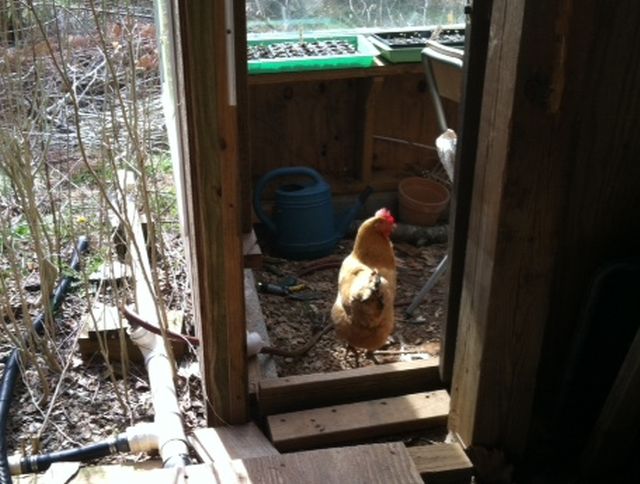
My chickens are free range and I notice Randa (the most intelligent) standing beside the closed greenhouse door.  Flashback to when I discovered last year she had made a nest out of sight in the greenhouse with >10 eggs.  I open the door for her and when I come back an hour later, she has laid an egg in a little nest she has fashioned.  What to do?  Initial thought is to keep her out of the greenhouse.  On reflection this is not a solution since she will probably then make a nest somewhere hidden in the surrounding growth, as she did 2 years ago and accumulated 16 eggs.  So now I leave the door ajar and she lays an egg each day in the green house which I collect at day’s end, together with all the other eggs laid by the normal chickens in the nest box in the coop.

Randa entering the greenhouse

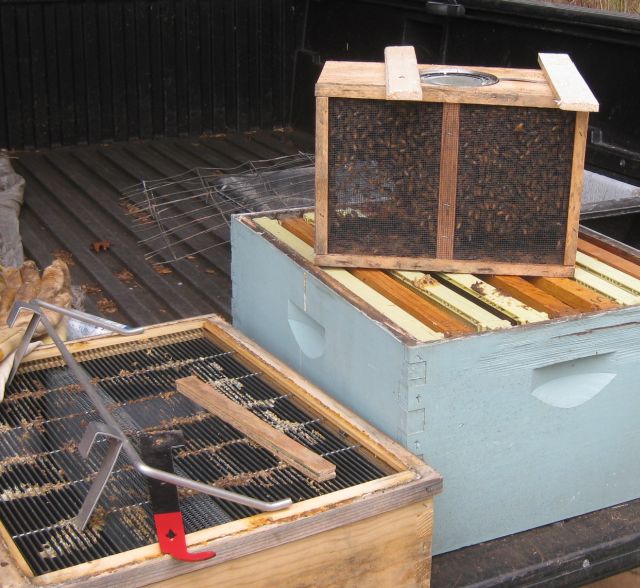
And on Saturday I took delivery and installed 2 packages of bees from our local professional beekeeper who maintains >500 hives and is the oracle of our local bee club.

So now I am fully into the swing of spring.

visit to the west coast

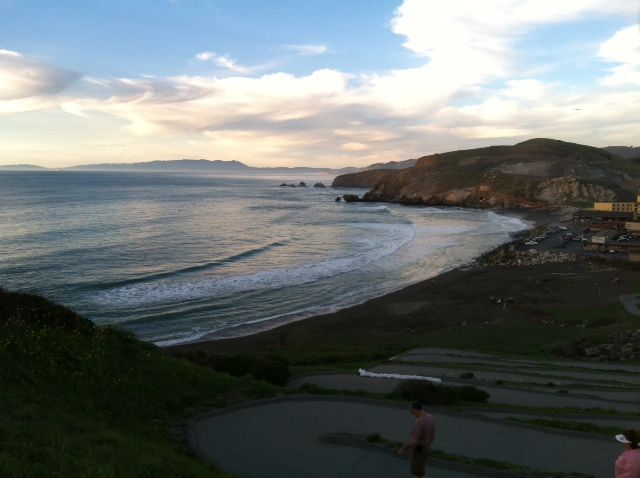
One of the big life events occurred for me in February – I became a grandfather (for the 1st time) and this occasioned a visit to San Francisco.  Actually South San Francisco which is a town south of San Francisco, fairly close to the airport and really close to Pacifica.  Pacifica is a small town on the Pacific with great walking/running trails and views of the ocean.

this is the middle bay with a helpful serpentine path to the top of the cliff

There is one bookstore to which we make our annual pilgrimage.  This time for $1 I purchased “Guns, Germs and Steel” by Jared Diamond a much referenced and fascinating read.  Especially for me with my interest in the development of agriculture and communities across the world.  Also an organic cafe with good coffee to mark the halfway point of the morning run.

this overlooks the 3rd and northern bay with its pier and nearby cafe
this overlooks the northern bay with its pier and nearby cafe and, in the distance, Marin county

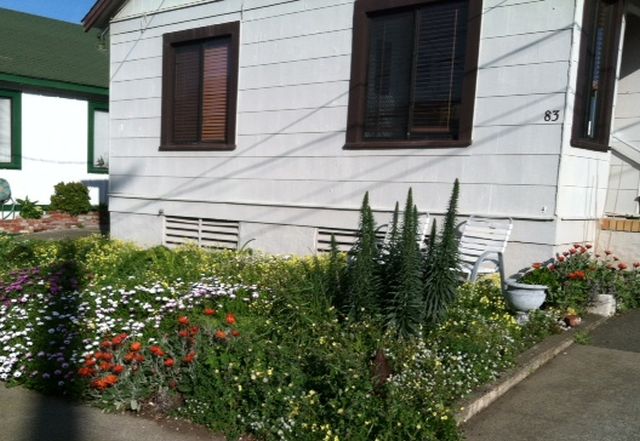
And to reach the cafe we pass small houses with flowerful front yards.

one of many front yards, none of which had grass lawns

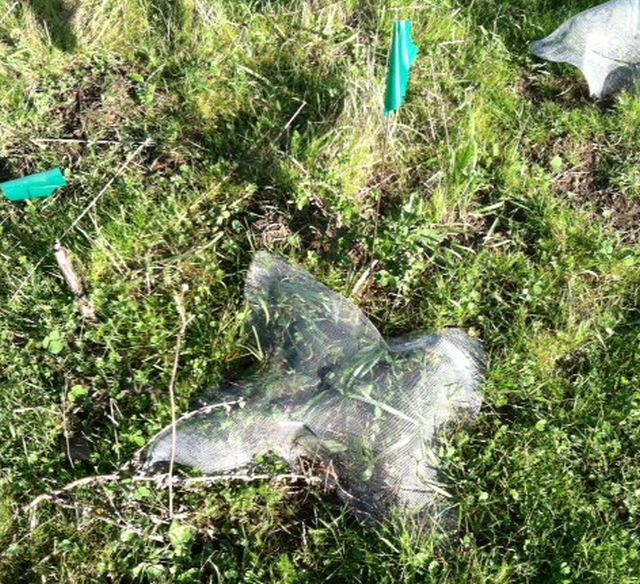
Although the paths cross rugged natural terrain you cannot but notice extensive work protecting the cliffs and reintroducing plants to the landscape.

this unusual object is wire mesh stapled around and protecting a tender plant with little flags dotted around signifying protected species

We had a great time with family and look forward to more visits to the area.

fruit tree workers

Ever since I trapped and relocated a feral cat (see post 12/9/2015) which I believe killed one hen and mauled another, confidence has returned – to the flock and me.  They now are truly free roaming – after the coop door opens in the morning and they spend awhile in the paddocks, I release them to roam the yard.  First stop for them is below the deck to gather seed scattered from the bird feeder, then a visit to the compost heaps and then hang out in the woodland area.

Except today with temps above freezing for the first time in a week, when the rooster and 7 hens pressed on beyond the compost heaps and the vegetable growing area (from which they are fenced out) to the orchard.  I had composted and thickly mulched all the fruit trees and they visited almost all the trees scattering the mulch and swallowing down worms and, I hope, slumbering fruit tree pests.

Great for my organic growing efforts and great for their diet.  One caveat – I leave the door open alert for a distress call from the rooster.  But the yard is fenced in and just up the road a neighbor’s flock of hens peck along the road and visit various yards and so far appear unscathed.  So maybe too will be mine.

homeward bound after a solid afternoon's work
homeward bound after a solid afternoon’s work

my Irrigation Adviser

Recent bad weather discouraged outdoor activity.  So I used my time indoors to tackle a BJC.3 (Beauty and Joy of Computing – Berkeley, CA) project.  We were recently instructed on web scraping which means using Snap! (a block programming language derived from Scratch) to go to the internet and scrape selected data from websites.

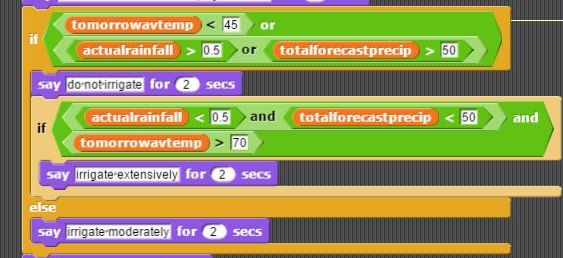
From Spring to Fall a daily decision is whether to water my crops and, if so, how much.  To make this analysis I need to know current soil moisture, expected precipitation (rainfall) in the next 12 hours and local average temperature.  If there is sufficient moisture in the ground or rain is imminent then it is not necessary to irrigate.  The need for irrigation is increased if temperatures are high since this will accelerate evaporation and unnecessary if temperatures are low.  At some point I will install sensors which will report ground conditions.  In the meantime I had some fun and devised my “Irrigation Adviser”.  Click on the following link and you can see the message given me on 2/16/2016 @ 2.10pm.