neem oil – a remedy for chickens

I have been intrigued with neem oil for some time. Something exotic about it. When I first planted tomatoes in north Georgia four years ago, and they were overwhelmed by aphids, neem came to my rescue. Aphids were never a problem again, not because of the neem but my voracious ladybug population. (This week I have been collecting my overwintering ladybug guests and ushering them out to their workplace in my vegetable garden). My second recourse to neem was a couple years ago when the stinkbugs arrived. With my pistol grip sprayer I doused the offenders and they looked dazed and disgusted. Last year I awaited them but they did not arrive, again not due to neem but to some mysterious forces at work. And so my neem oil sat unused in the cool basement for more than a year, until last week when it was recalled to the front line.

But a word about neem. A neat little book by John Conrick titled “Neem The Ultimate Herb” goes into much detail on its origins and uses. He traces its first use as a medical treatment to 4,500 years ago. He states it is a major element in preventing and healing diseases among Ayurvedic practitioners (a system of traditional medicine in India). The neem tree (Azadirachta indica) is a tropical evergreen which grows in much of Southeast Asia, welcomes extreme heat of up to 120 F but will not tolerate hard freezes – so unlikely to call my yard home. My interest is not in its medical properties, or how it is made, but its use for insect control. Unlike synthetic pesticides, most of which have quick acting nerve toxins, neem’s main action is as an anti-feedant, which dissuades pests from eating neem covered plants. It can also reduce an insect’s ability to reproduce. No wonder the stinkbugs looked dazed and disgusted! Conrick also mentions that neem has been found to be beneficial on bees.

So how did I use it as a remedy for my chickens? Our Buff Orpington rooster has a good looking comb but the tips of his comb turned black a few weeks ago from frost bite. He didn’t seem to mind and, as he is becoming more aggressive, I decided to leave him be. Then I noticed black spots at the base of the comb. One of the Golden Comets tried to peck at his comb (for food or as a grooming favor?) and he discouraged her endeavors. But this made me think that this was an insect problem not a frost bite issue. So how to treat it? Diatomaceous earth and Sevin dust have been suggested for mites and lice etc. but I didn’t want to powder a young vigorous rooster near his eyes. I also didn’t want to use a synthetic treatment given my recent success with an organic treatment, psyllium, for chicken crop problems. And then came the idea of neem – I cannot claim credit for this inspiration since I believe it was derived from internet browsing.

Neem is usually mixed with water but I was concerned this mixture could dribble into his eyes. So I took a little dropper bottle and mixed the neem with Johnson’s baby oil at 10% strength i.e. 36 drops of the baby oil and 4 drops of the neem oil (the neem oil is described as having 70% extract of neem oil). Administering the concoction single handed was not as big a challenge as I had thought. I cornered him in the coop, and held him firmly between my knees and then one hand held and pivoted his neck and crown and the other retrieved the pre-charged bulb dropper and doused the infected areas with the mixed oils. After initial hysterical protestations he submitted to the treatment. A day later most of the black infestation was gone and two days later he was cured. Easy enough now but, when his spurs are developed, I do not think this will be a happy experience for either of us.

This winter was very mild and the bugs are out and about and multiplying. I really would like not to use any organic treatments this year. I am hoping that with my expanded beneficial insects army and diverse plantings and good compost and strong plants I will be able to withstand the onslaught. Except in the month of August when we tend to become overwhelmed and then the best is to cut back on the plantings (so as not to subsidize future generations), and look the other way. But if I have to, then neem will be reactivated.
permaculture trending – comfrey

I like the pragmatic and intellectual underpinnings of permaculture. On the intellectual side, I am reading and enjoying Holmgren’s “Principles and Pathways beyond Sustainability”, at the quasi pragmatic/theoretical level I enjoyed Hemenway’s and Whitecraft’s books on permaculture in the United States and the United Kingdom respectively, and for a hands on approach, of course the two books by Holzer. And some of the suggestions have rubbed off.

Polyculture and biodiversity are not new to organic growing. I purchased in the 80’s Riotte’s book “Carrots Love Tomatoes – Secrets of Companion Planting for Successful Gardening” which was first published in 1975. However, the focus on perennial plants and guild’s is new for me.

I have grown Mullein (several varieties), Black Locust and Osange Orange from seed and will be transplanting them soon. My efforts to grow Gumi from seed have not yet succeeded. The plant that fascinates me the most is comfrey. My father-in-law was a serious organic grower in South Africa and he grew comfrey in the 60’s and 70’s. But its controversial history goes much further back in time.

An interesting read, is “Russian Comfrey – A Hundred Tons an Acre of Stock Feed or Compost For Farm, Garden or Smallholding” by Lawrence D. Hills published in London in 1953, which can be freely downloaded. The book begins with a quote: “Russian Comfrey is a weed; no stock will eat it; its yield in dry matter per acre is below that of orthodox fodder crops; it is impossible to get rid of, and fit only for a half-hearted trial on an odd corner of land where nothing else will grow. Its possibilities have been greatly overrated by those who sell it at high prices, and nothing reliable is known about it…..”

The story of Russian Comfrey begins in 1771 when an English gardener living in Hackney, London sold his nursery and became head gardener to the Palace of St. Petersburg for Empress Catherine The Great, of Russia. Between 1790 and 1891 he sent back to England several varieties of comfrey of which S. asperrimum became more highly regarded than S. officinale, the native species to England. Over the past 200 years it has had staunch supporters and harsh critics.

Apparently all species of comfrey require a deep soil, not necessarily a good one, and they have a reputation for growing on land where nothing else will grow because they have long and powerful roots which dive straight down and access subsoil water and minerals. A hard pan will defeat them, they need at least four feet depth, a 6.0 ph is as low as they can go, and they are at their best on clays, loams and sandy loams. They are used to cold winters and are moderately shade tolerant. However, they are unsuitable for planting under fruit trees not only because of the size to which they grow but because they will compete with the tree for nitrogen and potash. Comfrey must be cut frequently (every 4 to 6 weeks) in summer and not allowed to go to flower.

The Russian Comfrey does not spread by seed but by its roots and to prevent it becoming an invasive the ground near it should not be tilled. Since I shall not be using it for fodder, it will be composted. My poultry shall be doing the weeding and providing nitrogen rich droppings.

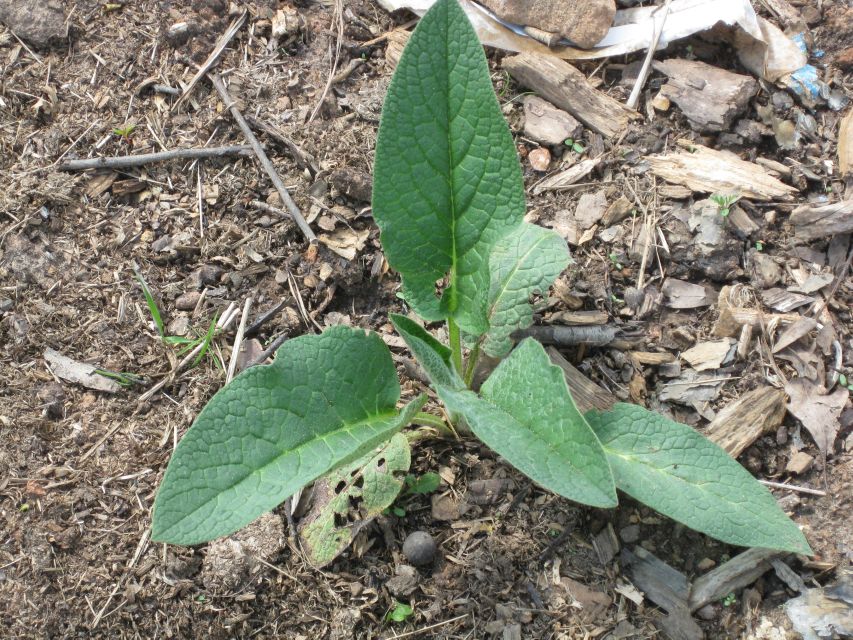
I purchased several Russian Comfrey root cuttings in the fall and they have now surfaced and are growing vigorously.

comfrey
Russian Comfrey growing vigorously, planted in the fall


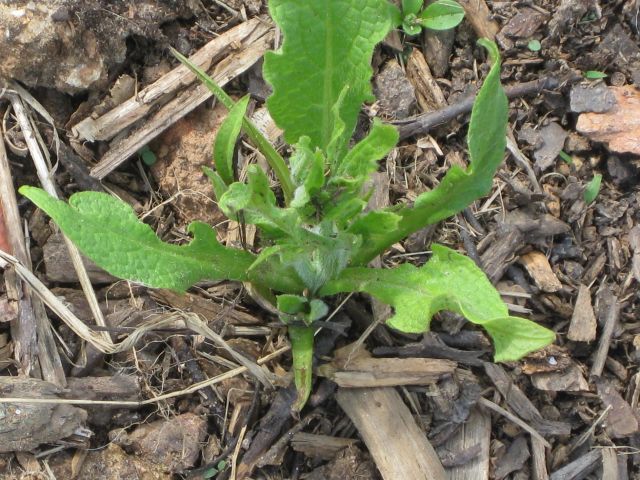
I also installed one cutting of Comfrey officinale, which does spread by seed and must be carefully watched. It has just surfaced and begun growing.

comfrey
Comfrey officinale – just one plant to monitor


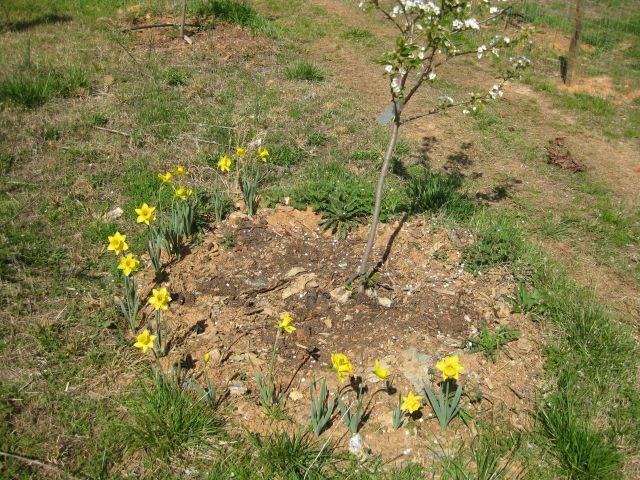
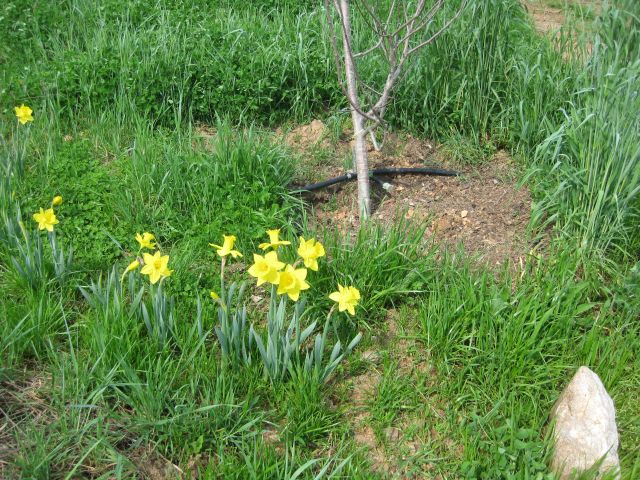
I mentioned my interest in guilds, a frequent permaculture topic. One of Hemenway’s suggestions is to plant daffodils around a fruit tree. They flower early in the season so will not compete for water in the dry months, they are poisonous and may dissuade predators and, they look pretty.

comfrey
blossoming pear with daffodil companions


Most of my pears are now in blossom. Last year I lost all my pears to a late frost. The average last frost day here is mid-April, so I am watching the weather reports and if frost is imminent I may try wrapping my pear trees to protect them. Below is an apple tree with daffodils and various cover crops which I shall cut down after they have seeded – I know I shall lose the benefit of the nitrogen nodules on the hairy vetch and clover but allowing them to seed gives me more for next year.

comfrey
apple tree with daffodils and cover crops including crimson clover, winter rye and hairy vetch


I am not including a photo of an apple tree with a nearby comfrey since, having now read the book on Russian Comfrey I realize I planted the comfrey too close to the tree and must relocate it – watching out of course that I do not leave any root remnants behind.

horse manure control test

My two main nutrition inputs are leaf bags from my neighbors, which I pick up in the fall, and horse manure (well rotted/decomposed) from the stables.  I have read articles about manure loaded with chemicals which wreaked havoc in growers’ plots.  I have not experienced this problem but, to put this concern behind me, I ran a simple test.

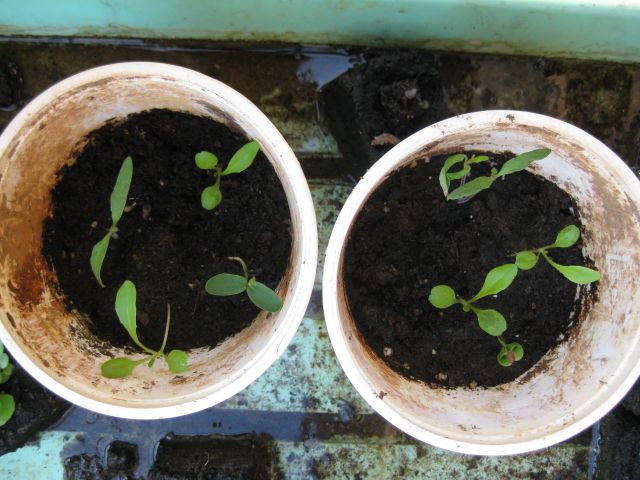
I took two empty 32oz yogurt containers, drilled holes in the bottoms for drainage, and filled one 50% with recently collected manure and the other with compost.  I then added another 30% sphagnum peat to both, so they were both about 80% full.  Into each pot I planted two lettuce seedlings, one tomato seedling and one black locust seedling, all comparably sized.  The compost pot is my control pot.  Watered and left for a week plus in my greenhouse.

The result to date, is that all the seedlings in both pots are doing fine.  Some of the seedlings in the manure pot appear better developed.

manure
container on left has manure and on right has compost

I shall keep an eye on both pots but I do not expect a change in the results.  Which means the manure I collect is ok.  Or is it?  Driving in this morning I listened to a recent Paul Wheaton podcast and he mentioned that wormers used on horses to control gastrointestinal parasites, subsist in the manure and may kill earthworms. I have a well established hardworking earthworm labor force specialized in compost making. So this podcast tidbit gives me something new to think about.  I could add a couple of worms to each pot and lid it (to prevent them from escaping) and see how they are doing in a couple of weeks.

egg production

I have mentioned my travails with the Speckled Sussex – one was ill and died and the other went into a serious slump and, despite my efforts also died.  So from 13 hens and 1 rooster I am down to 11 hens and a rooster.  Two of the hens had problems of sorts.

Gimpy, one of the hybrids inherited from my neighbor, developed a bad leg or hip.  Don’t know why – could this has been from the rough attentions of the rooster?  She hobbles with difficulty and I recently noticed she was now losing feathers on her back.   Thinking this was caused by insects (lice, mites, fleas) I began dusting her with diatomaceous earth.    I then ratcheted up the treatment and began dusting her with Sevin dust powder (deviating from organic principles here).  Then she wouldn’t come out of the coop during the day and I thought this was because the weather was cold and she did not have all her feathers to keep her warm.  But I noticed she wasn’t wandering around the coop but huddling in a corner under the nest boxes, so it occurred to me that some of the feather loss was because of feather-pecking by the other birds and she was sheltering defensively.  One warmer morning, I dusted her with Sevin and, despite her protests, took her outside and placed her amongst the others.  I noticed that two of the birds approached her as she balanced on a log on one foot (she tries not to use her damaged foot unless she has to)  and pecked at her back.  And got a bite of Sevin powder and backed off in disgust.  Maybe this helped.  I am pleased that she is now, of her own accord, coming out of the coop during the day.

My other patient is one of the Golden Comets whom I have named “Goldie” – a spur of the moment naming decision required when I took her to the vet.  Her problem was her large crop, which was always large, and her unusual neck movements as she tried to get the food down and to stay in her crop.  The vet realized I like to be hands on and was very helpful showing me how to insert a tube to try drain the crop contents.  He also prescribed  Nystatin for crop fungal infection and gave me a couple of tubes for administering the medicine and draining the crop, if I wished.  Well, Goldie seems to be getting better, as well.  After scouring the internet for advice and noticing what appeared to be conflicting suggestions, I decided to administer every few days, via a feeding tube, a capsule of psyllium fiber (Metamucil) mixed with 25ml of water and then massage the crop.  And it seems to be helping.

I should mention that, unlike the now departed pair of Speckled Sussex which appeared devoted to each other and always stayed together,  the other Golden Comet (Goldie’s sister as it were) appears little interested in Goldie and when I remove Goldie from circulation and then reintroduce her, the other Golden Comet pays scant attention.  This other Golden Comet is also amongst the most intelligent of the birds, the first to run up to me on the off chance I am bearing food and, when I am digging trenches or turning the dirt, she is constantly at my side pecking at the worms in the upturned soil as soon as they appear.  I am not suggesting intelligence trumps emotion, just that she appears to have reordered her priorities.

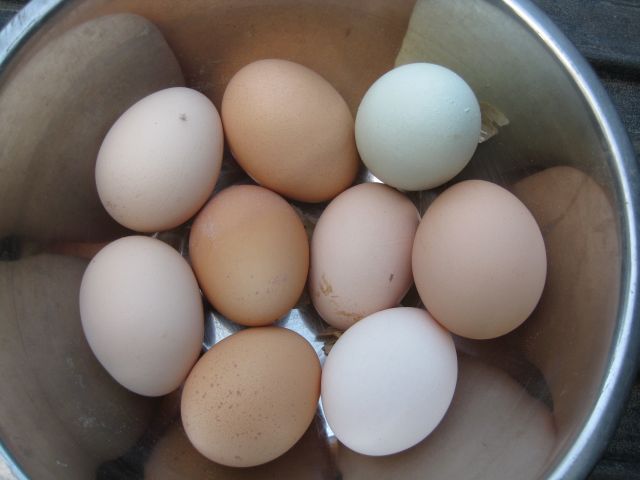
So it is spring now and everything is looking up, and the chicken appear happy and content and I am getting between 7 and 9 eggs a day – different sizes and colors.

a day's harvest - the green egg (top right) is from the Ameraucana


home beer brew

When I lived in London in the late 70’s through the mid 80’s it was common to make your own beer.  Boots, the large pharmacy retailer, sold a beer brewing kit for less than 10 pounds  ($16 at today’s rates) which contained all you needed to make your own beer.  Drinking beer at the pubs was popular and even when you visited friends for a meal, you would before or after the meal, head to the local pub.  However, and I began to dread the moment, your friend would occasionally insist you drink his own brew.  Some were good, most were blemished, including some of my own.

So now, many years later, I have returned to making my own beer.  One reason is I am using yeasts for various other purposes such as making whole wheat bread and I am growing three different types of mushrooms (yes, yeasts are classified in the kingdom of Fungi).  And I like beers, especially dark beers – each evening I have a Trader Joe’s Hofbrau bock.

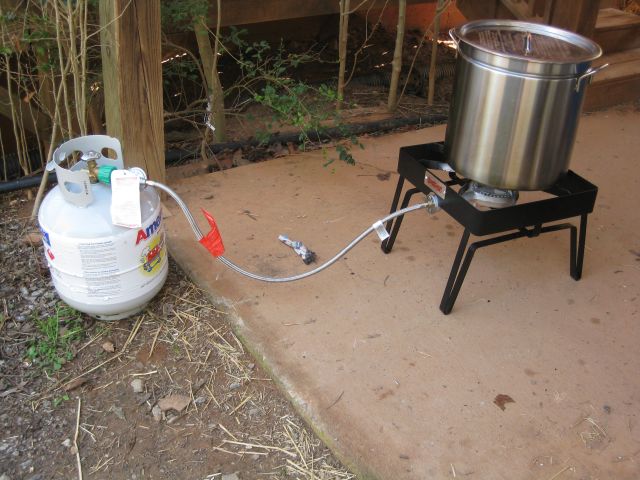
I ordered equipment and a kit (described as German style dark all malt) and yesterday I began my brew.  Relatively straight forward.  Clean all the equipment which will be used, then heat 1.5 gallons of water and mix in the ingredients and boil for a while.

beer
preparing the malt mixture (wort)

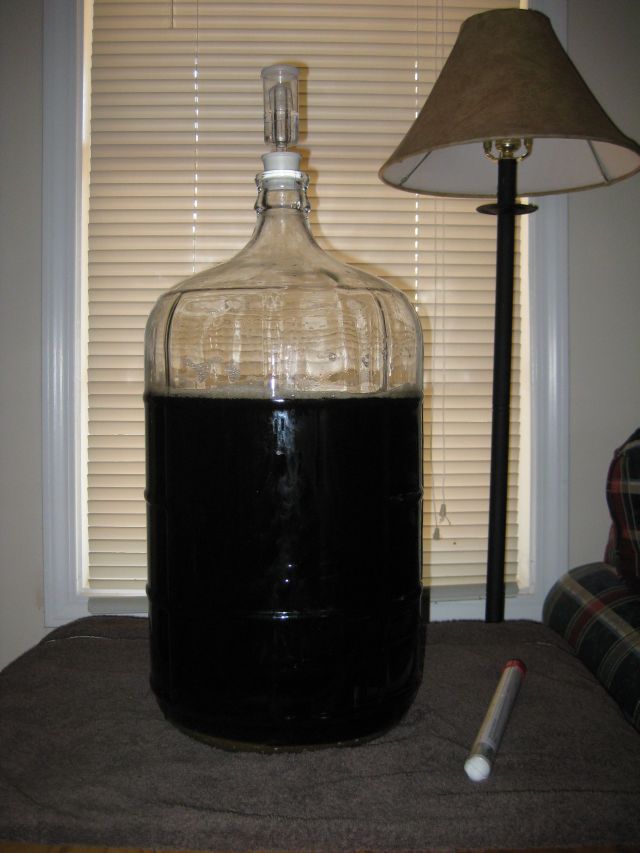
Next step is to move the hot contents to the fermentation vessel, allow it to cool down, add the yeast and leave it alone for a few days.  Here is a ‘photo of my carboy fermentation vessel before adding the yeast.

beer
6 gal glass carboy with airlock before adding yeast


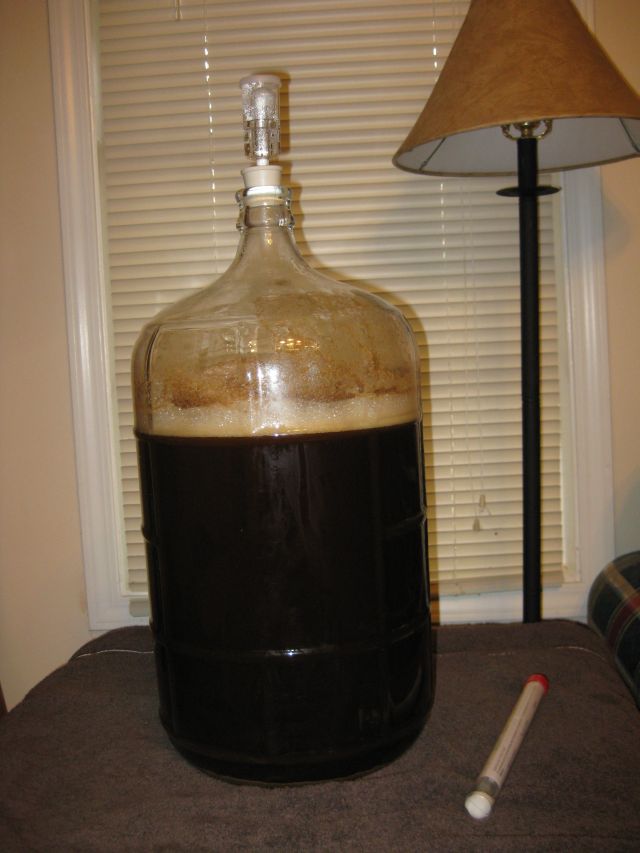
And here is a ‘photo 16 hours after adding the yeast.  The gadget at the top is an airlock which allows the bubbles to escape without admitting outside air, which could contaminate the contents.  The cylinder next to the carboy is an hydrometer which I will use to determine when the beer is ready for bottling.  It measures the specific gravity (“SG”) of the contents.  Alcohol has a lower SG than water and as the yeast ferments and makes alcohol, the SG will fall.  When the SG reaches the accepted range it will be bottling time and “Cheers!”

beer
carboy with brew 16 hours after adding the yeast, the airlock is bubbling


wood and veneers

When I buy furniture, and right now I am accumulating desks in the basement for work stations, I only buy real wood.  Most furniture is particle board (or chipboard) covered with a wood veneer or melamine based overlays.  Veneer furniture is  cheaper to make than real wood furniture and the veneer looks more impressive (at least to the untutored eye).  But it is not as resilient – it appears sturdy but when relocated it is prone to chipping and, once the veneer is chipped, you see the particles underneath.  A sudden transition from a sleek sophisticated appearance to something vulnerable and quite ordinary.  It is very difficult to repair.  It also does not tolerate reworking – I can sand down the scars and dents in real wood and then stain and varnish it and it assumes a new persona, not so the wood veneers.

Different from the veneers are the plywoods  – a tough resilient breed made from thin sheets of veneer glued with their grain at right angles for greater strength.  Plywood has several advantages over wood – resists warping, greater strength, and often less expensive.  Takes stress well and keeps going, but is fabricated and does not have the depth and integrity of real wood.  I prefer authencity and so I choose the oak or even the pine furniture when I visit the thrift store.

Which makes me think of our approaches to living.  My NuTrac journey certainly is not  glossy but, I hope, will be resilient to the knocks of life.


responsibility to animals

I had a good time at the Georgia Organics annual conference – its 15th and my 7th.  The Friday workshops and farm visit and the Saturday educational sessions were excellent and the two keynote speakers have national repute and lived up to expectations.  At my breakfast table on Friday morning was an organic livestock farmer.  I asked him a question which was triggered by the assistance I am providing to two ailing chickens:  “What do you do when one of your animals get sick?”  His answer was simple and to the point:  “If they get sick it means they do not fit in my system and I eliminate them.”

Later that day during the farm visit the same topic came up when the farmer was asked how often he deworms his sheep.  He deworms them all at the beginning of the season and then if one sheep needs deworming he will deworm it a second time and if it is still wormy (if that is the word) he eliminates it – “three strikes and you’re out” he said.  I am interested in dairy goats so I attended a session on keeping goats.  The presenter was from the west coast (interestingly several presenters had moved from the west coast to Georgia or Alabama) and her stance was different.  She stressed the importance of good management practices and prevention but, if a sheep or goat gets ill and is non responsive to organic treatments, she will use conventional medicine.  She felt she has a responsibility to the animal and cannot let it suffer.  The final viewpoint was expressed by a DVM (doctor of veterinary medicine) who said he would cull the animal to avoid the problem spreading and because its genetics were wrong.  His only exception was if the animal was a pet and then he would do whatever to save it.  So four commercial practitioners came to a three to one vote.

Some decisions are not simple.  If you hew to the organic road then conventional treatments should have no place.  I also understand the “genetics” argument – it is no surprise in humid summers that the tomatoes with inbred resistance to the various blights do far better than the regular tomatoes.  So to travel the organic path you must select robust partners.  I would probably have done much better with hybrid chickens than some of the gorgeous looking birds we bought, a few of which are struggling, which also makes me wonder if perhaps there was some inbreeding down the road.   One chicken has a persistent sour crop, which means the food she eats is not being processed properly by her body.  I watch her closely – she is the only one who won’t eat the occasional greens or yogurt which I provide, which would have helped avoid her condition.   After a couple visits to the vet I am now medicating her with nystatin (using a feeding tube down her throat to administer the medicine) and she may (believe it or not) have to wear a bra to help her crop regain its regular shape.  This is going to extremes, I agree, but I am also interested in how it all works – what causes things to go wrong and how you can fix them.

If you have to make a living from organic farming then culling the inferior specimens seems the way to go.  But then it gets back to why you are doing this anyhow – if it is to experience all the manifestations of life it is hard to let one depart when you could (presumably) have saved it, or at least made the attempt.


the beginnings of spring

The next couple of days I shall be at the Georgia Organics annual conference held this year in Columbus GA, south of Atlanta. This shall be my 5th year of attendance – my first few years I learned a lot and with each year there is less new information but I enjoy meeting other growers and learning from them. I was torn between doing a permaculture design course or the conference and have not ruled out a PDC for the future.

Shiitake mushrooms

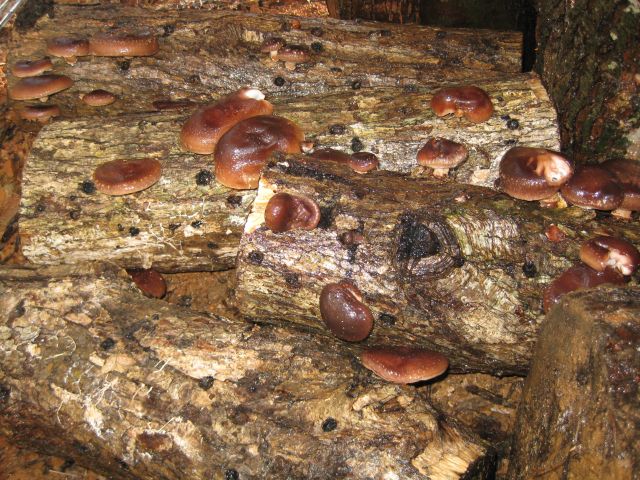
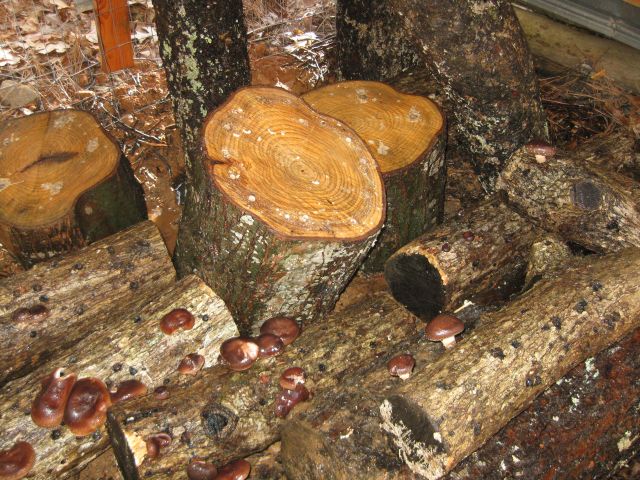
I picked about 15 mushrooms today.  Just as well I enclosed the growing area since, as I approached the shelter, I startled several large white tail deer, which are not usually there and may have been attracted by the smell of the mushrooms.  Notwithstanding my enclosure, someone small, perhaps a squirrel or smaller, did get in and savored a few chunks.

Shiitake mushrooms growing from 5 year logs

Today I also prepared another maple log with oyster mushroom spawn, this time grown on birch dowel plugs.  You can notice, in the photo below, on the center maple log the holes on the face of the log where I inserted the plugs and then covered with melted wax.  I also inserted plugs on the exterior trunk.

maple log with oyster mushroom dowel plugs

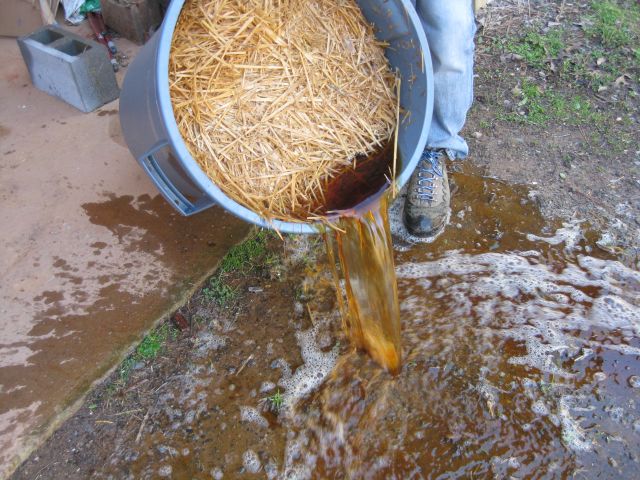
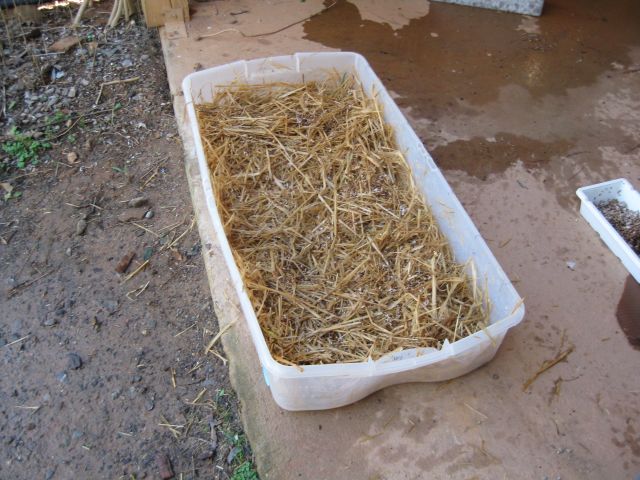
Another mushroom venture earlier this week was to soak straw for 5 days in a large trash bin weighted down with a cement block.  I located an unused plastic container, placed a sheet of wet cardboard (corrugations exposed) on the bottom and built up layers of oyster grain spawn and the wet straw.  I fitted the container with its lid and, since the contents were rather cold, I placed the container in a black trash bag and left it outside in the sun for a few hours to warm up.  Once warm, I transferred the brew indoor to a warmish location and I will leave it (in the black bag with access to some air) for a while until I see results, which I hope will be masses of white mycelium and not green/black bacteria blobs.

straw substrate for mushroom bed

You can see below the container in which the grain spawn and straw was packed.

oyster mushroom growing bed

Cold frame

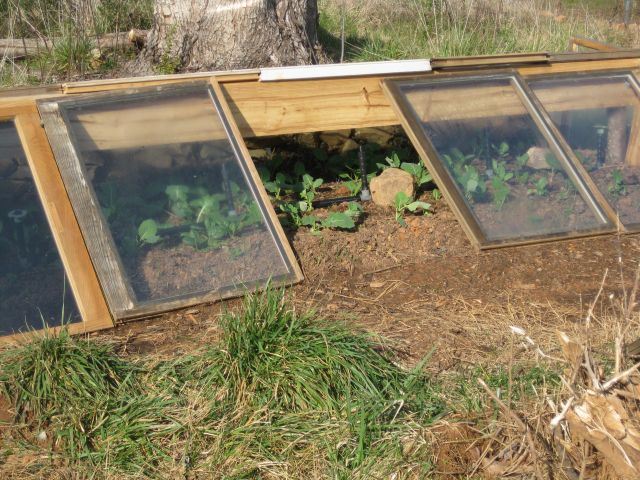
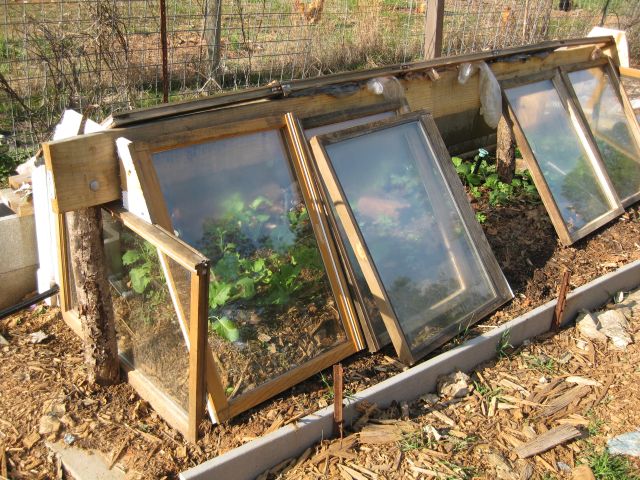
My two cold frames are performing as expected.  My regret is that I did not start them at the beginning of winter.  Had I done so I would have had larger pickings.  On warm days I lift off one of the windows to prevent temperatures rising too high, as you can see in the photo below.

cold frame at top of hill with modest sized vegetables

Both cold frames have internal irrigation (gravity fed from my rainwater tanks) so watering them, which must be done every couple days, is an easy matter.  When spring truly arrives I shall remove the windows and grow squash in the frames protected by row crop covers.  My squash has always been nailed by squash borers and perhaps this year I will be successful.

cold frame at bottom of hill with window temporarily displaced until day's end

Muscadine transplants

It appears that 11 of the 12 muscadine grape vines I transplanted have survived.  I know well why the one muscadine failed.  It takes much effort to relocate a muscadine – their roots travel far and wide and, so long as I limited my efforts to two a day, all went well.  It only takes about an hour to transplant a muscadine but when you are tired and impatient it is easy to tear off the roots.  The one that failed was the third I did in a morning and I rushed it and now it stands there, bark eroding, moistureless, silent fingers pointed at me.  I do not expect to get anything like the grape harvests of previous years when the muscadine roots happily invaded my composted vegetable beds and sucked nutrients wholesomely.  There were so many grapes my bees abandoned pollen gathering to suck their sweetness (as well as all manner of wasps and beetles).  I shall be satisfied with a limited offering and maybe more in future years as their roots go roaming.

6 muscadine vine tranplants, 3 on each side of the contour ditch


water

I think we take water for granted but should not. Friday’s Financial Times (Feb 17, 2012) reports that “Chinese officials have issued a stark warning over growing water shortages saying the situation is worsening every day and that more than two-thirds of cities are affected”.

Texas last year had the driest year on record, but the good news is that the drought may be receding and only 14% of the state is now in “exceptional drought” compared with 41% 3 months ago. In Georgia we continue with intrastate disputes between farmers in south Georgia concerned with metro Atlanta’s water consumption, and interstate disputes between Georgia, Alabama and Florida.

I try to meet the challenge by limiting irrigation to food producing vegetables, shrubs and trees and by capturing rainwater either in containers for later irrigation or directly into the ground (see the tab on “Rainwater harvesting”). My Atlanta running trail is on the banks of the Chattahoochee River, a major river in Georgia which is more than 400 miles long. After it has rained the river is swollen and fast moving and I think during my runs, of all the precious water rushing south and lost to our use. If we were smarter we would retain the rainwater in the earth or containers so we could use it later. If we were smarter we would also reduce our water use – do we have to plant lawns and plants, which require heavy irrigation in the summer? Other than food bearing plants, which we pressed into servitude and must be hydrated to produce to our expectations, why don’t we use plants acclimatized to our weather patterns. Once established with some tender care, and mulched, they should be left to fend for themselves, assisted by our snaring rainwater into the ground for their use.

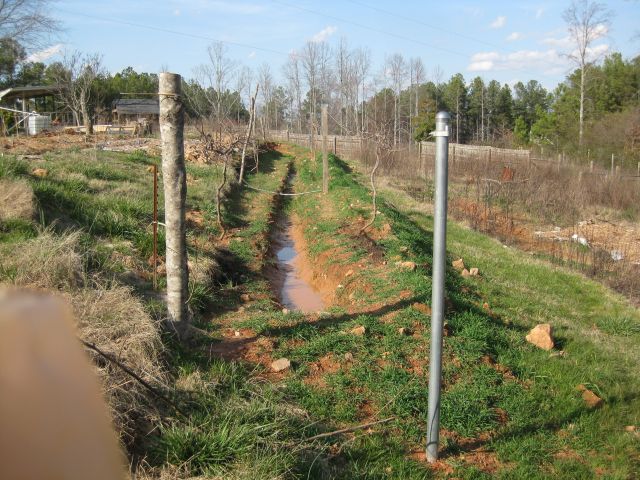
I continue to be intrigued by a rainwater ditch which winds through the north facing slope of my woodland. Initially I thought it was a contour ditch and a lot of it is on contour. But as I have traced it along it now appears that it slowly winds to lower levels of the hill. I think the intention was to have it on contour (horizontal) but to ensure that when rainfall was heavy the water would not wash over the ditch and erode it, so instead the excess water escapes to lower levels where it follows the contour for a while and then moves to lower levels. The idea apparently was to hold as much water in the ground for as long as possible. I may have mentioned in a previous post that there is a spring at the bottom of the hill which I believe originated from the water captured by this long winding ditch. All this comes to mind from an intriguing book I am reading -“1491” by Charles Mann, which postulates that the inhabitants of the Americas before Columbus were a lot more sophisticated than we think. I know it is a far stretch of the imagination to assume that the water snaring ditch on my woodland was built by earlier peoples, but who knows? And there are terraces also in two of the smaller valleys – who built them?

I do know that I should put this speculation aside and get seriously active with my bobcat in the main watershed area in the woodland by creating contour ditches/swales to forestall the loss of rainwater. A project for me in the coming months.

the Bees seem ok

The past few days have been warm – at 4pm today (Friday) the temperature is 68 deg F with a slight wind. I have noticed the bees busy at the entrance to the hive and a number of bees helicoptering in front of the hive (i.e going up and down in front of the hive). They do this to memorize the hive so they know where to return. This is good news for me since it means these are new field workers and therefore there is a functioning queen. I am assuming the older bees who overwintered do not need to rememorize the hive entrance.

So, with the happy knowledge that my bees made it through the winter, I decided to make my first attendance at the local bee keepers’ association. The association is fortunate to have, as its leader, a commercial beekeeper “BJ” who is extremely knowledgeable and from whom I bought my bee nuc two years ago. A “nuc” or nucleus was, in my case, 5 frames of nurse bees, eggs and a queen, which I placed in my 10 frame box (I added 5 frames) and from which my colony developed. So last evening I signed up as a member and absorbed the slide show presentation of risks and opportunities for bees during the closing stages of winter. Although I have managed to hold on to my bees for two years and have some idea (though limited) of hive activities, some of the techniques and rationales for frame and super manipulations seemed mind boggling and there appeared to be alternative courses of action as all three instructors chipped in. The key nugget was when BJ said you have to use bee logic not human logic but he then added that it took a long time to learn bee logic – so I will keep observing. Another useful nugget was to make sure the hive is “queen right” which means it has a well functioning queen. This does not mean opening up the hive and finding the queen and counting her legs and checking out her wings – this would be beyond me. Rather it means intelligently looking at the frames to ensure there are new eggs being laid in an orderly fashion (no missed cells) and there are capped eggs – in other words to check that production of new bees is efficient and in process.

I was pleased to learn there is some flexibility in how to keep bees. I follow a minimalist approach which means I rarely open the hive except to harvest honey and quash queen cells so as to forestall the arrival of new queens. The arrival of new queens inevitably leads to swarming when half the colony hives off with a queen. I learned that finding the queen cells is not that easy and to be sure you have found them all you have to scoot the bees off the frame since they are cunning and will hide the queen cells from view.

My main objective for signing up with the association is to learn how to propagate my colony without buying a new queen (I am trying my self reliance jig again). I listened intently when an instructor said he takes the frame with the queen cells and uses this frame to start a nuc. I think he was using shorthand but I will be reading up and trying my hand. He also added that if you split a hive so as to make two hives from one, then the bees lose a lot of momentum in their honey gathering, so it’s a trade off (but isn’t this the case with much of life anyway?)

I am not celebrating that my bees made it through the winter since recent setbacks with some of my chickens have instructed me that my “successes” may be more beginner’s luck than due to any insights and ability. However, my bees have made it through two winters and I attribute this to: a) leaving lots of honey for them for winter food, which I believe is much better for them than sugared water (I opened the hive today and there is still lots of food for them); b) no pesticides or herbicides or any chemicals in my growing activities and, fortunately for me, it appears my neighbors do not use ‘cides either; c) no chemicals used on the bees; d) a well sited hive which has full exposure to the winter sun and is surrounded on the west side by a window and north and east sides by plastic sheeting, all of which provide some protection from the wind and cold (the south side is open for the entrance to the hive). Perhaps I should also give credit to a queen with good genes and, of course, luck.