My property is about 50 minutes (=50 miles) north of Atlanta. Some 30 minutes into the trip I will often find a pretext to stop at the convenient Lowes DIY store for a “necessary ” purchase as well as for the free coffee, friendly cashier and to ease springs. The last reminds me of my army days when, after serious imbibing in the NCO mess, we would “request permission to ease springs” and then stumble over the tent guy ropes into the darkness of the night.
So this morning was no different and it occurred to me as I scouted the store, that I should visit the nursery area because this time of year they have large markdowns. Generally I do not buy plants at DIY stores but grow from seed or order from specialty internet providers, though some have disappointed! However, the trees and the shrubs were all marked down 50% and the decision was whether to go for the nectarine or the pomegranates. I tried to recall whether either were problematic for my area or required cross pollination, and failed. So I took a chance and bought the pomegranates, one of each of the two varieties, so I had cross pollination covered, their combined cost was less than the nectarine and, since they are smaller they would fit nicely as semi-understory plantings in my orchard. Plus my neighbor has a pomegranate shrub (from which I took a cutting a week ago) which bears sound but sour fruit and I delusion myself that with better sun exposure and my compost, the outcome will be better.
Not a very scientific method to reach a decision and so I was relieved when I later consulted my reference book, “Gardening in the South – Vegetables and Fruits” with Don Hastings, and the handy reference table informed me that nectarine are “very hard” to grow with worst problem being insects and diseases (the only other “very hard” is apricot), while the pomegranate is “easy except for cold” and its worst problem is cold damage. So I was lucky in my choice.
The book offers similar comments for fig and persimmon as for the pomegranate, and last year my two fledgling figs both died to the ground but came back strongly from their established roots. The native persimmon was similarly mauled and is growing more slowly. I may try protecting the figs, persimmon and pomegranates with wrappings or tomato cages filled with leaves. And with global warming, this problem too may pass.
(As for why two posts in the same day? Thank you Sandy, which headed north with her coattails blowing briskly and coldly – enough to keep me in doors after planting out the pomegranates.)
A good friend had a Hatteras 58 ft long range cruiser. I loved the boat. It had a big engine room and, as it had been outfitted over the years with new electronics and other necessities, it had different DC voltages for different circuits and a spaghetti of wires in all directions. When components failed, and they often did, I would haul out the wiring diagrams and try trace the fault. The diagrams enabled me to understand the function of the wires. When we left harbor I found my bearings from the buoys and the rule was simple – as you exit the harbor keep the red buoys on the left and the green buoys on the right – the rule was reversed when you entered the harbor “red, right, return”. And in the open seas where we had no discourse with civilization, nature provided our bearings – the magnetic compass, or the arc of the sun. Although gps via satellites was an easier alternative.
This past Saturday as my running/walking group munched at the bagel house, religion surfaced (a welcome change from presidential politics). And I wondered why, in an age of greatly enhanced electronic communication of news and knowledge, the three religions still build such fervor among their followers. A bemused silence followed. And then on Sunday I was discussing prop 37 (proposes labeling of genetically engineered foods) with one of my sons in California and I said it was hard to understand why anyone would vote against it and yet it is looking as though it won’t pass. And he said he still had to read up but if passed it would increase his grocery bill by $400 pa. He suggested I visit the “noprop37.” website Which I have done. It is a persuasive website. It hammers on so many touch points and in doing so it provides bearings for the undecided to navigate their ship.
I prize integrity, which is holding fast to your moral and ethical principles, but to do so we need bearings. Without bearings how would you progress in a dark churning sea? So we take our bearings from those we have elevated to role models (the noprop37 website included farmers, small business owners, scientists, medical practitioners, nobel prize winners etc). But then we find that our role models are flawed or also adrift or (worst) have a dog in the fight. And so perhaps this is why religions attract some – a safe harbor where the rules are clear and you don’t have the responsibility to decide, you just have to abide.
My permaculture readings have focused me on developing an edible forest garden and earthworks figure prominently in my designs. Although I already have a number of different fruit trees in my orchard I decided to expand the selection and expect, by the end of November, to receive 2 goumi, 2 pawpaw, 3 kiwi (2 female, 1 male), and a medlar, aronia, sour cherry, and juneberry. With these pending arrivals I have been at work preparing their planting sites on the side of the hill.
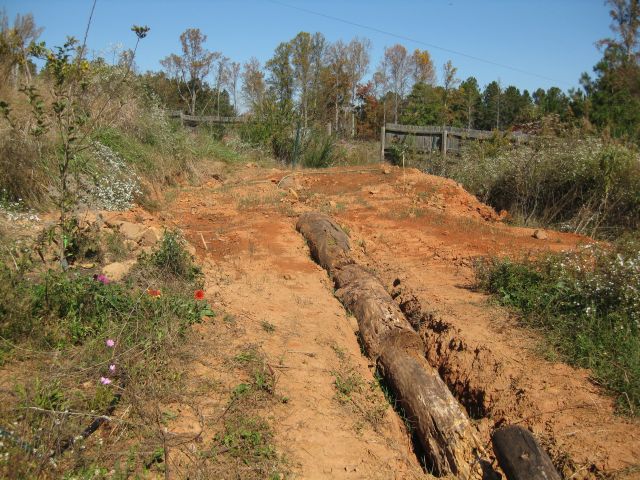
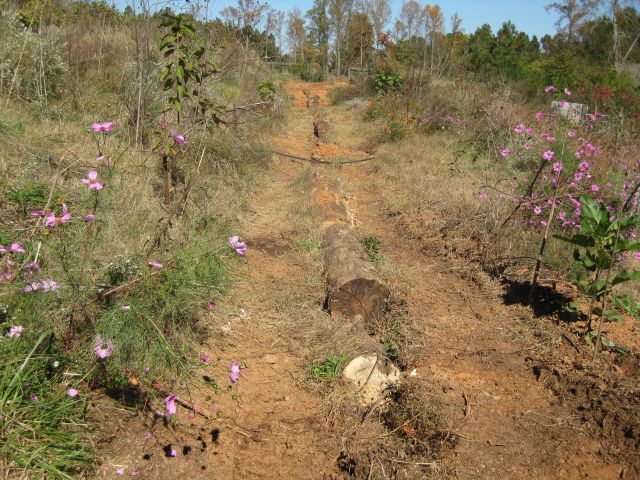
The earthworks are dug by my scruffy Takeuchi tracked bobcat. My approach is to terrace the slope with the terrace canted to the slope and with a contour ditch in the middle of the terrace. So rainwater on the terrace will move to the contour ditch and that which misses the contour ditch will move to where the terrace intersects with the slope. I fill the contour ditches with logs, for several reasons: a) my readings suggest that grasses promote bacteria and trees promote fungi and since the slope was grass covered, by filling the ditches with rotting tree trunks I am hoping to accelerate beneficial fungi in the soil; b) the contour ditches are a couple feet deep and without infill it is easy to fall in; c) if the ditches are left as ditches, they are quickly invaded by vegetation which competes with the tree roots and hides the location of the ditches (facilitating (b) above); d) parallel with (a) the tree trunks will provide nutrients to the soil as they degrade and will absorb and retain water for the benefit of the plantings.
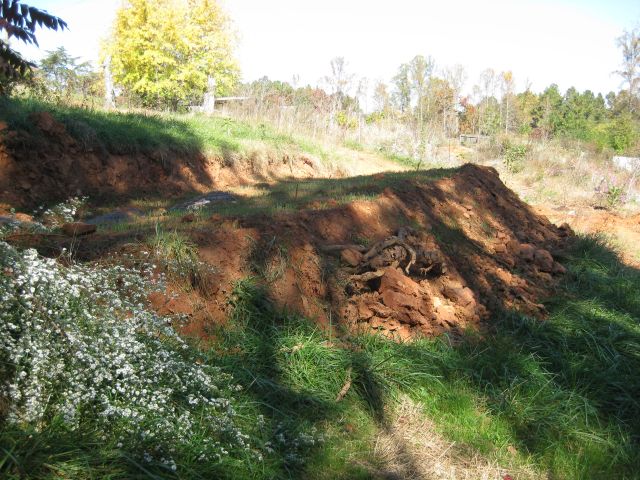
earthworks – a view of my new terrace showing the grading toward the slope and the cut made into the face of the slope
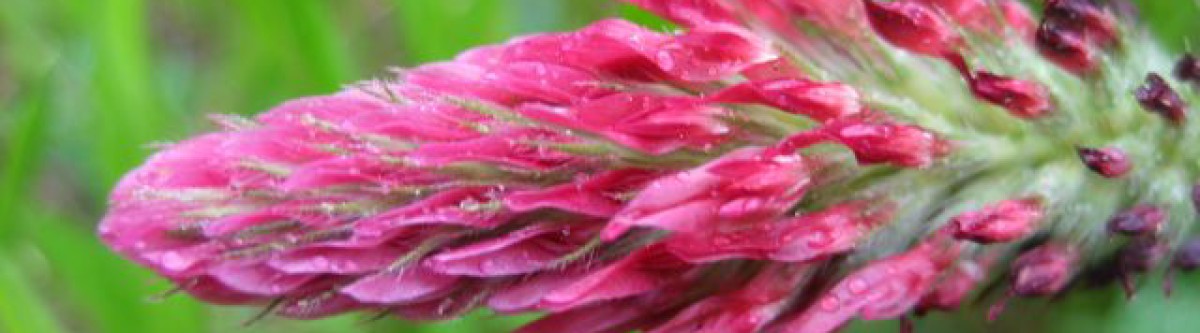
After grading the terrace I planted winter rye and crimson clover on the exposed earthworks and watered every couple of days with rainwater. I have marked the location of the future tree plantings with stones – they will be at least 15 ft apart. And, since my comfrey did so well this year, I have planted out root snippets from a couple of my comfrey plants.
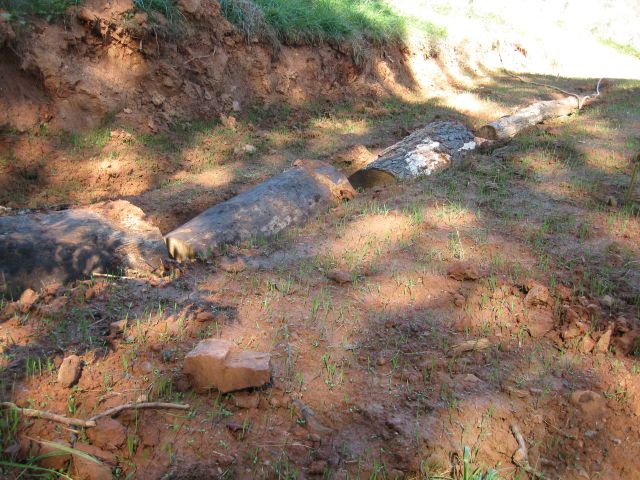
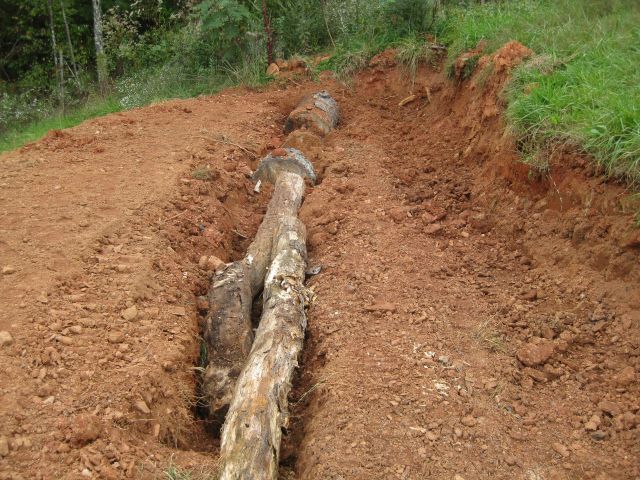
earthworks – terrace and contour ditch – looking north you can spot the winter rye seedlings. interspersed amongst them are crimson clover seedlingsearthworks – terrace and contour ditch – I am fortunate to have degrading tree trunks for filling the ditch
I created a second terrace as an extension to the terrace and tree plantings I made last year.
earthworks – terrace with contour ditch and tree trunks, follows the same principle as the one above and the two together will accommodate the new arrivals
And while I was at it I went back to last year’s terrace, deepened the contour ditch and filled it with tree trunks which had been left on the property by a previous owner.
earthworks – last year’s terrace upgraded to include tree trunks in the contour ditch. The cosmos and aster are still in bloom and the air is heavy with bees
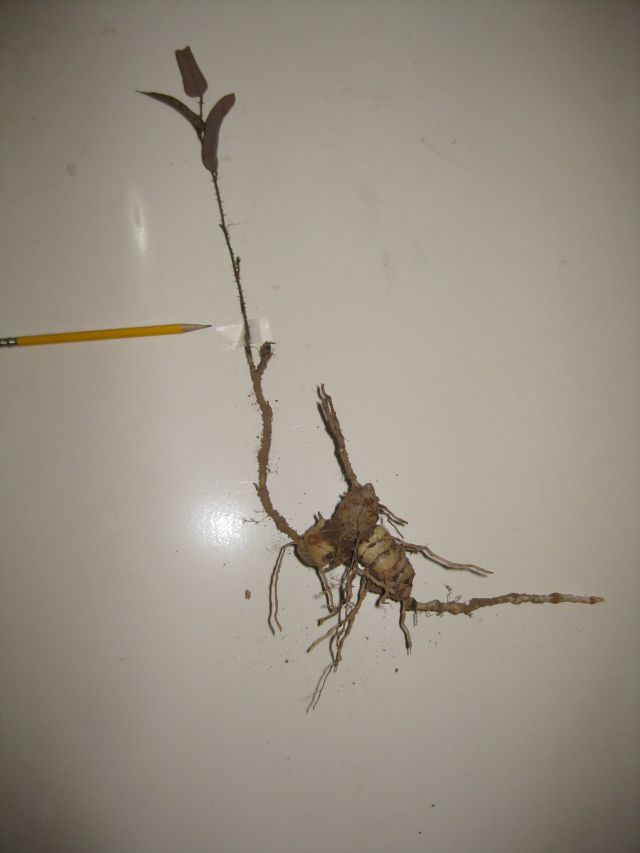
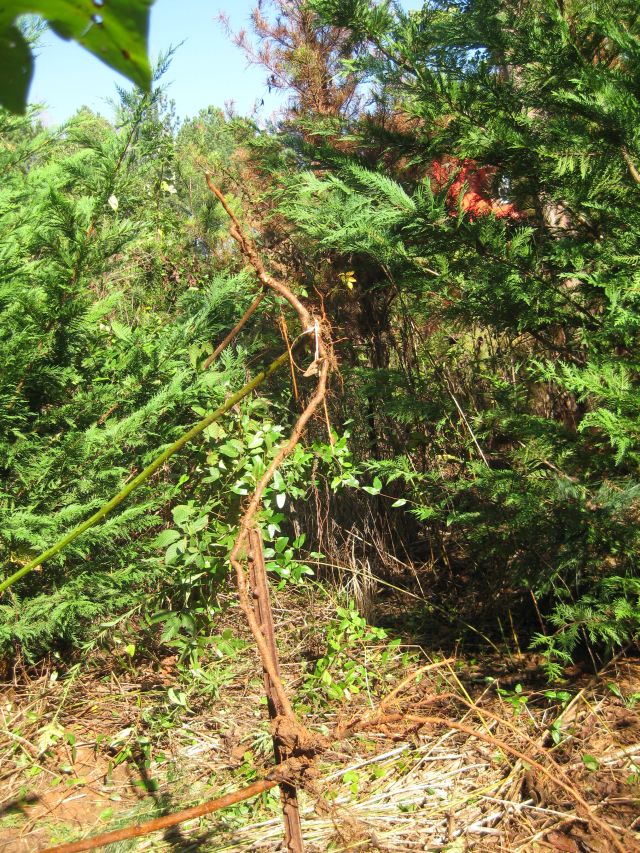
In my previous post I mentioned my battle with brambles and referred to brier in passing. Coincidentally, that evening I happened to listen to the Ballad of Barbara Allen in which the suitor dies from unrequited love for Barbara Allen. From his grave a rose grows and from hers a briar. The brier I just dug out and photographed is from the genus Smilax and got its name from Greek mythology. Krokus, a mortal man, tragically loved the woodland nymph Smilax and on his death he was turned into a flower and she into a prickly vine. And that is how the thorny vine I find in my growing area was given the Latin name Smilax.
Unlike brambles which have shallow horizontal running roots, this brier is more formidable. It holds its resources in large tubers about 8 inches below ground level. In the photograph below the pencil points to ground level and you can see the size of the tubers and their distance from ground level.
a youngish brier I dug out of the vegetable patch. the tubers are large in relation to the plant. the thorns on the larger briers in the adjacent woods are like barbed wire
My previous attempts to eliminate the brier failed because I did not know how it operated. I would dig up the accessible roots and think, with my perseverance, it would fade away. I now know I have to dig much deeper and locate and remove the tubers, to succeed.
The house I purchased a few years ago is on sloping ground and between the house and the tarmac road was a gully which the previous owner, a contractor, had filled with trash. (Not as bad as contractors digging holes for landscaping dirt for a new house and then filling with tree trunks, which results in sinkholes, anguish and expense for home owners.) I tried clearing the trash myself with trips in my pickup to the recycling center but made little progress. I did not have my bobcat at the time and so I engaged a contractor who removed several dump truck loads of trash and then filled in the gully with more dump truck loads of soil. And so I had a bare slope to work with. And I made a number of mistakes.
My initial steps, with hindsight, were ok. I cut down a big pine, delimbed it and positioned it diagonally about halfway up the slope. At its bottom end I constructed a french drain. The idea was to divert rainwater streaming down the slope to the drain and prevent erosion of the slope. There has been no erosion, so this probably helped.
Next, to populate the slope, I ordered various hardwoods from the South Carolina and Georgia forestry commissions. The price is reasonable when you order at least 10 trees of a kind, and ever cheaper as your order increases from 50 to 100 to 500 to 1,000. For a large tract this is the way to go. For my smallish area not the best solution. Most of the seedlings arrived in January and February. A better time to plant would have been in September and October when the roots could have established themselves before the cold weather. The seedlings were shipped bare root and some had minimal side roots just a large severed tap root. More side roots would have enabled the seedlings to establish themselves more quickly. Some of the items I liked were out of stock and so I did not have the variety I wished for.
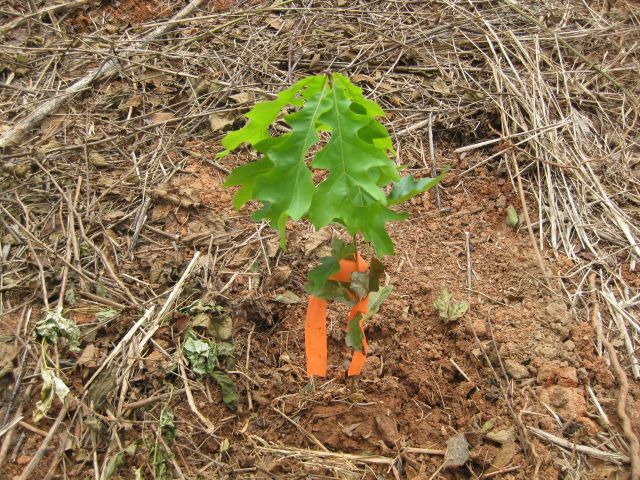
So what should I have done? Simple, just pick the acorns of the red and white oaks in the nearby woods and the nuts of the hickories, bury them in the ground alongside my vegetable plantings and then plant them on the slope a year later. This is what I did a few years later and had excellent results. By planting the nuts in the vegetable garden they were guaranteed ample watering, good sun exposure and good soil. And the good soil had another bonus. When I forked out the seedlings for replanting on the slope, because the ground was soft (and wet) most of the roots were intact, including the tap root. And these seedlings were from my area and so are well adapted to quickly populate the slope. Had I initially gone this route I apparently would have lost a growing season but the purchased seedlings took a long time to get going and I expect that my own seeded local sourced trees will grow at a faster pace.
a seedling grown from an acorn planted last fall. although small in size, the root exceeds 1 foot. the red surveyor’s tape increases visibility and reduces inadvertent destruction from a scythe
When I planted each seedling I dug out a good sized hole and filled it with a mixture of soil and my home made compost and watered well, following the adage “dig a $10 hole for a $1 plant”. Not a good idea – there were large trees bordering the slope and their roots immediately headed for the newly introduced nutrients and moisture. So I burdened the newcomers with fierce competition. I probably should have introduced them surreptitiously, below the radar.
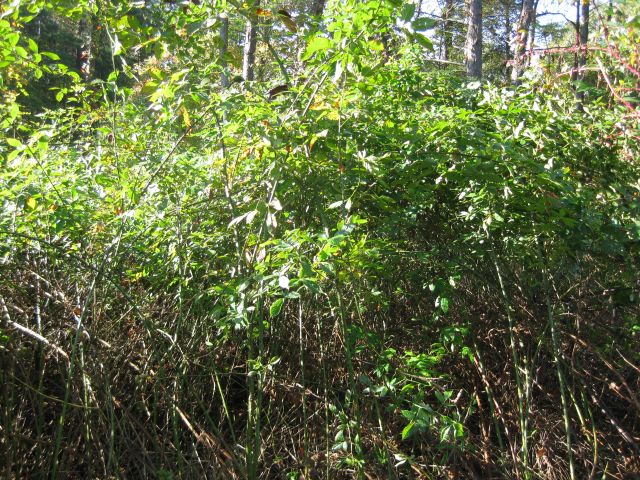
Other mistakes. After the slope was graded in the fall, I seeded with hairy vetch and clover and they took off well and helped combat erosion and added nutrients (nitrogen) to the ground. This was fine. But in following years I was focused on my edible plantings elsewhere and ignored the slope and it was invaded by brambles and brier which displaced my ground cover and competed with my tree plantings for moisture, nutrients and sun. In their excellent 2 volume book “Edible Forest Gardens” the authors (Jacke and Toensmeier) interview Martin Crawford, U.K. author of the equally excellent “Creating a Forest Garden” and on several occasions he stresses the importance of controlling brambles. He notes “very important – I have seen forest gardens taken over by these.” Well, I took my eye off the ball and the brambles completely took over, reaching heights in excess of 10 feet.
an example of the mass of brambles, dense, tall and overarching, forbidding easy access to their base
The past few weeks as I dug out the invader I became acquainted with its strategies. It has strong lateral roots which grow just below the surface and then pop up to establish new plants.
you can see the horizontal bramble root (shown here vertically) with the canes emerging every few feet to the left of it
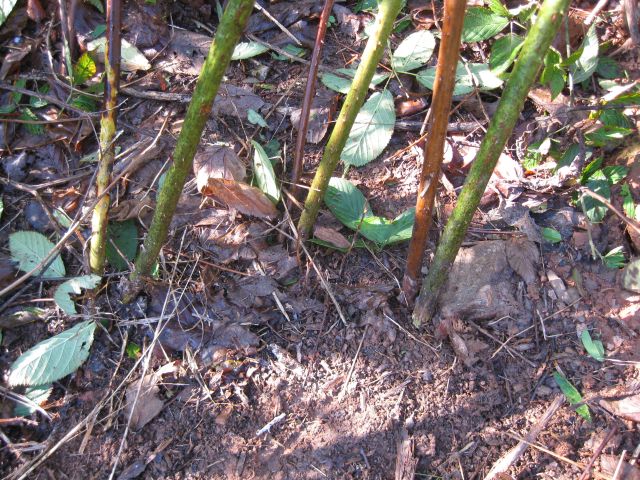
Also in winter the cane dies back and in spring a new cane emerges from the same base, so it is common to see a thin brown cane (previous year) and a thicker new green bramble cane for this year.
here are three pairs of brambles, each pair consisting of last year’s predecessor and this year’s replacement
The reason for increased diameter is not just because the old cane is dried out – the new cane can grow bigger because it is starting with the root base established by the previous year’s cane.
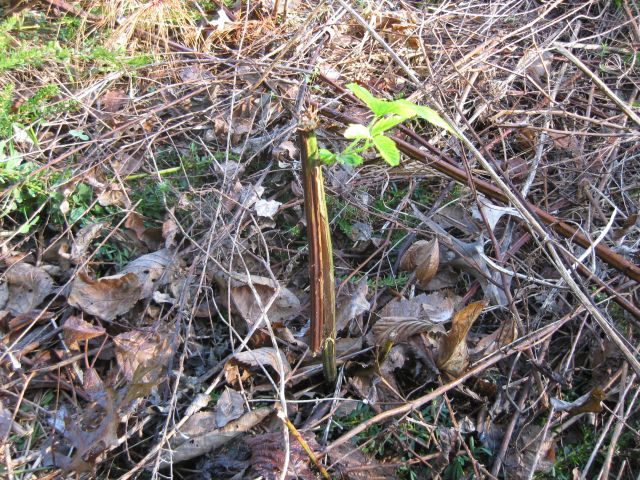
scything is not effective. within a week or so new shoots appear from the stump. you have to pull out the bramble which is much easier after rain has softened the ground. although for getting close to the bramble a long handled scythe for cutting and clearing is great
Just as I have been digging out bermuda grass in my berry planting area so am I committed to clean up the slope and release the hardwoods so they can grow vigorously and outshade their competitors which also include some tough rooted 2 foot grasses. It needs continuous attention and hard work to help the favorites outcompete the bramble and allied invaders.
We have started making our own kefir fermented milk products. Kefir originated when shepherds discovered that milk carried in leather pouches would ferment and produce a fermented beverage which has a pleasing taste, once your are accustomed to it.
We were given a starter culture and the procedure is you add milk to the kefir grains and allow it to ferment for 24 hours at room temperature. A tablespoon of the kefir grains is adequate for 8 ozs of milk. After 24 hours the grains have converted the lactose in the milk to lactic acid. You strain off the product and it contains probiotic bacteria and fungi which are great for GI health. You return to your jar the residue in the strainer and top it up with fresh milk and 24 hours later you have more kefir. You can blend the kefir with frozen blueberries or strawberries and add some honey to produce a smoothie.
Initially we added the kefir starter grains to 1% conventional milk and they were unhappy and refused to do their magic dance. We do not have easy access to raw milk and besides we (currently) have little use for the fat/cream which comes with the milk. We do not usually use organic milk. but on an inspiration we switched to 1% organic milk and the kefir is thriving.
So when studies are done on the benefits of organic produce and focus only on nutritional content, they are overlooking possible components such as anti-biotics in conventional milk. The question is whether these overlooked components affect not only the bacteria in kefir but the bacteria in our GI tract and therefore our health.
Two techniques used in this week’s presidential debate resonated with my internet Sustainability study on this week’s topic – GMO’s.
There seems to be three areas of concern on Genetically Modified Organisms (“GMO’s). Their effect on our health, on our environment and on our wallet. I will not dwell on environmental issues (such as genetic drift or loss of diversity) or wallet issues (will the seeds which produce our food be owned by corporations?).
But as for our health, there are studies which say GMO’s are safe and others which say they are harmful. This past Wednesday one presidential contender said he had a non-partisan study which said the other contender was wrong, to which the response was essentially “and I have 6 studies which say you are wrong”. So with studies nothing is conclusive until there has been a long lapse of time – consider how long it took for most everyone to agree that the climate is indeed getting warmer, notwithstanding that the timing of migratory flights and blooming of flowers changed several years ago and neither birds nor plants had a dog in the fight. And with studies you can become very cynical when you look at who did the funding.
A familiar legal concept is “burden of proof” or “onus” and in criminal cases the accused is presumed innocent, so the onus is on the prosecutor to prove guilt. When new drugs or procedures are introduced, which can impact our health or the environment, where rests the onus? The precautionary principle, in one version, states that “if an action or policy has suspected risk of causing harm to the public or to the environment, in the absence of a scientific consensus that harm would not ensue, the burden of proof falls on those who would advocate taking the action.”
There is a strong version of the principle, which does not weigh costs and benefits, and a weak version which does. The strong version of the precautionary principle will require those advocating GMO’s to prove that they are safe.
This is where the exceptions and prevarications get interesting. We use, and have come to depend on, electricity and the internet. They were new technologies that were not proven safe at the time of their introduction and even today have not been proven safe – can cell phone radiation damage our brains? Application of the strong form of the precautionary principle would have prevented or delayed their introduction.
And now for the second technique used in the presidential debate, which was also used in my internet lecture this week. In the presidential debate one contender said it was “immoral” to continue to create government debt. “Immoral” is such a strong word, it gets your attention. In my GMO lecture it was argued that applying the strong form of the precautionary principle is paralyzing, prevents development and can be “immoral” if it prevents the development of countries.
The strong form of the precautionary principle does not weigh costs and benefits. But in our own lives we do take risks and we weigh them against the benefits. Crossing a road can be dangerous, but for most of us the benefit of getting to the other side outweighs the risk of being struck by a car. Applying the principle strongly leads to delays, such as delays in introducing new drugs, which can cause harm. And so the argument goes, we should not stall progress and we should apply the weak form of the precautionary principle and consider costs and benefits.
And this apparently is where we are today with the application of the “substantial equivalence” rule which lightens the onus on those introducing GMO’s.
And two additional consolation arguments for the unconvinced – with world population growth and change in consumption patterns resulting from increasing affluence, we have to find a substitute for the green revolution and GMO’s can be the answer. (There is nothing like having your arm twisted to compel your concurrence or at least, silence). And finally, are GMO’s really all that novel? After all how about the wizardry of early inhabitants of America who used selective breeding to accomplish the miraculous transformation of grass/teosinte into modern corn/maize.
I am learning from and enjoying the Coursera course on Sustainability. The above question is interesting. Why should an increase in world population by x % require a much greater % increase in food production? The answer, I suppose, shows why being a vegetarian helps the world in dealing with sustainability issues. What “sustainability issues” you may ask. Well, water supply is becoming problematic – witness our recent drought in the mid-West and problems in India and other countries where they are rapidly depleting their ground water and having to drill deeper for less water. Also, the Green Revolution, which increased crop yields tremendously through the use of fertilizers and various ‘cides, which created their own problems, seems to have peaked in terms of crop yields, so to produce more food we will have to find more land. Unless we buy into GMO’s as the flag bearer for a new green revolution.
But to return to the question – why do we need so much more food. As the world’s population becomes wealthier through globalization the previously poor are now eating less rice, wheat, sorghum and potatoes and eating more chicken, pork and meat. To produce a chicken we need two calories of cereal for every calorie of chicken produced. For pork the ratio is 5 calories of cereal for one calorie of pork and for beef the ratio is 8 calories of cereal for every calorie of beef produced. So we have to produce a lot more food to cater for the changing consumption patters of the world’s population.
We interact with the world through our senses. The five traditional senses are sight, hearing, touch, smell and taste. We have other senses as well such as balance, perception of time, pain etc. If our senses warn us that our environment is unfriendly we respond – too much sun we cover ourselves, use an umbrella or sun screen or withdraw to the shade. To much glare we put on sunglasses, close our eyes or squint and look the other way. Too bitter a taste then we stop eating. Too loud a noise we put on ear muffs or withdraw to a safer distance. So we modify our behavior according to our sense perception of the interaction with our environment.
But there is one interaction with our environment where most of us proceed whilly nilly. Our gastrointestinal tract, often referred to as the “GI tract” digests the food we eat. It is immensely complicated. It also covers a huge area – according to Wiki: “The surface area of the digestive tract is estimated to be the surface area of a football field”. So in terms of size this is the largest interaction we have with the world around us. Many of our ailments derive from GI problems. It seems to me, using the analogy of a factory, that the problem can be stress, the functioning of the processing equipment or the raw materials used.
I know when I was under stress I would resort to antacids, a quick fix of the symptom but not the cause. But leave aside stress induced problems and think only of the effect of bad raw materials entering the processing facility. The sophisticated equipment will struggle to process inferior input. There will be delays, break downs, protests and a degradation of the whole plant. And what do we do – we are aware things aren’t right so we suffer and then head for the aisle with cures for digestive ailments, and then later take prescribed medicines or are compelled to more drastic intrusive measures. And our assessment often is there is not much to be done about it – just grin and bear it.
A bit like staying uncovered in the bright sun and then taking pain relievers to alleviate the sunscreen. Surely time to take more interest in what we eat in the first place?
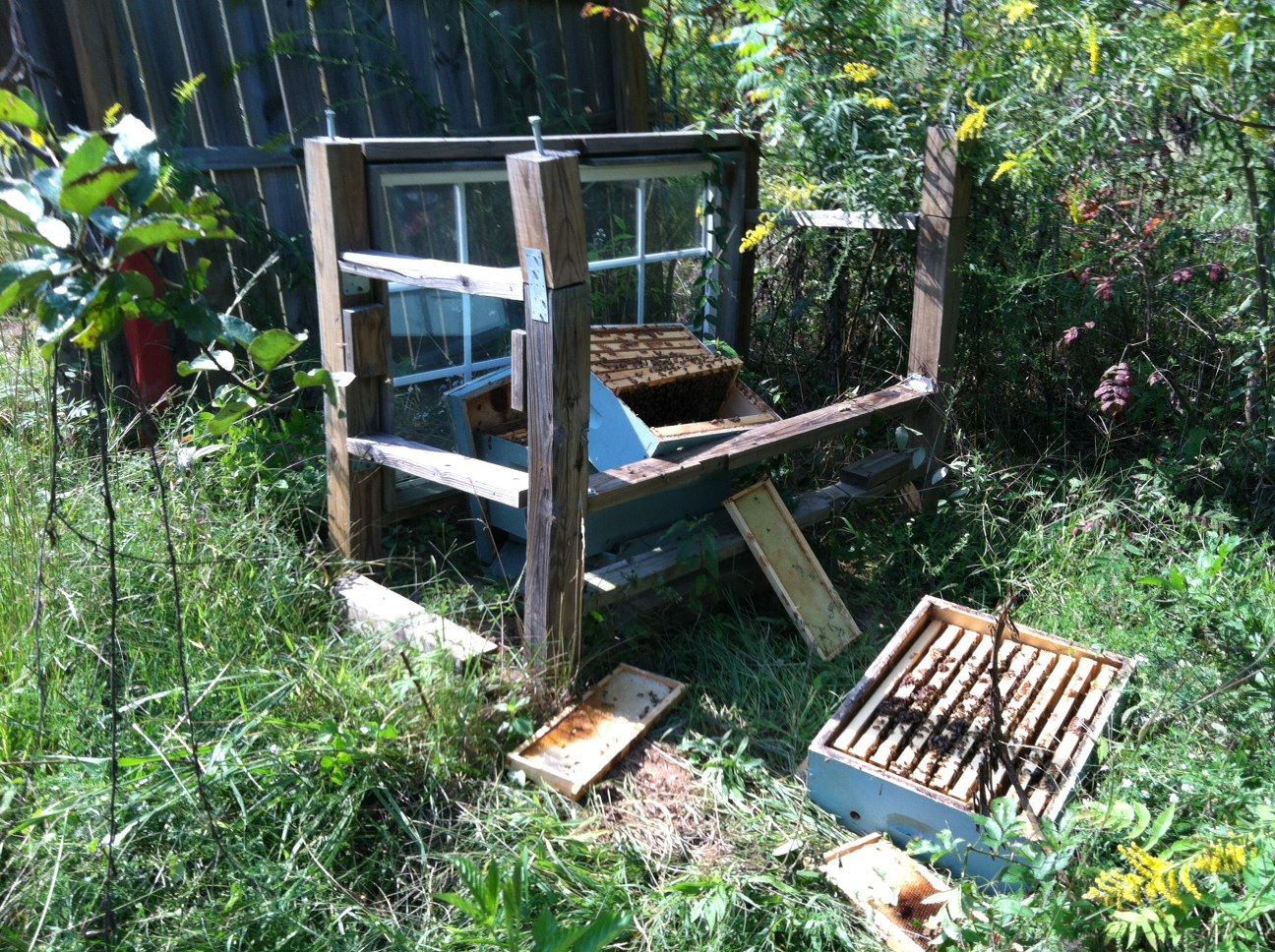
I inspected the bee hive last Sunday and on Tuesday I happened by and quickly glanced at the #1 hive. I kept on walking and stopped as my mind deciphered the image – the hive had been attacked. This is the first time it has happened. The hive cover was on one side, the top super was on the ground, the second super half way off, a frame on the ground and the deep slightly askew on the bottom board.
the bee hive after the attack. the wooden frame around it is stapled with plastic in the winter to provide additional protection from the wind and elements
I studied the frames – no honey had been removed. The bee hive boxes were undamaged and there were no claw marks. Was it human or animal? If human, since no honey was taken this must have been a prank. But unlikely to be human since the super on the ground was upside down and a human presumably would have picked it up and placed it down right side up. More likely an animal. But why? It it was after the honey why didn’t it take any – unless the bees drove it off? So a mystery. I reassembled the bee hive and hope the queen is ok.
I mentioned in my previous post that goldenrod and prairie fleabane (member of the aster family) are blooming and a bee favorite.
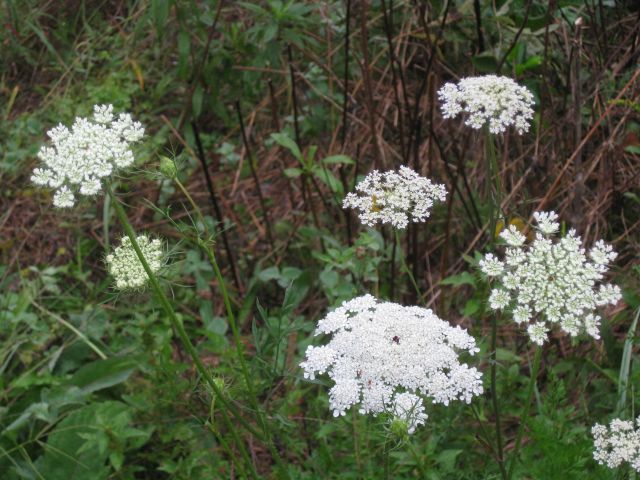
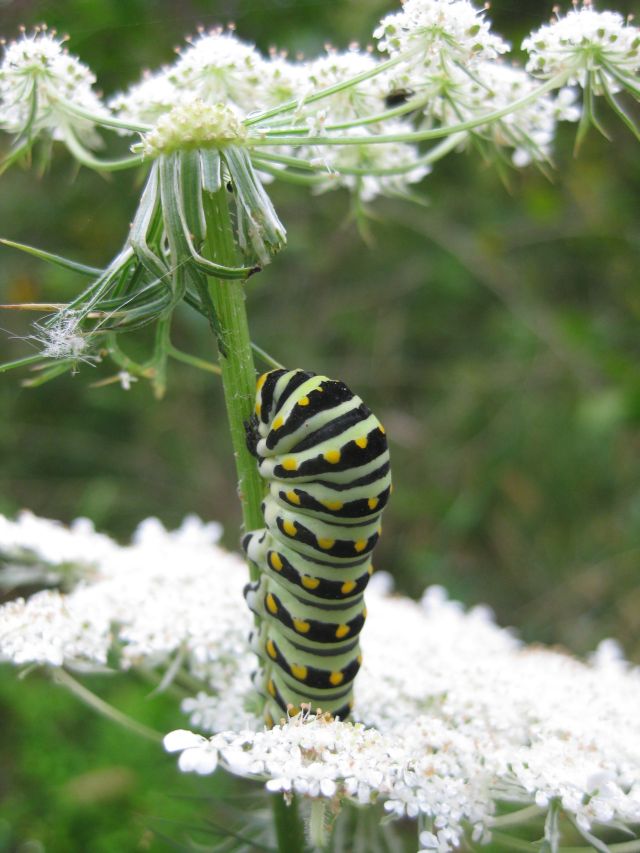
fleabane – the head of the flower is comprised of lots of little daisy like flowershere is a visitor who in one day removed half of the flowers above it
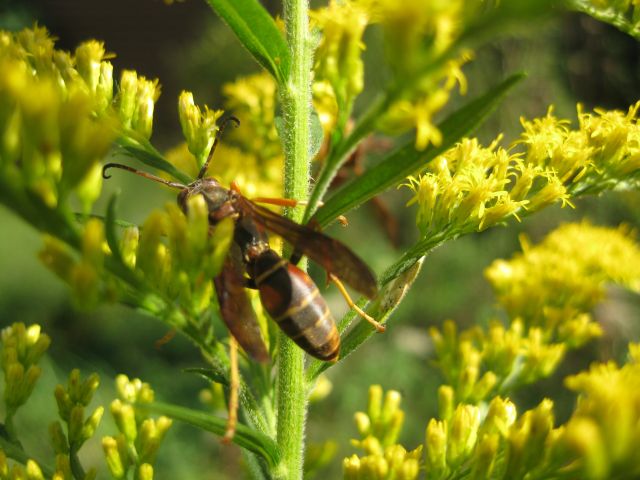
And the goldenrod is a hot favorite for wasps.
a wasp visiting the goldenrod
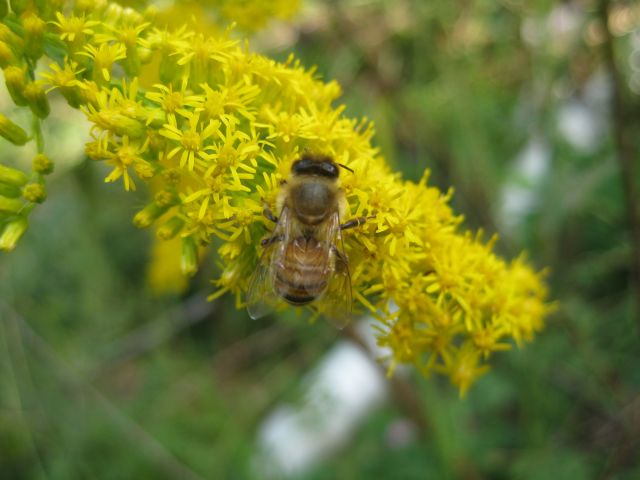
And of course for the bee.
a bee takes last opportunity to gather food before winter