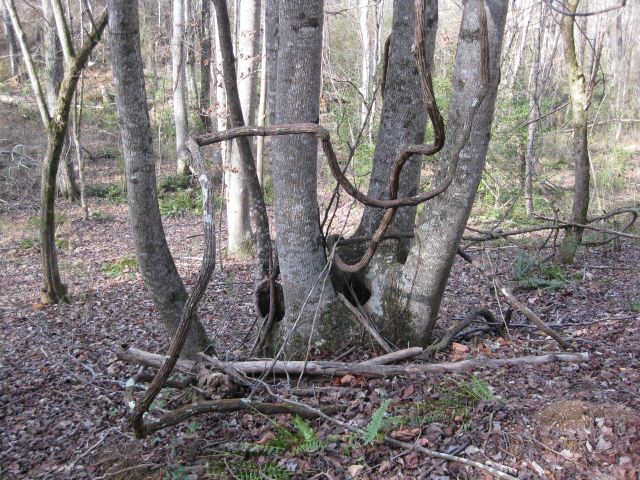
I don’t yet have the answer for why, in the woods, a number of tulip poplar trees have multiple trunks from the same base.
this tulip poplar has 4 trunks originating from the same base assessorized with python like vines
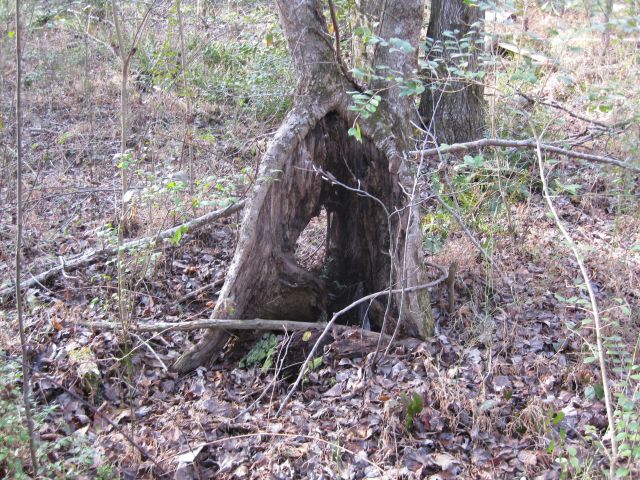
But the really unusual feature is how the base of the tree appears hollowed out.
hollowed out tulip poplar base
My current theory is that the tulip poplar grew up alongside the stump of a tree and then it sent out adventitious roots around the stump to mine the ingredients in the stump and when this was done and the stump had disappeared, it was left with a hollow base.
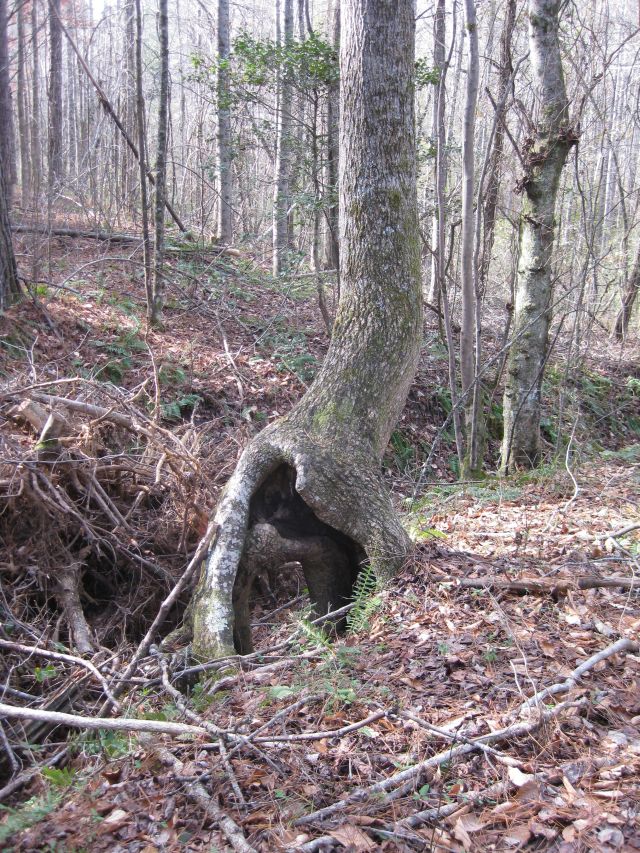
Here is another example of a hollowed out base.
another, larger example of a hollowed out base of a tulip poplar tree
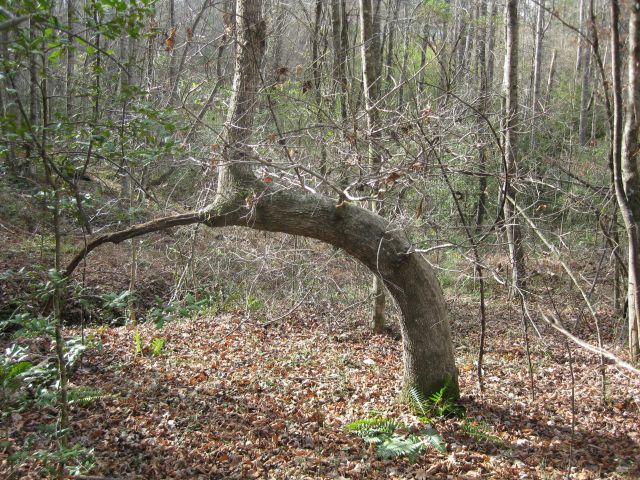
But this may not be the reason at all – tulip poplars may have a predeliction for spreading their base out. Here is an unusual example.
unusual tulip poplar configuration
This tulip poplar leans over to the left and then grow upright. Usually this occurs when a tree is knocked sideways but there is no indication this tree was knocked sideways. Its trunk appears well planted upright in the ground. But then you notice that skeletal offshoot on the left – is that a trunk or a branch?
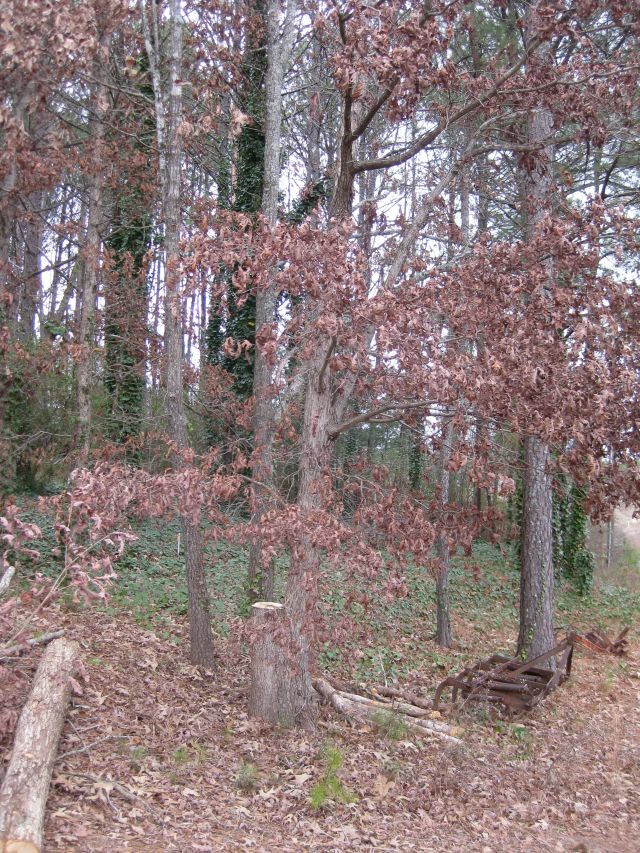
I really am not into cutting down trees gratuitously, especially not an oak tree, which is one of my favorite trees. When I made a road through the woods I selected a path which would require the fewest and smallest trees to be removed. But this week I needed wood posts. I did not wish to purchase the treated 4″ by 4″ posts because they are loaded with preservatives which will leach and be absorbed by the roots of my fruit trees, vines etc. Composite posts deform and are expensive. Even cedar posts rot over time. I concluded oak posts should hold their ground for several years, which is all I need at this time. But which oak tree to cut. Unusually, several oak trees have two trunks from the same base. Eventually the tree may split. It seems to incur little sacrifice to cut one of the trunks, the one which appears less vibrant. Then the root structure can feed the surviving trunk which will put out branches on the side where the other trunk stood.
twin trunked oak tree with left trunk removed at point where trunks met
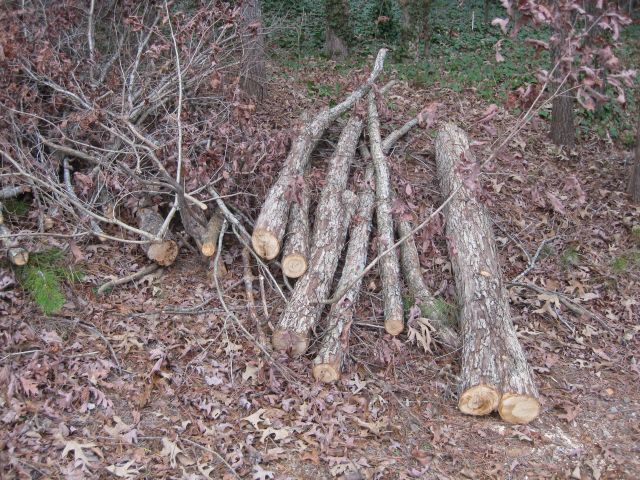
It was quick work to cut down the one trunk and then slice it to leave a main trunk and six 8 foot length future posts. Plus the branches will dry and provide good firewood. The main trunk is too large for a post and I ordered shitake inseminated dowel plugs so I can have shitake mushroom logs. I have been very successful with shitake growing from oak logs. Some of the posts will be used to carry the trellis for my kiwi vines which I recently planted.
products from the oak tree – the trunk on the right will make shitake mushrooms, the 6 8′ posts will be used for trellises and the branches on the left cannibalized for firewood
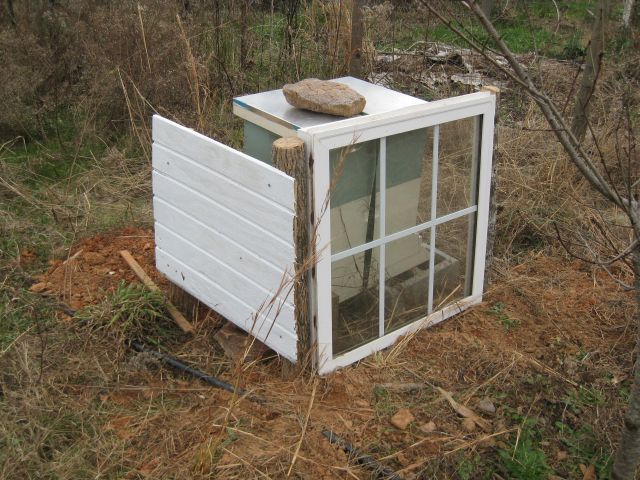
And there is always a use for oak posts. My first beehive is well protected from winter winds but my second beehive needed protection. With my clam posthole digger I dug 3 2 foot holes and grounded 3 small diameter oak posts to which I attached a surplus window for west wind protection yet still providing setting sun exposure, and a primed plywood rectangle for north wind protection. My woods provide a windbreak to the east and I leave the south side open for the south facing entrance and because winds from the south are less common.
#2 beehive with west facing window and north facing plywood protection from winterly winds held in place by oak tree mini posts#2 beehive seen from east side, the three small diameter oak tree posts sunk 2 ft into the ground are clearly visible. also a strap to protect against upheaval from nocturnal visitors
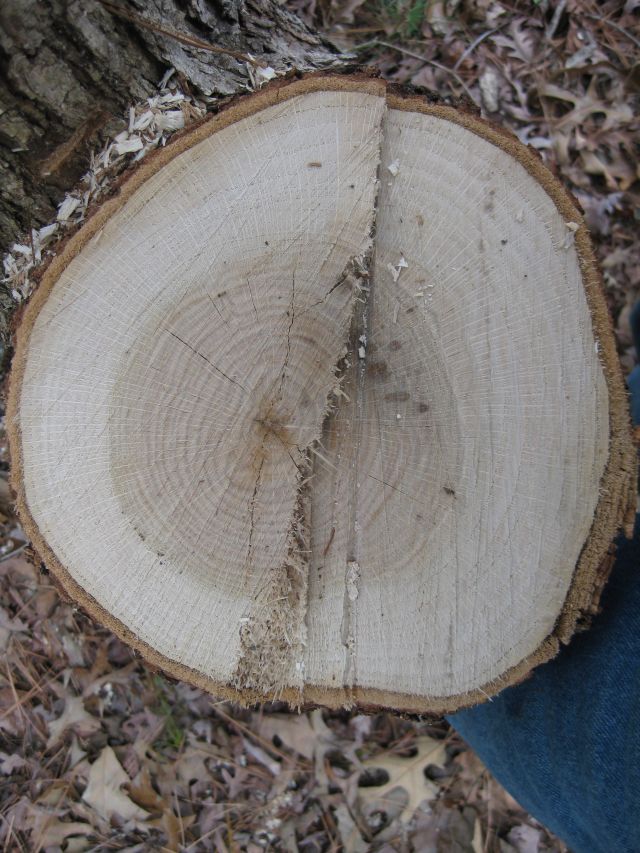
I happened to notice the growth rings on the stump of the oak tree and this got me thinking as to why there are growth rings. I know about heartwood and sapwood – the heartwood which is at the center of the trunk is darker in color (from accumulation of compounds), provides structural support and no longer transports water and the lighter colored sapwood conducts water.
heartwood, sapwood and growth rings on trunk of oak tree. I must still saw the face smooth and at an angle to shed rain
But what causes the growth rings which are the alternating bands of light wood and dark wood. The light ring is produced by large thin-walled cells and the dark ring by small, thick-walled cells. The large cells are formed during the rainy season when the cells grow and the small cells during the period of dormancy or no growth. Dormancy occurs during the winter in cold climates and during the dry season in tropical climates. I suppose if it rained evenly throughout the year you would not get growth rings?
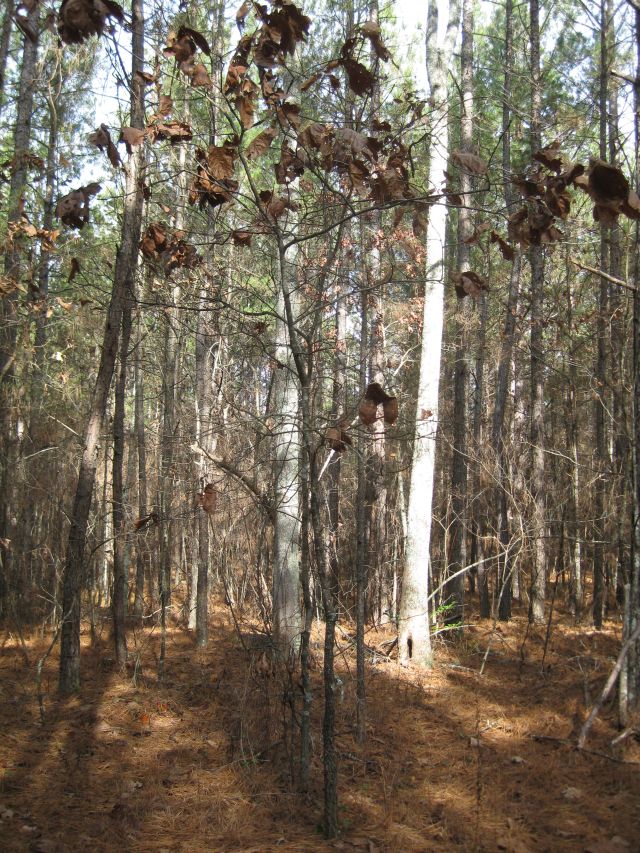
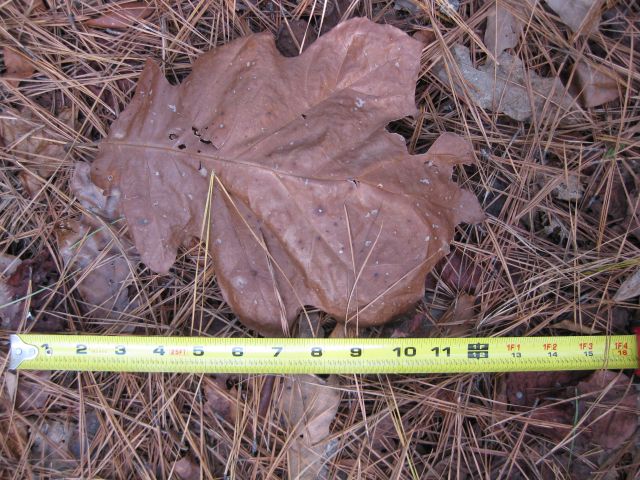
Yesterday, while walking through the woods, I noticed a very large oak tree leaf. Automatically, I looked up and around for the parent and saw just large pines and then, on the side, a smallish 14 ft oak tree. Could this small tree have produced such a large leaf, I wondered. It still retained some leaves and indeed they were very large.
small oak tree surrounded by much bigger pine and poplar trees
Now I know that oak trees will wait patiently in shrub form for an opening in the canopy above and then they spring to life. I have found 1ft high oak trees with 4 ft tap roots and know that a shrub like tree can be many years old. So to return to the riddle I hypothesized that the leaf size depends on the age of the tree and this smallish tree could be many years old. But that doesn’t work since a large nearby oak tree which I know is very old, has smallish leaves. And then, this morning, as I worked my way through my biology textbook, it fortuitously provided the answer.
a big leaf from a small oak tree – measures a foot in length
Some variation within a species is due to genetic diversity within individuals but some is due to response to the environment and this is called “phenotypic plasticity” meaning that the plant (its roots, shoots or leaves) are plastic or changeable depending on environmental conditions. The textbook (Biological Science by Scott Freeman 3rd edition page 798) states that oak leaves are a prominent example of phenotypic plasticity. Shade leaves (grow in the shade) are big and sun leaves are small. Shade leaves provide a large surface in order to absorb as much sunlight as possible. So that’s the reason why the small oak tree has big oak leaves compared with high standing oak trees which have direct access to the sunlight.
But then, the question could be asked, if absorbing sunlight is the priority why shouldn’t a big oak tree also grow big leaves? Leaves lose water (transpiration) and the more exposure to the sun the more water loss. In the shade however, humidity is higher and water loss is less so the large oak tree leaf in the shade can capture more light with minimum loss of water.
If we accept that the living world around us did not just happen, but is the result of millions of years of adaptation and improvement the question rises for me – why do so many insects (and frogs etc.) go through metamorphosis? I am referring to whole-change or complete metamorphosis where the juvenile form (called a larva) looks very different from the adult form. Think of butterfly and moth caterpillars (larvae) which change into flying adults. Or mosquito larvae which live and feed in freshwater and then change into pesky annoying mosquitoes.
I am not thinking here of the social insects such as ants and bees which also have complete metamorphosis and live in colonies where they are fed and protected by the adults. I can understand that in a colony where everyone hangs out, it makes sense for the adults to take care of the kids and to groom them into community behavior and it is easier to feed and groom little dependent larvae.
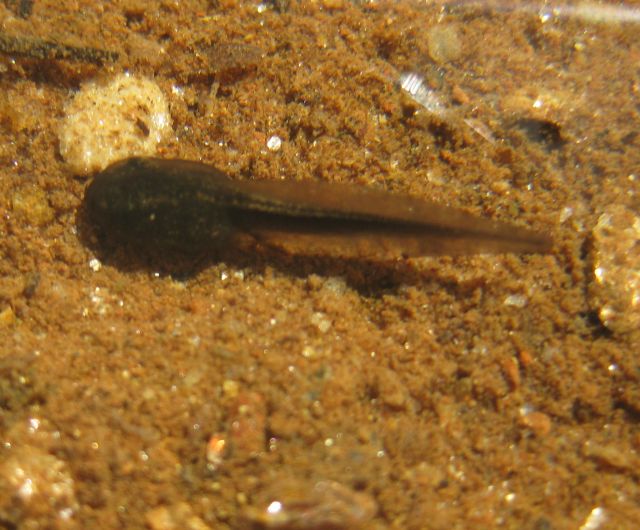
But what purpose is served by having a caterpillar larva precede the dainty butterfly? After all, grasshoppers don’t have complete metamorphosis. Instead there is a juvenile looking grasshopper called a nymph (wingless and sexually immature) which grows to become an adult. Or the tadpole the frog?
tadpole in the pond in the woods, just emerged from frogspawn
I posted that I was reading up on biology and in addition to the $10 textbook I acquired, I recently purchased a competing version for $4 (cost 1 cent, postage $3.99) – Biological Science by Scott Freeman 2007 edition 1,300 pages which delves more into understanding the why’s of life around us.
The Freeman book offers two explanations for complete metamorphosis. First is feeding efficiency, in that the adults and larvae usually feed on different materials such as the butterfly larvae on my vegetables and the adult butterflies on nectar. So the kids are not competing with the adults for food, which improves the survival prospects of both adults and juveniles (the juveniles more than the adults). The second explanation for metamorphosis is based on specialization in feeding and mating. The juveniles are sexually immature meaning they cannot breed so they focus just on eating and since this is their specialty, they do so exceeding well. The priority of the adults is mating and procreation and indeed some adults do not eat at all as they dedicate their life to ensuring future life.
All attractive hypotheses for this phenomenon of metamorphosis, something I had noticed but not considered.
In a recent post I mentioned that mushroom production in my mushroom shelter has been poor due to inadequate watering. The system I installed had a 0.5″ diameter water pipe run from a nearby slightly higher rainwater collection tank to the ceiling of the mushroom shelter from which the water flowed via bubblers onto the spawn impregnated logs. Water flow was weak and the bubblers often clogged.
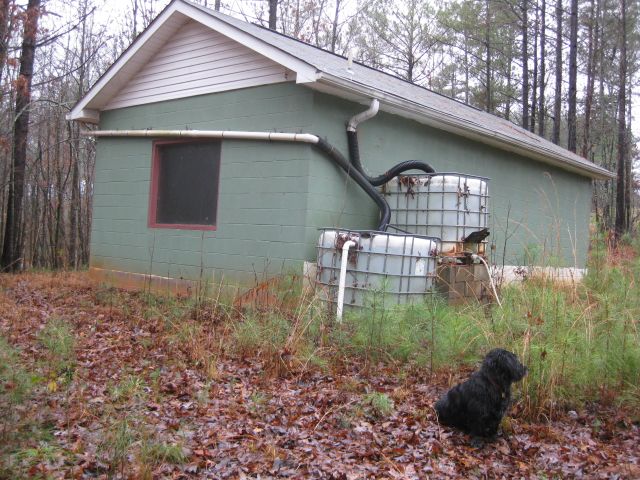
source of water for mushroom shelter is the elevated rainwater collection tank which collects from the north facing roof
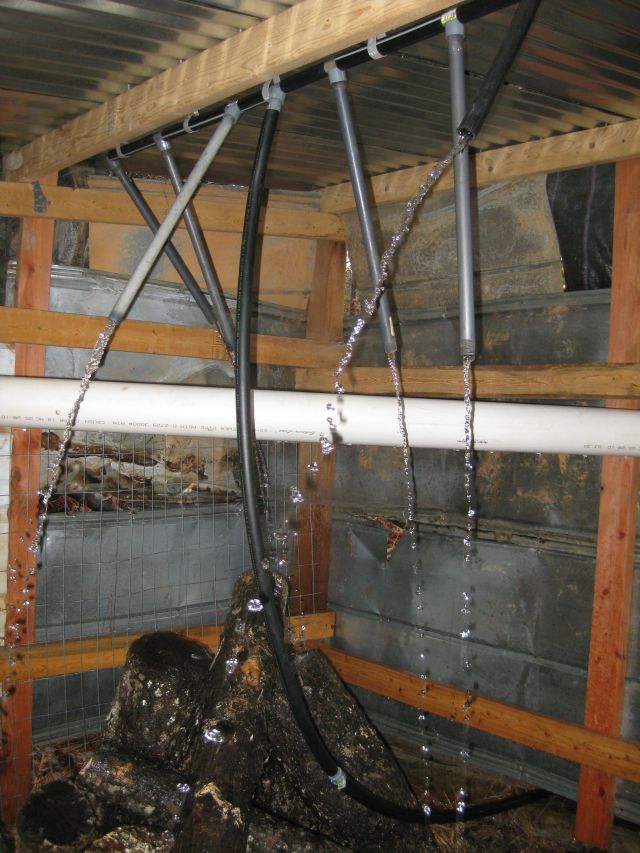
I rectified this by replacing the 0.5″ diameter pipe with a 1″ pipe and by eliminating the bubblers and using adjustable .75″ pipes to torrent the water onto the logs. I do not have the dispersion I had with the bubblers but the flow is strong and there is no clogging – any debris is blown out.
rainwater from the storage tank directed by adjustable pipes to the mushroom logs (ignore the horizontal white pipe)
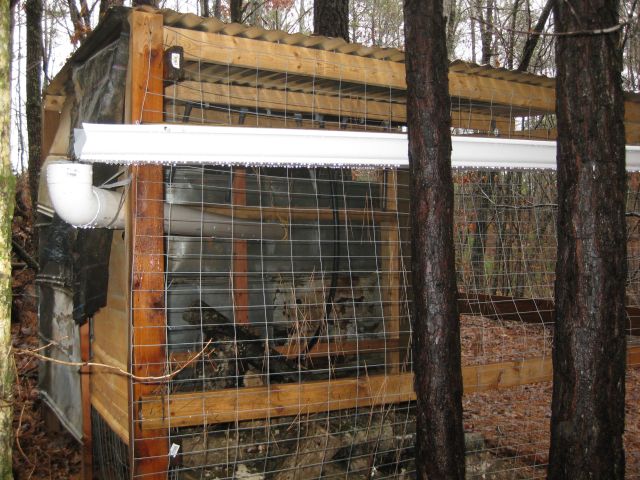
Another watering improvement I made is to collect rainwater from the roof of the mushroom shelter and direct it onto the logs. First step was to install a gutter.
gutter attached to catch rainwater from mushroom shelter roof with pronounced dip to the left to feed into 4″ elbow
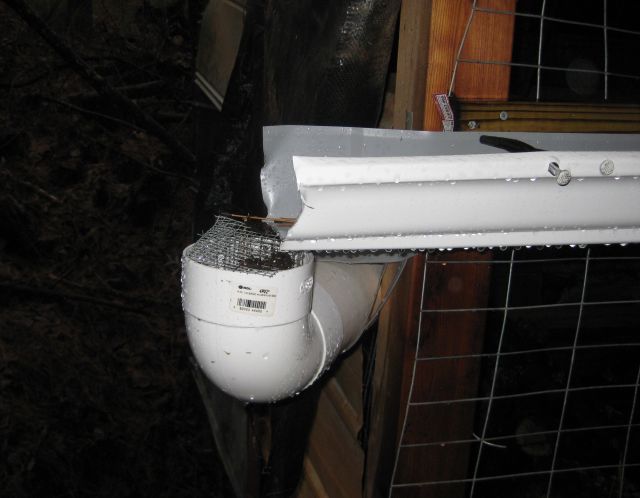
The open lower end of the gutter feeds into a 90 degree 4″ elbow attached to a 10ft 4″ water pipe. I crumpled chicken netting into a ball and inserted it into the open end of the elbow to trap leaves and debris before they entered the water pipe.
gutter on mushroom shelter feeds into elbow with protective chicken wire
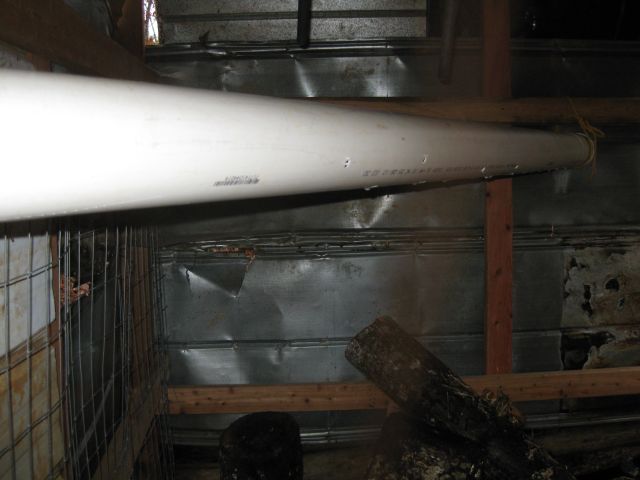
It was then a simple matter to lead the 4″ diameter 10ft pipe into the shelter, cap the far end, and secure it ensuring it dipped from the elbow end to the capped end. With a power drill I made holes staggered along the length of the pipe.
4″ diameter 10 ft water pipe in place with staggered holes to ensure good coverage of mushroom logs
The improvements should ensure more reliable mushroom production.
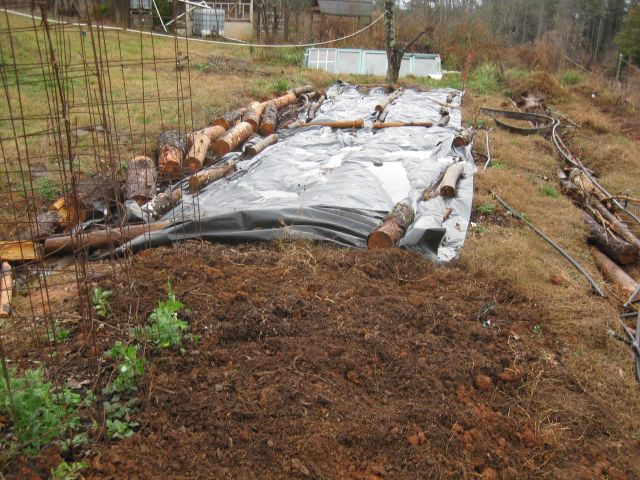
In my 9/21 post I described various tactics I am using to eradicate Bermuda grass organically and how I covered an area with 6mm thick commercial grade black plastic. Bermuda grass likes heat and rather than try solarize it with clear plastic (and this would only have possibly worked if I had tried this before the onset of summer), I thought completely depriving it of light might be more effective.
Today, some 3 months later, I decided I needed some of the covered area to plant out my remaining garlic cloves. Also I was curious to see what effect the exclusion of light had on the bermuda grass.
Bermuda grass area covered with thick black plastic 3 months ago
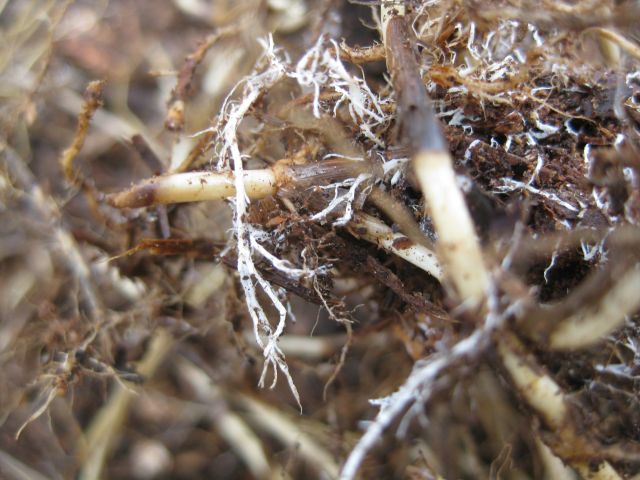
I lifted some of the black plastic covering, forked up a chunk of soil and pulled on the Bermuda shoots. To my surprise they slipped easily out of the soil, much more easily that an adjacent area which I had just finished clearing. So I decided to look more closely and noticed that the fungi strands on the ground, which I associated with the wood chips I had dumped the previous year, were actually decomposing the roots on the Bermuda grass shoots. Without their roots, the Bermuda grass shoots slid easily out of the moist soil.
fungi from woodchips laid the previous year have invaded Bermuda grass roots
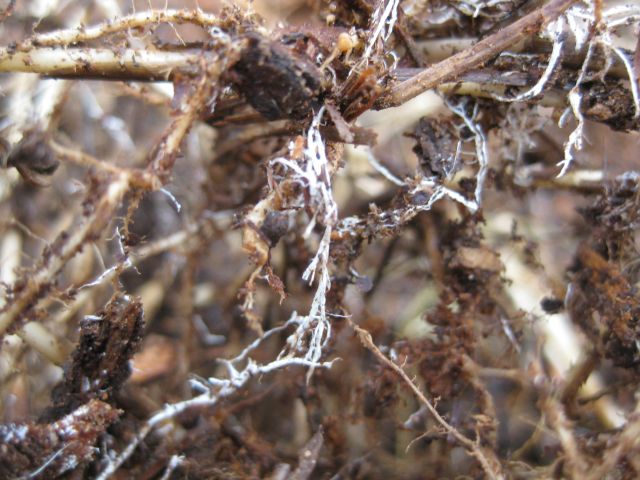
So the fungi attacked the roots. I am assuming this is decomposing (saprophytic) fungi (rather than parasitic) and they migrated from working on the wood chips.
another photo of the fungi decomposing the roots of the Bermuda grass
This could mean that either the Bermuda grass had died or had gone into a very deep withdrawal. Bermuda grass hibernates every winter – it turns white and to northern visitors looks as if it is dead. But in the spring the green shoots appear and, as the weather heats up, it comes vibrantly to life. But I have not seen fungus attack overwintering Bermuda, so it seems likely that the black plastic covering had a significant effect.
I shall leave some of the covering in place through spring and then see if the grass can rejuvenate itself, and if it doesn’t then this will be a viable non manual yet organic way to combat Bermuda grass – establish fungi, seclude the grass from light and let the fungi do their work.
In the meantime I shall continue clearing the now vulnerable Bermuda grass from more of the area so I can install garlic and several varieties of kale which should do well in the winter in this very sun exposed site.
“task” and “pleasure” seem opposed but not when it comes to fruit trees. I enjoy planting fruit tree saplings. Fruit trees are a long term investment and some of the best advice I received was to plant the trees first and then focus on the vegetables and berries. While in Portland last September I visited the Powell bookstore, which is a landmark. In the growing section I found the Lee Reich book “Uncommon Fruits for Every Garden” marked down to $9. I snapped it up, read it and then joined the Atlanta Fruits internet group where a member mentioned “Hidden Springs Nursery”. After coursing their website and cross referencing to Reich’s book, I ordered 11 fruit trees in mid-September. Yesterday, 11/28, the shipment arrived and today I planted out the saplings. The reason for the delay, they explained, was to ensure the fruit tree saplings had entered dormancy, which makes sense. The small fruit trees were carefully packed and arrived in good condition.
The fruit trees I ordered are somewhat unusual – pawpaw, medlar, juneberry, aronia, goumi, kiwi and sour cherry. The two pawpaw (Mango and Overleese) and the sour cherry I planted on a new terrace which I dug out of the hillside a few months ago. The sour cherry is located close to a sour cherry gifted by my neighbor and I hope the two will cheer each other along. The pawpaw in their early years are sensitive to summer sun and in spring I will build a sun shelter for each.
The instructions suggested that the juneberry and medlar fruit trees should be planted with the graft covered by soil to encourage rooting of the scion, which Reich confirmed.
I had earlier decided to plant the kiwi (2 females and 1 male of the Hardy variety) in a well exposed site. But the instructions said they should be planted on a north-facing slope or north of tree cover in order to delay their habit of early spring blossoming. So the site I selected is to the north of tall pine trees – the kiwi likes forest conditions and I hope they will be happy there.
I selected the medlar in part because of its history – it reached its peak popularity in the Middle Ages and Wiki says it was grown by the ancient Greeks and Romans beginning in the 2nd century BCE. Apparently its appearance is unappetizing, but not its taste – I hope I get to savor it in a few years.
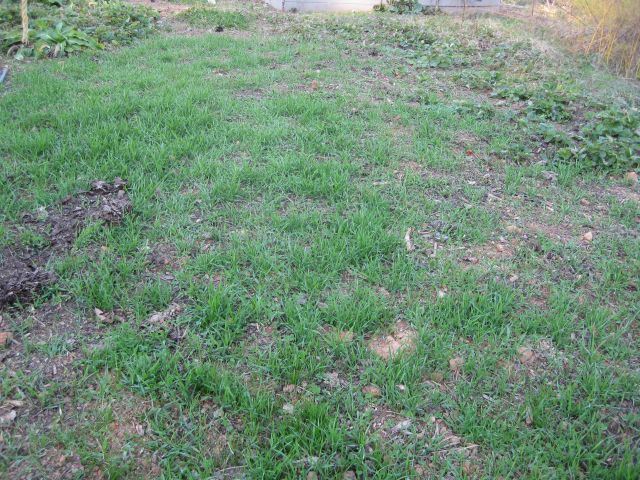
cover crops – I cleared the tomatoes and weeds, added compost and sowed winter rye and crimson clover. A few years ago I used hairy vetch, which worked well and next year I will order more since the local supplier, who originally sold me the seed, no longer carries it.
a vegetable growing area seeded with winter rye and crimson clover cover crops
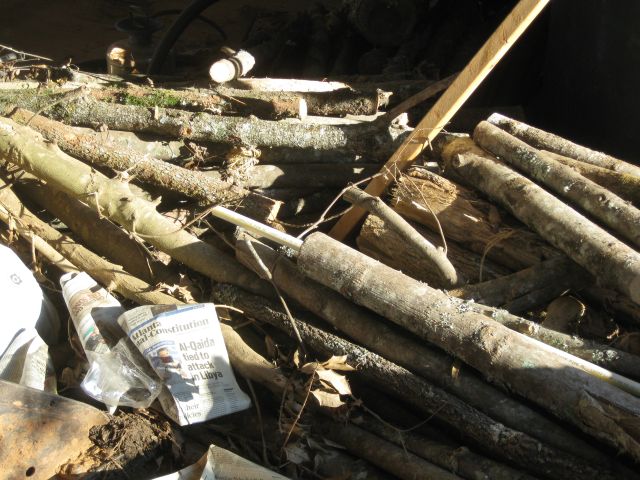
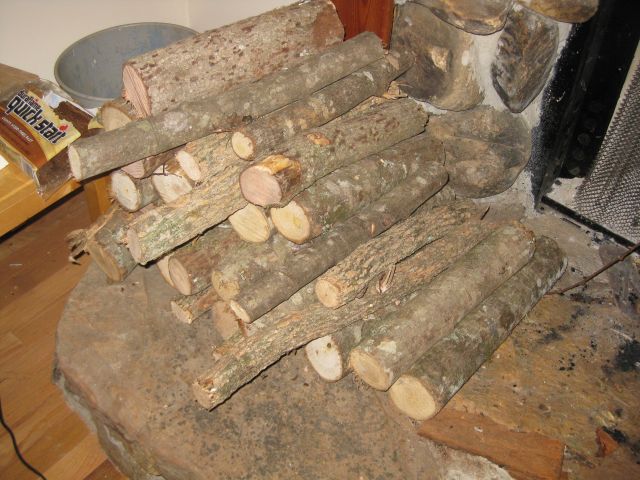
firewood – during the year I cut a new 5 foot wide route through the woods and I steered the path to avoid the larger trees. I had to uproot and remove smaller trees and I cut their trunks into 5 foot lengths and stored under cover for fuel for winter. I am now chain sawing the wood into 2 foot lengths to fit the grate. Last Sunday was cold and the wood burnt well.
firewood stored under cover drying for winter use. I have used some of the oak trunks as mini posts for structural jobs
firewood cut to size next the fireplace
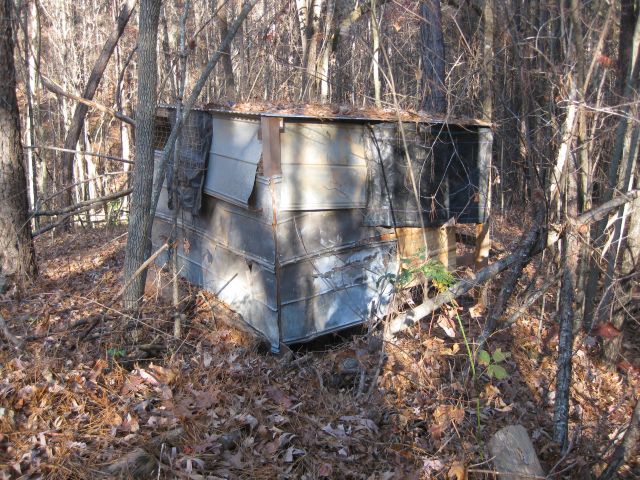
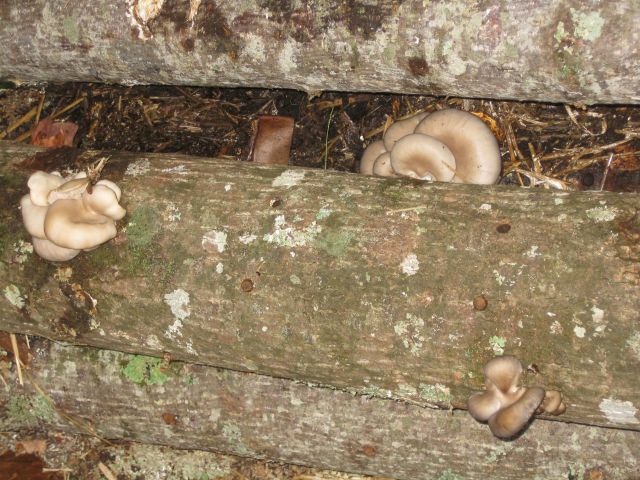
mushrooms – I built a mushroom house, which I filled with logs impregnated with sawdust spawn, and then neglected to water. A few weeks ago I watered the logs and some oyster mushrooms have surfaced. Encouraged, I shall water more regularly. Also I must affix a gutter to the roof of the shelter and direct the rainwater onto the logs – this is obvious and I should have done it at the outset.
mushroom shelter with solid sheeting or barrier cloth on north and west sides for sun protection, and chicken wiring and door protecting remaining access pointsmushrooms have begun to grow
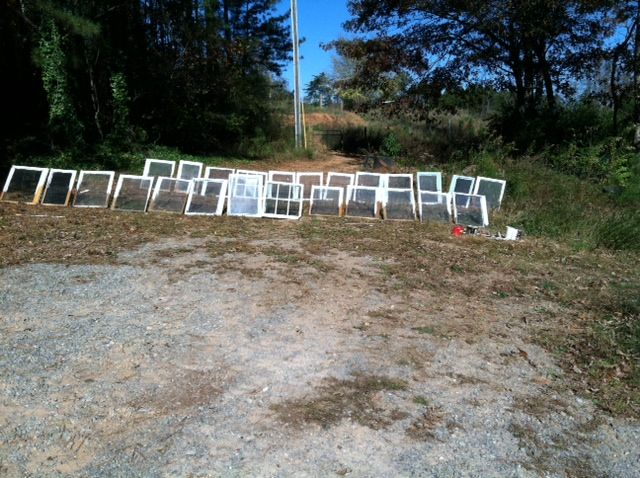
winter growing shelters – last year I was able to purchase a number of wooden windows for a $1 each and constructed rudimentary cold frames. This year I would like to create a larger structure but to do this I need posts. Pressure treated posts would be ideal but I do not want to pollute the soil or my vegetables. So the options are cedar wood (which rots with time), composite posts (which are expensive and may distort), metal structural posts (ideal but where will I find them) or use some oak trees from the woods (cheapest, self reliant and maybe the way to go). In the meantime I painted the wooden windows, first with Kilz primer and then a good quality exterior latex.
painted windows drying in the sun
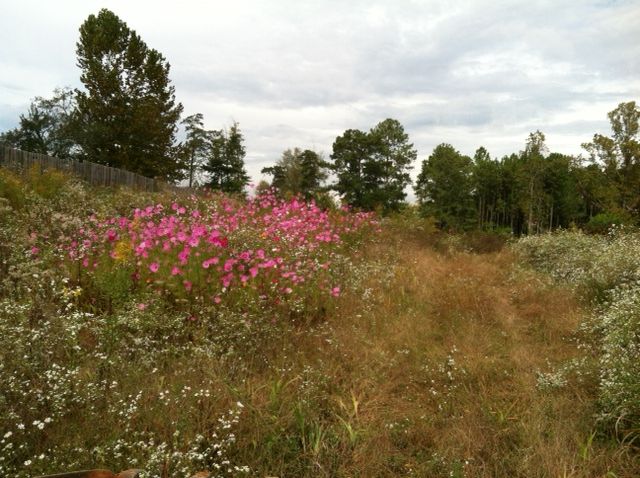
seed gathering – now the cosmos and zinnia have finished flowering and set seed, I sortie out to gather seed for next year.
ebullient cosmos in a field
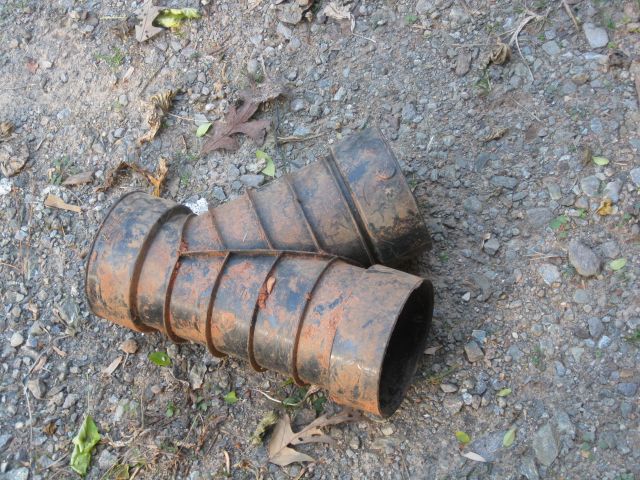
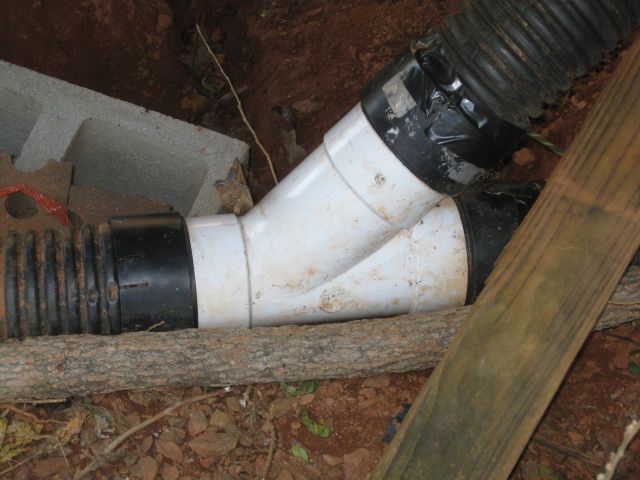
rainwater collection – when it comes to my rainwater harvesting systems the invariable rule is that it will fail wherever I have not checked. The main flow from the house roof went through a “Y” and the “Y” leaked in small amounts and eroded the ground supporting the connection so one of the 4″ pipes disconnected (maybe also assisted by the rodent hunting activities of my dog).
this is the old, cheaper, now replaced Y connection
I replaced the old Y with a more substantial Y, I rebuilt the underpinnings and I secured the inlet pipes to the Y with duct tape and am resolved to keep a good eye on this joint and have instructed Trudy to leave the water drainage pipes well alone.
rainwater harvesting – the more expensive replacement Y secured with duct tape
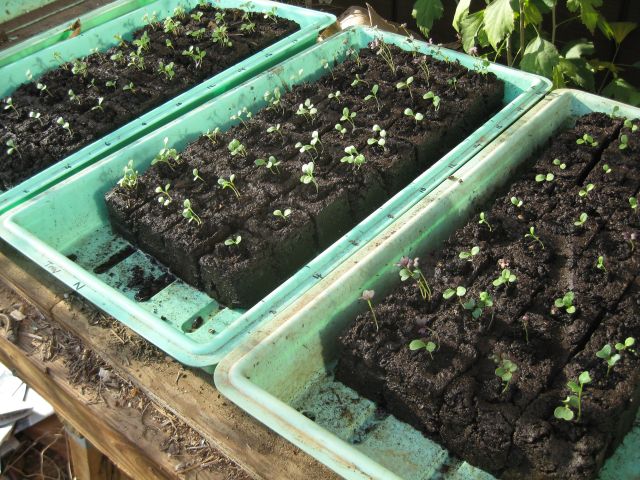
winter vegetables – I decided to seed more lettuce since I already have sufficient kale. The lettuce was seeded initially into 3/4″ soil blocks and are now in 2″ soil blocks in the greenhouse. I will probably grow some full size in the greenhouse and the remainder will be ground planted once I have figured out the construction of my new windowed winter shelter.
4 varieties of lettuce seedlings in 2″ soil blocks. the reason there are several in one block is this was older seed and I thought germination would be irregular. silly me, they all came up and I will have to thin or transplant.
cuttings and acorns/nuts – I have taken cuttings from trees I would like to replicate like mulberries, pears (my neighbor’s pear tree was prolific this year and my Giant Korean, which bore for the first time, was excellent), cherry, plum and one of my neighbor’s apple trees which had very sweet small apples. I know with the apple tree I may have a problem with the root stock. Perhaps next year, when I am successful with grafting, I will graft scions to root stock. As for nuts – my other neighbor gave me a dozen pecan nuts from his magnificent pecan tree and I also buried Ohio buckeye nuts, acorns from selected oak trees and nuts from other local trees. The cuttings and nuts are in an area which I visit and weed and water most days, with good sun exposure and the soil is well mixed with compost. So I am hopeful. If the cuttings are viable I may transplant them in spring next year or, better, wait till fall and then plant them out with the nut seedlings.
in earlier posts I mentioned other activities such as terracing the hill in anticipation of delivery of assorted fruit trees promised for the end of November, and winterizing the bee hives and the chicken coop. When really cold weather threatens I will wrap my fig and other cold sensitive trees in swadling and leaves to prevent die back.
I never studied biology and as I pursue my “new track “in growing and interacting with nature I am at a disadvantage.
I recently completed the excellent “Introduction to Sustainability” MOOC provided by www.coursera.org entirely free, and learned a lot. I enjoyed the experience and have now decided to study biology. There is a coursera course starting summer next year “Introduction to Biology: DNA to Organisms” and the notes suggest acquiring “Biology” by Campbell Reece. I was able to purchase the 2007 edition for less than $10 (including shipping) and am happily working my way through it. I also discovered an excellent website: http://www.dnaftb.org/1/animation.html titled “DNA from the Beginning” which is an animated primer on modern genetics, so as winter closes in, I have much to work on.
A few days ago I was plucking pea pods from the pea plants and I wondered how the peas would be pollinated now it was getting cold and my bees stay indoors when the temperature is less than 50 degrees. Since it was getting cold I headed indoors and began working through the website primer on genetics and, by pure serendipity, the first topic was on the Father of Genetics, Gregor Mendel, who in 1865 began his experiments on pea plants, which when left alone self fertilize. This answered my question on pollination.
Mendel focused on individual traits of pea plants (phenotypes) and by cross fertilizing them and careful analysis he concluded that each alternative form of a trait is specified by alternative forms of a gene (allele) and a pair of alleles is called a genotype. It was Mendel who identified dominant and recessive alleles and how the first generation (F1) will have the dominant trait but the second generation can begin to show the recessive trait. Which is why seeds from F1 hybrids will not produce true to the hybrid.
While working my way through the animated primer I read about Crick and Watson who discovered the DNA double helix and the book “The Double Helix” by Watson was referenced as a good read. I just finished reading it and it is excellent. Watson was an American student at the Cavendish Laboratory of Cambridge University and his insousiance and self-deprecating dialogue makes it an exciting romp with lots of humorous asides as he and Crick competed to beat Linus Pauling to solve the DNA configuration. At one point, when Crick and Watson were stumped “the problem was then put aside for a rapid scanning of a novel on the sexual misjudgments of Cambridge dons.” Or when visiting an aristocratic home “Sol Spiegelman and I went straight for a butler carrying smoked salmon and champagne, and after a few minutes sensed the value of a cultivated aristocracy.” When Watson excitedly informed Crick he had found the answer and was rebuffed, he notes: “Reporting that even a former birdwatcher could now solve DNA was not the way to greet a friend bearing a slight hangover.” There were four principal researchers and three of them got the Nobel prize but the fourth, Rosalind Franklin, died before the award and the prize is not awarded post-humously. There has been controversy about whether her contributions were fully recognized and I was pleased to read the unqualified tribute made by Watson in the Epilogue. A good read.
Georgia is the center of the poultry industry. At a local luncheon the former president of the largest poultry operation in the state recently (October 2012) said the industry grew tremendously since 1970 from 1.5 billion to 7.5 billions pounds of chicken a year. He added that by 2050 the world’s population will be 9.1 billion up 34 percent from the current 6.8 billion and meat production must increase by 74 percent.
His comments and others like his, operate at two levels – the explicit and the implicit. Explicitly there is huge growing demand (not only from the population increase but from increased demand for meat as people around the world earn more) and this is a selling opportunity so long as the infrastructure is in place, otherwise production will move to Latin America, etc. But there is also an implicit assertion – that there is a moral imperative to provide food for the growing population of the world.
And once you accept the implicit assertion you are boxed in. Because only conventional agriculture (Green Revolution now enhanced by GMO’s) can demonstrably supply the quantity of food required by the growing masses. I remember discussing organic growing with an intelligent younger person who accepted all the virtues of safer more nutritious food produced sustainably while caring for the environment, but concluded by saying that the big drawback, if organic production was the norm, was there wouldn’t be enough food for everyone. And that is the box I find myself in.
A big reason for the increase in world populations has been the availability of cheap food as a consequence of the Green Revolution, you can trace the correlation. But these production practices are not sustainable, using the definition of sustainable development as “…development that meets the needs of the present without compromising the ability of future generations to meet their own needs.” How do you brake a runaway train charging down a hill? No one wants wars or famine nor environmental collapse. No easy answers, but at least escape the box and say it would be no bad thing if food prices began to gradually rise as we transition to more sustainable growing methods with better quality food and it would be no bad thing either if the world population gradually fell to sustainable levels. Or do I have it wrong?