restocking the little pond

In June last year I dug a small pond in the woods where a spring emerges from the hillside.  I stocked it with a few goldfish and minnows – see my post on the little pond and by July I was sure the frogs had eaten all of them.  Then later in the year I noticed one fish, about 6 inches along, and then two fish and in January, the same two fish and a small fish.  Somehow a couple had survived and apparently propagated.

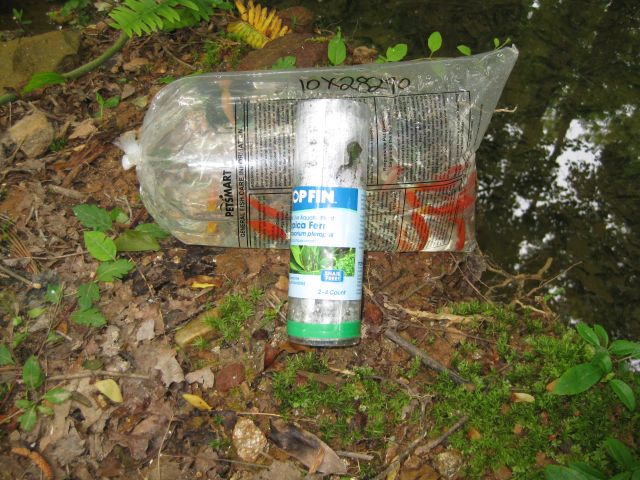
In my post in February this year I mentioned the frogspawn in the pond and, it would not surprise me if the surviving fish snacked on some of the frogspawn – what goes around comes around.  All was good until we recently had really heavy long lasting rains.  The spring became a gusher and the 3 fish may have opted to explore the overflow pipe rather than endure the silted waters of the pond.  It appears they are no longer in the pond though they can be skilful at camouflage.  Today I purchased a conical filter for the 4″ overflow pipe and 10 small goldfish at 14 cents each from PetSmart and a small aquatic flower for the shallow end.

the 10 goldfish are in a plastic bag container of water which was filled with oxygen.  in front is the aquatic plant
the 10 goldfish are in a plastic bag container of water which was filled with oxygen. in front is the aquatic plant

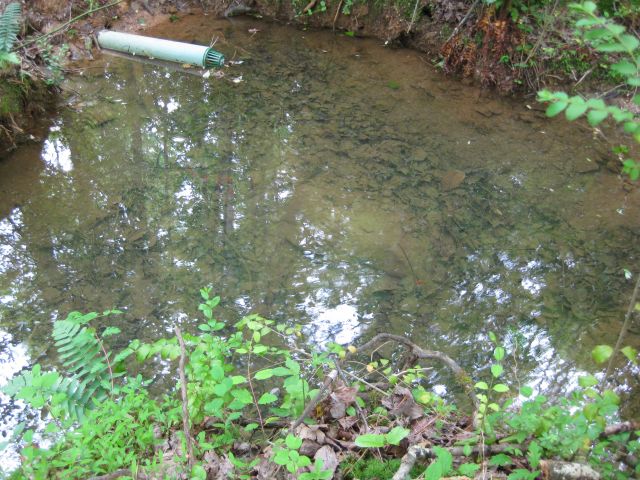
The pond outflow pipe now has a conical filter to prevent the new residents from taking off.

the pond with outflow pipe and filter.  it's about 3 feet deep at its deepest
the pond with outflow pipe and filter. it’s about 3 feet deep at its deepest

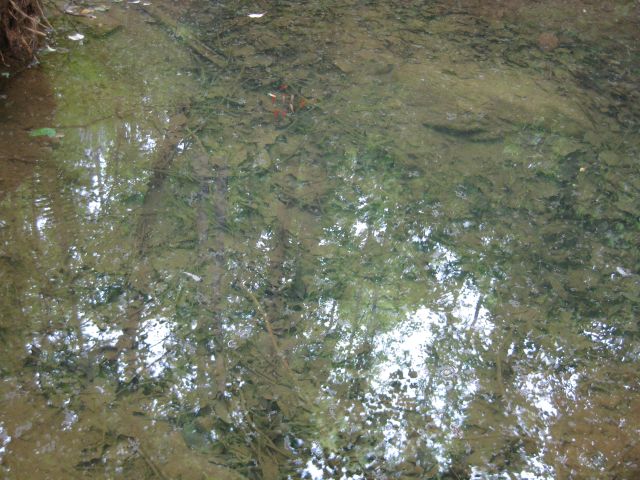
And if you look carefully you may spot the little group of ten.

pond goldfish
the 10 goldfish are in the center towards the top of the picture


why austerity should work, but doesn’t – from an organic grower’s perspective

Austerity is not a novel tactic.  Micawber recommended, though failed to implement it when he proclaimed in David Copperfield:

“Annual income twenty pounds, annual expenditure nineteen pounds nineteen and six, result happiness. Annual income twenty pounds, annual expenditure twenty pounds ought and six, result misery.”.

With an austere regimen, including food discipline and exercise, the overweight human gone to seed can be restored his former efficient self.  And it can also work for struggling countries.  The problem is when the degenerative process has gone too far.

When planting a tree you wish to become self sufficient you make sure to give it a good start.  A planting hole with boulders removed and some, but not too much nutrition for the first few months, is good.  Watering is key and should be weekly and deep.  If you water daily and feed it well, it will become accustomed to easily available surface water and nutrients and so it will not need to extend its roots deep into the ground.  And all will be well provided you continue its cosseted lifestyle with periodic spraying against pests and fungi.  It will be happy and productive but dependent on your continuous support.  And if one day the source of water and nutrients fails, it may not survive.  It roots will not be able to tap the water and nutrients located deep in the soil.  And if pesticides are withdrawn its succulent unchallenged growth will provide easy fodder for the insects, browsers and fungi that descend upon it.

You may say this analogy is far fetched.  But is it?  Populations that have lost their self reliant ways as typified by the expression “you eat what you hunt”  depend for their succour on past treasures (wealth accumulated by disciplined ancestors), or present resources (fortuitous mineral reserves) or future earnings (spending with debt to be borne by future generations).  The extent of the problem can be gauged from the amount and duration of trade deficits.  The trade deficit is an objective, timely (every month), accurate measurement of how well a country’s people, infrastructure and resources compete on the international stage.  For some countries good luck goes a long way such as countries rich in mineral resources (Middle East, Australia, Canada, and Russia for natural gas).  But for most countries the balance of trade (surplus or  deficit) measures competitiveness.  For a rapidly growing country a deficit may be expected in the early years of growth as the industrializing country develops its transport, communications and manufacturing infrastructures.  But when  mature countries such as the United States and Europe (Germany excepted) run continuous huge monthly trade deficits then this is the clearest indication they have lost their competitiveness to hungrier more agile competitors.  Their deep roots have shriveled and they are dependent on continuing doses of synthetic nourishment from their central banks.  In these circumstances a hefty dose of austerity not only won’t work, it can threaten the patient, as would sudden exercise the obese human.

The road to recovery must be slow and arduous – such countries will have to dismount their pedestals, tighten their belts, and learn to compete again for the manufacturing jobs which they bid quick good byes to in the happier days when service jobs seemed preferable.   Now distant competition is doorstep competition and service jobs (excepting those requiring a physical presence such as construction, plumbing or hairdressing) can be delivered quickly and efficiently through the internet from anywhere in the world.   Whole swaths of services from accounting, legal and medical research, to engineering, education and design services can now be contracted out to the best international competitor.

Remaining resources should be shepherded – the fracking bonanza must be frugally deployed, lest 30 years down the road we find ourselves where Britain is today with diminishing North Sea oil reserves and a steep hill to climb.  And the yardstick for measuring recovery should be, as Micawber suggested, the net of our inflows and outflows i.e. our  imports and exports as shown in the monthly balance of trade results, rather than unemployment, interest or inflation data, which respond to various stimuli but do not truly reflect the innate health and viability of the country.


hatched chicks

We have a Buff Orpington rooster and 8 hens, one of which is his sister.  Because most nights I am away from the property I have an automatic coop door opener (design specs elsewhere on this website).  Most nights I lock them in but, when I can’t neighborhood kids earn pocket money doing so.  And when they can’t a neighbor obliges and I will offer, though she doesn’t always accept, a dozen eggs.  She used to keep guinea fowl and she mentioned to me that all the eggs I had given her were fertilized.  My respect for Buffy (the rooster) leaped, not only for his efficacy but also for the way he distributed his favors unerringly.

So as I am a DIY’er I fashioned an incubator <$10 from website instructions and – after 21 days nothing happened.  So with a mother fox and 4 young encamped in the area and being uncertain of my rooster’s life expectancy when a mother fox has to provide, I bit the bullet and purchased a Brinsea 7 egg incubator.  (I am confident Buffy will sacrifice himself for his gals and with his elongated spurs give a good accounting but hope he will not be put to the test).

For incubation success you have to replicate as closely as possible the behavior of a mother hen – how she keeps her eggs warm all the time (except for brief snack and bathroom excursions), how she settles down and rolls them ever so slightly.  Temperature and humidity are critical factors.  The Brinsea has programable options and the default setting seemed designed for chicken (but could easily be adjusted for pheasant, quail, ducks and parrots).  My default settings were 99.5 deg F; 21 day incubation; egg turning every 45 minutes; turning angle 5 seconds duration; and no automatic cooling.  Some explanations – the significance of the 21 day count down is that on the 19th day the incubator will stop turning the eggs.  Automatic cooling is to mimic the cooling which occurs when the mom temporarily leaves the nest.  Since I opened the incubator every few days I thought this was sufficient.  For the last few days of incubation humidity must be high to soften the shell to enable chick emergence, so I checked both water reservoirs were full during this period.

I tried “candling” where you examine the eggs carefully under a bright light and did not learn much.  I did weigh the eggs at the outset and during incubation and noted all the eggs lost weight somewhat in line with recommendations, so I assumed the humidity was ok.

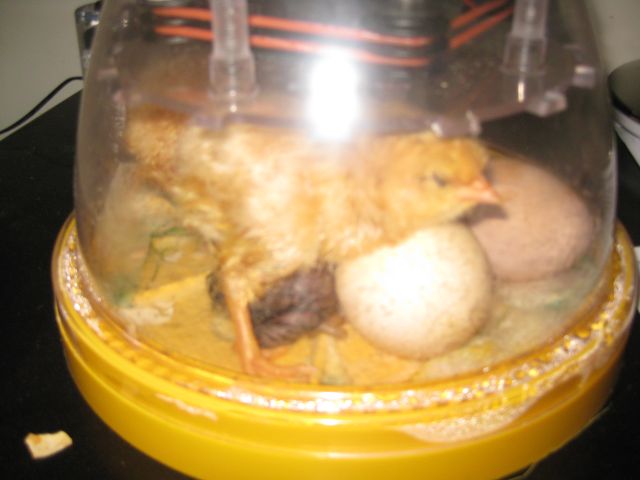
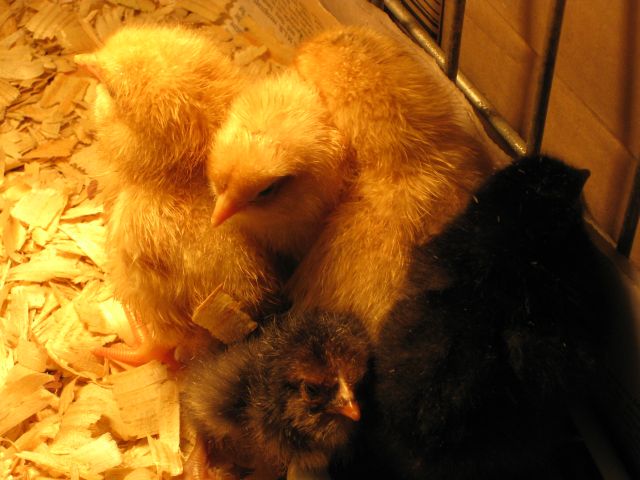
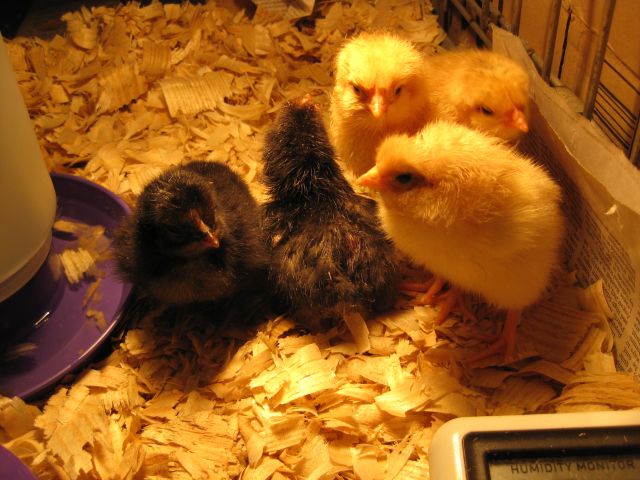
And,  on the 20th and 21st days there was action and 5 chicks emerged from their shells.  In anticipation, I had rigged a heat lamp over a simple brooder box.  I made a quick trip to Sackett’s, the local resource, and purchased an inexpensive plastic gravity fed waterer and feeder and chick feed.  They seem content – not only do they all seem to awake and jump into motion at the same time but, just like the closing of a switch, they all collapse and go to sleep at the same time, piled up on each other.  They all know how to eat but only one so far has figured out how to drink.  More training required there.  As for the remaining two eggs, they may not be viable – I will wait a few days more.

the incubator with the first two chicks emerged

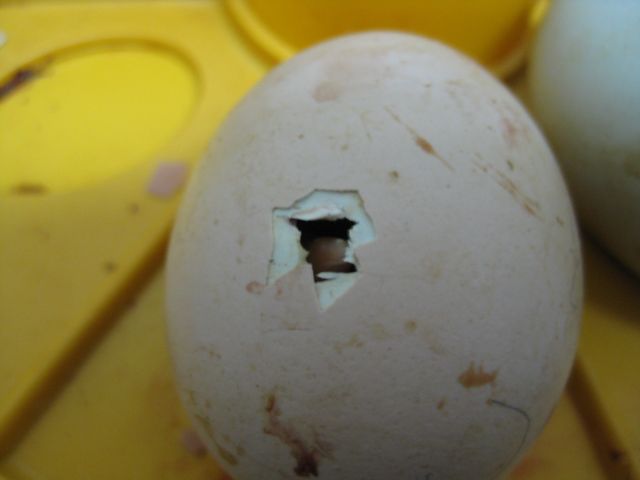
Prior to emerging chicks will make a small hole for breathing and to take a peek at the outside world.

breathing hole and a window to the big world

And what fun it is to snuggle up with siblings, a common dad but different moms.

5 new chicks
5 new chicks

And a final shot of the five (sex still unknown).

5 new chicks
5 new chicks


rampant nostalgia

I have heard of misty nostalgia when we revisit scenes from the past, often with selective vision ignoring what was bad.  I am now seized with rampant nostalgia.

A couple weeks ago the NYT Sunday magazine featured an interview with the author John Le Carre’.  I had tried his books several times the past 30 years and never got past the first 30 pages.  I was out of tune with his writing.  With T.S. Eliot it had been different.  I was aware that Eliot was a top poet (though he held several unfortunate views, from my perspective) and admission to the level of cognoscenti required diligent reading and learning until suddenly, as a plane emerges from the clouds, the turbulence slipped and I could see and appreciate.

But LeCarre’ was not on a mountain peak but a well regarded spy story writer.  And despite the recommendations of several London colleagues who read him on the tube and wherever else possible, I was not attracted.  So I was drawn out of curiosity to the NYT interview and liked that he was in the spy business and therefore well qualified to write on this genre.  I decided, to order through Amazon used copies of the 4 recommended novels.  And I am now 100 pages into the second, “Tinker, Tailor, Soldier, Spy” which was written in 1974 and I am flooded with memories of my 8 year’s life in London during the late 70’s and early 80’s.

My first few month’s in London had required rapid adaptation.  The checkered suit which my Johannesburg tailor assured me was the business fashion in London, immediately drew my manager’s attention “do you think we are going hunting?”.  But as the months and years rolled by I acclimated to London and the City of London and the culture and norms.  Then on to America and another big change.  And now I am avidly reading the cloaked  banter amongst individuals in a firm, ironically called the “Circus”, and the buildings and weather of London and I am instantly transported back in time and yes I probably do have my selective vision glasses on, as I again walk those streets.


Is not impermanence the very fragrance of our days?

I have a 50 minute drive to my property.  And NPR informs and entertains.  Except during the 2 week fund raising campaign.  Then I have to improvise and, since I have a basic truck which does not have a connection for mp3, I burn podcasts on CD’s and listen, intently, since you cannot rewind a missed phrase but must go b ack to the beginning of the track.

A review by Paul Wheaton on the self sufficiency and sustainability practices of the Japanese during the Edo period (book “Just Enough” by Azby Brown) kept me going for several days.  But I needed more.  In the past I listened to and enjoyed Krista Tippett broadcast interviews.  I downloaded a few and today I heard her interview with Joanna Macy, a Buddhist scholar and translater of Rainer Maria Rilke.  Exquisite.  They discuss two different ways to approach environmental degradation – the scientific informed approach armed with research, statistics and photographs, or from our being as part of this world.  I am working my way through the former but a beckoning portal has been illumined for me.

Here is the poem  from which this post’s header is taken:

Wild Love

Is not impermanence the very fragrance of our days?

Flare up like flame
and make big shadows I can move in.

Let everything happen to you: beauty and terror.
Just keep going. No feeling is final.
Don’t let yourself lose me.

Nearby is the country they call life.
You will know it by its seriousness

Give me your hand.

– the poetry of Rainer Maria Rilke translated by the philosopher of ecology Joanna Macy

sweet potatoes

I listened in on a nutrition lecture and heard a pointed saying, ascribed to Ayurveda:

“With good food, medicine is of no need.  With bad food, medicine is of no use.”

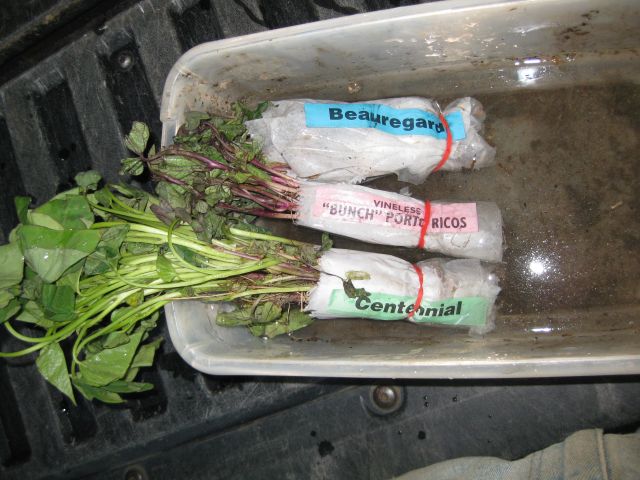
Sweet potatoes were prominent in the highly regarded traditional Okinawan diet – see my recent post.  In March I ordered “southern” styled sweet potatoes, they arrived yesterday and today with the Ayurvedic prescription in my thoughts, I planted them.

sweet potato slips
sweet potato slips

Detailed instructions accompanied the package and, as recommended, I wetted their feet and waited till the sun was setting before planting them.  I noticed that the Beauregard slips had not yet developed roots.  I hope this will not be a problem.

neighborly chat

Every so often I meet my neighbor (I will call him Thomas) and we catch up on local goings on.  Not a Robert Frost walk the line and set the wall event but courteous enough.  He hailed me as he backed his truck out his drive (I learned later he was on his way to the insurance company) and we got chatting.  I mentioned I heard his chainsaw the previous day hard at work followed by a loud crash.  He explained that he was taking down a rotten tree some of whose limbs had fallen on and made ineffective the electric fence which enclosed his 10+ dogs.  This explained why I had seen 5 of his larger dogs sprinting around the unfenced areas of my property (and why I had cut a sturdy oak club in anticipation of a meeting).  Apparently his dogs attacked and killed chicken belonging to another neighbor who had promptly called the sheriff on him.  A kindly neighbor, since a few miles north another resident simply shot the offending dogs.

Thomas had (past tense) a Kubota utility atv, which is an upmarket item costing >$10k.  It is usually parked in front of his house and was stolen last Saturday night when he was home.  He surmises that a red pickup he noticed the previous week driving slowly up and down the public gravel road was casing the neighborhood and that they arrived in the early hours with a trailer and pushed his Kubota onto the trailer and departed.  This occasioned a second meeting with the sheriff in the same week.  Although it was insured there is a large deductible.

The third tidbit of information was Thomas decided to alert the neighbors to safeguard their items stored outdoors and he met with another neighbor (who also adjoins my property) who informed him that he had noticed a fox with 4 young in a den on my property.  I had seen the fox on several occasions when it was eyeing my chicken and got my rooster excited, which alerted Trudy and brought us both rushing out.  Now with 4 young to feed I can expect to see her more frequently – but what will happen when Trudy and I are not on hand.  Thomas suggested to the neighbor (now without chicken) that the fox was to blame not his dogs, but that didn’t fly.


favorite bloomings

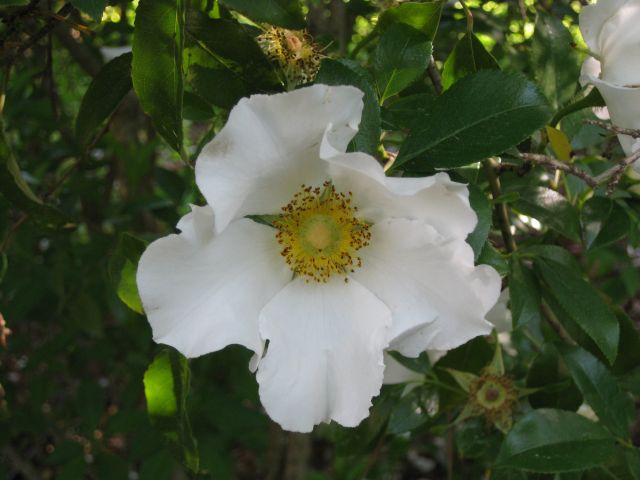
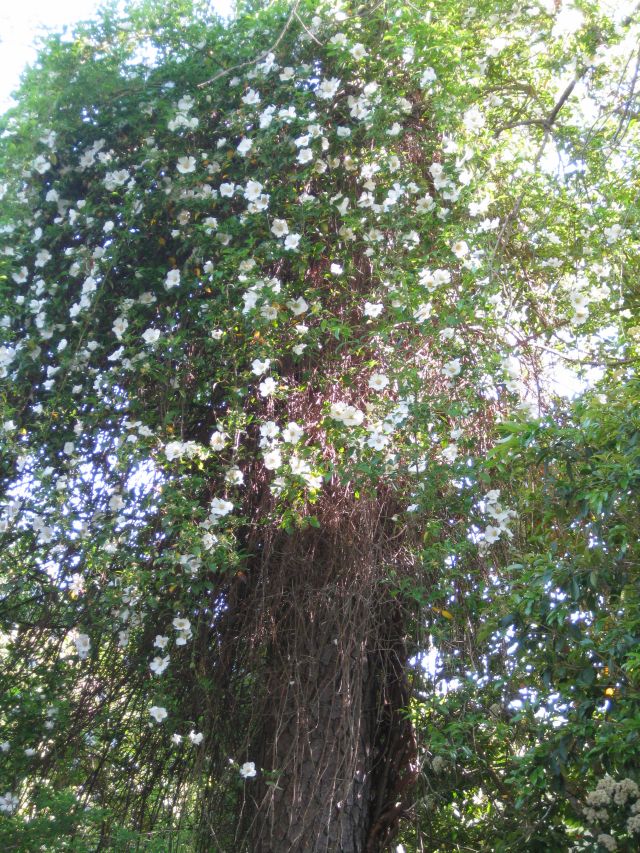
In early summer my two favorite blooms are the Cherokee rose and the Grancy Graybeard.  The Cherokee rose is not a sophisticated rose.

0424 cherokee roseb
Cherokee rose

Like the dogwood it has simple bright white petals.  It has vicious thorns, dark green leaves and thrives in the humidity of Georgia.  It is tough, independent, requires no nurturing and is our state flower.  It is an ambitious climber.  I nailed several cable hoops around a tall pine and after pointing it in the right direction it took off and now has a great 20+ ft view of its surroundings.

Cherokee rose on pine tree

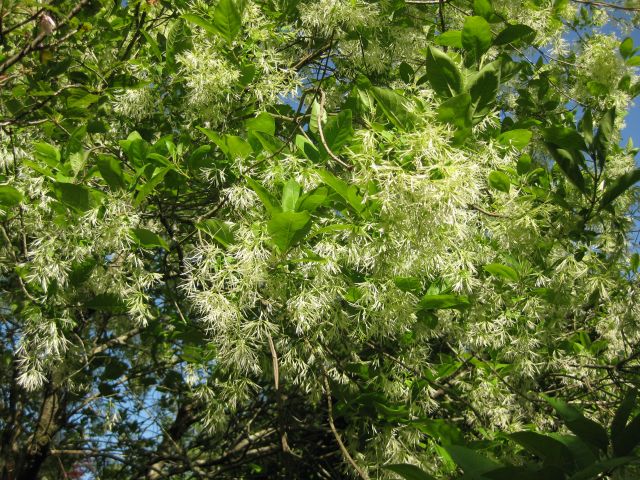
My other favorite is the Grancy Graybeard or Old Man’s Beard (I won’t bother with the Latin names).  It shows its beard for only a few days before it leaves become dominant – perhaps the reversion from old to young is what appeals to me.  You can see I am already a couple days too late.

Grancy Graybeard
Grancy Graybeard


Activity in the yard

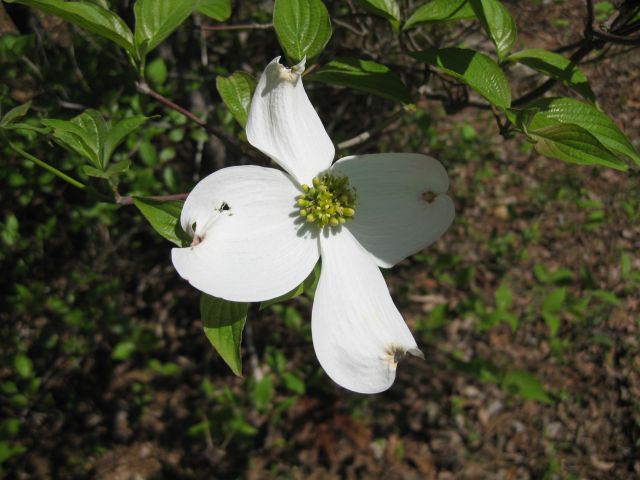
In the woods the splashes of white are the dogwoods. They have a striking, bright white flower.

the unpretentious dogwood flower

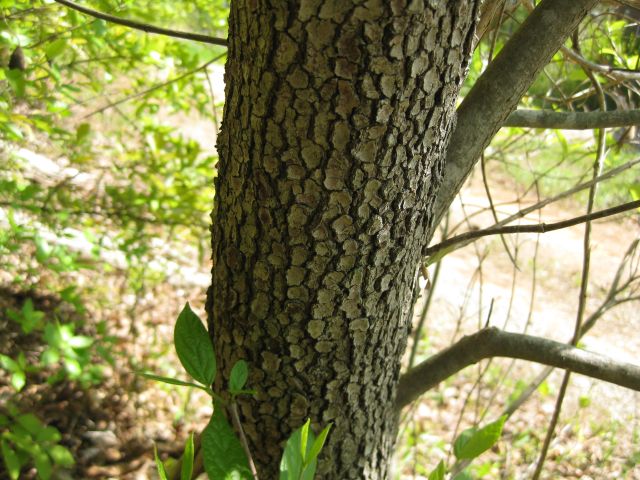
The dogwood tree trunk is also unusual.  It looks like the hide of an alligator.

dogwood tree trun
dogwood tree trunk

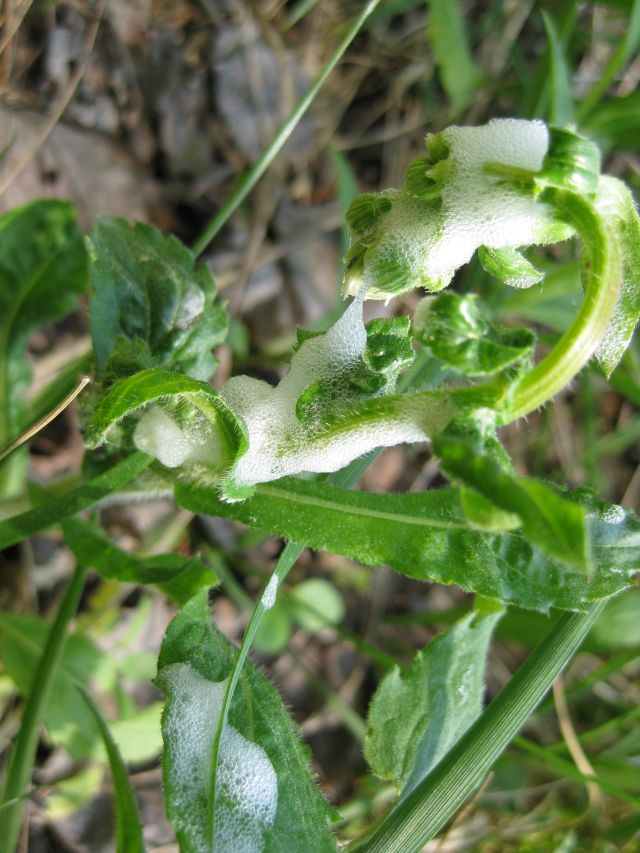
Lots of white foam on stems and leaves everywhere.

white foam on leaves

If you probe gently with a twig and look carefully you will see the odd looking spittle bug emerge.

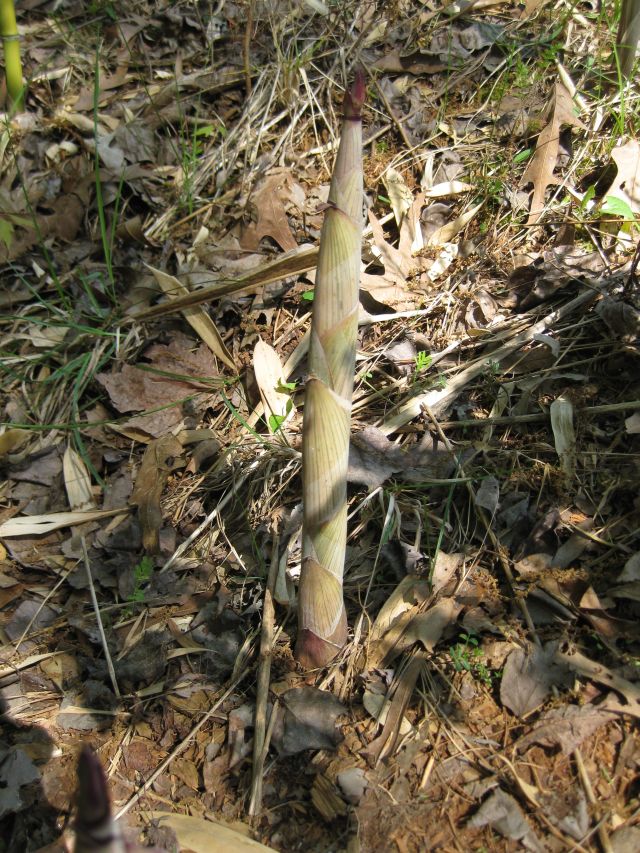
The bamboo patch is producing offspring.

new bamboo shoot
new bamboo shoot

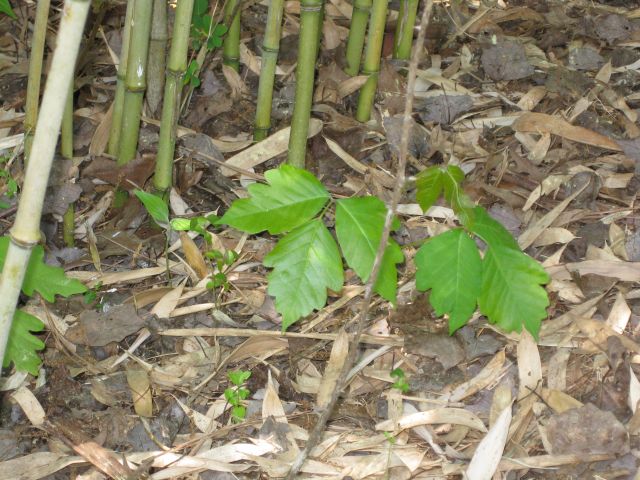
And of course, with the good comes the nasty – the ever lurking poison ivy.

poison ivy amongst bamboo

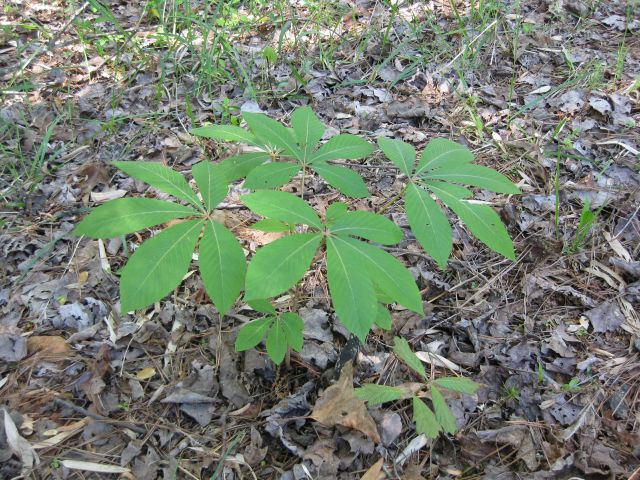
I thought the ohio buckeye plants, which I grew from nuts, had all succumbed.  So good to see survivors.

small ohio buckeye plant

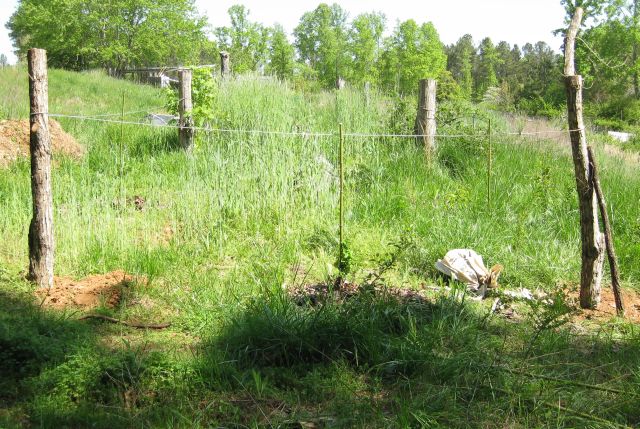
And the male kiwi and two females planted last fall made it safely through the winter.  I sectioned off 8ft lengths of an oak tree, dug >30″ post holes, and with cable threaded through, I made a trellis for my kiwi vines which are trained vertically on bamboo from my bamboo patch (the oak club leaning against the right post is for my neighbor’s large dogs which escaped their enclosure).

oak posts support cable for kiwi vines

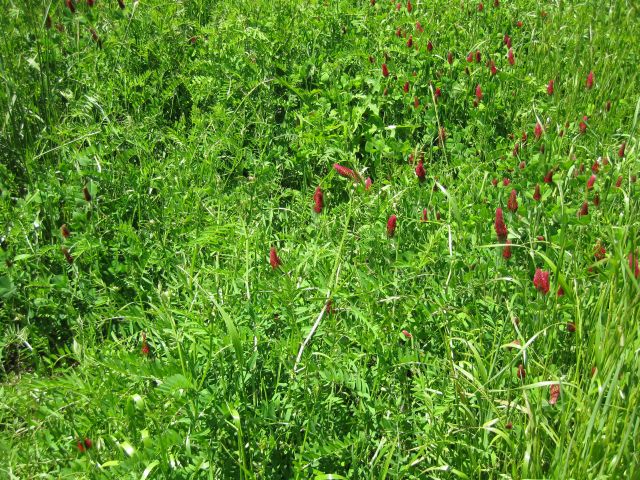
My groundcovers run rife.  In the orchard I have crimson clover and hairy vetch and will probably let them go to seed since they stall the spread of bermudagrass and their self propagation simplifies my life.

groundcover run rife

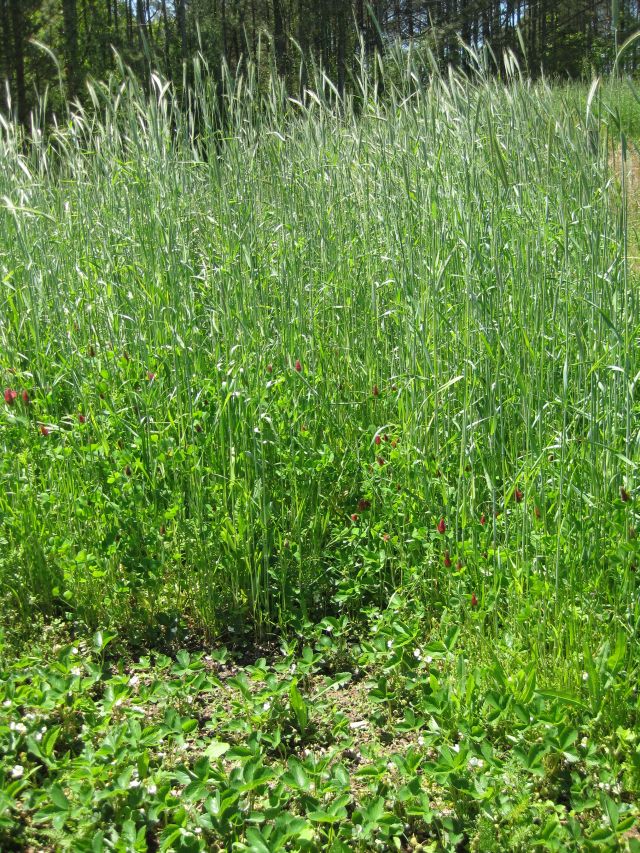
My winter rye in the vegetable area stands 6 ft tall.  I just received an email that my sweet potato slips have been shipped so this patch will soon be leveled.

winter rye standing guard behind my early season strawberries

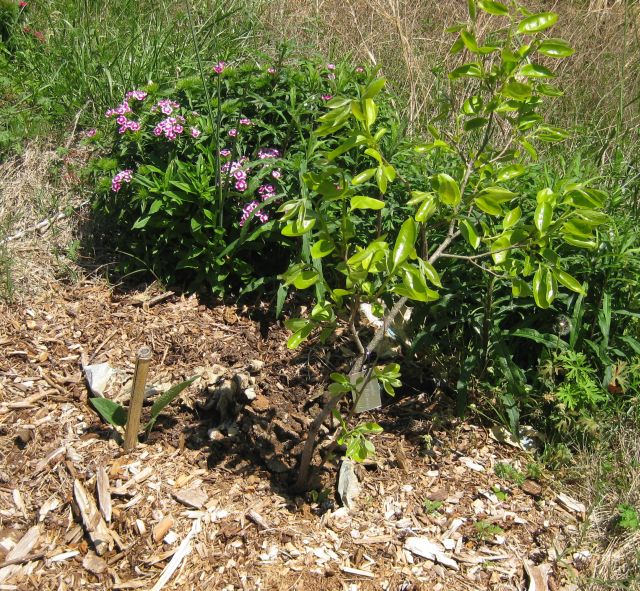
I find persimmon difficult to grow.  My Asian persimmon looks good next to its wildflower neighbors.

Asian persimmon with wildflower neighbors and a small comfrey appearing

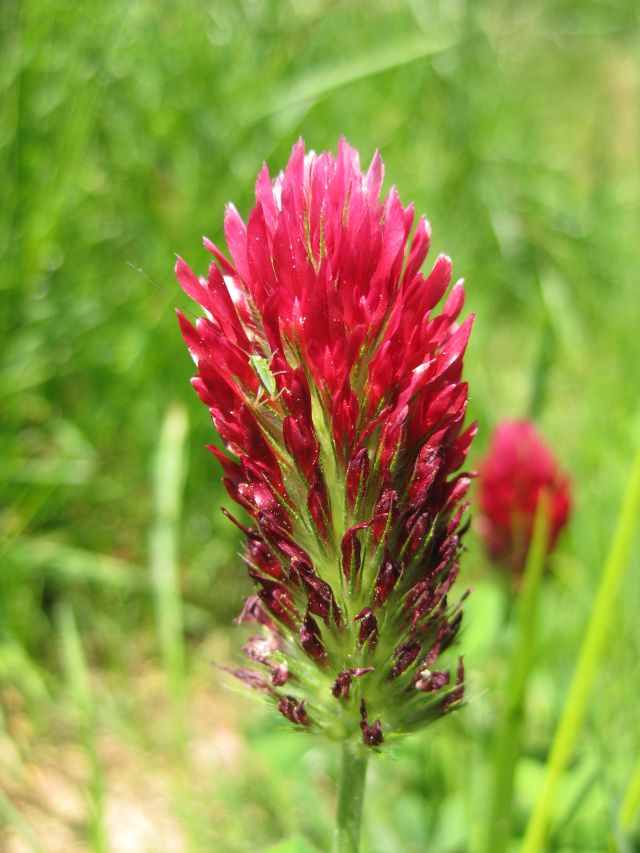
Crimson clover now lines the highway and surfaces in all my growing areas.  It is attractive to me, my bees, the bumblebees and even this small green hopper.

little hopper on crimson clover


Aldo Leopold – Green Fire

The local weekly gazette mentioned that the Mountain Conservation Trust of Georgia (MCT) was screening a new documentary on Aldo Leopold.  I was interested that Pickens county, where my property is, was the HQ of MCT an environmental group and I wanted to learn more about it.  Also, I vaguely knew the name Aldo Leopold but was unsure what he had done.

Last Saturday at the event I met with several board representatives.  Their mission, as I understand it, is to encourage large local landowners to place conservation easements on their land, which will protect the watershed and wild life, and also confer a tax benefit to the owner.  These easements do not provide public access.  Commendable.

I then watched the documentary and, though I have a tendency to doze off, I stayed awake throughout its 1 hour plus length.  And learned how a forester/hunter came to appreciate the significance of wild life and importance of caring for the land.  The latter is referred to as the “land ethic”.  The former gave rise to the title “green fire” which was the fading green light in the eyes of a wolf he had shot, the import of which only evolved within him many years later.  The documentary catalogs the wide scale elimination of wolves, which were considered destructive predators (this opinion later revised) as well as the elimination of the passenger pigeon of which there were billions in huge migratory flocks until hunting and habitat destruction made them extinct.  We have little to be proud of when our talents and needs extinguish a species.  But now some of us are learning our errors and making redress.