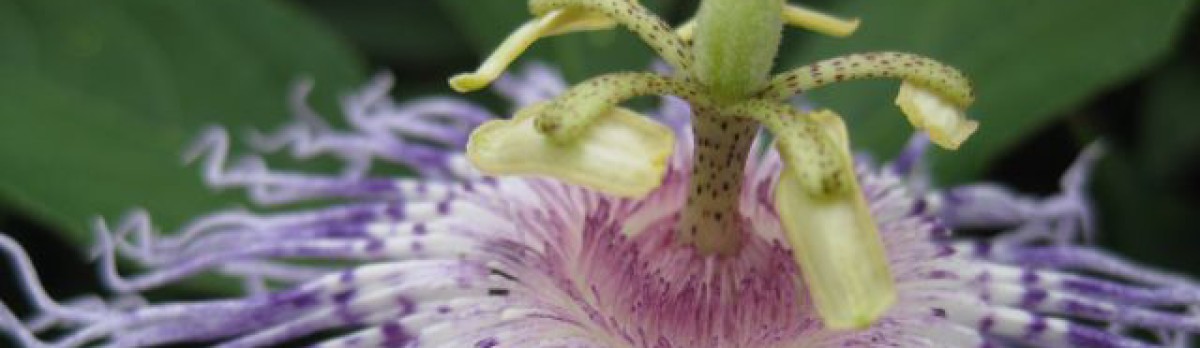
planting out the tomatoes

My main ritual early each summer is the planting out of the tomatoes.  I grow these from seed, initially in the basement (0.75″ soil blocks) then in the greenhouse (2″ soil blocks).  My first year was a glorious year, since then hard going.  Not beginner’s luck but a case of slipping under the radar the first time.  Now each year the pests and problems await me.  Though I rotate the growing site, this does not thwart the soil borne diseases – there is an interesting piece in this morning’s NYT on using grafted tomatoes – maybe next year.  The biggest problem is the stink bugs, which each year multiply and love despoiling my tomatoes.

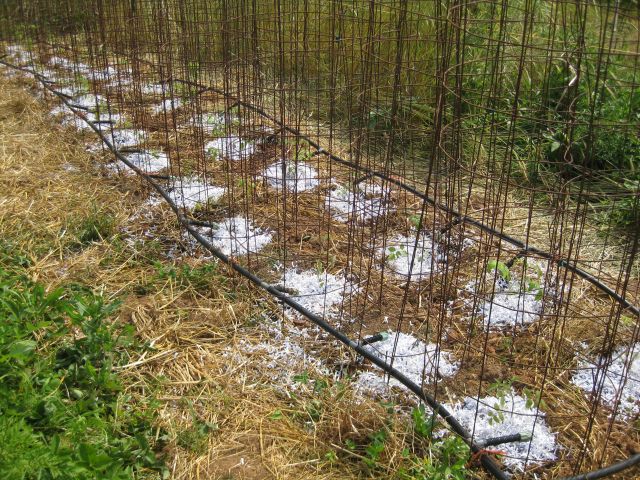
Undaunted I press ahead.  This year I planted 32  plants, less than last year.  And, for the first time in two adjoining rows of 16 plants each.  Previously I took care to wrap the stems just above and below the ground with aluminum to foil soil disease transmission – this year I just mulched with shredded paper waste.

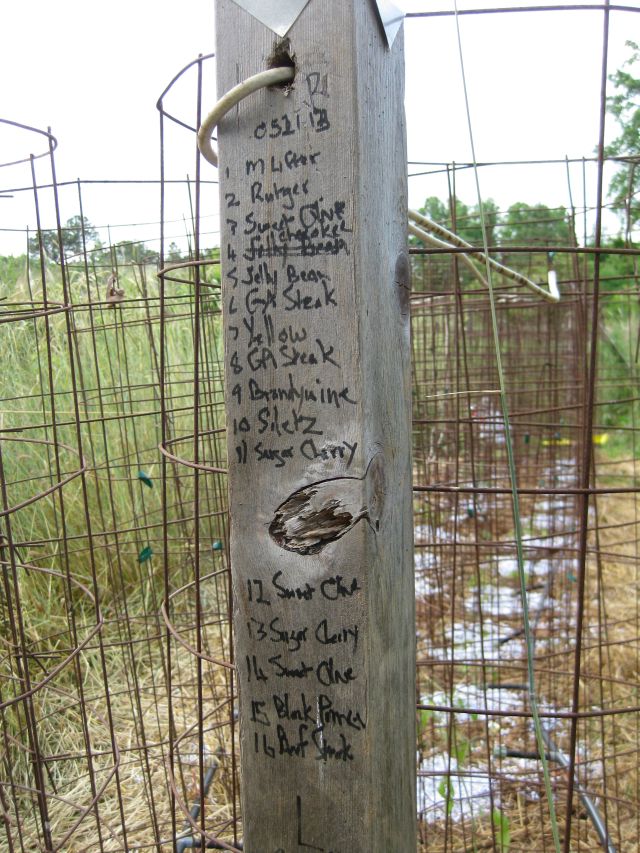
Each plant has a name tag, but these frequently go missing, so I also noted the details on a post which carries the cable securing the wire cages.
0531 tomato a
16 plants in the right row listed sequentially

The varieties, which include heirloom and hybrid, are:  Mortgage Lifter, Rutger, Sweet Olive, Cherokee, Jelly Bean (new), Georgia Steak, Yellow Pear (new), BrandyWine, Siletz, Sugar Cherry, Black Prince, and Beef Steak.  The other 16 plants are also listed on the post and are of the same varieties.

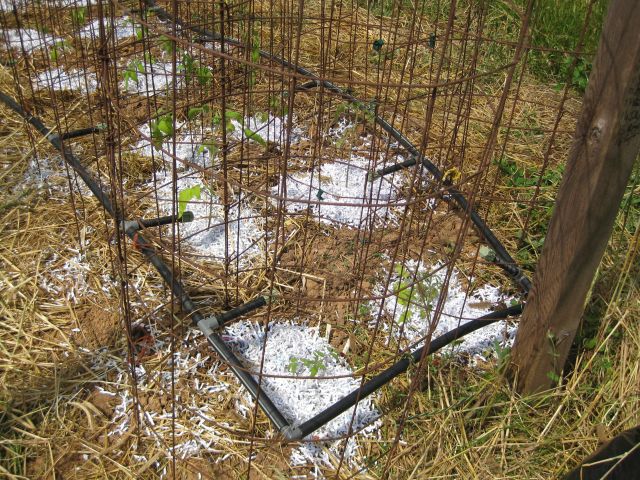
I also adjusted my irrigation system.  I use bubblers for each plant, gravity fed from my rainwater tanks.  In the past the lines and bubblers were at ground level.  Advantage was they were somewhat protected from the sun and degradation.  Disadvantage was that if the bubbler was raised, say 45 degrees, the water from the bubbler ran to the base of the bubbler and not on to the plant and if the bubbler was horizontal it was difficult to see if water was flowing.  With my gravity fed system blockages occur and, if not identified, no water leaves the bubbler.   So this year I raised the lines and the bubblers so it is much easier to check that the water is flowing.  Will see how it works out.
0531 tomato c
irrigation loop with lines and bubblers raised above the ground

The irrigation lines form a loop enclosing the 16 wire cages so the water pressure equalizes and all the bubblers should flow about the same, though of course they don’t, even after cleaning.  So everything in place and awaiting quick growth and the stink bugs.
0531 tomato b
the 32 wire cages each containing a tomato plant and each fed water through a bubbler, with the prominent shredded paper to conserve moisture and delay weeds

Wildflowers

Some of the wildflowers are glorious, this near the chicken coop.
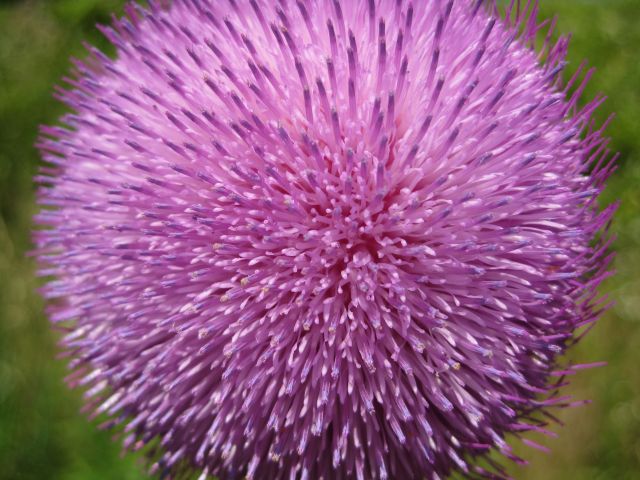
0531 wildflower


shading the PawPaw

Last September I purchased two PawPaw trees from HiddenSprings Nursery – a Mango and an Overleese.  Initially I planted them in an extended area of my new orchard but when a sickly apple tree had to be removed from my old orchard I decided to transplant the two small PawPaws close together where the apple tree had stood.  Incidentally this apple tree was purchased from a big box store to replace an apple tree which had previously failed.  So either there is a problem with the soil in this specific area or both trees were unsuited to my conditions.  Generally I purchase all my trees from specialist nurseries or develop them from cuttings.

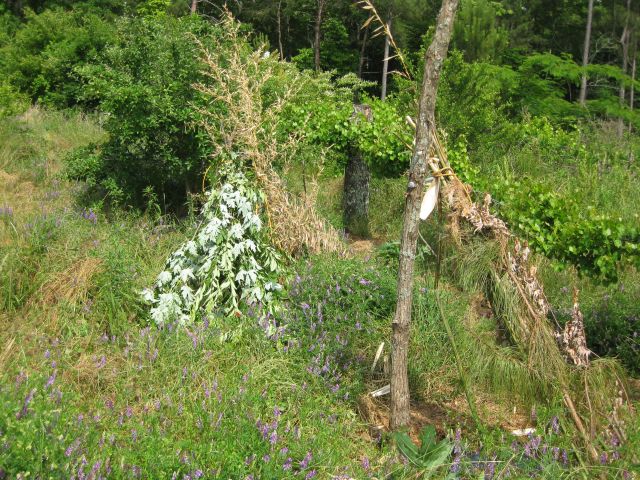
The instructions which accompanied the PawPaws said shade is needed for the first year or two, so I decided to construct a simple shelter.  I am averse to buying materials when I can make do with what is around me.  After experimenting with a tripod arrangement made from bamboo, which worked ok, I decided to utilize 10ft oak branches as the post for each shelter. I first dug a 2ft hole with a clam shell digger to anchor the posts.

0531 pawpaw a
oak post with horizontal 12″ carriage bolt to which are strapped branches and bamboo to provide shade from sun in south and west

The two shelters are about 8 ft apart.  On the right is a trellis of various muscadines and in front is hairy vetch which loves my area and is self propagated from a seeding several years ago.  I let it and the winter rye and clovers go to seed each year.  This ensures winter cover and slows down the spread of bermuda grass.

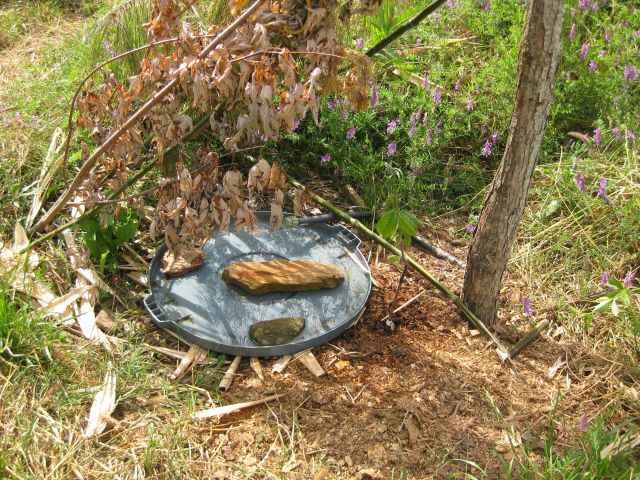
In my first shelter I have a watering stop for my bees.  The irrigation is arranged that the bubbler fills the basin (upturned trashbin cover) and then dribbles over onto the site of the PawPaw.  The flat stones in the water are landing pads for the bees.

0531 pawpaw b
you can spot the PawPaw. it is the small stem with a few leaves between the watering station and the oak post

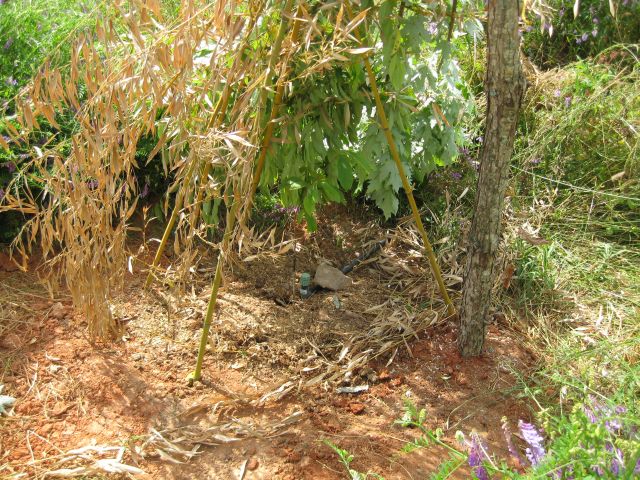
And my second shelter is similar, a post, surplus branches attached to the bolt on the post and a small pawpaw sheltering underneath.

0531 pawpaw c
this PawPaw is more difficult to spot though it is larger – its leaves are amongst the green leaves and its graft union is just discernible


“spa treatment” for Red

Of the 6 chickens inherited from my neighbor, Red has always been my favorite.  On one occasion I borrowed them to assist in the new vegetable area.  5 huddled in the furthest corner, Red came up to where I was forking up the soil and she focused on each upturning and snatched any worms or grubs that were unearthed.  I was told she was rescued from a commercial operation and that was why her beak was snipped – to minimize damage amongst stressed confined birds.  The bigger birds respected her and let her alone.

And all was well until last week when her behavior changed – not amongst the birds at the paddock corner scrounging for handfuls of seed, comb faded,  more time in the coop than out.  And last night I was sure she was at her end – standing in the corner with head drooped to the ground.  I separated her from the others and this morning I set out to take her body for burial – I dig a deep hole for the departed and, when covered, mark it with a boulder.  But there she was on her feet!

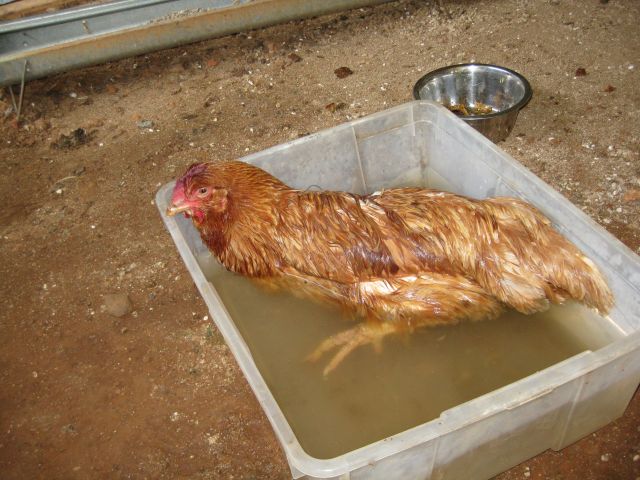
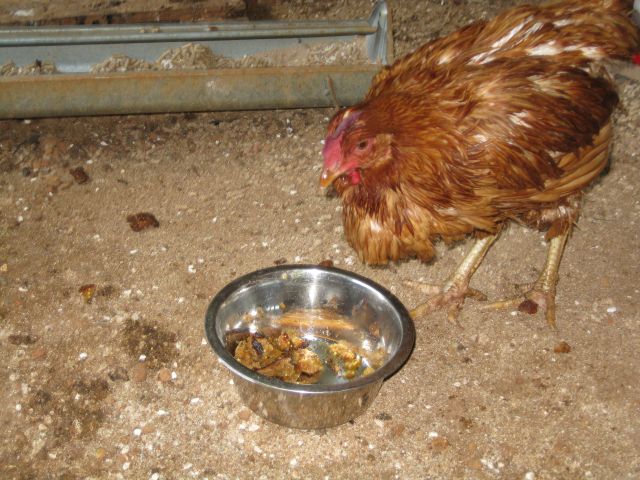
So I rolled out the “spa treatment” recommended at www.hencam.com.  A long soak in an epsom salt bath.  Which she enjoyed as you can see below.

epsom salt bath - warm water and quarter cup epsom salts
epsom salt bath – warm water and quarter cup epsom salts

Followed by pieces of whole wheat home made bread doused liberally with olive oil.

Red enjoying whole wheat bread and olive oil

The least I could do for a real character.  So we wait and see.

restocking the little pond

In June last year I dug a small pond in the woods where a spring emerges from the hillside.  I stocked it with a few goldfish and minnows – see my post on the little pond and by July I was sure the frogs had eaten all of them.  Then later in the year I noticed one fish, about 6 inches along, and then two fish and in January, the same two fish and a small fish.  Somehow a couple had survived and apparently propagated.

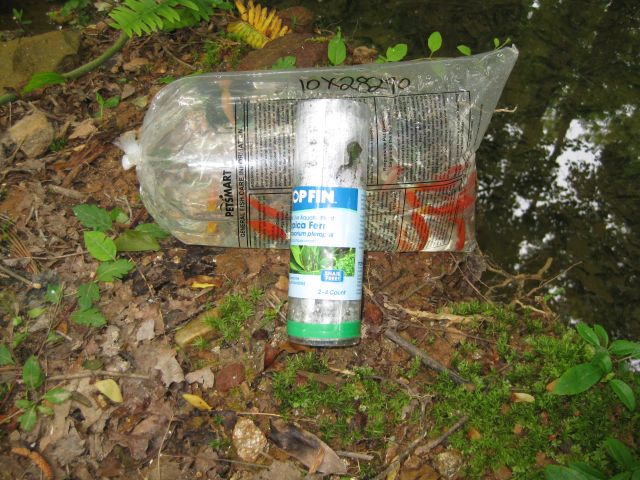
In my post in February this year I mentioned the frogspawn in the pond and, it would not surprise me if the surviving fish snacked on some of the frogspawn – what goes around comes around.  All was good until we recently had really heavy long lasting rains.  The spring became a gusher and the 3 fish may have opted to explore the overflow pipe rather than endure the silted waters of the pond.  It appears they are no longer in the pond though they can be skilful at camouflage.  Today I purchased a conical filter for the 4″ overflow pipe and 10 small goldfish at 14 cents each from PetSmart and a small aquatic flower for the shallow end.

the 10 goldfish are in a plastic bag container of water which was filled with oxygen.  in front is the aquatic plant
the 10 goldfish are in a plastic bag container of water which was filled with oxygen. in front is the aquatic plant

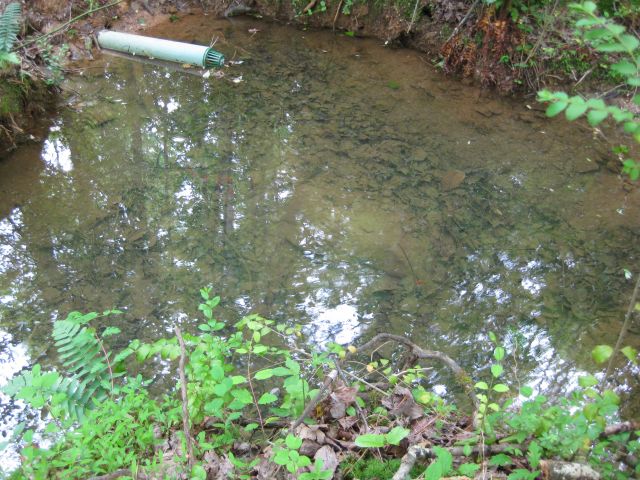
The pond outflow pipe now has a conical filter to prevent the new residents from taking off.

the pond with outflow pipe and filter.  it's about 3 feet deep at its deepest
the pond with outflow pipe and filter. it’s about 3 feet deep at its deepest

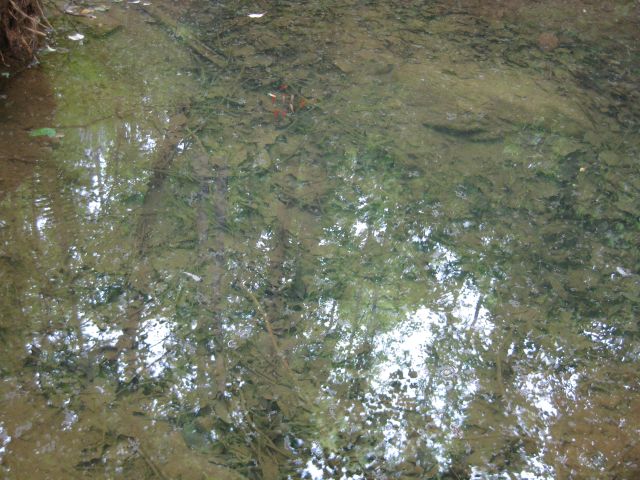
And if you look carefully you may spot the little group of ten.

pond goldfish
the 10 goldfish are in the center towards the top of the picture


why austerity should work, but doesn’t – from an organic grower’s perspective

Austerity is not a novel tactic.  Micawber recommended, though failed to implement it when he proclaimed in David Copperfield:

“Annual income twenty pounds, annual expenditure nineteen pounds nineteen and six, result happiness. Annual income twenty pounds, annual expenditure twenty pounds ought and six, result misery.”.

With an austere regimen, including food discipline and exercise, the overweight human gone to seed can be restored his former efficient self.  And it can also work for struggling countries.  The problem is when the degenerative process has gone too far.

When planting a tree you wish to become self sufficient you make sure to give it a good start.  A planting hole with boulders removed and some, but not too much nutrition for the first few months, is good.  Watering is key and should be weekly and deep.  If you water daily and feed it well, it will become accustomed to easily available surface water and nutrients and so it will not need to extend its roots deep into the ground.  And all will be well provided you continue its cosseted lifestyle with periodic spraying against pests and fungi.  It will be happy and productive but dependent on your continuous support.  And if one day the source of water and nutrients fails, it may not survive.  It roots will not be able to tap the water and nutrients located deep in the soil.  And if pesticides are withdrawn its succulent unchallenged growth will provide easy fodder for the insects, browsers and fungi that descend upon it.

You may say this analogy is far fetched.  But is it?  Populations that have lost their self reliant ways as typified by the expression “you eat what you hunt”  depend for their succour on past treasures (wealth accumulated by disciplined ancestors), or present resources (fortuitous mineral reserves) or future earnings (spending with debt to be borne by future generations).  The extent of the problem can be gauged from the amount and duration of trade deficits.  The trade deficit is an objective, timely (every month), accurate measurement of how well a country’s people, infrastructure and resources compete on the international stage.  For some countries good luck goes a long way such as countries rich in mineral resources (Middle East, Australia, Canada, and Russia for natural gas).  But for most countries the balance of trade (surplus or  deficit) measures competitiveness.  For a rapidly growing country a deficit may be expected in the early years of growth as the industrializing country develops its transport, communications and manufacturing infrastructures.  But when  mature countries such as the United States and Europe (Germany excepted) run continuous huge monthly trade deficits then this is the clearest indication they have lost their competitiveness to hungrier more agile competitors.  Their deep roots have shriveled and they are dependent on continuing doses of synthetic nourishment from their central banks.  In these circumstances a hefty dose of austerity not only won’t work, it can threaten the patient, as would sudden exercise the obese human.

The road to recovery must be slow and arduous – such countries will have to dismount their pedestals, tighten their belts, and learn to compete again for the manufacturing jobs which they bid quick good byes to in the happier days when service jobs seemed preferable.   Now distant competition is doorstep competition and service jobs (excepting those requiring a physical presence such as construction, plumbing or hairdressing) can be delivered quickly and efficiently through the internet from anywhere in the world.   Whole swaths of services from accounting, legal and medical research, to engineering, education and design services can now be contracted out to the best international competitor.

Remaining resources should be shepherded – the fracking bonanza must be frugally deployed, lest 30 years down the road we find ourselves where Britain is today with diminishing North Sea oil reserves and a steep hill to climb.  And the yardstick for measuring recovery should be, as Micawber suggested, the net of our inflows and outflows i.e. our  imports and exports as shown in the monthly balance of trade results, rather than unemployment, interest or inflation data, which respond to various stimuli but do not truly reflect the innate health and viability of the country.


hatched chicks

We have a Buff Orpington rooster and 8 hens, one of which is his sister.  Because most nights I am away from the property I have an automatic coop door opener (design specs elsewhere on this website).  Most nights I lock them in but, when I can’t neighborhood kids earn pocket money doing so.  And when they can’t a neighbor obliges and I will offer, though she doesn’t always accept, a dozen eggs.  She used to keep guinea fowl and she mentioned to me that all the eggs I had given her were fertilized.  My respect for Buffy (the rooster) leaped, not only for his efficacy but also for the way he distributed his favors unerringly.

So as I am a DIY’er I fashioned an incubator <$10 from website instructions and – after 21 days nothing happened.  So with a mother fox and 4 young encamped in the area and being uncertain of my rooster’s life expectancy when a mother fox has to provide, I bit the bullet and purchased a Brinsea 7 egg incubator.  (I am confident Buffy will sacrifice himself for his gals and with his elongated spurs give a good accounting but hope he will not be put to the test).

For incubation success you have to replicate as closely as possible the behavior of a mother hen – how she keeps her eggs warm all the time (except for brief snack and bathroom excursions), how she settles down and rolls them ever so slightly.  Temperature and humidity are critical factors.  The Brinsea has programable options and the default setting seemed designed for chicken (but could easily be adjusted for pheasant, quail, ducks and parrots).  My default settings were 99.5 deg F; 21 day incubation; egg turning every 45 minutes; turning angle 5 seconds duration; and no automatic cooling.  Some explanations – the significance of the 21 day count down is that on the 19th day the incubator will stop turning the eggs.  Automatic cooling is to mimic the cooling which occurs when the mom temporarily leaves the nest.  Since I opened the incubator every few days I thought this was sufficient.  For the last few days of incubation humidity must be high to soften the shell to enable chick emergence, so I checked both water reservoirs were full during this period.

I tried “candling” where you examine the eggs carefully under a bright light and did not learn much.  I did weigh the eggs at the outset and during incubation and noted all the eggs lost weight somewhat in line with recommendations, so I assumed the humidity was ok.

And,  on the 20th and 21st days there was action and 5 chicks emerged from their shells.  In anticipation, I had rigged a heat lamp over a simple brooder box.  I made a quick trip to Sackett’s, the local resource, and purchased an inexpensive plastic gravity fed waterer and feeder and chick feed.  They seem content – not only do they all seem to awake and jump into motion at the same time but, just like the closing of a switch, they all collapse and go to sleep at the same time, piled up on each other.  They all know how to eat but only one so far has figured out how to drink.  More training required there.  As for the remaining two eggs, they may not be viable – I will wait a few days more.

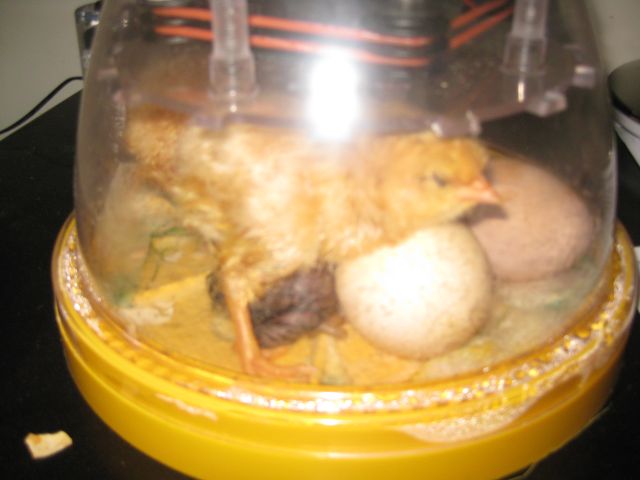
the incubator with the first two chicks emerged

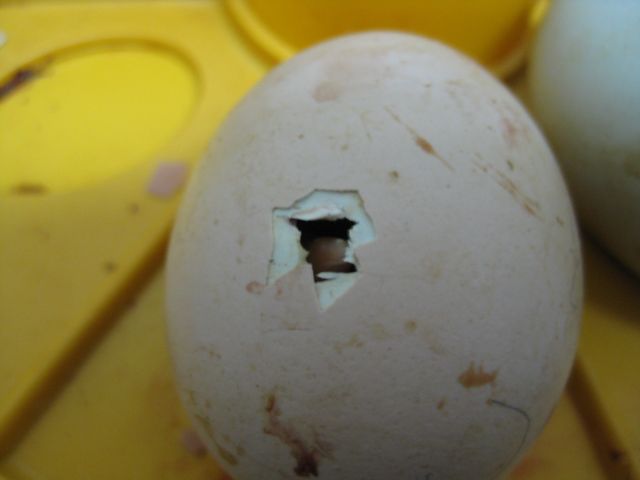
Prior to emerging chicks will make a small hole for breathing and to take a peek at the outside world.

breathing hole and a window to the big world

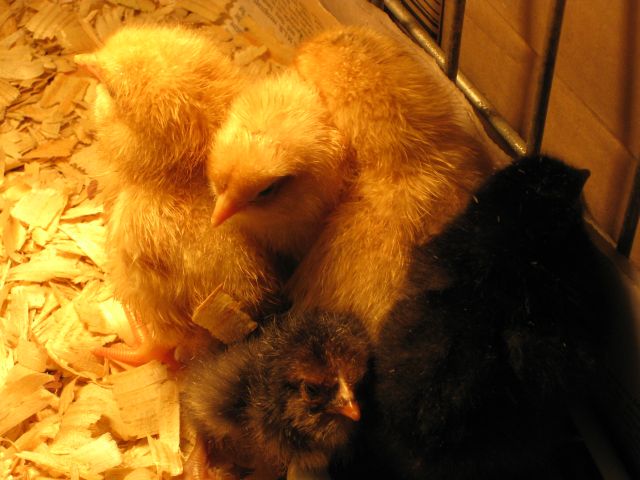
And what fun it is to snuggle up with siblings, a common dad but different moms.

5 new chicks
5 new chicks

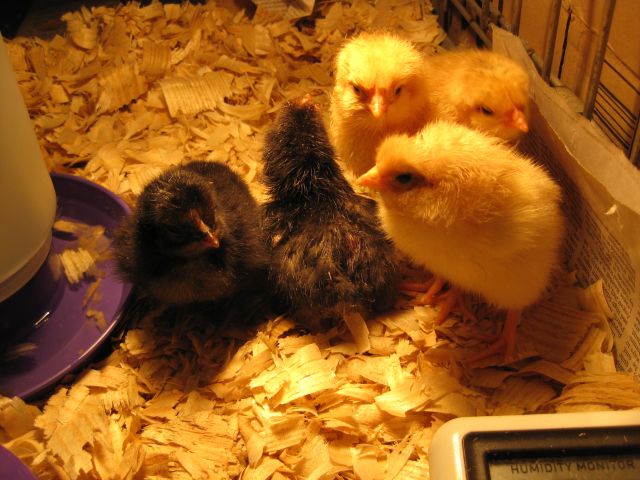
And a final shot of the five (sex still unknown).

5 new chicks
5 new chicks


rampant nostalgia

I have heard of misty nostalgia when we revisit scenes from the past, often with selective vision ignoring what was bad.  I am now seized with rampant nostalgia.

A couple weeks ago the NYT Sunday magazine featured an interview with the author John Le Carre’.  I had tried his books several times the past 30 years and never got past the first 30 pages.  I was out of tune with his writing.  With T.S. Eliot it had been different.  I was aware that Eliot was a top poet (though he held several unfortunate views, from my perspective) and admission to the level of cognoscenti required diligent reading and learning until suddenly, as a plane emerges from the clouds, the turbulence slipped and I could see and appreciate.

But LeCarre’ was not on a mountain peak but a well regarded spy story writer.  And despite the recommendations of several London colleagues who read him on the tube and wherever else possible, I was not attracted.  So I was drawn out of curiosity to the NYT interview and liked that he was in the spy business and therefore well qualified to write on this genre.  I decided, to order through Amazon used copies of the 4 recommended novels.  And I am now 100 pages into the second, “Tinker, Tailor, Soldier, Spy” which was written in 1974 and I am flooded with memories of my 8 year’s life in London during the late 70’s and early 80’s.

My first few month’s in London had required rapid adaptation.  The checkered suit which my Johannesburg tailor assured me was the business fashion in London, immediately drew my manager’s attention “do you think we are going hunting?”.  But as the months and years rolled by I acclimated to London and the City of London and the culture and norms.  Then on to America and another big change.  And now I am avidly reading the cloaked  banter amongst individuals in a firm, ironically called the “Circus”, and the buildings and weather of London and I am instantly transported back in time and yes I probably do have my selective vision glasses on, as I again walk those streets.


Is not impermanence the very fragrance of our days?

I have a 50 minute drive to my property.  And NPR informs and entertains.  Except during the 2 week fund raising campaign.  Then I have to improvise and, since I have a basic truck which does not have a connection for mp3, I burn podcasts on CD’s and listen, intently, since you cannot rewind a missed phrase but must go b ack to the beginning of the track.

A review by Paul Wheaton on the self sufficiency and sustainability practices of the Japanese during the Edo period (book “Just Enough” by Azby Brown) kept me going for several days.  But I needed more.  In the past I listened to and enjoyed Krista Tippett broadcast interviews.  I downloaded a few and today I heard her interview with Joanna Macy, a Buddhist scholar and translater of Rainer Maria Rilke.  Exquisite.  They discuss two different ways to approach environmental degradation – the scientific informed approach armed with research, statistics and photographs, or from our being as part of this world.  I am working my way through the former but a beckoning portal has been illumined for me.

Here is the poem  from which this post’s header is taken:

Wild Love

Is not impermanence the very fragrance of our days?

Flare up like flame
and make big shadows I can move in.

Let everything happen to you: beauty and terror.
Just keep going. No feeling is final.
Don’t let yourself lose me.

Nearby is the country they call life.
You will know it by its seriousness

Give me your hand.

– the poetry of Rainer Maria Rilke translated by the philosopher of ecology Joanna Macy