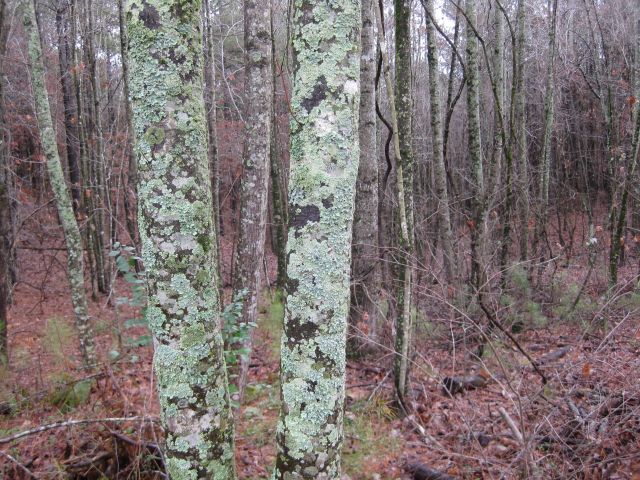
The recent heavy rains and at times warm weather have transformed the appearance of the woodland – the trunks of the trees have assumed a variegated green appearance.
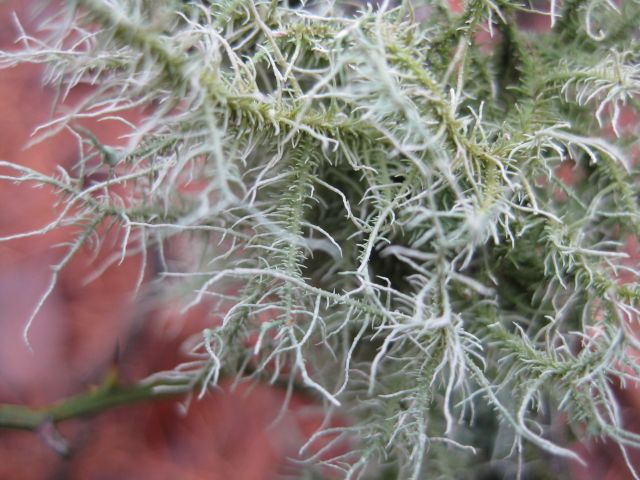
lichen on the trees
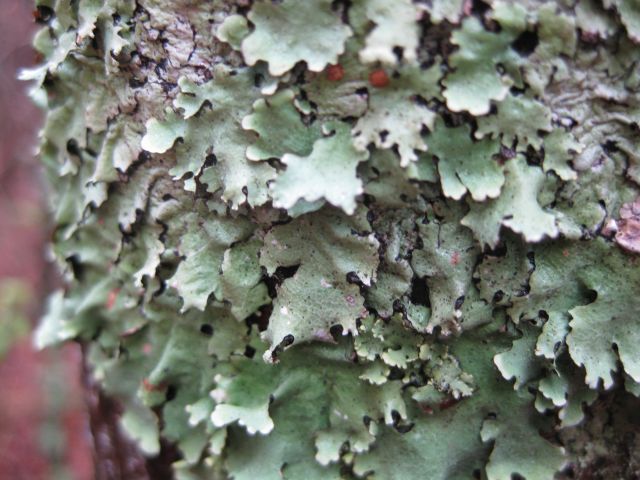
On closer examination these are lichen – a symbiotic alliance between photosynthesizing green alga and fungi.
leaf like lichen
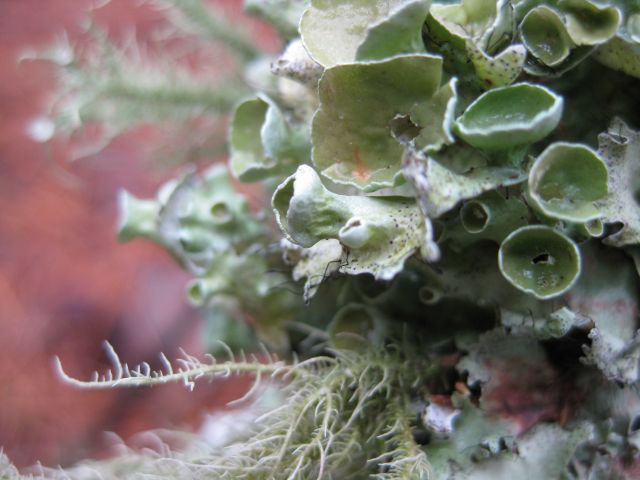
Other growths are more intricate.
unusual trumpet shapes
And there are the long reaching arms.
an intricate maze
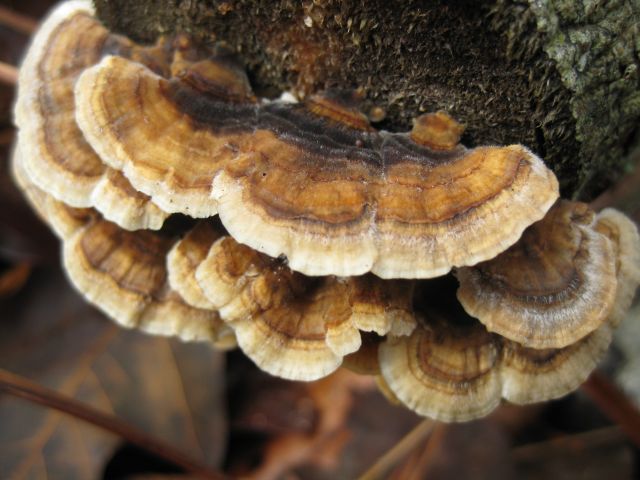
And finally some regular mushroom growths at work decomposing the end of a tree trunk.
The chicken are still doing well. Six hens from my former neighbor (4 hybrids, 1 Ameraucana, 1 ISA brown) and 8 youngsters ( 2 Buff Orpingtons (1 of which is a rooster called “Buffy”), 2 Golden Comets, 2 New Jersey Giants and 2 Speckled Sussex). No casualties, though one of the hybrids walks with a noticeable limp and is now called “Gimpy”. The two dominant hens are the Ameraucana and the ISA brown, which curiously are also among the smallest. The two largest hens, the New Jersey Giants, are the most timid and the 2 Speckled Sussex are the most antisocial. Whenever there is a commotion amongst the hens, Buffy rushes in to settle the dispute. He also charges out when there is a disturbance or security risk and crows throughout the day. Notwithstanding shortened daylight hours I am getting 5 to 6 eggs a day. I have decided against supplementing daylight with artificial lighting on a timer. The coop I constructed is working well for them – no moisture from outside and inside temperatures have not fallen below 30 F (when the outside has fallen to mid teens). They seem healthy enough though occasionally there is a soft shelled egg (to my dog’s delight) , so I supplement with yogurt and oyster shells.
I grow organically and my small orchard of 12 apple and assorted fruit trees began bearing fruit last year (actually I also have a 2nd orchard of first year fruit trees some years away from fruit bearing). With the appearance of fruit there also appeared a variety of bugs, especially on my apple trees. I know sanitation is important – removing the fallen fruit and wood cuttings because the pests overwinter in the fruit and cuttings. But how to remove the soil slumberers?
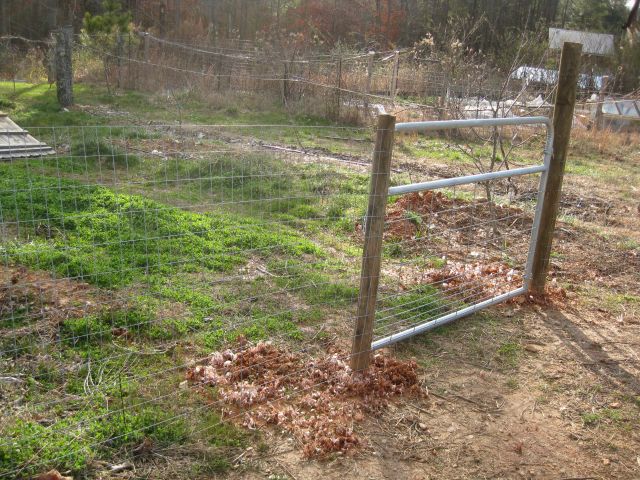
I installed a fence and 2 gates around the orchard and built a chicken day shelter and constructed a passage way to span the 120 ft from the main chicken enclosure to the orchard. And now my flock are hard at work in the orchard, removing debris and mulch with vigorous back swipes of their feet and voraciously eating the grubs and other soil dwellers.
a 6 ft galvanized mesh gate installed to the orchard chicken paddock
Fencing is a fairly costly business. I used welded rather than the more expensive woven wire fences which are necessary for horses and goats, so there is a saving there. However, the gates cost from $65 to $100 and, if I had welding skills and access to surplus metal, I would make them myself – but I don’t, so I pay – and they should last indefinitely.
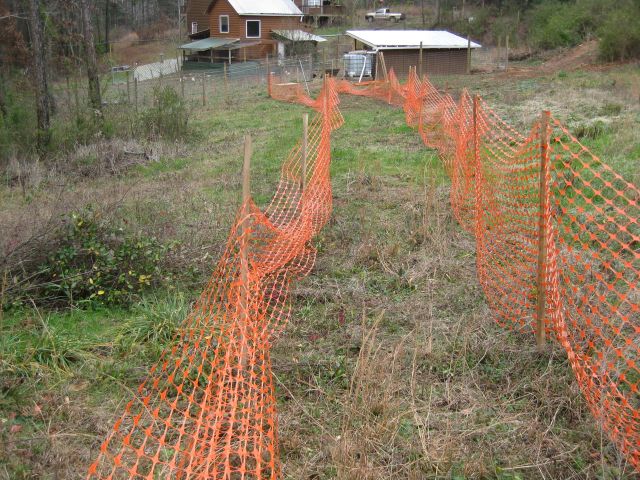
The passage way is temporary and I bought the red plastic material and stakes for about $9 per 100 ft from Lowes – marked down from $30.
passage way from main chicken enclosure to orchard paddock
I remedied the problem of the fence slipping down the posts by drilling a hole through each post near the top and tying string through the hole and the top of the fence.
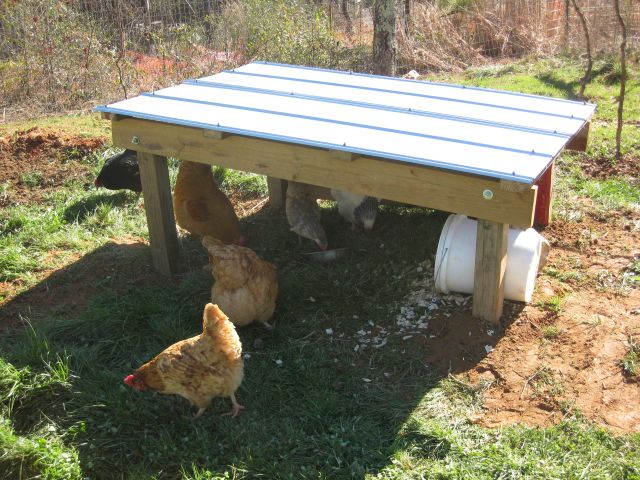
Finally, the day shelter. I dug 2 ft holes for each of the 4 posts, bolted on 6″ wide planks to the 2 long sides and then 2′ by 4″ purlins and then screwed down galvanized roof sheeting. The roof sheeting was $20 for a 12ft long 2 ft wide sheet, which I cut in half to fit in my truck and to produce a 6ft by 4ft roof. I will board up the south and west sides to make them feel more secure and sheltered from the sun. In the shelter I have horizontally placed a 5 gal bucket with straw in the hope the hens will use it for egg laying, and a water container. To alert the flock to the advantages of the shelter I threw in a few handfuls of scratch corn, which immediately got their attention.
chicken day shelter 6 ft by 4 ft, with 5 gal bucket for egg laying
The roof slopes to the west to ensure the rain will run to the west and not over the east entrance. In addition to reducing orchard pests I expect the flock will enjoy a more varied diet, get more exercise, and consume less of the purchased food I provide.
In a previous post I mentioned building my first cold frame using bargain priced windows from the local thrift, cement blocks and lumber. The seedlings in this cold frame are growing well and when it is cold (say 18 F outside temperature) the temperature in the cold frame is approximately 10 F higher. During the day the differential increases. And it keeps out the frost. So I am hoping to grow decent sized vegetables.
One cold frame was not enough because I had 10 windows remaining and there is a better site for a cold frame – on top of the hill where it catches early morning sun to late afternoon son. This location is unfenced and close to a road so there is a possibility of unwelcome attention, therefore my decision to locate the first cold frame in the better protected vegetable growing area. Nonetheless, the cost of building a cold frame is modest and the full time attention of the sun is a major plus.
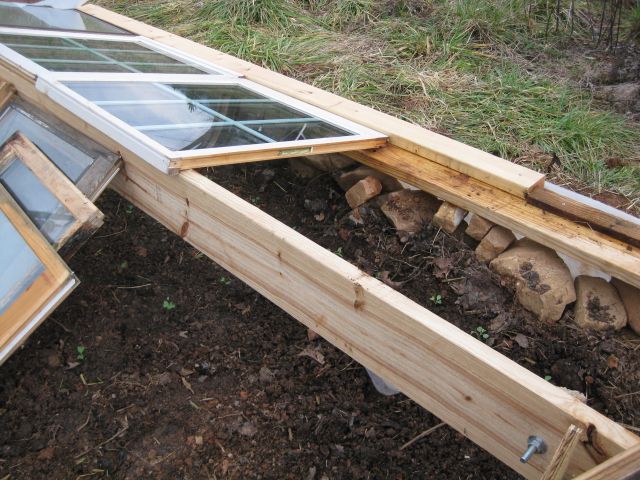
Construction was very similar to the first frame except I dispensed with all but two cement blocks (instead of the 17 used in the first cold frame). The blocks are located at each end of the cold frame and are spanned by a 10ft by 8″ wide 2″ thick, plank. In between the two cement block supports I built a stone wall of sorts using the large stones I had uncovered when I dug a contour ditch. I used a hammer and stone chisel to cut faces on the stones so they would stack.
basics of construction of cold frame - windows on top and south facing, stones on north side
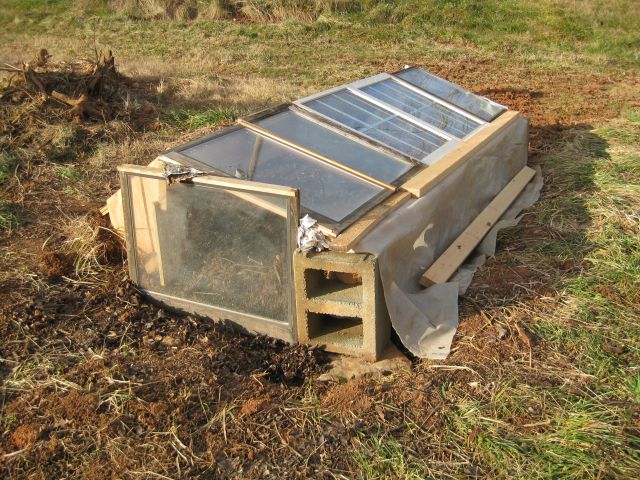
The purpose of the stones is to absorb the sun’s heat during the day and release it during the night. Only the top layer of the stones is visible – there are two (more skilfully arranged) layers below the soil level. To prevent the warm air exiting through the stones I draped 6 mil plastic sheeting on the outside of the frame.
north side of cold frame showing plastic sheeting draped over north stone wall
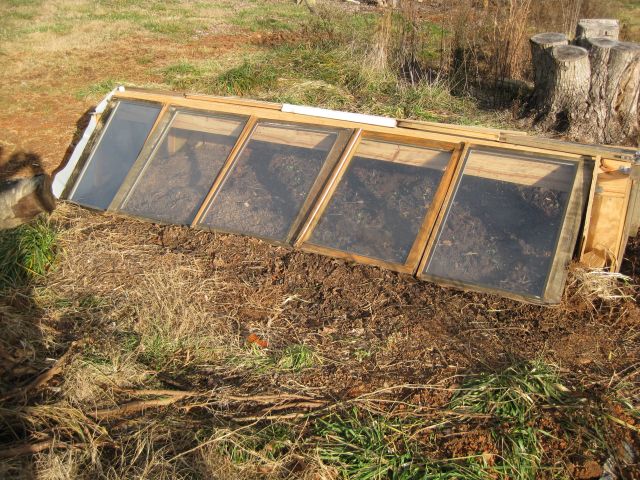
As before, I used the windows from the thrift store to enclose the frame. The savings from using 15 fewer cement blocks was partially offset by the cost of 3 additional window frames I had to purchase from the thrift store – a different floor manager did the pricing and he wanted $4 per window rather than $1 – such are the vagaries of life.
south facing aspect of cold frame, seedlings still to be planted
The gaps and openings I covered with bits of plank or plastic. I have now introduced some collard and broccoli seedlings and in the next week will add the remaining spinach and other cool season vegetables – and wait and hope that I will get a worthwhile yield.