We interact with the world through our senses. The five traditional senses are sight, hearing, touch, smell and taste. We have other senses as well such as balance, perception of time, pain etc. If our senses warn us that our environment is unfriendly we respond – too much sun we cover ourselves, use an umbrella or sun screen or withdraw to the shade. To much glare we put on sunglasses, close our eyes or squint and look the other way. Too bitter a taste then we stop eating. Too loud a noise we put on ear muffs or withdraw to a safer distance. So we modify our behavior according to our sense perception of the interaction with our environment.
But there is one interaction with our environment where most of us proceed whilly nilly. Our gastrointestinal tract, often referred to as the “GI tract” digests the food we eat. It is immensely complicated. It also covers a huge area – according to Wiki: “The surface area of the digestive tract is estimated to be the surface area of a football field”. So in terms of size this is the largest interaction we have with the world around us. Many of our ailments derive from GI problems. It seems to me, using the analogy of a factory, that the problem can be stress, the functioning of the processing equipment or the raw materials used.
I know when I was under stress I would resort to antacids, a quick fix of the symptom but not the cause. But leave aside stress induced problems and think only of the effect of bad raw materials entering the processing facility. The sophisticated equipment will struggle to process inferior input. There will be delays, break downs, protests and a degradation of the whole plant. And what do we do – we are aware things aren’t right so we suffer and then head for the aisle with cures for digestive ailments, and then later take prescribed medicines or are compelled to more drastic intrusive measures. And our assessment often is there is not much to be done about it – just grin and bear it.
A bit like staying uncovered in the bright sun and then taking pain relievers to alleviate the sunscreen. Surely time to take more interest in what we eat in the first place?
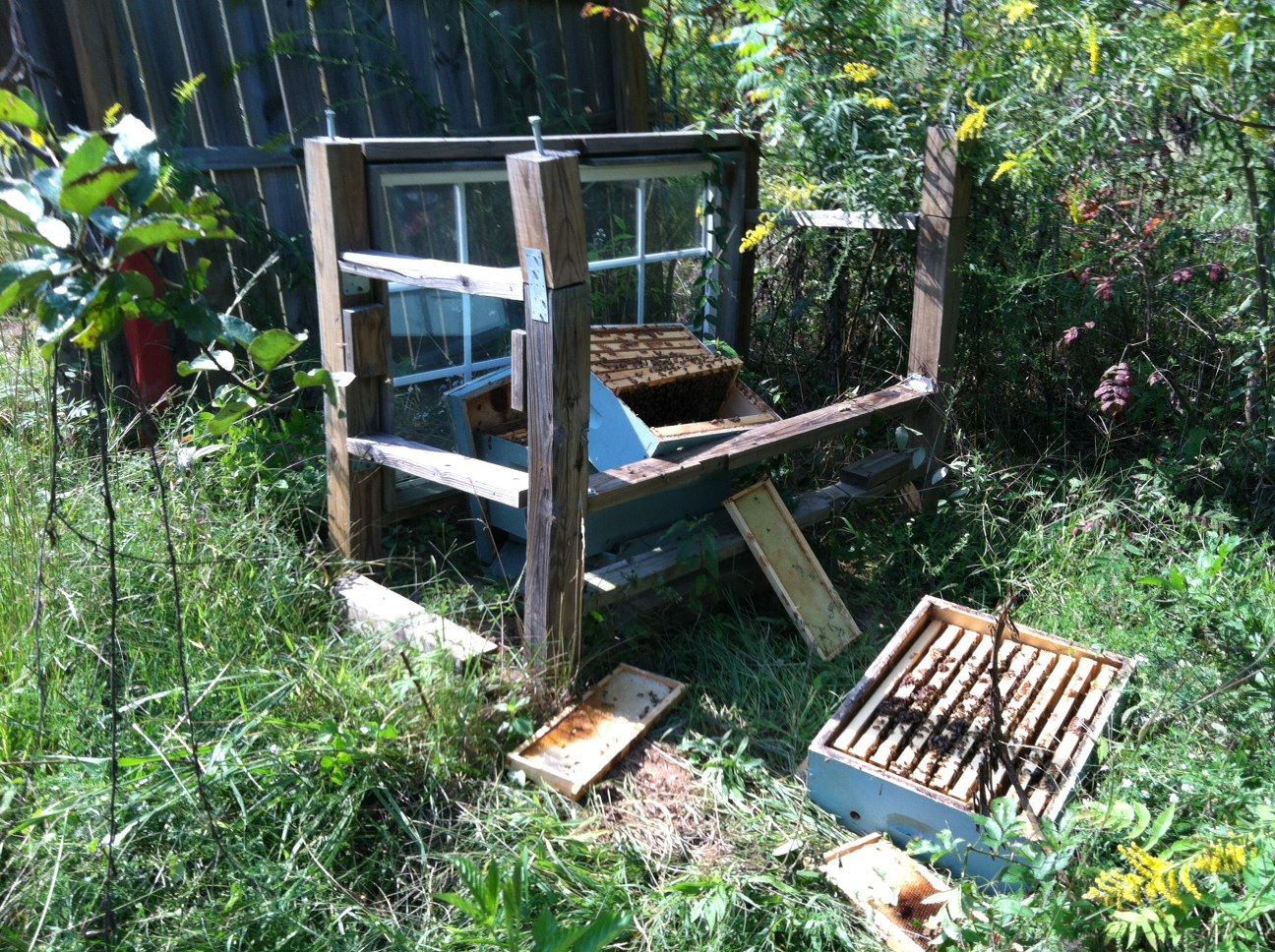
I inspected the bee hive last Sunday and on Tuesday I happened by and quickly glanced at the #1 hive. I kept on walking and stopped as my mind deciphered the image – the hive had been attacked. This is the first time it has happened. The hive cover was on one side, the top super was on the ground, the second super half way off, a frame on the ground and the deep slightly askew on the bottom board.
the bee hive after the attack. the wooden frame around it is stapled with plastic in the winter to provide additional protection from the wind and elements
I studied the frames – no honey had been removed. The bee hive boxes were undamaged and there were no claw marks. Was it human or animal? If human, since no honey was taken this must have been a prank. But unlikely to be human since the super on the ground was upside down and a human presumably would have picked it up and placed it down right side up. More likely an animal. But why? It it was after the honey why didn’t it take any – unless the bees drove it off? So a mystery. I reassembled the bee hive and hope the queen is ok.
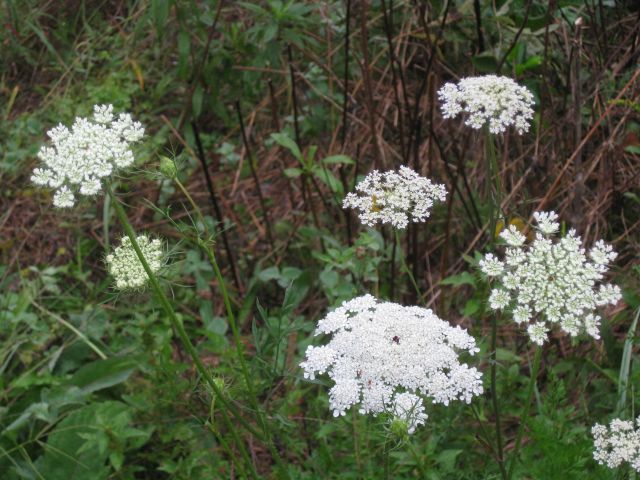
I mentioned in my previous post that goldenrod and prairie fleabane (member of the aster family) are blooming and a bee favorite.
fleabane – the head of the flower is comprised of lots of little daisy like flowershere is a visitor who in one day removed half of the flowers above it
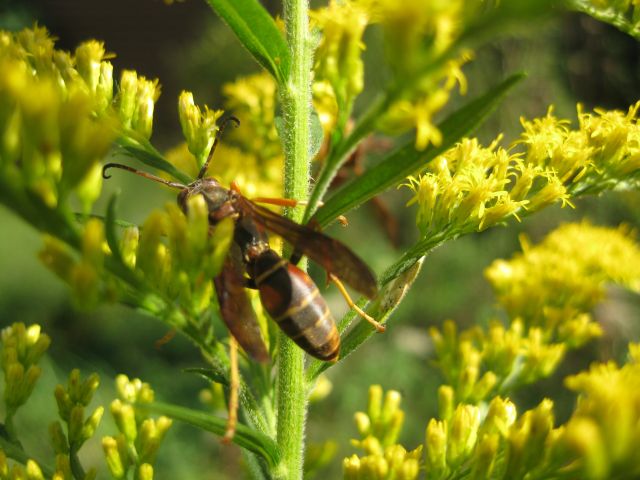
And the goldenrod is a hot favorite for wasps.
a wasp visiting the goldenrod
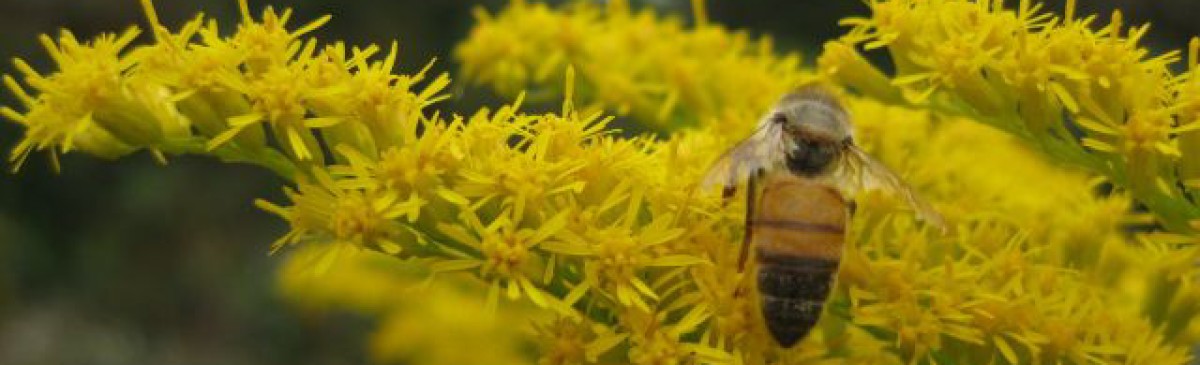
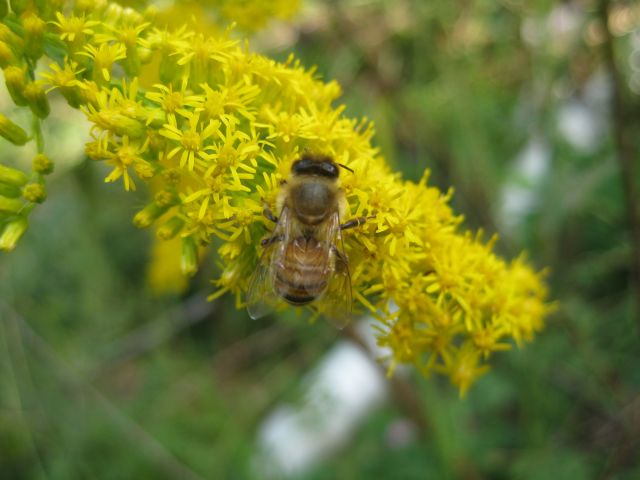
And of course for the bee.
a bee takes last opportunity to gather food before winter
In Cherokee county bees attract a lot of interest. I attended the beekeepers’ monthly meeting last Thursday. We are fortunate to have a commercial beekeeper as our coach and guru. I had missed the previous month’s meeting where they discussed inspecting for mites and chemical treatments. The meeting last Thursday was about Fall inspections and feeding.
First as to mites – most of the attendees were doing sugar dustings and mite counts -you sprinkle sugar on the bees and they vigorously groom themselves and each other and the mites fall onto a sticky board at the bottom of the hive and you count them and decide whether chemical treatment is necessary. Seems like most were applying chemical treatments in any case. Now I am still a beginner beekeeper – I think I have graduated from “novice” since I have kept the same bees (or rather their descendants) going since early 2010. And from philosophy or laziness I don’t count mites or do any chemical treatments. The philosophy springs from the belief that intervention usually causes more harm than good. I had some mishaps with some chicken where I tried to help and believe I exacerbated the situation. Even humans (if newspaper accounts are accepted) occasionally/often experience setbacks in hospitals from mishaps. As for bees, I think the lesser experienced of us can harm the queen and upset the equilibrium each time we intrude in the hive, even though with the best of intentions. I think the vigor of the bees and their ability to resist mites etc. is weakened by the poisons we spray in the environment, the poisons we treat them to make them stronger and the stress we create when we open the hive and disturb them (though I have often opened the hive for cursory inspections and not disturbed them at all). I grow organically, my immediate neighbors don’t spray and my bees have been doing fine, though our guru told me it is just a matter of time until the varroa mites and other dreads afflict me.
As for the feeding. Most of the attendees were feeding their bees with sugar mixed with water. Our coach asked who wasn’t feeding their bees and no one raised their hand and I didn’t, since I don’t want to appear controversial. If the bees have no food then now is the time to feed them since if you wait until temperatures fall below 47 degrees it will be too cold for the bees to feed on their sugary liquid food. So you feed them now and they store it in their cells and they partake of it during the wintry months. I don’t feed my bees – if I want them strong and healthy for the tough winter months they will survive much better on their honey than on sugared concoctions – after all that is why they harvest the honey in the first place. However, after all the dire warnings issued at the meeting and given that bee mortality over winter is high (around 30% I think), I concluded that I should take a look at my bees.
The last time I visited the bees was on July 29 of this year. I am certain of the date since I harvested about 4 gallons of honey from my # 1 hive (34 bottles all lid marked “072912”, nominally 12 0zs but filled to the top, say 15 ozs each = 510/128 = 4 gallons). It was my third harvesting in this year from the #1 hive. My #1 hive consists of a deep and two half deeps and I left 4 half frames for the bees expecting they would have sufficient time by summer end to replenish their supplies. During the July harvesting I also inspected my second new hive, which I started earlier this year with conscriptees from the #1 hive plus a new queen bee. It did not have much honey and, since it was its first year, I decided to leave it be.
This morning I inspected both hives. Lots of worker bees (phew! not drones which would indicate no queen) and lots of activity. The #1 hive, disappointingly did not have a lot of honey supplies. The top super had say 30 lbs, very little in the middle super, and the bottom deep had pollen and brood and some honey. I decided to intervene and since it will soon be getting cold, I reversed the supers by putting the top super with the honey above the deep containing the brood.
The #2 hive which consists of two deeps is in good shape. There are 10 full frames in a deep and the top deep, apart from the two outer frames on each side had 6 frames filled with honey. The bottom deep, again with the exception of the outer frames, had honey, pollen and well placed brood.
Conclusions. Now we have the goldenrod and aster in bloom and the bees are hard at work. When the blooms are finished and there is no more food to gather, I shall inspect the hives again and, if the #1 hive is looking thin on the honey side I shall give it a couple of deep frames of honey from the #2 hive. And hopefully that will be enough to get them through the winter.
I mentioned a couple posts ago the battle I am having with Bermudagrass. A few days ago we had really good rains which softened the soil and made it much easier to slowly withdraw the long Bermudagrass shoots. When the ground is dry the shoots clinging to the lumps of sod are easily broken and they remain in the ground to incubate a new invasion. I have a rototiller which I hardly ever use now I subscribe to the view that the spinning tines, which move at a set depth in the ground, create a hardpan in the soil just beyond their reach. However, tiring of forking out the shoots I recruited the tiller with mixed results. The tines were quickly woven with the long shoots which required frequent stopping to disentangle them.
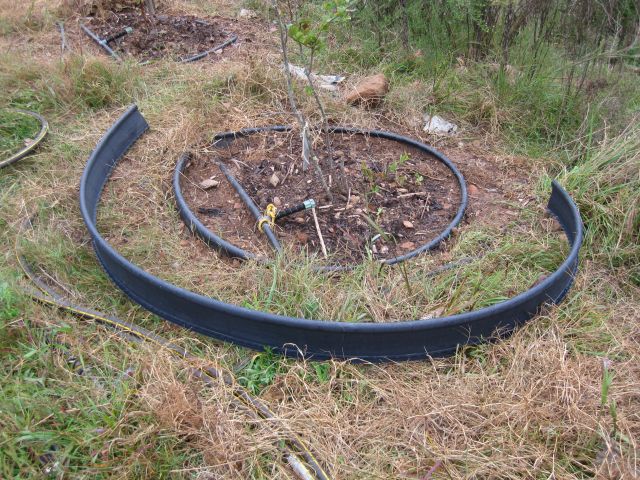
So I gave up and pondered and came up with two new strategies. First defense – I purchased a 40 ft black landscape edging roll ($19) and cut it into four 10 ft lengths, each of which was used to make a circumference around individual blueberry bushes.
10 ft black edging in place around plant with Bermudagrass removed and another 10ft length awaiting deployment
The diameter is about 3.2 ft (pi is 3.1 which is the ratio of a circumference to the diameter) which is sufficient for the time being. Have established the perimeter and dug out the Bermudagrass I will now have to defend against invaders sneaking under or over.
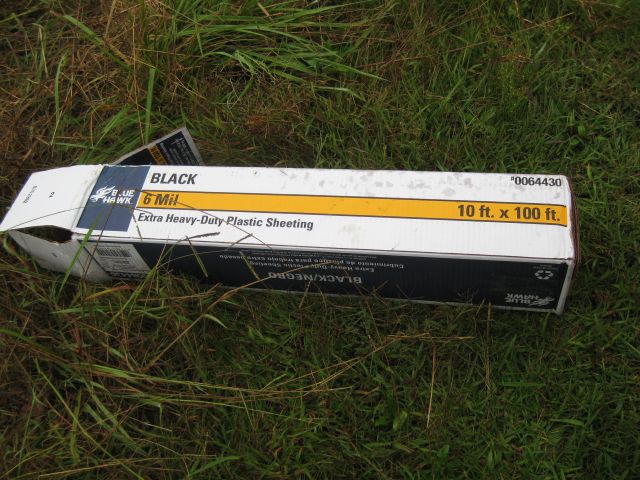
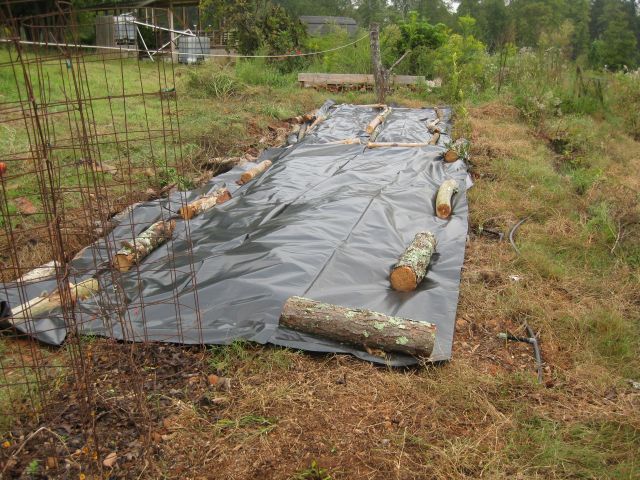
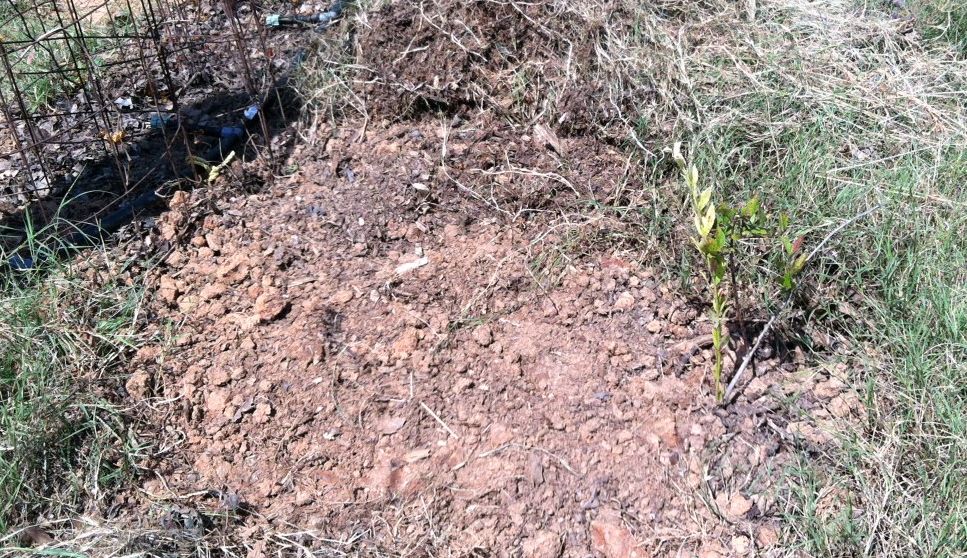
In chess often the best form of defense is attack. One Bermudagrass invested corridor runs between my 20 tomato cages and some young blueberry plantings. From this corridor the Bermudagrass invaded the tomato cages and the blueberries repeatedly this past season. Since we are now in September and temperatures are lower I decided that solarization using clear plastic may be ineffective. Instead I purchased commercial grade 6mm black plastic and, after removing the declining tomatoes and their cages, I covered the entire Bermudagrass area.
commercial grade 6mm black plastic used to deny light to Bermudagrass
Hopefully, now the Bermudagrass is entirely deprived of light, it will weaken and maybe depart. To be monitored.
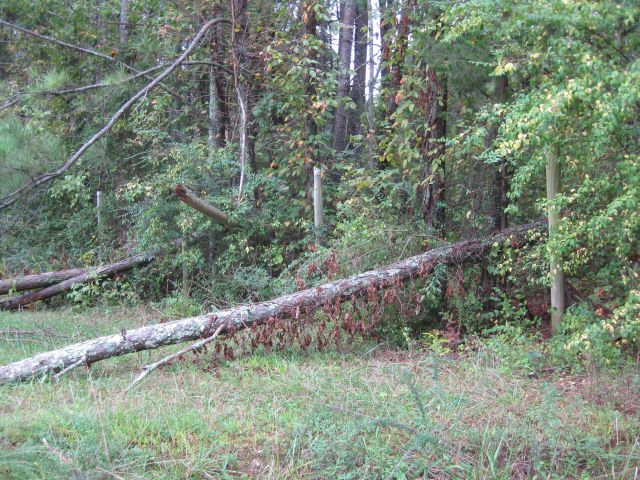
To secure the plastic in place I cut up some thick branches from a couple of my neighbor’s pine trees which collapsed over the fence into my field.
some of my neighbor’s pine trees which collapsed into my field, lengths of which will be used to pin the black plastic over the Bermudagrass
The wood is thoroughly rotted and when I am done with the black plastic, I will toss the wood into the contour ditches where it will continue to disintegrate and feed the fungi.
the problematic Bermudagrass area now fully covered with black plastic which is secured with pine trees limbs
Neighborly gifts
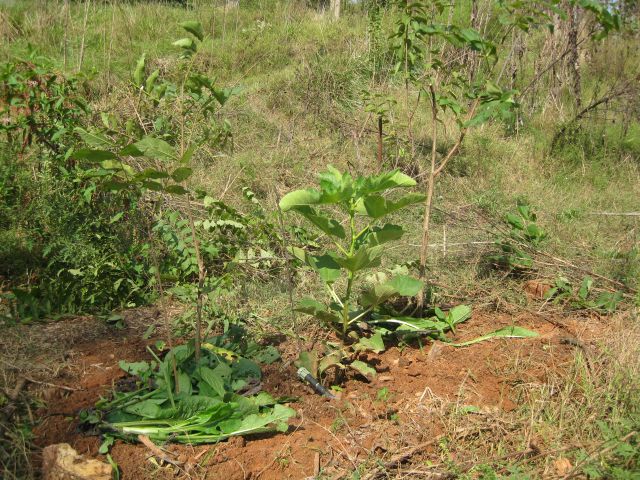
Another of my neighbors has 12 acres of fields and woods. This spring he offered me some pecans which had grown from his large pecan trees and which had evaded his mower. We decided to wait until it was cooler. Today I gave him some green tomatoes from the recently leveled tomato planting and he suggested we tackle the pecans. He also has a huge black walnut which had several offspring in the vicinity. Although the ground was soft from the recent rains, the pecans and walnuts, individually less than 4ft, had sunk deep tap roots. I did my best to free them but in the end had to sever the tap roots. I took two pecans and one walnut and, for the time being, until their planting area is ready (a week or so), I have planted them alongside one of my figs. The ground is rich, catches the sun nicely and is close to my walk path so I can keep an eye on them and water them frequently. I removed about 60% of their branches and leaves and, to retain moisture and maybe add some nutrients, I covered the base with comfrey leaves.
not that easy to see – in the middle is a fig tree from a cutting earlier this year, close to it on the right is a black walnut and on the left are two pecan saplings and their bases are covered with comfrey leaves
One of the pecans he had identified for me to remove was actually a coppicing – he had cut the 3 inch trunk close to the ground some time ago and new growth made it look like a young tree. I took a cutting of this new growth which I shall try start with other hardwood cuttings I shall be taking in the next few weeks.
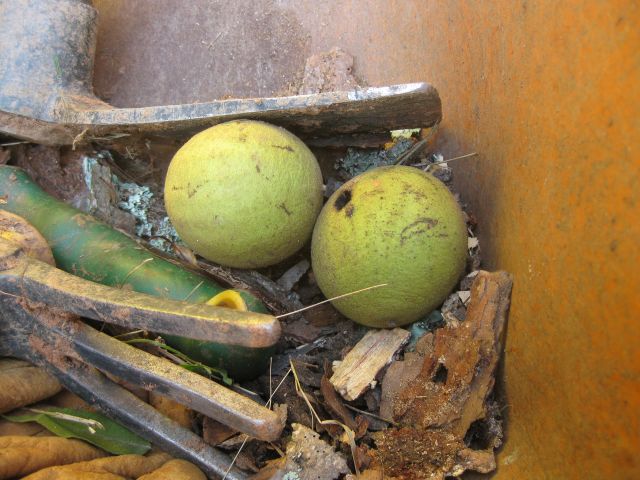
Finally, the black walnut tree, which produced the sapling had large walnuts, and I took a few and will bury them and maybe get some seedlings.
two large walnuts from my neighbor which may grow into black walnut trees
As a matter of principal (or is it pride) I try do all my irrigation with rainwater collected in storage tanks. Total storage capacity exceeds 6k gallons. The design is fairly simply – I collect directly into 3 large storage tanks and then pump to two temporary tanks at the top of the hill, from which the water gravity feeds to the watering areas (see tab at top of website for full details). I also collect rainwater at two remote locations (the chicken coop and tractor building) and pump the water to the storage tanks. The rainwater entering the 3 large storage tanks passes through basket filters before entering the tanks. The rainwater at the two remote locations goes directly into the three temporary tanks, each with about 280 gallons capacity.
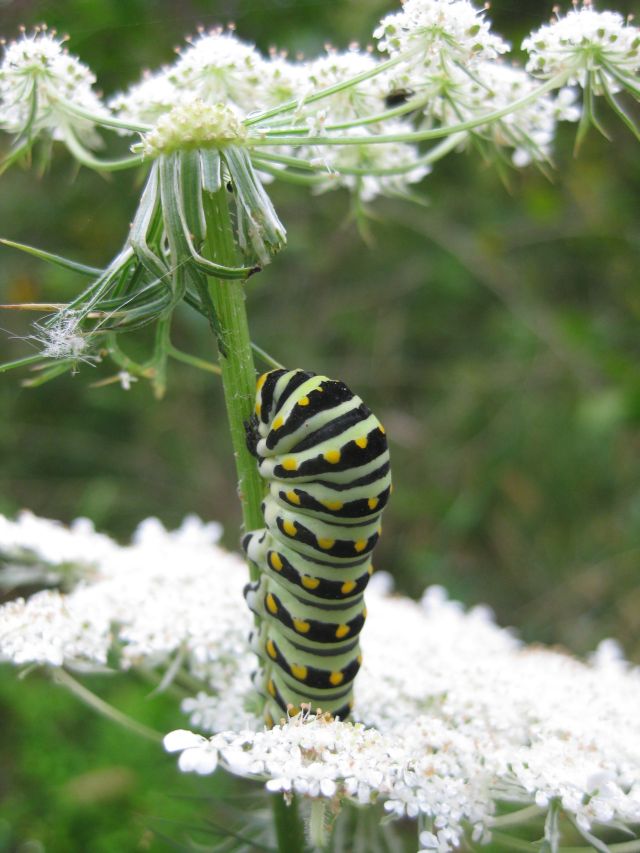
Unlike municipal or well water, rainwater arrives with debris. I have learned that I have to vigilantly check the water is flowing to the watering areas since algae or vegetation can easily clog the works. With a low pressure gravity system this invariably occurs whenever you don’t check. I am used to the routine and while observing water flow I also monitor the health of the plant or tree and look out for problems. Yesterday there was silver tracery around the base of a blueberry and a little investigating with a small stick unearthed a large slug which was then ejected to a less hospitable area. And I found numerous caterpillars demolishing my kale and hop plants and egg clutches of many more in waiting. They were consigned to a soap water container.
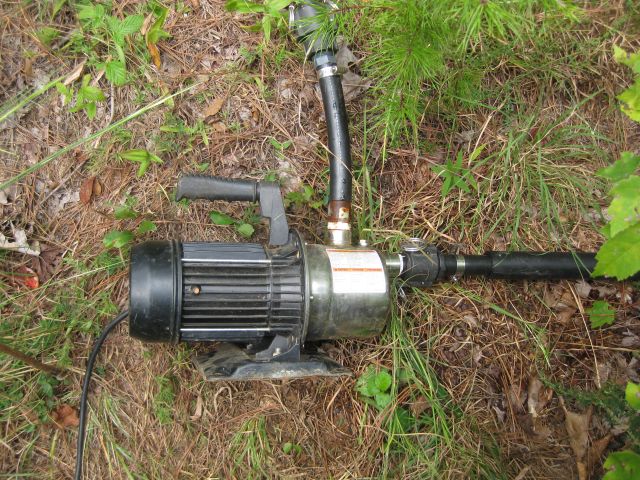
But this morning I had a new problem. I was pumping from the temporary tanks at the tractor building to a storage tank and after the pump had been in action for a few minutes I decided to check on water flow and noticed nothing was flowing. If there is air in the pump housing this can be the cause so I released the priming screw and made sure the housing was full of water but this did not solve the problem. The pump engine was working so I assumed the problem was with the impeller which the engine spins and the spinning of which drives the rainwater. As mentioned above, the temporary tanks do not have water filters and so I guessed that debris had clogged the impeller.
my portable rainwater pump with convenient carrying handle, water enters from the right and goes out through the top
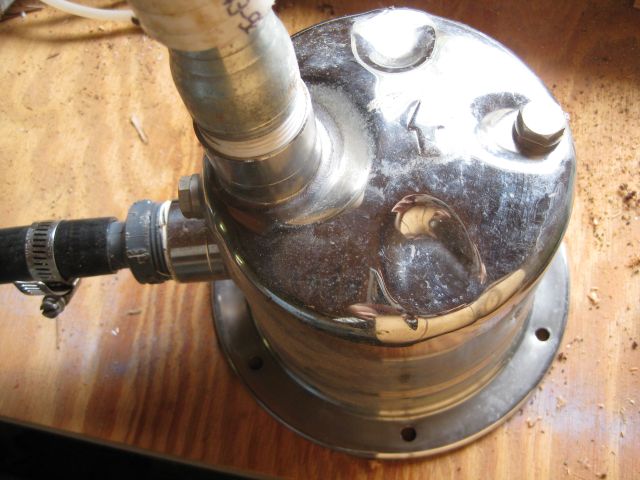
The part of the pump through which the rainwater moves is called the volute and can be clearly seen below.
the volute of the pump into which the rainwater enters, is pressured by the impeller and exits
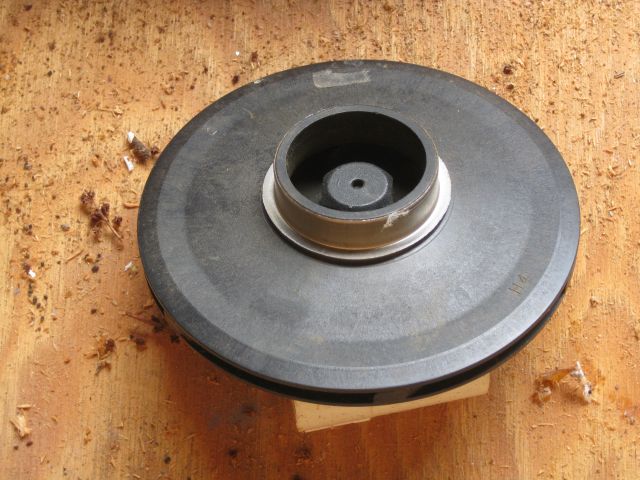
The rainwater is pressured by the impeller which is spun by the motor. The water enters through the hole in the middle of the impeller.
the rainwater enters through the hole in the center of the impeller
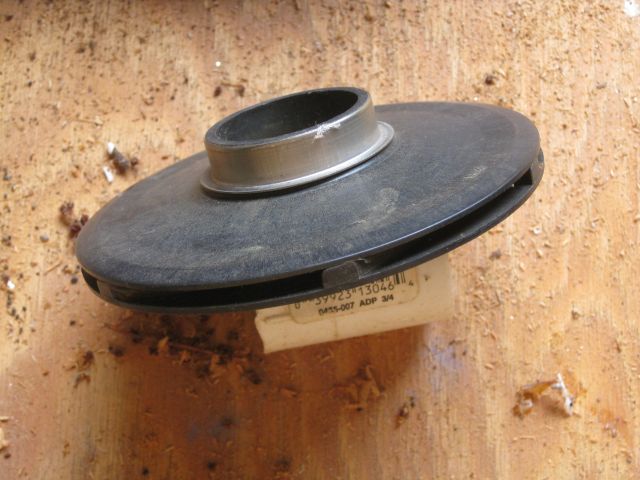
Centrifugal forces created by the spinning of the impeller eject the rainwater through vanes on the circumference of the impeller as can be seen below.
when the impeller is spun by the motor, rainwater is forced out through the slits in the circumference of the impeller
It was a simple repair. I removed the housing (volute) and then cleared the twigs which had gathered at the entrance hole to the impeller. I carefully replaced the housing and the pump was vigorously back in action.
My conclusions from this episode are that I should: a) filter the rainwater entering the temporary storage tanks to eliminate debris; b) not pump all the rainwater out of the storage tank since the debris comes out last and if I had left 3 inches of rainwater at the bottom of the chicken coop tank the problem would likely not have occurred when I transferred the then clogged pump to the tractor building tanks, or (c) replace the standard pump with one designed to pump trash water. A trash water pump has a larger centrifugal impeller which will not clog as easily.
When I began planting my vines and blueberry bushes in the field, Bermudagrass (also known as “devil grass” because it can be an highly aggressive difficult to eradicate weed) was not a problem. Yes it lurked among the broad bladed tall grasses but it was one of many. Now it is a major problem and it can thank me!
Bermudagrass is a wiry perennial (easy to cut your fingers if you are pulling hard on it), and is low-growing (hence easily checked by taller grasses) and it spreads by above ground shoots called stolons and below ground shoots called rhizomes. Every so often at a node on the shoot, a root is sent deep into the soil with at least two objectives: secure water in drought conditions, and act as an anchor to resist my eradication efforts.
I made two big mistakes. For each new planting I diligently dug out a 2 ft diameter hole, added a copious helping of my high grade compost and inserted and watered the new plant. This was mistake #1. Think of a house in a run down neighborhood which has been ignored until new occupants arrive with expensive possessions. The house attracts interest and invaders move in to seize the possessions. Previously it wasn’t worth the trouble, now there is booty and the risk of being caught (in the case of a weed, being plucked and ejected) is more than offset by the rich rewards. And who was the opportunistic invader – quick footed Bermudagrass stolons and rhizomes.
Its called the competitive exclusion principle where two species compete for the same niche – my high grade compost. The species with the greatest advantage will drive the other to exclusion. Blueberry bushes have short roots and they didn’t stand a chance and were overwhelmed by the Bermudagrass. As were too, my raspberries.
an insipid blueberry bush with adjacent pulled back mass of Bermudagrass
My logic had been that if I nourish and water the plants, they will quickly grow and outshade the competition. And this would probably have worked with the other grasses, but not against the overwhelming rapacity of Bermudagrass.
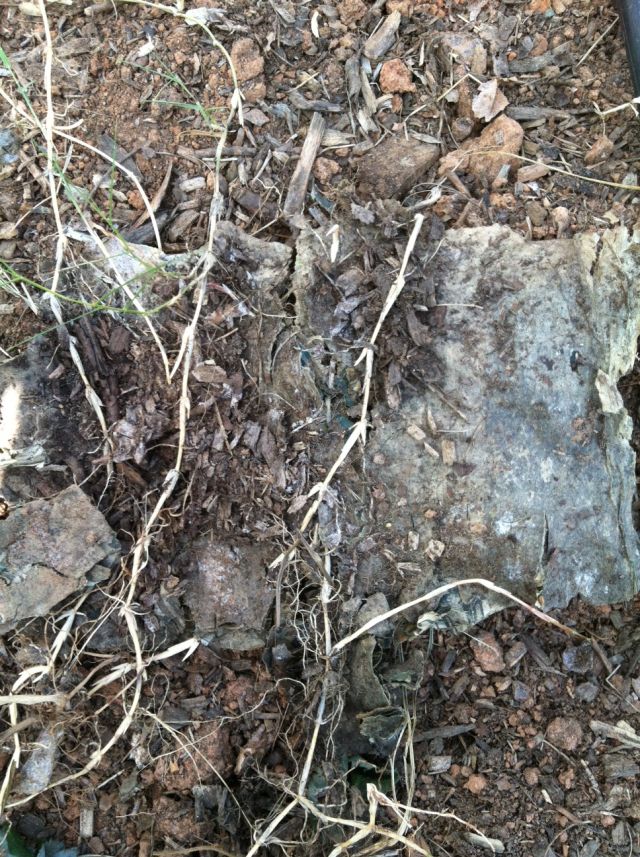
But I made a second mistake, which was just as devastating. I gave the Bermuda grass a decisive advantage over the other grasses competing for the 2ft circle. I mulched extensively with newspaper and woodchips. I first laid the newspaper, at least 8 pages thick, and then the 4″ layer of woodchips above so the chips would not compete with the shrub roots for nitrogen. The thick mulch effectively excluded all the other grasses and competition, but not the Bermuda grass. It quickly despatched scout rhizomes deep into the mulch and when they reported back on the superior quality of the compost an advance guard and then an entire regiment quickly invaded. So the deep mulching helped the Bermuda by favoring its competitive advantage of being able to delve in the dark into mulches on long exploratory missions and then to tunnel to the surface to capture sunlight.
Bermudagrass shoots at least 2 ft in length on the underside of thick wad of newspaper mulch
I suspect, but cannot prove, that the Bermudagrass shoots may host agents which demoralize the roots of my shrubs (allelopathic?).
And now I am hard at work with deep digging to locate and remove the rhizomes. And this time I am using plastic edging to guard the frontiers, which I hope will stop most of the Bermudagrass, but I shall have to be continuously vigilant.
Contour ditches
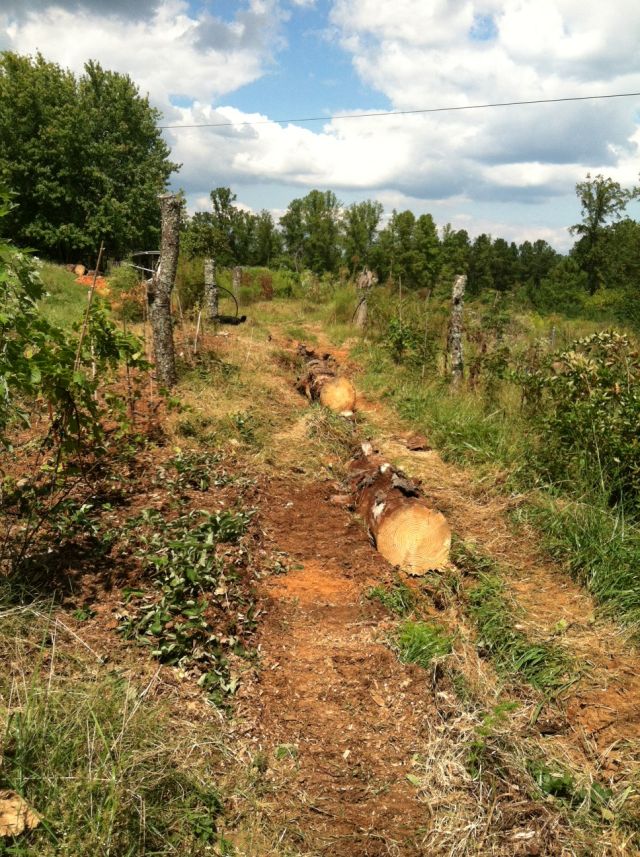
In a previous post I mentioned that large grasses and plants had moved into my contour ditches, which were established to catch, retain and infiltrate rainwater sliding down the hill. Cleverly some of the plants established themselves on the walls of the ditch – thus they were close to the entrapped rainwater at the bottom of the ditch but did not have to endure having their feet in the water for extended periods of time. My solution, as previously mentioned was to stoke the ditches with tree trunks and branches (stoke as in stoking a fireplace). A year ago some large pine trees were brought down with base trunk diameters exceeding 36″. My bobcat cuts a 24″ wide trench. So today I chainsawed the trunks of the pine trees, which did not exceed a 24″ diameter, into 10 ft lengths and relocated them to one of my contour ditches. Rather than have the nutrients and organisms of the pine tree logs slowly dissipate into the air or the field, they will now be embraced by the soil in the ditch and nurture the roots of my plantings. Also they will prevent new weedy growth in the ditches and will absorb rainwater and retain it. Hopefully, this time round, a win win solution.
+20″ diameter pine tree trunks now berthed in a contour ditch
My interest is moving from annual vegetable crops to tree crops and perennials. Perhaps the bonanza of pears from my Kieffer, Warren and Giant Korean, plus lots of figs from an old established tree have spurred me on.
With the summer heat deterring outdoor activity for much of the day, I have been reading extensively. Now that “Farmers of Forty Centuries” by F.H King (published 1911) is behind me, I moved on to “Tree Crops a Permanent Agriculture” by JR Smith published 1929 (freely downloadable) and enjoyed part one (titled “The Philosophy”) and read extracts on selected trees, all of which was very informative and relevant since the examples were taken from the southeast.
My knowledge and interest in trees was further expanded by a visit last week to Oregon including drives through large state forests and a 3 hour visit to the World Forestry Center. Located in Washington Park in Portland, the center’s mission is to “educate and inform people about the world’s forests and trees, and their importance to all life, in order to promote a balanced and sustainablefuture.” There is a wealth of information and I enjoyed the exhibits on different forests of the world and logging practices. Much emphasis was made of sustainable practices and yet it appeared to me that the practices they were promoting were not as sustainable as they could have been. It seems they monocrop i.e. after harvesting timber the new plantings are all of the same species. I wonder if this is truly sustainable? You don’t get diversity of plantings or of associated wildlife or other life forms, and, with no diversity it is much easier for a disease or insect attack to spread across the whole forest. A more diversified planting will produce a more varied canopy, encourage more diversity, with species perhaps supplementing each other and making better use of resources, and should be more resilient. Granted, when it comes to harvesting it is much easier to process similarly sized and similar tree species but in the long term is this the best practice?
I am now reading a very well written, insightful magnus opus – Edible Forest Gardens by Jacke and Toensmeier. Although I am familiar with a number of the concepts and there is some repetition, it is really a good read. I am also working on converting my fruit orchard to an edible forest garden by introducing lower canopy trees, shrubs, herbs and edible roots, and the book is a good reference. I just joined the Atlanta Fruits Yahoo group and there is a wealth of information in posts made over the past 10 years of what works and doesn’t work in the Atlanta area, which is proximate to my growing area.
Oh, I forgot to mention – I signed up for and am participating in a Coursera online course with 26,000 other students. The topic is “Introduction to Sustainability”. A 600 page textbook (current – published May 2012) is provided and each week for the 8 week duration there is required reading, lecture videos to watch and articles to read, plus quizzes to complete. And we are encouraged to participate in the forums where students from across the world (young and old) exchange information and views. And it is interesting, challenging and free!