It is good, I suppose, to be reminded occasionally of how fallible we are.
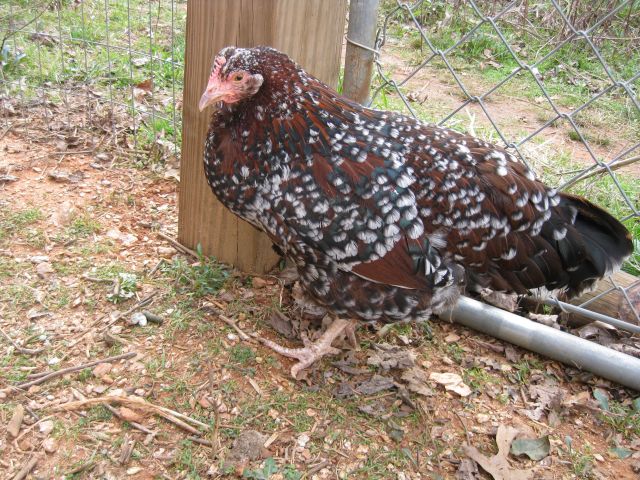
I have, or I should say “had”, a pair of Speckled Sussex hens – acquired with the other 3 different pairs as youngsters and, at the time of writing, less than a year old. For the past few weeks the Speckled Sussex had been acting out of sorts, not running up to the fence to greet me (in the expectation of handouts) as the others did, and preferring to huddle down next to each other. I thought this was a temporary malaise, perhaps the shortened daylight hours were depressing them, perhaps they enjoyed their own privacy. After all they are shorter and more compact than the other taller birds. Pehaps they were snobs. I remembered how, when I first brought them and the other 3 pairs of chicken home, they had victimized the two Golden Comets and continuously chased the Comets away from the communal feed tray. The result was the Comets were ostracized and had to have their own feed tray and keep their own quarters. This continued until the Comets got bigger, bigger than the Speckled Sussex, and more confident, and then it was no longer a problem.
So all these thoughts went through my mind as I kept an eye of the lonesome pair. I only realized there was a problem when they wouldn’t move at all when I approached them. Previously they had always kept their distance from me and rebuked any attempt to pick them up. Now they wouldn’t move and I was able to easily pick them both up, one in each hand, and carry them to their coop in the evening. And then it dawned on me that one was weak and sick and the other was loyally staying by its side (I will return to the use of “loyally” later). The next morning the weak one was clearly exhausted and its one eye was closed. The farm store manager suggested it had respiratory problems and asked if I heard a “gurgling” in its breathing. He suggested I dose it with VetRx, which I (and he) thought was an antibiotic. However, when I examined the package more closely I realized it was not an antibiotic but had natural ingredients to alleviate congestion (I could also have figured this out by reading the label more closely – “based on a formula in use since 1874”). I administered almost half a cup with a syringe and the hen began breathing much, much better. However, a few hours later the gurgle returned. And later that pm it departed – I think it was too weak and I had left intervention until too late.
My initial concern was that the other 13 birds might be affected (in addition to the 8 I purchased as youngsters, I was also gifted 6 older hens by a neighbor). This does not appear to be the case. But I have another problem – the remaining Speckled Sussex. Wikepedia describes “sentience” as “the ability to feel, perceive or be conscious, or to have subjective experiences”. Are chicken sentient? Based on my ongoing travails with the remaining Speckled Sussex I answer “definitely”. As her companion suffered she stopped eating and now her companion is no longer around she has lost all interest in her surroundings and apparently in life itself. For the past few mornings I have separated her from the others and offered home made whole wheat bread and 4 to 5 worms from the compost heap. I do not like offering worms on a platter – they are great workers and it seems unfair, but I feel I let her down and am trying to make amends (and save her). The worms are irresistible to her and she also enjoys snacking on the bread. But when I return her to the others she continues to be mournful and will sit alone and make an occasional lament (or so it sounds to me). There is, of course, the possibility that she is also unwell. I have an antibiotic (Tetracycline) at the ready and I have segregated her from the flock, but since she appears alert, is eating, and is breathing clearly, I am holding off on the antibiotic for now.
I tried to find another Speckled Sussex and was going to inspect it the next day, when it was sold. Perhaps this is better since a new hen may have its own problems with the rest of the flock and may not get on all that well anyway with my Speckled Sussex, so buying another one of approximately the same age may be compounding my problems.
With the above lesson, or reprimand, taken to heart I now act more quickly on possible problems. For several weeks one of the Golden Comets made a curious forward backward motion with its neck – not often, but perhaps every five minutes. Otherwise very active. On the off chance that there might be some blockage in her crop I dosed her with olive oil using a syringe. That funny motion seems to have stopped. But from now on, in addition to observing them, I will also intervene more quickly. And hopefully, sunny days will return.