not always clear sailing

It is good, I suppose, to be reminded occasionally of how fallible we are.

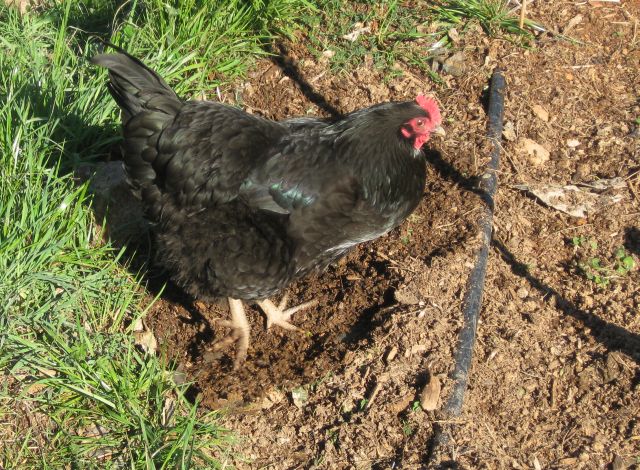
I have, or I should say “had”, a pair of Speckled Sussex hens – acquired with the other 3 different pairs as youngsters and, at the time of writing, less than a year old.  For the past few weeks the Speckled Sussex had been acting out of sorts, not running up to the fence to greet me (in the expectation of handouts) as the others did, and preferring to huddle down next to each other.  I thought this was a temporary malaise, perhaps the shortened daylight hours were depressing them, perhaps they enjoyed their own privacy.  After all they are shorter and more compact than the other taller birds.  Pehaps they were snobs.  I remembered how, when I first brought them and the other 3 pairs of chicken home, they had victimized the two Golden Comets and continuously chased the Comets away from the communal feed tray.  The result was the Comets were ostracized and had to have their own feed tray and keep their own quarters.  This continued until the Comets got bigger, bigger than the Speckled Sussex, and more confident, and then it was no longer a problem.

So all these thoughts went through my mind as I kept an eye of the lonesome pair.  I only realized there was a problem when they wouldn’t move at all when I approached them.  Previously they had always kept their distance from me and rebuked any attempt to pick them up.  Now they wouldn’t move and I was able to easily pick them both up, one in each hand, and carry them to their coop in the evening.  And then it dawned on me that one was weak and sick and the other was loyally staying by its side (I will return to the use of “loyally” later).  The next morning the weak one was clearly exhausted and its one eye was closed.  The farm store manager suggested it had respiratory problems and asked if I heard a “gurgling” in its breathing.  He suggested I dose it with VetRx, which I (and he) thought was an antibiotic.  However, when I examined the package more closely I realized it was not an antibiotic but had natural ingredients to alleviate congestion (I could also have figured this out by reading the label more closely – “based on a formula in use since 1874”).  I administered almost half a cup with a syringe and the hen began breathing much, much better.  However, a few hours later the gurgle returned.  And later that pm it departed – I think it was too weak and I had left intervention until too late.

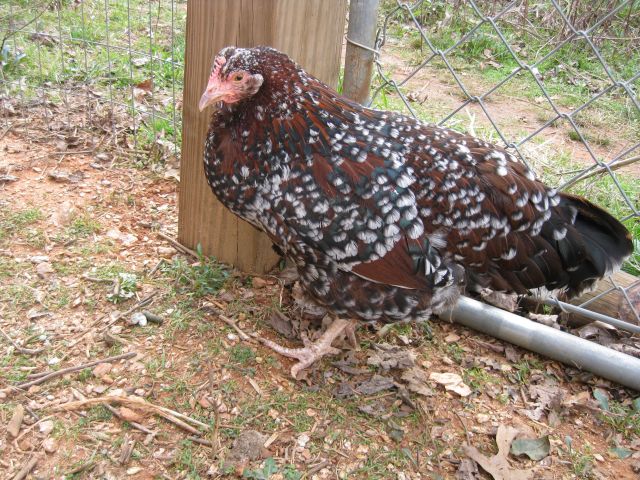
My initial concern was that the other 13 birds might be affected (in addition to the 8 I purchased as youngsters, I was also gifted 6 older hens by a neighbor).  This does not appear to be the case.  But I have another problem – the remaining Speckled Sussex.  Wikepedia describes “sentience” as “the ability to feel, perceive or be conscious, or to have subjective experiences”.  Are chicken sentient?  Based on my ongoing travails with the remaining Speckled Sussex I answer “definitely”.  As her companion suffered she stopped eating and now her companion is no longer around she has lost all interest in her surroundings and apparently in life itself.  For the past few mornings I have separated her from the others and offered home made whole wheat bread and 4 to 5 worms from the compost heap.  I do not like offering worms on a platter  – they are great workers and it seems unfair, but I feel I let her down and am trying to make amends (and save her).  The worms are irresistible to her and she also enjoys snacking on the bread.  But when I return her to the others she continues to be mournful and will sit alone and make an occasional lament (or so it sounds to me).  There is, of course, the possibility that she is also unwell. I have an antibiotic (Tetracycline) at the ready and I have segregated her from the flock, but since she appears alert, is eating, and is breathing clearly, I am holding off on the antibiotic for now.

I tried to find another Speckled Sussex  and was going to inspect it the next day, when it was sold.  Perhaps this is better since a new hen may have its own problems with the rest of the flock and may not get on all that well anyway with my Speckled Sussex, so buying another one of approximately the same age may be compounding my problems.
lonesome survivor

With the above lesson, or reprimand, taken to heart I now act more quickly on possible problems.  For several weeks one of the Golden Comets made a curious forward backward motion with its neck – not often, but perhaps every five minutes.  Otherwise very active.  On the off chance that there might be some blockage in her crop I dosed her with olive oil using a syringe.  That funny motion seems to have stopped.  But from now on, in addition to observing them, I will also intervene more quickly.  And hopefully, sunny days will return.
it’s off to work we go

So its off to work we go
now the night long roost is done
and the fledgling sun
brings cheer and early crow

we hear the padlock click
the stay bolt undone
we gather at the coop door
and here’s our keeper Rick

he points out the way
a 50 yard jog
across a field and up a hill
its the fruit trees turn today

a 50 yard jog

he is deep into organics
no sprays at all
munchies abounding
for us his soil mechanics

he wants the bad bugs gone
we’re happy to oblige
we eat them all both good and bad
and give our chicken song

we eat them all both good and bad

some say its like a squawk
or shriek to pierce the ears
our cries and clucks and tuck tuck tucks
that is music and our talk

the paddock has a shelter
with water for our thirst
and egg boxes provided
to cushion the ejector

its fenced to show the playground
we could easily fly above
but grass is greener this side
and grubs to be found

we feel with out splayed feet
the bugs beyond our view
a quick back swipe with claw
finds a wriggle for the beak

a quick back swipe with claw

they visit in the night
the possum, fox and coons
and then we’re in our coop home
secure and snuggled tight

there is a local hawk
we used to duck for cover
but now we’re twice its size
and he can only gawk

as we continue at our play
or should I say its work
the scoot and scratch and eat
a day long happy treat.

fungi

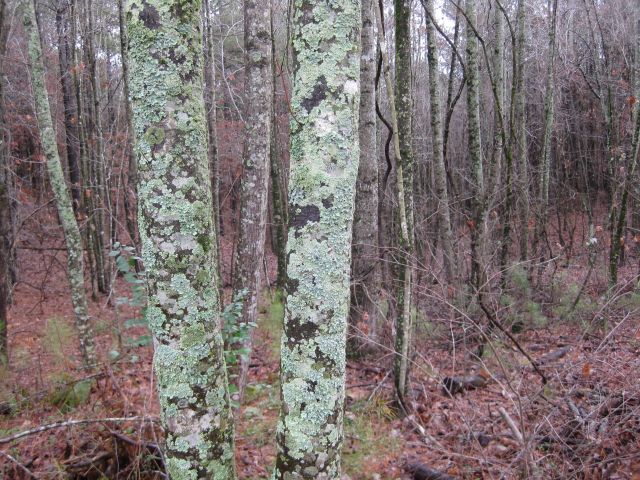
The recent heavy rains and at times warm weather have transformed the appearance of the woodland – the trunks of the trees have assumed a variegated green appearance.

lichen on the trees

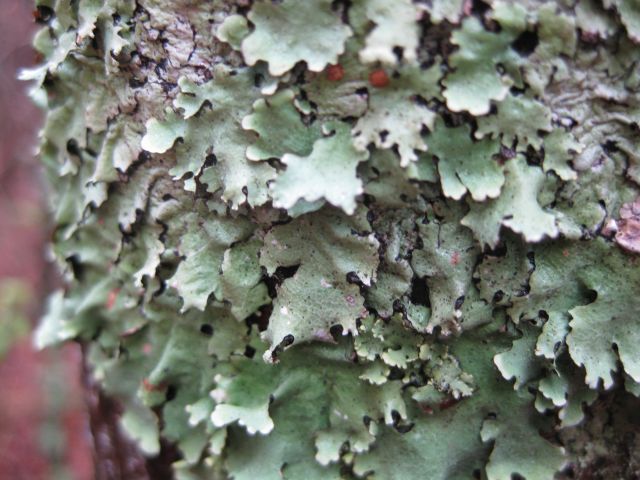
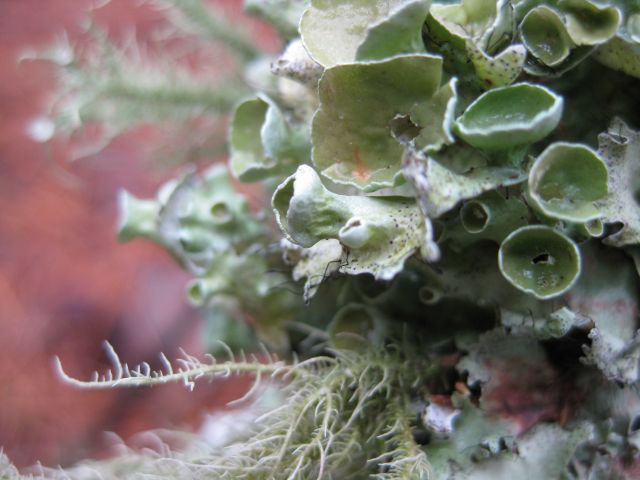
On closer examination these are lichen –  a symbiotic alliance between photosynthesizing green alga and fungi.

leaf like lichen


Other growths are more intricate.

unusual trumpet shapes

And there are the long reaching arms.

an intricate maze

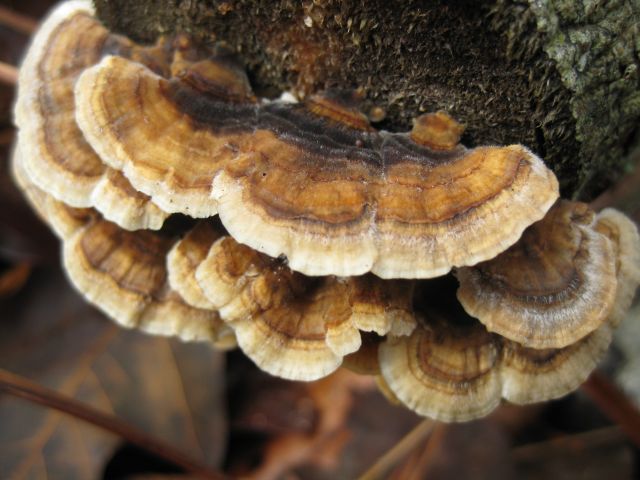
And finally some regular mushroom growths at work decomposing the end of a tree trunk.

regular decomposers


chicken synergies

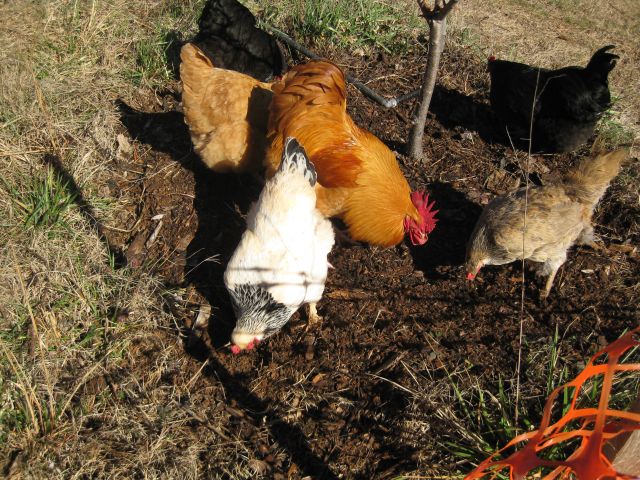
The chicken are still doing well.  Six hens from my former neighbor (4 hybrids, 1 Ameraucana, 1 ISA brown) and 8 youngsters ( 2 Buff Orpingtons (1 of which is a rooster called “Buffy”), 2 Golden Comets, 2 New Jersey Giants and 2 Speckled Sussex).  No casualties, though one of the hybrids walks with a noticeable limp and is now called “Gimpy”.  The two dominant hens are the Ameraucana and the ISA brown, which curiously are also among the smallest.  The two largest hens, the New Jersey Giants, are the most timid and the 2 Speckled Sussex are the most antisocial.  Whenever there is a commotion amongst the hens, Buffy rushes in to settle the dispute.  He also charges out when there is a disturbance or security risk and crows throughout the day.  Notwithstanding shortened daylight hours I am getting 5 to 6 eggs a day.  I have decided against supplementing daylight with artificial lighting on a timer.  The coop I constructed is working well for them – no moisture from outside and inside temperatures have not fallen below 30 F (when the outside has fallen to mid teens).  They seem healthy enough though occasionally there is a soft shelled egg (to my dog’s delight) , so I supplement with yogurt and oyster shells.

I grow organically and my small orchard of 12 apple and assorted fruit trees began bearing fruit last year (actually I also have a 2nd orchard of first year fruit trees some years away from fruit bearing).  With the appearance of fruit there also appeared a variety of bugs, especially on my apple trees.  I know sanitation is important – removing the fallen fruit and wood cuttings because the pests overwinter in the fruit and cuttings.  But how to remove the soil slumberers?

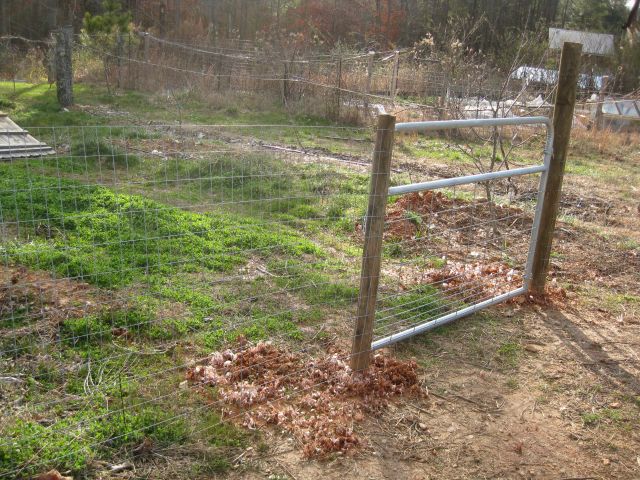
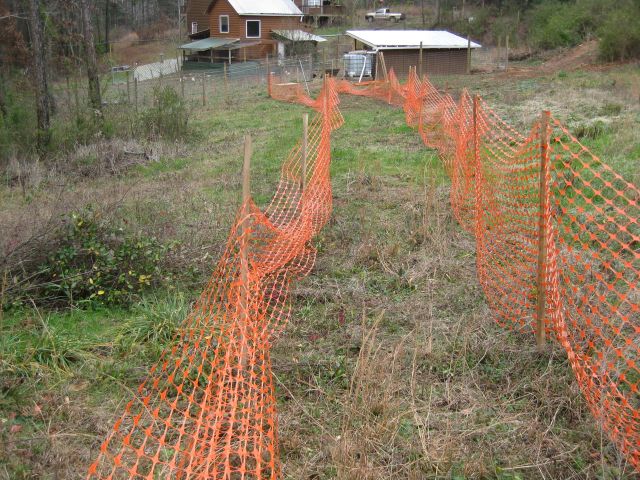
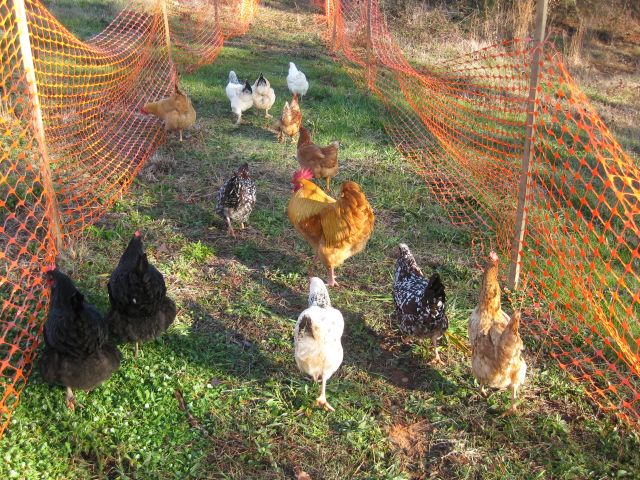
I installed a fence and 2 gates around the orchard and built a chicken day shelter and constructed a passage way to span the 120 ft from the main chicken enclosure to the orchard.  And now my flock are hard at work in the orchard,  removing debris and mulch with vigorous back swipes of their feet and voraciously eating the grubs and other soil dwellers.

a 6 ft galvanized mesh gate installed to the orchard chicken paddock

Fencing is a fairly costly business.  I used welded rather than the more expensive woven wire fences which are necessary for horses and goats, so there is a saving there.  However, the gates cost from $65 to $100 and, if I had welding skills and access to surplus metal, I would make them myself – but I don’t, so I pay – and they should last indefinitely.

The passage way is temporary and I bought the red plastic material and stakes for about $9 per 100 ft from Lowes – marked down from $30.

passage way from main chicken enclosure to orchard paddock

I remedied the problem of the fence slipping down the posts by drilling a hole through each post near the top and tying string through the hole and the top of the fence.

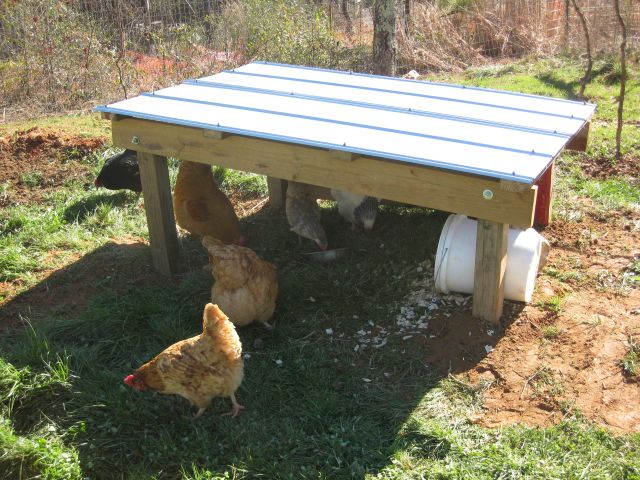
Finally, the day shelter.  I dug 2 ft holes for each of the 4 posts, bolted on 6″ wide planks to the 2 long sides and then 2′ by 4″ purlins and then screwed down galvanized roof sheeting.  The roof sheeting was $20 for a 12ft long 2 ft wide sheet, which I cut in half to fit in my truck and to produce a 6ft by 4ft roof. I will board up the south and west sides to make them feel more secure and sheltered from the sun.  In the shelter I have horizontally placed a 5 gal bucket with straw in the hope the hens will use it for egg laying, and a water container. To alert the flock to the advantages of the shelter I threw in a few handfuls of scratch corn, which immediately got their attention.

chicken day shelter 6 ft by 4 ft, with 5 gal bucket for egg laying

The roof slopes to the west to ensure the rain will run to the west and not over the east entrance.  In addition to reducing orchard pests I expect the flock will enjoy a more varied diet, get more exercise, and consume less of the purchased food I provide.


cold frame building (2)

In a previous post I mentioned  building my first cold frame using bargain priced windows from the local thrift, cement blocks and lumber.  The seedlings in this cold frame are growing well and when it is cold (say 18 F outside temperature) the temperature in the cold frame is approximately 10 F higher.  During the day the differential increases.  And it keeps out the frost.  So I am hoping to grow decent sized vegetables.

One cold frame was not enough because I had 10 windows remaining and there is a better site for a cold frame – on top of the hill where it catches early morning sun to late afternoon son.  This location is unfenced and close to a road so there is a possibility of unwelcome attention, therefore my decision to locate the first cold frame in the better protected vegetable growing area.  Nonetheless, the cost of building a cold frame is modest and the full time attention of the sun is a major plus.

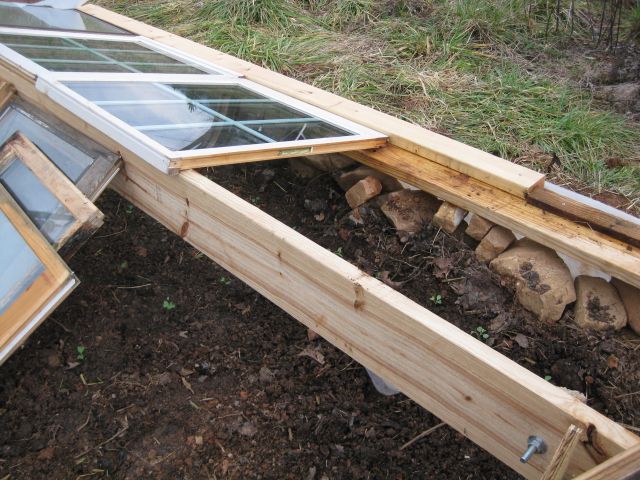
Construction was very similar to the first frame except I dispensed with all but two cement blocks (instead of the 17 used in the first cold frame).  The blocks are located at each end of the cold frame and are spanned by a 10ft by 8″ wide 2″ thick, plank.  In between the two cement block supports I built a stone wall of sorts using the large stones I had uncovered when I dug a contour ditch.  I used a hammer and stone chisel to cut faces on the stones so they would stack.

cold frame
basics of construction of cold frame - windows on top and south facing, stones on north side

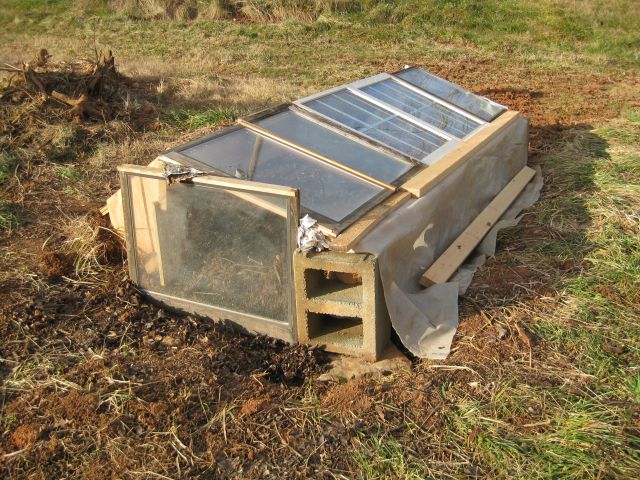
The purpose of the stones is to absorb the sun’s heat during the day and release it during the night.  Only the top layer of the stones is visible – there are two (more skilfully arranged) layers below the soil level.  To prevent the warm air exiting through the stones I draped 6 mil plastic sheeting on the outside of the frame.

cold frame
north side of cold frame showing plastic sheeting draped over north stone wall

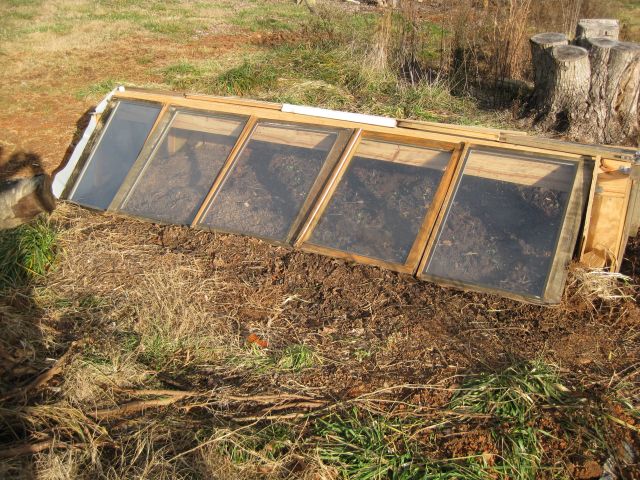
As before, I used the windows from the thrift store to enclose the frame.  The savings from using 15 fewer cement blocks was partially offset by the cost of 3 additional window frames I had to purchase from the thrift store – a different floor manager did the pricing and he wanted $4 per window rather than $1 – such are the vagaries of life.

cold frame
south facing aspect of cold frame, seedlings still to be planted

The gaps and openings I covered with bits of plank or plastic.  I have now introduced some collard and broccoli seedlings and in the next week will add the remaining spinach and other cool season vegetables – and wait and hope that I will get a worthwhile yield.


soil test

Eight years ago when I was working full time and all my growing activities took place in an Atlanta subdivision, I convinced myself I had to buy a soil test kit.  I splurged and bought a LaMotte model STH-4 (sounds like a revved up sports car) which is described as a “professional soil testing outfit”  and, in addition to pH, can test for nitrate nitrogen, phosphorus and potassium.  Needless to say, after a cursory test with meaningless results, I packed the model STH away and it has now resurfaced, in my hour of need when, with temps in the teens (before adjusting for wind chill), I need to do something worthwhile.

LaMotte soil test kit

I decided to take a soil sample from an area where I have done no growing so I will know what the unadjusted soil is like, and from my compost heap.  I know I should be focusing on the condition of the soil in my growing area but I have several months of winter ahead to sample more widely.

The LaMotte instructions for taking soil samples are very detailed – after all, if the sample is not representative of what you are interested in, the results may be skewed.  I took the samples carefully and allowed them to dry out in the green house and then ground them through a metal tea strainer to obtain a powdery sample for the tests.  I followed the procedures carefully.  Basically you fill a measured test tube with an extracting solution, then add the measured soil sample and shake for one minute and filter the soil suspension into a second tube.  The filtrate in the second tube is the general soil extract used for the tests.

For the nitrate nitrogen test you take a measure of the soil extract and add two different nitrate reagents, mix and allow to stand for 5 minutes and compare the color with the nitrate nitrogen color chart.  For potassium (potash) you take a measure of the soil extract, add two potassium reagents (the second reagent causes precipitation if potassium is present) and then you place an empty  calibrated narrow tube on white plexiglass which has a solid black line down the middle.  You slowly add the mixture to the narrow tube until the black line just disappears.  The calibration on the tube tells you how much potassium lbs you have per acre.  Finally, the phosphorus test is like the nitrate nitrogen test – you dissolve two potassium reagents in a measured soil sample and compare the color with the phosphorus color chart.

I performed the tests on my soil sample and the results were – zilch, or insipid if I were to be charitable.  I immediately thought that the chemicals in my soil testing kit had deteriorated.  So, before testing the compost sample, I decided to do an extreme test – I found some chemical fertilizer 13:13:13 (over 10 years old since I don’t use the stuff anymore).  And reran my tests.  And the results were off the wall – or certainly off the LaMotte charts for intensity.  Reassured somewhat, I then ran the tests on my compost sample – and it was interesting.  Mediocre nitrogen but strong potassium and phosphorus.  I will now extend my testing and improve my procedures and hopefully gain useful knowledge of my soil conditions and my growing practices.

I also tested for pH using a Hanna pH meter.  This also takes practice – if the electrode is not properly cleaned (I use an electrode cleaning solution) and properly stored (I use a storage solution) the results can be erratic.  My compost is showing a pH of around 6.5.  More food for thought.